RESISTED
EXERCISES FOR
LOWER LIMB
DEFINITION
Resisted exercise is any form of
active exercise in which dynamic
or static muscle contraction is
resisted by an outside force
applied manually or
mechanically.
MUSCLE PERFORMANCE &
RESISTANCE EXERCISES
Muscle performance refers to the capacity
of a muscle to do work (force x distance).
3 elements of muscle performance –
strength, power & endurance – can be
enhanced by some form of resistance
exercises.
STRENGTH
Ability of a contractile tissue to produce
tension & resultant force based on
demands placed on the muscles.
Strength training –controlling heavy loads
(resistance) for a relatively lower number of
repetitions or a short period of time.
POWER
Muscle power is related to strength &
speed of movement & is defined as work
produced by muscle per unit time (force ×
distance/time).
Power training –
By increasing work of muscle for specific
time or reducing time for specific work of
muscle.
ENDURANCE
Muscle endurance is the ability to
contract repeatedly against a load,
generate & sustain tension & resist
fatigue over an extended period of
time.
Endurance training – low intensity
muscle contraction, large number of
repetitions for prolonged time period.
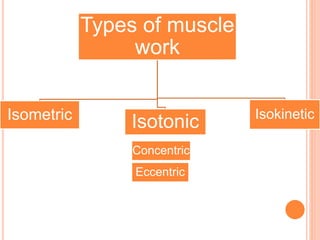
Types of muscle
work
Isometric
Isotonic Isokinetic
Concentric
Eccentric
PRINCIPLES
1. Overload principle
2. SAID principle
3. Reversibility principle
GENERAL
PRINCIPLES OF
RESISTANCE
TRAINING
EXAMINATION & EVALUATION
 Determine the baselines:
a. General physical examination
b. Strength: MMT, RM
c. ROM: Goniometry
d. Functional performance
Decide if strengthening is needed and
appropriate at this point
Periodic reassesment
APPLICATION
 Warm up
 Placement of resistance
 Stabilization
 Intensity of exs / amount of resistance
 Volume / no of reps & sets & rest intervals
 Verbal / written instructions
 Monitoring the patient
 Cool down
PRECAUTIONS
 Overtraining
 Overwork
 Exercise induced muscle soreness –
 Acute muscle soreness –
During or directly after strenuous exercise
 Delayed onset muscle soreness (DOMS) –
 DOMS begins to develop 12-24hrs after the cessation of
strenuous activity; intensifies & peaks 24-48hrs later
 Can be prevented by gradual progression of intensity &
volume of resistance; warm up & cool down; slow
stretches before & after exercise
CONTRAINDICATIONS
1. Pain
2. Inflammation
3. Severe cardiopulmonary
disease.
4. Loss of joint integrity
TYPES OF RESISTANCE
EXERCISES
Manual and mechanical
Static and dynamic
Open and closed chain
Isokinetic exercise
MANUAL AND MECHANICAL
RESISTANCE EXERCISES
 Manual resistance:
 Resistance is provided by hand.
 Can be provided by a therapist or self resisted.
 Can not quantify resistance
 Useful for weak muscles in the early stages of rehab
or conditions which needs careful control.
 Mechanical resistance:
 Resistance is applied through the use of equipment
or mechanical apparatus.
 Amount of resistance can be measured and can be
increased progressively.
 Useful when strong exercises needed.
MANUAL
RESISTANCE
EXERCISES
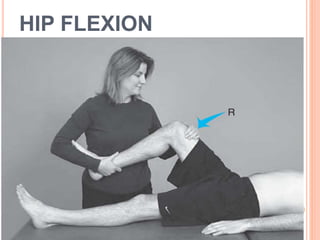
HIP FLEXION
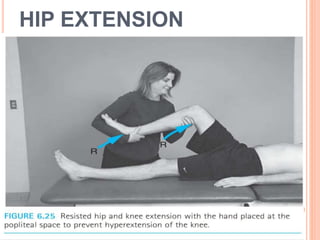
HIP EXTENSION
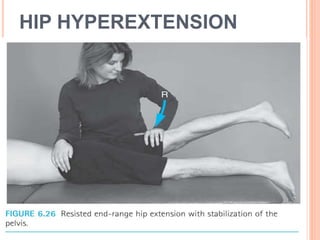
HIP HYPEREXTENSION
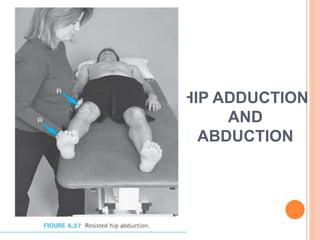
HIP ADDUCTION
AND
ABDUCTION
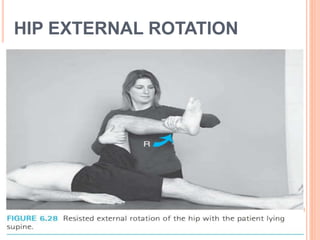
HIP EXTERNAL ROTATION
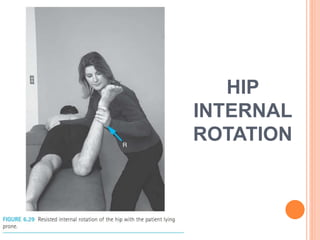
HIP
INTERNAL
ROTATION
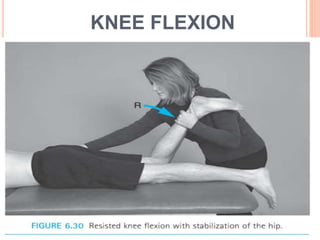
KNEE FLEXION
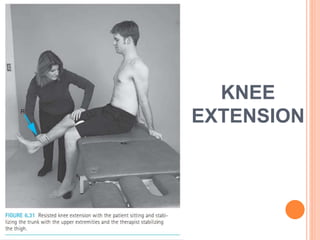
KNEE
EXTENSION
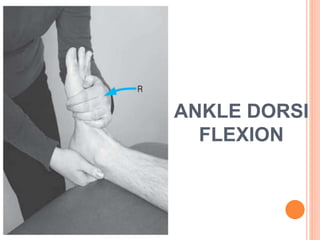
ANKLE DORSI
FLEXION
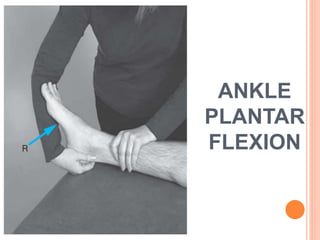
ANKLE
PLANTAR
FLEXION
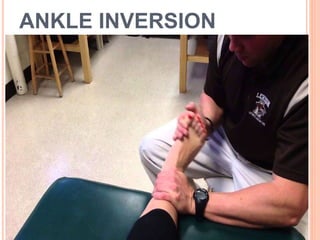
ANKLE INVERSION
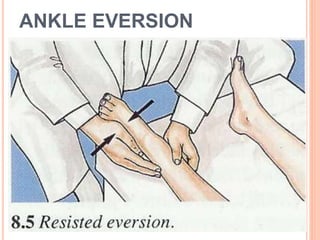
ANKLE EVERSION
MECHANICAL
RESISTANCE
EXERCISES
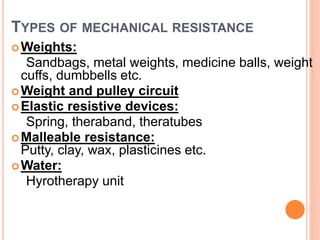
TYPES OF MECHANICAL RESISTANCE
Weights:
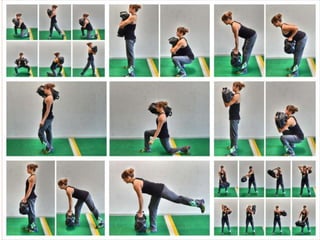
Sandbags, metal weights, medicine balls, weight
cuffs, dumbbells etc.
Weight and pulley circuit
Elastic resistive devices:
Spring, theraband, theratubes
Malleable resistance:
Putty, clay, wax, plasticines etc.
Water:
Hyrotherapy unit
ISOMETRIC EXERCISES
(STATIC)
 Sources of resistance –
Holding against force applied manually
Holding weight in particular position
Maintaining position against resistance of body
weight
Pushing or pulling immovable objects
 Prevent or minimize muscle atrophy due to
external immobilization
 Develop postural or joint stability
 Improve muscle strength when dynamic activity
is not permissible
DYNAMIC EXS – CONCENTRIC &
ECCENTRIC
 Resistance can be applied by –
Constant resistance (body wt/simple wt/ wt pulley)
Weight machine (variable resistance)
Isokinetic device (controls velocity)
 Acts as a source of shock absorption during high
impact activities.
 Essential component of rehabilitation & conditioning
program to reduce risk of muscle injury or re-injury.
DYNAMIC EXS – CONSTANT & VARIBLE
RESISTANCE
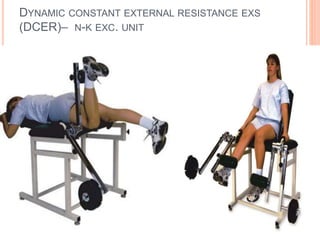
 Dynamic constant external resistance exs (DCER)–
free weights like weight cuffs, Pulley system, torque arm
units.
Contracting muscle is challenged maximally at only one
point of ROM
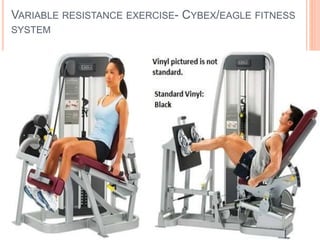
 Variable resistance exercise –
Specially designed resistance equipments imposes varying
levels of resistance to contracting muscle to load the muscle
more effectively at multiple points in ROM. Eg with elastic
tubes or bands or lever arm system.
Performed against manual resistance, a skilled therapist
can vary the force applied to the contracting muscle
throughout the ROM.
DYNAMIC CONSTANT EXTERNAL RESISTANCE EXS
(DCER)– N-K EXC. UNIT
VARIABLE RESISTANCE EXERCISE- CYBEX/EAGLE FITNESS
SYSTEM
OPEN CHAIN & CLOSED CHAIN
EXERCISES
 Functional activities & exc.’s are commonly
categorized as having weight bearing or non weight
bearing characteristics.
 Also called as “open or closed kinetic chain”
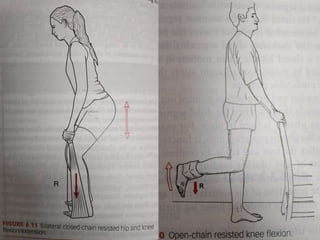
 Open kinetic chain refers to completely unrestricted
movement in space of a peripheral segment of the
body. (waving the hand, swinging the leg)
 Closed kinetic chain movements – peripheral
segment meets with the considerable external
resistance. One joint motion is always accompanied
by adjacent joint motions.
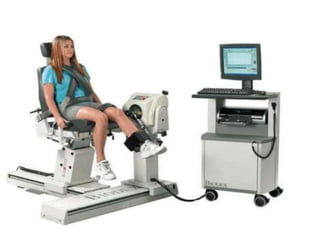
ISOKINETIC EXERCISES
Its a form of dynamic exs in which velocity of
muscle shortening or lengthening is
predetermined & held constant by a rate limiting
device known as isokinetic dynamometer.
Characteristics –
Constant velocity
Range & selection of training velocity
Specificity of training(speed specific)
Compressive forces on joints
Accommodation to fatigue
Accommodation of painful arc
SELECTED RESISTANCE
TRAINING PROGRAM
PRE
CIRCUIT WEIGHT
TRAINING
PLYOMETRICS
PROGRESSIVE RESISTANCE EXERCISE
 PRE is a system of dynamic resistance training with
constant external load to contracting muscle by
some mechanical means & incrementally
increased.
 RM (repetition maximum) – basis for determining &
progressing the resistance.
 Beneficial in variety of pathological conditions
(muscle injuries, osteoarthritis, osteoporosis,
hypertension, diabetes, COPD, etc)
 Various regimens are:-
Delorme
Oxford
Macqueen
DAPRE
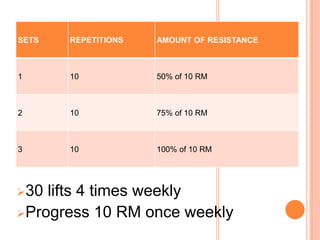
DELORME
REGIMEN
SETS REPETITIONS AMOUNT OF RESISTANCE
1 10 50% of 10 RM
2 10 75% of 10 RM
3 10 100% of 10 RM
30 lifts 4 times weekly
Progress 10 RM once weekly
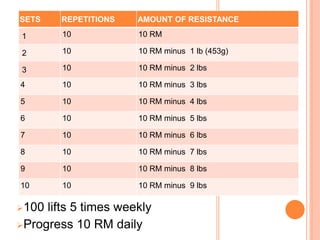
OXFORD
REGIMEN
SETS REPETITIONS AMOUNT OF RESISTANCE
1 10 10 RM
2 10 10 RM minus 1 lb (453g)
3 10 10 RM minus 2 lbs
4 10 10 RM minus 3 lbs
5 10 10 RM minus 4 lbs
6 10 10 RM minus 5 lbs
7 10 10 RM minus 6 lbs
8 10 10 RM minus 7 lbs
9 10 10 RM minus 8 lbs
10 10 10 RM minus 9 lbs
100 lifts 5 times weekly
Progress 10 RM daily
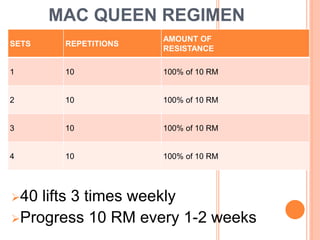
MAC QUEEN REGIMEN
SETS REPETITIONS
AMOUNT OF
RESISTANCE
1 10 100% of 10 RM
2 10 100% of 10 RM
3 10 100% of 10 RM
4 10 100% of 10 RM
40 lifts 3 times weekly
Progress 10 RM every 1-2 weeks
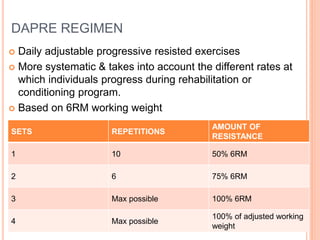
DAPRE REGIMEN
 Daily adjustable progressive resisted exercises
 More systematic & takes into account the different rates at
which individuals progress during rehabilitation or
conditioning program.
 Based on 6RM working weight
SETS REPETITIONS
AMOUNT OF
RESISTANCE
1 10 50% 6RM
2 6 75% 6RM
3 Max possible 100% 6RM
4 Max possible
100% of adjusted working
weight
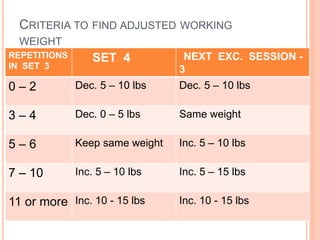
CRITERIA TO FIND ADJUSTED WORKING
WEIGHT
REPETITIONS
IN SET 3
SET 4 NEXT EXC. SESSION -
3
0 – 2 Dec. 5 – 10 lbs Dec. 5 – 10 lbs
3 – 4 Dec. 0 – 5 lbs Same weight
5 – 6 Keep same weight Inc. 5 – 10 lbs
7 – 10 Inc. 5 – 10 lbs Inc. 5 – 15 lbs
11 or more Inc. 10 - 15 lbs Inc. 10 - 15 lbs
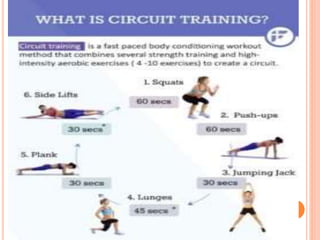
CIRCUIT WEIGHT
TRAINING
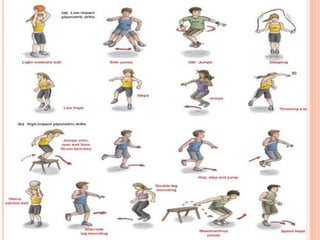
PLYOMETRIC
TRAINING
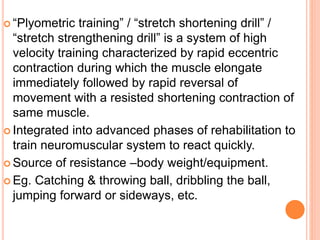
 “Plyometric training” / “stretch shortening drill” /
“stretch strengthening drill” is a system of high
velocity training characterized by rapid eccentric
contraction during which the muscle elongate
immediately followed by rapid reversal of
movement with a resisted shortening contraction of
same muscle.
 Integrated into advanced phases of rehabilitation to
train neuromuscular system to react quickly.
 Source of resistance –body weight/equipment.
 Eg. Catching & throwing ball, dribbling the ball,

jumping forward or sideways, etc.

THANK YOU

Resisted exercises for lower limb

  • 1.
  • 2.
    DEFINITION Resisted exercise isany form of active exercise in which dynamic or static muscle contraction is resisted by an outside force applied manually or mechanically.
  • 3.
    MUSCLE PERFORMANCE & RESISTANCEEXERCISES Muscle performance refers to the capacity of a muscle to do work (force x distance). 3 elements of muscle performance – strength, power & endurance – can be enhanced by some form of resistance exercises.
  • 4.
    STRENGTH Ability of acontractile tissue to produce tension & resultant force based on demands placed on the muscles. Strength training –controlling heavy loads (resistance) for a relatively lower number of repetitions or a short period of time.
  • 5.
    POWER Muscle power isrelated to strength & speed of movement & is defined as work produced by muscle per unit time (force × distance/time). Power training – By increasing work of muscle for specific time or reducing time for specific work of muscle.
  • 6.
    ENDURANCE Muscle endurance isthe ability to contract repeatedly against a load, generate & sustain tension & resist fatigue over an extended period of time. Endurance training – low intensity muscle contraction, large number of repetitions for prolonged time period.
  • 7.
    Types of muscle work Isometric IsotonicIsokinetic Concentric Eccentric
  • 8.
    PRINCIPLES 1. Overload principle 2.SAID principle 3. Reversibility principle
  • 9.
  • 10.
    EXAMINATION & EVALUATION Determine the baselines: a. General physical examination b. Strength: MMT, RM c. ROM: Goniometry d. Functional performance Decide if strengthening is needed and appropriate at this point Periodic reassesment
  • 11.
    APPLICATION  Warm up Placement of resistance  Stabilization  Intensity of exs / amount of resistance  Volume / no of reps & sets & rest intervals  Verbal / written instructions  Monitoring the patient  Cool down
  • 12.
    PRECAUTIONS  Overtraining  Overwork Exercise induced muscle soreness –  Acute muscle soreness – During or directly after strenuous exercise  Delayed onset muscle soreness (DOMS) –  DOMS begins to develop 12-24hrs after the cessation of strenuous activity; intensifies & peaks 24-48hrs later  Can be prevented by gradual progression of intensity & volume of resistance; warm up & cool down; slow stretches before & after exercise
  • 13.
    CONTRAINDICATIONS 1. Pain 2. Inflammation 3.Severe cardiopulmonary disease. 4. Loss of joint integrity
  • 14.
    TYPES OF RESISTANCE EXERCISES Manualand mechanical Static and dynamic Open and closed chain Isokinetic exercise
  • 15.
    MANUAL AND MECHANICAL RESISTANCEEXERCISES  Manual resistance:  Resistance is provided by hand.  Can be provided by a therapist or self resisted.  Can not quantify resistance  Useful for weak muscles in the early stages of rehab or conditions which needs careful control.  Mechanical resistance:  Resistance is applied through the use of equipment or mechanical apparatus.  Amount of resistance can be measured and can be increased progressively.  Useful when strong exercises needed.
  • 16.
  • 17.
  • 18.
  • 19.
  • 20.
  • 21.
  • 22.
  • 23.
  • 24.
  • 25.
  • 26.
  • 27.
  • 28.
  • 29.
  • 30.
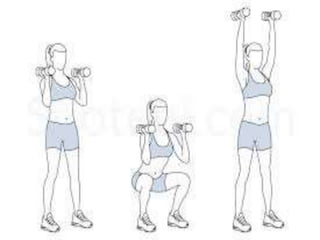
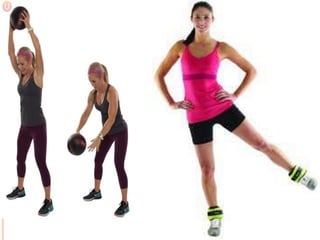
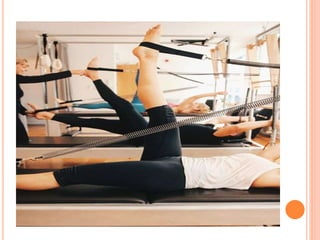
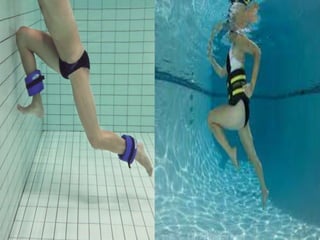
    TYPES OF MECHANICALRESISTANCE Weights: Sandbags, metal weights, medicine balls, weight cuffs, dumbbells etc. Weight and pulley circuit Elastic resistive devices: Spring, theraband, theratubes Malleable resistance: Putty, clay, wax, plasticines etc. Water: Hyrotherapy unit
  • 42.
    ISOMETRIC EXERCISES (STATIC)  Sourcesof resistance – Holding against force applied manually Holding weight in particular position Maintaining position against resistance of body weight Pushing or pulling immovable objects  Prevent or minimize muscle atrophy due to external immobilization  Develop postural or joint stability  Improve muscle strength when dynamic activity is not permissible
  • 43.
    DYNAMIC EXS –CONCENTRIC & ECCENTRIC  Resistance can be applied by – Constant resistance (body wt/simple wt/ wt pulley) Weight machine (variable resistance) Isokinetic device (controls velocity)  Acts as a source of shock absorption during high impact activities.  Essential component of rehabilitation & conditioning program to reduce risk of muscle injury or re-injury.
  • 44.
    DYNAMIC EXS –CONSTANT & VARIBLE RESISTANCE  Dynamic constant external resistance exs (DCER)– free weights like weight cuffs, Pulley system, torque arm units. Contracting muscle is challenged maximally at only one point of ROM  Variable resistance exercise – Specially designed resistance equipments imposes varying levels of resistance to contracting muscle to load the muscle more effectively at multiple points in ROM. Eg with elastic tubes or bands or lever arm system. Performed against manual resistance, a skilled therapist can vary the force applied to the contracting muscle throughout the ROM.
  • 45.
    DYNAMIC CONSTANT EXTERNALRESISTANCE EXS (DCER)– N-K EXC. UNIT
  • 46.
    VARIABLE RESISTANCE EXERCISE-CYBEX/EAGLE FITNESS SYSTEM
  • 47.
    OPEN CHAIN &CLOSED CHAIN EXERCISES  Functional activities & exc.’s are commonly categorized as having weight bearing or non weight bearing characteristics.  Also called as “open or closed kinetic chain”  Open kinetic chain refers to completely unrestricted movement in space of a peripheral segment of the body. (waving the hand, swinging the leg)  Closed kinetic chain movements – peripheral segment meets with the considerable external resistance. One joint motion is always accompanied by adjacent joint motions.
  • 49.
    ISOKINETIC EXERCISES Its aform of dynamic exs in which velocity of muscle shortening or lengthening is predetermined & held constant by a rate limiting device known as isokinetic dynamometer. Characteristics – Constant velocity Range & selection of training velocity Specificity of training(speed specific) Compressive forces on joints Accommodation to fatigue Accommodation of painful arc
  • 51.
  • 52.
  • 53.
    PROGRESSIVE RESISTANCE EXERCISE PRE is a system of dynamic resistance training with constant external load to contracting muscle by some mechanical means & incrementally increased.  RM (repetition maximum) – basis for determining & progressing the resistance.  Beneficial in variety of pathological conditions (muscle injuries, osteoarthritis, osteoporosis, hypertension, diabetes, COPD, etc)  Various regimens are:- Delorme Oxford Macqueen DAPRE
  • 54.
  • 55.
    SETS REPETITIONS AMOUNTOF RESISTANCE 1 10 50% of 10 RM 2 10 75% of 10 RM 3 10 100% of 10 RM 30 lifts 4 times weekly Progress 10 RM once weekly
  • 56.
  • 57.
    SETS REPETITIONS AMOUNTOF RESISTANCE 1 10 10 RM 2 10 10 RM minus 1 lb (453g) 3 10 10 RM minus 2 lbs 4 10 10 RM minus 3 lbs 5 10 10 RM minus 4 lbs 6 10 10 RM minus 5 lbs 7 10 10 RM minus 6 lbs 8 10 10 RM minus 7 lbs 9 10 10 RM minus 8 lbs 10 10 10 RM minus 9 lbs 100 lifts 5 times weekly Progress 10 RM daily
  • 58.
    MAC QUEEN REGIMEN SETSREPETITIONS AMOUNT OF RESISTANCE 1 10 100% of 10 RM 2 10 100% of 10 RM 3 10 100% of 10 RM 4 10 100% of 10 RM 40 lifts 3 times weekly Progress 10 RM every 1-2 weeks
  • 59.
    DAPRE REGIMEN  Dailyadjustable progressive resisted exercises  More systematic & takes into account the different rates at which individuals progress during rehabilitation or conditioning program.  Based on 6RM working weight SETS REPETITIONS AMOUNT OF RESISTANCE 1 10 50% 6RM 2 6 75% 6RM 3 Max possible 100% 6RM 4 Max possible 100% of adjusted working weight
  • 60.
    CRITERIA TO FINDADJUSTED WORKING WEIGHT REPETITIONS IN SET 3 SET 4 NEXT EXC. SESSION - 3 0 – 2 Dec. 5 – 10 lbs Dec. 5 – 10 lbs 3 – 4 Dec. 0 – 5 lbs Same weight 5 – 6 Keep same weight Inc. 5 – 10 lbs 7 – 10 Inc. 5 – 10 lbs Inc. 5 – 15 lbs 11 or more Inc. 10 - 15 lbs Inc. 10 - 15 lbs
  • 61.
  • 63.
  • 64.
     “Plyometric training”/ “stretch shortening drill” / “stretch strengthening drill” is a system of high velocity training characterized by rapid eccentric contraction during which the muscle elongate immediately followed by rapid reversal of movement with a resisted shortening contraction of same muscle.  Integrated into advanced phases of rehabilitation to train neuromuscular system to react quickly.  Source of resistance –body weight/equipment.  Eg. Catching & throwing ball, dribbling the ball, jumping forward or sideways, etc.
  • 66.