Introduction
 Shoulder joint (GH joint) has more mobility
than stability.
 Only SC joint connects the components of
shoulder joint to the axial skeleton. This puts
greater demands on the muscles for securing
the shoulder girdle on thorax during static and
dynamic conditions (dynamic stabilization).
Components of shoulder complex
 Clavicle, humerus and scapula are linked
with 3 interdependent linkages: SC joint, AC
joint & GH joint.
 Additionally a functional joint called
scapulothoracic joint ( ST joint) is considered as
a part oh shoulder complex.
Components of shoulder complex
MOVEMENTS
 Elevation: Sagittal plane flexion and frontal
plane abduction and all the motions in
between.
1/
3
ST
GH
2/
3
STERNOCLAVICULAR JOINT
 Movement of the clavicle at the SC joint
inevitably produces movement of the scapula
under conditions of normal function, because
the scapula is attached to the lateral end of the
clavicle.
 SC joint is a plane synovial joint, with 3
rotatory and 3 translatory degrees of
freedom.
SC articulating surface:
 The SC articulation consists of two saddle-
shaped surfaces, one at the sternal or medial
end of the clavicle and one at the notch
formed by the manubrium of the sternum and
first costal cartilage.
 It is a plane synovial joint.
 The articulating surfaces are incongruent.
 The superior portion of the clavicle does not
makes any contact with the manubrium,
instead it serves as an attachment site for SC
disk and interclavicular ligaments.
Sternoclavicular disk
 It is a fibrocartilaginous disk to increase
the congruency b/w incongruent articular
surfaces.
 Attachment: upper portion is attached to the
postero- superior clavicle and the lower portion
is attached to the manubrium and first
costal cartilage.
 The disk diagonally transects the SC joint
space
and divides the joint into 2 separate cavities.
 The disk is considered part of the manubrium
in elevation/depression and thus the upper
attachment of the disk serves as pivot point and
the disk acts as the part of the clavicle in
protraction/ retraction with lower attachment
serving as pivot point.
 The axis of motions of SC joint
elevation/depression and protraction/retraction
is located lateral to the SC joint, on the
costoclavicular ligament.
 The disk functions to absorb the medially
directed force transmitted along the clavicle
from its lateral end.
Sternoclavicular joint capsule and
ligaments
 Sc joint is supported by fibrous
capsule
 3 ligaments:
 Sternoclavicular
ligament
 Costoclavicular
ligament
 Interclavicular
ligaments
ANTERIOR
POSTERIOR
ANTERIOR
LAMINA
POSTERIOR
LAMINA
Sternoclavicular motions
 3 rotatory degrees of freedom:
 Elevation/depression
 Protraction/retraction
 Anterior/posterior rotation of clavicle
 3 degrees of translatory motion at the SC
joint (very small in magnitude):
 Anterior/posterior
 Medial/lateral
 Superior/inferior
Elevation/depression of clavicle
 Clavicular elevation= upto 48 degrees
 Passive clavicular depression= less than 15
degrees
Protraction/retraction of clavicle
 protraction= 15-20
degrees
 Retraction= 20-30
degrees
Anterior and Posterior Rotation of
the Clavicle
 Posterior rotation= 50 degrees
 Anterior rotation= less than 10
degrees
Sternoclavicular stress tolerence
 Although the SC joint is considered
incongruent, the joint does not undergo the
degree of degenerative change common to the
other joints of the shoulder complex.
 Strong force-dissipating structures such as
the SC disk and the costoclavicular ligament
minimize articular stresses and also prevent
excessive intra- articular motion that might
lead to subluxation or dislocation.
AC JOINT
 Plane synovial joint
 3 rotational and 3 translational degrees of
freedom
 The primary function of the AC joint is to allow
the scapula additional range of rotation on
the thorax and allow for adjustments of the
scapula (tipping and internal/external rotation)
outside the initial plane of the scapula in order
to follow the changing shape of the thorax as
arm movement occurs.
 In addition, the joint allows transmission of
AC articulating surface
 Incongruent surfaces
 Variation in
inclination of
articulating surface:
flat, reciprocally
concave-convex, or
reversed
(reciprocally
convex-concave).
AC joint disk
 Through 2 years of age, the AC joint is
actually a fibrocartilaginous union.
 With use of UE progressively, a joint space
develops on each articulating surface that may
leave a meniscoid fibrocartilage remnant
within the joint.
AC joint capsule and ligaments
 Superior acromioclavicular
ligament
 Inferior acromioclavicular
ligament
 Coracoclavicular
ligament
TRAPEZOID
(LATERAL)
CONOID
(MEDIAL
)
 The capsule of the AC joint is weak and cannot
maintain integrity of the joint without
reinforcement of the superior and inferior
acromioclavicular and the coracoclavicular
ligaments.
 Superior AC ligament is reinforced by
aponeurotic extensions from deltoid and
trapezius.
 Trapezoid portion: oriented more
horizontally. It resists posterior forces on
distal clavicle
 Conoid portion: oriented more vertically. It
resists superior and inferior forces
 Both limit upward rotation of scapula on AC
joint.
 Prevents medial displacement of
acromion on clavicle when leaning on 1
hand
 CC lig helps in coupling post clavicular rot
AC motions
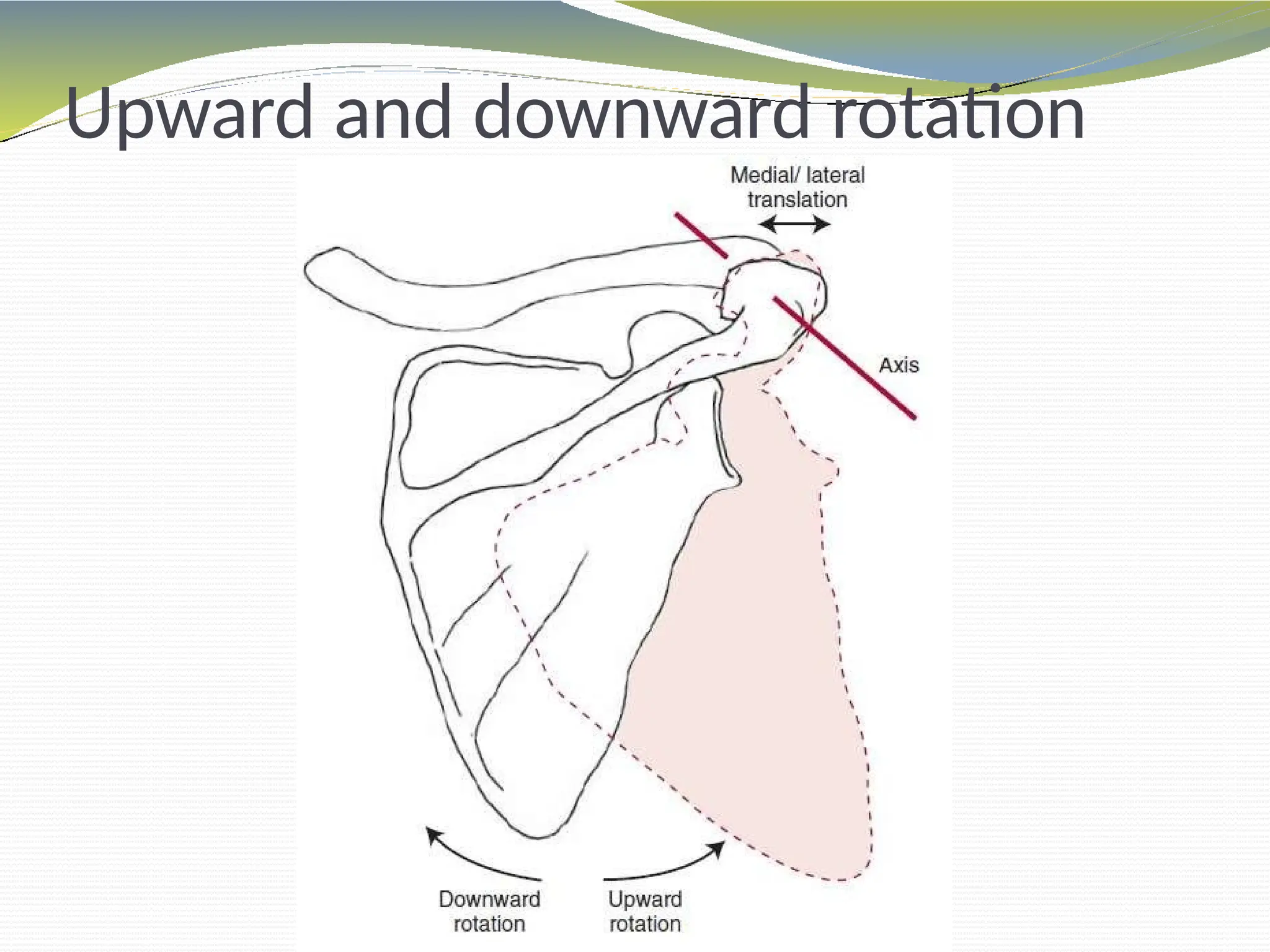
 3 rotatory motions:
 Internal/external rotation
 Anterior and posterior
tipping
 Upward and downward
rotation
 3 translatory motions:
 Anterior/posterior
 Medial/lateral
 Superior/inferior
Axis and planes for AC joint
motions
Internal/external rotation
While elevating the arm
 Protraction and
retraction of the
scapula require
internal and external
rotation, respectively,
for the scapula to
follow the convex
thorax and orient the
glenoid fossa with the
plane of elevation.
 Smaller values (20 to 35 degrees) have been
reported during arm motions, although up to
40 to 60 degrees may be possible with full-
range motions reaching forward and across
the body.
Anterior and posterior tipping
While elevating the arm
 The scapula posteriorly tips on thorax as the
scapula is upwardly rotating.
 The magnitude of anterior/posterior tipping
during elevation of arm is approx 30 degrees.
 Although in maximal flexion and extension,
ant/post tipping can reach up to 40 degrees or
more
Upward and downward rotation
 Upward rotation=30
degrees
 Downward rotation=17
degrees
Acromioclavicular stress tolerence
 AC joint is susceptible to trauma and
degenerative changes because of Smaller and
incongruent surfaces.
 It is commonly found in 2nd decade to 6th
decade of life.
ST JOINT
 It is not a true anatomic joint.
 The functional ST joint is part of a true closed
chain with the AC and SC joints and the
thorax.
RESTING POSITION OF SCAPULA
Resting position of scapula
 2 inches from midline
b/w
2nd and 7th rib.
 Internally rot -30-
45 degrees from
coronal plane.
 Ant tipped -10-
20degrees from
frontal plane
 Upward rotated - 10-
20 degrees from
sagittal plane
 The linkage of the scapula to the AC and SC joints,
however, actually prevents scapular motions
both from occurring in isolation and from
occurring as true translatory motions.
 Eg. When the arm is abducted, scapula
undergoes upward rotation, external
rotation and posterior tipping (all movts in
combination).
MOTIONS OF THE SCAPULA
 Upward rotation
 Elevation/depression
 Protraction/retraction
 Internal /external
rotation
UPWARD ROTATION
 Approx. 60 degrees
of upward rotation
of the scapula on the
thorax is typically
available.
 Upward rotation of
the scapula is
produced by
clavicular elevation
and posterior
rotation at the SC
joint and by
rotations at the AC
ELEVATION/DEPRESSION
 Elevation and depression
of the scapula are
produced by
elevation/depression of
the clavicle at the SC
joint and requires subtle
adjustments in
anterior/posterior
tipping and
internal/external
rotation at the AC joint to
maintain the scapula in
contact with the thorax.
PROTRACTION/RETRACTION
 Protraction and
retraction of the
scapula are produced
by
protraction/retractio
n of the clavicle at
the SC joint, and by
rotations at the AC
joint to produce
internal rot & ant
tipping.
Internal/external rotation
 Internal/external rotation
of the scapula on the
thorax should normally
accompany protraction/
retraction of the clavicle
at the SC joint.
 Internal rotation of the
scapula on thorax which
occurs only at the AC
joint, will result in the
prominence of the
vertebral border of
scapula. (WINGING OF
SCAPULA-suggestive of
impaired
neuromuscular control
of ST muscles ).
GH ARTICULATING SURFACE
 Scapula-
 Glenoid fossa is oriented/facing upwards
and 6-7 degrees retroverted.
 The radius of curvature of the fossa is increased
by articular cartilage that is thinner in the
middle and thicker on the periphery, which
improves congruence with the much larger
radius of curvature of the humeral head.
 Humerus-
 The head faces medially, superiorly, and
posteriorly with regard to the shaft of the
humerus and the humeral condyles.
 ANGLES:
 Angle of inclination=130-150 degrees
 Angle of torsion=30 degrees posteriorly
Angle of
inclinatio
n
Angle
of
torsio
n
 Because of the internally rotated resting position
of the scapula on the thorax, retroversion of the
humeral head increases congruence of the GH
joint.
 Reduced retroversion of humeral head
(anteversion)- increases ROM for internal
rotation and decreases ROM for external rotation
and has a tendency to produce anterior GH
subluxation.
 Vice versa for increased retroversion of humeral
head.
Subluxation of shoulder
GLENOID LABRUM
 Enhance the depth
or curvature of the
fossa by 50%.
 It is a redundant fold
of dense fibrous
connective tissue
with little
fibrocartilage.
 It is attached to
glenohumeral
ligament and long
head of biceps
brachii.
GH CAPSULE & LIGAMENTS
 GH Capsule laxity is
required for large
excursions of
shoulder joint.
 But capsule gives
less stability alone
and its work has
to be reinforced
by GH ligaments.
GH ligament
 Superior
 Middle
 Inferior
 Coracohumeral
lig
 Foramen of
weitbrecht- area
of weakness in
the capsule.
Rotator interval capsule
 superior GH ligament,
the superior capsule,
and the
coracohumeral
ligament are
interconnected
structures that bridge
the space between the
supraspinatus and
subscapularis muscle
tendons- rotator
interval capsule.
Inferior GH ligament complex
 Inferior GH ligament
has 3 parts:
 Anterior bands
 Axillary pouch
 Posterior bands
Function of GH ligament
• Limits ant and inf translation in
arm at 0 degrees of abduction
Superior GH
Lig
• Limits anterior translation at
arm 45 degrees abduction
Middle GH
Lig
• Limits ant translation beyond 45
degrees abduction + external
rotation
Anterior band
of IGHLC
• Limits posterior translation with
arm 45 degrees abd+ internal
rotation
Posterior
band of
IGHLC
Coracoacromial arch
Coracoacromial arch
 Contents under coracoacromial arch:
subacromial bursae, rotator cuff tendons
and portion of long head of biceps brachii.
 Also called as supraspinatus outlet/
subacromial space
 Normally, it is 10 mm wide, but reduces to
5mm on elevation of arm.
 Repetitive overhead activity can cause
painful impingement syndrome.
Bursae
 Subacromi
al
 Subdeltoi
d
Subacromi
al
bursae
Glenohumeral motions.
MOTIONS ROM available
Flexion 120
Extension 50
Abduction 90-120
Adduction
External rotation 60 degrees of combined motions
(arm
at side)
120 degrees of combined
motions ( arm at 90 degrees
abducted)
Internal rotation -
 For complete range of abduction to occur, there
must be 35-40 degrees of lateral rotation, for
the clearance of greater tubercle under the
Coracoacromial arch.
 MAXIMUM ABDUCTION IS FOUND TO OCCUR IN
SCAPULAR PLANE, i.e 30-40 degrees anterior to
frontal plane. This is due to lack of capsular
tension in scapular plane.
Intra-articular Contribution to
Glenohumeral Motions
 The convex humeral head is a substantially
larger surface and may have a different
radius of curvature than the shallow concave
fossa.
 Given this incongruence, rotations of the joint
around its three axes do not occur as pure
spins but have changing centers of rotation and
shifting contact patterns within the joint.
 Without downward sliding of the articular
surface of the humeral head, the humeral
head will roll up the glenoid fossa and
impinge upon the coracoacromial arch.
 Slight superior translation of the center of
the humeral head can still occur during
humeral
abduction despite inferior sliding of the
head’s articular surface. (1-2mm)
Static Stabilization of the GH Joint in the
Dependent Arm- UNLOADED ARM
 PASSIVE TENSION IN THE ROTATOR
INTERVAL CAPSULE
 AIR-TIGHT CAPSULE PRODUCING
NEGATIVE INTRAARTICULAR PRESSURE
 GLENOID INCLINATION-THERE IS SLIGHT
UPWARD TILT OF GLENOID FOSSA EITHER
DUE TO ANATOMICALLY OR DUE TO UPWARD
ROTATION OF THE SCAPULA.
UNLOADED ARM
LOADED ARM-STATIC STABILIZATION
 SUPRASPINATUS ACTIVITY STARTS WHEN
THE PASSIVE TENSION IN ROTATOR INTERVAL
CAPSULE IS INSUFFICIENT AS IN LOADED
ARM.
DYNAMIC STABILIZATION OF THE
GH JOINT
 The Deltoid and Glenohumeral Stabilization
 The majority of the force of contraction of the
deltoid causes the humerus and humeral head to
translate superiorly; only a small proportion of
force is applied perpendicular to the humerus and
directly contributes to rotation (abduction) of the
humerus.
 It also produces a shear force rather than a
compressive force
 The deltoid cannot independently abduct (elevate)
the arm. Another force or set of forces must be
introduced to work synergistically with the deltoid
for the deltoid to work effectively.
EFFECT OF DELTOID (ALONE) ON
ABDUCTION
The Rotator Cuff and
Glenohumeral Stabilization
 ROTATOR OR MUSCULOTENDINOUS CUFF
MUSCLES ARE:
 Supraspinatus (S)
 Infraspinatus (I)
 Teres minor(T)
 Subscapularis(S)
 The infraspinatus,
teres minor, and
subscapularis muscles
individually or together
have a similar line of
pull.
 The rotatory
component (Fy)
compresses as well as
rotates, and the
translatory
component (Fx) helps
offset the superior
translatory pull of the
The Supraspinatus and
Glenohumeral Stabilization
 The supraspinatus has
a superiorly directed
translatory
component (Fx) and
a rotatory
component (Fy) that
is more compressive
than that of the other
rotator cuff muscles
and can
independently abduct
the humerus.
The Long Head of the
BicepsBrachii
and Glenohumeral
Stabilization
 The long head of
biceps may produce
its effect by
tightening the
relatively loose
superior labrum and
transmitting
increased tension to
the superior and
middle GH ligaments.
 The long head of the biceps brachii, because of
its position at the superior capsule and its
connections to structures of the rotator interval
capsule, is sometimes considered to be part of
the reinforcing cuff of the GH joint.
 The biceps muscle is capable of contributing
to the force of flexion and can, if the
humerus is laterally rotated, contribute to
the force of abduction and anterior
stabilization.
Costs of Dynamic Stabilization of
the Glenohumeral Joint
 Supraspinatus tendon tears
 Supraspinatus impingement in subacromial
arch
 Rotator cuff tear
 AC joint degenerative changes
 Bicipital tendinitis
 Dislocation of shoulder
AC joint degenerative changes
Bicipital tendinitis
Scapulothoracic and
Glenohumeral Contributions
 SCAPULAR UPWARD ROT = 60 DEGREES
 SCAPULA not only upwardly rotates but
also posteriorly tips to 30 degrees.
 GLENO-HUMERAL CONTRIBUTION = 100 to
120 of flexion and 90 to 120 of abduction.
 TOTAL MOVEMENT IN ELEVATION= OF 150-
180 DEGREES
 The overall ratio of 2 of GH to 1 of ST motion
during arm elevation is commonly used, and the
combination of concomitant GH and ST motion
most commonly referred to as scapulohumeral
rhythm.
Sternoclavicular and
Acromioclavicular Contributions
Sternoclavicular and
Acromioclavicular Contributions
 The major shift in the axis of rotation( for scapular
upward rotation) happens because the ST joint
motion can occur only through a combination of
motions at the SC and AC joints.
 When the axis of scapular upward rotation is
near the root of the scapular spine, ST motion is
primarily a function of SC joint motion;
 when the axis of scapular upward rotation is at
the AC joint, AC joint motions predominate;
 when the axis of scapular upward rotation is in
an intermediate position, both the SC and AC
joints are contributing to ST motion.
 50 % of contribution from AC and SC joint is
required to produce a total of 60 degrees of
scapular upward rotation.
 Any additional degrees of upward rotation
is accomplished by posterior rotation of
clavicle.
Integrated
movemen
t during
elevation
Upward Rotators of the Scapula
 The motions of the scapula are primarily
produced by a balance of the forces between
the trapezius and serratus anterior muscles
through their attachments on the clavicle and
the scapula.
 TRAPEZIUS WITH SERRATUS Anterior-
forms a force couple for scapular upward
rotation
 INITIATION Of scapular rotation- upper
trap + middle traps
 AT THE END RANGE= Lower traps
DELTOID
 Scapular plane abduction- anterior and
middle deltoid
 Posterior deltoid has smaller MA and
thus less effective in frontal plane
abduction.
 Maintenance of appropriate length-tension
relationship of deltoid is dependent on
scapular position/movement and stabilization.
For example: when scapula cannot rotate,
there is more shortening of deltoid and thus
loss of tension, which causes elevation to upto
90 degrees only.
Supraspinatus
 Primary function is to produce abduction
with deltoid muscle.
 It has a fairly constant MA throughout the
range of motion of abduction
 Secondary function: acts as a ‘steerer’ of
humeral head and helps to maintain stability
of dependent arm.
Infraspinatus, teres minor and
subscapularis
 These muscle function gradually increases from-
0-115 degrees of elevation after which (115-180
degrees) it dropped.
 In the initial range of elevation, these muscles
(infrasp and t.minor) work to pull the humeral
head down, and during the middle range, these
muscles act to externally rotate for clearing
greater tubercle under coracoacromial arch.
 Subscapularis helps as internal rot when arm is at
side and during initial range
 With more abduction, its inter rot capacity decreases.
 Then it acts with other RC muscles to promote
stability by
compression.
UPPER AND LOWER TRAPEZIUS +
SERRATUS ANTERIOR
 This force couple produces upward rotation of
scapula.
 When the trapezius is intact and the serratus
anterior muscle is paralyzed, active abduction of
the arm can occur through its full range, although it
is weakened.
 When the trapezius is paralyzed (even though
the serratus anterior muscle may be intact),
active abduction of the arm is both weakened and
limited in range to 75, with remaining range
occurring exclusively at the GH joint.
 Without the trapezius (with or without the
serratus anterior muscle), the scapula rests in a
downwardly rotated position as a result of the
unopposed effect of gravity on the scapula.
 Serratus anterior produces upward
rotation, posterior tipping and external
rotation of scapula, which is necessary for
upward elevation of arm.
 The serratus is the primary stabilizer of the
inferior angle and medial border of the
scapula to the thorax.
How SA and trap work with
deltoid??
 The serratus anterior and trapezius muscles are
prime movers for upward rotation of the scapula.
These two muscles are also synergists for the deltoid
during abduction at the GH joint.
 The trapezius and serratus anterior muscles, as
upward scapular rotators, prevent the undesired
downward rotatory movement of the scapula by
the middle and posterior deltoid segments that are
attached to the scapula.
 The trapezius and serratus anterior muscles maintain
an optimal length-tension relationship with the deltoid
and permit the deltoid to carry its heavier distal lever
through full ROM.
Rhomboid
 It works eccentrically to control upward
rotation of the scapula produced by the
trapezius and the serratus anterior muscles.
 It adducts the scapula with lower traps to
offset the lateral translation component of
the serratus anterior muscle.
 Depression involves the forceful
downward
movement of the arm in relation to the
trunk.
Latissimus Dorsi and
Pectoral Muscle Function
 When the upper extremity is free to move in
space, the latissimus dorsi muscle may produce
adduction, extension, or medial rotation of the
humerus. Through its attachment to both the
scapula and humerus, the latissimus dorsi
can also adduct and depress the scapula and
shoulder complex.
 When the hand and/or forearm is fixed in
weight- bearing, the latissimus dorsi muscle
will pull its caudal attachment on the pelvis
toward its cephalad attachment on the scapula
and humerus. This results in lifting the body
up as in a seated pushup.
Pectoralis major muscle
 Clavicular
portion
 Sternal portion
 Abdominal
portion
Flexion of
shoulder
Depression
of
shoulder
Depressor
function is
assisted by
pectoralis
minor
Teres Major and Rhomboid
Muscle Function
 In order for the teres
major muscle to
extend the heavier
humerus rather than
upwardly rotate the
lighter scapula, the
synergy of the
rhomboid muscles is
necessary to stabilize
the scapula.
REFERENCE:
joint structure and function. Lavangie and Norkin, 4th edition
Thankyo
u

biomechanicsofshoulderug-160301061851.pptx

  • 3.
    Introduction  Shoulder joint(GH joint) has more mobility than stability.  Only SC joint connects the components of shoulder joint to the axial skeleton. This puts greater demands on the muscles for securing the shoulder girdle on thorax during static and dynamic conditions (dynamic stabilization).
  • 4.
    Components of shouldercomplex  Clavicle, humerus and scapula are linked with 3 interdependent linkages: SC joint, AC joint & GH joint.  Additionally a functional joint called scapulothoracic joint ( ST joint) is considered as a part oh shoulder complex.
  • 5.
  • 6.
    MOVEMENTS  Elevation: Sagittalplane flexion and frontal plane abduction and all the motions in between. 1/ 3 ST GH 2/ 3
  • 8.
    STERNOCLAVICULAR JOINT  Movementof the clavicle at the SC joint inevitably produces movement of the scapula under conditions of normal function, because the scapula is attached to the lateral end of the clavicle.  SC joint is a plane synovial joint, with 3 rotatory and 3 translatory degrees of freedom.
  • 9.
    SC articulating surface: The SC articulation consists of two saddle- shaped surfaces, one at the sternal or medial end of the clavicle and one at the notch formed by the manubrium of the sternum and first costal cartilage.  It is a plane synovial joint.  The articulating surfaces are incongruent.  The superior portion of the clavicle does not makes any contact with the manubrium, instead it serves as an attachment site for SC disk and interclavicular ligaments.
  • 12.
    Sternoclavicular disk  Itis a fibrocartilaginous disk to increase the congruency b/w incongruent articular surfaces.  Attachment: upper portion is attached to the postero- superior clavicle and the lower portion is attached to the manubrium and first costal cartilage.  The disk diagonally transects the SC joint space and divides the joint into 2 separate cavities.
  • 13.
     The diskis considered part of the manubrium in elevation/depression and thus the upper attachment of the disk serves as pivot point and the disk acts as the part of the clavicle in protraction/ retraction with lower attachment serving as pivot point.  The axis of motions of SC joint elevation/depression and protraction/retraction is located lateral to the SC joint, on the costoclavicular ligament.  The disk functions to absorb the medially directed force transmitted along the clavicle from its lateral end.
  • 14.
    Sternoclavicular joint capsuleand ligaments  Sc joint is supported by fibrous capsule  3 ligaments:  Sternoclavicular ligament  Costoclavicular ligament  Interclavicular ligaments ANTERIOR POSTERIOR ANTERIOR LAMINA POSTERIOR LAMINA
  • 16.
    Sternoclavicular motions  3rotatory degrees of freedom:  Elevation/depression  Protraction/retraction  Anterior/posterior rotation of clavicle  3 degrees of translatory motion at the SC joint (very small in magnitude):  Anterior/posterior  Medial/lateral  Superior/inferior
  • 17.
  • 18.
     Clavicular elevation=upto 48 degrees  Passive clavicular depression= less than 15 degrees
  • 19.
  • 20.
     protraction= 15-20 degrees Retraction= 20-30 degrees
  • 21.
    Anterior and PosteriorRotation of the Clavicle
  • 22.
     Posterior rotation=50 degrees  Anterior rotation= less than 10 degrees
  • 23.
    Sternoclavicular stress tolerence Although the SC joint is considered incongruent, the joint does not undergo the degree of degenerative change common to the other joints of the shoulder complex.  Strong force-dissipating structures such as the SC disk and the costoclavicular ligament minimize articular stresses and also prevent excessive intra- articular motion that might lead to subluxation or dislocation.
  • 25.
    AC JOINT  Planesynovial joint  3 rotational and 3 translational degrees of freedom  The primary function of the AC joint is to allow the scapula additional range of rotation on the thorax and allow for adjustments of the scapula (tipping and internal/external rotation) outside the initial plane of the scapula in order to follow the changing shape of the thorax as arm movement occurs.  In addition, the joint allows transmission of
  • 26.
    AC articulating surface Incongruent surfaces  Variation in inclination of articulating surface: flat, reciprocally concave-convex, or reversed (reciprocally convex-concave).
  • 27.
    AC joint disk Through 2 years of age, the AC joint is actually a fibrocartilaginous union.  With use of UE progressively, a joint space develops on each articulating surface that may leave a meniscoid fibrocartilage remnant within the joint.
  • 28.
    AC joint capsuleand ligaments  Superior acromioclavicular ligament  Inferior acromioclavicular ligament  Coracoclavicular ligament TRAPEZOID (LATERAL) CONOID (MEDIAL )
  • 30.
     The capsuleof the AC joint is weak and cannot maintain integrity of the joint without reinforcement of the superior and inferior acromioclavicular and the coracoclavicular ligaments.  Superior AC ligament is reinforced by aponeurotic extensions from deltoid and trapezius.
  • 31.
     Trapezoid portion:oriented more horizontally. It resists posterior forces on distal clavicle  Conoid portion: oriented more vertically. It resists superior and inferior forces  Both limit upward rotation of scapula on AC joint.  Prevents medial displacement of acromion on clavicle when leaning on 1 hand  CC lig helps in coupling post clavicular rot
  • 33.
    AC motions  3rotatory motions:  Internal/external rotation  Anterior and posterior tipping  Upward and downward rotation  3 translatory motions:  Anterior/posterior  Medial/lateral  Superior/inferior
  • 34.
    Axis and planesfor AC joint motions
  • 35.
  • 36.
    While elevating thearm  Protraction and retraction of the scapula require internal and external rotation, respectively, for the scapula to follow the convex thorax and orient the glenoid fossa with the plane of elevation.
  • 37.
     Smaller values(20 to 35 degrees) have been reported during arm motions, although up to 40 to 60 degrees may be possible with full- range motions reaching forward and across the body.
  • 38.
  • 39.
    While elevating thearm  The scapula posteriorly tips on thorax as the scapula is upwardly rotating.
  • 40.
     The magnitudeof anterior/posterior tipping during elevation of arm is approx 30 degrees.  Although in maximal flexion and extension, ant/post tipping can reach up to 40 degrees or more
  • 41.
  • 42.
     Upward rotation=30 degrees Downward rotation=17 degrees
  • 43.
    Acromioclavicular stress tolerence AC joint is susceptible to trauma and degenerative changes because of Smaller and incongruent surfaces.  It is commonly found in 2nd decade to 6th decade of life.
  • 45.
    ST JOINT  Itis not a true anatomic joint.  The functional ST joint is part of a true closed chain with the AC and SC joints and the thorax.
  • 46.
  • 47.
    Resting position ofscapula  2 inches from midline b/w 2nd and 7th rib.  Internally rot -30- 45 degrees from coronal plane.  Ant tipped -10- 20degrees from frontal plane  Upward rotated - 10- 20 degrees from sagittal plane
  • 48.
     The linkageof the scapula to the AC and SC joints, however, actually prevents scapular motions both from occurring in isolation and from occurring as true translatory motions.  Eg. When the arm is abducted, scapula undergoes upward rotation, external rotation and posterior tipping (all movts in combination).
  • 49.
    MOTIONS OF THESCAPULA  Upward rotation  Elevation/depression  Protraction/retraction  Internal /external rotation
  • 50.
    UPWARD ROTATION  Approx.60 degrees of upward rotation of the scapula on the thorax is typically available.  Upward rotation of the scapula is produced by clavicular elevation and posterior rotation at the SC joint and by rotations at the AC
  • 51.
    ELEVATION/DEPRESSION  Elevation anddepression of the scapula are produced by elevation/depression of the clavicle at the SC joint and requires subtle adjustments in anterior/posterior tipping and internal/external rotation at the AC joint to maintain the scapula in contact with the thorax.
  • 52.
    PROTRACTION/RETRACTION  Protraction and retractionof the scapula are produced by protraction/retractio n of the clavicle at the SC joint, and by rotations at the AC joint to produce internal rot & ant tipping.
  • 53.
    Internal/external rotation  Internal/externalrotation of the scapula on the thorax should normally accompany protraction/ retraction of the clavicle at the SC joint.  Internal rotation of the scapula on thorax which occurs only at the AC joint, will result in the prominence of the vertebral border of scapula. (WINGING OF SCAPULA-suggestive of impaired neuromuscular control of ST muscles ).
  • 55.
    GH ARTICULATING SURFACE Scapula-  Glenoid fossa is oriented/facing upwards and 6-7 degrees retroverted.  The radius of curvature of the fossa is increased by articular cartilage that is thinner in the middle and thicker on the periphery, which improves congruence with the much larger radius of curvature of the humeral head.
  • 56.
     Humerus-  Thehead faces medially, superiorly, and posteriorly with regard to the shaft of the humerus and the humeral condyles.  ANGLES:  Angle of inclination=130-150 degrees  Angle of torsion=30 degrees posteriorly
  • 57.
  • 58.
     Because ofthe internally rotated resting position of the scapula on the thorax, retroversion of the humeral head increases congruence of the GH joint.  Reduced retroversion of humeral head (anteversion)- increases ROM for internal rotation and decreases ROM for external rotation and has a tendency to produce anterior GH subluxation.  Vice versa for increased retroversion of humeral head.
  • 59.
  • 60.
    GLENOID LABRUM  Enhancethe depth or curvature of the fossa by 50%.  It is a redundant fold of dense fibrous connective tissue with little fibrocartilage.  It is attached to glenohumeral ligament and long head of biceps brachii.
  • 61.
    GH CAPSULE &LIGAMENTS  GH Capsule laxity is required for large excursions of shoulder joint.  But capsule gives less stability alone and its work has to be reinforced by GH ligaments.
  • 62.
    GH ligament  Superior Middle  Inferior  Coracohumeral lig  Foramen of weitbrecht- area of weakness in the capsule.
  • 63.
    Rotator interval capsule superior GH ligament, the superior capsule, and the coracohumeral ligament are interconnected structures that bridge the space between the supraspinatus and subscapularis muscle tendons- rotator interval capsule.
  • 64.
    Inferior GH ligamentcomplex  Inferior GH ligament has 3 parts:  Anterior bands  Axillary pouch  Posterior bands
  • 65.
    Function of GHligament • Limits ant and inf translation in arm at 0 degrees of abduction Superior GH Lig • Limits anterior translation at arm 45 degrees abduction Middle GH Lig • Limits ant translation beyond 45 degrees abduction + external rotation Anterior band of IGHLC • Limits posterior translation with arm 45 degrees abd+ internal rotation Posterior band of IGHLC
  • 66.
  • 67.
    Coracoacromial arch  Contentsunder coracoacromial arch: subacromial bursae, rotator cuff tendons and portion of long head of biceps brachii.  Also called as supraspinatus outlet/ subacromial space  Normally, it is 10 mm wide, but reduces to 5mm on elevation of arm.  Repetitive overhead activity can cause painful impingement syndrome.
  • 68.
  • 69.
    Glenohumeral motions. MOTIONS ROMavailable Flexion 120 Extension 50 Abduction 90-120 Adduction External rotation 60 degrees of combined motions (arm at side) 120 degrees of combined motions ( arm at 90 degrees abducted) Internal rotation -
  • 70.
     For completerange of abduction to occur, there must be 35-40 degrees of lateral rotation, for the clearance of greater tubercle under the Coracoacromial arch.  MAXIMUM ABDUCTION IS FOUND TO OCCUR IN SCAPULAR PLANE, i.e 30-40 degrees anterior to frontal plane. This is due to lack of capsular tension in scapular plane.
  • 71.
    Intra-articular Contribution to GlenohumeralMotions  The convex humeral head is a substantially larger surface and may have a different radius of curvature than the shallow concave fossa.  Given this incongruence, rotations of the joint around its three axes do not occur as pure spins but have changing centers of rotation and shifting contact patterns within the joint.
  • 72.
     Without downwardsliding of the articular surface of the humeral head, the humeral head will roll up the glenoid fossa and impinge upon the coracoacromial arch.
  • 73.
     Slight superiortranslation of the center of the humeral head can still occur during humeral abduction despite inferior sliding of the head’s articular surface. (1-2mm)
  • 74.
    Static Stabilization ofthe GH Joint in the Dependent Arm- UNLOADED ARM  PASSIVE TENSION IN THE ROTATOR INTERVAL CAPSULE  AIR-TIGHT CAPSULE PRODUCING NEGATIVE INTRAARTICULAR PRESSURE  GLENOID INCLINATION-THERE IS SLIGHT UPWARD TILT OF GLENOID FOSSA EITHER DUE TO ANATOMICALLY OR DUE TO UPWARD ROTATION OF THE SCAPULA.
  • 75.
  • 76.
    LOADED ARM-STATIC STABILIZATION SUPRASPINATUS ACTIVITY STARTS WHEN THE PASSIVE TENSION IN ROTATOR INTERVAL CAPSULE IS INSUFFICIENT AS IN LOADED ARM.
  • 77.
    DYNAMIC STABILIZATION OFTHE GH JOINT  The Deltoid and Glenohumeral Stabilization  The majority of the force of contraction of the deltoid causes the humerus and humeral head to translate superiorly; only a small proportion of force is applied perpendicular to the humerus and directly contributes to rotation (abduction) of the humerus.  It also produces a shear force rather than a compressive force  The deltoid cannot independently abduct (elevate) the arm. Another force or set of forces must be introduced to work synergistically with the deltoid for the deltoid to work effectively.
  • 78.
    EFFECT OF DELTOID(ALONE) ON ABDUCTION
  • 79.
    The Rotator Cuffand Glenohumeral Stabilization  ROTATOR OR MUSCULOTENDINOUS CUFF MUSCLES ARE:  Supraspinatus (S)  Infraspinatus (I)  Teres minor(T)  Subscapularis(S)
  • 80.
     The infraspinatus, teresminor, and subscapularis muscles individually or together have a similar line of pull.  The rotatory component (Fy) compresses as well as rotates, and the translatory component (Fx) helps offset the superior translatory pull of the
  • 81.
    The Supraspinatus and GlenohumeralStabilization  The supraspinatus has a superiorly directed translatory component (Fx) and a rotatory component (Fy) that is more compressive than that of the other rotator cuff muscles and can independently abduct the humerus.
  • 82.
    The Long Headof the BicepsBrachii and Glenohumeral Stabilization  The long head of biceps may produce its effect by tightening the relatively loose superior labrum and transmitting increased tension to the superior and middle GH ligaments.
  • 83.
     The longhead of the biceps brachii, because of its position at the superior capsule and its connections to structures of the rotator interval capsule, is sometimes considered to be part of the reinforcing cuff of the GH joint.  The biceps muscle is capable of contributing to the force of flexion and can, if the humerus is laterally rotated, contribute to the force of abduction and anterior stabilization.
  • 84.
    Costs of DynamicStabilization of the Glenohumeral Joint  Supraspinatus tendon tears  Supraspinatus impingement in subacromial arch  Rotator cuff tear  AC joint degenerative changes  Bicipital tendinitis  Dislocation of shoulder
  • 86.
  • 87.
  • 89.
    Scapulothoracic and Glenohumeral Contributions SCAPULAR UPWARD ROT = 60 DEGREES  SCAPULA not only upwardly rotates but also posteriorly tips to 30 degrees.  GLENO-HUMERAL CONTRIBUTION = 100 to 120 of flexion and 90 to 120 of abduction.  TOTAL MOVEMENT IN ELEVATION= OF 150- 180 DEGREES
  • 90.
     The overallratio of 2 of GH to 1 of ST motion during arm elevation is commonly used, and the combination of concomitant GH and ST motion most commonly referred to as scapulohumeral rhythm.
  • 91.
  • 92.
    Sternoclavicular and Acromioclavicular Contributions The major shift in the axis of rotation( for scapular upward rotation) happens because the ST joint motion can occur only through a combination of motions at the SC and AC joints.  When the axis of scapular upward rotation is near the root of the scapular spine, ST motion is primarily a function of SC joint motion;  when the axis of scapular upward rotation is at the AC joint, AC joint motions predominate;  when the axis of scapular upward rotation is in an intermediate position, both the SC and AC joints are contributing to ST motion.
  • 93.
     50 %of contribution from AC and SC joint is required to produce a total of 60 degrees of scapular upward rotation.  Any additional degrees of upward rotation is accomplished by posterior rotation of clavicle.
  • 94.
  • 95.
    Upward Rotators ofthe Scapula  The motions of the scapula are primarily produced by a balance of the forces between the trapezius and serratus anterior muscles through their attachments on the clavicle and the scapula.
  • 96.
     TRAPEZIUS WITHSERRATUS Anterior- forms a force couple for scapular upward rotation  INITIATION Of scapular rotation- upper trap + middle traps  AT THE END RANGE= Lower traps
  • 98.
    DELTOID  Scapular planeabduction- anterior and middle deltoid  Posterior deltoid has smaller MA and thus less effective in frontal plane abduction.  Maintenance of appropriate length-tension relationship of deltoid is dependent on scapular position/movement and stabilization. For example: when scapula cannot rotate, there is more shortening of deltoid and thus loss of tension, which causes elevation to upto 90 degrees only.
  • 99.
    Supraspinatus  Primary functionis to produce abduction with deltoid muscle.  It has a fairly constant MA throughout the range of motion of abduction  Secondary function: acts as a ‘steerer’ of humeral head and helps to maintain stability of dependent arm.
  • 100.
    Infraspinatus, teres minorand subscapularis  These muscle function gradually increases from- 0-115 degrees of elevation after which (115-180 degrees) it dropped.  In the initial range of elevation, these muscles (infrasp and t.minor) work to pull the humeral head down, and during the middle range, these muscles act to externally rotate for clearing greater tubercle under coracoacromial arch.  Subscapularis helps as internal rot when arm is at side and during initial range  With more abduction, its inter rot capacity decreases.  Then it acts with other RC muscles to promote stability by compression.
  • 101.
    UPPER AND LOWERTRAPEZIUS + SERRATUS ANTERIOR  This force couple produces upward rotation of scapula.  When the trapezius is intact and the serratus anterior muscle is paralyzed, active abduction of the arm can occur through its full range, although it is weakened.  When the trapezius is paralyzed (even though the serratus anterior muscle may be intact), active abduction of the arm is both weakened and limited in range to 75, with remaining range occurring exclusively at the GH joint.  Without the trapezius (with or without the serratus anterior muscle), the scapula rests in a downwardly rotated position as a result of the unopposed effect of gravity on the scapula.
  • 102.
     Serratus anteriorproduces upward rotation, posterior tipping and external rotation of scapula, which is necessary for upward elevation of arm.  The serratus is the primary stabilizer of the inferior angle and medial border of the scapula to the thorax.
  • 103.
    How SA andtrap work with deltoid??  The serratus anterior and trapezius muscles are prime movers for upward rotation of the scapula. These two muscles are also synergists for the deltoid during abduction at the GH joint.  The trapezius and serratus anterior muscles, as upward scapular rotators, prevent the undesired downward rotatory movement of the scapula by the middle and posterior deltoid segments that are attached to the scapula.  The trapezius and serratus anterior muscles maintain an optimal length-tension relationship with the deltoid and permit the deltoid to carry its heavier distal lever through full ROM.
  • 104.
    Rhomboid  It workseccentrically to control upward rotation of the scapula produced by the trapezius and the serratus anterior muscles.  It adducts the scapula with lower traps to offset the lateral translation component of the serratus anterior muscle.
  • 106.
     Depression involvesthe forceful downward movement of the arm in relation to the trunk.
  • 107.
    Latissimus Dorsi and PectoralMuscle Function  When the upper extremity is free to move in space, the latissimus dorsi muscle may produce adduction, extension, or medial rotation of the humerus. Through its attachment to both the scapula and humerus, the latissimus dorsi can also adduct and depress the scapula and shoulder complex.  When the hand and/or forearm is fixed in weight- bearing, the latissimus dorsi muscle will pull its caudal attachment on the pelvis toward its cephalad attachment on the scapula and humerus. This results in lifting the body up as in a seated pushup.
  • 108.
    Pectoralis major muscle Clavicular portion  Sternal portion  Abdominal portion Flexion of shoulder Depression of shoulder Depressor function is assisted by pectoralis minor
  • 109.
    Teres Major andRhomboid Muscle Function  In order for the teres major muscle to extend the heavier humerus rather than upwardly rotate the lighter scapula, the synergy of the rhomboid muscles is necessary to stabilize the scapula.
  • 110.
    REFERENCE: joint structure andfunction. Lavangie and Norkin, 4th edition Thankyo u