Differentiated Instruction
  and the Art Classroom
    Graduate Teaching Assistant, Sarah Cress
                 Art Ed 4273
MoStep Madness Agenda…
•   Dream Curriculum Peer Share
•   MoStep Two Video Share
•   Sketchbook Prompt
•   Sketchbook Discussion
•   MoStep Three, Can I Have a Volunteer?!
•   A Differentiated Sample
•   Break
•   Group Collaboration
•   Tips for Success
•   Strong Differentiated Anchors
•   Artifact Brainstorm Session
Sketchbook Prompt…
 Think back to your years as an
 elementary student. What did you
 struggle with? What did you succeed at?
 Now, imagine you have a mini-me in
 your art classroom. How will you best
 instruct yourself on a regular basis?
MoStep Three…
1.2.3 The preservice teacher understands how students differ in their
   approaches to learning and creates instructional opportunities that
   support the intellectual, social and personal development of all
   students.
• Performance Indicators: The preservice teacher…
    • 1.2.3.1 identifies prior experience, learning styles, strengths and
       needs
    • 1.2.3.2 designs and implements individualized instruction for
       students based on their prior experience, learning styles,
       strengths and needs
    • 1.2.3.3 knows when and how to access specialized services to
       meet students’ needs
    • 1.2.3.4 connects instruction to students’ prior experiences and
       family, culture and community.
MoStep Three Rubric…
The preservice teacher demonstrates an
 exemplary ability to adapt instruction and
 assessment to meet the diverse physical,
 intellectual and cultural needs of individual
 students. Based in high expectations, activities
 connect with and build upon students’
 individual strengths, prior experiences, family,
 culture, and community heritages. The
 candidate demonstrates knowledge of when
 and how to access specialized services.
A Mini Critique…
  Considering our
  basic understanding
  of differentiation,
  consider how your
  current instructor
  abides to this method
  of teaching. Create a
  list of the ways in
  which you have
  observed her
  differentiating.
What Students Need…
                 • Acceptance
                 • Understanding
                 • Respect
                 • Belonging
                 • Evidence of
                   contribution
                 • Challenge
                 • Support
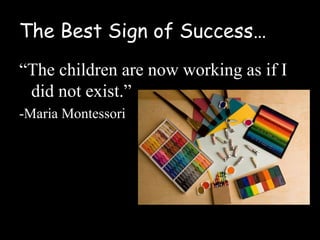
The Best Sign of Success…
“The children are now working as if I
 did not exist.”
-Maria Montessori
Some Obstacles in DI…
           • Getting started into groups smoothly
           • Giving directions for multiple tasks
           • Minimizing stray movements
           • Starting or stopping a lesson
           • Promoting on-task behavior
           • Helping groups effectively
           • Curbing noise
           • Keeping track of who is learning
             what
           • Grading daily tasks
           • Turning in work
A Differentiated Situation…
                • While viewing the
                  following video
                  sample, write down
                  all the various
                  instructional tools
                  used to relay new
                  concepts and
                  information.
A Differentiated Situation…
 My classroom is a beginning art 1-2 course composed of 8 males, 10 females, 50% ethnic minority.
 2 students are hearing impaired and accompanied by a signer, 6 have active IEPs (Individualized
 Education Program) with full inclusion, 2 students see the social worker regularly for anger
 management issues and 3 are ELL. The class is a mixture of 6 sophomores, 9 juniors and 3 seniors,
 16-18 years old where 16, function at grade level. My class is very diverse in terms of individual
 personalities. The class as a whole was shy and quiet in August, but now appear to be lively, curious
 and talkative. Although the class is a mixture of grade levels, cultural and linguistic diversity, the
 students work well together. They understand they have the same artistic skill-set and are extremely
 patient with one another. My hearing impaired students have extremely low reading and writing
 ability, and their interpreter currently does much of the writing for them. Although they are weak in
 these skills, they are eager to learn techniques. The remainder of the class ranges in writing ability. 4
 have extremely high, above average writing ability, while the remainder are low. This class is one of
 5 that meet in the same room everyday, as we are fortunate to have our own classroom and
 darkroom. Recently, our school district cut funding from previous years. Those cuts pose a threat to
 elective courses, like art, and may remove many programs and staff in our school that offered
 additional support to students who were low achieving. Prior to these cuts I did several writing
 assignments with my students involving critique and reflection. Now, it is crucial to foster even
 more opportunities for students to strengthen their writing. It is because of the diverse abilities
 within this class, that instruction of good writing practice is a challenge. A majority of my students
 are visual learners, while a few of them are auditory learners. Although 4 of my students are
 extremely talented writers, none of them have had experience writing about art. In order for all
 students to succeed and grow, I must present information in a variety of ways to ensure growth.
 Graphic organizers and other writing techniques and tools are used regularly to help students
 organize and present their thoughts in an engaging way.
How Would You Manage??
 In small groups devise an instructional plan for
 the described class. You have been asked by
 your divisional to create a lesson that
 incorporates writing and historical concepts in
 addition to art making. You have decided to
 present to students one art movement that
 profoundly shaped the history of creation.
 Within you group accomplish the following
 tasks…
How Would You Manage??
• Choose a major art movement to center your
  lesson around
• Make a list of the instructional resources you will
  need to adequately teach to all needs
• Plan a written activity in which students are asked
  to digest and interpret a specific work of art
• Plan an oral activity in which students share their
  perspectives of the chosen art movement
• Plan a process-based activity in which students
  create an art artifact using what they have learned
Burning Questions…
• How will you present your
  chosen artistic movement to
  the class considering their
  variant needs?
• How will you work with each
  individual student to ensure
  that they aren’t struggling, but
  are still being challenged?
Tips for Success…
• Present information in a variety of ways. In
  addition to the typical lecture style of presenting
  information also:
   – Use handouts
   – Use PowerPoint and/or
   overhead transparencies
   – Use manipulatives
   – Use games
   – Use your blackboard to provide additional direction
   – Provide hands-on instructional opportunities
Traits of Effective Anchors…
             • Important – related to key
               knowledge, understanding and
               skill
             • Interesting – appeals to student
               curiosity, interest and learning
               preference
             • Allow Choice – students can
               select from a range of options
             • Clear Routines and
               Expectations – students know
               what they are to do, how to do
               it, how to keep records, etc.
Examples of Artful Anchors…
•   Journal writing
•   Sketchbook assignments
•   Sketchbook experimentation
•   Brainstorming sequences
•   Article reviews
•   Online research
•   Book reviews
•   Preliminary artist statement writing
•   Preliminary peer critiques, oral or written
•   Paraphrasing of learned ideas or processes
•   Working on final products
•   Final artist statement writing
•   Final peer and teacher critiques, oral or written
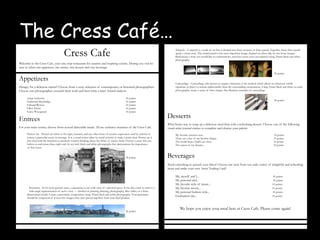
The Cress Café…
How to Manage and Assess…
• Utilize your present resources!
  – Speak with school counselors about general
    student concerns. Understand the context in which
    your students are coming from. Understand the
    population you will be addressing.
  – Speak with your support staff. Identify students
    with special needs and IEPS before the school year
    begins and gain a clear understanding of their
    specific accommodations.
How to Manage and Assess…
           • Begin each term with a
             pre-assessment that
             accomplishes the following:
             – Elicits information about
               student’s readiness to learn
               skills and concepts
             – Gathers information about
               student’s preferred methods
               of learning
             – Gathers information about
               students attitudes about the
               learning process
How to Manage and Assess…
• Check student understanding of key concepts
  regularly through any of the following
  techniques:
  – Sketchbook assignments
  – Journal writing
  – Exit sheets
  – One on one discussions
  – Group discussions
Artifact Brainstorm…
 Now, let’s
 brainstorm
 some ways
 we can
 demonstrate
 our newfound
 knowledge.

MoStep Three Presentation, By Sarah Cress

  • 1.
    Differentiated Instruction and the Art Classroom Graduate Teaching Assistant, Sarah Cress Art Ed 4273
  • 2.
    MoStep Madness Agenda… • Dream Curriculum Peer Share • MoStep Two Video Share • Sketchbook Prompt • Sketchbook Discussion • MoStep Three, Can I Have a Volunteer?! • A Differentiated Sample • Break • Group Collaboration • Tips for Success • Strong Differentiated Anchors • Artifact Brainstorm Session
  • 3.
    Sketchbook Prompt… Thinkback to your years as an elementary student. What did you struggle with? What did you succeed at? Now, imagine you have a mini-me in your art classroom. How will you best instruct yourself on a regular basis?
  • 4.
    MoStep Three… 1.2.3 Thepreservice teacher understands how students differ in their approaches to learning and creates instructional opportunities that support the intellectual, social and personal development of all students. • Performance Indicators: The preservice teacher… • 1.2.3.1 identifies prior experience, learning styles, strengths and needs • 1.2.3.2 designs and implements individualized instruction for students based on their prior experience, learning styles, strengths and needs • 1.2.3.3 knows when and how to access specialized services to meet students’ needs • 1.2.3.4 connects instruction to students’ prior experiences and family, culture and community.
  • 5.
    MoStep Three Rubric… Thepreservice teacher demonstrates an exemplary ability to adapt instruction and assessment to meet the diverse physical, intellectual and cultural needs of individual students. Based in high expectations, activities connect with and build upon students’ individual strengths, prior experiences, family, culture, and community heritages. The candidate demonstrates knowledge of when and how to access specialized services.
  • 6.
    A Mini Critique… Considering our basic understanding of differentiation, consider how your current instructor abides to this method of teaching. Create a list of the ways in which you have observed her differentiating.
  • 7.
    What Students Need… • Acceptance • Understanding • Respect • Belonging • Evidence of contribution • Challenge • Support
  • 8.
    The Best Signof Success… “The children are now working as if I did not exist.” -Maria Montessori
  • 9.
    Some Obstacles inDI… • Getting started into groups smoothly • Giving directions for multiple tasks • Minimizing stray movements • Starting or stopping a lesson • Promoting on-task behavior • Helping groups effectively • Curbing noise • Keeping track of who is learning what • Grading daily tasks • Turning in work
  • 10.
    A Differentiated Situation… • While viewing the following video sample, write down all the various instructional tools used to relay new concepts and information.
  • 11.
  • 12.
    A Differentiated Situation… My classroom is a beginning art 1-2 course composed of 8 males, 10 females, 50% ethnic minority. 2 students are hearing impaired and accompanied by a signer, 6 have active IEPs (Individualized Education Program) with full inclusion, 2 students see the social worker regularly for anger management issues and 3 are ELL. The class is a mixture of 6 sophomores, 9 juniors and 3 seniors, 16-18 years old where 16, function at grade level. My class is very diverse in terms of individual personalities. The class as a whole was shy and quiet in August, but now appear to be lively, curious and talkative. Although the class is a mixture of grade levels, cultural and linguistic diversity, the students work well together. They understand they have the same artistic skill-set and are extremely patient with one another. My hearing impaired students have extremely low reading and writing ability, and their interpreter currently does much of the writing for them. Although they are weak in these skills, they are eager to learn techniques. The remainder of the class ranges in writing ability. 4 have extremely high, above average writing ability, while the remainder are low. This class is one of 5 that meet in the same room everyday, as we are fortunate to have our own classroom and darkroom. Recently, our school district cut funding from previous years. Those cuts pose a threat to elective courses, like art, and may remove many programs and staff in our school that offered additional support to students who were low achieving. Prior to these cuts I did several writing assignments with my students involving critique and reflection. Now, it is crucial to foster even more opportunities for students to strengthen their writing. It is because of the diverse abilities within this class, that instruction of good writing practice is a challenge. A majority of my students are visual learners, while a few of them are auditory learners. Although 4 of my students are extremely talented writers, none of them have had experience writing about art. In order for all students to succeed and grow, I must present information in a variety of ways to ensure growth. Graphic organizers and other writing techniques and tools are used regularly to help students organize and present their thoughts in an engaging way.
  • 13.
    How Would YouManage?? In small groups devise an instructional plan for the described class. You have been asked by your divisional to create a lesson that incorporates writing and historical concepts in addition to art making. You have decided to present to students one art movement that profoundly shaped the history of creation. Within you group accomplish the following tasks…
  • 14.
    How Would YouManage?? • Choose a major art movement to center your lesson around • Make a list of the instructional resources you will need to adequately teach to all needs • Plan a written activity in which students are asked to digest and interpret a specific work of art • Plan an oral activity in which students share their perspectives of the chosen art movement • Plan a process-based activity in which students create an art artifact using what they have learned
  • 15.
    Burning Questions… • Howwill you present your chosen artistic movement to the class considering their variant needs? • How will you work with each individual student to ensure that they aren’t struggling, but are still being challenged?
  • 16.
    Tips for Success… •Present information in a variety of ways. In addition to the typical lecture style of presenting information also: – Use handouts – Use PowerPoint and/or overhead transparencies – Use manipulatives – Use games – Use your blackboard to provide additional direction – Provide hands-on instructional opportunities
  • 17.
    Traits of EffectiveAnchors… • Important – related to key knowledge, understanding and skill • Interesting – appeals to student curiosity, interest and learning preference • Allow Choice – students can select from a range of options • Clear Routines and Expectations – students know what they are to do, how to do it, how to keep records, etc.
  • 18.
    Examples of ArtfulAnchors… • Journal writing • Sketchbook assignments • Sketchbook experimentation • Brainstorming sequences • Article reviews • Online research • Book reviews • Preliminary artist statement writing • Preliminary peer critiques, oral or written • Paraphrasing of learned ideas or processes • Working on final products • Final artist statement writing • Final peer and teacher critiques, oral or written
  • 19.
  • 20.
    How to Manageand Assess… • Utilize your present resources! – Speak with school counselors about general student concerns. Understand the context in which your students are coming from. Understand the population you will be addressing. – Speak with your support staff. Identify students with special needs and IEPS before the school year begins and gain a clear understanding of their specific accommodations.
  • 21.
    How to Manageand Assess… • Begin each term with a pre-assessment that accomplishes the following: – Elicits information about student’s readiness to learn skills and concepts – Gathers information about student’s preferred methods of learning – Gathers information about students attitudes about the learning process
  • 22.
    How to Manageand Assess… • Check student understanding of key concepts regularly through any of the following techniques: – Sketchbook assignments – Journal writing – Exit sheets – One on one discussions – Group discussions
  • 23.
    Artifact Brainstorm… Now,let’s brainstorm some ways we can demonstrate our newfound knowledge.