Copyright &
Stock Images
INTRO
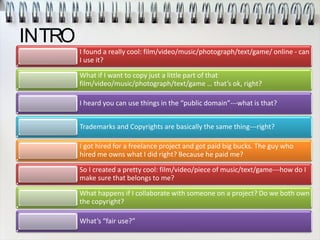
I found a really cool: film/video/music/photograph/text/game/ online - can
I use it?
What if I want to copy just a little part of that
film/video/music/photograph/text/game … that’s ok, right?
I heard you can use things in the “public domain”---what is that?
Trademarks and Copyrights are basically the same thing---right?
I got hired for a freelance project and got paid big bucks. The guy who
hired me owns what I did right? Because he paid me?
So I created a pretty cool: film/video/piece of music/text/game---how do I
make sure that belongs to me?
What happens if I collaborate with someone on a project? Do we both own
the copyright?
What’s “fair use?”
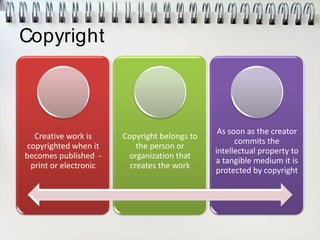
Copyright
Creative work is
copyrighted when it
becomes published -
print or electronic
Copyright belongs to
the person or
organization that
creates the work
As soon as the creator
commits the
intellectual property to
a tangible medium it is
protected by copyright
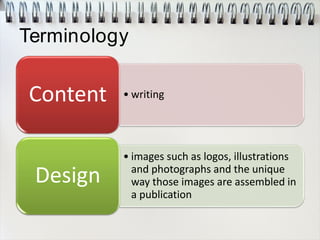
Terminology
• writingContent
• images such as logos, illustrations
and photographs and the unique
way those images are assembled in
a publication
Design
What isa Copyright?
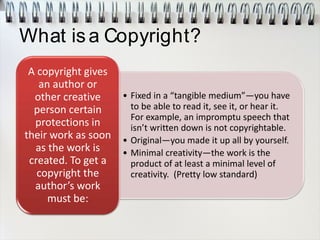
• Fixed in a “tangible medium”—you have
to be able to read it, see it, or hear it.
For example, an impromptu speech that
isn’t written down is not copyrightable.
• Original—you made it up all by yourself.
• Minimal creativity—the work is the
product of at least a minimal level of
creativity. (Pretty low standard)
A copyright gives
an author or
other creative
person certain
protections in
their work as soon
as the work is
created. To get a
copyright the
author’s work
must be:
Who seekscopyright protection?
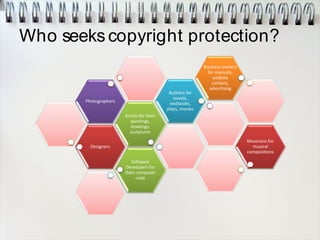
Designers
Artists for their
paintings,
drawings,
sculptures
Photographers
Authors for
novels,
textbooks,
plays, movies
Business owners
for manuals,
website
content,
advertising
Musicians for
musical
compositions
Software
Developers for
their computer
code
What worksare protected?
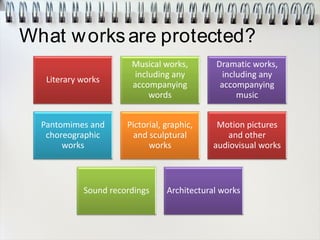
Literary works
Musical works,
including any
accompanying
words
Dramatic works,
including any
accompanying
music
Pantomimes and
choreographic
works
Pictorial, graphic,
and sculptural
works
Motion pictures
and other
audiovisual works
Sound recordings Architectural works
Fonts
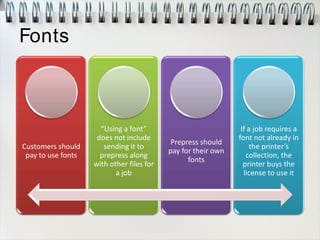
Customers should
pay to use fonts
“Using a font”
does not include
sending it to
prepress along
with other files for
a job
Prepress should
pay for their own
fonts
If a job requires a
font not already in
the printer’s
collection, the
printer buys the
license to use it
I’m using an image I found through Google. If it’s
on the internet, doesn’t that mean it’s free?
No. Just because an image is on the
internet, it doesn’t mean the image is
free to use.
You may still need the correct license to
use it. There is a difference between an
image being online and an image being
“in the public domain” (the term given
to content that is not owned or
controlled by anyone).
Some Background:
The founding fathers wanted to encourage creativity so
they created what is informally referred to as the patent,
trademark, and copyright clause of the Constitution:
• “The Congress shall have Power To…promote the Progress of Science and
Useful Arts, by securing for limited Times to Authors and Inventors the
exclusive Right to their respective Writings and Discoveries;”
• (Article 1, Section 8 in case you feel like reading it in your spare time.)
The Copyright Act itself is a federal law that covers all the
legal rules related to copyrighting.
What Rightsdo Copyright OwnersGet?
• reproduce the work
• prepare derivative works based upon the work
• distribute copies of the work to the public by sale or
other transfer of ownership, or by rental, lease, or
lending
• perform the work publicly
• display the copyrighted work publicly
• in the case of sound recordings, to perform the work
publicly by means of digital audio transmission
• in the case of a “work of visual art” the author has
certain rights of attribution and integrity
Copyright
owners
enjoy the
exclusive
right to:
How do I get a copyright?
You technically have a
copyright as soon as you “fix
it into a tangible medium”
BUT, and this is a big BUT:
You must register you work
with the United States
Copyright Office in order to
enforce your rights.
Common Myths:
• A: No…this just puts people
on notice. You still need to
register in order to sue.
Q: Isn’t putting a
© symbol next to
what I create
enough?
• A: No again. You still need
to register your work in
order to sue.
Q: What if I put my
work in a self
addressed
envelope and mail
it back to myself?
So how do I register?
•The cost of a copyright
application is $45
•In some cases, you can
register a series of
works for one
application fee.
Depending on what
you are
copyrighting, you
will need to fill out
one of several
forms available at
www.copyright.gov
Limited Duration:
Copyrights do not last forever.
Depending on the type of work, the
copyright will last for 70 years after you
die, or 120 years from its initial creation.
Once the copyright expires, the work
enters the “public domain.” Think the
Mona Lisa…
Permission
You will always need to ask
permission to use any part of (even
if it’s a little teeny itty bit) of a
film/video/music/photograph/text/
game/ that’s not yours.
• Well…almost always.
When Can I get away with NOT asking for Permission?
Works for which the copyright has expired. (tough to figure out unless its
really really old)
Works clearly and explicitly donated to the public domain.
Works that have not been fixed in a tangible form of expression (for example,
choreographic works that have not been notated or recorded, or
spontaneous speeches or performances that have not been written or
recorded).
Works consisting entirely of information that is common property and
contains no original authorship (for example, standard calendars, height and
weight charts, tape measures and rulers, and lists or tables taken from public
documents or other common sources).
Titles, Names, Short Phrasesand Slogans= Trademarks
Titles, names, short phrases, and slogans; familiar
symbols or designs; mere variations of typographic
ornamentation, lettering, or coloring; mere listings
of ingredients or contents are NOT protected by
copyright. This is what trademark law is for.
A trademark, unlike a copyright, is a source
identifier. The owner of a trademark gets a totally
different set of rights than those granted to a
copyright owner.
Ideas, Procedures, Methods, systems, etc. = Patents
Ideas, procedures, methods, systems,
processes, concepts, principles, discoveries,
or devices, as distinguished from a
description, explanation, or illustration are
NOT protected by copyright.
This is what patent law is for.
What is“Fair Use”?
• criticism,
• commentary
• news reporting
• teaching
• scholarship
• research.
Sometimes
you can use
copyrighted
work for
the
purposes
of:
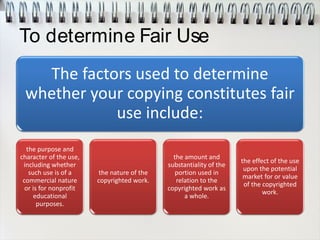
To determine Fair Use
The factors used to determine
whether your copying constitutes fair
use include:
the purpose and
character of the use,
including whether
such use is of a
commercial nature
or is for nonprofit
educational
purposes.
the nature of the
copyrighted work.
the amount and
substantiality of the
portion used in
relation to the
copyrighted work as
a whole.
the effect of the use
upon the potential
market for or value
of the copyrighted
work.
Don’t rely on Fair Use
Just because you may have a fair use
defense, doesn’t mean you’ll want to test it.
This is a very fact heavy defense…..
Law suits are expensive.
If possible: ask permission!
Letstalk about joint works
A “joint work” is a work prepared by two or more
authors with the intention that their contributions be
merged into inseparable or interdependent parts of a
unitary whole.
The authors of a joint work are co-owners of copyright
in the work.
Joint Ownership has serious implications …
More specifically….
Each co-author will own an equal ownership share
in the work. This will occur even if one of the co-
authors has contributed a greater quantity of the
work than the other co-authors.
Each co-author will own an "undivided" interest in
the entire work.
Any co-author, without the permission of their
fellow co-authors, may grant non-exclusive rights to
the work to third parties. (However, a co-author
may only grant exclusive rights to the work to third
parties if the co-author obtains the prior consent of
the other co-authors.)
Co-Authors
Each co-author has a duty to account to the other
co-authors for any profits obtained from the
exploitation of the work.
A co-author has the right to assign his/her
ownership share in the work to a third party or to
bequeath his/her ownership share to his/her heirs.
Each co-author will be entitled to equal authorship
credit for the work upon its publication.
Get a collaboration agreement in place
The best way to sort out joint
ownership is through discussion and
agreement at the start of a project.
Figure out who owns what and how
$$$ will be distributed based on the
contribution.
Employee vs. Independent Contractor
•a) work for
someone and
•b) when you
work for yourself
Now its
time to
discuss
ownership
rights
when you
Work for Hire Agreement
A smart client will ask you
to create the work as a
“work-made-for-hire.”
That way, even though you
created the work, the
client owns the copyright.
Work-for-Hire
If work is created by an employee as part of the job
responsibilities, the organizations owns the copyright
If the image is created on commission the artist owns
the copyright unless the contract between client and
artist includes a specific provision “work-for-hire” that
transfers ownership to the client
A lot of the times, the commissioned work doesn’t
exactly fit the “work-for-hire” requirements. In that
case, the client will ask you to “ASSIGN” your rights---in
writing.
What isa “Work Made for Hire”
•A work prepared by an employee within the scope of his or
her employment; or
•A work specially ordered or commissioned for use as a
contribution to a collective work:
•as a part of a motion picture
•as a part of other audiovisual work,
•as a translation,
•as a supplementary work,
•as a compilation,
•as an instructional text,
•as a test,
•as answer material for a test, or
•as an atlas
The
Copyright
Act defines
a “work
made for
hire” as:
Employees
As an employee, any work you create, within the scope of your
employment is automatically owned by… YOUR EMPLOYER.
No extra paperwork needed.
The implications of this:
•Since your employer owns the work, you can’t then use what you created later
at a new job … or even to post on your website or to include in your portfolio.
•You can only do these things if you: GET PERMISSION.
What if I’m a freelancer
If you are creating work as a freelancer, you are probably
being hired as an
• INDEPENDENT CONTRACTOR.
The person hiring you doesn’t pay your health insurance,
your employment taxes, etc.
As an independent contractor, you retain ownership of
everything you create.
This is true even if the client pays you for the work
Assignment vs. Licensing
Assignment means you give
the client ALL of your
copyrights.
If you don’t want to give up
ALL your rights, you may
LICENSE part of your rights.
Implied License to Use
What happens if you get hired to create something, but
you never sign a written agreement?
Can you prevent the client from using your work if you are
mad at him - or if he doesn’t pay you? Probably NOT
under Copyright Law.
Courts, based on the conduct of the parties, will usually
find that the client was granted a non-exclusive license for
the intended use.
You’d have to pursue this under a breach of contract
claim, if you don’t get paid for your work.
Intellectual Property Law
Intellectual property rights (IPRs) allow individuals to
claim and exercise rights in their creative and innovative
works
Some IPRs are well known
• copyright, patent, designs, and trademark
Others are known primarily to specialists
• trade secrets, geographical indications, semiconductor chip topography
rights, plant varieties and performers rights.
A work may be protected by several IPRs.
Creative Commons
• Creative CommonsLicencesare ©
licences.
– work can only be CClicensed by
rightsholder
– can’t be used to prevent ©
exceptions- fair dealing
– can’t be used to protect thingsnot
protected by © - ideas
• http://creativecommons.org/video
s/mayer-and-bettle2
• Linksto find Creative Commons
works
– http://commons.wikimedia.org
– http://flickr.com/creativecommons
• Big CCContent Directory
– http://wiki.creativecommons.org/Co
ntent_ Directories
What isCreative Commons?
Author uses this license to share his or her work to
the public and still have control over how it’s used
(derivative works, non profit, educational, etc)
The public must always give credit to the author.
You can use Creative Commons for your work as
well.
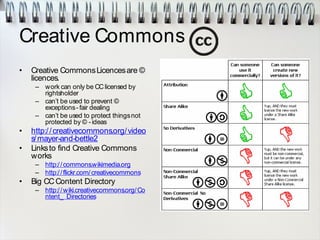
The Creative Commons
Creative Commons licenses are non-revocable.
Works under a Creative Commons licence must be used by licencees in
accordance with its terms. CC licences can vary considerably in scope.
Attribution = you must attribute the author and/or licensor in the manner
they require.
Non Commercial = you may not use the work in a manner primarily directed
toward commercial advantage or private monetary compensation.
NoDerivatives = you may only make verbatim copies of the work, you may
not adapt or change it.
ShareAlike = you may only make derivative works if you license them under
the same Creative Commons license terms.
When can you use an image?
When it’s qualified under Fair Use
When the author declares it public domain
When the author licenses it under an alternative
model
If you ask permission from the author
If you are the author
Searching and Sampling
Fair Use? What’s that?
•Under this clause, you can take copyrighted material and transform it into something else for criticism,
education, research, or parodying the original material.
•Examples:
•Saturday Night Live skits
•Using bits of work in a review of said work
•Limited copying made by a student for academic research
Fair Use is a privilege, not a right, so don’t abuse it.
No matter what, always make a habit to give credit to the author and link back to
his/her work.
Searching and Sampling
There is no real solid line to determine if an image is
Fair Use or infringement
Use the four factors to determine Fair Use
• The purpose of the derivative work (educational, parody, research)
• Nature of derived content
• Amount of original work used
• The effect that the new work has on the market value of the original
Stock Images
• http://www.morguefile.com/
• http://www.flickr.com/creativecom
mons/
• http://www.imageafter.com/
• http://www.sxc.hu/
• http://www.everystockphoto.com/
• http://www.studio25.ro/
• http://www.freepixels.com/
• http://pictures.fws.gov/
• http://images.jsc.nasa.gov/
• http://freestockphotos.com/
• http://www.flickr.com/
• http://freerangestock.com/
• http://www.freedigitalphotos.net/
• http://www.historicalstockphotos.c
om/
• http://www.pixelperfectdigital.com
/
• http://www.freemediagoo.com/
• http://openphoto.net/
• http://www.stockvault.net/
• http://browse.deviantart.com/reso
urces/stockart/
• http://www.dreamstime.com/free-
photos
• http://www.fotolia.com/FreeCont
ents
• http://www.iconspedia.com/
• http://www.bibleplaces.com/
• http://www.photolib.noaa.gov/
Advantages of Stock Photography
Stock is GREAT for Comps and Mock-Ups
Stock Photography is Cheaper and
Quicker Than a Photo Shoot
Stock Photography is Available for Instant
Download
For Brochures and Smaller Tactics, Stock
is Fine.
Problems with Stock Photography
Stock Photography is NOT
Original.
Stock Photographs Can Be
Bought By Anyone.
Stock Photography is Often
Cliché.
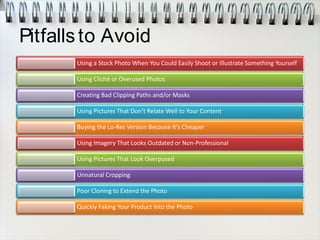
Pitfallsto Avoid
Using a Stock Photo When You Could Easily Shoot or Illustrate Something Yourself
Using Cliché or Overused Photos
Creating Bad Clipping Paths and/or Masks
Using Pictures That Don’t Relate Well to Your Content
Buying the Lo-Res Version Because It’s Cheaper
Using Imagery That Looks Outdated or Non-Professional
Using Pictures That Look Overposed
Unnatural Cropping
Poor Cloning to Extend the Photo
Quickly Faking Your Product Into the Photo
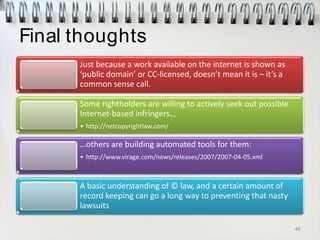
Final thoughts
Just because a work available on the internet is shown as
‘public domain’ or CC-licensed, doesn’t mean it is – it’s a
common sense call.
Some rightholders are willing to actively seek out possible
Internet-based infringers…
• http://netcopyrightlaw.com/
…others are building automated tools for them:
• http://www.virage.com/news/releases/2007/2007-04-05.xml
A basic understanding of © law, and a certain amount of
record keeping can go a long way to preventing that nasty
lawsuits
46

Copyright and stock images

  • 1.
  • 2.
    INTRO I found areally cool: film/video/music/photograph/text/game/ online - can I use it? What if I want to copy just a little part of that film/video/music/photograph/text/game … that’s ok, right? I heard you can use things in the “public domain”---what is that? Trademarks and Copyrights are basically the same thing---right? I got hired for a freelance project and got paid big bucks. The guy who hired me owns what I did right? Because he paid me? So I created a pretty cool: film/video/piece of music/text/game---how do I make sure that belongs to me? What happens if I collaborate with someone on a project? Do we both own the copyright? What’s “fair use?”
  • 3.
    Copyright Creative work is copyrightedwhen it becomes published - print or electronic Copyright belongs to the person or organization that creates the work As soon as the creator commits the intellectual property to a tangible medium it is protected by copyright
  • 4.
    Terminology • writingContent • imagessuch as logos, illustrations and photographs and the unique way those images are assembled in a publication Design
  • 5.
    What isa Copyright? •Fixed in a “tangible medium”—you have to be able to read it, see it, or hear it. For example, an impromptu speech that isn’t written down is not copyrightable. • Original—you made it up all by yourself. • Minimal creativity—the work is the product of at least a minimal level of creativity. (Pretty low standard) A copyright gives an author or other creative person certain protections in their work as soon as the work is created. To get a copyright the author’s work must be:
  • 6.
    Who seekscopyright protection? Designers Artistsfor their paintings, drawings, sculptures Photographers Authors for novels, textbooks, plays, movies Business owners for manuals, website content, advertising Musicians for musical compositions Software Developers for their computer code
  • 7.
    What worksare protected? Literaryworks Musical works, including any accompanying words Dramatic works, including any accompanying music Pantomimes and choreographic works Pictorial, graphic, and sculptural works Motion pictures and other audiovisual works Sound recordings Architectural works
  • 8.
    Fonts Customers should pay touse fonts “Using a font” does not include sending it to prepress along with other files for a job Prepress should pay for their own fonts If a job requires a font not already in the printer’s collection, the printer buys the license to use it
  • 9.
    I’m using animage I found through Google. If it’s on the internet, doesn’t that mean it’s free? No. Just because an image is on the internet, it doesn’t mean the image is free to use. You may still need the correct license to use it. There is a difference between an image being online and an image being “in the public domain” (the term given to content that is not owned or controlled by anyone).
  • 10.
    Some Background: The foundingfathers wanted to encourage creativity so they created what is informally referred to as the patent, trademark, and copyright clause of the Constitution: • “The Congress shall have Power To…promote the Progress of Science and Useful Arts, by securing for limited Times to Authors and Inventors the exclusive Right to their respective Writings and Discoveries;” • (Article 1, Section 8 in case you feel like reading it in your spare time.) The Copyright Act itself is a federal law that covers all the legal rules related to copyrighting.
  • 11.
    What Rightsdo CopyrightOwnersGet? • reproduce the work • prepare derivative works based upon the work • distribute copies of the work to the public by sale or other transfer of ownership, or by rental, lease, or lending • perform the work publicly • display the copyrighted work publicly • in the case of sound recordings, to perform the work publicly by means of digital audio transmission • in the case of a “work of visual art” the author has certain rights of attribution and integrity Copyright owners enjoy the exclusive right to:
  • 12.
    How do Iget a copyright? You technically have a copyright as soon as you “fix it into a tangible medium” BUT, and this is a big BUT: You must register you work with the United States Copyright Office in order to enforce your rights.
  • 13.
    Common Myths: • A:No…this just puts people on notice. You still need to register in order to sue. Q: Isn’t putting a © symbol next to what I create enough? • A: No again. You still need to register your work in order to sue. Q: What if I put my work in a self addressed envelope and mail it back to myself?
  • 14.
    So how doI register? •The cost of a copyright application is $45 •In some cases, you can register a series of works for one application fee. Depending on what you are copyrighting, you will need to fill out one of several forms available at www.copyright.gov
  • 15.
    Limited Duration: Copyrights donot last forever. Depending on the type of work, the copyright will last for 70 years after you die, or 120 years from its initial creation. Once the copyright expires, the work enters the “public domain.” Think the Mona Lisa…
  • 16.
    Permission You will alwaysneed to ask permission to use any part of (even if it’s a little teeny itty bit) of a film/video/music/photograph/text/ game/ that’s not yours. • Well…almost always.
  • 17.
    When Can Iget away with NOT asking for Permission? Works for which the copyright has expired. (tough to figure out unless its really really old) Works clearly and explicitly donated to the public domain. Works that have not been fixed in a tangible form of expression (for example, choreographic works that have not been notated or recorded, or spontaneous speeches or performances that have not been written or recorded). Works consisting entirely of information that is common property and contains no original authorship (for example, standard calendars, height and weight charts, tape measures and rulers, and lists or tables taken from public documents or other common sources).
  • 18.
    Titles, Names, ShortPhrasesand Slogans= Trademarks Titles, names, short phrases, and slogans; familiar symbols or designs; mere variations of typographic ornamentation, lettering, or coloring; mere listings of ingredients or contents are NOT protected by copyright. This is what trademark law is for. A trademark, unlike a copyright, is a source identifier. The owner of a trademark gets a totally different set of rights than those granted to a copyright owner.
  • 19.
    Ideas, Procedures, Methods,systems, etc. = Patents Ideas, procedures, methods, systems, processes, concepts, principles, discoveries, or devices, as distinguished from a description, explanation, or illustration are NOT protected by copyright. This is what patent law is for.
  • 20.
    What is“Fair Use”? •criticism, • commentary • news reporting • teaching • scholarship • research. Sometimes you can use copyrighted work for the purposes of:
  • 21.
    To determine FairUse The factors used to determine whether your copying constitutes fair use include: the purpose and character of the use, including whether such use is of a commercial nature or is for nonprofit educational purposes. the nature of the copyrighted work. the amount and substantiality of the portion used in relation to the copyrighted work as a whole. the effect of the use upon the potential market for or value of the copyrighted work.
  • 22.
    Don’t rely onFair Use Just because you may have a fair use defense, doesn’t mean you’ll want to test it. This is a very fact heavy defense….. Law suits are expensive. If possible: ask permission!
  • 23.
    Letstalk about jointworks A “joint work” is a work prepared by two or more authors with the intention that their contributions be merged into inseparable or interdependent parts of a unitary whole. The authors of a joint work are co-owners of copyright in the work. Joint Ownership has serious implications …
  • 24.
    More specifically…. Each co-authorwill own an equal ownership share in the work. This will occur even if one of the co- authors has contributed a greater quantity of the work than the other co-authors. Each co-author will own an "undivided" interest in the entire work. Any co-author, without the permission of their fellow co-authors, may grant non-exclusive rights to the work to third parties. (However, a co-author may only grant exclusive rights to the work to third parties if the co-author obtains the prior consent of the other co-authors.)
  • 25.
    Co-Authors Each co-author hasa duty to account to the other co-authors for any profits obtained from the exploitation of the work. A co-author has the right to assign his/her ownership share in the work to a third party or to bequeath his/her ownership share to his/her heirs. Each co-author will be entitled to equal authorship credit for the work upon its publication.
  • 26.
    Get a collaborationagreement in place The best way to sort out joint ownership is through discussion and agreement at the start of a project. Figure out who owns what and how $$$ will be distributed based on the contribution.
  • 27.
    Employee vs. IndependentContractor •a) work for someone and •b) when you work for yourself Now its time to discuss ownership rights when you
  • 28.
    Work for HireAgreement A smart client will ask you to create the work as a “work-made-for-hire.” That way, even though you created the work, the client owns the copyright.
  • 29.
    Work-for-Hire If work iscreated by an employee as part of the job responsibilities, the organizations owns the copyright If the image is created on commission the artist owns the copyright unless the contract between client and artist includes a specific provision “work-for-hire” that transfers ownership to the client A lot of the times, the commissioned work doesn’t exactly fit the “work-for-hire” requirements. In that case, the client will ask you to “ASSIGN” your rights---in writing.
  • 30.
    What isa “WorkMade for Hire” •A work prepared by an employee within the scope of his or her employment; or •A work specially ordered or commissioned for use as a contribution to a collective work: •as a part of a motion picture •as a part of other audiovisual work, •as a translation, •as a supplementary work, •as a compilation, •as an instructional text, •as a test, •as answer material for a test, or •as an atlas The Copyright Act defines a “work made for hire” as:
  • 31.
    Employees As an employee,any work you create, within the scope of your employment is automatically owned by… YOUR EMPLOYER. No extra paperwork needed. The implications of this: •Since your employer owns the work, you can’t then use what you created later at a new job … or even to post on your website or to include in your portfolio. •You can only do these things if you: GET PERMISSION.
  • 32.
    What if I’ma freelancer If you are creating work as a freelancer, you are probably being hired as an • INDEPENDENT CONTRACTOR. The person hiring you doesn’t pay your health insurance, your employment taxes, etc. As an independent contractor, you retain ownership of everything you create. This is true even if the client pays you for the work
  • 33.
    Assignment vs. Licensing Assignmentmeans you give the client ALL of your copyrights. If you don’t want to give up ALL your rights, you may LICENSE part of your rights.
  • 34.
    Implied License toUse What happens if you get hired to create something, but you never sign a written agreement? Can you prevent the client from using your work if you are mad at him - or if he doesn’t pay you? Probably NOT under Copyright Law. Courts, based on the conduct of the parties, will usually find that the client was granted a non-exclusive license for the intended use. You’d have to pursue this under a breach of contract claim, if you don’t get paid for your work.
  • 35.
    Intellectual Property Law Intellectualproperty rights (IPRs) allow individuals to claim and exercise rights in their creative and innovative works Some IPRs are well known • copyright, patent, designs, and trademark Others are known primarily to specialists • trade secrets, geographical indications, semiconductor chip topography rights, plant varieties and performers rights. A work may be protected by several IPRs.
  • 36.
    Creative Commons • CreativeCommonsLicencesare © licences. – work can only be CClicensed by rightsholder – can’t be used to prevent © exceptions- fair dealing – can’t be used to protect thingsnot protected by © - ideas • http://creativecommons.org/video s/mayer-and-bettle2 • Linksto find Creative Commons works – http://commons.wikimedia.org – http://flickr.com/creativecommons • Big CCContent Directory – http://wiki.creativecommons.org/Co ntent_ Directories
  • 37.
    What isCreative Commons? Authoruses this license to share his or her work to the public and still have control over how it’s used (derivative works, non profit, educational, etc) The public must always give credit to the author. You can use Creative Commons for your work as well.
  • 38.
    The Creative Commons CreativeCommons licenses are non-revocable. Works under a Creative Commons licence must be used by licencees in accordance with its terms. CC licences can vary considerably in scope. Attribution = you must attribute the author and/or licensor in the manner they require. Non Commercial = you may not use the work in a manner primarily directed toward commercial advantage or private monetary compensation. NoDerivatives = you may only make verbatim copies of the work, you may not adapt or change it. ShareAlike = you may only make derivative works if you license them under the same Creative Commons license terms.
  • 39.
    When can youuse an image? When it’s qualified under Fair Use When the author declares it public domain When the author licenses it under an alternative model If you ask permission from the author If you are the author
  • 40.
    Searching and Sampling FairUse? What’s that? •Under this clause, you can take copyrighted material and transform it into something else for criticism, education, research, or parodying the original material. •Examples: •Saturday Night Live skits •Using bits of work in a review of said work •Limited copying made by a student for academic research Fair Use is a privilege, not a right, so don’t abuse it. No matter what, always make a habit to give credit to the author and link back to his/her work.
  • 41.
    Searching and Sampling Thereis no real solid line to determine if an image is Fair Use or infringement Use the four factors to determine Fair Use • The purpose of the derivative work (educational, parody, research) • Nature of derived content • Amount of original work used • The effect that the new work has on the market value of the original
  • 42.
    Stock Images • http://www.morguefile.com/ •http://www.flickr.com/creativecom mons/ • http://www.imageafter.com/ • http://www.sxc.hu/ • http://www.everystockphoto.com/ • http://www.studio25.ro/ • http://www.freepixels.com/ • http://pictures.fws.gov/ • http://images.jsc.nasa.gov/ • http://freestockphotos.com/ • http://www.flickr.com/ • http://freerangestock.com/ • http://www.freedigitalphotos.net/ • http://www.historicalstockphotos.c om/ • http://www.pixelperfectdigital.com / • http://www.freemediagoo.com/ • http://openphoto.net/ • http://www.stockvault.net/ • http://browse.deviantart.com/reso urces/stockart/ • http://www.dreamstime.com/free- photos • http://www.fotolia.com/FreeCont ents • http://www.iconspedia.com/ • http://www.bibleplaces.com/ • http://www.photolib.noaa.gov/
  • 43.
    Advantages of StockPhotography Stock is GREAT for Comps and Mock-Ups Stock Photography is Cheaper and Quicker Than a Photo Shoot Stock Photography is Available for Instant Download For Brochures and Smaller Tactics, Stock is Fine.
  • 44.
    Problems with StockPhotography Stock Photography is NOT Original. Stock Photographs Can Be Bought By Anyone. Stock Photography is Often Cliché.
  • 45.
    Pitfallsto Avoid Using aStock Photo When You Could Easily Shoot or Illustrate Something Yourself Using Cliché or Overused Photos Creating Bad Clipping Paths and/or Masks Using Pictures That Don’t Relate Well to Your Content Buying the Lo-Res Version Because It’s Cheaper Using Imagery That Looks Outdated or Non-Professional Using Pictures That Look Overposed Unnatural Cropping Poor Cloning to Extend the Photo Quickly Faking Your Product Into the Photo
  • 46.
    Final thoughts Just becausea work available on the internet is shown as ‘public domain’ or CC-licensed, doesn’t mean it is – it’s a common sense call. Some rightholders are willing to actively seek out possible Internet-based infringers… • http://netcopyrightlaw.com/ …others are building automated tools for them: • http://www.virage.com/news/releases/2007/2007-04-05.xml A basic understanding of © law, and a certain amount of record keeping can go a long way to preventing that nasty lawsuits 46