Ethics:
a branch of philosophy which defines what is good for
individuals and society.
P3
describe contractual, legal and ethical obligations in the games
industry with some appropriate use of subject terminology
M3
explain contractual, legal and ethical obligations in the games industry
with reference to detailed illustrative examples and generally correct
use of subject terminology
D3
comprehensively explain contractual, legal and ethical obligations in
the games industry with reference to elucidated examples and
consistently using subject terminology correctly
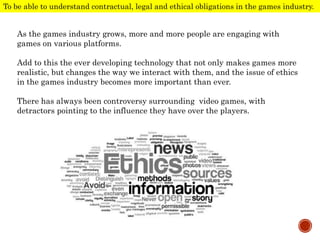
As the games industry grows, more and more people are engaging with
games on various platforms.
Add to this the ever developing technology that not only makes games more
realistic, but changes the way we interact with them, and the issue of ethics
in the games industry becomes more important than ever.
There has always been controversy surrounding video games, with
detractors pointing to the influence they have over the players.
To be able to understand contractual, legal and ethical obligations in the games industry.
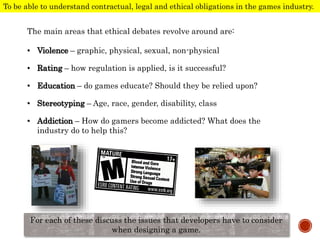
The main areas that ethical debates revolve around are:
• Violence – graphic, physical, sexual, non-physical
• Rating – how regulation is applied, is it successful?
• Education – do games educate? Should they be relied upon?
• Stereotyping – Age, race, gender, disability, class
• Addiction – How do gamers become addicted? What does the
industry do to help this?
To be able to understand contractual, legal and ethical obligations in the games industry.
For each of these discuss the issues that developers have to consider
when designing a game.
It becomes the responsibility of both the industry and the consumer to be
aware of the issues in gaming and act accordingly.
Research the following organisations an outline their role in the industry…
• The Entertainment and Leisure Software Publishers’ Association
(ELSPA)
• The Independent Games Developers Association (IGDA)
• Women in Games
• British Academy of Film and Television Arts (BAFTA)
• The Mobile Entertainment Forum (MEF)
To be able to understand contractual, legal and ethical obligations in the games industry.
http://www.ethicapublishing.com/ethical/3CH12.pdf

Ethical issues in the Games industry

  • 1.
    Ethics: a branch ofphilosophy which defines what is good for individuals and society.
  • 2.
    P3 describe contractual, legaland ethical obligations in the games industry with some appropriate use of subject terminology M3 explain contractual, legal and ethical obligations in the games industry with reference to detailed illustrative examples and generally correct use of subject terminology D3 comprehensively explain contractual, legal and ethical obligations in the games industry with reference to elucidated examples and consistently using subject terminology correctly
  • 3.
    As the gamesindustry grows, more and more people are engaging with games on various platforms. Add to this the ever developing technology that not only makes games more realistic, but changes the way we interact with them, and the issue of ethics in the games industry becomes more important than ever. There has always been controversy surrounding video games, with detractors pointing to the influence they have over the players. To be able to understand contractual, legal and ethical obligations in the games industry.
  • 4.
    The main areasthat ethical debates revolve around are: • Violence – graphic, physical, sexual, non-physical • Rating – how regulation is applied, is it successful? • Education – do games educate? Should they be relied upon? • Stereotyping – Age, race, gender, disability, class • Addiction – How do gamers become addicted? What does the industry do to help this? To be able to understand contractual, legal and ethical obligations in the games industry. For each of these discuss the issues that developers have to consider when designing a game.
  • 5.
    It becomes theresponsibility of both the industry and the consumer to be aware of the issues in gaming and act accordingly. Research the following organisations an outline their role in the industry… • The Entertainment and Leisure Software Publishers’ Association (ELSPA) • The Independent Games Developers Association (IGDA) • Women in Games • British Academy of Film and Television Arts (BAFTA) • The Mobile Entertainment Forum (MEF) To be able to understand contractual, legal and ethical obligations in the games industry.
  • 6.