Department Of Civil Engineering
Micro Project PPT
ON
‘Application Of Principle
Transmissibility Force’
Under The Guidance Of
Dr. R. Gawande
Maharashtra State Board of Technical Education,
Mumbai (Autonomous) (ISO-9001-2008) (ISO/IEC 27001:2013)
Academic Year 2022-2023
Submitted By:
 Sudhir Shende - 13
 Bhuvan Bisane - 14
Orthogonal and non orthogonal force
The Power of Lemi's Theorem: Illustrated Examples
Index
• R E S U LTA N T O F F O R C E S Y S T E M :
1 . R e s u l t a n t o f C o n c u r r e n t F o r c e s
2 . R e s u l t a n t o f N o n - C o n c u r r e n t F o r c e s
• PA R A L L E L F O R C E S Y S T E M :
1 . C h a r a c t e r i s t i c o f a F o r c e
• M O M E N T O F A F O R C E S :
1 . M o m e n t o f C o p l a n a r F o r c e s
2 . M o m e n t o f a F o r c e a b o u t a P o i n t a n d a n
A x i s
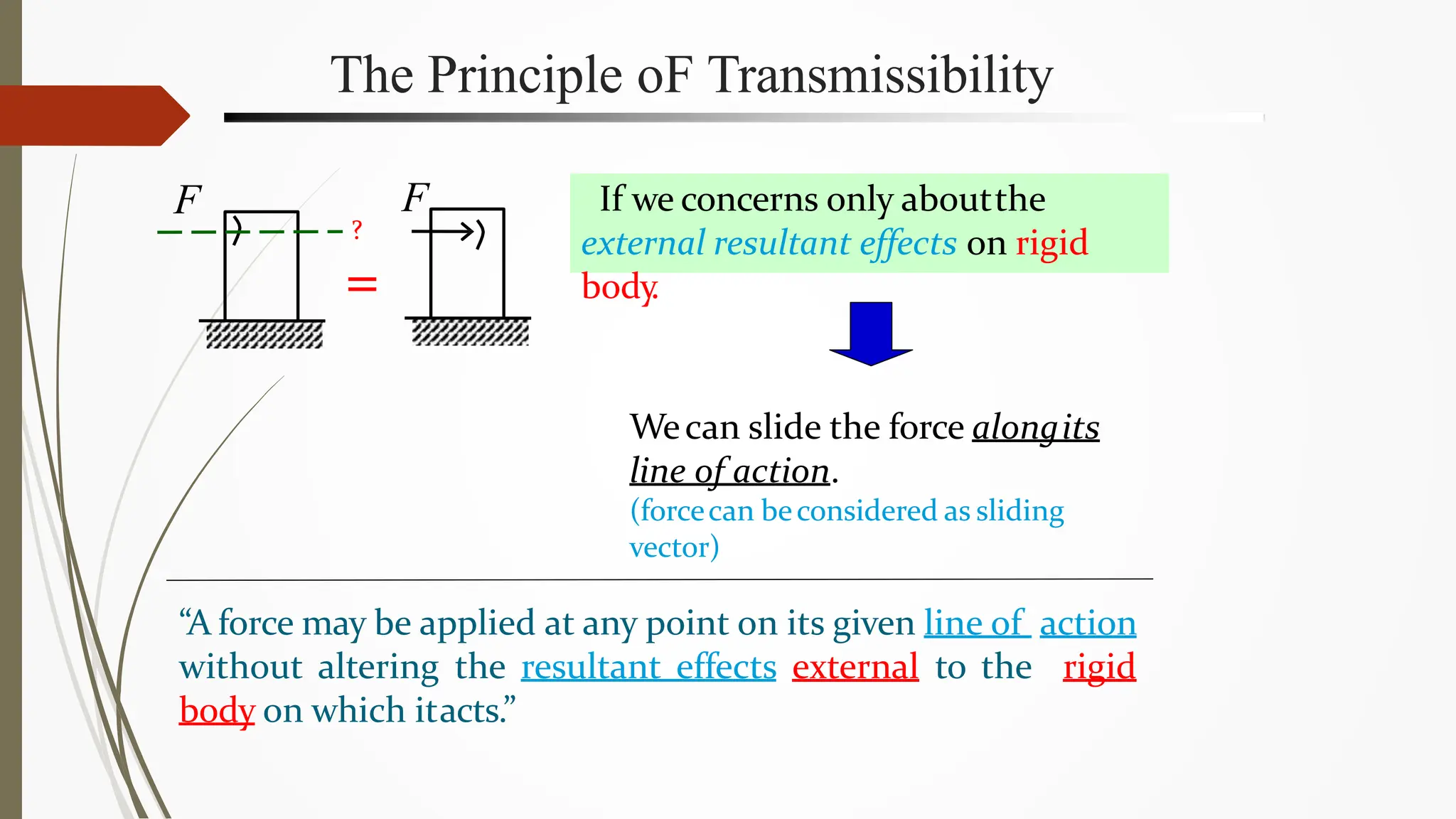
The Principle oF Transmissibility
“A force may be applied at any point on its given line of action
without altering the resultant effects external to the rigid
body on which itacts.”
Wecan slide the force alongits
line of action.
(forcecan beconsidered as sliding
vector)
F
F
?
=
If we concerns only aboutthe
external resultant effects on rigid
body
.
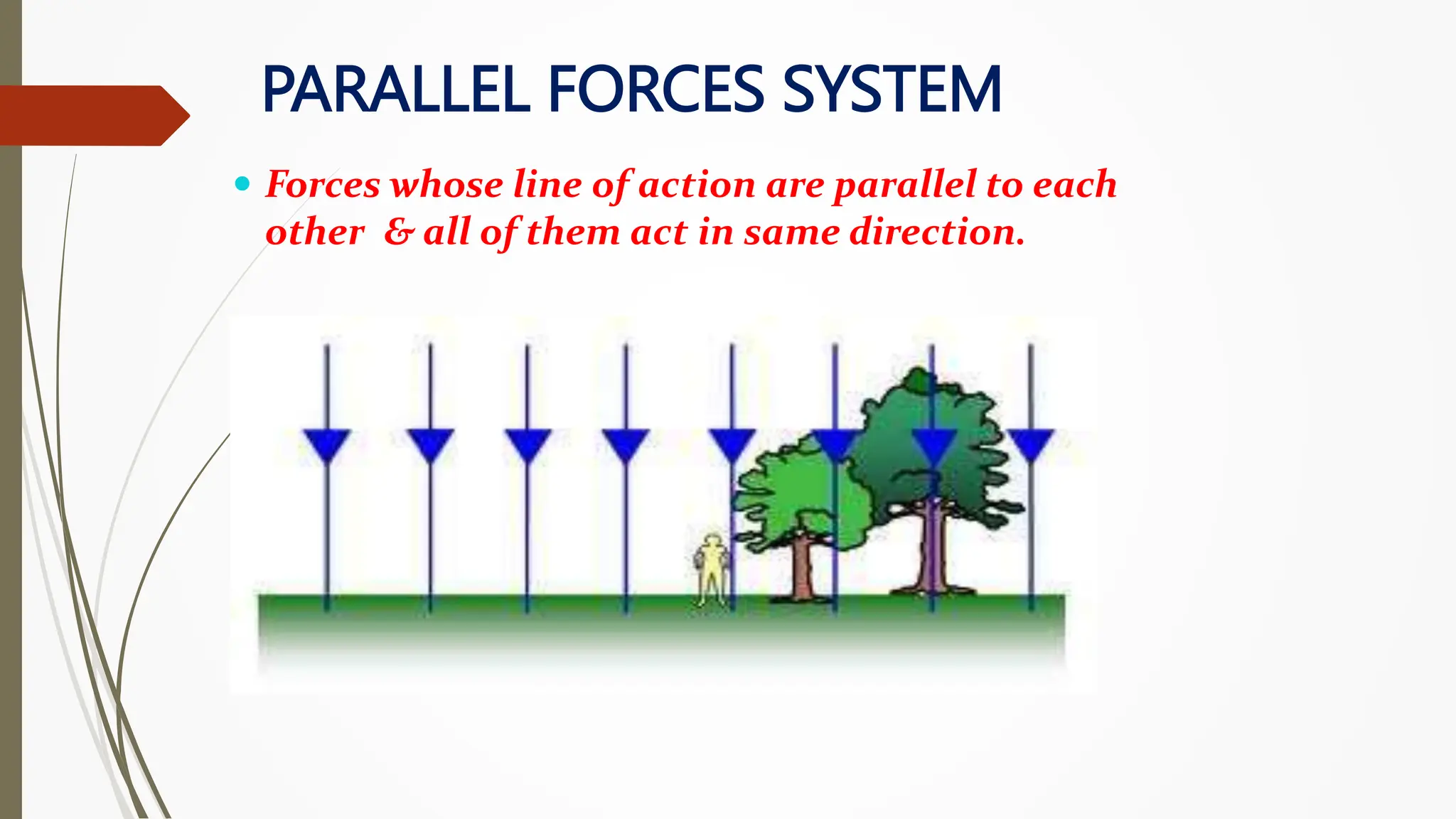
PARALLEL FORCES SYSTEM
 Forces whose line of action are parallel to each
other & all of them act in same direction.
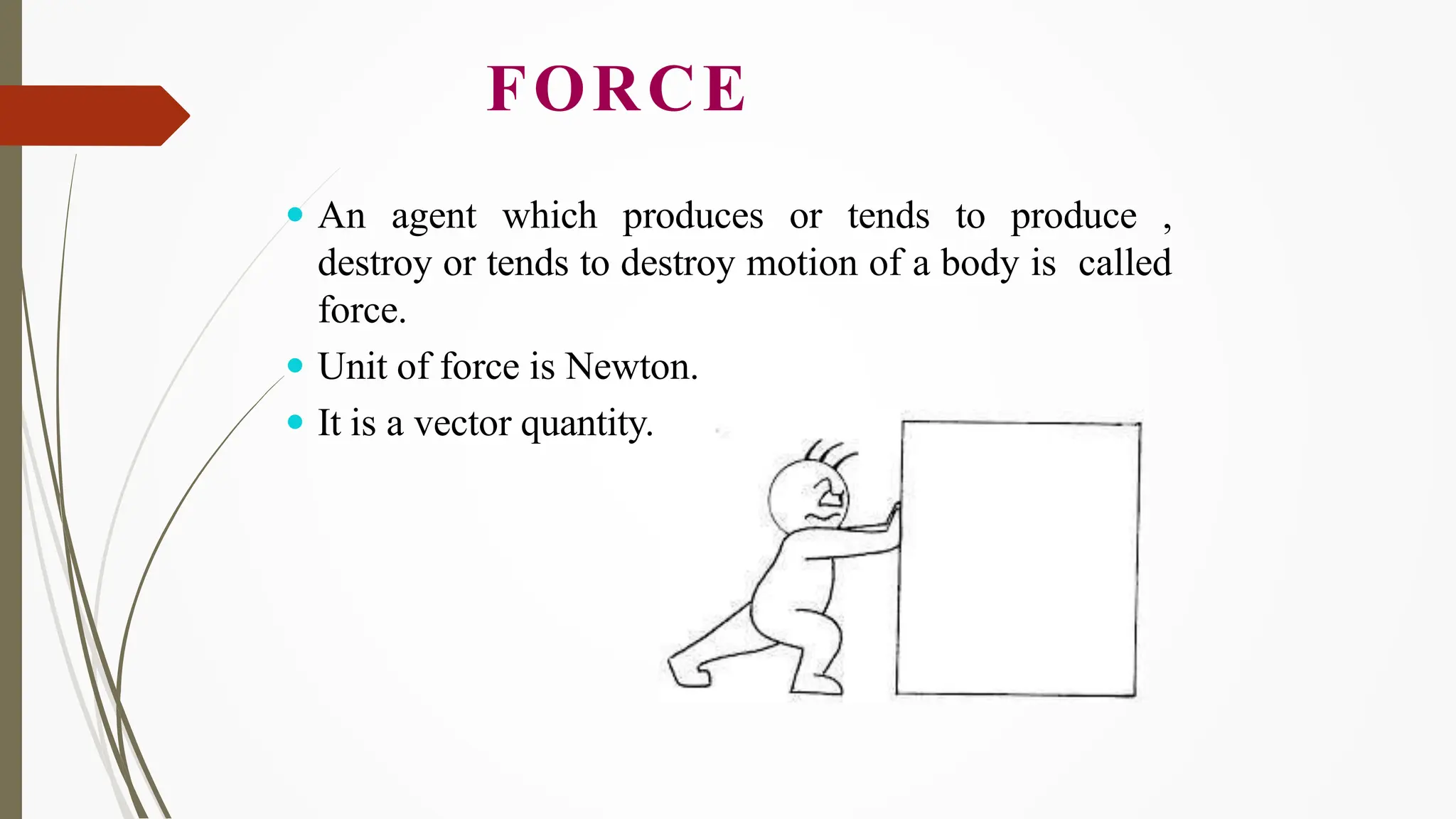
FORCE
 An agent which produces or tends to produce ,
destroy or tends to destroy motion of a body is called
force.
 Unit of force is Newton.
 It is a vector quantity.
RESULTANT OF CONCURRENT FORCE
SYSTEM
1. Resultant of Concurrent Forces:
The resultant of a concurrent force system can be defined as the
simplest single force which can replace the original system
without changing its external effect on a rigid body.
2. Resultant of Non-Concurrent Forces:
The resultant will not necessarily be a single force but a force
system comprising a force or a couple or a force and a couple.
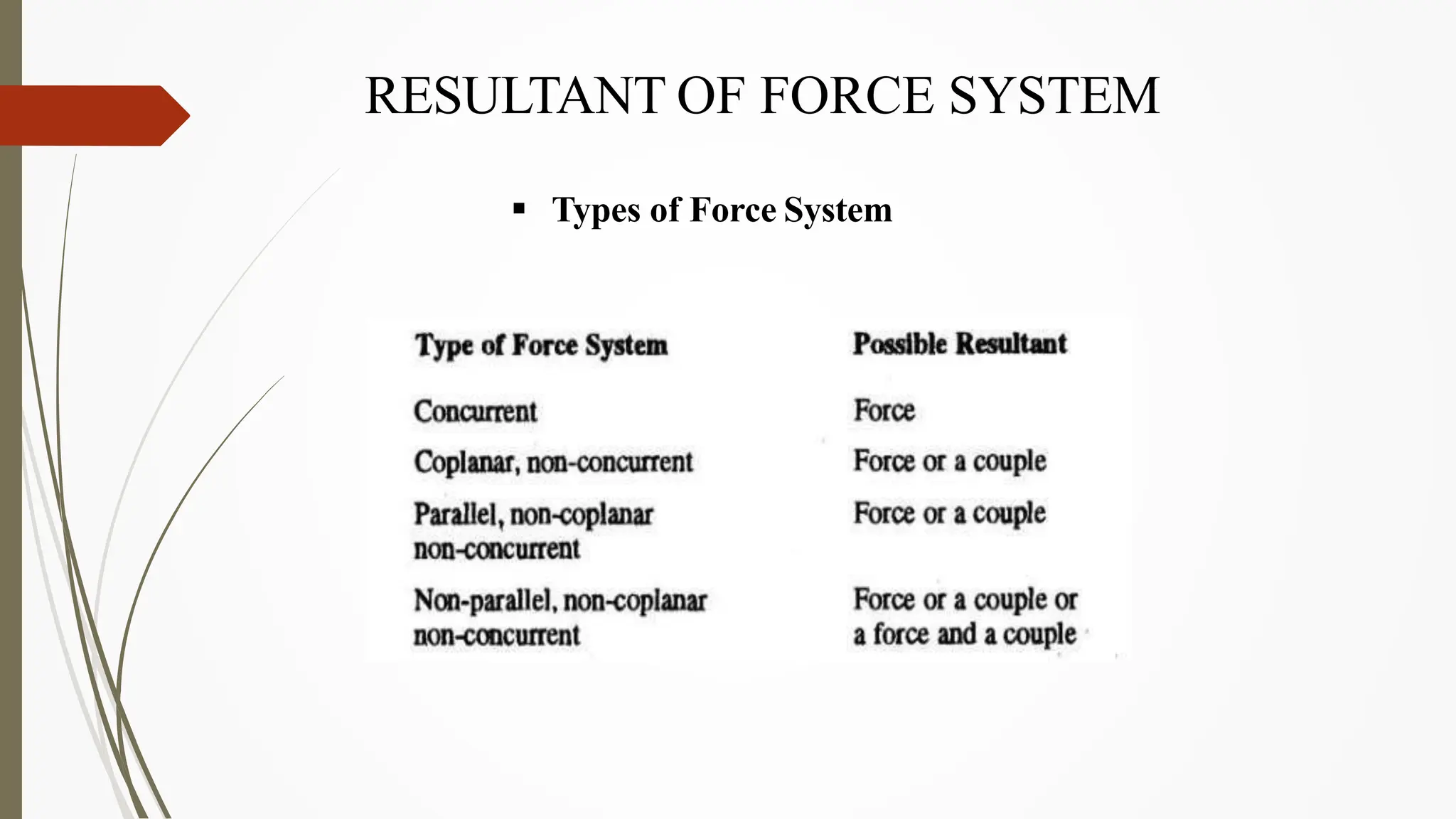
RESULTANT OF FORCE SYSTEM
 Types of Force System
RESULTANT OF FORCE SYSTEM
1. Resultant of Concurrent Forces:
The resultant of a concurrent force system can be defined as the
simplest single force which can replace the original system
without changing its external effect on a rigid body.
 Coplanar Concurrent Force
 Non-Coplanar Concurrent Force
2. Resultant of Non-Concurrent Forces:
The resultant will not necessarily be a single force but a force
system comprising a force or a couple or a force and a couple.
 Coplanar Non-Concurrent Force
 Non-Coplanarand Non-Concurrent Force
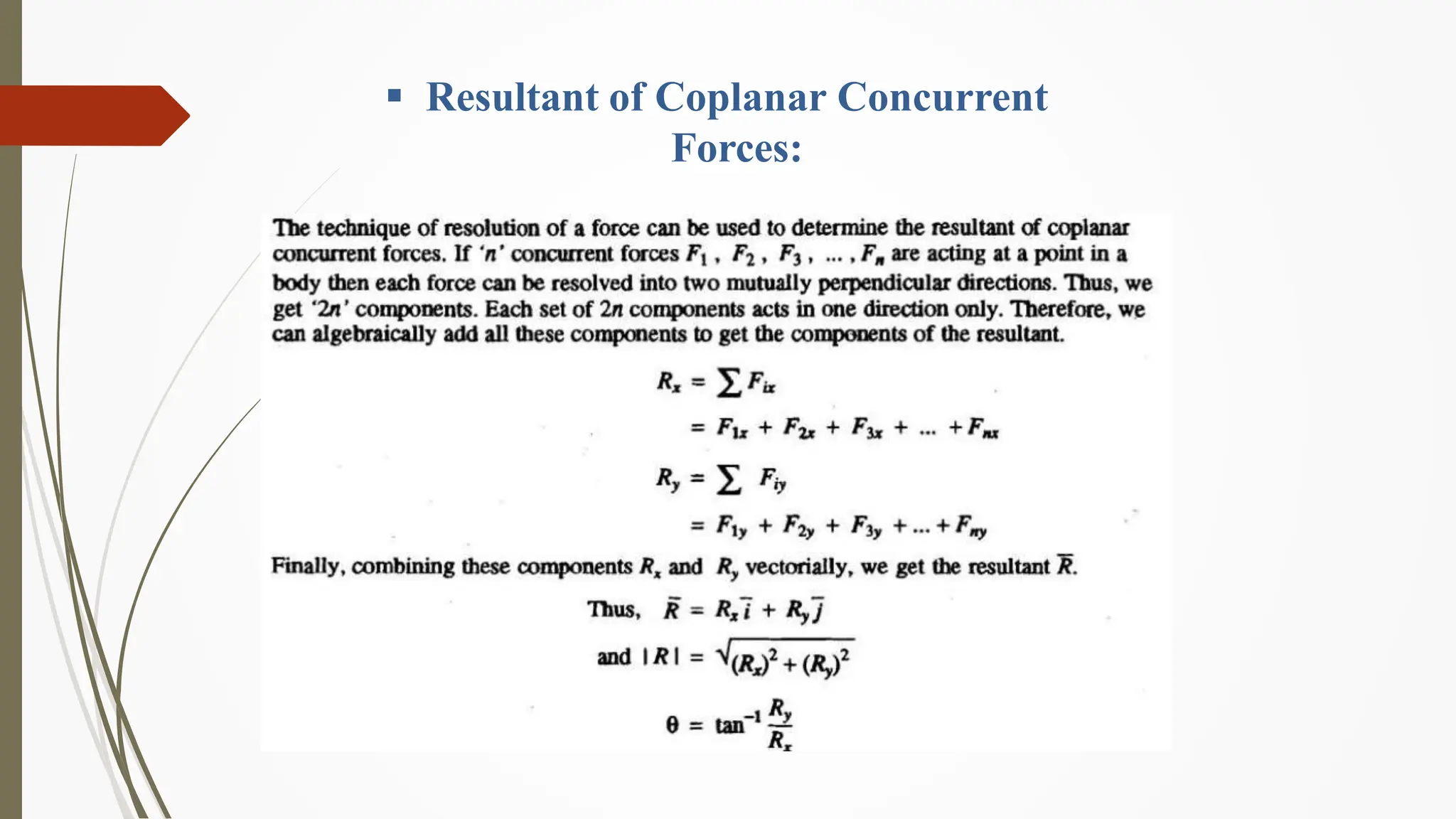
 Resultant of Coplanar Concurrent
Forces:
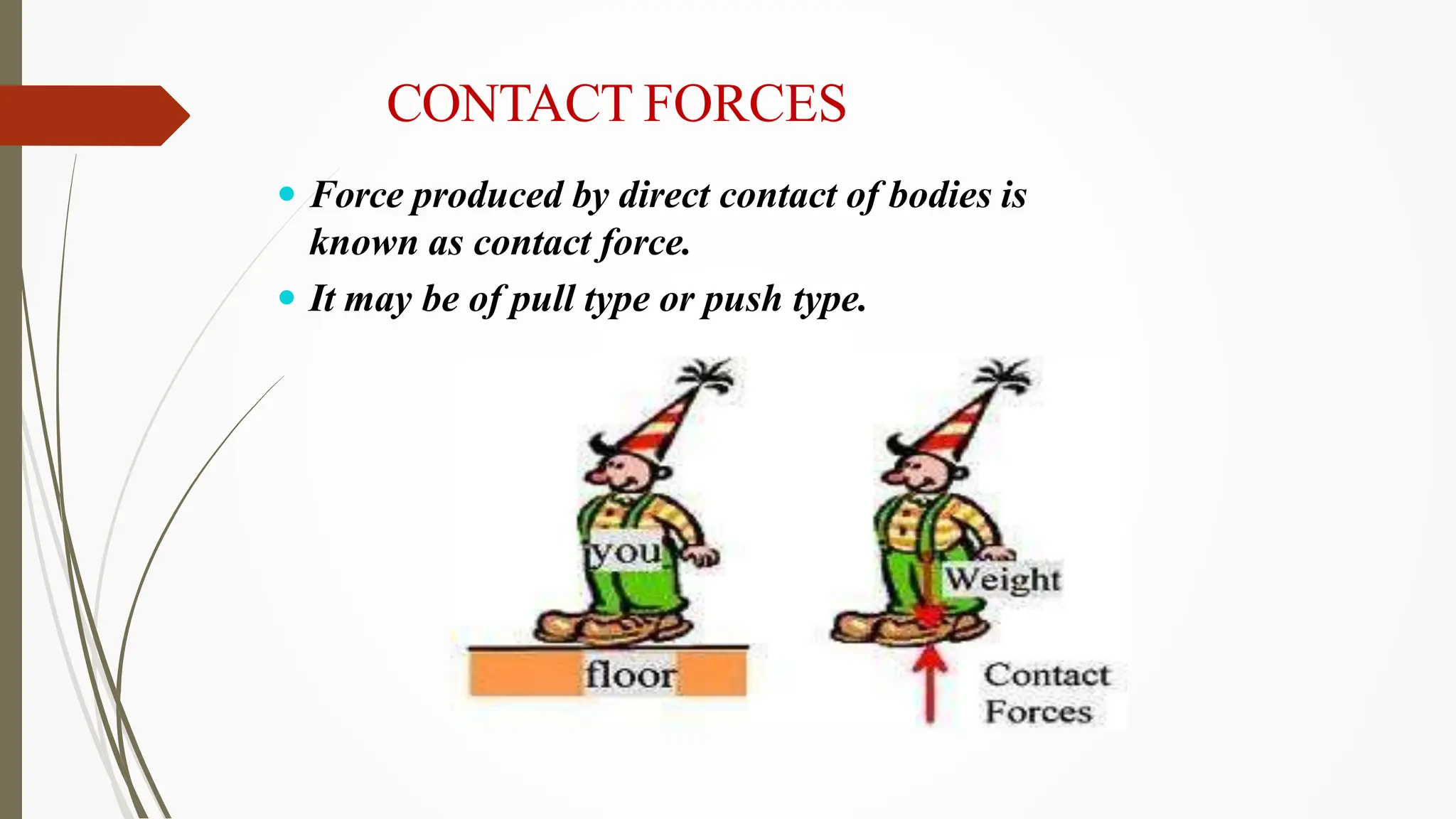
CONTACT FORCES
 Force produced by direct contact of bodies is
known as contact force.
 It may be of pull type or push type.

Forces.pptxppt types of forces polytechnic

  • 1.
    Department Of CivilEngineering Micro Project PPT ON ‘Application Of Principle Transmissibility Force’ Under The Guidance Of Dr. R. Gawande Maharashtra State Board of Technical Education, Mumbai (Autonomous) (ISO-9001-2008) (ISO/IEC 27001:2013) Academic Year 2022-2023 Submitted By:  Sudhir Shende - 13  Bhuvan Bisane - 14 Orthogonal and non orthogonal force The Power of Lemi's Theorem: Illustrated Examples
  • 2.
    Index • R ES U LTA N T O F F O R C E S Y S T E M : 1 . R e s u l t a n t o f C o n c u r r e n t F o r c e s 2 . R e s u l t a n t o f N o n - C o n c u r r e n t F o r c e s • PA R A L L E L F O R C E S Y S T E M : 1 . C h a r a c t e r i s t i c o f a F o r c e • M O M E N T O F A F O R C E S : 1 . M o m e n t o f C o p l a n a r F o r c e s 2 . M o m e n t o f a F o r c e a b o u t a P o i n t a n d a n A x i s
  • 3.
    The Principle oFTransmissibility “A force may be applied at any point on its given line of action without altering the resultant effects external to the rigid body on which itacts.” Wecan slide the force alongits line of action. (forcecan beconsidered as sliding vector) F F ? = If we concerns only aboutthe external resultant effects on rigid body .
  • 4.
    PARALLEL FORCES SYSTEM Forces whose line of action are parallel to each other & all of them act in same direction.
  • 5.
    FORCE  An agentwhich produces or tends to produce , destroy or tends to destroy motion of a body is called force.  Unit of force is Newton.  It is a vector quantity.
  • 6.
    RESULTANT OF CONCURRENTFORCE SYSTEM 1. Resultant of Concurrent Forces: The resultant of a concurrent force system can be defined as the simplest single force which can replace the original system without changing its external effect on a rigid body. 2. Resultant of Non-Concurrent Forces: The resultant will not necessarily be a single force but a force system comprising a force or a couple or a force and a couple.
  • 7.
    RESULTANT OF FORCESYSTEM  Types of Force System
  • 8.
    RESULTANT OF FORCESYSTEM 1. Resultant of Concurrent Forces: The resultant of a concurrent force system can be defined as the simplest single force which can replace the original system without changing its external effect on a rigid body.  Coplanar Concurrent Force  Non-Coplanar Concurrent Force 2. Resultant of Non-Concurrent Forces: The resultant will not necessarily be a single force but a force system comprising a force or a couple or a force and a couple.  Coplanar Non-Concurrent Force  Non-Coplanarand Non-Concurrent Force
  • 9.
     Resultant ofCoplanar Concurrent Forces:
  • 10.
    CONTACT FORCES  Forceproduced by direct contact of bodies is known as contact force.  It may be of pull type or push type.