


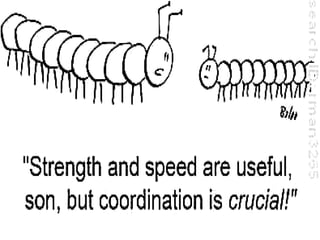



What is co-ordination?
 CO-ORDINATION implies an orderly pattern
or arrangement of group efforts to
ensure unity of actions in the pursuit of
common objectives. Coordination is the
orderly synchronizing of efforts of the
subordinates to provide the proper
amount, timing and quality of execution
so that their unified efforts lead to the
stated objective, namely, the common
purpose of the enterprise.
Co-ordination
 The Essence of Management Coming together
is a beginning, Keeping together is progress &
Working together is success. - Henry Ford
 “Coordination is balancing and keeping together
the team by ensuring suitable allocation of tasks
tom the various members and seeing that the
tasks are performed with harmony among the
members themselves.- Edward Francis Leopold
Brech
Nature & Features:
 Nature & Features are Not a distinct
function but the very essence for
management.
 Basic responsibility of manager. Does
not arise spontaneously or by force; has
to be through conscious efforts of the
management.
 Common purpose Balancing, timing and
integrating are the 3 basic elements to
be executed by management.
Types of co-ordination :
 Coordination can be classified as:
 Internal and External
 Vertical and Horizontal
 Procedural and Substantive
Internal co-ordination
 Internal Coordination among the
employees of the same department or
section, among workers or managers at
various levels, among branch offices,
plants, departments and sections.
External Coordination:
 External Coordination with customers,
suppliers, government and outsiders
with whom the enterprise has business
connections.
Vertical Coordination:
 Vertical Coordination This exists within a
department where the departmental
head is called upon to coordinate the
activities of all those placed below him.
Horizontal Co-ordination:
 This exists between different
departments such as production, sales,
purchasing, finance, personnel etc.
Procedural and Substantive co-
ordination:
 Procedural Coordination: It is the generalized
description of the behaviors and relationships
of the members of the organization. This
establishes the lines of authority and outlines
the sphere of activity and authority of each
member of the organization.
 Substantive Coordination: This is concerned
with the contents of the organizations
activities. In an automobile factory, an
organization chart is an aspect of procedural
coordination, while blueprints for the engine
block of the car being made are an aspect of
substantive coordination
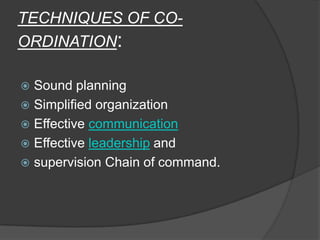
TECHNIQUES OF CO-
ORDINATION:
 Sound planning
 Simplified organization
 Effective communication
 Effective leadership and
 supervision Chain of command.
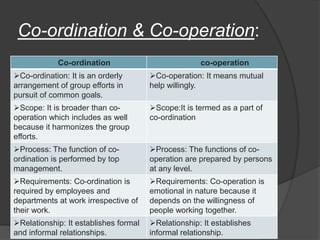
Co-ordination & Co-operation:
Co-ordination co-operation
Co-ordination: It is an orderly
arrangement of group efforts in
pursuit of common goals.
Co-operation: It means mutual
help willingly.
Scope: It is broader than co-
operation which includes as well
because it harmonizes the group
efforts.
Scope:It is termed as a part of
co-ordination
Process: The function of co-
ordination is performed by top
management.
Process: The functions of co-
operation are prepared by persons
at any level.
Requirements: Co-ordination is
required by employees and
departments at work irrespective of
their work.
Requirements: Co-operation is
emotional in nature because it
depends on the willingness of
people working together.
Relationship: It establishes formal
and informal relationships.
Relationship: It establishes
informal relationship.
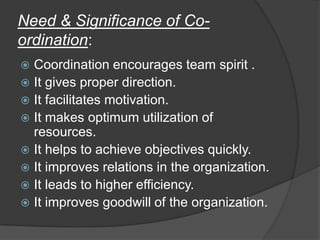
Need & Significance of Co-
ordination:
 Coordination encourages team spirit .
 It gives proper direction.
 It facilitates motivation.
 It makes optimum utilization of
resources.
 It helps to achieve objectives quickly.
 It improves relations in the organization.
 It leads to higher efficiency.
 It improves goodwill of the organization.
Presentation c ordination

Presentation c ordination

  • 2.
    What is co-ordination? CO-ORDINATION implies an orderly pattern or arrangement of group efforts to ensure unity of actions in the pursuit of common objectives. Coordination is the orderly synchronizing of efforts of the subordinates to provide the proper amount, timing and quality of execution so that their unified efforts lead to the stated objective, namely, the common purpose of the enterprise.
  • 3.
    Co-ordination  The Essenceof Management Coming together is a beginning, Keeping together is progress & Working together is success. - Henry Ford  “Coordination is balancing and keeping together the team by ensuring suitable allocation of tasks tom the various members and seeing that the tasks are performed with harmony among the members themselves.- Edward Francis Leopold Brech
  • 5.
    Nature & Features: Nature & Features are Not a distinct function but the very essence for management.  Basic responsibility of manager. Does not arise spontaneously or by force; has to be through conscious efforts of the management.  Common purpose Balancing, timing and integrating are the 3 basic elements to be executed by management.
  • 7.
    Types of co-ordination:  Coordination can be classified as:  Internal and External  Vertical and Horizontal  Procedural and Substantive
  • 8.
    Internal co-ordination  InternalCoordination among the employees of the same department or section, among workers or managers at various levels, among branch offices, plants, departments and sections.
  • 9.
    External Coordination:  ExternalCoordination with customers, suppliers, government and outsiders with whom the enterprise has business connections.
  • 10.
    Vertical Coordination:  VerticalCoordination This exists within a department where the departmental head is called upon to coordinate the activities of all those placed below him.
  • 11.
    Horizontal Co-ordination:  Thisexists between different departments such as production, sales, purchasing, finance, personnel etc.
  • 12.
    Procedural and Substantiveco- ordination:  Procedural Coordination: It is the generalized description of the behaviors and relationships of the members of the organization. This establishes the lines of authority and outlines the sphere of activity and authority of each member of the organization.  Substantive Coordination: This is concerned with the contents of the organizations activities. In an automobile factory, an organization chart is an aspect of procedural coordination, while blueprints for the engine block of the car being made are an aspect of substantive coordination
  • 14.
    TECHNIQUES OF CO- ORDINATION: Sound planning  Simplified organization  Effective communication  Effective leadership and  supervision Chain of command.
  • 15.
    Co-ordination & Co-operation: Co-ordinationco-operation Co-ordination: It is an orderly arrangement of group efforts in pursuit of common goals. Co-operation: It means mutual help willingly. Scope: It is broader than co- operation which includes as well because it harmonizes the group efforts. Scope:It is termed as a part of co-ordination Process: The function of co- ordination is performed by top management. Process: The functions of co- operation are prepared by persons at any level. Requirements: Co-ordination is required by employees and departments at work irrespective of their work. Requirements: Co-operation is emotional in nature because it depends on the willingness of people working together. Relationship: It establishes formal and informal relationships. Relationship: It establishes informal relationship.
  • 16.
    Need & Significanceof Co- ordination:  Coordination encourages team spirit .  It gives proper direction.  It facilitates motivation.  It makes optimum utilization of resources.  It helps to achieve objectives quickly.  It improves relations in the organization.  It leads to higher efficiency.  It improves goodwill of the organization.