Cooperative Learning


An Overview
Definition
   What it IS
   What it IS NOT
   Based on theory and work of Johnson and
    Johnson
Cooperative Learning is…
 Applied Social Psychology
 Intentional structuring of learning goals
   – to promote Positive Interdependence
   – Intentional structuring of learning goals so that students
     are encouraged to engage in Promotive Interaction
 Promotive Interaction is more likely to occur when
  there are 5 key elements intentionally structured
  and monitored throughout the lesson.
Learning Goals can be structured 3
           different ways:

 Cooperatively

 Competitively

 Individualistically
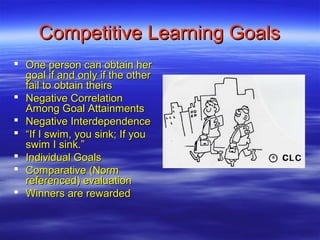
Competitive Learning Goals
 One person can obtain her
  goal if and only if the other
  fail to obtain theirs
 Negative Correlation
  Among Goal Attainments
 Negative Interdependence
 “If I swim, you sink; If you
  swim I sink.”
 Individual Goals
 Comparative (Norm
  referenced) evaluation
 Winners are rewarded
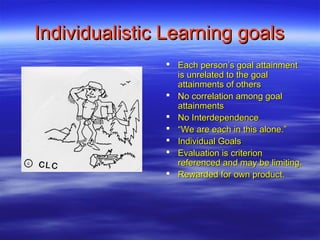
Individualistic Learning goals
                Each person’s goal attainment
                 is unrelated to the goal
                 attainments of others
                No correlation among goal
                 attainments
                No Interdependence
                “We are each in this alone.”
                Individual Goals
                Evaluation is criterion
                 referenced and may be limiting.
                Rewarded for own product.
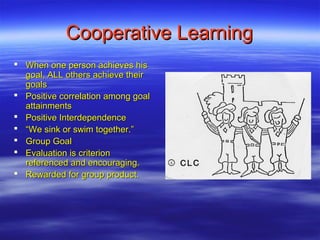
Cooperative Learning
 When one person achieves his
  goal, ALL others achieve their
  goals
 Positive correlation among goal
  attainments
 Positive Interdependence
 “We sink or swim together.”
 Group Goal
 Evaluation is criterion
  referenced and encouraging.
 Rewarded for group product.
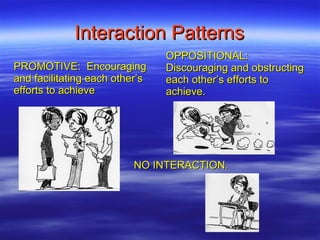
Interaction Patterns
                                OPPOSITIONAL:
PROMOTIVE: Encouraging          Discouraging and obstructing
and facilitating each other’s   each other’s efforts to
efforts to achieve              achieve.


                          NO INTERACTION.
Research Findings
1. Achievement and retention
2. Critical thinking and higher-level reasoning
3. Differentiated views of others
4. Accurate understanding of others’
   perspectives
5. Liking for classmates
Research Findings, cont.
6. Liking for teacher
7. Positive expectations toward future
    interactions
8. Liking for subject areas
9. Social Skills
10. Psychological health
11. Self-esteem
5 Key Elements
                  of
    Effective Cooperative Learning
                Groups
   Positive Interdependence
   Individual Accountability
   Face-To-Face Interaction
   Direct Instruction of Social Skills
   Processing
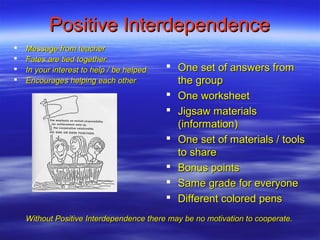
Positive Interdependence
   Message from teacher
   Fates are tied together
   In your interest to help / be helped    One set of answers from
   Encourages helping each other            the group
                                            One worksheet
                                            Jigsaw materials
                                             (information)
                                            One set of materials / tools
                                             to share
                                            Bonus points
                                            Same grade for everyone
                                            Different colored pens
    Without Positive Interdependence there may be no motivation to cooperate.
Individual Accountability
     The message the teacher       Using signatures
      gives to the students that    Individual Tests
      tells them:                   Different Colored Pens
1.   You must do your fair          Spot Checking as
      share of the work.             Students Work
2.    You must master the           Randomly Calling on
      material being learned.        Students
3.    You will be held
      accountable for your
      share of the work and
      mastering the learning.
Face-To-Face Interaction
 The message that           Sit at round tables so
  students:                   they can easily see
 have a group,               and hear one another.
 need to work with their    Designated areas on
  group,                      the floor (islands)
 need to stay with their    Space between the
  group,                      groups so the teacher
 Work synchronously          can move between
                              groups.
                             “Stay with your group.”
Direct Instruction of Social Skills
 Intentionally teaching
  social skills like any other
  skill.                          T-chart (looks like / sounds like)
 Structure regular               Role Play what “listening” is and
                                   is not.
  opportunities for students
                                  Discuss how it feels to be
  to learn, practice and be        listened to / ignored.
  evaluated on social skills      Ask students to think of a time
  until they become                when they were listened to.
  automatic.                       How did it feel?
 Establishing a need for the
  social skill
 Positively framing rules as
  skills
 Include Social Skills in
  each lesson
Processing
                                   Thumbs up or Thumbs down
                                   Rate yourself
 Intentionally structured         What did someone in your
  time                              group do / say that let you
 Reflect on how well we            know you were being listened
  worked together / used our        to?
  social skills (social skills)    Observer gives data
 Reflect on how well we            (feedback); Discuss
  completed our work               Write an goal for improving /
  (academic)                        maintaining the high quality of
 Review data,                      listening for tomorrow’s work.
 Make a goal for next time        Name 3 things your group did
                                    well in working together.
                                   Name 1 thing your group
                                    could do even better next
                                    time.
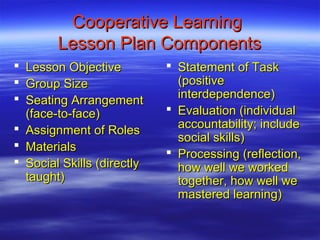
Cooperative Learning
        Lesson Plan Components
 Lesson Objective           Statement of Task
 Group Size                  (positive
                              interdependence)
 Seating Arrangement
  (face-to-face)             Evaluation (individual
 Assignment of Roles         accountability; include
                              social skills)
 Materials
                             Processing (reflection,
 Social Skills (directly     how well we worked
  taught)                     together, how well we
                              mastered learning)
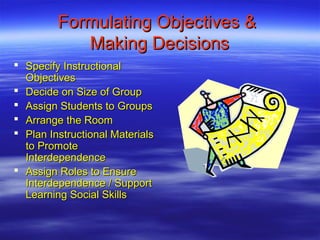
Formulating Objectives &
            Making Decisions
 Specify Instructional
  Objectives
 Decide on Size of Group
 Assign Students to Groups
 Arrange the Room
 Plan Instructional Materials
  to Promote
  Interdependence
 Assign Roles to Ensure
  Interdependence / Support
  Learning Social Skills
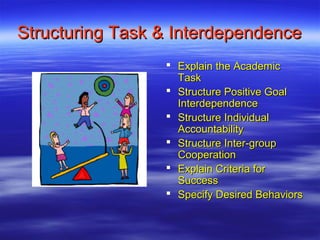
Structuring Task & Interdependence
                  Explain the Academic
                   Task
                  Structure Positive Goal
                   Interdependence
                  Structure Individual
                   Accountability
                  Structure Inter-group
                   Cooperation
                  Explain Criteria for
                   Success
                  Specify Desired Behaviors
Monitoring & Processing
 Monitor Students’ Behavior
 Provide Task Assistance
 Intervene to Teach
  Collaborative Skills
 Provide Closure to Lesson
 Evaluate Quality and
  Quantity of Student’s
  Learning
 Assess How Well The
  Group Functioned
 Set Goals
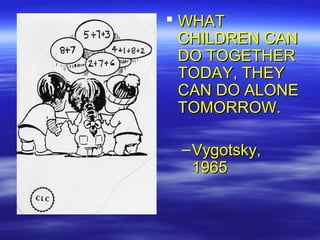
 WHAT
  CHILDREN CAN
  DO TOGETHER
  TODAY, THEY
  CAN DO ALONE
  TOMORROW.

 – Vygotsky,
   1965

Cooperative learning

  • 1.
  • 2.
    Definition  What it IS  What it IS NOT  Based on theory and work of Johnson and Johnson
  • 3.
    Cooperative Learning is… Applied Social Psychology  Intentional structuring of learning goals – to promote Positive Interdependence – Intentional structuring of learning goals so that students are encouraged to engage in Promotive Interaction  Promotive Interaction is more likely to occur when there are 5 key elements intentionally structured and monitored throughout the lesson.
  • 4.
    Learning Goals canbe structured 3 different ways:  Cooperatively  Competitively  Individualistically
  • 5.
    Competitive Learning Goals One person can obtain her goal if and only if the other fail to obtain theirs  Negative Correlation Among Goal Attainments  Negative Interdependence  “If I swim, you sink; If you swim I sink.”  Individual Goals  Comparative (Norm referenced) evaluation  Winners are rewarded
  • 6.
    Individualistic Learning goals  Each person’s goal attainment is unrelated to the goal attainments of others  No correlation among goal attainments  No Interdependence  “We are each in this alone.”  Individual Goals  Evaluation is criterion referenced and may be limiting.  Rewarded for own product.
  • 7.
    Cooperative Learning  Whenone person achieves his goal, ALL others achieve their goals  Positive correlation among goal attainments  Positive Interdependence  “We sink or swim together.”  Group Goal  Evaluation is criterion referenced and encouraging.  Rewarded for group product.
  • 8.
    Interaction Patterns OPPOSITIONAL: PROMOTIVE: Encouraging Discouraging and obstructing and facilitating each other’s each other’s efforts to efforts to achieve achieve. NO INTERACTION.
  • 9.
    Research Findings 1. Achievementand retention 2. Critical thinking and higher-level reasoning 3. Differentiated views of others 4. Accurate understanding of others’ perspectives 5. Liking for classmates
  • 10.
    Research Findings, cont. 6.Liking for teacher 7. Positive expectations toward future interactions 8. Liking for subject areas 9. Social Skills 10. Psychological health 11. Self-esteem
  • 11.
    5 Key Elements of Effective Cooperative Learning Groups  Positive Interdependence  Individual Accountability  Face-To-Face Interaction  Direct Instruction of Social Skills  Processing
  • 12.
    Positive Interdependence  Message from teacher  Fates are tied together  In your interest to help / be helped  One set of answers from  Encourages helping each other the group  One worksheet  Jigsaw materials (information)  One set of materials / tools to share  Bonus points  Same grade for everyone  Different colored pens Without Positive Interdependence there may be no motivation to cooperate.
  • 13.
    Individual Accountability  The message the teacher  Using signatures gives to the students that  Individual Tests tells them:  Different Colored Pens 1. You must do your fair  Spot Checking as share of the work. Students Work 2. You must master the  Randomly Calling on material being learned. Students 3. You will be held accountable for your share of the work and mastering the learning.
  • 14.
    Face-To-Face Interaction  Themessage that  Sit at round tables so students: they can easily see  have a group, and hear one another.  need to work with their  Designated areas on group, the floor (islands)  need to stay with their  Space between the group, groups so the teacher  Work synchronously can move between groups.  “Stay with your group.”
  • 15.
    Direct Instruction ofSocial Skills  Intentionally teaching social skills like any other skill.  T-chart (looks like / sounds like)  Structure regular  Role Play what “listening” is and is not. opportunities for students  Discuss how it feels to be to learn, practice and be listened to / ignored. evaluated on social skills  Ask students to think of a time until they become when they were listened to. automatic. How did it feel?  Establishing a need for the social skill  Positively framing rules as skills  Include Social Skills in each lesson
  • 16.
    Processing  Thumbs up or Thumbs down  Rate yourself  Intentionally structured  What did someone in your time group do / say that let you  Reflect on how well we know you were being listened worked together / used our to? social skills (social skills)  Observer gives data  Reflect on how well we (feedback); Discuss completed our work  Write an goal for improving / (academic) maintaining the high quality of  Review data, listening for tomorrow’s work.  Make a goal for next time  Name 3 things your group did well in working together.  Name 1 thing your group could do even better next time.
  • 18.
    Cooperative Learning Lesson Plan Components  Lesson Objective  Statement of Task  Group Size (positive interdependence)  Seating Arrangement (face-to-face)  Evaluation (individual  Assignment of Roles accountability; include social skills)  Materials  Processing (reflection,  Social Skills (directly how well we worked taught) together, how well we mastered learning)
  • 19.
    Formulating Objectives & Making Decisions  Specify Instructional Objectives  Decide on Size of Group  Assign Students to Groups  Arrange the Room  Plan Instructional Materials to Promote Interdependence  Assign Roles to Ensure Interdependence / Support Learning Social Skills
  • 20.
    Structuring Task &Interdependence  Explain the Academic Task  Structure Positive Goal Interdependence  Structure Individual Accountability  Structure Inter-group Cooperation  Explain Criteria for Success  Specify Desired Behaviors
  • 21.
    Monitoring & Processing Monitor Students’ Behavior  Provide Task Assistance  Intervene to Teach Collaborative Skills  Provide Closure to Lesson  Evaluate Quality and Quantity of Student’s Learning  Assess How Well The Group Functioned  Set Goals
  • 22.
     WHAT CHILDREN CAN DO TOGETHER TODAY, THEY CAN DO ALONE TOMORROW. – Vygotsky, 1965