Cooperative Learning
 Is the instructional use of small groups so that
the learners work together to maximize their
own and each other learner’s learning.
 Is an educational approach whichaims to
organize classroom activities into academic
and social learningexperiences.
 is alsocalledcollaborativelearning, interactin pairs or
groups to share knowledge and experiences.
 an instructionthat involves people working in teams
to accomplisha common goal, under conditionsthat
involve bothpositiveinterdependence andindividual
andgroupaccountability.
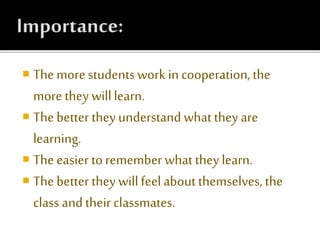
 The more students work in cooperation,the
more they willlearn.
 Thebetter they understand what they are
learning.
 The easier to remember what they learn.
 The better they will feel about themselves, the
class and their classmates.
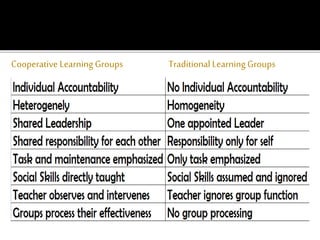
Cooperative Learning Groups Traditional Learning Groups
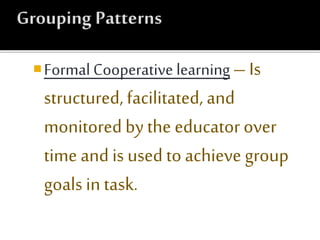
Formal Cooperative learning – Is
structured, facilitated, and
monitoredby the educator over
time and is used to achieve group
goals in task.
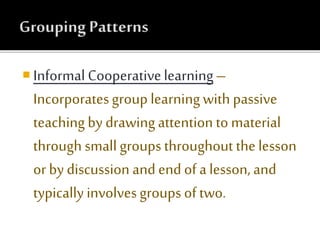
 Informal Cooperativelearning–
Incorporatesgroup learningwith passive
teaching by drawingattention to material
through small groups throughout the lesson
or by discussion and end of a lesson, and
typically involvesgroups of two.
Based group – provide
students support throughout
a semester or academic year.
 Positive Interdependence
 Individual and group accountability
 Face-to-facepromotiveinteraction
 Interpersonaland small group skills
 Group processing
Team members are obliged to rely
on one another to achieve the goal.
If any team members fail to do their
part, everyone suffers
consequences.
All students in a groupare held
accountable for doing their share
of the work andfor mastery of all
of the material to be learned.
must be done interactively, with group
members providing one another with
feedback, challenging reasoning and
conclusions, and perhaps most
importantly, teaching and encouraging
one another.
Students are encouraged and
helped to develop and practice
trust-building, leadership, decision-
making, communication, and
conflict management skills.
Team members set group goals,
periodically assess what they are
doing well as a team, and identify
changes they will make to function
more effectively in thefuture.
Is the process of organizing the
learners into learning teams, their
membership, the materials to be
learned, and the venue where
learningstations are structured.
Is the process where the learners
engaged themselves into actual
learning task to organize learning
into webs and other form of visual
devices.
Is the process of presenting the
output of learning through
reports, games, simulations,
drama, andetc.
Is the process of reasoning and
defending one’s learning through an
open interaction and discussion of
insights acquired in the cooperation
learning process.
Is an activity designed to break the
students into smaller groups to
maximize the participants into smaller
groups to maximize the participation
and the effectiveness of activities.
A collaboration of persons who are
interacting with one another in such a
manner that each person influences and
is influenced by each other. (Marvin
Shaw)
A group of small enough that
each member is aware of and
able to recall each other group
member. (John Brillhart)
Formed to address some
condition or problem that varies
widely in their competition and
functioning.
 Think Pair Share
 Peer Tutoring
 Jigsaw
 Problem Solving
 Storytelling
 Role-plays
 Paired interviews
Multiple ability label groups can be
used.
Formal or informal groups can be
used.
Same groups used again for future
lessons.
Can be used in any subject area.
 Small groups needed to ensure learning is
optimal.
 Overuse of strategy can lessen its
effectiveness.
 Grouping by similar ability levels does
not benefit all.
By:
Lea Montañez
JennielynNamang
Social Studies 11
Mr.Danilo Dohinog

Cooperative Learning

  • 1.
  • 2.
     Is theinstructional use of small groups so that the learners work together to maximize their own and each other learner’s learning.  Is an educational approach whichaims to organize classroom activities into academic and social learningexperiences.
  • 3.
     is alsocalledcollaborativelearning,interactin pairs or groups to share knowledge and experiences.  an instructionthat involves people working in teams to accomplisha common goal, under conditionsthat involve bothpositiveinterdependence andindividual andgroupaccountability.
  • 4.
     The morestudents work in cooperation,the more they willlearn.  Thebetter they understand what they are learning.  The easier to remember what they learn.  The better they will feel about themselves, the class and their classmates.
  • 5.
    Cooperative Learning GroupsTraditional Learning Groups
  • 6.
    Formal Cooperative learning– Is structured, facilitated, and monitoredby the educator over time and is used to achieve group goals in task.
  • 7.
     Informal Cooperativelearning– Incorporatesgrouplearningwith passive teaching by drawingattention to material through small groups throughout the lesson or by discussion and end of a lesson, and typically involvesgroups of two.
  • 8.
    Based group –provide students support throughout a semester or academic year.
  • 9.
     Positive Interdependence Individual and group accountability  Face-to-facepromotiveinteraction  Interpersonaland small group skills  Group processing
  • 10.
    Team members areobliged to rely on one another to achieve the goal. If any team members fail to do their part, everyone suffers consequences.
  • 11.
    All students ina groupare held accountable for doing their share of the work andfor mastery of all of the material to be learned.
  • 12.
    must be doneinteractively, with group members providing one another with feedback, challenging reasoning and conclusions, and perhaps most importantly, teaching and encouraging one another.
  • 13.
    Students are encouragedand helped to develop and practice trust-building, leadership, decision- making, communication, and conflict management skills.
  • 14.
    Team members setgroup goals, periodically assess what they are doing well as a team, and identify changes they will make to function more effectively in thefuture.
  • 16.
    Is the processof organizing the learners into learning teams, their membership, the materials to be learned, and the venue where learningstations are structured.
  • 17.
    Is the processwhere the learners engaged themselves into actual learning task to organize learning into webs and other form of visual devices.
  • 18.
    Is the processof presenting the output of learning through reports, games, simulations, drama, andetc.
  • 19.
    Is the processof reasoning and defending one’s learning through an open interaction and discussion of insights acquired in the cooperation learning process.
  • 20.
    Is an activitydesigned to break the students into smaller groups to maximize the participants into smaller groups to maximize the participation and the effectiveness of activities.
  • 21.
    A collaboration ofpersons who are interacting with one another in such a manner that each person influences and is influenced by each other. (Marvin Shaw)
  • 22.
    A group ofsmall enough that each member is aware of and able to recall each other group member. (John Brillhart)
  • 23.
    Formed to addresssome condition or problem that varies widely in their competition and functioning.
  • 24.
     Think PairShare  Peer Tutoring  Jigsaw  Problem Solving  Storytelling  Role-plays  Paired interviews
  • 25.
    Multiple ability labelgroups can be used. Formal or informal groups can be used. Same groups used again for future lessons. Can be used in any subject area.
  • 26.
     Small groupsneeded to ensure learning is optimal.  Overuse of strategy can lessen its effectiveness.  Grouping by similar ability levels does not benefit all.
  • 27.