COOPERATIVE
LEARNING
GROUP: TRAVELCHERS
C
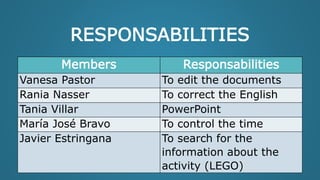
RESPONSABILITIES
Members Responsabilities
Vanesa Pastor To edit the documents
Rania Nasser To correct the English
Tania Villar PowerPoint
María José Bravo To control the time
Javier Estringana To search for the
information about the
activity (LEGO)
TEAM OBJECTIVES
Objectives Califications
Help the other members
to develop their
weaknesses
Listen to all the
members of the team.
Give ideas.
Evaluate the individual
work
Participation.
PERSONAL OBJECTIVES
Personal objectives Member Calification
Control the nerve in the
presentation.
Tania
Improve the concentration
in the group.
Javier
Let the rest do something
and self-control
María José
Participate more, give more
ideas.
Rania
Improve the self-control Vanesa
Microtask Date Time Person
responsible
Previous preparation. 29/1/2017 2 hours EVERYONE
Common set 31/1/2017
2/2/2017
7/2/2017
5 hours EVERYONE
Decision making. 2/2/2017
7/2/2017
5 hours and 30
minutes
EVERYONE
Team Planning 2/2/2017
7/2/2017
2 hours María José
Investigation 29/1/2017
31/1/2017
6/2/2017
3 hours EVERYONE
Prepare the activity 2/2/2017
7/2/2017
8/2/2017
2 hours Vanesa
Prepare the PowePoint 8/2/2017 4 hours and 30
minutes
Tania
Translation 2/2/2017
7/2/2017
2 hours Rania
Make the Lego figures 7/2/2017 4 hours Javier
Correction of the project 2/2/2017
7/2/2017
8/2/2017
4 hours EVERYONE
• What is cooperative
Learning?
• Positive
interdependence
• Individual accountability
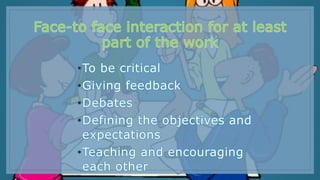
• Face-to face interaction
for at least part of the
work
• Appropriate use of
interpersonal skills
• Group processing
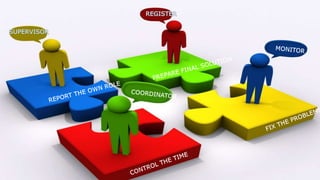
• Organization of the learning
process
• Groups formation
• APPS for groups
• Furniture organization
• Philosophy in the classroom
• Why the roles are
important?
• Learning techniques
• Jigsaw
• TGT
• Self-evaluation
C
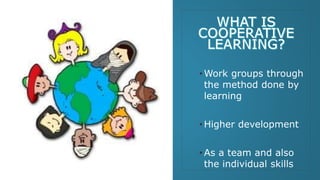
• Work groups through
the method done by
learning
• Higher development
• As a team and also
the individual skills
The success of the group
will depend on the
confidence in each other
Positive Interdependence
Individual
Accountability
This is the responsibility
of each member.
Appropriate use of collaborative skills
•Skills we use to relate to others
individually and in groups
•It implies the encouragement for
building the collaborative Skills such as
communication, leaderships, etc.
Group
processing
It is the co-
evaluation
and the self-
assessment
C
Groups formation
• Create heterogeneous groups
• By three or four members
• Diversity
• There are three types of groups:
• Base
• Experts
• Occasionals
C
TEAM MAKER
RANDOM TEAM GENERATOR
ADITTIO
WIGGIO
C
organize
furniture is
in the
“spike”
since no
one is given
the back
and it is
easier to
interact
with other
groups and
with your
one.
C
•It is based in transmitting to the children
some personal values
•Some motivating mottos like: “we all learn
from everyone” “everyone fits here”
•And the group motto:
“LETS GO FOR IT”
C
WHY THE ROLES
ARE
IMPORTANT?
• Promote and enhance
the individual skills
C
•The contents are divided in areas and
subareas
•It creates experts
•It starts and finishes with the same base team
•In between they move into an expert team
where they share their subarea
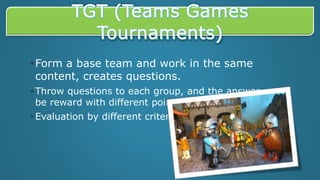
•Form a base team and work in the same
content, creates questions.
• Throw questions to each group, and the answer can
be reward with different points.
• Evaluation by different criteria.
C
self-evaluation and a co-
evaluation
C
•It is based on the TAI technique
•For the second year of primary education in
maths area, related to geometry
•OBJECTIVES:
• Recognise an object from different perspectives
• Classifications of lines, curves, mixed, and
• polygonal figures
• Recognize the number of the sides
• Identify sides and vertex
• Draw and construct different figures
•You will have 15 seconds to watch the figure and keep
it in your mind
•After this, you will have 1 minute to make the figure
with your pieces of LEGO.
•Once the time is out, you can check if your figure is
well made with the others members of your group
during another minute, when the figure is well made
the person who has it will pass to the next level, on
the contrary you will repeat the figure:
• If your figure is well made and someone has it badly, you have
to help your partner
Cooperative learning   presentation

Cooperative learning presentation

  • 1.
  • 2.
  • 3.
    RESPONSABILITIES Members Responsabilities Vanesa PastorTo edit the documents Rania Nasser To correct the English Tania Villar PowerPoint María José Bravo To control the time Javier Estringana To search for the information about the activity (LEGO)
  • 4.
    TEAM OBJECTIVES Objectives Califications Helpthe other members to develop their weaknesses Listen to all the members of the team. Give ideas. Evaluate the individual work Participation.
  • 5.
    PERSONAL OBJECTIVES Personal objectivesMember Calification Control the nerve in the presentation. Tania Improve the concentration in the group. Javier Let the rest do something and self-control María José Participate more, give more ideas. Rania Improve the self-control Vanesa
  • 6.
    Microtask Date TimePerson responsible Previous preparation. 29/1/2017 2 hours EVERYONE Common set 31/1/2017 2/2/2017 7/2/2017 5 hours EVERYONE Decision making. 2/2/2017 7/2/2017 5 hours and 30 minutes EVERYONE Team Planning 2/2/2017 7/2/2017 2 hours María José Investigation 29/1/2017 31/1/2017 6/2/2017 3 hours EVERYONE Prepare the activity 2/2/2017 7/2/2017 8/2/2017 2 hours Vanesa Prepare the PowePoint 8/2/2017 4 hours and 30 minutes Tania Translation 2/2/2017 7/2/2017 2 hours Rania Make the Lego figures 7/2/2017 4 hours Javier Correction of the project 2/2/2017 7/2/2017 8/2/2017 4 hours EVERYONE
  • 7.
    • What iscooperative Learning? • Positive interdependence • Individual accountability • Face-to face interaction for at least part of the work • Appropriate use of interpersonal skills • Group processing • Organization of the learning process • Groups formation • APPS for groups • Furniture organization • Philosophy in the classroom • Why the roles are important? • Learning techniques • Jigsaw • TGT • Self-evaluation
  • 9.
  • 10.
    • Work groupsthrough the method done by learning • Higher development • As a team and also the individual skills
  • 11.
    The success ofthe group will depend on the confidence in each other Positive Interdependence
  • 12.
    Individual Accountability This is theresponsibility of each member.
  • 14.
    Appropriate use ofcollaborative skills •Skills we use to relate to others individually and in groups •It implies the encouragement for building the collaborative Skills such as communication, leaderships, etc.
  • 15.
    Group processing It is theco- evaluation and the self- assessment
  • 16.
  • 17.
    Groups formation • Createheterogeneous groups • By three or four members • Diversity • There are three types of groups: • Base • Experts • Occasionals
  • 18.
  • 19.
  • 20.
  • 21.
  • 22.
  • 23.
  • 24.
    organize furniture is in the “spike” sinceno one is given the back and it is easier to interact with other groups and with your one.
  • 25.
  • 26.
    •It is basedin transmitting to the children some personal values •Some motivating mottos like: “we all learn from everyone” “everyone fits here” •And the group motto: “LETS GO FOR IT”
  • 27.
  • 28.
    WHY THE ROLES ARE IMPORTANT? •Promote and enhance the individual skills
  • 30.
  • 31.
    •The contents aredivided in areas and subareas •It creates experts •It starts and finishes with the same base team •In between they move into an expert team where they share their subarea
  • 32.
    •Form a baseteam and work in the same content, creates questions. • Throw questions to each group, and the answer can be reward with different points. • Evaluation by different criteria.
  • 33.
  • 34.
  • 35.
    •It is basedon the TAI technique •For the second year of primary education in maths area, related to geometry •OBJECTIVES: • Recognise an object from different perspectives • Classifications of lines, curves, mixed, and • polygonal figures • Recognize the number of the sides • Identify sides and vertex • Draw and construct different figures
  • 36.
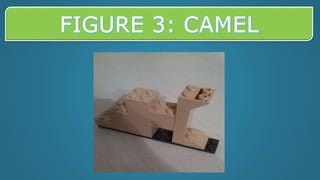
    •You will have15 seconds to watch the figure and keep it in your mind •After this, you will have 1 minute to make the figure with your pieces of LEGO. •Once the time is out, you can check if your figure is well made with the others members of your group during another minute, when the figure is well made the person who has it will pass to the next level, on the contrary you will repeat the figure: • If your figure is well made and someone has it badly, you have to help your partner