Sabine Reljic, ED834 Elaboration Theory Charles M.  Reigeluth’s  An Introduction [email_address]
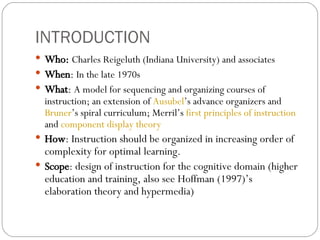
INTRODUCTION Who:  Charles Reigeluth (Indiana University) and associates When :  In the late 1970s What :  A model for sequencing and organizing courses of instruction; an extension of  Ausubel ’s advance organizers and  Bruner ’s spiral curriculum; Merril’s  first principles of instruction  and  component display theory How : Instruction should be organized in increasing order of complexity for optimal learning. Scope : design of instruction for the cognitive domain (higher education and training, also see Hoffman (1997)’s elaboration theory and hypermedia)
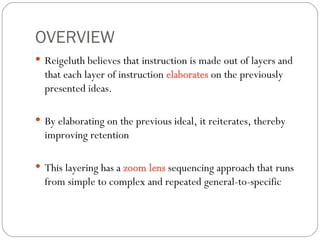
OVERVIEW Reigeluth believes that instruction is made out of layers and that each layer of instruction  elaborates  on the previously presented ideas. By elaborating on the previous ideal, it reiterates, thereby improving retention This layering has a  zoom lens  sequencing approach that runs from simple to complex and repeated general-to-specific
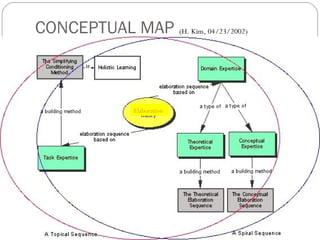
CONCEPTUAL MAP Elaboration Theory (H. Kim, 04/23/2002)
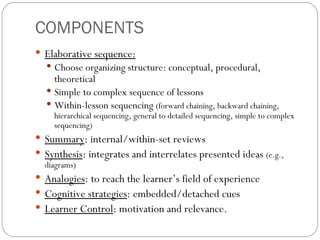
COMPONENTS Elaborative sequence: Choose organizing structure: conceptual, procedural, theoretical Simple to complex sequence of lessons Within-lesson sequencing  (forward chaining, backward chaining, hierarchical sequencing, general to detailed sequencing, simple to complex sequencing) Summary : internal/within-set reviews Synthesis : integrates and interrelates presented ideas  (e.g., diagrams) Analogies : to reach the learner’s field of experience Cognitive strategies : embedded/detached cues Learner Control : motivation and relevance.
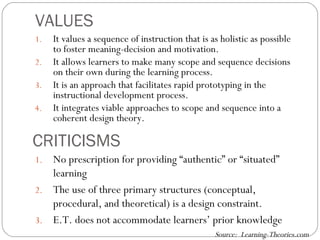
VALUES It values a sequence of instruction that is as holistic as possible to foster meaning-decision and motivation. It allows learners to make many scope and sequence decisions on their own during the learning process. It is an approach that facilitates rapid prototyping in the instructional development process. It integrates viable approaches to scope and sequence into a coherent design theory. CRITICISMS No prescription for providing “authentic” or “situated” learning The use of three primary structures (conceptual, procedural, and theoretical) is a design constraint. E.T. does not accommodate learners’ prior knowledge Source:  Learning-Theories.com
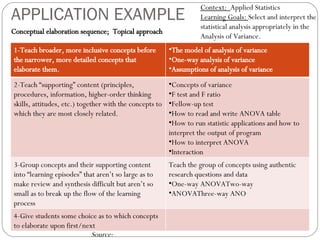
APPLICATION EXAMPLE Conceptual elaboration sequence;  Topical approach Context:  Applied Statistics Learning Goals:  Select and interpret the statistical analysis appropriately in the Analysis of Variance. Source: http://www.personal.psu.edu/users/h/x/hxk208/INSYS525/K_base1.htm 1-Teach broader, more inclusive concepts before the narrower, more detailed concepts that elaborate them. The model of analysis of variance One-way analysis of variance Assumptions of analysis of variance 2-Teach “supporting” content (principles, procedures, information, higher-order thinking skills, attitudes, etc.) together with the concepts to which they are most closely related. Concepts of variance F test and F ratio Fellow-up test How to read and write ANOVA table How to run statistic applications and how to interpret the output of program How to interpret ANOVA Interaction 3-Group concepts and their supporting content into “learning episodes” that aren’t so large as to make review and synthesis difficult but aren’t so small as to break up the flow of the learning process Teach the group of concepts using authentic research questions and data One-way ANOVATwo-way ANOVAThree-way ANO 4-Give students some choice as to which concepts to elaborate upon first/next
RESOURCES Instructional Design Models  http://web2.uwindsor.ca/courses/edfac/morton/instructional_design.htm Knowledge Base and Webliography  http://www.learning-theories.com/elaboration-theory-reigeluth.html Reigeluth, C. (1992).  Elaborating the elaboration theory.  Educational Technology Research & Development, 40 (3), 80-86 Reigeluth, C. (1999).  The elaboration theory: Guidance for scope and sequence decisions. In C.M. Reigeluth (ed.),  Instructional-design theories and models: A new paradigm of instructional theory, volume ii . (pp. 425-459). Hillsdale, N. Lawrence Erlbaum Associates.  (Do a Google Book Search) Tip Psychology.org “Elaboration Theory”   http://tip.psychology.org/reigelut.html

Elaboration Theory

  • 1.
    Sabine Reljic, ED834Elaboration Theory Charles M. Reigeluth’s An Introduction [email_address]
  • 2.
    INTRODUCTION Who: Charles Reigeluth (Indiana University) and associates When : In the late 1970s What : A model for sequencing and organizing courses of instruction; an extension of Ausubel ’s advance organizers and Bruner ’s spiral curriculum; Merril’s first principles of instruction and component display theory How : Instruction should be organized in increasing order of complexity for optimal learning. Scope : design of instruction for the cognitive domain (higher education and training, also see Hoffman (1997)’s elaboration theory and hypermedia)
  • 3.
    OVERVIEW Reigeluth believesthat instruction is made out of layers and that each layer of instruction elaborates on the previously presented ideas. By elaborating on the previous ideal, it reiterates, thereby improving retention This layering has a zoom lens sequencing approach that runs from simple to complex and repeated general-to-specific
  • 4.
    CONCEPTUAL MAP ElaborationTheory (H. Kim, 04/23/2002)
  • 5.
    COMPONENTS Elaborative sequence:Choose organizing structure: conceptual, procedural, theoretical Simple to complex sequence of lessons Within-lesson sequencing (forward chaining, backward chaining, hierarchical sequencing, general to detailed sequencing, simple to complex sequencing) Summary : internal/within-set reviews Synthesis : integrates and interrelates presented ideas (e.g., diagrams) Analogies : to reach the learner’s field of experience Cognitive strategies : embedded/detached cues Learner Control : motivation and relevance.
  • 6.
    VALUES It valuesa sequence of instruction that is as holistic as possible to foster meaning-decision and motivation. It allows learners to make many scope and sequence decisions on their own during the learning process. It is an approach that facilitates rapid prototyping in the instructional development process. It integrates viable approaches to scope and sequence into a coherent design theory. CRITICISMS No prescription for providing “authentic” or “situated” learning The use of three primary structures (conceptual, procedural, and theoretical) is a design constraint. E.T. does not accommodate learners’ prior knowledge Source: Learning-Theories.com
  • 7.
    APPLICATION EXAMPLE Conceptualelaboration sequence; Topical approach Context: Applied Statistics Learning Goals: Select and interpret the statistical analysis appropriately in the Analysis of Variance. Source: http://www.personal.psu.edu/users/h/x/hxk208/INSYS525/K_base1.htm 1-Teach broader, more inclusive concepts before the narrower, more detailed concepts that elaborate them. The model of analysis of variance One-way analysis of variance Assumptions of analysis of variance 2-Teach “supporting” content (principles, procedures, information, higher-order thinking skills, attitudes, etc.) together with the concepts to which they are most closely related. Concepts of variance F test and F ratio Fellow-up test How to read and write ANOVA table How to run statistic applications and how to interpret the output of program How to interpret ANOVA Interaction 3-Group concepts and their supporting content into “learning episodes” that aren’t so large as to make review and synthesis difficult but aren’t so small as to break up the flow of the learning process Teach the group of concepts using authentic research questions and data One-way ANOVATwo-way ANOVAThree-way ANO 4-Give students some choice as to which concepts to elaborate upon first/next
  • 8.
    RESOURCES Instructional DesignModels http://web2.uwindsor.ca/courses/edfac/morton/instructional_design.htm Knowledge Base and Webliography http://www.learning-theories.com/elaboration-theory-reigeluth.html Reigeluth, C. (1992). Elaborating the elaboration theory. Educational Technology Research & Development, 40 (3), 80-86 Reigeluth, C. (1999). The elaboration theory: Guidance for scope and sequence decisions. In C.M. Reigeluth (ed.), Instructional-design theories and models: A new paradigm of instructional theory, volume ii . (pp. 425-459). Hillsdale, N. Lawrence Erlbaum Associates. (Do a Google Book Search) Tip Psychology.org “Elaboration Theory” http://tip.psychology.org/reigelut.html

Editor's Notes

  • #2 Welcome to the Elaboration Theory seminar, an instructional-design theory (model). This ppt is based on information collected in different web-based sources which are either listed or embedded on the page itself or listed in the resource page at the end. I do not claim any original authorship to the content, only to the organization and presentation of the content for the purpose of summarizing the elaboration theory.