Conversion
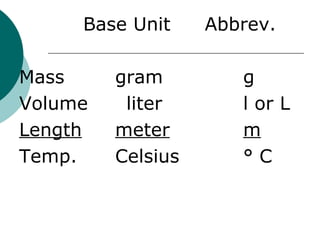
Base Unit   Abbrev. Mass gram g Volume  liter  l or L Length meter m Temp. Celsius  ° C
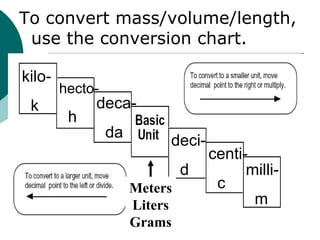
To convert mass/volume/length, use the conversion chart. kilo- k hecto- h deca- da deci- d centi- c milli- m Meters Liters Grams
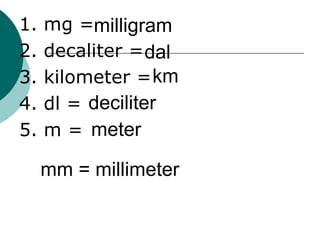
1. mg = 2. decaliter = 3. kilometer = 4. dl =  5. m = milligram dal km deciliter meter mm = millimeter
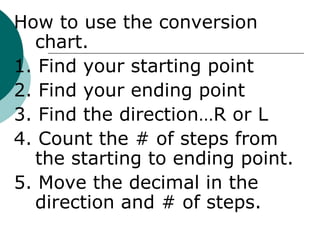
How to use the conversion chart. 1. Find your starting point 2. Find your ending point 3. Find the direction…R or L 4. Count the # of steps from the starting to ending point. 5. Move the decimal in the direction and # of steps.
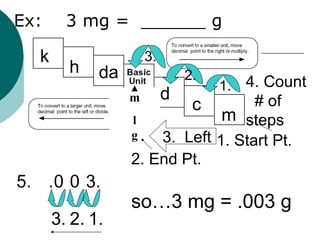
Ex:  3 mg =  ______ g k h da d c m 1. Start Pt. 2. End Pt. 3.  Left 4. Count  # of steps 1. 2. 3. 5.  3. 0 0 . 1. 2. 3. so…3 mg = .003 g m l g
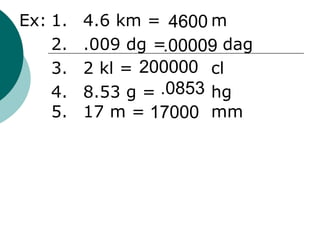
Ex: 1. 4.6 km = m 2. .009 dg  =    dag 3. 2 kl = cl  4. 8.53 g = hg   5. 17 m = mm    200000 .00009 4600 .0853 17000
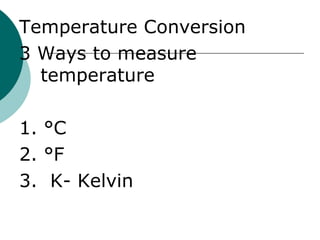
Temperature Conversion 3 Ways to measure temperature 1.  °C 2.  °F 3.  K- Kelvin
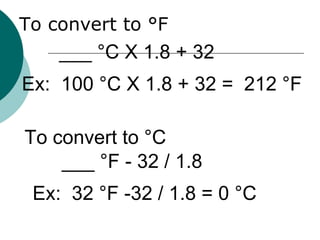
To convert to  °F ___ °C X 1.8 + 32 Ex:  100 °C X 1.8 + 32 =  212 °F To convert to °C   ___ °F - 32 / 1.8 Ex:  32 °F -32 / 1.8 = 0 °C
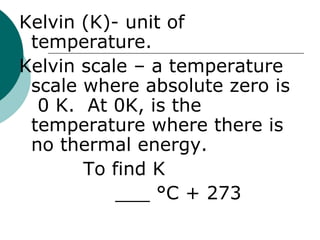
Kelvin (K)- unit of temperature.  Kelvin scale – a temperature scale where absolute zero is  0 K.  At 0K, is the temperature where there is no thermal energy. To find K ___  °C + 273
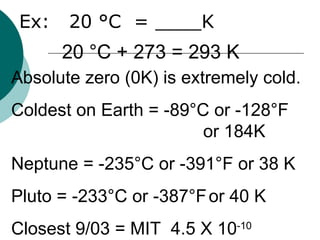
Ex:  20  °C  = ____K 20 °C + 273 = 293 K  Absolute zero (0K) is extremely cold.  Coldest on Earth = -89°C or -128°F  or 184K Closest 9/03 = MIT  4.5 X 10⁻¹⁰ Pluto = -233°C or -387°F or 40 K Neptune = -235°C or -391°F or 38 K
Boiling and Freezing Points of Water The Boiling points of water are 212°F, 100°C and  373 K. The Freezing points of water are 32°F, 0°C and 273 K.
36 °C = 62 °F = 98.6 °F = -10 °C = 50 °C  = 45 °F  = 500 K = 60 °F = 96.8 or 97  °F 16.6 or 17  °C 37   °C   14 °F 323 K 7.2 or 7 °C 227 °C 228.5 or 289 K

Conversion

  • 1.
  • 2.
    Base Unit Abbrev. Mass gram g Volume liter l or L Length meter m Temp. Celsius ° C
  • 3.
    To convert mass/volume/length,use the conversion chart. kilo- k hecto- h deca- da deci- d centi- c milli- m Meters Liters Grams
  • 4.
    1. mg =2. decaliter = 3. kilometer = 4. dl = 5. m = milligram dal km deciliter meter mm = millimeter
  • 5.
    How to usethe conversion chart. 1. Find your starting point 2. Find your ending point 3. Find the direction…R or L 4. Count the # of steps from the starting to ending point. 5. Move the decimal in the direction and # of steps.
  • 6.
    Ex: 3mg = ______ g k h da d c m 1. Start Pt. 2. End Pt. 3. Left 4. Count # of steps 1. 2. 3. 5. 3. 0 0 . 1. 2. 3. so…3 mg = .003 g m l g
  • 7.
    Ex: 1. 4.6km = m 2. .009 dg = dag 3. 2 kl = cl 4. 8.53 g = hg 5. 17 m = mm 200000 .00009 4600 .0853 17000
  • 8.
    Temperature Conversion 3Ways to measure temperature 1. °C 2. °F 3. K- Kelvin
  • 9.
    To convert to °F ___ °C X 1.8 + 32 Ex: 100 °C X 1.8 + 32 = 212 °F To convert to °C ___ °F - 32 / 1.8 Ex: 32 °F -32 / 1.8 = 0 °C
  • 10.
    Kelvin (K)- unitof temperature. Kelvin scale – a temperature scale where absolute zero is 0 K. At 0K, is the temperature where there is no thermal energy. To find K ___ °C + 273
  • 11.
    Ex: 20 °C = ____K 20 °C + 273 = 293 K Absolute zero (0K) is extremely cold. Coldest on Earth = -89°C or -128°F or 184K Closest 9/03 = MIT 4.5 X 10⁻¹⁰ Pluto = -233°C or -387°F or 40 K Neptune = -235°C or -391°F or 38 K
  • 12.
    Boiling and FreezingPoints of Water The Boiling points of water are 212°F, 100°C and 373 K. The Freezing points of water are 32°F, 0°C and 273 K.
  • 13.
    36 °C =62 °F = 98.6 °F = -10 °C = 50 °C = 45 °F = 500 K = 60 °F = 96.8 or 97 °F 16.6 or 17 °C 37 °C 14 °F 323 K 7.2 or 7 °C 227 °C 228.5 or 289 K