SCIENTIFIC
SCIENTIFIC
MEASUREMENT
MEASUREMENT
International System of Units
International System of Units (SI) -
(SI) -
measurement system used by scientists
around the world to express
measurements made in scientific
investigations [the Metric System].
[THE METRIC SYSTEM]
 Scientists
Scientists all over the world
all over the world know and
know and
use the metric system.
 Below is a list of the basic units of
Below is a list of the basic units of
the
the metric system
metric system (SI system) and
(SI system) and
the commonly used prefixes with
their meanings.
their meanings.
What units are used when
measuring objects?
measuring objects?
 Basic SI units:
Basic SI units:
– meters (m) -
meters (m) - length
length
– grams (g) -
grams (g) - mass
mass
– liters (L) –
liters (L) – volume
volume
– seconds (s) –
seconds (s) – time
time
– Celsius degree (
Celsius degree (o
o
C.) –
C.) –
temperature
temperature
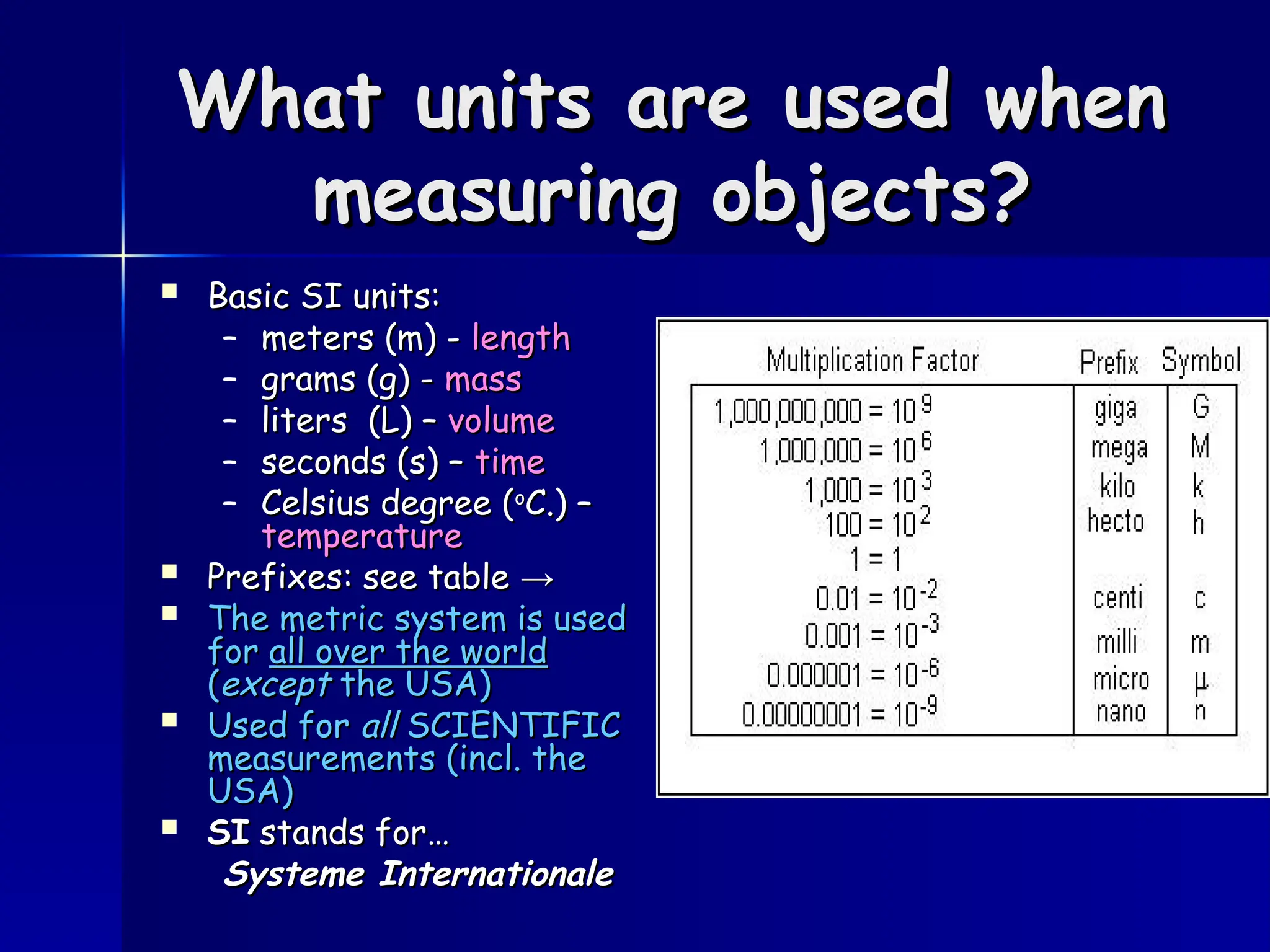
 Prefixes: see table
Prefixes: see table →
→
 The metric system is used
The metric system is used
for
for all over the world
all over the world
(
(except
except the USA)
the USA)
 Used for
Used for all
all SCIENTIFIC
SCIENTIFIC
measurements (incl. the
USA)
USA)
 SI
SI stands for…
stands for…
Systeme Internationale
BASIC UNITS OF THE
BASIC UNITS OF THE
METRIC SYSTEM
METRIC SYSTEM
BASIC UNIT
BASIC UNIT PROPERTY
PROPERTY
MEASURED
MEASURED
meter (m)
meter (m) length
length
gram (g)
gram (g) Mass
Mass
liter (L)
liter (L) Volume
Volume
second (s)
second (s) Time
Time
Celsius degree (C
Celsius degree (Co
o
)
) temperature
temperature
COMMON PREFIXES AND
COMMON PREFIXES AND
THEIR MEANINGS
THEIR MEANINGS
PREFIX
PREFIX
(abbreviation)
(abbreviation)
MEANING
MEANING
kilo – (k)
kilo – (k) 1,000 ( 1 thousand)
1,000 ( 1 thousand)
hecto – (h)
hecto – (h) 100 (1 hundred)
100 (1 hundred)
deca- or deka- (da or
dk)
dk)
10 (ten)
10 (ten)
deci- (d)
deci- (d) 0.1 ( tenth)
0.1 ( tenth)
centi- (c)
centi- (c) 0.01 (1 hundreth)
0.01 (1 hundreth)
milli- (m)
milli- (m) 0.001 (1 thousandth)
0.001 (1 thousandth)
How are we going to
How are we going to
remember this???
remember this???
 King
King
 Henry’s
Henry’s
 darned
darned
 MONEY (GOLD, LOOT)
MONEY (GOLD, LOOT)
 didn’t
didn’t
 come
come
 Monday.
Monday.
How do we convert in the
Metric system?
Metric system?
 Walk along the “Metric Sidewalk…..”
Walk along the “Metric Sidewalk…..”
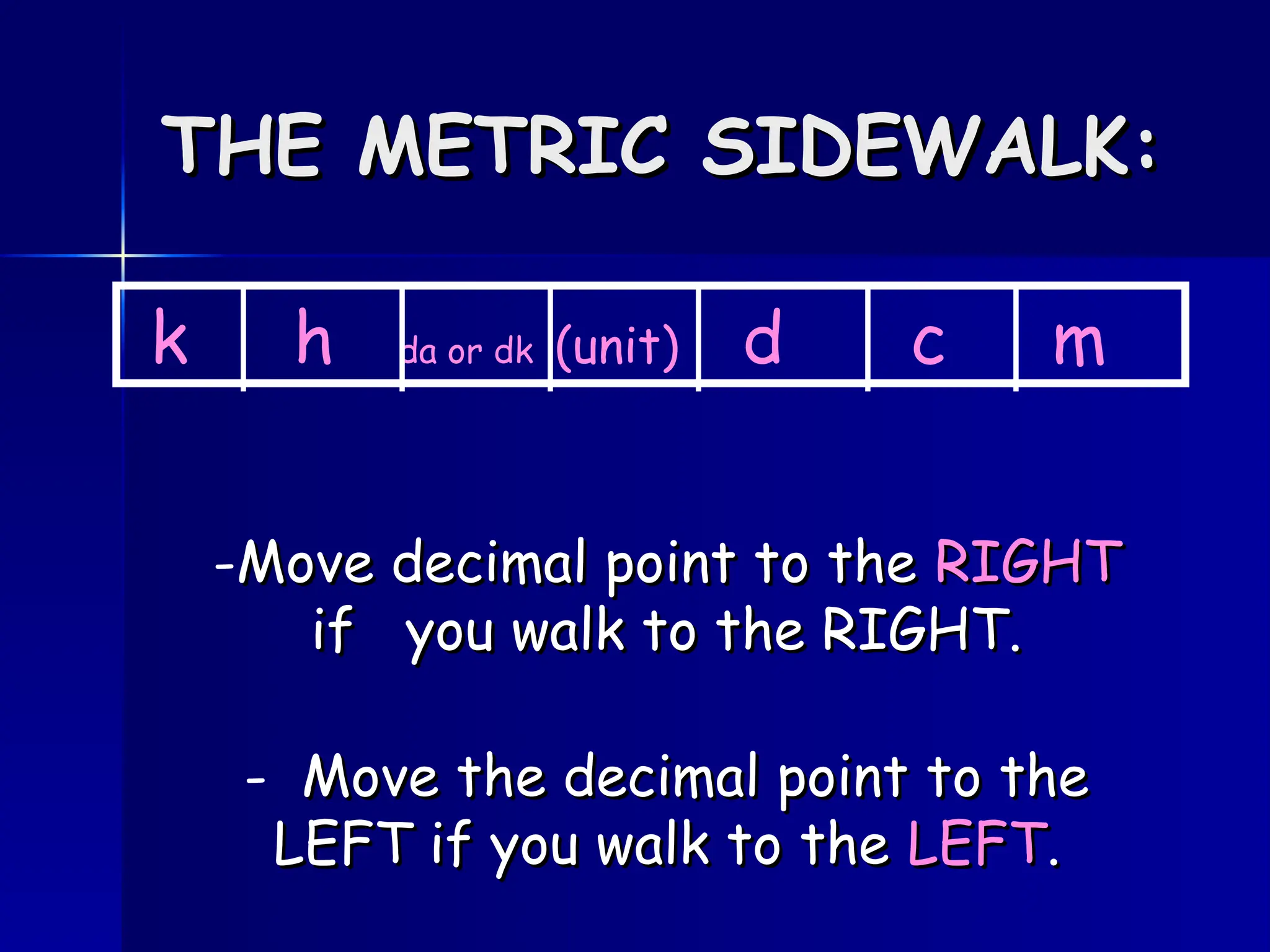
THE METRIC SIDEWALK:
k h da or dk (unit) d c m
-Move decimal point to the
Move decimal point to the RIGHT
RIGHT
if you walk to the RIGHT.
- Move the decimal point to the
Move the decimal point to the
LEFT if you walk to the
LEFT if you walk to the LEFT
LEFT.
.
PRACTICE:
PRACTICE:
1.
1. 23.675 cm = _____________ hm
23.675 cm = _____________ hm
2.
2. 56 dm = _____________ cm
56 dm = _____________ cm
3.
3. 14.356 mg = _____________ hg
14.356 mg = _____________ hg
4.
4. 12 kL = _____________ L
12 kL = _____________ L
5.
5. 6.98 hg = _____________ mg
6.98 hg = _____________ mg
6.
6. 9 m = _____________ km
9 m = _____________ km
7.
7. 6.854 cL = _____________ kL
6.854 cL = _____________ kL
0.0023675
560
0.00014356
12,000
698,000
0.009
0.00006854
More Practice:
More Practice:
8.
8. 3.65 mg = _____________ dg
3.65 mg = _____________ dg
9.
9. 9.987 g = _____________ hg
9.987 g = _____________ hg
10.
10. 12.203 km = _____________ mm
12.203 km = _____________ mm
0.0365
0.09987
12,203,000
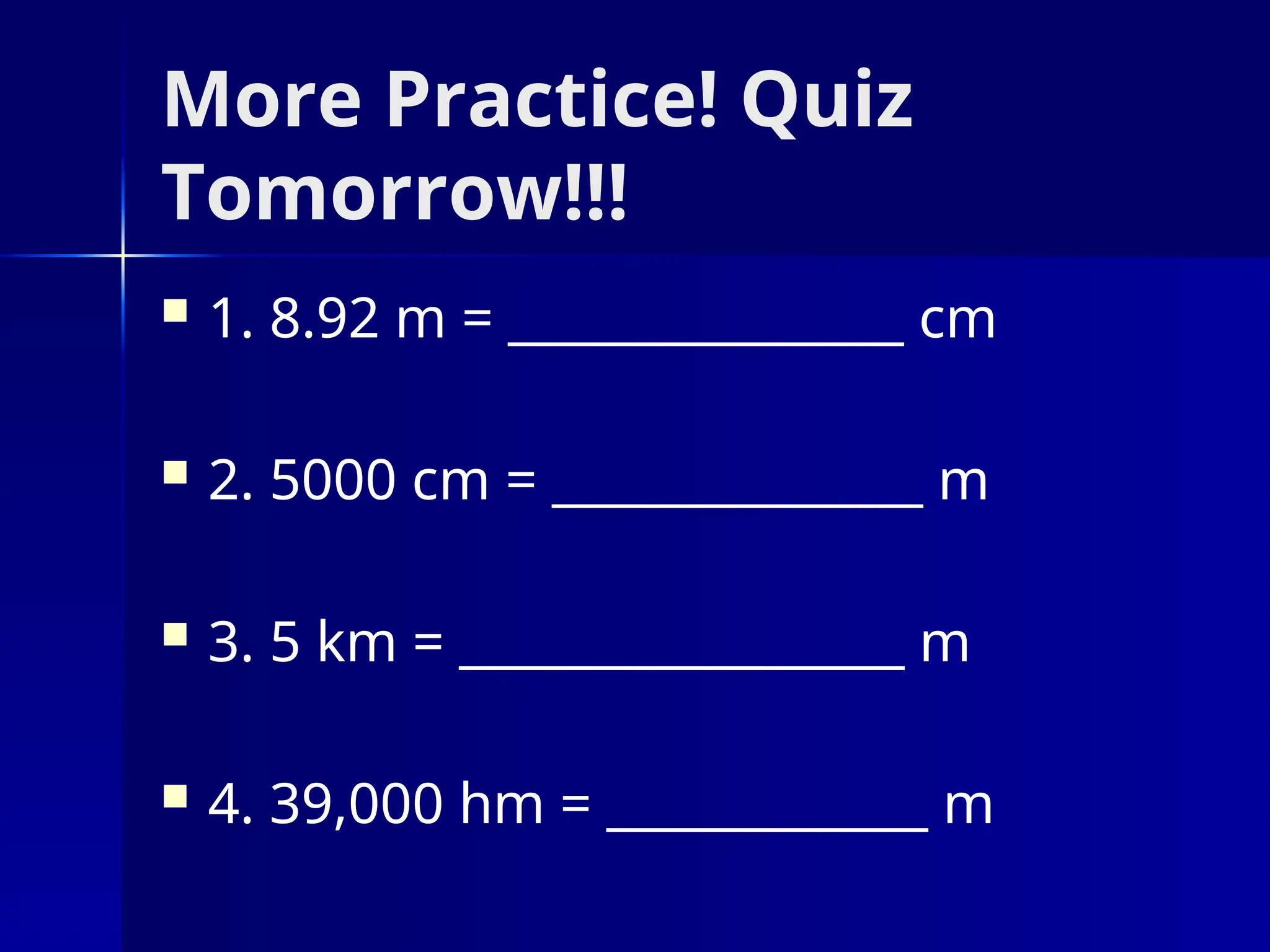
More Practice! Quiz
Tomorrow!!!
 1. 8.92 m = ________________ cm
 2. 5000 cm = _______________ m
 3. 5 km = __________________ m
 4. 39,000 hm = _____________ m
Even more practice!
 Kim and Meghan live on opposite
sides of town. On Sundays they ride
their bicycles and meet at the soccer
field. Kim rides 2.3 km, and Meghan
rides 2129 m.
– (a) Who has the longer ride? __________
– (b) How did you figure this out.
Temperature Scales
Temperature Scales
 Fahrenheit – used in USA
Fahrenheit – used in USA
 FP of water = 32
FP of water = 32 o
o
F.
F.
 BP of water = 212
BP of water = 212 o
o
F.
F.
 Room temp. = 67
Room temp. = 67 o
o
F.
F.
 Body temp. = 98.6
Body temp. = 98.6 o
o
F.
F.
Temperature Scales
Temperature Scales
 Celsius (Centigrade) – used
Celsius (Centigrade) – used
everywhere else
everywhere else
 FP of water = 0
FP of water = 0 o
o
C.
C.
 BP of water = 100
BP of water = 100 o
o
C.
C.
 Room temp. = 20
Room temp. = 20 o
o
C.
C.
 Body temp. = 37
Body temp. = 37 o
o
C.
C.
Temperature Scales
Temperature Scales
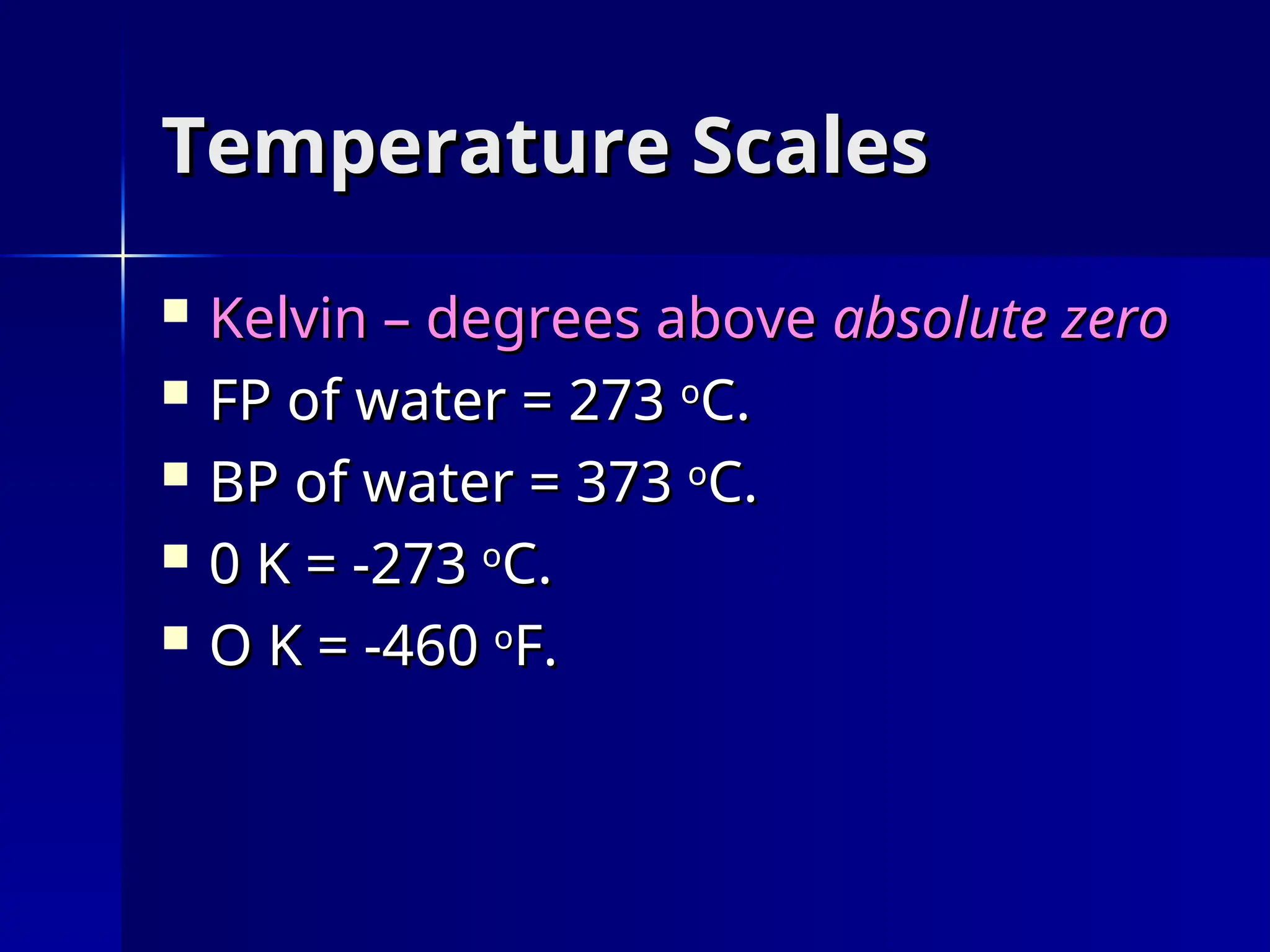
 Kelvin – degrees above
Kelvin – degrees above absolute zero
absolute zero
 FP of water = 273
FP of water = 273 o
o
C.
C.
 BP of water = 373
BP of water = 373 o
o
C.
C.
 0 K = -273
0 K = -273 o
o
C.
C.
 O K = -460
O K = -460 o
o
F.
F.
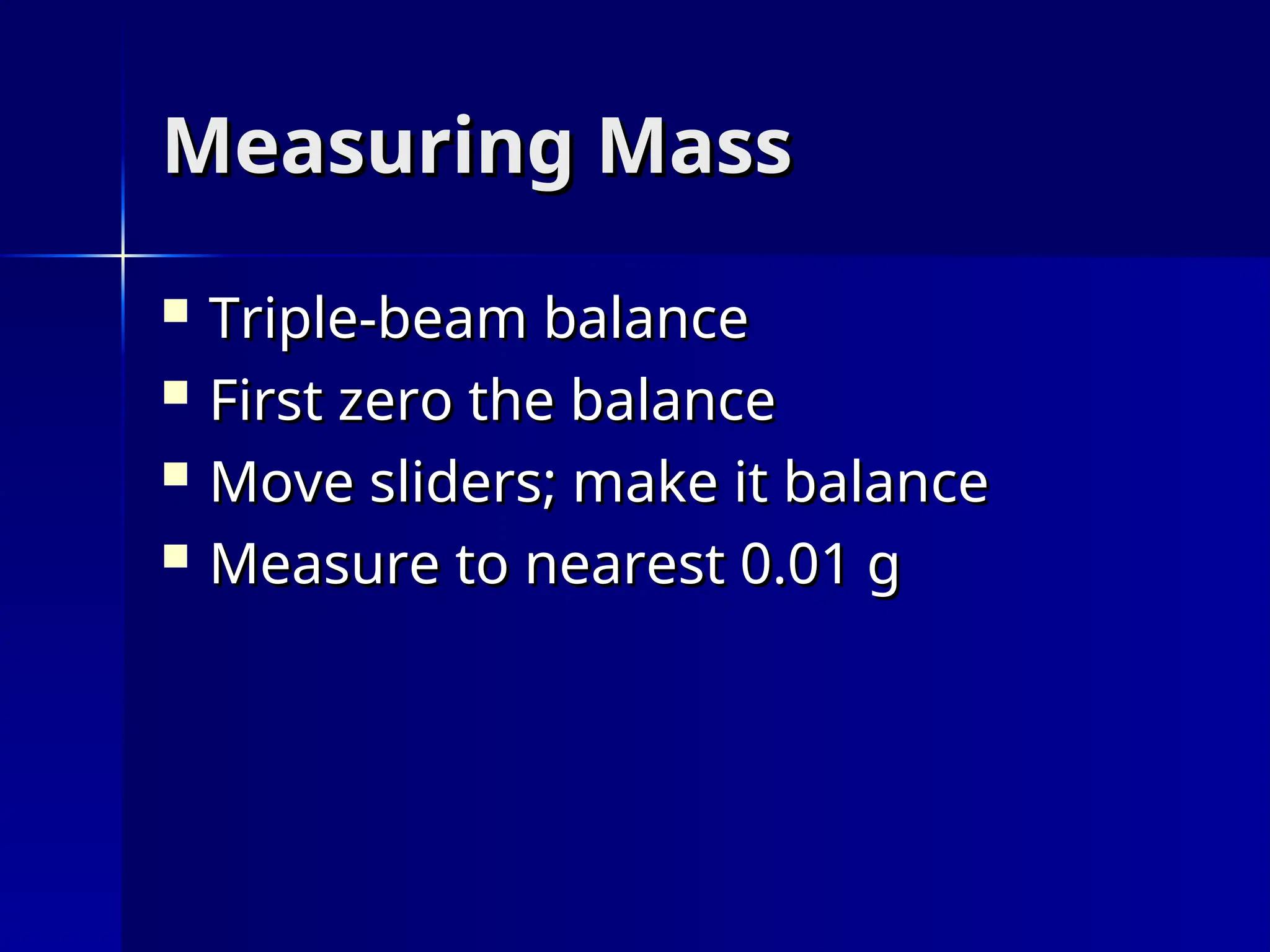
Measuring Mass
Measuring Mass
 Triple-beam balance
Triple-beam balance
 First zero the balance
First zero the balance
 Move sliders; make it balance
Move sliders; make it balance
 Measure to nearest 0.01 g
Measure to nearest 0.01 g
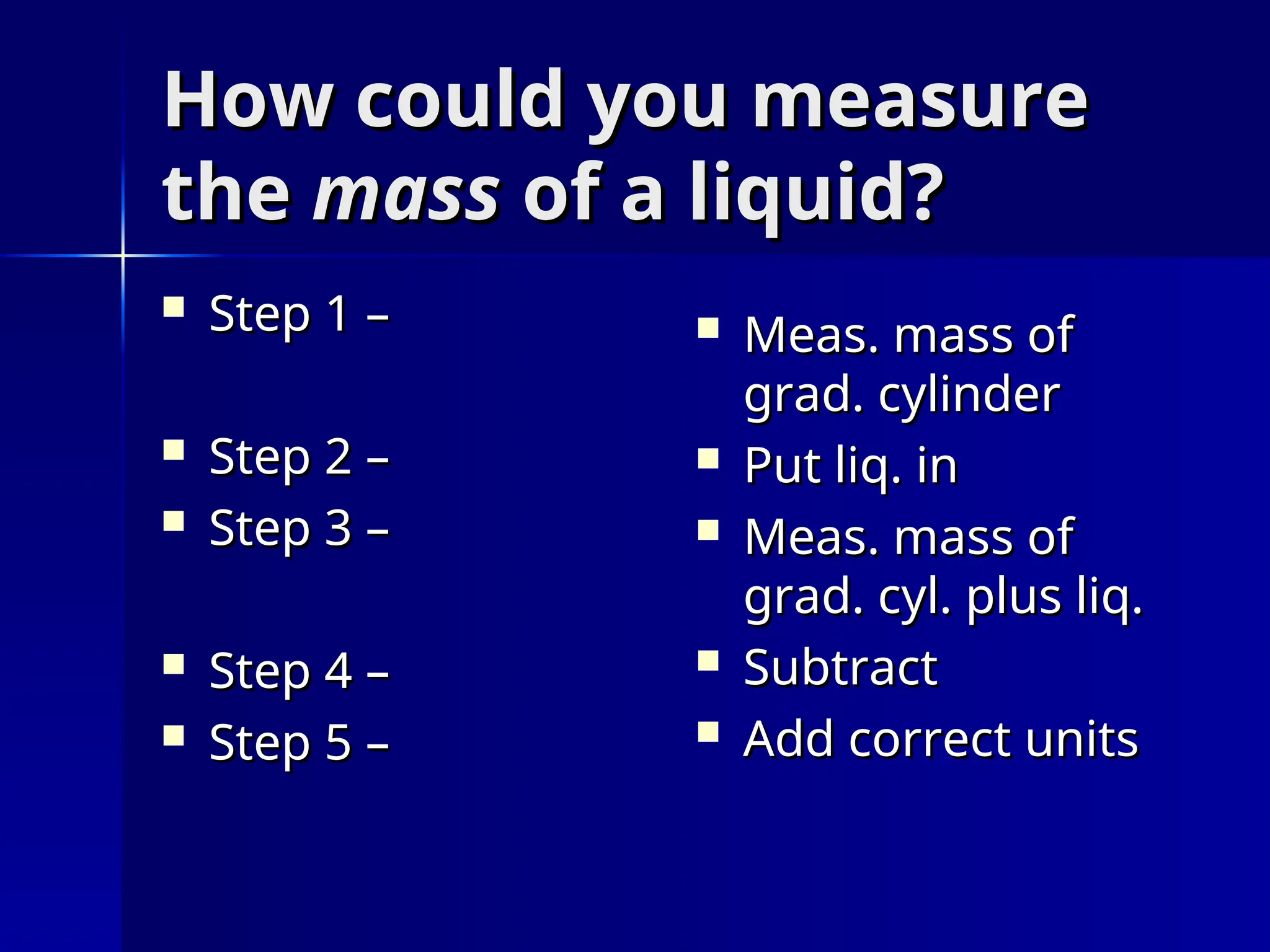
How could you measure
the
the mass
mass of a liquid?
of a liquid?
 Step 1 –
Step 1 –
 Step 2 –
Step 2 –
 Step 3 –
Step 3 –
 Step 4 –
Step 4 –
 Step 5 –
Step 5 –
 Meas. mass of
Meas. mass of
grad. cylinder
grad. cylinder
 Put liq. in
Put liq. in
 Meas. mass of
Meas. mass of
grad. cyl. plus liq.
 Subtract
Subtract
 Add correct units
Add correct units
Measuring Volume of a liquid
 Graduated cylinder
Graduated cylinder
 NOT a beaker!!!!!
NOT a beaker!!!!!
 Read at eye level
Read at eye level
 Bottom of meniscus
Bottom of meniscus
 1 ml = 1 cm
1 ml = 1 cm3
3
Measuring Volume of a solid
 Cube: V = l
Cube: V = l3
3
 Right rectangular prism: V = l w h
Right rectangular prism: V = l w h
 Cylinder: V = (4/3)
Cylinder: V = (4/3) π
π r
r2
2
h
h
 Cone:
Cone: V = (1/3)
V = (1/3) π
π r
r2
2
h
h
 Sphere: V = (4/3)
Sphere: V = (4/3) π
π r
r3
3
 Irregular solid: use the water
Irregular solid: use the water
displacement method!

Scientific measurement_metric_system.ppt

  • 1.
    SCIENTIFIC SCIENTIFIC MEASUREMENT MEASUREMENT International System ofUnits International System of Units (SI) - (SI) - measurement system used by scientists measurement system used by scientists around the world to express around the world to express measurements made in scientific measurements made in scientific investigations [the Metric System]. investigations [the Metric System]. [THE METRIC SYSTEM]
  • 2.
     Scientists Scientists allover the world all over the world know and know and use the metric system. use the metric system.
  • 3.
     Below isa list of the basic units of Below is a list of the basic units of the the metric system metric system (SI system) and (SI system) and the commonly used prefixes with the commonly used prefixes with their meanings. their meanings.
  • 4.
    What units areused when What units are used when measuring objects? measuring objects?  Basic SI units: Basic SI units: – meters (m) - meters (m) - length length – grams (g) - grams (g) - mass mass – liters (L) – liters (L) – volume volume – seconds (s) – seconds (s) – time time – Celsius degree ( Celsius degree (o o C.) – C.) – temperature temperature  Prefixes: see table Prefixes: see table → →  The metric system is used The metric system is used for for all over the world all over the world ( (except except the USA) the USA)  Used for Used for all all SCIENTIFIC SCIENTIFIC measurements (incl. the measurements (incl. the USA) USA)  SI SI stands for… stands for… Systeme Internationale Systeme Internationale
  • 5.
    BASIC UNITS OFTHE BASIC UNITS OF THE METRIC SYSTEM METRIC SYSTEM BASIC UNIT BASIC UNIT PROPERTY PROPERTY MEASURED MEASURED meter (m) meter (m) length length gram (g) gram (g) Mass Mass liter (L) liter (L) Volume Volume second (s) second (s) Time Time Celsius degree (C Celsius degree (Co o ) ) temperature temperature
  • 6.
    COMMON PREFIXES AND COMMONPREFIXES AND THEIR MEANINGS THEIR MEANINGS PREFIX PREFIX (abbreviation) (abbreviation) MEANING MEANING kilo – (k) kilo – (k) 1,000 ( 1 thousand) 1,000 ( 1 thousand) hecto – (h) hecto – (h) 100 (1 hundred) 100 (1 hundred) deca- or deka- (da or deca- or deka- (da or dk) dk) 10 (ten) 10 (ten) deci- (d) deci- (d) 0.1 ( tenth) 0.1 ( tenth) centi- (c) centi- (c) 0.01 (1 hundreth) 0.01 (1 hundreth) milli- (m) milli- (m) 0.001 (1 thousandth) 0.001 (1 thousandth)
  • 7.
    How are wegoing to How are we going to remember this??? remember this???  King King  Henry’s Henry’s  darned darned  MONEY (GOLD, LOOT) MONEY (GOLD, LOOT)  didn’t didn’t  come come  Monday. Monday.
  • 8.
    How do weconvert in the How do we convert in the Metric system? Metric system?  Walk along the “Metric Sidewalk…..” Walk along the “Metric Sidewalk…..”
  • 9.
    THE METRIC SIDEWALK: THEMETRIC SIDEWALK: k h da or dk (unit) d c m -Move decimal point to the Move decimal point to the RIGHT RIGHT if you walk to the RIGHT. if you walk to the RIGHT. - Move the decimal point to the Move the decimal point to the LEFT if you walk to the LEFT if you walk to the LEFT LEFT. .
  • 10.
    PRACTICE: PRACTICE: 1. 1. 23.675 cm= _____________ hm 23.675 cm = _____________ hm 2. 2. 56 dm = _____________ cm 56 dm = _____________ cm 3. 3. 14.356 mg = _____________ hg 14.356 mg = _____________ hg 4. 4. 12 kL = _____________ L 12 kL = _____________ L 5. 5. 6.98 hg = _____________ mg 6.98 hg = _____________ mg 6. 6. 9 m = _____________ km 9 m = _____________ km 7. 7. 6.854 cL = _____________ kL 6.854 cL = _____________ kL 0.0023675 560 0.00014356 12,000 698,000 0.009 0.00006854
  • 11.
    More Practice: More Practice: 8. 8.3.65 mg = _____________ dg 3.65 mg = _____________ dg 9. 9. 9.987 g = _____________ hg 9.987 g = _____________ hg 10. 10. 12.203 km = _____________ mm 12.203 km = _____________ mm 0.0365 0.09987 12,203,000
  • 12.
    More Practice! Quiz Tomorrow!!! 1. 8.92 m = ________________ cm  2. 5000 cm = _______________ m  3. 5 km = __________________ m  4. 39,000 hm = _____________ m
  • 13.
    Even more practice! Kim and Meghan live on opposite sides of town. On Sundays they ride their bicycles and meet at the soccer field. Kim rides 2.3 km, and Meghan rides 2129 m. – (a) Who has the longer ride? __________ – (b) How did you figure this out.
  • 14.
    Temperature Scales Temperature Scales Fahrenheit – used in USA Fahrenheit – used in USA  FP of water = 32 FP of water = 32 o o F. F.  BP of water = 212 BP of water = 212 o o F. F.  Room temp. = 67 Room temp. = 67 o o F. F.  Body temp. = 98.6 Body temp. = 98.6 o o F. F.
  • 15.
    Temperature Scales Temperature Scales Celsius (Centigrade) – used Celsius (Centigrade) – used everywhere else everywhere else  FP of water = 0 FP of water = 0 o o C. C.  BP of water = 100 BP of water = 100 o o C. C.  Room temp. = 20 Room temp. = 20 o o C. C.  Body temp. = 37 Body temp. = 37 o o C. C.
  • 16.
    Temperature Scales Temperature Scales Kelvin – degrees above Kelvin – degrees above absolute zero absolute zero  FP of water = 273 FP of water = 273 o o C. C.  BP of water = 373 BP of water = 373 o o C. C.  0 K = -273 0 K = -273 o o C. C.  O K = -460 O K = -460 o o F. F.
  • 17.
    Measuring Mass Measuring Mass Triple-beam balance Triple-beam balance  First zero the balance First zero the balance  Move sliders; make it balance Move sliders; make it balance  Measure to nearest 0.01 g Measure to nearest 0.01 g
  • 18.
    How could youmeasure How could you measure the the mass mass of a liquid? of a liquid?  Step 1 – Step 1 –  Step 2 – Step 2 –  Step 3 – Step 3 –  Step 4 – Step 4 –  Step 5 – Step 5 –  Meas. mass of Meas. mass of grad. cylinder grad. cylinder  Put liq. in Put liq. in  Meas. mass of Meas. mass of grad. cyl. plus liq. grad. cyl. plus liq.  Subtract Subtract  Add correct units Add correct units
  • 19.
    Measuring Volume ofa liquid Measuring Volume of a liquid  Graduated cylinder Graduated cylinder  NOT a beaker!!!!! NOT a beaker!!!!!  Read at eye level Read at eye level  Bottom of meniscus Bottom of meniscus  1 ml = 1 cm 1 ml = 1 cm3 3
  • 20.
    Measuring Volume ofa solid Measuring Volume of a solid  Cube: V = l Cube: V = l3 3  Right rectangular prism: V = l w h Right rectangular prism: V = l w h  Cylinder: V = (4/3) Cylinder: V = (4/3) π π r r2 2 h h  Cone: Cone: V = (1/3) V = (1/3) π π r r2 2 h h  Sphere: V = (4/3) Sphere: V = (4/3) π π r r3 3  Irregular solid: use the water Irregular solid: use the water displacement method! displacement method!