SHASHIKANT 25/10/2012 1
 Transportation
 Heating homes
 Cooking
 Power machinery used for agriculture,
industry/business, homes
 What else?
SHASHIKANT 25/10/2012 2
 Work- application of force
thru a distance.
 Energy- capacity to do
work
 Power- rate of flow of
energy or rate at which
work is done.
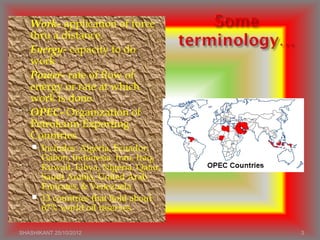
 OPEC- Organization of
Petroleum Exporting
Countries
 Includes: Algeria, Ecuador,
Gabon, Indonesia, Iran, Iraq,
Kuwait, Libya, Nigeria, Qatar,
Saudi Arabia, United Arab
Emirates, & Venezuela
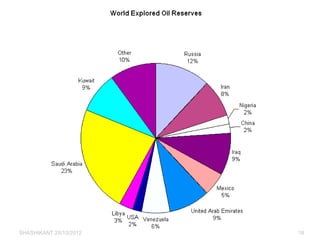
 13 countries that hold about
67% world oil reserves
SHASHIKANT 25/10/2012 3
 One calories is the amount of energy needed to
heat 1g of water 1°C.
 A kilocalorie is 1,000 calories
 1 BTU = energy to heat 1 lb of water 1°F
 1 watt (W) = 3.412 Btu/hour
 1 horsepower (hp) = 746 W
 Watt-hour- used to describe electrical energy.
Usually use kilowatt-hour (kWh)/ it is larger.
SHASHIKANT 25/10/2012 4
 Laws of thermodynamics tell 2 things aboutLaws of thermodynamics tell 2 things about
converting heat energy from steam to work…converting heat energy from steam to work…
 Conversion of heat to work is not 100% efficient because aConversion of heat to work is not 100% efficient because a
portion of the heat is wastedportion of the heat is wasted
 Efficiency of converting heat to work increases as the heatEfficiency of converting heat to work increases as the heat
temperature increases.temperature increases.
SHASHIKANT 25/10/2012 5
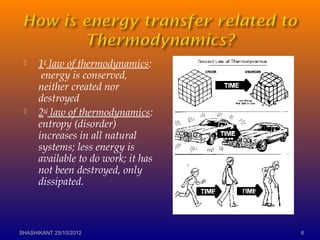
 1st
law of thermodynamics:
energy is conserved,
neither created nor
destroyed
 2nd
law of thermodynamics:
entropy (disorder)
increases in all natural
systems; less energy is
available to do work; it has
not been destroyed, only
dissipated.
SHASHIKANT 25/10/2012 6
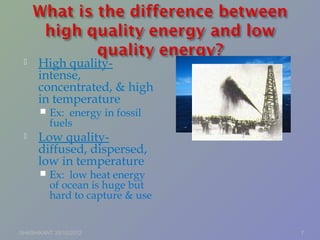
 High quality-
intense,
concentrated, & high
in temperature
 Ex: energy in fossil
fuels
 Low quality-
diffused, dispersed,
low in temperature
 Ex: low heat energy
of ocean is huge but
hard to capture & use
SHASHIKANT 25/10/2012 7
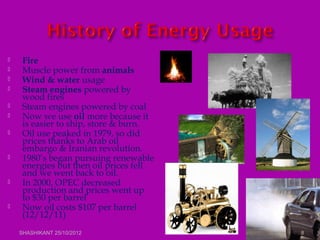
 Fire
 Muscle power from animals
 Wind & water usage
 Steam engines powered by
wood fires
 Steam engines powered by coal
 Now we use oil more because it
is easier to ship, store & burn.
 Oil use peaked in 1979, so did
prices thanks to Arab oil
embargo & Iranian revolution.
 1980’s began pursuing renewable
energies but then oil prices fell
and we went back to oil.
 In 2000, OPEC decreased
production and prices went up
to $30 per barrel
 Now oil costs $107 per barrel
(12/12/11)
SHASHIKANT 25/10/2012 8
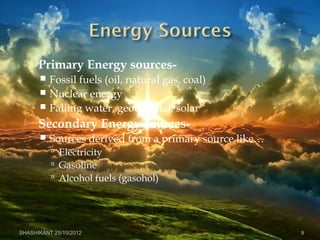
 Primary Energy sources-
 Fossil fuels (oil, natural gas, coal)
 Nuclear energy
 Falling water, geothermal, solar
 Secondary Energy sources-
 Sources derived from a primary source like…
 Electricity
 Gasoline
 Alcohol fuels (gasohol)
SHASHIKANT 25/10/2012 9
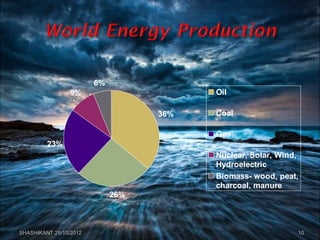
36%
26%
23%
9%
6%
Oil
Coal
Gas
Nuclear, Solar, Wind,
Hydroelectric
Biomass- wood, peat,
charcoal, manure
SHASHIKANT 25/10/2012 10
SHASHIKANT 25/10/2012 11
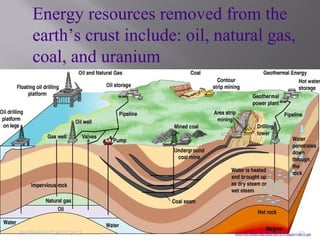
Energy resources removed from the
earth’s crust include: oil, natural gas,
coal, and uranium
www.bio.miami.edu/beck/esc101/Chapter14&15.pptSHASHIKANT 25/10/2012 12
 About ½ of all primary energy is lost when converted
to more useful forms
 Coal
 66% is lost to thermal conversion when energy in coal is
converted to electricity.
 10% is lost when transmitted to you at home.
 Oil
 75% lost during distillation, transportation, storage,
combustion in vehicles
 Natural Gas
 10% lost in shipping & processing
 Most efficient and least polluting (has more H than C so
produces less CO2 when burned so contributes less to global
warming.)
SHASHIKANT 25/10/2012 13
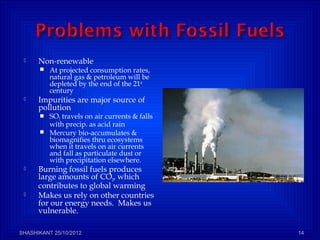
 Non-renewable
 At projected consumption rates,
natural gas & petroleum will be
depleted by the end of the 21st
century
 Impurities are major source of
pollution
 SO2 travels on air currents & falls
with precip. as acid rain
 Mercury bio-accumulates &
biomagnifies thru ecosystems
when it travels on air currents
and fall as particulate dust or
with precipitation elsewhere.
 Burning fossil fuels produces
large amounts of CO2, which
contributes to global warming
 Makes us rely on other countries
for our energy needs. Makes us
vulnerable.
SHASHIKANT 25/10/2012 14
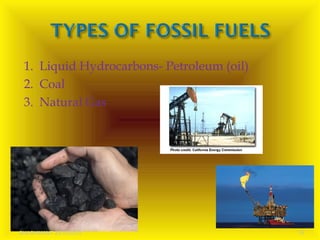
1. Liquid Hydrocarbons- Petroleum (oil)
2. Coal
3. Natural Gas
SHASHIKANT 25/10/2012 15
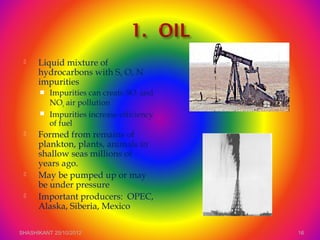
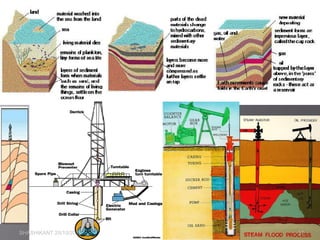
 Liquid mixture of
hydrocarbons with S, O, N
impurities
 Impurities can create SO2 and
NOx air pollution
 Impurities increase efficiency
of fuel
 Formed from remains of
plankton, plants, animals in
shallow seas millions of
years ago.
 May be pumped up or may
be under pressure
 Important producers: OPEC,
Alaska, Siberia, Mexico
SHASHIKANT 25/10/2012 16
SHASHIKANT 25/10/2012 17
SHASHIKANT 25/10/2012 18
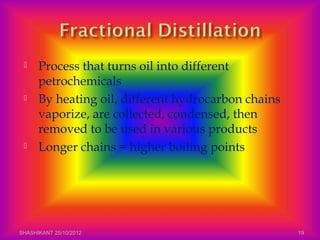
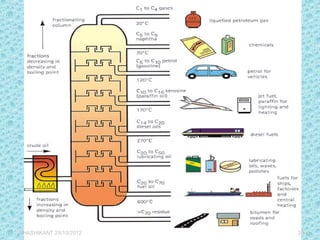
 Process that turns oil into different
petrochemicals
 By heating oil, different hydrocarbon chains
vaporize, are collected, condensed, then
removed to be used in various products
 Longer chains = higher boiling points
SHASHIKANT 25/10/2012 19
SHASHIKANT 25/10/2012 20
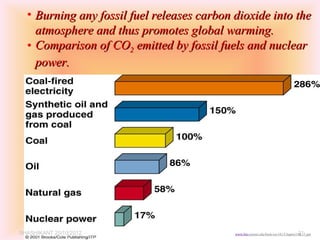
• Burning any fossil fuel releases carbon dioxide into theBurning any fossil fuel releases carbon dioxide into the
atmosphere and thus promotes global warming.atmosphere and thus promotes global warming.
• Comparison of COComparison of CO22 emitted by fossil fuels and nuclearemitted by fossil fuels and nuclear
power.power.
www.bio.miami.edu/beck/esc101/Chapter14&15.pptSHASHIKANT 25/10/2012 21
www.bio.miami.edu/beck/esc101/Chapter14&15.pptSHASHIKANT 25/10/2012 22
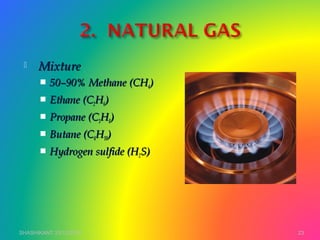
 MixtureMixture
 50–90% Methane (CH50–90% Methane (CH44))
 Ethane (CEthane (C22HH66))
 Propane (CPropane (C33HH88))
 Butane (CButane (C44HH1010))
 Hydrogen sulfide (HHydrogen sulfide (H22S)S)
SHASHIKANT 25/10/2012 23
www.bio.miami.edu/beck/esc101/Chapter14&15.pptSHASHIKANT 25/10/2012 24
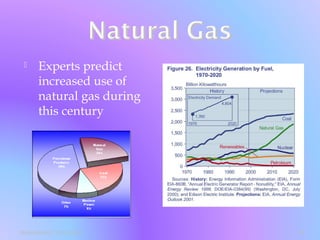
 Experts predict
increased use of
natural gas during
this century
SHASHIKANT 25/10/2012 25
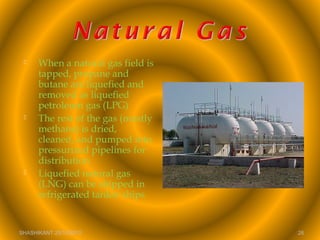
 When a natural gas field is
tapped, propane and
butane are liquefied and
removed as liquefied
petroleum gas (LPG)
 The rest of the gas (mostly
methane) is dried,
cleaned, and pumped into
pressurized pipelines for
distribution
 Liquefied natural gas
(LNG) can be shipped in
refrigerated tanker ships
SHASHIKANT 25/10/2012 26
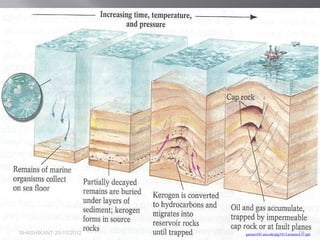
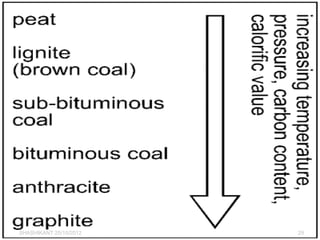
 Coal exists in many forms therefore a chemical
formula cannot be written for it.
 Coalification: After plants died they underwent
chemical decay to form a product known as
peat
 Over many years, thick peat layers formed.
 Peat is converted to coal by geological events such as
land subsidence which subject the peat to great
pressures and temperatures.
SHASHIKANT 25/10/2012 27
garnero101.asu.edu/glg101/Lectures/L37.pptSHASHIKANT 25/10/2012 28
SHASHIKANT 25/10/2012 29
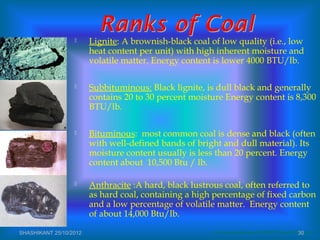
 Lignite: A brownish-black coal of low quality (i.e., low
heat content per unit) with high inherent moisture and
volatile matter. Energy content is lower 4000 BTU/lb.
 Subbituminous: Black lignite, is dull black and generally
contains 20 to 30 percent moisture Energy content is 8,300
BTU/lb.
 Bituminous: most common coal is dense and black (often
with well-defined bands of bright and dull material). Its
moisture content usually is less than 20 percent. Energy
content about 10,500 Btu / lb.
 Anthracite :A hard, black lustrous coal, often referred to
as hard coal, containing a high percentage of fixed carbon
and a low percentage of volatile matter. Energy content
of about 14,000 Btu/lb.
www.uvawise.edu/philosophy/Hist%20295/ Powerpoint%5CCoal.pptSHASHIKANT 25/10/2012 30
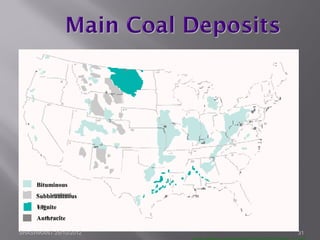
BituminousBituminous
AnthraciteAnthracite
SubbituminousSubbituminous
LigniteLignite
SHASHIKANT 25/10/2012 31
Advantages and DisadvantagesAdvantages and Disadvantages
© Brooks/Cole Publishing Company / ITP
www.bio.miami.edu/beck/esc101/Chapter14&15.ppt
Pros
 Most abundant fossil
fuel
 Major U.S. reserves
 300 yrs. at current
consumption rates
 High net energy yield
Cons
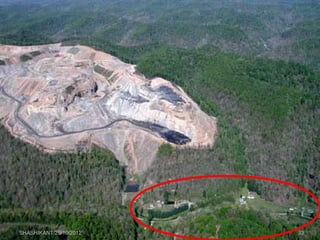
 Dirtiest fuel, highest
carbon dioxide
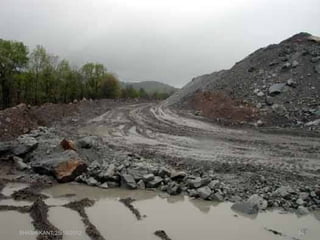
 Major environmental
degradation
 Major threat to health
SHASHIKANT 25/10/2012 32
SHASHIKANT 25/10/2012 33
SHASHIKANT 25/10/2012 34
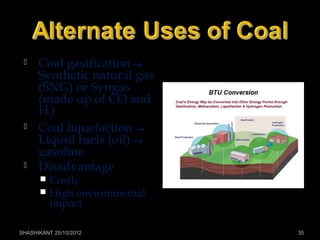
 Coal gasification →
Synthetic natural gas
(SNG) or Syngas
(made up of CO and
H2)
 Coal liquefaction →
Liquid fuels (oil) →
gasoline
 Disadvantage
 Costly
 High environmental
impact
SHASHIKANT 25/10/2012 35
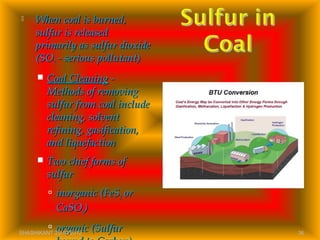
 When coal is burned,When coal is burned,
sulfur is releasedsulfur is released
primarily as sulfur dioxideprimarily as sulfur dioxide
(SO(SO22 - serious pollutant)- serious pollutant)
 Coal CleaningCoal Cleaning --
Methods of removingMethods of removing
sulfur from coal includesulfur from coal include
cleaning, solventcleaning, solvent
refining, gasification,refining, gasification,
and liquefactionand liquefaction
 Two chief forms ofTwo chief forms of
sulfursulfur
 inorganic (FeSinorganic (FeS22 oror
CaSOCaSO44))
 organic (Sulfurorganic (SulfurSHASHIKANT 25/10/2012 36
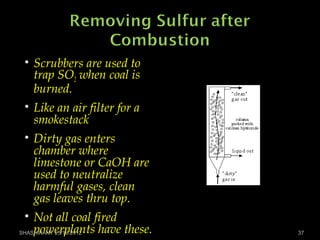
• Scrubbers are used to
trap SO2 when coal is
burned.
• Like an air filter for a
smokestack
• Dirty gas enters
chamber where
limestone or CaOH are
used to neutralize
harmful gases, clean
gas leaves thru top.
• Not all coal fired
powerplants have these.SHASHIKANT 25/10/2012 37
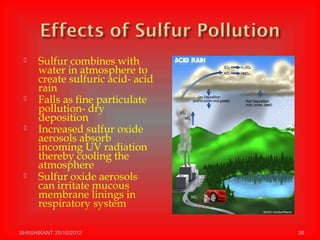
 Sulfur combines with
water in atmosphere to
create sulfuric acid- acid
rain
 Falls as fine particulate
pollution- dry
deposition
 Increased sulfur oxide
aerosols absorb
incoming UV radiation
thereby cooling the
atmosphere
 Sulfur oxide aerosols
can irritate mucous
membrane linings in
respiratory system
SHASHIKANT 25/10/2012 38
 Acid rain leaches metals (Al) out of soil, settles on fish gills,
causing suffocation.
 Leaches out soil nutrients
 Kills eggs(pH 5), larvae, fry (baby fish), and some adult fish
 Changes in pH can make some chemicals more toxic- kills trees or
aquatic life
 Decreases health of plants- more susceptible to disease
 As animals die from pH changes, other more hardy animals will
fill those new niches
 Upsets food web when sensitive species die.
 If regional climate changes due to cooling from sulfur pollution
 Changes in crops
 Changes in vegetation which leads to changes in fauna
distribution
 Changes in precipitation patterns
SHASHIKANT 25/10/2012 39

Conventional energy sources shashikant

  • 1.
  • 2.
     Transportation  Heatinghomes  Cooking  Power machinery used for agriculture, industry/business, homes  What else? SHASHIKANT 25/10/2012 2
  • 3.
     Work- applicationof force thru a distance.  Energy- capacity to do work  Power- rate of flow of energy or rate at which work is done.  OPEC- Organization of Petroleum Exporting Countries  Includes: Algeria, Ecuador, Gabon, Indonesia, Iran, Iraq, Kuwait, Libya, Nigeria, Qatar, Saudi Arabia, United Arab Emirates, & Venezuela  13 countries that hold about 67% world oil reserves SHASHIKANT 25/10/2012 3
  • 4.
     One caloriesis the amount of energy needed to heat 1g of water 1°C.  A kilocalorie is 1,000 calories  1 BTU = energy to heat 1 lb of water 1°F  1 watt (W) = 3.412 Btu/hour  1 horsepower (hp) = 746 W  Watt-hour- used to describe electrical energy. Usually use kilowatt-hour (kWh)/ it is larger. SHASHIKANT 25/10/2012 4
  • 5.
     Laws ofthermodynamics tell 2 things aboutLaws of thermodynamics tell 2 things about converting heat energy from steam to work…converting heat energy from steam to work…  Conversion of heat to work is not 100% efficient because aConversion of heat to work is not 100% efficient because a portion of the heat is wastedportion of the heat is wasted  Efficiency of converting heat to work increases as the heatEfficiency of converting heat to work increases as the heat temperature increases.temperature increases. SHASHIKANT 25/10/2012 5
  • 6.
     1st law ofthermodynamics: energy is conserved, neither created nor destroyed  2nd law of thermodynamics: entropy (disorder) increases in all natural systems; less energy is available to do work; it has not been destroyed, only dissipated. SHASHIKANT 25/10/2012 6
  • 7.
     High quality- intense, concentrated,& high in temperature  Ex: energy in fossil fuels  Low quality- diffused, dispersed, low in temperature  Ex: low heat energy of ocean is huge but hard to capture & use SHASHIKANT 25/10/2012 7
  • 8.
     Fire  Musclepower from animals  Wind & water usage  Steam engines powered by wood fires  Steam engines powered by coal  Now we use oil more because it is easier to ship, store & burn.  Oil use peaked in 1979, so did prices thanks to Arab oil embargo & Iranian revolution.  1980’s began pursuing renewable energies but then oil prices fell and we went back to oil.  In 2000, OPEC decreased production and prices went up to $30 per barrel  Now oil costs $107 per barrel (12/12/11) SHASHIKANT 25/10/2012 8
  • 9.
     Primary Energysources-  Fossil fuels (oil, natural gas, coal)  Nuclear energy  Falling water, geothermal, solar  Secondary Energy sources-  Sources derived from a primary source like…  Electricity  Gasoline  Alcohol fuels (gasohol) SHASHIKANT 25/10/2012 9
  • 10.
    36% 26% 23% 9% 6% Oil Coal Gas Nuclear, Solar, Wind, Hydroelectric Biomass-wood, peat, charcoal, manure SHASHIKANT 25/10/2012 10
  • 11.
  • 12.
    Energy resources removedfrom the earth’s crust include: oil, natural gas, coal, and uranium www.bio.miami.edu/beck/esc101/Chapter14&15.pptSHASHIKANT 25/10/2012 12
  • 13.
     About ½of all primary energy is lost when converted to more useful forms  Coal  66% is lost to thermal conversion when energy in coal is converted to electricity.  10% is lost when transmitted to you at home.  Oil  75% lost during distillation, transportation, storage, combustion in vehicles  Natural Gas  10% lost in shipping & processing  Most efficient and least polluting (has more H than C so produces less CO2 when burned so contributes less to global warming.) SHASHIKANT 25/10/2012 13
  • 14.
     Non-renewable  Atprojected consumption rates, natural gas & petroleum will be depleted by the end of the 21st century  Impurities are major source of pollution  SO2 travels on air currents & falls with precip. as acid rain  Mercury bio-accumulates & biomagnifies thru ecosystems when it travels on air currents and fall as particulate dust or with precipitation elsewhere.  Burning fossil fuels produces large amounts of CO2, which contributes to global warming  Makes us rely on other countries for our energy needs. Makes us vulnerable. SHASHIKANT 25/10/2012 14
  • 15.
    1. Liquid Hydrocarbons-Petroleum (oil) 2. Coal 3. Natural Gas SHASHIKANT 25/10/2012 15
  • 16.
     Liquid mixtureof hydrocarbons with S, O, N impurities  Impurities can create SO2 and NOx air pollution  Impurities increase efficiency of fuel  Formed from remains of plankton, plants, animals in shallow seas millions of years ago.  May be pumped up or may be under pressure  Important producers: OPEC, Alaska, Siberia, Mexico SHASHIKANT 25/10/2012 16
  • 17.
  • 18.
  • 19.
     Process thatturns oil into different petrochemicals  By heating oil, different hydrocarbon chains vaporize, are collected, condensed, then removed to be used in various products  Longer chains = higher boiling points SHASHIKANT 25/10/2012 19
  • 20.
  • 21.
    • Burning anyfossil fuel releases carbon dioxide into theBurning any fossil fuel releases carbon dioxide into the atmosphere and thus promotes global warming.atmosphere and thus promotes global warming. • Comparison of COComparison of CO22 emitted by fossil fuels and nuclearemitted by fossil fuels and nuclear power.power. www.bio.miami.edu/beck/esc101/Chapter14&15.pptSHASHIKANT 25/10/2012 21
  • 22.
  • 23.
     MixtureMixture  50–90%Methane (CH50–90% Methane (CH44))  Ethane (CEthane (C22HH66))  Propane (CPropane (C33HH88))  Butane (CButane (C44HH1010))  Hydrogen sulfide (HHydrogen sulfide (H22S)S) SHASHIKANT 25/10/2012 23
  • 24.
  • 25.
     Experts predict increaseduse of natural gas during this century SHASHIKANT 25/10/2012 25
  • 26.
     When anatural gas field is tapped, propane and butane are liquefied and removed as liquefied petroleum gas (LPG)  The rest of the gas (mostly methane) is dried, cleaned, and pumped into pressurized pipelines for distribution  Liquefied natural gas (LNG) can be shipped in refrigerated tanker ships SHASHIKANT 25/10/2012 26
  • 27.
     Coal existsin many forms therefore a chemical formula cannot be written for it.  Coalification: After plants died they underwent chemical decay to form a product known as peat  Over many years, thick peat layers formed.  Peat is converted to coal by geological events such as land subsidence which subject the peat to great pressures and temperatures. SHASHIKANT 25/10/2012 27
  • 28.
  • 29.
  • 30.
     Lignite: Abrownish-black coal of low quality (i.e., low heat content per unit) with high inherent moisture and volatile matter. Energy content is lower 4000 BTU/lb.  Subbituminous: Black lignite, is dull black and generally contains 20 to 30 percent moisture Energy content is 8,300 BTU/lb.  Bituminous: most common coal is dense and black (often with well-defined bands of bright and dull material). Its moisture content usually is less than 20 percent. Energy content about 10,500 Btu / lb.  Anthracite :A hard, black lustrous coal, often referred to as hard coal, containing a high percentage of fixed carbon and a low percentage of volatile matter. Energy content of about 14,000 Btu/lb. www.uvawise.edu/philosophy/Hist%20295/ Powerpoint%5CCoal.pptSHASHIKANT 25/10/2012 30
  • 31.
  • 32.
    Advantages and DisadvantagesAdvantagesand Disadvantages © Brooks/Cole Publishing Company / ITP www.bio.miami.edu/beck/esc101/Chapter14&15.ppt Pros  Most abundant fossil fuel  Major U.S. reserves  300 yrs. at current consumption rates  High net energy yield Cons  Dirtiest fuel, highest carbon dioxide  Major environmental degradation  Major threat to health SHASHIKANT 25/10/2012 32
  • 33.
  • 34.
  • 35.
     Coal gasification→ Synthetic natural gas (SNG) or Syngas (made up of CO and H2)  Coal liquefaction → Liquid fuels (oil) → gasoline  Disadvantage  Costly  High environmental impact SHASHIKANT 25/10/2012 35
  • 36.
     When coalis burned,When coal is burned, sulfur is releasedsulfur is released primarily as sulfur dioxideprimarily as sulfur dioxide (SO(SO22 - serious pollutant)- serious pollutant)  Coal CleaningCoal Cleaning -- Methods of removingMethods of removing sulfur from coal includesulfur from coal include cleaning, solventcleaning, solvent refining, gasification,refining, gasification, and liquefactionand liquefaction  Two chief forms ofTwo chief forms of sulfursulfur  inorganic (FeSinorganic (FeS22 oror CaSOCaSO44))  organic (Sulfurorganic (SulfurSHASHIKANT 25/10/2012 36
  • 37.
    • Scrubbers areused to trap SO2 when coal is burned. • Like an air filter for a smokestack • Dirty gas enters chamber where limestone or CaOH are used to neutralize harmful gases, clean gas leaves thru top. • Not all coal fired powerplants have these.SHASHIKANT 25/10/2012 37
  • 38.
     Sulfur combineswith water in atmosphere to create sulfuric acid- acid rain  Falls as fine particulate pollution- dry deposition  Increased sulfur oxide aerosols absorb incoming UV radiation thereby cooling the atmosphere  Sulfur oxide aerosols can irritate mucous membrane linings in respiratory system SHASHIKANT 25/10/2012 38
  • 39.
     Acid rainleaches metals (Al) out of soil, settles on fish gills, causing suffocation.  Leaches out soil nutrients  Kills eggs(pH 5), larvae, fry (baby fish), and some adult fish  Changes in pH can make some chemicals more toxic- kills trees or aquatic life  Decreases health of plants- more susceptible to disease  As animals die from pH changes, other more hardy animals will fill those new niches  Upsets food web when sensitive species die.  If regional climate changes due to cooling from sulfur pollution  Changes in crops  Changes in vegetation which leads to changes in fauna distribution  Changes in precipitation patterns SHASHIKANT 25/10/2012 39