Non-Renewable Resources
Prepared by Kiersten Lippmann2017
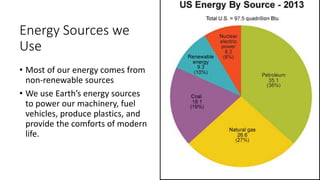
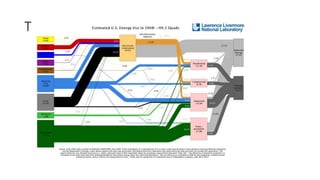
Energy Sources we
Use
• Most of our energy comes from
non-renewable sources
• We use Earth’s energy sources
to power our machinery, fuel
vehicles, produce plastics, and
provide the comforts of modern
life.
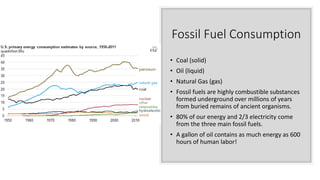
Fossil Fuel Consumption
• Coal (solid)
• Oil (liquid)
• Natural Gas (gas)
• Fossil fuels are highly combustible substances
formed underground over millions of years
from buried remains of ancient organisms.
• 80% of our energy and 2/3 electricity come
from the three main fossil fuels.
• A gallon of oil contains as much energy as 600
hours of human labor!
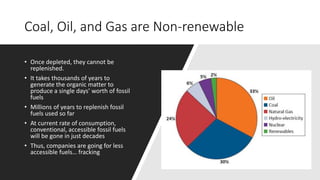
Coal, Oil, and Gas are Non-renewable
• Once depleted, they cannot be
replenished.
• It takes thousands of years to
generate the organic matter to
produce a single days’ worth of fossil
fuels
• Millions of years to replenish fossil
fuels used so far
• At current rate of consumption,
conventional, accessible fossil fuels
will be gone in just decades
• Thus, companies are going for less
accessible fuels… fracking
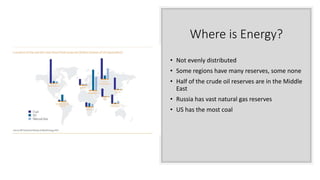
Where is Energy?
• Not evenly distributed
• Some regions have many reserves, some none
• Half of the crude oil reserves are in the Middle
East
• Russia has vast natural gas reserves
• US has the most coal
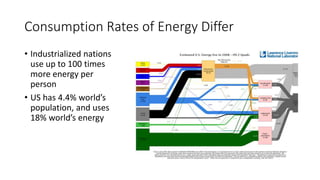
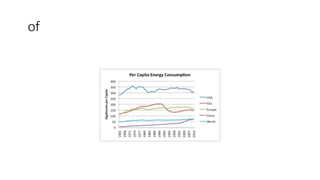
Consumption Rates of Energy Differ
• Industrialized nations
use up to 100 times
more energy per
person
• US has 4.4% world’s
population, and uses
18% world’s energy
Takes Energy to Make Energy
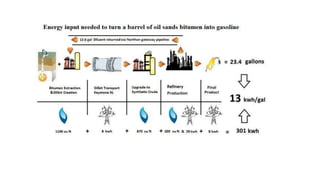
• Takes substantial energy to harness, extract, process and deliver
energy.
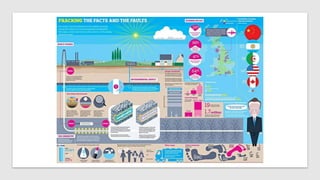
• Fracturing shale layers deep underground uses powerful machinery,
lots of water, specialized chemicals, vehicles, storage tanks, waste
ponds, pipelines, processing facilities, equipment for workers, and
more- all require ENERGY
• Net Energy= Energy Returned- Energy invested
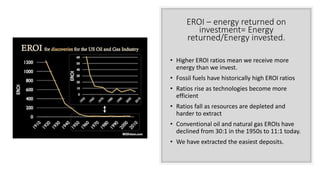
• EROI – energy returned on investment= Energy returned/Energy
invested.
EROI – energy returned on
investment= Energy
returned/Energy invested.
• Higher EROI ratios mean we receive more
energy than we invest.
• Fossil fuels have historically high EROI ratios
• Ratios rise as technologies become more
efficient
• Ratios fall as resources are depleted and
harder to extract
• Conventional oil and natural gas EROIs have
declined from 30:1 in the 1950s to 11:1 today.
• We have extracted the easiest deposits.
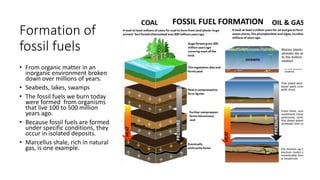
Formation of
fossil fuels
• From organic matter in an
inorganic environment broken
down over millions of years.
• Seabeds, lakes, swamps
• The fossil fuels we burn today
were formed from organisms
that live 100 to 500 million
years ago.
• Because fossil fuels are formed
under specific conditions, they
occur in isolated deposits.
• Marcellus shale, rich in natural
gas, is one example.
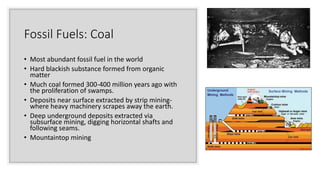
Fossil Fuels: Coal
• Most abundant fossil fuel in the world
• Hard blackish substance formed from organic
matter
• Much coal formed 300-400 million years ago with
the proliferation of swamps.
• Deposits near surface extracted by strip mining-
where heavy machinery scrapes away the earth.
• Deep underground deposits extracted via
subsurface mining, digging horizontal shafts and
following seams.
• Mountaintop mining
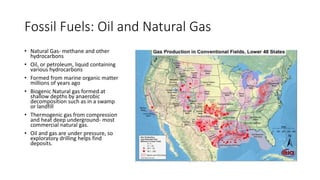
Fossil Fuels: Oil and Natural Gas
• Natural Gas- methane and other
hydrocarbons
• Oil, or petroleum, liquid containing
various hydrocarbons
• Formed from marine organic matter
millions of years ago
• Biogenic Natural gas formed at
shallow depths by anaerobic
decomposition such as in a swamp
or landfill
• Thermogenic gas from compression
and heat deep underground- most
commercial natural gas.
• Oil and gas are under pressure, so
exploratory drilling helps find
deposits.
Unconventional Fuels:
not YET widely used
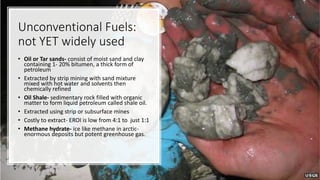
• Oil or Tar sands- consist of moist sand and clay
containing 1- 20% bitumen, a thick form of
petroleum
• Extracted by strip mining with sand mixture
mixed with hot water and solvents then
chemically refined
• Oil Shale- sedimentary rock filled with organic
matter to form liquid petroleum called shale oil.
• Extracted using strip or subsurface mines
• Costly to extract- EROI is low from 4:1 to just 1:1
• Methane hydrate- ice like methane in arctic-
enormous deposits but potent greenhouse gas.
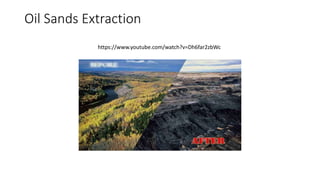
Oil Sands Extraction
https://www.youtube.com/watch?v=Dh6far2zbWc
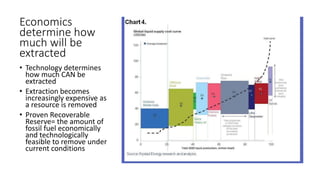
Economics
determine how
much will be
extracted
• Technology determines
how much CAN be
extracted
• Extraction becomes
increasingly expensive as
a resource is removed
• Proven Recoverable
Reserve= the amount of
fossil fuel economically
and technologically
feasible to remove under
current conditions
Many uses for
Fossil Fuels
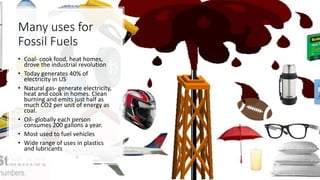
• Coal- cook food, heat homes,
drove the industrial revolution
• Today generates 40% of
electricity in US
• Natural gas- generate electricity,
heat and cook in homes. Clean
burning and emits just half as
much CO2 per unit of energy as
coal.
• Oil- globally each person
consumes 200 gallons a year.
• Most used to fuel vehicles
• Wide range of uses in plastics
and lubricants
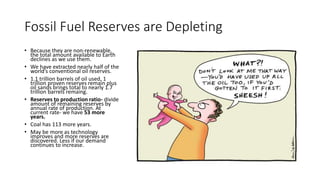
Fossil Fuel Reserves are Depleting
• Because they are non-renewable,
the total amount available to Earth
declines as we use them.
• We have extracted nearly half of the
world’s conventional oil reserves.
• 1.1 trillion barrels of oil used, 1
trillion proven reserves remain plus
oil sands brings total to nearly 1.7
trillion barrels remaing.
• Reserves to production ratio- divide
amount of remaining reserves by
annual rate of production. At
current rate- we have 53 more
years.
• Coal has 113 more years.
• May be more as technology
improves and more reserves are
discovered. Less if our demand
continues to increase.
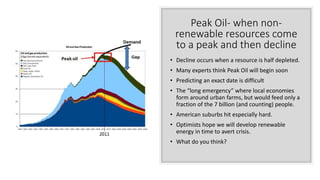
Peak Oil- when non-
renewable resources come
to a peak and then decline
• Decline occurs when a resource is half depleted.
• Many experts think Peak Oil will begin soon
• Predicting an exact date is difficult
• The “long emergency” where local economies
form around urban farms, but would feed only a
fraction of the 7 billion (and counting) people.
• American suburbs hit especially hard.
• Optimists hope we will develop renewable
energy in time to avert crisis.
• What do you think?
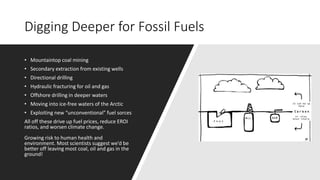
Digging Deeper for Fossil Fuels
• Mountaintop coal mining
• Secondary extraction from existing wells
• Directional drilling
• Hydraulic fracturing for oil and gas
• Offshore drilling in deeper waters
• Moving into ice-free waters of the Arctic
• Exploiting new “unconventional” fuel sorces
All off these drive up fuel prices, reduce EROI
ratios, and worsen climate change.
Growing risk to human health and
environment. Most scientists suggest we’d be
better off leaving most coal, oil and gas in the
ground!
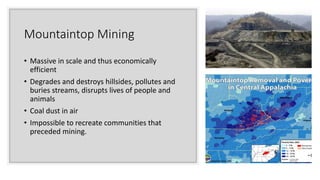
Mountaintop Mining
• Massive in scale and thus economically
efficient
• Degrades and destroys hillsides, pollutes and
buries streams, disrupts lives of people and
animals
• Coal dust in air
• Impossible to recreate communities that
preceded mining.
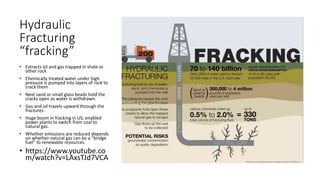
Hydraulic
Fracturing
“fracking”
• Extracts oil and gas trapped in shale or
other rock
• Chemically treated water under high
pressure is pumped into layers of rock to
crack them
• Next sand or small glass beads hold the
cracks open as water is withdrawn.
• Gas and oil travels upward through the
fractures
• Huge boom in fracking in US, enabled
power plants to switch from coal to
natural gas.
• Whether emissions are reduced depends
on whether natural gas can be a “bridge
fuel” to renewable resources.
• https://www.youtube.co
m/watch?v=LAxsTJd7VCA
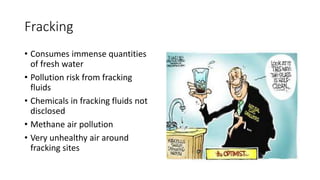
Fracking
• Consumes immense quantities
of fresh water
• Pollution risk from fracking
fluids
• Chemicals in fracking fluids not
disclosed
• Methane air pollution
• Very unhealthy air around
fracking sites
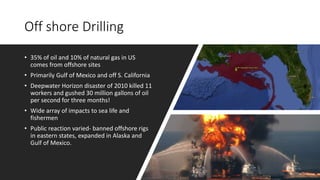
Off shore Drilling
• 35% of oil and 10% of natural gas in US
comes from offshore sites
• Primarily Gulf of Mexico and off S. California
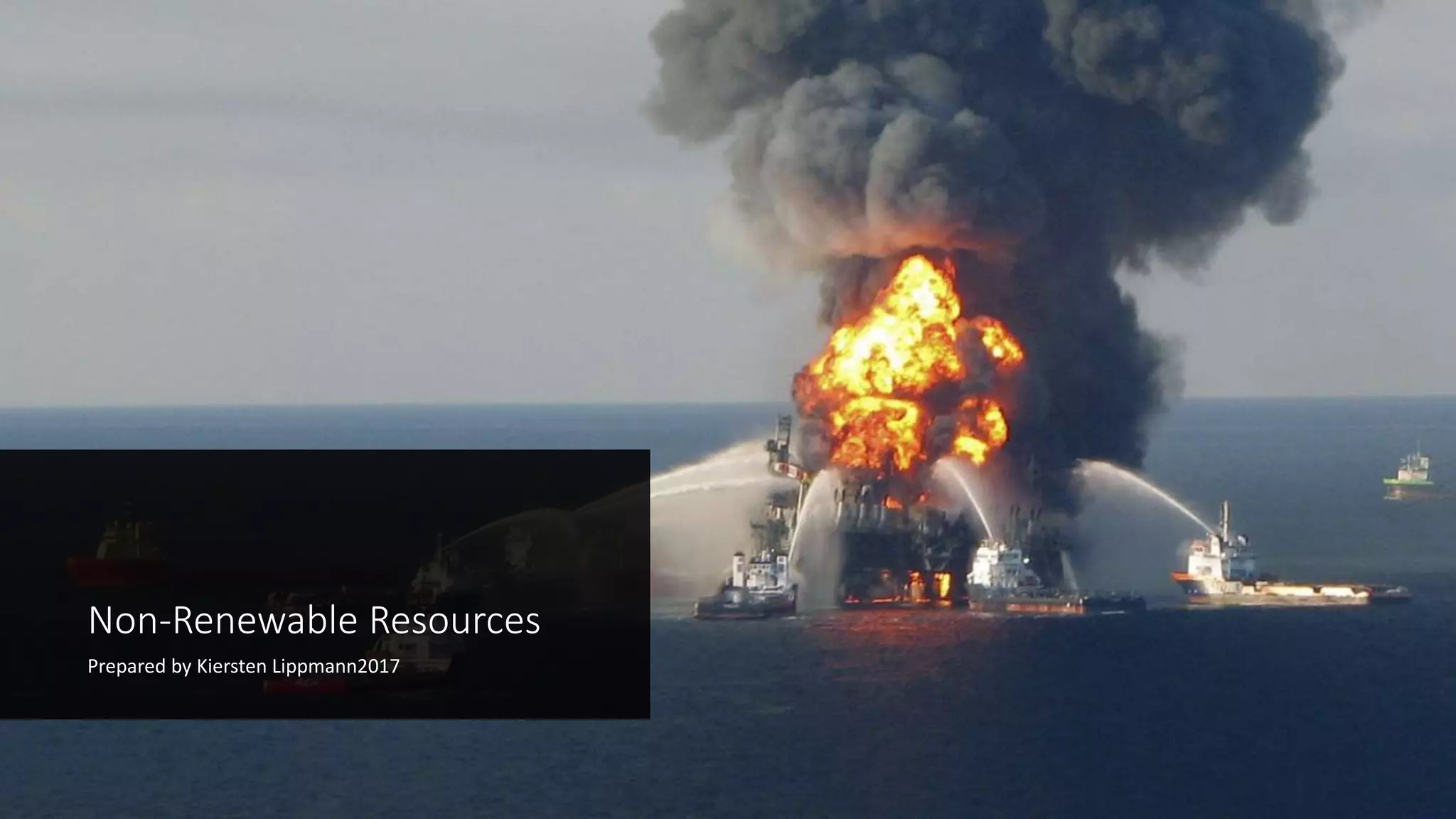
• Deepwater Horizon disaster of 2010 killed 11
workers and gushed 30 million gallons of oil
per second for three months!
• Wide array of impacts to sea life and
fishermen
• Public reaction varied- banned offshore rigs
in eastern states, expanded in Alaska and
Gulf of Mexico.
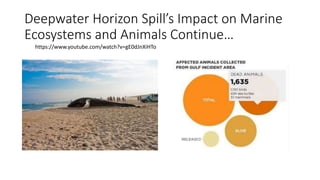
Deepwater Horizon Spill’s Impact on Marine
Ecosystems and Animals Continue…
https://www.youtube.com/watch?v=gE0dJnXiHTo
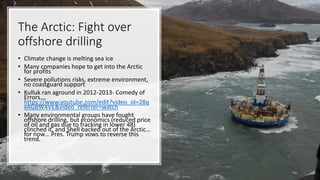
The Arctic: Fight over
offshore drilling
• Climate change is melting sea ice
• Many companies hope to get into the Arctic
for profits
• Severe pollutions risks, extreme environment,
no coastguard support
• Kulluk ran aground in 2012-2013- Comedy of
Errors….
https://www.youtube.com/edit?video_id=28q
xAGbW4VE&video_referrer=watch
• Many environmental groups have fought
offshore drilling, but economics (reduced price
of oil and gas due to fracking in lower 48)
clinched it, and Shell backed out of the Arctic…
for now… Pres. Trump vows to reverse this
trend.
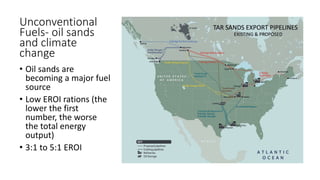
Unconventional
Fuels- oil sands
and climate
change
• Oil sands are
becoming a major fuel
source
• Low EROI rations (the
lower the first
number, the worse
the total energy
output)
• 3:1 to 5:1 EROI
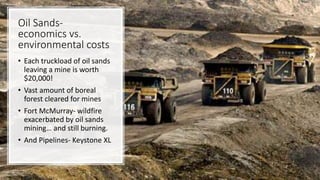
Oil Sands-
economics vs.
environmental costs
• Each truckload of oil sands
leaving a mine is worth
$20,000!
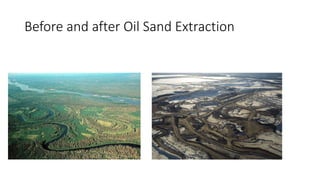
• Vast amount of boreal
forest cleared for mines
• Fort McMurray- wildfire
exacerbated by oil sands
mining… and still burning.
• And Pipelines- Keystone XL
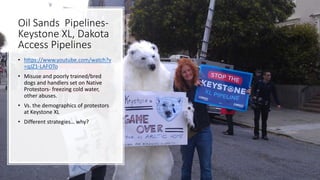
Oil Sands Pipelines-
Keystone XL, Dakota
Access Pipelines
• https://www.youtube.com/watch?v
=qJZ1-LAFOTo
• Misuse and poorly trained/bred
dogs and handlers set on Native
Protestors- freezing cold water,
other abuses.
• Vs. the demographics of protestors
at Keystone XL
• Different strategies… why?
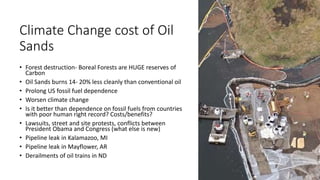
Climate Change cost of Oil
Sands
• Forest destruction- Boreal Forests are HUGE reserves of
Carbon
• Oil Sands burns 14- 20% less cleanly than conventional oil
• Prolong US fossil fuel dependence
• Worsen climate change
• Is it better than dependence on fossil fuels from countries
with poor human right record? Costs/benefits?
• Lawsuits, street and site protests, conflicts between
President Obama and Congress (what else is new)
• Pipeline leak in Kalamazoo, MI
• Pipeline leak in Mayflower, AR
• Derailments of oil trains in ND
Before and after Oil Sand Extraction
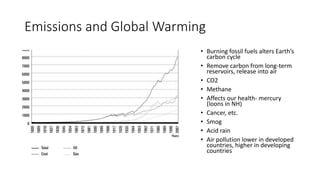
Emissions and Global Warming
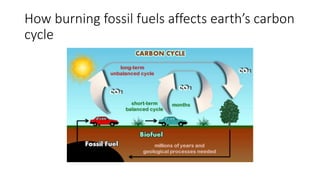
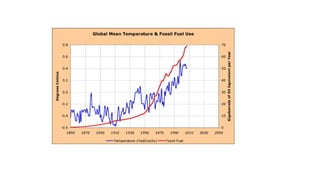
• Burning fossil fuels alters Earth’s
carbon cycle
• Remove carbon from long-term
reservoirs, release into air
• CO2
• Methane
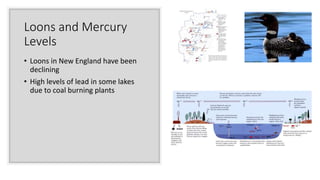
• Affects our health- mercury
(loons in NH)
• Cancer, etc.
• Smog
• Acid rain
• Air pollution lower in developed
countries, higher in developing
countries
How burning fossil fuels affects earth’s carbon
cycle
Loons and Mercury
Levels
• Loons in New England have been
declining
• High levels of lead in some lakes
due to coal burning plants
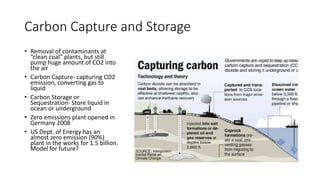
Carbon Capture and Storage
• Removal of contaminants at
“clean coal” plants, but still
pump huge amount of CO2 into
the air
• Carbon Capture- capturing CO2
emission, converting gas to
liquid
• Carbon Storage or
Sequestration- Store liquid in
ocean or underground
• Zero emissions plant opened in
Germany 2008
• US Dept. of Energy has an
almost zero emission (90%)
plant in the works for 1.5 billion.
Model for future?
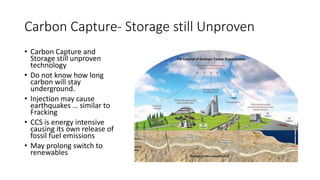
Carbon Capture- Storage still Unproven
• Carbon Capture and
Storage still unproven
technology
• Do not know how long
carbon will stay
underground.
• Injection may cause
earthquakes … similar to
Fracking
• CCS is energy intensive
causing its own release of
fossil fuel emissions
• May prolong switch to
renewables
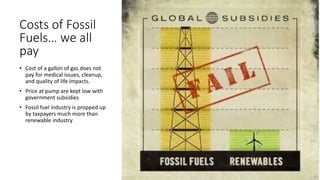
Costs of Fossil
Fuels… we all
pay
• Cost of a gallon of gas does not
pay for medical issues, cleanup,
and quality of life impacts.
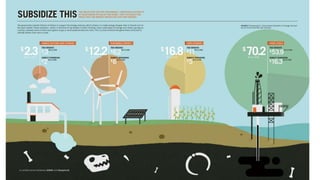
• Price at pump are kept low with
government subsidies
• Fossil fuel industry is propped up
by taxpayers much more than
renewable industry
a
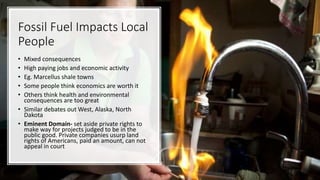
Fossil Fuel Impacts Local
People
• Mixed consequences
• High paying jobs and economic activity
• Eg. Marcellus shale towns
• Some people think economics are worth it
• Others think health and environmental
consequences are too great
• Similar debates out West, Alaska, North
Dakota
• Eminent Domain- set aside private rights to
make way for projects judged to be in the
public good. Private companies usurp land
rights of Americans, paid an amount, can not
appeal in court
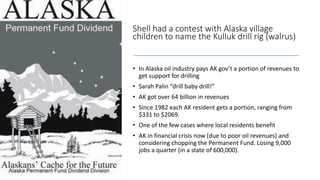
Shell had a contest with Alaska village
children to name the Kulluk drill rig (walrus)
• In Alaska oil industry pays AK gov’t a portion of revenues to
get support for drilling
• Sarah Palin “drill baby drill!”
• AK got over 64 billion in revenues
• Since 1982 each AK resident gets a portion, ranging from
$331 to $2069.
• One of the few cases where local residents benefit
• AK in financial crisis now (due to poor oil revenues) and
considering chopping the Permanent Fund. Losing 9,000
jobs a quarter (in a state of 600,000).
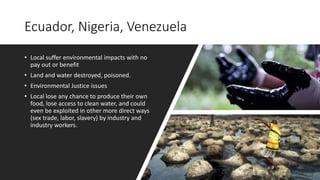
Ecuador, Nigeria, Venezuela
• Local suffer environmental impacts with no
pay out or benefit
• Land and water destroyed, poisoned.
• Environmental Justice issues
• Local lose any chance to produce their own
food, lose access to clean water, and could
even be exploited in other more direct ways
(sex trade, labor, slavery) by industry and
industry workers.
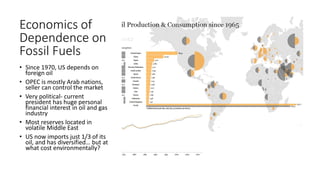
Economics of
Dependence on
Fossil Fuels
• Since 1970, US depends on
foreign oil
• OPEC is mostly Arab nations,
seller can control the market
• Very political- current
president has huge personal
financial interest in oil and gas
industry
• Most reserves located in
volatile Middle East
• US now imports just 1/3 of its
oil, and has diversified… but at
what cost environmentally?
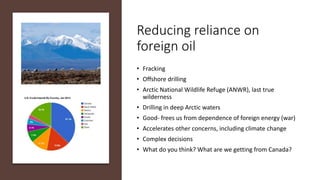
Reducing reliance on
foreign oil
• Fracking
• Offshore drilling
• Arctic National Wildlife Refuge (ANWR), last true
wilderness
• Drilling in deep Arctic waters
• Good- frees us from dependence of foreign energy (war)
• Accelerates other concerns, including climate change
• Complex decisions
• What do you think? What are we getting from Canada?
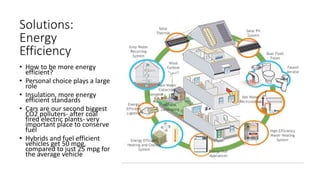
Solutions:
Energy
Efficiency
• How to be more energy
efficient?
• Personal choice plays a large
role
• Insulation, more energy
efficient standards
• Cars are our second biggest
CO2 polluters- after coal
fired electric plants- very
important place to conserve
fuel
• Hybrids and fuel efficient
vehicles get 50 mpg,
compared to just 25 mpg for
the average vehicle
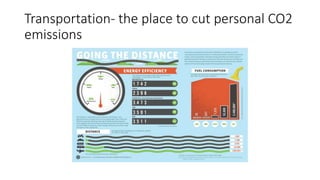
Transportation- the place to cut personal CO2
emissions
How is your gas
mileage?
• Is it that straightforward?
• Cost and energy of making
a new car vs. sticking with
an older vehicle
• It is difficult to get around
this part of NH without
access to a vehicle.
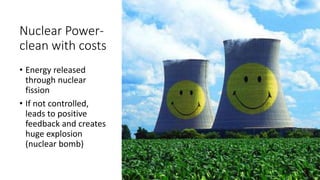
Nuclear Power-
clean with costs
• Energy released
through nuclear
fission
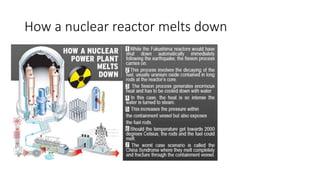
• If not controlled,
leads to positive
feedback and creates
huge explosion
(nuclear bomb)
How a nuclear reactor melts down
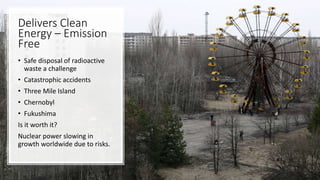
Delivers Clean
Energy – Emission
Free
• Safe disposal of radioactive
waste a challenge
• Catastrophic accidents
• Three Mile Island
• Chernobyl
• Fukushima
Is it worth it?
Nuclear power slowing in
growth worldwide due to risks.
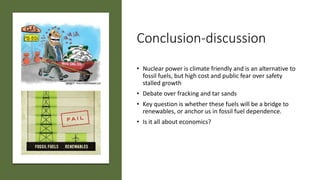
Conclusion-discussion
• Nuclear power is climate friendly and is an alternative to
fossil fuels, but high cost and public fear over safety
stalled growth
• Debate over fracking and tar sands
• Key question is whether these fuels will be a bridge to
renewables, or anchor us in fossil fuel dependence.
• Is it all about economics?
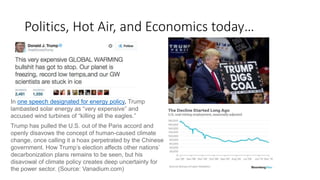
Politics, Hot Air, and Economics today…
In one speech designated for energy policy, Trump
lambasted solar energy as “very expensive” and
accused wind turbines of “killing all the eagles.”
Trump has pulled the U.S. out of the Paris accord and
openly disavows the concept of human-caused climate
change, once calling it a hoax perpetrated by the Chinese
government. How Trump’s election affects other nations’
decarbonization plans remains to be seen, but his
disavowal of climate policy creates deep uncertainty for
the power sector. (Source: Vanadium.com)
Paul Ryan on oil and climate change
of
T

Non-renewable Resources slides by Kiersten Lippmann

  • 1.
  • 2.
    Energy Sources we Use •Most of our energy comes from non-renewable sources • We use Earth’s energy sources to power our machinery, fuel vehicles, produce plastics, and provide the comforts of modern life.
  • 3.
    Fossil Fuel Consumption •Coal (solid) • Oil (liquid) • Natural Gas (gas) • Fossil fuels are highly combustible substances formed underground over millions of years from buried remains of ancient organisms. • 80% of our energy and 2/3 electricity come from the three main fossil fuels. • A gallon of oil contains as much energy as 600 hours of human labor!
  • 4.
    Coal, Oil, andGas are Non-renewable • Once depleted, they cannot be replenished. • It takes thousands of years to generate the organic matter to produce a single days’ worth of fossil fuels • Millions of years to replenish fossil fuels used so far • At current rate of consumption, conventional, accessible fossil fuels will be gone in just decades • Thus, companies are going for less accessible fuels… fracking
  • 5.
    Where is Energy? •Not evenly distributed • Some regions have many reserves, some none • Half of the crude oil reserves are in the Middle East • Russia has vast natural gas reserves • US has the most coal
  • 6.
    Consumption Rates ofEnergy Differ • Industrialized nations use up to 100 times more energy per person • US has 4.4% world’s population, and uses 18% world’s energy
  • 7.
    Takes Energy toMake Energy • Takes substantial energy to harness, extract, process and deliver energy. • Fracturing shale layers deep underground uses powerful machinery, lots of water, specialized chemicals, vehicles, storage tanks, waste ponds, pipelines, processing facilities, equipment for workers, and more- all require ENERGY • Net Energy= Energy Returned- Energy invested • EROI – energy returned on investment= Energy returned/Energy invested.
  • 9.
    EROI – energyreturned on investment= Energy returned/Energy invested. • Higher EROI ratios mean we receive more energy than we invest. • Fossil fuels have historically high EROI ratios • Ratios rise as technologies become more efficient • Ratios fall as resources are depleted and harder to extract • Conventional oil and natural gas EROIs have declined from 30:1 in the 1950s to 11:1 today. • We have extracted the easiest deposits.
  • 10.
    Formation of fossil fuels •From organic matter in an inorganic environment broken down over millions of years. • Seabeds, lakes, swamps • The fossil fuels we burn today were formed from organisms that live 100 to 500 million years ago. • Because fossil fuels are formed under specific conditions, they occur in isolated deposits. • Marcellus shale, rich in natural gas, is one example.
  • 11.
    Fossil Fuels: Coal •Most abundant fossil fuel in the world • Hard blackish substance formed from organic matter • Much coal formed 300-400 million years ago with the proliferation of swamps. • Deposits near surface extracted by strip mining- where heavy machinery scrapes away the earth. • Deep underground deposits extracted via subsurface mining, digging horizontal shafts and following seams. • Mountaintop mining
  • 12.
    Fossil Fuels: Oiland Natural Gas • Natural Gas- methane and other hydrocarbons • Oil, or petroleum, liquid containing various hydrocarbons • Formed from marine organic matter millions of years ago • Biogenic Natural gas formed at shallow depths by anaerobic decomposition such as in a swamp or landfill • Thermogenic gas from compression and heat deep underground- most commercial natural gas. • Oil and gas are under pressure, so exploratory drilling helps find deposits.
  • 13.
    Unconventional Fuels: not YETwidely used • Oil or Tar sands- consist of moist sand and clay containing 1- 20% bitumen, a thick form of petroleum • Extracted by strip mining with sand mixture mixed with hot water and solvents then chemically refined • Oil Shale- sedimentary rock filled with organic matter to form liquid petroleum called shale oil. • Extracted using strip or subsurface mines • Costly to extract- EROI is low from 4:1 to just 1:1 • Methane hydrate- ice like methane in arctic- enormous deposits but potent greenhouse gas.
  • 14.
  • 15.
    Economics determine how much willbe extracted • Technology determines how much CAN be extracted • Extraction becomes increasingly expensive as a resource is removed • Proven Recoverable Reserve= the amount of fossil fuel economically and technologically feasible to remove under current conditions
  • 16.
    Many uses for FossilFuels • Coal- cook food, heat homes, drove the industrial revolution • Today generates 40% of electricity in US • Natural gas- generate electricity, heat and cook in homes. Clean burning and emits just half as much CO2 per unit of energy as coal. • Oil- globally each person consumes 200 gallons a year. • Most used to fuel vehicles • Wide range of uses in plastics and lubricants
  • 17.
    Fossil Fuel Reservesare Depleting • Because they are non-renewable, the total amount available to Earth declines as we use them. • We have extracted nearly half of the world’s conventional oil reserves. • 1.1 trillion barrels of oil used, 1 trillion proven reserves remain plus oil sands brings total to nearly 1.7 trillion barrels remaing. • Reserves to production ratio- divide amount of remaining reserves by annual rate of production. At current rate- we have 53 more years. • Coal has 113 more years. • May be more as technology improves and more reserves are discovered. Less if our demand continues to increase.
  • 18.
    Peak Oil- whennon- renewable resources come to a peak and then decline • Decline occurs when a resource is half depleted. • Many experts think Peak Oil will begin soon • Predicting an exact date is difficult • The “long emergency” where local economies form around urban farms, but would feed only a fraction of the 7 billion (and counting) people. • American suburbs hit especially hard. • Optimists hope we will develop renewable energy in time to avert crisis. • What do you think?
  • 19.
    Digging Deeper forFossil Fuels • Mountaintop coal mining • Secondary extraction from existing wells • Directional drilling • Hydraulic fracturing for oil and gas • Offshore drilling in deeper waters • Moving into ice-free waters of the Arctic • Exploiting new “unconventional” fuel sorces All off these drive up fuel prices, reduce EROI ratios, and worsen climate change. Growing risk to human health and environment. Most scientists suggest we’d be better off leaving most coal, oil and gas in the ground!
  • 20.
    Mountaintop Mining • Massivein scale and thus economically efficient • Degrades and destroys hillsides, pollutes and buries streams, disrupts lives of people and animals • Coal dust in air • Impossible to recreate communities that preceded mining.
  • 21.
    Hydraulic Fracturing “fracking” • Extracts oiland gas trapped in shale or other rock • Chemically treated water under high pressure is pumped into layers of rock to crack them • Next sand or small glass beads hold the cracks open as water is withdrawn. • Gas and oil travels upward through the fractures • Huge boom in fracking in US, enabled power plants to switch from coal to natural gas. • Whether emissions are reduced depends on whether natural gas can be a “bridge fuel” to renewable resources. • https://www.youtube.co m/watch?v=LAxsTJd7VCA
  • 22.
    Fracking • Consumes immensequantities of fresh water • Pollution risk from fracking fluids • Chemicals in fracking fluids not disclosed • Methane air pollution • Very unhealthy air around fracking sites
  • 23.
    Off shore Drilling •35% of oil and 10% of natural gas in US comes from offshore sites • Primarily Gulf of Mexico and off S. California • Deepwater Horizon disaster of 2010 killed 11 workers and gushed 30 million gallons of oil per second for three months! • Wide array of impacts to sea life and fishermen • Public reaction varied- banned offshore rigs in eastern states, expanded in Alaska and Gulf of Mexico.
  • 24.
    Deepwater Horizon Spill’sImpact on Marine Ecosystems and Animals Continue… https://www.youtube.com/watch?v=gE0dJnXiHTo
  • 25.
    The Arctic: Fightover offshore drilling • Climate change is melting sea ice • Many companies hope to get into the Arctic for profits • Severe pollutions risks, extreme environment, no coastguard support • Kulluk ran aground in 2012-2013- Comedy of Errors…. https://www.youtube.com/edit?video_id=28q xAGbW4VE&video_referrer=watch • Many environmental groups have fought offshore drilling, but economics (reduced price of oil and gas due to fracking in lower 48) clinched it, and Shell backed out of the Arctic… for now… Pres. Trump vows to reverse this trend.
  • 26.
    Unconventional Fuels- oil sands andclimate change • Oil sands are becoming a major fuel source • Low EROI rations (the lower the first number, the worse the total energy output) • 3:1 to 5:1 EROI
  • 27.
    Oil Sands- economics vs. environmentalcosts • Each truckload of oil sands leaving a mine is worth $20,000! • Vast amount of boreal forest cleared for mines • Fort McMurray- wildfire exacerbated by oil sands mining… and still burning. • And Pipelines- Keystone XL
  • 28.
    Oil Sands Pipelines- KeystoneXL, Dakota Access Pipelines • https://www.youtube.com/watch?v =qJZ1-LAFOTo • Misuse and poorly trained/bred dogs and handlers set on Native Protestors- freezing cold water, other abuses. • Vs. the demographics of protestors at Keystone XL • Different strategies… why?
  • 29.
    Climate Change costof Oil Sands • Forest destruction- Boreal Forests are HUGE reserves of Carbon • Oil Sands burns 14- 20% less cleanly than conventional oil • Prolong US fossil fuel dependence • Worsen climate change • Is it better than dependence on fossil fuels from countries with poor human right record? Costs/benefits? • Lawsuits, street and site protests, conflicts between President Obama and Congress (what else is new) • Pipeline leak in Kalamazoo, MI • Pipeline leak in Mayflower, AR • Derailments of oil trains in ND
  • 31.
    Before and afterOil Sand Extraction
  • 32.
    Emissions and GlobalWarming • Burning fossil fuels alters Earth’s carbon cycle • Remove carbon from long-term reservoirs, release into air • CO2 • Methane • Affects our health- mercury (loons in NH) • Cancer, etc. • Smog • Acid rain • Air pollution lower in developed countries, higher in developing countries
  • 33.
    How burning fossilfuels affects earth’s carbon cycle
  • 34.
    Loons and Mercury Levels •Loons in New England have been declining • High levels of lead in some lakes due to coal burning plants
  • 35.
    Carbon Capture andStorage • Removal of contaminants at “clean coal” plants, but still pump huge amount of CO2 into the air • Carbon Capture- capturing CO2 emission, converting gas to liquid • Carbon Storage or Sequestration- Store liquid in ocean or underground • Zero emissions plant opened in Germany 2008 • US Dept. of Energy has an almost zero emission (90%) plant in the works for 1.5 billion. Model for future?
  • 36.
    Carbon Capture- Storagestill Unproven • Carbon Capture and Storage still unproven technology • Do not know how long carbon will stay underground. • Injection may cause earthquakes … similar to Fracking • CCS is energy intensive causing its own release of fossil fuel emissions • May prolong switch to renewables
  • 38.
    Costs of Fossil Fuels…we all pay • Cost of a gallon of gas does not pay for medical issues, cleanup, and quality of life impacts. • Price at pump are kept low with government subsidies • Fossil fuel industry is propped up by taxpayers much more than renewable industry
  • 40.
  • 41.
    Fossil Fuel ImpactsLocal People • Mixed consequences • High paying jobs and economic activity • Eg. Marcellus shale towns • Some people think economics are worth it • Others think health and environmental consequences are too great • Similar debates out West, Alaska, North Dakota • Eminent Domain- set aside private rights to make way for projects judged to be in the public good. Private companies usurp land rights of Americans, paid an amount, can not appeal in court
  • 42.
    Shell had acontest with Alaska village children to name the Kulluk drill rig (walrus) • In Alaska oil industry pays AK gov’t a portion of revenues to get support for drilling • Sarah Palin “drill baby drill!” • AK got over 64 billion in revenues • Since 1982 each AK resident gets a portion, ranging from $331 to $2069. • One of the few cases where local residents benefit • AK in financial crisis now (due to poor oil revenues) and considering chopping the Permanent Fund. Losing 9,000 jobs a quarter (in a state of 600,000).
  • 43.
    Ecuador, Nigeria, Venezuela •Local suffer environmental impacts with no pay out or benefit • Land and water destroyed, poisoned. • Environmental Justice issues • Local lose any chance to produce their own food, lose access to clean water, and could even be exploited in other more direct ways (sex trade, labor, slavery) by industry and industry workers.
  • 44.
    Economics of Dependence on FossilFuels • Since 1970, US depends on foreign oil • OPEC is mostly Arab nations, seller can control the market • Very political- current president has huge personal financial interest in oil and gas industry • Most reserves located in volatile Middle East • US now imports just 1/3 of its oil, and has diversified… but at what cost environmentally?
  • 45.
    Reducing reliance on foreignoil • Fracking • Offshore drilling • Arctic National Wildlife Refuge (ANWR), last true wilderness • Drilling in deep Arctic waters • Good- frees us from dependence of foreign energy (war) • Accelerates other concerns, including climate change • Complex decisions • What do you think? What are we getting from Canada?
  • 46.
    Solutions: Energy Efficiency • How tobe more energy efficient? • Personal choice plays a large role • Insulation, more energy efficient standards • Cars are our second biggest CO2 polluters- after coal fired electric plants- very important place to conserve fuel • Hybrids and fuel efficient vehicles get 50 mpg, compared to just 25 mpg for the average vehicle
  • 47.
    Transportation- the placeto cut personal CO2 emissions
  • 48.
    How is yourgas mileage? • Is it that straightforward? • Cost and energy of making a new car vs. sticking with an older vehicle • It is difficult to get around this part of NH without access to a vehicle.
  • 49.
    Nuclear Power- clean withcosts • Energy released through nuclear fission • If not controlled, leads to positive feedback and creates huge explosion (nuclear bomb)
  • 50.
    How a nuclearreactor melts down
  • 51.
    Delivers Clean Energy –Emission Free • Safe disposal of radioactive waste a challenge • Catastrophic accidents • Three Mile Island • Chernobyl • Fukushima Is it worth it? Nuclear power slowing in growth worldwide due to risks.
  • 52.
    Conclusion-discussion • Nuclear poweris climate friendly and is an alternative to fossil fuels, but high cost and public fear over safety stalled growth • Debate over fracking and tar sands • Key question is whether these fuels will be a bridge to renewables, or anchor us in fossil fuel dependence. • Is it all about economics?
  • 53.
    Politics, Hot Air,and Economics today… In one speech designated for energy policy, Trump lambasted solar energy as “very expensive” and accused wind turbines of “killing all the eagles.” Trump has pulled the U.S. out of the Paris accord and openly disavows the concept of human-caused climate change, once calling it a hoax perpetrated by the Chinese government. How Trump’s election affects other nations’ decarbonization plans remains to be seen, but his disavowal of climate policy creates deep uncertainty for the power sector. (Source: Vanadium.com)
  • 54.
    Paul Ryan onoil and climate change
  • 55.
  • 56.