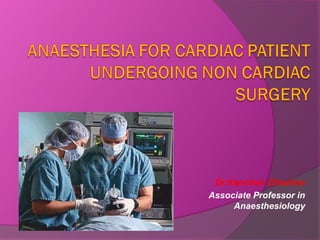
Cardiac patients undergoing non-cardiac surgery face an increased risk of perioperative complications like myocardial ischemia, infarction, and heart failure. Preoperative risk assessment, optimization of cardiac health, and intraoperative/postoperative management are crucial to mitigate these risks.
INTRODUCTION
Stress dueto surgery leads to an increase in cardiac output which can be achieved
easily by normal patients, but which results in substantial morbidity and mortality
in those with cardiac disease.
Most suitable anaesthetic can be given by understanding different cardiac disease.
The skill with which the anaesthetic is selected and delivered is more important
than the drugs used.
No. of patients with cardiac disease are increasing. due to the fact that the surgery
is being performed on older patients in whom the incidence of coronary artery
disease (CAD) is higher, and secondly, recent advances in diagnostic technology
have allowed us to detect CAD in asymptomatic or mildly symptomatic patients.
With increased awareness and improved cardiac surgical results,
patients who have undergone corrective cardiac surgery are also presenting for
noncardiac surgery.
3.
What Should beour Approach ?
Preoperative –
Pre anaesthetic evaluation,
Risk stratification and
preparation
Intraoperative –
Smooth induction ,
Smooth recovery ,
Smooth monitoring
Postoperatively –
Cont. monitoring and vigilance
4.
Pre anaesthetic evaluation
ASSESSMENTOF PERIOPERATIVE RISK
Goldman Cardiac Risk Index.
Lee’s risk stratification criterion
Detsky’smodified approach to Goldman index
NYHA Classification
Canadian Cardiovascular Society Classification
Follow AHA ( American Heart Association)
guidelines for perioperative cardiovascular
evaluation
5.
Medications : Keepin Mind
Continue all antianginals, anti hypertensives
Continue anti arrythmics
Continue Beta blockers and Statins
Continue Aspirin (not in some institue)
Discontinue Diuretics, Digitalis, Oral
hypoglycemics, ACE inhibitors
6.
O T Preparation
Ready Emergency cardiovascular drugs
(iv beta blockers, NTG, SNP, Inotropes,
Ephedrine, Phenylephrine, CCB, anti arrythmics
etc.
Cardiac equipments :Defibrillator, Pacemakers,
Syringe pump
PA catheter
Assessment ofLV Function
Early detection of ischemia
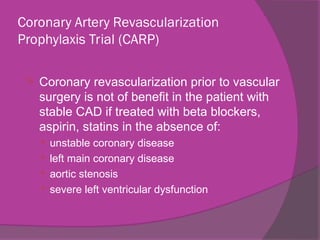
“v” waves
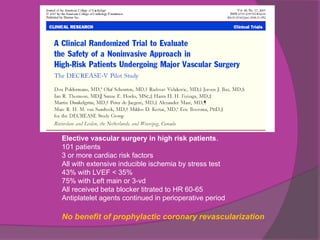
Increased PCWP
More accuracy than CVP
Intravascular volume problems
Especially in patients with severe lung
disease
Preoperative Preparation
Angina
Medications tocontrol it
Blood pressure controlled
Diastolic < 95 mm hg
Congestive heart failure treated
Diuretics
Afterload reduction
Bedrest if indicated
Control diabetes
15.
Our Approach 2012for beta blockers
Continue beta blockers for those already receiving
Initiate beta blockers prior to surgery (cautiously) for
patients who would otherwise need them -
Begin low dose as early as possible- >1 week - not day of surgery
Titrate to heart rate (60-70) and BP
Carefully follow those on beta blockers in the postoperative
period
Hypotension
Bradycardia
Postoperative tachycardia: look first for a treatable cause
(hypovolemia, anemia) rather than just increasing beta blocker dose.
16.
Anesthesia
Goal
Doestechnique make a
difference?
Laryngoscopy
Maintenance
Regional anesthesia
04/20/25 WE Ellis 16
17.
Anesthetic Technique
Goals ofAnesthesia
loss of conciousness
amnesia
analgesia
suppression of reflexes (endocrine and
autonomic)
muscle relaxation
18.
Anesthetic Management
Anaesthetic techniques–
Local anaesthesia
Regional anaesthesia
Combined Regional – General anaesthesia
General anaesthesia
Anesthetic management skills more important than technique.
Safest technique is the one the practitioner does best.
Anaesthetic technique must be based on the type of surgery and the desired
haemodynamic goals during anaesthesia.
19.
Role of LocalAnaesthesia
LA should be with appropriate IV sedation
Large doses of anaesthetic should be avoided -
cardiac toxicity - dysrrhythmias and myocardial depression.
Epinephrine with LA - tachycardia, which is undesirable
and should be avoided.
Monitored with an ECG, BP and a pulse oxymeter.
Supplemental oxygen therapy
Regular verbal contact with patient are important.
20.
Regional Anaesthesia
Intraoperativeadverse cardiac events do not differ when
general or regional anaesthesia is used.(study shows)
Certain procedures have shown better outcome under RA.
E.g.-
McLaren et al found no mortality under spinal anaesthesia
for fracture neck femur, versus 25%mortality after
GA.
Patients with prior MI undergoing transurethral resection of
prostate had <1% reinfarction rate after spinal versus 2-8%
after GA.
21.
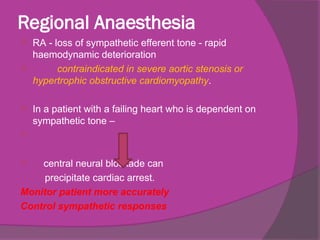
Regional Anaesthesia
RA- loss of sympathetic efferent tone - rapid
haemodynamic deterioration
contraindicated in severe aortic stenosis or
hypertrophic obstructive cardiomyopathy.
In a patient with a failing heart who is dependent on
sympathetic tone –
central neural blockade can
precipitate cardiac arrest.
Monitor patient more accurately
Control sympathetic responses
22.
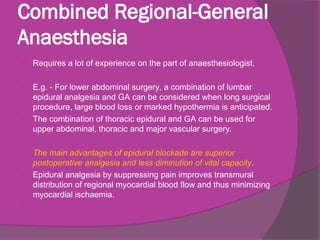
Combined Regional-General
Anaesthesia
Requiresa lot of experience on the part of anaesthesiologist.
E.g. - For lower abdominal surgery, a combination of lumbar
epidural analgesia and GA can be considered when long surgical
procedure, large blood loss or marked hypothermia is anticipated.
The combination of thoracic epidural and GA can be used for
upper abdominal, thoracic and major vascular surgery.
The main advantages of epidural blockade are superior
postoperative analgesia and less diminution of vital capacity.
Epidural analgesia by suppressing pain improves transmural
distribution of regional myocardial blood flow and thus minimizing
myocardial ischaemia.
23.
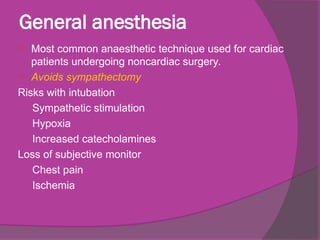
General anesthesia
Mostcommon anaesthetic technique used for cardiac
patients undergoing noncardiac surgery.
Avoids sympathectomy
Risks with intubation
Sympathetic stimulation
Hypoxia
Increased catecholamines
Loss of subjective monitor
Chest pain
Ischemia
24.
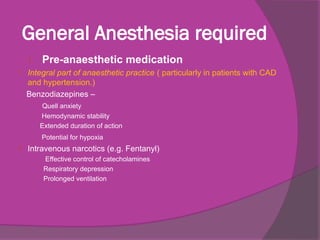
General Anesthesia required
I.Pre-anaesthetic medication
Integral part of anaesthetic practice ( particularly in patients with CAD
and hypertension.)
Benzodiazepines –
Quell anxiety
Hemodynamic stability
Extended duration of action
Potential for hypoxia
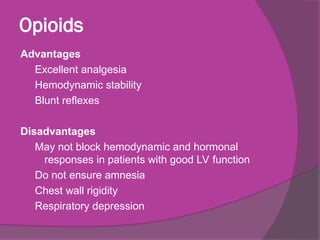
Intravenous narcotics (e.g. Fentanyl)
Effective control of catecholamines
Respiratory depression
Prolonged ventilation
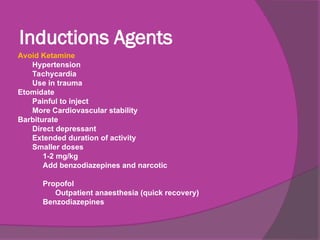
Inductions Agents
Avoid Ketamine
Hypertension
Tachycardia
Usein trauma
Etomidate
Painful to inject
More Cardiovascular stability
Barbiturate
Direct depressant
Extended duration of activity
Smaller doses
1-2 mg/kg
Add benzodiazepines and narcotic
Propofol
Outpatient anaesthesia (quick recovery)
Benzodiazepines
27.
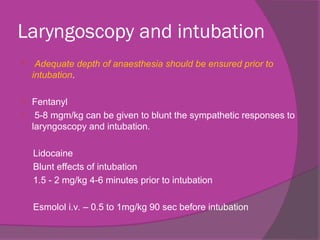
Laryngoscopy and intubation
Adequate depth of anaesthesia should be ensured prior to
intubation.
Fentanyl
5-8 mgm/kg can be given to blunt the sympathetic responses to
laryngoscopy and intubation.
Lidocaine
Blunt effects of intubation
1.5 - 2 mg/kg 4-6 minutes prior to intubation
Esmolol i.v. – 0.5 to 1mg/kg 90 sec before intubation
28.
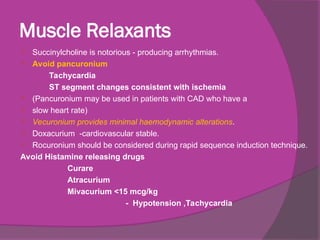
Muscle Relaxants
Succinylcholineis notorious - producing arrhythmias.
Avoid pancuronium
Tachycardia
ST segment changes consistent with ischemia
(Pancuronium may be used in patients with CAD who have a
slow heart rate)
Vecuronium provides minimal haemodynamic alterations.
Doxacurium -cardiovascular stable.
Rocuronium should be considered during rapid sequence induction technique.
Avoid Histamine releasing drugs
Curare
Atracurium
Mivacurium <15 mcg/kg
- Hypotension ,Tachycardia
29.
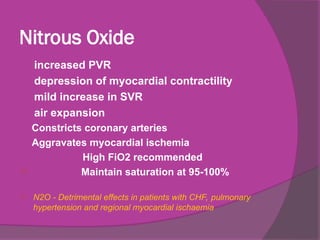
Nitrous Oxide
increased PVR
depressionof myocardial contractility
mild increase in SVR
air expansion
Constricts coronary arteries
Aggravates myocardial ischemia
High FiO2 recommended
Maintain saturation at 95-100%
N2O - Detrimental effects in patients with CHF, pulmonary
hypertension and regional myocardial ischaemia
30.
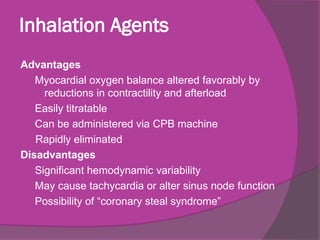
Inhalation Agents
Advantages
Myocardial oxygenbalance altered favorably by
reductions in contractility and afterload
Easily titratable
Can be administered via CPB machine
Rapidly eliminated
Disadvantages
Significant hemodynamic variability
May cause tachycardia or alter sinus node function
Possibility of “coronary steal syndrome”
31.
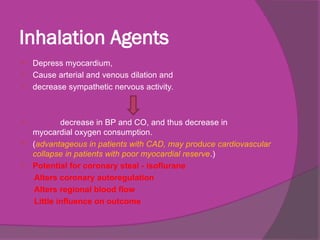
Inhalation Agents
Depressmyocardium,
Cause arterial and venous dilation and
decrease sympathetic nervous activity.
decrease in BP and CO, and thus decrease in
myocardial oxygen consumption.
(advantageous in patients with CAD, may produce cardiovascular
collapse in patients with poor myocardial reserve.)
Potential for coronary steal - isoflurane
Alters coronary autoregulation
Alters regional blood flow
Little influence on outcome
32.
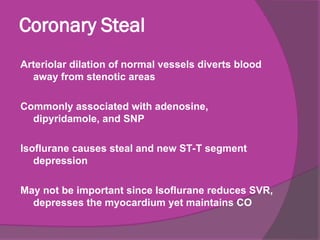
Coronary Steal
Arteriolar dilationof normal vessels diverts blood
away from stenotic areas
Commonly associated with adenosine,
dipyridamole, and SNP
Isoflurane causes steal and new ST-T segment
depression
May not be important since Isoflurane reduces SVR,
depresses the myocardium yet maintains CO
33.
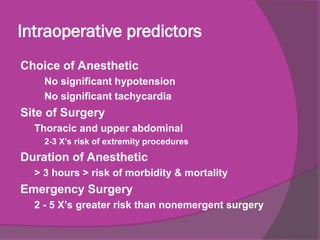
Intraoperative predictors
Choice ofAnesthetic
No significant hypotension
No significant tachycardia
Site of Surgery
Thoracic and upper abdominal
2-3 X’s risk of extremity procedures
Duration of Anesthetic
> 3 hours > risk of morbidity & mortality
Emergency Surgery
2 - 5 X’s greater risk than nonemergent surgery
34.
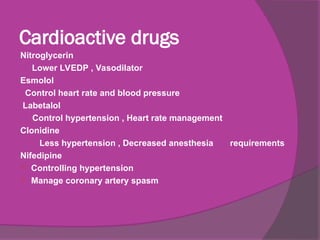
Cardioactive drugs
Nitroglycerin
Lower LVEDP, Vasodilator
Esmolol
Control heart rate and blood pressure
Labetalol
Control hypertension , Heart rate management
Clonidine
Less hypertension , Decreased anesthesia requirements
Nifedipine
Controlling hypertension
Manage coronary artery spasm
35.
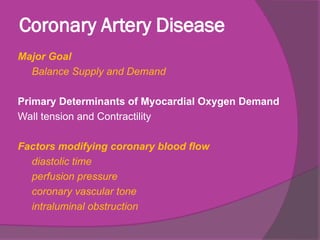
Coronary Artery Disease
MajorGoal
Balance Supply and Demand
Primary Determinants of Myocardial Oxygen Demand
Wall tension and Contractility
Factors modifying coronary blood flow
diastolic time
perfusion pressure
coronary vascular tone
intraluminal obstruction
36.
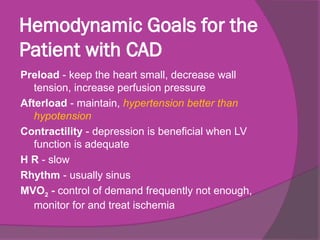
Hemodynamic Goals forthe
Patient with CAD
Preload - keep the heart small, decrease wall
tension, increase perfusion pressure
Afterload - maintain, hypertension better than
hypotension
Contractility - depression is beneficial when LV
function is adequate
H R - slow
Rhythm - usually sinus
MVO2 - control of demand frequently not enough,
monitor for and treat ischemia
37.
Monitored Anaesthesia Care
Employed in CAD patients
Patients carrying the highest risk are selected
Minimum anaesthetic interference
Adequate analgesia is mandatory
Failure to suppress the stress response
Highest incidence of 30 day mortality
(isacon 2008)
38.
HEART FAILURE
Inabilityof the heart to pump enough blood to match tissue requirements.
Commonest cause
ischaemic heart disease.
Other causes include hypertension, valvular heart disease and
cardiomyopathies.
Note that with an increase in contractility there is a greater cardiac output
for the same ventricular end- diastolic volume.
.
Drug treatments may include ACE (angiotensin converting enzyme)
inhibitors, diuretics and nitrates.
Echocardiogram to assess ejection fraction - values of less than 30%
equate to severe heart failure.
39.
Anaesthesia consideration
Preloadcan be reduced with diuretics and nitrates, and both
central venous and pulmonary artery pressures can be monitored.
Trans-oesophageal echocardiography, if available, is a useful tool
to visualize overall cardiac performance.
Maintenance of myocardial contractility - in particular inotropes
may be needed to oppose the cardiodepressant action of
anaesthetic agents.
Reduction of afterload by vasodilation, for example as a
secondary effect of spinal or epidural anaesthesia. This not only
reduces myocardial work, but helps maintain cardiac output.
However, the benefit of such actions may be limited by falls in
blood pressure which can compromise blood flow to vital organs
such as the brain and kidneys. So balance should be there
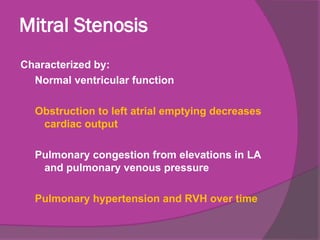
Mitral Stenosis
Characterized by:
Normalventricular function
Obstruction to left atrial emptying decreases
cardiac output
Pulmonary congestion from elevations in LA
and pulmonary venous pressure
Pulmonary hypertension and RVH over time
42.
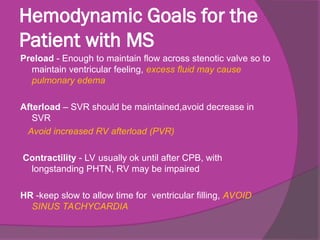
Hemodynamic Goals forthe
Patient with MS
Preload - Enough to maintain flow across stenotic valve so to
maintain ventricular feeling, excess fluid may cause
pulmonary edema
Afterload – SVR should be maintained,avoid decrease in
SVR
Avoid increased RV afterload (PVR)
Contractility - LV usually ok until after CPB, with
longstanding PHTN, RV may be impaired
HR -keep slow to allow time for ventricular filling, AVOID
SINUS TACHYCARDIA
43.
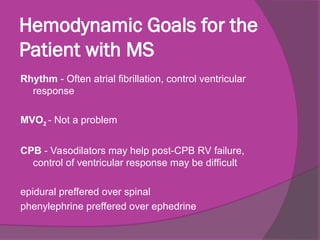
Hemodynamic Goals forthe
Patient with MS
Rhythm - Often atrial fibrillation, control ventricular
response
MVO2 - Not a problem
CPB - Vasodilators may help post-CPB RV failure,
control of ventricular response may be difficult
epidural preffered over spinal
phenylephrine preffered over ephedrine
Hemodynamic Goals forthe
Patient with MI
Preload – maintain or slightly increase ;an elevated preload
may cause increase in regurgitant flow and low preload
may cause inadequate cardiac output Usually pretty full,
may need to keep that way
Afterload - Decreases are beneficial, increases augment
regurgitant flow, avoid sudden increase in SVR
Contractility - Unrecognized myocardial depression
possible, titrate myocardial depressants carefully,
maintain or increase to decrease left ventricular volume
HR – maintain or increase , avoid bradycardia which
worsens regurgitant flow
46.
Hemodynamic Goals forthe
Patient with MI
Rhythm - Atrial fibrillation is occasionally a problem
MVO2 - only if associated with CAD, then caution!
CPB - New valve will increase afterload, unmasking
impaired ventricle
Spinal and epidural well tolerated but avoid
bradychardia
47.
Mitral valve prolapse-
anaesthesiaconsideration
Aboid decrease in preload
Continue antiarrhythmic drugs
Same consideration as for MI
Hemodynamic Goals forthe
Patient with AS
Preload - full, adequate intravascular volume to fill
noncompliant ventricle and to maintain BP
Afterload - already elevated but relatively fixed,
coronary perfusion pressure must be maintained,
Contractility - usually not a problem, inotropes may be
helpful preinduction in end-stage AS with
hypotension
Watch out for vasodilation
Treat hypotension with phenylephrine
50.
Hemodynamic Goals forthe
Patient with AS
Rate - not too slow (decrease CO), not too fast
(ischemia)
Rhythm - Sinus!! Cardioversion if hemodynamic
instability from SV dysrhythmias
MVO2 - Ischemia is an ever present risk, Avoid
tachycardia and hypotension
Mild to moderate may tolerate spinal and epidural
(epidual preferred)
spinal and epidural contraindicated in severe AS
High risk of myocardial ischaemia
51.
Aortic Insufficiency
Characterized by:
Chronicvolume overload
Ventricular dilatation
Eccentric hypertrophy
Forward stroke volume higher than normal
causing increased systolic pressure
Regurgitation across the valve causes
diastolic pressure to be lower than normal
52.
Hemodynamic Goals forthe
Patient with AI
Preload - normal to slightly increased to maximize
forward cardiac output and maintain BP
Afterload - Reduction beneficial with anesthetics or
vasodilators,increases augment regurgitant flow, avoid
sudden increase in afterload
Contractility - usually adequate
Rate - Modest tachycardia shortens diastolic phase
decreases regurgitant fraction and increases cardiac
output
Most patient tolerate spinal or epidural provided
intravascular volume is maintained
53.
Aortic Insufficiency
Onceasymptomatic death can occur with in 5 yrs
unless lesion is surgically repaired
Digitalis , Diuretics and afterload reduction (ACE
inhibitors) for chronic cond. (eventual surgical
repair)
Inotropes (dopamine,dobutamine) and
vasodilators for severe,chronic aortic regurgitation
(requires surgery)
54.
Hemodynamic Goals forthe
Patient with AI
Rhythm - usually sinus, not a problem
MVO2 - Not usually a problem
CPB - observe for ventricular distention (decreased
HR, increased ventricular filling pressure) when
going onto bypass
56.
Hypertension – Anaesthesiaconsideration
HTN (defined as a diastolic BP>90mmHg or a systolic BP>140mmHg in
adults) is the most common of all the cardiovascular diseases.
Most patients are under adequate control preoperatively and their
medication should be continued till the day of surgery.
Poorly controlled or uncontrolled hypertensives are at increased risk of
perioperative complications such as ischaemia, MI, arrhythmias and
cerebrovascular accidents (CVA).
In mild hypertensive patients a single dose of long acting beta-blocker may
reduce the risk of myocardial ischaemia during stressful periods.
However, in patients with moderate to severe HTN, cardiology consultation
should be obtained and BP brought under control prior to elective surgery.
57.
Coronary Artery Revascularization
ProphylaxisTrial (CARP)
Coronary revascularization prior to vascular
surgery is not of benefit in the patient with
stable CAD if treated with beta blockers,
aspirin, statins in the absence of:
unstable coronary disease
left main coronary disease
aortic stenosis
severe left ventricular dysfunction
58.
Elective vascular surgeryin high risk patients.
101 patients
3 or more cardiac risk factors
All with extensive inducible ischemia by stress test
43% with LVEF < 35%
75% with Left main or 3-vd
All received beta blocker titrated to HR 60-65
Antiplatelet agents continued in perioperative period
No benefit of prophylactic coronary revascularization
59.
How about thepatient who has
already received a stent and
requires noncardiac surgery ?
Joint Advisory Recommendationsand
Noncardiac Surgery
Consider bare metal stent if patient requires PCI and is
likely to require invasive or surgical procedure within next
12 months.
Educate patient prior to discharge re: risk of premature
antiplatelet discontinuation
Instruct patient to contact treating cardiologist before
antiplatelet discontinuation
Healthcare providers who perform surgical or invasive procedures must
be made aware of catastrophic risks of premature antiplatelet
discontinuation and should contact the treating cardiologist to discuss
optimal management strategy
62.
Joint Advisory Recommendationsand
Noncardiac Surgery
Defer elective procedures for which there is bleeding risk
until completion of antiplatelet course
1 month bare metal stent
12 months drug eluting stent
For patient with drug eluting stent who are to undergo
procedures that mandate discontinuation of thienopyridine
(eg, clopidogrel), continue aspirin if at all possible and
restart thienopyridine as soon as possible
No evidence for “bridging therapy” with antithrombins,
warfarin, or glycoprotein IIb/IIIa agents
63.
Postoperative predictors
Ischemia doesoccur most commonly in
the postoperative period
Persists for 48 hours or longer following
non-cardiac surgery
Predictor value is unknown
Goldman, L., (1983) Cardiac Risk and Complications of noncardiac
surgery, Annals of Internal Medicine. 98:504-513
Key Points
Clearance.Perform evaluation and make recommendations that
will relate to perioperative and long – term issues.
Tests only if likely to influence treatment.
Preoperative coronary revascularization if independently indicated.
Selective use of beta blockers. (beware bradycardia)
Statins
Beware of premature antiplatelet discontinuation in the patient
post PTCA stent.
Continue beta blocker, aspirin, statins,
66.
Summary
Patients withcardiac disease present for
anaesthesia every day.
Since their perioperative courses are associated
with greater morbidity and mortality, it is important
to provide a haemodynamically stable anaesthetic
This requires knowledge of the pathophysiology of
the disease, and of the drugs and procedures and
their effects on the patient.
 Most read

 Most read
 Most read