Robust Design:
Experiments for Better Products


       Taguchi Techniques


                            MITSloan
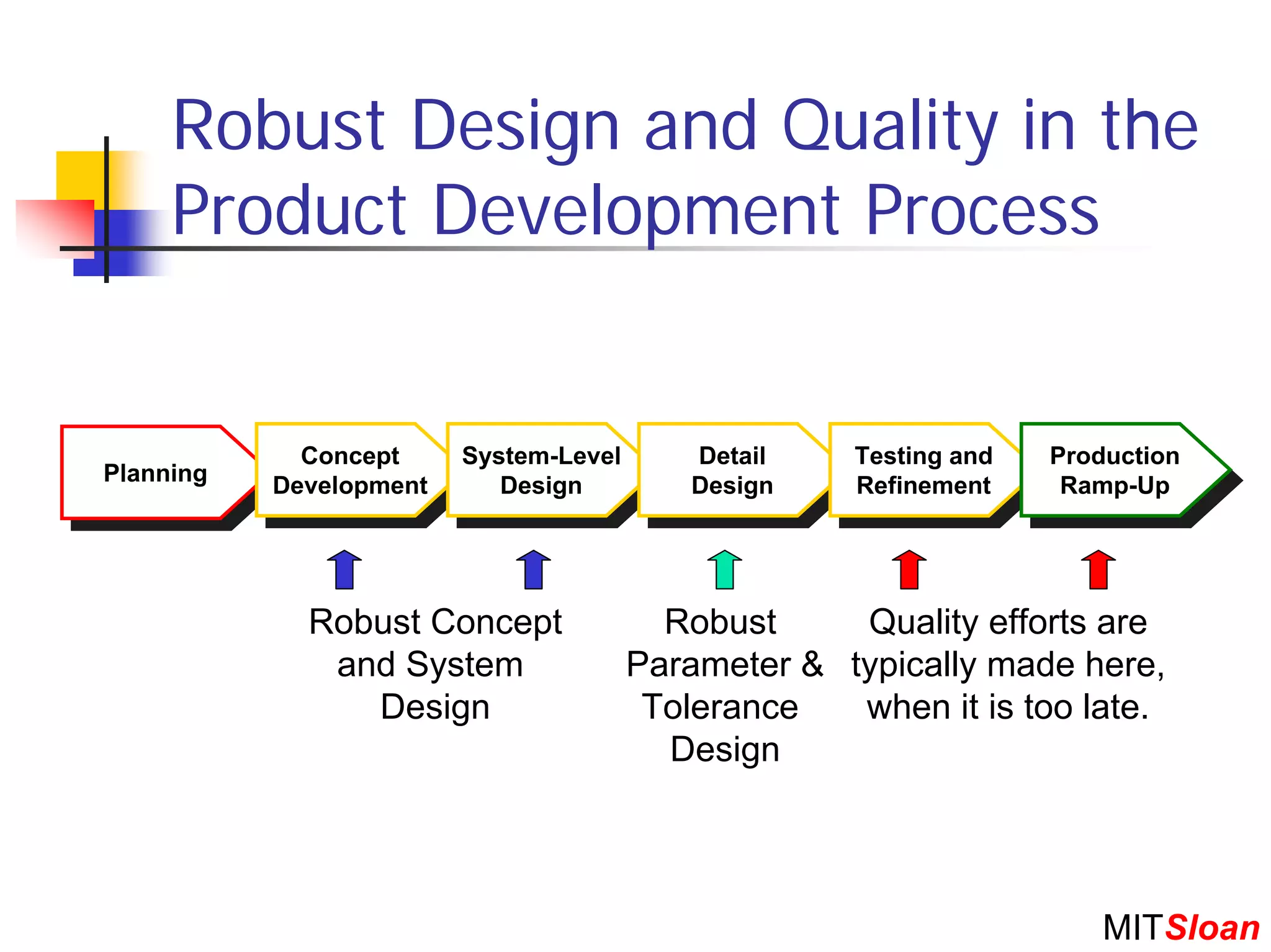
Robust Design and Quality in the
     Product Development Process


              Concept
               Concept   System-Level
                          System-Level   Detail
                                          Detail   Testing and
                                                    Testing and   Production
                                                                   Production
Planning
 Planning   Development     Design       Design    Refinement      Ramp-Up
             Development     Design       Design    Refinement      Ramp-Up


              Robust Concept           Robust     Quality efforts are
               and System            Parameter & typically made here,
                 Design               Tolerance   when it is too late.
                                       Design


                                                                      MITSloan
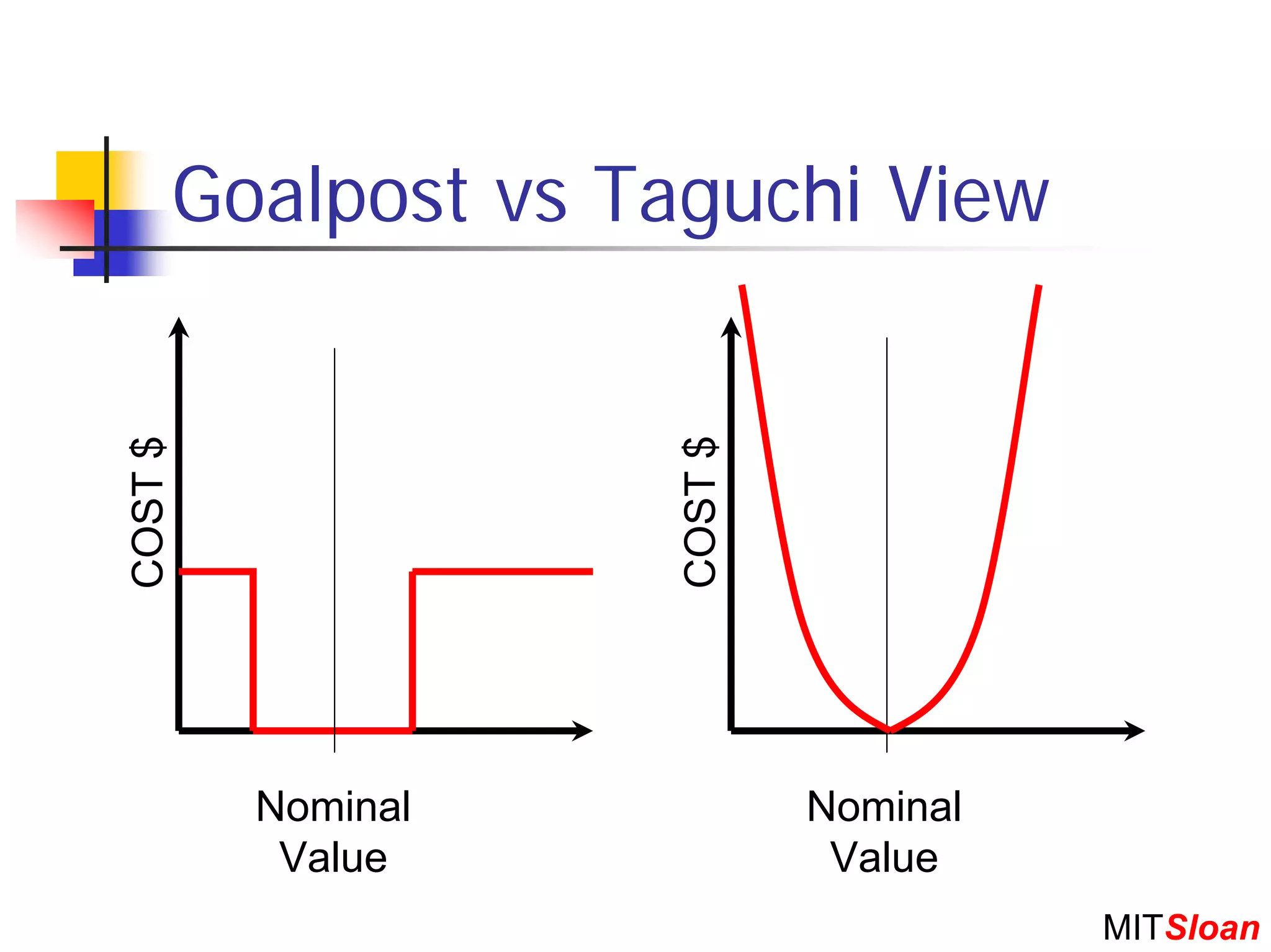
Goalpost vs Taguchi View


                       COST $
COST $


           Nominal              Nominal
            Value                Value
                                          MITSloan
General Loss Function
              Product & Process Engineer (a priori)

                     Manufacturing (daily)

      [
    k ⋅ σ + (µ − m )
          2                 2
                                ]
                           Nominal Value
                     Average Value
                Variance
       Cost Factor
                                             MITSloan
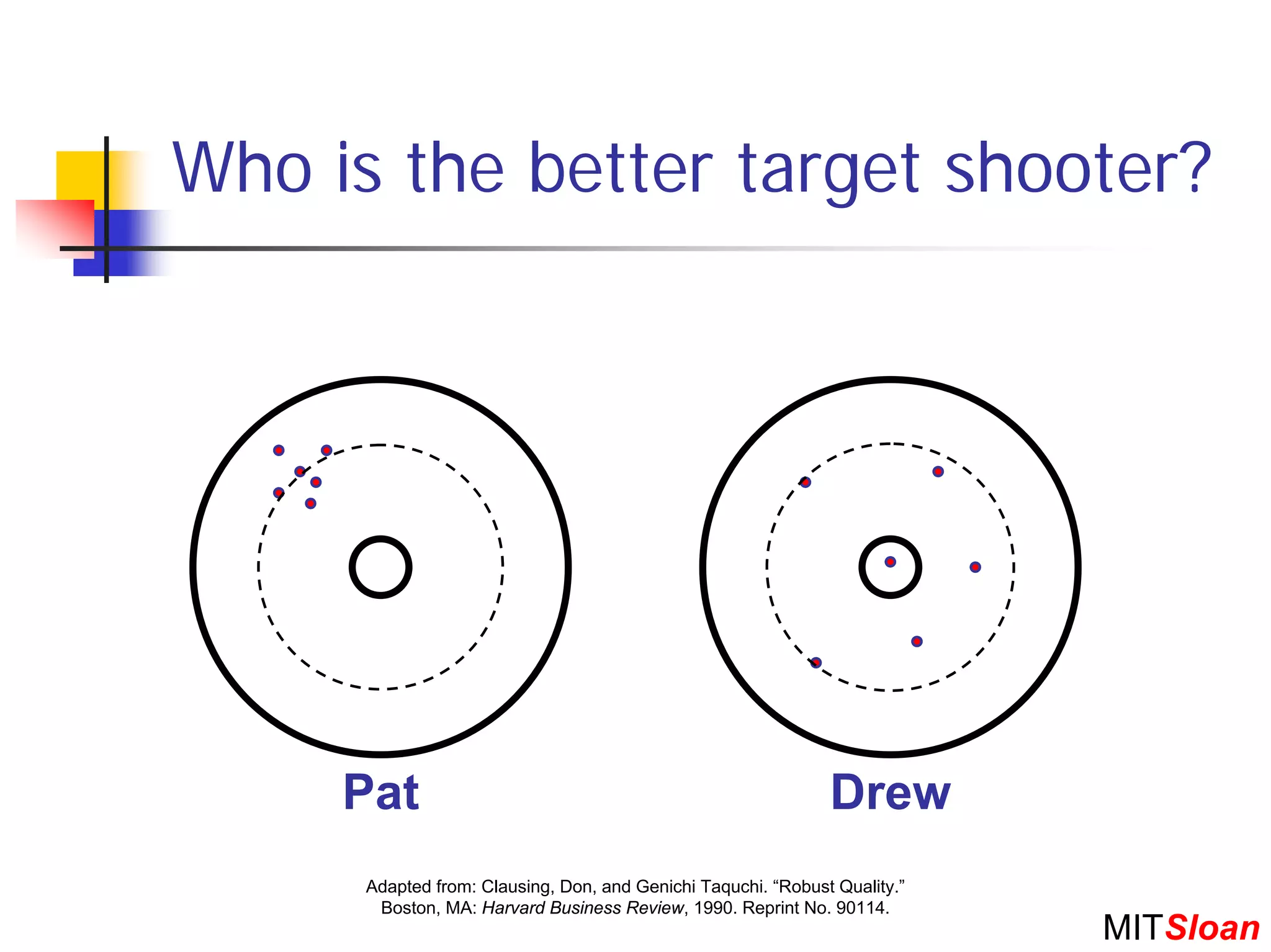
Who is the better target shooter?


     Pat                                                       Drew
      Adapted from: Clausing, Don, and Genichi Taquchi. “Robust Quality.”
       Boston, MA: Harvard Business Review, 1990. Reprint No. 90114.
                                                                            MITSloan
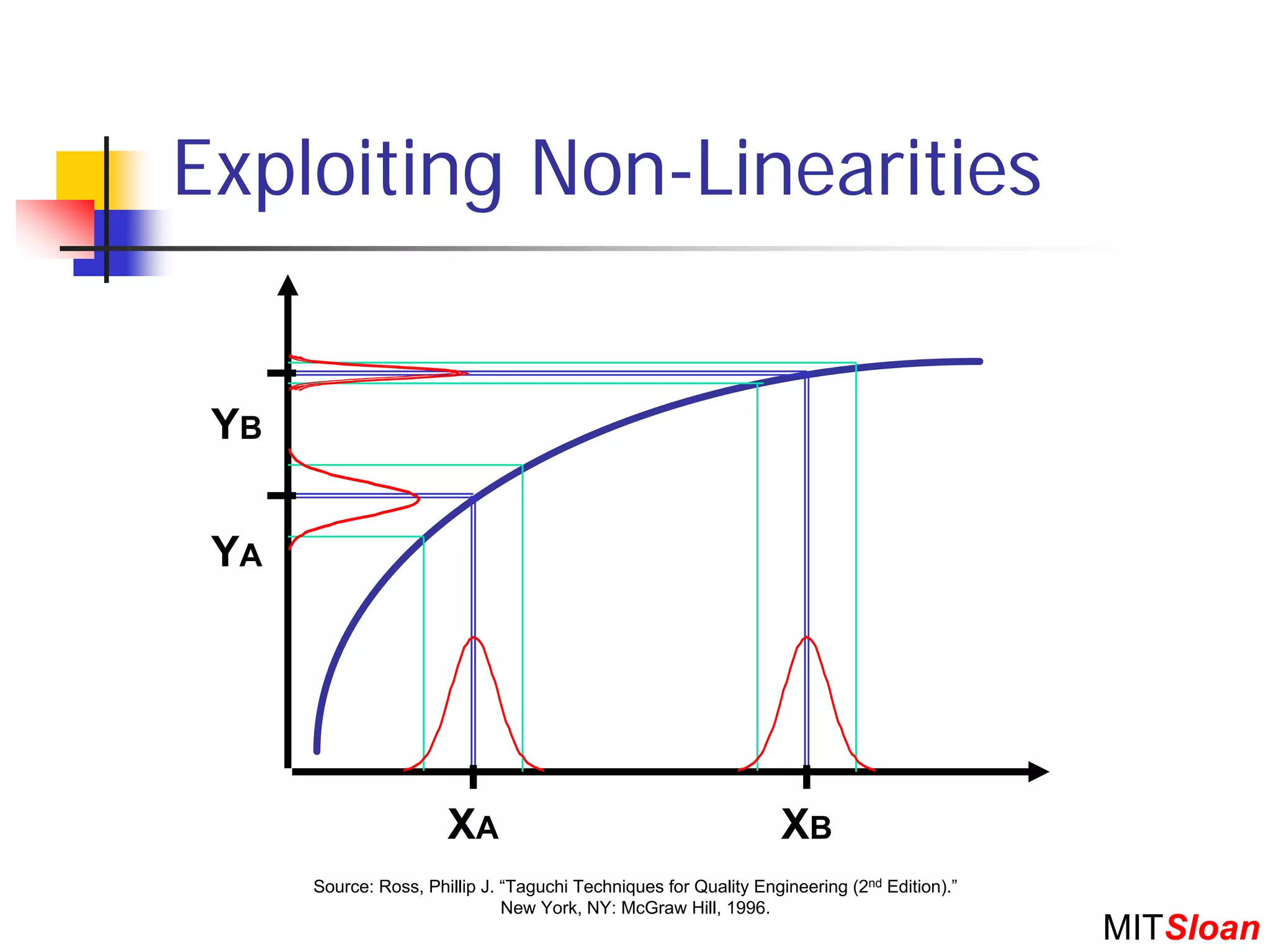
Exploiting Non-Linearities


 YB


 YA


                       XA                                          XB
      Source: Ross, Phillip J. “Taguchi Techniques for Quality Engineering (2nd Edition).”
                               New York, NY: McGraw Hill, 1996.
                                                                                             MITSloan
Goals for Designed Experiments

 Understanding relationships between
 design parameters and product
 performance
 Understanding effects of noise factors
 Reducing product or process variations


                                   MITSloan
Robust Designs
A Robust Product or Process performs correctly,
  even in the presence of noise factors.

  Outer Noise
  Environmental changes, Operating conditions, People
  Inner Noise
    Function & Time related (Wear, Deterioration)
  Product Noise
    Part-to-Part Variations

                                                MITSloan
Parameter Design

         Procedure


                     MITSloan
Step 1: P-Diagram
Step 1: Select appropriate controls,
 response, and noise factors to explore
 experimentally.
 controllable input parameters
 measurable performance response
 uncontrollable noise factors


                                    MITSloan
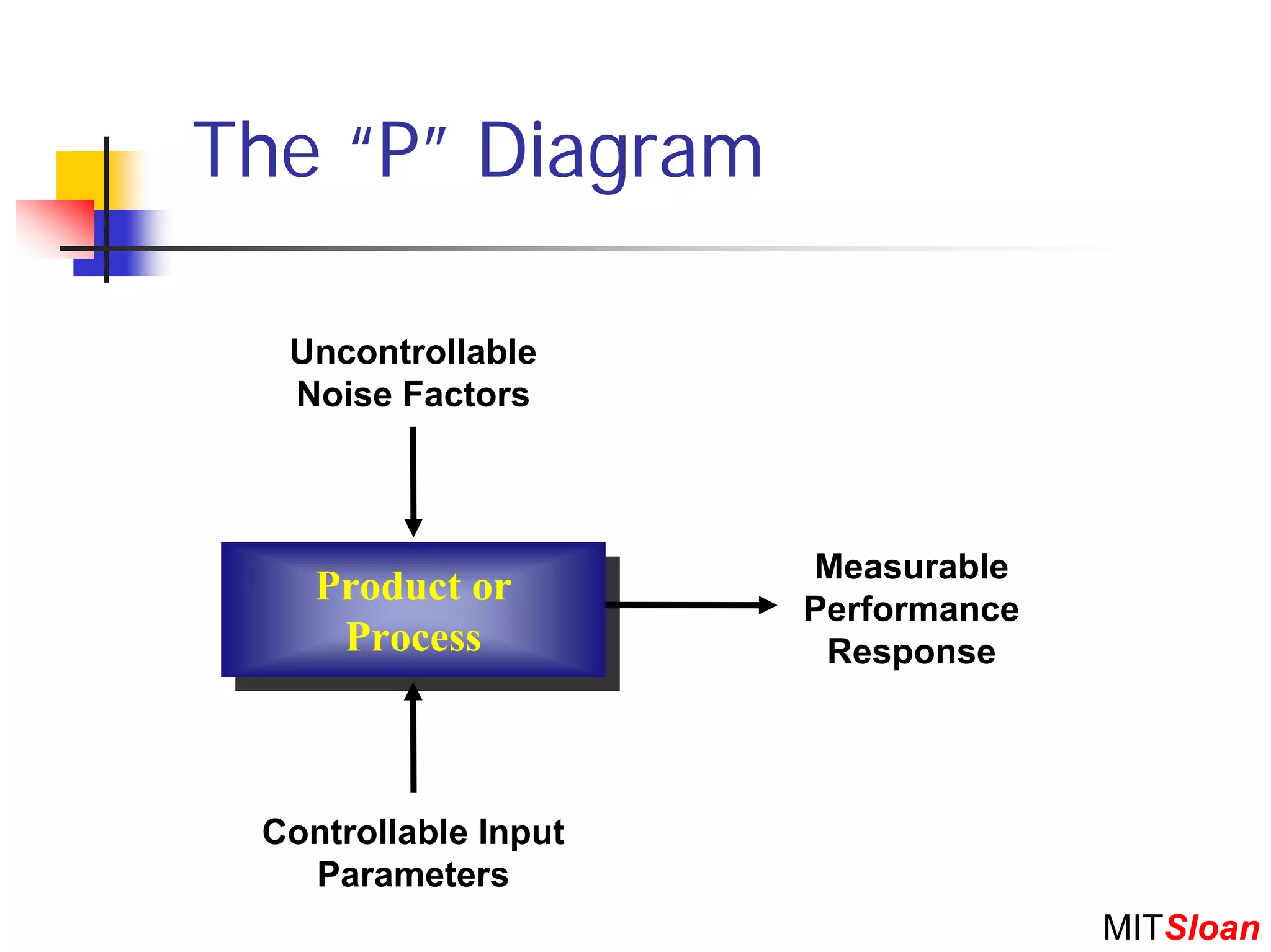
The “P” Diagram

  Uncontrollable
  Noise Factors


                      Measurable
    Product or
     Product or       Performance
      Process
       Process         Response


 Controllable Input
   Parameters
                                    MITSloan
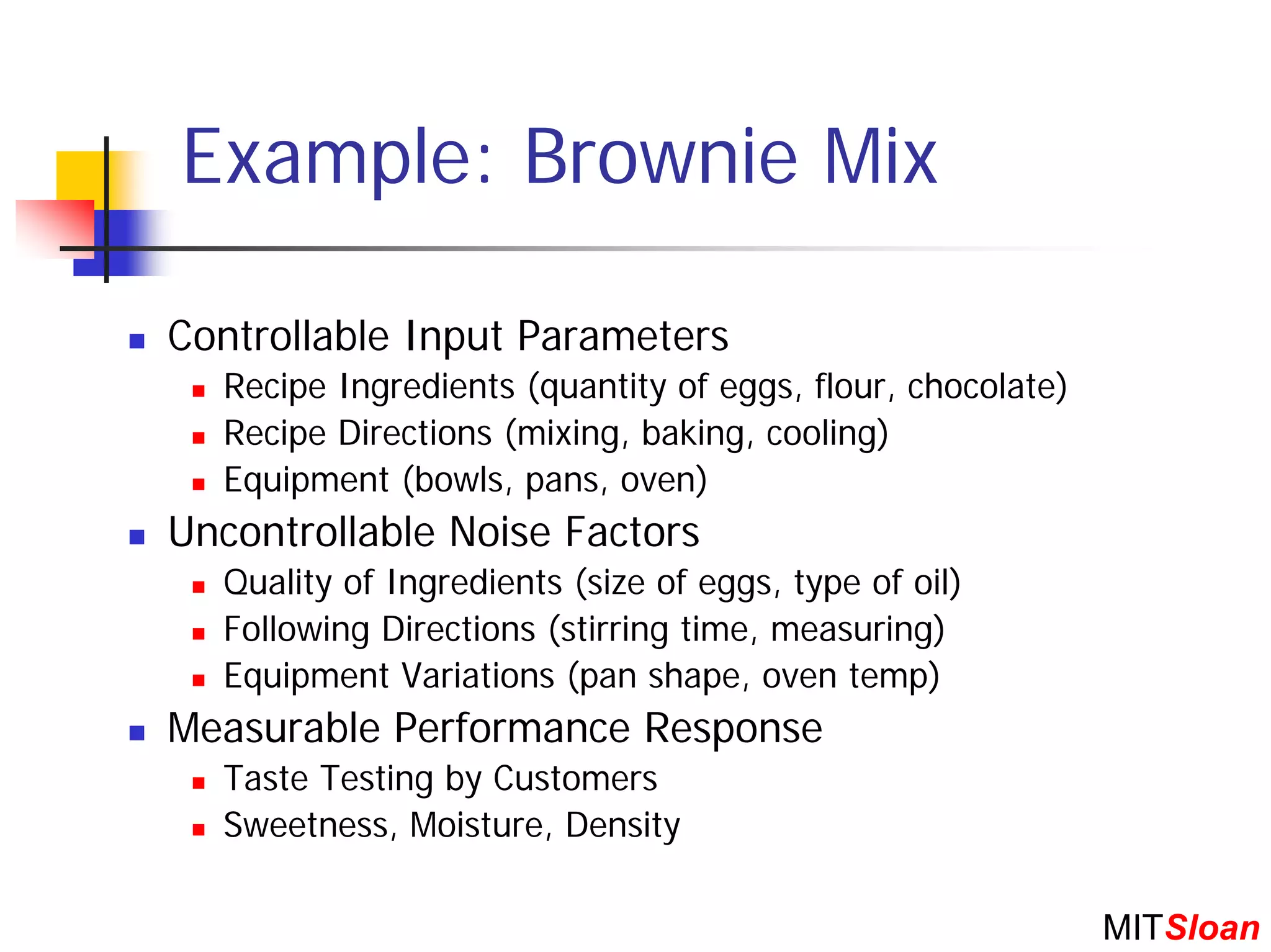
Example: Brownie Mix

Controllable Input Parameters
  Recipe Ingredients (quantity of eggs, flour, chocolate)
  Recipe Directions (mixing, baking, cooling)
  Equipment (bowls, pans, oven)
Uncontrollable Noise Factors
  Quality of Ingredients (size of eggs, type of oil)
  Following Directions (stirring time, measuring)
  Equipment Variations (pan shape, oven temp)
Measurable Performance Response
  Taste Testing by Customers
  Sweetness, Moisture, Density

                                                            MITSloan
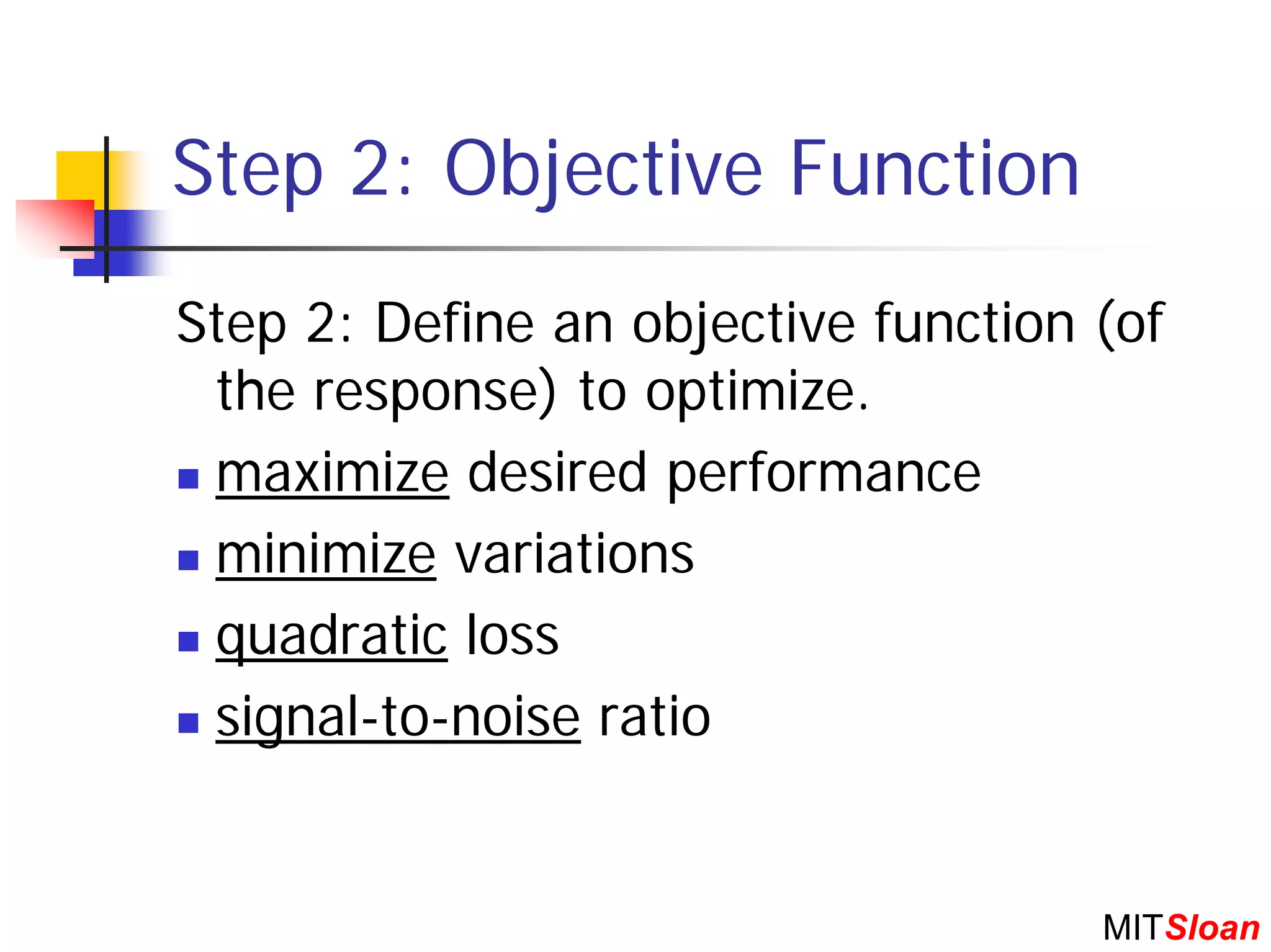
Step 2: Objective Function
Step 2: Define an objective function (of
 the response) to optimize.
 maximize desired performance
 minimize variations
 quadratic loss
 signal-to-noise ratio


                                     MITSloan
Types of Objective Functions

Larger-the-Better   Smaller-the-Better
e.g. performance      e.g. variance
     ƒ(y) = y2         ƒ(y) = 1/y2


Nominal-the-Best     Signal-to-Noise
   e.g. target         e.g. trade-off
 ƒ(y) = 1/(y–t)2    ƒ(y) = 10log[µ2/σ2]


                                          MITSloan
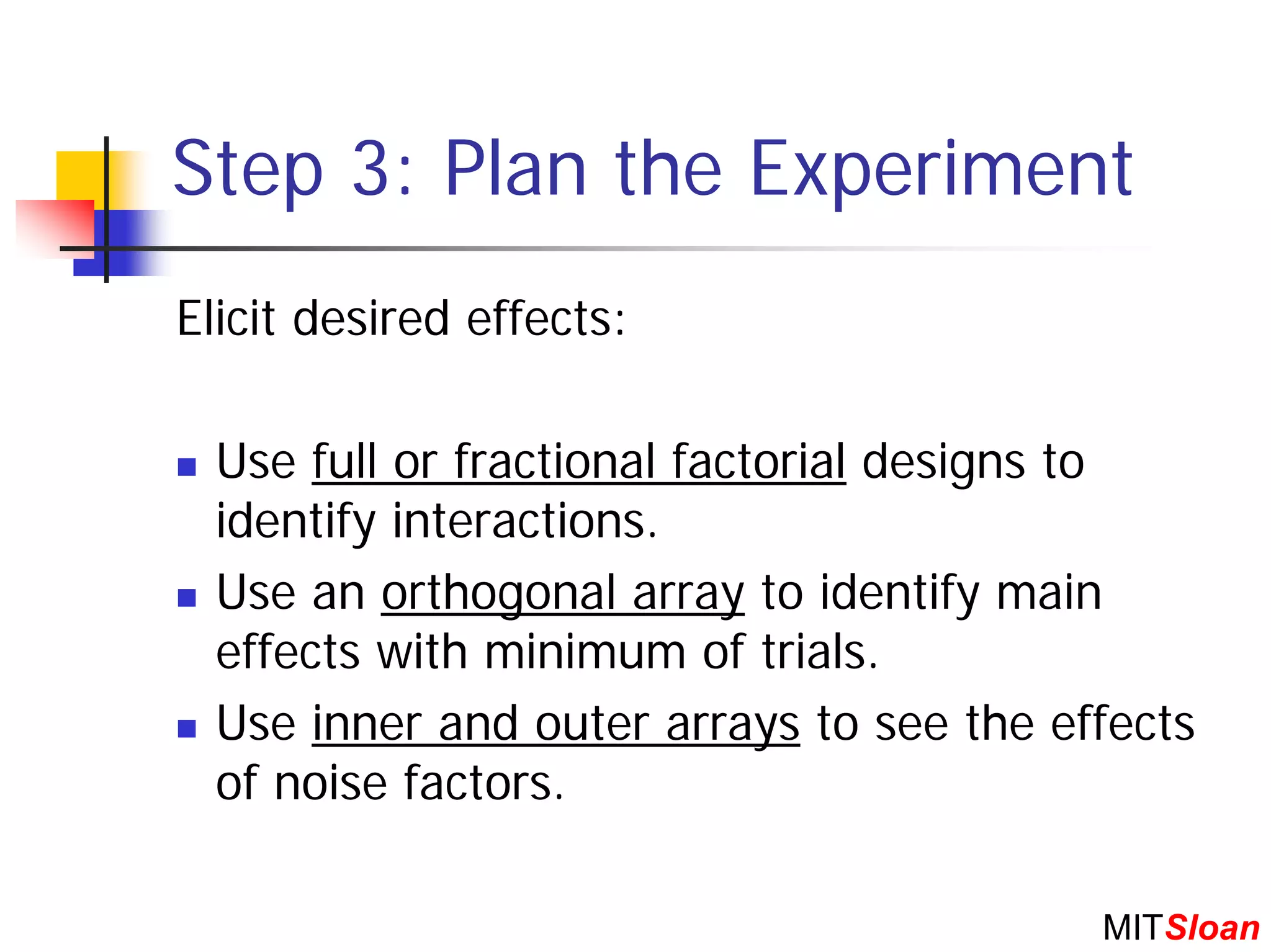
Step 3: Plan the Experiment
Elicit desired effects:

  Use full or fractional factorial designs to
  identify interactions.
  Use an orthogonal array to identify main
  effects with minimum of trials.
  Use inner and outer arrays to see the effects
  of noise factors.

                                          MITSloan
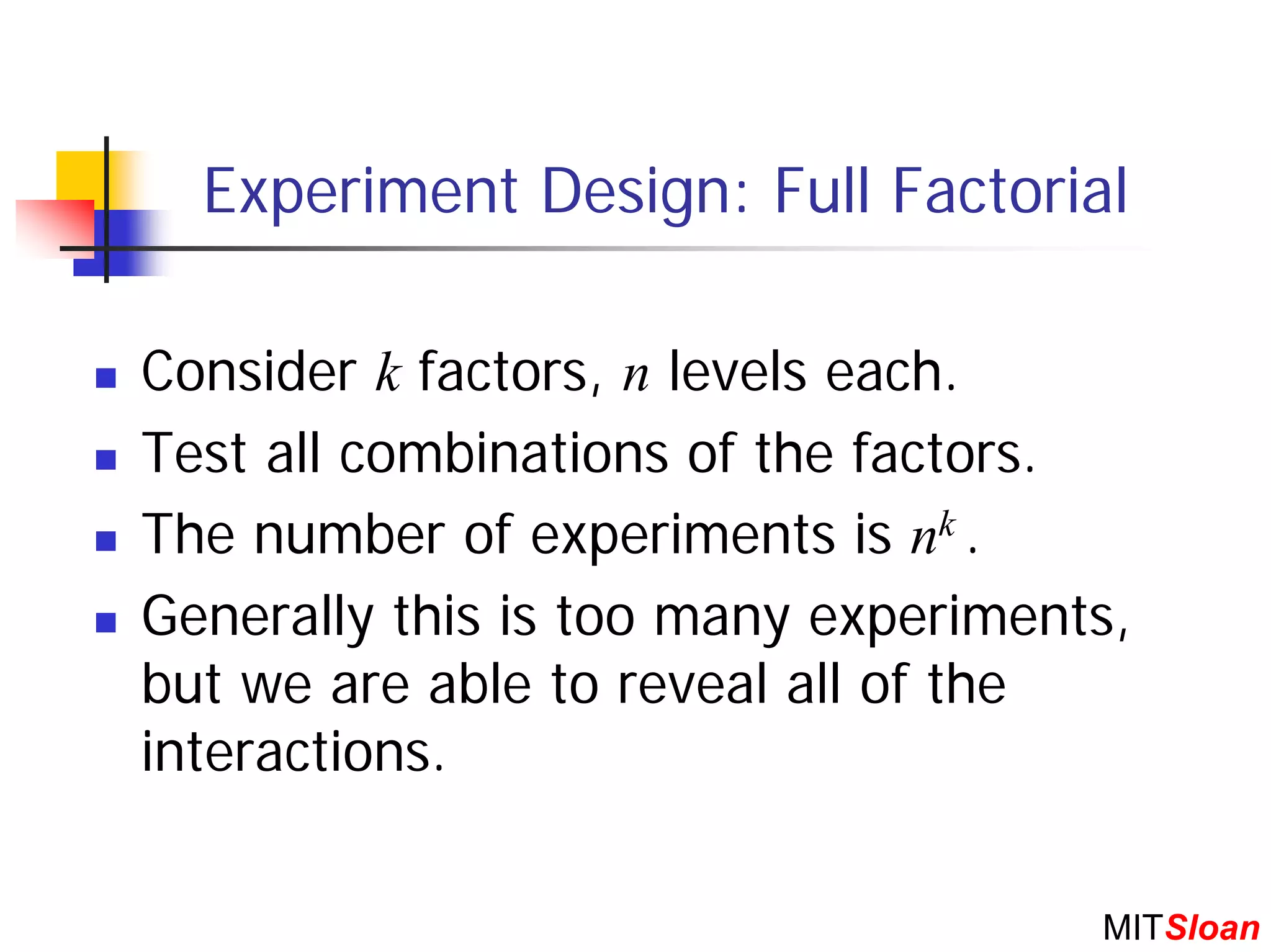
Experiment Design: Full Factorial

Consider k factors, n levels each.
Test all combinations of the factors.
The number of experiments is nk .
Generally this is too many experiments,
but we are able to reveal all of the
interactions.

                                     MITSloan
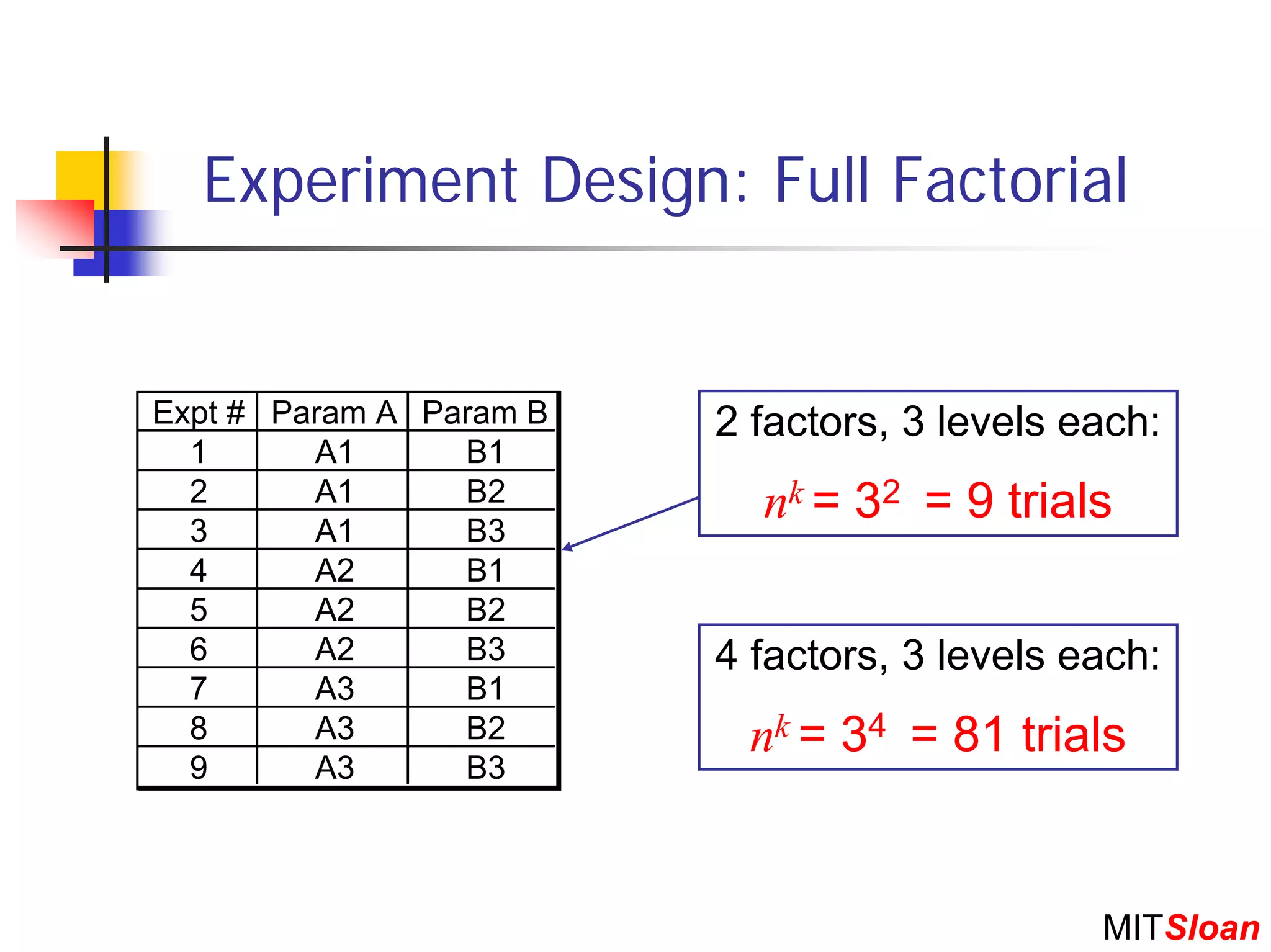
Experiment Design: Full Factorial


Expt # Param A Param B   2 factors, 3 levels each:
  1      A1      B1
  2      A1      B2        nk = 32 = 9 trials
  3      A1      B3
  4      A2      B1
  5      A2      B2
  6      A2      B3      4 factors, 3 levels each:
  7      A3      B1
  8      A3      B2       nk = 34 = 81 trials
  9      A3      B3


                                              MITSloan
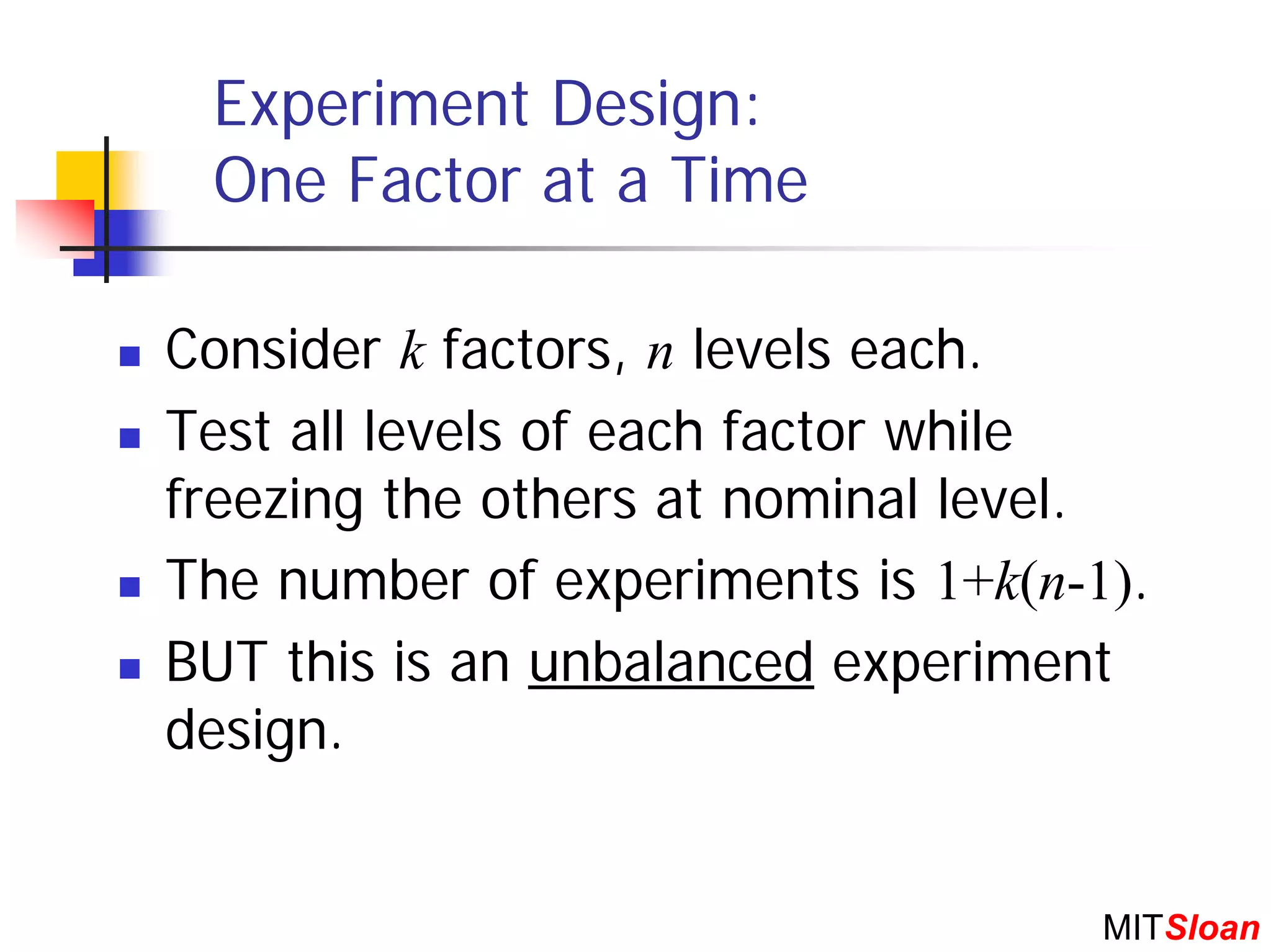
Experiment Design:
 One Factor at a Time

Consider k factors, n levels each.
Test all levels of each factor while
freezing the others at nominal level.
The number of experiments is 1+k(n-1).
BUT this is an unbalanced experiment
design.


                                    MITSloan
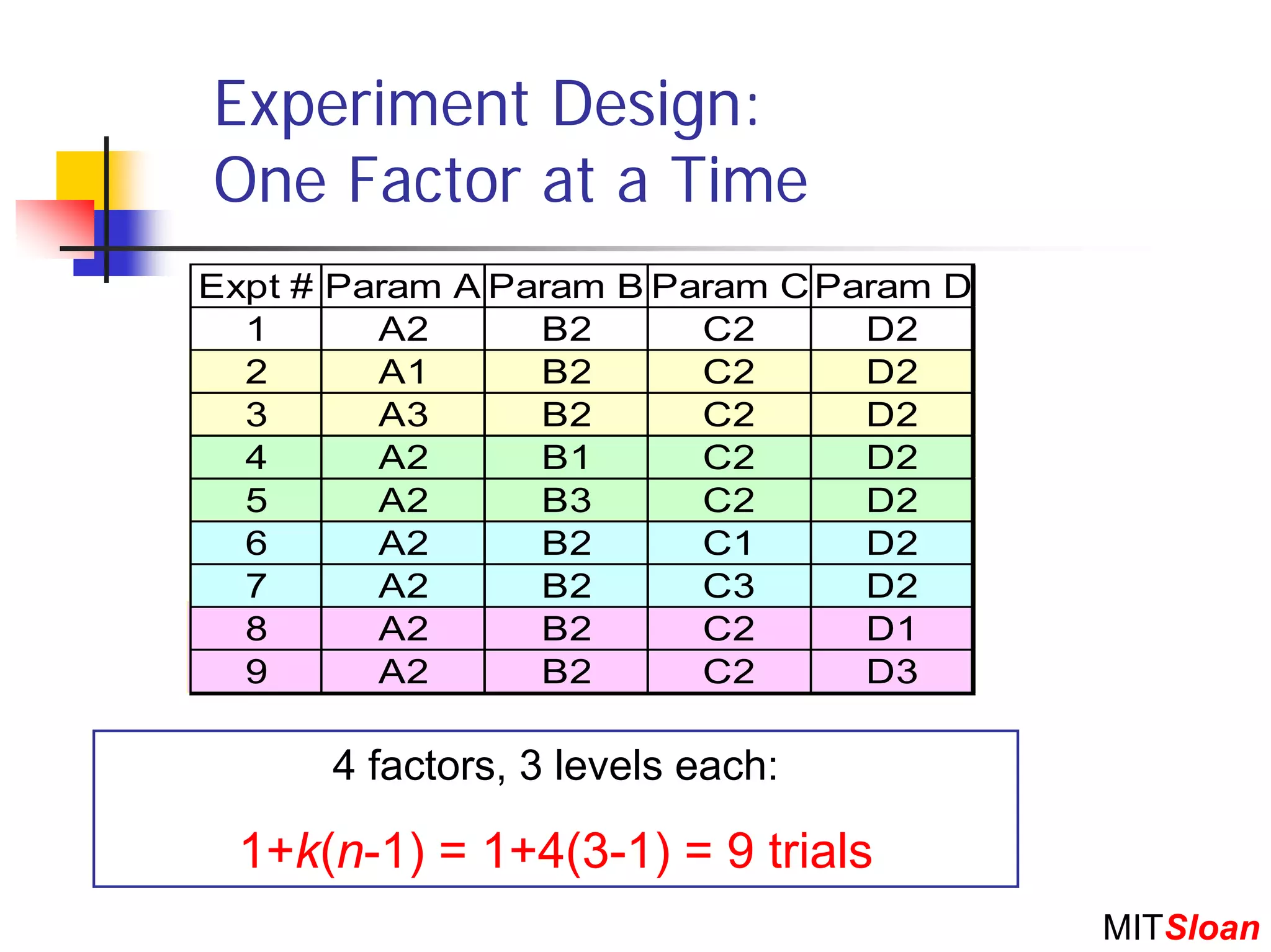
Experiment Design:
One Factor at a Time
Expt # Param A Param B Param C Param D
  1      A2      B2      C2      D2
  2      A1      B2      C2      D2
  3      A3      B2      C2      D2
  4      A2      B1      C2      D2
  5      A2      B3      C2      D2
  6      A2      B2      C1      D2
  7      A2      B2      C3      D2
  8      A2      B2      C2      D1
  9      A2      B2      C2      D3

      4 factors, 3 levels each:

 1+k(n-1) = 1+4(3-1) = 9 trials
                                         MITSloan
Experiment Design:
  Orthogonal Array

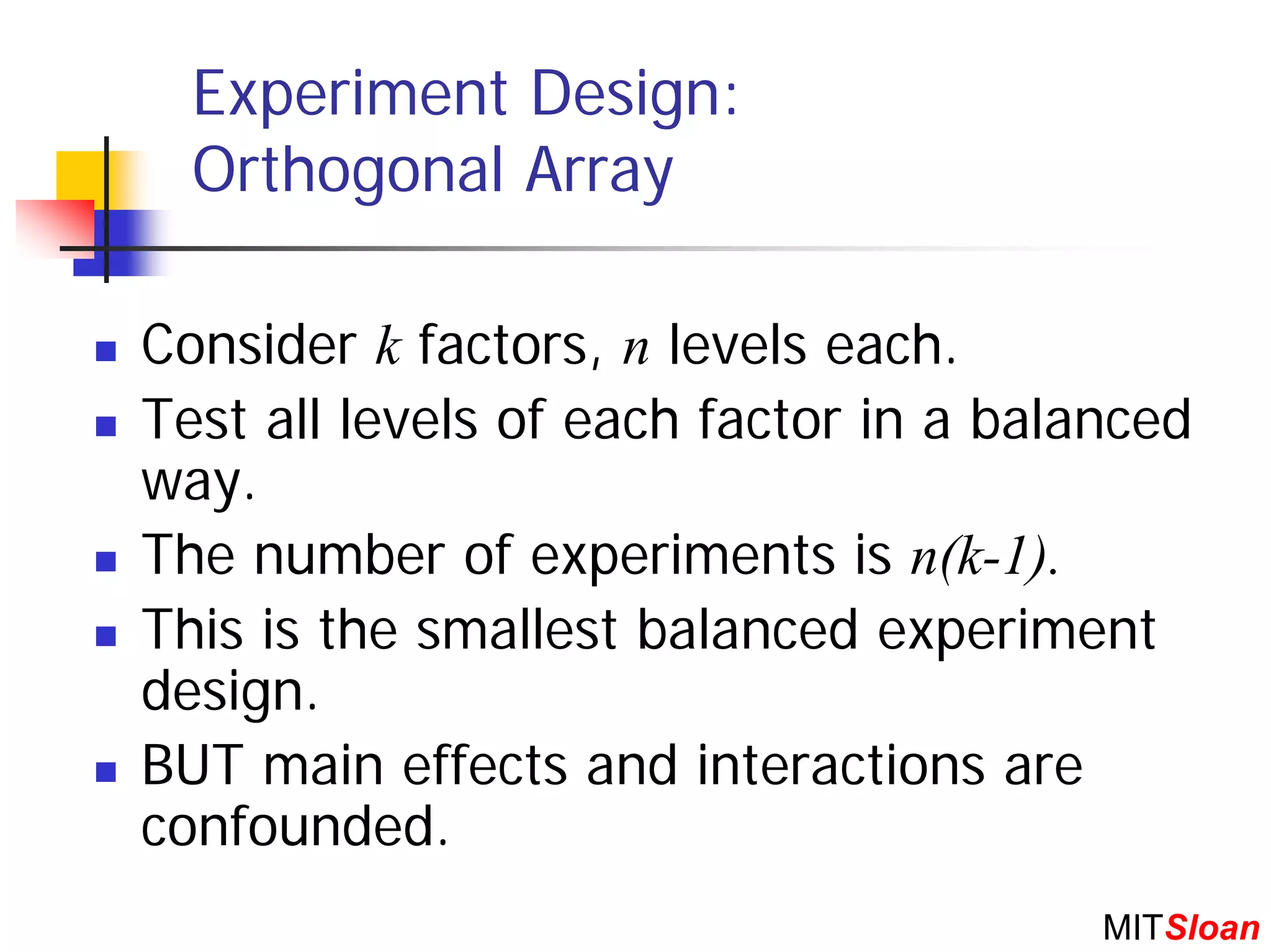
Consider k factors, n levels each.
Test all levels of each factor in a balanced
way.
The number of experiments is n(k-1).
This is the smallest balanced experiment
design.
BUT main effects and interactions are
confounded.
                                        MITSloan
Experiment Design:
Orthogonal Array
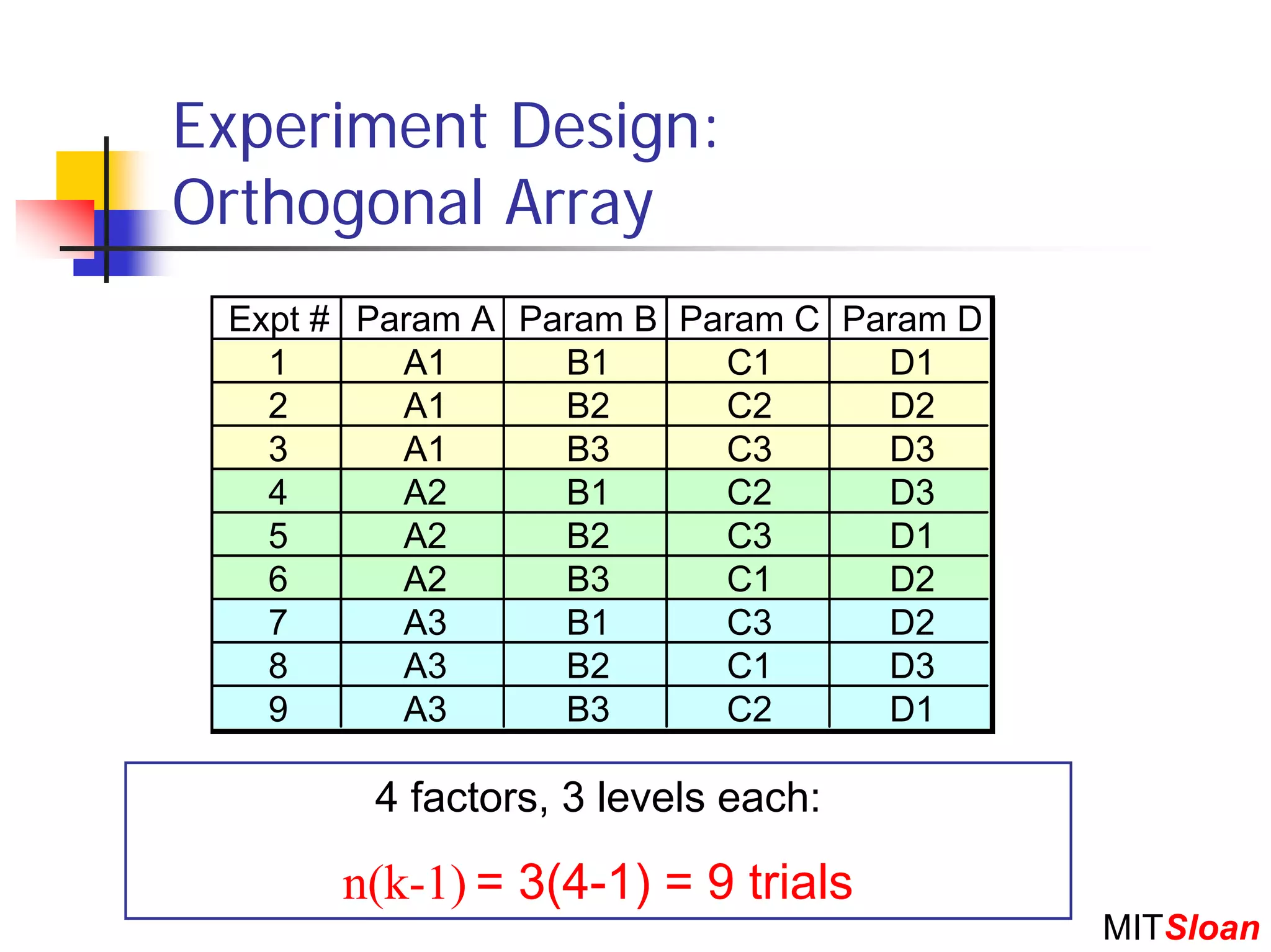
 Expt # Param A Param B Param C Param D
   1      A1      B1      C1      D1
   2      A1      B2      C2      D2
   3      A1      B3      C3      D3
   4      A2      B1      C2      D3
   5      A2      B2      C3      D1
   6      A2      B3      C1      D2
   7      A3      B1      C3      D2
   8      A3      B2      C1      D3
   9      A3      B3      C2      D1

        4 factors, 3 levels each:

      n(k-1) = 3(4-1) = 9 trials
                                          MITSloan
Using Inner and Outer Arrays
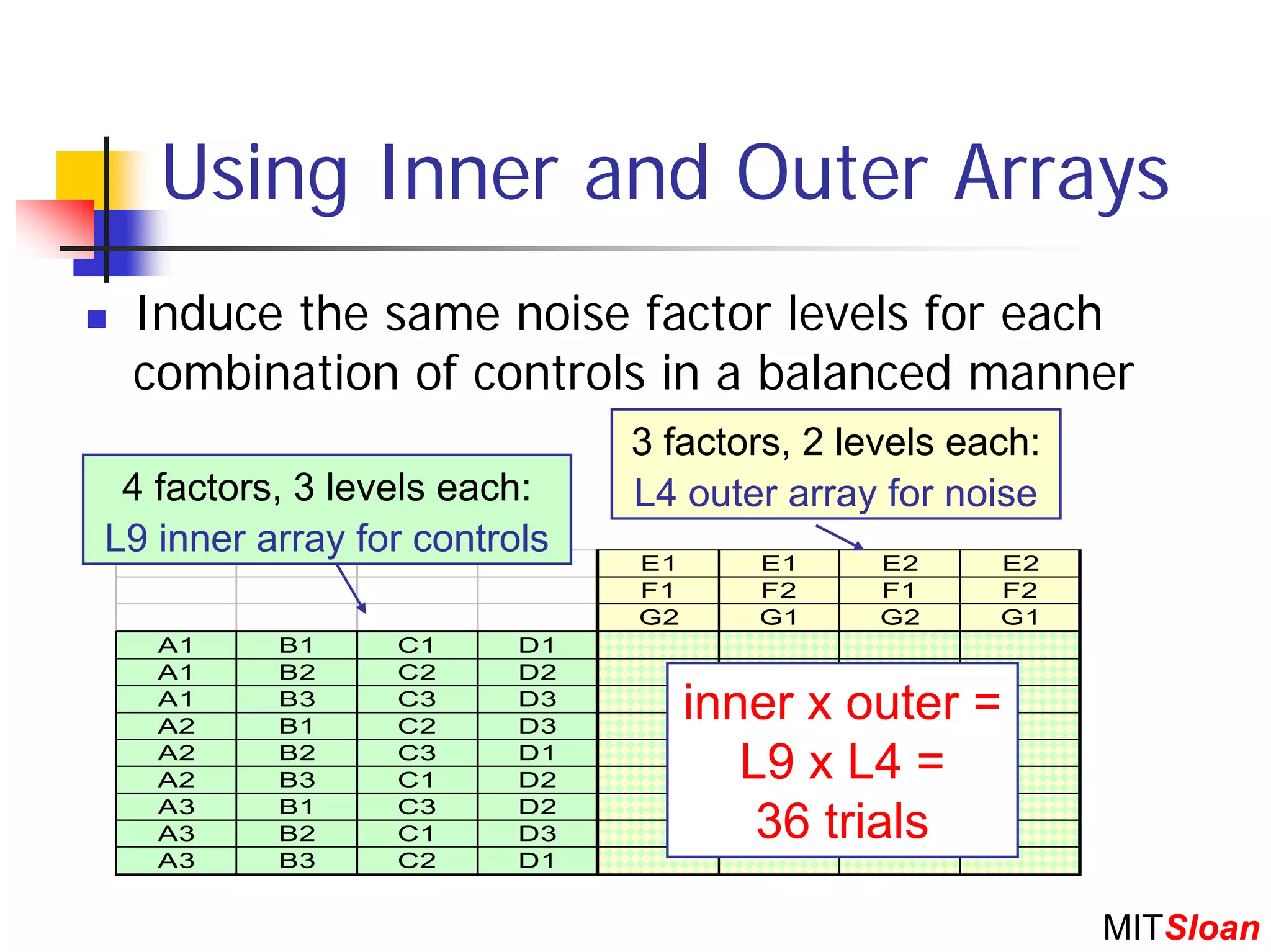
 Induce the same noise factor levels for each
 combination of controls in a balanced manner
                              3 factors, 2 levels each:
 4 factors, 3 levels each:    L4 outer array for noise
L9 inner array for controls   E1      E1     E2     E2
                              F1      F2     F1     F2
                              G2      G1     G2     G1
   A1     B1     C1      D1
   A1     B2     C2      D2
   A1
   A2
          B3
          B1
                 C3
                 C2
                         D3
                         D3
                                   inner x outer =
   A2
   A2
          B2
          B3
                 C3
                 C1
                         D1
                         D2           L9 x L4 =
   A3     B1     C3      D2
   A3     B2     C1      D3            36 trials
   A3     B3     C2      D1


                                                          MITSloan
Step 4: Run the Experiment

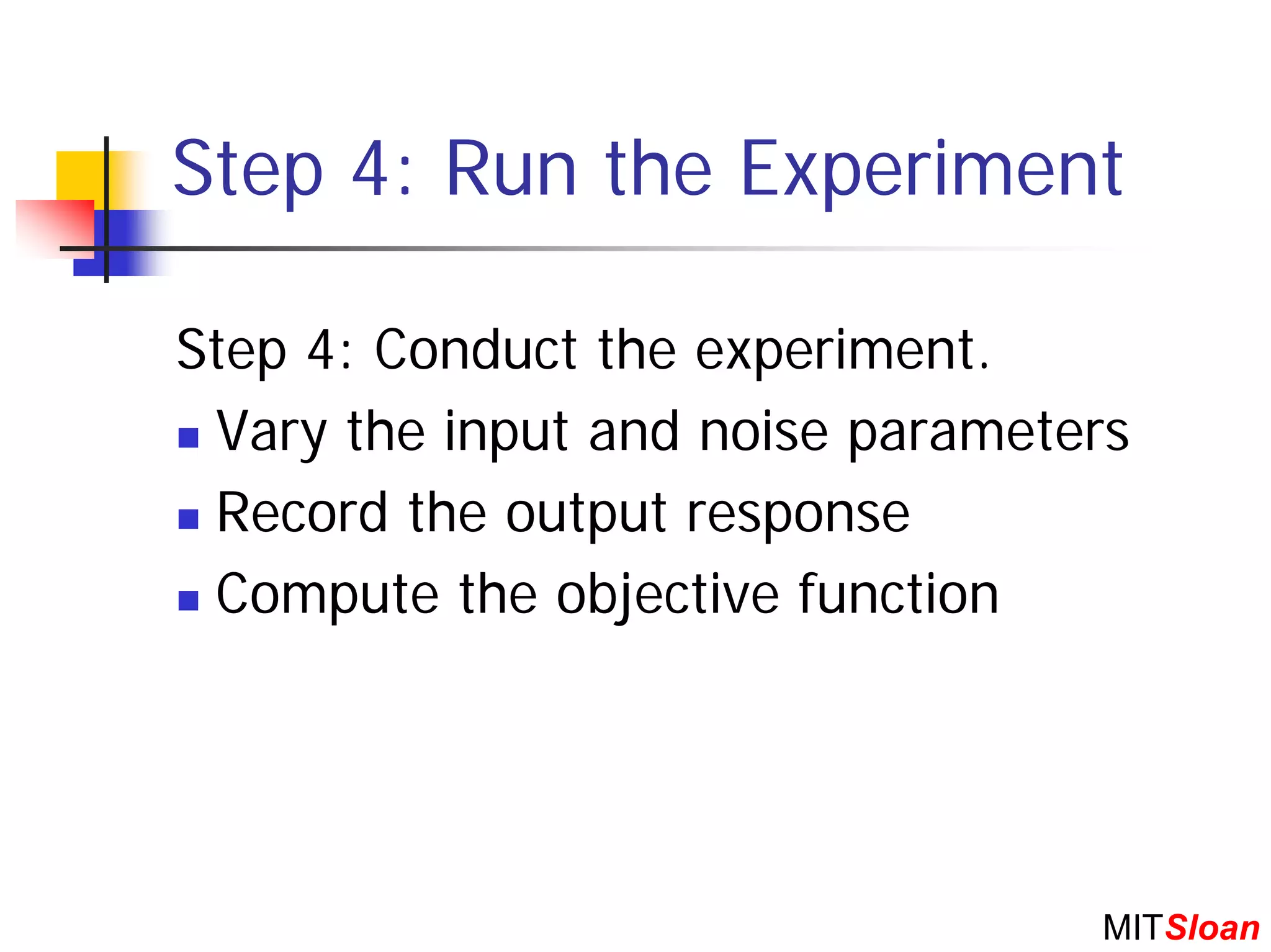
Step 4: Conduct the experiment.
 Vary the input and noise parameters
 Record the output response
 Compute the objective function


                                  MITSloan
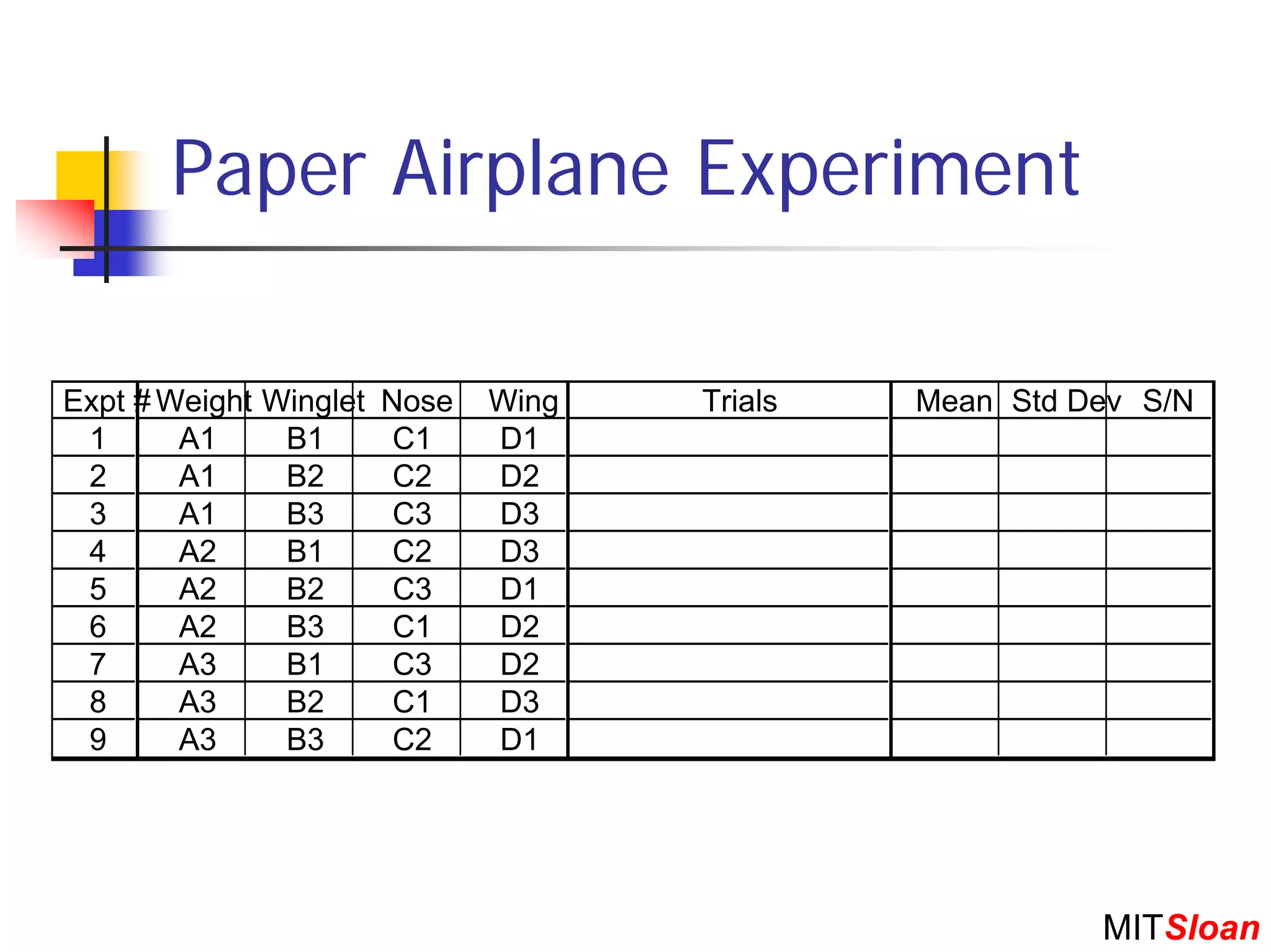
Paper Airplane Experiment

Expt # Weight Winglet Nose   Wing   Trials   Mean Std Dev S/N
 1      A1     B1      C1    D1
 2      A1     B2      C2    D2
 3      A1     B3      C3    D3
 4      A2     B1      C2    D3
 5      A2     B2      C3    D1
 6      A2     B3      C1    D2
 7      A3     B1      C3    D2
 8      A3     B2      C1    D3
 9      A3     B3      C2    D1


                                                       MITSloan
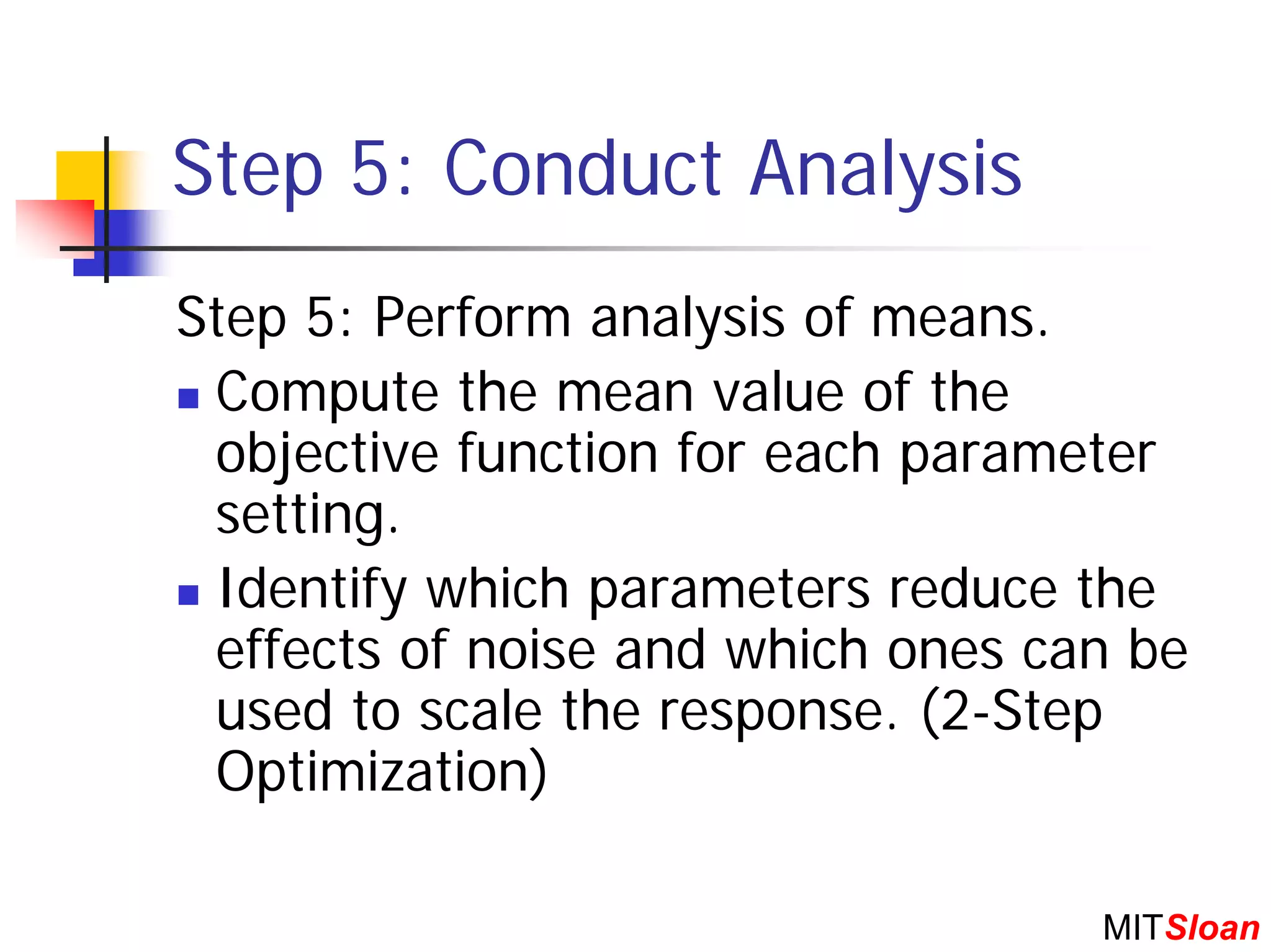
Step 5: Conduct Analysis
Step 5: Perform analysis of means.
 Compute the mean value of the
 objective function for each parameter
 setting.
 Identify which parameters reduce the
 effects of noise and which ones can be
 used to scale the response. (2-Step
 Optimization)

                                   MITSloan
Parameter Design Procedure
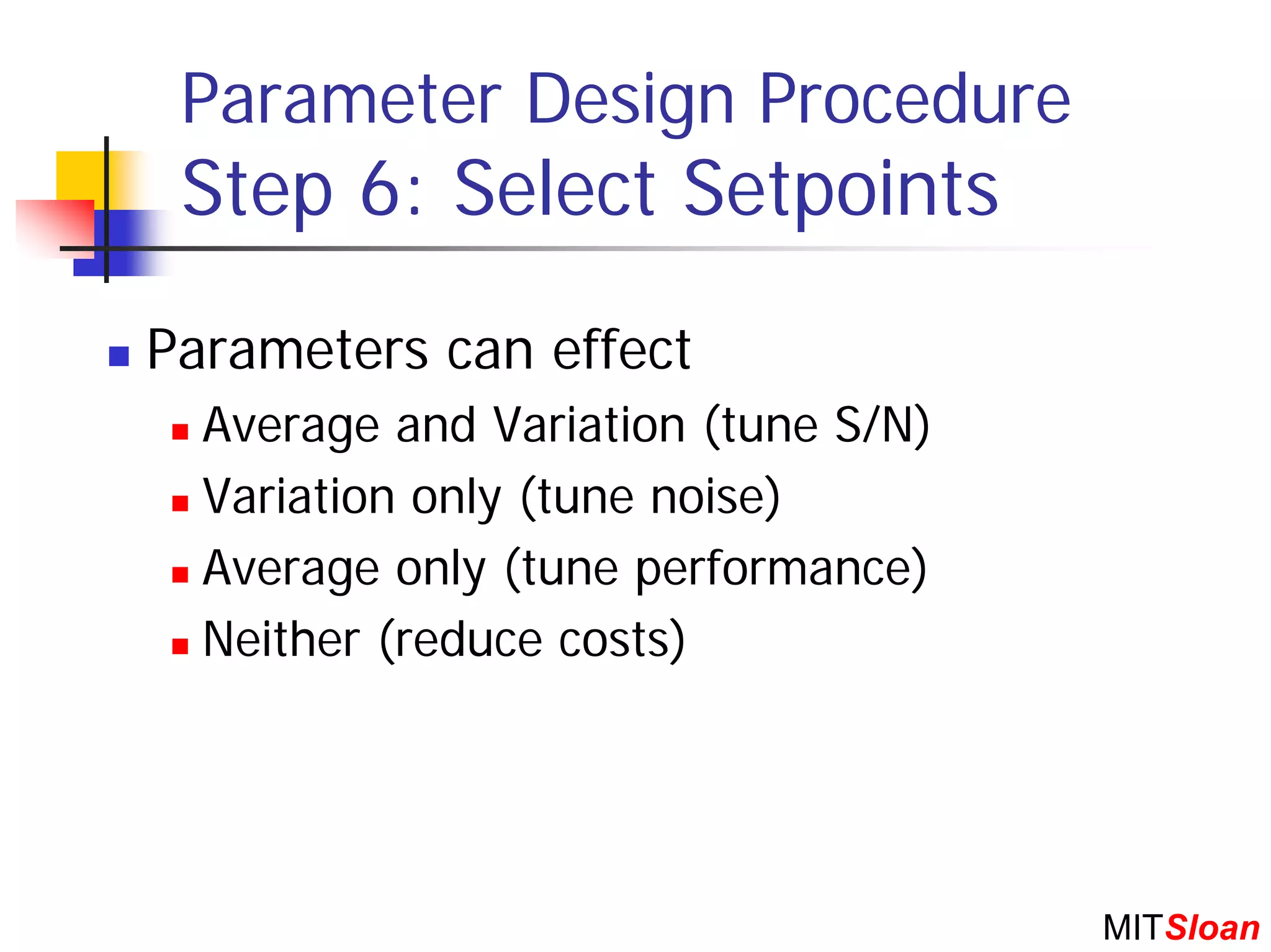
 Step 6: Select Setpoints
Parameters can effect
  Average and Variation (tune S/N)
  Variation only (tune noise)
  Average only (tune performance)
  Neither (reduce costs)


                                     MITSloan
Parameter Design Procedure
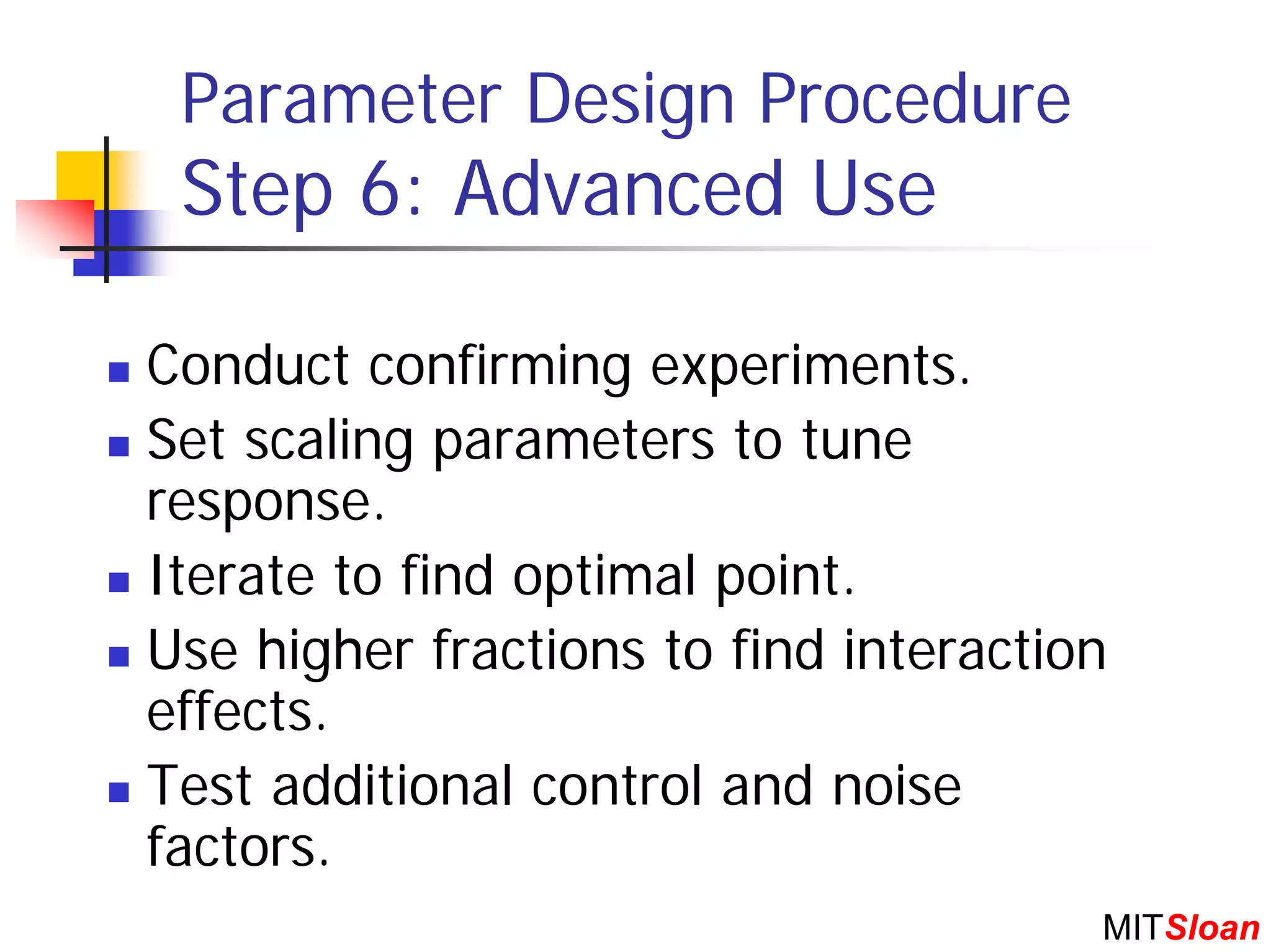
 Step 6: Advanced Use

Conduct confirming experiments.
Set scaling parameters to tune
response.
Iterate to find optimal point.
Use higher fractions to find interaction
effects.
Test additional control and noise
factors.
                                       MITSloan
Confounding Interactions

Generally the main effects dominate the
response. BUT sometimes interactions are
important. This is generally the case when
the confirming trial fails.
To explore interactions, use a fractional
factorial experiment design.


                                             MITSloan
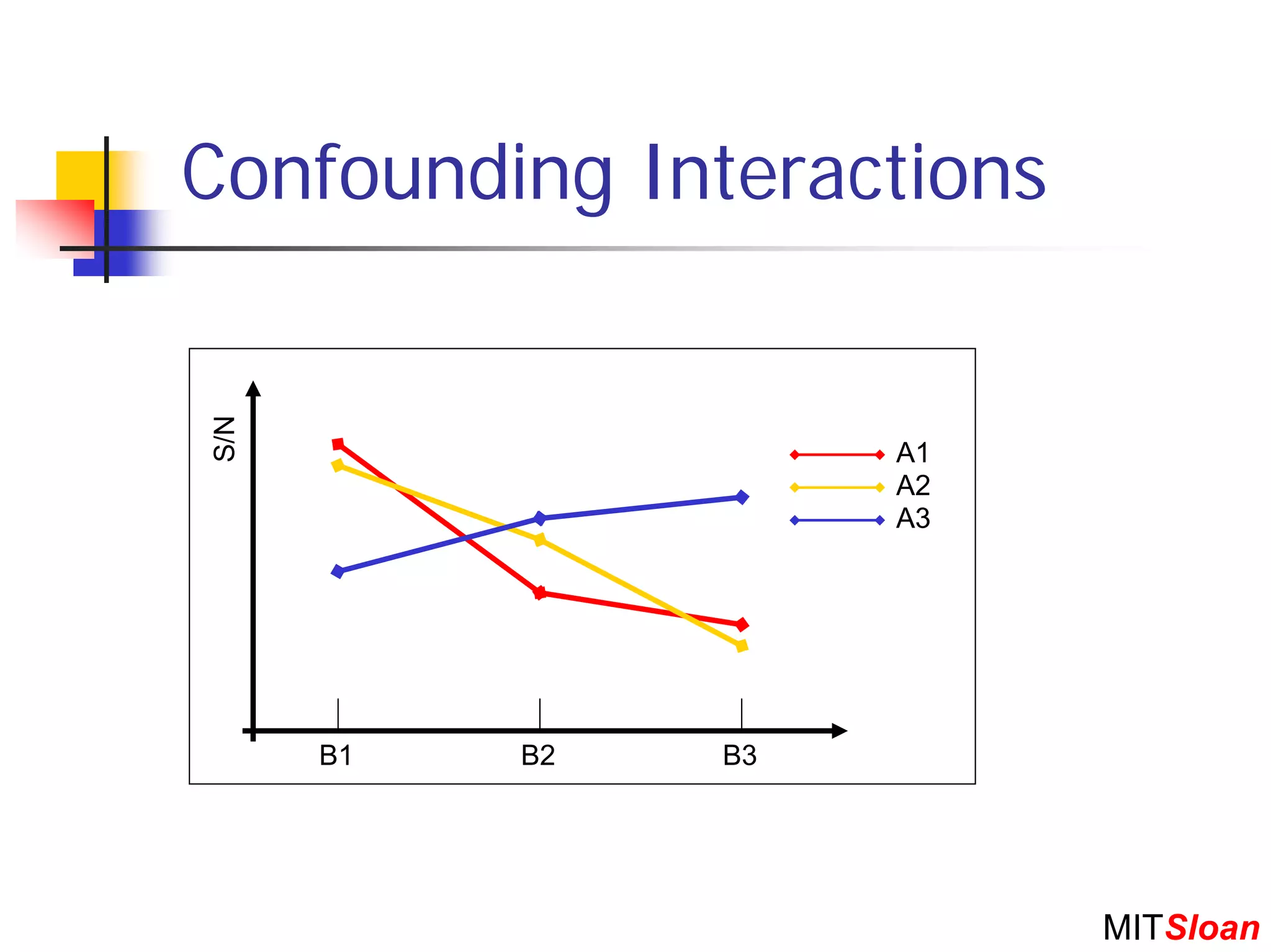
Confounding Interactions
S/N


                     A1
                     A2
                     A3


      B1   B2   B3


                           MITSloan
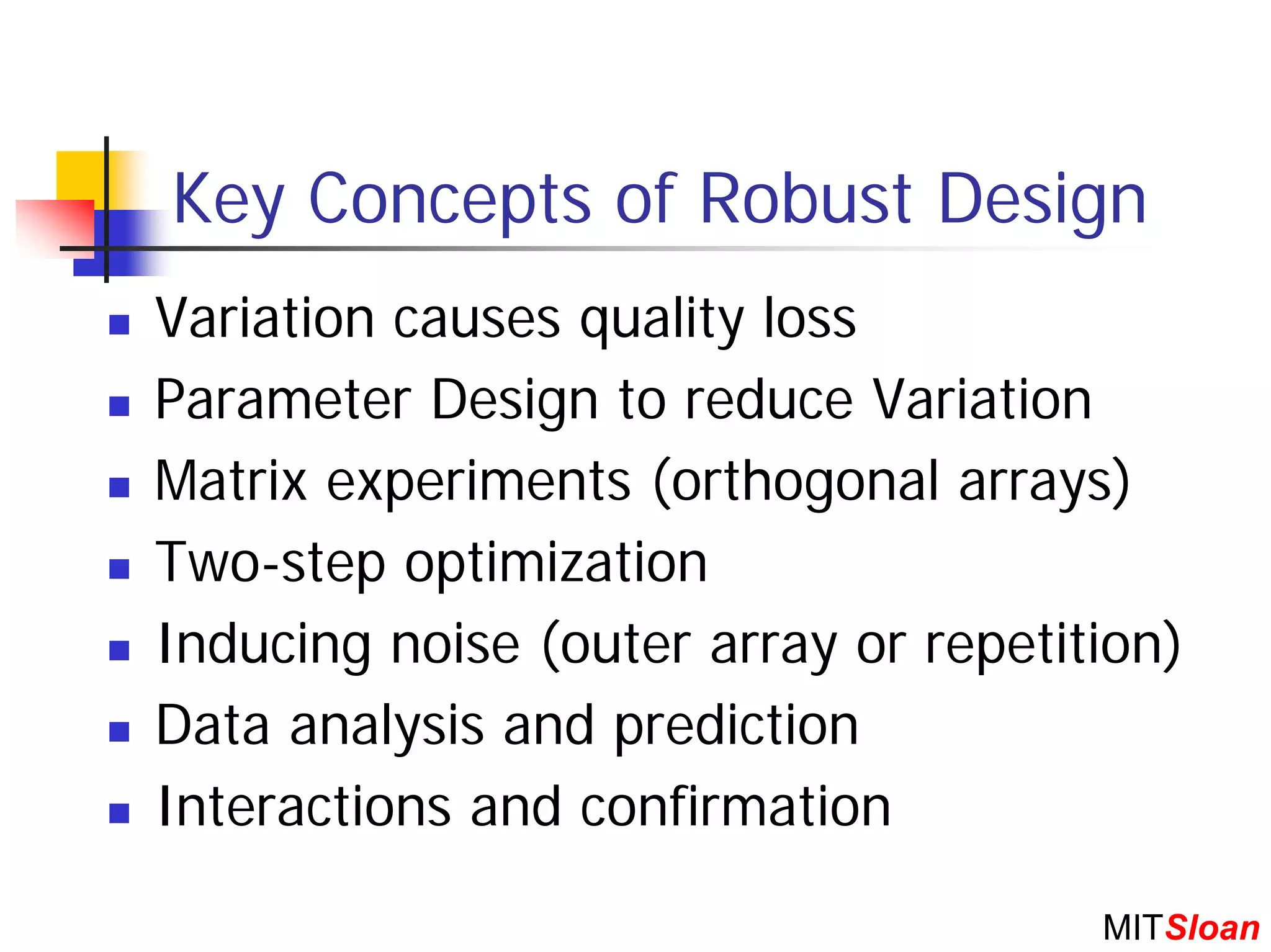
Key Concepts of Robust Design
Variation causes quality loss
Parameter Design to reduce Variation
Matrix experiments (orthogonal arrays)
Two-step optimization
Inducing noise (outer array or repetition)
Data analysis and prediction
Interactions and confirmation

                                      MITSloan

Robust Design

  • 1.
    Robust Design: Experiments forBetter Products Taguchi Techniques MITSloan
  • 2.
    Robust Design andQuality in the Product Development Process Concept Concept System-Level System-Level Detail Detail Testing and Testing and Production Production Planning Planning Development Design Design Refinement Ramp-Up Development Design Design Refinement Ramp-Up Robust Concept Robust Quality efforts are and System Parameter & typically made here, Design Tolerance when it is too late. Design MITSloan
  • 3.
    Goalpost vs TaguchiView COST $ COST $ Nominal Nominal Value Value MITSloan
  • 4.
    General Loss Function Product & Process Engineer (a priori) Manufacturing (daily) [ k ⋅ σ + (µ − m ) 2 2 ] Nominal Value Average Value Variance Cost Factor MITSloan
  • 5.
    Who is thebetter target shooter? Pat Drew Adapted from: Clausing, Don, and Genichi Taquchi. “Robust Quality.” Boston, MA: Harvard Business Review, 1990. Reprint No. 90114. MITSloan
  • 6.
    Exploiting Non-Linearities YB YA XA XB Source: Ross, Phillip J. “Taguchi Techniques for Quality Engineering (2nd Edition).” New York, NY: McGraw Hill, 1996. MITSloan
  • 7.
    Goals for DesignedExperiments Understanding relationships between design parameters and product performance Understanding effects of noise factors Reducing product or process variations MITSloan
  • 8.
    Robust Designs A RobustProduct or Process performs correctly, even in the presence of noise factors. Outer Noise Environmental changes, Operating conditions, People Inner Noise Function & Time related (Wear, Deterioration) Product Noise Part-to-Part Variations MITSloan
  • 9.
    Parameter Design Procedure MITSloan
  • 10.
    Step 1: P-Diagram Step1: Select appropriate controls, response, and noise factors to explore experimentally. controllable input parameters measurable performance response uncontrollable noise factors MITSloan
  • 11.
    The “P” Diagram Uncontrollable Noise Factors Measurable Product or Product or Performance Process Process Response Controllable Input Parameters MITSloan
  • 12.
    Example: Brownie Mix ControllableInput Parameters Recipe Ingredients (quantity of eggs, flour, chocolate) Recipe Directions (mixing, baking, cooling) Equipment (bowls, pans, oven) Uncontrollable Noise Factors Quality of Ingredients (size of eggs, type of oil) Following Directions (stirring time, measuring) Equipment Variations (pan shape, oven temp) Measurable Performance Response Taste Testing by Customers Sweetness, Moisture, Density MITSloan
  • 13.
    Step 2: ObjectiveFunction Step 2: Define an objective function (of the response) to optimize. maximize desired performance minimize variations quadratic loss signal-to-noise ratio MITSloan
  • 14.
    Types of ObjectiveFunctions Larger-the-Better Smaller-the-Better e.g. performance e.g. variance ƒ(y) = y2 ƒ(y) = 1/y2 Nominal-the-Best Signal-to-Noise e.g. target e.g. trade-off ƒ(y) = 1/(y–t)2 ƒ(y) = 10log[µ2/σ2] MITSloan
  • 15.
    Step 3: Planthe Experiment Elicit desired effects: Use full or fractional factorial designs to identify interactions. Use an orthogonal array to identify main effects with minimum of trials. Use inner and outer arrays to see the effects of noise factors. MITSloan
  • 16.
    Experiment Design: FullFactorial Consider k factors, n levels each. Test all combinations of the factors. The number of experiments is nk . Generally this is too many experiments, but we are able to reveal all of the interactions. MITSloan
  • 17.
    Experiment Design: FullFactorial Expt # Param A Param B 2 factors, 3 levels each: 1 A1 B1 2 A1 B2 nk = 32 = 9 trials 3 A1 B3 4 A2 B1 5 A2 B2 6 A2 B3 4 factors, 3 levels each: 7 A3 B1 8 A3 B2 nk = 34 = 81 trials 9 A3 B3 MITSloan
  • 18.
    Experiment Design: OneFactor at a Time Consider k factors, n levels each. Test all levels of each factor while freezing the others at nominal level. The number of experiments is 1+k(n-1). BUT this is an unbalanced experiment design. MITSloan
  • 19.
    Experiment Design: One Factorat a Time Expt # Param A Param B Param C Param D 1 A2 B2 C2 D2 2 A1 B2 C2 D2 3 A3 B2 C2 D2 4 A2 B1 C2 D2 5 A2 B3 C2 D2 6 A2 B2 C1 D2 7 A2 B2 C3 D2 8 A2 B2 C2 D1 9 A2 B2 C2 D3 4 factors, 3 levels each: 1+k(n-1) = 1+4(3-1) = 9 trials MITSloan
  • 20.
    Experiment Design: Orthogonal Array Consider k factors, n levels each. Test all levels of each factor in a balanced way. The number of experiments is n(k-1). This is the smallest balanced experiment design. BUT main effects and interactions are confounded. MITSloan
  • 21.
    Experiment Design: Orthogonal Array Expt # Param A Param B Param C Param D 1 A1 B1 C1 D1 2 A1 B2 C2 D2 3 A1 B3 C3 D3 4 A2 B1 C2 D3 5 A2 B2 C3 D1 6 A2 B3 C1 D2 7 A3 B1 C3 D2 8 A3 B2 C1 D3 9 A3 B3 C2 D1 4 factors, 3 levels each: n(k-1) = 3(4-1) = 9 trials MITSloan
  • 22.
    Using Inner andOuter Arrays Induce the same noise factor levels for each combination of controls in a balanced manner 3 factors, 2 levels each: 4 factors, 3 levels each: L4 outer array for noise L9 inner array for controls E1 E1 E2 E2 F1 F2 F1 F2 G2 G1 G2 G1 A1 B1 C1 D1 A1 B2 C2 D2 A1 A2 B3 B1 C3 C2 D3 D3 inner x outer = A2 A2 B2 B3 C3 C1 D1 D2 L9 x L4 = A3 B1 C3 D2 A3 B2 C1 D3 36 trials A3 B3 C2 D1 MITSloan
  • 23.
    Step 4: Runthe Experiment Step 4: Conduct the experiment. Vary the input and noise parameters Record the output response Compute the objective function MITSloan
  • 24.
    Paper Airplane Experiment Expt# Weight Winglet Nose Wing Trials Mean Std Dev S/N 1 A1 B1 C1 D1 2 A1 B2 C2 D2 3 A1 B3 C3 D3 4 A2 B1 C2 D3 5 A2 B2 C3 D1 6 A2 B3 C1 D2 7 A3 B1 C3 D2 8 A3 B2 C1 D3 9 A3 B3 C2 D1 MITSloan
  • 25.
    Step 5: ConductAnalysis Step 5: Perform analysis of means. Compute the mean value of the objective function for each parameter setting. Identify which parameters reduce the effects of noise and which ones can be used to scale the response. (2-Step Optimization) MITSloan
  • 26.
    Parameter Design Procedure Step 6: Select Setpoints Parameters can effect Average and Variation (tune S/N) Variation only (tune noise) Average only (tune performance) Neither (reduce costs) MITSloan
  • 27.
    Parameter Design Procedure Step 6: Advanced Use Conduct confirming experiments. Set scaling parameters to tune response. Iterate to find optimal point. Use higher fractions to find interaction effects. Test additional control and noise factors. MITSloan
  • 28.
    Confounding Interactions Generally themain effects dominate the response. BUT sometimes interactions are important. This is generally the case when the confirming trial fails. To explore interactions, use a fractional factorial experiment design. MITSloan
  • 29.
    Confounding Interactions S/N A1 A2 A3 B1 B2 B3 MITSloan
  • 30.
    Key Concepts ofRobust Design Variation causes quality loss Parameter Design to reduce Variation Matrix experiments (orthogonal arrays) Two-step optimization Inducing noise (outer array or repetition) Data analysis and prediction Interactions and confirmation MITSloan