
A Hybrid Approach for Leveraging ERP (SAP)
        and MES Functionality within
Integrated Biopharmaceutical Manufacturing
               Environments


             Presented by Farukh Naqvi
                SAP/MES Consultant
                  EnteGreat, Inc.


              Copyright © 2007, EnteGreat, Inc. All Rights Reserved.
Problem Statement

•   Today, Pharmaceutical companies face a wide assortment of
    problems concerning Plant-Manufacturing IT systems, Supply chain
    applications and quality requirements that are unique to “growing”
    Biologics manufacturing.

•   In an Integrated Manufacturing Organization with Various Levels of
    Manufacturing Complexity:
         •   Taking a one size fits all approach is both short sighted and limiting

         •   Implementing customized solutions for each area of manufacturing encourages
             complexity which quickly becomes extremely difficult to sustain


                                Copyright © 2007, EnteGreat, Inc. All Rights Reserved.
Goal of this Presentation

•   The goal of this presentation is to provide a holistic view of both the
    problems and potential solutions which leverages SAP investments
    to address the complexity of the biologic’s manufacturing operations
    (Fill, Finish and Biochem) by synchronizing the functionality with
    shop floor execution systems based on ISA S.88 standards.

•   Observations are Based on the Analysis of Three (3)
    Biopharmaceutical Organizations


                          Copyright © 2007, EnteGreat, Inc. All Rights Reserved.
Agenda

         The Expanding and Evolving Biologics Market
         “Shop Floor Granularity”
         Overview of Manufacturing Complexity in Biopharmaceuticals
         High Complexity Processes (Biochem and API Manufacturing)
             –   Functional Assessment of Planning, Scheduling and Execution in
                 High Complexity Manufacturing
             –   Lessons Learned and Benefits
         Low Complexity Processes (Filling and Finish)
             –   Functional Assessment of Planning, Scheduling and Execution in
                 Low Complexity Manufacturing
             –   Lessons Learned and Benefits

         Conclusions
         Question and Answer


                   Copyright © 2007, EnteGreat, Inc. All Rights Reserved.
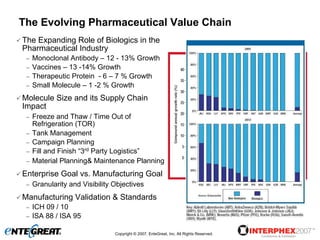
The Evolving Pharmaceutical Value Chain
The Expanding Role of Biologics in the
Pharmaceutical Industry
 – Monoclonal Antibody – 12 - 13% Growth
 – Vaccines – 13 -14% Growth
 – Therapeutic Protein - 6 – 7 % Growth
 – Small Molecule – 1 -2 % Growth

Molecule Size and its Supply Chain
Impact
 –   Freeze and Thaw / Time Out of
     Refrigeration (TOR)
 –   Tank Management
 –   Campaign Planning
 –   Fill and Finish “3rd Party Logistics”
 –   Material Planning& Maintenance Planning
Enterprise Goal vs. Manufacturing Goal
 –   Granularity and Visibility Objectives
Manufacturing Validation & Standards
 – ICH 09 / 10
 – ISA 88 / ISA 95

                                Copyright © 2007, EnteGreat, Inc. All Rights Reserved.
Visibility and Goals: Enterprise vs. Plant Level

    Enterprise Goals vs. Manufacturing Goals
     –   Example: Sensitivity for the Requirements and Technologies “While a
         10 second delay for posting to the ERP may not be an issue, it could
         spell disaster for manufacturing (i.e. lost product, safety issues, etc)”

•   Shop floor Granularity is a Denominator to Define the Variability of
    Manufacturing Processes

•   S88 is a Vehicle for Establishing Common Denominators
    (Granularity)


                             Copyright © 2007, EnteGreat, Inc. All Rights Reserved.
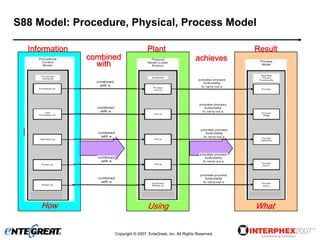
S88 Model: Procedure, Physical, Process Model

  Information                          Plant                                    Result
                combined                                          achieves
                  with


 Procedural                      Physical                                      Process


     How                               Using                                    What


                      Copyright © 2007, EnteGreat, Inc. All Rights Reserved.
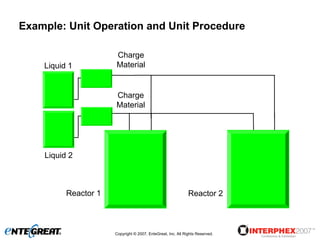
Example: Unit Operation and Unit Procedure

                      Charge
    Liquid 1          Material


                      Charge
                      Material


    Liquid 2


          Reactor 1                                           Reactor 2


                      Copyright © 2007, EnteGreat, Inc. All Rights Reserved.
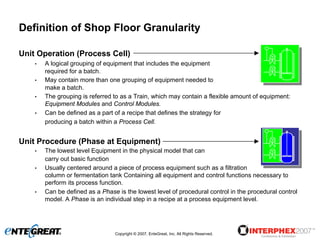
Definition of Shop Floor Granularity

Unit Operation (Process Cell)
    •   A logical grouping of equipment that includes the equipment
        required for a batch.
    •   May contain more than one grouping of equipment needed to
        make a batch.
    •   The grouping is referred to as a Train, which may contain a flexible amount of equipment:
        Equipment Modules and Control Modules.
    •   Can be defined as a part of a recipe that defines the strategy for
        producing a batch within a Process Cell.


Unit Procedure (Phase at Equipment)
    •   The lowest level Equipment in the physical model that can
        carry out basic function
    •   Usually centered around a piece of process equipment such as a filtration
        column or fermentation tank Containing all equipment and control functions necessary to
        perform its process function.
    •   Can be defined as a Phase is the lowest level of procedural control in the procedural control
        model. A Phase is an individual step in a recipe at a process equipment level.


                                 Copyright © 2007, EnteGreat, Inc. All Rights Reserved.
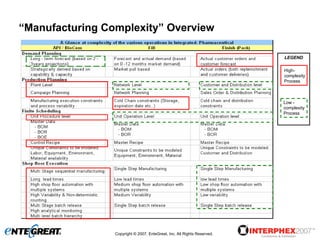
“Manufacturing Complexity” Overview

                                                                          LEGEND

                                                                          High-
                                                                          complexity
                                                                          Process


                                                                          Low -
                                                                          complexity
                                                                          Process


                 Copyright © 2007, EnteGreat, Inc. All Rights Reserved.
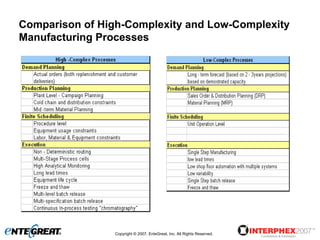
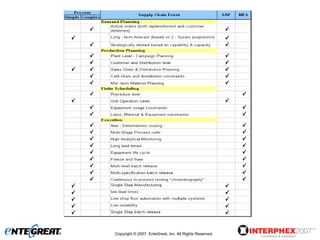
Comparison of High-Complexity and Low-Complexity
Manufacturing Processes


                 Copyright © 2007, EnteGreat, Inc. All Rights Reserved.
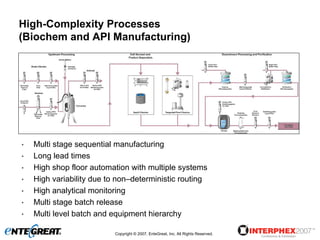
High-Complexity Processes
(Biochem and API Manufacturing)


•   Multi stage sequential manufacturing
•   Long lead times
•   High shop floor automation with multiple systems
•   High variability due to non–deterministic routing
•   High analytical monitoring
•   Multi stage batch release
•   Multi level batch and equipment hierarchy

                          Copyright © 2007, EnteGreat, Inc. All Rights Reserved.
High-Complexity Processes:
Planning in SAP Scheduling and Execution in MES
 Demand and Production Planning:
  •   Campaign Planning based on Forecast
  •   Capacity Planning based on Demonstrated Capacity
  •   Unconstrained Material & Labor Plan
  •   Bottom-up Planning

 Finite Scheduling in MES Layer
  •   Unit Operation and Procedure Level
  •   Unique Constraints to be Modeled: Labor, Equipment, Environment, Material
 Manufacturing Execution in MES
  •   Multi Stage Sequential Manufacturing
  •   Very High Deterministic Dependencies between Operations
 Standard SAP MRP or enterprise-level APS (APO) has the capability to
 do the production planning across the biopharmaceutical manufacturing
 at the Unit Operation Level

                          Copyright © 2007, EnteGreat, Inc. All Rights Reserved.
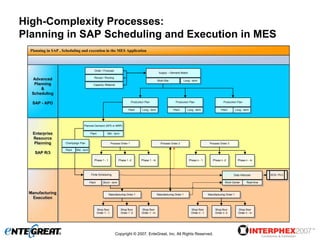
High-Complexity Processes:
Planning in SAP Scheduling and Execution in MES
  Planning in SAP , Scheduling and execution in the MES Application


                                              Order / Forecast
                                                                                                          Supply – Demand Match
                                             Recipe / Routing
  Advanced                                                                                               Multi-Site              Long - term
   Planning                                  Capacity /Material
      &
  Scheduling

   SAP - APO                                                                      Production Plan                      Production Plan                           Production Plan

                                                                              Plant        Long - term                Plant        Long - term                 Plant         Long - term


                                   Planned Demand (APS or MRP)


   Enterprise                             Plant            Mid - term
   Resource
    Planning         Champaign Plan                             Process Order 1                            Process Order 2                            Process Order 3

                     Plant   Mid - term
    SAP R/3
                                              Phase 1 - 1             Phase 1 -2          Phase 1 - m                                Phase n - 1        Phase n -2             Phase n - m


                                           Finite Scheduling                                                                                                             Data Historain           DCS / PLC

                                          Plant        Short - term                                                                                               Work Center         Real-time


 Manufacturing                                              Manufacturing Order 1                        Manufacturing Order 1                       Manufacturing Order 1
  Execution

                                                  Shop floor            Shop floor        Shop floor                                   Shop floor         Shop floor           Shop floor
                                                  Order 1 - 1           Order 1 -2        Order 1 - m                                  Order n - 1        Order n -2           Order n - m


                                                                   Copyright © 2007, EnteGreat, Inc. All Rights Reserved.
High-Complexity Processes: Lessons Learned

 Campaign Planning in SAP or SAP - APO
  •   Have the limited ability to do procedure level constraint based
      campaign planning & scheduling.
  •   Well suited to do campaign planning at operation level
 Resource and Material Qualification Planning:
  •   Limited inheritance in SAP
 Finite Scheduling
  •   Plant level or Procedure level localized Finite Schedule is
      best for Biochem Manufacturing
  •   Not well suited for Non-deterministic routing environments
 Execution
  •   Limited ability to handle freeze and thaw “time out of freezer” applications and
      times used “Ex: filtration column & chromatography column”
  •   Limited ability in execution of sequential upward child – parent relation of a
      process order
  •   Data processing granularity limitations
  •   Although it has not performed any Finite Scheduling or actual Execution of the
      process order on its own, it has been updated with this information in real time by
      the MES. To this regard, SAP is the “slave” system
                             Copyright © 2007, EnteGreat, Inc. All Rights Reserved.
High Complexity Processes: Benefits

 Improves Control and visibility on non-deterministic operations
 Improved response time to the changing dynamics on the
  floor
 Reduces in error due to non–availability of equipment
 Improves the batch release time
 Improves batch first-time pass
 Provides enough granularity and visibility to the enterprise
 systems by providing Real time update of the SAP process order on the
 WIP status at process cell level and improves customer service.
 Relieves SAP from the task of detailed Finite Scheduling – depending on
 the order volume, this could mean significant improvement on system
 performance in SAP.
 Since only the planned order is required for finite scheduling in MES, there
 is less dependence on the uptime of SAP for execution purposes. (“Thin”
 planned order to planned order interface from SAP to MES).
 “Thick” shop order to process order interface from MES to SAP

                          Copyright © 2007, EnteGreat, Inc. All Rights Reserved.
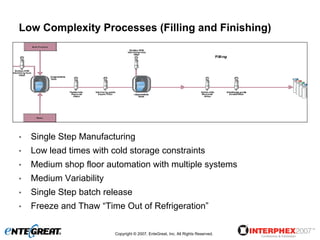
Low Complexity Processes (Filling and Finishing)


•   Single Step Manufacturing
•   Low lead times with cold storage constraints
•   Medium shop floor automation with multiple systems
•   Medium Variability
•   Single Step batch release
•   Freeze and Thaw “Time Out of Refrigeration”

                         Copyright © 2007, EnteGreat, Inc. All Rights Reserved.
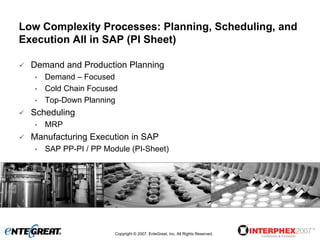
Low Complexity Processes: Planning, Scheduling, and
Execution All in SAP (PI Sheet)

  Demand and Production Planning
  •   Demand – Focused
  •   Cold Chain Focused
  •   Top-Down Planning
  Scheduling
  •   MRP
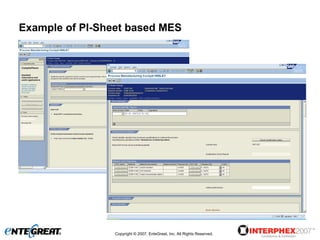
  Manufacturing Execution in SAP
  •   SAP PP-PI / PP Module (PI-Sheet)


                        Copyright © 2007, EnteGreat, Inc. All Rights Reserved.
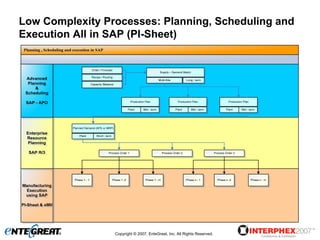
Low Complexity Processes: Planning, Scheduling and
Execution All in SAP (PI-Sheet)


                 Copyright © 2007, EnteGreat, Inc. All Rights Reserved.
Example of PI-Sheet based MES


                 Copyright © 2007, EnteGreat, Inc. All Rights Reserved.
Low Complexity Processes: Lessons Learned

  Demand planning needs a sophisticated planning tool (APO)
  Production planning can be handled with simple MRP
  Scheduling could be handled with the SAP functionality
  Manufacturing execution can be done using SAP PP-PI Module and
  Pi-Sheets
  Packaging is good process to extend SAP foot-print to
  manufacturing execution and leverage SAP investment


                      Copyright © 2007, EnteGreat, Inc. All Rights Reserved.
Low Complexity Processes: Benefits

  Investments have been made in SAP – that can be leveraged for
  fill & finish execution in a practical manner
  Provides “One Version of Truth”
  Improves Supply Chain Management visibility
  Improves batch disposition and improves Quality processes
  Improves the Inventory management


                      Copyright © 2007, EnteGreat, Inc. All Rights Reserved.
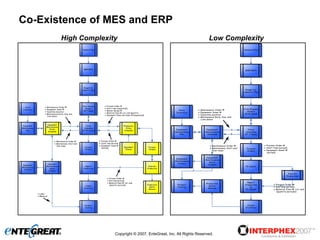
Co-Existence of MES and ERP
       High Complexity                                                  Low Complexity


                     Copyright © 2007, EnteGreat, Inc. All Rights Reserved.
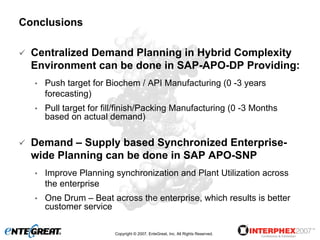
Conclusions

  Centralized Demand Planning in Hybrid Complexity
  Environment can be done in SAP-APO-DP Providing:
  •   Push target for Biochem / API Manufacturing (0 -3 years
      forecasting)
  •   Pull target for fill/finish/Packing Manufacturing (0 -3 Months
      based on actual demand)

  Demand – Supply based Synchronized Enterprise-
  wide Planning can be done in SAP APO-SNP
  •   Improve Planning synchronization and Plant Utilization across
      the enterprise
  •   One Drum – Beat across the enterprise, which results is better
      customer service

                        Copyright © 2007, EnteGreat, Inc. All Rights Reserved.
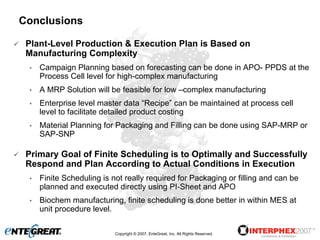
Conclusions

 Plant-Level Production & Execution Plan is Based on
 Manufacturing Complexity
 •   Campaign Planning based on forecasting can be done in APO- PPDS at the
     Process Cell level for high-complex manufacturing
 •   A MRP Solution will be feasible for low –complex manufacturing
 •   Enterprise level master data “Recipe” can be maintained at process cell
     level to facilitate detailed product costing
 •   Material Planning for Packaging and Filling can be done using SAP-MRP or
     SAP-SNP

 Primary Goal of Finite Scheduling is to Optimally and Successfully
 Respond and Plan According to Actual Conditions in Execution
 •   Finite Scheduling is not really required for Packaging or filling and can be
     planned and executed directly using PI-Sheet and APO
 •   Biochem manufacturing, finite scheduling is done better in within MES at
     unit procedure level.

                           Copyright © 2007, EnteGreat, Inc. All Rights Reserved.
Copyright © 2007, EnteGreat, Inc. All Rights Reserved.
Questions


               Farukh Naqvi
   E-mail: farukh_naqvi@entegreat.com
           Phone: 205-968-3050
            www.entegreat.com


             Copyright © 2007, EnteGreat, Inc. All Rights Reserved.

15079 1

  • 1.
    A Hybrid Approachfor Leveraging ERP (SAP) and MES Functionality within Integrated Biopharmaceutical Manufacturing Environments Presented by Farukh Naqvi SAP/MES Consultant EnteGreat, Inc. Copyright © 2007, EnteGreat, Inc. All Rights Reserved.
  • 2.
    Problem Statement • Today, Pharmaceutical companies face a wide assortment of problems concerning Plant-Manufacturing IT systems, Supply chain applications and quality requirements that are unique to “growing” Biologics manufacturing. • In an Integrated Manufacturing Organization with Various Levels of Manufacturing Complexity: • Taking a one size fits all approach is both short sighted and limiting • Implementing customized solutions for each area of manufacturing encourages complexity which quickly becomes extremely difficult to sustain Copyright © 2007, EnteGreat, Inc. All Rights Reserved.
  • 3.
    Goal of thisPresentation • The goal of this presentation is to provide a holistic view of both the problems and potential solutions which leverages SAP investments to address the complexity of the biologic’s manufacturing operations (Fill, Finish and Biochem) by synchronizing the functionality with shop floor execution systems based on ISA S.88 standards. • Observations are Based on the Analysis of Three (3) Biopharmaceutical Organizations Copyright © 2007, EnteGreat, Inc. All Rights Reserved.
  • 4.
    Agenda The Expanding and Evolving Biologics Market “Shop Floor Granularity” Overview of Manufacturing Complexity in Biopharmaceuticals High Complexity Processes (Biochem and API Manufacturing) – Functional Assessment of Planning, Scheduling and Execution in High Complexity Manufacturing – Lessons Learned and Benefits Low Complexity Processes (Filling and Finish) – Functional Assessment of Planning, Scheduling and Execution in Low Complexity Manufacturing – Lessons Learned and Benefits Conclusions Question and Answer Copyright © 2007, EnteGreat, Inc. All Rights Reserved.
  • 5.
    The Evolving PharmaceuticalValue Chain The Expanding Role of Biologics in the Pharmaceutical Industry – Monoclonal Antibody – 12 - 13% Growth – Vaccines – 13 -14% Growth – Therapeutic Protein - 6 – 7 % Growth – Small Molecule – 1 -2 % Growth Molecule Size and its Supply Chain Impact – Freeze and Thaw / Time Out of Refrigeration (TOR) – Tank Management – Campaign Planning – Fill and Finish “3rd Party Logistics” – Material Planning& Maintenance Planning Enterprise Goal vs. Manufacturing Goal – Granularity and Visibility Objectives Manufacturing Validation & Standards – ICH 09 / 10 – ISA 88 / ISA 95 Copyright © 2007, EnteGreat, Inc. All Rights Reserved.
  • 6.
    Visibility and Goals:Enterprise vs. Plant Level Enterprise Goals vs. Manufacturing Goals – Example: Sensitivity for the Requirements and Technologies “While a 10 second delay for posting to the ERP may not be an issue, it could spell disaster for manufacturing (i.e. lost product, safety issues, etc)” • Shop floor Granularity is a Denominator to Define the Variability of Manufacturing Processes • S88 is a Vehicle for Establishing Common Denominators (Granularity) Copyright © 2007, EnteGreat, Inc. All Rights Reserved.
  • 7.
    S88 Model: Procedure,Physical, Process Model Information Plant Result combined achieves with Procedural Physical Process How Using What Copyright © 2007, EnteGreat, Inc. All Rights Reserved.
  • 8.
    Example: Unit Operationand Unit Procedure Charge Liquid 1 Material Charge Material Liquid 2 Reactor 1 Reactor 2 Copyright © 2007, EnteGreat, Inc. All Rights Reserved.
  • 9.
    Definition of ShopFloor Granularity Unit Operation (Process Cell) • A logical grouping of equipment that includes the equipment required for a batch. • May contain more than one grouping of equipment needed to make a batch. • The grouping is referred to as a Train, which may contain a flexible amount of equipment: Equipment Modules and Control Modules. • Can be defined as a part of a recipe that defines the strategy for producing a batch within a Process Cell. Unit Procedure (Phase at Equipment) • The lowest level Equipment in the physical model that can carry out basic function • Usually centered around a piece of process equipment such as a filtration column or fermentation tank Containing all equipment and control functions necessary to perform its process function. • Can be defined as a Phase is the lowest level of procedural control in the procedural control model. A Phase is an individual step in a recipe at a process equipment level. Copyright © 2007, EnteGreat, Inc. All Rights Reserved.
  • 10.
    “Manufacturing Complexity” Overview LEGEND High- complexity Process Low - complexity Process Copyright © 2007, EnteGreat, Inc. All Rights Reserved.
  • 11.
    Comparison of High-Complexityand Low-Complexity Manufacturing Processes Copyright © 2007, EnteGreat, Inc. All Rights Reserved.
  • 12.
    High-Complexity Processes (Biochem andAPI Manufacturing) • Multi stage sequential manufacturing • Long lead times • High shop floor automation with multiple systems • High variability due to non–deterministic routing • High analytical monitoring • Multi stage batch release • Multi level batch and equipment hierarchy Copyright © 2007, EnteGreat, Inc. All Rights Reserved.
  • 13.
    High-Complexity Processes: Planning inSAP Scheduling and Execution in MES Demand and Production Planning: • Campaign Planning based on Forecast • Capacity Planning based on Demonstrated Capacity • Unconstrained Material & Labor Plan • Bottom-up Planning Finite Scheduling in MES Layer • Unit Operation and Procedure Level • Unique Constraints to be Modeled: Labor, Equipment, Environment, Material Manufacturing Execution in MES • Multi Stage Sequential Manufacturing • Very High Deterministic Dependencies between Operations Standard SAP MRP or enterprise-level APS (APO) has the capability to do the production planning across the biopharmaceutical manufacturing at the Unit Operation Level Copyright © 2007, EnteGreat, Inc. All Rights Reserved.
  • 14.
    High-Complexity Processes: Planning inSAP Scheduling and Execution in MES Planning in SAP , Scheduling and execution in the MES Application Order / Forecast Supply – Demand Match Recipe / Routing Advanced Multi-Site Long - term Planning Capacity /Material & Scheduling SAP - APO Production Plan Production Plan Production Plan Plant Long - term Plant Long - term Plant Long - term Planned Demand (APS or MRP) Enterprise Plant Mid - term Resource Planning Champaign Plan Process Order 1 Process Order 2 Process Order 3 Plant Mid - term SAP R/3 Phase 1 - 1 Phase 1 -2 Phase 1 - m Phase n - 1 Phase n -2 Phase n - m Finite Scheduling Data Historain DCS / PLC Plant Short - term Work Center Real-time Manufacturing Manufacturing Order 1 Manufacturing Order 1 Manufacturing Order 1 Execution Shop floor Shop floor Shop floor Shop floor Shop floor Shop floor Order 1 - 1 Order 1 -2 Order 1 - m Order n - 1 Order n -2 Order n - m Copyright © 2007, EnteGreat, Inc. All Rights Reserved.
  • 15.
    High-Complexity Processes: LessonsLearned Campaign Planning in SAP or SAP - APO • Have the limited ability to do procedure level constraint based campaign planning & scheduling. • Well suited to do campaign planning at operation level Resource and Material Qualification Planning: • Limited inheritance in SAP Finite Scheduling • Plant level or Procedure level localized Finite Schedule is best for Biochem Manufacturing • Not well suited for Non-deterministic routing environments Execution • Limited ability to handle freeze and thaw “time out of freezer” applications and times used “Ex: filtration column & chromatography column” • Limited ability in execution of sequential upward child – parent relation of a process order • Data processing granularity limitations • Although it has not performed any Finite Scheduling or actual Execution of the process order on its own, it has been updated with this information in real time by the MES. To this regard, SAP is the “slave” system Copyright © 2007, EnteGreat, Inc. All Rights Reserved.
  • 16.
    High Complexity Processes:Benefits Improves Control and visibility on non-deterministic operations Improved response time to the changing dynamics on the floor Reduces in error due to non–availability of equipment Improves the batch release time Improves batch first-time pass Provides enough granularity and visibility to the enterprise systems by providing Real time update of the SAP process order on the WIP status at process cell level and improves customer service. Relieves SAP from the task of detailed Finite Scheduling – depending on the order volume, this could mean significant improvement on system performance in SAP. Since only the planned order is required for finite scheduling in MES, there is less dependence on the uptime of SAP for execution purposes. (“Thin” planned order to planned order interface from SAP to MES). “Thick” shop order to process order interface from MES to SAP Copyright © 2007, EnteGreat, Inc. All Rights Reserved.
  • 17.
    Low Complexity Processes(Filling and Finishing) • Single Step Manufacturing • Low lead times with cold storage constraints • Medium shop floor automation with multiple systems • Medium Variability • Single Step batch release • Freeze and Thaw “Time Out of Refrigeration” Copyright © 2007, EnteGreat, Inc. All Rights Reserved.
  • 18.
    Low Complexity Processes:Planning, Scheduling, and Execution All in SAP (PI Sheet) Demand and Production Planning • Demand – Focused • Cold Chain Focused • Top-Down Planning Scheduling • MRP Manufacturing Execution in SAP • SAP PP-PI / PP Module (PI-Sheet) Copyright © 2007, EnteGreat, Inc. All Rights Reserved.
  • 19.
    Low Complexity Processes:Planning, Scheduling and Execution All in SAP (PI-Sheet) Copyright © 2007, EnteGreat, Inc. All Rights Reserved.
  • 20.
    Example of PI-Sheetbased MES Copyright © 2007, EnteGreat, Inc. All Rights Reserved.
  • 21.
    Low Complexity Processes:Lessons Learned Demand planning needs a sophisticated planning tool (APO) Production planning can be handled with simple MRP Scheduling could be handled with the SAP functionality Manufacturing execution can be done using SAP PP-PI Module and Pi-Sheets Packaging is good process to extend SAP foot-print to manufacturing execution and leverage SAP investment Copyright © 2007, EnteGreat, Inc. All Rights Reserved.
  • 22.
    Low Complexity Processes:Benefits Investments have been made in SAP – that can be leveraged for fill & finish execution in a practical manner Provides “One Version of Truth” Improves Supply Chain Management visibility Improves batch disposition and improves Quality processes Improves the Inventory management Copyright © 2007, EnteGreat, Inc. All Rights Reserved.
  • 23.
    Co-Existence of MESand ERP High Complexity Low Complexity Copyright © 2007, EnteGreat, Inc. All Rights Reserved.
  • 24.
    Conclusions CentralizedDemand Planning in Hybrid Complexity Environment can be done in SAP-APO-DP Providing: • Push target for Biochem / API Manufacturing (0 -3 years forecasting) • Pull target for fill/finish/Packing Manufacturing (0 -3 Months based on actual demand) Demand – Supply based Synchronized Enterprise- wide Planning can be done in SAP APO-SNP • Improve Planning synchronization and Plant Utilization across the enterprise • One Drum – Beat across the enterprise, which results is better customer service Copyright © 2007, EnteGreat, Inc. All Rights Reserved.
  • 25.
    Conclusions Plant-Level Production& Execution Plan is Based on Manufacturing Complexity • Campaign Planning based on forecasting can be done in APO- PPDS at the Process Cell level for high-complex manufacturing • A MRP Solution will be feasible for low –complex manufacturing • Enterprise level master data “Recipe” can be maintained at process cell level to facilitate detailed product costing • Material Planning for Packaging and Filling can be done using SAP-MRP or SAP-SNP Primary Goal of Finite Scheduling is to Optimally and Successfully Respond and Plan According to Actual Conditions in Execution • Finite Scheduling is not really required for Packaging or filling and can be planned and executed directly using PI-Sheet and APO • Biochem manufacturing, finite scheduling is done better in within MES at unit procedure level. Copyright © 2007, EnteGreat, Inc. All Rights Reserved.
  • 26.
    Copyright © 2007,EnteGreat, Inc. All Rights Reserved.
  • 27.
    Questions Farukh Naqvi E-mail: farukh_naqvi@entegreat.com Phone: 205-968-3050 www.entegreat.com Copyright © 2007, EnteGreat, Inc. All Rights Reserved.