Manufacturing
Processes for
Design
Professionals
¦;*>
Hob Thompson
Manufacturing
Processes for
Design
Professionals
On the previous spread: The Eye chair, designed by
Jackie Choi for Boss Design (see pages 342-343).
Any copy of this book issued by the publisher as a
paperback is sold subject to the condition that it
shall not by way of trade or otherwise be lent, resold,
hired out or otherwise circulated without the
publisher's prior consent in any form of binding or
cover other than that in which it is published and
without a similar condition including these words
being imposed on a subsequent purchaser.
First published in the United Kingdom in 2007
by Thames & Hudson Ltd,i8iA High Holborn,
London wcivyox
www.thamesandhudson.com
© 2007 Rob Thompson
Reprinted 2010
All Rights Reserved. No part of this publication may
be reproduced or transmitted in any form or by
any means, electronic or mechanical, including
photocopy, recording or any other information
storage and retrieval system, without prior
permission in writing from the publisher.
British Library Cataloguing-in-Publication Data
A catalogue record for this book is available from
the British Library
ISBN 978-0-500-51375-0
Designed by Christopher Perkins
Printed and bound in China
Contents
How to use this book 8 Introduction 10
The importance of materials and manufacturing
knowledge for successful design practice
Part One
Forming Technology
Plastics and Rubber
Blow Molding
Extrusion Blow Molding (EBM)
Injection Blow Molding lIBM)
Injection Stretch Blow Molding (ISBM)
Thermoforming
Vacuum Forming
Pressure Forming
Plug-assisted Forming
Twin Sheet Thermoforming
Rotation Molding
Vacuum Casting
Compression Molding
Compression Molding Rubber
Compression Molding Plastic
Injection Molding
Moldflow analysis
Gas-assisted Injection Molding
Multishot Injection Molding
In-Mold Decoration
Reaction Injection Molding
Dip Molding
Metal
Panel Beating
Dishing
Jig Chasing
Wheel Forming
Planishing
Metal Spinning
Metal Stamping
Secondary Pressing
Deep Drawing
Superforming
Cavity Forming
Bubble Forming
Backpressure Forming
Diaphragm Forming
22
30
36
40
Ul*
50
64
68
72
78
82
88
92
Tube and Section Bending
Mandrel Bending
Ring Rolling
Swaging
Rotary Swaging
Hydraulic Swaging
Roll Forming
Forging
Drop Forging
Roll Forging
Sand Casting
Die Casting
High Pressure Die Casting
Low Pressure Die Casting
Investment Casting
Metal Injection Molding
Electroforming
Centrifugal Casting
Press Braking
Glass and Ceramics
Glassblowing
Studio Glassblowing
Machine Blow and Blow
Machine Press and Blow
Lampworking
Blowing
Hole Boring
Bending
Mandrel Forming
Clay Throwing
Ceramic Slip Casting
Press Molding Ceramics
Jiggering
Ram Pressing
98
104
110
m
120
124
130
136
140
144
148
152
160
168
172
176
Wood
CNC Machining 182
Wood Laminating 190
Kerfing
Solid Wood Lamination
Veneer Lamination
Steam Bending 198
Circle Bending
Open Bending
Paper Pulp Molding 202
Composites
Composite Laminating 206
Wet Lay-up
Pre-preg Lay-up
Resin Transfer Molding
DMC and SMC Molding 218
Filament Winding 222
3D Thermal Laminating 228
3D Laminating I3DL)
3D Rotary Laminating (3Drl
Layered Manufacturing
Rapid Prototyping 232
Stereolithography (SLA)
Selective Laser Sintering (SLS)
Direct Metal Laser Sintering (DMLS)
/•
Part Two
Cutting Technology
Chemical
Photochemical Machining
Thermal
Laser Cutting
Electrical Discharge Machining
Die Sink EDM
Wire EDM
Part Three
Joining Technology
Thermal
Arc Welding
Manual Metal Arc Welding (MMA)
Metal Inert Gas Welding IMIG)
Tungsten Inert Gas Welding (TIG)
Plasma Welding
Submerged Arc Welding (SAW)
Power Beam Welding
Laser Beam Welding [LBW]
Electron Beam Welding (EBW)
Friction Welding
Rotary Friction Welding (RFW)
Linear Friction Welding (LFW)
Orbital Friction Welding (OFW)
Friction Stir Welding (FSWl
Vibration Welding
Ultrasonic Welding
Resistance Welding
Projection Welding
Spot Welding
Seam Welding
Mechanical
2UU Punching and Blanking 260
Die Cutting 266
248 Water Jet Cutting 272
254 Glass Scoring 276
Soldering and Brazing 312
282 Conduction Method
Torch Method
Furnace Method
Staking 316
Hot Air Staking
Ultrasonic Staking
288 Hot Plate Welding 320
Mechanical
294 Joinery 324
Weaving 332
Upholstery 338
Timber Frame Structures 344
298
302
308
Part Four
Finishing Technology
Additive Processes
Spray Painting 350
Powder Coating 356
Electrostatic Spraying
Fluidized Bed Powder Coating
Anodizing 360
Electroplating 364
Galvanizing 368
Vacuum Metalizing 372
Subtractive Processes
Grinding, Sanding and Polishing 376
Wheel Cutting
Belt Sanding
Honing
Lapping
Electropolishing 384
Abrasive Blasting 388
Photo Etching 392
CNC Engraving 396
Printing
Screen Printing 400
Pad Printing 404
Hydro Transfer Printing 408
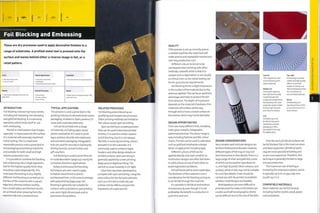
Foil Blocking and Embossing 412
Part Five
Materials
Introduction to Materials 418
Plastics
Introduction to Plastics 424
Thermoplastic 430
Thermoset 440
Bioplastic 446
Metals
Introduction to Metals 448
Ferrous 454
Non-Ferrous 457
Wood and natural fibres
introduction to Wood 464
Softwoods 470
Hardwoods 472
Natural fibres 480
Ceramics and Glass
Introduction to Ceramics and Glass 482
Ceramics 488
Glass 490
Directory
Glossary and Abbreviations 496
Featured Companies 502
Organizations and Other Sources 512
of Information
Further Reading 516
Illustration Credits 519
Acknowledgments 522
Index 524
Continuous Internal
Manufacturing Processes for Design Professionals
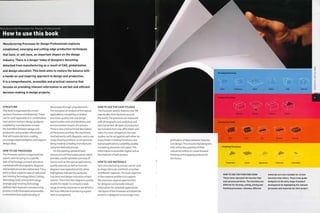
How to use this book
Manufacturing Processes for Design Professionals explores
established, emerging and cutting-edge production techniques
that have, or will have, an important impact on the design
industry. There is a danger today of designers becoming
detached from manufacturing as a result of CAD, globalization
and design education. This book aims to restore the balance with
a hands-on and inspiring approach to design and production.
It is a comprehensive, accessible and practical resource that
focuses on providing relevant information to aid fast and efficient
decision-making in design projects.
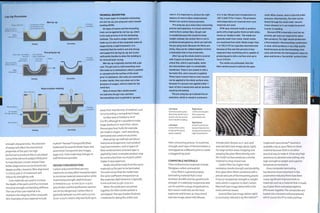
STRUCTURE
This book is organized into 2 main
sections: Processes and Materials.These
can be used separately or in combination.
Each section contains design guidance
supplied by manufacturers to ease
the transition between design and
production and provides information
that will inspire decision-making,
encourage experimentation and support
design ideas.
HOWTO USE PROCESSES
The Processes section is organized into
4 parts, each focusing on a specific
type of technology, and each process is
explained with photographs, diagrams
and analytical and descriptive text.The 4
parts (colour coded for ease of reference)
are: Forming Technology (blue), Cutting
Technology (red), Joining Technology
(orange) and Finishing Technology
(yellow). Each featured manufacturing
process is fully illustrated and provides
a comprehensive understanding of
the process through 3 key elements.
The text gives an analysis of the typical
applications, competing or related
processes, quality and cost, design
opportunities and considerations, and
environmental impacts of a process.
There is also a full technical description
of the process and how the machinery
involved works, with diagrams, and a case
study showing products or components
being made by a leading manufacturer
using the featured process.
On the opening spread of each
process you will find a data panel, which
provides a bullet-pointed summary of
factors such as the typical applications,
quality and cost, as well as function
diagrams (see opposite) which, when
highlighted, indicate the particular
functions and design outcomes of each
process. These function diagrams quickly
enable the reader to compare a wide
range of similar processes to see which is
the most effective in producing a given
item or component.
HOWTO USE THE CASE STUDIES
The Processes section features real-life
case studies from factories around
the world.The processes are explained
with photographs and analytical and
descriptive text. All types of production
are included, from one-off to batch and
mass. For cross-comparison the case
studies can be set against each other on
many levels, including functions, cost,
typical applications, suitability, quality,
competing processes and speed.This
information is accessible, logical and at
the forefront of each process.
HOWTO USE MATERIALS
Each manufacturing process can be used
to shape,fabricate andfinish anumber
of different materials.The main objective
of the material profiles is to support
the processes, expand opportunities
for designers and provide relevant
information for potential applications.
The layout of the Processes and Materials
sections is designed to encourage cross-
Cutting Functions
External Internal Channel Surface
Joining Functions
pollination of ideas between industry
and design.This ensures that designers
fully utilize the potential of their
industrial toolbox to create forward-
thinking and engaging products for
the future.
Forming Functions
Bend
Overlap
Preparation Colour Appearai
HOW TO USE THE FUNCTION ICONS
These Icons represent the function that
each process performs. The functions are
different for forming, cutting, joining and
finishing processes. Likewise, different
Protection Information
materials are more suitable for certain
functions than others. These Icons guide
designers In the early stage of product
development by highlighting the relevant
processes and materials for their project.
Sheet
Finishing Functions
vlanufactui ing Processes for Design Professionals
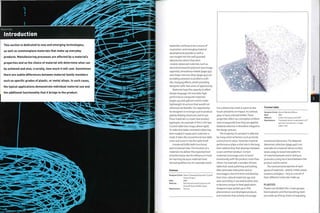
Introduction
Manufacturing technology is both fascinating and inspiring.
The products around us are the result of the delicate touch of
craftsmen, highly mechanized production, or both. The Processes
section gives first-hand insight into a range of manufacturing
techniques including mass producing everyday products, batch
producing furniture and prototyping with some of the most advanced
technologies we have at our disposal. The visual case studies,
combined with in-depth technical analysis, show what happens now
and how designers and research institutes are continually pushing
the boundaries of what will be possible in the future.
Manufacturing is continually in a state
of transition.The level of technology
is different in various industries, so
whilst some manufacturers are leading
the way, such as in the production of
carbon fibre composites (page 214) and
rapid prototyped plastics and metals
(page 232), others are maintaining
highly skilled traditional crafts. The
combination of craft and industrial
techniques in processes such as panel
beating metal (page72),jiggering and
jolleying ceramics (page 176) and steam
bending wood (page 198) produces
articles that unite the user and maker
with a sense of pride and ownership.
The examples in this book
demonstratethe inner worldngs
of a 1 arg e ran g e of m anufacturin g
processes. In some cases the tasks are
carried out by hand to demonstrate the
techniques more clearly.The continued
importance of an operator is evident in
many processes. Even mass-production
techniques, such as die cutting and
assembling packaging (page 266),rely
on an operator to set up and fine tune
the production line. But, where possible,
manual labour is being replaced by
computer-guided robotic systems.The
aim is to reduce imperfections caused
by human error and minimize labour
costs. Even so, many metal, glass, wood
and ceramic processes are based on
manufacturing principles that have
changed very little over the years.
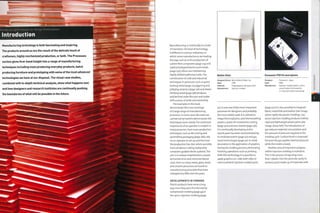
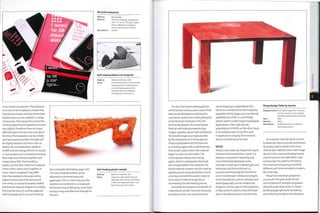
Bellini Chair
Designer/client: Mario Bellini/Heller Inc.
Date: 1998
Material: Polypropylene and glass fibre
Manufacture: Injection molded
50) is now one of the most important
processes for designers, and probably
the most widely used. It is utilized to
sh ape th erm opl asti cs an d th erm os etti n g
plastics, waxes for investment casting
(page 130) and even metals (page 136).
It is continually developing and in
recent years has been revolutionized by
in-mold decoration (page 50) and gas
assist technologies (page 50). In-mold
decoration is the application of graphics
during the molding process, eliminating
finishing operations such as printing.
With this technology it is possible to
apply graphics on 1 side, both sides or
onto multishot injection molded parts
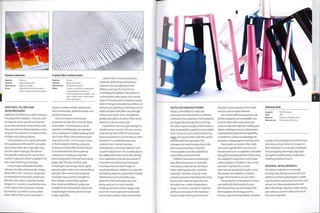
Panasonic P901iS smartphone
Designer: Panasonic. Japan
Date: 2005
Manufacture: Injection molded plastic covers
using Yoshida Technoworks
in-mold decoration technology
(page 50). It is also possible to integrate
fabric, metal foils and leather (see image,
above right) into plastic moldings. Gas
assist injection molding produces hollow,
rigid and lightweight plastic parts (see
image, above left).The introduction of
gas reduces material consumption and
the amount of pressure required in the
molding cycle. Surface finish is improved
because the gas applies internal pressure
while the moldis closed.
Another area of important progress
within injection molding is multishot.
This is the process of injecting more
than 1 plastic into the same die cavity to
produce parts made up of materials with
^3
o
a
c:
o
;H
o
z
DEVELOPMENTS IN FORMING
Plastic products have come a long
way since they were first formed by
compression molding (page 44) in
the 1920s. Injection molding (page
widely used to describe the matt texture
produced by EDM. Nowadays, mobile
phones and similar products are more
often produced with in-mold decoration,
which requires a gloss finish.
Whereas mass production is limited
by high tooling costs and thus high
volume production of identical parts,
each product directly manufactured
from CAD data is limited only by the
imagination and capabilities of the
designer. Rapid prototyping (page 232)
is one of these processes: it is not yet
suitable for mass production, but it is
capable of producing similar volume
parts whose shape is different each time
without significant cost implications.
Combined with the possibility of making
shapes not possible with any other
process, these techniques are giving rise
to a new design language. For example,
one-off and 1 ow volume products
have emerged in recent years that are
designed by the customers and merely
facilitated by the designer. Also, the US
military are using rapid prototyping to
make spare parts for their equipment, as
opposed to waiting for delivery.
Recently metal powders have been
added to the list of materials that can be
shaped by rapid prototyping. At present,
rapid prototyping metal is best suited
to the production of parts no larger
than about 0.01 m3 (0.35 ft3). Even so, the
opportunities of this process are vast,
because larger parts can be made by
investment casting (page 130) a rapid
prototyped wax or plastic pattern.
Thermoforming (page 30) is a process
generally associated with plastic
packaging. However,Superform
Aluminium in the USA and UK have
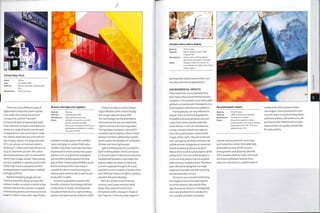
Roses on the Vine
Designer/client: Studio Job/Swarovski Crystal
Palace Project
Date: 2005
Material: Aluminium base with red
and peridot coloured
Swarovski® crystal
Manufacture: Base laser cut and gold anodized
Entropia
Designer/client: Lionel Dean, FutureFactories/
Kundalini
Date: 2006
Material: Polyamide (PA) nylon
Manufacture: Selective laser sintering (SLS1
different colours,hardnesses,textures or
transparency. Over-molding is a similar
process; the difference is that over-
molding is not carried out in the same
tool. Using this technique, materials
other than plastic can be integrated into
injection molding.
Developments in plastic molding
are also affected by improvements in
metalworking technologies.The surface
finish on mobile phones and other
small consumer electronic equipment
became almost standardized due to
the development of electrical discharge
machining (EDM) for plastic mold
making.This process makes it possible to
machine concave profiles (molds) to the
same high degree of precision as relief
profiles. High voltage sparks between
a copper electrode (tool) and metal
workpiece vaporize surface material.
The rate of spark erosion determines
the surface finish and so it is used to
simultaneously cut and finish metal
parts. Hence the term 'sparked' finish was
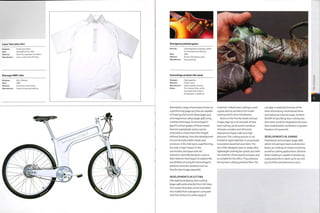
Laser Vent polo shirt
Designer: Vexed Generation
Date: Spring/Summer 2004
Material: Quick dry polyester microfibre
Manufacture: Laser cutting and stitching
Biomega MN01 bike
Designer: Marc Newson
Date: 2000
Material: Aluminium alloy frame
Manufacture: Superforming and welding
Outrageous painted guitar
Paint by: Cambridgeshire Coatings Ltd/US
US Chemicals and Plastics
Date: 2003
Material: Illusion Outrageous paint
Manufacture: Spray painting
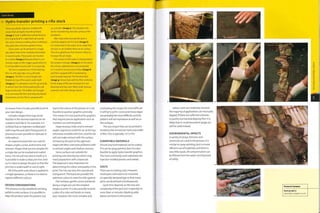
Camouflage printed rifle stock
Designer:
Material:
Manufacture:
Notes:
Hydrographies
Plastic stock
Hydro transfer printing
The transfer films can be
decorated with artwork,
photographs or patterns.
developed a range of processes, known as
superforming (page 92), that are capable
of shaping aluminium alloys (page 457)
and magnesium alloys (page 458) using
a similar technique. At around 4500C
(8400F) certain grades of these metals
become superplastic and so can be
stretched to many times their length
without breaking. Since the development
of commercially viable metals and
processes in the mid 1970s, superforming
has had a major impact in the
automotive, aerospace and rail
industries. Recently, designers such as
Marc Newson have begun to explore the
possibilities of using this technology to
produce consumer products such as
bicycles (see image,opposite).
materials. Indeed, laser cutting is used
a great deal by architects for model
making within short timeframes.
Roses on the Vine by Studio Job (see
image, page 13), is an example of how
laser cutting can be used to produce
intricate, complex and otherwise
impractical shapes with very high
precision.This cutting process is not
limited to rigid materials. In 2004 Vexed
Generation launched Laser Vent. The
aim of the designers was to create ultra
lightweight clothing for cyclists, but with
the aesthetic of low-key leisurewear and
so suitable for the office.They achieved
this by laser cutting synthetic fibre. The
cut edge is sealed by the heat of the
laser, eliminating conventional hems
and reducing material usage. Another
benefit of specifying laser cutting was
that vents could be integrated into areas
that needed better ventilation or greater
freedom of movement.
DEVELOPMENTS IN JOINING
Powerbeam technologies (page 288),
which include laser beam and electron
beam, are making an impact in joining
as well as cutting applications. Electron
beam welding is capable of producing
coalesced joints in steels up to 150 mm
(5.9 in) thick and aluminium up to
DEVELOPMENTS IN CUTTING
Like rapid prototyping, laser cutting
(page 248) works directly from CAD data.
This means that data can be translated
very readily from a designer's computer
onto th e surface of a wi de ran g e of
I
450 mm (17,7 in) thick. Laser welding is
not usually applied to thick materials,
but a recent development known as
Clearweld® makes it possible to laser
weld clear plastics and textiles (page
288).This technique has the potential to
transform applications that are currently
limited to coloured materials.
Joinery (page 324) and timber frame
construction (page 344) have changed
very little over the years. Developments
have mostly been concentrated in
materials such as new types of
engineering timbers (page 465) and
biocomposites. However, in 2005 TWI
assessed the possibility of joining wood
with techniques similar to friction
welding metals (page 294) and plastics
(page 298). Beech and oak were
successfully joined by linear friction
welding (see image, page 295). Friction
welding revolutionizedmetalwork by
eliminating the need for mechanical
fasteners, and in the future the same
could happen in woodwork.
DEVELOPMENTS IN FINISHING
There have been many developments in
finishing, but spray painting remains one
of the most widely used processes, from
one-off to mass production. Over the
years arange of sprayed finishes have
evolved including high gloss, soft touch,
thermochromatic, pearlescent and
iridescent. The cost of paint varies
dramatically depending on the type and
can be very high for specialist paints such
as the Outrageous range (see image,
pageij above left). A film of aluminium is
incorporated into spray painted finishes
by vacuum metalizing (page 372) to give
the appearance of chrome, silver or
an 0di zin g, or for functi on al purposes,
such as heat reflection.
Hydro transfer printing (page 408)
has recently transformed spray painting.
With this process it is possible to wrap
printed graphics around 3D shapes.This
means anything that can be digitally
printed can be applied to almost
any surface. Applications include car
interiors, mobile phones, packaging and
camouflaging gun stocks (see image,
page 15 above right).
SELECTING A PROCESS
Process and material selection is integral
to the design of a product. Economically,
it is about striking a balance between the
investment costs (research, development
and tooling) and running costs (labour
and materials). The role of the designer is
to ensure that the available technology
will deliver the expected level of quality.
High investment costs are usually
only justifiable for high volume products,
whereas low volume products are limited
by high labour and material costs.
Therefore, the tipping point comes when
expected volumes outweigh the initial
costs.This can happen before a product
has reached the market, or after years of
manufacturing at relatively low volumes.
The cost of materials tends to have a
greater impact in high volume processes.
This is because labour costs are generally
reduced through automation.Therefore,
fluctuations in material value caused by
rising fuel prices and increased demand
affect the cost of mass produced items.
Occasionally the cost of production is
irrelevant, such as composite laminating
carbon fibre racing cars (page 214). Until
recently, this has been too expensive
for application in commodity products,
but due to recent developments in
the production techniques it is now
becoming more common in sports
equipment and automotive parts.This is
also partly due to the obvious benefits of
improved strength to weight.
The design features that can be
achieved with high volume processes
cannot always be produced with lower
volumes ones. For example, blow
molding plastic (page 22) and machine
glassblowing (page 152) are limited
to continuous production due to the
nature of the process. Therefore, there
is very little room for experimentation.
In contrast, the qualities of injection
molding can be reproduced with
vacuum casting (page 40) and reaction
injection molding (page 64), for instance.
This means that low volumes can be
produced with much lower initial
costs and therefore a higher level of
experimentation is usually possible.
Process selection will affect the
quality of the finish part and therefore
the perceived value. This is especially
important when 2 processes can produce
the same geometry of part. For example,
sand casting (page 120) and investment
casting (page 130) can both be used to
manufacture 3D bulk shapes in steel.
However, due to the lower levels of
turbulence, investment casting will
produce parts with less porosity. It is
forthis reason that aerospace and
automotive parts are investment cast.
DESIGN SOFTWARE
Predicting and testing the quality of
the finished part has become more
reliable with developments in computer
simulation software, such as finite
element analysis (FEA).There are
many different programmes, which
are becoming more widely used in the
process of design for manufacture
(pages 50-63,64-7 and 130-5), and
it is no longer limited to high volume
production. The forming of many
products is simulated using FEA software
33
o
o
c
o
H
o
to maximize the efficiency of the
operation (see images, above); previously,
tools were engineered and then tested
and adjusted accordingly. FEA software
is not used in all forming applications,
but it does have many advantages.
Most importantly, it reduces tooling
costs, because parts can be molded
'right first time'.
As well as mold flow simulation,
FEA is used to predict accurately how the
part will perform in application (pages
124-9,214 and 226-7).This does not
de-skill the process of engineering;
it is another tool that can help to
minimize material consumption and
double-check calculations made by
designers and engineers.
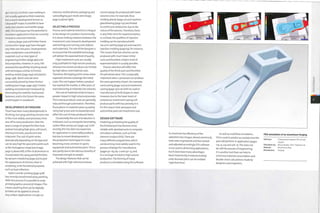
FEA simulation of an aluminium forging
Software: Professional Engineer (Pro E) and
Forge3
SimuLatlon by: Bruce Burden, W.H. Tildesley Ltd
Material: Aluminium alloy
Manufacture: Forging
Case Study
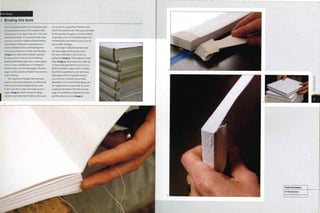
^ Binding this book
I ~
This bool< demonstrates the techniques used
to manufacture many of the products that
surround us in our day-to-day lives. Like most
commercial books, it is manufactured using
a process similar to traditional bookbinding.
And whether hardcover or paperback, it is
made of folded sections stitched together
in a process known as section-sewn binding
(image i). An alternative method is perfect
binding, which is the process of adhesive
bonding Individual pages into a scored paper
cover. It is less durable and so is limited to
thinner books, but the advantage is that the
pages can be opened out flatter than section-
sewn bindings.
This sequence of images demonstrates
section-sewn case binding on a smaller book
than this, but the principles are the same.
In this case, the sections are made up of i5
pages (image 2), which consist of a large
signature (printed sheet) folded 4 times and
cut to size on a guillotine. Therefore, the
extent of books bound in this way is divisible
by the number of pages in a section, which
is typically 4,8 or 16. Perfect binding is not
limited by the same factors and so can be
any number of pages.
Linen tape is adhesive bonded onto
the sewn edges of the sections and
the sewn assembly is cut to size in a
guillotine (image 3). This produces a neat
edge (image 4). Hard covers are made up
of heavy-duty grey board 2.5 mm (0.1 in.)
thick concealed in paper, cloth or leather.
By contrast, paperback covers are heavy-
duty paper, which is typically around
0.25 mm (0.01 in.) thick. Any printed
decoration, such as hot foiling (pages 412-
5) is applied prior to assembly. The cover
Is adhesive bonded to the first and last
page, the assembly is clamped in a press
and the adhesive cures (image 5).
Featured Company
R S Bookbinders
www.rsbookbinders.co.uk
Forming Technology
Forming Technology
Blow Molding
This group of processes is typically used to mass produce hollow
packaging containers. They are a very rapid production method
for large volumes of thin walled parts.
1 Moderate tooling costs
1 Low unit costs
Quality
• High quality, uniform thin walled parts
• High quality surface finish that can be
gloss, textured or matt
Typical Applications
• Chemical packaging
• Consumer packaging
• Medical packaging
Related Processes
• Injection molding
• Rotation molding
• Thermoforming
Suitability
• Suitable only for high volume
production runs
Speed
• Very rapid cycle time (typically 1-2
minutes)
INTRODUCTION
Blow molding is carried out In 3 different
ways: extrusion blow molding (EBM),
injection blow molding (IBM) and
injection stretch blow molding (ISBM).
Each of the processes has its particular
design opportunities and is suitable for
different industries.
EBM is favourable for many
applications because it has low tooling
and running costs. It is a versatile process
that can be used to produce a wide
variety of shapes in an extensive choice
of materials. Containers can be molded
with integral handles and multiple
layered walls.
IBM is a precise process that
is suitable for more demanding
applications such as medical containers
and cosmetic packaging. It is used to
produce containers with very accurate
neck finishes as well as wide mouths.
ISBM is typically used to produce high
quality glass clear PET containers such as
water bottles. The injection cycle ensures
very accurate neck finishes and the
stretch cycle gives superior mechanical
properties. ISBM is particularly suitable
for beverage, agrochemical and personal
care applications.
TYPICAL APPLICATIONS
EBM is used mainly in the medical,
chemical,veterinary and consumer
industries to produce intravenous
containers, medicine bottles and vials,
and con sum er packaging.
IBM is utilized especially for consumer
packaging and medical packaging
(medicine bottles, tablet and diagnostic
bottles and vials).
ISBM is predominant in the personal
care, agrochemicals, general chemicals,
food and beverages and pharmaceutical
industries to produce carbonated and
soft drink bottles, cooking oil containers,
agrochemical containers, health and oral
hygiene products, bathroom and toiletry
products, and a number of other food
application containers.
RELATED PROCESSES
Thermoforming (page 30),rotation
molding (page 36) and injection molding
(page 50) can all be used to form the
same geometry parts. Even so, blow
molding is the process of choice for large
volumes of hollowthin walled packaging.
QUALITY
The surface finish is very high for all
of these processes.The IBM and ISBM
technologies have the additional
advantage of precise control over neck
details, wall thickness and weight.
DESIGN OPPORTUNITIES
All of the blow molding processes can be
used to produce thin walled and strong
containers.The neck does not have to
be vertical or tubular. Features such as
handles, screw necks and surface texture
can be integrated into all 3 processes.
The principal reason to select I BM
is that there is more control over wall
thickness and neck details.This means
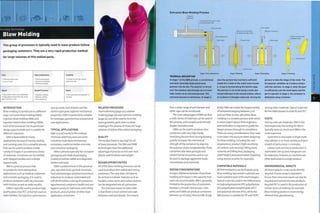
Extrusion Blow Molding Process
Polymer
granules
Conventional extrusion screw
and barrel assembly
fj11
{=^
1 Extrusion die
.
O
Extrused parison
Split mold
u
Part sealed
Blow pin removed
Molds open
ft
w
Flash removed with
profiled cutter
Finished part
Stage 1: Extruded parison
TECHNICAL DESCRIPTION
In stage 1 of the EBM process, a conventional
extrusion assembly feeds plastlcized
polymer into the die. The polymer is forced
over the mandrel and emerges as a circular
tube, known as an extrused parison. The
extrusion process Is continuous. In stage 2,
Stage 2: Blowing Stage 3: Demolding
A
Stage A: Trimming
once the parison has reached a sufficient
length the 2 sides of the mold close around
It. A seal Is formed along the bottom edge.
The parison Is cut at the top by a knife and
moved sideways to the second station, where
air Is blown In through a blow pin, forcing the
parison to take the shape of the mold. The
hot polymer solidifies as It makes contact
with the cold tool. In stage 3, when the part
Is sufficiently cool the mold opens and the
part Is ejected. In stage U, the container Is
deflashed using a trimmer.
that a wider range of anti-tamper and
other caps can be introduced.
The main advantages of EBM are that
a wide choice of materials can be used in
this process, and complex and intricate
shapes manufactured.
ISBM can be used to produce clear
containers with very high clarity.
Stretching the pre-form during blowing
greatly increases the mechanical
strength of the container by aligning
the polymer chains longitudinally.These
containers also have good gas and
solvent barrier properties and so can
be used to package aggressive foods,
concentrates and chemicals.
DESIGN CONSIDERATIONS
A major difference between these blow
molding techniques is the capacity that
each can accommodate. IBM is generally
limited to the production of containers
between 3 ml and 1 litre (0.005-1.760
pints) and ISBM can produce containers
between 50 ml and 5 litres (0.088-8.799
pints). EBM can create the largest variety
of containers ranging between 3 ml
and 220 litres (0.005-387 pints). Blow
molding is a complex process with which
to work. Expert advice from engineers
and toolmakers is required to guide the
design process through to completion.
There are many considerations that need
to be taken into account when designing
for blow molding, including the user
(ergonomics), product (light sensitivity
of contents andviscosity), filling (neck,
contents and filling line), packaging
(shelf height) and presentation (labelling
using sleeves or print, for example).
COMPATIBLE MATERIALS
All thermoplastics can be shaped using
blow molding, but certain materials are
more suited to each of the technologies.
Typical materials used in the EBM process
include polypropylene (PP), polyethylene
(PE), polyethylene terephthalate (PET)
and polyvinyl chloride (PVC), while the
IBM process is suitable for PP and HDPE
among other materials.Typical materials
for the ISBM process include PE and PET
COSTS
Tooling costs are moderate. EBM is the
least expensive, the tooling for I BM is
typically twice as much and ISBM is the
most expensive.
Cycle time is very rapid. A single mold
may contain ic or more cavities and eject
a batch of parts every 1-2 minutes.
Labour costs are low, as production is
automated. Set-up and changeover can
be expensive, however, so machines are
often dedicated to a single product.
ENVIRONMENTAL IMPACTS
All thermoplastic scrap can be directly
recycled. Process scrap is recycled in-
house. Post-consumer waste can also be
recycled and turned into new products.
Recycled PET is used in the production of
certain items of clothing, for example.
Blow molding plastics is more energy
efficient than glassblowing.
"ase Study
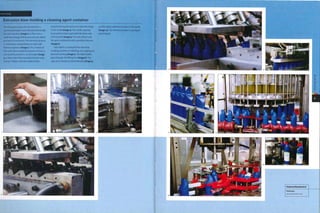
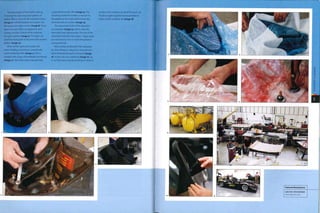
Extrusion blow molding a cleaning agent container
The PE polymer granules are stored in a
communal hopper and coloured individually
for each machine (image i). In this case a
small percentage of blue granules are added
just prior to extrusion. The extrusion process
is continuous and produces an even wall
thickness parison (image 2). The 2 halves of
the mold close around the parison to form a
seal and the parison is cut to length (image
3). A blow rod is then inserted into the neck,
and air is blown into the mold at 8 bar
(116 psi) forcing the parison to take the shape
of the mold (image 4). The molds separate
to reveal the blown part with the blow rods
still inserted (image 5). The rods retract and
the part is deflashed with a profiled trimmer
(image 6).
Each batch is conveyed from the blow
molding machine to labelling and capping via
pressure testing (image 7). The EBM bottles
pass through the filling line (image 8). The
caps are screwed on automatically (image 9)
and the labels adhesive bonded to the bottle
(image io). The finished product is packaged
and shipped.
4
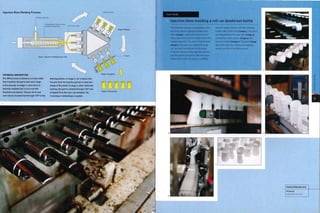
Injection Blow Molding Process
Polymer granules
Blowing mold
Conventional injection screw
and barrel assembly Pre-form mold
Stage 2: Blowing
Stage 1: injection molding the pre-form
Stripper
TECHNICAL DESCRIPTION
The IBM process is based on a rotary table
that transfers the parts onto each stage
in the process. In stage 1, a pre-form is
injection molded over a core rod with
finished neck details. The pre-form and
Stage 3: Stripping
blowing station. In stage 2, air is blown into
the pre-form forcing the parison to take the
shape of the mold. In stage 3. after sufficient
cooling, the part is rotated through 120° and
stripped from the core rod complete. No
Staged: Final product
core rod are transferred through 120° to the trimming or deflashing is needed.
5*
r.
/
A
$3
• >
K
r
* '
'
ection blow molding a roll-on deodorant bottle
The polished core rods are prepared so the
pre-forms can be injection molded onto
them (image i). Each core rod is inserted
into a split mold and hot molten white PP is
molded around it. The necl< is fully formed
(image 2). The parts are rotated through
120° and are inserted into the blowing
mold. Air is blown in through the core rod
and the plastic is forced to take the shape
of the mold cavity. The polymer solidifies
when it makes contact with the relatively
cooler walls of the mold (image 3). The parts
are stripped from the core rods (image 4),
counted by a laser sensor (image 5) and
pressure tested (image 6). The parts (image
7) are then fed into a filling and capping
system similar to the EBM process.
Featured Manufacturer
Polimoon
www.poiimoon.com
Blown part
Injection
molded pre-form
Stage 3: Blowing cycle
Blown part ejected
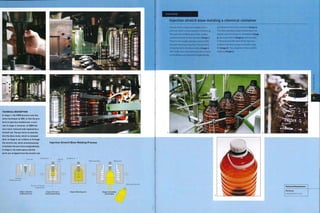
Pre-form stretched
longitudinally
Stage 1: Injection Stage 2: Pre-form
molded pre-form stretched and blown
TECHNICAL DESCRIPTION
In stage 1, the ISBM process uses the
same technique as IBM, In that the pre¬
form is injection molded over a core
rod. In stage 2, however, in ISBM the
core rod is removed and replaced by a
stretch rod. The pre-form is inserted
into the blow mold, which is clamped
shut. In stage 3, air is blown in through
the stretch rod, which simultaneously
orientates the pre-form longitudinally.
In stage 4, the mold opens and the
parts are stripped from the stretch rod.
„ . Air blown
Core rod
8
Staged: Demolded
and stripped
Injection Stretch Blow Molding Process
Stretch Air blown in—fj
rod Molds separate
Case Study
Injection stretch blow molding a chemical container
The pre-form is injection molded over a
core rod, which is removed prior to blowing.
The injection molded part is thin walled,
as demonstrated by the operator (Image i).
There is not usually operator contact with
the parts during production. The pre-form
is transferred to the blow molds (image 2),
The molds close around the pre-form and it
is simultaneously stretched longitudinally
and blown to form the container (Image 3),
The blown product is ejected and does not
require any trimming. It is demolded (image
4), pressure tested (image 5) and a handle
is fitted around the neck of the injection
molded container, using an annular snap
fit (image 6).The container is then sent for
capping (image 7).
7
Featured Manufacturer
Polimoon
www.polimoon.com
Forming Technology
Thermoforming
In this group of processes, thermoplastic sheet materials
are formed with the use of heat and pressure. Low pressures
are inexpensive and versatile, whereas higher pressures can
produce surface finishes and details similar to injection molding.
Costs
• Low to moderate tooling costs
• Low to moderate unit costs, roughly
3 times material cost
Quality
• Depends on material, pressure and
technique
Typical Applications
• Baths and shower trays
• Packaging
• Transportation and aerospace interiors
Related Processes
• Composite laminating
• Injection molding
• Rotation and blow molding
Suitability
• Roll fed; batch to mass production
• Sheet fed: one-off to batch production
Speed
• Roll fed cycle time: 10 seconds to
1 minute
• Sheet fed cycle time: 1-8 minutes
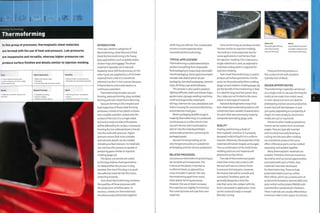
INTRODUCTION
There are 2 distinct categories of
thermoforming: sheet fed androli fed.
Sheet fed thermoforming is for heavy
duty applications, such as pallets, baths,
shower trays and luggage.The sheet
material is typically cut to size and
loaded by hand. Roll fed processes, on the
other hand, are supplied by a roll of sheet
material from areel. It is sometimes
referred to as the 'in-line' process because
it thermoforms, trims and stacks in a
continuous operation.
Thermoforming includes vacuum
forming, pressure forming, plug-assisted
forming and twin sheet thermoforming.
Vacuum forming is the simplest and
least expensive of these sheet forming
processes. A sheet of hot plastic is blown
into a bubble and then sucked onto the
surface of the tool. It is a single-sided
tool and so only one side of the plastic
will be affected by its surface. In pressure
forming the hot softened sheet is forced
into the mold with pressure. Higher
pressure means that more complex
and intricate details can be molded,
including surface textures. For relatively
low volumes this process is capable of
producing parts similarto injection
molding (page 50).
The above 2 processes are suited
to forming shallow sheet geometries.
For deep profiles the process is plug
assisted.The role of the plug is to push
the softened material into the recess,
stretching it evenly.
Twin sheet thermoforming combines
the qualities of these processes with
the production of hollow parts. In
essence, 2 sheets are thermoformed
simultaneously and bonded together
while they are still hot. This complicated
process is more expensive than
conventional thermoforming.
TYPICAL APPLICATIONS
Thermoforming is used extensively to
produce everything from disposable
food packaging to heavy-duty returnable
transit packaging. Some typical examples
include clear plastic point-of-sale
packaging,clamshell packaging, cosmetic
trays, drinking cups and briefcases.
This process is also used to produce
lighting diffusers; bath and shower trays;
garden pots; signage; vending machines;
small andlargetanks;motorcycle
fairings; interiors for cars, aeroplanes and
trains;housing for consumer electronics;
and protective head gear.
Blister packaging (bubble wrap) is
made by thermoforming. It is produced
continuously on a roller, which is the
vacuum former, and is laminated to
seal air into the individual blisters
and provide protective cushioning for
packaged goods.
Vacuum forming tooling can be
very inexpensive and so is suitable for
prototypin g an d 10w volum e product! on.
RELATED PROCESSES
Low pressure thermoforming techniques
are versatile and inexpensive.This
is because the plastic is formed as
a softened sheet, as opposed to a
mass of molten material.This sets
thermoforming apart from many
other plastic forming processes.
However, the use of sheet increases
the material cost slightly.To minimize
this some factories extrude their own
materials.
Pressure forming can produce surface
finishes similarto injection molding.
The tooling is more expensive, but for
some applications it will be less than
for injection molding.This is because a
single-sided tool is used, as opposed to
matched tooling which is required for
injection molding.
Twin sheet thermoforming is used to
produce 3D hollow geometries. Similar
parts can be produced by blow molding
(page 22) and rotation molding (page 36),
yet the benefit of thermoforming is that
it is ideal for large and flat panels. Also,
the 2 sides are not limited to the same
colour or even type of material.
Material developments mean that
twin sheet thermoformed products will
sometimes have suitable characteristics
for parts that were previously made by
composite laminating (page 206).
QUALITY
Heating and forming a sheet of
thermoplastic stretches it.Aproperly
designed mold will pull it in a uniform
manner. Otherwise, the properties of the
material will remain largely unchanged.
Thus a combination of the mold finish,
molding pressure and material will
determine surface finish.
The side of thermoformed plastic
sheet that comes into contact with
the tool will have an inferior finish
to pressure formed parts. However,
the reverse side will be smooth and
unmarked.Therefore, parts are
generally designed so that the
side that came into contact with the
tool is concealed in application.Tools
can be outward (male) or inward
(female) curving.
Above left
Textured light diffuser
manufactured by
vacuum forming.
Above
Foam filledTerracover®
ice pallet made by twin
sheet thermoforming.
Pressure forming produces a
fine surface finish with excellent
reproduction of detail.
DESIGN OPPORTUNITIES
Thermoforming is typically carried out
on a single mold. In vacuum forming the
mold can be made from metal, wood
or resin. Wood and resin are ideal for
prototyping andlow volume production.
A resin tool will last between io and
500 cycles, depending on complexity of
shape. For more products, aluminium
molds are cast or machined.
Similarto othermolding operations
inserts can be used to form re-entrant
angles.They are typically inserted
and removed manually. Routing or
cutting into the part after molding
can sometimes produce the same
effect. Otherwise, parts can be molded
separately and welded together.
Many thermoplastic materials are
suitable.Therefore, there are numerous
decorative and functional opportunities
associated with each of them. Also,
materials have been developed
forthermoforming.These include
preprinted sheets (such as carbon
fibre-effect), which are a coextrusion of
acrylonitrile butadiene styrene (ABS) and
poly methyl methacrylate (PMMA) with
aprintedfilm sandwiched in between.
These materials are usually affected by a
minimum order in the region of 3 tonnes.
o
~n
o
TECHNICAL DESCRIPTION
Vacuum forming is a straightforward
process and provides the foundation for the
other thermoforming techniques. A sheet of
material is heated to its softening point. This
is different for each material. For example,
the softening point of polystyrene (PS) is
127-182°C (261-360°F| and PP is U3-165°C
(289-329°F). Certain materials, such as
HIPS, have a larger operating window (that
is, the temperature range in which they are
formable), which makes them much easier
to thermoform.
The softened plastic sheet is blown into
a bubble, which stretches it in a uniform
manner. The airflow is then reversed and
the tool is pushed up into the sheet. The
material is drawn onto the surface of the
mold by vacuum at about 0.96 bar (14 psi).
To assist the flow of air, channels are drilled
into the tool. They are located in recesses
and across the surface of the mold to extract
the air as efficiently as possible.
Pressure forming is the reverse of
vacuum forming; the sheet is formed onto
the surface of the mold under approximately
6.9 bar (100 psi) of air pressure. This
means that a greater level of detail can be
achieved. Surface details on the mold will
be reproduced with much more accuracy
than vacuum forming. Surface finish can be
more accurately controlled and is therefore
functional. However, like vacuum forming
only one side of the sheet will be functional.
Thermoforming Processes
Preheated sheet
Plug-assisted forming is used to bring
the benefits of male mold forming to female
parts because blowing a softened sheet into
a bubble stretches it evenly while draping
the sheet into a female mold produces more
localized stretching. The plug stretches
the sheet prior to forming and so ensures
that there is adequate wall thickness for
deep profiles. Otherwise the material
will tear. When the air Is drawn out, the
sheet conforms to the mold profile and the
hydraulic plug retracts.
In twin sheet thermoforming, 2 sheets
are thermoformed and clamped together.
Forming the vacuum
This forms an enclosed and thin walled
product. Both sides of the product are
functional, unlike the single sheet processes.
The machines are rotary. The clamps
transfer the sheet into the heating chamber,
where it is raised to softening temperature;
it Is then thermoformed and clamped; and
finally rotated to the unloading station. The
2 sheets are thermoformed individually, one
above the other. Once fully formed they are
clamped together. Residual heat from the
thermoforming enables the bond to form
with prolonged contact. The bond has similar
strength to the parent material.
Multilayered materials are
coextruded to provide benefits: for
example, providing a barrier to moisture
or bacteria; different colours; and
sandwiching recycled material between
films of virgin (aesthetic) material to
reduce energy.
Textured sheets can be thermoformed
(see image, page 31, above left).Typically
sheets are textured on one side and
so the smooth side is formed against
the m old. There is a range of standard
textures, which are cast or extruded by
the material manufacturer. Examples
include frosted, haircell, lens, embossed
and relief.
Twin sheet thermoforming
produces 3D hollow parts.This has
added benefits including lightness
and rigidity, insulation and 2 separate
m ateri al s (upper an d 1 ower). Sin gl e
sheet thermoforming is typically limited
to only a single side of functionality.
Twin sheet, on the other hand, provides
functional surfaces on both sides.
Foam can be molded into twin sheet,
or be injected post-forming for added
rigidity and strength (see image, page
31, above, right).
DESIGN CONSIDERATIONS
Thermoforming is ideal for shallow thin
walled parts. It is not usually practical
forthe depth to exceed the diameter.
Materials can be stretched more evenly
over the surface of a deep profile using
plug-assisted forming.
Air channels on the surface of the
mold will leave slight pimples.These
can be eliminated on aesthetic surfaces
with the use of microporous aluminium
molds (see image, top).This material
has a much shorter molding lifespan
because the pores clog up eventually.
However, they are very useful for design
details (see image, middle), which would
otherwise require hundreds of air
channels (holes).
Plug-assisted forming
Heated and
softened sheet
Clamp ring
Female mold
Air channels
1— 
v y ¦ 1
1—— It!
Upper mold
Plug-assisted preheated sheet Forming the vacuum
Twin sheet thermoforming
Air sucked out
from both sides
1
/ 
fiH]
Lower mold
Preheated sheets
Textures are sometimes necessary
on the surface of the mold to assist the
flow of air and avoid air pockets forming.
These are known as 'open textures'.
Sheet fed thermoforming is used to
process sheet materials ranging from
i mm to 12 mm (0.04-0.47 in.). Roll fed
is supplied by a reel and so is limited to
o.i mm to 2.5 mm (0.004-0.1 in.).The size
of part is typically restricted to 1.5 x 3.5 m
(5 x 11.5 ft), although some machines are
capable of dealing with sheets of 2.5 X4m
(8 x13 ft).
Draft angles are essential when
th erm oformi n g over protrusi on s, or m al e
molds. This is because the heated plastic
sheet is expanded; as it cools it will shrink
by up to 2%. Different materials have
different levels of shrinkage: for example,
ABS will shrink 0,6% and H DPE 2%. A draft
angle of 2° is usually recommended.
The material stretches as it Is
thermoformed, and this will be more
prominent in deeper and undulating
profiles.Therefore, care must be taken
to avoid sharp corners and points where
three corners meet.These will cause
excessive thinning and thus weak points.
Forming the vacuum and clamping
COMPATIBLE MATERIALS
Although almost all thermoplastic
materials can be thermoformed, the
most common are ABS, polyethylene
terephthalate (PET) (including PETG,
which is PET modified with glycol),
polypropylene (PP), polycarbonate (PC),
high impact polystyrene (HIPS) andhigh
density polyethylene (H DPE).The glycol in
PETG reduces brittleness and premature
ageing. PETG is clear (almost like PC)
and is therefore often the material of
choice for lighting diffusers and medical
packaging, for example.
COSTS
Tooling costs are typically low to
moderate, depending on the size,
complexity and quantity of parts. The
most expensive tools are machined
aluminium.Tooling for pressure forming
is 30-50% more expensive than vacuum
forming, but is still considerably cheaper
than tooling for injection molding.
The speed of thermoforming depends
on the selected process and material
thickness. Sheet fed processes typically
produce 1-8 parts per minute. Roll
fed machines are generally faster and
multiple cavity tools can make hundreds
Top Above
Microporous aluminium Carpet covered
moldmaking material, thermoforming
shaped by CNC machining, produced in a single
operation.
Middle
Textured design feature
vacuum formed on mold
made of microporous
aluminium.
of parts per minute. Roll fed machines
are automated, while sheet fed machines
are generally loaded by hand. This
increases labour costs.
ENVIRONMENTAL IMPACTS
This process Is only used to form
thermoplastic materials, so the majority
of scrap can be recycled. Kaysersberg
Pi asti cs, wh o provi ded th e extrudl n g
the sheet material case study (page 34),
produce only 1.4% scrap material; the rest
is recycled.
Sheet conforms
to mold profile
Mold
pushes up
into sheet
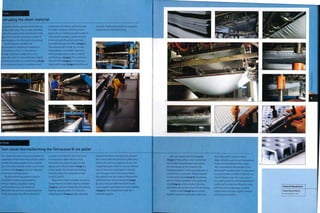
ixtruding the sheet material
aysersberg Plastics extrude sheet material
ar thermoforming. They can very accurately
Dntrol the quality of the material and mal<e
djustments almost instantly as a result of
iheir findings in the thermoforming process.
As with injection molding, the
lermoplastic is melted and mixed by an
Archimedean screw. It is squeezed out
Trough a die that is 3,084 mm (121 in.)
e, after which it is forced between highly
polished steel rollers to a set thickness (image
i).The extrusion process is continuous and
in operation the sheet is pulled through
the rollers. However, when the process
begins, there is nothing to pull through. To
overcome this problem, straps are fixed
to the extrusion flow front, and these
are pulled through the rollers (image 2).
The extrusion die is made up of many
independently controllable segments,
which are adjusted to make a uniform
wall thickness (image 3).The continuous
sheet of HOPE (image 4) is slit along its
length with knives (image 5) and then cut
to length. The finished sheets are stacked in
preparation for thermoforming.
ise Study
Twin sheet thermoforming demonstrates the
capabilities of thermoforming with the added
benefit of bonding together to form hollow
parts. The sheet material, which is 4 mm (0.16
in.) thick HOPE (image 1), was extruded and
cut to size as outlined above.
The thermoforming machine consists
of 4 stations: loading and unloading;
primary heating; secondary heating;
and thermoforming. Two sheets are
thermoformed and then clamped together;
in this case study they will be referred to
as 'sheet A' and 'sheet B'. First of all, sheet
A is manually loaded onto the rotary
thermoforming machine and clamped
tightly around its perimeter (image 2). It
is then loaded into the primary heating
chamber, where the temperature is set
ati6o0C (32o0F).
Meanwhile, sheet B is loaded. As sheet A
moves into the secondary heating chamber
(image 3), sheet B is rotated into the primary
heating chamber, where it is heated to
softening point (image 4) and suspended
between the thermoforming tools. Because
this is twin sheet thermoforming there are 2
tools in this station, as opposed to only 1 for
single sheet parts. Sheet A is vacuum formed
over the lower tool, and sheet B is formed
over the upper tool. As the vacuum draws
the material onto the surface of the tool the
profile becomes more pronounced (image
5). Just as they are both formed the molds
come together and clamp the sheets together
(image 6). The residual heat bonds the 2
materials together.
Twin sheet thermoforming the Terracover® ice pallet
After 41/2 minutes the tools separate
(image 7). Meanwhile, 2 more sheets have
been loaded and preheated, and replace
the formed part as it is rotated to the
unloading station. In this way production is
as continuous as possible. The formed part
is trimmed by hand (image 8). Re-entrants
are cut using a handheld router guided by
a Jig (image 9), while complex trimming
operations are carried out by CNC machining
Sheets A and B (image 10) are welded
together around the perimeter and across
the surface with a series of spikes
(approximately 2,400), so an homogenous
bond is formed between the 2 sheets.
This is essential for the strength of the
Terracover® ice pallet, which is engineered
to accommodate 5 tonnes of load over an
areaof only 150 x 150 mm ( 5.91 x 5.91 in.).
It is used to cover ice rinks temporarily for
events such as concerts. Filling the cavity
with foam (see image, page 31, above,
right) further increases rigidity, strength
and thermal insulation.
Featured Manufacturer
Kayserberg Plastics
www.kayplast.com
Forming Technology
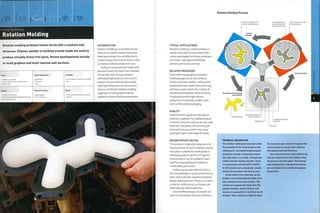
Rotation Molding
Rotation molding produces hollow forms with a constant wall
thickness. Polymer powder is tumbled around inside the mold to
produce virtually stress free parts. Recent developments include
in-mold graphics and multi-layered wall sections.
INTRODUCTION
Rotation molding is a versatile process
that can be used to create hollow and
sheet geometries. It is cost effective to
produce large and small products in low
to medium volume production runs.
Tooling is comparatively inexpensive
because it does not have to be matched
to internal cores or engineered to
withstand high pressure. Even so, this
process can be used to produce parts
with tight tolerances on closures and
fixtures. Similar to injection molding
(page 50), in-mold graphics can be
applied to reduce finishing operations.
• Medium cost tooling
• Low to medium unit cost (3 to 4 times
material cost)
• Automotive
» Furniture
• Toys
• Low to medium volumes up to 10,000
units
Quality
• Surface finish is good
• Low pressure during molding produces low
stress concentrations
Related Processes
» Blow molding
• Thermoforming
Speed
• Long cycle time (between 30 and 60
minutes)
Costs Typical Applications Suitability
Rotation Molding Process
TYPICAL APPLICATIONS
Rotation molding is used to produce a
variety of products, such as boat hulls,
canoes and kayaks, furniture, containers
and tanks, road signs and bollards,
planters, pet houses andtoys.
RELATED PROCESSES
Thermoforming (page 30) and blow
molding (page 22) can also produce
hollow and sheet profiles. Hollow parts
produced by twin sheet thermoforming
will have a seam where the 2 sheets of
material come together. Blow molding
is typically used for high volume
production of relatively smaller parts,
such as thin walled packaging.
QUALITY
Surface finish is good even though no
pressure is applied.The molded product
is almost stress free and has an even wall
thickness.The plastic will shrink by 3%
during the process, which may cause
warpage in parts with large flat areas.
DESIGN OPPORTUNITIES
This process is relatively inexpensive for
the production of low to medium volume
runs and is suitable for small products
and large products up to 10 m3 (353 ft3).
Some products can be molded in pairs
and then separated post-molding to
create sheet geometries.
Tooling can betaken directly from a
full size prototype in wood, aluminium or
resin, which aids the transition between
design and production.There is no core in
a rotation molding tool, so changes are
relatively easy and inexpensive.
Several different types of powder are
used to mold shapes that have different
Polymer solidifies with Hole for gas to escape
from hot plastic
Heating chamber
Accurately measured
Molded product charge of polymer
Rotating arm
Loading / unloading
platform
Die cavity
TECHNICAL DESCRIPTION
The rotation molding process starts with
the assembly of the metal molds on the
rotating arm. A predetermined measure
of polymer powder is dispensed evenly
into each mold. It is closed, clamped and
rotated into the heating chamber. There
it is heated up to around 250oC U820F)
for 25 minutes and is constantly rotated
around its horizontal and vertical axes.
As the walls of the mold heat up the
powder melts and gradually builds up an
even coating on the inside surface. The
rotating arm passes the molds onto the
cooling chamber, where fresh air and
moisture is pumped in to cool them for 25
minutes. They continue to rotate at about
20 revolutions per minute throughout the
entire process to ensure even material
distribution and wall thickness.
Once the parts have cooled sufficiently
they are removed from the molds so that
the process can start again. The heating
and cooling times, and speed of rotation,
are controlled very carefully throughout
the process.
levels of complexity. Micro-pellets and
fine powders are more suitable for tight
radii and fine surface details; however,
fine powders show up surface defects
more readily. Foam-filled, hollow or other
multi-layered walls can be produced
with composite polymers, which are
triggered at varying temperatures. Wall
thicknesses in solid wall sections are
typically no more than 5 mm (0.24 in.).
Maximum thickness is determined
by the temperature of the mold and
thermal conductivity of the polymer.
Inserts and preformed sections
of different colour, threads, in-mold
{ graphics and surface details can be
integrated into the molding process.
Overmolding of 1 material onto another
premold reduces assembly costs and
1 produces seamless finishes. Additives
can be used to m ake th e m ateri al s U V
and weather resistant, flame retardant,
static-free or food safe.
| DESIGN CONSIDERATIONS
Low pressure produces low molecular
mass materials that have low
mechanical strength. However, this can
be overcome by integrating ribs into the
design. Abrupt changes in wall section
are not possible, and sharp angles and
tight corners should be avoided. Small
radii can be achieved across bends in 1
direction, but are not suitable for corners.
Low pressure also means that high gloss
finishes are not practical.
Product length is restricted to 4 times
the diameter, to prevent uneven material
distribution in the molding cycle.
COMPATIBLE MATERIALS
Polyethylene (PE) is the most commonly
rotation molded material. Many other
thermoplastics can be used, such as
polyamide (PA), polypropylene (PP),
polyvinyl chloride (PVC) and ethylene
vinyl acetate (EVA).
COSTS
Tooling costs are relatively inexpensive
because tools do not have to be
engineered to resist high pressures
andthere is no internal core, so minor
changes can be made easily. Steel molds
are the most expensive, followed by
aluminium. Resin tools are the least
expensive and suitable for production
runs up to about icq parts.
Cycle time is usually between 30 and
90 minutes depending on wall thickness
and choice of material. Several tools are
mounted on the rotating arms at the
same time, which reduces cycle time.
Rotation molding is labour intensive.
Fully automated molding is available for
small parts and high volumes to reduce
the costs.
I
ENVIRONMENTAL IMPACTS
There is very little scrap material in
this process because predetermined
measures of powder are used. The molds
stay closed and clamped throughout the
entire molding and cooling process. Any
thermoplastic scrap can be recycled.
Case Study
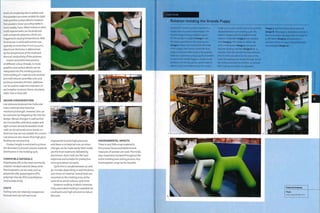
Rotation molding the Grande Puppy
Each mold is used to produce batches in a
single colour to avoid contamination. The
Grande Puppy is being molded in green
PE. The powder is weighed (irtiage 1) and
the mold assembled on the rotating arm
(image 2). Valves are inserted into the holes
in the puppy's feet, which control the flow
of gas in and out of the mold as the polymer
heats up. A generous 3.6 kg (7.94 lb) of powder
is used in the Grande Puppy to ensure a wall
thickness of 6 mm (0.236 in.), which makes It
safe as a seat and children's toy. The mold is
made up of 4 parts, which have to be carefully
cleaned between each molding cycle. The
mold is charged with the predetermined
measure of powder (image 3) and clamped
shut (image 4). The molds, on either side
of the rotating arm (image 5), are passed
onto the heating chamber (image 6) for 25
minutes. Once the powder has had sufficient
time to melt and adhere to the walls of the
mold, the rotating arm moves through 120° to
the cooling chamber for a further 25 minutes.
After cooling, the molds are separated
(image 7) and the final products exposed
(image 8).The puppy is demolded carefully to
avoid any surface damage while the polymer
is still warm (image 9) and placed on a
conveyor belt on its way to being deflashed
and packaged (image 10).
Magis
vww.magisdesign.com
Forming Technology
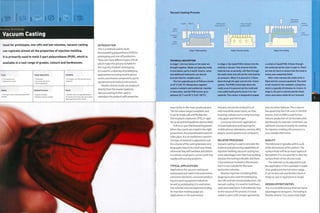
Vacuum Casting
Used for prototypes, one-offs and low volumes, vacuum casting
can replicate almost all the properties of injection molding,
it is primarily used to mold 2-part polyurethane (PUR), which is
available in a vast range of grades, colours and hardnesses.
¦ Low tooling costs
1 Moderate unit costs
Typical Applications
• Automotive
• Consumer electronics
• Sports equipment
Suitability
• Prototypes, one-offs and low volume
production
Quality
• Very high surface finish and reproduction
of detail
Related Processes
• injection molding
• Reaction injection molding
Speed
• Variable cycle time (typically between
45 minutes and 4 hours, but up to several
days depending on size of part)
INTRODUCTION
This is a method used to mold
thermosetting polyurethane (PUR) for
prototyping and one-off production.
There are many different types of PUR,
which make this process suitable for
the majority of plastic prototyping.
It is used for a diversity of prototyping
applications including mobile phone
covers, automotive components, sports
equipment and medical instruments.
Flexible silicone molds are produced
directly from the master (pattern).
Vacuum casting is then used to
reproduce the product with properties
Vacuum Casting Process
Mold
part A
Locating
ridge j
Flows through
and up risers
Stage 1: Mold assembly Stage 2: Vacuum casting Stage 3: De-molding
TECHNICAL DESCRIPTION
In stage 1, the two halves of the mold are
brought together. Molds are typically made
In two halves: parts A and B. Inserts, cores
and additional mold parts can also be
incorporated for complex parts.
The two separate parts of PUR are stored
at A0°C (104°F). Mixing them together
causes a catalytic and exothermic reaction
to take place, and the PUR warms up to
between 650C and 70°C (U9-1580F|.
In stage 2, the liquid PUR is drawn into the
mold by a vacuum. This ensures that the
material has no porosity, will flow through
the mold cavity and will not be restricted by
air pressure. When it is poured In, it flows
down through the gate and into the runner
system. The PUR is held high above the
mold, so as it is poured into the mold and
runs underneath gravity forces it to rise
upwards. The runner is designed to supply
a curtain of liquid PUR. It flows through
the mold and up the risers in part A. There
are lots of risers to ensure that the mold is
evenly and completely filled.
After a few minutes the mold cavity is
filled and the vacuum equalized. The mold
is left closed for the complete curing time,
which is typically A5 minutes to U hours. In
stage 3, the part is ejected and the flash,
risers and excess material are removed.
very similar to the mass-produced part.
The full colour range is available, and
it can be made soft and flexible like
thermoplastic elastomer (TPE), or rigid
like acrylonitrile butadiene styrene (ABS).
PUR is a 2-part thermosetting plastic.
When the 2 parts are mixed in the right
proportions, the polymerization process
takes place. It is an exothermic reaction.
The type of material is adjusted to suit
the volume of the casting because very
large parts have to be cured very slowly,
otherwise they will overheat and distort.
In contrast, small parts can be cured very
rapidly without any problems.
TYPICAL APPLICATIONS
Applications for vacuum casting are
widespread and used in the automotive,
consumer electronic, consumer product,
toy and sport equipment industries.
As well as prototyping, it is used when
low volumes rule out expensive tooling
for injection molding (page 50).
Applications in the automotive
industry include the production of
inlet manifolds, water tanks, air filter
housin g s, radi ator parts, 1 amp h ousin g s,
clips, gears and live hinges.
Consumer electronic applications
include keyboards and housings for
m obile ph on es, tel evi si on s, cam eras, M P3
players, sound systems and computers.
RELATED PROCESSES
Vacuum casting is used to simulate the
material and processing capabilities of
injection molding. Vacuum casting has
some advantages over injection molding
because the tooling is flexible and there
is less pressure involved in the process,
but it is not suitable for the same
production volumes.
Reaction injection moulding (RIM)
(page 64) is also used for prototyping,
one-offs and low volume production. Like
vacuum casting, it is used to moldfoam,
solid and elastomeric PUR materials. Due
to the nature of the process, it is best
suited to parts with simpler geometries
and smootherfeatures.This is due to
the speed that the PUR cures in the RIM
process. Even so, RIM is used for low
volume production of car bumpers and
dashboards, for example. Until there are
sufficient volumes to justify the tooling
for injection molding, this process is a
very suitable alternative.
QUALITY
The tolerance is typically within 0.4%
of the dimensions of the pattern.The
surface finish will be an exact replica of
the pattern. It is not possible to alter the
surface finish of the silicone mold.
The material can be adjusted to suit
the application. PUR is available in water
clear grades and the full colour range.
It can be very soft and flexible (shore A
range 25-90) or rigid (shore D range).
DESIGN OPPORTUNITIES
This is a versatile process that has many
advantages for designers.The tooling is
flexible silicone.This means that slight
re-entrant angles and undercuts can be
ejected by flexing the tool rather than
increasing the number of parts of the
tool. It is also possible to incorporate
cores and inserts to make larger re¬
entrants and internal features.
The PUR prototyping material range
is designed to mimic injection molded
materials such as polypropylene (PP),
ABS and polyamide (PA) nylon. Snap fits,
live hinges and other details that are
otherwise limited to injection molding
can be made. Additives can be used to
improve flame retardant qualities, heat
resistance and UV stability.
The silicone tooling can be taken from
almost any non-porous pattern material.
Reproducing the master in silicone
greatly reduces cost and cycle time.
Because this is a low pressure process,
it is possible to make step changes in the
wall thickness.
The properties of different plastics can
be incorporated as over-moldings. This is
similar to multi-shot injection molding,
except that the part is removed from
the mold and piaced in another for the
second material.
DESIGN CONSIDERATIONS
Parts can be any size from a few grams
up to several hundred kilos, but size
will affect the cycle time. Larger parts
h ave to be cured si owly to avoid th e
exothermic reaction causing shrinkage
and distortion. Parts are typically less
than 2.5 kg (5.51 lb), which can be cured in
1 hour or less.
Wall thicknesses down to 0.5 mm
(0.02 in.) can be produced in small areas.
However, it is recommended that wall
thickness be greaterthan 1 mm (0.04 in.)
and ideally no less than 3 mm (0.118 in.).
Very sharp details, such as knife edges,
are difficult to reproduce in any molding
application and so should be avoided.
COMPATIBLE MATERIALS
There are several hundred different
grades of PUR.This process is also used to
cast polyamide (PA) and wax patterns for
investment casting (page 130).
Left
Here a PUR vacuum
casting ofrigidyellow
ABS mimic is over-
molded with flexible
black TPE mimic.
COSTS
Tooling costs are generally low, but this
is largely dependent on the size and
complexity of the pattern. A mold will
usually take between 0.5-1 day to make
in silicone and need to be replaced after
20-30 cycles.
Cycle time is good, but depends on the
size of the part andtype ofmaterial.
Labour costs are moderate, depending
on the level of finishing required. Mold
making, vacuum casting and finishing
are all carried out manually.
ENVIRONMENTAL IMPACTS
Accurately measuring the material
reduces scrap, which cannot be recycled
because it is a thermosetting plastic.
The process is carried out in a vacuum
chamber, so any fumes and gases can be
extracted and filtered.
Case Study
Vacuum casting a computer screen housing
This housing for a computer screen used in
hospitals is a low volume production part.
First the silicone mold is made. The
pattern is suspended in a box by the gate,
runners and risers. The box is then filled
with silicone rubber, which completely
encapsulates it. When fully cured, the mold
halves are separated by cutting into the
silicone to meet the pattern (image 1). It is a
skilful process, and the geometry of the part
will determine the mold-making technique.
The pattern is removed from the mold
(image 2). Fine details, such as logos and
surface texture, are reproduced exactly.
The split line was continued across the
open central area by a thin film, which was
attached to the product prior to casting in
silicone.This technique produces a split mold,
which has incorporated gate, runners and
risers (image 3).
The silicone is flexible and so will typically
only last for 20-30 cycles before it has to
be remade. It is taped together to stop any
movement during casting (image 4).Two
pipes are attached, which will deliver the
liquid PUR.
The casting process takes place under
vacuum. The PUR pours into the mold and is
unrestricted by air pressure (image 5). As the
moldfills up the PUR emerges from the risers.
The mold is left in an oven at 40°C (io4°F)
until the PUR has fully cured.This particular
grade takes 45 minutes.
The ejection process begins by
blowing pressurized air into the risers
(image 6).This helps to release the
casting from the mold. The 2 halves of the
mold are separated to reveal the casting
(image 7). it is removed with the risers
intact (image 8).These are detached by
hand, and the 2 halves of the computer screen
housing assembled (image 9). The finished
product (image 10) is very similar to a mass-
produced injection molded part, with ribs,
perforations, logos and matt surface finish.
Forming Technology
Compression Molding
In this rapid process, rubber and plastic are shaped by
compressing them into a preheated die cavity. Compression
molding is generally used for thermosetting materials.
Costs
• Moderate tooling costs
• Low unit costs [3-4 times material cost)
Typical Applications
• Automotive under-the-bonnet
• Electrical housing and kitchen equipment
• Seals, gaskets and keypads
Suitability
• Medium to high volume production
Quality Related Processes Speed
• High strength parts with high quality • DMC and SMC molding • Plastic: Rapid (2 minute cycle time)
surface finish • Injection molding • Rubber: Slower (10 minute cycle time)
• Vacuum casting
INTRODUCTION
This process is used to mold rubber and
plastic into sheet and bulk geometries.
It is suitable for molding both
thermosoftening and thermosetting
materials. It is also used to produce
parts in the dough and sheet molding
compound (DMC and SMC), in DMC and
SMC molding (page 222).
Compression molding thermosetting
plastics has played an important role
in the transition between metal and
plasticparts in engineering. Plastics
have been used to replace metals ever
since phenolic resin (Bakelite) was
Compression Molding Rubber Process
first compression molded in the 1920s.
Bakelite marks a significant point in the
history of plastic manufacturing because
it was the first synthetically produced
polymer that could be molded. Since then
huge developments in plastic technology
have meant that injection molding
(page 50) is now used to produce parts
that were traditionally compression
molded. Even so, compression molding
is used to form certain rubber and
thermosetting plastic parts that are not
suitable for injection molding. DMC and
SMC molding technologies followed
in the 19605 and provided industry
with thermosetting plastic parts which
compete with metal die castings in terms
of strength, durability and resilience.
The process of compression molding is
simple: a measure of material is placed in
between preheated matched tools, which
come together and force the material
into the die cavity.
TYPICAL APPLICATIONS
Compression molding is reserved for
specific materials with particularly
demanding applications such as
heat and electrical insulation. Some
typical applications include electrical
housing, kitchen equipment, ashtrays,
handles and light fittings. Demand
has recently increased for under-the-
bonnet applications in battery-powered
cars because thermosetting materials
can provide the electrical insulation
and stability that are required for
these parts.
TECHNICAL DESCRIPTION
The sequence for compression molding
rubber is identical to compression
molding plastic (page ^81 except that
the cycle time is slightly longer. To show
the different compression molding
techniques, a sheet geometry has here
been used instead of a side action tool.
In stage 1, the rubber is conditioned
to remove any crystalllnity that might
have built up since its production. Then
a measure of conditioned rubber is
placed in the lower mold. In stage 2, the
2 halves of the mold are brought together
and pressure is applied gradually to
encourage the material to flow. After
10 minutes the rubber is fully cured and
its molecular structure is formed. In
stage 3, the molds separate and the parts
are peeled from the die cavity. The tear
lines, which are integrated into the design
to reduce secondary operations, ensure
that the flash separates in a consistent
manner when it is removed and so leaves
a tidy edge detail.
Thermosetting rubber can be formed
by compression molding, injection
molding and vacuum casting (page 40).
It is used to produce an array of products
including flexible keyboards, keypads,
seals and gaskets. Logos and other
decorative moldings for running shoes,
shoe soles and other sports equipment
are also made in this way. Electronics
housing can be molded in a single piece
of rubber, which provides protection
against damage as well as water.This is
especially useful for handheld navigation
devices and other portable electronic
equipment.
RELATED PROCESSES
Compression molding and injection
molding are closely related. Both require
matched tooling (although tooling for
compression is cheaper) and the molding
process is done under pressure with
heat.The difference is that injection
molding is predominantly used for
thermoplastics and compression
molding for thermosetting plastics.
However, engineering thermoplastics
are suitable for demanding applications
and can also be injection molded;
thermoplastic elastomers (TPEs) can be
injection molded to give the same look
and feel as rubber.
Compression molding long strand
fibre reinforced plastics (FRP) is known as
DMC and SMC molding.
Vacuum casting is typically used for
prototypes, one-offs and lower volumes
than compression molding. It is used to
form polyurethane resin (PUR), which
is available is a range of densities and
hardnesses.
QUALITY
This is a high quality process. Many of
the characteristics can be attributed
to the materials, such as heat resistant
and electrically insulating phenolics
or flexible and resilient silicones.
Thermosetting plastics are more i
crystalline and so are more resilient to
heat, acids and other chemicals.
Surface finish and reproduction of
detail is very good. By compressing rather
than injecting material in the die cavity,
the parts have reduced stress and are less
prone to distortion.
DESIGN OPPORTUNITIES
The main design opportunities are
associated with the material properties.
Thermosetting materials have many
advantageous qualities when compared
with thermoplastics.They can be filled
with glass fibre (see also DMC and SMC
molding), talc, cotton fibre or wood dust
to increase their strength, durability,
resistance to cracking, dielectric
resilience and insulating properties.
Rubber compression molding is
used to produce parts with various
levels of flexibility. Live hinges andtear
lines can be integrated into the design
to eliminate secondary operations.
Another major advantage of working
with rubber is that draft angles can be
eliminated and slight re-entrant angles
are possible because the material is
flexible and so can be stretched over a
mold core. A further advantage is that it
is possible to integrate a range of colours
in rubber compression molding.They
are either introduced as a pre-form, such
as buttons or logos, or are molded in
the same sequence. Preformed rubber
inserts provide a cleaner joint between
colours. However, the colour joint is quite
often covered up, for instance, by
a control panel in a keypad application.
Thermosetting resins, on the other
hand, are much less colourful, especially
phenolics. Phenolic resin is naturally dark
brown and so only dark colours can be
achieved, such as the traditional dark
brown Bakelite products of the 1920s. If
necessary, vibrant colours are applied in
the finishing operations.
Another major advantage of
compression molding is its relatively
inexpensive tooling, especially for rubber
molding. Also metal inserts and electrical
components can be molded into both
rubber and plastic parts.
DESIGN CONSIDERATIONS
As with injection molding, there are
many design considerations that need
to be taken into account when working
with compression molding.
Draft angles can be reduced to less
than 0.50 if the tool and ejector system
are designed carefully.
The size of the part can be anything
from 0.1 kg up to 8 kg (0.22-17.64 lb) (on a
400 tonne/441 US ton press).The overall
dimensions are limited by the pressure
that can be applied across the surface
area, which is affected by part geometry
an d desi g n. An oth er m aj or factor th at
affects part size is the method by which
gases are vented from the thermosetting
material as it cures and heats up.This
plays an important role in tool design,
which aims to get rid of gases through
the use of vents and by incorporating
clever rib design in the tool.
Wall thickness for parts can range
from less than 1 mm (0.04 in.) (0.3 mm/
0.012 in. in rubber) up to 50 mm (1.97 in.)
or more. Step changes between different
wall thicknesses are not a problem;
the transition can be immediate. Wall
thickness in plastic parts is limited by
the nature of the thermosetting reaction
because it is exothermic. Thick wall
sections are prone to blistering and other
defects as a direct result of the catalytic
reaction. It is therefore generally better
to reduce wall thickness and minimize
material consumption. For this reason,
bulky parts are hollowed out or inserts
are added. However, some applications
require thick wall sections, such as parts
that have to withstand high levels of
dielectric vibration.
COMPATIBLE MATERIALS
Compatible thermosetting materials
include phenolic, polyester, urea,
melamine and rubber. Even though
it is possible to compression mold
thermoplastics it is not recommended.
There are many rubbers that can be
molded in this way.The most common
are silicones because they are readily
available in small and large batches and
take colour very well.
COSTS
Tooling costs are moderate and much
less expensive than for injection
molding, especially for certain rubber
sheet geometries, which can be made
using simple and inexpensive tooling
that is manually operated.
For plastics, cycle time is very rapid
and usually about 2 minutes per part.
By contrast, rubbers take considerably
Compression molding silicone keypads
In this case transparent silicone keypads are
being molded in a multiple cavity tool. This
sort of tooling can only be used for sheet
geometries; it would virtually impossible to
force the material into a tall cavity. However,
the tooling for rubber molding can be as
complex as that for plastic molding, which is
demonstrated in the case study on page 48.
Silicone rubber is extruded, conditioned
and preformed into pellets in preparation
for molding (image 1). Excess material is
used to ensure even and thorough material
distribution. The pellets are inserted into each
mold cavity (image 2), generally using human
hands - automation being necessary only for
large volumes.
The 2 halves of the tool are brought
together and the complete tool is placed
under a press (image 3).The tool takes
about 10 minutes to reach i8o°C (3560F).
Crosslinking takes place as a result of time
and pressure. The time it takes depends on
the thickness of material and cure system
used. The mold is removed from the press and
opened (image 4). The parts are removed by
blowing compressed air between the flash
and surface of the mold. Once they have
been demolded,the parts are packed for
shipping (image 5). They will be 'torn' from
the flash when they are finally assembled. The
thinner sections of material that surround
each button determine the resistance of the
button when it is pressed.
longer and often need to be left in the
heated press for 10 minutes or more.
Labour costs can be quite high.
ENVIRONMENTAL IMPACTS
The main environmental impacts
arise as aresult of the materials used.
Thermosetting plastics require higher
molding temperatures, typically between
1700C and i8o0C (338-3560F). It is not
possible to recycle thermosets directly,
due to their molecular structure, which
is cross-linked.This means that any scrap
produced, such as flash and offcuts, has
to be disposed of.
Featured Manufacturer
RubberTech2000
www.rubbertech2000.co.uk
Stage 1: Load Stage 2; Mold
TECHNICAL DESCRIPTION
In stage 1, a measure of powder, or a
preformed pellet, is loaded Into the die
cavity in the lower tool. Prior to loading,
the preformed pellets will have been
conditioned in a heating chamber at
approximately 100°C (2120F), in order to
improve production rates and molding
quality. In stage 2, the upper tool is
gradually forced into the die cavity in
a steady process, which ensures even
distribution of material throughout the
die cavity. The material plasticizes at
approximately 115°C 1239°F) and is cured
when it reaches 150°C (302°F). This
takes about 2 minutes. In stage 3, the
parts of the mold separate in sequence.
If necessary, the part is forced from the
lower tool by the ejector pin.
Compression molding plastic is a
simple operation, yet it is suitable for the
production of complex parts. It operates
at high pressure, ranging from 40 to 400
tonnes (40-441 US tons), although 150
tonnes (165 US tons) is generally the limit.
The size and shape of the part will affect
the amount of pressure required. Greater
pressures will ensure better surface finish
and reproduction of detail.
Compression Molding Plastic Process
Upper tool forced
down onlo powder
Pressure and
heat applied
Static platen
Hydraulic ram _
Moving platen
Measure of
powder or
preformed
Side action _
tool
Platen raised
Finished part
Tools
separate
Ejector pin
ft
Stage 3: Demold
O
O
~D
D
2
CD
Featured Manufacturer
Cromwell Plastics
www.cromweU-plastics.co.uk
Case Study
Compression molding thermosetting plastic
The tooling for compression molding can be
very complex, especially for large volumes and
automated production. For this lamp housing
for outdoor lighting, a multiple impression
tool has been used, which produces 6
parts in every cycle. The product is being
manufactured in phenolic resin because
the material has to be able to withstand
weathering and have exceptional electrical
insulation qualities.
The lower half of the compression tool is
made up of 3 parts: 1 static and 2 side action
(image 1). Phenolic powder is prepared by
compressing it into pellets, which are heated
up to around ioo0C (2i20F) in preparation
for molding (image 2). The 3 parts of the
lower tool are brought together to form
the die cavity, into which the phenolic
pellets are dropped (image 3). The upper
mold is forced into the die cavity and after
2 minutes the mold separates to reveal the
formed and fully cured resin. The parts are
then stripped from the upper tool (image 4).
Flash can be seen around the split lines
and has to be removed manually or in a
vibration chamber.
For this product, small electrical contacts
made from brass (image 5) are then inserted
into the molding and maintained in position
by friction (image 6), unlike inserts in the
molding, which are not removable from
the part. The final lamp housing parts
demonstrate the high level of finish that can
be achieved with this process (image 7).
Forming Technology
Injection Molding
This is one of the leading processes used for manufacturing
plastic products, and is ideal for high volume production of
identical products. Variations on conventional injection molding
include gas assisted, multishot and in-mold decoration.
INTRODUCTION
injection molding is a widely used and
well-developed process that is excellent
for rapid production of identical parts
with tight tolerances. It is used to create
a huge diversity of our day-to-day plastic
products. Accurately engineered tools
and high injection pressures are essential
for achieving excellent surface finish and
reproduction of detail. Consequently, this
process is suitable only for high volume
production runs.
There are many different variations
on injection molding technology. Some
of the most popular include gas-assisted
injection molding (page 58), multishot
injection molding (page 60) and in-mold
decoration (page 62).
TYPICAL APPLICATIONS
Injection-molded parts can be found
in every market sector, in particular in
autom oti ve, i n dustri al an d h ous eh ol d
products.They include shopping baskets,
stationery, garden furniture,keypads, the
housingofcon sum erelectronics,plastic
cookware handles and buttons.
RELATED PROCESSES
The relative suitability of related
processes depends on factors such as
part size and configuration, materials
being used,functional and aesthetic
requirements, and budget.
Although injection molding is
very often the most desirable process
due to its repeatability and speed,
thermoforming (page 30) is a suitable
alternative for certain sheet geometries,
and extrusion Is more cost-effective
for the production of continuous
profiles.
Parts that will ultimately be made
by injection molding can be prototyped
and produced in low volumes by vacuum
casting (page 40) and reaction injection
molding (page 64). Both of these
processes are used to form polyurethane
resin (PUR).This is a thermosetting
plastic that Is available in a wide range
of grades, colours and hardnesses. It can
be solid or foamed. Reaction injection
molding is used for a diverse range of
products, including foam moldings for
upholstering furniture and car seats, and
low volume production of car bumpers
and dashboards.
QUALITY
The high pressures used during injection
molding ensure good surface finish,
fine reproduction of detail and, most
importantly, excellent repeatability.
The downside of the high pressure
is that the resolidified polymer has a
tendency to shrink and warp. These
defects can be designed out using rib
details and careful flow analysis.
Surface defects can include sink
marks, weld lines and streaks of
pigment.Sink marks occur on the
surface opposite a rib detail, and
weld lines appear where the material
is forced to flow around obstacles, such
as holes and recesses.
Costs
• Very high tooling costs but depends on
complexity and number of cavities
• Very low unit costs
; Quality
| • Very high surface finish
I • Highly repeatable process
Speed
• injection cycle time is generally
between 30 and 60 seconds
Injection Molding Process
Hopper
Polymer
granules
Gate
Archimedean
screw
Barrel Static platen
Hydraulic
clamping arm
Ejector pins
Moving platen
Injection molding process
Solidified part
ejected
Ejection cycle
DESIGN OPPORTUNITIES
So much is practically possible with
injection molding that restrictions
generally come down to economics. The
process is least expensive when using
a simple split mold. Most expensive
are very complex shapes, which are
achievable in a range of sizes, from large
car bumpers to the tiniest widgets.
Retractable cores controlled by cams or
hydraulics can make undercuts from
the sides, top or bottom of the tool
simultaneously and will not affect the
cost significantly, depending on the
complexity of the action.
In-mold and insert film decoration
are often integrated into the molding
cycle, so eliminating finishing processes
such as printing. There is also a range of
pigments available to produce metallic,
pearlescent,thermochromatic and
photochromatic effects, as well as vibrant
fluorescent and regular colour ranges.
Inserts and snap-fits can be molded into
the product to assist assembly.
Multishot injection molding can
combine up to 6 materials in one
product.The combination possibilities
include density,rigidity, colour, texture
and varying levels of transparency.
TECHNICAL DESCRIPTION
Polymer granules are dried to exactly
the right water content and fed into the
hopper. Any pigments are added at this
stage at between 0.5% and 5% dilution.
The material is fed into the barrel,
where it is simultaneously heated, mixed
and moved towards the mold by the
rotating action of the Archimedean screw.
The melted polymer is held In the barrel
momentarily as the pressure builds up
ready for injection into the mold cavity.
The correct pressure is achieved and
the melted plastic is injected into the die
cavity. Cycle time is determined by the
size of the part and how long the polymer
takes to resolidify, and is usually between
30 and 60 seconds.
Clamping pressure Is maintained
after injection to minimize warpage and
shrinkage once the part is ejected.
To eject the part, the tools move apart,
the cores retract and force is applied
by the ejector pins to separate the part
from the surface of the tool. The part is
dispensed onto a conveyor belt or holding
container, sometimes by a robotic arm.
Tools and cores are generally
machined from either aluminium or tool
steel. The tools are very complex parts
of the injection molding process. They
are made up of water cooling channels
[for temperature control), an injection
point (gate), runner systems (connecting
parts) and electronic measuring
equipment which continuously monitors
temperature. Good heat dispersal
within the tool is essential to ensure the
steady flow of melted polymer through
the die cavity. To this end, some cores
are machined from copper, which has
much better conductive qualities than
aluminium or steel.
The least expensive injection molding
tooling consists of 2 halves, known as the
male tool and female tool. But engineers
and toolmakers are constantly pushing
the boundaries of the process with more
complex tooling, retractable cores,
multiple gates and multishot injection
of contrasting materials.
Motorized screw
and hydraulic ram
Heater
bands
i=> :=> [=> i=>
Flow and heating of
polymer granules
DESIGN CONSIDERATIONS
Designing for Injection molding is a
complex and demanding task that
involves designers, polymer specialists,
engineers, toolmakers and molders. Full
collaboration by these experts will help
realize the many benefits of this process.
Injection molding operates at high
temperaturesandinjectsplasticized
material into the die cavity at high
pressure.This means that problems
can occur as a result of shrinkage and
stress build-up. Shrinkage can result in
warpage, distortion, cracking and sink
marks. Stress can build up in areas with
sharp corners and draft angles that are
too small. Draft angles should be at least
0.5° to avoid stressing the part during
ejection from the tool.
The injected plastic will follow the
path of least resistance as it enters the
die cavity and so the material must be
fed into the thickest wall section and
finish in the areas with the thinnest
wall sections. For best results wall
thickness should be uniform, or at least
within io%. Uneven wall sections will
produce different rates of cooling, which
cause the part to warp. The factors
that determine optimal wall thickness
include cost,functional requirements
and molding consideration.
Ribs serve a dual function in part
design: firstly, they increase the strength
of the part, while decreasing wall
thickness; and secondly, they aid the
flow of material during molding. Ribs
should not exceed 5 times the height of
the wall thickness. Therefore, it is often
recommended to use lots of shallow ribs,
as opposed to fewer deep ribs.
All protruding features are treated as
ribs and must be 'tied-in' (connected) to
the walls of the part to reduce air traps
and possible stress concentration points.
Holes and recesses are often integrated
in part design in order to avoid costly
secondary operations.
Injection molded parts are often
finished with afine texture, which
disguises surface imperfections. Large
gloss areas are more expensive to
produce than matt or textured ones.
COMPATIBLE MATERIALS
Almost all thermoplastic materials can
be injection molded. It is also possible to
mold certain thermosetting plastics and
metal powders in a polymer matrix.
COSTS
Tooling costs are very high and depend
on the number of cavities and cores and
the complexity of design.
Injection molding can produce small
parts very rapidly, especially because
multicavity tools can be used to increase
production rates dramatically. Cycle time
is between 30 and 60 seconds, even for
multiple cavity tools. Larger parts have
longer cycle times, especially because the
polymer will take longer to resolidify and
so will need to be held in the tool while
it cools.
Labour costs are relatively low.
However,manual operations, such
as mold preparation anddemolding,
increase the costs significantly.
ENVIRONMENTAL IMPACTS
Thermoplastic scrap can be directly
recycled in this process. Some
applications, such as medical andfood
packaging, require a high level of virgin
material, whereas garden furniture may
require only 50% virgin material for
adequate structural integrity,hygiene
and colouring capability.
Injection molded plastic is commonly
associated with mass produced short
term products, such as disposables.
However, it is possible to design products
so that they can be disassembled
easily, which is advantageous for both
maintenance and recycling. If different
types of materials are used, then snap
fits and other mechanical fasteners
make it more convenient to disassemble
and dispose of the parts with minimal
environmental impact.
Case Study
Manufacturing and assembling a Pedalite
This bicycle pedal light is powered by an
energy storage capacitor and microgenerator
rather than any form of chemical battery.
It was designed by Product Partners, in
conjunction with the ciient (Pedalite Limited),
toolmaker/molder (ENL Limited), gearbox
manufacturer (Davall Gears) and polymer
distributor (Distrupol Limited).
A dose working partnership with ENL
ensured Product Partners'ideas were
successfully translated through the design,
development and toolmaking process,
ensuring a 'right first time' product. The
technically challenging combined overmold
assembly, for instance, was approved at the
first-off tool trials.
To ensure the gearbox concept was
feasible Davall Gears were recruited to
provide expertise in gear ratios, gear
detail design, materials specification and
manufacture. Polyamide (PA) nylon was
chosen for its exceptional wear characteristics
and self-lubrication properties.
The cutaway drawing (below) shows the
anatomy of the injection-molded parts as
well as the internal mechanisms and parts,
injection-molded casings very often have to
accommodate a fixed-space package. In this
case, specific spindle bearings have been used
to satisfy legislations and the gear system is
designed for optimum energy generation.
MOLDFLOW ANALYSIS
Polymer distributor Distrupol was consulted
about materials selection andmoldflow
analysis. Feedback on the developing
design led to the modification of the
components in CAD to reduce potential
problems of sinkage, flow marks, weid
lines and so forth.
MOLDING THE PEDALITE
The raw material 1s a glass-filled nylon
that is white in its raw state, if a colour
is required, then pigment is added. In
this case a small quantity of Clariant
masterbatch yellow was used (Image i).
The end result is a surprisingly vivid
yellow colouring.
In normal operations, the injection
molding process takes place behind a
screen within the machine (image 2),
but for the purposes of this case study
the dies are shown in close-up with the
screen open.
The polymer is melted and mixed
before injection into the die cavity. Once
the die cavity has been filled, packed
and clamped, and the polymer has
resolidified, the male and female halves
of the mold move apart. The product
is held in the moving tool by the upper
and lower retractable cores and the 2
side-action cores (image 3), The injection
point is indicated by the sprue, which has
remained intact, to be removed either
by hand or robotically. The 4 cores are
retracted in sequence, to reveal the true
complexity of this molding (image 4).
Finally, the part is ejected from the mold
by a series of ejector pins (image 5).
ASSEMBLING THE PEDALITE
There are many parts that make up the
Pedalite (see image, page 54). All of the
plastic parts are injection molded.The
bearing locator is a friction fit, which
requires more precise tolerance than
can be achieved with injection molding.
Therefore, it is drilled post-forming
(image 6) and the bearing locator and
bearing inserted. The overmolded end
cap is fixed to the pedal housing with
screw fixings (image 7). The reflectors
snap fit into place (image 8), ensuring
that all the components are held together
securely.The snap fits can be released so
that the Pedalite can be dismantled for
maintenance and recycling (image 9).
The finished product is installed by
conventional means onto a bicycle
(image 10).
Cycle pedal design is subject to
considerable safety and technical
restrictions. Pedalite eliminates the
expense and inconvenience of battery
replacement, as well as the negative
environmental Impact of battery disposal.
The 24/7 light output of Pedalite does
not replace existing cycle safety lighting,
but supplements it and also provides a
unique light 'signature' (lights moving
up and down) that helps motorists judge
their distance from the cyclist.
IO
Featured Manufacturer
ENL
www.enl.co.uk
ase Study
Moldflow analysis
Prior to manufacturing, Moldflow software is
used to analyse and maximize the efficiency
of a design. The software is suitable for
all types of plastic injection molding and
metal die casting. It brings together part
design, material selection, mold design and
processing conditions to determine the
manufacturability of the part. This reduces
the costs and time delays associated with
otherwise unforeseen manufacturing
problems. It also maximizes the efficiency
of production and can reduce material
consumption with significant savings.
A 3D model of the required part is
generated in a suitable computer aided
design (CAD) or computer aided engineering
(CAE) software package.
Moldflow is a predictive analysis tool
used to simulate the 3D model in production
to analyse filling, packing and cooling.
The examples below illustrate analysis of flow,
warp, fibre orientation, cooling and stress,
MPI/FLOW
MPI/Flow simulates the filling and packing
phases in the molding process, helping to
predict the behaviour of the material as it
flows through the die cavity. This is used to
optimize the location of the gate, balance
runner systems and predict potential
problems. Different versions are used
to simulate different plastic and metal
molding techniques.
The MPI/Flow is here demonstrated on
3 products. Two stages of an Abtec part are
simulated (images 1 and 2) to demonstrate
confidence of fill, which is colour coded, MPI/
Flow was used to simulate various
gate positions and runner system
configurations.
By changing the location of the gate on
the automotive hubcap for PolyOne (image 3)
it was possible to reduce stress and make sure
there were no air traps in critical areas.The
colour scale indicates bulk stress.
The colour scale on the automotive
Interior product manufactured by Resinex
and Gaertner & Lang (image 4) indicates
fill time in seconds. Appearance is very
Important, so the flow analysis software
was used to eliminate weld lines and colour
variation in critical areas. This was achieved
by changing the location of the gate and
temperature of the runner system.
Confidence Of Fill
Low 1
Confidence Of Fill
Low
High
[sec]
Featured Manufacturer
Moldflow
www. m 0 Id flow, com
MPI/WARP
This analysis too] is used to predict
shrinkage and warping, which are the
result of stresses built up during the
molding process. The Information is
used to specify material selection and
processing parameters to minimize
potential problems.
Any more than 5 mm (0.2 in.) warp
was unacceptable on this Efen electronic
switchboard cabin (image 5). The analysis
found that by reducing wall thickness
warp could be reduced by go%.
On the CAD model for a Jokon
automotive lamp assembly (image 6), it
was essential that the part did not warp
so that it would maintain a water-tight
seal in application. Warpage was reduced
by 50% by optimizing wall thickness
(images 7 and 8).
MPI/COOL
MPI/Cool 1s used to analyse the design
of mold cooling circuits. Uniform cooling
is important to make sure that the
part does not warp and to minimize
cycle times.
A filter housing manufactured by
Hozelock shows the configuration of
the mold cooling circuits (images 9
to 11). Changing the layout of the circuit
reduced cycle time by 2 seconds and so
saved more than 4% of the production
cost; reducing the wall thickness reduced
cycle time by 7.3 seconds and shot weight
by 19,6%, saving 24% of the production
costs. Combining the 2 produced 26.1%
overall savings.
TECHNICAL DESCRIPTION
Gas-assisted injection molding
techniques were first used in mass
production in 1985. Since then the
technology has steadily improved and
is now into the third generation of
development. Initially it was developed
to overcome the problem of sink marks
caused by shrinking. A smalt amount of
gas was blown in during the injection
cycle to apply internal pressure as the
polymer cooled before the tool opened.
With very precise computer control,
it is now possible to gas fill long and
complex moldings. Each cycle will be
slightly different because the computer
makes adjustments for slight changes in
material properties and flow.
The process uses modified injection
molding equipment, in stage 1, plastic
is injected into the mold cavity but does
not completely fill it. In stage 2, gas is
injected, which forms a bubble In the
molten plastic and forces It Into the
extremities of the mold. The plastic
and gas injection cycles overlap. This
produces a more even wall thickness
because as more plastic is injected the
air pressure pushes It through the mold
like a viscous bubble. The gas bubble
maintains equal pressure even over long
and narrow profiles. Wall thickness can
be 3 mm (0.118 in.) or more.
In stage 3, as the plastic cools
and solidifies, the gas pressure is
maintained. This minimizes shrinkage.
Less pressure is applied to the plastic
because the gas assists its flow around
the die cavity.
Gas-Assisted Injection Molding Process
Partially filled
die cavity
Modified injection
molding equipment
Stage 1: Conventional
injection molding
Air pocket
Injection continues
Gas injected
Stage 2: Gas injected
Finished part
Stage 3: Finished product
Gas injection molding the Magis Air Chair
The Air Chair was designed by Jasper
Morrison and production began in 2000
(image i).The gas injection molding sequence
takes approximately 3 minutes (images 2-5).
The sample cut from the leg of the Air
Table shows 2 technologies (image 6). The
first is gas injection, which creates the hollow
profile.The second technology is the thin skin
around the outside of the material: there is a
clear division between the outer unfilled PP
and the glass filled structural internal PP.
Two materials are used because the outer
skin is aesthetic and therefore should not
be filled. However, unfilled PP is not strong
enough to make the entire structure.
The 2 layers of material in this sample are
produced in a similar way to gas injection.
The outer skin is injected first. The glass
filled PP is injected behind it in a technique
known as 'packing out'. The second material
acts like a bubble of air and pushes the first
material further into the die cavity without
breaching it. Finally, the gas is injected to
produce a hollow section and make it rigid
but lightweight.
The gas injection molding technique
produces a plastic chair with a very good
surface finish. It weighs only 4.5 kg (9.92 lb)
and is capable of withstanding heavy use.
Featured Company
Magis
www.magisdesign.com
Multishot Injection Molding Process
Moving and
rotating platen
Polymer B granules
Static platen Rotating
platen
Molten polymer A injected
into lower die cavity
Molten polymer B injection
molded over solidified polymer A
Part A rotated into
die cavity ready for
njection of polymer B
Platen rotates
180°
Empty die cavity
Stage 1: Injection Stage 2: Ejection Stage 3: Rotation
TECHNICAL DESCRIPTION
Injection molding 2 or more plastics together
is known as multishot or overmolding. The
difference is that multishot is carried out
in the same tool. Overmolding is a term
used to describe injection molding over
any preformed material, including another
thermoplastic, or metal insert, for example.
The process of multishot Injection
molding uses conventional Injection molding
machines. It is possible to multishot up
to 6 different materials simultaneously,
each one into a different die cavity in the
same tool.
The tool is made up of 2 halves: one Is
mounted onto a static platen, the other
onto a rotating platen. Like conventional
injection, this process can have complex
cores, Inserts and other features.
In stage 1, polymers A and B are injected
at the same time Into different die cavities:
polymer A is injected into the lower die
cavity; meanwhile, polymer B is Injected
over a previously molded polymer A in the
upper cavity. The molten polymers form a
strong bond because they are fused together
under pressure.
In stage 2, the molds separate and the
sprue is removed from molded polymer A.
Meanwhile the finished molding is ejected
from the upper die cavity. The rotating
platen spins to align molded polymer A with
the upper die cavity. In stage 3, the mold
closes again and the sequence of operations
is repeated.
Multishot injection molding a handheld gas detector
This product is molded by Hymid for Crowcon.
It is a handheld gas detection unit (image
i). Multishot injection molding has very
important benefits that are essential for
the effectiveness of this device, which is
potentially lifesaving.The part is made up of
a water clear polycarbonate (PC) body and
thermoplastic electrometric (TPE) covering.
The features of these materials are combined
by multishot injection molding.
This is a tricky combination because the
materials operate at different temperatures.
Therefore, the runner system for the PC is
heated with oil, whereas the TPE runner is
cooled with water.
Of the 2 die cavities (image 2), the
closest has just been injected with water
clear PC, This gives the product rigidity,
toughness and impact resistance. The
farthest die cavity is the PC with aTPE
molded over it. The TPE provides integral
features with hermetic seals, such as flexible
buttons and a seal between the 2 halves.
The mold half with the moldings rotates
through 180° (images 3 and 4), In doing so, it
brings the solidified PC into alignment with
the second injection cavity. Then the finished
molding is ejected (image 5) ready for the
next injection cycle to commence.
The knurled metal inserts (image 6) are
incorporated in the PC by overmolding,These
are inserted into the mold by hand prior to
each injection cycle.
The finished moldings are stacked
(image 7) ready for assembly. The integral and
flexible button detail is shown in the final
product (image 8).
Featured Manufacturer
Hymid Multi-Shot
www.hymid.co,uk
TECHNICAL DESCRIPTION
The in-mold decoration process is used
to apply print to plastic products during
injection molding, thus eliminating
secondary operations such as printing
and spraying. However, the cycle time of
injection molding is increased slightly.
The process is used in the production
of nearly every modern mobile phone,
camera and other small injection
molded product.
In stage 1, a printed PC film is loaded
into the die cavity prior to injection
molding. The print side is placed
inwards, so that when it is injection
molded the print will be protected
behind a thin film of PC.
In stage 2, when the hot plastic is
injected in the die cavity, it bonds with
the PC film. (This is similar to multishot
injection molding.) In stage 3, the film
becomes integral with the injection
molded plastic and has a seamless
finish, with a printed surface.
If the surface of the mold is not
flat or slightly curved then the film is
thermoformed to fit exactly. When the
hot plastic is injected it is forced against
the mold face at pressures between 30
and 17,000 N/cm2 (20-11,720 psi). The
pressure is determined by the type of
material and surface finish.
Another technique, known as insert
film molding, differs because the film
is supplied as a continuous sheet. It is
sucked into the die cavity by a strong
vacuum (similar to the thermoforming
process), the mold closes and the
injection process follows.
In-Mold Decoration Process
Conventional injection
molding equipment
Printed PC film loaded
Stage 1: Film inserted
Plastic injected behind film
Stage 2: Conventional
Injection molding
Finished part with
printed surface
Stage 3: Finished product
Featured Company
Luceplan
www.Luceplan.com
Case Study
In-mold decoration Luceplan Lightdisc
This case study demonstrates the production
of the Luceplan Lightdisc (image i). It was
designed by Alberto Meda and Paolo Rizzatto
in 2002. By incorporating in-mold decoration,
the diffuser acts as shade, too. Graphics and
instructions are included on the in-mold film
and this eliminates all secondary printing.
The process is similar to conventional
injection molding, except that a printed film
is placed into the die cavity.
The film is prepared and placed into the
mold by hand (images 2 and 3).The opposite
side of the mold is textured to provide the
diffusing effect in the light (image 4). The
mold is clamped shut under 600 tonnes
(66i US tons) of hydraulic pressure and the
injection molding takes place (image 5).The
part is demoldedby hand (image 6), but this
can also be carried out using a robot.
This finished molding is inspected prior
to assembly (image 7). Screw bosses are
incorporated into the injection molding,
so the assembly procedure is relatively
straightforward. The electrics are inserted and
fixed in place (image 8). Then the 2 halves of
the Lightdisc are screwed together (image 9).
The fixings are covered with a snap fit
enclosure (image 10), which means the whole
product can be taken apart for maintenance
and recycling.
8
9 IO
Forming Technology
Reaction Injection Molding
INTRODUCTION
These are low pressure, cold cure
processes. Cold cure foam molding
is generally attributed to molding
PL) R foam for upholstery and sports
equipment, whereas RIM covers molding
all types of PUR including foam. In both
processes, the density and structure of
PUR are chosen to suit the application.
As well as low, medium and high
volume production, this process is
commonly used to prototype parts
that will be injection molded (page
50) because the tooling is much less
expensive than for injection molding,
while repeatability and accuracy are high.
TYPICAL APPLICATIONS
Popular uses include domestic and
commercial furniture such as chairs,
car, train and aeroplane seats, armrests
and cushions.These processes are also
suitable for cushioning functions in
footwear, such as in the soles, and for
safety and tactility in toys.
RIM is chosen a great deal in the
automotive industry for products such as
bumpers,under-bonnet applications and
car interiors. It is utilized in the medical
and aerospace industries for niche
products and low volume production
runs, too.
RELATED PROCESSES
Bulk foam geometries are also formed
by CNC machining (page 186) orfoam
fabrication.This technique is often
utilized to cover wooden structures in
upholstery (page 342). Foam molding is
becoming more widely used, for example,
in the production of furniture and car
seats-new formulations of PURfoam
producing fewer isocyanates, so they are
therefore less toxic.
Vacuum casting (page 40) is used
to form similar geometries in PUR,
but is typically applied to smaller and
more complex shapes. Vacuum casting
and RIM are chosen to prototype
and manufacture low volumes.The
properties of the part are similar to
injection molding.
QUALITY
The quality of the surface finish is
determined by the surface of the mold.
The tooling can be produced in glass
reinforced plastic (GRP), etched or alloyed
steel. Even though this is a low pressure
process, the liquid PUR reproduces fine
surface textures and details very well.
DESIGN OPPORTUNITIES
This is an extremely versatile process
as the mechanical properties of the
cured PUR can be designed to suit the
application.The flexibility of foam can
range from semi-rigid to very rigid, and
the density can be adjusted from 40 kg/
m3 to 400 kg/m3 (2.5-25 lb/ft3).The outer
skin andinnerfoam can have contrasting
properties to form parts with a rigid skin
andlightweight foam core, for example.
RIM is similarto injection molding:
parts can be textured and the surface
• Low to moderate tooling costs, depending
on the size and complexity of molding
Typical Applications
• Automotive
• Furniture
• Sporting goods and toys
Suitability
• One-off to high volume production
Quality
• High quality moldings with good
reproduction of detail
Related Processes
• CNC machining
• Injection molding
• Vacuum casting
Speed
• Rapid cycle time (5-15 minutes),
depending on complexity of molding
Reaction injection molding (RIM) includes cold cure foam
molding. Both processes are used to shape thermosetting foam
by injecting thermosetting polyurethane resin (PUR) into a mold,
where it reacts to form a foamed or solid part.
Part A: liquid isocyanate
Part B: liquid polyol
Cold Cure Foam Molding Process
Lower mold
Steel framework
Upper mold
Runners
Retractable core
Bung inserted
Stage 1; Mold filled
TECHNICAL DESCRIPTION
In stage 1, the molds are cleaned and
a release agent is applied. Inserts and
frames are then put into place and the
mold Is clamped shut. The 2 ingredients
that react to form PUR are stored In
separate containers. The polyol and
Isocyanate are fed Into the mixing
head, where they are combined at high
pressure. The predetermined quantities
of liquid chemicals are dispensed into the
mold at a low pressure. As they are mixed
they begin to go through a chemical
exothermic reaction to create PUR.
During stage 2 the polymer begins to
expand to fill the mold. The only pressure
on the mold is from the expanding liquid,
so molds have to be designed and filled to
ensure even spread of the polymer while
it is still in its liquid state. As the polymer
expands the runners allow trapped air to
escape. A bung is Inserted in the gate to
maintain internal pressure in the mold.
In stage 3, the product is demolded
after 5-15 minutes. Shot and cycle times
vary according to the size and complexity
of the part. The upper and lower sections
of the mold are separated and the cores
are removed. The mold Is then cleaned
and prepared for the next cycle.
Upper mold raised
Core retracted
Stage 2: Polyurethane formed Stage 3: Demolded and trimmed
Above
A predetermined
measure of polyol and
isocyanate is dispensed
into a plastic bag
to demonstrate the
reaction process.
Above
The 2 liquids react
and expand to form
lightweight and flexible
foam.The reaction
isi-way,so once the
material has been
formed it cannot be
modified except by
CNC machining.
Above
The Eye chair is molded
in cold cure MD1
formulation of around
55l<g/mJ(3,4 lb/fts).
This CAD visual shows
the supporting metal
framework, which is
overmolded with foam.
Plastic panels
printed with in~mold decoration.
Preformed materials are used to decorate
the surface of the part, and colour is
specified by Pantone reference.
RIM has many advantages over other
plastic molding processes. For example,
both thick and thin wall sections from
5 mm (0.2 in.) upwards can be molded
into the same part. Also, inserts such as
plywood laminates, plastic moldings,
threaded bushes and metal structures
can be molded into the part (see
image, left). Fibre reinforcement can be
incorporated into the plastic to improve
strength and rigidity of the product. This
is known as SRiM (structural injection
are included in the
molding for upholstery.
Case Study
Cold cure foam molding the Eye chair
The Eye chair has a parallel Internal core,
complex internal steel structure and plastic
back plate for upholstery, so has a challenging
geometry for foam molding.
The first step in the molding cycle is
the mold preparation. A release agent is
sprayed onto the internal surfaces of the
mold (image ij.The steelwork is then loaded
into the mold over the internal core and the
whole assembly is closed and clamped shut
(image 2). A predetermined quantity of polyol
and isocyanate are mixed and injected into
the mold through the gate at the top
(image 3). After 12 minutes the chemical
reaction is complete and the part can be
demolded.The 2 halves of the mold are
separated to reveal the foam product
(image 4). The chair is removed from the
internal core and checked for any defects
(image 5). Excess flash is then removed
with a rotating trimmer (image 6). This
foam seat is part of the Eye chair (image
7), which is upholstered (page 342) by Boss
Design.
molding) or RRIM (reinforced reaction
injection molding). Finally,fibre mats
and other textiles can be molded in,
for improved resistance to tearing
and stretching.
The molds can be made in various
materials, depending on the quantities
and required surface finish. GRP is often
used to produce molds for prototyping; it
is relatively inexpensive and reduces lead
times. For production runs above 1,000,
units, aluminium or steel tools are used.
DESIGN CONSIDERATIONS
The size of part that can be molded
ranges from minute to very large (up to
3 m/10 ft long).The polymer is very liquid
in its non-catalysed state, so will easily
fl ow aroun d 1 arg e an d complex m ol ds.
When foam molding over steel
framework, the foam must be at least
10-15 mm (04-0.59 in.) larger, to ensure
the structure is not visible on the surface
of the foam.
COMPATIBLE MATERIALS
PUR is the most suitable material
because it is available in a range of
densities, colours and hardnesses. It can
be very soft and flexible (shore A range
25-90) or rigid (shore D range).The cell
structure of foam materials is either
open or closed. Open-cell foams tend to
be softer and are upholstered or covered.
Closed-cell foams are self-skinning and
used in applications such as armrests.
COSTS
Tooling costs arelowtomoderate.They
are considerably less than when tooling
for injection molding due to reduced
pressure andtemperature.GRPtooling is
cheaper than aluminium and steel.
Cycle time is quite rapid (5-15
minutes). Atypical mold will produce
50 components per day.
Labour costs are low to moderate and
automated processes reduce labour costs
significantly. Prototyping and low volume
production require more labour Input.
ENVIRONMENTAL IMPACTS
A predetermined quantity of PU R is
mixed and Injected in each cycle to
ensure minimal waste. Flash has to
be trimmed from the molded part.
Reconstituted foam blocks are often
Incorporated into the molded part to
reduce virgin material consumption.
The Isocyanates that are off gassed
during the reaction are harmful and
known to cause asthma.The polyol/MDI
system produces fewer Isocyanates than
theTDI method.
XI
m
>
o
o
O
O
r~
a
Featured Manufacturer
Interfoam
www.interfoam.co.uk
Forming Technology
Dip Molding
INTRODUCTION
The processes of dip molding and dip
coating have been usedfor commercial
applications since the 1940s, Many
el ectri cal, autom oti ve an d h an d tool
applications surround us in our daily
lives. Even so, it remains an unfamiliar
process to many.
Dip molding is versatile and low
cost. Flexible materials can be formed
into hollow profiles and severe re¬
entrant angles, and all materials can be
formed into sheet profiles. It can easily
be converted into a coating process
by exchanging the release agent for a
primer. Polyvinyl chloride (PVC) coatings
are common for electrical applications,
metal tools andhandles.
It uses only a single male tool, (
which keeps costs to a minimum. As In
thermoformlng (page 30), the side that
does not come Into contact with the tool
will be smooth and free of split lines,
flash or marks.
TYPICAL APPLICATIONS i
Dip moldings are used in a wide range
of industries, including automotive,
mining, marine, medical, aerospace, and (
promotion and marketing. Roughly 60%
of dip molding is for electrical Insulation
covers, due to PVC's high electrical
insulation properties.
Dip coatings can be found on tools
and handle grips,playground equipment,
outdoor furniture, wire racks (in fridges
and dishwashers for example) and as
electrical housing.
I
RELATED PROCESSES
Dip molding produces parts with similar
geometries to thermoforming and 1
This low-cost method of producing thermoplastic products is
used to produce hollow and sheet geometries in flexible and
semi-rigid materials. As a coating method, this process can build
up a thick, bright, insulating and protective layer on metal parts.
• Very low tooling costs
• Low to moderate unit costs
Typical Applications
• Caps and sleeves
• Electrical insulation covers
• Tool handgrips
Suitability
• One-off to high volume production
Related Processes
• Injection molding
• Powder coaling
• Thermoforming
Quality
• Gloss or matt finish
¦ No flash or split lines
Dip Molding Process
Tool rack
Pre-heated
metal tool
injection molding (page 50).The main
difference between thermoforming and
dip molding is that dip molding Is used
to produce flexible parts. Dip molding is
less expensive for low volumes. A further
advantage is that flexible materials can
be molded into hollow profiles and parts
with re-entrant angles.
Plastic coating methods include dip
coating and powder coating (page 360).
Dip coating is used In applications that
demand comfort and flexibility, such as
handle grips.
Liquid PVC
plasticol
Tank
QUALITY
Dip molding and coating produce parts
with a smooth and seamless finish.
There is a single male tool and so there
are no split lines, flash or other related
imperfections.The outside surface (that
does not come into contact with the tool)
tends to be glossy, but can also be matt or
foam-like.
The side that comes into contact with
the tool is precise; embossed details and
textures will be reproduced on the tool-
side of the molding exactly. It is possible
to revert the part after molding, so that
textures are on the outside.
Because the material is liquid until It
gels onto the tool, it can run and sag like
paint.Therefore, the wall thickness at the
bottom of the part is likely to be thicker
than the top.To minimize this tools
are Inverted after dipping, which also
reduces the formation of a drip at the
base of the molding.
The speed of the dipping operation
and temperature of the tool will
affect the quality of the molded part.
'Creep'lines are caused by high tool
temperature and slow dipping speed;
TECHNICAL DESCRIPTION
The dip molding process consists of pre¬
heating, dipping and baking. Automated
and continuous production is rapid; these
3 stages overlap as more than 1 batch is
processed simultaneously.
First of all the tool is cleaned and
pre-heated. The oven is set to between
300°C and /iOO°C (572-752°F|. The length
of time pre-heating takes depends on the
tool mass, but is typically between 5 and
20 minutes. The tools are commonly made
of cast or machined aluminium, although
steel and brass are also used.
The hot metal tool is coated with a
dilute silicone solution for dip molding
and with a primer for dip coating. The
tool, which is now between 80oC and
110oC (176-230oFl, is positioned above
the tank of liquid plastisol PVC.
The tank rises up to submerge the tool
to the fill line. On contact the plastisol
gels to form polymerized PVC on the tool
surface. The wall thickness rapidly builds
up, reaching 2.5 mm (0.1 in.) within 60
seconds. The PVC polymerizes at 60'>C
|1^0°F|, so as the tool cools and the wall
thickness builds up, polymerization slows
down. Once the PVC has polymerized,
it cannot be returned to a liquid and so
cannot be recycled directly.
Dwell time in the liquid polymer is
usually between 20 and 60 seconds. To
increase wall thickness the tool is heated
up for longer, or steel is used to maintain
a higher temperature for longer.
The gelled part is removed from
the plastisol and placed in an oven
to solidify fully. Sometimes parts are
inverted so that drips run back in, but
this is not always necessary. The curing
oven is set between 120°C and 240°C
(2/V8-/i64°F), depending on tool mass and
wall thickness. The material remains
hot and pliable, which makes it easier
to remove from the tool, especially if
it has severe re-entrant angles. It Is
prepared for removal by cooling In a bath
of water, which brings It down to handling
temperature. The parts are then removed
with compressed air. The PVC fully age
hardens in about 24 hours.
Case Study
Dip molding a flexible bellow
The pre-heated aluminium tools are dipped
in dilute silicone solution (image i).Ttie
silicone promotes the flow of liquid over the
surface of the tool and then acts as a release
agent once it has solidified. The water steams
from the surface of the tool to leave a very
thin film of concentrated silicone.
The tools are mounted above the tank
of room temperature liquid plastisol PVC
(image 2). They are submerged steadily.
on the other hand, air bubbles can form if
the dipping speed is too fast. Prototyping
Is essential to calculate the optimum dip
speed and tool temperature.
DESIGN OPPORTUNITIES
A major advantage is that tooling for
this process is very low cost. There is no
pressure applied to the tool and wear
is minimal with flexible materials,
so the same tooling can be used for
prototyping and actual production.
Multiple tools can be mounted together
for simultaneous dipping to reduce cycle
time considerably.Typically, the tooling
is machined or cast aluminium, and It 1s
a male tool, which Is simpler to machine
than a cavity.
Wall thickness Is determined by 2
factors: the temperature of the tool and
the dip time (dwell). Within reason, high
temperatures and long dips produce
thick wall sections. Wall thickness is
generally between 1 mm and 5 mm
(0.04-0.2 In.).
It is possible to dip twice to build
up 2 layers of material.The advantages
include dual colour and different
shore hardness. As well as the obvious
aesthetic advantages, twin dip can
provide functional benefits, such as
electrical insulation that wears to
highlight material thinning.
ensuring that the viscous liquid does not fold
over on itself and trap air (image 3). After 45
seconds the tank is lowered to reveal the dip
molded parts (image 4), which are quickly
inverted (image 5) and placed in an oven to
fully cure.
They are removed from the oven and
lowered into a bath of cold water (image 6).
The water lowers the temperature of the tool
enough for the operatorto handle the parts.
There are many vivid colours available
and parts can be produced with gloss,
matt or foam-like finishes. PVC is also
available in clear, metallic, fluorescent
and translucent grades.
DESIGN CONSIDERATIONS
This process is only suitable for molding
over a single tool, therefore the accuracy
of the outside details is difficult to
maintain.The PVC will smooth over
features such as sharp corners.This will
produce variable wall thicknesses, which
can be a problem with protruding details
because sufficient material may not
build over them.
Tool design is affected by the nature
of the liquid material. Plastisol PVC is
viscous and gels on contact with hot
metal. Therefore, flat surfaces, un dercuts
and holes become air traps if they are not
designed carefully. Air traps will stop the
material coming Into contact with the
hot metal tool, resulting in depressions
and even holes where the material has
not gelled sufficiently. In contrast, air
traps might be deliberately designed
into a tool to produce holes that would
otherwise need to be punched as a
secondary operation.
To avoid air traps, a draft angle of
between 5° and 15° is recommended on
faces that are parallel to the surface of
Compressed air is blown in, which frees the
plastic part from the metal and allows it to be
removed (image 7).
The inside of the final part is matt
(replicating the tool) and the outside is
smooth and glossy (image 8).
There are many additives, which
are used to Improve the material's
flame retardant qualities, chemical
resistance, UV stability and temperature
resistance, and to reduce its toxicity
for food-approved grades. The level of
plastlcizer affects the hardness of PVC.
It Is available from shore hardness A 30
to 100; whereby 30 is very soft and 100 is
semi-rigid.
COSTS
Tooling costs are minimal. Cycle time is
rapid and multiple tools reduce cycle
time dramatically.
Labour costs are moderate.
ENVIRONMENTAL IMPACTS
PVC Is the most suitable material for the
dip process and so makes up the majority
of dip molded and coated products.
The environmental credibility of PVC
has been under Investigation In recent
years due to dioxins, harmful organic
compounds that are given off during
both the production andthe incineration
of the material.
Gelled material cannot be reused
in dip molding because the reaction
process is i-way. It can be ground up and
used In other applications.
Featured Manufacturer
Cove Industries
www.cove-industries.co.uk
the liquid polymer. It is also advised that
radii are used to help the flow of plastic.
This is similar to sand casting (page 120),
which requires draft angles and fillets to
avoid air bubbles in molten metal. This
means that sand casting is suitable for
the production of the tooling because
if it can be sand cast effectively then
chances are it will dip mold just as well.
COMPATIBLE MATERIALS
PVC is the most common material used
for dip molding and coating. Other
materials, in eluding nylon, silicone, latex
and urethane, are also used, but only for
specialist applications.
Forming Technology
Panel Beating
runs. It is used to produce the entire
chassis and bodywork of cars.
High quality handmade Deep drawing
Stamping
Superforming
• Long cycle time, dependent on the size
and complexity of part
Smooth curves and undulating shapes in sheet metal can be
produced with this sheet forming process. Combined with metal
welding technologies, panel beating by a skilled operator is
capable of producing almost any shape.
1 Low to moderate tooling costs
1 Moderate to high unit costs
Quality
Typical Applications
• Aerospace
• Automotive
• Furniture
Related Processes
Suitability
• One-off to low volume production
Speed
INTRODUCTION
Panel beating is controlled stretching
and compressing of sheet metal. Many
techniques are used, including press
braking (page 148), dishing, crimping,
wheel forming (English wheeling) and
jig chasing (hammerforming).These
processes in conjunction with arc
welding (page 288) produce almost any
profile in sheet metal. Panel beating is
used in the automotive, aerospace and
furniture industries for prototyping, pre-
production and low volume production
Manual panel beating is a highly
skilled process. Coventry Prototype Panels
operate a 5-year apprenticeship, which
is required to learn all of the necessary
skills. Wheeling and jig chasing are
combined to form sheet materials into
both smooth and sharp multi-directional
curves, embosses, beads andflanges.
TYPICAL APPLICATIONS
Panel beating is used in prototyping,
production and repair work for the
automotive,furniture and aerospace
industries. Examples of cars that are
manufactured in this way include Spyker,
Rolls Royce, Bentley, Austin Martin and
Jaguar. Designers Ron Arad and Ross
Lovegrove harness the opportunities of
these techniques to produce seamless
metal furniture, interiors and sculpture.
RELATED PROCESSES
Stamping (page 82), deep drawing (page
88) and superforming (page 92) are
used to produce similar geometries. The
difference is that panel beating is labour
intensive and thus has higher unit costs.
Stamping and deep drawing require
matched tooling, which means very
high investment costs but dramatically
reduced unit costs and improved cycle
time.Therefore, panel beating is usually
reserved for production volumes of under
1 o parts per year. Any m ore th an thi s an d
it becomes more economical to invest in
matched tooling or superforming.
QUALITY
Shaped metal profiles use the ductility
and strength of metals to produce
lightweight and high strength parts.
Above
Dishing into a sand bag
is now largely confined
to prototyping.
Right
This Austin Healey 3000
was given a completely
new body by Coventry
Prototype Panels.
Surfaces are planished and polished
(page 388) and a skilled operator can
achieve a superior A-class'finish.These
techniques are used to finish stainless
steel brightwork for Bentley production
cars because the requirements of the
surface finish are so high.
DESIGN OPPORTUNITIES
The most important benefit for designers
is that almost any shape can be produced
in metal by panel beating. Large and
small radius curves are produced with
similar ease by a skilled operator. Sheets
can be embossed, beaded or flanged to
improve their rigidity without increasing
their weight.
Parts are not limited to the size of the
sheet metal because multiple forms can
be seamlessly welded together. In fact,
most shapes are produced from multiple
panels because they would be too
impractical to make from a single piece
of material.
A range of sheet materials can
be formed, including stainless steel,
aluminium and magnesium. Even
though magnesium is more expensive
than aluminium, it has superior strength
to weight and is approximately one-third
lighter.
For low to medium volume
production, panel beating is used in
combination with superforming.These
processes complement each other
because superforming produces sheet
profiles with a high surface finish in a
single operation. Panel beating is used to
produce details such as fins, air intakes
and beading that have re-entrant angles
and are not suitable for superforming in
a single operation.
DESIGN CONSIDERATIONS
A significant consideration is cost. A
great deal of skill is required to produce
accurate profiles with a high surface
finish.This means high labour costs.
CD
Panel Beating Process
Epoxy or
steel jig
Dishing into a sandbag Jig chasing
Preformed
metal workpiece
Wheel forming Planishing
TECHNICAL DESCRIPTION
Panel beating is made up of different
operations, such as dishing, jig chasing and
wheel forming. Planishing is used to produce
a smooth finish on panel beaten sheet metal.
Bags of sand or metal shot are still used
for certain applications. They are useful
in the forming of deep profiles such as
motorcycle mudguards. Dishing is rapid,
but it is the least accurate and controllable
of the panel beating techniques. A wooden,
leather or plastic mallet (generally shaped
like a teardrop) is used to beat the metal
into shape. With each blow the sand or metal
shot displaces and conforms to the shape
of the profile of the hammer, which allows
the metal to be formed. It requires a great
deal of skill to stretch and compress the
metal accurately Into the bag. Hammering
into a shaped dolly or over a stake is more
accurate but less versatile.
Jig chasing (also known as
hammerformingl is the process of stretching
and compressing Igatheringl sheet metal
to conform to the shape of a CNC machined
tool. The tool is either 'soft' and made of
epoxy, or 'hard' and made of steel. Epoxy
tools will typically only produce up to 10
parts or so before the edge details are
too worn. Large circumference curves are
typically formed by another method prior
to jig chasing. For example, a sheet may be
wheel formed to the general shape of the
tool and then jig chased to form accurate
sheet metal shapes. An engineer's hammer
is used to beat a plastic or metal chaser
against the surface of the metal. Plastic
chasers are used for soft profiles and dish
shapes, while metal chasers are used for
tight bends, sharp angles and flat surfaces.
Wheel forming is also known as English
Wheeling. It was developed and mastered by
panel beaters in early automotive production
in England. The metal workpiece is passed
back and forth between a wheel and an anvil.
The wheel is flat faced and the anvil has a
profile (crown). The role of the anvil is to
stretch the sheet progressively with each
overlapping pass. Low-crown anvils produce
a large radius curve and high-crown anvils
produce a tighter bend.
Planishing is a finishing operation and
is essentially smoothing over the surface
with repeated and overlapping hammer
blows. Aflat-faced planishing hammer
or slap hammer are used to hammer the
surface gently against a dolly or dome. The
process stretches the metal slightly but is
not considered a forming operation. After
a succession of taps with the hammer, the
operator abrades the surface with a metal
file to highlight remaining undulations. This
process is repeated until the desired surface
finish is required. After this the metal work
is sanded and polished.
Wheel
It also means that there are very few
facilities that can carry out such work.
Soft tooling (epoxy) is only suitable for
production of up to 10 parts. After this
hard tooling in steel is required because
the soft tooling will continuously have to
be replaced. Material thickness is limited
to 0.8 mm to 6 mm (0.024-0.236 in.)
for aluminium and 0.8 mm to 3 mm
(0.024- o.n8 in.) for steel.
COMPATIBLE MATERIALS
Most ferrous and non-ferrous metals
can be shaped in this way. Aluminium,
magnesium and all types of steel are the
most commonly used sheet materials.
COSTS
Tooling costs are low to moderate
depending on the size and complexity.
For one-offs and low volumes they
are 5-axis CNC machined (page 186)
from blocks of epoxy and can be used
for up to 10 parts. For higher volumes
tools are machined from steel, which is
considerably more expensive but still a
great deal less expensive than tooling for
stamping or superforming.
Cycle time is long but depends on
the size and complexity of the part. It
is possible to construct the chassis and
bodywork of a car from 3D CAD drawings
in approximately 6 weeks.
This is a labour intensive process and
the level of skill required is very high.
Therefore, labour costs are high, but,
combined with low tooling, costs are
considerably cheaper than start-up costs
for the related processes.
ENVIRONMENTAL IMPACTS
Panel beating is an efficient use of
materials and energy.There is no scrap
produced in the forming operations,
although there may be scrap produced
in the preparation (ofthe blank,for
instance) and subsequent finishing
operations.
Case Study
Panel beating the Spyker C8 Spyder
This case study illustrates the production
ofthe Spyker C8 Spyder in aluminium
(image 1), In 1914 Spyker cars merged with
the Dutch Aircraft Factory to combine
their skills in automotives, aircraft and
aerodynamics. Since then they have
been producing lightweight and high
performance cars.They are manufactured
in low volumes and so can be modified
to bespoke customer requirements. It is
even possible for customers to watch cars
being built by the skilled operators via a
dedicated webcam in the factory.
The chassis and bodywork are
handcrafted aluminium. Sheet
aluminium is cut to size (Image 2).
A crimping machine is used to compress
(gather) the metal together in a selected
area for increased curvature on the wheel
former (image 3). It works like 2 pairs of
pliers, gripping and forcing the sheet
together in tandem.
The wheel former is made up of a flat-
faced wheel and a low- or high-crowned
anvil (image 4). The sheet is passed bacl< and
forth between the rolls in overlapping strokes
(image 5). Each pass stretches the metal
slightly and so forms a 2-directional bow in
the sheet.
When the correct curvature is
approximately achieved in the sheet, it is
transferred onto the jig chaser. It is clamped
onto the surface of the epoxy tool and
gradually stretched and compressed to
conform to the shape (image 6).The sheet
is worked gently with a variety of chasers
until it matches the shape of the epoxy tool
precisely. Polyamide (PA) nylon chasers are
used to stretch selected areas of the
sheet into embossed details (image 7).
Aluminium chasers are used to form flat
areas (image 8).
The sheet is removed from the tool
and holes are cut and filed (image 9).
After this it is mounted onto the tool once
again and reworked with an aluminium
chaser (image 10).
The panels are shaped individually
and then brought together on a jig. They
are TIG welded (page 290) to form strong
and seamless joints (image 11). Each
weld is carefully levelled by grinding,
planishing, filing and polishing. A slap
hammer is used to planish the curved
metal onto a dolly, which is held on the
other side of the metal by the operator
(image 12). It takes a great deal of skill and
patience to achieve the desired finish.
The finished panels are polished to a very
smooth finish and spray painted. In the
meantime, the brightwork is polished on
conventional polishing wheels (image 13).
Assembly of the car engine, suspension
and interior (images 14 and 15) is carried out
by Karmann in Germany.
6
7
8
r
>
CD
m
>
Featured Manufacturer
Coventry Prototype Panels
www.covproto.com
Forming Technology
Metal Spinning
Spinning is the process of forming rotationally symmetrical
sheet metal profiles. It is carried out on a single-sided tool, as
progressive tooling or - in a process known as spinning on-air'
- without tooling at all.
Costs
• Low tooling costs
• Moderate unit costs
Typical Applications
• Automotive and aerospace
• Jewelry
• Lighting and furniture
Suitability
• One-offs and low to medium volume
production
Quality
1 • Variable: surface finish is largely
dependent on the skill of the operator and
the speed of the process
Related Processes
• Deep drawing
• Metal stamping
Speed
• Moderate to rapid cycle time,
depending on part size and complexity,
and the type and thickness of material
INTRODUCTION
Although metal spinning is an industrial
process, it has retained elements of
craft. The combination of these qualities
makes this a very satisfying process with
which to work.
Metal spinning can be utilized to
form sheet profiles including cylinders,
cones and hemispheres. It is frequently
combined with punching, fabrication
or pressing to provide a wider range
of design opportunities such as
flanged edges, asymmetric profiles and
perforated shapes.
Spinning Process
TYPICAL APPLICATIONS
This process is utilized in the furniture,
lighting, kitchenware, automotive,
aerospace and jewelry Industries. Some
typical products made in this way
include anglepoise lampshades, lamp
stands, flanged caps and covers, clock
facades, bowls and dishes.
RELATED PROCESSES
Metal stamping (page 82) and deep
drawing (page 88) are capable of
producing similar profiles in sheet metal.
Metal spinning is often combined with
pressing and metal fabrication to achieve
more complex geometries, a wider range
of shapes and technical features. Simple
profiles can be extruded or fabricated
and time scales, quantities andbudget
determine the appropriate choice.
QUALITY
A very high finish is achievable by skilled
operators with manual and automated
processes.The quality of the inside
surface finish is determined by the mold
and the outside surface finish is shaped
by the tool. Manual and automated
techniques are often combined for
optimum quality. There is no tooling for
spinning on-air and the inside surface
finish is therefore not affected.
TECHNICAL DESCRIPTION
In stage 1 of the spinning process, a
circular metal blank is loaded onto the
tool (mandrel). In stage 2, the metal blank
and mandrel are spun on the lathe and a
rolling wheel forces the metal sheet onto
the surface of the mandrel. This stage of
the process is similar to throwing clay on
a potter's wheel. The metal is gradually
shaped and thinned as it is pressed onto
the mandrel. In this case the finished part
cannot be removed from the mandrel until it
is trimmed. In stage 3, the mandrel is split
so that a re-entrant angle can be shaped
in the neck of the part. The top and bottom
are trimmed and the part is demolded. The
whole process takes less than a minute.
DESIGN OPPORTUNITIES
Metal spinning is an adaptable process.
Tooling for manually operated low
production runs is relatively inexpensive.
This means that designers can realize
their ideas with this process early on
and make structural and aesthetic
adjustments to the 3D form. Ribs,
undulations and surface texture can
be integrated into a single spinning
operation. Steps or ribs can reduce wall
thickness and so produce thinner and
more cost-effective parts.
Textures can be integrated onto only
1 side of the part because a low profile
texture on the mold will not be visible
on the opposite surface. Metal spinning
can also form meshes and perforated
sheet materials.
The tool (mandrel) can be male or
female depending on the part geometry.
In both cases only 1 tool is required, unlike
matched tooling used in deep drawing
and stamping.Therefore, changes are
relatively inexpensive and the tooling
costs are considerably reduced.
DESIGN CONSIDERATIONS
Metal spinning is limited to rotationally
symmetrical parts. The ideal shape for
this process is a hemisphere, where the
diameter is greater than or equal to
twice the depth. Parts that have a greater
Case Study
Spinning the Grito lampshade
A combination of automated and manual
techniques is used to shape the Grito
lampshade. The metal blank is cut and
loaded onto the mandrel (image i) and the
CNC metal rolling wheel guides the blank
over the surface of the mandrel in stages
(image 2). With each pass the metal sheet
is manipulated and controlled in much
the same way as clay throwing (page 172).
The metal can be drawn out and thinned,
or simply pressed onto the surface of the
spinning mandrel. It takes only 30 seconds
to complete the first stage of the spinning
process (image 3).
The parts are made in batches, which
are stacked up in preparation for the next
stage of spinning (image 4). The pre-spun
parts are now loaded onto a manually
operated spinning lathe and worked by
hand (image 5). This requires a profiled
tool (image 6), the shape of the too! being
determined by the design of the part. In
this case manual metal spinning is required
to achieve a re-entrant angle on the neck
of the lampshade. This is made possible by
splitting the mandrel inside the part so that
each piece can be removed independently.
The shape is worked by the craftsman,
who gradually improves the surface finish
with a polished profiled metal tool (image
7). Once spinning is complete, the surface
finish is improved further by polishing with
an abrasive pad (image 8). The top and
bottom are trimmed and the 2 parts of the
mandrel removed. Post-spinning operations
include punching in 2 stages (image 9) and
painting. The parts are masked (image 10)
and then sprayed (image 11). The finished
part (image 12) is slipped over the cord and
bulb and is supported by the undercut in
the neck.
depth than diameter are achievable but
will greatly increase costs. Parallel sides
and re-entrant angles are also possible.
However, this can entail multiple
interlocking tools and will increase cost.
Work hardening in steels Is another
consideration for a designer,This factor
can prove advantageous: for example,
work hardening can increase the
durability of a part. However, parts that
need to be worked on after spinning have
to be stress-relieved by heat treatment
processes, which is a disadvantage.
Small to very large parts can be metal
spun up to 2.5 m (8 ft) in diameter and
tolerances down to 1.5 mm (0.059 in.).
COMPATIBLE MATERIALS
Mild steel, stainless steel, brass, copper,
aluminium and titanium can all be
formed by metal spinning,
COSTS
Tooling costs can be very low, especially
for prototyping and low production
runs. Materials include wood, plastic,
aluminium and steel. For large
production runs the metal tooling costs
are considerably cheaper than for metal
stamping and deep drawing because
metal spinning uses a single-sided tool.
Spinning on-air needs no tooling, but the
labour costs tend to be higher.
Cycle time is determined by the size
and complexity of the part and the
choice of material. Forming aluminium
is far quicker than steel because of its
ductility and malleability. Steel may also
require heat treatment, which further
increases cycle time.
Labour costs can be moderate to high
for manual operations, especially if a
very high quality, A-class aesthetic finish
is required. Automation reduces labour
costs considerably.
ENVIRONMENTAL IMPACTS
The metal blank is often supplied as a
square sheet, so there is waste produced
at the beginning of each cycle when the
sheet is cut into a circle. However, waste
metal is readily recycled. In operation, a
small amount of metal is trimmed from
the part, in order to finish the edges.
Energy requirements for this process
are quite low, especially if it is manually
operated. The energy used is equivalent
to turning a lathe.
Featured Company
Mathmos
www,ma[hmos.co.uk
This cold metal pressing technique is used to form shallow sheet
and bend profiles in sheet metal. It is rapid and precise, and is
used to produce a wide range of everyday products from car
bodies to metal trays.
Costs Typical Applications
• High tooling costs
• Low to moderate unit costs
• Automotive
• Consumer products
• Furniture
Quality
• High quality and precise bends as a result
of matched tooling
Related Processes
• Deep drawing
• Metal spinning
• Press braking
Speed
• Rapid cycle time (under 1 second to
1 minute)
Suitability
• High volume production
INTRODUCTION
Metal stamping is used to describe
forming shallow metal profiles between
matched steel tools.Tooling costs are
high and so this process is only suitable
for high volume production.
It is a rapid process used to form
precise shapes without significantly
reducing the material's thickness. It is
known as deep drawing (page 88) when
the relationship between depth and
diameter mean that controlled drawing
is required, which slightly reduces the
material's thickness during forming.
Mass produced parts that require
multiple forming and cutting operations
are produced with progressive dies,
a process made up of a series of dies
working very rapidly and in tandem.
While a part is being formed the
second operation is being carried out
simultaneously on the part that was
formed previously and so on. Parts may
require 5 operations or more, which is
reflected in the number of workstations.
TYPICAL APPLICATIONS
Stamping is widely used. Most mass
production metalwork in the automotive
industry is stamped or pressed. Examples
include bodywork, door linings and trim.
Metal camera bodies, mobile phones,
television housing, appliances and MP3
players are formed by stamping. Kitchen
and office equipment, tools and cutlery
are made in this way. Not only are the
external features stamped, but also
much of the internal metalwork and
structure is shaped in the same way.
RELATED PROCESSES
Low volume parts are manufactured by
panel beating (page 72) metal spinning
(page 78) or press braking (page 148).
These can produce similar geometries
to metal stamping, but they are labour
intensive and require skilled operators.
Even though stamping and deep
drawing are similar, there are distinct
differences between them. Parts with a
depth greater than half their diameter
have to be drawn out and their wall
thickness reduced.This has to be carried
out gradually and more slowly to avoid
overstretching and tearing the material.
Superforming (page 92) can produce
large and deep parts in a single
operation. However, it is limited to
aluminium, magnesium and titanium
because they are the only materials with
suitable superplastic properties.
QUALITY
Shaped metal profiles combine the
ductility and strength of metals in parts
with improved rigidity and lightness.
If appearance is not critical, parts are
simply deburred after forming. Polishing
(page 388) is used to improved surface
finish. Parts can also be powder coated
(page 356), spray painted (page 350) or
electroplated (page 364).
DESIGN OPPORTUNITIES
These are rapid and precise methods
forforming shallow metal profiles from
Metal Stamping Process
sheet materials. Round, square and
polygonal shapes can be made with
similar ease.
Ribs can be integrated into parts to
reduce the required wall thickness.This
has a knock on effect in reducing weight
and cost.
Shapes with compound curves and
complex undulating profiles can be
formed between matched tools.The
only other practical way of forming
these profiles is by panel beating, which
is labour intensive and a highly skilled
process. Soft tooling can be used to
progress from panel beating to metal
stamping.This is where 1 side of the
tooling is made of semi-rigid rubber,
which applies enough pressure to form
the metal blank over the punch.
DESIGN CONSIDERATIONS
Stamping is carried out on a vertical
axis.Therefore, re-entrant angles have
to be formed with a secondary pressing
operation. Secondary operations include
further press forming, cutting, deburring
and edge rolling.
The first stamping operation can only
reduce the diameter of the blank by up to
30%. Subsequent operations can reduce
the diameter by 20%. This indicates the
number or operations (workstations)
required in the production of apart.
As in deep drawing, the limits of
this process are often determined by
the capabilities of the machine; bed
size determines the size of blank and
stroke determines the length of draw
achievable. Speed is determined by stroke
height andthe complexity of the part.
The thickness of stainless steel that
can be stamped is generally between
TECHNICAL DESCRIPTION
Metal stamping is carried out on a
punch press. The power is transferred
to the punch by either hydraulic rams or
mechanical means such as a flypress.
Hydraulic rams are generally preferred
because they supply even pressure
throughout the stamping cycle. Even so,
flypresses still have their place in the
metalworklng industry.
The punch and die (matched toolingl
are dedicated and generally carry out
a single operation such as forming or
punching. In operation, the metal blank
is loaded onto the stripper. The punch
then clamps and forms the part in a
single stroke.
After forming, the stripper rises
up to eject the part, which Is removed.
Sometimes the part is formed in a
continuous strip, out of which it then
has to be punched. This is common in
progressive die forming.
In progressive die forming the
stamped metal workpiece would now
be transferred to the next workstation.
This is either carried out manually,
or by a transfer yoke. Most systems
are automated for very high-speed
production. The next operation may be
further pressing, punching, beading or
another secondary operation.
0.4 mm and 2 mm (0.02-0.08 in.). It is
possible to stamp thicker sheet, up to
6 mm (0.236 in.), but this will affect the
shape that can be formed.
COMPATIBLE MATERIALS
Most sheet metals can be formed in this
way including carbon steel, stainless
steel, aluminium, magnesium, titanium,
copper, brass and zinc.
COSTS
Tooling costs are high because tools have
to be machined precisely from high-
strength tool steel. Semi-rigid rubber
tooling is less expensive, but still requires
a single-sided steel tool and is only
capable of low volume production.
Cycle time is rapid and ranges from 1
to ovenoo parts per minute. Changeover
and setup can be time consuming.
Labour costs are generally low
because this process is mechanized
and often fully automated. Finishing
products by polishing will increase
labour costs considerably.
ENVIRONMENTAL IMPACTS
All scrap can be recycled. Metal stamping
produces long lasting and durable items.
Case Study
s
Blank preparation
There are 2 main processes used to cut
out the blanks for metal pressing.The
first is punching.The tooling is expensive
and so it is limited to parts that are
produced in high volumes and are
relatively simple shapes (images 1 and 2).
This example is the Cactus! bowl, made by
stamping and punching. It was designed
by Marta Sansoni and production began
in 2002,
The alternative is to laser cut the parts.
This can produce very complex blanks
and thus reduce secondary operations
(images 3 and 4). The Mediterraneo bowl
illustrated here was designed by Emma
Silvestris in 2005.
Featured Manufacturer
Alessi
www.alessi.com
Case Study
Metal stamping
Stamping is used across many industries and
for a wide range of applications. Alessi is an
example of a manufacturer who uses metal
pressing (stamping and deep drawing) to
produce parts of the highest standard.
The example that is used to demonstrate
the stamping process is a serving plate,
which is formed in stainless steel sheet. It
was designed by Jasper Morrison in 2000
(image 1).
The metal blanks are laser cut in batches.
They are coated with a thin film of oil just
prior to stamping (image 2). This is essential
to ensure that the metal will slide between
the die and punch during operation.
The blank is loaded onto the tool and
stamped (images 3-6). It is a rapid process
and each part takes only a few seconds
to complete. The part is removed from
the stripper (image 7). It is transferred
onto a spinning clamp, a rolling cutter is
introduced from the side and the excess is
trimmed (image 8). The formed parts are
stacked up in preparation for secondary
operations (image 9). In this case, a small
bead of wire is rolled into the perimeter
of the tray to give it rigidity. This helps to
reduce the gauge of metal used.
Featured Manufacturer
Alessi
www.alessi.com
TECHNICAL DESCRIPTION
Secondary pressing covers a range of
processes, including further stamping,
bending, rolling, beading or embossing. Side
action tools are used to create re-entrant
angles that are not possible in a single
operation.
Exchanging the punch for a roller die and
spinning the part makes it possible to apply
a bead, rolled edge or other detail that runs
continuously around the product.
Secondary Pressing Processes
Metal
platform
Stripper
Side action
Stage 1: Load Stage 2: Press Stage 3; Strip
T
Case Study
Secondary pressing operations
These images demonstrate some typical
secondary pressing and deburring operations.
The first example is a product from the
Kalisto family, designed by Clare Brass in 1992
(image 1). First of all the metal is deep drawn.
Then it is placed onto separate tooling that
applies sideways pressure (image 2). The parts
are spun against the side ofthe tool, forming
the side profile (image 3).
The second example is the Tralcio Muto
tray (image 4), which was designed for Alessi
by Marta Sansoni in 2000. It is punched on
page 263. If this product was manufactured
in very large volumes, these processes would
be combined into adjacent workstations as
progressive die forming.
The stamped plate is placed onto a
spinning clamp (image 5). There is a sequence
of 3 operations, which include cutting (see
image 8, page 85), deburring (image 6) and
then edge rolling (image 7).
The rolled edge increases the stiffness of
the part and means thinner gauge steel can
be used (image 8). It also improves the feel of
the edge ofthe plate; without a roll it would
feel very thin and would damage easily.
i
¦¦
Hollow
Forming Technology
Deep Drawing
In this cold metal forming process, the part is made by a punch
that forces a sheet metal blank into a closely matched die to
produce sheet geometries. Very deep parts can be formed using
progressive dies.
1 High to very high tooling cost
1 Moderate unit cost
Typical Applications
• Automotive and aerospace
• Food and beverage packaging
• Furniture and lighting
Suitability
• Medium to high volume production
INTRODUCTION
Cold metal pressing is known as 'deep
drawi n g' wh en th e depth of th e draw i s
greater then the diameter (sometimes
when the depth is only 0.5 times greater
than the diameter).This process can
be used to produce seamless sheet
geometries without the need for any
further forming or joining operations.
There is a limit to how much sheet
metal can be deformed in 1 operation,
andthe type of material and sheet
thickness determine the level of
deformation. A variety of techniques
are therefore used to produce different
Related Processes
• Metal spinning
• Metal stamping
• Superforming
Speed
• Rapid cycle time (a few seconds to
several minutes), depending on the
number of operations
Quality
• Good surface finish
geometries. Simple cup-like geometries
can be produced in a single operation,
while very deep parts and complex
geometries are made using progressive
dies or the reverse drawing technique.
Reverse drawing presses the sheet
material twice in a single operation,
inverting the shape after the first draw.
Operating in this way accelerates
cycle time and reduces the number
of progressive tools required.
TYPICAL APPLICATIONS
The most common products
manufactured by deep drawing include
beverage cans and kitchen sinks.
However, these techniques are also
used to produce a variety of items in
the automotive, aerospace, packaging,
furniture andlighting industries.
RELATED PROCESSES
Shallow profiles are formed by metal
stamping (page 82). Metal spinning
(page 78), sheet ring rolling (see tube
and section bending, page 98) and
superforming (page 92) can be used
to make similar geometries in sheet
metal. Deep drawing and metal spinning
produce seamless parts that typically do
need to be welded post-forming.
QUALITY
Surface finish is generally very good, but
depends on the quality of the punch and
die. Wrinkling and surface issues usually
occur around the edge, which is trimmed
post-forming.
DESIGN OPPORTUNITIES
Various sheet geometries can be
produced with the deep drawing,
including cylindrical, box-shaped and
irregular profiles, which can be formed
with straight, tapered or curved sides.
Undercuts can be achieved with
progressive dies or perpendicular action
in the drawing press. However, this will
greatly increase the tooling costs.
DESIGN CONSIDERATIONS
Depending on the type of material
and thickness, parts ranging from less
than 5 mm to 500 mm (0.2-19.69 in.)
in diameter can be formed by deep
drawing.The length of draw can be
up to 5 times the diameter of the part.
Longer profiles require thicker materials
because material thickness is reduced in
long draws.
The limits of deep drawing are often
determined by the capabilities of the
machine such as bed size (controls the
size of blank), stroke (determines the
length of draw achievable) and speed
(which is restricted by stroke height and
complexity of part).
COMPATIBLE MATERIALS
Deep drawing relies on a combination of
a metal's malleability and resistance to
thinning.The most suitable materials are
steels, zinc, copper and aluminium alloys.
TECHNICAL DESCRIPTION
The deep drawing process is carried
out in different ways - the method
of process being determined by the
complexity of the shape, depth of draw,
material and thickness. In stage 1, a
sheet metal blank is loaded into the
hydraulic press and clamped into the
blank holder. In stage 2, as the blank
holder progresses downwards the
material flows over the sides of the
lower die to form a symmetrical cup
shape. In stage 3, the punch forces the
material through the lower die in the
opposite direction. The metal flows
over the edge of the lower die to take
the shape of the punch. In stage U, the
part is ejected.
The tonnage of the press is
determined by the tooling. Anything
up to 1,000 tonnes may be applied to
shape a long or large profile.
Deep Drawing Process
Metal blank
Blank holder
Lower die
Punch
Profile of
first draw
4
Stage 1: Load Stage 2: Draw Stage 3: Reverse draw Stage 4: Finished part
r
i 4 5
Metals with high resistance to thinning
are less likely to tear, wrinkle or fracture
during processing, so thinner sheet
material can be used to start with,
COSTS
Tooling costs are very expensive because
the punch and die have to be engineered
to precise tolerances. Progressive
tooling, required to produce complex
or especially deep parts, increases costs
considerably for this process.
Cycle time is quite rapid but depends
on the number of stages in the pressing
cycle, while labour costs are moderate
due to th e 1 evel of autom ati on.
ENVIRONMENTAL IMPACTS
Scrap is produced when the sheet
material is cut to size and the finished
part trimmed. Fortunately, all scrap
material can be recycled into new sheet
metals or other metal products.
Case Study
Deep drawing the Cribbio
Blanks are cut to suit each deep drawing
application. In this case, the Cribbio is circular,
so a circular blank is cut from a sheet of 0.8
mm (0.031 in.) carbon steel (image 1). The final
part has a reduced wall thickness of 0.7 mm
(0.028 in.) as a result of thinning during
drawing. A fine layer of oil is then applied
to both sides of the blank, forlubrication
(image 2).
The blank is loaded into the blank holder
(image 3) on a 500 tonne press, which
progresses downwards, forcing the sheet
metal to flow over the lower die (image 4).
The punch simultaneously forces the material
inside the lower die (turning it inside out).
The first stage of this part's forming is
complete and it is removed (image 5).
The drawn part is loaded onto the second
of the progressive dies (image 6). A punch
forces the material into the lower die, turning
it inside out once again.This process of
reverse deep drawing means that fewer
tools are required to achieve the same length
of draw. The drawn part is then removed
(image 7). At this point the metal blank has
been forced through 2 progressive deep
drawing cycles, which both applied reverse
draw. Even though the Cribbio is a complex
part to deep draw, production remains as
high as 50 parts per hour. The top edge is then
trimmed to remove any wrinkles and tearing
that may have occurred to the perimeter
of the metal blank during clamping and
drawing (image 8) and so produce a clean
edge detail. The parts are transferred onto a
punch that perforates the surface (image 9).
Side actions are extremely expensive
to incorporate into the deep drawing
cycle, so are often carried out post-
forming. After perforation a ring of
pressed metal is crimped over the top
edge to create a safe and ergonomic
trim (images 10 and 11).The steel Cribbio
is finished with a hardwearing epoxy
coating (image 12).
Featured Manufacturer
Rexite
www.rexite.il
Forming Technology
Superforming
INTRODUCTION
Superform alummium developed the
technique of superforming aluminium
alloys and more recently magnesium
alloys. The process was developed to
reduce the weight of metal components
by minimizing fabrication operations
and required wall thickness.
Superforming is a hot metal forming
process that uses similar principles
to thermoforming plastics (page 30).
A sheet of aluminium is heated to
450-5000C (840-9320F) and then forced
onto a single surface male or female
tool using air pressure. There are 4 main
types of superforming: cavity, bubble,
backpressure and diaphragm. Each of
these techniques has been developed to
fulfil specific application requirements.
Cavity forming is good for large and
complex parts such as automotive body
panels and is excellent for shaping 5083
aluminium alloy.
Bubble forming is suitable for deep
complex components, especially where
wall thickness needs to remain relatively
constant.This process can be used
to manufacture geometries that are
impossible to achieve using any other
forming process.
The backpressure forming process was
developed to produce structural aircraft
components in 7475 alloys. Although
similarto cavityforming,the process
differs by using air pressure from both
sides of the sheet. It is gradually pulled
onto the surface of the tool using slight
pressure differential.This maintains the
integrity of the sheet and means that
'difficult' alloys can be formed.
Diaphragm forming is used to shape
complex sheet geometries in non-
This recently developed hot forming process is used to produce
sheet metal parts following similar principles to thermoforming:
a metal blank is heated to softening point and formed onto a
single-sided tool using air pressure.
Low to moderate tooling costs
Moderate to high unit costs
Typical Applications
• Aerospace
• Automotive
• Furniture
Suitability
• Low to medium volume production
Quality
• Very good surface finish
Related Processes
• Deep drawing
• Metal stamping
• Thermoforming
Speed
• Rapid cycle time (5-20 minutes!
• Trimming and assembly operations
increase overall processing time
.
Lett
Tests show that a
piece of superplastic
aluminium alloy
will stretch several
times its length
without breaking.
superplastic alloys such as 2014,2024,
2219 and 6061, making the process ideal
for producing structural components.
Finite element analysis (FEA) flow
simulation software helps to reduce the
time needed to get from CAD design to
superformed product.
TYPICAL APPLICATIONS
The use of these processes to create
complex sheet geometries from a single
piece of material has been rapidly
growing in many applications, including
aerospace, automotive, buildings, trains,
electronics,furniture and sculpture.
RELATED PROCESSES
Metal stamping (page 82) and deep
drawing (page 88) are used to make
similar sheet metal geometries, while
thermoforming (page 30) and composite
laminating (page 206) produce similar
geometries in thermoplastics and glass
reinforced plastic (GRP) composites.
QUALITY
The surface finish on the tool and the
accuracy of any post-forming operations
affect the quality of a superformed part.
Like thermoforming, the side of the sheet
that does not come into contact with the
mold will have the highest quality finish.
Typically, the aluminium alloys exhibit
good corrosion resistance, mechanical
strength and surface finish.The alloys
that are suitable for superforming have
differing characteristics, which make
them useful for a variety of applications.
DESIGN OPPORTUNITIES
Like other aluminium parts, superformed
components can undergo a range of
post-forming operations to achieve the
final desired part or assembly.
The diaphragm forming process can
be used to form parts that are generally
classified as 'non-superplastic'.This
allows alloys used for aircraft structures,
such as 2014,2024,2219 and 6o5i,to be
superformed. In many cases diaphragm
forming is the only practical way of
successfully shaping such materials, and
aerospace designers are beginning to
see the benefits that the superforming
of such alloys brings to the design and
manufacture process. For example, they
eliminate costly fabrication work by
forming large parts from a single sheet,
thereby enhancing structural integrity
while reducing costs and improving
repeatability.
Another advantage of the
superforming process is the range of
aluminium alloys that can be formed,
providing solutions to virtually any
engineering problem.
The alloy 5083 contains aluminium,
magnesium and manganese. It is used
for applications requiring a weldable
moderate strength alloy having good
corrosion resistance. As such it is an
excellent all-round alloy and ideal
for many applications. Superformed
components using 5083 alloy sheet
are supplied in the 0 temper and offer
many advantages over parts fabricated
from 1200 or 3000 series and other
5000 series alloys. Simple or complex 3D
sheet geometries can be manufactured
as a single piece forming with high
quality surface finish, making 5083
particularly suitable for automotive, rail,
architectural and marine applications.
This alloy allows a good compromise
between formability and corrosion
resistance, combined with moderate
strength.Typical applications of 5083
include transportation and construction.
Superforming of 5083 is performed using
the cavity or bubble forming technique.
A heat treatable alloy processed to
give excellent superplasticforming
properties-with component strains in
excess of 200%-is 2004, which allows
complex detail to be achieved.Typical
uses include electronic enclosures,
aerospace components and smaller
complex form components. Unprotected
2004has similar corrosion resistance
to other copper containing aluminium
alloys. In most service situations it
is necessary to have some form of
surface protection. Cladding with
pure aluminium is commonly used to
enhance the corrosion resistance of these
alloys with Clad 2004 being designed to
give enhanced corrosion resistance.
The alloy 7475 contains aluminium,
zinc, magnesium and copper. It is
suitable for applications requiring the
high strength of 7075 and increased
fracture toughness.The sheet's strength
is approximately the same as that of
7075 combined with toughness similar
to 2024-T3 at room temperature. Its
high strength to weight ratio allows
its extensive use within the aerospace
industry for structural components.
Resistance to stress corrosion cracking
and exfoliation are similar to that of
7075.The T76 type temper provides for
improved exfoliation resistance over
T6 type temper, with some decrease in
strength. Stress corrosion cracking in
7475 T76 is not anticipated if the total
Superforming Process
Cavity forming
Stage 1; Preheated sheet loaded stage 2; Pressure applied
Bubble forming
LUl
EH]
Stage 1; Preheated sheet loaded
and blown
Backpressure forming
Stage 2: Vacuum applied
D 1}
Stage 1: Preheated sheet loaded Stage 2: Pressure applied
Diaphragm forming
1} ft D
Stage 1: Preheated sheet loaded Stage 2: Pressure applied
TECHNICAL DESCRIPTION
In all U superforming processes a sheet of
metal is loaded into the machine, clamped
in place and heated to between 450°C and
500°C (840-932oF). The temperature is
determined by the type and thickness of
sheet material.
In cavity forming, the hot metal sheet is
forced onto the inside surface of the tool by
air pressure at 1-30 bar (U.5-435 psi|. The
hot metal is superplastic and so forms easily
over complex and intricate shapes. This
process is generally used to manufacture
large shallow parts.
Bubble forming is similar to
thermoforming. In stage 1, the hot metal
sheet is blown into a bubble and the tool
rises into the mold chamber. In stage 2, the
pressure is then reversed and the bubble of
metal is forced onto the outside surface of
the tool. This process is ideal for deep and
complex parts. The wall thickness is uniform
because the bubble process stretches the
material evenly prior to forming.
Backpressure forming is very similar
to cavity forming. The difference is that in
backpressure forming air pressure is also
applied to the reverse side of the hot metal
sheet as it is being superformed. In this way
the forming process is more controlled and
reduces the stress on the hot metal sheet.
Diaphragm forming was developed to
superform so-called 'non-superplastic'
alloys. It can achieve this because the
metallic sheet diaphragm supports the
hot metal sheet and aids the flow of
material into complex 3D profiles, by
sustained tensile stress is less than 25%
of the minimum specified yield strength.
DESIGN CONSIDERATIONS
The maximum size of part that
can be formed is different for each
superforming technique. In each case, 1
of the limiting dimensions can often be
exceeded depending on part geometry
and alloy selection.
Cavity forming can be used to produce
parts up to 3,000 x2,000 x600 mm (n8
x 79 x 24in.) and 10 mm (0.4in.) thick,
while bubble forming can be used to
produce parts up to 950 x 650 x 300 mm
(37 x 26 x 12 in.) and 6 mm (0.236 in.) thick.
Backpressure forming has a maximum
plan area of roughly 4,500 mm2 (6.97
in.2), and diaphragm forming can be used
to produce parts up to 2,800 x 1,600 x
600 mm (110 x 63x24 in.).
Different alloys have different
mechanical and physical properties, and
this must be taken into consideration
during the design process. It may well
be possible to form a complex shape in
i alloy, but that alloy may not have the
properties requiredfor in-service use.
Primary structure applications for the
aerospace industry require high strength
alloys accompanied with good service
properties such as fatigue toughness
and stress corrosion resistance.These
requirements are adequately met
with the alloy 7475, which has been
successfully used to form air intake
lip skins and access door assemblies,
for example. For less demanding
applications the heat-treated version
of 2004 has found many applications
for secondary structures such as
aerodynamicfairings and stiffeners.
allowing unrestrained movement of the
component sheet.
THE BUBBLE FORMING SEQUENCE
The bubble forming sequence shows how
aluminium is superformed. The hot metal
sheet is blown Into a bubble in the molding
chamber (image 1). The tool rises up into
the metal bubble. Only a virtual image of
this stage of the process is shown in image
2 because the metal sheet is not usually
translucent. As the tool rises up the hot
metal is forced onto its surface by air
pressure (image 3). The tool continues to
rise and the metal is forced onto it until the
forming process is complete and the tool
can be retracted (image 4). The part is now
formed and ready for trimming and any
other post-forming operations.
In the formed condition the alloy has
suitable mechanical properties for
internal fittings such as kicking panels
andlight fittings.
COMPATIBLE MATERIALS
Superplastic metals that can be shaped
in this manner include aluminium,
magnesium and titanium alloys.The
most commonly formed aluminium
sheet materials include 5083,2004
and 7475.
COSTS
Although tooling costs can be quite low
compared to matched die tooling, they
do depend on the size and complexity
of the part. Cycle time is rapid, typically
5-20 minutes.
Labour costs are moderate. Each part
is trimmed and cleaned post-forming.
ENVIRONMENTAL IMPACTS
Scrap and offcuts are recycled to produce
new sheets of aluminium and other
aluminium products.
Case Study
Superforming the Siemens Desiro train facade
The aluminium sheet is loaded into the
superforming mold (image i).The clamps
are brought down onto the perimeter of
the sheet (image 2) and the temperature
increased to 4500C (8400F). The
superforming cycle takes approximately
50 minutes, after which the part is
unloaded (image 3).The demolded part is
loaded onto a support structure and CNC
trimmed and machined (image 4),The
scale and complexity of the part can vary
greatly before it is assembled (image 5).
The train front is made in 2 halves so it
has to be tungsten inert gas (TIG) welded
to form the complete front unit. The 2
halves are brought together in a specially
designed jig (image 6) and welded (image
7). CAD renderings are available of the
Siemens Desiro train facade, which the
panels are destined to become (image 8).
oi
c
n
m
50
Tl
o
xi
Forming Technology
Tube and Section Bending
INTRODUCTION
Architects and designers have long
utilized the functional and aesthetic
properties of bent metal, especially
tubular steel. Bending methods are
generally inexpensive and make use
of the ductility and strength of metal.
Bending minimizes cutting andjoining
in certain applications, which reduces
waste and cost.
There are 2 main types of tube and
section bending, which are mandrel
bending and ring rolling (see images,
opposite, above).
Mandrel bending is specifically
designed for making small radii in metal
tube. It is named after the mandrel that
is inserted into the metal tube to prevent
it from collapsing during bending. Ring
rolling is used to form continuous and
generally larger bends in both tube and
section (extruded profile or bar). It is also
commonly known as section bending.
Used mainly in the furniture, automotive and construction
industries, this process is used to form continuous and fluid
metal structures. Tight bends can be formed with a mandrel over
a rotating die, or long and undulating curves between rollers.
Costs
r] • No cost for standard tooling
i • Moderate to high cost for specialized tooling
• Low to moderate unit costs
Typical Applications
• Construction
• Furniture
• Transport and automotive
Suitability
• One-off to high volume production
Related Processes Speed
Quality
• High • Arc welding
• Press braking
• Swaging
• Rapid cycle time
• Machine setup time can be long
Steam bent (page 198) furniture was
the precursor to tubular steel and uses
similar bending techniques.Tubular
steel was developed in Germany for the
automotive and aerospace industries,
andThonet saw its potential. In the 1920s
they began developing tubular steel
furniture with members of the Bauhaus,
including Mart Stam, Marcel Breuer and
Mies van der Rohe. Many of the designs
from this time are still in production.
TYPICAL APPLICATIONS
Metalwork is either bent as a continuous
length, or fabricated using cast or
pre-bent 'elbows' to join straight
sections. Many products are formed by
mandrel bending, including domestic
and office furniture, security fencing
and automotive applications (such as ,
exhaust pipes).
Ring rolling can be used to bend
a range of profiles (tube, extrusions
and bar) into large-radius bends.
Many products are formed using this
technique such as structural beams (for
bridges and buildings), architectural
trims (on curved facades) and street
furniture. In fact, most bent metalwork in
construction will be processed using ring
rolling. Rolling sheet materials is known
as plate rolling.
It is even possible to produce 3D
section bends such as the tracks on a
rollercoaster, which can be achieved with
careful manipulation on aring roller.
RELATED PROCESSES
Tubular metalwork consists of mainly
bending,press braking (page 148) and
arc welding (page 282). Press braking is
capable of producing taperedhollow
profiles with multiple bends on a suitably Above, left
shaped punch. An example of this is
hexagonal lampposts that are tapered
along their length.
Ring rolling can produce similar
profiles to roll forging (page 114). The
difference is that roll forged components
Mandrel Bending Process
The legs of tables and
chairs are commonly
produced by mandrel
bending.
Above
Ring rolling can shape
tube, extruded profile
and metal sheets. The
arc can be adjusted
along its length to give
non-circular bends.
CD
m
>
in
m
o
z
D
Mandrel
Stage 1: Load
TECHNICAL DESCRIPTION
The metal blank Itubel Is loaded over
the mandrel and clamped onto the die.
Non-mandrel forming Is only possible for
certain parts with thicker walls.
The blank Is drawn onto the rotating
die as It spins, and the mandrel stops the
walls collapsing at the point of bending.
The pressure clamp travels with the tube
to maintain an accurate and wrinkle free
bend. An additional clamp Is sometimes
required to prevent wrinkling on the
Stage 2: 90° bend
inside of the bend, especially for very thin
walled sections.
The size of the rotating die determines
the radius of the bend. The distance
travelled determines the angle of bend.
Case Study
Mandrel bending the S4.3 chair
Mart Stam designed the S43 chair (image 1),
which was introduced by Thonet in 1931. In
1926 it began as a chair made from straight
sections of gas pipe connected with cast
'eibows'.The design was later refined and
produced by Thonet from a single, continuous
bent steel tube. It has since been made using
the same technique; the only difference is
that new technology is making the process
faster and more accurate. The majority
of mandrel bending is still performed on
semi-automated machines because set ud
time is quicker and tooling is less expensive.
However, it is much more cost effective in the
long run to produce large volumes on fully
automated machines.
The steel tube, or blank (image 2), is
carefully cleaned and polished (image 3) prior
to forming, because it is much more easily
done at this stage. The blank is loaded by
hand over the mandrel and into the pressure
clamps (image 4).
The CNC machine aligns the tube and
the bending sequence begins.The first bend
is made at the start point (image 5). From
there, the blank is extended and twisted to
the second bend point and so on (images 6,
7 and 8). The operation is precisely controlled
and there is no scrap; the bending process
uses the entire length of tube. When the
process is complete the bent structure is
removed by hand and each piece is checked
for accuracy (image 9) and then hung up
(image 10).
The bent metal forms are metal plated
prior to assembly (image 11). The wooden seat
and back are laminated, CNC machined and
lacquered in preparation (images 12 and 13).
The final parts are brought together and
assembled with rivets (image 14), The careful
design, refinement and production of this
chair make the process look easy. The final
product is simple, lightweight and uses the
minimum material (image 15).
Featured Manufacturer
Thonet
www.thonet.de
Ring Rolling Process
Metal section
Dynamic rotating
roller
TECHNICAL DESCRIPTION
Ring rolling is much simpler than
mandrel bending in operation. The
tube, profile, or sheet is passed
between 3 rollers. One of the rollers,
in this case the bottom right, is moved
Inwards to make the bend tighter.
The radius of the bend is decreased
gradually over several cycles to avoid
cracking or wrinkling the metal. The
blank is rolled back and forth until the
curve meets the required shape.
Rotating cores
(spindles)
are solid and ring rolled parts are hollow
or sheet,The thickest solid section that
can be ring rolled is 80 mm (3.15 in.),
whereas roll forging can produce solid
parts of up to 150 tonnes (165 US tons).
Roll forging is sometimes referred to as
'ring rolling', which can be confusing.
QUALITY
Applying a bend to a sheet of material
increases its strength; these processes
combine the ductility and strength of
metals to produce parts with improved
rigidity and lightness.
The aesthetic quality of manual
operations, such as mandrel bends, is
largely dependent on the skill of the
operator and their experience with the
particular machine set up.The dies are
often not exact, so an operator must
know how to compensate for optimum
bend angles. Automated and CNC
operations are more precise.
DESIGN OPPORTUNITIES
Mandrel bending is more versatile than
ring rolling for certain applications;
a variety of bend radii can be applied
to a single length of metal across any
axis. However, it is limited to relatively
small diameter tube and can only form
bends up to 200 mm (7.87 in.) radius. It
is suitable for one-offs, batch and mass
production.
The advantage of ring rolling is that it
is capable of producing a range of bends
in almost any metal profile (although it
must be remembered that specialized
Left
Continuous circular
metal profiles, such as
these heating elements,
are produced by ring
rolling and then arc
welding the seam.
tooling can be very expensive, especially
for large section bending). It is possible
to form either a specific section or the
complete length; metal rings can be
formed along their entire length and
welded (see image, left).The radius does
not have to be constant; this process
can be used to produce arcs that do not
fit into a circle.This technique is used
predominantly in the construction
industry for structural beams.
The 2 main functions of ring rolling
are bending lengths or forming rings.
Lengths of tube up to i m (3.3 ft) in
diameter can be bent. Alternatively,
metal sheet 4.5 m (14.8 ft) wide can be
rolled to form a tube, or cone, in materials
up to 80 mm thick (plate rolling),
Lengths of metal, including profile, tube
and sheet, can be rolled into rings, the
maximum radius of which is determined
by the capabilities of the manufacturer,
DESIGN CONSIDERATIONS
All of the bending processes stretch
material on the outside of the bend and
compress material on the inside of the
bend. However, metal is more willing to
stretch than compress. Therefore, a bent
piece of metal will be slightly longer,
especially the outside dimension. This
means that the length of a piece of
material on a drawing rarely corresponds
Case Study
Ring rolling
In this process metal tube is cut to length
(image 1) and fed into the rollers. The
rollers are adjusted to gradually bend the
pipe into the desired radius (image 2),
As the rollers move closer together the
radius of the bend will be decreased.
These are parts of a larger structure,
which do not require a tight radius
(image 3), In this case the process is being
used to bend tubular steel; a range of
profiles and flat sections can be bent, but
require rollers with fitting profiles.
to the length apiece of material once it
has been bent.
In mandrel bending, the maximum
size of tube is typically 80 mm (3,15 in.),
but depends on the tooling available.
Wall thickness ranges from 0.5 mm to
2 mm (0.002-0.079 in.).
Minimum bend radius is typically
around 50 mm (2 in.). However,bends
have to fit into the equipment; in other
words, several bends in close proximity
may not be feasible.
Mandrel bending is capable of
producing tight bends because the
internal mandrel prevents wrinkling
and failure. Ring rolling does not use a
mandrel and so is generally limited to
bend radii above 200 mm (7.87 in.).
COMPATIBLE MATERIALS
Almost all metals can be formed in this
way including steel, aluminium, copper
and titanium. Ductile metals will bend
more easily.
COSTS
Standard tooling is used to produce
a wide range of bent geometries.
Specialized tooling will increase the unit
price considerably,but will depend on the
size and complexity of the bend.
Cycle time 1s rapid In most operations.
Labour costs are high for manual
operations, because a high level of skill
and experience is required to produce
accurate bends,
ENVIRONMENTAL IMPACTS
Bending, as opposed to cutting and
weld1ng,1s generally less wasteful and a
more efficient use of energy. There is no
scrap produced in the bending operation,
although there maybe scrap produced in
the preparation (of a blank for instance)
and subsequent finishing operations.
Featured Manufacturer
Pipecraft
www,pipecraft,co.uk
Forming Technology
Swaging
There are 2 swaging techniques, hammering and pressing. These
processes are used to reduce or expand metal pipe into tapers,
joints or sealed ends.
Cost Typical Applications Suitability
• Low to moderate tooling costs
• Low to moderate unit costs
• Probes and spikes
• Rigging
• Telescopic poles
• One-off to high volume production
Quality Related Processes Speed
• High precision • Arc welding
• Tube and section bending
• Rapid cycle time, but depends on
complexity of operation
INTRODUCTION
Swaging is the manipulation of metal
tube, rod or wire, in a die. It is typically
used to reduce cross section by
drawing out the material, but pressing
techniques are also capable of expanding
the diameter of pipe by stretching.
Hammering techniques are a rotary
operation, known as rotary swaging and
tube tapering.The ideal angle of taper
is no more than 300,but it is possible to
swage up to 450 where necessary. Smaller
angles are simpler, quicker and more cost
effective to produce. Rotary swaging is
capable of producing sealed ends in pipe.
Rotary Swaging Process
Pressing is a hydraulic operation and
is often referred to as'endforming'.The
pressing action is applied from multiple
angles simultaneously and can be used
to expand or reduce the diameter of pipe,
TYPICAL APPLICATIONS
Applications for swaging are diverse.
It is used to form large parts such as
cylindrical lampposts, connectors
andjoints for load bearing cables,
and piping for gas and water. It is also
widely employed for small and precise
products such as ammunition casing,
electrodes for welding torches and
thermometer probes.
Swaging is used a great deal to form
joints.There are 2 main types of joint,
friction fit andformed. Friction fit joints
can be taken apart any number of
times, whereas formed joints tend to be
permanent. Friction fit examples include
tent poles, walking frames, crutches
and other telescopic parts. Formed joint
examples include swaging a metal
lug or terminal onto cable for rigging
(sometimes known as atalurit splice),
electrical cables and throttle cables.
Tubes can also be swaged together to
form apermanent joint.
RELATED PROCESSES
Swaging is the most rapid and widely
used method for tapering and end
forming.Tapered metal profiles can
also be produced by ring rolling plate
(see tube and section bending, page
98) and arc welding (page 282) the
seam. Hydroforming is a recently
developed process that is capable of
forming complex hollow parts from
tube. However, it is currently much more
Hammer block
Channel
Die opening
control key
Open
TECHNICAL DESCRIPTION
In rotary swaging, the metal is
manipulated by a hammering action. This
is generated by hammer blocks, which
move in and out on the hammer block roll
as the spindle head rotates rapidly.
The die opening, which is at its full
extent when the spindle head rotates
and the hammer block rolls fall between
the annular rolls, determines the size
of the tube that can be swaged. The
dies are machined from tool steel (see
image, belowl.
DESIGN OPPORTUNITIES
It is possible to rotary swage tapers along
the entire length of pipe. For example,
if the maximum length of swage on a
particular machine is 350 mm (13.78 in.),
then longer tapers are made in 2 or more
stages. End forming, on the other hand,
is generally limited to short lengths of
Right
Fresh dies are machined
from tool steel for each
application, because
it is uncommon for 2
swaged products to
be alike.
expensive and specialized. Applications
include automotive chassis and high end
bicycle frames.
QUALITY
Swaging compresses or expands metal
during operation. Steel work hardens
in these conditions, which improves its
mechanical properties.
Components are typically produced to
tolerances of o.i mm (o.oo4in.).They can
be made even more accurate, but this
will increase cycle time considerably.
Ultimately, the quality is dependent
on the skill of the operator. The surface
finish is generally very good and can be
improved with polishing (page 376).
Case Study
Rotary swaging steel pipe
Rotary swaging is capable of forming not
only open-ended tapers but also sealed
ends in a length of pipe. This is especially
useful for hollow probes and spikes.
In the first images, 25 mm (0.98 in.)
diameter tube (image 1) is being formed
into a 30° taper to a sealed end.The pipe
is forced into the swaging die as it rotates
at high speed (image 2). After 20 seconds
or so, the pipe is retracted fully formed
(image 3). The last 10 mm (0.4 in.) is likely
to be solid metal.
Small diameter tube is rotary swaged
using the same technique (images 4
to 6). In this case the finished part does
nothave a solid sealed end (image 6).The
diameter of the hole at the end can be
[n made precise by swaging the pipe over
metal wire.
deformation due to the pressure that
is required.
Precision parts, such as nozzles for
MIG welding (page 282), are formed in a
rotary swage die over an Internal die.This
ensures maximum precision on both the
inside and outside measurements.
DESIGN CONSIDERATIONS
Metal is more willing to stretch than
to compress, so swaging tends to draw
out metal into longer lengths.Therefore
thread tapping and hole making should
be carried out as secondary operations.
The machinery determines the
feasible diameter of metal blank. Both
rotary swaging and end forming can
accommodate diameters over 150 mm,
(5.91 In.) such aslampposts.They can
also form very fine wire, as small as 1 mm
(0.04 In.) diameter.
Material thickness is also determined
by the capabilities of the swager.The
gauge of material affects the ability of
the pipe to be formed. There is no rule of
thumb as to whether thicker of thinner
gauges are more suitable because both
can be formed equally well.The benefit
of thicker wall sections is that there is
more material to manipulate, but It will
take more hammering or pressing. Each
design must be judged on Its merits.
COMPATIBLE MATERIALS
Almost all metals can be formed in this
way including steel, aluminium, copper,
brass and titanium. Ductile metals will
swage more easily. Tube, rod and wire are
all suitable for swaging.
COSTS
Tooling is generally Inexpensive, but
depends on the length and complexity
of the swage.
Cycle time is rapid.
Labour costs are high for manual
operations because a high level of skill
and experience 1s required to produce
accurate parts.
ENVIRONMENTAL IMPACTS
Th ere i s very 1 ittl e waste m ade by
swaging. It is not a reductive process like
machining. In fact, the hammering or
pressing action can strengthen the metal
blank, contributing towards a longer
lasting product.
Rotary swaging is generally a
manually operated process.The vibration
can cause 'white finger', especially In
larger parts.
CO
o
Featured Manufacturer
Elmill Swaging
www.elmill.co.uk
r
Hydraulic Swaging Process
Reducing Expanding
Open Open
TECHNICAL DESCRIPTION
In hydraulic swaging the pressure is applied
to either the inside or the outside of the
pipe diameter. It is typically applied from at
least 5 die segments simultaneously, which
surround the pipe wall. Turning the pipe
during forming ensures even deformation
of the wall section.
The hydraulic action is applied along
the axis of the pipe being formed. The
guide block is wedge shaped and forces the
die to either contract or expand. The die
determines the shape and angle of swage,
which can be parallel or tapered.
For parallel end forming, such as joint
forming, standard tools are available for
each pipe diameter. Tapered swaging
requires specially designed tooling.
Case Study
Hydraulic swaging
Swaging dies are used to either expand
the diameter of a pipe (images i, 2 and 3)
or reduce it (images 4,5 and 6). The part
is continuously rotated during operation
to produce a uniform finish. Hydraulic
swaging can be applied to a variety of
profiles, including square and triangular
sections, as well as round.
Forming Technology
Roll Forming
Sheet and strip metal can be formed into ribbed panels,
channels, angles or polygons with progressive rollers. Such roll
forming is a continuous process capable of producing A,500 m
(15,000 ft) of rolled steel per hour.
High specialized tooling costs
Low to moderate unit costs
Quality
• Good pitch accuracy (0.125-0.25 mm/
0.005-0.01 in.)
Typical Applications
• Automotive and transportation
• Construction
• Enclosures for white goods
Related Processes
• Forging and extrusion
• Metal stamping
• Press braking
Suitability
• Batch production of minimum 1.500 m
(5,000 ft)
Speed
• Very rapid, but depends on the
complexity of bends and length of parts
• Long changeover limes
j:
INTRODUCTION
This metal sheet forming process is
used to produce 2D continuous profiles
with a constant wall thickness. It will,
for example, bend metal strip (up to 0.5
m/1.6 ft wide) into continuous lengths
of angle, channel, tube and polygon
shapes. Roll formers (tools) are mounted
alongside one another so in a continuous
process they can form sheet materials
into ribbed, corrugated and crimped
patterns up to 1.4 m (4.6 ft) wide.
Rolling is a continuous operation
that operates at speeds up to 1.25 m (4.1
ft) per second. Holes, ridges and other
auxiliary patterning are carried out
simultaneously to reduce cycle time.
TYPICAL APPLICATIONS
Examples of cold rolled products include
roof and wall panels, lorry sidings, chassis
for trains and cars, aerospace structural
parts, shop fittings, structural beams
for construction and brackets and
enclosures for white goods.
RELATED PROCESSES
Extrusion, press braking (page 148)
and roll forging (see forging, page 114)
are all used to produce similar
continuous profiles to roll forming.
Short parts, cut to length during roll
forming, can also be made by metal
stamping (page 82).
Roll forming is limited to profiles
with a constant wall thickness, whereas
extrusion and roll forging can be used
to produce profiles with varying wall
thickness and parts that cannot be
produced by bending a single sheet of
material, such as an I-beam.
Like roll forming, press braking can
produce continuous profiles. However,
each bend is another operation in
press braking, whereas roll forming is
continuous and therefore a much more
rapid production process.
QUALITY
Applying a bend to a sheet of material
increases its strength; roll forming
combines the ductility and strength of
metal to produce parts with improved
rigidity and lightness.
Cold working steel significantly
improves the grain alignment and thus
the strength of the material.
The roll formers do not affect the
surface finish of the metal being shaped,
and angles are accurate to within +10
andbetween 0.125 Tnm 0.25 mm
(0.005-0.01 in.).
DESIGN OPPORTUNITIES
Roll forming is used to make standard
and custom-made products. Many items
are readily available, which eliminates
tooling costs and minimum production
volumes. However, new and original
profiles can be designed and analysed
using finite element analysis (FEA)
software.Tooling is an investment that is
offset by the volume of production.
This process can be used to produce a
range of profiles, from ribbed panels to
channels and box sections. Hollow tube
Cold Roll Forming Process
Metal strip
from coil
Roll formers driven Upper roll former
in highly polished
hardened sleel
Upper roll former
Workpiece I Lower roll former
Stage 1: Progressive roller A
Re-entrant angle (blind
corner) formed by
sequence of roll formers Lower roll former
Leg
E
Finished
profile
J
Blind corners
Stage 2: Progressive roller B
and box sections made in this way are
seam welded because they are formed to
maintain the enclosed shape.
Complex shapes with undercut
features (blind corners that cannot be
directly pressed by rollers), tight bends
andhemmedjoints can be formed with
multiple roll formers in sequence.
Because roll forming is a continuous
process parts of any length can be made
but they are generally limited to 20 m
(66 ft) for ease of handling.The profile
is cut to length as it is rolled and it is
possible to produce lengths as short as
0.02 m (7.87 in.) at full speed.
DESIGN CONSIDERATIONS
Tooling and changeover (set-up) is
expensive in roll forming and so this
process is suitable only for production
runs greater than 1,500 m (5,000 ft).
The most significant consideration is
that bends can onlybemadein the line
of production. They will have a radius
that is equivalent to, or greater than,
_material thickness.
The depth of cross-section will affect
the costs of tooling. Parts are generally
designed so that their depth is less than
the opening to the roll former, in order to
ensure accurate and high quality bends
in the workpiece.
The width of strip or sheet that can be
processed is limited by the capabilities
of the manufacturer. It is not uncommon
to be restricted to less than 0.5 m (1.6 ft)
wide. Multiple rolls alongside one
another can form sheet materials over
Left
Highly polished roll
forming tools such
as these are used
to manufacture
continuous metal
profiles at speeds up
to 4,500 m (15,000 ft)
per hour.
TECHNICAL DESCRIPTION
As the name suggests, cold roll
forming is carried out at room
temperature. Sheet or strip metal
is generally fed into the roll forming
process from a coil, and it Is bent
into the desired shape by a series of
progressive roll formers. However, it
is also possible to form precut sheets.
The bends are formed gradually over
several metres (yards); each set of
rollers is shaped to form the bend
slightly more than the previous one.
The diagram illustrates 2 roll formers
in a series of 8 or more.
The roll formers are expensive
because they are engineered to match
precisely. They are typically machined
from hardened steel and polished to
a very high finish. Water-cooling and
lubricants reduce tool wear and help to
maintain high speed production.
The roll formers, which are fixed
in place, apply an even pressure on
the surface of the metal. Therefore,
symmetrical designs are simple to
produce and less likely to have camber
or curve.
Operations including punching
and notching are integrated into the
production cycle. Holes that are not
critical are precut into the flat metal to
reduce roll forming cycle times.
jj
o
o
?0
Case Study
Roll forming an angle
This simple roll forming process is used to
produce an angle within strip steel. A coil of
metal strip is loaded onto the tool (image
i) and is then pulled through a series of 8
progressive roll formers (image 2), in order
to make this single bend. The formers are
powered by electric motors, which drive
each roll at exactly the same speed. Tension
is maintained by pressure on top of the coil.
The finished part emerges from a die
at the end of the production cycle, which
ensures the dimensional consistency of the
part (image 3). The finished parts are then
cut to length and stacked (image 4).
Varying levels of complexity, including
hem, re-entrant and asymmetric profiles
(image 5), can be achieved on thin-walled
parts formed by roll forming.
Featured Manufacturer
Blagg & Johnson
www.blaggs.co.uk
this width but are more specialized and
expensive to tool up for.
Sheet thickness for roll forming is
typically limited to 0.5-5 (0.02-0.2
in.). Bends should be at least 3 times
material thickness from the edge of the
strip, otherwise it may not be possible to
form the bend.
COMPATIBLE MATERIALS
Almost all metals can be formed in this
way. However, it Is most commonly
used for metals that are not feasible to
extrude such as stainless steel, carbon
steel and galvanized steel.
COSTS
Specialized tooling will increase the unit
price considerably, but will depend on the
size and complexity of the bend. Tooling
costs are generally equal to progressive
tooling for metal stamping.
Cycle time depends on the complexity
of profil e, thi ckn es s of m etal an d 1 en gth
of cut-off. Simple profiles can be formed
at up to 4,500 m (15,000 ft) perhour.
ENVIRONMENTAL IMPACTS
Bending is an efficient use of materials
and energy. No scrap is produced in roll
forming, although it may occur during
machining or finishing operations.
y
Forming Technology
Forging
The forming of metal by heating and hammering or pressing was
traditionally performed by blacksmiths on anvils. Nowadays,
forgings are made by hammering, pressing or rolling hot metal
with sophisticated dies and extreme pressure.
1 Moderate to high tooling costs
1 Moderate unit costs
Quality
• Excellent grain structure
Typical Applications
• Automotive and aerospace
• Hand tools and metal implements
• Heavy duty machinery
Related Processes
• Casting
• Machining
• Tube bending (ring rolling]
Suitability
• All types of production
Speed
• Rapid cycle time [typically less than
a minute) depending on size, shape
and metal
INTRODUCTION
Metal has been forged into high-
strength tools and implements for many
centuries. Examples include horseshoes,
swords and axe heads, which were
formed by blacksmiths hammering hot
metal on anvils.There are now many
different types of forging, which are used
to produce an array of products from
crankshafts to ice axes.The different
techniques can be dividedinto drop
forging, press forging and roll forging.
Drop forging is carried out as either
an open or closed die operation.The
processes forms hot metal billets
through repeated hammering.The main
difference between the closed and open
die techniques is that open die forging
is generally carried out with flat dies,
where as closed die forging shapes metal
by forcing it into a die cavity. Closed die
forging (also referred to as impression
die forging) is used to produce complex
and intricate bulk shapes. Open die
forging, on the other hand, is typically
used to 'draw out' a billet of metal into
shafts and bars and can produce parts up
to 3 m (10ft) long.
Press forging is essentially the same
as drop forging, except that parts are
formed by continuous hydraulic pressure,
as opposed to hammering. Press forging
is used to shape hot and cold metals; the
temperature of the metal is determined
by the material, part size and geometry.
Roll forging forms continuous metal
parts through a series of metal rollers.
This process is used to forge straight
profiles andrings (washers), which can
be up to 8.5 m (28 ft) In diameter and 3 m
Drop Forging Process
Closed die forging
Ram
Open die forging
Upper die
Hardened 1
steel tool .—.
y-" '-7
metal billet ,  /
1
1 Metal is
drawn out under
Anv"l
Lower die
Flash
Loading Initial press Loading Completed forging
TYPICAL APPLICATIONS
The high-strength nature of forged metal
parts makes them ideal for demanding
applications and critical components
that require excellent resistance to
fatigue. Forged components are found
in lifting equipment, aerospace, military
applications, cars and heavy machinery.
Many gears, plumbing parts, hand
tools and implements are forged. Car
axles and crankshafts are open die
forged. The heads of nails and bolts are
cold forged.
RELATED PROCESSES
Forging is suitable for one-offs and low
volume production as well as mass
production runs. At low volumes it is an
alternative to CNC machining (page 182),
and at high volumes it competes with die
or Investment casting (pages 124 and 130).
Ring rolling as covered in tube bending
(page 98) produces similar geometries to
roll forging, but they require welding,
whereas roll forged rings are seamless.
QUALITY
By its very nature,forging improves grain
structure in the finished part. Metal
billets go through plastic deformation as
they are forged and as a result the metal
grains align in the direction of flow. This
produces exceptional strength to weight
and reduces stress concentrations that
tend to occur in corners and fillets. Parts
TECHNICAL DESCRIPTION
The drop forging process is carried out
using either a closed or open die. An
open die Is typically used for drawing
out (elongating a part and reducing its
cross-section), upsetting (shortening a
part and increasing its cross-section) and
conditioning (preparing a part for closed
die forging). Open die forging is also used
to shape hexagonal and square section
bars. The tool face is generally square
or v-shaped for simple forming. The
workpiece is repositioned between each
drop of the hammer by the operator. This
requires a great deal of operator skill
and experience and is not suitable for
automation. Long profiles can be forged
in sections.
Closed die forging can be automated
for high volume production. The tools are
fabricated in tool steels (chromium-based
or tungsten-based) or low alloy steels.
The life expectancy of a tool is largely
dependent on the shape of the part, but is
also affected by the ductility of the forging
material. For example, stainless steel
must be heated to over 1250°C (2282°F)
and so stresses and wears the surface
of the tool much more rapidly than
aluminium, which is forged at only 500°C
(932°F). During operation, lubricant that
acts as coolant is applied to the surface of
the tool to cool it down and reduce wear.
In drop forging, the ram brings the
upper die into contact with the workpiece
under great pressure, from 50 kg/m2
to 10,000 kg/m2 (362-72,330 lb/ft2).
The force is generated by gravity fed
weights or by powered means (hydraulic
or compression) forcing the ram down.
Press forging is powered by hydraulic
rams, which force the metal into the
die cavity in a squeezing action. This
technique can be used to process metals
hot or cold. Cold metal forging is typically
used for small parts, no larger than
10 kg (22 lb). The advantage of cold
forging is that it can be used to produce
near net shape parts that do not require
secondary operations.
can be machined post-forging with no
loss of quality because there are no voids
or porosity in the finished article.
The tolerances range from 1 mm
(0.04 in.) in small parts up to 5 mm
(0.2 in.) in large parts,but vary according
to requirements because reducing
tolerances increases costs. Forging is
often combined with machining for
Improved accuracy.
DESIGN OPPORTUNITIES
Forging is suitable for low volume
production and one-offs.This is
Roll Forging Process
Billet
cross-section
Rollers draw out and
reduce cross-section
of metal
®or metal
'0 ®
Stage 1: Reducing cross-section
Profiled rollers
shape metal bars
Finished profile
cross-section
Stage 2: Profiling
TECHNICAL DESCRIPTION
Roll forging carried out as a continuous
process. Metal bar or plate is fed into the
rollers, which draw out and profile the
hot metal in stages. Each stage reduces
the cross-section gradually, easing
the metal into the desired profile. This
process is generally used to shape metal
into simple continuous profiles.
Seamless rings can also be formed in
this way. First, a hole is punched in the
middle of a forged disk, which is then
roll forged into the desired profile. This
is also known as ring rolling.
because it produces parts with superior
properties that cannot be manufactured
in any other way. Small volumes can be
machined, but will have to compensate
for reduced strength resulting from
random grain alignment.
Undercuts are not possible in forging.
However, it is possible to form undercuts
and joints with secondary forging
operations. An example of this is the
swivel link (see image,below).These are
produced by first making 2 separate drop
forgings.They are joined together by
upset forging a stopper on the shaft of
the eyelet. Upset forging increases the
cross-section and reduces the length of
the shaft, a process similarto shaping the
head of a bolt.
Typically, wall thickness should be
5 mm to 250 mm (0.2- 9.84 in.).There is
no restriction on step changes in wall
thickness with this process.
Forging can be used to make a
huge range of component sizes and
geometries. Drop forgings can weigh
as little as 0.25 kg (0.55 lb) or as much as
5o kg (132 lb). Roll forging can produce
seamless rings weighing more than
100 tonnes (110 US tons).
DESIGN CONSIDERATIONS
Designing for forging must take into
account many factors that also affect
design for casting, including partition
line, draft angles, ribs, radii and fillets.
Parts are formed by hammering, or
pressing, which can produce surprisingly
deep protrusions, up to 6 times the
thickness of material. Draft angles can be
minimized and even eliminated by clever
design, especially in ductile materials
Left
To unite the 2 parts
of the swivel link, the
heated shaft of the
eyelet is driven through
the hole into a die that
shapes the stopper.
such as aluminium and brass. Radii,
however, are very important because
they encourage the flow of metal and
reduce tool wear.The minimum radius
increases with depth of protrusion.
COMPATIBLE MATERIALS
Most ferrous metals, including carbon,
alloy and stainless steels, can be forged.
Non-ferrous metals including titanium,
copper and aluminium are also suitable.
COSTS
Tooling costs are moderate to high,
depending on the size and geometry of
the part. Closed die forging tools typically
last between 50 and 5000 cycles.Tool
life expectancies are affected by the
complexity of forging geometry, the
design of the forging cavities, sharpness
of radii, the material to be forged, the
temperature required to forge that
material and the quality of the surface
finish of the tool. Incorporating multiple
cavities into a tool and pre-forming the
metal billet increase the cycle time.
Cycle time is rapid. A typical forging is
complete in less than a minute. However,
mass production forging can produce
parts in less than 15 seconds.
Labour costs are moderate to high
duetothelevel of skill andexperience
required.This is a relatively dangerous
process, so health and safety depend on
the abilities of the workforce.
ENVIRONMENTAL IMPACTS
A great deal of energy is required to heat
metal billets to working temperature
and hammer or press them into shape.
No material is wasted because all
scrap and off cuts can be recycled.
Drop forging a piston end cap
In this case study a piston end cap is being
drop forged in a combination of open and
closed dies. The metal billet is preformed and
the scale is broken off 1n open die forging in
preparation for closed die forging.
The mild steel is delivered in 6 m
(19.7 ft) lengths (image 1), which are cut
into billets. The size of billet is determined
by the weight and geometry of the part.
The billets are loaded into a furnace, which
heats them up to i25o'C (2282^). Each billet
takes approximately 30 minutes to heat up
sufficiently for forging. The 'cherry red' billet
is removed from the furnace with a pair of
tongs (image 2).
The metal is aligned in the open die
(image 3) and formed by repeated blows
from the hammer (image 4). The shape
of the part is changed but the volume
stays the same. The metal spraying out
with impact is mill scale, which is formed
as the steel surface oxidizes. This has to
be removed because otherwise it will
contaminate the final part.
1 .
1
1 vaA
o
aa
cd
I
The part is now ready for the dosed
die forging process (image 5). The floor
shakes with the impact of the hammer
(image 6), With each cycle the hot metal
is forced further into the upper and
lower die cavities. Once the flash has
formed, it cools more rapidly than the
rest of the metal because it is thinner
and less ductile. Therefore, the remaining
hot metal is maintained within the die
cavity and is forced into the extremities
of it with each repeated blow from the
hammer (images 7 and 8).
It is a gradual, but rapid process. In
this case the metal does not need to be
reheated at any point and so the entire
forging operation is complete within
30 seconds. Due to the depth of this
forging it must be carried out while the
metal is 'cherry red'. The extremities are
the first to cool off, and can be seen as
duller patches (image 9).
These lumps of metal are too heavy
for a single operator to manhandle with
tongs, so they have to work In pairs to
move the metal between workstations
(image 10). it requires a great deal of
skill and experience to work in this
environment. The flash is sheared off In
a punch (image 11) and the part, which Is
still very hot, is dispensed (image 12).
Featured Manufacturer
W. H. Tildesley
www.whtildesley.com
t '
Forming Technology
Sand Casting
Molten metal is here cast in expendable sand molds, which are
broken apart to remove the solidified part. For one-off and low
volume production this is relatively inexpensive and suitable for
casting a range of ferrous metals and non-ferrous alloys.
Costs
1 Low tooling costs
1 Moderate unit costs
Typical Applications
• Architectural fittings
• Automotive
• Furniture and lighting
Suitability
• One-off to medium volume production
Quality
• Poor surface finish and high level of
porosity.
Related Processes
• Centrifugal casting
• Die casting
• Forging
Speed
• Moderate cycle time (30 minutes
typically), but depends on secondary
operations
INTRODUCTION
Sand casting is a manual process used
to shape molten ferrous metals and
non-ferrous alloys. It relies on gravity to
draw the molten material into the die
cavity and so produces rough parts that
have to be finished by abrasive blasting,
machining or polishing.
The sand casting process uses regular
sand, which is bonded together with
clay (green sand casting) or synthetic
materials (dry sand casting) to make the
molds. Synthetic sand molds are quicker
to make and produce a higher quality
surface finish. However, the quality of the
casting is largely dependent on the skill
of the operator in the foundry.
There are many variables in the
casting process that the designer can
do nothing about, although properly
designed parts with sufficient draft
angles will result in higher quality parts.
Sand casting is most commonly used
to shape metals. Glass can also be cast in
this way, but because of its high viscosity
it will not flow through a mold.
Evaporative pattern casting is a hybrid
of the sand casting and investment
casting (page 130) processes, and it can
beinexpensive. Instead of a permanent
pattern, evaporative pattern casting
uses an expendable foam pattern (often
polystyrene), which is embedded in the
sand mold. The foam pattern istypically
formed by CNC machining (page 182) or
injection molding (page 50).The molten
metal burns out the foam pattern as it
is poured in. Parts made in this way have
inferior surface finish, but this technique
is very useful for prototyping, one-off and
manufacturing very low volumes.
TYPICAL APPLICATIONS
Sand casting is used a great deal in the
automotive industry to make engine
block and cylinder heads, for example.
Other applications include furniture,
lighting and architectural fittings.
RELATED PROCESSES
Die casting (page 124), centrifugal casting
(page 144) and forging (page 114) are all
alternatives to sand casting metals. Sand
casting is often combined with forging
or CNC machining and arc welding (page
282) to create more complex parts. Die
casting produces parts more accurately
and rapidly and so is generally reserved
for high volume production.
QUALITY
The quality of surface finish and
mechanical properties depend largely
on the quality of the foundry. For
example, nitrogen is pumped through
molten aluminium to remove hydrogen,
which causes porosity. When the parts
are removed from the sand molds the
surface finish is distinctive, so all cast
parts are blasted with an abrasive.
Varying grits are used to produce the
highest quality finish. Parts can then be
polished to achieve very high surface
finish. Because sand casting relies on
gravity to draw the molten material into
the mold cavity, there will always be an
element of porosityin the cast part,
DESIGN OPPORTUNITIES
There is plenty of scope for designers
using this process. For low volume
production it is generally less expensive
than die casting and investment casting.
Draft angles are required on the sand
mold to ensure removal of the pattern.
The cores also require draft angles so that
they can be removed from their molds.
However, multiple cores can be used
and they do not have to correspond to
external draft angles because the mold
TECHNICAL DESCRIPTION
The sand casting process is made up of
2 main stages: moldmaking and casting.
In stage 1, the mold is made in 2 halves,
known as the cope and drag. A metal casting
box is placed over the wooden pattern and
sand is poured in and compacted down.
For dry sand casting the sand has a
vinyl ester polymer coating, which is room
temperature cured. The polymer coating on
each sand particle helps to achieve a better
finish on the cast part because it creates a
film of polymer around the pattern, which
forms the surface finish in the cast metal.
For green sand casting, the sand Is mixed
with clay and water until it is sufficiently wet
to be rammed into the mold and over the
pattern. The clay mix is left to dry so that
there is no water left in the mix. Water must
be removed because otherwise it will boil
and expand during casting, thereby causing
pockets of air in the mold.
Meanwhile, sand cores are made in
separate split molds and then placed In
the drag. The runner and risers, which
are covered with an insulating sleeve, will
already have been built into the pattern.
Sand Casting Process
Molten metal
poured into runner
Stage 1: Moldmaking
In stage 2, the 2 halves of the mold are
clamped together with the cores in place.
The metal is heated up to several hundred
degrees above its melting temperature. This
is to ensure that during casting it remains
sufficiently molten to flow around the mold.
A predetermined quantity of molten metal
is poured into the runner, so it fills the
mold and risers. Once the mold is full an
exothermic metal oxide powder is poured
into the runner and risers, which burns
at a very high temperature and so keeps
Stage 2: Sand casting
the metal at the top of the mold molten for
longer. This means that as the metal inside
the mold solidifies and shrinks as it cools
it can draw on surplus molten metal in the
runner and risers. Porosity on the surface
of the part is therefore minimized.
is broken to remove the solidified metal
parts.This means that complex internal
shapes can be formed, which may not be
practical for the die casting processes.
Sand casting can be used to produce
much larger castings than other casting
methods (up to several tonnes).The
molds for castings can weigh a lot more
than the casting itself. It is therefore not
practical or economical to produce very
large castings any other way.
DESIGN CONSIDERATIONS
Many design considerations must be
taken into account for sand casting parts.
These include draft angles (range from
1° to 5°, although 2° is usually adequate), 1
ribs, recesses, mold flow and partition
lines. The part must be designed to take
into account all aspects ofthe casting
process,from patternmaking to finishing.
These elements affect the design and so
all parties should be consulted early on in
the design process for optimum results.
The wall thickness that can be cast is
2.5mm up to 130mm (1-5.12 in.). Changes
in wall thickness are best avoided,
although small changes can be overcome
with tapers and fillets. If a large change
in cross-section is required, then parts
are often cast separately and assembled.
Metals cool at different rates.
Therefore it is essential to know the
material ofchoice at the design stageto
ensure accurate castings in the selected
material. Steel will shrink nearly twice as
much as aluminium and iron, whereas
brass will shrink about 50% more than
aluminium. Shrinkage increases with
cross-section and part size.
COMPATIBLE MATERIALS
This process can be used to cast ferrous
metals and non-ferrous alloys.The most
commonly sand cast materials include
iron, steel, copper alloys (brass, bronze)
and aluminium alloys. Magnesium
is becoming increasingly popular,
especially in aerospace applications
because of its lightness.
COSTS
Tooling costs arelowforone-offandlow
volume production, the main cost being
for patternmaking, which is inexpensive
compared to die casting tooling. Low
cost patterns can be machined in wood
or aluminium. Foam patterns for the 4
evaporative pattern method are the least
expensive of all.
Cycle time is moderate but depends
on the size and complexity ofthe part.
Casting usually takes less than 30
minutes, but secondary and finishing
operations increase cycle time.
Labour costs can be high, especially as
the majority of this process is manually 5
operated and the quality of casting is
affected by the skill ofthe operator.
ENVIRONMENTAL IMPACTS
Alarge percentage of each casting
solidifies in the runner and risers. This
material can be directly recycled in most
cases.The mold sand can be reused by
mixing it with virgin material. In green
sand casting up to 95% ofthe mold
material can be recycled after each use.
Energy requirements for sand casting
are quite high because the metal has
to be raised to several hundred degrees
above its melting temperature.
Case Study
Sand casting a lamp housing
The casting temperature of aluminium is
between 7300C and 78o0C (1346-1436^), yet
in preparation the aluminium is heated up
to more than 900°C (i652°F) in a kiln (image
i).The mold is prepared by placing a metal
casting box over the pattern (image 2). Sand
coated in afiim of vinyl ester is poured
over the pattern (image 3).The box is filled
incrementally and rammed down after each
fill (image 4). The quality of the fill and so
the quality ofthe final casting are largely
dependent on the skill ofthe operator
(image 5). The vinyl ester cures at room
temperatures and solidifies rapidly.
In the meantime, the cores are prepared
in a separate mold. They are made with the
same sand coated in vinyl ester.The sand is
carefully packed into the mold cavity and
rammed to compact it (image 6).The mold
can be opened almost immediately. The core
can then be removed (image 7), but it is still
very delicate at this stage and so must be
handled carefully.
Once the cores have been placed into
the drag (image 8), the mold is ready to be
brought together and clamped. Hot molten
metal is poured into the runner (image 9),
where it spreads through the mold and
up the risers. When the mold is full an
exothermic metal oxide (aluminium oxide
in this case) is poured into the runner and
risers (image 10). The powder burns at a
very high temperature, which keeps the
aluminium molten in the top ofthe mold
for longer. This is important to minimize
porosity in the top surface of the cast part.
After 15 minutes the casting boxes are
separated along the partition line and
the part is revealed - covered in a layer of
charred sand (image 11).The sand is broken
away from around the metal casting
(image 12). The surface finish is relatively
good and so little finishing is required. The
parts are cut free from the runner system
(image 13) and are now ready for abrasive
blasting and finishing (image 14).
(/).
>
CO
>
cn
Featured Manufacturer
Luton Engineering Pattern Company
www.chilterncastingcompany.co.uk
Die casting is a precise method of forming parts from metal.
This high speed process uses pressure to force molten metal
into reusable steel molds, to create intricate and complex
3-dimensional geometries.
High tooling costs
Low unit costs
Typical Applications
• Automotive
• Furniture
• Kitchenware
Suitability
• High volume production
Quality
• Very high surface finish
• Variable mechanical properties
Related Processes
• Forging
• Investment casting
• Sand casting
Speed
• Rapid cycle time that depends on size
and complexity of part
INTRODUCTION
There are various techniques in die
casting, including high pressure die
casting, low pressure die casting and
gravity die casting.
High pressure die casting is a versatile
process and the most rapid way of
forming non-ferrous metal parts. Molten
metal is forced at high pressure into
the die cavity to form the part.The high
pressures mean that small parts, thin
wall sections,intricate details andfine
surface finishes can be achieved.The
tooling and equipment is very expensive,
and so this process is suitable only for
high volume production.
In low pressure die casting molten
material is forced into the die cavity
by low pressure gas.There is very little
turbulence as the material flows in
and so the parts have good mechanical
properties. This process is most suitable
for rotationally symmetrical parts in low
melt temperature alloys. A good example
would be an aluminium alloy wheel.
Gravity die casting is also known as
permanent mold casting; steel molds
are the only feature that differentiate
it from sand casting (page 120).The
molds can be manually operated or
automated for larger volume production.
Reduced pressure means that tooling
and equipment costs are lower, so
gravity die casting is often used for short
productions runs, which would not be
economic for other die casting methods.
TYPICAL APPLICATIONS
High pressure die casting is used to
produce the majority of die cast metal
parts such as for the automotive
industry, white goods, consumer
el ectroni cs, packagin g, furn iture,
lighting, jewelry and toys.
Low pressure methods are widely
utilized in the automotive industry
to make wheels and engine parts,
for example.They are also used to
make products for the home such as
kitchenware and tableware.
RELATED PROCESSES
Forging (page 114), sand casting and
investment casting (page 130) are
alternative processes. However, die
casting is the process of choice forlarge
volume production of metal parts due to
its versatility, speed, quality, minimum
wall section, high strength to weight and
repeatability.
Die casting is often compared to
injection molding (page 50).The main
differences are related to the material
qualities. Compared to plastics,
metals are more resistant to extreme
temperatures, they are durable and
have superior electrical properties.
Therefore, die castings are more suitable
for applications that demand these
properties such as engine parts.
QUALITY
Die cast parts have superior surface
finish, which improves with pressure.
High speed injection methods cause
turbulence in the flow of metal, which
can lead to porosity in the casting. Voids
and porosity are an inevitable part of
metal casting that can be limited when
engineering the product at the design
stage. Mold flow simulation is used to
optimize the filling of the cavity of the
mould and eradicate any potential voids
and porosity. Strength analysis is carried
out prior to manufacture to test the
mechanical properties of the part (see
image, right).
Right
Strength analysis
of Chair One shows
the resilience of the
structure. This software
is used to double check
that the engineering of
the product is correct
before manufacturing
the tools for casting.
S, Miees
SHEG,
( Ave.
- +1
H +1
+1
a +8
( fraction =
Crit. : 75%)
.65e+008
. 50e+008
. 38e+008
.25e+008
.13e+008
.00e+008
.75e+007
.50e+007
.25e+007
.006+007
.75e+007
.50e+007
.256+007
.006+000
a
k"
High Pressure Die Casting Process
Partition line
Cold chamber method
Hydraulic rams provide
clamping force
Molten metal
Shot piston
Water cooling channel
mold platten
Die cavity
Part ejected
Runner system
Ejector pins
Stage 1: Metal injection Stage 2: Part ejected
TECHNICAL DESCRIPTION
High pressure die casting is carried out as
a hot or cold chamber process. The only
difference is that in the hot chamber method
the molten metal is pumped directly from
the furnace into the die cavity. The machine
sizes range from 500 tonnes (551 US tons) to
more than 3,000 tonnes (3,307 US tons). The
required clamp force is determined by the
size and complexity of the part being made.
Metal ingots and scrap are melted
together in a furnace that runs 24 hours a
day. In stage 1 of the cold chamber method,
a crucible collects a measure of molten
metal and deposits it into the shot cylinder.
In the hot chamber method the shot cylinder
is fed through the furnace. The hot liquid
metal is forced into the die cavity by the
shot piston at high pressure. The pressure
is maintained until the part has solidified.
Water cooling channels help to keep the
mold temperature lower than the casting
material and so accelerate cooling within the
die cavity.
in stage 2, when the parts are sufficiently
cool, which can take anything from a few
seconds to several minutes depending on
size, the mold halves open and the part
is ejected. The flash and runner systems
have to be trimmed before the part is ready
for joining and finishing operations. High
pressure die cast parts require very little
machining or finishing, because a very high
surface finish can be achieved in the mold.
DESIGN OPPORTUNITIES
There are many advantages to using
die casting if the quantities justify it.
Intricate or bulky fabrications can be
redesigned to become more economic
with improved strength and reduced
weight. For example, holes in sheet
material are seen as waste, whereas
holes in die castings are savings because
they are produced directly in the mold
and so reduce material consumption.
These processes can be used to
produce complex shapes with internal
cores and ribs. High pressure methods
will reproduce very fine details and can
form thinner wall sections than other
casting processes. Parts are produced to
high tolerances and often require little or
no machining andfinishing.
External threads and inserts can be
cast into the product.
DESIGN CONSIDERATIONS
This process has technical considerations
similar to injection molding.These are
rib design, draft angles (1,5° is usually
sufficient), recesses, external features,
mold flow and partition lines.The part
must be designed to take into account
all aspects of the casting process, from
toolmaking to finishing, so all parties
should be consulted early on in the
design process for optimum results.
Casting is most suitable for small
parts because the steel tooling becomes
very large and expensive for parts above
g kg (20 lb). Side action and cores can
increase the cost of the tool considerably.
However,there maybe an associated
benefit if the same feature reduces
wall thickness, by increasing strength,
for example.
Low Pressure Die Casting Process
Hydraulic rams
provide clamping
force
Gas pressure i
Water cooling channels
Die cavity
Moving mold platten
Part ejected
Runner system
Remaining molten
metal
Stage 1: Metal injection Stage 2: Part ejected
COMPATIBLE MATERIALS
Choice of material is an essential part
of the design process in die casting
because each material has particular
properties to be exploited. Die casting
is only suitable for non-ferrous metals.
The melting point of ferrous metals is
too high, so liquid forming is carried out
by investment or sand casting, and solid
state forming by forging.
Non-ferrous metals including
aluminium, magnesium, zinc, copper,
lead and tin are all suitable for die
casting.A1 uminium andmagnesium
are becoming popularfor consumer
electronics due to their high strength
to weight properties.They are
dimensionally stable, even at high
temperatures, resistant to corrosion
and can be protected and coloured by
anodizing (page 360).
COSTS
Tooling costs are high because tools
have to be made in steel to be able
to withstandthe temperature of the
molten alloys. For gravity die casting,
sand cores can be used for complex
shapes and slight re-entrant angles.
Especially if a multiple cavity mold
is used, cycle time is rapid-from a few
seconds to several minutes, depending
on the size of the casting.
TECHNICAL DESCRIPTION
In low pressure die casting the mold and
furnace are connected by a feed tube. The
mold is mounted on top of the furnace
with a horizontal split line. In stage 1, the
molten material is forced up the feed tube
and into the die cavity by gas pressure on
the surface of the metal in the furnace.
Gas pressure is maintained until the part
has solidified.
In stage 2, when the gas pressure
is released, the molten metal still
remaining In the feed tube runs back
down into the crucible. The casting is left
for a short time to solidify before the top
Labour costs are low for automated
die casting methods.
ENVIRONMENTAL IMPACTS
All the waste metal generated in casting
can be directly recycled.There is no loss of
strength and so the waste metal can be
mixed with ingots of the same material,
melted down and recast immediately.
This process uses a great deal of
energy to melt the alloys and maintain
them at high temperatures for casting.
half of the mold is raised and the part
ejected. The nature of this process means
that it Is most suitable for parts that are
symmetrical around a vertical axis.
Case Study
High pressure die casting Chair One
This chair was designed by Konstantin
Grcic for Magis in 2001 and took 3 years
to develop from brief to production. It
was designed specifically for die casting
in aluminium, which is a very common
material in high pressure die casting and
so is used in large quantities by foundries
(image i).The raw material (which may
come from recycled stock) is melted in the
holding furnace and mixed with scrap
from the casting process. A crucible for
transferring the molten aluminium into
the shot cylinder lowers into the holding
furnace and collects a measured charge of
the metal (image 2). It is poured into the
shot cylinder (image 3) and forced into the
die cavity by a shot piston. This machine has
a clamping force of 1,300 tonnes (1,433 US
tons), which is necessary for casting the 4 kg
(8.82 lb) chair seat.
After 2 minutes the molds separate to
reveal the solidified part, which is collected
by a robotic arm (image 4). Once the part
has been extracted the mold is steam
cleaned and lubricated for the next cycle
(image 5). Meanwhile, the part is dipped in
water to cool it down and ensure that it is
completely solidified (image 6).
The flash and runner systems are
removed (image 7) and the scrap material
is fed straight back into the holding furnace
so that it can be recast. Although the
stacked chair seats already have a very high
surface finish (image 8), this is improved by
polishing (page 376). Inserts are used in the
tools so that different leg assemblies can be
fitted (image 9).
Featured Company
Magis
www.magisde5ign.com
r
[T* I i 1
mlkztl
mfgil
5, t'S Is*
 ''
-H- fAi
..-""t-I
itikttftfti
if • ¦ ' n
P'Ste
lisS'fP
J*-"::
iii
Typical Applications Suitability
» Low to moderate cost wax injection tooling
» Non-permanent molds
1 Moderate to high unit costs
• Aerospace
» Construction
• Consumer electronics and appliances
• Low to high volume production
Quality Related Processes Speed
1 Very high
1 Complex shapes with high Integrity
• Die casting
• Metal injection molding
• Sand casting
» Long cycle time (24 hours)
Liquid metals are formed into complex and intricate shapes in
this process, which uses non-permanent ceramic molds. It is also
known as lost wax casting.
INTRODUCTION
This is a versatile metal casting process. It
is more expensive than die casting (page
124), but the opportunities outweigh the
price difference for many applications.
Due to its many advantages,
investment casting is used to produce a
wide range of products from only afew
grams to more than 35 kg (77.16 lb) and
less than 5 mm (0.2 in.) long up to over
0.5 m3 (17.66 ft3).
Investment casting is made up of
3 elements: expendable pattern, non-
permanent ceramic mold and metal
casting.The patterns are typically
injection molded (page 50) wax, but
other materials are also used, including
rapid prototyped (page 232) models.
Both small and large volumes can be
accommodated, from prototypes to mass
production of 40,000 or more parts per
month. It is also possible to produce very
complex, intricate parts with thin and
thick wall sections that cannot be cast in
any other way.
TYPICAL APPLICATIONS
Applications are widespread and include
products for the aerospace, automotive,
construction, furniture, sculpture and
jewelry industries. Parts include gears,
housings, electronic chassis, covers and
fascias, engine parts, turbine blades
and wheels (see image, above), medical
impl ants, brackets, 1 evers an d h an dl es.
RELATED PROCESSES
Some parts made by investment casting
are also suitable for die casting, sand
casting (page 120) or metal injection
molding (page 136). When volumes
exceed 5,000, production may shift to
die casting if the design is suitable.
QUALITY
Investment casting produces high
integrity metal parts with superior
metallurgical properties.The surface
finish is generally very good and is
determined by the quality of the
expendable pattern.
Dimensions are typically accurate to
within 125 microns (0.0049 i11-) for every
25 mm (0.98 in.) of cast metal.
DESIGN OPPORTUNITIES
Investment casting does not have the
same shape limitations as other casting
techniques.This is because neither the
pattern nor metal part has to be ejected
at any point.The pattern and mold are
both non-permanent: the wax is melted
from the ceramic shell, which in turn
is broken from the cast part. In other
words, it is possible to cast shapes with
undercuts and varying wall thickness
that are not feasible with other liquid
forming processes.This eliminates costly
fabrication operations.
Complex internal shapes are feasible
in the injection molding of the wax
pattern.The molds are sometimes very
complex, consisting of many parts, to
reduce assembly operations later on. For
precise and critical internal geometries,
soluble wax or ceramic pre-formed cores
TECHNICAL DESCRIPTION
There are many stages to the investment
casting process, which are divided into
pattern making, ceramic mold making
and casting.
In stage 1, the expendable pattern is
formed, which in this case is wax injection.
The tooling is typically aluminium. Unlike
conventional injection molding, these tools
can have many parts, which are assembled
are used.These are Injection molded
separately and then over-molded with
conventional wax. When the casting is
complete it is submerged in water and
the soluble wax melts away.
Injection molded wax is still the most
commonly used pattern material. Other
materials and techniques include rapid
prototyped wax (thermojet) and plastic
models (quickcast), acrylic and machined
or molded expanded polystyrene (EPS),
known as lost foam casting. In fact, any
material that can be burnt out and has a
by hand. The wax is injected at low pressure,
and so there is little flash, or other problems
that are associated with high-pressure
injection techniques.
The wax parts are molded with the gate
and runner system attached. In stage 2, the
whole assembly is mounted onto a central
feed system. Everything is wax and so can be
melted and joined together. Each assembly
Itree) may hold tens or even hundreds
of products, depending on the size of the
parts, which increases production rates.
In stages 3 and 4, the assembly is
dipped in ceramic slurry and then coated
with fine grains of refractory material.
The primary coating is made up of very
fine particles, which ensures a good
surface finish on the inside of the shell
mold. The number of coats depends on
the size of part and the metal being cast.
This wet dipping and dry stuccoing
process, known as investing, is repeated
7 to 15 times with progressively coarser
refractory materials. Between each
cycle the shell is left to dry for 3 hours.
In stages 5 and 6, the wax patterns
and runner system are melted out in a
steam autoclave and the ceramic shell is
subsequently fired at 1095°C (2003°F1. It
is removed from the kiln at between SOCTC
and 1095°C (932-2003°F)depending on the
metal being cast.
In stage 7, whilst the shell mold is still
very hot, molten metal is poured in. In
most cases gravity is used to fill the mold.
It is also possible to pull the molten metal
through using a vacuum, or force it into the
mold under pressure.
Once the casting has solidified and
cooled, in stage 8 it is broken out of the
shell mold using impact and vibration. For
delicate parts, the shell is removed using
chemical dissolution or high-pressure water.
The individual parts have to be removed
from the runner system and cleaned up.
Machining is needed to clean up the surfaces
that were in contact with the runner system.
The parts are then finished with abrasive
blasting (page 3881, or left 'as cast', because
the surface finish is generally very good.
The simulation shows
potential problem areas
in the original part.
Left
The part is modified in
CAD. A new simulation
shows that no problem
areas remain.
sufficiently low coefficient of expansion
is suitable for the pattern, although some
materials will take longer than others to
burn out. Wax has proved to be the most
effective material for large volumes and
high surface finish.
DESIGN CONSIDERATIONS
Wall sections do not have to have a
uniform thickness; sometimes thicker
sections are actually required to aid
the flow of metal into the mold cavity.
It is possible to feed metal to the cavity
through multiple gates, ensuring good
distribution around even complex parts.
The wall thickness depends on the
alloy. The typical wall thickness for
aluminium and zinc is between 2 mm
and 3 mm (0.079-0.118 in.), although it
is possible to cast wall sections as thin
as 1.5 mm (0.059 'n-)- Steel and copper
alloys require thicker wall sections,
typically greater than 3 mm (0.118 in.),
but for small areas a thickness of 2 mm
(0.079 in.) is possible.
Cast parts are dimensionally accurate
and minimize machining operations.
However, internal threads and long blind
holes can only be formed on parts as a
secondary operations.
As with other liquid forming
processes, cast parts are typically ribbed
and reinforced to eliminate warping and
distortion when cooling.
COMPATIBLE MATERIALS
Almost all ferrous and non-ferrous
metal alloys can be investment cast.This
process is suitable for casting metals that
cannot be machined and fabricated in
any other way such as superalloys.
The most commonly cast materials
are carbon and low alloy steels, stainless
steels, aluminium, titanium, zinc, copper
alloys and precious metals. Nickel, cobalt
and magnetic alloys are also cast.
COSTS
There are tooling costs for the wax
injection process.These can be moderate
for complex molds with removable
core segments. A simple split mold is
relatively low cost and has along life
expectancy, as the wax has alow melting
temperature and in not very abrasive.
Cycle time is long and generally 24
hours or more.
Investment casting is a complex
process that requires skilled operators.
Therefore,labour costs can be quite high.
ENVIRONMENTAL IMPACTS
Very little metal is wasted in operation
and any scrap and offcuts can be directly
recycled 1n the furnaces.The melted wax
is reused in the runner systems.
The ceramic shells cannot be recycled,
but their material is totally inert and
non-toxic.The smoke and particles
produced by casting are captured by
ceramic filtration.
Investment casting a window support
CAD
All parts are designed and developed on
CAD. Flow simulation software is used to
reduce problem areas such as porosity. The
image sequence demonstrates this process.
The original part (see image, far left) was
gradually modified (see image, left). Areas of
potential porosity are highlighted in yellow.
INVESTMENT CASTING
This is the production of a 'spider' used in
the construction industry for supporting
panes of glass. They are manufactured
in stainless steel and often finished by
electropolishing (page 384).
The expendable pattern is injection
molded wax (image i) in a tool very
similar to that used in conventional
injection molding. The process is fully
automated, but molds with complex
internal cores are manually operated.
The mold tool is 3% larger than the
final metal casting, to allow for the wax
to shrink 1% and the metal to shrink 2%.
The wax patterns, which are molded
with a gate attached, are assembled
onto a runner system (image 2). The joint
interface is melted with a hot knife and
held together to form a bond.
The assembly, known as a 'tree', is dipped
by hand into a water-based zircon ceramic
solution (image 3). The primary coating
is always carried out by hand because it
is the most critical and essential for good
surface finish. The wax tree is transferred
into a coating chamber, which applies fine
refractory powder (image 4) and hung up to
dry (image 5).
At this stage the ceramic shell is very fine
and has to be reinforced with secondary
coatings of a more substantial mullite
ceramic. This is carried out automatically
by a robot (images 6 and 7). The secondary
coatings are applied every 3 hours.
After at least 7 coats the ceramic shells
are sufficiently robust. Metals with higher
melting point and large parts require
more coats. The wax is removed In a steam
autoclave and recycled. The hollow ceramic
shell is placed in a kiln at 109 50C (20 030F) to
harden it fully and remove any residual wax.
It is an exact replica of the wax pattern.
The ceramic mold is red hot when it is
removed from the kiln 3 hours later (image 8).
In the meantime, the molten stainless steel is
prepared in a crucible, which is used to pour
the metal into the mold (image 9).The metal
is poured by hand into the mold (image 10).
The ceramic molds retain a great deal of
heat as the molten metal is poured in. This
encourages the metal to flow through even
the most complex shapes.
The mold is left to cool for approximately
3 hours (image ii).The ceramic shell is broken
from the solidified metal with a pneumatic
hammer (image 12).
The individual parts are removed from the
runner system, ground off and polished up to
produce the finished article (image 13).
This process combines powder metallurgy with injection molding
technology. It is suitable for the production of small parts in
steel, stainless steel, magnetic alloys, bronze, nickel alloys
and cobalt alloys.
High tooling costs
Moderate to low unit costs
Typical Applications
• Aerospace
• Automotive
• Consumer electronics
Suitability
• High volume production
• Low to medium volume production for
certain applications
Quality
• Very high quality surface finish
• High level of density
Related Processes
• Die casting
• Forging
• Investment casting
Speed
• Rapid cycle time similar to injection
molding (30-60 seconds typically)
• Debinding and sintering (2-3 days)
INTRODUCTION
Metal injection molding (MIM) is a
powder process and a similar technique,
known as powder injection molding
(PIM), is used to shape ceramic materials
and metal composites.
MIM combines the processing
advantages of injection molding with
the physical characteristics of metals. It is
thereby possible to form complex shapes,
with intricate surface details and precise
dimensions. Parts are ductile, resilient
and strong, and can be processed in the
same way as other metal parts, including
welding, machining, bending, polishing
an d el ectropl ati n g.
This process is suitable for forming
small components generally up to 100 g
(3-53 oz). As with conventional injection
molding (page 50), MIM is predominantly
used for high volume production,
although low to medium volumes can be
viable where MIM offers technical, design
or production advantages over other
manufacturing processes.
TYPICAL APPLICATIONS
MIM is capable of producing a wide
range of geometries and so is utilized
in many industries. The accuracy and
speed of the process mate it ideal for
manufacturing components for the
aerospace, automotive and consumer
electronics industries.
RELATED PROCESSES
Investment casting (page 130), die
casting (page 124),forging (page 114)
and CNC machining (page 182) can be
used to produce similar geometries. In
fact, investment casting and MIM are
often interchangeable, depending on
tolerances and intricacy of features.
While die casting can produce similar
features and tolerances to MIM, it can be
used only for non-ferrous materials, not
for steels and high melting point metals.
Forging is generally chosen for larger
components, typically those weighing
more than 100 g (3.53 oz), in ferrous and
non-ferrous metals, but forging cannot
produce the intricate features and
accuracy of MIM.
MIM reduces, or eliminates, the
needfor secondary operations such as
machining. It is capable of producing
parts with a complexity and intricacy
that may not be feasible in any other
processes. Secondary operations can also
work out much more expensive for large
volumes of production.
QUALITY
Like injection molding, the high
pressures used in this process ensure
good surface finish, fine reproduction of
detail and, most importantly, excellent
repeatability. However, MIM has the
same potential defects, including sink
marks, weld lines andflash. Unlike many
plastics, metal parts can be ground and
polished to improve surface finish.
Careful design will eliminate the
needfor secondary operations.This is
especially important for flash at joint
lines, which becomes a metal burr
Metal Injection Molding Process
o
Moving core
Water cooling
channels
1
Die cavity filled
under pressure
Hydraulic
clamping arm
Mold tool
Stage 1: Injection molding
after sintering.This is normally readily
removed after molding, but may be
problematic in surface textures and
threads. Incorporating flat areas in
threads and locating the partition line in
non-critical areas reduce such problems.
After sintering, MIM parts are
almost 100% dense and have isotropic
characteristics. In other words, there
is very little porosity.This ensures the
structural integrity and ductility of the
metal part (see artwork, above, stage 2).
DESIGN OPPORTUNITIES
Design opportunities and consideration
for MIM are more closely related to
injection molding than to conventional
metalwork. For example, MIM can
reduce the number of components and
subsequent secondary operations of
conventional metalworking because
it can produce complex and intricate
geometries in a single operation.Tools
can have moving cores and unscrewing
threads for example, making the
inclusion of internal threads, undercuts
andblindholes possible.
Complex tooling, because it comprises
m ovin g parts, m ay in crease tool
costs significantly, but if it eliminates
secondary operations on the MIM parts
the extra costs can be offset, particularly
where large volumes are required.
Powder parts
Heater bands
Support plate
Stage 2: Heating and sintering
TECHNICAL DESCRIPTION
Fine metal powder, typically no larger
than 25 microns (0.00098 in.) in diameter,
is compounded with a thermoplastic
and wax binder. The spherical metal
particles make up roughly 80% of the
mixture. The manufacturers themselves
often make up this feedstock and so the
exact ingredients are likely to be a well-
guarded secret.
For MIM, the injection molding
machines are modified slightly in order
to accommodate the plasticized powder
composite material.
In stage 1, the injection cycle is much
the same as for other injection molding
processes, although the molded parts are
roughly 20% larger in every dimension
prior to heating and sintering. This is to
allow for the shrinkage, which will take
place as the binder is removed.
In stage 2, the 'green' parts are heated
In a special debind oven, to vaporize and
remove the thermoplastic and wax binder.
The molded parts are now in pure metal,
with all binder material removed.
The final stage Is to sinter the parts
in a vacuum furnace. This typically starts
with a nitrogen/hydrogen mixture,
(depending on material type) changing to
a vacuum as the sintering temperature
Increases. The 'green' part will shrink
roughly 15-20% during sintering, to
accommodate the loss of material during
debinding. The resulting metal part has
very little porosity.
Certain parts, especially those with
overhanging features, are supported
in specially designed ceramic support
plates so that they do not sag at high
temperature. Parts with flat bases usually
do not require additional support.
Left
These bent samples
demonstrate the
structural integrity
and ductility of
MIM material.
Left
This range of parts has
been produced by the
MiM process.
Without any additional costs
textures and other surface details can be
incorporated into the molding process,
eliminating these as finishing operations.
Holes and recesses can be molded
into the metal part and it is feasible to
produce these with a depth to diameter
ratio of up toiotoi.
DESIGN CONSIDERATIONS
Like conventional injection molding,
when designing for MIM it is essential
to involve the manufacturer in the
development process to ensure that
the part is designed to optimize the full
advantage of the MIM process.
A significant consideration and
limitation on the process is the size of
part.The general size rangeisfrom o.i g
to 100 g (0.0035-3.53 oz).or UP to 15° t11"11
(5.91 in.) in length. Such size restrictions
relate to the sintering operation, which
removes the plastic matrix and causes
the part to shrink considerably. Large
parts and thick wall sections are more
likely to distort during the heating and
sintering process.
Wall thickness is generally between
1 mm and 5 mm (0.04-0.2 in.). It is
possible to produce wall thicknesses
of 0.3 mm to 10 mm (0.012-0.4 in.), but
such extreme measurements may cause
problems. Like injection molding, the
wall thickness should remain constant.
To maintain a uniform wall thickness
and keep material consumption to a
minimum, it is necessary to core out bulk
parts with recesses, blind holes and even
through holes.
Internal corners are a source of stress
concentration and so should have a
minimum radius of 0.4mm (0.016 in.).
Outside corners can be sharp or curved,
depending on the requirements of the
design. Draft angles are not normally
required, except for long draw faces,
which makes the designer's job easier.
a-EsoH
Case Study
Metal injection molding a cog from a window lock mechanism
The compounded metal powder and
thermoplastic and wax binder are formed
into pellets for Injection molding (image
i).The metal powder is very fine and the
particles spherical to give a final dense
sintered structure.
The injection molding equipment Is
similar to that used for plastic injection
(image 2).The mixed materials are not
as fluid as thermoplastics. The tooling is
generally machined from tool steel and can
have moving cores, inserts and complex
ejector systems for intricate shapes (image 3).
On release from the injection molding
equipment, the parts are a dull greyish colour
- which Is referred to as 'green' state - and
they are surprisingly heavy, due to their high
level of metal content. They are replaced onto
support trays, which are stacked up In the
debind oven (Images 4 and 5). This stage is
often manually operated, but Is suitable for
automation If the volumes justify it.
The binder is completely removed in the
debind oven, then high temperature sintering
causes the metal particles to fuse together.
The finished parts have a bright lustre
(image 6). They are solid metal, with very little
porosity. MIM parts have good mechanical
properties and are stronger and less brittle
than conventionally sintered components.
rn
o
—j
o
o
r*
E3
COMPATIBLE MATERIALS
The most common metallic materials for
MIM are ferrous metals including low
alloy steels, tool steels, stainless steels,
magnetic alloys and bronze. Aluminium
and zinc are not suitable, and parts in
these materials can usually be made as
die castings.
COSTS
Tooling costs are similarto plastic
injection moldtools.The MIM materials
are typically high cost, due to the level of
processing andpretreatment necessary
to make them suitable for the Injection
molding operation.
Injection cycle time is rapid: like
pi asti c in j ecti on, th e part 1 s m ol ded in
30-60 seconds. Unlike injection molding,
the parts need to have the binder
removed and then be sintered, which is
usually done over a further 2-3 days, as
the debinding time is 15-20 hours, plus
several hours for sintering. Labour costs
are low for injection molding because it
is often fully automated. However, MIM
requires sintering, which does Increase
manual operations and so costs.
ENVIRONMENTAL IMPACTS
Scrap material in the injection molding
cycle, including feeders, can be directly
recycled. Once the material has been
sintered it cannot be recycled so easily,
but rejects are rare at that stage as parts
are accurate andrepeatable.
The plastic binder is vaporized during
the debinding operation and collected in
waste traps, without any environmental
problem.
Featured Manufacturer
Metal Injection Mouldings
www.metalinjection.co.uk
Forming Technology
Electroforming
Electroforming is electroplating onto non-conductive surfaces.
The object being electroformed can be used as a mold, or
encapsulated. Electroforming is an extremely precise technique
for reproducing sheet geometries.
Costs
• Low tooling costs generally
• High unit costs, partly dependent on
electroforming material
Typical Applications
• Architecture and interiors
• Biomedical
• Jewelry, silversmithing and sculpture
Suitability
• One-off to batch production
Quality
• Very high: exact replica of the mold with
relatively uniform wall thickness
Related Processes
• CNC machining
• Investment casting
• Laser cutting and engraving
Speed
• Very long cycle time (a few hours up to
several weeks), depends on the materials
and thickness of electroforming
INTRODUCTION
Electroforming is the same as
electroplating (page 364), but it is carried
out on non-conductive or non-adherent
metal surfaces (such as stainless steel).
It is made possible by covering the non-
conductive material (mandrel) with
a layer of silver particles. This forms a
surface onto which metal is deposited.
The process builds up the metal layer
in a gradual andprecise manner.The
electroformed product will be an exact
replica of the mandrel. It is suitable for
very small parts as well as large and
complex shapes.
Electroforming Process
The electroforming process is carried
out in solution and on a mandrel.
Therefore, part geometry is not restricted
by conventional mechanical problems
such as the application of pressure.
This means that a perfectly flat surface
is made in exactly the same way as an
undulating and intricate engraving.
Adding ribs, recesses and embossed
design features affects neither the cycle
time northe cost of electroforming.
TYPICAL APPLICATIONS
Due to its exceptional accuracy,
electroforming is used in applications
that are dimensionally precise. For
example, it is popular for biomedical
equipment, microsieves, filters, optical
equipment and razor foils.
It is used to make tools for composite
laminating (page 206), embossing and
metal stamping (page 82). Electroformed
nickel tooling largerthan 1 m3 (35 ft3)
can work out less expensive than CNC
machining (page 182) steel mold tools
frojn solid.
Decorative applications include
interior fittings, sculptures, lighting,
jewelry and tableware. Metal film props,
such as masks and goblets, are also made
in this way because electroforming
can reproduce very fine details and is
suitable for small batch production runs.
Examples of mandrels include molded
rubber and wooden carvings. Either can
be used to produce electroformings or
metal encapsulations.
RELATED PROCESSES ^
Electroforming is unmatched in its ability
to reproduce the surface of a mandrel to
within sub microns. It is used to replicate
TECHNICAL DESCRIPTION
The difference in operation between
electroforming and electroplating is that
the forming process is generally carried
out more slowly, for improved accuracy.
The coating on the surface of the
mandrel is connected to a DC power
supply. This causes suspended metal ions
in the electrolytic solution to bond with it
and build up a layer of pure metal.
The mandrel is generally designed
to be removed and reused; it may also
be permanently encapsulated within
the electroforming, or dissolved away.
Encapsulation can take place on almost
any material, including wood, plastic
and ceramics. An example of a mandrel
material is silicone rubber, which is
durable and reusable. They are mounted
onto a plastic support, which holds them
in shape during electroforming. Rigid
plastics can be molded or machined and
used for mandrels for more precise parts.
As the thickness of electroplating
builds up on the surface of the workpiece,
the ionic content of the electrolytic
solution is constantly replenished by
dissolution of the metal anodes, which
are suspended in the electrolyte in a
perforated conductive basket.
The process is indefinite, although
wall thickness is generally between
5 microns (0.00019 in.) and 25 mm (1 in.).
Process time, which can take anything
from a few hours to 3 weeks, is computer-
controlled to ensure a high degree of
accuracy and repeatability.
holograms. Similar sheet geometries
can be made by investment casting
(page 130), with its lost wax process, and
electroforming is sometimes used to
produce the molds for the wax patterns
that are used for investment casting.
Electroforming mandrels are made
by rapid prototyping (page 232), laser
cutting and engraving (page 248),
manual engraving, CNC machining,
vacuum casting (page 40) and injection
molding (page 50).
QUALITY
The metals used in electroforming
-nickel, copper, silver and gold - are
generally quite soft, with the exception
of nickel, and so have to be built up in
sufficient thicknesses to produce self-
supporting structures.The metal content
can be controlled with extreme precision:
for example, silver electroformed parts
are 100% silver, which is more than
sterling silver parts.
The surface finish is an exact replica
of the surface of the mandrel in reverse.
Electroforming copper
This silicone mandrel is a molding taken from
a hand engraving (image i). It is the negative
of the product, so will make replicas of the
original as electroformings.
The mandrel is coated with pure silver
powder (image 2), which provides a base
onto which the copper will deposit and grow.
The whole face needs to be charged with
a DC electrical current, so copper wires are
connected away from the critical face of the
part, on the flange of the mandrel (image 3).
The mandrel Is then submerged in the
electroforming tank (images 4 and 5), where
the electrolytic solution is supplied with fresh
ions by pure copper anodes (image 6). The
copper is deposited on the surface of the
mandrel to form a uniform wall thickness.
After 48 hours this part will be
fully formed (image 7) and have a wall
thickness of 1 mm (0,04 in.). It is then
removed from the mandrel, which can be
cleaned up and reused. The electroformed
part is cleaned, too, and trimmed prior to
subsequent processing (image 8).
4
Featured Manufacturer
BJS Company
www.bjsco.com
Therefore, quality of finish is determined
by the original product.
DESIGN OPPORTUNITIES
Because mandrels can be made from
semi-flexible rubber, intricate shapes and
re-entrant angles can be produced with a
single mandrel.
Electroformed products can be
manufactured in a relatively inexpensive
material, such as copper or nickel, which
can be deposited at faster rates than
other metals. Once the process has been
completed, the electroformed part can
then be electroplated, to combine the
cost effectiveness and strength of the
base material with the decorative and
hardwearing properties of another
material on the surface.
Electroforming can be used to
reproduce work that would take too long
by h an d or any oth er m ean s: for exam pi e,
intricate engravings can be reproduced
many times with electroforming.
Case Study
Metal encapsulated wood with gold
This follows the same basic electroforming
process as In the case study opposite except
that the mandrel Is covered entirely by
a uniform metal layer and so cannot be
reused. The permanently encapsulated
mandrel is often used as a pattern to
make reusable mandrels for subsequent
electroforming operations.
The original wooden carving (image 1) is
sprayed so It has a silver conductive surface
(image 2). The spray gun has 2 nozzles.
which coat the object In water-based silver
nitrate and a reducing agent. Combined,
they react to leave a thin film of pure silver
(image 3).This Is the same process as the
mirroring of glass.
The metal encapsulated mandrel
is then ready to be coated in gold by
electroforming. After processing, the part is
selectively polished to highlight the carving
details (image 4).
DESIGN CONSIDERATIONS
This process has high operating costs,
which do not come down significantly
with an increase in volume.
The wall thickness of an electroformed
part is uniform. Depending on the
requirements of the application,
these are typically between 5
microns (0.00019 in-) arici 25171171
(i in.) thick.
The maximum size for electroforming
is determined by the tank size. Typically
this is up to 2 m2 (21.5 ft2). However, there
are tanks large enough to form metal
parts up to 16 m2 (172 ft2). At this size
dimensional tolerance is reduced to 500
microns (0.019 i1"1-)- Parts electroformed
in very large tanks can take up to 3 weeks
to form a sufficient wall thickness for the
needs of the application.
COMPATIBLE MATERIALS
Almost any material, such as
wood, ceramics and plastic, can be
electroformed or encapsulated with
m etal. Any m ateri al th at can n ot be
used as a mandrel can be reproduced
in silicone, which is also suitable for the
electroforming process.
COSTS
Tooling costs depend on the complexity
of the mandrel Some mandrels are
produced directly from a carved master,
such as wood or metal, while others are
made specially for electroforming, which
can be more expensive.
Cycle time depends on the thickness
of electroforming. It is also determined
by the rate of deposition, temperature
an d el ectropl ated m etal.
Wall thickness on a part is built up at
approximately 25 microns (0.00098 in.)
per hour for silver and up to 250 microns
(0.0098 in.) per hour for nickel.The rate
of deposition will influence the quality
of the electroforming: slower processes
tend to produce a more precise coating
thickness than faster ones.
Featured Manufacturer
BJS Company
www.bjsco.com
Labour costs are moderate to high
depending on the finishing involved.
Some parts require a high level of surface
finish, which tends to be a manual job.
ENVIRONMENTAL IMPACTS
Electroforming is an additive rather than
reductive process. In other words, only
the required amount of material is used
and so there is less waste.
However, plenty of hazardous
chemicals are used in the process.These
are carefully controlled with extraction
and filtration to ensure minimal
environmental impact.
Forming Technology
Centrifugal Casting
Centrifugal casting is inexpensive and suitable for casting
metals, plastics, composites and glass. Because tooling costs
are very low, this process is used to prototype as well as mass
produce millions of parts.
Costs Typical Applications Suitability
1 • Low tooling costs
1 • Low unit costs, but depends on chosen
1 material
• Bathroom fittings
• Jewelry
• Prototyping and model making
• One-off to high volume production
Quality Related Processes Speed
• Very good reproduction of fine detail and
surface texture
• Die casting
• Investment casting
• Sand casting
• Rapid cycle time (0.5-5 minutes
typically)
INTRODUCTION
Centrifugal casting covers a range
of spinning processes used to shape
materials in their liquid state. By
spinning at high speed, the material is
forced to flow through the mold cavities.
The mold material - silicone or metal
- differentiates the 2 main types of
centrifugal casting. Small parts,from
afew grams up to 1.5 kg {3.3 lb), can be
cast in silicone molds.This technique
is cost effective for producing any
quantity of small parts from one-off to
mass production because the molds are
relatively inexpensive and are quick to
make. Materials that can be cast include
white metal, pewter, zinc and plastic.
Larger products and higher melting
point materials (steel, aluminium
and glass) are cast in metal molds.
Centrifugal Casting Process
Horizontal casting
with multicavity tool
TECHNICAL DESCRIPTION
The tooling for centrifugal casting is either
silicone or machined metal. The former
material is used to produce small and
asymmetric parts. Metals are utilized to cast
high melting temperature materials and
larger parts. Large molds can only produce
parts that are rotationally symmetrical
because of the nature of the spinning
process. Silicone tooling Is extremely cost
effective. The pattern can be pushed into
Horizontal casting
with single cavity tool
the silicone to form the die cavity, or It can
be machined.
The 2 horizontal casting techniques
shown above use tooling made from silicone
or metal. Molten material is fed along the
central feed core, which Is In the upright
position. As the mold spins the metal Is
forced along the runner system and info
the die cavities. Flash forms between
the meeting point of the 2 mold halves.
Open mold Solidified wall
thickness
Spinning axis
Vertical casting
with open tool
Runners can be integrated Into the tooling to
encourage air flow out of the die cavity.
Vertical casting methods are similar to
rotation molding. The difference Is that in
centrifugal casting the mold rotates around
a single axis, whereas rotation molding
tools are spun around 2 axes or more. In
operation, a skin of molten material forms
over the inside surface of the mold to form
sheet or hollow geometries.
Central
feed core
Half
Runner Central
system feed core
Die cavity
This technique is generally chosen for
products that are symmetrical around
an axis of rotation and can be i m (39.4
in.) or more in diameter.The shape and
complexity of part is limited by the
nature of the process itself.
Composites and powders are also
formed in metal molds.This technique
is similar to rotation molding (page 36),
except that the mold is spun around only
i axis,instead of 2 axes ormore.
TYPICAL APPLICATIONS
Silicone molds are used to produce
prototypes, models and mass production
parts for a range of industries.The largest
areas of application are for jewelry,
bathroom fittings and architectural
models.These products are within the
size limitations of silicone tooling and
the low melting point metals are also
sufficiently strong for centrifugal casting.
Metal molds are used to cast metal
pressure vessels,flywheels, pipes and
glass tableware.
RELATED PROCESSES
Regardless of the material used, this is a
casting process and many comparable
processes are available for shaping a
spectrum of material s: for example,
metal casting includes sand (page 120),
die (page 124) and investment (page 130)
techniques. Comparable shapes can be
formed in plastic by injection molding
(page 50), vacuum casting (page 40)
and reaction injection molding (page
64). Also, similar glassware can be
made by press molding (page 176) and
glassblowing (page 152).
The quality that differentiates
centrifugal casting from all these
processes is that it combines relatively
low costs for small parts in materials
with a melting point below 5000C
(9320F).The tooling costs for larger parts
and higher melting point materials can
be relatively small, too, because it is a low
pressure process.
QUALITY
Spinning the mold at high speed forces
thematerial to flow through small die
cavities. Surface details, complex shapes
and thin wall sections are reproduced
very well. In small parts tolerances of 250
microns (0.00984 in.) are realistic.
The fact that centrifugal casting is a
low pressure process has benefits and
limitations for the material quality. For
example, materials are not packed into
the die cavity-as in injection molding
and pressure die casting - so the parts
will be more porous.This process
therefore tends to be used for parts that
do not have to withstand high loads.
However, the benefit of low pressures is
that there is less distortion as the part
cools and shrinks.
Large metal parts that are formed
centrifugally have a harder outer surface
because a higher concentration of
heavier molecules will be forced to the
periphery of the die cavity.
Top
Really small parts, such
as this 40:1 scale oil
can for a model railway,
are feasible with
centrifugal casting.
Above
A un scale model of an
alloy wheel in pewter.
Right
This multi-cavity
silicone split mold
produces 35 metal parts
in a single cycle.
which is part of a model
Raleigh car, displays
very fine detailing.
DESIGN OPPORTUNITIES
The main opportunities for designers are
associated with silicone mold centrifugal
casting.This technique can produce from
i to 100 parts in a single cycle.
Large parts are cast around the central
core. Separate gates feed small parts,
which are placed around the central coTe,
so many can be cast in a single mold (see
image, right).
Using semi-rigid silicone means
complex details and re-entTant angles
that are not suitable in hard tooling can
be cast. Multiple cores can be Inserted by
hand for shapes that even silicone will
not tolerate.
Because centrifugal casting is a
low-pressure process, step changes in
wall thickness do not cause significant
problems. Also, parts can be fed with
molten material from multiple points to
overcome small wall sections in between
larger sections.
As with other metal casting
techniques, metal parts can be molded
with inserts and removable cores. Parts
can also be polished, electroplated,
painted and powder coated.
DESIGN CONSIDERATIONS
In silicone molds wall thickness ranges
from 0.25 mm to 12 mm (0.01-0.472 in.),
while in metal molds wall thicknesses
can be much larger.
Metals produced in silicone mold
centrifugal casting have a low melting
point. Therefore, they will not be as
strong and resilient as metals formed
in other ways.To overcome this problem
wall thickness can be increased and ribs
added to the part.
COMPATIBLE MATERIALS
Silicone molds can be used to cast some
plastics including polyurethane. Metals
include white metal, pewter and zinc.
Metal molds are used to shape most
other metals, powders (metal, plastic,
ceramic and glass) and metal matrix
composites.
COSTS
Silicone tooling costs are very low,
especially for multiple cavity molds.
Metal molds are more expensive, but still
relatively inexpensive for their size.
The cycle time for low melting point
metals and plastics ranges from 0.5
to 5 minutes. Glass products can take
many days to anneal, depending on the
thickness of material. Labour costs are
generally low.
ENVIRONMENTAL IMPACTS
All scrap metal, thermoplastics and glass
can be directly recycled. Small parts
require very little energy to produce,
while multicavity molds are cost effective
and reduce material consumption.
White metal and pewter are alloys of
lead.The exception to this rule is British
Standard pewter, which contains no lead.
Even though it is a naturally occurring
material, in large enough quantities
lead is a pollutant: for example, it causes
problems with the nervous system
if ingested in sufficient quantities.
Therefore, lead should not be used in
products designed for drinking or eating.
Case Study
Centrifugal casting a pewter scale model
Featured Manufacturer
CMA Moldform
www.cmamoldform.co.uk
This cast pewter part is quite large (image
1) and so each mold can produce only 1 part
at a time. The silicone mold is assembled
with cores (image 2}. These make it possible
to form re-entrant angles. The 2 halves of
the mold are brought together and located
with pimples and matching recesses on the
interface (image 3).
The mold is placed onto a spinning table
and clamped between 2 metal discs (image 4),
It is sealed into a box during spinning so that
the flash metal can be collected. The mold is
spun at high speed. Molten pewter is poured
into the central feed core at more than 4500C
(84O0F) (image 5) and enters the mold, where
it is pushed through the runner system by
centrifugal force. It begins to cool and solidify
very quickly. Once the mold is full of metal the
spinning is stopped and the pewter is allowed
to rest for 3 minutes.
The mold halves are separated and the
cast metal part is removed (image 6). It is still
very hot and so it is set to 1 side and allowed
to cool. From molten to solid state it will
shrink approximately 6%. Centrifugal casting
is a low pressure process, so the part is less
likely to distort as it cools.
Forming Technology
Press Braking
This simple and versatile technique is utilized to bend sheet
metal profiles for prototypes and batch production. A range of
geometries can be formed including bend, continuous and sheet,
it is also referred to as brake forming.
Costs
• No cost for standard tooling
• Low to moderate unit costs
Quality
• High quality and accurate bends to within
±0.1 mm (0.004 in.)
Typical Applications
• Consumer electronics and appliances
• Packaging
• Transport and automotive
Related Processes
• Extrusion
• Metal stamping
• Roll forming
Suitability
• One-off to batch production
Speed
• Cycle time of up to 6 bends per minute
• Machine set-up time can be long
INTRODUCTION
Press brakes are fundamental to low
to medium volume metalwork.When
combined with cutting and joining
equipment, press brakes are capable of
producing a range of products including
continuous, bend and sheet geometries.
They tend to be manually operated and
are used for one-off, low volume and
batch production up to 5,000 units.
Pressure is applied by a hydraulic ram,
which forces the metal to bend along
a single axis between a punch and die.
There are many standard punches and
dies, which are used to produce a range
of bends with different angles and
circumferences (see image, opposite),but
always in a straight line.
TYPICAL APPLICATIONS
Press brakes are versatile machines,
capable of bending both thick and thin
sections up to 16 m (52 ft) long. Examples
include lorry sidings, architectural
metalwork, interiors, kitchens, furniture
and lighting, prototypes and general
structural metalwork and repairs.
RELATED PROCESSES
This process tends to be limited to
volumes less than 5,000 parts. Each bend
is another operation andthe machine
has to be set up to accommodate
each bend. While this is not a lengthy
process with modern computer-guided
machinery, every second counts in high
volume production.Thus large volumes
of manufacture often justify processes
with highertooling costs provided they
reduce the number of operations and
cycle time.
Press Braking Process
Hydraulic ram
Workpiece
[blank]
t
Die I
¦>i4
Stage 1: Load Stage 2: Air bending Bottom bending Gooseneck bending
TECHNICAL DESCRIPTION
Press brakes are driven by hydraulic rams,
which apply vertical pressure. The tonnage
required is determined by U factors: bend
length, thickness, tensile strength and bend
radii. Increasing the width of the lower die
increases the bend radii and reduces the
Metal stamping (page 82) can produce
shapes with complex undulating profiles
in a single operation. Design for this
process is very different from that of
press braking.
Metal folding is similar to press
braking: they are both used to form tight
bends in thin sheet materials. Metal
folding machines are often integrated
into a sheet metalworking production
line.They are used in the manufacture of
thin walled metal enclosures, packaging
and electronics housing, for example.
The sorts of geometries that can be made
include squares, rectangles, pentagons,
hexagons and tapered shapes.
Roll forming (page 110) shapes
metal sheet into continuous profiles
with a constant wall section and is
similar to extrusion. Roll forming has
the advantage of being able to process
almost any metal. Extrusion, on the other
hand, is capable of producing hollow
profiles with varying wall thicknesses.
tonnage required to make the form. A typical
press brake of 100 tonnes (110.2 US tons)
will fold 3 m 110 ft) of 5 mm (0.2 in.) steel in a
32 mm (1.26 in.) wide lower die. A narrower
die will require more tonnage.
In stage 1, the prepared workpiece is
loaded onto the die. In stage 2, pressure
is applied by the hydraulic ram so the
punch forces the part to bend. Each bend
takes only a few seconds. Computer-
guided machines reposition themselves
between bends. Alternatively, the same
bend can be made on a batch of parts
before the machine is repositioned for
the next operation.
Right
Many different shapes
of bend can be formed
without investment in
tooling, using standard
punches like these.
QUALITY
Applying a bend to a sheet of material
increases its strength, while bending
processes combine the ductility and
strength of metals to produce parts with
improved rigidity and lightness.
Machines are computer guided,
which means they are precise to within
at least o.oi mm (0.0004 in-) and can
be preprogrammed for any given part.
The geometry of the bend determines
the type of punch and die that are used;
there are many different types, including
air bending dies, V-dies for bottom bending,
gooseneck dies, acute angle dies and
rotary dies. Tools can be laser hardened for
improved durability.
Air bending is used for most general
work such as precision metalwork, while
bottom bending with matched dies (also
called V-die bending or coining) is reserved
for high precision metalwork because it
needs more pressure to operate.Gooseneck
dies are for bending re-entrant angles that
cannot be accessed by a conventional tool.
Even so, the aesthetic quality of press
braking is largely dependent on the skill
of the operator and their experience with
that particular machine,
DESIGN OPPORTUNITIES
Press brakes form continuous bends in
sheet material up to 8 m (26 ft) long;
16 m (52 ft) is possible by literally bolting
machines together. Using an air bending
die, it is possible to bend a range of
angles very quickly by depressing the ram
only as much as necessary. Acute-angle
dies can form sheet material into acute
bends down to 30°, Segmented dies can
produce bends up to specific lengths,
which means multiple bends can be
made simultaneously.
Press brakes have the capability of
producing long, tapered and segmented
profiles, which are not possible with roll
forming or extrusion.
DESIGN CONSIDERATIONS
The main limitation of press braking is
that it can do only straight line bends.
The internal radius is roughly 1 times
material thickness for ductile material
and 3 times material thickness for
hard materials. Bend allowance (also
referred to as stretch allowance) is
used to calculate the dimensions of a
piece of metal post-forming. Generally,
it is sufficient to add the length of arc
through the middle of the material
thickness to calculate the dimensions
of the flat net shape.
The punch has to apply pressure along
the entire length of the bend. Hollow
parts are produced by fabricating sheet
geometries post-bending.This is also a
consideration for enclosures with 2 close
90° angle bends that form an undercut
feature (re-entrant), for example.
Punches with overhanging features can
be used; they reach into undercuts and
apply pressure along the entire length of
the bend.
The maximum thickness (subject
to the capability of the machine) is
approximately 50 mm (2 in.) if the metal
is cold formed. Beyond this, the surface
of the material reaches the extent of its
ductility and will tear. Introducing heat
to the bend area means the process
can bend higher thicknesses and the
limitation is then machine capability.
Maximum dimensions are generally
limited by sheet size because lengths up
to 16 m (52 ft) have been bent for street
lighting, for example.
COMPATIBLE MATERIALS
Almost all metals can be formed
using press braking, including steel,
aluminium, copper and titanium. Ductile
metals will bend more easily and so
thicker sections can be formed.
COSTS
Standard tooling is used to produce
a wide range of bent geometries: for
example, an air bending die can produce
arange of angles down to very acute
bends. However, this is less accurate than
V-dies for bottom bending. Specialized
tooling will increase the unit price,
depending on the size and complexity
of the bend.
Cycle time is up to 6 bends per minute
on modern computer guided equipment.
Set-up can take a long time but is greatly
reduced by a skilled operator.
Labour costs are high for manual
operations because a high level of skill
and experience are required to produce
accurate parts.
ENVIRONMENTAL IMPACTS
Bending is an efficient use of materials
and energy.There is no scrap in the
bending operation, although there may
be scrap produced in the preparation
(of the metal blank, for example) and in
subsequent finishing operations.
Case Study
Press braking an aluminium enclosure
Aluminium blanks are prepared for press
braking by turret punching (page 260) and
deburring, guillotining or laser cutting (page
248). In this case study, the 3 mm (0.118 in.)
aluminium blanks were cut out using a turret
punch. As much of the preparatory work as
possible is carried out before the bending
process is done, because this is quicker and
easier on a flat sheet.
The blanks are processed in batches
(image 1) so the factory can supply its
customers just-in-time (JIT).
In air bending with standard tooling, the
metal blank is inserted against a computer-
guided stop (image 2), which ensures that the
part is located precisely prior to bending. The
downstroke of the punch is smooth to avoid
stressing the material unnecessarily and
takes only a couple of seconds (image 3). The
process is repeated to form the second go0
bend (images 4 and 5).
Gooseneck bending (images 6 and 7) is
used when it would not be possible to form
the second bend (images 8 and 9) with a
conventional punch because of the length
of the overhang.
The formed joints are designed in a such
a way that the punch can access the joint
line as easily as possible and so that bends
do not run too dose to the edge (image 10).
Bends that run off at an angle, for example,
may have to be formed in matched dies to
maintain accuracy.
Finally the joints are TIG welded, ground
and polished in preparations for spray
painting (images 11 and 12).
Featured Manufacturer
Cove Industries
www.cove-industries.co.uk
Forming Technology
Glassblowing
Both decorative and functional, hollow and open-ended vessels
can be created by glassblowing. The process involves blowing
a bubble of air inside a mass of molten glass, which is either
gathered on the end of a blowing iron or pressed into a mold.
Costs
• High tooling costs for mechanized
production, low for studio glassblowing
• Unit cost for mechanized production is low
Typical Applications
• Food and beverage packaging
• Pharmaceutical packaging
• Tableware and cookware
Suitability
• One-off to high volume production
Quality
• High quality and high perceived value
Related Processes
• Glass press molding
• Plastic blow molding
• Water jet cutting and scoring
Speed
• Fast cycle time if mechanized
• Slow to very slow cycle time for studio
glassblowing
INTRODUCTION
Glassblowing has been used to create a
multitude of household and industrial
products for centuries. However, many
of the blown glass products that we
use today are manufactured in 2 ways.
Th e fi rst m eth od i s "kn 0wn as 'studio
glass' and is the production of one-off
pieces, generally with artistic expression.
The second method is mechanized
production and can be divided into 2
main categories: machine press and
press; and machine press and blow.
Mouth glassblowing has been practised
for over 20 centuries. Before the
development of blowing irons, hollow
containers were made using friable cores
that could be scraped out once the glass
had solidified. High volume mechanized
production uses compressed air to blow
molten glass into cooled molds, which
greatly accelerates the rate of production.
TYPICAL APPLICATIONS
Glassblowing is suitable for a variety of
vessels, containers and bottles, which
include tableware, cookware, food and
pharmaceutical packaging, storage
jars and tumblers. Glassware is ideal
for applications that require chemical
resistance and hygienic qualities.
RELATED PROCESSES
Many items of packaging that were
previously made in glass are now
producedbyblowmolding plastic (page
22).This process is used to manufacture
domestic, pharmaceutical, agricultural
and industrial containers. Glass press
molding (page 176) is used to produce
open-mouthed and sheet geometries,
while water jet cutting (page 272) and
TECHNICAL DESCRIPTION
There are many stages to glassblowing by
hand, and everything that is needed for this
process must be prepared in advance in
order not to waste time and fuel because
glassblowing is carried out at temperatures
in excess of 600°C (1112°F).
The glass used in studio glassblowing
is typically soda lime or crystal glass. It is
maintained at more than 1120°C (2(K8°F)
in a crucible, which is accessible through
a small hole in the side of the furnace. It is
only cooled down when the crucible needs
to be removed and replenished, which is
approximately every 18 months. The surface
of the glass can develop a skin over time;
this is periodically skimmed off.
In stage 1, the nose of the blowing
iron is preheated in a small kiln, raising
its temperature to above 600oC (1112°F).
Once it is glowing red hot a small piece of
coloured glass is attached to the blowing
end. The coloured glass and nose of the
blowing iron are dipped into the crucible of
molten glass at between 30° and ^5°. Molten
glass is gathered onto the end of the blowing
iron by making up to 4 full turns so that even
coverage is achieved. The blowing iron must
now be constantly turned for the duration
of the process to prevent the glass from
slumping.
The parison of hot glass is rolled on a
'marvering' table, which has a polished
metal surface. The process of 'marvering'
begins the shaping of the glass. In stage
2, air is blown in and it is intermittently
inserted into the 'gloryhole' to maintain its
temperature above 600°C (1112°F). This is
a gas-fired chamber that is used to keep the
Studio Glassblowing Process
Air blown in
Blowing iron
Cracked off
Stage 1 Stage 2 Stage 3 Stage U Stage 5 Stage 6 Stage 7 Finished
container
glass at a working temperature because if
the glass cools below 600°C (1112°F) and is
reheated it may suffer thermal shock, which
will cause it to shatter.
The molten glass can be marked and
decorated in many ways. Coloured glass and
silver foils can be rolled onto the surface and
then encapsulated into the part with another
layer of clear glass. Coloured threads of
glass can be trailed over the surface of the
parison from a separate gather. These trails
can be dragged over the surface of the glass
to create patterns, in a technique known as
'feathering'.
Many tools are needed to shape the hot
glass when it is being blown. Blocks of wood
and paper are used to prepare the parison
and shape the glass. The blocks of wood are
kept submerged in water so that they do not
catch fire when they are held directly against
the surface of the glass. Paper pads are
sprinkled with water and used in the same
way. In stage 3, profiled formers or molds
may be used to shape the glass accurately.
In stage 4, pucellas (sprung metal tongsj
are used to reduce the diameter of the glass
vessel. Formers are utilized to control the
shaping of the glass and to achieve straight-
sided vessels, for example.
In stage 4, the workpiece is transferred
onto a punting iron, or 'punty'. This is a
steel rod with a small glass gather, which
is attached to the base of the workpiece
by an assistant guided by the glassmaker.
In stage 5, the glass vessel is 'cracked off
the blowing Iron and in stages 6 and 7 it is
shaped from the open end. The finished part
Is placed in an annealing kiln. Annealing
is the process of cooling glass down over a
prolonged period. This is essential because
stress build-up occurs in glass of varying
thickness as it cools at different rates and
this can result in shattering. The annealing
process gradually relieves these stresses.
scoring (page 276) are used to profile
sheet materials.
QUALITY
Glass is a material that has a high
perceived value because it combines
decorative qualities with great inherent
strength. Certain glass materials can
withstand intense heating and cooling,
and sudden temperature changes.
The structure is weakened only by
surface imperfections and impurities in
the raw material. Surface imperfections
can be minimized by tempering, and
careful mixing and heating of batch
glass with cullet (recyclate) will ensure
the highest quality of finished product.
DESIGN OPPORTUNITIES
Because the studio glass processes
are free from the limitations of mass
production, there are many ways that
glassmakers can manipulate the shape
and surface of the glass to create
exciting effects. A method called'graal'
is used to create sophisticated patterns
and textures on the surface of glass
by etching into a layer of colour on the
surface of a blown and cooled parison,
which is then reheated and coated in
another layer of glass to form the final
product. It is possible to create a layer of
cracks in the surface of glass by dipping
ahot parison into warm water and then
reheating it.The effect of the water is to
cover the surface with cracks. Air bubbles
Case Study
Studio glassblowing into a mold
The glass vessel being made here was
designed by Peter Furlonger in 2005 and
is being blown by the studio team at The
National Glass Centre.
The blowing iron is preheated until it is
glowing red, around 5oo0C (iii20F).Then a
lump of coloured glass is attached to the end
of the blowing iron (image 1). It is brought up
to working temperature in a 'gloryhole' and
'marvered' on a polished steel table (image 2).
The coloured glass is then dipped into a
crucible of molten glass in a furnace, which
is maintained at more than 1120<>C (20480F),
and an even coating of clear glass is gathered
over the coloured glass (image 3). The hot
glass is shaped into a parison using cherry
wood formers that have been soaked in water
(image 4).
This process is repeated several times
until there is plenty of glass on the end of the
blowing iron for the next stage of the process.
All the time the studio glassblower is rolling
the hot glass back and forth on the blowing
iron. This ensures that the glass does not
slump and deform.
The hot glass parison is then laid into a
dish of blue powdered glass (image 5). Layers
of colour are built up in this way to create
added'depth'in the abrasive blasted finish,
which is applied later (page 388).
The gloryhole is used to maintain the
temperature of the glass at above 6oo0C
(ni20F) and around 8oo0C (i4720F) (image 6),
where it feels like sticky toffee, and can be
easily shaped and worked (image 7).
The glass parison is blown and heated
and shaped until it is a suitable size with
adequate wall thickness for molding
(image 8). During blowing the temperature
of the glass must be above 6oo0C (in20F) so
that it can be manipulated: any colder and it
will become too rigid.
The mold is preheated to between 500°C
and 6oo°C (932-1112^) in a small kiln.The
blown glass parison is placed in the mold,
rotated and blown simultaneously forcing it
against the relatively cooler mold walls, which
starts to harden the glass (image 9).The
glass cools down and loses its red glow. The
glassblower then uses a blowtorch to produce
a metallic effect on the outside of the vessel
(image 10).This effect will be used to enhance
the effects of abrasive blasting.
The parison is in its final shape. It Is cut
to size by'cracking-off'the top (image 11).
The final blown vessel (image 12) is annealed
before it is finished with abrasive blasting.
can be encapsulated in the walls of
a glass vessel by pricking the molten
parison with pins andthen sealing the
small bubbles of air in with another
layer of glass. Coloured glass can be
trailed across the surface of the parison,
or coloured glass pieces can be rolled
onto the surface to create controlled and
beautiful patterns.
Mechanized methods are used only
for mass production. Very precise detail
can be achieved such as screw threads
and embossed logos.The tolerances are
fine and repeatability is good.
DESIGN CONSIDERATIONS
Studio glassblowing is limited in size
onlyby the dimensions ofthe'gloryhole'
and what the glassmaker can handle.
This process is nearly always carried out
by 2 people and so can be expensive. A
typical blown part can be made in 20
minutes or so, while more complex and
sophisticated techniques will increase
the operation times dramatically. The
experience of the maker, however, will
limit the effects that can be achieved and
the rate of production.
Products for mass production
glassblowing have to be designed to
accommodate the production line.The
high tooling costs and set-up time mean
that this process is suitable only for runs
of at least 10,000 parts.
Designers must be very considerate
about stress concentrations in the final
product. Smoothing out the shape as
much as possible will reduce stress,
although tight radii can be achieved
where necessary. Problems may occur
in screw cap features, for example.
Designers generally work to draft
angles of 5° but this is not a problem
when working with round and elliptical
shapes. It is advised that parts are
kept symmetrical and that the neck is
centralized because the product has to fit
into conventional production,filling and
labelling lines.
COMPATIBLE MATERIALS
Soda-lime glass is the most commonly
used for high-volume production, it
is made up of silica sand, soda ash,
limestone and other additives. Light
shades, tableware, cut glass, crystal glass
and decorative objects are typically made
from lead alkali glass. Borosilicate glass
is used for laboratory equipment, high
temperature lighting applications and
cookware.
COSTS
Tooling costs are high for mechanized
production methods, but are low to non¬
existent for studio glassblowing, where
equipment costs are low. For different
products, studio glassblowing often
utilizes the same tools, which include
metal tongs, paper formers, cherry wood
paddles and cork tables.
Cycle time is governed by the
preparation and annealing required in
glass production. Mechanized molding
cycles are extremely fast. Beatson
Clark produce in excess of 15,000 glass
containers every 24hours (see case study,
page 159). Studio glass, on the other hand.
Case Study
Studio glassblowing with coloured effects
Peter Layton is renowned for his use of colour
to produce dynamic and engaging works in
glass. This is a relatively simple piece designed
by him and blown by Layne Rowe; it shows
some of the weaith of techniques used by the
London Glassblowing studio team.
The 'punty' and biowing irons are
preheated in a small gas-fired kiln (image 1).
A small piece of white glass is attached to the
end of a punty together with a 'gob' of clear
glass (image 2). The white giass is heated
to around 8oo0C (i4720F) and is worked on
a 'marver'table into a long thin rod. At this
point a gob of molten red and clear glass is
gathered onto a punty and allowed to run
over the white glass (image 3). Overlaying
coloured glass builds up strata that add visual
depth to the final piece.
The overlaid glass is worked on the
marvering table and then swung, which
exploits gravity to elongate it. A thin stream
of molten blue glass is then trailed across
the surface of the overlaid gob In a spiral
(image 4). At this stage it is difficult to
differentiate the colours, as they are all
glowing red hot.
At this point, the glass gob comprises
a white core, with overlaid red and clear
glass and a trailed blue spiral. To enhance
the pattern even further, the molten
mass of glass is wound around a punty, which
coils the glass and transfers the spiralling
pattern from longitudinal to helix (image
5). The mixed colour parison Is worked on a
marvering tabie and cherry wood formers are
used to create a uniform and stable shape.
The spiralling pattern within the glass can
now been seen (image 6). The glass parison,
which has now been transferred to a blowing
iron, is dipped into the crucible in the furnace
and a'gather'of clear glass forms a coating
over the pattern, which is worked in a wood
block or former (image 7),
The process of gathering and forming is
repeated 2 or 3 times, until there Is sufficient
glass on the end of the blowing iron to start
blowing (image 8). The blowing process
expands the gob of glass, magnifying the
pattern as it does so. While the parison is
blown it is continuously rotated and worked
with damp paper pads to coax the glass into
the desired shape (image 9). The temperature
of the glass is also maintained throughout
the entire process, at more than 8oo0C
(i4720F) in a 'gloryhole' (image 10).
Once blowing is complete, the parison is
transferred onto a punty (image 11). Working
on the punty enables the glassblower to
develop the shape further; by forming,
pulling a stem or flattening it on a cork table,
for example. In this case the glassblower is
making a bowl and so needs to expand the
diameter of the rim. This is achieved with
pucellas, which are used to draw out the hot
glass (image 12). All the time he 1s moving it
in and out of the gloryhole to maintain the
required working temperature. Once the
bowl is finished, he cracks it off the end of the
punty and it is transferred to an annealing
kiln for controlled cooling over a period of 36
hours (image 13).
o
CO
CD
(X)
Featured Manufacturer
London Glassblowing
www.londonglassblowing.co.uk
Machine Glassblowing Process
Machine blow and blow method
Stage 1 Stage 2
T
Stage 3 Stage U Stage 5
Finished
Stage 6 bottle
Machine press and blow method
| Gob
Stage 1 Stage 2 Stage 3 Stage 5
Finished
Stage 6 container
TECHNICAL DESCRIPTION
The mechanized glassblowing process
begins in the mixing department, where
the raw materials are mixed together.
At this stage they are either coloured
with additives, or a decolourant is added
to make clear glass. They are fed into
the glass-melting furnace with cutlet at
1500°C (2730°F) where they fuse together
to form a homogenous, molten mass.
Glass is drawn through the furnace and
conditioned (slowly cooled) to its working
temperature of approximately 1150°C
(2100°F|. This process takes up to 24
hours.
The conditioned glass flows from the
bottom of the forehearth and is cut into
'gobs'. These are fed into a bottle-making
machine below. There are 2 different
molding methods that are used, either
press and blow or blow and blow. The
processes are essentially the same, except
that the parison (pre-form) Is either
pressed or blown. The press and blow
method is more suited to wide-mouth jars,
whereas the blow and blow technique is
used for containers with a narrower neck.
In stage 1, the molten glass gob is
guided along tracks into a parison mold.
In stage 2 of the blow and blow method,
a plunger rises and presses a neck into
the molten glass, and in stage 3, air is
injected through the mold into the formed
neck. In the press and blow method, all
of this is done by a plunger. In stage U,
the mold opens and a partially formed
vessel is released and inverted through
180°. In stage 5, the bottle is transferred
to the second blow mold. In stage 6, air
is injected through the neck to blow the
vessel into its final shape. The glass cools
against the sides of the mold before it
opens and releases the part. The vessels
are then passed through a 'hot end'
surface treatment process to apply an
external coating, which helps the glass
maintain its strength during its working
life. The vessels are fed by conveyor belt
through the annealing lehr to remove
any stress build-up. A second surface
treatment is added at the 'cold end' of the
lehr to improve the product's resistance to
scratching and scuffing. Every container
is then subject to rigorous inspections,
including sidewall and base scans,
pressure tests, bore tests and the flatness
of the sealing surface.
is a much slower process that requires
great skill and experience. Each product
could take between 5 minutes and 2
hours to blow, depending on the number
of stages required.
Labour costs are relatively low for
mechanized methods and are relatively
higher in studio glass, due to the high
level of craftsmanship needed,
ENVIRONMENTAL IMPACTS
Glass is along-lasting.material. It is
ideal for packaging that will be refilled,
especially for food an d beverag es, which
greatly extends a product's useful life.
Successful refilling systems, such as the
Finnish drinks bottles and British milk
bottles, are refilled tens of times before
they need to be recycled.
All scrap glass material can be
recycled directly in the manufacturing
process. Glass is an ideal material for
recycling because it can be melted and
remanufactured many times without
degradation. Even so, more than 1 million
tonnes of container glass still make it to
landfill every year in the UK alone.
Glassblowing is energy intensive and
so there have been many developments
in recent years to reduce energy
consumption. Improved furnace design
and production techniques reduce
energy usage and thus reduce the price
ofproduction.The raw ingredients
of glass can affect its environmental
credentials because they are mainly
oxides, which will find their way into the
atmosphere during production.
Case Study
Mechanized glassblowing a beer bottle
A 500 ml (0.88 pint) beer bottle can be
made using the blow and blow method. The
main raw ingredient, silica sand, comprises
about 70% of the final product and is piled
up inside the factory (irnage 1). The various
ingredients are mixed and melted to form
molten glass, and after sufficient time in
the glass-melting furnace the conditioned
glass flows from the bottom of the
forehearth and is cut into 'gobs' (image 2).
The gobs are fed along tracks to the
molds, into which the molten glass settles
and the neck is formed. These formed
parisons (image 3) are then transferred to
the blowing mold (image 4) in tandem.
Robotic arms invert the parisons through
180° as the freshly blown bottles are
removed (image 5). The split mold closes
and the bottles are filled with compressed
air, which forces the molten glass onto
the surface of the cool mold (image 6).
All 16 blowing molds produce bottles
continuously all year round (image 7) and
dispense them on a conveyor belt that
transfers the hot glass products (5500C/
io220F) to a gas-fired lehrfor annealing.
Having left the lehr, the bank of bottles
are moved towards testing and inspection
areas (image 8). The finished bottles leave
the production line as a single stream
and are fed into an automated packaging
machine (image 9).
O
cn
(T)
cd
z:
cd
Featured Manufacturer
Beatson Clark
www.beatsonclark.co.uk
Forming Technology
Lampworking
Glass is formed into hollow shapes and vessels by lampworking,
also known as 'flameworking', by a combination of intense heat
and manipulation by a skilled lampworker. Products range from
jewelry to complex scientific laboratory equipment.
• Typically no tooling costs
• Moderate to high unit costs
Quality
• Very high quality, but depends on the skill
of the lampworker
Typical Applications
• Artwork
• Jewelry
• Laboratory equipment
Related Processes
Glass press molding
• Glassblowing
Suitability
• One-off to batch production
Speed
• Moderate to long cycle time, depending
on the size and complexity of part
INTRODUCTION
The process of lampworking has been
around since the development of the
Bunsen burner around 150 years ago.
It is currently used to shape glass into
functional and decorative objects.
Thisis ahotforming process:
borosilicate glass is formed at 800-
i2000C (i472-2i920F) and soda-lime
glass is formed at 500-700^
(g32-i2920F). A great deal of skill and
experience are required to work hot glass
intimately, and therefore this is one of
the few industries that still
trains apprentice workers.
Lampworking Operations
Workpiece: sealed
glass tube
Blowing Localized heating up
to 1000oC (18320F)
Air blown in by
lampworker
Localized heating
. upto 1000oC
Hole boring (18320FI
Rubber bung
Stage 2: Forming
Hot glass forms easily
Cold glass remains
unchanged
Bending
Localized heating up
to 1000oC (18320Fl
Workpiece: glass tube Mandrel forming
Cooling glass
maintains shape
Cold glass remains
unchanged
Applied pressure
Hot glass forms easily
Stage 2: Forming
Mandrel rotated
Workpiece glass
tube or rod
gradually heated
up to working
temperature
2
"D
s
o
aj
Lampworking is carried out in i
of 2 ways: benchwork or lathework.
Benchwork can be used to create
complex, intricate and asymmetric
shapes, whereas lathework is suitable
for parts that are symmetrical around an
axis of rotation (or at least partly so).
Benchwork is generally limited to
30 mm (1.18 in.) diameter tube; it is
impractical for the lampworker to hold
anything larger and manipulate it at
the same time. Latheworking is suitable
formuch largertube diameters (upto
415 mm/16.34 in.).
TYPICAL APPLICATIONS
Lampworking is the only way to make
certain specialized scientific apparatus
andprecision glassware.When combined
with casting and grinding, lampworking
TECHNICAL DESCRIPTION
Although benchworking and latheworking
are carried out in different ways, they
use the same basic techniques such
as blowing, bending, hole boring and
mandrel forming.
A mixture of natural gas and oxygen
are burnt to generate the heat required
for lampworking. Alternatively, propane
is used instead of natural gas, but it
burns much hotter and so reduces the
temperature range at which the glass
can be formed. The working temperature
is 800-1200°C |U72-21920F| for
borosilicate glass, at which stage it has
the flexibility of softened chewing gum.
All parts of the workpiece must be kept at
a similar temperature to avoid cracking.
The workpiece can then be rolled,
blown, twisted, bent or shaped into the
desired shape - with very fine tolerances
if needed. The tools used are similar to
those for glassblowing; various formers
shape the workpiece and 'marver' the hot
glass. Tungsten tweezers are used to pull
glass across a surface or to bore holes.
Trails of coloured glass can be pulled
across the surface or metal leaf feathered
onto the hot glass.
Everything made in this way has to be
annealed in a kiln. For borosilicate glass
the temperature of the kiln is brought
up to approximately 570°C (1058°F) and
then maintained for 20 minutes, after
which it is slowly cooled down to room
temperature. This process is essential to
relieve built up stress within the glass.
Some very large pieces, such as artworks,
can takes several weeks to anneal.
Case Study
Benchworking a total condensation stillhead
A total condensation stillhead (variable
takeoff pattern) is a piece of scientific
apparatus used for a specific distillation
process. This case study demonstrates some
of the techniques used to produce it. Like any
other lampworking, a stillhead starts as a
series of glass tubes that are cut to length in
preparation for the flamework itself.
The lampworker uses a technical drawing
(BS 308) to ensure that the product is to be
constructed to close tolerances (image 1).
The first part of the stillhead is brought up
to working temperature and starts to glow
cherry red (image 2). When hot enough the
glass can be pulled and manipulated like
chewing gum. Tungsten picks are used to
twist and seal the end of the glass tube
(image 3). From the cool end, air is then blown
into the part, forcing the hot end of the tube
into an even bubble (image 4). At each stage
of the process the accuracy of the parts are
checked against the drawing (image 5).
The blown tube is placed back into the
flame and tungsten picks are used to form
a hole (image 6), which is opened out with a
tungsten reamer (image 7). In the meantime
the second part of the stillhead is brought
up to temperature (image 8) and drawn out
without reducing the wall thickness (image
9). It is heated around its circumference and
the hot glass is pushed back on itself to create
a rib (image 10). This will help to locate it in
the previously formed part. Once in place,
the 2 parts are heated simultaneously, which
causes the glass to fuse and join (image
11). A tight bend is achieved at the neck by
blowing into the tube - air pressure acts like
a mandrel, which stops the walls collapsing
- and by forming the bend by hand (image 12).
This relatively simple subassembly (image 13)
will form only a small section of the stillhead.
is used to produce everything from test
tubes to complex process glassware.
Many industries utilize the versatility
of lampworking in glass for prototyping
and plant equipment. It is also used in
the jewelry industry to make beads and
other decorative pieces. Architects and
artists alike have applied this process to
lighting, sculptures andfunctional parts
of their designs.
RELATED PROCESSES
Lampworking needs a great deal of
skill; even simple shapes can be time-
consuming to produce. Geometries that
are suitable for glassblowing (page 152)
or press molding (page 176) will therefore
be made in that way as soon as the
volumes justifythetooling costs.
QUALITY
The quality of the part is largely
dependent on the skill of the lampworker.
During operation, the parts have to be
carefully heated and cooled for each
forming, cutting and joining action. Even
tiny stresses in the part will cause the
glass to shatter or crack. Annealing the
parts after lampworking ensures they
are stabilized and stress free.
DESIGN OPPORTUNITIES
3
The size, geometry and complexity of a
part are limited only by the imagination
of the designer. Lampworking is equally
suitable for precise functional objects
and decorative fluid artefacts.
DESIGN CONSIDERATIONS
Everything made in this way comes from
a combination oftube and rod glass. 4
JdV ¦pj
J
1 M
The glass must have equal coefficient of
expansion (COE) to be compatible. COE
is the rate at which the glass molecules
expand and contract during the heating
and cooling process. A part made up of
glass with different COE values will crack
or shatter because of the build-up of
stress within the material.
The various ranges of glass are
idiosyncratic; they have different colour
options, operating temperatures and
prices.The lampworker will advise the
designer as to which is most suitable for
their particular application.
COMPATIBLE MATERIALS
All types of glass can be formed by
lampworking.The 2 main types are
borosilicate and soda-lime glass.
Borosilicate glass is a'hard glass'known
underthe leading trade names Pyrex®,
Duran® and Simax®. It is very resistant
to chemicals, so is ideal for laboratory
equipment, pharmaceutical packaging
and preservation jars. Soda-lime glass, on
the other hand, can be found in domestic
applications such as packaging, bottles,
windows and lighting. It is known as 'soft
glass', because it has a lower melting
temperature. Soda-lime glass is less
expensive; unlike borosilicate, however,
it cannot be mended or reformed once
it has been annealed. One of the most
common artistic glasses is Morettl Glass,
manufactured in Murano, Italy.
COSTS
There are usually no tooling costs, while
cycle time Is moderate, but depends
on the size and complexity of the part.
The annealing process Is usually run
overnight, for up to 16 hours, but can
take a lot longer depending on material
thickness.Very thick glass may take
several months to anneal, because in
such cases the temperature is lowered by
only i.50C (2.70F) per day.
Labour costs are high due to the
level of skill required-lampworking
being complex and therefore not
suitable for automation. Where possible,
glassblowing and press molding are
used to produce standard parts that are
finished or assembled with lampworking,
to reduce cycle time andlabour costs.
ENVIRONMENTAL IMPACTS
Glass scrap is recycled by the supplier, so
no glass is wasted during the process.
A great deal of heat is required
to bring the glass up to working
temperature. A mixture of natural gas
and oxygen are burnt to produce heat.
The combustion is non-toxic, but the
glass becomes so bright when it is heated
that protective eyewear must be worn.
The glasses are fitted with didymium
lenses, which filter the bright yellow
sodium flare and prevent cataracts.They
also enable the lampworker to see what
he or she is doing.
A glass spiral Is created using a graphite-
coated mandrel. The glass must reach its
optimum temperature just before it is formed
over the mandrel; if it is too hot, the glass will
stretch rather than bend. Such an operation
requires a great deal of skill and experience.
The glass tube may sag very slightly just
before it is formed over the mandrel
(image 14).
A U-bend is then worked in another tube
section, using a much larger area of heat
(image 15). Spreading the heat out makes
sure that the U-bend will be even across a
large diameter. As soon as the glass is up
to temperature it is carefully bent by hand
(image 16) to form the final bend (image 17).
The stillhead parts are then almost
complete, so assembly can start.This process
comprises heating and boring holes and then
joining the parts together with a flame. To
do this, a very small area is heated (image 18)
and then blown, forcing the glass to stretch
until it can be removed with the tungsten
picks.The hole is opened out to the correct
diameter with a tungsten reamer (image
19). The extension that will be joined to the
assembly is prepared by cutting it to length
with the flame (image 20) and then opening
it out and into the profile that will neatly fit
the hole (images 21 and 22). The 2 parts are
brought together and heated until the glass
fuses (images 23 and 24). A complete stillhead
(image 25) takes 4,A hours to create from start
to finish.
20 21
22 23
Featured Manufacturer
Dixon Glass
www.dixonglass.co.uk
,
>
CO
CO
o
o
m
>
Featured Manufacturer
Dixon Glass
www.dixonglass.co.uk
¦Case Study
Latheworking the triple walled reaction vessel
—
A lathe can be used to form large and smal)
parts very accurately. The only requirement
is that they are rotationally symmetrical up
to a certain point (the final part may have
additions that are not symmetrical).
The operation starts with a large tube
section being heated gently to raise its
temperature while spinning at approximately
5o rpm (image i).The neck of the innermost
jacket is formed with intense localized heat
and a profiled carbon bar (image 2). The 2
halves of the tube section are separated, and
a hole is opened out using another profiled
carbon bar (image 3). These form the first 2
reaction vessel jackets, which are assembled
off the lathe (image 4). Throughout the
process the assembly has been spinning to
ensure even heat distribution.
A rod of glass is used to pick hot glass from
the melt zone (image 5) and to bore a hole
(image 6). The hole Is opened out and the 2
parts are fused together using the profiled
carbon bar (image 7). The process is repeated
for the third and final jacket.
Once all 3 jackets of the reaction vessel are
brought together, an extension tube is fused
onto the bottom, using the heat of the gas
torch in much the same way as benchworking
(image 8). Some extra touches are added by
boring and joining onto the outer jacket of
the reaction vessel (images 9 and 10) to create
the semi-finished product (image n).
o
7a
2
z
CD
Forming Technology
Clay Throwing
Ceramic products that are symmetrical around an axis of rotation
can be made on a potter's wheel. The style, shape and function of
each piece can be as varied as the potter who creates it, and each
studio adapts and develops their own techniques.
Costs
1 No tooling costs
1 Low to moderate unit costs
Typical Applications
• Gardenware
• Kitchenware
• Tableware
Suitability
• One-off and low volume production
Quality
• Variable, because handmade
Related Processes
• Ceramic slip casting
• Press molding ceramics
Speed
• Moderate cycle time (15-45 minutes),
depending on size and complexity
• Long firing process (8-12 hours)
INTRODUCTION
Throwing (also known as turning) is used
to produce sheet and hollow shapes that
are rotationally symmetrical. It is often
combined with other processes to make
more complex products, with handles
and feet, for example.
Clay throwing has been used for
centuries all over the world to create a
diversity of products. The process relies
on the skill of the potter to create high
quality and uniform pieces.
TYPICAL APPLICATIONS
Generally clay throwing is used to
produce one-off and short production
runs of gardenware such as pots and
fountains. Kitchenware and tableware,
such as pots, jugs, vases, plates and bowls,
are also manufactured in this way.
RELATED PROCESSES
Slip casting ceramics (page 168) and
press molded ceramics (page 176)
use molds and so are more suitable
for making identical parts than clay
throwing.
QUALITY
Because they are handmade, thrown
pots tend to have a variable quality that
depends on the skill of the potter and on
the material itself. Earthenware is the
most commonly used pottery ceramic.
It is brittle and porous and has to be
sealed with a glaze to be watertight.
Earthenware garden products are prone
to crack in freezing conditions because
they absorb water.
DESIGN OPPORTUNITIES
By the very nature of this process all
Throwing Process
Electric motor
Air pocket
_ Mixing paddle
Drive shaft
Rotating
clay pot
Extruded
clay plug
Potter's wheel
Stage 1: Pug mill
parts will be rotationally symmetrical.
To create asymmetric shapes, other skills
such as handwork, carving and pressing
are combined with clay throwing. Knobs,
feet, spouts and other embellishments
can be added post-throwing.
DESIGN CONSIDERATIONS
The size of part is restricted by the skill of
th.e potter, the quality of the wheel, the
wall thickness and the size of the kiln.
Wall thickness ranges from 5 mm (0.2 in.)
for small parts up to 25 mm (1 in.).
COMPATIBLE MATERIALS
Clay materials including earthenware,
stoneware and porcelain can be thrown
on a potter's wheel. Porcelain is the
most difficult material to throw and
earthenware the easiest, because it is
more robust and forgiving (see ceramic
slip casting).
COSTS
There are no tooling costs for the clay
throwing process. Cycle time is moderate.
Stage 2: Throwing
but depends on the complexity and size
of the part. For example, simple shapes
can be produced within 15 minutes or so,
whereas tall or particularly 1 arge parts
may have to be formed in stages, which
prolongs cycle time.The firing time
can be quite long and is determined by
whether the parts are biscuit fired and
then glaze fired, or are once-fired only.
Labour costs are moderate because
each potter requires a high level of
technical ability to throw accurate pieces.
ENVIRONMENTAL IMPACTS
There are no harmful by-products from
this pottery-forming process. Any scrap
produced during the throwing process
can be directly recycled. Once fired,
discarded pieces are not reworked into
thrown clay unless special effects are
required. Some studios,for example, mix
'green'and fired clay with fresh clay to
produce speckled and decorative effects.
The firing process is energy intensive.
Therefore the kiln is fully loaded for each
firing cycle.'Once-firing'reduces energy
TECHNICAL DESCRIPTION
In stage 1 for wheel thrown pottery,
the clay body is 'pugged' in a pug mill.
This process has 2 main functions: it
thoroughly mixes and conditions the
clay for throwing, and it removes some
of the air pockets. Some pug mills
are equipped with a vacuum pump
to remove even more air. Pugging is
frequently carried out at the beginning
of the day, for 1 hour or so, in order to
produce sufficient pugged clay for a
day's throwing. Prior to throwing the
clay is 'wedged' by hand to improve the
working consistency of the material.
In stage 2, the predetermined
quantity of clay is 'thrown' onto a 'bat',
which is then placed on the potter's
wheel. The ball of clay is centred on
the spinning wheel, which is generally
powered by an electric motor but can
be driven by a kick wheel.
While the wheel turns, the potter
gradually draws the clay vertically
upwards, to create a cylinder with an
even wall thickness. Clay throwing
must always start In this way, to ensure
even wall thickness and distribution
of stress, even though the shape can
subsequently be manipulated into a
variety of geometries.
The bat and thrown part are then
removed from the potter's wheel, and
air dried together for about an hour,
or until the clay is leather-hard. The
weather and ambient temperature
affect how long clay takes to dry out.
At this point the part is trimmed, to
remove any excess material, and
assembled with any other parts such
as feet, handles or stands.
The firing process can be carried
out in the same way as with ceramic
slip casting and press molding
ceramics, or it can be done in a single
operation, known as 'once-fired'. Parts
with delicate features, such as cups
with handles, are biscuit fired first to
minimize the risk of breaking during
glaze firing.
Case Study
Hand throwing a garden pot
Although premixed day is supplied to the
studio (image i), it still has to be pugged in a
pug mill and 'wedged'by hand.The extruded
pug of day is weighed into predetermined
quantities and worked by hand into the
correct consistency for throwing (image 2).
Pummelling the clay levels the density of the
material and makes it supple for shaping.
The predetermined quantity of day is then
thrown down onto the bat. This action makes
the clay denser at the base, which helps to
give it strength.The lump of clay is rotated
and 'centred' by hand, until the mass of the
clay is rotationally symmetrical and can be
shaped. The potter then makes a doughnut
shape (image 3), which is drawn up into a
cylinder with even wall thickness (image 4).
Once the cylinder has reached the desired
height the part can be shaped. However, if the
day pot being made is too high to be shaped
in i throw, as here, a second level of day
needs to be added. Potters have developed
a technique that enables them to build a
pot higher than 1 throw would usually allow,
but it takes a great deal of skill because the
lower part has to match the additional piece
very accurately.
The sides of the first part are smoothed
(image 5) and then the top is finished with
a level top, achieved using a flat blade. Its
height and diameter are checked (image 6)
and it is fired with a gas torch, which hardens
the clay very slightly and just enough for it to
be self-supporting (image 7). Once the clay is
sufficiently green-hard, the top is trimmed for
a second time (image 8).
For the second part of the pot, the potter's
wheel is prepared (image 9) and another ball
of clay is thrown onto the bat. The second
part is thrown in much the same way as the
first until it is the same diameter and wall
thickness at the top (image 10). It does not,
however, have a solid base. It is turned upside
down and placed carefully on top of the first
part (image 11). The clay parts are aligned
and joined together. Once the bat has been
removed from the base of the top part, the
thrower smooths the joint line and continues
to shape the pot upwards (image 12).
The completed pot is left to air dry until it
is green-hard throughout. Because this pot
is to be once-fired, the glaze is applied before
the pot has been biscuit fired. The wet glaze
is painted on using a small pipette (image
13). The pot is placed in the kiln for firing at
lyoo'C (3092°?) for 8-12 hours (image 14),
after which the finished pot is removed from
the kiln (image 15).
Featured Manufacturer
S. & B. Evans & Sons
www.sandbevansandsons.com
Forming Technology
Ceramic Slip Casting
Identical hollow shapes with an even wall thickness can be
produced with this versatile ceramic production technique. It is
used in the manufacture of many familiar household items and
remains a largely manual operated process.
1 Low tooling costs
Moderate to high unit costs
I
Quality
• Surface finish determined by mold, glaze
and skill of the operator
Typical Applications
• Bathroom whiteware
• Kitchen and tableware
• Lighting
Related Processes
• Clay throwing
• Press molded ceramics
Suitability
• Low volume and batch production
Speed
• Moderate cycle time (0.4-4 hours),
depending on size and complexity
• Long firing process (up to 48 hours)
INTRODUCTION
Ceramic slip casting is ideal for the
manufacture of multiple identical
products. A permanent plaster mold can
produce up to 50 pieces before it needs
replacing, and automated slip casting
techniques can make many thousands of
parts. Numerous household objects and
tableware items are produced using this
casting technique.
The ceramic slip (also known as slurry)
is a finely ground (particle size around
1 micron/0.000039 in.) mixture of clay,
minerals, dispersing agents and water.
Traditionally, the type of ceramic slip
used was determined by the location of
the factory because the local clay would
be incorporated in its production.
Pottery is the general term used
to describe ceramic materials that
are suitable for slip casting. Well-
known types of pottery materials
include earthenware and terracotta
(characteristically reddish orange but its
colouring varies from country to country),
cream ware (a type of earthenware made
from white Cornish clay combined with
a translucent glaze), and stoneware and
porcelain (fine, high quality materials
that can be fired at high temperatures
to enhance their shiny white and
sometimes translucent qualities).
TYPICAL APPLICATIONS
Slip casting is used to form a wide variety
of household items such as basins,
lighting, vases, teapots, jugs, dishes,
bowls, figurines and other utilitarian
and decorative objects forthe bathroom,
kitchen and table.
RELATED PROCESSES
Clay throwing (page 168) is suitable for
sheet geometries. However, it is generally
associated with one-off and low volume
production of idiosyncratic products.
Press molding ceramics (page 176) is
productive and repeatable like ceramic
slip casting, but its application is also
limited to sheet geometries.
QUALITY
The overall quality of the final piece is
largely dependent on the skill of the
operator.The materials used in slip
casting are generally quite brittle and
porous, which means that they are not
very tough and tend to fracture rather
than deform underload. Earthenware,
terracotta and creamware are the most
porous and so have to be glazed to be
watertight. Stoneware and porcelain,
on the other hand, have much better
mechanical properties, even though they
are still quite brittle.
DESIGN OPPORTUNITIES
This process can be used to produce a
range of both simple and complex 3D
sheet and hollow geometries. Simple
shapes can be slip cast in a single
operation, without any assembly: for
example, a conical or straight-sided jug
with handle and spout can be molded in 1
piece. By contrast, objects with undercuts
or other intricate details may need to be
Slip Casting Process
molded in several pieces and assembled,
or be formed in a multiple-part mold.
Assembly operations are preferably
avoided because of their cost, but they
are sometime unavoidable. It is very
important that the product is designed
with consideration forthe process.
DESIGN CONSIDERATIONS
The slip casting process relies on a
porous plaster mold drawing moisture
from the slip by capillary action.The slip
must be exactly the right consistency
and the plaster mold sufficiently dry so
that they work in harmony.
The design and construction of the
plaster mold will have an impact on the
quality of the slip casting. Plaster molds
are generally produced directly from
the master, which can be made of clay,
wood, rubber or other modelmaking
material.The parting lines are worked
out to optimize production and reduce
assembly operations.
Shrinkage is in the region of 8%, but
depends on the type of material. Draft
angles are not usually a problem because
the molds are inward curving.
The size of part that can be slip cast
is limited for practical reasons such as
weight and fragility of the material.
However, large parts, such as shower
trays, are feasible for ceramic slip casting.
COMPATIBLE MATERIALS
Ceramic materials such as earthenware,
terracotta, creamware, stoneware and
porcelain can all be slip cast.The main
ingredient for all of the compatible
pottery materials is clay, which is
a natural material that can be dug
up from the ground. It can be mixed
Preprepared Flash lines to
be removed
i Molds
: separated
1 Part ready
for trimming,
assembly
and firing
Stage 1: Fill with slip Stage 2: Ceramic deposit forms Stage 3: Demolding
TECHNICAL DESCRIPTION
In stage 1, the mold is prepared so It Is
clean and free from any previous slip
contamination. For intricate molds and
small details a fine dust can be used to
ensure that the slip casting and molds
release cleanly. The molds are fastened
together with rubber bands - care being
taken to ensure that the molds are
secure and can withstand the appropriate
internal pressure, because slip is a
relatively heavy material, about twice the
weight of water.
Meanwhile, the casting slip has been
prepared by mixing together clay, silicate,
soda ash and water. The consistency of
the slip is essential for the success of the
casting: It must be well blunged and free
from lumps. The mold is filled with the
slip and left to stand for 5 to 25 minutes.
The length of time the slip is in the mold
and the ambient temperature determines
the wall thickness.
In stage 2, the plaster mold draws
moisture from the slip, causing the
clay platelets to pile up around the
mold wall and create a ceramic deposit
(shell). When the ideal wall thickness Is
achieved the slip Is drained (or poured)
from the mold. The mold is left to stand
for anything between 1 and 1U hours
to ensure that the ceramic shell is
sufficiently leather-hard to be removed
from the mold.
In stage 3, the 'leatherware' is
carefully removed from the mold and
fettled to remove any flash.
The next stages of processing depend
on the surface treatment that is going
to be used. The parts are left to air dry
so that they are self-supporting and
can withstand manhandling. The length
of time Is determined by the weather
conditions, because hot weather will
cause the clay to dry out more quickly.
Following cutting, assembly and
sponging, the parts are further air dried
until the ceramic turns whitish in colour,
known as 'greenware'. The parts are now
ready to be biscuit fired, to remove all
remaining moisture. This takes place in
a kiln over 8 hours. The temperature of
the parts is raised to 1125°C (2057oF) and
retained at that level for 1 hour before
cooling slowly.
Following the first firing all remaining
surface decoration, such as glazing
and hand painting, is carried out. The
'biscuitware' is then glaze fired using
the same cycle as biscuit firing. When
the finished ceramic slip castings are
removed from the kiln they are watertight
and rigid.
with water and a number of different
minerals to create various ceramic slips.
Deflocculants are added to the slip to
decrease the amount of water required
to make it fluid. This is achieved by aiding
the suspension of the clay particles in
water and reducing the porosity in the
final product.
COSTS
Tooling costs arelow.The plaster molds
are generally produced from a rubber or
clay master, which takes a great deal of
skill to create.They must be engineered
not only to eliminate undercuts, but also
to contain the least number of pieces.
Ideally, plaster molds comprise only 2 or 3
pieces in order to maintain cycle times.
Labour costs are moderate to high due
to the level of skill required, and they can
be especially high in handmade pieces.
This is by far the 1 argest expen se an d it
determines the cost of the parts.
ENVIRONMENTAL IMPACTS
During slip casting there can be up to
15% waste.The majority of this waste can
be directly recycled as slip. However, if the
parts have been fired then the ceramic
is no longer suitable for recycling.There
are no harmful by-products from these
pottery-forming processes.
Case Study
Slip casting the puzzle jug
A total of three molds are used in the
production of the puzzle Jug. Each mold is
cleaned and prepared and the bottom of the
mold and the locating points to the main
body of the mold are checked (image 1). In
turn each mold is filled to the brim with
casting slip made from earthenware (image
2). The molds are left to stand for 15 minutes,
or until a sufficient wall thickness has built
up as a deposit on the inside mold wall. The
remaining slip is poured from the mold into
a bath, where it will be recycled for another
mold (image 3).The slip casting is left in the
mold for 45 minutes while the plaster molds
continue to draw moisture from the slip and
turn it leather-hard (image 4).The slip casting
can then be demolded, but this has to be
carried out very carefully to make sure that
it retains its shape (image 5). The casting is
then left to air dry before any further work is
carried out (image 6).
The outer skin of the puzzle jug is then
pierced using a profiled punch (image 7).The
floral pattern is marked very lightly on the
mold so that each jug will look very similar
even though they have been handmade.
A slip is used to join the parts together so
they will become integral to the structure
during biscuit firing. The assembly process
consists of inserting and fixing the inner skin
(watertight) and outer skin together at the
rim, using slip (images 8 and 9), and placing
the handle on the jug (image 10).
After biscuit firing a cream glaze is applied
(image 11). The glaze is blue so that the
operator can see where the glaze has already
been applied. Finally the puzzle jug is placed
into the kiln for glaze firing, which takes up
to 8 hours (image 12), after which the finished
jug is removed from the kiln (image 13),
>
o
w
o
>
cn
Featured Manufacturer
Hartley Greens & Co. (Leeds Pottery)
www.hartleygreens.com
Forming Technology
Press Molding Ceramics
Ram pressing, jiggering and jolleying are all techniques for
manufacturing multiple replica ceramic parts with permanent
molds. They are used in the production of kitchen and tableware,
including pots, cups, bowls, dishes and plates.
Costs
• Low to medium tooling costs
• Low to medium unit costs, depending on
level of manual input
Quality
• High quality finish
Typical Applications
• Kitchen and tableware
• Sinks and basins
• Tiles
Related Processes
» Ceramic slip casting
» Clay throwing
Suitability
• Low to high volume production
Speed
• Rapid cycle time (1-6 per minute],
depending on level of automation
• Long firing process (up to 48 hours)
INTRODUCTION
In this process, clay is forced into sheet
geometries using permanent molds,
Parts are compressed and have an even
wall thickness. Press molding is often
em ployed for the mass production of
popular ceramic flatware andtiles.
The 2 main techniques used to
press ceramics are jiggering (known as
jolleying if the mold is in contact with the
outside surface of the part rather than
the inside surface) and ram pressing.
Although both of these processes can be
automated, jiggering andjolleying are
often carried out as manual operations
and can be used only on geometries
that are symmetrical around an axis of
rotation. Ram pressing can be utilized to
make symmetrical shapes as well as oval,
square, triangular and irregular ones.
TYPICAL APPLICATIONS
Uses for press molding ceramics include
flatware (such as plates, bowls, cups
and saucers, dishes and other kitchen
and tableware vessels), sinks and basins,
jewelry andtiles.
RELATED PROCESSES
Clay throwing (pagei68) and ceramic
slip casting (page 172) are used to make
similar products and geometries.
Press molding differs from them by
specializing in high volume and the rapid
production of identical parts.
OUALITY
The pottery materials used in press
molding are brittle and porous (see
ceramic slip casting), so the surface is
often made vitreous by glazing, which
provides a watertight seal.
A very high surface finish can be
achieved with both jiggering and ram
pressing techniques. When compared to
ceramic slip casting and clay throwing,
press molding has the advantage of
producing parts that are uniform and
compressed and therefore less prone
to warpage.
DESIGN OPPORTUNITIES
Jiggering and ram pressing can be used
to produce most shapes that can be
slip cast in a 2 part mold. Using molds
increases repeatability and uniformity
of part, so even tall objects are easily
produced with minimum skill. Manual
operations, such as adding handles and
spouts, ten d to require a hi gher 1 evel of
operator skill.
Ram pressing has the advantage of
being able to produce shapes that are
not rotationally symmetrical. Many
design features (handles and decoration,
for example) can be pressed directly onto
the part to reduce or eliminate assembly
and cutting operations.The part is
pressed and cut in a single operation,
thereby reducing cycle time dramatically.
DESIGN CONSIDERATIONS
The 2 part mold used in ram pressing has
to be made to tight tolerances to ensure
accurate and uniform reproductions. By
contrast, jiggering uses a single mold
Jiggering Process
Stage 1: Open mold, loading and unloading
Stage 2: Closed mold
andprofiling tool to shape the clay.This
means that jiggering is more suitable for
prototyping and shot production runs.
The heat of the ram press molds
1 e ath er h arden s th e cl ay duri n g th e
pressing cycle, which means that the
part can be removed from the mold
immediately. Jiggered parts, on the
othex hand, have to be left to air dry on
the mold. This causes a problem, in that
many molds have to be used to form
multiple products and these take up a
large amount of storage space.
Shrinkage is in the region of 8%, but
does depend on the type of material.
COMPATIBLE MATERIALS
Clay materials including earthenware,
stoneware and porcelain can be pressed.
Unlike ceramic slip casting, the day is
not watered down for these processes.
However, it is essential that the material
i s suffi ci ently m oi st to fl ow duri n g th e
pressing cycle. The clay used for ram
pressing is slightly stiffen
COSTS
Tooling costs for jiggering are relatively
low because a single sided mold is used.
For volume production multiple tools are
required because the clay has to be left
on the mold to air dry.
Ram pressing uses split molds, which
are in the region of 10-20 times the cost
of jiggering molds. However, they have a
higheryield than jiggering molds, more
rapid turnover and they last many more
cycles (approximately 10,000).
Cycle time is rapid for ram pressing
and slightly slowerfor jiggering.
Automated processes accelerate
production of press moldings.
Labour costs are higher for manual
operations, but for automated
techniques they are relatively low.
ENVIRONMENTAL IMPACTS
In all pressing operations scrap is
produced at the 'green' stage and so
can be directly recycled. Using molds to
reproduce the parts accurately reduces
TECHNICAL DESCRIPTION
A plaster 'male' mold is used in the
jiggering process and a 'female' one
for the jolleying process. In stage 1, the
mold is mounted onto a metal carrier
attached to an electric motor that spins
at high speed. A charge of mixed clay is
loaded onto the clean mold. In stage 2,
as the mold and clay spin, the jiggering
arm is brought down onto the clay. A
profiled former with a shaping blade,
which is different for each mold shape,
forces the clay to take the shape of the
rotationally symmetrical mold. The
profiled former determines 1 side of
the clay part and the mold determines
the other side. The process is very
rapid and takes less than a minute.
Once the final shape is complete
and the edges have been trimmed, the
mold and clay are removed from the
metal carrier intact. The clay part is
left on the mold until it is sufficiently
'green' to be removed. If the part is
demolded immediately It will deform
because the clay is still very supple.
The length of time is determined by
the weather conditions and ambient
temperature: a hot environment
will cause the clay to dry out more
quickly, if there are secondary
operations to be carried out, such as
piercing or assembly, then the clay
part Is transferred onto a 'female'
support mold.
waste caused by inconsistency.There
are no harmful by-products from these
pottery forming processes.
The firing process is energy intensive,
so therefore the kiln is fully loaded for
each firing cycle.
Finished part trimmed and
removed on the mold for support
Pressure applied to shape the
clay over the plaster mold
Plaster mold rotates at
high speed
— Metal carrier
Case Study
Jiggering a plate
If numerous identical parts are being made
with this process, then multiple plaster molds
are required (image i) because the parts have
to be left on the molds while they harden to a
'green' state. Each mold is made individually.
To press mold each part, a charge of mixed
clay is spun on a jiggering wheel so it spreads
out to form an even and uniform 'pancake' of
clay (image 2). The pancake is then transferred
onto the plaster mold (image 3). The jiggering
arm is brought down onto the day and a
profiled former shapes the outside surface
while the mold shapes the inside surface
(image 4). While the part is still spinning
on the mold, the edge is trimmed, to form a
perfectly symmetrical shape (image 5). The
mold and clay part are removed intact, so that
the clay can air dry and harden sufficiently
before it is removed from the mold for biscuit
firing (image 6).
In this case the piece of flatware is to be
pierced and so after a few hours of air drying
the plate is transferred onto a female support
mold. The rim can then be pierced without
forcing it out of shape (image 7). The part is
then ready to be biscuit fired, to remove all
remaining moisture. This takes place in a kiln
over 8 hours. The temperature of the parts is
raised and then soaked at i^s'C (2057°F)fon
hour before cooling slowly.
Following the first firing, all remaining
surface decoration is carried out such as
glazing (image 8) and hand painting. The
I
biscuitware is then placed in specifically
designed 'setters' and glaze fired using
the same cycle (image 9). When the
finished ceramic plates are removed from
the kiln they are watertight and rigid
(image io).
Featured Manufacturer
Hartley Greens & Co. (Leeds Potteryl
www.hartleygreens.conn
TECHNICAL DESCRIPTION
This is an automated process that forms
parts by hydraulic action. Each product
will be identical and manufactured to
fixed tolerances. The molds are typically
made of plaster, although these have
a limited lifespan. The die casings can
be made to accommodate either 1 large
part or several smaller objects.
In stage 1, a charge of mixed clay is
loaded into the lower mold. In stage 2,
the upper and lower molds are brought
together at pressures from 69 N/cm2 to
276 N/cm21100-A00 psi). The pressure
is evenly distributed across molds and
through the clay, which produces even
and uniform parts. During the pressing
cycle the warm plaster molds draw
moisture from the clay, to accelerate
the hardening process. The perimeters
of each mold cavity on the upper and
lower section come together to cut the
excess flash from the clay part. The
ram pressing process is more rapid that
jiggering and can produce up to 6 cycles
every minute.
Once the pressing cycle is complete,
the molds separate and the parts are
instantly released by steam pressure
that is forced through the porous molds.
The clay parts are self-supporting and
can be demolded immediately after they
have been ram pressed.
Ram Press Process
Metal die casting
Metal die casting
Cutting edge
Charge of clay
Hydraulic ram
Porous lower mold
Stage 1: Open mold, loading and unloading
Finished part removed
and trimmed
Upper
platen
Excess flash
Pressed flatware
Lower platen
Stage 2; Closed mold
Case Study
Ram pressing 2 dishes
The day used in ram pressing needs to
be slightly stiffer than for jiggering. Some
measured charges of mixed clay are cut from
the pug roll (image i).The charges of clay
are placed into the lower mold cavity (image
z) and the 2 halves of the mold are brought
together (image 3). The pressure forces the
clay to flow plastically through the mold
cavity and to squeeze out as flash around the
edge (image 4).The flash is cut as the molds
come together and the edges of the mold
cavities make contact.
The molds are separated and any excess
flash is quickly removed for reprocessing
(image 5). The clay parts are instantly ejected
by steam pressure, which is forced through
the porous plaster mold (irnage 6). The
parts are self-supporting as soon as they are
demolded because the ram pressing process
dehydrates the clay during the pressing cycle,
and this hardens it sufficiently for immediate
biscuit firing. Ram pressed clay parts take
glaze and other decoration very well, as the
surface is compressed and uniform.
Featured Manufacturer
Hartley Greens & Co. (Leeds Pottery)
www.hartleygreens.com
Forming Technology
CNC Machining
Using CNC machining, CAD data can be transferred directly
onto the workpiece. The CNC process is carried out on a milling
machine, lather or router, and results in a rapid, precise and high
quality end product.
Costs Typical Applications Suitability
1 • Low tooling costs
1 • Low unit costs
• Automotive
• Furniture
• Tool making
• One-off to mass production
Quality
1
Related Processes Speed
• High quality finish that can be improved
with grinding, sanding and polishing
• Electrical discharge machining
• Electroforming
• Laser cutting
• Rapid, but depends on size and number
of operations
INTRODUCTION
CNC machining encompasses a range
of processes and operations including
milling, routing, lathe turning, drilling
(boring), bevelling, reaming, engraving
and cutting out. It is used in many
industries for shaping metal, plastic,
wood, stone, composite and other
materials. The terminology and use
of CNC machining is related to the
traditional material values of each
particular industry. For example, CNC
woodworking is affected by grain,
greenness and warpage. By contrast,
CNC metalworking is concerned with
 - * a*
CNC Machining Process
Dust extraction unit
Track for
O
yand zaxes
Track forx- and
y-axis movement
Guard
Chuck and spindle
Vacuum clamp
3-axis CNC with tool carousel
Track for z-axis
movement
Track forx- and
y-axis movement
Pivoting head
Pivoting router
Chuck
Cutting tool
Table
5-axis CNC with interchangeable tools
1 ubri cation, m inute tol eran ces an d th e
heat-affected zone (HAZ).
The number of axes that the CNC
machine operates on determines the
geometries that can be cut. In other
words, a 5-axis machine has a wider
range of motion than 2-axis one.The
type of operation can also determine the
number of axes. For example, a lathe has
only 2 possible axes of motion (the depth
of cut and position along the length of
the workplace), whereas a router can
operate on all 5 axes of possible motion
(x,y and z axes, and 2 axes of rotation).
The x andy axes are typically horizontal
an d th e z axi s i s vertical. Th e 2 axes of
rotation are vertical and horizontal, to
achieve 360° of possible movement.
The principles of CNC manufacturing
can be applied to many other processes
such as ultrasonics, fusion welding and
plastic molding.
TYPICAL APPLICATIONS
Almost every factory is now equipped
with some form of CNC machinery. It is
an essential part of both prototyping
and mass production lines.Therefore,
applications are diverse and widespread
across the manufacturing industry.
CNC machining isusedfor primary
operations such as the production
TECHNICAL DESCRIPTION
Among the many different types of
CNC machinery, CNC milling machines
and CNC routers are essentially
the same, CNC lathes, on the other
hand, operate differently because the
workpiece is spun rather than the tool.
The woodworking and metalworking
industries will probably use different
names for similar tools and operations
- the names and practices can be
traced back to when these materials
were hand worked using material-
specific tools and equipment.
Most modern CNC machinery has
x- and y-axis tracks (horizontal) and
a z-axis track (vertical). Some older
versions, or reconditioned machines,
have an x- and y-axis table Instead.
Beyond this, there are CNC robotics in
development that will occupy a space
and move freely within it, rather than
being fixed to a table with tracks. The
new technology relies on data for each
part to be preprogrammed, so that it
can locate machining and assembly
operations for each individual piece as
it comes across them.
Many different tools are used in the
cutting process, including cutters (side
or face), slot drills (cutting action along
the shaft as well as the tip for slotting
and profiling), conical, profile, dovetail
and flute drills, and ball nose cutters
(with a dome head, which is ideal for
3D curved surfaces and hollowing out).
By contrast, CNC lathes use single-
point cutters because the workpiece
is spinning.
There are several ways to change
the cutting tool and here are two
examples. The 3-axls CNC machine has
a tool carousel with an array of cutting
tools and drills. This accelerates
the cutting process dramatically
and tool changes are instant. The
5-axis machine has a single tool. On
both CNC machines, the tools can
be changed by hand, but this Is rare.
In most cases there Is a separate
magazine that Is loaded with a set of
tools that the CNC head will locate and
use automatically.
Case Study
CNC carving the Ercol Windsor chair
CNC machining can be used to cut and
shape a wide range of materials. In this
case study, it is used to make the various
components that comprise the beech Erco)
Windsor chair, Ercol is a manufacturer of
traditional and contemporary wooden
furniture, and they mix craftsmanship
with new technology. This combination is
very interesting as it illustrates the vast
possibilities of CNC machining working
alongside other processes,
CNC ROUTING THE SEAT
A plank of wood is prone to warping and
buckling. For this reason, the planks used
in the seat of the chair are first cut into
small widths, which are flipped and glued
back together with butt joints (image i).
Each section of wood in the plank will then
balance the forces of its neighbours. The
planks are cut to size and loaded onto the
CNC machine table (image 2). The parts
are pushed firmly onto the vacuum clamp,
which is activated to hold the piece in place.
With a slot drill, the 3-axis CNC machine
cuts the external profile of the seat (image
3), after which the tool carousel is rotated
and the edge is profiled with a separate
cutting tool (image 4),Then, material is
removed from the top side of the seat
by a dish-shaped cutter, to produce the
ergonomic profile required (image 5). The
process takes less then 2 minutes before
the seat is removed from the vacuum
clamp. A seal runs around the periphery
of the vacuum clamp and it maintains the
vacuum within the grooves incised across
its surface (image 6). This is a very quick and
effective method for clamping continuous
runs of the same parts. Because the seat
is not quite finished it is stacked up for
secondary operations (image 7).
Holes are required for assembly, but
the 3-axis CNC machine is capable only
of profiling vertical holes. The seats are
therefore loaded onto a 5-axis CNC, which
drills holes at the correct angle for the legs
and back to be assembled.
of prototypes to minute tolerances,
toolmaking and carving wood. More
often, however, it is utilized for secondary
operations and post-forming, Including
the removal of excess material and
boring holes.
RELATED PROCESSES
CNC machining is versatile and widely
used, competing with many other
processes. For toolmaking, it is the most
cost effective method of production up
to approximately 1 m3 (35 ft3). Any larger
and electroforming (page 140) nickel
becomes more cost effective.
Laser cutting (page 248) is suitable for
profiling and shaping metals apd plastics
as well as other materials. It is rapid and
precise and more suitable for certain
applications, such as profiling sheet poly
methyl methacrylate acrylic (PMMA).
Electrical discharge machining (EDM)
(page 254) is used to profile and shape
metals. It is used for concave shapes that
are not practical for machining.
CNC machining is also used to
prototype and manufacture low volumes
of parts that can be formed by steam
bending (page 198), die casting (page
124), investment casting (page 130), sand
casting (page 120) and injection molding.
QUALITY
This process produces high quality parts
with close tolerances. CNC machining
is accurate across 2D and 3D curves and
straight lines. Depending on the speed of
operation, a CNC machine leaves behind
telltale marks of the cutting process.
These can be reduced or eliminated
by, for example, sanding, grinding or
polishing (page 376) the part.
DESIGN OPPORTUNITIES
CNC machining can be used to produce
3Dforms directlyfrom CAD data.This
is very useful in the design process,
especially for prototyping and smoothing
the transition between design and
production of apart.
Some CNC machining facilities
are large enough to accommodate a
full-scale car (and larger, up to 5 x 10 x
5 m/16.5 x 33 x 16.5 ft) for prototyping
purposes. Many different materials can
be machined in this way, including foams
and other modelmaking materials.
3 4
In operation, there is no difference
between simple and complex shapes,
and straight or curved lines.The CNC
machine sees them as a series of points
that need to be connected.This provides
limitless design opportunity.
DESIGN CONSIDERATIONS
Most CNC machining is almost
completely automated, with very little
operator interference.This means that
the process can run indefinitely once
started, especially if the CNC machine
is capable of changing tools itself. The
challenge for the designers is to utilize
the equipment available; it is no good
designing a part that cannot be made in
the identified factory.
For parts with geometries that need
different cutting heads or operations,
multiple machines are used in sequence.
Once up and running, the CNC process
will repeat a sequence of operations very
accurately and rapidly. Changing the set¬
up is the major cost for these processes,
CNC LATHE TURNING THE CHAIR LEGS
The legs and spokes for the chair back are
rotationa)ly symmetrical and produced
on a CNC lathe. Cut and profiled timber is
loaded into the automatic feeder
(image 8). This in turn is loaded onto the
lathe centres (image 9), which are 'alive'
and rotate with the workpiece (they are
known as dead centres when they are
stationary). Each workpiece is spun
between the headstock andtailstock of
the lathe at high speed (image 10). Parts
with large cross-section are spun more
slowly because the outside edge will be
spinning proportionately faster.
The cutting action is a single, smooth
arc made by the cutting head, which
carves the workpiece as a continuous
shaving (image 11). These images depict
the profiling of a chair leg, which requires
a second cutting operation to form a
'bolster' (shoulder) in the top for locating
the leg within the seat (image 12).
Vertical holes are drilled for the cross
bars, which make up the leg assembly
(image 13). The profiled legs are loaded
into crates for assembly in batches
(image 14). They still have a'handle'
attached to the top end, which is waste
material removed prior to assembly.
and subcontractors often charge set-up
time separately from unit costs. As a rule,
larger parts, complex and Intricate
shapes and harder materials aremore
expensive to machine.
COMPATIBLE MATERIALS
Almost any material can be CNC
machined, including plastic, metal, wood,
glass, ceramic and composites.
COSTS
Tooling costs are minimal and are limited
to jigs and other clamping equipment.
Some parts will be suitable for clamping
in a vice, so there will be no tooling costs.
Cycle time is rapid once the machines
are set up. There is very little operator
involvement, so labour costs are minimal.
ENVIRONMENTAL IMPACTS
This is a reductive process, so generates
waste in operation. Modern CNC systems
have very sophisticated dust extraction,
which collects all the waste for recycling
or incinerating for heat and energy use.
The energy is directed to specific parts
of the workpiece by means of the cutting
tool, so very little is wasted. Dust that is
generated can be hazardous, especially
because certain material dusts become
volatile when combined.
1,
ASSEMBLING THE ERCOL WINDSOR CHAIR
Each chair is assembled by hand because
wood is a'live'material which will
move and crack and so parts need to be
individually inspected. Adhesive is used
in all the joints and soaks into the wood
grain to create an integral bond between
the parts.
Adhesive is added to each joint with a
cue tip (image 15).The legs and cross bars
are then carefully put together and the
joints 'hammered home' (image 16).The
legs come right through the seat and a
wedge is driven into the legs' end grain
to reinforce the joint (image 17). Once
the adhesive is dry the excess material is
removed from the seat with a belt sander
and a shaped sanding block (image 18).
Sanding also improves the cut finish left
by the CNC machining.
Meanwhile, the backrest for each chair
will have been steam bent, the vertical
spokes profiled to shape on a CNC lathe,
and the relevant parts glued together.
After the legs and seat have been
assembled the backrest is put in place
(image 19), the joints being glued and
reinforced in the same way as the legs.
Once the legs have been cut to the same
length, the assembled chair is ready for
surface finishing (image 20).
17
Featured Manufacturer
Ercol Furniture
www.ercol.com
Forming Technology
Wood Laminating
Multiple sheets of veneer or solid timber are formed using molds
and bonded together by very strong adhesives, to produce rigid,
lightweight structures.
Costs
• Low tooling costs
• Moderate unit costs
Typical Applications
• Architecture
• Engineering timber
• Furniture
Suitability
• One-off to medium volume production
Quality
• High
Related Processes
• CNC machining
• Steam bending
Speed
• Medium to long cycle time (up to
24 hours)
INTRODUCTION
There is nothing new about the process
of bonding 2 or more layers of material
together to form a laminate. However,
as a result of developing stronger, more
water-resistant and temperature durable
adhesives, lighter and more reliable
structures can now be engineered in
laminated wood and so greater creative
opportunities have arisen in design and
architecture.There are 3 main areas of
wood lamination: solid wood, wood chip
and veneer lamination.
Solid wood bending is a cold press
process generally limited to a single
axis. It consists of bending sections of
wood and laminating them together
with adhesive. It is typically used to
form structural elements for buildings.
To make a tighter bend radii possible,
the wood can be kerfed, that is slots
can be cut into the inside of the bend,
perpendicular to the direction of bend.
Laminating then acts as a means of
locking the bend in place. Kerfing is a
useful modelmaking technique, as bends
can be formed in solid sections of wood
or in plywood without high pressure or
even tooling. Sheets precut with kerfing
already exist for this purpose,
Wood chip techniques are often used
to produce engineering timbers (page
465) for architectural applications such
as load bearing beams, trusses and eaves.
The products are manufactured using
high pressure and penetrating adhesives
to bond the wood chips permanently.
Veneer lamination is an exciting
process for designers, and over the years
it has been used a great deal in the
furniture industry by designers such
as A1 var Aalto, Walter Gropius, Marcel
Wood Laminating Processes
Kerfing 1 Parallel
UIMIMUT
IMJUlfUMr
Grain runs
perpendicular
to cuts
Solid wood lamination
Wood will be bent
along the grain
Adhesive applied to
inside surfaces
Adhesive applied to
inside surfaces
Breuer and the Eames, and more recently
the Azumis and BarberOsgerby, Veneers
are laminated onto a single mold, with
the addition of a vacuum or split mold.
The adhesives are cured by low voltage
h eatin g, radi ant h eati n g, radi 0 frequen cy
(RF) or at room temperature,
TYPICAL APPLICATIONS
Depending on the adhesive, wood
laminating processes can be used to
produce articles, such as furniture and
architectural products, for use both
indoors and outdoors.
Wood chip and solid timber
applications include engineering timber
products such as trusses, beams and
eaves, while veneer laminating and
kerfing are used to produce an array of
products that include seating, storage
and room dividers.
RELATED PROCESSES
Veneer laminating has been replaced
over the years by other composite
Adhesive applied to
inside surfaces
Parts bent by hand
or over a mold
Wood clamped onto
single sided mold
Plug (upper mold)
Veneers forced together
under pressure
constructions and metal processes. For
example, light aircraft were once made
from laminated veneers and are now
produced in high tech composites of
carbon, aramid, glass and thermosetting
resins, as developments in technology
have made this economically possible.
For certain applications, CNC
machining (page 182) is an alternative to
wood laminating. Steam bending (page
198) can be used to form solid timber.
A combination of these 2 processes is
frequently employed to achieve greater
flexibility in manufacture.
QUALITY
The quality of afinished wood laminated
article is high, although the parts
often require finishing operations and
sanding. The integral quality of the parts
is determined by the grade of timber
and strength and distribution of the
adhesive. Working with timber requires a
skilled workforce, and these processes are
no exception.
TECHNICAL DESCRIPTION
KERFING
In this process, a series of parallel cuts
are made in one side of the workpiece.
This can be done with a band saw, table
saw or router. The kerfs are usually
between one-third and three-quarters
of the depth of the workpiece. Locally
reducing the thickness of material
makes It more pliable, and a smooth
bend can be achieved if the kerfs are
cut close together. In the diagram 2
matching kerfed boards have been
bent and bonded together to hide the
kerfing. Kerfing can also be concealed
with thick veneer.
SOLID WOOD LAMINATING
Only gradual and large radii bends can
be formed using solid wood laminating.
Therefore this process is generally
used to strengthen a section of timber
by cutting it into sections and bonding
them back together in the desired
shape. Laminating reduces shrinkage,
twisting and warpage, which may
be critical to a building project, for
example. To maintain the balance
between tension and compression,
the sections must be inverted on one
another if they are cut from the same
log, to avoid warpage post-forming.
VENEER LAMINATING
This is carried out in a number of
ways, such as onto a single sided mold,
with the addition of a vacuum, or in
a split mold. All use the same basic
principle of laminating an odd number
of veneers (plies) perpendicular to
each other, as seen in plywood, with
adhesive under pressure. The wood
is the matrix for the adhesive, which
determines the lamination strength.
Adhesive is applied to the face of
each veneer as it is laid on top of the
last. The lay-up is symmetrical, with a
core made up of an uneven number of
plies and face veneers of a similar
material and equal thickness. This is
essential to ensure that the part does
not warp. Sheets are laminated this
way to improve their resistance to
shrinkage, warpage and twisting.
Case Study
Veneer laminating preparation
The method of preparation is the same for all
of the veneer laminating processes.
Face veneers are 'bookmatched' or
'slipmatched', depending on the grain of the
wood. Slipmatching means taking veneers
from the log and placing them next to one
another. In bookmatching the veneers are
opened next to one another (like a book) to
create a symmetrical and repeating pattern.
Complex and curving grain is generally
bookmatched to avoid it looking too 'busy',
whereas straight grained wood is often
slipmatched.
In this case study the face veneers have
been bookmatched (image i).They are
then stitched together on their reverse
side with a continuous glass filament
coated with a hot melt adhesive (image 2).
This join needs to hold in place only until
the veneers are permanently bonded
during lamination.
Cur ve d form s m ade by 1 am in ati n g
have minimal spring-back, unlike
those made by steam bending, and are
stronger than sawn curves, because
the grain ofeachlayeris aligned to the
direction of curve andnot shortened.
DESIGN OPPORTUNITIES
When combined with other
woodworking processes,laminating
offers designers a great deal of creative
freedom. But designers have to bear
in mindthat there are tooling costs,
which will have an effect on the cost of
prototyping. Simple and small molds
produced in wood can be low cost,
whereas high volume veneer laminating
uses metal tools.
Solid woodlaminating is limited
to simple bends that are generally
along a single axis. Veneer laminating
is also generally limited to single axis
bends. However, shallow dish shapes
are possible with conventional veneers.
In 2002, the Danish company Cinal
The core veneers, which are often birch
of a lower grade, are rotary cut (peeled)
from a log. Much larger sheets can be
produced this way than by slicing across
the width of the log. They are cut to size
on a guillotine (image 3). Each layer of
veneer is coated with urea-formaldehyde
(UF) glue (image 4) and then stacked in
preparation for laminating.
developed a unique bending and
layering technique that makes it possible
to produce much deeper dish profiles.
Cutting wood into strips, or
veneers, and bonding it back together
greatly improves its strength and
resistance to shrinkage, twisting and
warpage. Applying a simple curve
to a structure further improves its
strength characteristics.
DESIGN CONSIDERATIONS
Laminated veneer constructions are
made up of a core section, which in some
cases is covered with face veneers to
give the product Its final look and feel.
Laminating relies on a balance between
tension and compression,Therefore, its
construction is crucial to the stability
and strength of the formed part.
Veneer laminations are made up of
an odd number of veneers, with
alternating grain direction, and
whateveris appliedtoi sideofthe
laminate must also be applied to the
reverse. In other words, if alaminated
construction is finished on 1 side with a
decorative veneer, then a similar veneer
must be bonded onto the opposite side
for structural balance.The second veneer
does not have to be the same grade, or
even species in some cases, if it is out
of sight.
The minimum internal radius is
determined by the thickness ofthe
individual veneers, rather than by the
number of veneers or thickness ofthe
build.This means that even parts with
large wall thicknesses can be formed
to tight internal radii. Each veneer is
typically between 1 mm and 5 mm
(0.04-0.2 in.) thick,
COMPATIBLE MATERIALS
The 2 materials that make up this
composite are wood and adhesive.There
are 2 main types of adhesive used, urea-
formaldehyde for indoor applications
and phenol-form aldehyde for exterior
applications.
Any timber that is cut into veneers or
solid planks can be laminated. The wood
must be free from defects, such as knots,
to ensure an even grain.The most flexible
timbers include birch, beech, ash, oak and
walnut. However, most other woods can
be formed in this way. Even thin sheets
of medium density fibreboard (MDF) and
plywood are also suitable.Thicker sheets
of material should be treated like planks,
andkerfed.
Compressed wood, known as
Bendywood® (page 468), can be heavily
manipulated without high pressure to
achieve greater freedom of design in
laminating products.
COSTS
Toolin g costs are 10w to moderate for
wood laminating. Wood-based products,
such as oriented strand board (OSB)
and plywood, as well as solid timber can
be used to produce molds, which often
last for several hundred products. For
high quantities the wooden molds are
replaced with aluminium or steel ones.
Although cycle time can be long, it
depends on the adhesive curing system,
RF adhesive curing is generally between
2 and 15 minutes; radiant heat methods
take between io minutes and an hour;
and curing at room temperature takes
the longest. After initial curing the
products have to be left for up to 7 days
to harden fully and dry out.
Labour costs are high for manual
operations due to the high level of skill
required to ensure consistency of quality
parts. Automated processes are rapid
and have much lower labour costs,
ENVIRONMENTAL IMPACTS
The various laminating processes require
different amounts of energy. For example,
manual laminating onto a mold at room
temperature requires no energy at all,
whereas laminating with RF or heat does
require energy, but greatly accelerates
the process.
o
o
z
<s
Waste is produced as offcuts post-
forming,These offcuts are incinerated
and their embodied energy recovered,
or they can be reused. In some cases,
the offcuts are incinerated to generate
steam, which is used to heat the adhesive
and accelerate curing.
These processes generallyhave alow
impact, especially if the wood is sourced
locally and from renewable sources.
Featured Manufacturer
.
Isokon Plus
www.isokonplus.com
Case Study
The T46 coffee table was designed by Hein
Stolle in 1946, but was not produced until
2001. It has a monocoque construction and
is formed from a continuous lamination.
Cut and prepared veneers of birch ply are
loaded into a cold press (image 1). The plug
(upper mold) is forced into the die (lower
mold) using a manually operated screw
(image 2). A great deal of pressure can be
applied in this way, making it a very efficient
method of production. As this is a cold
process, the table is left in the mold for 24
hours until the adhesive has fully cured. It is
then removed from the mold (image 3), cut
out using a 5-axis CNC router and sanded,
Finally the table is sprayed with a matt
lacquer (image 4).
Cold pressing the T46 table
Featured Manufacturer
Isokon Plus
www.isokonplus.com
Cold pressing the Isokon Long Chair arms
When Marcel Breuer designed the Isokon
Long Chair in 1936, he included various
laminated parts.This case study describes the
production of the arms, the shape of which
is too complex to be formed in a single mold.
In this case the birch veneers are cut into
strips slightly larger than the final profile, to
allow for trimming and sanding operations.
The veneers are sandwiched between 2
aluminium sheets before being loaded into
the cold press mold (image i). The aluminium
sheets ensure that the face veneers are not
damaged when pressure is applied. Clamps
are progressively tightened onto the veneers
until the glue is oozing from the laminations
(image 2). The mold, which comprises several
parts (image 3) for easy disassembly, is left
for 24 hours, after which the part is removed,
trimmed, assembled and sanded. The final
product is upholstered in red fabric (image 4)
on a removable seat pad.
Featured Manufacturer
Isokon Plus
www.lsokonplus.com
Case Study
Radio frequency laminating the Flight Stool
The Flight Stool was designed by
BarberOsgerby in 1998. It is produced by
Isokon Plus in a split mold, and the adhesive
curing is accelerated with RF.
The birch core veneers and walnut face
veneers are prepared with adhesive. They
are loaded into the metal-faced mold
(image 1). A copper coil is inserted to
connect the metal-faced mold halves before
maximum pressure is applied (image 2). RF
generation is activated, which raises the
temperature of the adhesive to
approximately 700C (i580F) by exciting the
molecules. This accelerates the curing
process so that the part can be removed
from the mold within 10 minutes.
The part is demolded (image 3) and
held in a jig until it has cooled down. This
is to reduce spring-back. The Flight Stool
is trimmed, sanded and painted. In 2005,
a set of special edition Pantone colours were
produced (image 4).
I
3
Featured Manufacturer
Isokon Plus
www.isokonplus.com
Case Study
Bag pressing the Donkey3 storage unit
This process, which uses a vacuum to force
the part onto a single sided mold, reduces
costs and increases flexibility. However, only
shallow geometries like the base of Donkeys
can be formed in this way. This product
was designed by Shin and Tomoko Azumi in
2003 and is a development of the original
Isokon Penguin Donkey designed by Egon
Riss in 1939.
The birch veneers are prepared and a
film of adhesive is applied to each surface.
The veneers are then laid on a single sided
mold (image i).The rubber seal is drawn
over the parts (image 2) and a vacuum
forces the lamination to take the shape of
the mold. A heater is introduced to raise the
temperature on the mold to 6o0C (i40°F)
and decrease cycle time. After 20 minutes
the adhesive is fully cured and the parts can
be removed from the mold (image 3). The
final product is lacquered (image 4).
Certain woods are suitable for bending over a shaped former
when they are steamed and softened. This process, which
combines industrial techniques with traditional craft, is used to
produce tight and multi-axis bends in solid wood.
1 Low tooling costs
1 Moderate to high unit costs
Typical Applications
• Boat building
• Furniture
• Musical instruments
Suitability
• One-off to high volume production
Quality
• Good quality and high strength due to grain
alignment
Related Processes
• CNC machining
• Wood laminating
Speed
• Slow cycle time (up to 3 days)
INTRODUCTION
Bentwood production was industrialized
by Michael Thonet during the 1850s,
with the production of chair type No. 14
(now known as No. 214). At the time
many other manufacturing techniques
were going through a similar transition
from manual labour to mechanized
production.This period, instigated by
the invention of the steam engine in the
18th century, is known as the Industrial
Revolution. Michael Thonet was a
pioneer of mass production; more than
50 million No. 14 chairs were sold within
the first 50 years of production.
Steam bending is still used extensively
in furnituremaking, boat building
and construction. It remains the most
effective technique for bending solid
wood into both single axis and multiple
axis bends. Other techniques, such as
laminating, do not require such high
quality timber because they are a
composite: the wood merely provides
a matrix forthe adhesive.
TYPICAL APPLICATIONS
Steam bending is commonly used to
produce furniture, boats and a range of
musical instruments.
RELATED PROCESSES
While CNC machining (page 182) and
woodlaminating (page 190) can be used
to produce similar geometries, steam
bending is specified for applications
that require the aesthetic appeal and
structural benefits of solid wood.
QUALITY
The primary attribute of bentwood is
that its grain runs continuously along
its entire length. If the bend is made
across more than 1 axis, the timber will
be twisted to align the grain. In other
words, the grain will remain on the same
face along the entire length of timber.
This gives added strength to the bend
and minimizes springback. By contrast,
a sawn timber profile will have had
itslengths of grain cut through, thus
shortening them and weakening the
structure as a whole.
High quality timber is essential
for steam bending. Solid timber will
not delaminate, although it may split.
Splitting will usually occur during
bending only as a result of defects such
as knots, rot or uneven grain in the wood.
Even though the same jigs are used
time and again, no 2 pieces of bentwood
will be the same.Therefore, steam
bending is not suitable for applications
that demand precision.
DESIGN OPPORTUNITIES
The main advantage of bentwood is its
strength, which means parts are lighter.
Design in wood requires both an
understanding of production technology
andthe material itself. Wood is a
forgiving material. Unlike many plastic,
metal and glass processes, which require
expensive and complex equipment,
wood can be prototyped and even batch
produced in a workshop. Steam bending
Steam Bending Process
Tensioning strip
Pressure clamp
Circle bending
Wooden blank
Rotating jig
Stage 1: Load
/
Stage 2: Bend
1 Wooden blank
Open bending
Stationary jig
(downward pressure)
Hydraulic
clamping
Tensioning system
strip
Stage 1: Load Stage 2: Bend
can be done with relatively simple
equipment: a plastic pipe, a metal water
container and a stove.This means that it
is possible to explore design ideas quickly
and inexpensively.
For complex bends and continuous
forms, sections are shaped individually
andthen joined.This makes it possible
to^produce almost any shape.The only
limiting factor is cost.
r
DESIGN CONSIDERATIONS
Modern production techniques have
minimized springback and maximized
consistency. However, wood is a variable
material and no 2 pieces will be alike.
Therefore, consideration must be
given to ensure that the assembly can
accommodate some flexibility. Steam
bent parts often need to be anchored;
otherwise they will gradually unwind
over time. For example, an umbrella
handle will gradually straighten out
because it is a tight bend and the end is
not secured.
All of the profiling (shaping of the
timber length) must be carried out prior
to bending because it is much easier
andmore cost effective than shaping a
piece that has already been steam bent.
Simple shape changes and joint profiles,
however, are carried out post-bending.
Bentwood profiles tend to be
square or circular in cross-section, and
these are the easiest profiles to bend.
Complex shapes and undulations in
the profiles are weak points and are
generally avoided. However, tapers are
often incorporated and can be used to
aid the bending process. For example,
thin sections are preferable around
tight bends and thicker sections may be
required for joints.
The minimum bend radius depends
on the dimensions and type of wood.
COMPATIBLE MATERIALS
Hardwoods are more suitable than
softwoods for steam bending, and some
hardwoods are more pliable than others.
TECHNICAL DESCRIPTION
There are essentially 3 main bending
techniques. The first is manually
operated for bending along multiple
axes, and this can take many different
forms. The other 2 are power assisted
and are used for single axis bends;
circle bending is designed for forming
enclosed rings, such as seat frames
and armrests, whereas open bending
Is used for open-ended bend profiles
such as a backrest.
All of the processes work on the
same principle; the wooden blank Is
steamed and softened. In stage 1 it Is
clamped in position onto a jig and In
stage 2 It Is formed by the jig.
Wood Is a natural composite
made up of llgnin and cellulose. To
make the wood adequately pliable
the llgnin, which bonds the cellulose
chains together, must be softened
(plastlclzed) to reduce Its strength.
This is achieved by thermo-mechanical
steam treatment. Once the llgnin Is
sufficiently flexible, the wood can
be manipulated. The wooden blank
Is locked In place and the llgnin is
encouraged to harden In a drying
chamber. The whole process can
take several days, depending on the
dimensions and type of wood.
All of the processes rely on the
tensioning strip, which Is held on the
outside edge of the wooden blank in
order to minimize stretching along that
edge of the bend. The bend Is therefore
formed by compression.
Beech and ash are common in
furnituremaking, as they produce tightly
packed grain and have good flexibility.
Oak is common in construction because
it is durable, tough and suitable for
outdoor use. Elm, ash and willow are
traditionally used in boatbuilding,
as they have interlocking grain, are
lightweight and have good resistance
to water. Maple is suitable for musical
instruments because is it decorative,
durable and bends well.
Other materials that are suitable for
steam bending include birch, hickory,
1 arch, i roko an d popl ar.
COSTS
Tooling costs are low.The cycle time
for steam bending is quite slow, due to
the length of each stage in the process:
Case Study
Steam bending the Thonet No. 2H chair
The classic Thonet No, 214 chair was designed
by Michael Thonet in the 1850s and was the
first mass produced chair by the company.
There were 2 versions, with and without arms
(image 1), and to date more of these chairs
have been manufactured than any other
piece of furniture.
The chair is made with beech purchased
from within a 113 km (70 mile) radius of the
manufacturer's premises. Once the timber
has been delivered, it is air dried until it
reaches about 25% water content - a state
known as 'green' (image 2). In this state the
timber is sawn Into lengths and profiled on
a lathe in preparation for bending (image 3)
- green timber being considerably easier to
cut than timber that has been kiln dried.
The profiled square or circular parts are
submerged in a bath of softened water
at 6o0C (i4o0F)for 24 hours. Then they
are steamed at 1040C (2ig0F) in a pressure
chamber (at 0.6 bars/8.7 Ps') for 1~3 hours
(depending on the size of timber) (images 4
and 5). Such athermo-mechanical process
ensures the lignin structure is plasticized
sufficiently for bending.
Wood will compress when the lignin
becomes plastic, but it will tear very quickly
if it is stretched more than 1% of its length.
Therefore, the legs and backrest parts are
each manually bent by 2 operators and
secured in a tensioning strip with clamps
(image 6). This strip has 2 functions: it stops
the outside fibres stretching and helps to
control the twist of the wood. The craftsmen
are synchronized in their movements as
they clamp the bentwood into the metal jig
(image 7).The part in its jig is loaded into the
drying chamber, set to 8o0C (i750F), for up to
2 days. The length of time needed to dry the
timber to approximately 8% moisture content
depends on the size of cross-section.
The parts are removed from the jig so that
it can be reused (image 8). The pencil mark,
which can still be seen, indicates the centre of
the length of wood and is used to align it on
the jig during bending. This is very important
because the part has been tapered already
and misalignment would make it a write-off
during assembly into the final chair.
In addition to the manual bending
illustrated above, there are 2 different
methods of power assisted bending: circle
and open bending. Circle bending is used to
form the chair seat and arms for the No. 214
chair. Like the manual bending, the wood for
the arms is held under tension to avoid the
outside fibres stretching (images 9-11). Once
bent and locked into the jig, the part is moved
into the drying chamber for up to 2 days, after
which it is removed from the jig and retains
its bent shape (image 12).
Featured Manufacturer
Thonet
www.thonet.de
soaking (24 hours), steaming (1-3 hours)
and final drying (24-48 hours).
Labour costs are moderate to high,
due to the level of craftsmanship needed.
ENVIRONMENTAL IMPACTS
Steam bending is alow impact process.
Often timber is locally sourced: for
example,Thonet buy all their timber
from within a 113 km (70 mile) radius
of the processing plant. Less waste is
produced in solid wood bending than
in laminating and machining.
Forming Technology
Paper Pulp Molding
Molded pulp packaging is made entirely of waste material from
the paper industry. The process by which it is manufactured is
environmentally friendly as the recycled material needs only the
addition of water.
Low to moderate tooling costs
Low to moderate unit costs
Typical Applications
• Biodegradable flowerpots
• Packaging
Suitability
• Batch and mass production
Quality
• Variable
Related Processes
• Die cutting
• Molded expanded polystyrene
• Thermoforming
Speed
• Rapid cycle time (5-10 cycles per
minute)
• Drying time 15 minutes
>
INTRODUCTION
Molded paper pulp is a familiar material.
Although it has become associated
mainly with egg boxes, it is also used
extensively for packaging fruit, medical
products, bottles, electronic equipment
and other products. It is utilized as an
enclosure and as a lining, to protect and
separate the contents within a box (see
image, left).
Pulp packaging provides a useful
outlet for industrial and post-consumer
paper waste. Shredded paper and card
are mixed with water, pulped and
molded. It can be reused or recycled and
is completely biodegradable.
Air dried paper pulp moldings have a
smooth surface on i side only.The surface
quality is improved by wet pressing or
hot pressing after molding.
TYPICAL APPLICATIONS
The primary use of paper pulp molding
is for packaging. There are a couple of
exceptions, including biodegradable
flowerpots and even a lampshade.
RELATED PROCESSES
Molded expanded polystyrene (page 432),
thermoforming (page 30) and die-cut
corrugated card (page 266) are all used
for similar applications. As well as its
environmental benefits, paper pulp has
many other advantages; it is lightweight,
cushioning and protective, anti-static,
molded (increases versatility) and
relatively inexpensive.
QUALITY
Paper pulp is made up of natural
ingredients and so by its very nature
is a variable material. Even so, paper
Stage 2: Transfer
Pulp shell
Stage 3: Demold
Pulp build-up
Pulp stock
Mold tool
Stage 1: Molding
Paper Pulp Molding Process
Vacuum Tool mount
Stainless steel
gauze
TECHNICAL DESCRIPTION
The mold tool is typically machined
aluminium, and it is covered with a fine
stainless steel mesh (see image, top)
which acts like a sieve and separates
the water from the wood fibres. The tool
is covered with holes, roughly 10 mm
10.4 in.) apart, which provide channels for
the water to be siphoned up (see image,
middle).
The pulp stock is a mixture of 1.4%
pulped paper and water. In stage 1, it is
stirred constantly to maintain an even
mixture as the tool is dipped in it. The
molding is formed over the tool by a
vacuum, which draws water from the pulp
stock, and in doing so begins to dry out
the pulp shell that forms over it. The tool
is dipped in the stock long enough for it to
build up adequate wall thickness, typically
2-3 mm (0.79-0.118 in.). The vacuum is
constant, and in stage 2 it holds the pulp
onto the surface of the tool as it emerges
from the tank.
In stage 3, the pulp shell is demolded
into a transfer tool, which continues to
apply a vacuum. Typically this tool is
polyurethane, which is less expensive to
machine than aluminium. The transfer
tool places the pulp shell, which is now
only 75% water and self-supporting, onto
a conveyor belt. The shell is then warmed
and dried in an oven for about 15 minutes.
Alternatively, it is pressed into a hot tool
that dries it out rapidly.
pulp moldings are generally accurate to
within o.i mm (o.oo4in.).They can also
be made resistant to grease and water
with an additive known as 'beeswax'.
The smoothness of the molding is
improved by wet pressing or hot pressing
in the drying cycle. With such techniques
logos and fine text can be embossed
into the molding. Alternatively, parts
can be hot pressed in the final stage
of air drying.This technique is a cost
effective alternative to conventional hot
pressing, which requires up to 4 sets of
tools to accommodate the progressively
shrinking pulp molding.
DESIGN OPPORTUNITIES
The main advantage of paper pulp
molding compared to the related
processes is its environmental impacts.
Essentially, paper pulp packaging is
board formed into sheet geometries. It
is therefore typically not an added value
material. However, it can be coloured
and printed, foil blocked and blind
embossed. It is naturally grey or brown.
Top
The face oftilis tool is
covered with stainless
steel mesh.
Middle
The tool is covered with
holes, for water to be
drawn through it and a
pulp molding to form.
Above
Cull-U N packaging is
UN certifiedforthe
transportation of
hazardous chemicals.
The contents, in a
cardboard box, can be
dropped onto a steel
plate from 1.4m (4.6ft),
without breaking.
Case Study
Molding paper pulp packaging
The corrugated card waste produced in
1 side of Culler Packaging's facility is raw
material in the paper pulp production
plant (image i). A predetermined quantity
is loaded into a vat, mixed with water and
pulped gradually with a rotating paddle.
The process is carried out slowly to avoid
shortening the fibre length of the pulp.
The pulp stock, which is 4% water, is
fed through a series of vats that remove
contamination and condition it in
preparation for molding (image 2),
The tools are mounted on a rotating
arm, and usually work in tandem (Image
3). It is important that the tools all
require roughly the same mass of pulp to
maintain even distribution of pulp in the
stock. The tools are dipped into the stock
for about 1 second (image 4), after which
they emerge coated with a rich brown
layer of pulp (image 5). The partially dry
depending on the stock. Brown pulp is
typically made up ofhigh quality craft
paper, whereas grey pulp is composed of
recycled newsprint and is not as sturdy or
resilient as brown pulp.
Air dried moldings will have 1 smooth
side (the tool side) and 1 rough one.The
rough side will not show fine details that
have been reproduced on the smooth
side. Wet pressing improves surface
finish. And hot pressing improves surface
finish and reduces permeability. Logos,
instructions and otherfine details can be
pressed into a partially dry molding.
DESIGN CONSIDERATIONS
Paper pulp is made up of cellulose wood
fibres bonded together with lignin (the
2 main ingredients of wood itself). No
additional adhesives, binders or other
ingredients are added to strengthen this
natural composite material.Therefore,
the wall thickness is increased and ribs
are designed in for added strength.
The ribbing provides added strength
pulp shell is demolded into a transfer tool.
The role of the transfer tool is to place
the fragile pulp shell carefully onto the
conveyer (image 6).
The pulp moldings are fed into a gas
heated oven (image 7). Hot air (2000C/
392°F) is gently circulated around the
moldings to dry them out. After 15 minutes
or so, the completed pulp shells are stacked
onto a pallet for shipping (image 8).
for the part when it is both wet and
dry. This is especially important for air
dried moldings, which have to be self-
supporting within seconds of forming,
because they are deposited onto a
conveyor belt while still having at least
75% water content.
When fully dry, any ribbing provides
added support for the package contents,
including cushioning, strength and a
friction fit.
Material thickness can range from
i mm to 5 mm (0.04-0.2 in.), depending
on the design needs. Pulp moldings can
be up to 400 x 1,700 mm (15.75 x 66.92
in.) and 165 mm (6.5 in.) deep. Vertical
dipping machines can make products
deeperthan 165 mm (6.5 in.).
Draft angles are especially important
for this process.The tools come together
along a single axis and there is no room
for adjustment. The molded part must
therefore be extracted along that axis.
Draft angles are usually 50 on each
side,but will depend on the design of
the molding. It must be remembered
that, when extracted from thetool,the
molded part comprises up of 75% water
and so is very supple.
The parts are typically stacked onto a
pallet and,because of the draft angle, the
parts can be packed more densely, saving
on costly transportation expenses.
COMPATIBLE MATERIALS
This process is specifically designed for
molding paper pulp. It can be industrial
or post-consumer waste, or a mixture of
both of these.
It is possible to mix in other fibres,
such as flax, with the waste paper
material, to reduce further the
environmental impact of the product.
Additional fibres will affect the aesthetics
and strength of the part.
COSTS
Tooling costs are generally low but
do depend on the complexity of the
molding. Wet pressing and hot pressing
require additional tooling. As the pulp
molding dries it shrinks, and so for
hot pressing several sets of tools are
sometimes required. Each set of tooling
roughly doubles the initial costs.
Cycle time is rapid. Some machines
can operate at up to 10 cycles per minute.
However, it is more common to mold
around 5 parts per minute.The drying
time extends the cycle time, adding
roughly 15 minutes to the process. Hot
pressing is quicker.
Labour costs are relatively low because
most operations are automated.
ENVIRONMENTAL IMPACTS
This process for disposable packaging has
admirable environmental credentials,
because it uses ioo% recycled material,
which can be recycled again and is fully
biodegradable. In the above case study
from Cullen Packaging, the paper pulp
is made up of by-product from their
corrugated card production facility next
door, diverting it from landfill.
Waste produced by th e process can
be directly recycled and averages 3%.
Water used in production is continuously
recycled to reduce energy consumption.
Featured Manufacturer
Cullen Packaging
www.cuUen.co.uk
Forming Technology
Composite Laminating
Strong fibres and rigid plastics can be amalgamated to form ultra
lightweight and robust products, using composite laminating.
A range of material combinations is used to produce parts that
are suitable for the demands of high performance applications.
Costs
• Moderate to high tooling costs
• Moderate to high unit costs, determined by
surface area, complexity and performance
Typical Applications
• Aerospace
• Furniture
• Racing cars
Suitability
• One-off to batch production
Quality
• High performance lightweight products
Related Processes
• DMC and SMC molding
• Injection molding
• Thermoforming
Speed
• Long cycle time (1-150 hours),
depending on complexity and size of part
INTRODUCTION
Composite laminating is an exciting
range of processes that are used in the
construction of racing cars, aeroplanes
and sailing boats alike.
There are 3 main types of laminating:
wet lay-up, pre-preg (short term for
pre-impregnatedwith resin) and resin
transfer molding (RTM) (also known
as resin infusion).The resins used are
typically thermosetting and so will cure
at room temperature. In wet lay-up they
are soaked into woven mats of fibre
reinforcement, which is draped into a
mold. For precision products, autoclaves
are used to apply heat and pressure
during the curing phase.
Pre-preg is the most expensive
composite laminating process, and
therefore is limited to applications
where performance is critical. It is made
up of a mat of woven reinforcement
with resin impregnated between the
fibres. The quantity of resin is precise, so
each layer of the lamination provides
optimum performance.This reduces the
weight and increases the strength of the
product, which is cured under pressure in
an autoclave.
RTM is used for larger volume
manufacturing. Unit price is reduced
by accelerated production as a result of
using split molds, heat and pressure and
dividing the labour force into specialized
areas of production.
TYPICAL APPLICATIONS
Until recently composite laminating
was limited to low volume production.
However, since the development of RTM
it is now possible to make thousands of
identical products.These processes are
finding application in the production of
automotive parts and bodywork and in
the aerospace Industry.
Manual laminating processes are
generally limited to high performance
products, due to high costs. However,
designers have long craved the immense
potential of carbon fibre and other
composites, and so occasionally it is used
for domestic products such as furniture.
Fibreglass is much cheaper and often the
material of choice for such applications.
High performance applications
include the production of racing cars,
boat hulls and sailing equipment.
structural framework in aeroplanes,
satellite dishes, heat shielding, bicycle
frames, motorcycle parts, climbing
equipment and canoes.
RELATED PROCESSES
Composite laminating is unequalled in
its versatility and performance. Processes
that can produce similar geometries
include dough molding compound
(DMC) and sheet molding compound
(SMC) (page 218), injection molding
(page 50) and thermoforming (page 30).
Metalworking processes that are used
to produce the same geometries include
panel beating, superforming (page 92)
and metal stamping (page 82).
DMC and SMC bridge the gap
between injection molding and
composite laminating.
QUALITY
The mechanical properties of the product
are determined by the combination of
materials and lay-up method. All of them
produce products with long strand fibre
reinforcement.The resins used include
polyester, vinylester, epoxy, phenolic and
cyanate.They are all thermosetting and
so have cross-links in their molecular
structure. Thismeanstheyhavehigh
resistance to heat and chemicals as well
as very high fatigue strength, impact
Top left
Nomex® honeycomb
core is used to increase
the strength and
bending stiffness of
composite laminates.
Above Left
Nomex® honeycomb
core is laminated into
Kevlar® aramidfibre
epoxy for exceptional
strength to weight
properties.
Above
A lightweight
aerodynamic racing
car spoiler is made by
CNC machining PUR
foam and encasing it in
carbon fibre reinforced
epoxy resin.
resistance and rigidity. Laminates cured
under pressure have the least porosity.
Processes other than RTM use single
sided molds, which produce a gloss finish
on onlyi side. However, by joining two 3D
sheet geometries together a 3D hollow
part is made with an all over molded
finish. The surface finish of wet lay-up
and RTM products is improved by using
a gel coat.
DESIGN OPPORTUNITIES
These versatile processes can be used
for general-purpose glass fibre products
or high performance application with
carbon and aramid fibre.The materials
and method of lamination are selected
according to the budget and application,
which makes these processes suitable
for a wide range of prototyping and
production applications.
Fibre reinforcement is typically glass,
carbon, aramid or a combination. Various
weaves are available to provide different
o
o
2:
T3
O
ffi
H
m
r~
>
§
Z
CD
Lay-Up Processes
Single sided tool
Rigid j
framework
Combination of fibre
reinforcement and
thermosetting resin
Wet lay-up
Molding Demolding
Inner layer: permeable
blue film"
Pre-preg
carbon fibre
Skin of 6-8 mm j
(0.236-0.315 in.) '
Intermediate
layer: breathable
Pre-preg lay-up
Valves
Molding Demolding
Resin transfer molding
Moving platen
Air escapes
through split line
Static platen
Finished
workpiece
Molding Demolding
strength characteristics.The direction
of weave will affect the mechanical
properties of the part. For high
performance products this is calculated
using finite element analysis (FEA) prior
to manufacture. Certain weaves have
better drape and so can be formed into
deeper profiles. However, fibre alignment
is critical; just 50 of movement will
reduce its strength by 20%.
Core materials are used to increase
the depth of the parts and thus increase
torsional strength and bending stiffness.
The role of the core material is to
maintain the integrity of the composite
skin. Examples of core material include
DuPont™ Nomex® honeycomb (their
trademark for aramid sheet), foam and
aluminium honeycomb (see images,
page 207). Cores make step changes in
wall thickness possible.
DESIGN CONSIDERATIONS
Carbon and aramid fibres are very
expensive, so every effort should be taken
to minimize material consumption while
maximizing strength. Wall thickness
is limited to 0.25-10 mm (0.01-0.4 in.)
(any thicker and the exothermic reaction
can be too dangerous). Carbon fibre is
generally between 0.5 mm and 0.75 mm
(0.02-0.03 in.) and is only ever built up in
TECHNICAL DESCRIPTION
The 3 main types of composite laminating
are wet lay-up, pre-preg and resin transfer
molding (RTM).
All types of weave and thermosetting
resin can be applied by wet lay-up, which
is the least precise of all the laminating
methods. The mold is single sided and is
made up of a skin of the composite material
supported by a rigid framework. It is
essential that the mold Is not only strong
and supportive during lay-up, but is also
sufficiently flexible to allow the molding to
be removed post-curing.
Wet lay-up is typically started with a gel
coat. The gel coat is a thermosetting resin
(the same as in lamination), which is painted
or sprayed onto the surface of the mold
prior to lamination. Gel coats are anaerobic;
in other words, they cure when not in the
presence of oxygen, which is ideal for the
mold face.
Mats of woven fibre reinforcement
are laid onto the gel coat, and then
thermosetting resin is painted or sprayed
areas that need density of material, such
as surrounding a racing driver's head.
Surface area is limited to 16 m2
(172 ft2), although it is possible to make
larger products in more than i piece.
Monocoque boat hulls,for example,
are made in stages-each area being
laminated and cured one at a time.
Manual lay-up methods are labour
intensive and expensive. Each product
may have between 1 and 10 layers of
fibre reinforcement, and each layer is
applied by hand. A complex product may
be constructed from 10s of parts, which
makes it very expensive.
Molds should be made from the same
materials as the part to be laminated.
This will ensure that the molds have
the same coefficient of expansion as
the materials. Wall thickness is typically
6 mm to 8 mm (0.236-0.315 in.).
When the mold parts are joined
together, the fibre reinforcement is
overlapped.The case studies illustrate
2 methods for doing this skilful and
onto it. It is important to achieve the right
balance of resin to fibre reinforcement.
Rollers are used to remove porosity.
Pre-preg lay-up is more time-consuming,
precise and expensive. It Is most commonly
used to form carbon fibre. No gel coat
is needed because this would Increase
weight; Instead, the carbon fibre Is cut to
predetermined patterns, which are laid Into
the pre-preg mold. Because the fibres are
sticky, they can be rubbed together to form
a lamination that is free of porosity.
After lay-up the whole mold Is covered
with 3 layers of material. The first is
a blue film, which is permeable, while
the Intermediate layer Is a breathable
membrane. These 2 are sealed in with a
hermetic film, and a vacuum is applied.
These layers ensure that an even vacuum
can be applied to the whole surface area,
because if a vacuum was applied under 1
layer of film It would stick and air pockets
would be left behind.
The pre-preg lay-up is placed into an
autoclave, which is raised to a pressure
Left above
General purpose glass
fibre chop strand mat is
used in wet lay-up and
resin transfer molding.
Left below
Carbon fibre twill is
a high performance
weave material.
Right above
Unidirectional glass
fibre weave has
specialized uses.
Right below
Kevlar® aramid and
epoxy composite has
very good resistance to
high temperatures.
of 4.H bar (60 psi) and a temperature of
120°C (2^8°F) for 2 hours. The pressure
and temperature are lowered when core
materials are used.
RTM uses matched molds to produce
parts with a high quality finish on both sides,
known as 'double A side'. The molds are
typically made from metal. Small molds
are machined from solid. Molds larger than
1 m3 (35.31 ft3) are typically electroformed
because at this size this process Is less
expensive than machining and is capable of
producing parts with a surface area up to
16 m2 (172 ft2).
The molds are preheated, then the
fibre reinforcement is laid into the open
mold. When closed, resin is Injected under
pressure. Alternatively, the resin can be
drawn through the mold under vacuum
(resin infusion) or it can simply be poured
In prior to molding.
Because RTM Is basically a wet lay-up
process, gel coats are required for glass
fibre products. For high volume production
a thermoplastic-thermosettlng combination
is used, which produces a very high quality
finish because as the thermosetting resin
cools and shrinks the thermoplastic takes Its
place and forms a Tow profile' surface finish.
ItiWi
time-consuming process.To maximize
strength, each layer of the lamination is
overlapped at a different point to create
astaggeredlap joint.
COMPATIBLE MATERIALS
Fibre reinforcement materials include
fibreglass, carbon and aramid.
Glass fibre is a general purpose
laminating material that is heat
resistant, durable and has good tensile
strength. It is relatively inexpensive and
can be used for a range of applications.
Non-woven materials are the least
expensive and known as chop strand
mat (see image, above left). Weaves
include plain (known as 0-90), twill
and specialist (see image, above right).
Forlarge surface areas chopping and
spraying the glass fibres directly onto
the mold's surface produces a similar
material to chop strand mat.
Carbon fibre has higher heat
resistance, tensile strength and durability
than glass fibre. When combined with a
precise amount of thermosetting plastic
it has an exceptional strength to weight
ratio, which is superior to steel. Carbon
fibre twill (see image, below left) is the
most common weave.
Aramid fibre (see image, below right)
is commonly referred to by the DuPont™
trademark name Kevlar®. Aramid is
available only as spun fibres or sheet
material because there is no other
practical way to make it. It has very high
resistance to abrasion and cutting, very
high strength to weight and superior
temperature resistance.
Since composite laminating
has become more important in the
automotive industry there have been
many significant improvements in
materials such as a material that is made
up of glass fibres and polypropylene
(PP) woven together.The composites are
loaded into a heated mold and pressed,
which causes the PP to melt and flow
around the glass fibre reinforcement (see
images, page 216, above).
COSTS
Tooling costs are moderate to high,
as moldmaldng is a labour intensive
process. Cost depends on the size and
complexity of the product. The tooling is
done in the same way as the laminated
product. Therefore, a master (pattern)
has to be made. However, it is possible to
form th e m ol d from al m ost any m ateri al
and then fill, spray paint and polish the
surface to produce the required finish.
Cycle time depends on the complexity
of the part. A small part might take an
hour or so, whereas a large one with
lots of undercut features and cores may
require as many as 150 hours.
Labour costs are high because
composite laminating is a skilful and
labour intensive process.
ENVIRONMENTAL IMPACTS
Laminated composites reduce the
weight of products and so minimize
fuel consumption. However, harmful
chemicals are used in their production
and it is not possible to recycle any of the
offcuts or scrap material.
Operators must wear protective
clothing in order to avoid too much
Far left
PP and glass fibre have
been woven together
into a novel composite
material, which can
then be formed into
rigid, lightweight panels
using resin transfer
molding technology.
contact with the materials and potential
health hazards.
Material developments are reducing
the environmental impact of the process.
For example, hemp is being researched
as an alternative to glass fibre, and in
some cases thermoplastics are replacing
thermosetting materials.
Left
Rigid molded glass fibre
reinforced PP panels
such as this have begun
to replace sheet metal in
the automotive industry.
Case Study
Wet lay-up for the Ribbon chair
The Ribbon chair (image 1) was designed This agent stops the gel coat bonding with
by Ansel Thompson in 2002. It is the surface of the tool.
constructed with vinylester, glass and The flanges are taped to enable the mold
aramid reinforcement, and a polyurethane to be closed (Image 4), then the gel coat
foam core, in a lengthy process that takes is applied and the masking tape removed
approximately 1 day. The sequence of events (images 5 and 6).
are; mold preparation, release agent, gel
coat, lamination, cure time, demolding and
then finishing.
The mold is prepared before each
molding (image 2). Because the chair is a
complex shape, the mold is designed to
come apart to make demolding easier.
Particular care is taken in preparing the
surface finish because it will be reflected
on the outside surface of the part. Once the
parts have been assembled, a wax release
agent is applied with a soft cloth (image 3).
The glass and aramid fibre mat is cut
into patterns to fit the chair, using i of
2 different types of fibre reinforcement
(image 7). Sheets of fibre are laid onto the
gel coat, and vinylester is applied to the
back (image 8). Air is then removed with a
paddle roller (image 9).
The layers are gradually built up, and
care is taken to ensure that joints do not
overlap and cause weaknesses (image 10).
An area of aramid is then applied to the
inside of the seat, to increase resilience
and strength (image n).
9
IO 11
The molds are then brought together
and bolted along the flange (image 12).
Excess resin squeezes out as the bolts
are tightened. The design of the mold
means that an overlap of material forms
a strong joint. While clamped shut an
expanding polyurethane (PUR) foam is
injected into the mold cavity. This forces
the lamination against the surface of
the mold, in order to improve the surface
finish. It also increases the strength of the
chair by supporting the thin composite
wall sections.
After about 45 minutes the vinylester
is fully cured and the mold is separated
(image 13). it is trimmed and polished to
complete the process (image 14).
Featured Manufacturer
Radcor
www. rad cor. co.uk
Case Study
Racing car design with carbon fibre
Pre-preg carbon fibre is used in the
production of high performance racing
cars such as the Lola B05/30 Formula 3 car
{image 1), which is manufactured by Lola Cars.
Construction (image 2) is closely tied into
design and engineering. High performance
products have to be engineered to take
the maximum load,yet be as lightweight
as possible. It is the role of a carbon fibre
engineer to push carbon fibre to its limits.
The process of designing and producing
a car takes approximately 8 months. By
using detailed design, FEA and controlled
testing, parts can be produced directly
from the CAD drawing. In the CAD
drawing of the monocoque chassis on
the car (image 3), FEA software is used
to determine the stresses and strains
on the structure (image 4). This helps
the engineer to calculate the optimal
structure within set parameters.
Critical parts are molded and tested to
ensure that the calculations are correct.
A crash test is simulated on the nose
cone of the car-the average deceleration
being 25G during impact (image 5). The
aim of this part is to deaccelerate the car
in a head-on collision.The nose cone is
coloured yellow and is attached to the
monocoque structure.
Success is measured in energy absorption
per gram (0.035 oz) of carbon fibre. The
image shows how the carbon has shattered
into fragments. Each of the fragments is
absorbing a small amount of the Impact;
so the smaller the fragments, then the
more successful the engineering design.
Exact replicas of the cars, Including
carbon fibre wheels, are tested at 50%
scale in a wind tunnel (image 6). This
helps to solve issues of aerodynamics,
balance and tuning.
Featured Manufacturer
Lola Cars International
www.lolacars.com
Case Study
Pre-preg carbon fibre lay-up for the roll hoop trailing edge
This case study demonstrates the production
of a small piece of the Intersport Lola B05/40
racing car (image 1). In total, this car is made
up of hundreds of carbon fibre components.
Production starts when the designers
complete the 'lay-up handbook', which
outlines the production requirements of
each part, including pattern profile, number
of laminations and sequence of production.
This case study covers the production of the
roll hoop trailing edge, which is made with
a simple split mold, so is relatively simple.
Parts such as the monocoque structure (see
opposite) comprise many different pieces,
cured at different stages and incorporates
core material. The lay-up handbook ensures
that each part is made according to the
design requirements.
The patterns of carbon fibre are fed
through to a kit cutter, which functions much
like an x-y plotter (image 2).The carbon fibre
is coated with plastic film on either side. This
Is peeled off just prior to lay-up (image 3).
The mold is In 2 parts (image 4), which are
laid up separately. The carbon fibre patterns
are aligned on the part with the rubbed side
downwards (image 5). Each i Is trimmed
(image 6), leaving a small overlap to make a
stronger joint interface, before the next layer
is applied.
o
o
The second part of the mold 1s kid up
in exactly the same way. Each pattern of
carbon fibre is cut to fit the mold like a dress
(image 7). Profiled 'dobbers' are used to rub
the weave into tight corners (image 8). Three
layers of carbon fibre are applied to each
surface, and the 2 halves of the mold are
brought together (image 9). The layers are
carefully overlapped in the joint with another
dobber (image 10).
When all the layers are in place the
entire molding and tool are covered with
a permeable blue film (image 11). This is
overlaid with a layer of breathable membrane
(image 12). The mold is then placed inside
a pale pink hermetic film (image 13). The
resulting 'sandwich' enables a vacuum to
be applied on the mold, which forces the
laminate onto its surface (image 14).
The vacuumed mold is then placed in
an autoclave (image 15), which cures the
resin with heat and pressure. The size of the
autoclave limits the size of part - larger parts
are restricted to oven or room temperature
curing methods.
Many molds are placed in the autoclave
at 1 time because curing is a 2 hour process.
When finished, the part is removed (image
16). At the Lola Cars workshop (image 17), up
to 20 laminators may be working at 1 time to
produce the complete car. All of the parts are
finally brought together and assembled to
make up the complete car (image 18).
Costs
• Moderate tooling costs
• Low unit costs (3 to 4 times material
Typical Applications
• Automotive
• Building and construction
• Electrical and telecommunication
Suitability
• Medium to high volume production
Quality
• High strength parts with long fibre length
Related Processes
• Composite laminating
• Compression molding
• Injection molding
Speed
• Cycle time between 2-5 minutes
Compression molding is used to form dough molding compound
(DMC) and sheet molding compound (SMC) into structural and
lightweight parts. These processes bridge the gap between
composite laminating and injection molding.
INTRODUCTION
Combined with compression molding,
DMC and SMC have been used to replace
steel and aluminium in applications
such as automotive bodywork and
structural electronic enclosures.
DMC and SMC are typically glass
reinforced thermosetting materials
such as polyester, epoxy and phenolic
resin. DMC is also referred to as BMC
(bulk molding compound).There are
thermoplastic alternatives such as GMT
(glass mat thermoplastic), which is a
fibre reinforced polypropylene (PP). Other
types of reinforcement include aramid
and carbon fibre. In recent years natural
materials with suitable properties, such
as hemp, have been trialled in an attempt
to reduce the environmental impact of
these materials.
DMC is compression molded to
form bulk shapes. In contrast, SMC is
compression molded to form lightweight
sheet components with a uniform
wall thickness. Fibre length is longer in
SMC: the raw materials are available
with different weave patterns for
different structural applications.This
has significant mechanical advantages,
similar to those of laminated composites
(page 206).
A similar process, called pultrusion,
is used to produce continuous
lengths of fibre-reinforced plastic.
Instead of compressing the materials,
pultrusion draws fibre through abath
of thermosetting resin, which cures
to form a continuous profile similar
to extrusion. Pultrusion is the bridge
between filament winding (page 222)
and extrusion for continuous profiles.
TYPICAL APPLICATIONS
These materials can be mass-produced
and so are suitable for application in a
range of industries.
Thermosetting composite materials
have high resilience to dielectric
vibration, high mechanical strength
and are resistant to corrosion and
fatigue.These qualities make DMC
and SMC very useful in electrical and
telecommunication applications. Some
examples include enclosures, insulating
panels and discs.
The high volume, high strength and
lightweight characteristics of DMC and
SMC make them suitable for automotive
parts. Examples include body panels,
seal frames and shells, engine covers
and structural beams. Electric cars are
making use of these materials because
they combine mechanical strength with
high dielectric strength.
In the building and construction
sector, DMC and SMC are suitable for
door pan el s, fl oorin g an d roof coverin g
materials.They are very durable and so
are suitable for public space furniture
and signage.
Compression Molding DMC Process
Hydraulic ram
Locating pin
Static platen
Ejector pins
Stage 1: Load Stage 2: Mold Stage3: Finish
RELATED PROCESSES
Similar products can be made by
injection molding (page 50) and
composite laminating. Reinforced
injection molded products are
structurally inferior because the length
of the fibre is considerably shorter.
QUALITY
This is a very high quality process. Many
of the characteristics can be attributed
to the materials such as heat resistant
and electrically insulating polyester or
phenolic.Thermosetting plastics are
more crystalline and as a result are more
resistant not only to heat, but also to
acids and other chemicals.
Surface finish and reproduction of
detail is very good. The compression,
rather than injection, of material in the
die cavity produces parts with reduced
stress that are less prone to distortion.
DESIGN OPPORTUNITIES
The type of fibre reinforcement and
length of strand can be modified to suit
the requirements of the application.This
helps to reduce weight and maximize the
efficiency of the process.
Metal inserts and electrical
components can be over-molded.This
reduces secondary operations.
Step changes in wall thickness are not
a problem with DMC molding.
TECHNICAL DESCRIPTION
The diagram illustrates compression
molding DMC. SMC is a similar
process, except that it is used for sheet
profiles as opposed to bulk shapes.
The molding compound is a mixture of
fibre reinforcement and thermosetting
resin; DMC is made up of chopped fibre
reinforcement, whereas SMC contains
sheets of woven fibre reinforcement.
The sequence of operation is the same
for both and includes loading, molding
and de-molding. In stage 1, a measure of
DMC or SMC is loaded into the die cavity in
the lower tool. Metal inserts with locating
pins are loaded into slots. They are in
line with the direction of ejection because
otherwise the part would not release
from the mold.
In stage 2, the upper tool is gradually
forced into the die cavity. It is a steady
process that ensures even distribution of
material throughout the die cavity.
Thermosetting material plasticizes
at approximately 115°C (239° F) and is
cured when it reaches 150°C (302°F)(
which takes 2-5 minutes. In stage 3, the
parts of the mold separate in sequence.
If necessary, the part is relieved from the
lower or upper tool with ejector pins.
It is a simple operation but is suitable
for the production of complex parts.
It operates at high pressure, ranging
from AO to 400 tonnes UA-WI US tons),
although 150 tonnes (165 US tons) is
generally the limit. The size and shape
of the part will affect the amount of
pressure required. Greater pressures
will ensure better surface finish and
reproduction of detail.
DESIGN CONSIDERATIONS
Colours are applied by spray painting
(page 350) because the thermosetting
resins in DMC and SMC have a limited
colour range.
As with injection molding, there are
many design considerations that need
to be taken into account when working
with compression molding. Draft angles
can be reduced to less than o.50,if both
the tool and the ejector system are
designed carefully.
The size of the part can be 0.1-8 kg
(0.22-17.64 lb) on a400 tonne (441 US
ton) press.The dimensions are limited by
the pressure that can be applied across
the surface area, which is affected by part
g eom etry an d design. An oth er m aj or
factor that affects part size is venting
gases from the thermosetting material
as it cures andheats up.This plays an
important role in tool design, which aims
to get rid of gasses with the use of vents
and clever rib design.
o
>
z
a
en
2
o
S
o
r*
a
Wall thickness can range from i mm to
50 mm (0.04-1.97 in.)-It is limited by the
exothermic nature of the thermosetting
reaction because thick wall sections are
prone to blistering and other defects as a
direct result of the catalytic reaction. It is
generally better to reduce wall thickness
and minimize material consumption, so
bulky parts are hollowed out or inserts
are added. However, some applications
require thick wall sections such as parts
that have to withstand high levels of
dielectric vibration.
Case Study
Compression molding 8-pin rings
This is a DMC compression molding
operation. In preparation, the metal inserts
are screwed onto locating pins (image 1). The
surface of the metal inserts are knurled to
increase the strength of the over-molding. The
pins are loaded into the upper tool (image 2).
Inserts are also loaded into the lower tool.
A pre-determined weight of polyester and
glass based DMC is loaded into the die
(images 3 and 4).
The 2 halves of the die come together
to force the polyester to fill the die cavity.
After curing, the molds separate to reveal the
fully formed part (image 5). The locating pins
attached to the metal inserts remain on
the part as it is removed (image 6).
The locating pins are unscrewed
from the metal inserts (image 7) and
the workpiece is de-flashed by hand
(image 8). The finished moldings are
stacked (image 9).
COMPATIBLE MATERIALS
Thermosetting materials molded in
this way include polyester, epoxy and
phenolic resin.Thermoplastic composites
are generally polypropylene; the molding
process for these is different because
they have to be plasticized and formed.
Fibre reinforcement can be glass,
aramid, carbon or a natural fibre such
as hemp, jute, cotton, rag andflax. Other
fillers include talc and wood.The various
fibre reinforcement and filler materials
are used to increase the strength,
durability, resistance to cracking,
dielectric resilience and insulating
properties of the part.
COSTS
Tooling is generally less expensive than
for injection molding because less
pressure is applied and the tooling tends
to be simpler.
Cycle time is 2-5 minutes, depending
on the size of the part and length of time
it takes to cure.
Labour costs are moderate because
the process requires a great deal of
manual input.
ENVIRONMENTAL IMPACTS
The main environmental impacts
arise as a result of the materials used.
Thermosetting plastics require higher
molding temperatures, typically between
i7o0C and i8o0C (338- 3560F). It is not
possible to recycle them directly due
to their molecular structure, which is
cross-linked.This means that any scrap
produced, such as flash and offcuts, has
to be disposed of.
Featured Manufacturer
Cromwell Plastics
www.cromwell-plastics.co.uk
Forming Technology
Filament Winding
INTRODUCTION
Filament winding is used to produce
continuous, sheet and hollow profiles
for applications that demandthe high
performance characteristics of fibre
reinforced composites.They are produced
by winding a continuous length of fibre
around a mandrel.The fibre 1s coated
with thermosetting resin to produce
high strength and lightweight shapes.
The fibre (typically glass, carbon or
aramid) is applied as a tow that contains
a set number of fibre monofilaments. For
example,i2l< tow has 12,000 strands,
while 24k has 24,000 strands.
Layers of carbon fibre monofilaments, coated in epoxy resin,
are wound onto a shaped mandrel to give the ultimate strength
characteristics. The mandrel is either removed and reused, or
permanently encapsulated by the carbon fibres.
Costs
• Low to moderate tooling costs, depending
on size
• Moderate to high unit costs
Quality
• High gloss surface finish
• High performance, lightweight products
Typical Applications
• Aerospace
• Automotive
• Deep sea submersibles
Related Processes
• 3D thermal laminating
• Composite laminating
• DMC and SMC molding
Suitability
• One-off to batch production
Speed
• Moderate cycle time for small parts
(20-120 minutes); large parts may take
several weeks
There are 2 main types of winding,
'wet'and'pre-preg'. Wet winding draws
the fibre tow through an epoxy bath
prior to application. Pre-preg winding
uses carbon fibre tow pre-impregnated
with epoxy resin, which can be applied
directly to the mandrel without any
other preparation.
TYPICAL APPLICATIONS
Fil am ent woun d products can be foun d
in high performance applications in the
aerospace, deep sea and automotive
industries. Some examples include
blades for wind turbines and helicopters,
pressure vessels, deep sea submersibles,
suspension systems, torsional drive
shafts and structural framework for
aerospace applications,
RELATED PROCESSES
Filament winding is used to produce
low volumes of cylindrical parts. Higher
volumes can be produced by DMC and
SMC molding (page 218). Composite
laminating (page 206) is used to
produce similar profiles. The benefit of
filament winding is that the direction
of the strand can be adjusted precisely
throughout production from almost
o0 up to 90°. In composite laminating,
filaments are woven into mats with
intertwined warp and weft.
The 3D thermal laminating (3DL, page
228) developed by North Sails is similar to
filament winding.The difference is that
filaments are laid onto a static mold in
a process known as tape laying. In this
case the molds can be very large and up
to 400 m2 (4,305 ft2). 3DL is best suited to
sheet parts, where as filament winding is
more suitedto hollow parts.
QUALITY
There are 4 main types of finish.These
are 'as wound', taped, machined and
epoxy gel coat.'As wound'finishes have
no special treatment. Taped finishes
produce a smooth surface finish.The
principle is the same as vacuum bagging
in composite laminating, but the surface
finish is more controllable. Surfaces are
machined where precise tolerances are
required (see image,top). Smooth, glossy
finishes can be achieved with epoxy gel
coat (see image,left).
Stiffness is determined by the
thickness of lay-up andtube diameter.
Winding is computer guided,
making it precise to 100 microns
(0.0039 in.). The angle of application
will determine whether the layer is
providing longitudinal, torsional (twist)
or circumferential (hoop) strength. Layers
are built up to provide the required
mechanical properties. Products cannot
be interchanged between applications
because their properties will be designed
specifically for each.
DESIGN OPPORTUNITIES
Opportunities for designers are limited
to cylindrical and hollow parts. But they
need not be rotationally symmetrical;
Above
This pressure vessel
has an aluminium liner
filament wound with
carbon fibre composite.
Left
The gloss surface finish
is a gel coat resistant to
heat or chemical attack.
Top
CNC machining after
filament winding
produces very accurate
surface dimensions.
Channels, recesses and
tapers on the outside
surface are applied in
this way.
Filament Winding Process
Supply reel
of carbon fibre
Continuous length of
carbon fibre tow
Guide
head
TECHNICAL DESCRIPTION
The carbon fibre tow is applied to the
rotating mandrel by a guide head. The head
moves up and down along the mandrel as it
rotates, and guides the filament into the
geodesic overlapping pattern.
The width of the tow is chosen according
to the material being used and the layer
thickness required.
The fibre is continuous and only
broken when a new supply reel of fibre
reinforcement is loaded. This is the wet lay-
up process; the fibre reinforcement is coated
with an epoxy resin by a wheel rotating in a
bath of the resin.
A complete circuit is made when the
guide head has travelled from 1 end of the
mandrel to the other and back to the starting
point. The speed of the head relative to the
speed of mandrel rotation will determine the
angle of the fibre. A single circuit may have
several different angles of tow. depending
on the requirements.
Bulges can be made by concentrating the
tow in a small area. These are used either to
create localized areas of strength or to build
up larger diameters that can be machined
for accuracy.
oval, elliptical, sharp edged and flat-sided
profiles can be filament wound (see
image above).
Parallel-sided and conical mandrels
can be removed and reused, while
3-dimensional hollow products that
are closed at both ends can be made by
winding the filament tow over a hollow
liner, which remains as part of the final
product (see image, page 227, above).This
technique is known as bottle winding
and is used to produce pressure vessels,
housing and suspension systems.
Other than shape, the benefits of
winding over a liner include forming a
water, air and gas tight skin.
DESIGN CONSIDERATIONS
This is a high cost process for low
volumes. Increasing the volumes reduces
unit cost. Even so, the materials are
expensive and so every effort is made
to reduce material consumption while
maximizing strength.
Parallel-sided parts can be made
in long lengths and cut to size.
Conventional filament winding is
typically limited to 3 m (10 ft) long and up
to 1 m (3.3 ft) in diameter. However, much
larger forms are produced by filament
winding, such as space rockets, which
may take several weeks to make.
Winding over a liner will increase
the cost of the process because a new
liner is manufactured for each cycle.
These products are typically used for
demanding applications, so the liners
are typically produced by electron
beam welding (page 288) high-grade
aluminium or titanium.
Winding over a hollow liner produces
parts that have inward and outward
facing corners such as a bottleneck
profile. Even though it is possible, it is
generally not recommended to wind over
outward facing corners with a radius
of less than 20 mm (0.8 in.) because
product performance will be affected.
There is no lower limit on the radius for
inward facing corners.
COMPATIBLE MATERIALS
Types of fibre reinforcement include
glass, carbon and aramid. An outline of
their particular qualities is given under
composite laminating.
Resins are typically thermosetting and
include polyester, vinylester, epoxy and
phenolics.Thermosetting plastics have
cross-links in their molecular structure,
which means they have high resistance
to heat and chemicals. Combined with
carbon fibres these materials have very
high fatigue strength, impact resistance
and rigidity.
COSTS
Tooling costs are low to moderate.
Encapsulating the mandrel will increase
the cost.
Filament winding cycle time is 20-120
minutes for small parts, but can take
several weeks for very large parts. Curing
time is typically 4-8 hours, depending on
the resin system.
The winding process is computer-
guided. Even so,there is ahigh level
of manual input, so labour costs are
moderate to high.
ENVIRONMENTAL IMPACTS
Laminated composites reduce the
weight of products and so reduce fuel
consumption.
Operators have to wear protective
clothing to avoid the potential health
hazards of contact with the materials.
Thermosetting materials cannot be
recycled, so scrap and offcuts have to be
disposed of. However, new thermoplastic
systems are being developed that will
reduce the environmental impacts of
the process. Top
Non-circular profiles
are suitable for filament
winding. Examples
include the blades for
wind turbines and
helicopters.
Above
Ibis flywheel is made
up of 3 parts: the inner
lining is glass fibre and
the other 2 layers are
carbon fibre.
Case Study
Filament winding a racing propshaft
problem when tow is laid at or close to go0
(image 5). In this case the carbon fibre is
sealed onto the mandrel with a plastic tape
(itnage 5). The tape squeezes excess epoxy
resin from the carbon and ensures a high
quality, smooth finish. The excess is cut off
while it is uncured (image 7). This is so that
the mandrel can be removed once the
composite has cured.
The filament wound assemblies are
placed into an oven, which cures the resin at
up to 2000C (3920F) for 4 hours. The whole
curing process takes 8 hours because the
temperature inside the oven is ramped
up and down gradually. Small droplets
of resin form on the surface of the tape
during curing (image 8).This is removed
when the tape is peeled off.
The cured composite is removed from
the mandrel (image 9). It is possible to
remove long cylinders from mandrels
because metal expands and shrinks more
than carbon fibre, so is slightly smaller
once it has cooled.This provides just
enough space to remove the mandrel.
The ends of the shaft are cut off
to precise tolerances, and machined
metalwork is assembled onto the ends
(image io). These are bonded in with
adhesives, which are heat cured.
These are used in cars to deliver power from
the engine to the wheels. Traditionally these
components are made from metal, but when
carbon composite is used it is possible to
mate weight savings of up to 65%, Finite
element analysis is used to determine
the stress and strain on the product prior
to manufacture.The results, seen in the
computer generated images, indicate the
required angle of tow and number of layers.
They are a parallel section tube and so are
made on removable and reusable mandrels
(image 1). Carbon fibre tow is supplied from
a spool (image 2). Many different spools can
be running simultaneously for multifibre
composites or if more than 1 mandrel is
being wound at the same time.The fibres are
coated with epoxy resin as they pass over the
wheel (image 3).
The angle of application ranges from go0
to almost o0. The mandrel ends are tapered so
that adequate tension can be pulled on the
tow without it slipping along the mandrel
(image 4) at shallow angles; this is not a
1. .
Bend Continuous
Hi r.^ Bulk Internal
Forming Technology
3D Thermal Laminating
This technology was developed by North Sails to make
ultra lightweight, seamless 3-dimensional sails. The fibre
reinforcement is continuous over the entire surface of the sail,
replacing traditional methods of cutting, stitching and gluing.
1 Very high tooling costs
' Very high unit costs
Quality
• Very high strength to weight properties
Typical Applications
• Sailing
Related Processes
• Composite laminating
• Filament winding
• Stitching
Suitability
• One-off and small batch production
Speed
• Cycle time up to 5 days
A
%
wMwi lb
INTRODUCTION
The first 3-dimensional laminating (3DL)
sail was constructed by Luc Dubois and
J, P. Baudet at North Sails in 1990. Since
then the process has been adopted by
nearly every racing boat in the Volvo
Ocean RaceandAmerica'sCup-2major
sailing grand prix.
Sails have a 3D 'flying shape'. In
conventional sailmaking, cut patterns
are stitched or glued together to produce
the optimum shape. In 3DL,the sails are
molded in the optimum flying shape and
so eliminate cutting and joining. This
produces sails that are up to 20% lighter
than conventional equivalents.They are
also stronger and seamless.
The 3DL process combines the benefits
of composite laminating (page 206)
with filament winding (page 222).The
3-dimensional sheet geometries are
formed over computer-guided molds.
The fibre reinforcements (aramid and
carbon) are laid down individually along
pre-determined lines of stress. They are
sandwiched between thin sheets of
polyethylene terephthalate (PET) coated
with a specially developed adhesive.
3DLmanufacturing is along process,
and demand within the industry is very
high.Therefore,3-dimensional rotary
laminating (3Dr) was developed as a
method for continuous production.
lnsteadofmanylarge3-dimens1onal
molds, 3Dr sailmaking is carried out
on a single rotating drum.The shape
of the drum is manipulated as the sail
Is constructed over it.The process is a
very recent development and so is still
Fibre layouts
Any combination of
performance fibres can
be laminated by the
3DLand3Dr processes.
The quantity, type and
direction of fibre is
adjusted to suit the
level of performance
demanded by the
application.Types of
fibre include aramid,
carbon,polyester and
other advancedyarns.
Above, from left to right,
600 series, 800 series
and 800 series. Left,
from left to right, 900
series andTFi series.
TYPICAL APPLICATIONS
Although these laminating technologies
are currently limited to sailmaking, there
is potential for them to be developed
for application in a variety of products
such as high altitude balloons, dirigibles,
tension structures, temporary structures
and inflatable structures.
RELATED PROCESSES
The only processes capable of producing
very large and seamless shapes are 3DL
and 3Dr. Circular, conical, elliptical and
similar shapes, however, can be produced
by filament winding, composite
laminating and stitching (see upholstery,
page 338). Filament winding Is generally
limited to structures no larger than
3 m (10 ft) in length andi m (3.3 ft) in
diameter, but this is not always the case.
QUALITY
These sails are bui'lt to perform a very
specific function. They are required to
hold their shape, even in strong winds,
be durable and lightweight and produce
minimum resistance to the flow of air
over the surface.
Aerospace vacuum and pressure
techniques are used to cure the
laminates on the mold.This ensures
that the composite will not delaminate,
even when extreme loads are applied.
Th e thermally formed PET maintains
the position ofthe fibres, which are laid
down in alignment with the direction of
stress across the sail.
DESIGN OPPORTUNITIES
At present, opportunities for designers
are limited because these processes are
restricted to sailmaking. In the future
there is potential for application of these
techniques In other Industries.
Specific fibre layouts and composites
provide varying levels of performance
(see Images, above).The 600 series is
made up of high-modulus aramid fibres
andlaid down along the lines of stress
to maintain shape and durability.The
flowing shape produced In the catenary
curves joins areas of stress with smooth,
flowing lines of fibre reinforcement.
The 800 and 900 series combine
carbon fibre with the aramid to reduce
weight and stretch. Different films
can be used on the outside surfaces to
protect against tearing and chafing
and provide UV stability. Plain weave
polyester, known as taffeta, is used on
the outside surface ofthe TFi series to
increase durability
DESIGN CONSIDERATIONS
The materials and manufacturing
processes used In 3DL are expensive
and therefore are limited to high
performance applications.
Sails are designed to be strong under
tension.Therefore, this process is not
suitable for use in applications that
require resistance to compression.
The sails are not molded with a
uniform wall thickness; the thickness
varies with the Intended application.
Minimum wall thickness Is limited
by the thickness of PET film and fibre
reinforcement.
COMPATIBLE MATERIALS
The 2 outer films are PET coated with a
special adhesive.The fibre reinforcement
is of carbon, aramid, polyester or a
combination ofthe 3 materials.
COSTS
Tooling costs are high. The male molds
are computer guided and adjusted to the
flying shape of sail being made.They are
also very large, up to 400 m2 (4,306 ft2).
Cycle time is up to 5 days because of
the lengthy curing process.
Labour costs are high due to the level
of skill required to make reliable products
for high performance applications.
ENVIRONMENTAL IMPACTS
These sails minimize material
consumption and reduce weight.
Case Study
3DL sails on a TP 52 type racing boat
Featured Manufacturer
North Sails
www.northsails.com
The TP 52 type racing boat (rmage i) has here
been fitted with North Sails 3DL composite
sails. The process starts with a bespoke sail
design (flying shape), because each boat
requires a slightly different shape. There are a
range of sizes possible from 10 m2 to 500 m2
(108-5,382 ft2). The shape of the molds is
computer guided, so they can be adjusted for
many different sail shapes (images 2 and 3).
The PET film is laid across the mold
(image 2) and pulled tight with tensioning
straps. The 6-axis computer controlled gantry
lays down the strands of carbon fibre
(image 4). An operator in a hang-gliding
harness inspects the sail (image 5).
The PET and fibre are vacuum bagged
and held under pressure. An operator
then moves over the sail applying heat to
thermally form the composite over the
mold surface, using either a conductive
heating system in contact with the
laminate surface (image 6), or an infrared
heating system that travels above the
laminate surface (image 7), depending on the
fibre in the sail. The finished laminate is
Inspected after curing and left for a
further 5 days to ensure that the adhesive
has reached its full bond strength.
When the sail has fully cured, corner
reinforcements, batten pockets, eyelets,
and other details are applied by sail
makers using traditional cutting and
sewing techniques.
nuiwuiii!"''-
Three-Dimensional Laminating Process I3DLJ Three-Dimensional Rotary Laminating Process (3Dr)
Supply reel Rotating drum
TECHNICAL DESCRIPTION
Each sail has an individual 3D shape. The
designer produces a CAD file, which is
transferred onto the surface of the mold by a
series of pneumatic rams. The shape of the
mold will determine the 'flying shape' of the
sail when it is made.
A PET film is laid over the mold and put
under tension. It is coated with a specially
developed adhesive, designed for North
Sails by its industrial partners for the 3DL
process. Strands of fibre reinforcement are
applied by a fibre placement head guided by
Pneumatic
rams
Heat and vacuum
pressure applied
a computer controlled overhead gantry. It
operates on 6 axes, so can follow the profile
of the mold exactly. The fibres follow the
anticipated 'load lines'. Adhesive is applied
to the fibres as they are laid down onto the
mold, which helps to keep them in place.
A second layer of film is laid on top of the
fibres and forced to laminate under pressure
at approximately 8.6 N/cm2 (12.5 psi) from a
vacuum bag. Heat is then applied with a
blanket to cure the adhesive. After curing,
the composite sail is removed from the mold
and brought to the curing floor for a further
5 days to ensure the adhesive is fully cured
and will not delaminate.
The 3Dr process is carried out on a
rotating drum as opposed to the static
horizontal mold used in 3DL. This enables
the sails to be put together much more
quickly. The composite sail is formed as
the drum rotates and leaves the drum
completed. The shape of the drum is
computer controlled to produce 2-directional
curvature; the flying shape of the sail.
Case Study
3Dr sails on a Melges 24
A more recent development at North
Sails has been to make sails using rotary
molds (sDr), which is a more rapid and
cost effective process for sailmaking.The
Melges 24 racing boat is fitted with a 3Dr
laminated sail (image 1).
The rotating drum contains about
2000 actuators, which shape the surface
into complex curvatures describing the
flying shape of a sail. The shape of the
drum is manipulated to accommodate
the change in shape along the length
of the sail. The drum surface is shaped
to curve in 2 directions simultaneously,
using the principals of Gaussian
curvature (images 2-4).
Fibre reinforcement is applied to the
bottom PET film, which rotates on the
drum (image 5). The sail leaves the drum
fully formed in 3 dimensions. Finishing
touches are applied by skilled sail makers.
Featured Manufacturer
North Sails
www.northsails.com
Forming Technology
Rapid Prototyping
These layer building processes can be used to prototype one-offs
or to direct manufacture low volume production runs from CAD
data. There is no tooling involved, which not only helps to reduce
cost, but also has many advantages for the designer.
Costs
• No tooling costs
• SLS is the cheapest and DMLS the most
expensive process
Typical Applications
• Automotive, FI and aerospace
• Product development and testing
• Tooling
Suitability
• One-offs, prototypes and low volume
production
Quality
• High definition of detail and surface finish
Related Processes
• CNC machining
• Electrical discharge machining
• Investment casting
Speed
• Long process, but turnaround is rapid
because there is no tooling and data is
taken directly from CAD file
INTRODUCTION
Rapid prototyping is used to construct
simple and complex geometries by
fusing together very fine layers of
powder or liquid. The process starts with
a CAD model sliced into cross-sections.
Each cross-section is mapped onto the
surface of the rapid prototyping material
by a laser, which fuses or cures the
particles together. Many materials such
as polymers, ceramics, wax,metals and
even paper can be formed in this way.
This description will concentrate on 3
main processes: stereolithography (SLA),
selective laser sintering (SLS) and direct
metal laser sintering (DMLS). SLA is the
most widely used rapid prototyping
technique and produces the finest
surface finish and dimensional accuracy.
These processes are utilized
mainly for design development and
prototyping, in order to reduce the
time it takes to get a product to market.
However, they can also be used to
direct manufacture products that have
to be precisely reproduced with very
accurate tolerances.
TYPICAL APPLICATIONS
The high tolerances of the SLA process
mean that it is ideal for producing
fit-form prototypes that are used to
test products before committing to the
chosen method of production.
The SLS technique is often selected
to produce functional prototypes and
test models because the materials
have similar physical characteristics to
injection molded parts.
DMLS is suitable for injection and
blow molding tooling, wax injection and
press tools.This process is typically used
to produce functional metal prototypes
and low volume production runs of parts
for the automotive, Fi, jewelry, medical
and nuclear industries.
RELATED PROCESSES
Conventional CNC machining (page 182)
operations remove material, whereas
rapid prototyping builds only what is
necessary. Machining produces very
accurate parts, but is a slow, energy
intensive process. Rapid prototyping
can produce complex internal shapes
by undercutting, which would be time-
consuming and expensive to machine.
Electrical discharge machining
(page 254) is another reductive process.
Material is removed by sparks that
are generated between the tool and
workpiece.This process is mainly used
to form concave profiles that would be
impractical to CNC machine.
Investment casting (page 130) has
many of the geometry advantages of
rapid prototyping because the ceramic
molds are expendable.'
QUALITY
SLA techniques produce the highest
surface finish and dimensional accuracy
of all rapid prototyping ones. All these
layer-building processes work to fine
tolerances: SLS builds in o.i mm (0,004
in.) layers and is accurate to ±0.15 mm
(0.006 in.); SLA forms in 0.05-0.1 mm
(0.002-0.004 in.) layers and is accurate
to ±0.15 mm (0.006 in.); and DMLS builds
in 0.02-0.06 mm (0.008-0.0024in.)
layers and is accurate to ±0.05 mm
(0.002 in.).
Top
PP mimic part with live
hinges and snap fits
has been produced by
stereolithography.
Above left
Direct metal laser
sintering is suitable for
making nickel-bronze
electric seat adjustment
cogs for use in the
automotive industry.
Above
This carbon strand
filled nylon impellerhas
been manufactured by
selective laser sintering.
As a result of manufacturing 3D forms
in layers, contours are visible on the
surface of acute angles. All of the parts
therefore require finishing when they
come out of the machine. It is possible
to acquire a very high 'glass-like' surface
finish on the water clear SLA epoxy resin,
by polishing.
Micro modelling can be used to
produce intricate and precise parts (up
to 77 x 61 x 230 mm/3.03 x 2.40 x 9.05 in.).
This process builds in 25 micron (0,00098
in,) layers, which are almost invisible to
the naked eye and so eliminates surface
finishing operations.
Stereolithography Process Selective Laser Sintering Process
CO2 laser
SLA part
Paddle to break
surface tension
r Solid state UV laser
1'
Honeycomb
support structure
'i
UV sensitive liquid
epoxy resin
Build platform progresses downwards
in steps of 0.05 mm to 0.1 mm
(0.002-0.004 in.)
TECHNICAL DESCRIPTION
STEREOLITHOGRAPHY
All of these rapid prototyping processes
start with a CAD drawing sliced into cross-
sections. Each cross-section represents a
layer in the build, generally between 0.05
mm and 0.1 mm (0.002-0.004 in.) thick for
SLA modelling. The model is built 1 layer
at a time by an UV laser beam directed by a
computer-guided mirror onto the surface of
the UV sensitive liquid epoxy resin. The UV
light precisely solidifies the resin it touches.
Each layer is applied by submersion of the
build platform into the resin. The paddle
Multiple SLS parts
Build platform progresses
downwards in steps of
0.1 mm (0.004 in.)
self-supporting =
forming a non-
sintered "cake-
Delivery
chambers
progress upwards,
supplying powder
to the roller
sweeps across the surface of the resin
with each step downwards, to break the
surface tension of the liquid and control
layer thickness. The part gradually develops
below the surface of the liquid and is kept
off the build platform by a support structure.
This is made in the same incremental way,
prior to building the first layer of the part.
SELECTIVE LASER SINTERING
In this layer-additive manufacturing
process, a CO2 laser fuses fine nylon powder
in 0.1 mm (0.004 in.) layers, directed by a
computer-guided mirror. The build platform
progresses downwards in layer thickness
steps. The delivery chambers alternately
rise to provide the roller with a fresh charge
of powder to spread accurately over the
surface of the build area. Non-sintered
powder forms a 'cake', which encapsulates
and supports the model as the build
progresses. The whole process takes place
in an inert nitrogen atmosphere at less than
1 % oxygen to stop the nylon oxydizing when
heated by the laser beam.
DESIGN OPPORTUNITIES
There are many advantages to using
rapid prototyping technology such as
reducing time to market and lowering
product development costs. However,
the most desirable qualities of this
process for designers are not cost
savings, they are that complex, intricate
and previously impossible geometries
can be built with these processes to
fine tolerances and precise dimensions.
There is no tooling and so changes to the
design cost nothing to implement.The
combination of these qualities provides
limitless scope for design exploration
and opportunity.
The SLS technique forms parts with
physical characteristics similartothat
of injection molded polymers. Because
parts can be made with live hinges
and snap fits, this process is ideal for
functional prototypes.
The SLA technique is suitable for water
clear, translucent and opaque parts.
The surface finish can be improved with
polishing and painting, SLA materials
mimic conventional thermoplastics,
which means SLA is good for making
parts with the visual and physical
characteristics of the final product.
DMLS provides an alternative to
machining aluminium parts.The
advantage of DMLS is that it produces
very accurate parts (±0,05 mm/0.002
in.) with fine surface definition
(0.02 mm/0.0008 in.layers),andthe
final product is 98% dense metal. As a
result, DMLS parts have good mechanical
strength and so are suitable for tooling
and functional metal prototypes.
DESIGN CONSIDERATIONS
The main restriction for these processes
is the size of the machine: SLS is limited
to parts of 350 x 380 x 700 mm (13.78 x
14.96 x 27.56 in.); SLAis restricted to parts
ofsoox 500x500 mm (19.69x19.69
x 19.69 in.); while the DMLS process is
DIRECT METAL LASER SINTERING
A considerable amount of heat is generated
during this process because a 250 watt
CO2 laser is used to sinter the metal alloy
powders. An expendable first layer of the
part is anchored to the steel plate to stop
distortion caused by differing rates of
contraction. Such a layer also means that
the part is easier to remove from the steel
plate when the build is complete. During
the sintering process, the delivery chamber
rises to dispense powder in the path of
the paddle, which spreads a precise layer
over the build area. The build platform is
incrementally lowered as each layer of
metal alloy is sintered onto the surface of
the part. The whole process takes place in an
inert nitrogen atmosphere at less than 1%
oxygen to prevent oxydization of the metal
powder during the build.
Direct Metal Laser Sintering Process
confined to parts of 250 x 250 x 185 mm
(9.84x9.84x7.28 in.).
The orientation of the part can affect
its m ech ani cal properti es - stran d fill ed
materials having better strength in
certain geometries.The orientation of
SLS parts in regular nylon powders has
to be considered, to maintain accuracy.
For example, a tube is built vertically to
keep it round; if built horizontally the
tube would be very slightly oval. A large
flat plane should be manufactured at an
incline because if it is built flat there will
be too much stress in the part, which will
result in warpage.
A live hinge is always constructed so
that the hinge is on the horizontal plane,
for strength; if it was built vertically the
layers would be too short to withstand
the stress of opening and closing, and
wouldfail.
In the SLS system, multiple parts can
be built simultaneously and on different
planes because the non-sintered powder
supports the sintered parts. By contrast,
parts made by SLA and DMLS processes
need to be supported and undercuts
must be tied into the build platform.This
means that fewer parts can be formed
at the same time and fine undercuts are
more difficult to achieve.
COMPATIBLE MATERIALS
The SLS process is compatible with a
variety of nylon-based powders. The
tough Nylon 11 is heat resistant up to
1500C (3020F) and so can be used to
produce functional prototypes that are
suitable for working situations. Carbon
filled and glass filled materials have been
developed to build structural parts. The
carbon filled material Windform™ XT
was designed specifically for use in wind
tunnels. It has good resistance to wind
load and vibration, superior mechanical
properties and high surface finish, which
makes this an ideal material for Fi and
aerospace applications. Recent material
developments for the SLS process include
powders with rubber-like qualities and
those with integral colour, to reduce post¬
processing operations.
The SLA process uses liquid epoxy
resin polymers that are categorized
by the thermoplastics that they are
designed to mimic. Some typical
materials include acrylonitirile
butadiene styrene (ABS) mimic.
polypropyl en e/polyethyl en e (PP/ PE)
mimic and water clear polybutylene
terephthalate (PBT)/ABS mimic. Materials
that can withstandtemperatures up to
2000C (3920F) have been developed for
the SLA process,
„ The DMLS process is compatible
with specially developed metal alloys:
2 examples are nickel-bronze, which is
slightly harder wearing than aluminium
tooling, and steel alloy, which has similar
characteristics to mild steel,
COSTS
There are no tooling costs.
The cost of rapid prototyping is
largely dependent on build time. Cycle
time is slow, but these processes reduce
the need for any preparation or further
processing and so turnaround is very
rapid. Individual part cost is reduced if
multiple products are manufactured
simultaneously,The SLS powders are
self-supporting and so large numbers
of components can be built around and
inside one another to reduce cost.
The build times are affected by the
choice of process and layer thickness:
typically SLS machines build 2 mm to
3 mm (0.079-0.118 in.) per hour in o.i mm
(0.004 m) layers; SLA machines build 1.2
mm to 12 mm (0.047-0.47 in.) per hour;
and DMLS machines build at a rate of
2-12 mm3 (0.00012-0.00073 in*3) Per
hour. One drawback with SLS is that parts
| have to be left to cool, which can increase
cycle time by up to 50%.
Labour costs are moderate, although
they depend on finishing required. SLS
parts are generally less expensive than
SLA ones because they needless post-
building processing. DMLS parts are
typically cut from the steel plate by EDM
wire cutting and are then polished. This
can be a 1 en gthy process, but it depen ds 4
on the product and application.
ENVIRONMENTAL IMPACTS
All the scrap material created during
rapid prototyping can be recycled,
except the carbon filled powders.These
processes are an efficient use of energy
and material, as they direct thermal
energy to the precise point where it
is required.
5
Case Study
Building an SLA part of PE mimic
The rapid prototyping machine works
automatically, overnight. The CAD data from
a .stl file guides the UV laser (image ij.The
SLA parts appear as ghost-like forms in the
clear epoxy resin (image 2). Each pass of
the laser fuses another 0.05 mm to 0.1 mm
(0.002-0.004 in.) to the preceding layer by
constructing the 'skin' (image 3) and then
filling in the'core'material (image 4).The
build platform moves down 1 step, and the
paddle sweeps across the top of the build
tank to break the viscous surface tension
and ensure that the correct depth of layer is
in place to be fused (image 5). The finished
parts are left to drain and then removed
from the build tank along with any uncured
epoxy resin residue (image 6). The parts are
separated from the build platform (image
7) and the support structure that separated
them is carefully detached (image 8). An
alcohol-based chemical (isopropinol alcohol)
is used to clean off the uncured resin liquid
and any other contamination (image 9) and
the parts are then fully cured under intensive
UV light for 1 minute (image 10). The build
strata are Just visible in the finished part
(image 11) and can be removed with abrasive
blasting,polishing or painting.
'V
f ¦
IP
V'
Featured Manufacturer
CRDM
www.crdm.co.uk
Case Study
Building an SLS part
The SLS process takes place in a sealed,
nitrogen rich atmosphere that contains
less than 1% oxygen. The temperature
inside the building chamber is
maintained at i700C (338^), Just below
the melting point of the polymer powder,
so that as soon as the laser makes
contact with the surface particles they
are instantly fused (image i) by the i20C
(220F) rise in temperature. Following the
sintering process the delivery chamber
moves up to deliver powder to the roller,
which spreads it across the surface of
the build area (image 2), coating the part
with an even layer of powder (image 3).
The building process can take
anything from 1 hour to 24 hours. Once
it is complete, the build platform is
raised (image 4), pushing the mixture of
non-sintered powder and sintered parts
I into a clear acrylic container. The block
of powder is disposed of in a clean-up
booth and work begins to excavate the
parts (image 5). The non-sintered'cake'
encapsulates the parts and has to be
carefully brushed away so that individual
parts can be removed for cleaning (image
6). Once most of the excess powder has
been removed (image 7), the parts are
blasted with a fine abrasive powder
(image 8).The final partis an exact
replica of the computer model, accurate
to 150 microns (0.0059 in.) (image g).
Featured Manufacturer
CRDM
www.crdm.co.uk
Building a DMLS part
The DMLS process builds a metal part from
data within a .stl file. To make the process
more efficient, each layer of the build is not
completely filled in by the laser, The part is
broken up into 3 main elements, which are
the outer skin, the inner skin and the core. For
every 3 layers of metal powder that are spread
the outer skin is sintered 3 times, the inner
skin is sintered twice and the core is sintered
only once. A cross-section of atypical DMLS
part shows the outer skin, inner skin and core,
visible in the different tones (image 1).
A steel build plate is set precisely inside
the build chamber (image 2). Its thickness is
13-45 mm (0.51-0.77 in.), depending on the
depth of part to be built on it.
The fine metal powder used to form this
part comprises spheres of nickel-bronze alloy,
20 microns (0.00078 in.) in diameter.The
powder is sieved into the delivery chamber
and then spread evenly across the build area
in preparation for the first pass of the laser
(image 3). When the build area is ready for
sintering to begin (image 4), the CO2 laser
is guided across the surface layer by a CNC
mirror (image 5). After each pass of the laser,
a new layer of powder is spread over the build
area (image 6).
Once building is complete, the build
platform is raised (image 7), the excess
powder is brushed away (image 8) and
the steel plate removed with the part still
attached (image 9). The part is eventually
removed from the steel build plate by
EDM wire cutting (see electrical discharge
machining, page 254).
This part will be used as an insert in
an injection molding tool. Some 20,000-
30,000 components can be produced
with the part before any significant wear
occurs. Harder metal alloy powders will
produce 100,000-200,000 parts from a
single impression tool.
Featured Manufacturer
CRDM
www.crdm.co.uk
Cutting Technology
Cutting Technology
Photochemical Machining
Unprotected metal is chemically dissolved in photochemical
machining. Masks are designed so that components are cut out
and engraved simultaneously. The results are both decorative
and functional.
1 Very low tooling cost
1 Moderate to high unit costs
Quality
• High: accurate to within 10% of material
thickness
Typical Applications
• Aerospace
• Automotive
• Electronics
Related Processes
• Abrasive blasting
• CNC machining and CNC engraving
• Laser cutting
Suitability
• Prototype to mass production
Speed
• Moderate cycle time (50-100 microns/
0.002-0.00/i in. per hour)
lillfe I
INTRODUCTION
This chemical cutting process, which is
used predominantly to mill and machine
thin sheet metals, is also known as
chemical blanking and photofabrication.
Decorative chemical cutting is known as
photo etching (page 392).
Photochemical machining has 3 main
functions: weight reduction, scoring
and cutting out (known as profiling). It
can chemically remove surface material,
andean mark lines on most metals. The
cutting action is precise to within 10%
of material thickness and so is suitable
fortechnical application. Profiling is
achieved by attacking the material from
both sides simultaneously.Therefore, this
process is limited to foils and thin sheet
metal between 0.1 mm and 1 mm (0.004-
0.04 in.) thick. However, accuracy can be
maintained only in sheet materials up to
0.7 mm (0.028 in.) thick.
TYPICAL APPLICATIONS
The technical aspects of this technology
are utilized in the aerospace, automotive
and electronics industries.
Circuit boards are made by coating
the plastic (typically polycarbonate)
board with a thin layer of copper. Areas of
the metal are then chemically removed
in order to create the positive image of
the circuit board.
Other products include modelmaking
nets, control panels, grills, grids,
meshes, electronic parts, micro metal
components and jewelry.
RELATED PROCESSES
Laser cutting (page 248) and engraving
are used to produce similar products.
However, lasers heat up the workpiece.
Photo Etching Process
Stage 1: Applying photosensitive resist film
UV light source
Acetate negative Unexposed areas
remain soft
Exposed film hardens
1} 1} ^
Stage 2: UV exposure
Metal dissolves .
in acid
Ferric -
chloride
-1 x 1 irr
Oscillating
nozzles
Exposed film
protects metal
surface
etchant XXX X-
L
Stage 3: Chemical cutting
TECHNICAL DESCRIPTION
In stage 1, the metal workpiece Is
carefully prepared, because it Is
essential that It is clean and grease
free to ensure good adhesion between
the film and the metal surface. The
photosensitive polymer film Is applied
by hot roll laminating or dip coating
(page 68). In this case it Is being hot
roll laminated onto the metal. The
coating Is applied to both sides of the
workpiece because every surface will
be exposed to the chemical machining
process.
In stage 2, acetate negatives (the
tool) are prepared in advance and
are printed from CAD or graphics
software files. The negatives are
applied to either side of the workpiece,
then both sides of the combined
workpiece - resist film and negative
- are exposed to UV. The patterns are
different on each side, so where they
do not meet up, the cut will only go
half way through the sheet. The soft
and unexposed photosensitive resist
film Is chemically developed away. This
process exposes the areas of the metal
that are to be etched.
In stage 3, the metal sheet is
passed under a series of oscillating
nozzles that apply the chemical etch.
The oscillation ensures that plenty
of oxygen is mixed with the acid to
accelerate the process. Finally, the
protective polymer film is removed
from the metalwork in a caustic soda
mix to reveal the finished etching.
which can cause distortion in very thin
metals. Lasers are typically suitable for
thicker materials, which are impractical
for photochemical machining.
CNC machining (page 182) and CNC
engraving (page 396) also produce a
heat-affected zone (HAZ), which can
result in distortion in the workpiece.
Photochemical machined engravings
have the same finish as an abrasive
blasted surface (page 388).
QUALITY
This process produces an edge finish free
from burrs, and it is accurate to within
10% of the material thickness. Another
advantage of photochemical machining
is that there is no heat, pressure or tool
contact, and so the process is less likely
to cause distortion, and the final shape is
free from manufacturing stresses.
The chemical process does not affect
the ductility, hardness or grain of the
metal structure. The surface finish is
matt, but can be polished (page 376).
DESIGN OPPORTUNITIES
Photochemical machining is used to
score lines, mill holes, remove surface
material and profile entire parts
(blanking).These different functions
are applied simultaneously during
machining.The type of cut is determined
by the design of the protective mask.
Case Study
Photochemical machining a brass screen
The design for the negatives is prepared
using graphics software (image i )„ which
shows how the chemical machining process
works-The left hand drawing is the reverse
and the right hand drawing is the front
of the workpiece.The 2 sides are etched
simultaneously, so the areas that are blacked
out on both sides will be cut through
(profiled). Areas that are black only on 1 side
will behalf etched.
The negatives are printed onto acetate
(image 2).Then a 0.7 mm (0.028 in.)
brass sheet is degreased in a bath of 10%
hydrochloric add. It is washed and dried, and
a photosensitive film is laminated onto both
sides (image 3). The process takes place in a
dark room, to protect the film.
The coated workpiece is placed into an
acrylic jig (image 4). The negatives are aligned
and mounted onto each side of the jig. The
assembly is placed under a vacuum and
exposed to UV light on both sides (image 5),
Unexposed photosensitive film is washed off
in a developing process (image 6)
Afterthe first stage of chemical machining
(image 7), the process is repeated until the
chemical has etched through the entire
thickness of material (image 8). This can take
up to 25 minutes for 0.7 mm (0.028 in.) brass.
Ferrous metals will take longer.
Finally, the brass screen is removed from
the brass sheet and the tabs that connected
the workpiece are trimmed (image gi
s 78,v (CMYK/Pieviewl
that is, by the photosensitive polymer
resist film.
Score lines can be machined to act as
foldlines.Changing the width of score
will determine the angle of fold, and this
is particularly useful for modelmaking
and other secondary operations.
Profiling entire parts is achieved
by chemically cutting the sheet from
both sides. Lines that do not match
up on both sides will become surface
markings on 1 side.Therefore, sheets can
be profiled and decorated (or scored) in a
single operation.
Photochemical machining is suitable
for prototyping and high volume
production.Tooling costs are minimal:
the negatives can be produced directly
from CAD drawings or artwork and
will last for many thousands of cycles.
This means that small changes are
inexpensive and adjustments can
be made to the design. For these
reasons this process is suitable for
experimentation during design.
DESIGN CONSIDERATIONS
The intricacy of a pattern is restricted
by the thickness of the material: any
configuration can be machined, as long
as the smallest details are larger than
the material thickness.The minimum
dimension for internal and external
a.T.
.u,
0*3.
X-uJ.
_i
• 7. A
Hi
mate
aa ÿ;
* • ¦
I a"-
li, i, J TF
S zi W- J-l
-fidop. e|.g>
•Sgjopt
radii, holes, slots and bars is 1.5 times the
thickness of the material.
Although any thickness of sheet
material can be photo etched, only sheets
and foils between 0.1 mm and 1 mm
(0.004-0.04 in.) can be profiled using
photochemical machining. Materials
more than 1 mm (0.04 in.) thick will have
a visible concave or convex edge profile
left by the chemical process.
Tabs are an essential part of the
design for profiling. They connect the
parts to the workpiece and hold the
parts in place as they are being cut out.
Tabs make handling easy, especially if
the parts are very small or in secondary
operations such as electroplating (page
364) andforflat sheet packaging.The
shape of the tabs -V-shape or parallel - is
determined by the secondary operations.
A V-shape tab is for manually breaking
out, whereas a parallel tab is for parts
that are punched or machined. V-shaped
tabs can be sunk within the profile of the
part so that when removed there is no
burr. The tabs can be half the material
thickness and a minimum of 0.15 mm
(0.006 in.) each.
COMPATIBLE MATERIALS
Most metals can be photo etched
including stainless steel, mild steel.
• * ***
rv *•*'* "
1 - - *
1 ^iMi
.y
t
mI
X S** I • A-
r-C* I** * J ^
w*** 1 • *
aluminium, copper, brass, nickel,tin and
silver. Of these, aluminium is the easiest,
and stainless steel is the hardest and so
takes longer to etch.
Glass, mirror, porcelain and ceramic
are also suitable for photo etching,
although different types of photo resist
and etching chemical are required.
COSTS
The only tooling required is a negative
that can be printed directly from CAD
data or a graphics software file.
Cycle time is moderate. Processing
multiple parts on the same sheet reduces
cycle time considerably.
Labour costs are moderate and
depend on the complexity and duration
of photochemical machining process.
ENVIRONMENTAL IMPACTS
During operation, metal that is removed
from the workpiece is dissolved in the
chemical etchant. However, offcuts and
other waste can be recycled. There are
very few rejects because photochemical
machining is a slow, controllable process.
The chemical used to etch the metal is
one-third ferric chloride. Caustic soda is
needed to remove spent protective film.
Both of these chemicals are harmful, and
operators must wear protective clothing.
I
I
g
>
o
X
Featured Manufacturer
Mercury Engraving
www.mengr.com
I I «
Cutting Technology i
Laser Cutting
This is a high precision CNC process that can be used to cut, etch,
engrave and mark a variety of sheet materials including metal,
plastic, wood, textiles, glass, ceramic and leather.
1 No tooling costs
1 Medium to high unit cost
Quality
• High quality finish
• Precision process
Typical Applications
• Consumer electronics
• Furniture
• Model making
Related Processes
• CNC machining and engraving
• Punching and blanking
• Water jet cutting
Suitability
• One-offs to high volume
Speed
• Rapid cycle time
INTRODUCTION
The 2 main types of laser used for this
process are CO2 and Nd:YAG. Both work
by focusing thermal energy on a spot
0.1 mm toi mm (0.0004-0.004in.) wide
to melt or vaporize the material. Both
operate at very high speeds to precise
tolerances and produce accurate parts
with very high edge finish. The main
difference between them is that CO2
lasers produce a 10 micron (0.00039 in-)
infrared wavelength and Nd:YAG lasers
produce a more versatile 1 micron
(0.000039 It1-) infrared wavelength.
TYPICAL APPLICATIONS
Applications are diverse and include
modelmaking, furniture, consumer
electronics, fashion, signs and trophies,
point of sale, film and television sets, and
exhibition pieces.
RELATED PROCESSES
CNC machining (page 182), water jet
cutting (page 272) and punching and
blanking (page 260) can all be used to
produce the same effect in certain
materials. However, the benefit of the
laser cutting process is that it cuts
thermoplastics so weill that they require
no finishing; the cutting process leaves a
polished edge. Laser cutting can also be
used to score and engrave, so competes
with CNC engraving (page 396), abrasive
blasting (page 388) and photo etching
(page 392) for some applications.
QUALITY
The choice of material will determine
the quality of the cut. Certain materials,
like thermoplastics, have a very high
surface finish when cut in this way.
Laser processes produce perpendicular,
smooth, clean and cuts with a narrow
kerf in most materials.
DESIGN OPPORTUNITIES
These processes do not stress the
workpiece, like blade cutting, so small
and intricate details can be produced
without reducing strength or distorting
the part. Therefore very thin and delicate
materials can be cut in this way.
Raster-engraving methods can be
used to produce logos, pictures and fonts
on the surface of materials with cuts of
various depths. Certain systems are very
flexible and can be used to engrave from
a variety of file formats.
DESIGN CONSIDERATIONS
These are vector-based cutting systems:
the lasers follow a series of lines from
point to point.The files used are taken
directlyfrom CAD data, which is divided
up into layers that determine the depth
of each cut. It is important that all lines
are 'pedited' (joined together) so that the
laser cuts on a continuous path. Replica
lines also cause problems because the
laser will treat each line as another cut
and so increase process time.
Compatible file formats include .DXF
an d. DWG. Any oth er fil e form ats m ay
need to be converted.
Laser Cutting Process technical description
CO, and Nd:YAG laser beams are guided
Mirror .
to the cutting nozzle by a series of fixed
mirrors. Due to their shorter wavelength,
Nd;YAG laser beams can also be guided to
the cutting nozzle with flexible fibre optic
cores. This means that they can cut along
5 axes because the head is free to rotate in
any direction.
The laser beam is focused through a lens
that concentrates the beam to a fine spot,
between 0.1 mm and 1 mm (0.000^-0.00^ in).
The height of the lens can be adjusted
to focus the laser on the surface of the
material. The high concentration beam melts
or vaporizes the material on contact. The
pressurized assist gas that blows along the
path of the laser beam removes the cutting
debris from the kerf.
Vacuum bed
This process is ideally suited to cutting
thin sheet materials down to 0.2 mm
(0.0079 i11-); it15 possible to cut sheets up
to 40 mm (1.57 in.), but thicker materials
greatly reduce processing speed.
Different laser powers are required for
different operations. For example, lower
powered lasers (150 watts) are more
suitable for cutting plastics because they
leave a polished edge. High-powered
lasers (1 to 2 kilowatts) are required to
cut metals, especially reflective and
conductive alloys.
COMPATIBLE MATERIALS
These processes can be used to cut a
multitude of materials including timber,
veneers, paper and card, synthetic
marble,flexible magnets, textiles and
fleeces, rubber and certain glasses
and ceramics. Compatible plastics
include polypropylene (PP), poly methyl
methacrylate (PMMA), polycarbonate
(PC), polyethylene terephthalate
glycol (PETG), carbon fibre, polyamide
(PA),polyoxymethylene (POM) and
polystyrene (PS). Of the metals, steels
cut betterthan aluminium and copper
alloys, for example, because they are not
as reflective to light and thermal energy.
COSTS
There are no tooling costs for this
process. Data is transmitted directly from
a CAD file to the laser cutting machine.
Cycle time is rapid but dependent on
m ateri al thi ckn ess. Thi cker m ateri al s take
considerably longer to cut.
The process requires very little labour.
However, suitable CAD files must be
generatedforthe laser cutting machine,
which may increase initial costs.
ENVIRONMENTAL IMPACTS
Careful planning will ensure minimal
waste, but it is impossible to avoid
offcuts that are not suitable for reuse.
Thermoplastic scrap, paper and metal
can be recycled,but not directly.
Above
Laser cutting produces
a polished edge on
certain thermoplastics
and so eliminates
finishing operations.
:ase Study
Laser cutting, raster engraving and scoring
LASER CUTTING PLASTIC
The pattern was designed by Ansel Thompson
for Vexed Generation in 2005. This series
of samples demonstrate the versatility of
the laser cutting process. The strength and
depth of the CO2 laser can be controlled to
produce a variety of finishes.The laser is used
to cut translucent 3 mm {o.n8 in.) thick poly
methyl methacrylate (PMMA) (image i).This
is a relatively thin material, so the laser can
work rapid ly even though it is a complex and
intricate profile. The result (image 2) took only
12 minutes to complete.The laser leaves a
polished edge on PMMA materials and so no
finishing operations are required.
LASER RASTER ENGRAVING
Adjusting the strength and depth of the laser
cutter can produce interesting finishes. Raster
engraving uses only a small percentage of
the laser's power and produces engravings
up to 40 microns (0.0016 in.) deep (image 3).
This form of engraving can be carried out
on a variety of materials and surfaces. For
example, anodized aluminium maybe raster
engraved to reveal the bare aluminium
beneath, instead of being printed. The sample
took approximately 25 minutes to complete,
which is considerably longer than for a simple
cutting operation.
More powerful lasers can engrave deeper
channels in materials. However, when the
depth exceeds the width, problems with
material removal result in a poor quality
finish on the cut edge.
LASER SCORING
In this case the laser is being used at only
3% of its potential. Scoring produces 'edge
glow' effect in the cut detail (image 4) I his
is caused by light picked up on the surface of
the material being transmitted out through
the edges. The scoring acts like an edge and so
lights up in the same way.
LASER CUTTING WOOD
In this example 1 mm (0.04 in.) thick birch
plywood is being cut and scored to form
part of an architectural model. The first pass
scores surface details laid out in the top
layer of the CAD file. Secondly, the laser cuts
internal shapes and finally the outside profile
(image 5). The entire cutting and scoring
process takes only 8 minutes. The parts are
removed and assembled to form a building
facade in relief (image 6).
Case Study
Laser cutting the Queen Titania
Alberto Meda and Paolo Rizzatto designed the
Queen Titania for Luceplan in 2005 (Image 1),
It is a modified (1.4 m/4.6 ft long) version of
the Titania, which was first manufactured by
Luceplan in 1989.
The structure of the light is reminiscent
of an aeroplane wing.The parts are laser cut
from a sheet of aluminium and assembled to
form a lightweight and rigid structure.
The process starts by loading a sheet of
aluminium into the laser-cutting machine
(image 2). This is an Nd:YAG and oxygen
cutting process operating at 5oo watts.
The machine is capable of cutting sheet
steel up to 25 mm (0.98 in.) thick and
aluminium up to 5 mm (0.2 in.) thick
(image 3). Aluminium produces a larger
HAZ (heat-affected zone) and so is trickier
to laser cut.
The laser cutting process is rapid: each
sheet takes only 8 minutes to process
(image 4). The parts on this sheet do not
necessarily make up an entire light. Many
lights are made in each batch, and so the
parts are nested to optimize production and
reduce waste.
The cut parts do not have to be de-burred
or treated in any other way, which Is a major
advantage of laser cutting. Each part is
removed from the sheet and hung up ready
for assembly (images 5 and 6).
The light is assembled in 2 halves, which
are joined by riveting (images 7 and 8).
The assembled structure is anodized (page
360) before the electronic and lighting
components are added. The reason for
anodizing is to ensure longevity of the
finish of the light. The surface of untreated
aluminium Is less stable and more likely to
change over time.The surface finish is grey,
and light filters produce the vibrant colours.
'
Cutting Technology
Electrical Discharge Machining
High voltage sparks erode the surface of the workpiece or cut a
profile by vaporizing the material, making this a precise method
of machining metals. Material is removed from the workpiece
and a texture is applied simultaneously.
INTRODUCTION
Electrical discharge machining (EDM)
has revolutionized toolmaking and metal
prototyping. It is extremely precise and
can be used to texture metal surfaces as
well as machine them.This makes it ideal
for toolmaking for injection molding
Costs
• Low tooling costs for EDM; no tooling costs
for wire EDM; very high equipment costs
• Moderate to high unit costs
Typical Applications
• Precision metalwork in the aerospace
and electronics industries
• Tool making
Suitability
• One-offs and modifications to existing
metalwork
• Low volume production
(page 50) and other plastic forming
processes, which is the largest area of
application for this process.
There are 2 versions of the EDM
process: die sink EDM (also known as
spark erosion) and wire EDM (also known
as wire erosion). Die sink EDM can be
used to bore holes, texture surfaces
Quality
¦ • Very high control of surface finish and
r
Related Processes
• CNC machining
• Laser cutting
• Water jet cutting
Speed
• Long cycle time
and die-sink complex geometries deep
into metal parts. Wire EDM is similar in
principle to hot wire cutting polymer
foams and is used to create internal and
external profiles with either parallel
ortapering sides. Combined, these
processes provide metalworkers with
unlimited versatility.
TYPICAL APPLICATIONS
EDM equipment is very expensive, so
its use is limited to applications that
demand the very high levels of precision
and the ability to work hardened steels
and other metals that are impractical
for CNC machining (page 182). It has
been widely adopted by the toolmaking
1 n dustry for i n j ecti on m ol din g, m etal
casting and forging. It is also used for
modelmaking, prototyping and low
volume production of typically no more
than 10 parts.
RELATED PROCESSES
EDM is generally used in conjunction
with CNC machining.The electrodes
(tools) for die sink EDM are machined by
conventional metalworking techniques
(see image, top). However, complex
and intricate tools are sometimes cut
using wire EDM, which combines the
2 processes (see image, above right).
Die sink EDM has replaced CNC
machining in applications that require
accurate and intricate internal features.
EDM is used because it can produce
geometries that are not feasible with
any other process. Internal features,
especially in hard metals, are not
practical for CNC machining because
they would require very fine cutting tools,
which would wear out rapidly.
Alternatives to wire EDM include
water jet cutting (page 272), laser
cutting (page 248) and the power beam
processes (page 288) for certain profiling
and drilling procedures. All of these
processes have high equipment costs,
so the choice is often determined by
available facilities. Wire EDM is suitable
for parts up to 200 mm (7.87 in.) thick
that require high dimensional accuracy,
parallel kerf walls and a controlled
surface texture.
QUALITY
The quality of EDM parts is so high they
can be used to manufacture tooling for
injection molding without any finishing
operations. Surface finish is measured
on the Association of German Engineers'
VDI scale (see image, above left).The
VDI scale is comparable with roughness
average (Ra) 0.32-18 microns (0.000013-
0.00071 in.). Many of the plastic products
surrounding us today have been molded
in tools shaped and finished by E DM.
Top
On these die sfnlc EDM
tools, the patination of
black vaporized metal
shows the cutting area.
Above left
The VDI scale is used to
measure the texture of
the surface.
Above right
This very small die
sink EDM tool was cut
out using the wire
EDM process. It is too
small and intricate to
produce by conventional
machining.
The quality of the finish and resulting
texture are determined by the cutting
speed and voltage. High voltage and high
cutting speed produce a rough texture.
Lower voltage, slower cutting speeds
and more passes produce finer surface
textures. Parts can be manufactured
accurate to 5 microns (0.00019 in-)-
DESIGN OPPORTUNITIES
A major advantage for designers is the
ability of this process to cut metals and
apply a texture simultaneously.Textures,
including matt and gloss, are usually
applied after machining operations
using abrasive blasting or photo etching
techniques. EDM produces accurate
Spark erosion
Workpiece
Movement in x, y and
z axes
Copper electrode
(tool)
Dielectric fluid
in continuously
running bath
Clamp (+]
TECHNICAL DESCRIPTION
Die sink EDM takes place with the
electrode (tool) and workpiece
submerged in light oil, similar to
paraffin. This fluid is continuously
running and so both maintains the
temperature of the workpiece and
flushes out vaporized material. It Is also
dielectric, which insulates the working
area and sustains the static discharge
within In It.
The copper electrode (tool) and metal
workpiece are brought within close
proximity, which initiates the spark
erosion process. High voltage sparks
leap from the electrode to the workpiece
and vaporize the surface of the metal.
The electrical discharges jump between
the closest points on the electrode and
the workpiece, forming continuous and
even surface material removal.
There is no pressure required in
operation. The electrode is lowered
into the workpiece very gradually,- the
speed of the process is dependent on
the finish required and can range from
2 mm3 (0.00012 in.3) per minute to over
400 mm3 (0.024 in.3) per minute for very
rough finishes. As the tool is sunk into
the workpiece it is continuously agitated
and descends in a spiral. This action
flushes vaporized material away from
the cutting area and ensures even and
efficient material removal.
textures, which are determined by the
machine settings, eliminating the need
for further finishing operations.
These processes can be used to
produce geometries that are not possible
with conventional machining. For
instance, the guide heads on many wire
EDM machines can move independently
during the cutting process.The
advantage is that complex tapers, up to
30°, can be cut with extreme precision,
which is not possible with any other
machining technique.
Die sink EDM can be used to produce
internal geometries on parts that are not
possible with conventional machining.
Die sink EDM Process
D
¦=>
This is because a negative copper
electrode can be machined into shapes
that are not suitable for cavities.The
negative electrode (tool) is reproduced in
the workpiece, creating sharp corners
and complex features that would
otherwise be impractical.The erosion of
the copper electrode (tool) is considerably
slower than the erosion of the workpiece
(0.1%), so small internal radii and
complex features are reproduced to the
same precision as simple geometries.
Wire EDM can be used in much the
same way as hot wire cutting polymer
foam, although it is considerably more
precise andmuch slower,The equipment
requires a high level of skill to operate.
Stress is not applied to the electrode
(tool or wire) or workpiece during
processing because the metal is not
being shaped by force, but in stead by
high voltage sparks that vaporize the
surface. Other than the obvious, this
has many processing advantages. For
example, multiple thin-walled parts can
be stacked up and cut by wire EDM to
reduce processing time.
DESIGN CONSIDERATIONS
Although these processes can produce
internal radii as small as 30 microns
(0.0012 in.), it is always better to use
larger radii to avoid stress concentration.
However, these do not need to be any
larger than 500 microns (0.02 in.) in most
applications.The minimum internal
radius is also affected by the thickness
of the wire electrode, which is typically
50 microns (0.0020 in.) to 300 microns
(0.012 in.) in diameter.
The thickness of material that can
be cut by wire EDM ranges from o.i mm
(0.004 in.) up to 200 mm (7-87 i^-).
but depends on the capabilities of
the equipment.The depth that can be
produced by die sink EDM is limited by
the ease with which vaporized metal
(black powder) can be flushed away, so
maximum depth is affected by the depth
to diameter ratio. Very deep profiles are
possible, but may require extra flushing,
which will increase cycle time.
COMPATIBLE MATERIALS
Many metals can be shaped by EDM
techniques.The hardness of the material
does not affect whether it can be
processed in this way. Metals including
stainless steel, tool steel, aluminium,
titanium, brass and copper are
commonly shaped in this way.
COSTS
Wire EDM does not require tooling.
However, it does consume wire electrode
continuously, which must be replaced.
Case Study
Die sink EDM
This process is widely used for tool-making. As
well as machining entire cavities for injection
molding, it is often used to modify existing
tools. It can also be used to bore holes or
emboss surface textures and graphics. In this
case study, Hymid Multi-Shot are forming a
cavity directly into the surface of high-carbon
steel (image 1). It is not practical to machine
complex and intricate cavities into hard
metals like this, other than by using EDM.
The copper alloy electrode (tool) is inserted
into a tool holder that is registered with
the computer guided tool head (image 2).
The EDM machines are programmed to the
settings required forthe tool.The black areas
show the parts of the tool that have been
exposed to spark erosion. Each tool may last
for only 5 uses before it has to be replaced.
If extreme levels of precision, to within
5 microns (o.oooig in.), are required, new
tools are machined for each EDM operation.
including a tool for roughing out and a
separate tool for finishing.
The tool and workpiece are inserted and
submerged in a dielectric fluid, which is
similar to paraffin (image 3). In fact, paraffin
was once used as the insulating fluid, until
this oil was developed.
Sparks and fumes are given off during
rough cutting (image 4). The copper electrode
is charged with an electric current, which
jumps to the oppositely charged workpiece
when they come into very close proximity.
There are several thousand sparks per
second. Each spark vaporizes a small piece
of surface material. The arcs will jump
across the shortest distance between the
electrode and workpiece, which ensures
evenly distributed surface removal. In this
case the process is vaporizing around 400
mm3 (0.024 in.3) per minute. The resulting
surface finish is very rough (image 5).
The second stage of machining is
much slower, in this case as low as 50 mm3
(0,003 in.3) per minute (image 6), This
produces a much finer surface texture
(image 7), This is a very shallow impression;
die sink EDM can also be used to form very
deep cavities.
cs
m
o
o
>
r~
o
CD
o
X
>
O
>
O
in
Featured Manufacturer
Hymid Multi-Shot
www,hymid,co,uk
TECHNICAL DESCRIPTION
In this process the wire electrode,
which is usually copper or brass, is fed
between the supply spool and take up
spool. It is charged with a high voltage,
which discharges as the wire progresses
through the workpiece. Similar to
die sink EDM, the spark occurs in the
smallest gap between the metals. There
are many thousand sparks per second,
which vaporize very small amounts of
the metal surfaces. The wire electrode
is not recycled; instead it is replaced
continuously, which maintains the
accuracy of the process.
This process is submerged in
deionized water, which is maintained at
20oC (680F). The water is continuously
running to flush spent material and
recycled through a filtration system.
The upper wire guide can be moved
along x and y axes to enable cutting
angles up to 30°.
Wire EDM Process
Supply spool!-)
Clamps 1+)
Static wire guide
Take-up spool (-)
Die sink EDM tools are typically made
from a copper alloy, which can be shaped
by conventional machining processes
or wire EDM.The tooling is relatively
inexpensive, but for precision parts new
tools are required for each operation.
Different factors affect cycle time
for wire and die sink EDM. In wire EDM
applications, cycle time is affected by
the thickness of the material.Thicker
materials require higher power and
consume more wire electrode. As a
rough guide, a piece of 36 mm (1.42 in.)
hardened steel can be cut at 1.5 mm
(o.osgin.) per minute.This will produce
an even, matt finish. Slowing the process
down, or using multiple passes, will
produce a finer texture. Speeding the
process up will produce a rougher
surface finish.
Similarly, the cycle time of die sink
EDM is determined by the size of the
cutting area and desiredfinish.Typically,
internal geometries are roughed out
at between 200 mm3 and 400 mm3
(0.012- 0.024 in.3) per minute. As the
term suggests, this will produce a rough
finish. After this a new tool is used at a
much slower cutting rate, which can be
as low as 2 mm3 (0.00012 in.3) per minute,
to produce a very fine finish. Therefore,
very fine surface textures are best suited
to small surface areas.
Labour costs are moderate due to the
high level of operator skill required and
the length of the process.
ENVIRONMENTAL IMPACTS
This process requires a great deal of
energy to vaporize the metal workpiece.
However, it does eliminate the need for
any further processing, such as abrasive
blasting (page 388) or photo etching
(page 392).
The electrically insulating fluids are
continually recycled for reuse. The metal
electrodes are also suitable for recycling.
Fumes are given off during operation,
which can be hazardous.
Case Study
Wire EDM
Featured Manufacturer
Hymid Multi-Shot
www.hymid.co.uk
Unlike die sink EDM, which is used to form
internal relief cavities, wire EDM is used to cut
internal and external profiles. The wire is held
under tension to cut straight lines. The guide
heads move in tandem along x and y axes to
produce profiles and independently along x
andy axes to produce tapers. The wire acts
like the copper tool used in die sink EDM and
is usually a copper alloy.
There are many cutting operations in
this case study. This collection of images
illustrates one of those operations, the
principles of which can be applied to all
other wire EDM operations.The partly
machined high-carbon steel workpiece
(image 1) is loaded into a jig and clamped
in place. A small hole is drilled in
preparation, which the wire electrode is
automatically fed through (image 2).
The guide heads are brought close to
the workpiece for precision and both the
workpiece and wire electrode are submerged
in deionized water, which acts as an insulator
(image 3). Once submerged, the cutting
process begins (image 4). It is a long process;
in this case the 36 mm (1.42 in.) workpiece is
cut at 1.5 mm (0.059 in.) per minute. This will
produce the desired finish.
After cutting, which takes approximately
2 hours, the part is removed and cleaned
(image 5). The accuracy of the part is
measured on a micrometer (image 6). On the
finished article you can just make out the kerf
where the wire has cut from the pre-drilled
hole to the cutting profile (image 7): on the
left are the parts prior to cutting, in the centre
is the finished workpiece and on the right the
material that has been removed.
Cutting Technology
Punching and Blanking
Circular, square and profiled holes can be cut from sheet
materials using a hardened steel punch. Tooling is either
dedicated or interchangeable, depending on the geometry and
complexity of design.
Costs Typical Applications Suitability
• Low to moderate tooling cost
• Low to moderate unit costs
• Automotive and transportation
• Consumer electronics and appliances
• Kitchenware
• One-off to mass production
Quality Related Processes Speed
¦ • High quality and precise, but edges require
1 de-burring
• CNC machining
• Laser cutting
• Water jet cutting
• Rapid cycle time (1-100 per minute)
• Tooling changeover is time consuming
INTRODUCTION
Punching and blanking are shearing
processes used in metalworlc.They are
essentially the same, but the names
indicate different uses: punching refers
to cutting an internal shape (see images,
below and opposite) and blanking is
cutting an external shape in a single
operation.
Cutting out large parts (blanking), or
removing large areas of material from
the centre of the workpiece (punching)
becomes impractical with a single tool
above 85 mm (3.35 in.) diameter because
it would be too expensive. In such cases
multiple punches around the perimeter
of the cut string together in a process
known as 'nibbling'.
Another operation, known as
'notching', is the removal of material
from the outside of the workpiece.
These processes are generically
referred to as punching.They are often
combined in a production line such as
progressive dies in metal stamping (page
82). In other applications, punching may
be the core process, in which case the
operations are carried out on a punch
press, or turret punch. A punch press uses
a single tool and is typically set up for a
repetitive operation. A turret punch is
coijiputer controlled, and is loaded with
multiple tools that can accommodate
complex and varied operations, including
nibbling. Flypressing is a manually
operated spinning press.
TYPICAL APPLICATIONS
Some typical products include
kitchenware, such as Alessi colanders,
bowls and plates, consumer electronic
and appliance enclosures,filters, washers,
hinges, separators, general metalwork
and automotive body parts.
These processes are used a great deal
in low volume and prototype production
of parts that will ultimately be shaped by
processes such as stamping.
RELATED PROCESSES
These processes can only be used for
thin sheet materials up to 5 mm (0.2 in.).
Water jet cutting (page 272) andlaser
cutting (page 248) are suitable for a
wide range of materials and thicknesses.
Small cuts can be made more quickly by
punching because each cycle removes
a chunk of material, whereas laser and
water jet have to trace the outline.
CNC machining (page 182) of
holes and profiles is more precise,
but consequently more expensive. A
machining operation, such as drilling
or milling, will produce perpendicular
walls without burr, but cycle time is
con si derably longer.
QUALITY
The shearing action forms'roll over'on
the cut edge andfractures the edges
of the material.This results in burrs,
which are sharp and have to be removed
by grinding and polishing (page 376).
Problems are minimized by careful tool
design and machine set up.
DESIGN OPPORTUNITIES
It is not just flat sheet that can be
punched. Stamped, deep drawn (page
88), roll formed (page no) and extruded
metal parts are also suitable. Specialized
tooling is required for 3D parts, which
Above left Above
These figures are The perforation on the
punched from Alessi Max Le Chinois colander
stainless steel products is punched in 2 stages
and leave ahole of on a rotating die to
exactly the same shape. accommodate its profile.
will increase investment cost. It may also
have to be carried out in several stages
because punching can only occur in the
vertical position.Thus, Max Le Chinois
(see image, above), the Alessi colander
designed by Philippe Starck, requires 2
punches: 1 forthe perforations on the
side and 1 for the base. The product is
punched and rotated in stages until the
full circumference is complete.
Turret punches can be used to
prototype parts without investing
in expensive tooling. A typical
metalworking factory will have many
tools for cutting a range of profiles
guided by computer.
Punching tends to be used to
add function to a metal part such as
perforations orfixing points. It is also
used for decorative applications because
a punched hole, for example, does not
have to be circular or square.
Selective material removal will reduce
weight but may not reduce strength too
much.Therefore, it is sometimes practical
to carry out functional punching and
selective material reduction on an item
in the same operation.
ro
Os
DESIGN CONSIDERATIONS
The first consideration is the width of
material being removed or left behind.
Punch diameter or width should be not
smaller than material thickness. Also, the
width of material left behind should be
greater than the thickness of material.
Fixing points should be inset as far as
possible for maximum strength.
Parts that are cut out have to be
tied into the sheet of material by tabs.
These ensure that the part does not
move about during production, but are
sufficiently fragile to allow the parts
to be broken outby hand. The burr left
behind will have to be polished off, unless
it is concealed in a recess.
COMPATIBLE MATERIALS
Almost all metals can be processed in
this way. It is most commonly used to
cut carbon steel, stainless steel and
aluminium and copper alloys.
Other materials, including leather,
textiles, plastic, paper and card, can
also be punched, but metalworking
machinery is not suitable. These
materials are softer and easier to cut
than metal. Punching in this case is
typically referred to as die cutting (page
266), which is the process of making all
the cuts in a single stroke.Thin metal
sheet is also suitable for die cutting.
COSTS
Standard and small tools are inexpensive.
Specialized and 3D tools can be more
expensive but are suitable for small
batch production.
Cycle time is rapid. Between 1 and
100 punches can be made every minute,
but this depends on loading time
and continuity of production.Tooling
changeover time can be expensive.
Labour costs are moderate to high
because these processes require skilled
operators to ensure high quality cuts.
Machine set up determines the quality
and speed of cut.
Punching and Blanking Process
Hydraulic ram i
or fly press
Workpiece
n Punch
I l 1 Stripper
n n
1 1
1 Die
Scrap or
workpiece
Stage 1: Loading
TECHNICAL DESCRIPTION
The operation is the same whether it is
carried out on a turret punch, punch press
or flypress. It is possible to punch a single
hole, multiple holes simultaneously, or
many holes with the same punch.
In stage 1, the workpiece is loaded
onto the roller bed. In stage 2, the
stripper and die clamp the workpiece.
The hardened punch stamps through it,
causing the metal to fracture between
the circumferences of the punch and die.
The die is slightly larger than the punch
to allow for roll over and burr caused
by the shearing process. The offset is
determined by the type and thickness
of material and ranges from 0.25 mm
Cutting edge Roll over and burr
Scrap or
workpiece
Stage 2: Punching
to 0.75 mm (0.01- 0.03 in.). Therefore,
the sides of the hole are not exactly
perpendicular to the face.
Once cut, the punch retracts and the
stripper ensures that the metal comes
free. Either the punched material or the
surrounding material is scrap, depending
on whether it is a punching or blanking
operation. In both cases the scrap is
collected and recycled.
Dedicated tooling may be made up
of many punches joined together. They
operate simultaneously in a punch press.
Complex and intricate shapes are more
easily achieved with these tools such as
in the Alessi case study.
ENVIRONMENTAL IMPACTS
Parts can be nested very efficiently on
a sheet to minimize scrap. Any scrap is
collected and separated for recycling, so
there is very little wasted material.
The de-burring process is abrasive and
so produces some waste.
Case Study
Punch pressing the Alessi Tralcio Muto tray
This case study illustrates a stage in the
production of the Tralcio Muto tray (image l),
which was designed for Alessi by Marta
Sansoniin 2000.
The tray is stamped in stainless steel; the
edges are trimmed, de-burred and rolled. The
part is coated in a thin film of oil (image 2).
Trays are loaded into the tool (image 3) one
at a time (image 4). The design is such that
the punching operation is carried out in 2
stages.There is too much cutting for a single
stroke on this 150 tonne (165.35 US ton) press.
The first punch is made (images 5 and 6)
and the product is rotated through go" and
punched again to produce the complete
pattern (images 7 and 8).
The tray is punched from the back
so that the burrs are on the flat front
surface. This is to ensure that the tray can
be polished to a very high finish. If it were
punched from the front, the edges of the
holes would have a slight radius from the
impact and so could not be polished to
such a high level.
The final part is removed from the too!
and taken to be polished (image 9),
Featured Manufacturer
Alessi
www,ales5i,com
Case Study
Featured Manufacturer
Cove Industries
www.cove-industries.co.uk
The turret punch is loaded with a series of
matching punches and dies (image i).The
orange surround on the punch is the stripper,
which makes sure the punch can retract from
the wofkpiece.
The die set is loaded into the turret and
their location programmed into the computer
guiding software (iinage 2). Optimization
software ensures that the punch selected
is the most efficient for each cut. Many
different tools may be used for a single part,
all of which are pre-loaded into the turret.
Changeover time can be lengthy, and all
the while the machine is not working it is
losing money.
Parts are nested together on a sheet to
minimize scrap. The punching operation
takes less than 2 minutes for these parts
(image 3). The sheet is moved around on
the roller bed and the turret rotates to
select the die set for each operation.
Each cycle produces a small piece of scrap,
which is siphoned into a collection basket for
recycling (image 4). In a blanking operation,
these pieces of metal are the workpiece. Many
of the pieces, such as squares and circles, are
from straightforward punching operations.
The crescent shaped part was produced by a
nibbling operation, in which a circular punch
makes a larger diameter hole with many
overlapping cuts,
The cut out part is inspected and cleaned
up (image 5). Tabs maintain the blank in the
sheet until it is further processed (image 6).
In this case, the metal blanks are formed into
enclosures by press braking (page 148).
ttm
Cutting Technology
Die Cutting
Using die cutting, thin sheet materials can be cut through, kiss
cut, perforated and scored in a single operation. It is a rapid
process and is utilized a great deal in the packaging industry for
mass producing cartons, boxes and trays.
Low tooling costs
Low unit costs
Quality
• High quality edge finish
Typical Applications
• Packaging
• Promotional material
• Stationery and labels
Related Processes
• Laser cutting
• Punching
• Water jet cutting
Suitability
• Low to high volumes
Speed
• Very rapid cycle time (up to 4,000 per
hour)
INTRODUCTION
This process, which is also referred to as
blanking, is a stamping process in which
shapes are cut from sheet material using
steel knives mounted on wooden tools.
It is the opposite of punching (page 260),
which is the removal of material from the
workplace by a similar action.
Die cutting, which is carried out as
a linear or rotary operation, is the most
cost effective way to cut complex net
shapes from most non-metallic sheet
materials,including plastic, paper,
card,felt andfoam. It combines many
operations into a single stamping action.
The depth and shape of each steel rule
determines whether it cuts through,
kiss cuts (in which the top layer is cut
through and the support layer is left
intact), scores or perforates the material.
TYPICAL APPLICATIONS
This process is primarily used in the
packaging industry. The number and
angle of lines does not affect the
operating cost, so it is ideal for packaging
systems that have intricate details or
complex shapes and are not based on
right angles. Many boxes, cartons and
trays are made in this way.
A major area of application is
cutting out labels, including pressure
sensitive and adhesive backed ones.
Other stationery applications are
plastic and paper folders, envelopes and
promotional material. Lighting products
are also made using die cutting.
This process lends itself to low volume
production, as low as 50 parts, because of
its relatively inexpensive tooling.
Top
This is the steel rule
wooden die used for
the Libellule light
(page 269).
Above
The foam pads that
surround the sharp
blades eject the cut or
perforated material.
RELATED PROCESSES
Die cutting is the process of choice for
most non-metallic and non-glass flat
sheet cutting applications. Sheet metals
are cut into similar shapes by punching,
water jet cutting (page 272), laser cutting
(page 248) or simply with a guillotine.
Sheet glass is typically scored (page 276)
or water jet cut.
QUALITY
The tools used in die cutting are
typically laser cut and so precise. The
steel knives wear very slowly and have
a long lifespan.The quality of the cut
is therefore very high and repeatable
over large volumes.The cutting action is
between a sharp cutting rule and a steel
cutting plate, and therefore results in
clean, accurate cuts. Scoring, kiss cutting
and perforating are equally precise, and
the depth of cut is accurate to within
50 microns (o.ooig in.). Accuracy also
depends on the material being die cut:
for example, corrugated materials have
a unidirectional core pattern that may
affect scored bends.
Some materials resist certain cutting
techniques, especially kiss cutting.
Cutting such materials may result in
a halo around the perimeter, or cause
laminated materials to delaminate.
Testing is essential to eliminate such
aesthetic defects.
DESIGN OPPORTUNITIES
The complexity of a design does not
affect the cost of die cutting -unlike
many mass production techniques in the
packaging industry such as the printing
and rotary slotting machines used to
produce cardboard boxes.Therefore,
designers are free to explore innovative
structures such as closures, handles and
display windows in packaging without
fear of ramping up the cost.
The size of the product is also
insignificant because multiple small
TECHNICAL DESCRIPTION
Die cutting consists of 3 main elements:
the steel rule wooden die, the press
either side of it and the sheet material
to be cut.
Steel rules are mounted in a
wooden die. The slots for the rules are
typically laser cut. If the blades wear
out then they can be easily replaced.
The steel rules pass right through the
wooden die and press against the steel
support plate. This ensures that all of
the energy produced in the hydraulic
rams is directed Into the cutting or
scoring action.
The pressure required for cutting
is determined by the thickness and
type of material. It is also sometimes
possible to cut through multiple sheets
simultaneously. Generally, the pressure
required to die cut is between 5 and 15
tonnes (5.5-16.5 US tons), but some
die cutters are capable of ^00 tonnes
(441 US tons) of pressure.
In stage 1, the sheet is loaded onto
the cutting plate, which rises up to meet
the steel rule wooden die. In stage 2, the
sharp steel rules cut right through the
sheet material, while foam and rubber
pads either side of each cutting rule
apply pressure to the sheet material to
prevent it from jamming. The cutting
action is instantaneous, each sheet
being processed within a few seconds.
However, particularly tight and complex
geometries can clog up the die, in which
case the operator may have to remove
material manually.
It Is possible to score certain
materials, such as corrugated card
and plastic, using different techniques,
including perforating and creasing, and
by adding a ribbed strip on the cutting
plate. The type of steel rule used to
score the material is determined by the
angle and depth of score required.
Die Cutting Process
Perforated
cutting rule
Sheet material
Cutting
rule
Score
rule
u Ju n
Angle
score rule
with lower die
Support plate
I Steel rule
I wooden die
| Cutting plate
Foam pads
Stage 1: Loading
i Hydraulic ram
Stage 2; Die cutting
shapes can be mounted onto a single die,
maximizing output. Cutting beds can
typically accommodate sheet materials
up to 1.5 x 2.5 m (5 x 8 ft).
A multitude of materials can be die
cut. This means that an entire packaging
system can be shaped in this way,
including the card enclosure and foam
padding, for example.
Multiple operations are performed
simultaneously. Materials can be cut
to specific depths in increments only
microns apart, such as in kiss cutting,
which is used for the production of
self-adhesive labels on a backing
film. Because these operations have
to be extremely precise (within 50
microns/o.ocng in.), they take longer to
set up and require skilled operators to
control the tools.
Prototyping in sheet materials is
generally an inexpensive process. Most
cutting operations are carried out on a
CNC x- andy-axis cutter, which transfers
vector based CAD data to a cutting head
operating on x andy axes.This same
process is used to cut fabric patterns
for upholstery (page 338) andfibre
reinforcement for composite laminating
(page 206).
DESIGN CONSIDERATIONS
Thetypeofmaterial will determinethe
thickness that can be cut.
Possible shape, complexity and
intricacy are determined by the
production of the steel rule dies. Steel
rule blades can be bent down to a 5 mm
(0.2 in.) radius. Holes with a smaller
radius are cut out using a profiled punch.
Sharp bends are produced by joining 2
steel rules together at the correct angle.
The width between the blades is
limited to 5 mm (0.2 in.); any smaller and
ejection ofmaterial becomes a problem.
Thin sections should be tied into thicker
sections to minimize ejection problems.
Nesting parts is essential to reduce
material consumption, cycle time, scrap
material and costs in general.
Case Study
Die cutting the Libellule light
This Libellule pendent light was designed
by Black & Blum (image 1). Because the
volumes for this product do not justify
fully automated production, it is made on
a manually operated die cutting machine
(image 2). To reduce weight and maximize
production efficiency, 2 shades are produced
on each piece of polypropylene sheet, which
is cut to size (image 3).
Each cycle requires the operator to load
and unload the cut sheet (image 4), after
which the cut shapes are easily removed
from the sheet (images 5 and 6), which
becomes scrap material (image 7).
Featured Manufacturer
PFS Design & Packaging
www.pfs-design.co.uk
Case Study
Die cutting and assembling a crashlock box
This crashlock cardboard box (image i) is
produced in very large numbers and so
production is fully automated. It is called
a 'crashlock' because the base is glued
together in such a way that It unfolds as
the box is opened up.
Die cutting is the most effective method
of manufacturing the box because there
are angled cuts and scores that cannot
be produced on printing and slotting
machines. Very simple boxes that are scored
and cut at right angles can be produced
economically with rotary cutters on the
end of the print line. However, as soon
as there is an angle to score, such as on
the base of the crashlock box, die cutting
techniques are used.
Large quantities of card are needed
for this production process that requires
4,000 feeds per hour (image 2). The card
is die cut in an enclosed production line,
after which is it fed onto the folding
production line (image 3).This is an
incredible and rapid process, which is
hypnotic to stand and watch.
The combination of levers, arms,
rollers and glue dispensers gradually
assemble the boxes (images 4-7). The
finished boxes emerge from the press,
with the adhesive fully cured, flat and ready
to ship (image 8).
This particular set-up is not dedicated,
and most of the mechanisms are computer
controlled. Therefore atthe click of a button
they move into place ready for the next
sequence of events. However, setting up the
process for the first time is still a long and
highly skilled job.
COMPATIBLE MATERIALS
Many materials can be cut by die cutting,
including corrugated plastic, plastic
sheet, plastic film, self-adhesive films,
cardboard, corrugated card, board, foam,
rubber, leather, veneer, felt, textile, very
thin metals, fibreglass and other fibre
reinforcement, flexible magnets, cork,
vinyl and DuPont™Tyvek®.
COSTS
Tooling costs are low.Tools are usually
wooden based and wear out very slowly.
Cycle time is very rapid. Automated
systems can operate at up to 4,000 feeds
per hour. Each feed may produce 4 or
more parts, which means a cycle time of
16,000 parts per hour.
Labour costs are low in automated
systems. Manually operated production
is restricted to low volume parts and is
slightly more expensive, but operation is
rapid and needs little adjustment or
maintenance. Set-up can be expensive in
both automated and manually operated
versions, due to the machine down time.
ENVIRONMENTAL IMPACTS
Die cutting does produce offcuts.
However, scrap can be minimized
bynesting the shapes together on a
sheet. Most scrap can be recycled by
the material supplier. In some cases
the offcuts can be recycled by the
manufacturers themselves, such as In
thecaseofCullen Packaging, who use
the scrap material from their cardboard
packaging facility as raw material in their
paper pulp production plant (page 204).
7
Featured Manufacturer
Cullen Packaging
www.cullen.co.uk
I
1 No tooling cost
Moderate unit cost
Typical Applications
• Aerospace components
• Automotive
• Scientific apparatus
Suitability
• One-off to medium volumes
Quality
• Good quality
Related Processes
• Die cutting
• Laser cutting
• Punching and blanking
Speed
• Moderate cycle time, depending on the
type and thickness of material
A high-pressure jet of water, which is typically mixed with
abrasives, produces the cutting action. It will cut through almost
any sheet material from soft foam to titanium, and is capable of
cutting stainless steel up to 60 mm (2.36 in.) thick.
INTRODUCTION
This is a versatile process for cold cutting
sheet materials. It has been used for
commercial industrial applications since
the 1970s andhas continued to develop
at a rapid pace. It is carried out as either
water only cutting or abrasive water jet
cutting. Water only cutting is ahigh-
velocity jet of water at pressures up to
4,000 bar (60,000 psi).The supersonic jet
of pure water erodes the materials and
produces the cutting action. In abrasive
water jet cutting small particles of sharp
material are suspended in the high-
velocity jet ofwaterto aidthe cutting
process in hard materials. In this case the
cutting action is executed by the abrasive
particles as opposed to the water. Both
are very accurate and work to tolerances
of less than 500 microns (0.02 in.).
TYPICAL APPLICATIONS
Applications for this process are diverse.
As with most new technology, the
aerospace and advanced automotive
industries were the early adopters.
However, this process is now an
essential part of many factories. Specific
applications include cutting intricate
glass profiles for scientific apparatus,
titanium for aerospace and carbon
reinforced plastic for motor racing.
RELATED PROCESSES
This process competes with a diversity
of machining operations as a result of
the diversity of compatible materials.
Laser cutting (page 248), die cutting
(page 266), punching and blanking (page
260) and glass scoring (page 276) are all
alternatives for profiling sheet materials.
Laser cutting is suitable for a range of
materials, but produces a heat-affected
zone (HAZ). Die cutting and punching
and blanking are used to cut a wide
range of thin sheet materials. Glass
scoring is only suitable for thin materials.
QUALITY
One of the main advantages of water
jet technology is that it is a cold process;
therefore it does not produce a heat-
affected zone (HAZ), which is most critical
in metals. This also mean s that there is
no discolouration along the cut edge and
pre-printed or coated materials can be
cut this way.
Pure water jet produces a much
cleaner cut than abrasive systems. In
both operations, there is no contact
between the tool andworkpiece and so
there is no edge deformation. However,
the flow of water drags in deep materials
due to reduced pressure and so produces
a rougher finish. The process is slowed
down to accommodate this in harder
materials, which increases cycle time.
DESIGN OPPORTUNITIES
This process cuts most sheet materials
between 0.5 mm and 100 mm (0.02-
3.94 in.) thick. The hardness of the
material will determine the maximum
Abrasive Water Jet Process
High-pressure
water feed
4
thickness. For example, polymer foam
100mm (3.94 in.) thick will cut with very
little drag, but the maximum thickness
for stainless steel is 60 mm (2.36 in.) and
the cycle time is considerably longer.
One-off to medium volumes can be
accommodated because there are
no tooling costs. Also, the scale of the
workpiece does not dramatically increase
costs.Therefore, this process is ideal
for prototyping and experimentation.
Materials can be changed and tested
without any start-up cost because the
main cost factor is time.
External and internal profiles can be
cut in the same operation. Entry holes are
unnecessary, except in materials that are
likely to delaminate or shatter on impact.
The process does not create stresses in
the workpiece, so small, intricate and
complex profiles are possible.
Nozzle
DESIGN CONSIDERATIONS
Reducing cycle time reduces the cost of
the water jet process. Sharp corners and
tight radii slow down the process; the
water jet cutter will slow down to avoid
drag, which inadvertently increases
cut taper on curves. Also, holes with
a diameter smaller than the depth of
material should be drilled.
The sharp particles used in abrasive
water jet cutting vary in size much like
sandpaper (120,80 and 50). Different
grit sizes affect the quality of the surface
finish; finer grit (higher number) is
slower and produces a higher quality
surface finish.
The final accuracy of the part is
determined by a combination of many
factors including material stability,
thickness and hardness, accuracy of
TECHNICAL DESCRIPTION
This is only a small part of the equipment
required to produce water jet cutting. Tap
water is supplied to the cutting nozzle
at very high pressure from a pump and
intenslfler combination. In the pressure
chamber the water reaches up to 4,000
bar (60,000 psi). At this high pressure It
Is forced through a small opening In the
'orifice' (0.1 to 0.25mm In diameter). This
Is also sometimes called a jewel because
It Is made of diamond, sapphire or ruby.
In abrasive jet water cutting the sharp
mineral particles (often garnet! are fed
Into the mixing chamber and come Into
contact with the supersonic water, which
propels them at very high speed towards
the workpiece. The abrasive particles
create a beam 1 mm (0.04 in.) In diameter,
which produces the cutting action. The
taper left by the cutting process can be
decreased by reducing the cutting speed
or increasing the water pressure. The
same techniques will reduce drag and
other cutting defects, which are especially
prominent on internal and external radii.
The difference between this process
and pure water jet cutting Is the addition
of abrasive particles. Without the mineral
particles it Is the water alone that erodes
the workpiece.
The high velocity jet Is dissipated by
the bath of water below the workpiece.
This water Is continuously sieved, cleaned
and recycled.
Water jet cutting glass
The water jet cutter is CNC, so every
operation is programmed into the
machine from a CAD file (image i). The
discs are being cut from 25mm (0.98 in.)
plate glass.The cutting nozzle progresses
slowly around the workpiece to achieve
a clean cutting action. As it progresses,
the operator inserts wedges to support
the part as it is being cut (image 2). This
image clearly shows the drag on the
high-velocity jet of water as it erodes
the material. The faster the cutting
process, the greater the effect of drag and
subsequent drop in quality.
After cutting, the part is carefully
removed. The cutting programme is
designed to overrun at the start and
end of the process to ensure a perfectly
symmetrical disc (image 3). The surface
finish that is left by the abrasive water
jet cutting action (image 4) is improved
by polishing, which takes place on a
diamond encrusted polishing wheel
(image 5). Finally, a small chamber is
ground onto the cut edge (image 6).
the cutting bed, consistency of water
pressure and speed of cut.
Very thin materials may break before
the cutting process has finished due
to the weight of the part on the uncut
material. Tabs can be designed in to avoid
this, or wedges inserted to support the
part.Tabs mean secondary operations
because they will have to be removed
afterwards.
COMPATIBLE MATERIALS
There are very few materials that cannot
be cut in this way. The first water jet
cutting was developed to machine wood.
Very little wood is now cut in this way.
but it is possible to cut wood and other
natural materials.
Mild steel, stainless steel and tool
steel can all be cut with high accuracy.
Titanium, aluminium, copper and brass
are suitable for complex profiles and
can be cut rapidly with this process
compared to other cutting technologies.
Marble, ceramic, glass and stone can
be cut into intricate profiles even though
they are quite brittle.
Laminates and composite materials
(including carbon reinforced plastic)
can be cut very effectively. Laminated
parts tend to delamlnate under stressful
cutting conditions, and the water jet
process does not cause these problems.
Even printed and coated materials can
be cut without any detrimental effects to
the surface.
COSTS
There are no tooling costs.
Cycle time can be quite slow but
depends on the thickness of material and
quality of cut.Thin sheets of material
can be stacked up and cut In a single
operation to reduce cycle time.
Labour costs are moderate due to the
skilled workforce that Is required.
Instrument Glasses
www.instrument-glasses.co.uk
ENVIRONMENTAL IMPACTS
The kerf is quite narrow and so very little
material Is wasted during operation.
Offcuts In most materials can be recycled
or re-used. Computer software Improves
efficiency by nesting parts together to
produce minimal waste. Water jet does
not produce a HAZ or distortion, so the
parts can be nested relatively closely and
as little as 2 mm (0.079 ,T1-) apart.
There are no hazardous materials
created In the process or dangerous
vapours off-gassed. The water is usually
tapped from themains andis cleaned
and recycled for continuous use.
Featured Manufacturer
Cutting Technology
Glass Scoring
INTRODUCTION
Class scoring is the most widely used
technique for shaping and sizing
sheet glass from 0.5 mm to 20 mm
(0.02-0.8 in.) thick. It is used for both
industrial and decorative applications:
manufacturers and craftsmen alike
utilize this process for general sheet
cutting operations.
Carried out on a computer guided x-y
plotter, this is a high speed and precise
cutting technique. Handheld scoring
tools are also widely used, especially for
simple, long and straight cuts.
This is a precise method for cutting sheet glass materials. The
cutting wheel is guided along x and y axes at high speed from a
CAD file to produce one-offs or high volumes of parts.
Costs
1 No tooling costs
1 Low unit costs
Typical Applications
• Furniture
• Glass panes and tiles
• Stained glass
Quality
• Good quality cut edge, but with some
lateral cracking
Related Processes
• Laser cutting
• Water jet cutting
Suitability
• One-off to high volume production
Speed
• Rapid cycle time (roughly 100 m/328 ft
per minute)
Glass Scoring Process
Glass workpiece
Rotating head
Cutting wheel
Stage 1: Score
Median crack
Stage 2: Breakout
TECHNICAL DESCRIPTION
Glass scoring can be carried out by hand
or on a computer-guided x-y plotter. This
diagram shows computer-guided scoring.
Attached to the rotating head is a
tungsten carbide cutting wheel. Low
pressure is applied to the cutting wheel
as it runs across the surface of the glass.
This produces a flaw that forms as a crack
just ahead of the cutting wheel. This crack
is known as a median or vent crack and is
typically less than 1 mm (O.O^i in.) deep.
Once the operation is complete, the glass
sheet is removed from the cutting bed.
Applying pressure to the glass forces the
shallow crack to extend through its depth
and the parts are broken out.
This method produces a good quality
cut edge. The median crack caused by the
cutting wheel is a different texture to the
break (see image, opposite).
TYPICAL APPLICATIONS
Display screens,tabletops, lenses, filters,
protective glass covers and glass signage
are just a few of the wide range of
products made in this way.
This is the main technique for cutting
out stained glass designs.
RELATED PROCESSES
Waterjet cutting (page 272) andlaser
cutting (page 248) are also used to profile
sheet glass materials. They are both
slo,werthan scoring for simple external
profiles, but are capable of cutting
through a wide variety of materials and
thicknesses. Class scoring is suitable for
materials up to 20 mm (0.8 in.) thick. By
contrast, waterjet cutting is capable of
cutting sheet glass up to 70 mm (2.75 in.)
thick. Laser cutting produces a very high
surface finish on the cut edge with less
defects than other cutting methods.
QUALITY
The scoring technique produces a clean
break. However, if the cut edge is exposed
in application, it should be polished.
DESIGN OPPORTUNITIES
The main advantage for designers is
the speed and versatility of this process.
Designs can be prototypedfreehand,
with a compass, or around a profile. In
production, the design is cut from sheet
by a computer guided cutting wheel.
Small shapes are possible in thin
materials. For example, disks down to
5 mm (0.2 in.) in diameter are feasible.
DESIGN CONSIDERATIONS
This process is limited by what can
be broken out of the glass sheet. It is
possible to cut simple straight or curved
lines of any length, but internal shapes
cannot be made, only external profiles.
Each score must run from edge to
edge, or as a continuous shape.Therefore
it is ideal for cutting out disks, rectangles
and simple irregular shapes. But designs
with indents in the profile, such as a
crescent shape, cannot be easily made.
Also, acute angles and complex shapes
are not practical because it may not be
possible to break them out of the sheet in
a single piece.
COMPATIBLE MATERIALS
All types of sheet glass can be cut such as
float glass, textured, coloured, mirrored
and dichroic glass.
COSTS
There are no tooling costs.
Cycle time is rapid, and cutting speeds
Of loo m (328 ft) per minute are typical.
Labour costs are low for automated
operations and high for manual
processes such as stained glass.
ENVIRONMENTAL IMPACTS
No glass is wasted in this operation: all
offcuts can be recycled.This is a verylow
impact process, which requires very little
energy in operation.
Unlike waterjet cutting, this process
does not remove a kerf width from
the material.Therefore, parts can be
n ested closer together, further reducing
material consumption.
I
Case Study
Glass scoring dichroic lenses
The discs are cut out on a computer guided
x-y plotter. A small amount of lubricant is
sprayed onto the cutting wheel and glass
prior to cutting (image i).
A small median crack forms under the
tungsten carbide cutting wheel (image 2).The
amount of pressure is adjusted according to
the thickness of material. For example, 20 mm
(0.8 in.) thick glass needs a relatively high
level of pressure to form a median crack large
enough to enable the shape to be broken out
afterwards. At this point the crack is very
shallow. Gentle pressure is applied, which
causes it to 'run'. Straight edges can be broken
out by hand (image 3).
Circles and other shapes are broken out
using 'running pliers' (image 4), These break
the glass outside of the desired shape, causing
it to fail along the median crack.The shallow
cracking caused by the wheel is visible in
contrast with the 'run'fracture (image 5).
Scoring causes small amounts of lateral
cracking. To give a sense of scale, this sample
is only 3 mm (0.118 in.) thick.
I U»W^'V*»vÿv'»xv"1 v"• V1'V'SVV'
Joining Technology
Joining Technology
Arc Welding
Arc welding encompasses a range of fusion welding processes.
These processes can only be used to join metals because they
rely on the formation of an electric arc between the workpiece
and electrode to produce heat.
No tooling costs
Low unit costs
Quality
• High quality
Typical Applications
• Containers
• Fabrications
• Structures
Related Processes
• Friction welding
• Power beam welding
• Resistance welding
Suitability
• One-off to mass production
Speed
• Slow to rapid cycle time
«
INTRODUCTION
The most common types of arc welding
are manual metal arc (MMA), metal inert
gas (MIG) and tungsten inert gas (TIG),
which are respectively called shielded
metal arc welding (SMAW), gas metal arc
welding (GMAW) and gas tungsten arc
welding (GTAW) in the US. Arc welding
also includes submerged-arc welding
(SAW) and plasma welding (PW).
The joint interface and electrode (in
some cases) melt to form a weld pool,
which rapidly solidifies to form a bead of
weld metal. A shielding gas and layer of
slag (in some cases) protects the molten
weld pool from the atmosphere and
encourages formation of a'sound'joint.
MMA, MIG andTIG welding can all be
operated manually. PW and SAW are
more suited to mechanized systems due
to the bulkiness and complexity of the
equipment, but there is a microplasma
variant that is suited to manual work.
MIG welding is also very well suited to
automation because it uses continuous-
feed consumable electrode and separate
shielding gas.TIG welding is only suitable
for certain automated applications such
as orbital welding of pipes.
TYPICAL APPLICATIONS
Arc welding is an essential part of the
fabrication process, used extensively in
the metalworking industries.The various
processes are suited to different uses,
determined by volumes, material type
and thickness, speed and location.
MMA welding is the most portable of
the processes, requiring relatively little
equipment; it is used a great deal in
the construction industry andfor other
site applications such as repair work.
Manual Metal Arc Welding Process
Consumable electrode
Weld pool
Evolved gas shield —
Weld metal
Slag —
Flux covering
Core wire
TECHNICAL DESCRIPTION
MMA welding, also known as stick
welding, has been in use since the
late 1800s, but has seen major
development in the last 60 years.
Modern welding techniques use a
coated electrode. The coating (flux)
melts during welding to form the
protective gas shield and slag. There
are several different types of flux
and electrode, which improve the
versatility and quality of the weld.
MMA welding can only produce
short lengths of weld before the
electrode needs to be replaced. This
is time consuming and stresses the
welded joint because the temperature
is uneven. The slag that builds up on
top of the weld bead has to be removed
before another welding pass can take
place. It is not suitable for automation
or large volume production, and the
quality of the weld is largely dependent
on the skill of the operator.
Above left
An operator uses
MMA welding to join
steel plate.
Left
Joining steel pipes with
MMA welding.
Above
An arc is formed
between the coated
electrode and
workpiece.
Featured Manufacturer
TWI
www.twi.co.uk
Top
A steel joint that has
been MMA welded.
Above
Coated electrodes are
used in MMA welding.
TECHNICAL DESCRIPTION
MIG welding is also referred to as semi-
automated welding. The principle is the
same as MMA welding; the weld is made
by forming an arc between the electrode
and the workpiece and is protected by
a plume of inert gas. The difference
is that MIG welding uses an electrode
continuously fed from a spool and the
shielding gas is supplied separately.
Therefore, MIG welding distinguishes
itself from MMA welding through higher
productivity rates, greater flexibility and
suitability for automation.
The gas shield performs a number of
functions, including aiding the formation
of the arc plasma, stabilizing the arc
on the workpiece and encouraging the
transfer of molten electrode to the weld
pool. Generally the gas is a mixture of
argon, oxygen and carbon dioxide. MIG
is also known as metal active gas (MAG)
in the UK when CO2 or O2 are present in
the shielding gas. Non-ferrous metals
require an inert argon-helium mixture.
Featured Manufacturer
TWI
www.twi.co.uk
Metal Inert Gas Welding Process
Top
An operator uses MIG
welding to seal the end
of a steel pipe.
Above left
Example of a MIC
welded tee joint profile.
Above
Cross-section of a MIG
welded overlapping
joint profile.
Opposite
MIG consumable
electrode, which also
acts as a filler wire
during welding.
Modified MMA technology can be used
for wet underwater welding of pipes and
other offshore structures.
MIG welding accounts for about half
of all welding operations and is used in
many Industries, it is used extensively for
car assembly because it is rapid and
produces clean welds.
The quality and slower speeds of TIG
welding make it ideally suited to precise
and demanding applications. It may be
manual or fully automated.
There are 3 main types of PW, which
have different applications. Microplasma
welding Is suited to thin sheet and mesh
materials. Medium current welding
Gas nozzle
Weld pool
Gas shield
Weld metal
Contact tube
Consumable electrode
•lOOnim-
provides an alternative to conventional
TIG welding; the equipment is bulkier
but the weld is more penetrating.
Keyhole welding has the advantage of
deep penetration and high welding
speeds.This means it is suitablefor sheet
material up to 10mm (0.39 in).
Due to the nature of SAW it is only
suitable for horizontal welding positions.
RELATED PROCESSES
More recent fusion welding technologies,
including laser and electron beam
welding (page 288), are providing an
alternative to the conventional processes,
especl ally for thi cker m aterial s th at
require deep penetration.
Other welding processes, such as
friction welding (page 294), resistance
welding (page 308) and gas welding,
are alternatives for certain applications.
Adhesive technologies are becoming
more sophisticated, providing Increased
joint strength with no heat-affected zone
(HAZ), which is sometimes preferable.
QUALITY
The quality of manual arc welding is
largely dependent on operator skill.
Precise and clean weld beads can be
formed with MMA, MIG and TIG welding.
Automated welding operations
produce the cleanest and most precise
welded joints. MIG welding produces a
neat and continuous weld bead, as can
be seen on aluminium alloy metal ship
decks. Steel ship decks are SAW.
DESIGN OPPORTUNITIES
As well as being suitable for batch and
mass production of actual parts, these
processes make it possible to realize
complex metal assemblies without
expensive tooling costs. Combined with
profiling operations such as gas,plasma,
or laser cutting (page 248), welding can
be used to fabricate accurate prototypes.
MMA is especially useful for quickly
fabricating steel structures, whereas TIG
welding can be used to produce Intricate
and delicate metal fabrications.
Theequ1pmentforMMA,MIG andTIG
welding can be used in horizontal,
vertical and inverted positions, making
these versatile for manual operations.
DESIGN CONSIDERATIONS
Welding Is aline-of-slght process.
Therefore, parts need to be designed so
that a welder or robot can get access to
the joint.The geometry of the joint will
affect the speed of welding. Deposition
rate and duty cycle (how much welding
is achieved in an average hour, allowing
for set up, cooling, jigging and so on) are
used as a measure of the efficiency of
a process. Deposition rate is measured
as kg/hour (Ib/hr), and duty cycle as a
percentage. MMA has a deposition rate
of approximately 2 kg/hr (4.4 Ib/hr) and
duty cycle of 15-30%;TIG has a deposition
rate of approximately 0.5 kg/hr (1.1 Ib/hr)
and duty cycle of 15-20%; MIG has a
deposition rate of approximately 4 kg/hr
(8.8 Ib/hr) and a duty cycle of 20-40%;
and SAW has a deposition rate of
approximately 12.5 kg/hr (27.5 Ib/hr) and
duty cycle of 50-90%.
Certain metals, such as titanium, can
only be welded to like metals. In contrast,
carbon steel can be welded to stainless
steel or nickel alloys, and aluminium
alloys to magnesium alloys.
MIG welding Is limited to materials
between 1 mm and 5 mm (0.039-0.2 in.)
thick. PW can accommodate the largest
range of materials, from 0.1 mm upto
10 mm (0.0039-0.39 in.) thick.
As with all thermal metal fabrication
processes, arc welding produces a HAZ.
All welding produces residual stress in
HAZ weld area and beyond.The problems
are caused by a change in structure
leading to change in properties and
susceptibility to cracking.
All of these processes require the
workpiece to be connected to an earth
return to the power source, so that the
electrical current passes through the
electrode and creates an arc with the
weld pool. If the metalwork is painted or
coated in any way, this will insulate the
metal contact and make welding difficult
or impossible. Also, assemblies and
fabrications may contain other elements
th at coul d be dam ag ed by th e el ectri cal
current, so It is important to mount the
metal contact close to the weld zone to
create a path of least resistance avoiding
the vulnerable parts of the assembly,
COMPATIBLE MATERIALS
MMA welding is generally limited to
steel,iron andnlckel alloys.There are also
electrodes for welding copper alloys. MIG
andTIG welding, PW and SAW can be
used on ferrous and non-ferrous metals.
TECHNICAL DESCRIPTION
TIG welding Is a precise and high quality
welding process. It is ideal for thin sheet
materials and precise and intricate work.
The main distinction is that TIG welding
does not use a consumable electrode;
instead, it has a pointed tungsten
electrode. The weld pool is protected by
a shielding gas and filler material can be
used to increase deposition rates and for
thicker materials.
The shielding gas is usually helium,
argon or a mixture of both. Argon is the
most common and is used for TIG welding
steels, aluminium and titanium. Small
amounts of hydrogen can be added to
produce a cleaner weld that has less
surface oxidization. Hydrogen makes the
arc burn hotter and so facilitates high
welding speeds, however, it can also
increase weld porosity. Helium is more
expensive, but helps the arc burn hotter
and so facilitates higher production rates. Top
Detail ofTIG welded
butt joint profile.
Middle
An arc is formed
between the tungsten
electrode and workpiece,
and the filler material
melts into the weld pool
Gas nozzle
Tungsten electrode
Gas shield
Arc
Below
Joining metal pipe by
TIG welding.
Tungsten Inert Gas Welding Process
Optional
filler material
Weld metal
Above
Automated TIG welding
in operation.
TIG is widely used on carbon steel,
stainless steel and aluminium, and it is
the main process for joining titanium.
MIG welding is commonly used to join
steels, aluminium and magnesium.
Certain PW technologies can be used
on very thin sheets, meshes and gauzes.
COSTS
There are no tooling costs unless special
jigs or clamps are required.
Cycle time is slow for MMA welding,
especially because the electrode needs
to be replaced frequently. MIG welding
is rapid, especially if automated, andTIG
welding falls somewhere in the middle.
Labour costs are high for manual
operations, due to the level of skill
Tequired. Some automated versions can
run almost completely unattended and
so labour costs are dramatically reduced.
ENVIRONMENTAL IMPACTS
A constant flow of electricity generates
a great deal of heat during the welding
process, and there is very little heat
insulation, so it is relatively inefficient.
SAW insulates the arc in a layer of flux,
producing 5o% thermal efficiency,
compared with 25% for MMA welding.
This process produces very little waste
material; slag must be removed.
Featured Manufacturer
TWI
www.twi.co.uk
TECHNICAL DESCRIPTION
Plasma welding is very similar to TIG
welding. This means that the process
is versatile and capable of welding
everything from meshes and thin sheets
to thick materials in a single pass.
There are 3 main categories of
plasma welding, which are microplasma,
medium current and keyhole plasma.
Microplasma is operated with relatively
low electrical current, so is suitable for
materials as thin as 0.1 mm (0.0039 in.)
and meshes. Medium current techniques
are a direct alternative to TIG welding
but with deeper penetration. Keyhole
welding can be achieved with plasma
because of its powerful, small diameter.
The temperature of the plasma is
estimated to be between 3000°C and
6000°C (5432-10832°F). This is capable
of penetrating material up to 6mm
(0.236 in.) in a single pass.
TECHNICAL DESCRIPTION
SAW, like MIG welding, forms the
weld by creating an arc between
the continuously fed electrode and
workpiece. However, there is no
need for a shielding gas because the
electrode is submerged in a layer of
flux fed to the joint from a hopper.
There are many associated benefits
of submerging the arc, including the
absence of a visible arc light, spatter-
free weld area and very little heat loss.
As the welding torch passes along
the joint, the flux is laid down in front
and collected for recycling behind.
The weld pool is not visible and it is a
complex operation, so it is generally
mechanized. The flux will affect
the depth of penetration and metal
deposition rate, so the workpiece must
be horizontal to maintain the layer of
flux. However, overlapping, butt and
tee joint profiles are all possible and
frequently used.
Plasma Welding Process
Weld pool ,
Weld metal .
mi
v
Plasma nozzle
Plasma gas
Tungsten electrode
Shielding gas
Submerged Arc Welding Process
Flux recycling
Layer of flux
Right
In submerged arc
welding asolidfluxis
used, which limits the
process to horizontal
joints including lap,
butt and tee profiles.
Of the powerful welding processes, electron beam welding
is capable of joining steels up to 150 mm (5.91 in.) thick and
aluminium up to 450 mm (17.72 in.) thick, while laser beam
welding is mainly used for materials thinner than 15 mm (0.6 in.).
Costs
• No tooling costs
• Very high equipment costs
• High unit costs
Typical Applications
• Aerospace
• Automotive
• Construction
Suitability
• Specialist to mass production
Quality
• High strength joint
Related Processes
• Arc welding
• Ultrasonic welding
Speed
• Rapid cycle time
INTRODUCTION
Like arc welding, power beam welding
joins materials by heating and melting
the joint interface, which solidifies to
form a high integrity weld.The difference
is that power beam processes do not
rely on the formation of an electric arc
between the welding electrode and
workpiece to generate heat. Heat is
produced by the concentration of energy
in the power beam.
Both laser and electron beam
technologies are capable of establishing
a'keyhole'in the workpiece to deliver
heat deep into, or through, the joint.
Indeed, this ability means they can be
used to cut, machine and drill materials
as well as weld them together.
Lasers produce light waves that are
focused to achieve power densities above
loo W/mm2 (i mm2 = 0.039 in.2). At this
power most engineering materials melt
or vaporize, and laser beam welding
(LBW) is therefore suitable for welding
a range of materials, in eluding most
metals and thermoplastics from 1 mm to
15 mm (0,04-0.59 in.).The many different
types of laser technologies include CO2,
direct diode and Nd:YAG, as well as Yb
disc and Yb fibre lasers. Besides welding,
lasers are used to cut and engrave (see
laser cutting, page 248), and fuse layers
of particles (see rapid prototyping,
page 232).
Electron beams are generated in a
high vacuum. Electrons are energized
using a cathode heated to above 20000C
(36320F) and up to two-thirds the speed
of light for normal industrial electron
beam guns.The high velocity electrons
bombard the surface of the workpiece,
causing it to heat up and melt, or
vaporize in an instant.The focused
electrons create power densities as high
as 30,000 W/mm2 (1 mm2 = 0.039 in-2)
in a localized spot. Thus electron beam
welding (EBW) produces rapid, clean
and precise welds in materials between
0.1 mm and450 mm (0.004-17.72 in.)
thick, depending on the material.
TYPICAL APPLICATIONS
LBW is used on a wide range of industrial
applications,including aluminium
car frames (such as the Audi A2),
construction, shipbuilding and airframe
structures. Since the 1970s, it has been
developed for plastics and utilized for
joining thermoplastic films, injection
m ol ded parts, textil es an d tran sparent
components in the automotive,
packaging and medical industries.
EBW has been in development since
th e 19 60s an d h as been used for m any
years in Japan for welding heavy duty
offshore and underground piping.The
ability of this process to penetrate thick
materials makes it ideal for construction
and nuclear applications.
RELATED PROCESSES
Although they are specialized processes,
LBW and EBW are gradually becoming
more widespread for joining parts in a
single pass, which would previously have
been almost impossible to achieve.There
are no processes that compete with them
in this area.
Arc welding (page 282), however, is
an alternative to power beam welding
for thin sheet applications. For plastics,
ultrasonic welding (page 302) is an
alternative to LBW.
LBW can be combined with arc
welding to increase opportunities for
production. For example, large structures
often have varying joint gaps that
cannot be avoided. Because power beam
technologies are not suitable unless
accurate joint configurations are lined
up precisely with the laser or electron
beam, laser-arc hybrids developed for
shipbuilding have been used instead.
These can accommodate variations
in joint gap. The combination of high
powered laser welding with versatile
metal inert gas (MIG) welding increases
the quality of joints and improves
production rates.
QUALITY
Both LBW and EBW processes form
rapid and uniform high integrity welds.
They have superior penetration and
so produce a relatively smaller heat-
affected zone (HAZ) than arc welding. A
major advantage of power beam welding
is its ability to make deep and narrow
welds. However, this means there is a
huge temperature differential between
the melt zone and parent material, which
can cause cracking and other problems
in certain metals, especially high
carbon steels.
LBW in plastics produces extremely
high quality joints. In overlapping
geometries the laser penetrates the top
part and affects only the joint interface,
leaving absolutely no trace of the process
on either surface.
DESIGN OPPORTUNITIES
Power beam welding has many
advantages such as increased production
rate, narrow HAZ and low distortion.
Another major advantage for designers
is the ability to join dissimilar materials:
for example, EBW can be used to fuse
a range of different metals. As well as
joining dissimilar metals, LBW can weld
a range of different thermoplastics to
one another. Factors that affect material
choice include relative melting point and
reflectivity.
It is now possible to weld clear
plastics and textiles using a technique
known as Clearweld®.The Clearweld®
process was invented and patented
by TWI, and is being commercialized
by Centex Corporation.This process is
particularly useful in applications that
demand high surface finish (see image,
above). The principle is that an infrared
absorbing medium is applied to the
joint region, either printed or film. This
causes the joint to heat up on exposure
to the laser beam. Without the infrared
absorbing medium the laser would
pass right through clear materials and
textiles. Hermetic seals can be achieved
in plastics and fabrics, so this technology
Above
A dear plastic
printer ink cartridge
laser welded using
Clearweld®.
has potential applications in waterproof
clothing,for example.
EBW is carried out in a vacuum,
which until recently has meant that
the workpiece size is restricted by the
size of the vacuum chamber. However,
mobile EBM has been made possible by
reduced pressure techniques developed
in the 1990s. It is now feasible to apply
a local vacuum in a small EBW unit that
travels aroundthe joint.This has many
advantages, including on-site welding
of parts too large or unsuitable for the
vacuum chamber.
DESIGN CONSIDERATIONS
These processes require expensive
equipment and are costly to run,
especially EBW which is carried out
in a vacuum. Both EBW and LBW
are automated, and need careful
programming prior to any welding.The
cost and complexity of power beam
processes means that they are suitable
only for specialist applications and
m
1—
o
Laser Beam Welding Process
Laser beam
delivered via mirrors
or fibre optic cables
Workpiece
TECHNICAL DESCRIPTION
In LBW, the COz, Nd;YAG and fibre laser
beams are guided to the workpiece by a
series of fixed mirrors. Nd:YAG and fibre
laser beams can also be guided to the
welding or cutting head by fibre optics,
which has many advantages. These
laser technologies typically weld at 7
kW, which is suitable for fusion welding
8 mm (0.315 in.) carbon steel in a single
pass at up to 1.5 m (5 ft) per minute.
These processes can be used for many
different welding operations, including
profile, rotary and spot welding. Spot
welding processes have been recorded
at rates of up to 120,000 welds per hour.
A shielding gas is used to protect
the melt zone from oxidization and
contamination. Because of their shorter
wavelength, Nd:YAG laser beams can
also be guided with fibre optics. This
means that they can cut along 5 axes, as
the head is free to rotate in any direction.
The laser beam is focused through
a lens that concentrates the beam to a
fine spot, between 0.1 mm and 1 mm
(0.004-0.04 in.) wide. The height of
the lens is adjusted to focus the laser
on the surface of the workpiece. The
high concentration beam is capable of
melting the workpiece on contact, which
resolidifies to form a homogenous bond.
massproduction.Thep ayoff i s th at th ey
are very rapid: EBW can produce high
integrity welds at up to io m/minute
(33 ft/minute) in thick sections.
For an effective butt weld the joints
have to fit tight tolerances and align
with the beam very accurately. As a
result, preparation can also be costly and
time-consuming, especially for large and
cumbersome parts.
Material thickness is much greater
for power beam welding than with arc
welding. High power EBW can be used
to join steel from 1 mm up to 150 mm
(0.04-5.91 in.) thick, aluminium up to
450 mm (17.72 in.) thick and copper up
to 100 mm (3,94in.) thick. Nor are these
processes limited to very thick materials;
they are also used to join thin sheet and
film materials with extreme precision.
COMPATIBLE MATERIALS
Many different ferrous and non-
ferrous metals can bejoined by power
beam welding. The most commonly
welded metals include steels, copper,
aluminium, magnesium and titanium.
EBW, however, is limited to metallic
materials because the workpiece must
be electrically conductive.
Aluminium is highly reflective but can
be welded with both lasers and electron
beams. Certain alloys are more suitable
than others for power beam welding,
such as 5000 and 6000 series'.
Titanium can be power beam welded,
but it is highly reactive to oxygen and
nitrogen.This means that it is more
difficult and therefore more costly to
weld.Tungsten inert gas (TIG) welding
is used as an alternative but is up to 10
times slower than laser welding.
LBW can be used to join
most thermoplastics, including
polypropylene (PP), polyethylene (PE),
acrylonitrile butadiene styrene (ABS),
polyoxymethylene (POM) acetal and poly
methyl methacrylate (PMMA).
COSTS
There are no tooling costs, but jigs
and clamps are necessary because of
the precision required for the welding
process to be successful. Equipment
costs are extremely high, especially for
processes that involve EBW.
Cycle time is rapid, but set-up will
increase cycle time, especially for large
and complex parts. For EBW each part
has to be loaded into a vacuum chamber
and a considerable vacuum applied,
which can take up to 30 minutes. Mobile
reduced pressure techniques have
lowered set-up time and increased cycle
time considerably.
Labour costs are high.
ENVIRONMENTAL IMPACTS
Power beam welding efficiently
transmits heat to the workpiece, EBM
typically requires a vacuum, which
is energy intensive to create. Recent
developments have made it possible to
weld steels up to 40 mm (1.57 in.) thick.
However, weld quality and width to
depth ratio are diminished.
Above right
A robot manipulates
the Nd:YAG lasers.
Right
The process of NchYAG
laser beam welding
commences.
Far right
This detail shows the
Nd:YAC laser beam
welding head while it
is in operation.
Below
Detail of the finished
NdrYAG laser weld.
Above
An operator checks the
CO2 LBW equipment.
Electron Beam Welding Process
High voltage cathode
w
Workpiece
l
11
, Electron particles agitated
between electrodes
. Anode
Magnetic focus coil
High velocity
beam of
electrons
Vacuum
Melt zone
TECHNICAL DESCRIPTION
Electrons are emitted from a heated
tungsten cathode. They are pulled
and accelerated into the gun column
at up to two-thirds the speed of light.
Magnetic focusing coils concentrate the
beam into a fine stream, which impacts
on the surface of the workpiece. The
electrons' velocity is transmitted
into heat energy on contact, which
vaporizes a localized area that rapidly
penetrates deep into the workpiece.
EBW is carried out in a vacuum of
lO'MO"2 mbar 10.000000U5-0.000U5
psi). The level of vacuum determines
the quality of the weld because the
atmosphere can dissipate the electron
beam, causing it to lose velocity.
Reduced pressure EBW is carried out
at 1-10 mbar 10.0145-0.145 psil, which
requires considerably less energy and
time. As the fusion welding is carried
out in a vacuum there is very little
contamination of the melt zone, which
ensures high integrity welds.
Left
Apiece of electron
beam welding
equipment.
NV?
Above
Electron beam welding
in progress.
Above
The scale of this
electron beam welded
gear is shown by the
ruler beneath it.
Below
This cross-section of
electron beam welded
joint demonstrates the
integrity of a deep weld.
Featured Manufacturer
IB
o
aJ
CD
O
z
o
TWI
www.twi.co.uk
RFW. LFW and OFW: No tooling costs
FSW: Inexpensive tooling costs
Low to moderate unit costs
Typical Applications
• Aerospace
• Automotive and transportation
• Shipbuilding
Suitability
• High volume production
Quality
• High integrity hermetic seal
• High strength joint that can have similar
characteristics to base material
Related Processes
• Arc welding
• Power beam welding
• Resistance welding
Speed
• Rapid cycle time that depends on size
of joint
Forge welding processes are used to form permanent joints in
metals. There are U main techniques: rotary friction welding
(RFW), linear friction welding (LFW), orbital friction welding
(OFW) and friction stir welding (FSW).
INTRODUCTION
The 4 main friction welding techniques
can be separated into 2 groups:
conventional techniques including LFW,
OFW and RFW processes; and a recent
derivative, FSW.
LFW, OFW and RFW operations weld
materials with frictional heat generated
by rubbing the joint interface together.
The joint plasticizes and axial pressure is
applied, forcing the materials to coalesce.
The rotary technique (see main image)
was the earliest and is the most common
of the friction welding techniques.
In FSW the weld is formed by a
rotating non-consumable probe (tool),
which progresses along the joint mixing
the material at the interface (see image,
page 396, above left).
TYPICAL APPLICATIONS
Application of these processes is
concentrated in the automotive,
transportation, shipbuilding and
aerospace industries.
In the automotive industry, RFW is
usedfor critical parts including drive
shafts, axles and gears. LFW is utilized to
join engine parts, brake discs and wheel
rims. OFW has not yet found commercial
application in metals, but is utilized
in the plastics industry (see vibration
welding, page 298). FSW is used to join
flat panels, formed sheets, alloy wheels,
fuel tanks and space frames.
The first commercial application of
FSW was in the shipbuilding industry,
for welding extruded aluminium
profiles into large structural panels.
This has benefits for many industries:
for example, the railway one, in the
construction of prefabricated structural
components in train carriages (see
images, page 297, above, top right and
above right). FSW is suitable as it causes
very little distortion in the welded parts,
even across long joints in thin sections.
Recently, FSW has been introduced
into the consumer electronics industry,
such as in the fabrication of Bang &
Olufsen aluminium speakers (see
images, page 297, above left and left).
RELATED PROCESSES
Even though the welds are of similar
quality, friction welding is not as widely
used as arc welding (page 282) and
resistance welding (page 308).This
is mainly because it is a more recent
development: for example,TWI patented
friction stir welding only in 1991. It is also
because friction welding is a specialized
technique, and the equipment costs are
extremely high.
Friction welding does not take the
weld zone above melting point, so this
process can join metals that are not
suitable for fusion welding by arc or
power beam welding (page 288).
Friction welding plastics is known as
vibration welding (page 298).
QUALITY
Friction welding produces high integrity
welds. Butt joints are fused across the
Friction Welding
Processes
Rotary friction welding
Stage 1: Load
Plasticized metal
Stage 2: Friction through rotation
Weld flash
Stage 3: Axial pressure
Linear friction welding
CLamps Workpiece
Stage 1: Load
Interface plasticizes
Reciprocating
motion
Stage 2: Friction through  j Axial pressure
rubbing
Weld flash
Stage 3; Axial pressure
Axial pressure
Above
This titanium blistc
(i-piece bladed disc) for
]et engines is made by
linear friction welding.
Right
These beech blocks have
been joinedby linear
friction welding.
Another technique uses stored energy
and is known as inertia friction welding.
In this process the spinning workpiece
is attached to a flywheel. Once up to
speed, the flywheel is left to spin freely.
The parts are brought together and the
stored energy in the flywheel spins the
parts sufficiently for a weld to form. The
process Is similar to RFW, except that a
mandrel Is used to maintain the Internal
diameter of the pipe.
LFW and OFW are based on the same
principles as RFW. However, instead of
rotation, the parts are oscillated against
one another. In stage 1, the 2 workpleces
are clamped. In stage 2, the joint Interface
is heated by rubbing the parts together.
In stage 3, axial force Is Increased and
maintained until the joint has formed.
LFW typically operates at frequencies
up to 75 Hz and amplitudes of ±3 mm
10.118 in.). These processes were
developed for parts that are not suitable
for rotary techniques.
TECHNICAL DESCRIPTION
The use of RFW Is limited to parts where
at least 1 part Is symmetrical around
an axis of rotation. In stage 1, the 2
workpleces are secured onto the chucks.
In stage 2,1 of the parts is spun while
the other is stationary. They are forced
together, and friction between the 2
faces causes the metal to heat up and
plastlclze. In stage 3, after a specified
time - a minute or so - the spinning
stops and the axial force Is Increased to
20 tonnes or so. Flash forms around the
circumference of the joint and can be
polished off afterwards.
TECHNICAL DESCRIPTION
This process is similar to RFW, LFW
and OFW because the metals are
welded by mixing the joint interface.
Likewise, there is no consumable wire,
shielding gas or flux. However, FSW
differs from the other friction welding
techniques because it uses a non-
consumable probe to mix the metals.
The probe is rotated in a chuck
at high speed, pushed into the joint
line and progresses along the joint
interface, plasticizing material that
comes into contact with it. The probe
softens the material, while the
shoulder and backing bar prevent
the plasticized metal from spreading.
As the probe progresses, the mixed
material cools and solidifies, to
produce a high integrity weld.
Even though FSW tools are non-
consumable, they can run for only up to
1000 m (39.4 in.) before they need to be
replaced. Some techniques run more
than 1 tool in parallel, for a broader
weld or for a weld from either side to
form a deeper joint.
Friction Stir Welding Process
Rotating chuck
entire joint interface. These are solid
state welding processes. In other words,
theyweldmetalsbelowtheirmelting
point.The heat-affected zone (HAZ) is
relatively small and there is very little
shrinkage, and thus distortion, even in
long welds.
DESIGN OPPORTUNITIES
As the friction welding techniques are
relatively new processes, especially FSW,
many commercial opportunities have yet
to be fully understood.
Friction welding offers important
advantages such as the ability to join
dissimilar materials without loss of weld
Probe
Backing bar
Shoulder Plasticized metal
L
integrity. Useful material combinations
include aluminium and coppe'r, and
aluminium and stainless steel.
It is also possible to join materials
of dissimilar thickness. Multiple layers
stacked up can be welded in a single pass
with FSW.
Use of RFW, LFW and OFW is limited
to parts that can be moved relative to
one another along the same joint plane.
FSW, on the other hand, can be computer-
guided around circumferences, complex
3D joint profiles and at any angle of
operation. Combined, these processes
can fuse almost any joint configuration
and part geometry. FSW is also capable of
Above left
This aluminium butt
joint profile is being
made using friction
stir welding.
Above right
The tool (probe) and
buttjoint have been
formed in aluminium
by friction stir welding.
producing butt, lap, tee and corner joints.
It is particularly useful in the fabrication
of parts that cannot be cast or extruded
such as large structural panels made up
of several extrusions.
These processes are not affected by
gravity, and so can be carried out upside
down if necessary.
DESIGN CONSIDERATIONS
Because they are comparatively new, the
equipment costs for friction welding are
still very high.Therefore it is expensive to
develop products with these processes
in mind unless there are high volumes
of production to justify the investment.
This is partly why friction welding is
used extensively in the automotive and
shipbuilding industries and only to a
limited extent elsewhere.
FSW is suitable for materials ranging
from 1.2 mm up to 50 mm {0,047-1.97 in.)
in non-ferrous metals. It is possible to
weld joints up to 150 mm (5.91 in.) deep if
welded from both sided simultaneously.
Recently, microfriction welding
techniques have been developed that are
capable of welding materials down to
0.3 mm (0.012 in.).
Joint size in RFW, LFW and OFW
techniques is limited to less than
2,000 mm2 (3.1 in.2).
Left above and left
Bang & Olufsen BeoLab
aluminium speakers
were designed by David
Lewis and launched
during 2002.
Above, top right and
above right
Lightweight and
structural aluminium
panels, made by friction
stir welding, are needed
in the production of
train carriages.
COMPATIBLE MATERIALS
Most ferrous and non-ferrous metals
can be joined in this way, including low
carbon steel, stainless steel, aluminium
alloys, copper, lead, titanium, magnesium
and zinc. It is even possible to weld metal
matrix composites.
Pipes can be joined in a process known
as radial friction welding, which is a
development on RFW.The difference is
that in radial friction welding an internal
mandrel is used to support the weld area.
Recent developments in LFW have
made it possible to join certain woods,
including oak and beech (see image, page
295, right). Although TWI assessed the
process in 2005, it is still in the very early
stages of development. In the future
this process has the potential to replace
conventional wood joining techniques.
cost of this process is largely dependent
on the equipment and development for
the application.
Cycle time is rapid for RFW, LFW and
OFW. FSW is the slowest of the friction
welding processes because it runs along
the entire length of the joint. Using
FSW, 5 mm (0,2 in.) aluminium can be
welded at approximately 12 mm (0.472
in.) per second.Thick materials will take
con siderably 1 on g er.
ENVIRONMENTAL IMPACTS
Friction welding is an energy efficient
process for joining metals; there are
no materials addedto the joint during
welding such as flux, filler wire or
shielding gas.This process generates no
waste; the exception is run-offs in FSW,
wh ere th e wel d run s from edg e to edg e.
COSTS
FSW requires tooling, the cost of which
depends on the thickness and type of
material; even so, it is inexpensive,The
Featured Manufacturer
TWI
www,twi,co,uk
Joining Technology
Vibration Welding
Homogenous bonds in plastic parts can be created using
vibration welding. Rapid linear or orbital displacement
generates heat at the interface, and this melts the joint material
and forms the weld.
Low to moderate tooling costs
Low unit costs
Typical Applications
• Automotive
• Consumer electronics
• Packaging
Suitability
• Medium to high volume production
INTRODUCTION
Vibration welding is based on friction
welding (page 294) principles.The
parts are rubbed together to generate
frictional heat, which plasticizes the
joint interface. The process is carried out
as linear or orbital vibration welding.
Linear vibration welding uses transverse,
reciprocating motion - the vibration
occurs in only 1 axis. Orbital vibration
welding uses constant velocity motion
- a non-rotating offset circular motion
in all directions.The vibration motion
occurs equally in both the x andy axes
and all axes in between.
TYPICAL APPLICATIONS
Although this process is typically utilized
in the automotive industry, it is now
steadily becoming more widespread in,
for example, medical, consumer
electronics and white good appliances.
ssisr
Speed
• Very rapid cycle time (up to 30 seconds]
Quality Related Processes
• Friction welding
• Hot plate welding
• Ultrasonic welding
Vibration Welding Process
RELATED PROCESSES
Linear friction welding metal and linear
vibration welding plastic are the same
process; both join parts by rubbing them
together using linear motion, under axial
force. Ultrasonic welding (page 302) and
certain adhesive technologies are
frequently an alternative, especially for
thin walled and delicate parts.
Ultrasonic welding transfers energy
through the part to thejoint interface.
By Contrast, the Vibration process
transfers energy directly to thejoint
interface, so does not rely on the ability
of the part material to transmit energy.
Fillers, regrind, colour additives and
contamination all affect a material's
ability to transmit energy and so reduce
the effectiveness of ultrasonic welding
but not vibration welding.
Recent developments include heating
the joint interface prior to welding, in a
process similar to hot plate welding
(page 320). Combined, these processes
create neat and high strength welds with
much less debris, especially important
for such applications as filter housings.
QUALITY
Vibration welding produces strong
bonds. It is possible to form hermetic
seals for automotive and packaging
applications. When certain material
combinations are joined in this way a
complete mixing of the materials occurs,
resulting in a homogenous bond.
Further variables to influence
weldability include moisture content and
the addition of resin modifiers.
Stage 2: Closed mold, welding and clamping
TECHNICAL DESCRIPTION
In stage 1 of linear vibration, 1 part Is
placed in the lower platen and the part
to which it is to be joined is positioned
in the upper platen. In stage 2, the heat
necessary to melt the plastic is generated
by pressing the parts together and
vibrating them through a small relative
displacement from 0.7 mm to 1.8 mm
(0.028-0.071 in.) at 240 Hz or a 4 mm
(0.016 in.) peak to peak at 100 Hz in the
plane of the joint under a force of
1-2N/mm2 (0.69-1.37 psi).
Heat generated by the resulting
friction melts the plastic at the interface
within 2-3 seconds. Vibration motion
is then stopped and the parts are
automatically aligned. Pressure is
maintained until the plastic solidifies
to bond the parts permanently with a
strength approaching that of the parent
material itself.
During orbital vibration welding, each
point on the joint surface of the moving
part orbits a different and distinct point
on the joint surface of a stationary part.
The orbit Is continuous and of constant
speed, identical for all points on
the joint surface. The movement's
orbital character Is produced by three
electromagnets arranged horizontally at
relative angles of 120°. These magnets
Influence the movement of the fixture
and generate a harmonic movement.
Compensation for the decreasing force
of one electromagnet is provided by
attraction of the next electromagnet,
together with a change in direction. This
causes rotary vibration of the fixture,
which ensures a controlled relative
movement in a frequency between
190 Hz and 220 Hz and an amplitude
range between 0.25 mm and 1.5 mm
(0.1-0.59 in.) peak to peak.
Case Study
Linear vibration welding an automotive light
In this case study Branson Ultrasonics
are producing a short production run
of automotive sidelights. A pair of right-
and left-hand sidelights is being molded
simultaneously. The red reflectors (image i)
are placed into the lower platen (image 2),
then the sidelight housings (image 3) are
positioned into the upper platen, where they
are held by vacuum (image 4).
During the welding cycle, the lower
platen holding the stationary part (in this
case the red reflectors) rises to meet the
upper platen (image 5), forcing the parts
together at a pressure of 103-207 N/cm2
(150-300 psi) (image 6). Either hydraulic or
electromagnetic drivers are used to create
the vibration in the upper platen. This is
mounted onto a resonant spring assembly to
ensure that the parts align accurately once
the vibration sequence concludes and the
polymers resolidify. The welding process lasts
no more than 2-15 seconds, after which the
parts are held under a measured clamping
force for another 2 to 15 seconds and the
melted polymer in the joint interface cools
to form a continuous weld. Finally the mold
platens part to reveal the welded parts held
by vacuum in the upper platen.The vacuum is
released, dispensing the sidelights (image 7).
These are quality checked (image 8) and
packed for shipping.
for products with thin wall sections or
long unsupported walls because they
will flex unless supported by the tooling.
Orbital technology, on the other band,
requires less clamping pressure than
linear methods and so can be used for
more delicate products. It is currently
suitable for relatively small parts, up to
250 mm (9.84in.) in diameter.
Vibration welding Is not suitable for
applications where the workpiece cannot
be vibrated, for Instance, as products
with moving parts in the top section.
DESIGN OPPORTUNITIES
Both linear and orbital vibration welding
provide a fast, controlled and repeatable
m eth od of ach 1 evln g a perm an ent stron g
bond between 2 plastic parts.They also
eliminate the need for mechanical
fastenings and adheslves.
These processes can accommodate
parts with complex geometry, whether
large or small, and can be used to create
perimeter and internal welds. As long
as the parts can be moved relative to
each other along the same joint plane,
vibration welding can be used.
DESIGN CONSIDERATIONS
Vibration welding is most suitable for
injection molded and extruded parts.
However, 2 essential requirements must
be taken Into account when considering
the process. Firstly, the design must allow
for the required movement between the
parts to generate sufficient frictional
heat; the plane of vibration must be flat,
or at least within 10°. Secondly, the parts
must be designed so that they can be
gripped adequately to ensure sufficient
energy transmission to the joint.
Linear vibration welding can be used
to weld parts up to 500 x 1,500 mm
(20 x 59 In.), but It Is not recommended
COMPATIBLE MATERIALS
Thermoplastics (Including amorphous
and semi-crystalline) are suitable for
this process, and some polymer based
composite m aterl al s, therm opl asti c
films andfabrics can also be welded
in this way. Vibration welding Is
particularly useful for materials that
are not easllyjoined by ultrasonic
welding or adhesive bonding such
as polyoxymethylene (POM) acetal,
polyethylene (PE),polyam1de (PA) nylon,
and polypropylene (PP). Plastic welding
is limited to joining like materials. There
are a couple of exceptions to the rule
such as acrylonltrlle butadiene styrene
(ABS), poly methyl methacrylate (PMMA)
acrylic and polycarbonate (PC), which can
be welded to one another.
COSTS
Tooling has to be designed and built
specifically for each part, which Increases
the start-up costs of the process,
especially if the product is made up of
multiple parts that need to be joined In
this way.
Cycle time Is rapid: welding Is typically
between 2 and 15 seconds and clamping
time Is the same. Welding multiple parts
simultaneously can reduce cycle time.
Labour costs are relatively low, especially
when fully automated or Integrated Into
a production line.
ENVIRONMENTAL IMPACTS
There are no materials addedto the joint
to form the weld, which means that this
process does not generate any waste.
Featured Manufacturer
Branson Ultrasonics
www.branson-plasticsjoin.com
Joining Technology
Ultrasonic Welding
This process forms permanent joints using ultrasonic waves
in the form of high-energy vibration. It is the least expensive
and fastest plastic welding process and so is the first to be
considered in many welding applications.
1 Low tooling costs
1 Low unit costs
Typical Applications
• Consumer electronics and appliances
• Medical
• Packaging
Suitability
• Batch and mass production
INTRODUCTION
Ultrasonic technology includes welding,
swaging, staking (page 316),inserting,
spot welding, cutting, and textile and
film sealing. Welding is the most widely
used ultrasonic process and is employed
by a ran g e of in dustri e s, in cl udin g
consumer electronics and appliances,
automotive, medical, packaging,
stationery andtoys.
It is fast, repeatable and very
controllable.The conversion of electrical
energy into mechanical vibration is
an efficient use of energy. No fillers
are required, and there is no waste
or contamination. It is safe to use for
toys, medical applications and food
preparation. Ultrasonic cutting is used
to cut cakes, sandwiches and other
foods without squashing them: the
high-energy vibrations effortlessly cut
through both hard and soft foods. It is
also used to seal drinks cartons, sausage
skins and other food packaging.
Speed
• Rapid cycle time (less than 1 second)
• Automated and continuous processes
can form many welds very rapidly
Quality
1 High quality permanent bond
1 Hermetic seals are possible
Related Processes
• Hot plate welding
• Power beam welding
• Vibration welding
TYPICAL APPLICATIONS
Ultrasonic welding in used for a vast
range of products in many different
industries.The packaging industry
uses ultrasonics for joining and sealing
cartons of juice and milk, ice cream tubs,
toothpaste tubes, blister packs, caps and
enclosures.
Applications in consumer electronics
include mobile phone covers and screens,
watch bodies, hairdryers, shavers and
printer cartridges. Applications in the
textile and non-woven industries include
nappies, seat belts, filters and curtains.
RELATED PROCESSES
Ultrasonic welding is often the first
joining process to be considered. If it
is not suitable then hot plate welding
(page 320, vibration welding (page 298),
laser welding (see power beam welding,
page 288) may be used.
QUALITY
Ultrasonic welding produces
homogenous bonds between plastic
parts. Joint strength is high andhermetic
seals are possible.
A small amount of flash is produced,
but this can be minimized with careful
design such as housing the joint out of
sight or with the provision of flash traps.
DESIGN OPPORTUNITIES
The advantage of ultrasonic technology
is the range of welding processes
and techniques that are available. For
example, as well as conventional joining
ultrasonic welders can spot weld, stake,
embed metal components (known as
inserting), swage and form joints.
This diversity gives greater design
freedom. For example, products like
mobile phones and MP3 players are
made up of material combinations that
may not be possible with multi-shot
injection molding (page 50), or other
processes. Parts that cannot be molded in
a single operation can be ultrasonically
joined to produce complex, intricate and
otherwise impossible geometries.
DESIGN CONSIDERATIONS
The main considerations for designers
are type of material (ease of welding) and
geometry of the part. There are 3 main
types of joint design: straightforward
overlapping material, energy director
and shear joints (see images, page 304).
The difference is that energy director
and shear joint techniques have molded
details to aidthe ultrasonic process.
Overlapping joints, such as extruded
tube packaging sealed at one end, are the
least strong, but are suitably effective for
the application (see image, above left).
Top and opposite
TheTSM6 mobile phone
by Product Partners
uses ultrasonic welding
on the front assembly.
Above left
Ultrasonic welding
produces hermetic seals
in extruded plastic tube,
for instance, those for
cosmetic packaging.
Above
Triangular beads,
known as energy
directors, are molded
onto each side of
the joint interface,
perpendicularto one
another, to maximize
the efficiency of the
welding process.
The energy director is raised bead
of material on one side of the joint. It is
generally triangular and is molded inline
with the joint or perpendicular to it (see
image, above).The role of the triangular
bead is to minimize contact between
the 2 surfaces and therefore maximize
the energy transferred to the joint. This
reduces the amount of energy needed
to produce the weld, reduces flash and
minimizes cycle time.
The alternative method, shear joint,
works on the same principle of reducing
surface area in the joint to maximize
efficiency.The difference is that instead
Ultrasonic Welding Process
Energy director
FO
fl fi
Inserting
V
4
A
Shear joint Spot welding
of a triangular bead, the joints are
designed with a shoulder or step.This
detail concentrates the vibratory energy
to a thin line of contact. As the parts
are pressed together, the shoulder
progresses down the joint until the
entire interface is welded.
Horn (tool) size and shape is limited
because the horn has to resonate at the
correct frequency and withstand high-
vibration energy. Horns are typically no
larger than 300 mm (11.81 in.). Longer
welds can be made in more than a
single step, with multiple heads or as a
continuous process.
Joints must be designed with
consideration for transmitting sufficient
energy to the interface.The tool has
to be within a certain distance of the
joint. Generally, amorphous materials
dampen the vibrations less and so can
be far field welded, meaning the joint is
more than 5 mm (0.2 in.) from the horn
contact point. However, semi-crystalline
and low stiffness parts have to be near
field welded, meaning the joint is within
5 mm (0.2 in.) of the contact point.
COMPATIBLE MATERIALS
All thermoplastics can be joined in this
way. Many amorphous thermoplastics
such as acrylonitrile butadiene styrene
(ABS), poly methyl methacrylate (PMMA),
polycarbonate (PC) and polystyrene (PS)
can be joined to themselves and in some
cases to one another. Semi-crystalline
thermoplastics such as polyamide (PA),
cellulose acetate (CA),polyoxymethylene
(POM),polyethylene terephthalate (PET),
polyethylene (PE) and polypropylene (PP)
can only be joined to themselves.
There are many factors that affect the
ability of a material to weld to itself or
another plastic. For example, a material
has to be sufficiently stiff to transfer
vibratory energy to the joint interface.
Amorphous materials are more
suited to energy directing joint designs,
whereas semi-crystalline materials are
best welded with shear joints.
Textile and non-woven materials,
including thermoplastic fabrics,
composite materials, coated paper and
mixed fabrics, can be joined.
Some metals can be joined in this
way. However, the technology is more
specialized and less widespread. It is
also known as 'cold welding'because
the parts are joined below their melting
point. It is similar in principle to diffusion
bonding, which is aform of brazing (page
312). However, no flux or other surface
preparation is required as long as the
joint fits properly.
COSTS
Horns have to be made from high-grade
aerospace aluminium or titanium. Even
so, tooling costs are generally low.
Cycle time is very rapid. Welding time
is typically less than 1 second. Loading
and unloading will increase cycle time
slightly. Automated and continuous
operations are very rapid and can
produce several welds per second.
TECHNICAL DESCRIPTION
Ultrasonic welding works on the principle
that electrical energy can be converted
into high-energy vibration by means of
piezoelectric discs. Electricity is converted
from mains supply (50 Hz in Europe or
60 Hz in North America) into 15 kHz, 20 kHz,
30 kHz or 40 kHz operating frequency. The
frequency Is determined by the application;
20 kHz Is the most commonly used frequency
because It has a wide range of application.
The converter consists of a series of
piezoelectric discs, which have resistance
to 15, 20, 30 or 40 kHz frequencies. The
crystals that make up the discs expand
and contract when electrically charged. In
doing so, they convert electrical energy Into
mechanical energy with 95% efficiency.
The mechanical energy Is transferred to
the booster, which modifies the amplitude
Into vibrations suitable for welding. The horn
transfers the vibrations to the workpiece.
The size and length of the horn are limited
because it has to resonate correctly.
The ultrasonic vibrations are transferred
to the joint by the workpiece. This generates
frictional heat at the Interface, which causes
the material to plastlcize. Pressure Is
applied, which encourages material at the
joint Interface to mix. When the vibrations
stop, the material solidifies to form a strong,
homogenous bond.
The horn in the diagram is shaped to
apply vibratory energy to selected areas of
the joint. Other joining techniques include
energy director, inserting, shear joint and
spot welding. In each case, the red area
Indicates the weld zone. This is barely visible
from the surface, but clear In a microscopic
view (see Image, belowl.
33
>
in
o
o
2
o
Top
Each application
requires a new horn
to be mactiinedfrom
high-grade aerospace
aluminium ortitanium.
Above
Ultrasonic welding is a
precise and neat Joining
process,ascan be seen
in this microscopic
image of a shear joint.
Labour costs are generally low. Tooling
changeover Is quick and the process is
highly repeatable without the need for
operator intervention.
ENVIRONMENTAL IMPACTS
Ultrasonic welding is an efficient use
of energy; almost all of the electrical
energy is converted into vibrations at
the joint interface, so there is very little
heat radiation. It is rapid and there are no
other materials added to the joint. There
is no risk of contamination, which makes
this process suitable for food packaging,
toys and medical products.
Welding reduces mixing materials,
weight and cost by eliminating the need
for mechanical fasteners or adhesives.
This Is a permanent joining method,
which means parts cannot be easily
disassembled for recycling. However, if
only like materials are joined, this is not
a problem.
Case Study
Ultrasonic welding a shear joint
This case study illustrates the equipment
used in ultrasonic joining and a simple shear
joint in a small impellor.
This product is suitable for ultrasonic
joining because a shear joint is used, housed
in the lower part. This provides a clean finish
with very little flash. It is a 3-dimensional
shape, but tooling is made for every
application, so this does not increase costs.
Boosters are anodized aluminium and
coloured to indicate the frequency at which
they operate (image 1), which is 15,20,30
or 40 kHz. This application requires 30 kHz.
The converter, booster and horn are screwed
together and inserted in a vertical pillar
assembly (images 2 and 3).
The parts that are going to be joined
(image 4) make up a small impellor. There
is a small step on the blades of the impellor,
which provide the interference for the shear
joint. The lower part is placed in the anvil,
which provides support (image 5). The upper
part, which is over-molded onto a metal bar,
locates on top and is self-aligning.
The horn is brought into contact with the
part and the welding process is completed
in less than a second (image 6).The finished
part is removed from the anvil with a
permanent hermetic joint (image 7).
Branson Ultrasonics
www.branson-plasticsjoin.com
Joining Technology
Resistance Welding
These are rapid techniques used to form welds between 2 sheets
of metal. Spot and projection welding are used for assembly
operations, and seam welding is used to produce a series of
overlapping weld nuggets to form a hermetic seal.
Costs
• Low tooling costs, if any
• Low unit costs
Typical Applications
• Automotive
• Furniture and appliances
• Prototypes
Suitability
• One-off to mass production
^ Quality Related Processes
h • High shear strength, low peel strength 'Arc welding
I • Hermetic joints possible with seam • Friction welding
I welding • Riveting
Speed
• Rapid cycle time
INTRODUCTION
All of the resistance welding techniques
are based on the same principle: a high
voltage current is passed through 2
sheets of metal, causing them to melt
and fuse together.
As the name suggests, these processes
rely on metal's resistance to conducting
electricity. High voltage, concentrated
between 2 electrodes, causes the metal
to heat and plasticize. Pressure applied
during operation causes the melt zone to
coalesce and subsequently form a weld.
The 3 main resistance welding
processes are projection, spot and seam.
Projection Welding Process
Electrode (+] j
Electrode (-)
Stage 1: Load
TECHNICAL DESCRIPTION
In projection welding, the weld zone is
localized. This can be done in 2 ways; either
projections are embossed onto 1 side of the
joint, or a metal insert is used.
This process is capable of producing
multiple welds simultaneously because
unlike spot welding the voltage is directed
by the projection or insert. The electrodes
do not determine the size and shape of the
weld. Therefore, they can have large surface
area that will not wear as rapidly as spot
welding electrodes.
Stage 2; Clamp
and weld
Stage 3: Unload
These are used in many sheet metal
industries, but most importantly in
automotive construction,They have
been fundamental in the development
of mass produced cars: operating at high
speeds they are suitable for both manual
and automated application. A single car
may have up to 4,000 spot welds holding
its metalwork together.
TYPICAL APPLICATIONS
Applications are widespread, including
the automotive, construction,furniture,
appliance and consumer electronic
industries.These processes are used for
prototypes as well as mass production.
Above Left
The ring is placed onto a
lower electrode, which
locates it to ensure
repeatable joints.
Above
The second part has
protrusions that
localize the voltage.
It is clamped into the
upper electrode.
Right
Projection welding
takes a second or so.
Both welds are formed
simultaneously and are
full strength almost
immediately.
Spot and projection welded products
include car chassis and bodywork,
appliance housing, electronic circuitry,
mesh and wire assembly.
Seam welding is used on products
such as radiators, gas and water tanks,
cans, drums and fuel tanks.
Spot Welding Process
Electrode (+) .
I f I
I 1 i ® 1 i
Stage 1: Load Stage 2: Clamp
and weld
1}
i ! j
Electrode I-) i BB BH
Stage 3; Unload
TECHNICAL DESCRIPTION
Spot welding is the most versatile of the
resistance welding processes. The weld zone
is concentrated between 2 electrodes that
are clamped onto the surface of the metal
joint. Very high voltage plasticizes the metal
and pressure is applied, forcing it to coalesce
and subsequently form a weld nugget.
Because the weld is concentrated
between the electrodes only 1 weld can
be produced with each operation. Multiple
welds are produced in sequence.
Equipment is generally not dedicated,
so this process is the least expensive and
the most suitable for prototyping and low
volume sheet metal work.
Lett
Spot welding stainless
steel mesh with a hand
held welder and larger,
static lower electrode.
Below lett
The welded mesh covers
a paper pulp molding
tool (page 202).
Above
Heavy duty handheld
welding guns like this
are used for general
sheet metal assembly
work. Sophisticated
computer-guided
robotic systems are
used for high volume
welding operations.
RELATED PROCESSES
Resistance welding stands alone in
the welding techniques: it is simple,
consistent, low cost and de-skilled. Arc
welding (page 282) and power beam
welding (page 288) require ahigh level of
skill to operate with such efficiency.
Formed and riveted joints require
preparation. Resistance welding can
be applied with very little surface
preparation. Weld nuggets are formed
easily in most metals, regardless of
theirhardness. Slightly higher clamping
pressures are required when welding
harder materials to achieve the same
level of coalescence.
Seam Welding Process
c?=C>
Electrode (+]
Electrode (¦
QUALITY
Weld quality is consistently high. Joints
have high shear strength, but peel
strength can be limited with small and
localized weld nuggets,
DESIGN OPPORTUNITIES
These are simple and versatile processes.
Spot welding is widely available for
prototyping sheet metal work; it is
relatively inexpensive and can be used on
a range of materials,
Dissimilarmetals can bejoined
together, although the strength of the
joint may be compromised. Also, different
thickness of material can bejoined
together, or multiple sheet materials
laid on top of each other. Assemblies up
to 10 mm (0.4 in.) deep can bejoined
with a single spot weld, but thickness is
generally limited to between 0.5 mm and
5 mm (0.02-0,2 in.).
DESIGN CONSIDERATIONS
The position of the weld is limited
by 2 factors;the reach of the welding
equipment and the shape of the
electrode. Theform of atypical handheld
spot welding gun (see image, opposite,
above) makes clear the constraints.
The weld point must be accessible
from the edge of the sheet. Welding
equipment typically operates on a
vertical axis, so weld points must be
accessible from above and below. Even so,
it is possible to weld in confined spaces
with offset or double bent electrodes,
COMPATIBLE MATERIALS
Most metals can bejoined by resistance
welding, including carbon steels,
stainless steels, nickels, aluminium,
titanium and copper alloys,
COSTS
Tooling costs are not always a
consideration: many joints can be welded
with inexpensive standard tooling.
Specially designed tooling maybe
required to weld contoured surfaces, but
is generally small and not expensive.
Most assemblies can be welded with
standardelectrodes (tooling),which
minimizes costs. However, certain
applications, including contoured
surfaces, require dedicated electrodes.
Cycle time is rapid. Spot welding can
only produce 1 weld at atime and so
islimitedtoabouti weldpersecond.
Projection welding can produce multiple
welds simultaneously, so is more rapid.
The speed is affected by changes in
material thickness, welding through
coatings and variability in part fit up.
TECHNICAL DESCRIPTION
Seam welding is a continuous process in
which the welding occurs between rolling
electrodes. It is possible to form hermetic
joints in sheet metal using this technique.
An alternative technique is used to apply
multiple spot welds in a line. This is done
by replacing the rolling electrodes with
wheels that have a single electrode on the
perimeter, which produces a spot weld when
the upper and lower electrodes are aligned.
This technique is used for high volume
production of metal radiators, for example.
ENVIRONMENTAL IMPACTS
No consumables (such as flux,filler or
shielding gas) are required for most
resistance welding processes. Water
is sometimes used to cool the copper
electrodes, but this is usually recycled
continuously without waste.
There is no waste generated by the
process itself, and spot welding does not
require any preparatory or secondary
operations that create waste.
Joining Technology
Soldering and Brazing
Both these processes form permanent joints by melting a filler
processes is the melting point of the filler materials, which is
lower for soldering than it is for brazing.
Costs
• No tooling costs, but may require jigs
• Low unit costs
Typical Applications
• Electronics
• Jewelry
• Kitchenware
Suitability
• One-off to mass production
Quality
• High strength bond, close to strength of
parent material
Related Processes
• Arc welding
• Resistance welding
Speed
• Rapid cycle time 11-10 minutes de¬
pending on technique and size of joint)
INTRODUCTION
These processes have been used in
metalworking for centuries to join lead
frames in stained glass windows and
copper sculptures, for example. More
recently, filler material shave been
developed that are suitable for joining
many metallic and ceramics materials.
The most well known application is
soldering printed circuit boards (PCBs).
Traditionally, lead-based solders were
used for many applications, including
PCBs. As a result of the negative
environmental impacts of lead and other
heavy metals, tin, silver and copper filler
materials are now more commonly used.
The melting temperature of the filler
material determines whether the process
is known as soldering, which is below
45o0C (8400F), or brazing, which is above.
But the melting point of the workpiece is
always higher than the filler material, so
filler materials are non-ferrous.
There are 3 main elements to the
process: heating, flux and filler material.
There are several techniques that
employ different combinations of these
elements to achieve a range of design
opportunities. For example, the filler
material is drawn into the joint by
capillary action, dipped, or inserted as
a pre-form. Heating methods include
induction, furnace and flame. Fluxes
protect the surface of the joint from
oxidizing. An alternative is to carry
out the operation in a vacuum or in
the presence of an inert gas (such as
hydrogen brazing).
TYPICAL APPLICATIONS
These are widely used processes. The
most common use of soldering is joining
electronic components, such as surface,
or through hole mounting onto PCBs. It is
ideal for this because solder is conductive
and is suitable for joining delicate
components. Many electronic parts are
assembled by hand using a soldering
iron, especially for low volume parts.
High volume production is carried out in
a process known as 'wave soldering'. In
operation, the PCBs are assembled with
all the relevant components, preheated
and dipped in a tank of flux, followed
by a tank of solder. The solder wets the
unmasked metal connections and forms
apermanent, conductive joint when it
is baked.
An alternative method for mass-
producing soldered joins is known as
'reflow soldering'. In this case, a paste
of solder and flux is screen printed onto
the part and then baked. The advantage
is that hundreds, or even thousands of
joints can be coated in a single pass of
the squeegee.
Soldering is also used a great deal in
jewelry, domestic plumbing (hermetic
seals in copper pipes), silverware and
food preparation items, restoration and
repair work (re-soldering).
Brazing is generally stronger than
soldering because the filler material
has a higher melting point than solder.
Typical applications include industrial
Soldering and Brazing Processes
Conduction method Torch method
| Workpiece
Workpiece
JCapillary
action
1 Small
gap
Stage 1: Assembly Stage 2: Applying heat
and filler material
Stage 1: Assembly Stage 2: Applying heat
and filler material
Heating elements
Furnace method
TECHNICAL DESCRIPTION
Soldering and brazing is made up of
the following main elements; joint
preparation, flux, filler material and
heating. These 3 diagrams illustrate
the most common methods for heating
a joint.
There are many different techniques,
but the basic principle of soldering and
brazing is that the workpiece is heated
to above the melting point of the filler
material. At this point the filler becomes
molten and is drawn into the joint by
capillary action. The liquid metal filler forms
a metallurgical bond with the workpiece to
create a joint that is as strong as the filler
material itself.
The filler material is typically an alloy
of silver, brass, tin, copper or nickel,
or a combination of these. The choice
of filler material is determined by the
workpiece material because they have to be
metallurgically compatible.
Fluxes are an essential part of the
process. The type of flux is determined
by the filler material. The role of flux is to
provide a clean, oxide-free surface, so the
filler can flow around the joint and form
a strong bond. This is also referred to as
surface 'wetting'.
Wetting is the coverage achieved by the
filler material. It is hindered by surface
contamination and surface tension between
the materials. In some instances, such as
reflow soldering, fluxes are incorporated
into the filler to aid wetting. To encourage
wetting on the surface of ceramic materials
they are coated with metal by electroplating
(page 364), or vacuum metalizing for non-
conductive materials (page 372).
Workpiece
DDDDDDD D D D D D D-
Conveyor
belt
Stage 1: Assembly
CONDUCTION HEATING
Conduction heating is typically carried out
with a soldering iron. The diagram depicts
a through joint, which is common on circuit
boards. The alternative is surface mounting.
In this case the filler material, solder, is fed
into the joint separately as a rod or wire.
Applying a fine coat of filler and flux to the
workpieces prior to assembly is similarly
effective; on heating, the filler material
coalesces to form the joint. On heating, the
filler material coalesces to form the joint.
TORCH HEATING
The next method of heating is using a gas
torch, usually oxyacetylene. However,
soldering can be carried out with a cooler
burning gas such as propane. As with the
previous technique, the joint is heated to the
desired temperature and the filler material
is added. A small gap of approximately
0.05 mm (0.02 in.) is necessary to facilitate
capillary action. The gap can be larger, but
this will affect the strength of the joint.
This is not restricted to manual
operations. Mass production methods
may have many torches fixed in place
and pointing at the workpiece such as in
the production of certain bicycle frames.
Stage 2; Applying heat
and filler material
The filler may be added as a pre-form, or
coating, which becomes molten under the
intense heat of the flames.
FURNACE HEATING
Both of the previous methods have been
based on heating localized areas of the
workpiece. Furnaces heat up the entire
workpiece to the melting point of the filler
material. This process is ideal for making
multiple joints simultaneously, for mass
production and for materials that are brazed
in a protective atmosphere such as titanium.
The filler material can be added as a pre¬
form, or as in the case of reflow soldering,
the flux and filler are screen printed onto the
joints. The baking process can take longer
than other methods, but many parts can be
joined simultaneously.
Instead of a furnace, it is possible to
apply heat using a shaped element, which
surrounds the part without touching it, to
elevate the temperature of the joint area.
This technique is more commonly used for
large volume production brazing.
pipework, bicycle frames, jewelry
and watches. Brazing is also usedfor
joining components in engines, heating
elements, and parts for the aerospace
and power generation industries.
RELATED PROCESSES
Like arc welding (page 282), brazing
uses thermal energy to melt the filler
material. But soldering and brazing do
not melt the parent material, which is
beneficial for thin, delicate and sensitive
components. Resistance welding (page
308) is used for similar applications but
with different joint geometry.
QUALITY
Soldering and brazing do not heat the
joint above the melting temperature
of the parent material and so there is
minimal metallurgical change, or heat-
affected zone (HAZ). The finish of the
1 '' joint bead is usually satisfactory without
the need for significant grinding. And
even though brazing is usually carried
out with brass filler, the colour can be
adjusted to suit the parent material.
DESIGN OPPORTUNITIES
The main advantage of these processes is
that they do not affect the metallurgy of
the parent material. Even so, an integral
metallurgical bond is made at the
interface by the molten filler material.
Soldering and brazing are simple
processes, but there are many variations,
which make them versatile and
suitable for many different materials
and joint geometries. The range of
techniques cover manual and automated
production, making these processes
equally suitable for one-off and mass
production. One-off and small batch
production is typically carried out with
ahandheldtorchandfillerrod,whereas
mass produced items are fed through a
furnace on a conveyor belt.
Filler material is drawn into the
j oi nt by capill ary acti on. Th erefore, th e
joints do not have to fit exactly; the filler
material will bridge the gap.This also
mean s very complex and intricate joints
can be made because the molten filler is
drawn right through.
Alternatively, the filler material can
be inserted into the joint as a pre¬
form. In such cases, it is possible to join
multiple products, or multiple joints
simultaneously.
DESIGN CONSIDERATIONS
The filler material determines the
optimum service temperature and
strength of soldered and brazed joints.
Butt, tee and scarf joint types are not
generally suitable for these processes
because joint interface must be as
large as possible.Therefore, whatever
the configuration, the joint interface is
designed to provide substantial surface
area. This may affect the decorative
aspects of the product.
In furnace and vacuum methods
the size of the products is limited by
chamber size.
Case Study
Brazing the Alessi Bombe milk jug
This is the Bombe milk jug (image 1). It was
designed by Carlo Alessi in 1945 and is still in
production today. It was originally made by
metal spinning brass (page 78), but is now
deep drawn stainless steel (page 88). Brazing
is used to join the spout and handle even
though it would be quicker by resistance
welding. Brazing is still used to maintain the
integrity of the original design.
First of all, the joint is checked and coated
with flux paste (image 2). An overlap has been
created between the spout and body to
maximize the surface area to be joined.
They are mounted into a jig (image 3).
The brazing process is very rapid, lasting
30 seconds or so (image 4). The craftsman
first warms up the join area with an
oxyacetylene torch. When it is up to
temperature, the filler material is added.
It flows into the joint interface and forms
an even bead.
There is very little finishing required.
The brazed part is removed from the jig
complete (image 5). It is lightly polished
and cleaned before being packed
(image 6).
COMPATIBLE MATERIALS
Most metals and ceramics can be
joined with these techniques. Metals
include aluminium, copper, carbon steel,
stainless steel, nickel, titanium and metal
matrix composites.
Ceramics can be joined together
and to metals. Many ceramics can be
joined, but brazing is generally reserved
for engineering materials due to the
sophistication of the process.
A similar process to brazing, known as
diffusion bonding, is suitable for joining
ceramic, glass and composite materials.
This process joins materials in a vacuum
chamber, using a small amount of
pressure and very thin film of filler
coated onto the joint interface. When
the temperature is raised a very small
amount of pressure is applied, which
causes the molecules in the joint to
mix and form a strong bond. Dissimilar
materials, such as metals and ceramics,
can be joined in this way.
COSTS
There are no tooling costs. But jigs may
be necessary to support the assembly.
However, joints can be designed to locate
and therefore do not need to be jigged.
Cycle time is rapid and ranges from
i-io minutes for most torch applications.
The cycle time for furnace techniques
may be longer, but is offset because
multiple products can be joined
simultaneously.
Labour costs are generally low.
ENVIRONMENTAL IMPACTS
Soldering and brazing operate at lower
temperatures than are welding.There
are very few rejects because faulty parts
can be dismantled and reassembled.
i/i
o
o
m
X)
Butt
1 Scarf
• OJ
¦2
°
Joining Technology
Staking
Thermoplastic studs are heated and formed into permanent
joints. This process is suitable for joining dissimilar materials
such as plastic to metal. There are 2 main techniques: hot air and
ultrasonic staking.
1 Low tooling costs
Low unit costs
Typical Applications
• Appliances
• Automotive
• Consumer electronics
Suitability
• Medium to high volume production
Quality Related Processes Speed
• High strength joints with variable
appearance
Rapid cycle time (0.5-15 seconds)
Hot plate welding
Ultrasonic welding
Vibration welding
INTRODUCTION
These are dean and efficient processes
used to assemble injection molded
thermoplastic parts with other materials.
They utilize the ability of thermoplastics
to be heated and reformed without any
loss of strength.
The joint configurations resemble
rivets. A plastic stud, injection molded
onto the component, is heated and
formed into a tight fitting joint.
Dissimilar materials can be joined, as
long as 1 is thermoplastic; staking is used
extensively to join metal circuitry into
plastic housing.
TYPICAL APPLICATIONS
The largest areas of application are in the
consumer electronics and automotive
industries. In many instances, staking has
replaced mechanical methods such as
screws and clips.
Applications in the automotive
industry include control panels,
dashboards and door linings. Staking is
ideal for joining electrical components
into plastic housing because the studs
are insulating.
RELATED PROCESSES
If 2 similar materials are being joined
then ultrasonic (page 302), hot plate
(page 320), vibration (page 298) or other
welding techniques can be used. Staking
stands alone in its ability to join plastics
to metals without additional fixings.
QUALITY
These are permanent joints.The
strength of the jointis determined by
the diameter of the stud and mechanical
properties of the parent material.
Staking Process
Hot air staking Ultrasonic staking Alternative profiles
f
DESIGN OPPORTUNITIES
This is a simple process that eliminates
consumables such as screws and rivets.
The studs are injection molded into
the part and add no cost to the
forming process.
An alternative to staking is molded
snap fits. The advantage of staking is
that multiple fixing points can be
molded in, as long as they are in
the same line of draw (tool action).
Snap fits are more difficult to integrate
onto a product's surface without
complextool actions.
Multiple studs can be heated and
formed simultaneously to form large
joint areas. It is possible to produce
watertight seals by sandwiching a
rubber seal in the assembly.
There are no restrictions on the layout,
pattern or number of studs. Pressure
is applied during operation and so the
joints are tight and free from vibration.
Low pressures are sufficient to form
the joints, so thin walled and delicate
parts that may not be able to stand up to
vibration can be joined in this way.
DESIGN CONSIDERATIONS
The principal consideration is that the
studs should align in a vertical direction,
otherwise they cannot be formed in a
single stroke.
Staking is limited to injection molded
parts (page 50) and so large volumes.
These joints are usually internal
and so appearance is not a major
consideration. Due to the nature of the
process joints are neat and clean, but the
finish is not controllable.
COMPATIBLE MATERIALS
This process is limited to injection
molded parts. Suitable materials include
polypropylene (PP), polyethylene (PE),
acrylonitrile butadiene styrene (ABS) and
poly methyl methacrylate (PMMA).
COSTS
Tooling costs are low. Aluminium jigs
are required to support the part during
assembly. Ultrasonic staking uses a horn
(tool). Hot air staking uses standard
tooling, which is laid out to suit the
orientation of the studs.
Cycle time is rapid. Ultrasonic staking
can form joints in 0.5-2 seconds. Hot air
staking cycle times are 5-15 seconds.
Labour costs are low because these
processes are generally automated.
ENVIRONMENTAL IMPACTS
Staking eliminates consumables such as
rivets, screws and clips.
TECHNICAL DESCRIPTION
The thermoplastic stud is softened
with hot air or ultrasonic vibration. It
is then formed into a domed, knurled,
split or hollow head. The shape of the
tool is adjusted to fit the requirements
of the application and stud diameter.
Round studs are typically 0.5 mm
to 5 mm (0.02-0.2 in.). Rectangular
and hollow studs can be much larger,
as long as the wall thickness is thin
enough for staking.
Hot air staking is a 2 stage process.
In stage 1, hot air is directed at the
stud. The temperature of the air is
determined by the material's
plasticizing point. In stage 2, a cold
stake with a profiled head presses
down onto the hot stud. This
simultaneously forms and cools the
stud and joins the materials.
Ultrasonic staking is more rapid and
takes only a few seconds. It is a single
stage operation in which the stud is
heated up by ultrasonic vibrations. As
the stud is heated up It softens and is
formed by pressure applied by the tool.
Ultrasonic welding is suitable for
a range of other operations including
welding, sealing and cutting.
Case Study
Hot air staking
This case study demonstrates atypical
hot air staking application. The parts
being assembled are the lamp housing
and electrical contacts.
The lamp housing is placed into a tool
and the pressed metal contacts are placed
over the studs (images i and 2).
A stream of hot air is directed at each
stud for a few seconds (image 3). Cold
dome-headed tools form the hot plastic
studs (image 4).The stakes retract and
the assembly operation is complete
(images 5 and 6).
Featured Manufacturer
Branson Ultrasonics
www.branson-plasticsjoin.com
Case Study
In this case, ultrasonic staking is used to join
a rubber seal onto an injection molded part.
The 2 parts are assembled on a jig (image 1).
The studs are rectangular to provide a larger
joint area.
The ultrasonic horns are mounted onto a
single booster and work simultaneously. The
inside of the horn forms the stud into the
desired shape (image 2).
The ultrasonic horns compress onto the
parts and apply vibrations to heat up the
studs (image 3). The ultrasonic vibrations
form the studs very quickly. After a couple of
seconds the joint is complete and the horns
retract (image 4).
4
Featured Manufacturer
Branson Ultrasonics
www.branson-plasticsjoin.com
Joining Technology
Hot Plate Welding
Related Processes
Quality
TYPICAL APPLICATIONS
The automotive Industry is the largest
user of hot plate welding.The process
is also usedfor some packaging and
pharmaceutical products.
• Variable cycle time (30 seconds to
10 minutes)
High quality homogenous bonds
Hermetic seals possible
Ultrasonic welding
Vibration welding
RELATED PROCESSES
Similar joint profiles are suitable for
vibration (page 298) andultrasonic (page
302) welding.This process is selected
because only small levels of pressure are
This is a simple and versatile process used to join materials. The
joint interface is heated to above its melting point, causing it to
plasticize. The parts are then clamped together to form the weld.
Costs
1 Moderate tooling costs
1 Low unit costs
Typical Applications
• Automotive
• Packaging
• Pharmaceutical
Suitability
• Batch to mass production
INTRODUCTION
Hot plate welding is used to form joints
in extruded and injection molded (page
50) thermoplastic parts. It is a very simple
process: the joint interface is heated until
it plasticizes andthen pressed together
until it solidifies. It is also a versatile
process: size is restricted only by the
size of the heating platen, and the joint
profile may be flat or 3D.The equipment
can be either portable or fixed to a
production line.
Hot Ptate Welding
Axial force applied
Stage 1: Loading Stage 2; Heating
required to form the joint, unlike these
other processes, which means small and
delicate parts can be welded.
QUALITY
The strength of the weld Is affected
by the design of the part and type of
material. Strength Is therefore very
difficult to quantify because it varies
according to the application. Flash
produced by pressure in the welding
operation is often left untrimmed. It is
posslbleto conceal the joint flash with a
flange around the weld area.
Heating andplasticizlng is localized,
up to i mm (0.04 in.) on either side,
and so the process does not affect the
structure of the workpiece.
DESIGN OPPORTUNITIES
There are few restrictions on part size
and geometry; the joint interface can be
very complex and have both internal and
external welds.The only requirement
is that it can be accessed by a hot plate
along one axis. Joints on different axes
must be welded in a second operation.
This process is not specific to any
thermoplastics material. In other words,
different materials can be welded with
the same tooling. All that need to be
adjusted Is the temperature of the
heating platen.
TECHNICAL DESCRIPTION
This process is made up of several
stages, which can be divided into 3 main
operations; loading, heating and welding.
In stage 1, the parts are loaded into
the tools, which generally operate on a
vertical axis. They are held in place by a
small vacuum. The tools align the joint
Interface, so that it can be heated and
welded very accurately.
A pre-heated platen is located between
the parts. In stage 2, the parts are brought
into contact with the heated platen,
which raises the temperature of the joint
interface and plasticizes the outer layers
of material. The temperature Is adjusted
according to the plastic parts being
welded. Generally, it Is set 50°C to 100°C
(90-180°F) above the melting temperature
of the polymer because it has to warm the
plastic up enough for it not to fall below
melting point before the weld has been
made. Maximum temperature is around
500°C (932°F).
The hot plate Is coated with a thin film
of polytetrafluoroethylene (PTFE), which
prevents the melting plastics from sticking
during heating. For particularly sticky
plastics, heat Is applied without contact
(convection rather than conduction), but
this can cause problems. The benefit
of contact with the tool Is that pressure
can be applied for uniform heating.
Non-contact heating Is less effective,
and Impractical for complex and
undulating joint profiles. PTFE coatings
start to degrade above 270°C (518°F) and
give off toxic fumes. Therefore, they can
only be used for low melt temperature
plastics such as polypropylene |PP) and
polyethylene (PEl.
The hot plate Is generally a flat
plate of aluminium, but can be profiled
to accommodate parts with a 3D joint
Interface ias shown In the diagram).
In stage 3, the parts separate from the
heated platen, which is withdrawn to allow
the parts to be brought together. Axial
pressure Is applied and the plastlcized
joint Interfaces mix to form a homogenous
bond. A pre-determined amount of
material Is displaced by the pressure,
which produces small beads of flash.
The parts are held In place until
the polymer has solidified and cooled
sufficiently so that It can be removed.
Small parts are typically heated for around
10 seconds and then clamped (welded) for
a further 10 seconds. Therefore, cycle time
Is up to 30 seconds. Large applications
may take considerably longer.
Case Study
¦ Hot plate welding an automotive part
DESIGN CONSIDERATIONS
This process is most commonly used to
weld butt joints. Lap joints are possible in
simple parts and extrusions, but this is a
much less common configuration.
The strength of the joint is improved
by increasing the surface area of the
weld. Incorporating a tee-shape or right
angle at thejoint interface,for example,
will increase the weld area.
The maximum dimension of part
that can be welded is limited by the
size of equipment, which can be up to
620 mm by 540 mm (24.41 x 21.26 in.) on
the heating pi aten an d up to 350 mm
(13.78 in.) high.
COMPATIBLE MATERIALS
Most thermoplastics can be joined in this
way, although it is limited to injection
molded and extruded parts. Some
materials, in eluding polyamide (PA),
oxidize when they are heated to melting
point, which can decrease the strength of
the weld.
COSTS
Tooling costs are moderately expensive
because they are required to support the
part accurately during welding. Parts are
often supported with a vacuum, which
further increases cost.
ENVIRONMENTAL IMPACTS
This process does not add any material to
thejoint and there is no waste produced
during welding. Hot plate welding has a
low environmental impact.
This product is a typical application for hot
plate welding. It is part of a water-cooling
system for an automotive under-the-
bonnet application. This process is ideal
because both internal and external welds
can be made simultaneously. Only a small
amount of pressure is required to form
the weld, which is suitable for thin wall
sections.
The part is made of 2 injection molded
halves (image i).The top and bottom half
are loaded into their respective jigs and
are held in place by a small vacuum
(linages 2 and 3). The required pressure,
heating and welding time have been
established through tests and so the
process is run automatically to ensure
accurate repeatability; the operator sets
the programme for these particular parts
(image 4).
Heating takes place on a heated
platen (image 5), which raises the
temperature of the material to more
than 5o0C (9o0F) higher than its melting
point.This ensures that there is sufficient
heat build up in the joint for welding to
take place. After only a few seconds, the
tools separate and the heating platen
is withdrawn. The parts are then brought
together and held under pressure until the
joint interface has mixed and solidified
(image 6). The whole process takes no more
than 25 seconds.
The tools part and leave the welded
product in the bottom half (image 7). The
part is removed and checked. A bead of
flash is typical with this process (image 8);
it builds up around thejoint as the pressure
is applied.
Cycle time is generally rapid; around
10 seconds. However, complex and large
welds can take considerably longer; up to
10 minutes.
Hot plate welding is either partially
orfully automated, so labour costs are
relatively low.
Joining Technology
Joinery
Contemporary furniture is constructed with both handmade and •L
machine made joints. There are many different types, and it is up
w
to the joiner to select the strongest and most visually pleasing ¦/ ,
for each application.
Costs Typical Applications Suitability
• No tooling costs; jigs may be necessary
• Moderate to high unit costs depending on
the complexity
• Construction
• Furniture and cabinet making
• Interiors
• One-off to high volume production
1
Quality Related Processes Speed
|
_ • Friction welding
• Timber frame construction
• Cycle time depends on complexity
' '¦]
INTRODUCTION
Joinery remains an essential part of
furniture and cabinet making. Craft and
industry have combined over the years
and as a result a standard selection
of joint configurations have emerged.
These include butt, lap, mitre, housing,
mortise and tenon, M-joint, scarf, tongue
and groove, comb,finger and dovetail.
Additionally, butt joints are strengthened
with dowels or biscuits.
All of these joints can be further
reinforced with screws and nails, but this
section is dedicated to joints that are
secured only with adhesive. (For metal
fixtures in timber frame construction,
see pages 344-7.)
Joints have to work both functionally
and decoratively.The art of joinery
is using wood to its strengths. It is
ani sotropi c an d i s stron g er al on g th e
length of its grain. It is alsoproneto
shrinking or expanding as it dries or
absorbs water from the atmosphere.
Therefore, the joint design must be
sympathetic to the strengths and
instabilities of this natural material.
Joints can be seamless and almost
invisible, or they can provide contrast to
emphasize the joint.These are decisions
made by the designer and made possible
by a skilled joiner.
TYPICAL APPLICATIONS
Joinery is used in woodworking
industries, including furniture and
cabinet making, construction, interiors,
boat building andpatternmaking.
Typical furniture includes tables,
chairs, desks, cabinets and shelves.
Joinery is used in construction for timber
roof trusses, gable ends, doors and
window frames. Interior applications
for this process include floors, walls,
structures and stairwells.
RELATED PROCESSES
Joinery and timber frame structures
(page 344) overlap. Simple joinery
is used a great deal in timber frame
construction, especially if the joints
are on display. Buttimberframe
construction tends to be concerned with
speed of operation and reliability of joint.
Metal fixtures are often used, rather than
spending time cutting a complex joint.
The advantage of gluing is that it
spreads th e 1 oad over the entire joint and
is not visible from outside.
In the future, linear friction
welding (page 294) may compete with
conventional gluing techniques.
QUALITY
The quality of joint is very much
dependent on skill.There is very
little room for error, but mistakes are
inevitable. Skilled cabinet makers
differentiate themselves by their ability
to repair mistakes imperceptibly.
Products made from wood have
unique characteristics associated
with visual patterns (growth rings),
smell, touch, sound and warmth. High
quality woodwork is often left exposed.
Joint Configurations
TECHNICAL DESCRIPTION
The diagram illustrates the most common
joint types. They include handmade and
machine made configurations, which are
used in furniture construction, house
building and interior structures.
There are U main types of adhesive,
which are urea polyvinyl acetate (PVA),
formaldehyde (UF), 2-part epoxies and
polyurethane (PUR). PVA and UF resins are
the,least expensive and most widely used.
PVA is water based and non-toxic, and
excess can be cleaned with a wet cloth. PUR
and 2-part epoxies can be used to join wood
to other materials, such as metal, plastic or
ceramic, and are waterproof and suitable for
exterior use. They are rigid, so restrict the
movement of the joint more than PVA.
Butt joints are the simplest form of
joinery. They are inexpensive to prepare
because the 2 planks are simply cut to
length. However, they are also the weakest
because there is a relatively small interface
for gluing and 1 face is end grain. End grain
is the least strong face for all fixing types,
including adhesives, nails and screws.
Butt joints are reinforced with dowels,
biscuits or metal fixings. The benefit of
these is that they are concealed within the
joint interface. These are widely used in high
volume production and flat pack furniture.
A mitre joint is a simple, neat method of
joining 2 planks at right angles. It is more
aesthetically pleasing than a butt joint
because it ensures continuity of long grain
and avoids exposed end grain.
A lap joint increases the size of the
interface to include gluing to long grain on
both sides. This increases the strength of the
joint and requires more preparation.
A comb joint (also called a finger joint)
provides a much larger gluing area and is a
common joint for boxes or drawers in tables
and cabinets. It is made by a series of spaced
cutters on a spindle molder, a spinning
cutter for profiling lengths or ends of wood.
Dovetail joints are modified finger joints.
They are cut with re-entrant angles, which
increase the strength of the joint In certain
directions. They are especially useful for
drawers, which are repeatedly pulled and
pushed from the front.
A housing joint is a lap joint in the middle
of a workpiece. It is common for shelves and
cabinet making.
Mortise and tenon joints are used to join
perpendicular lengths of wood. The leg is the
tenon and the mortise the hole. The tenon is
usually cut on a band saw, and the mortise
on a mortiser, which is a machine with a drill
bit inside a chisel that cuts square holes in
wood. Alternatively, the mortise can be cut
by hand. There are many different types
including haunch, shoulder, blind, through
(illustrated) and pegged.
Scarf joints, tongue and groove, M-joints
and finger joints are primarily used to join
planks of wood to make larger boards.
They increase the gluing surface between
2 planks in a butt joint configuration.
M-joints are machine-made and suitable
for mass production. They are cut on a high¬
speed spindle molder.
The finger joint is machine-made and
designed to integrate lengths of timber
into a continuous profile. It is designed to
maximize gluing area and joint strength.
There are many variations on each of
the above joints, including the angle of
interception and whether the joint detail
penetrates right through the wood or is blind
(not right through).
Case Study
Mortise and tenon and M-joints in the Home Table
This is the Home Dining Table, which was
designed by BarberOsgerby in 2000. It is
produced from solid oak with a range of
different joints (image 1).
The legs are mitred together (image 2).
The legs and table frame are joined with
a mortise and tenon, the traditional
and strongest joint for this application
(images 3-5). The top is made by joining
solid planks of oak with M-joints (images
6 and 7).
On the assembled table the mitre joint is
almost invisible (image 7). The grain merges
on the front of the leg because the 2 halves of
the leg are cut from the same plank of wood.
Materials like medium density fibreboard
(MDF) tend to be concealed under several
layers of paint. A very high level offinish
can be achieved on these surfaces with
repeated painting and polishing.
DESIGN OPPORTUNITIES
Joints have several primary functions,
which include lengthening or widening,
change of grain direction and joining
shapes that cannot be made in a single
process orfrom a single piece.
The style of joint should minimize the
amount that wood will naturally twist
and buckle, reduce weight and maximize
gluing area.
Joinery maximizes the opportunities
of designing with timber. It is possible
to make large flat surfaces, such as
tabletops, of planks joined together
with M-joints or tongue and grooves
and with 'bread board'ends of wood
fixed across the ends of the planks to
prevent warping. Long and continuous
lengths can be made with M-joints and
finger joints. Shelving and cabinets can
be assembled with simple housing, lap
or butt joints reinforced with dowels
or biscuits. Simple boxes can be made
with butt, mitred and lap joints, or more
decorative comb and dovetail joints.
Change of grain direction is especially
useful for load bearing applications.
For example, the framework and legs
of a table are join ed together, partly
because the grain should run in different
directions for optimum strength.The
most common joint forthis application is
a mortise and tenon because it helps to
prevent twisting.
Joinery is often combined with CNC
machining (page 182), laminating (page
190), steam bending (page 198), timber
frame construction and upholstery (page
338).The joints maybe exposed and
decorative or purely functional.
DESIGN CONSIDERATIONS
There is no limit on the size of plank
orlength of wood that can be joined.
However, the type of joint and its size
relative to the wood are important
considerations.There are guidelines
to maximize retained strength in the
timber that is cut to form the joint.
For example, mortises (mortise and
tenon joint) and grooves (tongue and
groove joint) should be no wider than
one-third the thickness of the workpiece.
This will ensure that there is sufficient
material aroundthe joint to support it.
The choice of joint is determined
by a balance between functional and
decorative requirements, and economic
factors.There are types of joint that
have been used traditionally for joining
legs to tables and panels to doorframes
or making shelves and drawers, for
example. For each application the joints
are modified and adjusted.The case
studies illustrate some of the most
common joint types and how they
are used.
Aesthetics play an important role for
exposed joints. For example, a mitred
joint will cover up end grain and provide
a neat edge detail with continuity of
surface grain, whereas comb and dovetail
joints express craftsmanship and add
perceived value.
Economic factors, such as cycle time
and labour costs, often have a role to play.
For example, a part that is being made
v.
using butt joints will be less expensive
than finger or dovetail types. However,
glued butt joints may not provide such
a large and strong joint interface as
other methods.Therefore, very strong
adhesives, dowels and biscuits are used
to maximize strength.
COMPATIBLE MATERIALS
The most suitable woodfor joinery is
solid timbers, including oak, ash, beech,
pine, maple, walnut and birch.
Joinery is not limited to wood. These
methods can be applied to any material
as long as it is sufficiently hard to cut a
joint into. Synthetic materials will not
require such complex profiles because
they are more stable than wood.
COSTS
Most applications do not require tooling.
Some machine made joints may need
tool s cut for spindle molders or routers,
but these are generally inexpensive.
Cycle time 1s totally dependent on
the complexity of the job and the skill
of the operator. A single joint may take
only 5 minutes to cut and assemble, but
there might be 15 different joints on the
product. Generally, the same or similar
joints will be used as much as possible
on a product to minimize set up and
changeover time on the machines.
6
Labour costs tend to be quite high due
to the level of skill required.
ENVIRONMENTAL IMPACTS
Wood has many environmental benefits,
especially if it is sourcedfrom renewable
forests.Timber Is biodegradable, can be
reused or recycled and does not cause
any pollution.
Joints tend to be formed by cutting, so
waste is unavoidable. Dust, shavings and
wood chips are often burnt to reclaim
energy in the form of heating.
Featured Manufacturer
Isokon Plus
www.isokonplos.com
Case Study
Mitred and biscuit reinforced butt joints in a bedside table
This is a simple, veneered bedside table.
The 4 sides of the product are lipped with
solid oak edges, veneered, cut to size and
mitred. Grooves are cut for the biscuit
reinforced butt joints.
To join the mitred joints, the parts are
laid face up (joint down) on the table. The
faces are taped (irnage i) to keep the joint
tight during assembly Prior to assembly,
the biscuits (Image 2) are placed into pre-
cut grooves on the butt joint, and glue is
applied to all of the joints (image 3).
The 4 sides are assembled with the
tape still in place (image 4).This keeps the
joint tight and acts like a clamp (image 5).
Featured Manufacturer
Windmill Furniture
www.windmilLfurniture.com
Case Study
Dowelled butt joints in a table drawer
This case study illustrates dowels used to
strengthen butt joint configurations. The
parts are drilled with the holes set apart to
exact measurements (image i).This is often
carried out on a drill with 2 heads, which are
set exactly the same distance apart for both
sides of the joint.
The dowels are made from beech or
birch, because they are suitably hard
materials (image 2).They are inserted into
the joint with glue and hammered into
place (image 3).
Featured Manufacturer
Windmill Furniture
www.windmiUfurniture.com
Case Study
Comb jointed tray
Comb joints are traditionally used to
join the sides of trays and drawers. The
joint is cut by spindle molder with a set
of cutters separated by matched spacers.
Both sides are cut with the same set up to
ensure a perfect fit (image i), which can
be assembled by hand (image 2).
The base of the tray, which is located
in a housing joint between the 4 sides,
holds it all square, and the finished
product is lacquered (image 3).
Featured Manufacturer
Windmill Furniture
www.windmillfurniture.com
;ase Study
Housing joints in the Donkey
This version of the Donkey was designed
by Egon Riss in 1939. It is made from
birch plywood (image 1). Housing joints
are a simple and a strong way to fix the
shelves into the end caps (image 2). This
use of this joint means that the product
can be assembled and glued in a single
operation. The end caps are clamped
together, which applies even pressure to
all the joints.
Featured Manufacturer
Isokon Plus
www.isokonplu5.com
Case Study
Decorative inlay
This is a simple form of wood inlay,
used visually to separate 2 veneers on a
tabletop (image 1). The inner veneer is
bird's eye maple and the outer veneer is
plain maple. This type of decorative Inlay
is made up of layers of exotic hardwoods
and fruitwoods, which are cut Into strips
(image 2). The groove is cut by router, and
the strips of inlay are bonded In with UF
adhesive (image 3).
Featured Manufacturer
Windmill Furniture
www.windmillfurniture.com
Joining Technology
Weaving
Weaving is the process of passing strands or strips of material
over and under each other to form an intertwined structure.
Fibre strength and alignment can be adjusted specifically for
each application, reducing weight and material consumption.
Costs
• There are no tooling costs
• Low unit costs, but dependent on the raw
material
Typical Applications
• Furniture
• Interiors
• Storage
Suitability
• One-off to high volume production
Quality
• Depends on raw material
Related Processes
• Steam bending
• Upholstery
• Wood laminating
Speed
• Machine weaving is rapid
• Hand weaving is moderate to slow, but
depends on size and complexity of part
INTRODUCTION
Weaving is used across a wide range
of industries, including textiles, rug
making, sail making and architecture.
This section focuses on rigid textiles,
which are used in the construction and
upholstery of furniture, baskets, fences,
screens and mats. Rigid textiles can be
made not only as flat panels, but also as
3D, self-supporting structures.
There are 3 main types of rigid textile
weaving: plain (see image, opposite,
above middle), twill (see image, opposite,
top) and satin (in which either the warp
or the weft bridges 5 perpendicular
strands or more). Satin has a slightly less
stable textile, a warp- or weft-rich surface
and a more densely packed weave. Other
types of weaving, such as machine-made
tri-axial 'strand caning' (see image,
opposite, above) and 'basket weaving'
(see image,below), are combinations of
these techniques.
Machine made textiles are woven
as panels, which are then secured to a
structural framework.To make 3D profiles
they are draped over molds and coated in
adhesive to retain their shape.
Hand weaving techniques date back
thousands ofyears and are very similar
today because many are not suitable
for mechanized mass-production.
Nevertheless, there is a substantial
market for hand woven products, which
are made in large quantities in countries
with enough labour to make production
economically attractive.
Hand weaving is carried out either
on a loom (in which case it can be
mechanized), between rigid elements
(which do not have to be parallel as they
are in machine weaving), or as a 3D self-
supporting structure.There are many
techniques including plaiting (general
weaving), hand caning, lashing, splint
seat weaving and coiling.
TYPICAL APPLICATIONS
Weaving is used in many different
areas of furniture construction. Typical
products include stools, chairs, tables,
sofas, beds, lights, storage boxes, blinds
and screens.
Other products using similar
techniques and materials include
baskets, fences and wall and floor panels.
Top
Twill, or herringbone,
is a diagonal pattern
created by overlapping
2 strands ormore at
a time.
Above middle
Plain weave is a simple
'1 up, 1 down'pattern.
Above
Cane weave.This is the
most popular method
of caning, based on
the traditional 7-step
manual technique
to form an octagonal
pattern
Above
The Lloyd Loom Nemo
chair, designed by
Studio Dillon in 1998,
is made up of a single
steam bent ring, onto
which the woven
material is fixed.
RELATED PROCESSES
Alternatives to rigid textiles in furniture
include upholstery (page 338) with
leather or'soft'textiles, wood laminating
(page 190) and composite laminating
(page 206). Similar to upholstery,
woven 'rigid' textiles are often fixed
wonto a steam bent (page 198) or
CNC machined (page 182) wooden
support structure.
Wood and composite laminates
rely on adhesives to hold the layers
together. By contrast, woven materials
are maintained by friction.This means
woven structures tend to be more
flexible and deform permanently.The
advantage is that woven structures can
be shaped, for example onto a mold in
the case of the Lloyd Loom Nemo (see
image, above right).
QUALITY
The quality of weave is determined
by the combination of rawmaterial
Loom Weaving Process
t
#
TECHNICAL DESCRIPTION
Weaving rigid textiles on a loom consists
of 3 movements repeated many times;
raising and lowering the heddle bars,
feeding the weft and beating.
Each strand of warp is fed through
an eyelet in the heddle bar. The heddle
bars are operated individually or as a set,
and are computer-guided or moved by
depressing a foot pedal. Moving them up
and down determines whether the warp or
weft will be visible from the top side. This
is how patterns are made, and they can be
very intricate. In the diagram the heddles
are separated into 2 sets, which creates a
basket weave pattern.
A weft is fed into the space between the
fibres and in front of the beater. The beater
is a series of blunt blades that sit between
each fibre. They are used to 'beat' each
weft tightly into the overlapping warp.
The weft is held in place by the beater
while the lower heddle bar moves up and
the upper heddle bar moves down, which
locks the weft between the warps. The
process is repeated to form the next run.
and pattern. Nearly all contemporary
weaving is carried out on computer-
controlled looms, which produce high
quality, repeatable materials. The quality
of handmade weaves depends on the
skill of the weaver.
Rigid textiles tend not to be as tightly
woven as 'soft'textiles. Material is used
only where necessary and there is give
between the fibres, which makes them
lightweight and durable structures.They
are breathable, which is advantageous
for applications such as beds and chairs,
especially in hot and humid climates.
DESIGN OPPORTUNITIES
Woven structures tend to be
multifunctional, and there are
many opportunities associated with
construction and application.
Each type of weave has a different
appearance, drape and robustness.
Combined with different materials,
an endless number of structural
properties can be achieved,This
makes woven structures suitable for
both self-supporting and reinforced
applications. For example,food parcels
dropped in World War 11 were made by
placing i woven basket inside another
for protection: this was durable enough
to drop without a parachute, saving
valuable materials.
Colours and patterns can be woven
into rigid textiles. Like 'soft'textiles,
they are treated as repeating modules.
Alternatively, they can be printed on, or
dyed in a solid colour.
Different types and thickness of
material are combined to produce
structures with specific load-bearing
capabilities. For example, the weft can
bind a structural warp together, as in the
Lloyd Loom basket weave.
Handmade weaves illustrate a
major advantage, which is that a
woven structure can be designed and
constructed to suit a specific load
bearing application.
The continuity and direction of fibres
directly affect the strength of a woven
product. Laminated composites,filament
winding (page 222) and 3D thermal
lamination (page 228) exploit this
property to huge advantages with 'soft'
fibres reinforced with rigid adhesive.
Case Study
Weaving upholstery
This case study demonstrates weaving and
the subsequent upholstery of woven material
onto a steam bent wooden structure. The
example being made is the Lloyd Loom
Burghley chair (image 1).
Lloyd Loom manufacture their own paper-
based weaving material. The warp is made by
twisting strips of Kraft paper into tight fibres
(images 2 and 3). It is coated with a small
amount of adhesive to lock it in place. The
weft has a metal filament along its centre.
The metal is concealed in paper (image 4) and
is the structural element of the basket weave.
Each of the looms is loaded with 664
bobbins of twisted paper warp (image 5). The
looms produce flat and continuous woven
material 2 m (6.6 ft) wide (image 6). The wire
wefts are folded along the edge to lock the
warps in place (image 7). Otherwise they
would spread out and fall off the end of the
structural wefts.
The woven material is transferred onto a
steam bent structural framework (image 8).
The edge is stapled with a braid of twisted
paper to secure the strands and prevent any
fraying (image 9). Finally, the completed chair
is sprayed with a protective coating, which
ensures the longevity of the material.
Featured Manufacturer
Lloyd Loom
www.lloydloom.com
The benefits of weaving 'rigid textiles'
according to strength requirements are
weight reduction and an aesthetic that is
directly related to function.
DESIGN CONSIDERATIONS
Hand weaving techniques, which
include rattan and wicker furniture, are
time consuming and labour intensive.
Machine made weaves tend to be a
standard pattern. Even so, there Is a wide
range to choose from.They are supplied
as a fl at p an el. Th i s can be bent, but
typically only tightly in i direction, or
gently over a shaped mold. Forcing it into
complex profiles will push the fibres out
of alignment and affect the strength and
aesthetics of the product.
The size of bend is determined by the
type of material. Some materials, such
as cane, can be bent to very tight angles.
Other materials arenotso pliable and
may split.These shapes have to be woven
into a 3D shape by hand, or by joining
panels of material.
Many of the materials used in rigid
weaving are natural and so need to be
protected from the elements. This is
often done with a clear or coloured spray
coating (page 350).
COMPATIBLE MATERIALS
Woven furniture was traditionally
handmade using natural fibres such
as rattan, willow and bamboo. Mass
production methods can also produce
continuous woven materials from metal,
paper, plastic and wood.
COSTS
There are no tooling costs unless the
weave is formed over a mold. Even then
the tooling costs tend to be low.
Cycle time depends bn size, shape
andthecomplexityofthewe ave or 3 D
product.
Labour costs tend to be high because
ahigh level of skill is required. Weaves
made by machine and then upholstered
onto products require less labour, but still
require highly trained operators.
ENVIRONMENTAL IMPACTS
This process creates products with
minimal materials. Hand weaving
methods traditionally use locally grown
materials and so do not require the
transportation of raw materials over
large distances. However, these practices
are becoming less common.
The mechanical join is formed by
intertwining materials.Therefore, there
are no chemicals, toxins or other hazards
associated with melting, fusing, or
otherwise altering materials to join and
shape them.
Most waste is either biodegradable or
capable of being recycled.
r
Case Study
Strand caning
The S32 was designed by Marcel Breuer and
production at Thonet began in 1929 (image 1).
It is among most highly mass-produced
tubular steel chairs in history.
The sheets of strand cane are pre-woven
on a loom (image 2).There are many different
types and patterns, but this octagonal pattern
is the most popular. It is a reproduction of the
traditional y-step hand caning technique.
First of all the cane is cut into strips and
soaked for at least 35 minutes. This is to
ensure that it is sufficiently pliable to be
formed. The seat back, which is the product
being made here, is steam bent and a groove
is cut around the front Into which the cane
is fixed.
The cane is hammered into the groove
using a specially shaped tool (image 3).
A spline of cane is then pressed into the
groove to secure the weave (image 4). They
are both locked in place with adhesive.
The excess material is trimmed off and
the spline finished off (images 5 and 6).
The assembly is placed into a warm press,
which applies even pressure (image 7) and
the finished seat backs are stacked ready
for assembly onto the tubular metal frame
(image 8).
Thonet
www.thonet.com
Featured Manufacturer
CD Scarf
t Tee
1 Overlap
Joining Technology
Upholstery
Upholstery is a highly skilled process and the quality of
craftsmanship can set products apart. It is the process of
bringing together the hard and soft components of a piece of
furniture to form the finished article.
I
Quality
• Very high quality that depends on the skill
of the upholsterer and type of material
Related Processes
• Steam bending
• Weaving
• Wood lamination
Speed
• Moderate to long cycle time depending
on size and complexity of product
INTRODUCTION
Atypical upholstered chair consists of
a structural frame, foam padding and a
textile cover. Sofas and lounge chairs may
also have a sprung seat deck. Springs are
mounted onto the frame or suspended
within it.There are 3 main spring
systems: 8-way hand-tied, drop-in and
sinuous springs.
Hand-tied springs are the most
expensive and considered superior. Using
them increases cycle time considerably.
A wooden box is fabricated, webbing is
stretched across it and the springs are
hand-tied to the webbing up to 8 times.
Drop-in and sinuous springs are
machine-made.They are as their
names suggest: drop-in springs are
a prefabricated unit fixed into the
framework, and sinuous springs are
continuous lengths of steel wire bent
into's' shapes and fixed at either end.
The structural framework is generally
fabricated in wood or metal. Its strength
determines the durability of the product.
 • 
 
^ X
^ 
 ^
Nowadays, the padding is
polyurethane (PUR) foam. It is either
molded using the RIM process (page 64)
or cut and glued tog ether. Modern foams
have reduced the need for sprung seat
decks, and many contemporary sofas and
lounge chairs no longer have springs.
Instead, foam density is designed to
provide maximum comfort.
The covering is fabric or leather and
is permanently fixed to the padding and
underlying framework.
TYPICAL APPLICATIONS
Upholstery is used extensively in
furniture and interior design. It is
used to make 'soft'furnishings for the
automotive,marine, home, office and
transport industries.The materials
for each of these applications will
vary according to the likely wear and
environmental conditions.
Typically, upholstered products
include lounge chairs, sofas, task and
office chairs, car seats and interiors, boat
seats and interiors, break out seating and
padded walls.
RELATED PROCESSES
There are many processes used in the
upholstery procedure. Wooden frames
tend to be laminated (page 190), steam
bent (page 198) or CNC machined (page
182). Metal frames are bent (page 98) or
cut and welded (page 308).The cover is
cut out on a CNC x- andy-axis cutter, or
by hand, sewn together and glued and
stapled onto the foam and framework.
The foam padding is either molded
over the framework, or cut and glued
onto it. The choice of RIM is not solely
dependent on quantities because certain
shapes cannot be produced feasibly in
any oth er way an d h ave to be m ol ded.
Alternatives to upholstery include
mesh stretched over the framework,
wooden, plastic or metal slats, injection
molding (page 50), weaving (page 332)
and wood lamination.
Stage 1: Pick-up Stage 2: Loop Stage 3; Finish
TECHNICAL DESCRIPTION
Machine stitching is a simple form of
mechanical joining that requires a complex
series of operations to execute. There are
3 main types of machine sewing: lockstitch,
chain stitch and overlock. The diagram
illustrates lockstitching, which is used to
join the leather cover in the Boss Eye chair
case study.
Lockstitching is a mechanized
process. The needle and shuttle hook are
synchronized by a series of gears and shafts,
powered by an electric motor.
In stage 1, the upper thread is carried
through the fabric by the needle, and
the lower thread is wound on a bobbin.
The needle pierces the layers of material
and stops momentarily. In stage 2, a spinning
shuttle hook picks up the upper thread.
The shuttle hook loops behind the lower
thread, which is held under tension on the
bobbin. In stage 3, as the shuttle continues
to rotate, tension is applied to the upper
thread, which pulls it tight, forming the next
stitch. Meanwhile, the feed dog progresses
forward, catches the fabric and pulls it into
place for the next drop of the needle. The
fabric is supported between the presser foot
and feed dog. Industrial sewing machines
can repeat this sequence over 5,000 times
every minute.
Chain stitching, or loop stitching, is the
process of making stitches from a single
thread. The downfall of this method is that
if the thread is broken at any point it readily
comes apart.
Overlocking, or serging, is the process
of finishing the edge of fabric with multiple
threads. It protects the fabric from fraying
by casting a net of interlocking stitches over
the edge.
Feed dog
Lower thread Shuttle hook
Bobbin
Machine Stitching Process
Layered textile
or leather
Presser fool Needle 1 Needle bar
Upper thread
QUALITY
The look of the upholstery is largely
dependent on the skill of the upholsterer.
The comfort is determined by the quality
of foam and springs, while the longevity
of the product is affected by the rigidity
and strength of the framework.
Right
With a highly skilled
operator, an industrial
sewing machine can
produce over 5,000
accurately placed
stitches per minute.
DESIGN OPPORTUNITIES
The density and hardness of foam can be
chosen to suit the application. The fabric
or leather cover is adhesive-bonded to
the foam, so undercuts and overhangs
can be upholstered. Shape limitation
is determined by what can be cut and
shaped in the textile; single axis curves
are easily covered with textile, whereas
multiple axis curves require elastic
material or 2 or more pieces of material
stitched together.
Each product has to be upholstered
individually and so manufacturers are
often prepared to run single colours,
or short runs of colour. The textiles
available are as varied as the clothes you
wear. Different weaves and materials
have varying levels of durability, andthe
toughness of the covering is determined
by the application of the product. For
example, a domestic lounge chair may be
used for only 3 or 4 hours on an average
day, whereas break out areas in offices
will see much heavier usage.
Fabrics have varying levels of elasticity
and bias. Slightly elastic fabrics reduce
the number of pieces required to cover
a 3D shape. However, they can only be
used on convex shapes because they will
bridge concave profiles.
Upholstered covers can be finished
in a number of different ways. Possible
details include button tufting, beading
and twin stitching.
DESIGN CONSIDERATIONS
Whatever the design, it must be possible
to cut and stitch a fabric shape that will
cover it.There are various techniques
used to conceal the open end of the
fabric cover. Conventionally, the fabric
cover is pulled on and the edges stapled
onto a single face, typically the bottom or
back of the product. This is then covered
with a separately uph ol stered pan el.
Concave shapes can be upholstered,
but the cover will need to be secured in
place with a panel, pins, ties or adhesive
to maintain the cover in place.
Left
The distinctive relief
pattern of this button
tufted Chesterfield
leather sofa is created
by pinning the leather
cover to the support
structure.
Fabrics come on rolls that are typically
1.37 m (4.5 ft) wide. Leather comes in
various sizes: for example, cow hides
range from 4 m2 to 5 m2 (43-54 ft2) and
sheep skins can range from 0.75 m2 to
1 m2 (8-10 ft2).
The choice of covering material is an
important factor in determining the unit
price. High value materials, such as high
quality leather from a top supplier like
Elmo Leather in Sweden, can double the
price of the product
COMPATIBLE MATERIALS
The area of application, such as
automotive, marine, domestic, office,
education, healthcare or public
transport, determines the specification
of uphol stery m ateri al.
Contract grade materials suitable
for high wear applications include
polyamide (PA) nylon, thermosetting
and thermoplastic polyester, synthetic
leather polyurethane (TPU), polyvinyl
chloride (PVC),polyproylene (PP) and
other hardwearing fibres.
General upholstery materials for low
wear applications include leather, flock,
raffia, mohair, cotton and canvas.
Outdoor application materials have
to withstand exposure to the elements
and ultraviolet light. Examples include
synthetic leather TPU and polycarbonate
(PC) coated materials.
COSTS
There are no tooling costs in this process,
but there may be tooling costs in the
RIM foam process and for any wood
laminating or steam bending.
Cycle time is quite long but depends
on the size and complexity of the piece.
Batch production does not reduce the
labour costs,but material costs may be
reduced due to increased buying power.
Labour costs tend to be high due to the
level of skill required.
ENVIRONMENTAL IMPACTS
Upholstery is the culmination of
many processes and as a consequence
a typical sofa will include many
different materials that have varying
environmental implications.
The choice of covering material will
affect the environmental impact of
the product. For example, the William
McDonough collection of fabrics
produced by Designtex is biodegradable
and manufactured in a closed loop
industrial process. Many leather
materials have to go through a series
of potentially environmentally harmful
tanning and dying processes before they
can be used in upholstery. By contrast,
Elmo Leather produce a chrome-free
leather called Elmosoft.There are no
hazardous substances used in the
production process.
A lot more waste is produced when
upholstering with leather,! reason why
it is so much more expensive.The net
shapes can be nested very efficiently on
fabric, producing only 5% waste, whereas
leathermayhaveimperfectionsthat
cause up to 20% waste. Offcuts can
sometimes be used in furniture with
smaller pieces, or gloves.
Case Study
Upholstering with cut foam
These images illustrate a technique for
upholstering foam-padded chairs. An
example of a chair produced in this way
is the Sona chair, designed by Paul Brooks
(image 1). Production began in 2005.This
technique is suited to geometries that
have a constant wall thickness; RIM is more
cost effective for complex and undulating
shapes such as the Eye chair.
This case study shows upholstering the
Neo chair using the cut foam technique.
The structure is laminated wood (image 2),
onto which the foam is bonded (images 3
and 4). The covering material is stretched
over the foam and stapled onto the plywood
substrate. Each panel Is made up in this
way and then fitted together to conceal the
inner workings of the chair.
c
~D
nr
o
Featured Manufacturer
Boss Design
www.bossclesign.co.uk
Upholstering a RIM foam chair
The Eye chair was designed by Jackie Choi for
Boss Design and production began In 2005.
It is covered with fabric or leather (irnage 1).
The polyurethane foam is made by
Interfoam using the RIM process. The foam
has a metal structure for support and plastic
or wooden panels to which the covering
material can be fixed.
Upholstering this product is a time-
consuming and highly skilled operation.
First of all, the foam is coated in a thin film
of adhesive (image 2) and covered in soft
polyester or down lining, which helps smooth
over imperfections and gives the surface a
better feel (image 3).
Meanwhile, the leather is prepared by a
pattern cutter (image 4), who carefully has to
work out the least wasteful arrangement of
patterns on the sheet. If possible, the patterns
are cut from a single skin and stitched
together (image 5). A tape is sewn on the
inside for additional strength. Many different
stitch patterns and details can be applied;
this is twin stitch. The patterns are carefully
designed so that the seams line up with the
corners of the chair.
Once the leather patterns have been
assembled, the cover is pulled over the
foam inside out and sprayed with adhesive
(image 6). The adhesive is not sticky at this
point because it is triggered by steam.
The cover is removed and fitted onto the
foam (image 7). It is stapled in place using the
plastic panels molded into the product
for this reason (image 8). Another panel,
upholstered separately, snap fits onto
the plastic panel to conceal the trimmed
edges (image 9).
The leather cover is now securely in
place. However, there are undercuts to
which the cover must be bonded if it
is to retain its shape. This is done with
steam and a soft cloth (images 10 and 11). This
process requires a great deal of patience; the
heat from the steam softens and activates the
adhesive, so that as the cover is gently pushed
into the desired shape, the adhesive bonds to
the foam overhang.
The final chair is inspected prior to
packing and shipping (image 12).
Joining Technology
Timber Frame Structures
APPLICATIONS
As technology in this area progresses,
so does the range of applications.
Approximately three-quarters of the
world's housing construction is timber.
Timber frame is the most popular form
of construction in countries with cold
climates because it is such afast and
efficient method of building.
Some typical products include factory-
constructed houses, theatre and film sets,
temporary structures (such as pavilions
INTRODUCTION
Timber frame structures are used in
factory-made low-rise buildings, interior
structures, roofs, large enclosures and
freestanding structures.There are
many standard products, including
roof and attic trusses, wall panels and
floor cassettes. Bespoke structures are
manufactured for each application,
which m ay h ave different fun ction al
and decorative requirements.
Engineering timbers utilize the
strength and stability of laminated wood
and include plywood, oriented strand
board (OSB), laminated strand lumber
(LSL), parallel strand lumber (PSL) and
composite I-beams. These materials
are used in a variety of combinations
to produce lightweight structures,
engineered to precise requirements.
A variety of softwoods are used, and
each piece is strength graded. Structural
designers select timber strong enough
for each application.
Buildings and other large-scale
structures are simulated in CAD
software. They are tested for load-bearing
stren gth an d 1 ocation -specifi c factors
such as wind speed.
Large-scale timber frame construction uses a variety of fixing
methods. Softwood and engineering timber structures can span
large gaps. Amongst other applications, they are used for house
building because construction is fast and efficient.
Costs
• No tooling costs
• Moderate unit costs, depending on
complexity
Typical Applications
• Temporary structures
• Theatre and film sets
• Timber frame housing
Suitability
• One-off to medium volume production
Quality
• Lightweight and long lasting
Related Processes
• Joinery
Speed
• Moderate cycle time (5-30 minutes
per frame)
Fixing Methods
4
Straight nailing Skew nailing Nail plates
Bolts
and exhibitions), permanent and large-
scale structures (including airports,
government offices and residential
housing), and interior structures (such
as stairwells, warehouse conversions and
wide spanning floors and ceilings).
RELATED PROCESSES
Joinery (page 324) and timber frame
structures overlap. Joinery tends to use
adhesives and wooden fixtures, whereas
timber frames use metal fixtures for
speed and ease of manufacture.
There are 2 main housing alternatives
in the UK construction industry, which
are masonry and steel framework. The
choice of material will determine the
method of construction. Timberframe is
steadily becoming more popular in the
U K due to its beneficial environmental
impact and the speed of production.
QUALITY
Wood is a natural composite made up
of lignin and cellulose.This has many
advantages, but means that designs
need to accommodate dimensional
changes as a result of variation in
moisture content. In timberframe
construction, the strength and lightness
Framing connectors
of wood is harnessed and dimensional
stability achieved by laminating
layers with strong adhesives to form
engineering timbers (page 190).
Like other natural materials, wood has
unique characteristics associated with
visual patterns (growth rings), smell,
touch, sound and warmth. The finish can
be exposed to make use of its sensual
qualities, or concealed, depending on the
requirements of the application.
DESIGN OPPORTUNITIES
There are many reasons for building
with timber: it has a low environmental
impact, it is lightweight and strong, it
is inexpensive and each piece is unique.
It can be shaped using similar processes
to plastic and metal, but will always
retain natural qualities.
Timberframe construction is not
limited to a range of standard products.
Many structural designs have been
refined to give optimum performance,
but this does not limit the designer with
regard to size or shape. Manufacturers
have to accommodate a range of
products, so there is little cost difference
between making 10 or 100 identical
products using this process.
TECHNICAL DESCRIPTION
Various fixing methods are used
in timber frame construction to
accommodate different joint types and
access to them. They are generally
semi-permanent, and so can be
removed if necessary.
Nailing is used for tee and overlap
joint configurations. It is always
preferable to nail through the thinner
material and into the thicker material.
This provides obvious mechanical
advantages. Generally, two-thirds of
the nail shank should penetrate the
lower material.
The strength of a nailed joint is
determined by the angle at which the
nail intersects the grain because wood
is anisotropic. The nail shank parts the
grain as it is forced into the wood. The
grain contracts around it, forming a
tight grip. Nailing into end grain is the
weakest, and nailing across the grain
is strongest.
Nail plates are effective for tee
and butt joints. They are steel plates
that have been stamped to form a rack
of short nails. Even though these do
not penetrate deep into the material
they are strong due to the number
of nails. They eliminate the need for
overlapping joints.
Bolts tend to require more joint
preparation. They are not self-tapping,
like screws and nails, so require a
pre-hole slightly larger than the shank.
However, they tend to be stronger than
other fixing methods because they grip
the joint from both sides.
An alternative method for tee
joints in load-bearing applications is
framing connectors. These are bent
metal fixings nailed in place to provide
support in the critical areas and reduce
stress on the joint. They are similar to
a housing joint (see Joinery).
Metal fixtures come in a variety
of finishes. They tend to be made in
carbon steel, which is galvanized
for improved longevity. For exterior
applications, especially near the coast,
stainless steel fixings should be used
to avoid corrosion, which can cause
staining and ultimately joint failure.
COMPATIBLE MATERIALS
All timber products Including softwoods,
hardwoods, veneers and engineering
timbers can be used.
DESIGN CONSIDERATIONS
Designed properly, wooden structures
can achieve large spans.They are capable
of bearing significant loads, even in
cantilever configurations. Care must
be taken to ensure correct support to
reduce stress on load-bearing joints. For
example, there are guidelines for drilling
holes, which weaken structures.
Wood is anisotropic and is stronger
along the length of its grain than across.
It can only be used for load-bearing
applications in low-rise construction,
although it is capable of carrying
significant load and has been used in the
UK for up to 7 storeys.
The strength of timber panels relies
on the combination of the frame and
th e skin. Th erefore, pan el s ten d to be
con structe dflatandthenfixedtogether
to form 3D structures.
The size of mechanical fixture is
calculated on CAD software to ensure
adequate support. Generally, nails are
used for tee and butt joints, while bolts
are used for overlapping joints.
COSTS
There are no tooling costs: assembly can
be achieved with hand tools, but the
industry is evolving more sophisticated
CNC assembly operations. Cycle time
is moderate. Each frame takes 3 to 30
minutes to construct. A typical timber
frame house can be constructed on site
at a rate of a floor per day, but large,
complex or curved structures may take
longerthan this.
Labour costs are typically high due to
the level of skill and number of operators
required for large construction.
ENVIRONMENTAL IMPACTS
One of the main reasons for specifying
timber frame construction is the
environmental advantage that it has
over competing methods.Timber is a
renewable material. It has lower levels of
'embodied energy'than alternatives -in
other words, it uses less energy to grow,
extract, manufacture, transport, install,
use, maintain and dispose of than other
construction methods. In fact, timber
frame structures have up to 50% less
embodied energy than steel and concrete
equivalents. Timber is biodegradable,
and it can be reused or recycled.
iiii
Case Study
Constructing a timber frame building
rigidity to the framework and maximizes its
strength without adding too much weight.
Floor cassettes are assembled using
lightweight I-beams, which are a composite
of LVLandOSB (image 10). They can span
distances up to 7.5 m (24.6 ft). They are fully
assembled in the factory and then dismantled
into units for transportation.
The units are brought together on site
and assembled very quickly (image 11). Each
floor takes approximately 1 day to construct.
Framing connectors are used to tie the
I-beams together (image 12). They are also
used to tie timber beams into masonry and
steel framework.
The load bearing structure of this 4-storey
timber frame house (image 1) is the
woodwork. It is being clad with a masonry
skin, which does not come into contact
with the timber framework; there is a cavity
between them.
The structure of the building is
manufactured as flat panels off-site in a
factory. The pine struts for the roof and
attic trusses are cut to length in preparation
(image 2). They are assembled according to
the requirements of the drawing, and nail
plates are placed on either side of the joint
(image 3). Each Joint is placed in a hydraulic
press, which force the nail plates into the
timber (images 4 and 5). Once the joints are
assembled they are pressed simultaneously.
Each piece has been strength tested to verify
its structural integrity and thus its location in
the framework (image 6).
The wall panels are nailed together using
pneumatic guns (images 7 and 8). Once again,
all of the wood is cut to length and packaged
as a bundle for assembly. The assembly
process is computer-controlled and
adjusts the bed and clamps to fit each
part.The operator and machine work
together nailing the joints.
The strength of these panels is
achieved with a combination of timber
frame and an OSB skin, which is nailed
onto 1 side (image 9). The skin contributes
Finishing Technology
c o
0 U3
'¦P 03
S E
1 -I
Q.
Finishing Technology
Spray Painting
Spray painting is a fast and efficient means of applying adhesive,
primer, paint, lacquer, oil, sealant, varnish and enamel. The
surface determines the applicable finish and how long the
process takes.
Costs
• No tooling costs, but may require jigs
• Low to high unit costs, depending on size
and paint
Typical Applications
• Aerospace
• Automotive and transportation
• Consumer electronics and appliances
Suitability
• One-off to mass production
Quality
• Variable because it depends on the skill of
the operator
Competing Processes
• Hydro transfer printing
• Powder coating
• Vacuum metalizing
Speed
• Variable cycle time, depending on size
and drying or curing time
INTRODUCTION
Spray coating is the application of liquid
borne materials onto a surface.The
sprayed material generallyhasi ormore
of the following functions: filler, primer,
colour, decoration and protection.
High gloss, intense and colourful
finishes are produced by a combination
of meticulous surface preparation,
basecoat and topcoat. The role of the
base coat is to supply a monotone
backdrop for the high gloss topcoat. The
topcoat is clear and contains platelets
or flakes of colour. As it is applied to
the basecoat, the platelets or flakes are
propelled onto the surface of the base
coat. This produces a topcoat that is
multilayered: it is rich with colour near
the basecoat and almost clear on top.
This promotes a glossy, rich and intense
colour finish.
The majority of spray painting is
manually operated. However, there
are sufficiently high volumes in the
automotive, consumer electronics and
appliance industries to justify robotic
spraying systems.
TYPICAL APPLICATIONS
Spray painting is used in a vast range
of applications including prototyping,
repairs, low volume and mass
production. It is used in the automotive
industry for painting metalwork, and
in the consumer electronics industry to
colour plastic injection moldings.
COMPETING PROCESSES
Powder coating is a dry coating
technique (page 356) with a finish
similar to 2-pack thermosetting paints
(see technical description, page 353). It
produces a uniform and glossy coating.
Some techniques are electrostatic and
so attract the coating particles to the
surface of the workpiece. Combined
with collection and recycling of the dry
powder, up to 95% material utilization
can be achieved with powder coating.
Hydro transfer printing (page 408)
can produce effects that were previously
spray painted with airbrushes and
masking. It is a dipping process and
reproduces patterns and print much
more rapidly than spray painting.
Vacuum metalizing (page 372) is
essentially spray painting with pure
aluminium.The aluminium is locked
onto the surface of the workpiece by a
basecoat and topcoat that are sprayed.
It produces a highly reflective finish that
can be tinted or coloured.
QUALITY
The quality of surface finish in this
process depends on the skill of the
operator. Spray coatings are built up
in thin layers, typically between 5 and
100 microns (0.0002-0.004 in.) thick,
with the exception of high-build systems
such as combined filler-primer. It is
essential that the surface is prepared to
a high finish.
Above
These swatches are a
range of Kandy colours
over different basecoats.
Each basecoat produces
a new range of slightly
different colours.
Colours can also be
matched to Pantone or
RAL reference charts.
The level of sheen on the coating is
categorized as matt or egg shell, semi-
gloss, satin or silk and gloss.
The surface finish may not be critical if
the role of the coating is to protect the
surface. Protective paints form a barrier
between the workpiece and atmosphere,
to prevent rusting,for example.
Spray Coating Process
Workpiece Topcoat
or lacquer
Spray mist Paint supply
Rotating table
or support jig
Spray gun Manually
operated
TECHNICAL DESCRIPTION
Spray guns are gravity fed, suction
fed or pressure fed. The diagram
illustrates a gravity-fed gun. They all
use a jet of compressed air to atomize
the paint into a fine mist. The trigger
controls the valve through which the
pressurized air flows. The atomized
paint is blown out of the nozzle and
makes a cone shape. Pressurized air
is blown out of the cap onto the cone,
which forces it into an elliptical shape.
This gives the operator more control
because the shape can be adjusted to
suit the application and required film
thickness. The coating is applied onto
the surface in overlapping strokes.
Suction feed guns have the paint
pot on the underneath instead of
on top. The paint is drawn into the
jet of air by suction. Pressure feed
systems are supplied by a paint pot
that is connected to the spray gun via a
flexible pipe. The paint is pressurized
to force it into the spray gun.
However, paint is not integral to the
surface and so is prone to peeling and
flaking.This is often the result of pinholes
or porosity in the coating, which allows
the surface of the workpiece to corrode
underneath.
Some aesthetic problems include
'pebbling', 'orange peeling',runs and
sags. Pebbling is caused by a coating that
is too dry; the thinner evaporates before
it has had a chance to settle and smooth.
Water borne paints are prone to orange
peeling. As the name suggests, it is when
the surface resembles orange peel. It is
caused by the coating not flowing on the
surface, or improper paint thinning. Runs
and sags occur when there is too much
wet coating material.
DESIGN OPPORTUNITIES
There is an almost unlimited range of
colours and finishes for paints. Standard
colour ranges include RALand Pantone.
Colour is supplied by pigments,
which are solid particles of coloured
material.They can be replaced or
enhanced by platelets of metallic,
pearlescent, dichroic, thermochromic or
photoluminescent materials.
Entire surfaces can be painted,
including different materials, to produce
a seamless finish. Otherwise, masks and
templates can be used to create different
colours, patterns, logos and text. Masks
and templates can be made from tape,
paper or cardboard for example.
There are many different techniques
used to apply decorative effects. For
example, overlaying colours and tones
using different spraying techniques
will produce graduation, shading and
mottling. Marbling is achieved by
draping materials over a wet topcoat,
which drags and smears it over the
basecoat. Covering it with a clear topcoat
seals in the pattern with dramatic effect
(see image, page 350).
A flock finish can be achieved by
spraying adhesive followed by fibres of
cotton, paper, silk or similar material.
There is even a varnish employed
to produce a cracked topcoat. Crackle
varnish is painted over a colour. Onto this
is applied a contrasting colour, typically
g ol d on top of bl ack. Th e crackl e varn i sh
allows the topcoat to crack but not peel
as it dries and contracts.The effect is
similar to antique gold leaf.
DESIGN CONSIDERATIONS
The opportunities for paint effects and
quality are heavily dependent on the
skill of the operator. With the correct
preparation and basecoat almost any
combination of materials can be coated.
An important consideration is that
spraying applies coatings in line-of-sight,
so deep undercuts and recesses are more
difficult to coat evenly. Electrostatic
techniques draw more spray to the
surface, but there is always overspray.
There is no size restriction. If the part
will not fit in a spray booth or cannot be
moved then it can be sprayed on site.
For example, very large aeroplanes are
Conventional spray guns operate at
approximately 3.45 bar (50 psi). This
depends on the type and viscosity of paint.
Painted surfaces are nearly always made
up of more than 1 layer. If necessary the
surface is prepared with filler and primer.
The primer may provide a surface onto
which paint will adhere such as an acidic
etch primer used to make a good bond with
metallic surfaces. Some topcoats require
a basecoat to provide a coloured backdrop.
Opaque topcoats can be applied directly onto
the primer.
Paints are made up of pigment, binder,
thinner and additives. The role of the binder
is to bond the pigment to the surface being
coated. It determines the durability, finish,
speed of drying and resistance to abrasion.
These mixtures are dissolved or dispersed
in either water (water bornel or a solvent
(solvent bornel.
The ingredients of varnish, lacquer and
paint are essentially the same. Lacquers and
varnishes can be pigmented, tinted or clear.
Another type of paint, 2-pack, has
emerged. They are so called because they
are made up of 2 parts, the resin and the
catalyst or hardener. They are thermosetting
and bond to the surface in a 1 -way reaction.
They are also hazardous to use because they
contain isocyanates.
Water-borne paints are made up of
pigment and a binder of acrylic emulsion,
vinyl emulsion or polyurethane, dissolved or
dispersed in water. They are applied to the
surface and dry as the water evaporates and
the binder adheres to the workpiece. They
are flexible and so are suitable for painting
wood and other materials that are likely to
expand and contract In their lifetime.
Solvent-borne paints (also known as
alkyd and oil-basedl are made up of pigment
and a binder of alkyd resin dissolved in
thinners. Solvent-based paints are slow
drying and off-gas polluting and harmful
volatile organic compounds (VOCs).
Additives provide specific qualities such
as quick drying, antifouling, anti-mould or
antimicrobial properties.
There are 2 different types of enamel
painting. The first is similar to the above,
except that it is a mixture of paint with a high
level of lacquer, which produces a high gloss
finish. The second Is applying a coating of
glass, which is bonded onto the surface of
the workpiece at high temperatures (above
the melting point of the glass]. This limits
the finish to materials with a higher melting
point ceramics and metal, for instance.
sprayed in booths that are modified
aircraft hangers.
COMPATIBLE MATERIALS
Almost all materials can be coated with
paint, varnish and lacquer. Some surfaces
have to be coated with an intermediate
layer, which is compatible with both the
workpiece and topcoat.
Enamel paints that contain glass are
only suitable for high-melting-point
materials such as ceramics and metal.
COSTS
Tooling is not required. However,]igs or
framework may be necessary to support
the workpiece during spraying.
Cycle time is rapid but depends on the
size, complexity, number of coats and
drying time. A small consumer electronic
product may be complete within 2 hours;
in contrast, a car may take several days.
Automated spraying techniques are
very rapid. The parts are sprayed as the
productis assembled to avoidmasking.
All surface coatings are left for at least
12 hours to harden fully. Water borne
paints and varnishes will dry in 2-4
hours. Solvent borne products will take
roughly 4-6 hours.
Labour costs are typically high
because these tend to be manual
processes, and the skill of the operator
will determine the quality of the finish.
ENVIRONMENTAL IMPACTS
Solvent borne paints contain volatile
organic compounds (VOC). Since the
ig8os automotive manufacturers have
been making the switch to water-based
paint systems to reduce their VOC
emissions. It was not until the late 1990s
that water-based systems were capable
of producing a finish that equalled the
previous solvent-based technologies.
Water-based paints are less toxic and
easily cleaned with water.
Spraying is usually carried out in a -
booth or cabinet to allow the paints
to be recycled and disposed of safely.
One system uses running water, which
catches the overspray and transfers it
to a central well where it settles and
separates ready for treatment.
Case Study
Spray painting a Pioneer 300 light aircraft
Thfs is the Pioneer 300 (image i).The kit
components are manufactured by Alpi
Aviation, Italy (image 2). The fuselage is
assembled prior to spray painting. The joints
between components are filled and rubbed
down to make a smooth surface for the
primer. Masking is used to protect the glass
hood and areas of the bodywork (image 3).
A 2-pack polyurethane paint is used to
prime the surface. All paint sprayed in this
way has to be filtered to make sure that there
are no lumps, dust or other contamination
that might block the spray nozzle (image 4).
The first coat is sprayed on in overlapping
strokes (image 5). Each stroke is overlapped
by about 50% to ensure a uniform coating.
The whole process is carried out in a
spray booth that cleans and circulates the air
continuously. It takes only a few minutes for
the giant fans to remove and replace all the
air in the booth.
In total 3 coats are applied and left to
dry (image 5). The length of the drying tie
depends on the cure system. Once the primer
is sufficiently dry, the fuselage is rubbed
down with abrasive paper (image 7). Painting
several coats and then abrading the surface
produces a much smoother finish. More coats
of primer are required if the finish is not
good enough at this stage because the
topcoat will show up every imperfection.
In preparation for the topcoat the
top layer of masking tape is removed
(image 8). Underneath is a second layer
of masking,whichmarkswhere the
topcoat will be sprayed up to. The edges
are staggered in this way to avoid a build
up of paint; otherwise the primer would
produce a visible white line along the
masked edge.
The topcoat is applied (image 9)
to each component. The 'racing' stripe
is masked and the second topcoat colour
is applied (images 10 and 11).The finished
fuselage is assembled (image 12), ready for
the wings.
Finishing Technology
Powder Coating
This dry finishing process is used to coat a range of metalwork
by either spray or a fluidized bed. The powder adheres to the
workpiece electrostatically and is cured in an oven to produce a
glossy protective coating.
1 No tooling costs
Low unit cost
Quality
• High quality, gloss and uniform
Typical Applications
• Automotive
• Construction
• White goods
Related Processes
• Dip molding (as a coating)
• Galvanizing
• Spray painting
Suitability
• One-off to mass production
Speed
• Rapid application depending on size of
part and level of automation
• Curing takes 30 minutes or more
INTRODUCTION
Powder coating is primarily used to
protect metalwork from corrosion and
damage: the polymer forms a durable
skin on the surface of the metal.
Because it is a polymer there are many
associated benefits such as a range of
vivid colours and protective qualities that
are engineered to suit the application.
Furthermore, it is a dry process that has
low environmental impacts.
Powder coating was developed in
the 1960s for in-line coating aluminium
extrusions (page 360) such as window
frames. Architects and designers enjoyed
the possibilities of powder coating and so
demand increased for powder coating on
other metal s, in cludin g steel. Currently,
aluminium and steel are the most widely
powder coated materials, but many other
materials are being explored that could
benefit from a powder coated finish,
including plastics and wood composites.
The powder can be applied as an
electrostatic spray or in a fluidized bed.
The most common method of
application is electrostatic spraying
because it is more versatile. Fluidized
bed is limited by the size of the tank
and colour batches, and is therefore
most suitable for mass production
applications such as wire rack shelves
in fridges and automotive parts. It is
more commonly used for thermoplastic
powder coatings.
TYPICAL APPLICATIONS
Powder coating is suitable for both
functional and decorative applications.
Functional applications include
products for abrasive, outdoor and
high-temperature environments
such as automotive, construction and
agricultural parts. Powder coating is also
used in white goods that demand good
temperature and chemical resistance.
Other than that, it is used a great deal for
parts of indoor and outdoor furniture,
domestic and office products.
RELATED PROCESSES
Powder coating is often used in
conjunction with other finishing
processes for particularly demanding
or outdoor applications. For example,
steelwork must be galvanized (page 368)
prior to powder coating for a durable and
long-term finish. Without galvanizing,
the steel would rust beneath the powder
coating, causing it to blister and flake.
Alternatives to powder coating
include wet spray painting methods
(page 350), especially 2-part
thermosetting paints which are
extremely durable.These techniques are
m ore suitabl e if a vari ety of m ateri al s are
being coated, or if the materials cannot
withstand the high temperatures in the
powder coating baking process.
QUALITY
The polymer coating is baked onto the
workpiece in an oven, which produces
a glossy, durable and tough finish. By its
very nature, powder coating produces
Electrostatic Spraying Process Fluidized Bed Powder Coating Process
r

r
I' Charged
spray nozzle (-)
Spray guns
Voltage I
Plume of
electrostatically
charged powder
Electrically
grounded metal
workpiece
Layer of powder
builds up
Layer of powder
builds up
Electrically
grounded
workpiece
Airflow
through powder
a uniform finish.This is because the
airborne orfluidizedpowderis drawn
to and adheres to the surface of the
workpiece electrostatically.There is
greater electrical potential difference
where the coating is thinnest, which
encourages the powder to build up in a
uniform manner.
Thermoset coatings are the most
commonly used and have similar
characteristics to 2-part epoxy, or
polyester paints.The baking process
forms cross-links in the polymerthat
increase hardness and resistance to acids
and chemicals. In contrast, thermoplastic
coatings do not cross-link when heated.
Instead, the dry powder coating melts
and flows over the surface as it warms
up. Cooling re-solidifies the polymer to
produce a smooth and even coating.
DESIGN OPPORTUNITIES
These processes are used to provide
alayer of protection, often with the
addition of col our. There are many
associated benefits, especially for
application in children's play areas or
publ i c furn iture, for exam ple.Therange
of colours is unlimited and even metallic,
speckled, textured and wood grain
finishes are possible.
As well as pigments, many other
additives can be mixed into the powder.
Additives are used to improve the
TECHNICAL DESCRIPTIONS
ELECTROSTATIC SPRAYING
Powder coating materials are made by
blending together the ingredients; resin,
pigment, filler and binder. The mixture
is then ground into a fine powder so that
each particle contains the necessary
ingredients for application.
The most common powder coating
technique is electrostatic spraying. In
this process the powder is suction fed
or pressure fed to the spray gun. Air
pressure forces it through the spray
nozzle, which applies a high-voltage
negative charge to each particle. This
negative charge creates electrical
potential difference between the particle
and electrically grounded workpiece. The
electrostatic force draws the plume of
powder towards the workpiece, causing
it to wrap around and lightly coat the
reverse side. The negatively charged
polymer powder adheres to the workpiece
with static energy. All parts of the
workpiece must be exposed to the stream
of powder to ensure a uniform coating.
The whole process takes place in a
spray booth. The parts are generally fed
into and out of the booth on a conveyor
belt, which provides the electrical
grounding. After spraying, the workpiece
is baked in an oven at approximately
200°C (392°F) for 30 minutes or so.
FLUIDIZED BED POWDER COATING
The fluidized bed technique is used
to apply plastic coatings to parts
both with and without the addition of
electrostatic energy.
The fluidized powder is made up of
the same ingredients as those used in
electrostatic spraying. In fluidized bed
coating, the powder is contained in a
tank. Air is pumped through it to create
a powder-air mixture that is dynamic,
similar to a liquid. The part is dipped into
the fluidized powder, which adheres to its
surface. For thermosets, the powder has
to be cured after dipping in the same way
as electrostatic spraying.
It is frequently used to apply
thermoplastic coatings. The workpiece
is pre-heated to just above the melting
temperature of the thermoplastic and
dipped into the fluidized powder, which
adheres to the surface of the workpiece
on contact. In this way, thick coatings can
be applied in a single dip or with multiple
dips. Thicker coatings provide a greater
level of protection as well as smoothing
over rough surfaces and joints.
This technique, without the addition of
electrostatic energy, improves the coating
of wire racks and other parts that cause
problems during electrostatic spraying
due to the 'Faraday cage' effect.
Case Study
Electrostatic spraying a gate
In this case study, Medway Galvanising are
powder coating some previously galvanized
steelwork. Preparation is key to the success
of the finish. First of all, the parts have been
galvanized (page 368) to protect the base
metal, which is then sanded to produce an
even higher quality finish (image 1).
The cleaning process consists of a
series of 10 baths that progressively clean,
degrease and prepare the surface for
powder coating. A bath of zinc phosphate
(image 2) provides an intermediate binding
layer between the clean galvanized surface
and the thermosetting powder.
The metalwork, in this case part of a
steel gate, is loaded onto an electrically
grounded conveyor belt that delivers it
into the powder-coating booth (image 3).
This process is manually operated, due to
the level of versatility that is required in
the factory. The operator is protected as he
sprays a plume of electrostatically charged
powder over the metalwork (image 4).
The powder coated finish is very
delicate at this point, so handling is kept
to a minimum. The part is loaded onto a
conveyor that takes it through a camelback
oven (image 5), The temperature inside the
oven is 2000C (392°F).The part is heated
as it is conveyed up and over the heating
compartment, hence the name. At this
temperature the thermosetting polymer
chemically reacts, forming cross-links
between the molecular strands to produce
a very durable and tough coating. It is a
gradual process and lasts 30 minutes or so.
The cured part has a rich-looking red
plastic coating (image 6). It is still very warm
and is left to air dry for a short period while
the thermosetting plastic fully hardens.
coating's UV stability, chemical
resistance, temperature resistance and
durability, for example. Antimicrobial
additives can also be incorporated, which
inhibit the growth of mould, mildew and
bacteria on the surface of the coating.
The choice of thermoplastic and
thermosetting powders provides
designers and manufactures with a large
scope of opportunity.The coating can be
engineered with additives, binders and
pigments to suit a specific application if
the volumes justify It. Otherwise, there
Is a vast range of polymer characteristics
that can be utilized in standard powder-
coated finishes.
There is very little risk of powder
coatings running into sags In either
technique, even when a heavy build up
is required.The thickest coatings can be
achieved with fluldlzed bed techniques,
which can be built up by dipping a hot
workpiece several times In thermoplastic
powder. Electrostatic spraying can also
produce thick coatings, but it Is more
time consuming and less practical.Thin
films can be very difficult to achieve,
especially with electrostatic methods
and thermosetting powders.
DESIGN CONSIDERATIONS
Part design will affect the choice
of technique. Each technique is
generally suited to different materials:
thermoplastic powders are coated
using the fluldlzed bed technique and
thermosets are electrostatically sprayed.
But this is not always the case.
Electrostatic spraying is a versatile
and widely used process. Most parts
can be coated in this way. Fluldlzed
bed coating offers improved coverage
on complex and intricate geometries,
especially if they will cause the 'Faraday
cage' effect in electrostatic spraying.
Surface finish is determined by the
quality of the finish prior to coating,
unless a very heavy coating is produced
in a fluldlzed bed. Castings, for example,
will produce a textured finish if they are
not prepared effectively. Preparation
consists of anumber of cleaning and
etching baths, which ready the surface
for powder coating.These stages are
essential to produce a sufficient bond
between workpiece and coating to
ensure its longevity.
COMPATIBLE MATERIALS
Many metals can be coated in this
way. However, the majority of powder
coating is used to protect and colour
aluminium and steelwork,Technologies
are emerging that make it possible
to powder coat certain plastics and
composite wood panels, although they
are new and relatively specialist. It is
also possible to powder coat glass by the
fluldlzed bed method.
The coating materials include
th erm opl asti cs an d th erm osets. Typi cal
thermosets Include epoxy, polyester,
acrylic and hybrids of these polymers.
They are characterized by good resistance
to chemicals and abrasion, andtheir
hardness and durability. Certain grades
offer added protection against UV.
Thermoplastic powders include
polyethylene (PE), polypropylene (PP),
polyamide (PA), polyvinyl chloride (PVC),
fluoropolymers and many more. These
coatings make up a small percentage
of the powder coating market. They
can be built up in thick layers using the
fluldlzed bed method to provide superior
performance characteristics.
COSTS
There are no tooling costs, although
equipment costs are relatively high.
One coat is usually sufficient, so cycle
time is very rapid. The baking process to
cure the resin adds approximately half
an hour to the cycle.
This is a simple process: powder is
easy to spray and the potential electrical
difference actively encourages a uniform
coating to develop.Therefore, labour
costs can be quite low.
ENVIRONMENTAL IMPACTS
Material utilization tends to be much
higher with powder coating than wet
spray painting methods. This 1s partly
due to electrostatically charging the
particles, but also because It Is possible
to collect and filter powder overspray.
Production lines powder coating with
continuous colour can achieve over 95%
powder utilization.
Everything requiredforthe coating
is contained in each particle: resin,
pigment, filler and binder. Therefore It is
not necessary to suspend the powder in a
solvent or water, which can be harmful to
the operator and environment.
Featured Manufacturer
Medway Galvanising Company
www.medgalv.co.uk
Costs
• Tooling is not usually necessary
• Low unit costs, but increasing with film
thickness
Typical Applications
• Architectural
• Automotive
• Consumer electronics
Suitability
• One-off to high volumes
Quality
• High quality, lightweight and very hard
Related Processes
• Powder coating
• Spray painting
Speed
• Moderate cycle time (approximately
6 hours)
The surface of aluminium, magnesium and titanium can be
anodized to form a protective oxide layer. It is naturally light
grey, but can be electrolytically coloured, or dyed, with a range of
vivid colours including red, green, blue, gold, bronze and black.
INTRODUCTION
Anodizing refers to a group of processes
that are used to treat the surface of
metals. The workpiece is made the
anode and submerged in an electrolytic
solution.The process builds up the
naturally occurring oxide layer on the
surface of the metal.The film is hard,
protective and self-healing; aluminium
oxide is inert and among the hardest
materials known to man.
There are 3 main methods, which
are natural anodizing, hard anodizing
and chromic acid anodizing. Most
architectural, automotive and general
anodizing is carried out in sulphuric
acid using the natural or hard anodizing
methods. Chromic acid anodizing is a
more specialized process.
Natural anodizing produces finishes
5-35 microns (o.oooig- 0.0014 in.) thick
and grey in colour.The finish can be
coloured to range of vivid shades, such
as the Bang & Olufsen BeoLab 4000
speakers (see image,opposite).
Hard anodizing produces films up to
50 microns (0.0020 in.) thick. It is used for
more demanding applications because
the thicker film Improves wear and
temperature resistance.
TYPICAL APPLICATIONS
Anodizing Is used to protect and enhance
metal for both Indoor and outdoor use.
Indeed, most aluminium in the
automotive, construction,leisure and
consumer electronics industries is
treated this way.
Well known examples include the
Maglite, Apple IPod and G5 Powermac.
Other products Include karabiners and
general climbing equipment,televisions,
telephones, appliances, control panels,
picture frames, cosmetic packaging, shop
fronts and structural products.
RELATED PROCESSES
Painting (page 350) and powder coating
(page 356) addalayer of material to the
surface of the metal.The advantages
of these processes include building up
thick layers, a wide colour range and how
easily they can be repaired.
Aluminium, magnesium and titanium
are relatively expensive metals and
are selected for their superior strength
to weight ratio. Anodizing improves
the material's natural resistance to
weathering without significantly
increasing weight, and is therefore the
most popular surface technology.
Chemically colouring stainless steel Is
a similar process: the naturally occurring
passive film on the surface of themetal is
enhanced.
QUALITY
Anodizing is unmatched for surface
treating aluminium,magnesium and
titanium. It Is light, very hard, self-healing
and resistant to weathering.The anodic
film is Integral to the underlying metal
and so will not flake or peel like some
coating processes. It has the same
melting point as the base metal and
Anodizing Process
TECHNICAL DESCRIPTION
Anodizing has 3 main stages: cleaning
and etching, anodizing and sealing.
In stage 1, the cleaning and etching
baths prepare the workpiece for
anodizing. The surface is either etched
or brightened in chemical baths.
Etching produces a matt or dull finish
and minimizes preparatory operations.
Brightening (chemical polishingl
produces a very high gloss surface
suitable for decorative applications. Alkali
and acid baths are used in succession to
neutralize each other.
In stage 2, the anodizing takes place In
an electrolytic solution, which is generally
dilute sulphuric acid. A current Is passed
between the workpiece (anode) and
electrode (cathode). This causes oxygen
to gather on the surface of the part, which
reacts with the base metal to form a porous
oxide layer (aluminium produces aluminium
oxide). The length of time in the bath, the
temperature and the current determine the
rate of film growth. It takes approximately
s
U
'{r
Workpiece:
anode
£
Cathode (-)
Dilute
sulphuric acid
electrolyte
OOC COC
y
Stage 1; Cleaning and etching Stage 2: Anodizing Stage 3: Sealing
15 minutes to produce 5 microns
(0.00019 in.) of anodic film.
Anodizing adds an anodic film to the
surface of the metal. In doing so, a small
amount of base material Is consumed
(roughly half the thickness of the anodic
film). This will affect the roughness of the
surface. Only thin coatings will retain a high
gloss finish and these are therefore not
suitable for high-wear applications.
Colour is applied In 3 main ways. The
Anolok™ system, recommended for outdoor
applications, is an electrolytic colouring
process. A range of colours are created by
depositing cobalt metal salts in the porous
anodized surface prior to sealing. The
colour is produced by light interference.
An alternative technique uses tin instead
of cobalt. This is popular, but the colour is
less resistant to UV light than the Anolok™
system. The third technique is known as
'dip and dye'. In this, the colour is created by
simply dying the anodic film prior to sealing.
This process can produce the widest range
of colours, but it Is the least UV stable and
consistent, so is generally only used for
decorative and indoor applications.
In stage 3, the surface of the porous film
Is sealed in a hot water bath. Sealing the film
produces the hardwearing and weather-
resistant characteristics that are associated
with anodizing.
certain colour systems are guaranteed
for up to 30 years.
The appearance of the finished piece
is determined by the quality of the mill
finish prior to anodizing. It is Important
that the material is from the same batch
if it Is used together because different
batches will have varying colour effects.
It is not possible to colour match to
specific swatches such as Pantone.
DESIGN OPPORTUNITIES
Anodizing has many benefits Including
hardness, ease of maintenance, colour
stability, durability,heat resistance and
corrosion resistance, and it is non-toxic.
Anodic films have very high dielectric
strength, so electrical components can be
mounted onto them.
Anodizing can be applied to all types
of finishes and textures, Including satin,
brushed, embossed and mirror polished.
The anodic film can be selectively
removed by laser engraving (page 248)
orphoto etching (page 292).This is
used to create patterns, text or logos by
contrasting the colour of the anodized
surface with that of the base metal.
DESIGN CONSIDERATIONS
Anodizing adds a film thickness to the
dimensions of the product, but the
Above
The vivid colours of
these Bang & Olufsen
BeoLab 4000 speakers
are produced by
anodizing aluminium.
Case Study
> Anodizing automotive trims
Heywood Metal Finishers use the Anolok™
colouring system. This technique is used to
anodlze parts for exterior and demanding
applications such as in the construction and
automotive industries. It is distinguished
from other processes by the colouring phase:
cobalt metal salts are deposited 1n the porous
film during colouring.The colours (grey,
bronze, gold and black) are produced by light
interference and so are more durable and less
prone to fading than other methods.
In this case, aluminium extrusions
are being anodized for automotive
application (image i).The lengths are
loaded onto an adjustable jig, which is set
up to accommodate different lengths of
metal (image 2).
The parts are mounted at a slight
incline to allow the chemicals to drain
off during dipping (image 3). There are
10 baths in the anodizing cycle and the
whole process can take up to 6 hours
(images 4 and 5).
At the other end of the plant some
aluminium parts are being anodized.
They are dipped into the sulphuric acid
electrolyte for between 15 and 5o minutes
(image 6). Longer dip times produce
thicker films, which are generally more
hardwearing. After this, they are sealed in
hot water with additives at a temperature
of 980C (208.4°F).
The anodic film is non-toxic and can
be handled immediately after sealing.
The parts are removed from the jig and
packed (image 7).
etching and cleaning process usually
compensates forthis as it removes about
the same amount of material. However,
this will depend on the anodizing
system and hardness of the material
because softer material will etch more
rapidly.Therefore, it is essential that the
anodizing company is consulted for parts
that have critical dimensions.
The colouring process will determine
the UV stability of the part.The AnoM™
colouring system, which applies cobalt
metal salts electrolytically,1s guaranteed
for up to 30 years in architectural
applications, but the colour range is
limited to grey, bronze, gold and black.
Variation in the chemical composition
of the metal affects the colour. This is
a concern both for welded joints and
for fabrications containing metal from
different batches.
This is a dipping process and so liquids
have to be able to drain from the parts.
The maximum size of part that can be
anodized is limited by the capacity of
the baths, and fabrications can be up to
7 x 2 x 0.5 m (23 x 6.6 x 1.6 ft).
COMPATIBLE MATERIALS
Aluminium, magnesium and titanium
can be anodized.
COSTS
There are no tooling costs.but jigs may
have to be made up to accommodate the
parts in the anodizing baths. Cycle time is
approximately 6 hours.
This process is generally automated,
so labour costs are minimal.
ENVIRONMENTAL IMPACTS
Waste from anodizing production
is non-hazardous. Companies are
monitored closely to ensure they do not
allow contamination into wastewater
or landfill. Although acidic chemicals are
used in the anodizing process there are
n o h azardous by-products.
The baths are continuously filtered
and recycled. Dissolved aluminium
is filtered from the rinse tanks as
aluminium hydroxide, which can be
safely recycled or disposed of.
Anodized surfaces are non-toxic.
Finishing Technology
Electroplating
This is an electrolytic process used to apply a thin film of metal
to another metal surface. A strong metallurgical bond is formed
between the base material and coating. Electroplating produces
a functional and durable finish.
Costs
• No tooling costs, although jigs may be
required to support parts
• High unit costs, determined by materials
Quality
• Coating material is chosen for specific
qualities such as brightness or resistance to
corrosion
Typical AppUcations
• Consumer electronics
• Furniture and automotive
• Jewelry and silversmithing
Related Processes
• Galvanizing
• Spray painting
• Vacuum metalizing
Suitability
• One-off to high volume production
Speed
• Moderate cycle time, depending on
type of material and thickness of coating

INTRODUCTION
Electroplating is used to produce
functional and decorative finishes
on metals.Thin layers of metal,from
less than i micron (0.000039 in.)
up to 25 microns (0.0098 in) thick,
are deposited on the surface of the
workpiece in an electrochemical process.
Electroplated metals benefit from
a combination of the properties of the
2 materials. For example, silver-plated
brass combines the strength and reduced
cost of brass with the long lasting lustre
of silver.
It is possible to plate certain plastics in
an electrochemical process. However, this
is not strictly electroplating. It is a slightly
different process because the finish can
only be achieved by coating the plastic
with an electroless intermediate layer.
This provides a stronger base for the
desired material to be plated onto, but it
is difficult to produce a long lasting finish
because there is no metallurgical bond
between the coating and substrate.
TYPICAL APPLICATIONS
This process is used a great deal by
jewellers and silversmiths, who can form
parts in less expensive materials that
have suitable mechanical properties,
then coat them with silver or gold to give
a bright, inert and tarnish-free surface
finish. Examples include rings, watches
and bracelets.Tableware includes
beakers, goblets, plates and trays.
Trophies, medals, awards and other
pieces that will not come into prolonged
human contact can be plated with
rhodium or nickel for an even longer
lasting and brighter finish.
Examples of electroplated plastic
include automotive parts (gear sticks,
door furniture and buttons), bathroom
fittings, cosmetic packaging and trims on
mobile phones, cameras and MP3 players.
Electroplating has many important
functional roles, such as improved levels
ofhygiene, ease of joining (such as
silver and gold soldering) and improved
thermal and electrical conductivity. Gold
is used in critical applications to improve
conductivity and ensure a tarnish free
surface finish.
RELATED PROCESSES
Electroplating is the most reliable,
repeatable and controllable method
of metal plating.
There are many other techniques
used to coat materials with metal,
including spray painting (page 350) with
conductive paints, galvanizing (page
368) and vacuum metalizing (page
372).
Spray painting technology has been
improving steadily.There are now paints
with high metallic content. Finishes can
be polished and buffed like solid metal.
These processes rely on the polymer
carrier within which the metal platelets
are suspended. Like vacuum metalizing,
these surface coatings do not form a
metallurgical bond with the workpiece.
Electroplating Process
Wire jig
Electrically charged
workpiece
Electroplated
metal coating
Connected to
power source (-)
Connected to
power source (+)
TECHNICAL DESCRIPTION
Electroplating is made up of 3 main
stages, which are cleaning, electroplating
and polishing. The parts are mounted
onto a jig to support them through the
electroplating process.
The cleaning stage consists of
degreaslng In a hot caustic solution. Then
parts are Immersed in a dilute cyanide
solution, to remove surface oxidization,
which is neutralized in sulphuric acid.
Electroplating occurs in an electrolytic
solution of the plating metal held in
suspension in Ionic form. When the
workpiece is submerged and connected to
a DC current, a thin film of electroplating
forms on its surface. The rate of
deposition depends on the temperature
and chemical content of the electrolyte.
As the thickness of electroplating
builds up on the surface of the workpiece
the Ionic content of the electrolyte Is
replenished by dissolution of the metal
anodes. The anodes are suspended in the
electrolyte In a perforated container.
The thickness of electroplating
depends on the application of the product
and material. For example, nickel
used as an intermediate levelling layer
may be up 10 microns (0.00039 in.),
while electroplated gold needs to be
only 1 micron (0.000039 In.) thick for
decorative applications.
After electroplating the parts are
finely polished (buffed) In a process
known as 'colouring over'.
QUALITY
Electroplated films are made up of
pure metal or alloys. An integral layer
is formed between the workpiece and
metal coating because each metal ion
forms a strong metallurgical bond with
its neighbour.
Metals that will not plate to each
other can be joined with intermediate
layers that are compatible with both
the coating and base material. For
example, brass will affect the strength
and corrosion resistance of a gold
electroplating. Thereto re, a nickel
intermediate layer is used as a barrier
and provides a strong inter metallic bond
and protection to the brass.
The quality of surface finish is largely
dependent on the surface finish of
the workpiece prior to electroplating.
The metal coating is too thin to cover
scratches and other imperfections.
DESIGN OPPORTUNITIES
The main benefit of this process is
tha,t it can produce the look, feel and
benefits of 1 metal on the surface of
another, allowing parts to be formed in
materials that are less expensive or have
suitable properties for the application.
Electroplating then provides them
with a metal skin that possesses all the
desirable aesthetic qualities.
The most common electroplating
materials include tin, chrome, copper,
nickel, silver, gold and rhodium. Each of
these materials has their own particular
properties and benefits.
Rhodium is a member of the platinum
family and is very expensive. It has a long-
lasting lustre that will not tarnish easily
in normal atmospheric conditions, and
is hard, highly reflective and resistant to
most chemicals and acids. It is used for
decorative applications that demand
superior surface finish such as medals
and trophies.
Gold is a unique precious metal
with a vibrant yellow glow that will not
oxidize and tarnish.The alloy content of
the electrolyte bath will affect whether
it has a rose or green tint. The purity of
gold is measured in carat (ct), or karat
(kt) in North America: 24 ct is pure gold;
18 ct is 75% gold by weight; 14 ct is 58.3%
gold; 10 ct is 41.1% gold and 9 ct is 37.5%
gold. Many national standards, including
the US standard, allow 0.3% negative
tolerance: the British standard does not.
Silver is less expensive than the
previous metals. It is bright and highly
reflective, but the surface will oxidize
more readily and so has to be frequently
polished or'coloured over'to maintain its
brightness. Silver's tendency to oxidize is
used to emphasize details by'blackening'
it in a chemical solution and then
polishing raised details back to bright
silver. This technique is often used in
jewelry to emphasize relief patterns.
Nickel and copper are often used as
intermediate layers.They help to produce
a very bright finish because they provide
a certain amount of levelling. If they are
built up in sufficient quantities they will
cover small imperfections and produce
a smooth layer to electroplate onto.
As intermediate layers they provide a
barrier between the electroplated metal
and workpiece. This Is especially useful
for metals that either contaminate each
other, or are not compatible.
Copper is an inexpensive material for
electroplating, but tarnishes very quickly
and so Is rarely used as a topcoat.
DESIGN CONSIDERATIONS
Parts have to be connected with a DC
¦ current to be electroplated. This can be
I done in 2 ways: they are either 'loose
wired' or mounted onto a rigid jig. Loose
wiring is an effective way to hold parts
forlowvolume electroplating. Jigs have
a fixed point of contact, which Is visible
after electroplating.This Is minimized
by contacting the workpiece between 2
small points, or on an inconspicuous part
of the product.
It Is possible to mask areas with
special waxes or paint so they are not
electroplated.This will increase unit cost.
Chrome plating was used extensively
in the automotive and furniture
industries. It is still used a great deal but
Is steadily being replaced, due to the
heavy metal content of the process. At
present there is nothing to compete with
the brightness and durability of chrome
electroplate onto a nickel basecoat.
Similar levels of reflectivity can be
achieved with other metal combinations,
but they may not be as durable.
COMPATIBLE MATERIALS
Most metals can be electroplated.
However, metals combine with different
levels of purity and efficiency.
COSTS
There are no tooling costs, but jigs may
be required to hold the parts In the tank.
Cycle time depends on the rate
of deposition, temperature and
electroplated metal. It Is approximately
25 microns (0.00098 in.) perhourfor
silver and up to 250 microns (0.0098 in.)
per hour for nickel.The rate of
deposition will affect the quality of the
electroplating: slower processes tend to
produce more precise coating thickness.
Labour costs are moderate to high
depending on the application. For
example, silverware and jewelry has to
be finished to a very high level because
appearance and durability are critical.
ENVIRONMENTAL IMPACTS
Many hazardous chemicals are used in
all of the electroplating processes.These
are carefully controlled with extraction
and filtration to ensure minimal
environmental impact.
Coating thickness is measured in
microns, and these processes apply only
the necessary amount of material.
Gold and silver are inert and suitable
for all types of products including
medical implants, beakers,bowls and
jewelry. Nickel should not be used in
contact with the skin because it is
irritating and can be poisonous.
The plastic that is most commonly
electroplated is acrylonitrlle butadiene
styrene (ABS). It is able to withstand the
6o0C (i4o0F) processing temperature,
and it is possible to etch into the surface
to form a relatively strong bond between
it and the electroless plated metal.

Case Study
-> Silver electroplating nickel-silver cutlery
The quality of the finish is largely dependent
on the smoothness of the finish prior to
electroplating.These nickel-silver spoons are
polished to a high gloss In preparation for
silver electroplating (images i and 2).
They are being coated entirely with a
thin layer of silver and so they are connected
to the DC current with a loose fitting wire
(image 3). The parts are agitated in the
electroplating bath so they receive an even
coating. If they were jigged on aframe there
would be a small area left unplated.
To prepare the metal for electroplating it
is immersed in a series of cleaning solutions,
including a dilute cyanide solution, in which
the surfaces of the spoons can be seen fizzing
(image 4). All traces of contamination, such as
polishing compound and grease, are removed.
In this case 25 microns (0.00098 in.) of
silver is being electroplated onto the surface
(image 5). This takes approximately an hour
in the electroplating bath.The whole process
is computer-controlled to ensure maximum
precision and quality of surface finish.
The electroplated parts are cleaned and
dried (image 6). At this point the finish is
not a high gloss. A brightening agent is
sometimes added to the electroplating
bath to produce a more reflective finish. The
surface is improved and finished with a very
fine iron powder polishing compound, known
as 'rouge'. This is applied in a buffing process
known as 'colouring over'to produce the
highly reflective finish (image 7).
4
33
o
-a
7
Featured Manufacturer
BJS Company
www.bjsco.com
Typical Applications Suitability
Architectural and bridges
Automotive
Furniture
One-off to mass production
Competing Processes
Electroplating
Spray painting
Vacuum metalizing
• Rapid cycle time (typically complete
within 10 minutes)
Quality
• Excellent protection
• Appearance affected by quality of steel
Finishing Technology
Galvanizing
In this process steel and iron are hot dipped In molten zinc that
alloys to its surface metallurglcally and provides electrochemical
protection against the elements. It produces a bright, distinctive
pattern on the surface, which over time becomes dull and grey.
Costs
INTRODUCTION
Zinc and iron combine to produce a vety
effective alloy that increases the life of
steelwork and ironwork substantially.
Unprotected metalwork continuously
corrodes and its structure is undermined,
whereas galvanized metalwork is
protected from the elements and so
retains its structural integrity. Waterloo
Station, for example, has recently had its
Victorian steel roofre-galvanizedforthe
first time (see image, opposite).
During galvanizing, zinc bonds with
iron metallurgically to produce a layer of
zinc-iron alloy coated by a layer of pure
zinc. The coating is therefore integral to
the base material; the intermediate alloy
layer is very hard and can sometimes
exceed the strength of the base material.
Galvanizing is carried out in 2 ways:
hot dip or centrifugal galvanizing.They
are essentially the same, except that
in centrifugal galvanizing the parts
are dipped in baskets and then spun
after submerging in molten zinc. This
removes excess zinc and produces a more
uniform, even coating.This is particularly
useful for threaded fasteners and other
small parts that require accurate coating.
Galvanizing is resilient to aggressive
handling and over the last 150 years
has proven to provide a long-lasting,
tough and low-maintenance coating.
Galvanized steel can be recycled and so
has an almost indefinite lifespan.
TYPICAL APPLICATIONS
Typical applications include architectural
steelwork such as stairwells, walls, floors
and bridges; agricultural hardware,
automotive chassis and furniture.
COMPETING PROCESSES
Other techniques used to coat materials
with metal include electroplating
(page 364), vacuum metalizing (page
372) and spray painting (page 350)
with conductive paints. Unlike these
processes, galvanizing is limited to
coating steel andiron with zinc.
QUALITY
When the steelwork is removed from the
galvanizing bath the zinc has a bright,
clean finish. Over time and with exposure
to atmospheric conditions this becomes
dull and grey. It is tough and protects the
base material against corrosion from
oxygen, water and carbon dioxide. Levels
of corrosion can vary from o.i microns
(0.0000039 in.) per year for indoor uses
to 4-8 microns (0.00015- 0.00031 in.) per
year for outdoor applications near the
coast. A typical coating is between 50 and
150 microns (0.0020- 0.0059 in.) thick
depending on the application technique.
The thickness of the coating is normally
determined by the thickness of the base
metal.The exceptions are centrifugal
galvanized coatings, which produce a
slightly thinner coating, or thicker
coatings produced by roughening the
surface of the part or adding silicon to
the steel during production.
By its very nature the zinc coating
protects the steel, even if it is penetrated.
Hot Dip Galvanizing Process
The zinc will react with atmospheric
elements more readily than iron and
forms a deposit over the exposed area
that protects the base material from
further corrosion.
The look of the zinc coating is also
affected by the quality of the steel.The
final effect can appear bright and shiny
to dull and grey; the latter is caused by
steel with high silicon content.
DESIGN OPPORTUNITIES
This is a versatile process that can be
used to protect small items such as nuts
and bolts as small as 8mm (0.315 in.)
diameter, to very large structures up
to 12 m x 3 m (40 x 10 ft). Structures
larger than this can be fabricated post-
galvanizing. Complex and intricate
shapes can be galvanized in a single
operation, including hollow and open-
sided vessels.
DESIGN CONSIDERATIONS
Galvanizing coats the entire surface of a
part with zinc. High temperature tape,
grease or paint can be used to mask
areas. Certain hollow geometries can be
galvanized only on the outside, but this
requires special coating techniques.
The galvanizing bath is maintained at
4500C (84O0F), so all parts must be able
to withstand that temperature. Another
important consideration is potentially
explosive design elements that include
sealed tubes and blind corners. All
weldingslag,grease an dp ainthaveto
be removed pre-treatment.
COMPATIBLE MATERIALS
Because galvanizing relies on a
metallurgical bond, only steel and iron
can be coated in this way.
COSTS
The costs of this process are low,
especially in the long term. No specific
tooling is required. Cycle time is rapid.
Labour costs are moderate; the quality
of finish is affected by the skill of the
operators, amongst other factors.
ENVIRONMENTAL IMPACTS
This process can increase the life of
steelwork to between 40 and 100 years.
It is widely accepted that half of all
new steel produced is used to replace
corroded steel. In some countries this
costs up to 4% of GDP. Galvanizing
dramatically increases the longevity
of steel fabrications, reducing their
environmental impact.
The process uses zinc efficiently to
protect the surface of steelwork. After
each dip the unused zinc drains back into
the galvanizing bath for reuse. Zinc can
be recycled indefinitely without loss of
any physical or chemical properties.
TECHNICAL DESCRIPTION
There are typically 6 baths in the hot
dip galvanizing process. The first U are
in the cleaning and degreasing stage
of the process. The parts are dipped in
hot caustic acid for degreasing. Next,
the parts are dipped in 2 progressive
hydrochloric acid pickling baths to
remove all mill scale and rust. Lastly,
they are washed at 80°C (176°Fj in
preparation for the zinc flux.
During stage 2 the metalwork is
dipped in a flux of hot zinc ammonium
chloride to condition the clean surface
for galvanizing and ensure a good flow
of zinc over the internal and external
surfaces of the metalwork.
Finally, the metal work is immersed
in a bath of molten zinc, which is
maintained at 450oC |8/iO°F). The zinc
bonds with the iron metallurgically to
create a zinc-iron alloy that is inherent
to the surface of the metalwork. Strata
of zinc-iron alloy layers of varying
concentration are built up during the
process, and the outer layer is typically
pure zinc. The dipping process can
last up to 10 minutes, depending on
the depth of zinc coating required. The
parts are gradually withdrawn from
the zinc bath to allow excess zinc to
drain off.
Above
The roof ofWaterloo
Station in London was
galvanized nearly 100
years ago. It has not
needed re-galvanizing
until recently and will
probably last another
century before any
further treatment.
Case Study
Hot dip galvanizing steelwork
First of all the parts are cleaned and checked
for any air or solution traps that may cause
problems during the galvanizing process.
The metalwork is then rigged onto beams at
a 30° angle to facilitate draining {images i
and 2). Drainage holes may have to be
designed into the product to ensure that
solution can drain off during the process.
The metalwork is moved through to
the galvanizing plant where it is dipped
in progressive cleaning and pickling
baths (image 3).The preparation, cleaning
and base material content determines
the quality of the galvanized part, so
this stage of the process is essential to
ensure consistent levels of quality. The
penultimate bath (image 4) contains a flux
that conditions the surface in preparation
for the hot dip galvanizing. The metalwork
is removed from the flux steaming in
preparation for galvanizing (image 5);
its temperature has by now been raised to
8o0C (1760F).
The parts are then dipped into a bath of
molten zinc at 4500C (84O0F) (image 6).The
zinc spits as it comes into contact with the
cooler metal. During galvanizing the surface
of the molten zinc is continuously skimmed
to remove any contamination and flakes of
metal that might affect the quality of the
galvanized finish (image 7).
The parts are removed from the molten
zinc slowly to allow excess zinc to drain back
into the bath (image 8). The use of zinc is
very efficient; a ratio of roughly 1:15 of zinc to
metalwork is usual. The parts are removed
from the bath and air dried or quenched,
according to the customer requirements
(image 9) and they are loaded for delivery
(image 10).
3
4
Finishing Technology
Vacuum Metalizing
Also known as physical vapour deposition (PVD) and sputtering,
the vacuum metalizing process is used to coat a wide range
of materials in metal to create the look and feel of anodized
aluminium, chrome, gold, silver and other metals.
No tooling costs, but jigs are required
Moderate unit costs
Typical Applications
• Consumer products
• Reflective coatings
• RF. EMI and heat shielding
Suitability
• One-off to mass production
Quality Related Processes Speed
INTRODUCTION
This process combines very high vacuum
and an electrical discharge that vaporizes
almost pure metal (most commonly
aluminium) in a vacuum deposition
chamber. The plume of vaporized metal
condenses onto surfaces, coating them
with a high-gloss film of metal.
It is a means of coating many different
materials,including plastic, glass and
metal, with metal.There are no tooling
costs, and the process is controllable and
repeatable, making it suitable for coating
everything from single prototypes to
mass produced items. Prototypes and
• High quality, high gloss and protective
finish with similar characteristics to spray
painted coatings
• Moderate cycle time (6 hours including
spray painting)
• Electroplating
• Galvanizing
• Spray painting
Vacuum Metalizing Process
models in suitable materials can be
coated to give the look and feel of a metal
part. In contrast, mass produced metal
parts can be coated for added value.
Coating thickness depends on the
application. Cosmetic finishes are
typically less than 6 microns (0.00024 in.)
thick, with a metal film of less than
1 micron (0.000039 in.). For functional
coatings, thicknesses of 10 to 30 microns
(0.00039-0.0012 in.) are producedusing
plasma vaporizing techniques, which can
build up film thickness indefinitely.
TYPICAL APPLICATIONS
Vacuum metalizing is used equally for
decorative and functional applications.
Decorative uses include jewelry,
sculptures, trophies, prototypes, kitchen
utensils and architectural ironmongery.
Coatings can be functional, providing
electromagnetic interference (EMI) or
radio frequency (RF) shielding, improved
wear resistance, heat deflection, light
reflection, an electrically conductive
surface or a vapour barrier. Some typical
products are torch and automotive light
reflectors, machine parts, metalized
pi asti c fil m s an d con sum er el ectron 1 cs.
RELATED PROCESSES
Other processes used to coat materials
with metal include electroplating (page
364), galvanizing (page 368), and spray
painting (page 350). Spray painting with
conductive paints is also suitable for RF
and EMI shielding,These processes are
closely related; spray painting is used to
apply abase coat pre-metalizing and seal
in the delicate metal film with a topcoat.
Spray painting and vacuum metalizing
can coat the widest range of materials.
Vacuum chamber
Vaporized metal
disperses
Vacuum
pulled lO"''
millibars
Workplece mounted
onto rotating fixture,
which in turn rotates
on a spinning wheel
Outer frame
also rotates
Electrodes Wire spiral carriers
TECHNICAL DESCRIPTION
The parts are first cleaned and coated
with a base coat by spray painting. The
base coat has 2 main functions; improving
surface finish and encouraging the metal
vapour to adhere to the workpiece.
The workpieces are mounted onto
rotating holding fixtures (custom made
for each part), which are in turn rotated
on spinning wheels. The assembly
is suspended within a frame, which
also rotates. All in all, the parts are
being rotated around 3 parallel axes
simultaneously. This is to ensure an even
coating with line-of-sight geometry.
Before the vacuum metalizing can
take place, a vacuum has to be generated
within the metalizing chamber. To reach
10' millibars (0.0000145 psi) takes
approximately 30 minutes, depending
on the materials being coated. The
metalizing process can operate at a lesser
degree of vacuum, but the quality of the
finish will be inferior.
When the correct pressure is reached,
an electrical discharge is passed through
the wire of aluminium (or other metal) by
the electrodes. The combination of the
electric current and high vacuum cause
the almost pure metal to vaporize in an
Instant. It bursts into a plume of metal
vapour, which condenses on the relatively
cool surface of the workplece. The
condensing metal adheres to the base
coat on the parts In a thin, uniform layer.
The vacuum metalized film Is
protected by the application of a topcoat.
This Is water-clear, but can be coloured
to mimic various metallic materials. The
topcoat is then cured in a warm oven
for 30 minutes or so. The end result Is
a metallic layer encapsulated between
2 coats of lacquer, which is durable and
highly reflective.
Case Study
Vacuum metalizing brass hinges with aluminium
i
The process starts with the application
of a base coat lacquer (image i).This is
essential for a high-quality finish; not only
does it promote good adhesion between
the workpiece and metallic coating, it also
gives a smoother finish. Once applied, the
workpieces, which are mounted onto their
jigs, are loaded into a warm oven to accelerate
the curing of the base coat (image 2).
After 30 minutes or so, the jigs are loaded,
with the parts, onto the rotating holding
fixtures (image 3). Loading the parts by hand
means that they are individually checked,
which limits waste. The parts are secured
to the holding fixtures by clips that will
not affect the quality of the coating. Each
design will require a different method for
connecting it to the holding fixtures.
The wire spiral holders that connect
the positive and negative electrodes are
loaded with 95% pure aluminium wire
QUALITY
Vacuum metalizing is used to
increase the surface quality by
improving reflectivity, wear and
corrosion resistance. It also improves
colouring capability; the topcoat can
be impregnated with a wide range of
metallic colours.The quality of the finish
Is determined by the quality of the
surface priorto coating.
The coating is applied on line-of-sight
geometry.This means that the parts
have to be rotated during metalizing to
encourage an even coating, and deep
undercuts and recesses can escape the
coating process.The vacuum can be
replaced with argon gas to encourage a
more vigorous coating, but this will be
more expensive to carry out because it is
a specialist process.
DESIGN OPPORTUNITIES
Vacuum metalizing is an inexpensive
and versatile metal coating technique.
There Is no tooling cost, which makes a
(image 4). The whole assembly is loaded into
the vacuum chamber (image 5). It takes about
30 minutes or so to pull a sufficient vacuum.
An electrical discharge is passed through
the wire, causing it to heat up and vaporize
(image 6). It glows white-hot and a film of
aluminium begins to form on the workpiece.
The vacuum metalizing process takes only a
few minutes. The chamber is brought back up
to atmospheric pressure and the door opened.
smoother transition from prototyping
to production, and also means that
designers can explore the look and feel of
their objects in metal at an early stage.
The coating produced by vacuum
metalizing is fine and uniform. Passing
the workpiece through the process more
than once Increases the film thickness.
Vivid colours can be used to replicate
anodized aluminium, bright chrome,
silver, gold, copper or gunmetal, among
others.The advantage of this is that
relatively Inexpensive materials can be
formed and then vacuum metalizedto
give the look and feel of metal.
DESIGN CONSIDERATIONS
The quality of the coating 1s affected by
the surface quality of the workpiece. In
other words, the metal finish will only be
as smooth as the uncoated finish. If the
desired effect is distressed, this must be
achieved priorto metal coating.
The maximum size of the part that
can be metalized is determined not only
Everything that goes into the vacuum
chamber emerges with a thin coating of
vaporized metal. The unprotected metal
film can be easily rubbed off at this stage.
Spraying a lacquer topcoat onto the
workpiece secures the thin metallic film and
bonds it to the base coat. The parts before
and after they have been vacuum metalized
appear markedly different (image 7).
by the vacuum chamber, but also by the
geometry of the part. Flat parts up to
1.2 m x i m (3.94 x 3.3 ft) can be coated,
where as 3D parts are limited to
1.2 m x 0.5 m (3.94 x 1.6 ft) because they
have to rotate as they are metalized.
COMPATIBLE MATERIALS
Many materials are suitable, including
metals, rigid and flexible plastics, resins,
composites, ceramics and glass. Natural
fibres are not suitable; it is very difficult
to apply vacuum if moisture is present.
Aluminium is the most commonly
used metal for coating. Other metals that
can be used include silver and copper.
Metalizing extends the life of
products by increasing their resistance to
corrosion and wear. Very little material
is needed for the metal coating because
it is generally a very thin film, but this
depends on the application.
COSTS
There are no tooling costs, but jigs
often have to be made to support the
workpiece in the vacuum chamber.
Cycle time is moderate (up to 6 hours).
It is quite a labour intensive process;
the parts have to be sprayed, loaded,
unloaded and sprayed again.This means
the labour costs can be quite high, but
depend on the complexity and quantity
of parts.
ENVIRONMENTAL IMPACTS
This process creates very little waste.
Spraying the base coat and topcoat has
Impacts equivalent to spray painting.
Featured Manufacturer
VMC Limited
www.vmclimited.co.uk
Finishing Technology
Grinding, Sanding and Polishing
Surfaces are eroded by abrasive particles In these mechanical
processes. The surface finish ranges from coarse to mirror,
and can be a uniform texture or patterned depending on the
technique used and type and size of abrasive particle.
Costs
• No tooling costs for many applications
• Non-standard profiles may require tooling
• Unit costs dependent on surface finish
Typical Applications
• Automotive, architectural and aerospace
• Cookware, kitchens, sanitary and medical
• Glass lenses, storage jars and containers
Suitability
• One-off to mass production
Quality
• High quality finish that can be accurate to
within fractions of a micron (0.000039 in.)
Related Processes
• Abrasive blasting
• Electropolishing
Speed
• Rapid to long cycle time, depending on
size and type of finish
INTRODUCTION
Grinding, sanding and polishing cover
a wide range of processes used to finish
metal, wood, plastic, ceramic and glass
products.The size andtype of abrasive
particle, combined with the method
of finishing, will determine the range
of surface effects that can be achieved.
These terms are used to describe
different techniques for surface cutting.
Grinding is used to produce surface
finishes on hard materials. The process
fulfils a range of functions, including
deburring metals, preparing surfaces
forfurther processes, cutting into or
right through materials, and precision
finishes.There are many different
grinding techniques, including wheel,
belt and platen grinding, honing and
barrel finishing. Many different abrasive
materials are used, including metal,
mineral, diamond and maize seed.
Sanding is used to describe the
process of eroding surfaces with
Mechanical Grinding, Sanding and Polishing Techniques
Wheel cutting
Workpiece
Surface cutting
Abrasive Workpiece
Belt sanding
Table Workpiece Rotating
platen
Support
plate
Edge cutting Linear
Abrasive
coating
Honing
Workpiece
Spinning
axle
Profiled honing
stone
Outside diameter
Abrasive
coating
Hollow Profiled
workpiece honing stone
Inside diameter
Abrasive 1
block
Lapping
<=! !=> | Lap
¦
Cylindrical profile
1 Workpiece
Abrasive
pad
Workpiece
Table
abrasive-coated substrates.The abrasive
particles consist of sand, garnet,
aluminium oxide or silicone carbide;
each has its benefits and limitations.
The grade of paper (grit) is determined
by the size of particle and ranges from
40 to 2,400. Lower numbers indicate
fewer particles for the same area and so
produce a courser finish.
These processes are known as
polishing when they are used to produce
a bright and lustrous finish on hard
surfaces. Polishing is characterized by
the use of compounds in the form of
pastes, waxes and liquids in which the
TECHNICAL DESCRIPTION
These are common techniques used for
cutting surfaces in industrial applications.
Each is capable of applying a range
of finishes, from super bright to very
coarse, depending on the type of abrasive
material. They all rely on lubrication,
which reduces the build up of heat and
wear on the cutting tool.
To achieve a highly reflective and
super-bright finish, the material will
pass through a series of stages of
surface cutting, which will use gradually
finer grits of abrasive. The role of each
abrasive is to reduce the depth of surface
undulation. In mirror polishing this Is
measured in terms of Ra (roughness
average); a mirror polish is less than Ra
0.05 microns (0.0000019 in.).
Wheel cutting is carried out at high
speed. Either the outside edge or the
face of the wheel is coated with abrasive
particles, generally made from metal
and so providing a hard surface to grind
or polish. They are equally suitable for
coarse grinding and diamond polishing.
The set up of the wheel and table will
determine the precision of the finish.
Belt sanding Is used in both
woodworking and metalworking. There
are many different types of machine.
Including free standing and portable
types. Like wheel cutting machines, they
operate at high speed and are designed
to apply the desired finish very quickly.
They are not suitable for applying a
super-bright finish. The diagrams
Illustrate how they are set up to cut
different geometries of product. The
rotary method is suitable for circular and
Irregular tube and rod profiles; as the belt
spins, the platen rotates to produce an
even finish around the outside diameter.
Honing is suitable for grinding and
polishing internal and outside diameters
of rotationally symmetrical parts. It Is
a precise method of surface cutting;
an example application Is finishing the
inside diameter of cylinder blocks in
engines. The tooling for this can be made
up specially for each job. The abrasive
surface wears away gradually as it is
used, and therefore has to be replaced to
retain accuracy.
Lapping is typically used to produce a
very fine and super-bright finish on hard
metallic and glass surfaces. The abrasive
Is not coated onto the pad or block, but
is Integral to it. Blocks are rigid abrasive
blocks, and pads are flexible rubbers
impregnated with abrasives of a defined
grit size. The surface finish is therefore
very controllable. Lapping can be carried
out at different speeds depending on the
material being polished; mirror finishes
on flat and cylindrical surfaces can take
many hours to complete.
Case Study
Wheel grinding
Wheel grinding is used to produce a
very flat surface that is suitable for rapid
prototyping onto using the direct metal
laser sintering (DMLS) process (page 232).
First the surface is milled to provide an
even surface for grinding (images 1 and 2).
This speeds up the process.Then the
metal plate 1s placed onto the magnetic
grinding table and carefully ground for
up to 45 minutes to produce the desired
Ra value (images 3 and 4).
Featured Manufacturer
CRDM
www.crdm.co.uk
abrasive particles are suspended. Cloths
are commonly used to apply the abrasive
paste, elther by h and or spun at high
speed on a wheel.
Mixing water with abrasive-coated
substrates, such as wet and dry paper,
produces a similar effect.The water
suspends abrasive particles that form
during sanding, creating a paste that
contributes to a very fine surface finish.
TYPICAL APPLICATIONS
These processes are used in all
manufacturing Industries both for
surface preparation and as precise
finishing operations. Applications are
widespread and cover both Industrial
and DIY projects.
As well as finishing, grinding can cut
into or right through fibre reinforced
composites, metals and glass.This is
especially useful for brittle materials.
RELATED PROCESSES
Electropolishing (page 384) Is used to
produce bright, lustrous and burr-free
finishes on metal. It is not as accurate as
these techniques and cannot produce
such a bright fin1 sh. The advantage of
electropolishing is that part geometry Is
not a significant consideration and will
not affect cost or cycle time.
Abrasive blasting (page 388) is
commonly used to smooth and finish
metal castings. It is a versatile and rapid
process, but produces a limited range of
surface finishes, all of which are matt.
Polishing and grinding of embossed
patterns in metal will emphasize the
depth of texture.
QUALITY
It is possible to grind and polish surfaces
accurate to within fractions of a micron.
Precision operations are considerably
more expensive and time consuming,
but are sometimes the only viable
method of manufacture. For example,
Case Study
Honing glass
in this case honing is being used by Dixon
Glass to produce an airtight seal between
a glass container and a stopper.
The profiled metal honing stone is
machined specially for this application.
It is loaded Into the chuck of a lathe and
coated with a mineral based cutting
compound (image 1). As the part is ground,
the coarseness of abrasive compound Is
reduced to produce a finer finish (image 2).
Abrasive honing increases the size of hole
very gradually until the glass stopper fits
perfectly into it (image 3). The glass stopper
is finished in the same way.
The finished products (image 4) are
used to store scientific specimens for
many decades, and honed glass is the only
material capable of this.
glass specimen jars (see case study) are
ground with a honing tool to form a
hermetic seal capable of maintaining
the contents for more than icq years.
Mechanical polishing produces
hygienic surfaces, suitable for catering
and medical applications.
Polished metal finishes reflect over
95% of the light that hits their surface.
Finely polished stainless steel Is i of the
most reflective metals and can be used
as a mirror.
Depth of surface texture at this scale
is measured as a value of Ra (roughness
average). Approximate Ra values for
metal finishes are as follows: a ground
Featured Manufacturer
Dixon Glass
www.dixonglass.co.uk
DESIGN OPPORTUNITIES
Polished surfaces are more hygienic
and easier to clean, which makes them
very suitable for high traffic areas and
human contact. In contrast, satin and
finely textured finishes are prone to
fingerprints and other marks.
finish obtained with 80-100 grit will
be Ra 2.5 microns (0.000098 In.); a dull
buffed finish from 180-220 grit will be Ra
1.25 microns (0.000049 i1"1-); dull polish
from 240 grit will be Ra 0.6 microns
(0.000024 in.); and a bright polish
produced with a polishing compound
will be Ra 0.05 microns (0.0000019 in-)-
Case Study
^ Rotary sanding
This is a typical application for the
rotary belt sanding method (image i).
It produces an even satin finish on the
surface of stainless steel (image 2). It is
equally suitable for non-uniform profiles.
n
5
H
>
1
J
D
¦)
1
1
")
1
•)
I
Featured Manufacturer
Plpecraft
www.pipecraft.co.uk
Repeating patterns can be polished
into surfaces, like those found on cafe
tables,These patterns reduce the visual
effects of wear and dirt.
It is often more cost effective to polish
stock material, such as sheet or tube,
prior to fabrication. The joints can then
be polished manually afterwards.
DESIGN CONSIDERATIONS
The shape of the part will determine
the effectiveness of these processes.
For example, precision grinding and
polishing operations are limited to flat,
cylindrical and conical shapes.This is
because the operations are reciprocal
and rely on either rotating or moving
back and forth.
In contrast, cosmetic grinding and
polishing operations can be applied to
most shapes because they can be carried
out manually If necessary.
The hardness of the material will
affect the surface finish. Stainless steel Is
very hard and so can be polished to a very
fine surface finish; aluminium is a softer
metal and so cannot be polished to such
a bright lustre.
COMPATIBLE MATERIALS
Any material can be ground, sanded
or polished, but they may not produce
desirable results.The hardness of the
material will affect how well It finishes,
as well as how long It will take.
COSTS
Much grinding, sanding and polishing
can be carried out with standard tooling.
Consumables are a consideration for the
unit price. Specific tooling can be very
costly, but depends on the size.
Cycle time is largely dependent on
the size, complexity and smoothness of
surface finish. Brightly polished surfaces
can take many hours to achieve.
Labour costs are also dependent on
the size, complexity and smoothness
of surface finish required. A dull polish
will add about 10% of the raw material
cost, a measured finish about 25% and a
reflective finish about 60%.
ENVIRONMENTAL IMPACTS
Even though these are reductive
processes, there is very little waste
produced in operation.
Case Study
-> Vibratory finishing
This is a method used for finishing high
volumes. It is especially suitable for deburring
metal, but is also used to cut back painted
surfaces and a range of other applications.
A deep drawn (page 88) metal part is placed
into the vibrating barrel, which is filled with
smooth, hard pellets (image 1). It works in
much the same way as pebbles eroding
each other on the beach to produce smooth,
rounded stones. Many products can be in the
barrel together.
Crushed maize seed (image 2), which
is used to produce a very fine finish on
hard surfaces, is the next stage in the
abrasive process.
Case Study
^ Manual polishing
This is the most expensive and time-
consuming method of polishing. It is used
to produce an extremely high surface
finish on the surface of parts that cannot
be polished by mechanical means. This
polishing method can be used to work every
surface of this colander (images 1-3). The
size of spinning mop can be adjusted to fit
smaller profiles such as spoons.The density
of the mop is adjusted for different grades
of cutting compound.
The final stage is a buffing process,
which uses the finest polishing compound
to produce a highly reflective finish. It is a
labour intensive process, but is nonetheless
used to finish a high volume of products
(image 4).
o
33
t/i
>
z
o
z
o
>
"O
o
cn
3;
Featured Manufacturer
Alessi
www.alessi.com
Case Study
-> Diamond wheel polishing
Featured Manufacturer
Zone Creations
www.zone-creations.co.uk
Diamond particles are used to finish a range
of materials that are too hard for other
polishing compounds.They are also used
for high speed finishing of plastics. This
acrylic box has been CNC machined. The
lid and base are paired up and then the 4
sides are cut on a circular saw (image i).This
produces an accurate finish, but it has an
undesirable texture. The workpiece is placed
on the cutting table and clamped in place.
The diamond cutting wheel is spinning at
high speed and produces a super fine finish
in amatter of seconds (rmages 2 and 3). This
is a mass-production method suitable
for finishing a high volume of products
(image 4).
Case Study
-> Lapping
Lapping is used to produce a range of
finishes, including reciprocal patterns, dull
and super bright finishes. To polish a sheet of
stainless steel to a bright finish, the polishing
compound is applied with a roller each time
the lapping pad passes over the surface
(image i). Pressure is applied to maintain
a very accurate finish. Afterwards a lime
substitute is spread over the surface of the
stainless to remove any remaining moisture
before packing (image 2).
When lapping to produce a patterned
finish, the edges of the sheet are deburred
prior to polishing (image 3) because a
protective plastic film is applied by the
machine directly after polishing. The
circular pads that make the pattern
(image 4) are impregnated with abrasive
particles. The pattern (image 5) is a
typical example of the finish that can be
achieved by this method.
<D
XI
cn
>
o
>
"D
O
Featured Manufacturer
Professional Polishing
www.professionalpoUshing.co.uk
Finishing Technology
Electropolishing
This is the reverse of electroplating; material is removed from
the surface of the workpiece by electrochemical action to leave
metal parts with a bright and clean finish.
Costs
• No tooling costs, but jigs are required
• Low unit cost (roughly 5% material cost)
Typical Applications
• Architectural and construction
• Food processing and storage
• Pharmaceutical and hospitals
Suitability
• One-off to mass production
Quality
• High quality, bright, lustrous and hygienic
surface finish
Related Processes
• Electroplating
• Grinding, sanding and polishing
Speed
• Moderate cycle time (5-30 minutes)
INTRODUCTION
Electropolishing produces a bright
lustre on the surface of metals. It is an
electrochemical process; surface removal
takes place in an electrolytic solution,
which can be very accurate. As well as
polishing, this process cleans, degreases,
deburrs, passivates and improves the
corrosion resistance of metal surfaces.
It is becoming more widely used because
the environmental impacts are less
harmful than those of other processes.
Electropolished stainless steel has
similar visual characteristics to chrome-
plated metals. Electropolishing is a
Electropolishing Process
Electrically charged
workpiece (+)
Dissolved
metal particles
Heated electrolytic
solution (phosphoric
and sulphuric acid)
Microscopic detail
simpler process than electroplating
chrome (page 364) and uses less water
and chemicals, so is more cost effective.
As a result of the increase in use of
electropolishing, it is steadily becoming
less expensive.
TYPICAL APPLICATIONS
Electropolishing has become a widely
accepted finishing process for metals.
In architectural and construction
metal work, it is used for both aesthetic
andfunctional reasons (resistance
to corrosion and reduced stress
concentration). In the pharmaceutical
and food industries it is used for
mainly functional reasons (hygiene
and resistance to corrosion). Aesthetic
applications make up roughly 90% of its
total use.
RELATED PROCESSES
Electropolishing has been steadily
replacing more ecologically harmful
processes such as chrome plating
(see electroplating, page 364).This is
driven by industry's aim to reduce the
consumption of chrome and other heavy
metals (very toxic chromic acid is used for
chrome plating). Electropolishing does
produce chemical waste that must be
cleaned and pH neutralized, but it is less
harmful than these other processes.
Similar to mechanical polishing (page
376), electropolishing is a reductive
process. However, it is possible to
electropolish complex shapes that would
be impractical by mechanical means.
QUALITY
The quality of finish that can be achieved
with electropolishing enhances the
surface of metalwork both aesthetically
and functionally. Aesthetically, it
increases the brightness and reflective
index by smoothing (polishing) the
surface of the metal. On a microscopic
level, the high points are dissolved
more rapidly than the troughs.The
result is reduced surface roughness
and reduced surface area. However, the
end result is largely dependent on the
TECHNICAL DESCRIPTION
The electropolishing process is made up
of 3 elements: the pre-cleaning (where
necessary), the polishing (see diagram)
and the final cleaning to remove
chemical contaminants.
The process takes place in a bath of
electropolishing solution, which is made
up of phosphoric and sulphuric acid. The
bath is maintained between 50°C and
90°C (122-194°F), depending on the rate
of reaction; the warmer the solution, the
more rapid the reaction. The workpiece
is suspended on an electrically charged
jig and becomes the anode. The cathode
is also placed in the electropolishing
solution and is generally made of
the same material as the workpiece.
For electroplating, conversely, the
workpiece becomes the cathode.
When an electric current is passed
between the cathode and the workpiece,
the electropolishing solution dissolves
metal particles from the surface of
the workpiece. Surface dissolution
takes place more rapidly on the peaks
because that is where the power density
is greatest. Low points are dissolved
more slowly, and thus the surface of the
material is gradually made smoother.
After electropolishing the parts are
neutralized, rinsed and cleaned.
surface finish prior to electropolishing
because material removal is usually no
greater than 50 microns (0.002 in.), so a
rough finish will be smoothedbut not
completely removed. Even so, this process
is frequently used for deburring as well
as polishing because burrs are like high
points and so are dissolved very rapidly.
Functionally, electropolishing
produces a finish that is clean, hygienic,
less prone to stress concentration
and more resistant to corrosion. The
electrochemical action removes dirt,
grease and other contamination.
Case Study
Electropolishing architectural steelwork
This case study demonstrates a recent
development in electropolishing technology.
The equipment has been modified to reduce
effluents and improve the environmental
credentials of the process.
Throughout the process test pieces
are checked to measure the rate of
electropolishing accurately (Image i).
Electropolishing is generally used to remove
up to 40 microns or so: this sample shows
a reduction of 30 microns (0,0012 in,).
The sample indicates the amount of time
required in the electrolyte to remove
sufficient materials.
These are investment cast stainless
steel architectural spiders (see page 133),
which are designed to hold panes of glass
in buildings (image 2), They are jigged with
electrical contact (image 3),This particular
process requires only a small number of
baths to electropolish effectively, neutralize
and rinse the parts. They are mounted onto
a rotating frame which suspends them in
each tank (image 4),
They are dipped in the electrolytic
solution for 10 minutes or so. As they are
raised up, the green acidic mixture drains
back into the tank (image 5), The polishing
process is complete, and the rest of the
process neutralizes and rinses.
The spiders are hung to drain after
they have been rinsed (image 6), and are
then washed a final time to remove any
remaining contamination.The parts are
then heated to dry (image 7), after which
they are safe to handle and so are packed
and shipped.
It produces a more hygienic surface
because potential microscopic bacterial
and dirt traps are opened up to allow
more thorough sterilization,The process
dissolves iron more readily than other
metallic elements, and this phenomenon
means that electropollshed stainless
steels have a chromium-rich layer on
the surface,This layer protects the steel
from corrosion because it reacts with
oxygen to form chromium oxide, which
passivates the surface and makes it less
reactive to atmospheric elements. As well
as protecting the steel, the chromium-
rich layer can be so bright that It also
gives the Illusion of chrome plating,
DESIGN OPPORTUNITIES
The entire process takes place
submerged in baths of solution, which
has many advantages over mechanical
operations,The process is equally
effective on small technical and large
structural parts. Size and complexity
have no bearing on cycle time. It does
not apply any mechanical stress to parts
and so can be used to deburr andfinlsh
delicate parts that are not suitable for
mechanical polishing techniques.
This process is also useful in the
preparation of parts that will be used
in applications that require contact
between surfaces.This method of
polishing deburrs and so reduces
friction between mated surfaces such as
threaded assemblies.
DESIGN CONSIDERATIONS
The level of finish is determined by the
quality of the metal surface prior to
electropolishing, so preparation is key.
Marks from blunt tools on the forming
or cutting machine, deep scratches and
other imperfections will not disappear
with electropolishing. Instead,they
may be emphasized by the enhanced
surface finish. Metalwork that requires
preparation, such as a casting, Is abrasive
blasted (page 388) to produce a uniform
surface finish that will respond well.
COMPATIBLE MATERIALS
Most metals can be electropollshed,
but this process is most widely used for
stainless steels (particularly austenitlc
grades). Generally, an electropolishing
plant will be set up for a specific material
because different materials cannot be
polished together or even In the same
electrolytic solution. Other metals
that can be treated in this way Include
aluminium and copper.
COSTS
There are no tooling costs, but jigs are
required for electrical contact.
Cycle time is rapid, but depends on
the amount of material removal and
cleanliness of the part.
This process tends to be either fully or
partially automated, so labour costs are
relatively low. It adds only 5% to the cost
of the base material, as opposed to metal
plating, which can add up to 20%.
3
5
ENVIRONMENTAL IMPACTS
The environmental Impacts of this
process are threefold. Firstly, it Is
replacing the use of chrome-plated steel,
which is a harmful material due to the
chemicals used in its production.
Electropolishing uses less harmful
chemicals, needs less water and Is
simpler to operate. Secondly, It increases
the longevity of stainless steel because it
increases the material's natural
protection against corrosion. And thirdly,
this process removes material, rather
than coating with an additional material,
so reduces material consumption and
eliminates delamlnatlon and other
associated problems.
Approximately 25% of the chemical
solution is replaced annually.The
consumption of chemicals represents
only a small proportion of the overall
costs. They tend to be far less hazardous
to the operator, and the resultant residue
1s more easily treated than with other
metal finishing processes.
Featured Manufacturer
Firma-Chrome Ltd
www.firma-chrome.co.uk
Finishing Technology
Abrasive Blasting
This is a generic term used to describe the process of surface
removal by fine particles of sand, metal, plastic or other abrasive
materials, which are blown at high pressure against the surface
of the workpiece and produce a finely textured finish.
Costs
• No tooling costs, but masks may be
required
• Low to high unit cost
Quality
Typical Applications
• Architectural glass
• Decorative glassware
• Shop fronts
Competing Processes
Suitability
• High volume removal of surface
material
• Low to medium volume fine finishing
Speed
• Very fine details can be produced by skilled
operators
• Chemical paint stripping
• Photo etching
• Polishing
• Rapid cycle time, but slowed down by
masking, layering and carving
INTRODUCTION
Abrasive blasting encompasses sand
blasting, dry etching, plastic media
blasting (PMB), shot blasting and
bead blasting. All ofthesehave 2
main functions. Firstly, they are used
to prepare a surface for secondary
operations by removing contaminants
andapplying a fine texture that will aid
surface addition processes. Secondly, they
can be used to apply a decorative texture
to the surface of a part such as affecting
the transparency of glass or applying
a pattern. Other functions include
deburring, cutting and drilling.
Glass carving is used in architectural
glass and shop fronts. It is the process
of sculpting the glass with 3D relief
patterns, with and without the use of
masking (see image, page 484, above
right).
TYPICAL APPLICATIONS
Typical surface removal operations
include the deburring and preparation
of metal surfaces for further finishing
operations and removing damaged or
weak material from a surface such as
rotten wood from sound wood or paint
and rust from metal.
Typical decorative applications
include glassware, signage, awards and
medals and art installations.
COMPETING PROCESSES
CNC engraving (page 396),photo etching
(page 392) and laser cutting (page 248)
are all used to produce similar effects
on glass and a range of other materials.
Textured plastic films laminated onto
glass sheet produce similar effects to
QUALITY
With manual operations the success
of this process is largely dependent
on the skill of the operator. Very fine
details can be reproduced accurately.
Material removal is permanent, so care
must be taken to etch the surface of the
workpiece in a controlled fashion.
DESIGN OPPORTUNITIES
This is afast and effective way of
removing surface material.The various
grades and types of blasting media mean
that a range of textures and effects can
be achieved, from a very fine texture
(similar to that achieved with acid
etching), to a more rugged sand-blast
look.The depth of texture will affect the
level of transparency in clear materials
by increasing light refraction.This quality
can be used to enhance the visual depth
of an image, which will also be affected
by layers of colour in the workpiece.
DESIGN CONSIDERATIONS
Like spray painting (page 350), this
process is limited by line-of-site
geometry.This also means that erosion
will not occur under the edges of the
mask, but rather perpendicular to it.
The abrasive material must be matched
to the workpiece and it is advisable
to test the abrasives, pressure and
distance from workpiece prior to full
production.Textures can act as dirt traps,
emphasizing fingerprints on glass for
example; to reduce visual degradation
they are often encased in a laminate or a
clear, protective coating.
TECHNICAL DESCRIPTION
This is a simple process that can be used
to attain extremely sophisticated results
on many different materials. Abrasive
blasting can be either pressure fed. or
siphon (suctionl fed. Both can be used
inside a sealed booth (glove box) or a
walk-in booth. Alternatively, blasting
apparatus can be used on-site or
outdoors if the workpiece is very large or
impractical to move. With all operations,
the steady stream of compressed air
generally operates at pressures between
5.51 bar and 8.62 bar (80-125 psi), except
some specialized systems such as PMB.
which operate at 2.76 bar (iOpsij.
Pressure fed systems are the most
effective. The abrasive material is
forced through the blasting gun from a
pressurized tank, attached by a flexible
pipe. Siphon fed systems are more
versatile because they suck the blast
material through a feed pipe, which is
simply inserted into a container of blast
material. Both processes are controlled
by 5 main variables: air pressure, nozzle
diameter, distance from workpiece.
abrasive flow rate and type of abrasive.
The choice of abrasive material is
crucial and will be affected by many
factors, which include the material being
etched, the depth, grade and speed of cut
and economics. The abrasives are graded
in much the same way as abrasive papers.
The choice of materials includes sand.
glass bead, metal grit, plastic media and
ground walnut and coconut shells.
Sand is the most commonly used
because it is the most readily available
and versatile. Metal grit abrasives include
steel and aluminium oxide. Steel grit
is the most aggressive and is used to
create a rough texture on the surface
of the workpiece. Aluminium oxide is
gentler and less durable, resulting in a
softer texture. Glass beads are the least
abrasive and reserved for more delicate
materials. Plastic media are the most
expensive blast materials and require
specialist equipment. They are much
softer than other blast materials and the
shapes, from round to angular, can be
selected to suit the application. Certain
natural materials, such as walnut shells,
will not affect glass or plated material.
This can be useful if, for example, the
operator only wants to erode the metal
part of a product made up of metal
and glass.
Wax resists are used for decorative
applications. The abrasive materials
cannot penetrate 'slippery' materials
and bounce off. leaving the masked area
untouched. Wax resists are produced
from artwork that has been generated in
2-tone and are applied to the surface of
the workpiece using an adhesive backing.
Case Study
Decorative sand blasting
The glass vesse] being decorated here was
designed by Peter Furlonger in 2005. It was
shaped by glassblowing (see page 152). For
this project, sand blasting has been used to
decorate the surface of the workpiece with
a multilayered artwork.The same principle
can be used to apply decorative patterns to
surfaces, except the wax resist is replaced
with masking.
Firstly, the artwork or pattern is
translated onto a wax resist, either by hand
or by printing (image 1) and applied to the
workpiece (image 2). Negative etching is
used to describe the process of etching
the image and leaving the background
intact. This case study is an example of
positive etching because the image is left
intact and the background is textured.
Once the wax resist has been applied,
the inside surface is masked to avoid
damaging it with the abrasive (image 3).
COMPATIBLE MATERIALS
This process is most effective for etching
metal and glass surfaces, but can be used
to prepare and finish most materials
such as wood and some polymers.
COSTS
There are no tooling costs. However,
masks maybe required, the cost of which
Is affected by the complexity and size of
the area to be abrasive blasted.
Cycle time is good, but is slowed down
by complex masking and multilayerlng.
Automation of simple tasks will greatly
improve cycle time.
For manual operation labour costs are
relatively high.
ENVIRONMENTAL IMPACTS
The dust that is generated during
abrasive blasting can be hazardous.
Booths and cabinets can be used
to contain the dust that Is created,
otherwise breathing apparatus will be
required, much the same as those used
i
The product is held in a glove box with
protective gloves. The operator (artist)
carefully etches away the unprotected areas
of the workpiece with virgin aluminium
oxide, ranging from 180 grit to 220 grit
(image 4). Once the first stage of etching Is
complete, specific areas of the wax resist are
removed, and other delicate areas have their
protection reinforced (image 5). This will
enable the artist to create a multilayered
etched image. This technique is particularly
effective on this product because the coloured
surface has been built up in layers, in that
the top layer has been fired with a blowtorch
to produce metallic effect, the layer
underneath is non-metallic and the base
layer Is clear glass.
The product is returned to the booth
for the second stage of the etching process
(image 6). Finally the wax resist and all other
masking is removed to ready the workpiece
for cleaning and polishing (image 7).
Featured Manufacturer
The National Glass Centre
www.nationalglasscentre.com
for spray painting (page 350) and other
hazardous finishing processes.
Working in a sealed booth means that
the blast materials can be reclaimed
easily for re-use. Attaching a vacuum
system to the blast head makes It
possible to reclaim spent material for
field stripping applications.
JSi m
Finishing Technology
Photo Etching
This is surface removal by chemical cutting. It has a similar
appearance to abrasive blasting. The surface of the metal is
masked with a resist film and unprotected areas are chemically
dissolved in a uniform manner.
=5 Costs
Low cost tooling
Moderate to high unit costs
Quality
• Prolonged exposure to chemical attack will
cause undercutting
Typical Applications
• Jewelry
• Signage
• Trophies and nameplates
Competing Processes
• Abrasive blasting
• CNC machining and engraving
• Laser cutting and engraving
Suitability
• Prototype to mass production
Speed
• Moderate cycle time, typically
50-100 microns (0.002-0.0039 in.]
per pass (5 minutes)
INTRODUCTION
Photo etching, also referred to as acid
etching and wet etching,is the process of
surface removal by chemical dissolution.
This process is precise andlow cost.
Phototooling is printed acetate, which is
inexpensive to replace.The accuracy of
the etching is determined by the resist
film, which protects areas of the sheet
that will remain unchanged.
Surface removal is slow, typically
50-100 microns (0.0020-0.0039 in.) in
a 5 minute pass. Depths of 150 microns
(0.0059 in ) are suitable for decorative
applications. Patterns, text and logos can
be filled with colour.
TYPICAL APPLICATIONS
Applications include signage, control
panels, nameplates,plaques and
trophies. Photo etching is also employed
by jewellers and silversmiths for
decorative effect.
Photo Etching Process
COMPETING PROCESSES
Laser cutting (page 248), CNC engraving
(page 396) and abrasive blasting (page
388) are used to produce similar effects
in a wide range of materials. However,
lasers and CNC engraving heat up the
workpiece and can cause distortion in
thin materials.
QUALITY
A major advantage of photochemical
machining is that it is less likely to cause
distortion because there is no heat,
pressure or tool contact; the final shape
is free from manufacturing stresses.
The chemical process does not affect
the ductility, hardness or grain of the
metal structure.
DESIGN OPPORTUNITIES
This process is suitable for prototyping
and high volume production.Tooling
costs are minimal; the negatives can be
produced directly from CAD drawings,
graphic software or artwork and last for
many thousands of cycles. Small changes
are inexpensive and adjustments can be
made to the design, so this process is
suitable for experimentation and trials
during the design process.
Lines, dots and areas of etching can be
filled with colour if the etch is more than
150 microns (0.0059 in-) deep. Very small
details can be coloured independently
such as patterns,logos, text and
halftone images (visible dot pattern). It
is possible to etch multiple layers with
repeated masking and processing; layers
significantly increase cycle time.
Thin sheet materials, up to i mm
(0.04 in.), can be cut as well as etched (see
photochemical machining,page 244).
Metal workpiece
Laminating roller
applies film
Film adheres
to metal surface
r
Stage 1: Applying photosensitive resist
UV light source
Phototooling . Unexposed areas
remain soft
1 Exposed film hardens
Stage 2: UV exposure
X X 2 x
. Oscillating
nozzles
. Exposed film
protects metal
surface
Stage 3: Etching
Metal dissolved
by acid
Ferritic chloride
etchant
TECHNICAL DESCRIPTION
The material Is meticulously prepared;
it Is essential that the metal workpiece
is clean and grease free to ensure good
adhesion between the film and the metal
surface. In stage 1, the photosensitive
polymer film is applied by dip coating
(page 68) or, as here, hot roll laminating.
The coating is applied to both sides of the
workpiece because every surface will be
exposed to the chemical etching process.
Phototooling (acetate negatives) are
printed in advance from CAD or graphic
software files or artwork. In stage 2, the
negatives are applied to either side of
the workpiece and the workpiece, resist
and negative are exposed to UV light.
Both sides of the part are exposed to
ensure that the resist on the reverse is
fully hardened and protective. The soft,
unexposed photosensitive resist film is
chemically developed away. This exposes
the areas of the metal to be etched.
In stage 3, the metal sheet passes
under a series of oscillating nozzles that
apply the chemical etch. The oscillation
ensures that plenty of oxygen is mixed
with the acid to accelerate the process.
Finally, the protective polymer film is
removed from the metalwork in a caustic
soda mix to reveal the finished etching.
Case Study
Photo etching a stainless steel plaque
This case study illustrates the entire etching
sequence where graphics are applied to only
i side of the metalwork. The part is a building
plaque for the British Embassy in Beirut.
The final product is a combination of photo
etching and colour fill (image i).
The process begins with a printed acetate
negative (image 2). Each negative can be
used for a single etching process or multiple
etchings; there is very little wear and tear, so
they can last a very long time. In preparation,
the metal workpiece is carefully cleaned in
a series of baths. The first bath contains 10%
hydrochloric acid and degreases the metal,
which is then washed in mild detergent and
water (image 3). The surface of the metal is
dried with pressurized air.
The process takes place in a dark room to
protect the photosensitive film. The polymer
film is applied to both sides of the metal
sheet by hot roll laminating (image 4). The
negative is secured to 1 side of the workpiece
and placed in the light booth, where it is
exposed to ultraviolet light on both sides
(image 5). Unexposed polymer film is washed
off in a developing process (image 6). Close
inspection often reveals minor blemishes in
the protective film, which can be touched up
with a liquid chemical resist that dries onto
the film instantly (image 7).This is a time-
consuming process but it ensures a high
quality finish.
The workpiece now passes through
the etching process, which takes up to
20 minutes (image 8). The depth of the
etch is checked, 150 microns (0.0059 in-) is
sufficient for filling with colour (image 9).
The remaining polymer resist and
chemical etchant are cleaned off with a
caustic soda mix and then finally with
pure water (image 10). It is desirable to
trim the edges at this stage because it
is likely that the chemical etchant will have
attacked them during processing.
Filling the etched areas with colour is a
2-stage process and usually takes no longer
than 30 minutes. The colour is mixed, using
cellulose-based paints, and squeegeed over
the workpiece surface (image 11). Multiple
colours can be applied to very intricate
patterns, but this takes considerably longer.
Each colour will require 20 minutes drying
time. Finally, excess paint is polished off and
the plaque is finished (image 12).
Chemical cutting processes, including
photo chemical machining and etching,
are generally limited to sheet materials.
It is possible to etch very thick materials,
or 3D surfaces using a paste. The stencil
is applied in the same way, but instead
of passing the workpiece under a series
of oscillating nozzles, a chemical paste is
applied, which has a similar effect,
DESIGN CONSIDERATIONS
The intricacy of detail is limited only
by the quality of the photosensitive
film. Very small details, down to
0.15 mm (0.006 in.) in diameter, can be
reproduced. Therefore, it is essential that
the film and phototooling are free from
dust and other contamination because
this is large enough to be visible on the
finished workpiece.
Lines and large areas of surface
material can be removed without
causing any stress to the workpiece.
COMPATIBLE MATERIALS
Most metals can be photo etched,
including stainless steel, mild steel,
aluminium, copper, brass, n 1 ckel, tin and
silver. Aluminium is the most rapidto
etch and stainless steel takes the longest.
Glass, mirror, porcelain and ceramic
are also suitable for photo etching,
although different types of photo resist
and etching chemical are required.
COSTS
Tooling costs are minimal.The only
tooling required is a negative that can
be printed directly from data, graphics
software or artwork.
Cycle time is moderate. Processing
multiple parts on the same sheet reduces
cycle time considerably.
Labour costs are moderate.
6
ENVIRONMENTAL IMPACTS
In operation, metal that is removed
from the workpiece is dissolved in the
chemical etchant. However, offcuts and
other waste can be recycled. There are
very few rejects because it is a slow and
controllable process.
The chemical used to etch the metal
is one-third ferric chloride. Caustic soda
is used to remove spent protective film.
Both of these chemicals are harmful and
operators must wear protective clothing.
Featured Manufacturer
Mercury Engraving
www.mengr.corn
Finishing Technology
CNC Engraving
out on a milling or routing machine.
These machines will operate on a
• Moderate, depending on the size and
complexity of engraving
Laser cutting
Photo etching
Screen printing
A precise method for engraving 2D and 3D surfaces, CNC
engraving is a high quality and repeatable process. Filling
engravings with different colours and the use of clear materials
are effective ways to enhance design details.
1 No tooling costs
Moderate unit costs
Quality
Typical Applications
• Control panels
• Toolmaking and diemaking
• Trophies, nameplates and signage
Competing Processes
Suitability
• One-off to batch production
Speed
INTRODUCTION
CNC and laser technologies (page
248) are the 2 main methods used for
engraving.These processes have replaced
engraving by hand with chisels or a
pantograph; both of these methods are
still practised, but the labour costs are
too high for them to compete. Another
important factor is that CNC and laser
technology can be used to engrave a
wi der ran g e of m ateri al s, in cludin g
stainless steel andtitanium.
The CNC engraving process is carried
CNC Engraving Process
Track and bellows
Workpiece .
Adhesive film .
ZH
Movement in x. y
and z axes
Engraving tool
1 Tungsten (or other)
cutting tip
minimum of 3 axes; x,y and z. Machines
operating on 3 axes are suitable for
engraving flatworl<;5-axis machines
are able to produce more complex
engravings and accommodate 3D
surfaces, but are more expensive to run,
TYPICAL APPLICATIONS
Almost every industry uses engraving
in some form. Some products that
stand out are trophies, nameplates and
signage. Other products include control
panels, measuring instruments, tool
surfaces for plastic molding and metal
casting andjewelry.
COMPETING PROCESSES
Laser technologies are suitable for
engraving very fine details down to
0.1 mm (0.004in.). However, equipment
costs are high and so it is less commonly
used than CNC milling and routing,
which are more readily available.
Photo etching (page 392) is suitable
for shallow engraving of metals. Screen
printing (page 400) and cut vinyl are
inexpensive alternatives to engraving.
QUALITY
This is a high quality, repeatable
process precise to 0.01 mm (0.0004 in.).
A compromise has to be made between
the size of the cutting head and the
speed of cut. Smaller cutting heads,
which are often 0.3 mm (0.0012 in.) or
less, reproduce fine details and internal
radii more accurately. In contrast,
larger cutting heads will complete the
engraving in less time, making them
more economical.
DESIGN OPPORTUNITIES
In clear materials engravings can be
applied to the reverse of the part, which
greatly improves the visual qualities
of the engraving, in a single pass the
engraving is deep enough to fill in with
colour. Other than the obvious benefit
of colour matching to, for example, a
company logo, filling in with colour
visually eliminates any evidence of the
cutting operation.
Any thickness of material can be
engraved down to approximately 1 mm
(0.04 in.). Even with 3-axis machines, the
cutting depth can be varied across the
engraving by stepping up and down.
Fixing points and other markings can be
made during the engraving process to
reduce time and increase accuracy.
DESIGN CONSIDERATIONS
Very fine and intricate details are
reproducible, but large engravings with
very fine details will take much longer
to process. The size of the workpiece is
TECHNICAL DESCRIPTION
The cutting speed is determined by the
material and engraving tool. Tungsten
is the most commonly used material
for cutting tips. It can be re-sharpened
and even re-shaped several times.
It is not uncommon to cut a fresh
tool for each job, depending on the
requirements of the design. Harder
materials, such as granite, will require
diamond-coated cutting bits.
This is a 3-axis CNC ma'chine, with
all movement controlled by the track
and bellows. The operating programme
engraves the design either in straight
lines, or following the profile of the
design and creating a centrifugal
pattern. The choice of cutting path
depends on the shape of the engraving.
Cutting speeds are generally
1 mm to 50 mm (0.04-1.97 in.) per
second. Harder materials and deeper
engravings require slower cutting.
determined by the CNC bed size. Some
factories are equipped with beds large
enough to machine full size models of
cars. However, standard beds are often
no larger than 2 m2 (21.53 ft2), which is
adequate for the majority of applications
and less expensive to run.
The CNC process operates from
CAD data. Illustrator files are sufficient
for 2-axis engraving. Older versions of
certain programmes are more stable
than newer editions, so it is sensible to
work with the manufacturer's preferred
version of any software to ensure
maximum compatibility.
Typefaces are often engraved,
especiallyfor signage,nameplates and
trophies.They should always be supplied
to the manufacturer as outlines, or
vectors, otherwise they may be replaced
by another font in the transition.
COMPATIBLE MATERIALS
Almost any material can be engraved
in this way, including plastic, foams.
Case Study
-> CNC engraving a trophy
COSTS
There are no tooling costs. Cycle time is
moderate,but depends on the size and
complexity of the engraving. Simple
engravings with large internal radii
can be cut very quickly, while intricate
designs will take considerably longer due '
to the reduced size of the cutting tool.
Labour costs are minimal.The
operation can usually run without any
intervention from an operator.
ENVIRONMENTAL IMPACTS
All material that is removed is waste and
is not normally recycled.
CNC engraving can be as complex as the
designer chooses. Here, a relatively simple
design is engraved onto a pre-cut 10 mm
(0.4 in.) poly methyl methacrylate (PMMA)
acrylic blank (image 1). Multiple parts can
be cut simultaneously to reduce set-up and
programming time. The 3 sheets are secured
on the work bed using an adhesive film.
Before the engraving process begins, the
cutting tip is zeroed to the top right-hand
corner of the workpiece (image 2).This
" synchronizes the CAD data with the CNC
D
H
D
>
H
wood, metal, stone, glass, ceramic and
u
composites. Even so, it is not common
n to find manufacturers that machine all
n
'' these materials.There are many reasons
for this, including their cutting tools,
cutting speeds, and the fact that dust
from certain materials can become
volatile when combined.
engraving machine and ensures accurate
tolerances on the part, which will not be
trimmed post-engraving.
It takes 45 minutes to engrave the 3
trophies on 1 side with the straight-line
method of cutting (image 3). A cutting tip of
0.3 mm (0.012 in.) is used because the
internal radii are very tight. A balance has to
be struck between larger cutters, which will
remove material more rapidly, and definition
of detail. Fine lines visible in the water clear
plastic can be reduced with polishing or
slower cutting speeds. Cellulose-based paint
is applied to the engraving to emphasize the
design (image 4). The engraving is cut just
deep enough to contain the paint effectively,
at 0.2 mm (0.008 in.). Multiple colours can
be applied to very intricate, interweaving
patterns, but this takes considerably longer.
Each colour will require 20 minutes drying
time. This trophy uses a single colour and so
can be cleaned up after 20 minutes. The use
of clear plastic demonstrates the precision of
the CNC engraving process (image 5).
Finishing Technology
Screen Printing
Traditionally known as silkscreen printing, this is a wet printing
process used to apply graphics to flat and cylindrical surfaces.
It is inexpensive and can be used on a variety of materials
including textiles, paper, glass, ceramic, plastic and metal.
1
Costs
• Low tooling costs
• Low unit costs, but dependent on number
of colours
Typical Applications
• Clothing
• Consumer electronics
• Packaging
Suitability
• One-off to mass production
Quality
• High quality and sharp definition of detail
Related Processes
• Foil blocking
• Hydro transfer printing
• Pad printing
Speed
• Manual systems (1-5 cycles per minute)
• Mechanized production (1-30 cycles
per minute)
INTRODUCTION
This versatile printing process is used to
apply accurate and registered coatings
to a range of substrates. It is not just
used to apply ink; any material the right
consistency can be printed. For example,
solder paste is screen printed onto circuit
boards in reflow soldering (page 312),
in-mold decoration films (page 50)
are screen printed and even butter is
screen printed onto bread in the mass
production of sandwiches.
All of the screen printing techniques
use the same simple process. It is suitable
for manually operated or mechanized
The Screen Printing Process
Charge Exposed Screen
of ink mesh
Frame
Stage 1: Load
systems and the quality is similar. Most
types of ink are suitable, which means
this method can print graphics onto
almost any surface.
TYPICAL APPLICATIONS
Screen printing is used across many
industries because it can print onto
many different substrates and is
inexpensive.Typical products include
wallpaper, posters,flyers, bank notes,
clothes, signage, artwork and packaging.
Ink can be screen printed directly
onto a product's surface, or onto an
adhesive label that is bonded to the
surface. Graphics are screen printed onto
films usedfor in-mold decoration in the
production of consumer electronics and
similar products.
Scratch-off inks, which are usedfor
direct mail, mobile top-up cards and
security applications, are applied by
screen printing.
Printed circuit boards (PCB), radio
frequency identification (RFID) chips and
other electronic applications are typically
made by covering the surface with
copper and then selectively removing
it to produce the circuitry, but it is now
possible to screen print circuitry with
conductive inks. Flexible materials can
be printed in this way, and there are even
transparent conductive inks.
RELATED PROCESSES
Developments in varnishes and inks
cured by ultraviolet light mean this
process can produce decorative effects
that are similar to, or even richer than,
solid colours in foil blocking (page 412).
Varnish can be applied over the entire
surface to enrich and protect the colours.
Impermeable
film
Ink permeates
exposed mesh
Rubber
squeegee
Stage 2: Screen print
Stage 3: Unload
TECHNICAL DESCRIPTION
This is a wet printing process. A charge
of ink is deposited onto the screen, and
a rubber squeegee is used to spread
the ink evenly across the screen. Those
areas protected by the impermeable film
(stencil! are not printed.
The screens are made up of a frame,
over which a light mesh is stretched.
The mesh is typically made up of nylon,
polyester or stainless steel.
Each colour requires a separate
screen. A full-scale positive image of
each colour is printed onto a separate
sheet of acetate. The areas to be printed
with ink are black and the areas not to be
printed are clear. The full-scale positive
is mounted and registered on the screen,
which is coated with photosensitive
emulsion. The emulsion is exposed to
ultraviolet light, which causes it to harden
and form an impermeable film. The areas
that were not exposed, under the black
parts of the acetate, are washed away to
produce the stencil.
There are U main types of ink: water-
based, solvent-based, polyvinyl chloride-
(PVC-) based plastisol, and UV curing.
Water and solvent-based inks are
air-dried or heated to accelerate the
process. PVC-based plastisol inks are
used mainly to print textiles. They have
varying levels of flexibility, determined by
the quantity of plastisol, which can cope
with stretching fabrics. They polymerize,
or harden, when heat is applied. UV inks
contain chemical initiators, which cause
polymerization when exposed to UV light.
These inks have superior colour and
clarity, but are also the most expensive.
or in selected areas, when it is known as
'spot varnishing'.
Like foil blocking, screen printing is
generally limited to flat and cylindrical
parts. It is not possible to print undulated
or concave surfaces.This is where pad
(page 404) and hydro transfer (page 408)
printing take over.
QUALITY
Screen printing produces graphics with
clean edges.The inks have a paint-like
consistency and so will not run or bleed
in most cases.
The definition of detail and thickness
of printed ink is determined by the size of
mesh used in the screen. Heavier gauges
will deposit more ink, but have lower
resolution of detail. These tend to be used
in the textile industry, which requires
copious amounts of ink, whereas light
meshes are used to print on paper and
other less absorbent materials.
DESIGN OPPORTUNITIES
There is a vast range of colours, including
Pantone and RAL ranges. Equally, there
are numerous types of ink such as clear
varnish, metallic, pearlescent, fluorescent,
thermochromatic and foam.
In a process known as 'window
printing', the reverse of a clear panel is
printed, so the ink is protected beneath
the panel and has a high gloss finish.This 2
is used on mobile phone screen covers
and televisions, for example.
In a similar way, multicoloured
designs can be applied to a range of
products by screen printing a reverse of
the image onto the back of a clear label.
The label is bonded to the product to give
the impression of direct printing with no
label.This technique, sometimes referred
to as'transfer printing', can be used to
apply screen printed graphics to any
shape that will accept an adhesive label.
DESIGN CONSIDERATIONS
Each colour is applied with a different
screen, which will require registration.
Each colour also has to dry, or cure.
between applications, but this can be
accomplished in a matter of seconds
with UV curing systems.
The type of ink is generally
determined by the application and the
material being printed.
COMPATIBLE MATERIALS
Almost any material can be screen
printed, including paper, plastic, metal,
ceramic and glass.
COSTS
Tooling costs are low, but depend on the
number of colours because each colour
will require a separate screen.
Mechanized production methods are
the most rapid, and can print up to 30
parts per minute.
The labour costs can be high for
manual techniques, especially for
complex and multicolour work.
Mechanized systems can run for long
periods without intervention.
ENVIRONMENTAL IMPACTS
Inks for printing on light-coloured
surfaces tend to be less environmentally
harmful. PVC-, form aldehyde- and
solvent-based inks contain harmful
chemicals, but they can be reclaimed and
recycled to avoid water contamination.
Case Study
-> Window printing a glass screen
In this case study a pane of glass is printed on
both sides with contrasting colours. The white
print on the face of the glass is Informative
and the black printing on the back conceals
the component behind it.
The white details have already been
printed and have dried and cured sufficiently
for the black coat to be applied (image 1).
The colours are applied in batches because
a different screen has to be used for each.
The part is loaded face down underneath the
screen (image 2). A small amount of black ink
is applied to the screen (image 3).
For a high-quality print on glass, a solvent-
based 2-pack Ink is used. This has excellent
adhesion to a wide range of'difficult' surfaces,
including glass, plastics, metals and ceramics.
It is also resistant to abrasion, wear and
many solvents.
A rubber squeegee is used to spread the
ink across the surface of the screen (image 4).
Pressure is applied during spreading, to
ensure that the ink penetrates the permeable
areas of mesh to build up a dense layer of
colour with clean edges.
The part is removed while the ink is still
wet (image 5). Because It is solvent-based, this
ink will dry and cure at room temperature
in about 1 hour, but for optimum results, the
parts are stacked in racks (image 6) and the
drying process is accelerated in an oven at
2000C (3920F).
3
Screen printing 1s an efficient use of
ink; applying Ink directly to the product's
surface reduces material consumption.
Screens are recycled by dissolving the
Impermeable film away from the mesh
so that it can be reused.
6
Featured Manufacturer
Instrument Glasses
www.instrument-glasses.co.uk
4^
Finishing Technology
Pad Printing
Pad printing, also known as tampo printing, is a wet printing
process used to apply ink to 3D and delicate surfaces. It can be
used to apply logos, graphics and other solid colour details to
almost any material.
I-
Costs
• Low tooling costs
• Low unit costs
Typical Applications
• Automotive interiors
• Consumer electronics
• Sports equipment
Suitability
• Batch to mass production
Quality
• High quality and sharp edges, even on
undulating surfaces
Competing Processes
• Hydro transfer printing
• Screen printing
• Spray painting
Speed
• Printing takes 2 to 5 seconds
• Oven curing takes 20 to 60 minutes
4J O
€* O O
U O c
o
INTRODUCTION
This process produces repeatable print
on surfaces that are flat, concave, convex
or even both.This is possible because the
ink is applied to the product by a silicone
pad. When the silicone is brought into
contact with the surface, it wraps around
it while stretching very little, so graphics
can be applied to a range of surfaces
without loss of shape and quality.
This process lays down a much
thinner film of ink than screen printing
(page 400). It is typically less than
i micron (0.000039 in.),soforbacl<lit and
critical applications more than 1 layer
may have to be applied.
TYPICAL APPLICATIONS
Pad printing is used to decorate a
range of products where appearance or
information is important on undulating
or delicate surfaces. Keypads in handheld
devices, remote controls and some
mobile phones are pad printed.
rv&
o
o O
c •€* O
4® © o
o • ^
Pad Printing Process
it is used a great deal in the
production of consumer electronics
where in-mold decoration (page 50) is
not suitable.Typical examples include
the application of logos, instructions
and images.
Sports products can be complex
shapes. For example, golf balls are round
and have dimples covering their surface.
It is possible to pad print graphics that
cover these undulations with high
definition of detail and clean edges.
Other balls, including footballs, baseballs
and basketballs, are also printed this way.
RELATED PROCESSES
Pad printing and hydro transfer printing
(page 408) are the only printing methods
suitable for applying ink directly to
undulating surfaces. Spray painting
(page 350) can be used to similar effect,
but is a different process and requires
masking and finishing.
The difference between pad and hydro
transfer printing is that hydro transfer
is used to cover entire surfaces. Pad
printing tends to be much more accurate,
rapid and used for the application of
graphical details.
QUALITY
The quality of print is determined by the
definition of detail on the cliche plate.
The smooth silicone will transfer all of
the ink it picks up onto the surface of the
part.The definition of detail can be very
fine, down to 0.1 mm (0.004 i1"1-) lines
spaced o.i mm (0.004 in.) apart.
TECHNICAL DESCRIPTION
A positive image of 1 colour of the
design is engraved onto the cliche. In
stage 1, it is flooded with ink and wiped
clean with a squeegee to ensure a good
covering of ink in the engraved pattern,
but none on the plate itself. This is
because the silicone pad will pick up
all the ink it comes into contact with.
The engraved design in the cliche
is very shallow. Therefore, the layer
of ink is very thin and begins to dry
almost immediately. In stage 2, the
silicone pad comes down and presses
onto the ink and cliche. The ink
adheres to the surface of the silicone
as it is drying out.
In stage 3, the silicone pad moves
over to the product. Meanwhile, the
squeegee tracks back across the
cliche, which is about to be flooded
with ink again.
In stage U, the silicone pad is
compressed onto the workpiece.
It wraps around the profile of the
workpiece, ensuring adequate
pressure between the surfaces to
transfer the Ink. The silicone has very
low surface energy, so the ink comes
off very easily.
In stage 5, the part is finished, and
the silicone pad tracks back to the
cliche, where a fresh charge of ink has
been flooded and wiped clean. The next
part is loaded in, and the process starts
all over again.
Because it is possible to pad print
fresh ink on top of wet ink, machines
often work in tandem. As soon as 1
colour has been printed, the part is
transferred to a second machine and
printed with subsequent colours.
Workpiece
Silicone pad
Cliche
Stage 1: Preparation
Squeegee
Stage 2: Pick-up
5
O
T)
CD
B
Stage 3: Transfer
Cliche flooded
Staged: Print
Stage 5: Finish
Case Study
^ Pad printing a backlit keypad
This is a compression-moided (page 44)
rubber keypad for a handheld electronic
device. It is backlit, so the printing quality
must be very high because any imperfections
will be emphasized.
In this case, pad printing is being used
to apply the negative graphics.The buttons
have already been printed white and yellow
(image 1). These are the colours that will be
seen when it is illuminated.
The keypad is loaded onto the pad printing
machine (image 2). To prevent the buttons
from moving during printing, a small
acrylic jig is placed over the part.
The cliche is flooded with ink and
wiped by the squeegee (image 3). Next,
the silicone pad is brought into contact
with the cliche and pressed down lightly
to pick up the ink (image 4).
As the silicone pad transfers to above
the workplace, the squeegee floods the
DESIGN OPPORTUNITIES
As in the other printing methods, the
ink is printed with linear or rotary
application. Rotary techniques make
it possible to print continuously onto
undulating surfaces; they can also print
cylindrical products, such as cosmetic
packaging, all the way round.
Like screen printing, pad printing
can be used to apply conductive inks.
Therefore, it is possible to print circuitry
on curved, concave and convex shapes.
DESIGN CONSIDERATIONS
This process is capable of printing flat,
convex and concave shapes. However,
there is a limit to how far around a profile
the silicone pad will form. For example,
it is not possible to print more than half
the way round a cylindrical part. For this,
rotary pad printing is used.
It is limited to graphical details no
larger than 100 mm x 100 mm (3.94 in.).
This is the maximum size that can be
picked up by the pad from the cliche.
COMPATIBLE MATERIALS
Almost all materials can be printed in
this way.The only materials that will not
accept print are those with lower surface
energy than the silicone pad such as
polytetrafluoroethylene (PTFE).This is
because the ink has to transfer, and such
materials are just as non-stick as silicone.
Some plastic materials will require
surface pre-treatment to ensure high
print quality.
ENVIRONMENTAL IMPACTS
This process is limited to solvenbbased
inks and associated thinners that may
contain harmful chemicals.
The inks used in pad printing are
typically limited to solvent-based types
because water-based inks will not pick
up on the silicone pad.
COSTS
Tooling costs are low. The cliche is
typically the most expensive but is
limited to 100 mm x 100 mm (3.94 in.). It
is cut by laser (page 248), photochemical
(page 244) or CNC (page 182) machining.
Cycle time is rapid. Inks can be laid
down wet-on-wet, which is an advantage
for multiple-colour printing.
Labour costs are low because most of
the process is mechanized.
cliche with fresh ink (image 5).The ink on the
silicone pad is a thin film (image 6).
The printing process is very rapid. The
silicone pad aligns with the part and is
pressed onto it (images 7 and 8). Pressure
is applied and the ink is transferred onto
the surface of the workpiece.
On the finished part (image 9), the
black masks the light so that coloured
numbers are displayed.The parts are
placed onto racks and in an oven to cure
the ink fully (image 10).
• *
©
>
o
T)
30
KjJ
¦
Featured Manufacturer
Rubbertech2000
www.rubbertech2000.co.uk
Finishing Technology
Hydro Transfer Printing
Hydro transfer printing is used to apply decorative finishes to
3D surfaces. A range of vivid graphics can be digitally printed
onto the transfer film, which is wrapped around the product with
water pressure.
Costs
• No tooling costs, but small products
require jigs
• Low to moderate unit costs
Quality
Typical Applications
• Automotive
• Consumer electronics
• Military
Related Processes
Suitability
• Low volume to mass production
Speed
INTRODUCTION
Hydro transfer printing is known
by many different names, including
immersion coating, cubic printing and
aqua graphics. They are all basically the
same process, but different companies
supply the various printing technologies.
This is a relatively new process, but has
already been applied across a wide range
of products and industries. It has 2 main
functions: imitation and decoration.The
entire surface of a product can be coated
with a print of wood grain, marble, snake
skin or carbon fibre (see image, left), for
example. It is hyper-realistic and can
transform the appearance of aflat or
3D product.
Altern ati vely, g eom etri c pattern s,
flags, photographs or a company's own
graphics can be applied for decorative
effect.The transfer films are printed
digitally, so images can be block colour,
multicoloured and continuous tone with
no effect on cost.
TYPICAL APPLICATIONS
This process is used for applications
where surface appearance and cost are
critical. For example, car interiortrims
can be injection molded plastic (page 50),
but decorated to look like walnut. The
automotive industry has used the
process a great deal, partly because it
integrates as part of the spray painting
process (page 350). Other products
include alloy wheels, door linings, gear
sticks and steering wheels.
Hydro transfer printing is a cost-
effective method for applying decorative
finishes to mobile phone covers,
computer mice, sunglasses and sports
equipment. It allows for much shorter
ftttttx
ft
High-definition images
Wrap with very little stretch
In-mold decoration
Pad printing
Spray painting
Hydro Transfer Printing Process
Activator
(thinners)
Stage 1: Activation Stage 2: Immersion Stage 3: Finish
production runs that in-mold decoration
(page 50), and does not require specially
designed tooling.
As demonstrated in the case study,
these processes lend themselves
to applying camouflage and other
concealing finishes to weapons.The
finish is as durable and resistant to
ultraviolet light as a spray painted
coating and so is suitable for application
on rifle stocks, barrels and scopes.
RELATED PROCESSES
Hydro transfer printing is an addition
to conventional spray painting. The
immersion process makes up one-third
of production; the other two-thirds are
spraying before and after immersion.
Spray painting can produce similar
affects to hydro transfer without the
immersion process,using masking and
airbrushing.These techniques are still
used on large and impractical surfaces,
but they are time consuming and labour
intensive. The hydro transfer process is
more cost effective for applying many
decorative surface finishes.
Pad printing (page 404) is the
only other printing process capable
of applying graphics to undulating
surfaces, but it is limited to small areas,
whereas hydro transfer is used to coat
entire products. Pad printing is a more
precise printing technique.
TECHNICAL DESCRIPTION
The diagram illustrates the immersion
cycle, which is only one-third of the whole
process. Prior to applying the print the
surface is prepared, typically by coating
it with an opaque basecoat (primer). At
this stage it is possible to smooth any
blemishes and improve the surface finish.
The immersion process is carried out
in a tank of warm water at 30oC to 40oC
(86-104oF). The transfer film is made up
of a polyvinyl alcohol (PVOH) backing and
ink surface. In stage 1, the PVOH side is
laid on to the surface of the warm water
and triggered with a spray activator.
Each stage of the process has to be timed
QUALITY
The quality of print in this process is
equal to digital printing and the colour
range is limitless. The ink is less than
i micron (0.000039 in.) thick and is made
durable by sandwiching between a
basecoat (primer) and topcoat (lacquer).
The basecoat ensures that the ink will
bondto the substrate, while the topcoat
seals it in.
DESIGN OPPORTUNITIES
With this process it is possible to make
products look as if they are formed from
materials that would be too expensive.
There is a wide range of standard prints
accurately because once activated the
film becomes gelatinous and delicate. If
left for too long, it will disperse across
the water. Sliding baffles are used to stop
it moving about.
In stage 2, the part is immersed and
the pressure of the water forces the ink
to follow the contours of the surface. The
inks are transferred to the surface of
the part as it is submerged. The whole
process takes only 3-4 minutes.
After printing, the inks are locked in
with a transparent topcoat (lacquer). This
is applied by spraying and can be matt or
gloss depending on the application.
Above
Hydro transfer printing
is used to apply a vast
range of hyper-realistic
finishes, including wood
grain, figured, grained
an d cam oufl age, onto
fiat or 3D surfaces
Case Study
Hydro transfer printing a rifle stock
These are plastic injection molded rifle
stocks that are hydro transfer printed
(Image i). Each is different, mainly because
it is impractical to make them all exactly
the same. However, making them individual
also gives the consumer greater choice.
Some parts can be printed in a single
dip, others have to be masked and printed
in several cycles. These parts are masked
in 2 halves (image 2) because there is a re¬
entrant angle on the trigger guard which it
is not possible to print well In a single dip.
The ink is supplied on a PVOH backing
film on rolls typically 1 m (3.3 ft) wide
(image 3).The film is cut to length and
floated on top of the warm water bath
(image 4). It is allowed to rest for 45 seconds,
In which time the PVOH backing film will
begin to dissolve. The baffles are brought
in to surround the film and stop any lateral
movement, and the film is sprayed with
an activator (image 5). This prepares the
ink for transferring onto the surface of the
workpiece.
After only a few seconds the part is
carefully dipped Into the tank (image 6).
It is immersed in the water at an angle that
ensures no air bubbles form on Its surface.
The Ink is gelatinous, but remains intact as
it wraps the 3D shape.
The surface of the water is cleared before
the product emerges (image 7). At this point
the Ink has adhered but is not protected.
It is rinsed to remove any residue (image 8)
and then sprayed with a hardwearing
and resistant topcoat. The finished item
(image 9) shows how well the film conforms
to the shape of the part because It is not
distorted and has even filled small recesses,
channels and other design details.
to choose from; it is also possible to print
your own design.
Complex shapes that may not be
feasible in the desired material can be
coated to look like it. For example, it is
unlikely that an injection molded part
with snap fits and other fixing points is
practical or even possible to replicate in
solid walnut.
An experienced printer can coat all
shapes, angles, curves, protrusions and
recesses. Shapes that are too complex for
a single dip can be masked and coated
twice.The ink will not stick to itself, so it
is possible to make a clean join line. Even
so, it is best to design the part so that the
join line is underneath or out of sight.
All of the print and colour is applied in
a single operation, so there is no need to
register different colours.
DESIGN CONSIDERATIONS
This process is only suitable for printing
patterns onto surfaces. It is possible to
align the product with the pattern, but
due to the nature of the process it is not
feasible to position graphics precisely.
This means it is not practical for graphics
that require precise application such as
numbers on control panels.
Deep recesses, holes and re-entrant
angles require an outlet for air at the top,
otherwise a bubble will form, and the ink
will not make contact with the surface.
Immersing the part at the optimum
angle will often overcome problems with
re-entrant angles and shallow recesses.
Some surfaces are suitable for
printing onto directly, but others may
need preparation with a basecoat.
The basecoat is also important for
determining the colour and quality of the
print.The inks are very thin and almost
transparent.The basecoat provides the
optimum colour to view the inks against.
Flat surfaces, gentle curves and bends
along a single axis are the simplest
shapes to print. It is also possible to print
5 sides of a cube andbends on many
axes. However, the more complex and
undulating the shape, the more difficult
it will be to print. Cones and sharp edges
are probably the most difficult, and the
pattern will not reproduce as well as on
flat surfaces.
The size of part that can be printed is
limited to the immersion tank and width
of film.This is typically 1 m2 (11 ft2).
COMPATIBLE MATERIALS
Almost any hard material can be coated.
If it can be spray painted, then it is also
feasible to apply hydro transfer graphics.
The most commonly used substrates are
injection molded plastics and metals.
COSTS
There are no tooling costs. However,
small parts will need to be mounted
on specially designed jigs so that many
parts can be printed simultaneously
Cycle time depends on the size and
complexity of the part, but is typically no
more than 10 minutes. Masking adds
labour and time to the process.
Labour costs are moderate, because
the majority of applications are manually
dipped. If there are sufficient volumes
to justify mechanized dipping then it is
likely that in-mold decoration (page 50)
will be used instead.
ENVIRONMENTAL IMPACTS
Avariety of sprays, thinners and
chemicals are used in the process. It is
similar to spray painting, but is a more
effi ci ent use of m ateri al s, an d th ere 1 s
very little waste. All contamination can
be filtered from the water and disposed
of safely.
Featured Company
Hydrographies
www.hydro-graphics.co.uk
~
Finishing Technology
Foil Blocking and Embossing
These are dry processes used to apply decorative finishes to a
range of substrates. A profiled metal tool is pressed onto the
surface and leaves behind either a reverse image in foil, or a
relief pattern.
INTRODUCTION
Foil bl ocki n g i s kn o wn by m any n am es,
including foil stamping, hot stamping
and gold foil blocking. It is a pressing
operation, which lends itself to use
with embossing.
The foil or relief pattern (see images,
opposite) is impressed onto the surface
of a material with precisely machined
metal tooling.This is a rapid and
repeatable process used a great deal in
the packaging and printing industries
and suitable for both small and high
volume production runs.
It is possible to combine foil blocking
and embossing into a single operation,
but for the highest quality finish they
should be used Independently.This
is because the tooling is very slightly
different. Foil blocking is carried out on
the face of the material with a square
edge tool, whereas emboss tooling
has a small radius and the best results
are achieved when pressing from the
opposite side into a matched tool.
Costs
• Very low tooling costs
• Low unit costs
Typical Applications
• Consumer electronics
• Packaging
• Stationery and printed matter
Suitability
• Very low volumes to mass production
Quality
¦ • High quality repeatable finish with fine
1
Related Processes
• Pad printing
• Screen printing
• Spot varnish
Speed
• Rapid cycle time (approximately 1.000
cycles per hourl
WJ-:
¦ ;
'¦'It
• - •"
;l)tV
Wm
A
TYPICAL APPLICATIONS
This process is used a great deal in the
printing industry to decorate book covers,
packaging, invitations, flyers, posters, CD
cases and corporate stationery.
Foil can be printed onto a range
of materials. Including paper, wood,
plastic and leather. It is used to print
logos and text directly onto stationery
and cosmetics packaging. Holographic
foils are used for security on bankcards,
driving licences, concert tickets and
gift vouchers.
Foil blocking is used to print films for
in-mold decoration (page 50), mainly for
consumer electronic applications.
Rotary (continuous) foil blocking
techniques are even used to apply
imitation wood finish to plastic
architectural trim. In this area it overlaps
with pad printing (page 404), Foil
blocking is generally not suitable for
surfaces with undulations; pad printing
uses semi-rigid silicone pads and so
overcomes this problem.
RELATED PROCESSES
Foil blocking and embossing are
gratifying and inexpensive processes.
Other printing methods are limited to
flat colour, except spot varnishing.
Spot varnishing is a coating process
that can be used to decorate printed
finishes. It is used for similar reasons
to foil blocking, but it is not opaque
like foils; it works by enriching colours
beneath it on the substrate. It is
commonly used to enhance logos,
headers and other design details on
printed surfaces. Spot varnishing is
generally applied by screen printing
(page 400) or digital printing,The
varnish is cured Instantly in UVlight,
Clear foils have been developed to
compete with spot varnishing. Using the
same colour for the foil and substrate,
such as a rich red on matt red, can
achieve similar effects and give the
impression of a spot varnish.
QUALITY
If the process is set up correctly and on
a reliable machine, the metal tool will
make precise and repeatable impressions
over long production runs.
Different colours tend not to be
overlapped when printing with other
methods; a benefit of foil is that it is
opaque and so registration is not usually
so critical. Even so, the metal tooling can
be set up to precise requirements.
Foil blocking forms a slight impression
in the surface of the material due to the
pressure applied. This can be an aesthetic
advantage and helps to protect the foil
from abrasion. The depth of impression
depends on the material's hardness; thin
materials will emboss all the way
through and so have a raised surface on
the reverse, which may not be desirable.
DESIGN OPPORTUNITIES
There are many different foils, including
matt, gloss, metallic, holographic,
patterned and clear.The colour range is
vast,Including Pantone and RAL colour
charts.The foils can be used to add value,
such as gold leaf, emphasize a design
detail, or apply print, including type.
Different colours of foil can be
applied directly onto each another, so
multicolour designs are often laid down
in solid colours on top of each other, to
avoid registration problems.
Foil will bond well to most substrates.
The thickness of the material is not a
consideration for foil blocking as long as
it can be fed through the machine.
It is possible to foil block and emboss
simultaneously, even though it is not
preferable; the benefit is a reduction in
cycle time and cost.
V 1

i V
¦ W.
>
i V
V
DESIGN CONSIDERATIONS
Very complex and Intricate designs can
be block foiled and embossed. Fiowever,
different types of foil may or may not
lend themselves to fine details.There is a
large range of silver and gold foils, some
of which can be used for type down to
1.5 mm high (6 point). Other colours, such
as black, white or red, may not be suitable
for such fine details. Trials should be
carried out with the printer to establish
whether small designs are feasible.
Bold typefaces are more difficult to
print because the holes in the letters are
smaller, and half-toned graphics (tints)
can be difficult due to the size of the dots.
Top right
Embossing is used for
subtle and high quality
effects on printed
matter. It is known as
'blind embossing' when
it is carried out on
non-printed materials.
Above
Foil blocking can
reproduce lines as thin
as 0.25 mm (o.oi in.) in
most colours.
Top left
This magnesium tool
is for embossing thin
sheet materials.
Middle left
This 6 point type has
been photochemically
machined onto the
surface of a magnesium
foil blocking tool. Laser
engraved copper is best
for very high volumes
and very fine details.
Left
Foilblbckingisnot
limitedto flat parts.
Cylindrical cosmetic
packaging is often
decorated in this way
for added value.
Only flat and cylindrical surfaces can
be foil blocked. Flat is the most common
and least expensive. Cylindrical parts
require more specialized tooling and
so are more expensive.Therefore, this
technique is generally limited to large
volume production.
The maximum size of tooling is
limited by the impression pi aten, which
is typically up to Ai, or 594 x 841 mm
(23.38 x 33.11 In.).
COMPATIBLE MATERIALS
Most materials can be foil blocked,
including leather, textile, wood, paper,
card and plastic.
o
o
z
CD
>
CD
O
CO
CO
Z
O
Foil Blocking and Embossing Processes
Stage 2; Foil block Stage 2: Emboss
M
Foil blocking
film
Printing
foil
Stage 3: Unload Stage 3: Unload
The thickness depends on the density
and resilience of materials. Embossing is
generally limited to paper and card up to
2 mm (0.08 in.) or 500 gsm, plastic up to
i mm (0.04 in.) andleather. Any thickness
can be debossed (impressed on 1 side).
COSTS
Tooling costs are very low for both foil
blocking and embossing. Rotary tools and
matched tooling are more expensive.
Cycle time is rapid, and up to 1,000
parts per hour can be processed.
Labour costs in production are not
high, but changeover time is variable,
depending on the complexity of the
design because the tools have to be
registered with existing print.
ENVIRONMENTAL IMPACTS
Environmental impacts are very low.
Recycling used foil is impractical, so some
designs, such as borders, waste all of the
foil within the design area. Embossing
produces no waste.
TECHNICAL DESCRIPTION
Foil blocking and embossing are
essentially the same process. The
difference is that in foil blocking, a layer
of foil is placed between the tool and
substrate during stamping.
The tooling Is metal and Is
machined by laser cutting (page 2^81,
photochemical machining (page lUU] or
CNC engraving (page 396). The raised
areas of the tool apply the Image, and
can be used to apply either a positive or
negative Impression of the design.
In each process, heat and pressure are
applied. The metal tools are typically
100-200oC (212-392°F). They can be
linear or rotary In orientation; rotary
processes are very rapid and can be
used for continuous production of sheet
materials and cylindrical parts.
Metallic foils are very thin deposits of
aluminium, applied by vacuum metalizing
(page 372). Non-metallic colours, prints,
patterns and clear foils are thin films of
plastic. Both types are supported by a
plastic backing film. This also maintains
the Integrity of the film once the foil has
been printed. On the surface of the foil
is a thin film of adhesive that bonds the
delicate foil to the substrate.
The combination of heat and pressure
bond it to the substrate on contact. It
is embedded Into the surface, and the
depth of Impression is determined by
the hardness of the materials and the
pressure applied to the tool. The tool has
square edges, which help to provide a
clean edge on the cut out.
Embossing Is carried out between
matched tooling, whereas debossing only
requires an Impression tool. Emboss tools
have a small radius at the perimeter of
the design for aesthetic and functional
reasons; a sharp edge would stress the
fibre of the workplece. In a foil block-
emboss combination, the foil cut off Is not
as clean as in separate operations.
Case Study
^ Foil blocking paper
There are many different types of foij,
which are supplied on rolls (image 1). Rolls
are supplied 640 mm (25 in.) wide and
122,153 or 305 m (400,500 or 1,000 ft.)
long.The rolls are cut to length and
loaded onto the press (image 2). The
tooling is photochemically machined
magnesium (image 3). It is mounted onto
the press behind the foil. Each piece of
paper is picked up by a series of vacuum
nozzles, which feed it onto the impression
bed (image 4). The pressing takes less
than a second (image 5), and the paper
is unloaded.
After an impression, the foil (image 6)
is wound onto a take up reel. It is now
considered scrap. On the finished foil
blocking, the gold foil catches the light to
produce a shimmering and eye catching
design detail (image 7}.
sieuaieN
ued
Materials
Introduction
This section is dedicated to new and emerging technologies,
as well as commonplace materials that make up everyday
products. Manufacturing processes are affected by a material's
properties and so the choice of material will determine what can
be achieved and also, crucially, how much it will cost. Sometimes
there are subtle differences between material family members
such as specific grades of plastic, or metal alloys. In such cases,
the typical applications demonstrate individual material use and
the additional functionality that it brings to the product.
Materials continue to be a source of
inspiration, and emerging material
developments provide us with a
rare insight into the well-guarded
laboratories where they were
created. Advanced materials, such as
electroluminescent polymers (see image,
opposite), amorphous metals (page 453)
and shape memory alloys (page 452), are
providing solutions to problems with
life-changing effects, whilst providing
designers with new areas of opportunity.
Materials have the capacity to affect
design language. For example, high-
performance composite materials
(pages 419 and 438) are used to make
lightweight structures that wouldnot
otherwise be feasible.The opportunity
for designers is no longer just to produce
gravity-defying structures, but to use
these materials to create new product
typologies. An example of this is the lace
Crochet table (see image, above right).
To make this table, crocheted cotton has
been soaked in epoxy and cured over a
mold. It takes the conventional lace table
cover and turns it into the table itself.
A material fulfils both functional
and emotional roles. The function of a
material is to deliver the expected level
of performance. But its influence is more
far reaching because materials have
sensual qualities too. For example, wood
Cosmos
Designer/client: Naoto Fukasawa/Swarovski Crystal
Palace Project
Date: 2006
Material: Electroluminescent polymer and
Strass® Swarovski® crystal
Manufacture: Various
has a distinctive smell, is warm to the
touch and dents on impact. In contrast,
glass is hard, cold andbrittle.These
properties affect our conception of them
and consequently how they are applied.
Material selection is therefore integral to
the design process.
The longevity of a product is affected
by many external factors such as trends
and economic value. However, material
performance plays a vital role in the long-
term relationship that develops between
a user and their product. Certain
materials encourage users to bond
emotionally with the product more than
others. For example, a wooden kitchen
table that needs polishing and looking
after promotes interaction and so
encourages a bond to form and develop.
Over time, natural materials age and
wear according to use and location and
so become unique to that application.
Designers have picked up on this
phenomenon and developed products
and materials that actively encourage
Crochet table
Designer/client: Marcel Wanders/Moooi
Date: 2001
Material: Cotton and epoxy resin (EP)
Manufacture: Crocheted cotton is saturated in EP
and then formed over a single
sided mold
emotional interaction.The Material
Memories collection (page 442) is an
example of a material whose surface
wears away to reveal new patterns
of material beneath and in doing so
promotes a long-term bond between the
product and its owner.
The mechanical properties of each
group of materials - plastic, metal, wood,
ceramics and glass - vary as a result of
their different molecular make up.
PLASTICS
Plastics are divided into 2 main groups:
thermoplastic and thermosetting. Both
are made up of long chains of repeating
Self-healing plastic microcapsule
Made by: Beckman Institute, USA
Notes: This scanning electron microscope
image shows the fracture plane
of a self-healing epoxy with a
ruptured urea-formaldehyde
microcapsule in the centre.
Recycled stationery
Remarkable
Recycled materials including car
tyres, car parts, CD cases, plastic
boxes, polystyrene packaging,
drinks cups and juice cartons
Various
Made by:
Material:
Manufacture:
units,known as polymers.The polymeric
structure of thermoplastics means that
they become plastic and then fluid when
heated and so can be molded in a range
of processes. Their properties can be fine
tuned by adjusting the polymer structure
very slightly.Therefore, there are many
different types and new ones emerge all
the time. Thermoplastics can be melted
and reprocessed, but their strength will
be slightly reduced each time. Even so,
plastics do not break down rapidly in
landfill and are energy efficient to recycle,
so new products are constantly emerging
that make use of these properties (see
image, above left).Thermosetting
plastics, on the other hand,form polymer
chains when 2 parts react together, or
when i part is catalyzed.They differ
from thermoplastics because during
polymerization they form permanent
cross-links, so cannot be heated, melted
andformed;they are shaped in a mold by
pouring (see vacuum casting, page 40),
injecting (page 50), or vacuum drawing
(see composite laminating, page 206).
The rate of polymerization can be
adjusted to suit the process and
application.This Is critical because the
reactions are exothermic, so large wall
thicknesses may buildup too much heat
during curing and affect the strength of
the part.
Self-healing plastic sample
Made by: Beckman Institute, USA
Notes: Image of a self-healing fracture
specimen after testing. This shows
1 half of the specimen after it has
been fractured into 2 pieces.
Th e fact th at th erm osettin g pi astl cs
are formed by mixing 2 parts means that
they can be developed to self-heal if a
crack forms. Autonomic Healing Research
at the Beckman Institute In the USA
recently developed a structural plastic
that has self-healing properties (see
Images, opposite, above right and below).
The breakthrough was made possible
by the development of microcapsules
of dicyclopentadlene (DCPD) that acts
as a healing agent with a wall thickness
that would rupture when the material
began to crack, but not before. The
microcapsules release the healing
agent, which is catalyzed by chemicals
also encapsulated in the material.The
liquid material is drawn Into the crack by
capillary action and polymerizes to form
a strong bond with the parent material.
Up to 75% of material toughness Is
recovered by the self-healing process.
Generally, the properties of families of
materials are similar.There are obviously
exceptions to the rule, and among the
most intriguing is polyethylene (PE),
which is a member of the thermoplastic
polyolefin family (page 430). Low-density
polyethylene (LDPE) is a commodity
plastic used in a wide range of packaging
applications. Ultra high-density
polyethylene (UHDPE),on the other hand,
is an exceptionally strong fibre used
in applications ranging from medical
devices to bullet-proof armour.
WOOD
Wood is also made up of polymers: lignin,
cellulose and hemicellulose. Lignin is a
polymer composed of repeating and
cross-linked phenylpropane units;
cellulose is made up of repeating glucose
molecules; and hemicellulose is a
complex branched polymer that forms
cross-links between cellulose and lignin.
Some biopolymers, such as cellulose and
starch (page 446), can be molded and
shaped in similar ways to thermoplastics.
Unlike synthetic plastics, they will break
down naturally and over a shorter time.
Droog Design Table by Insects
Designer/owner:Front (Sofia Lagerkvist, Charlotte
von der Lancken, Anna Lindgren
and Katja Savstroml/Droog Design
Date> 2003
Material: Wood
Manufacture: Surface decoration created by
wood eating insects
As a natural material, wood is prone
to attack by Insects, animals and disease.
No product demonstrates this more
cleverly than Table by insects (see image,
above). In this case wood eating Insects
were let loose on the table after it was
constructed.The patterns formed by
the Insects are intriguing and will be
different each time a product is made in
the same way.
Wood has anisotropic properties
as aresult of its grain:both tensile
and compression strength are greater
along the grain than across it. Steam
bending (page 198) works by heating
and softening the lignin into its plastic
70
O
C
o
—I
o
Glass bottles
Made by: Beatson Clark
Material: Soda lime glass
Manufacture: Glassblowing (machine blow
and blow)
Notes: Clear glass cannot tolerate colour
contamination, but brown or green
glass can use a high percentage of
mixed cullet (recycled glass).
state so that the wood can be shaped
over aformer.This process utilizes wood's
inherent strengths because the grain
is formed into the direction of bend.
The length of the grain also affects the
strength of wood. Processes that reduce
grain length, such as CNC machining
(page 182), therefore reduce tensile and
compressive strength.
METALS
Metals are made up of metallic elements,
which are combined in different
amounts to form metals with specific
properties.The temperature at which the
bonds between the elements break down
and the metal melts varies according to
its ingredients. Low melting point metals,
such as zinc (42ocC/7880F), become liquid
at a temperature that is below the point
of degradation of some thermosetting
plastics.They can therefore be shaped
in a plastic mold (page 144), which has
obvious financial advantages. Metals
with a higher melting point can be cast
in molds made from steel. However, steel
and refractory metals cannot be cast in
this way and so are either investment
cast (page 130) in refractory ceramic
shells, or formed in their solid or plastic
state. Unlike polymer chains, the strength
of bond between metallic elements does
not decrease overtime or with repeated
recycling.This is of great importance
because the process of mining metals
is more expensive and energy intensive
than the synthesis of plastics.
When formed in their plastic state,
metals have improved grain alignment
compared with liquid state formed parts.
Forging (page 114) is used to produce
bulk shapes in arange of metals.The
hammering or pressing action forces the
metals into shape; as a result the grain
follows the contours of the part. Liquid
state forming produces turbulence in the
hot metal, and so the resulting part has
inferior mechanical properties.
CERAMICS AND GLASS
Ceramics are made up of non-metallic
substances and are formed at high
temperatures.Therefore, they have
good high temperature properties, but
this also means that a lot of energy is
required during production. Ceramics
are either crystalline or non-crystalline.
Crystalline ceramics, known simply as
ceramics, can be shaped by hand (page
168), pressing (page 176), slip casting
(page 172) or sintering, and are then
fired at high temperature in a kiln. Non¬
crystalline ceramics, known as glass,
are formed in their hot, molten state by
hand (page 160), blowing (page 152), press
molding, press bending or kiln forming.
Violin
Made by:
Material:
Manufacture:
Notes:
Frederick Phelps
Spruce
Hand carved from solid wood
Knot-free and very high quality
spruce is still unsurpassed as a
material for making violins.
These materials are relatively high
cost compared to the other groups, so
nowadays are generally only used when
no others are suitable. For example,
clear or tinted glass is used in reusable
packaging applications because it is inert
and can be cleaned, sterilized, reused
or recycled. Refractory ceramics used
for investment casting have very high
temperature resistance, but are brittle
enough to be broken away afterwards
without damaging the metal part within.
COMPOSITES
Composites combine the properties of
different material groups and so blur
the boundaries between them. The
most readily combined materials are
plastics with fibre reinforcement.The
type of plastic determines the method of
forming. Fibre reinforcement is selected
to suit the performance demands of
the application and has a similar effect
to grain in wood, producing materials
with anisotropic properties. Processes
such as 3D thermal laminating (page
228),filament winding (page 222) and
composite laminating (page 206) take
advantage of this property because the
fibres can be laid down according to the
direction of stress. Even injection molded
(page 50) fibre reinforced plastic parts
have anisotropic properties because the
fibres align with the direction of flow.
Finite Element Analysis (FEA) software is
employed to maximize the efficiency of
fibre reinforcement whilst minimizing
molding issues.
TRADITIONAL AND NEW MATERIALS
Composite materials create new
opportunities for designers because
they have the potential to replace the
conventional materials for any given
application. Plastics are making the
biggest impact by replacing metals
in critical applications. However, the
properties of some materials are
irreplaceable. High quality acoustic
musical instruments, such as violas,
violins and cellos, are still hand crafted
by highly skilled makers. Every aspect
of the product from material selection
to tuning is overseen by the maker
(see image, above), and a signature
on the finished piece represents their
dedication.Traditionally, spruce (page
470) is used for the soundboard of a
violin; maple (page 475) isusedforthe
back; and the neck, bridge and tuning
buttons are carved from rosewood or
ebony (page 478).The finest violins are
produced from wood that was felled
io or more years previously. The tree is
felled in the winter months, when it is
said to be 'sleeping', so that there is as
little oil and moisture in the wood as
possible.These instruments are worth a
lot of money, but the harmony that has
been struck between the materials and
manufacturing remains unchallenged by
modern methods.
Materials
Plastics
There is an almost unlimited choice of plastics and rubbers; many
thousands of different types surround us in our everyday lives.
They offer unique benefits for designers, manufacturers and
users. Certain types can outperform metals in many applications.
They are produced in large quantities to reduce cost, but we
still hold onto the values associated with natural materials.
Therefore, over the years synthetic plastics have been engineered
to look and feel like silk, leather and natural rubber.
TYPES OF PLASTIC
Plastics are made up of polymers: long
chains of repeating units (monomers)
which occur naturally. Synthetic plastics
are produced by the petrochemical
industry. Some natural polymers are
refined and molded without the addition
of petrochemicals.These are known as
bioplastics, and they include starch-
based, cellulose-based and natural
rubber materials.
Bioplastics require less energy to
produce as raw materials and are
fully biodegradable at the end of
their useful life.There are also grades
of synthetic plastics available that
have been modified to break down
within a specified time period. This
is made possible by the addition of
bioactive compounds, which do not
affect the physical qualities of the
plastic but enable it to be digested by
microorganisms in the ground within
1 to syears. Products made with this
material include some clear plastic
bottles, food trays and refuse bags.
Synthetic plastics are divided
into 2 groups: thermoplastics and
thermosetting plastics (thermosets).
The distinction is not always clear-cut
because some materials can be both
thermoplastic and thermosetting
depending on their polymeric structure,
for instance, polyester and polyurethane.
Materials can also be compounded to
produce composites of both groups.
The defining difference between these
2 groups is that thermosetting plastics
form permanent cross-links between
the polymer chains.This creates a more
durable molecular structure that is
generally more resistant to heat and
Foam swatches
chemicals. The formation of cross-links
means that the curing process is i-way;
they cannot be remolded.
Thermoplastics can be remolded
many times. Off cuts and scrap (regrind)
can be reprocessed with virgin material
without a significant effect on the
properties of the material. Regrind is
typically limited to less than 15%, but
some materials may contain a much
higher percentage.
Thermoplastics are further
categorized by molecular structure and
weight.The structure or crystallinity
differs according to the type of material
and method of manufacture. For
example, if polyethylene terephthalate
(PET) is cooled quickly, the polymer
chains form a random and amorphous
structure. However, if it is allowed to
cool slowly, the polymer chains form an
orderly crystalline structure. Amorphous
pi astics ten d to be tran sparent an d h ave
greater resistance to impact. In contrast,
crystalline materials tend to have better
resistance to chemicals.
Polymers are blended together to
form copolymers and terpolymers
such as styrene acrylonitrile (SAN) and
acrylonitrile butadiene styrene (ABS).
All 3 groups ofplastic-bioplastics,
thermoplastics and thermosets -
contain elastomeric (rubber) materials.
Made by: Beacons Products
Material: Various -
Manufacture: Molded and cut
Notes: Most plastics can be foamed with
open or closed-cell structures. The
density, colour and hardness of
foam can be specified to suit the
requirements of the application.
Elastomers are characterized by their
ability to stretch and return to their
original shape.Thermoplastic elastomers
(TPE) can be melt processed in exactly the
same way as rigid thermoplastics.They
are frequently over-molded and multi-
shot injection molded (page 50) onto
rigid thermoplastic substrates to harness
the qualities of both.
Like synthetic plastics, synthetic
rubbers are produced by the petro¬
chemical industry. Natural rubber (NR),
on the other hand, is produced from a sap
tapped from the Para rubber tree [Hevea
brasiliensis) and is used to make products
such as lorry and aeroplane tyres.
Most types ofplastic can be foamed.
This is carried out with a blowing agent.
There are many different types of foam,
ranging from flexible to rigid, with
either open or closed cells (see image,
above). Foams are used for a spectrum of
applications such as upholstery, safety,
model making and as a core material in
composite laminating (page 206).
XI
o
o
c
o
Pantone swatches
Made by: Pantone
Material: Polycarbonate (PC)
Manufacture: Injection molded
Notes: International reference used to
select, specify and match colours.
ADDITIVES, FILLERS AND
REINFORCEMENT
Additives and fillers are used to enhance
the properties of plastics. They are used
to improve colour, specific mechanical
properties, electrical conductivity,mold
flow and antimicrobial properties and to
increase the material's resistance to fire,
UV light and chemical attack.
Some plastics, such as polycarbonate
(PC), polystyrene (PS) and PET, are water
clear and so take colour very well; they
can be tinted or opaque.The colours
are typically made up of a carrier resin
coated in pigment, which is added to the
raw material during processing.
Colour is generally determined by
reference to either Pantone (see image,
above left) or RAL.These are recognized
as international standards and ensure
th at th e col our th at is specifi ed by th e
designer in i country is exactly the same
as the colour that is injection molded
by a factory in another country. Other
colour effects that can be achieved in
E-glass fibre reinforcement
Made by: Various
Material: Woven glass fibre
Manufacture: Extruded and woven
Notes: E-glass, or electrical grade glass.
is borosilicate and was first
made for electrical insulation. The
type of weave used is determined
by the application.
plastics include metallic, pearlescent,
thermochromatic, photochromatic and
photoluminescent.
Fillers to improve mechanical
properties include talc, minerals, fibres
and textiles.Thermoplastics can be
injection molded (page 50), extruded
and compression molded (page 44) with
all of these fillers. Fibre reinforcement
may be less than 1 mm (0.004 i11) 'or|g
in thermoplastic molding. Long and
continuous strand fibre reinforcement
is incorporated into thermosets by
compression molding, composite
laminating and 3D thermal laminating
(page 228).The types of fibre used
include glass (see image, above right),
aramid, carbon and more recently hemp
and jute. Fibre reinforced composite
materials have superior strength for
their weight, several times greater
than metal, and different grades are
suitable for everything from boat hulls
to lightweight stacking furniture (see
image, opposite).
Carbon fibre is manufactured by
oxidizing, stretching and heating a
polymer, such as polyacrylonitrile
(PAN),to overi5000C (2732^) in a
controlled atmosphere. The process of
carbonization takes places over several
stages of heating and so requires a great
deal of energy. Eventually, long ribbons of
almost pure graphite are formed, and the
width of ribbon will affect the strength
of the carbon fibre.There are different
grades (strengths) of carbon fibre, which
depend on the manufacturer.
Carbon fibre has very high strength to
weight and as a result of its own success
is becoming more difficult to purchase
because production cannot keep up with
demand. It is a relatively expensive
material, but is becoming more
widespread in consumer products such
as sports equipment.This is partly due to
the added value that carbon fibre brings
to an application, but also as a result of
improved manufacturing techniques,
including recent breakthroughs in
recycling methods.Traditional composite
laminating requires a great deal of highly
skilled labour and is therefore very
expensive. New techniques are now
being used, such as resin transfer
molding and resin infusion (page 206),
which are more rapid and mechanized
and so reduce labour costs considerably.
*
NOTES ON MANUFACTURING
Plastics with different molecular
structures lend themselves to different
m ethods of m anufacture. Th ermopl astics
are shaped by heating them until they
are soft or liquid enough to be formed, so
they are generally supplied in granulated
form. Processes such as thermoforming
(p§ge 30) require sheet materials, which
are extruded from granules.This
increases the material costs due to the
extra processing that is required.
Thermoplastics are also available as
drawn fibres and blown film.
Different amounts of crystallinity
also affect processing. For example,
amorphous materials do not have a
sharp melting point like crystalline
materials.Therefore, they are more
suited to processes like thermoforming,
because the material stays soft and
formable over a wider temperature
range. In contrast, crystalline materials
will flow more easily in the mold due
to their sharp melting point and are
therefore more suitable for thin wall
sections and complex features.
Due to their different properties, not
all thermoplastics are compatible. Care
must be taken when using processes
such as multi-shot injection molding and
plastics welding to ensure a strong inter-
material bond. Material incompatibility
is sometimes used as an advantage, for
example, in release agents and lubricants.
Thermosets are cured in the mold.
Some are engineered to cure at room
temperature such as polyester, vinyl ester,
epoxy (EP) andpolyurethane (PUR);these
are supplied in liquid form and mixed
with a catalyst or hardener. They can be
poured or injected into a mold.
Alternatively, powdered, liquid or solid
thermosets are heated in a mold to
trigger the formation of cross-links.
The production of bioplastics crosses
over with both thermoplastics and
thermosets; they can be molded with
thermoplastic technology, but the
process may not be repeatable. Cellulose
Stacking stool
Designer: Rob Thqmpson
Date: 2001
Material: Polyester and glass fibre
Manufacture: Composite laminating
acetate (CA) andpolylactic acid (PLA) are
processed using similar techniques to
thermoplastics. For example, Potatopak
food packaging (see image, page 446
top right) is produced by compression
molding powdered starch.
MATERIAL DEVELOPMENTS
The plastics industry is constantly
evolving. New blends, compounds and
additives are being developed to create
opportunities, improve performance and
reduce cost. Many developments will
affect the design industry in the coming
yeanbelowis abrief outline of some of
the most important.
/
L'Oreal shop, Paris
Client: L'Oreal
Date: Completed 2004
Material: Bencore Starlight polycarbonate
(PC)
Manufacture: CNC machining
There are many different types of
lightweight composite plastic panels.
Core materials include aluminium
honeycomb, DuPont™ Nomex®
honeycomb and corrugated and rigid
foam. Bencore, an Italian manufacturer,
produce a range of plastic panels used
in applications such as furniture, trade
fair stands, shop interiors and exteriors
(see images, above).The polycarbonate
(PC) core, whose commercial name is
Birdwing®, is thermoformed into 19 mm
(0.75 in.) diameter 3D cells.This core is
laminated between clear or coloured PC
sheets (see images, above).These panels
are also available in styrene acrylonitrile
(SAN),high impact polystyrene (HIPS)
or polyethyleneterephthalate modified
with glycol (PETG).
Rapid prototyping (page 232) has
revolutionized the design process. Not
only are models accurate to within a few
microns,but also this process is capable
of producing plastic parts that cannot be
made in 1 piece in any other way. Plastics
Bencore Starlight and Lightben
Made by: Bencore
Material: Polycarbonate [PCI
Manufacture: High pressure laminated
Notes: Available in polycarbonate (PC),
styrene acrylonitrile (SANI,
high impact polystyrene 1HIPSI and
polyethylene terphthalate modified
with glycol (PETG).
available include epoxy resin,unfilled
nylon, and glass or carbon filled nylon.
Traditionally these materials have been
engineered to mimic production grade
plastics such as acylonitrile butadeine
styrene (ABS), polypropylene (PP) and
poly methyl methacrylate (PMMA) acrylic.
Recent developments have made it
suitable for direct manufacturing low
volume parts and one offs as well as pre-
production models.
Conductive polymers combine the
benefits of plastics technology with the
conductivity of metals. Developments
include printed circuitry, light emitting
plastics and electroactive polymers (EAP).
Printed circuitry is used in Plastic
Logic's flexible active-matrix display
(see image, opposite above left).
This technology has the potential to
revolutionize the way we read books,
reports and even the morning paper.
The rigid glass backpane required for
conventional amorphous silicon-based
displays has been replaced by a plastic,
which means the display can be flexible,
thinner and more lightweight.
Light emitting polymers, or polymer
light emitting diodes (PLED), are based
on the principles of electroluminescence.
Sandwiched between 2 electrodes, the
polymer lights up when an electrical
current is passed through it. It is now
possible to print a matrix of plastics that
emit different colours of light to produce
very thin flat panel displays.
EAPs are similar to electroactive
ceramics and shape memory metal
alloys: they respond to electrical
stimulation with a change in shape or
size.They are in the very early stages of
Flexible active matrix display
Made by: Plastic Logic
Material: Plastic display using E Ink®
Imaging Film
Manufacture: Active-matrix LCD backplane
fabricated onto plastic substrate
Notes: Displays made from plastic are
more flexible and lighter than those
made of glass.
development, and at present there are
very few commercial applications.
ENVIRONMENTAL IMPACTS
There have been many developments
that reduce the environmental impacts
of plastics. For example, many disposable
products are produced in bioplastics or a
thermoplastic with bioactive additives.
Thermoplastics are very efficient to
recycle.There is minimal degradation
of quality and some products are even
made from 100% recycled materials.
Smile Plastics in the UK manufacture
a range of plastic sheets by made up
of ioo% recycled plastic material (see
image, above right).They are produced
from packaging, footwear and even old
mobile phones. Patagonia, an American
based company, produce a range of
fleeces from 100% recycled plastics drink
bottles (PET).The role of the designer is
to ensure that plastics can be recycled
with minimal contamination.Therefore,
parts shouldbe designed in a single
material if possible and with recycling
and disassembly in mind.
This book cannot avoid mentioning
the negative environmental impacts
of certain plastics. Not only do they
take thousands of years to biodegrade,
some are also harmful in production.
For example, polyester and epoxy
Recycled plastic sheets
Made by: Smile Plastics
Material: 100% recycled thermoplastic
Manufacture: Compression molded
Notes: Many thermoplastics can be
preprocessed in this way, including
polyethylene (PE). PET, PVC and
polycarbonate (PC).
compounds (VOC) and are known
carcinogens. During production care
must betaken to avoid inhaling them,
andsome plastics will continue to off-
gas during their lifetime and so both
reduce indoor air quality and pollute
the atmosphere.
contain styrene; phenolic resin, urea
andmelamine contain formaldehyde;
polyurethaneresin (PUR) contains
diisocyanates; and polyvinyl chloride
(PVC) contains dioxins.These chemicals
are known pollutants and are toxic.
Some are referred to as volatile organic
V
Polyolefins
• Polyethylene (PE)
• Polypropylene (PP)
• Ethylene vinyl acetate (EVA)
• lonomer resin
PP and PE are the building blocks of the plastic
industry and make up more than half of total
global production.
Qualities:These plastics have alow
coefficieTit of friction and are notedfor
their resistance to water absorption
and attack by many acids and alkalis.
They are non-toxic and are available as
transparent, tinted or opaque. They are
generally not suitable for applications
above ioo0C (2i20F).
PE has good resistance to punching
and tearing, even at low temperatures,
its properties are partly determined by
its molecular weight, and it is classified
as high-density (H DPE), ultra high-
density (UHDPE),low-density (LDPE),
ultra low-density (ULDPE) and linear
low-density (LLDPE).
POLYOLEFINS
IKEA Kalas mug
Designer/client: Monika Mulder/IKEA
Date: 2005
Material: Polypropylene |PP)
Manufacture: Injection molded
U H D P E i s an excepti on al m ateri al
with very high impact resistance. It was
developed in the igyos by DSM, who
manufacture it underthe trade name
Dyneema®. As a drawn fibre or sheet it is
up to 40% stronger than para-aramid
(DuPont™ Kevlar®, see polyamides page
438) and 15 times stronger than steel.
PP has exceptional fatigue resistance,
so is ideal for integral hinges and snap
fits. It has a waxy feel, due to low surface
energy, which means it is difficult to coat
with adhesives and paints. Even so, it is
easily welded and mechanically joined.
EVA can be semi-rigid, or very flexible,
depending on the vinyl acetate content.
POLYOLEFINS
Plastic cork
Made by: Various
Material: Ethylene vinyl acetate (EVA)
Manufacture: Co-extrusion
Notes: The plastic is tasteless, long lasting
and can be extracted with a
conventional corkscrew.
a
Ni
POLYOLEFINS
Thin walled bottles
Made by: Various
Material: High density polyethylene (HDPE)
Manufacture: Extrusion blow molding (EBM)
Notes: Polypropylene (PR), polyethylene
(PE). polyethylene terephthalate
(PET) and polyvinyl chloride (PVC)
are all suitable for EBM.
As a semi-rigid polymer it has similar
characteristics to LDPE. Increasing
the vinyl acetate content increases
its flexibility and produces similar
characteristics to rubber.
Atypical ionomeris ethylene
methacrylic acid (E/MAA). lonomers are
thermoplastics with ionic cross-links.
They have superior abrasion resistance
and tear strength, high levels of
transparency and good compatibility and
adhesion to many metals and polymers.
Their exceptional impact resistance
makes them virtually shatterproof, even
at low temperatures.
lonomers can be shaped by
conventional thermal forming processes.
As they cool and solidify the metal ions
(sodium or zinc) form cross-links in the
thermoplastic structure, giving them
similar characteristics to thermosetting
plastics at low temperatures. On heating,
the ionic cross-links break down so the
material can be recycled and reprocessed.
POLYOLEFINS
Clamshell CD packaging
Designer/client: Unknown
Date: Unknown
Material: Polypropylene (PP)
Manufacture: Injection molding
j^'ces DE CajK
POLYOLEFINS
Delices de Cartier
Made by/client: Alcan Packaging Beauty/Cartier
Date:- 2006
Material: DuPont™ Surlyn® ionomer resin
cap on a glass bottle
Manufacture: Cap is injection molded
Applications: The whole family of
materials are used to make textiles for
consumer and industrial applications. PE
is used for thin walled plastic packaging.
Examples include shopping bags, milk
bottles, medical and cosmetic packaging.
It is non-toxic and so is used for toys and
chopping boards.
UHDPE is used for high performance
applications such as bullet proof
garments, ropes and parachute strings.
PP is a versatile material that lends
itself to a wide range of applications. It is
used for food packaging, drinking cups,
caps and enclosures. Other uses include
furniture,lighting andwaterpipes.
STYRENES
MacBook Pro packaging
Made by: Unknown
Material: Expanded polystyrene (EPS)
Manufacture: EPS molding
Notes: EPS is lightweight, protective and
insulating.
STYRENES
Attila can crusher
Designer/client: Julian Brown/Rexite
Date: 1996
Material: Glass filled acrylonitrile butadiene
styrene (ABS)
Manufacture: Injection molding
Styrenes
• Polystyrene (PS)
• Acrylonitrile butadiene styrene (ABS)
• Styrene acrylonitrile (SAN)
• Styrene butadiene styrene (SBS)
• Styrene ethylene butylene styrene (SEBS)
This is a broad range of thermoplastics that are
easy to process and have good visual properties.
EVA is puncture and tear resistant and
is often used for medical packaging such
as blood transfusion bags. In recent years,
EVA has seen an explosion in consumer
and packaging applications such as
luxurious carrier bags and flexible net
packaging used for glass bottles and
fruit. As foam it is used for trainer soles
and imitation cork.
lonomers are used in a range of
applications,from blown films and
coatings to injection molded and blow
molded parts. It is possible to mold thick
wall sections without sink marks or voids.
It is water-clear and so can feel and look
like glass and is therefore utilized in high-
end packaging such as cosmetics. Other
applications Include golf balls covers and
the soles of football boots.
Costs; PE, PP and EVA are low cost,
lonomers are medium cost.
Qualities: PS is categorized as general
purpose (GPPS), expanded (EPS) and
high impact (HIPS). GPPS is naturally
transparent andbrittle. HIPS is produced
by blending PS with polybutadiene; it
has improved impact resistance and
toughness. EPS is molded by expanding
PS beads with gas and steam, which
inflates them into foam that is 2%
material and 98% atmosphere.
ABS has similar properties to HIPS
with superior chemical and temperature
resistance. It has a high gloss surface (like
GPPS) and is produced in vivid colours.
SAN is resistant to impact and
scratching and has excellent light
transmission qualities (90%).
SBS and SEBS are copolymerized with
synthetic rubber (page 445) and so have a
large range of flexibility, with a shore
hardness range of oA-soD.Theyremain
flexible even at low temperatures.
These materials are generally limited
to applications below 8o0C (i760F).
VINYLS
Kolon Furniture 'Double Chair'
Designer/ownenJan Konings and Jurgen Bey/
Droog Design
Date: 1997
Material: Polyvinyl chloride (PVC) covering
and used furniture
Manufacture: PVC covering stretched over used
furniture to create new objects
VINYLS
Water soluble pouch
Made by: Various
Material: Polyvinyl alcohol (PVOH)
Manufacture: Plastic welded film
Notes: The film dissolves in cold water to
deliver a measured dose of
detergent to laundry.
Applications: GPPS is used for disposable
food packaging, cutlery and drinking
cups, CD 'jewel' cases, lighting diffusers
and model making kits. HIPS is used for
vending cups, product housings and toys.
EPS is used in 3 main ways: either molded
into the desired shape (packaging,
.helmets and toys), molded into pellets
(loose fill), or as sheet material that
can be cut (model making, thermal
insulation and packaging), EPS is the
ch eapest polymer foam.
ABS is used for a range of applications
including housings for power tools,
telephones, computers and medical
equipment, ear defenders and other
safety equipment, children's toys and
automotive parts.
SAN has high thermal stability and so
is often used for transparent kitchen
appliance mixing bowls, water purifiers
and other products that require a very
high surface finish and durability
combined with the convenience of
dishwashing. It is also used in the
automotive and medical industries.
SBS and SEBS are used extensively
in multishot injection molding (page
50) and co-extrusion applications with
thermoplastics including PE and PP
(see polyolefins, page 430), ABS, PC (see
polycarbonate, page 435) and PA (see
polyamide, page 438). Products include
babies'teats and dummies, ice cube
trays, soft touch grips and children's toys.
Costs: Low.
Vinyls
• Polyvinyl chloride (PVC)
• Polyvinyl alcohol (PVOH)
PVC has a glossy appearance and its shore
hardness can be adjusted to suit the application.
PVOH is a water soluble barrier film.
Qualities: PVC is along lasting material
andmore than half of global production
is for use in the construction industry.
It has a glossy surface finish and is
available in a range of vivid colours. It is
either plasticized or not. Unplasticized
PVC (uPVC) is rigid; where as plasticized
PVC is flexible with a shore hardness
range of 60-95A. It is naturally flame
retardant and has good resistance to UV
light, but PVC is not suitable for exposure
to prolonged periods at temperatures
above 6o0C (i400F).
The downside of PVC is that it
contains chlorine and dioxins.This
has led to many campaigns against its
use, especially in food, medical and toy
appli cati on s. H o we ver, th e producti on
of PVC is increasing as it replaces more
wood and metal products in the building
and construction industries.
Hydrolyzed polyvinyl acetate (PVA)
makes PVOH, a water-soluble film. PVA is
used in adhesives and coating because it
is not suitable for molding. PVOH is
produced as fibres andfilms. It dissolves
easily in water and the rate of dissolution
is adjusted by the structure of the
polymer (crystallinity) and temperature;
PVOH will absorb more water as it warms
up. This means that PVOH can be used in
water at room temperature without
biodegrading; when the water is warmed
to its trigger temperature, the polymer
chains start breaking down rapidly.
Applications: PVC is used to make 'vinyl'
records. Now it is more widely used for
extruded window frames, doorframes
and guttering. Other applications
include identity and credit cards, medical
packaging, tubing, hoses, electrical tape
and electrically insulating products.
Vinyl is used to coat materials and
fabrics to protect them from chemicals,
stains and abrasion. Examples include
coated wallpaper and upholstery fabrics.
PVOH is used in hospital laundry
bags, water-soluble packaging,fishing
bait rigs and, when mixed with sodium
tetraborate, children's 'slime'.
Costs: Low.
Acrylic and composites
• Poly methyl methacrylate (PMMA)
Acrylic is used for its combination of clarity,
impact resistance, surface hardness and gloss.
ACRYLIC AND COMPOSITES
Lymm Water Tower kitchen
Designer/client: Ellis Williams Architects/
Russell and Jannette Harris
Date; Completed 2005
Material: DuPont™ Corian® (acrylic and
aluminium trihydratel
Manufacture: Thermcformed, CNC machined and
adhesive bonded
Qualities: Acrylic sheet materials are
available as extruded or cast.There are
small differences between the 2 that will
affect how they are machined and
formed. Sheets can be up to 60 mm
(2.36 in.) thick,but become very
expensive over io mm (0.4 in.). Sheet
materials can be thermoformed (page
30), drape formed and machined (page
182). Acrylic can be machined to tight
tolerances because it is a hard material
and it can be polished to a high gloss
finish (especially by diamond polishing,
page 376). Sheet materials can be cut
with conventional wood cutting
equipment, as long as the tool does not
heat the material above 8o°C (i760F),
because it will start to soften. It is an
ideal material for laser cutting, scoring
and engraving (page 248) because the
heat of the laser produces a gloss finish.
Edge glow (see image, opposite) is
caused by light picked up on the surface
of the sheet and transmitted out through
the edges. Cut edges and scored lines
glow in the right lighting conditions.
This effect is exploited in signage and
decorative applications.
It is possible to incorporate materials
and objects in cast acrylic sheet or blocks.
Examples included barbed wire, razor
blades, flowers, grass and broken glass.
DuPont™ Corian® (see image,
opposite) is a blend of PMMA and natural
mineral (aluminium tri-hydrate).This
forms a hard, durable sheet material. It is
relatively expensive, but has a luxurious
quality unmatched in thermoplastics.
Sheets are 3680 x 760 mm (145 x 30 in.),
6 mm to 12.3 mm (0.024-0.48 in.) thick
. and available in a wide range of colours.
Applications: Acrylic is used in point of
sale displays,furniture, signage, light
diffusers, control panels, screens, lenses
and architectural cladding.
Costs: Moderate.
Polycarbonate
ACRYLIC AND COMPOSITES
Discs showing edge glow
Made by: Various
Material: Poly methyl methacrylate (PMMA)
acrylic
Manufacture: Cast or extruded
Notes: Tinted acrylic materials produce
edge glow from ambient light.
• Polycarbonate (PC)
PC has excellent clarity and superior mechanical
properties. Rich and luminous colours make this
an ideal material for electronic products such as
mobile phones and Apple Mac computers.
Qualities: PC is a suitable and safe
alternative to glass for certain products
such as beakers and spectacle lenses.
It has an amorphous structure, which
contributes to it being the toughest clear
plastic. However, this also means that it
is prone to degradation by UV light and
certain chemicals.
PC is blended with other polymers,
such as ABS (see styrenes,page432),to
increase rigidity and impact resistance,
especially for thin walled parts. Blending
and molding materials together
harnesses the desirable properties of
each; PC-ABS is less expensive than PC
and improves the properties of ABS, with
POLYCARBONATE
Bluetooth Penelope*Phone
Designer/clientr Nicolas Roope and Kam Young/
HuLger Ltd
Date: 2005
Material: Polycarbonate (PC)
Manufacture: Injection molded
POLYCARBONATE
Miss K table lamp
Designer/client: Philippe Starck/Flos
Date: 2003
Material: Polycarbonate (PC) internal and
external diffuser, and poly methyl
methacrylate (PMMA) acrylic frame
Manufacture: Injection molded and vacuum
metalized with aluminium
better surface finish and processing, for
example. PC is a relatively compatible
material, which can be blended,
multishot injection molded (page
50) and coextruded with a number of
different materials.
Applications: Applications include
lighting diffusers (indoor, outdoor and
automotive), police riot shields and
safety shields, beakers, beer glasses and
babies bottles, motorcycle helmets and
CDs and DVDs.
Costs: Moderate.
Thermoplastic
polyurethane
• Thermoplastic polyurethane (TPU)
There is a range of flexibilities from shore
hardness 55A to SOD. TPU is resistant to
abrasion, tearing and puncturing.
Qualities: The properties of TPU are
similar to thermoset polyurethane (page
443).They are tough, durable, resistant
to fuels, oils and greases and resistant
to flexural fatigue across a broad
temperature range,from -450C to 750C
(-49 -167° F). Th ey exhibit 1 ow 1 e vel s of
creep and high levels of resilience and so
are suitabl e for 1 oad bearin g appl i cati on s.
TPU is available as a resin, sheet, film
and tube. It is naturally opaque but can
be produced in clear.
Applications: TPU is breathable and
so is usedfor many clothing and
sportswear applications such as shoes
THERMOPLASTIC POLYURETHANE
Golf ball
Made by: Various
Material: Thermoplastic polyurethane (TPU)
Manufacture: Injection molded
Notes: Golf balls are made up of 2 or
more layersfthe core is typically
synthetic rubber and the outer
layer is TPU.
Company: Sei Global
Date: 2006
Material: Polyethylene terephthalate (PET)
Manufacture: Injection blow molded
THERMOPLASTIC POLYESTERS
Sei water bottle
x
m
70
o
"D
>
CO
i
THERMOPLASTIC POLYURETHANE
Feu D'lssey
Designer/client: Curiosity Inc./Beaute Prestige
International
Date: 2001
Material: The red casing is thermoplastic
polyurethane (TPU1
Manufacture: Injection molded
and weatherproof outdoor clothing. It is
a tactile material and is used to make
synthetic leather.
It is suitable for abrasive applications
such as conveyor belts, automotive
interior linings, instrument panels,
wheels and over-molded gear sticks and
levers. As well as molded products,TPU is
applied as a coating.
Costs: Moderate.
Thermoplastic
polyesters
• Polyethylene terephthalate (PET)
• Polyethylene terephthalate modified with
glycol (PETG)
• Polybutylene terephthalate (PBT)
• Polycyclohexylene dimethylene
terephthalate (PCT)
• Liquid crystal polymer (LCP)
• Thermoplastic polyester elastomer (TPC-ET)
There is a range of thermoplastic polyester
engineering materials. All have high dimensional
stability and are resistant to chemicals.
Qualities: PET is the most widely used
thermoplastic polyester (for thermoset
polyesters, see page 442). It can be
amorphous or semi-crystalline
depending on how it is processed and
cooled (rapid cooling does not allow the
formation of a crystalline structure). It is
possible to modify PET with glycol (PETG):
this reduces the brittleness and
premature ageing of PET. PETG has
improved thermoforming properties and
so is ideal for lighting diffusers and
medical packaging,for example.
PBT is electrically insulating and
flame retardant. It can be glass filled,
which improves its heat stability and
temperature range up to 2000C (3g20F).
PCT has all the mechanical properties
of PET and PBT with greater resistance to
high temperatures and water absorption.
LCP is an aromatic polyester. It is non-
fl am m abl e, h as excepti on ally 10 w m ol d
shrinkage and very high dimensional
stability. LCP has rod-like molecules,
which align during melt processing.They
produce superior physical properties
over a wide temperature range with very
little thermal expansion or shrinkage,
especially in the direction of flow;
the molecular alignment produces
anisotropic properties.
TPC-ET is an engineering elastomer,
it has excellent fatigue resistance and
THERMOPLASTIC POLYESTERS
Chevrolet HHR headlamp
Designer/client: DuPont™ Automotive/Chevrolet
Date: 2006
Material: Headlamp bezel and trim ring are
DuPont™ Crastin® polybutylene
terephthalate (PBT)
Manufacture: Injection moulded
Polyamides
• Polyamide (PA)
• Aromatic polyamide (Kevlar® and Nomex®)
PA. commonly known as nylon, is a versatile
material used in a wide range of applications.
Aromatic polyamides are stronger than steel for
their weight.
THERMOPLASTIC POLYESTERS
Flexometer® wrist guard
5^ Designer/client: Dr Marc-Herve Binet/Skimeter
'/] Date: 2003
Material: DuPont™ Hytrel® thermoplastic
polyester ITPC-ET)
Manufacture: Injection molding
its flexibility ranges from 30-80D. It has
high impact strength, tear strength and
impact resistance.
Applications: PET is used for drinks
bottles because it is transparent in its
amorphous state, is easily blow molded
and can withstand internal gas pressure
from carbonated drinks. Post-consumer
PET bottles are reprocessed into new
products such as textiles andfleeces.
PET is used as an industrial film. An
example is Madico's Lumisty view control
film. The textured surface on the film
refracts light and controls the viewing
angle either horizontally or vertically. It is
used as a coating on glass and plastic for
security, decoration, to reduce ultraviolet
light and to preverft glass disintegrating
if it breaks. It is a high performance
material: Northsails jDLandBDr
technology (page 228) laminates aramid
and carbon fibres between PET film.
PBT and PCT are used for oven handles
and knobs, electrical connector blocks,
switches and light bulb housing. LCP is
used for lighting connectors, computer
chip carriers, microwave oven parts
and cookware, mobile phone parts and
aerospace optical components.
TPC-ET is used in keypads, tubing,
seals, sports goods, medical devices and
soft touch handles.
Costs: Costs vary according to type: PET is
low to moderate cost, TPC-ET is moderate
cost, PBT and PCT are moderate to high
cost and LCP is high cost.
Qualities: There are many different
grades of nylon, which are categorized
as follows: nylon 6; nylon 6,6; nylon 6,12;
amorphous nylon (transparent) and high
temperature nylon.These grades can be
modified in a number of different ways
to produce reinforced,flame retardant,
tough and super-tough versions.
Nylon is self-lubricating,has alow
coefficient of friction, and has good
resistance to abrasion and chemicals.
There are 2 main types of aromatic
polyamides, including para-aramids
known by the DuPont™ trademark name
Kevlar®, and meta-aramids, which are
also known by the DuPont™ trademark
name Nomex®.They are only available
as spun fibre or sheet material because
there is no other practical way to form
them. They have superior resistance to
temperatures up to 5OO0C (9320F) and
are inherently flame retardant.
Para-aramidfibres have exceptional
strength to weight, far superior to steel.
Alongside UHDPE (see polyolefms,page
POLYAMIDES
Makita Impact Driver
Designer/client: Makita
Date: 2006
Material: Polyamide (PA) nylon body and
thermoplastic elastomer (TPE)
pistol grip
Manufacture: Multishot injection molded
430), they are as close as scientists have
come to mimicking spider web.
Meta-aramids are used mainly for
their high heat performance, electrical
insulation andflame resistance.They do
not have the same level of resistance to
cutting and abrasion as para-aramids
and so they are often reinforced or
.laminated into papers.
Applications: Nylon is used in bushes
and bearings, electrical equipment
housings,furniture parts (mechanisms
and feet) and sports equipment.
As a drawn fibre, it exhibits similar
properties to silk and so is widely used
as a substitute in garments, apparel and
carpets. Following its conception in the
1930s, nylon rapidly became a material in
its own right. Stockings and tights made
out of nylon are very successful because
they are dramatically cheaper than silk
versions. Cordura® is the trade name for
nylon fabrics from Invista; they are tough,
durable and resistant to abrasion.
Powdered nylon is fused into 3D forms
in rapid prototyping (page 232).
Para-aramids are used as a single
material for ropes and sheets, and
commonly as fibre reinforcement in
composite materials. Meta-aramids
are foun d in appl icati on s th at dem an d
very high performance such as power
generation, aircraft, aerospace, racing
cars and fire fighting. They are often
used as fabrics such as in flame resistant
undergarments worn by racing drivers.
Costs: Nylon is moderate cost and
aromatic polyamides are high cost.
ACETAL
Flo-Torq® IV propeller hub
Designer/client: Mercury Marine
Date: 2006
Material: DuPont™ Delrin® acetal
Manufacture: Over-molded by injection molding
onto titanium rods
Acetal
• Polyoxymethylene (POM)
POM, known as acetal, is an engineering polymer
that bridges the gap between plastics and
metals.
Qualities: A high level of crystallinity
means acetal is dimensionally stable
at peak temperatures and can operate
¦close to its melting point. It is resistant
to many chemicals, fuels and oils, and its
low coefficient of friction reduces wear.
It is tough, even at low temperatures,
with low warpage, and has high fatigue
endurance, so is suitable for spring and
snap fits. It is ideally suited to injection
molding (page 50) and machining (page
182), but can be rotation molded (page
36), blown (page 22) and extruded.
Applications: Acetal is used if the less
expensive thermoplastic polyester (page
437), PE (see polyolefins, page 430) and
polyamides (opposite) are not suitable. It
is important in the appliance, hardware
and automotive, industries where it has
replaced metal parts. Uses include
speaker grilles, sports goods, seatbelt
systems and automotive fuel systems.
Costs: Moderate to high.
Polyketone
• Polyetheretherketone (PEEK)
PEEK is used for its hardness, dimensional
stability and wide working temperature range
of -20oC to 250oC (-4-A820F|. It is suitable for
molding and machining and is available as sheet,
plate, rod and tube.
Qualities: PEEK is an opaque grey
material. It is non-flammable, electrically
insulating and hard, with a low friction
coefficient. Mechanical properties are
maintained at temperatures as high as
2500C (4820F), and it is resistant to many
acids and chemicals.
PEEK reinforced with carbon fibre
has dramatically improved mech anical
properties with little increase in weight,
and is used in the aerospace industry.
Applications: Aerospace, medical
equipment and electronic products.
Costs: Very high.
Fluropolymers
• Polytetrafluoroethylene (PTFE)
• Ethylene tetrafluoroethylene (ETFE)
• Fluorinated ethylene propylene (FEP)
Commonly known by the DuPont™ trademark
name Teflon®, fluoropolymers are well suited to
use in extreme environments: they are inert and
stable across a wide temperature range.
They are non-flammable, resistant to
stress cracking and fatigue, ultraviolet
light and virtually all chemicals.They
operate effectively at a wide temperature
range from -2500Ct0 2500C (-418-482^).
They can be formed by a host of melt
processes including injection molding
(page 50), rotation molding (page 36) and
extrusion, but they are very expensive
and so often limited to coatings and
linings.They can be transparent or
opaque, so coatings can appear invisible.
Applications: These are high cost
materials, but they are effective as a thin
coating. Examples include non-stick
cookware and self-cleaning coatings
on fabric and glass. Fluoropolymers are
also used for automotive, aerospace and
laboratory applications.
Costs: Very high.
Thermoplastic
rubber compounds
• Melt-processible rubber (MPRI
• Thermoplastic vulcanizate (TPVl
• Engineering thermoplastic vulcanizate (ETPV!
These combine the performance of rubberwith
the processing advantages of thermoplastics.
TPV and ETPV are made up of a
thermoplastic matrix embedded with
particles of EPDM (see polyolefins,page
43 o). Th e th erm opl asti c m atri x of TPV
is PP. It is known as ETPV when the PP
is replaced by a higher performance
thermoplastic.
Applications: The range of applications
include keypads, soft touch handles and
grips, hot water tubing, seals, gaskets,
sportswear and goods, medical devices
and automotive parts.
Costs: Moderate to high.
Formaldehyde
condensation resins
• Phenol formaldehyde resin (PF)
• Urea formaldehyde (UF)
• Melamine formaldehyde (MF)
These thermosetting materials have a hard
and glossy finish that is resistant to scratching.
They are resistant to most chemicals, have good
dielectric properties and operate across a wide
temperature range.
Qualities: These are classified as a family
containing fluorine atoms, which give
them superior resistance to virtually all
chemicals and an extremely low friction
coeffi ci ent. Th e low fricti on coeffi ci ent
acts like a lubricant and stops other
materials sticking to them.
Qualities: These materials contain
elements of rubber but do no"t cross-link
during shaping, so can be recycled many
times.They have similar mechanical and
physical properties to rubber but can be
molded on conventional thermoplastic
equipment.This means much more rapid
processing times.They typically range
from shore hardness 20 to 90A.
These materials are resistant to
abrasion, chemicals, fuels and oils.They
have high impact strength, are flexible
even at low temperatures and resistance
toflexural fatigue. MPR can withstand
constant use at 1250C (2570F) and ETPV up
toi500C (3020F).
Qualities: PF, under the trade name
Bakelite, revolutionized the plastics and
design industry. It was invented around
1900 and became the first commercially
molded synthetic polymer in the 1920s.
PF is naturally dark brown or black and so
does not colour easily.
UF and MF are sub-categorized as
amino resins.They are naturally white
or clear and so are available in a range of
vivid colours. In the 1930s, they began to
replace PF for use in domestic products
like tableware.
Formaldehyde resins are resistant
to moisture absorption and so do not
stain easily.They are tasteless and so are
FORMALDEHYDE CONDENSATION RESINS
Le Creuset casserole
Designer/client: Le Creuset
Date: Unknown
Material: Phenolic resin handle
Manufacture: Compression molded
Designer/client: Saluc
Date: N/a
Material: Phenolic resin
Manufacture: Molded, ground and polished
Applications: Examples include electrical
housing, plugs and sockets, kitchen
equipment, tableware, ashtrays, knife
and oven handles, light fittings and
snooker, pool,bowling andcroquet
balls. Demand has recently increased
for under-the-bonnet applications
in battery-powered cars because
these materials provide the electrical
insulation and stability that is required
at a reasonable price.
They are used in adhesives for
laminating plywood and they are
impregnated into papers andfibres.
For example, DuPont™ Nomex® (see
polyamides, page 438) is impregnated
with PF, laminated wood is bonded
together with UF and Formica is a
laminate of paper or cotton and MF.
Costs: PF and UF are low cost. MF is more
expensive.
FORMALDEHYDE CONDENSATION RESINS
Mebel clam ashtray
Designer/client; Alan Fletcher/Mebel
Date: 1970
Material: Melamine
Manufacture: Compression molded
FORMALDEHYDE CONDENSATION RESINS
Aramith billiard balls
suitable for food and drink applications,
and are also resistant to burning.
PF is suitable for operating
temperatures up to i2o0C (248^). MF
forms more cross-links than the other
2, and so has superior mechanical and
chemical resistance properties.
Vinyl esters
and composites
Polyesters
and composites
• Polyester
Polyesters are the least expensive composite
laminating resins.
POLYESTERS
Material memories
Designer; Rob Thompson
Date: 2002
Material: Polyester resin and natural fibres
Manufacture: Composite laminating
Qualities: These differ from
thermoplastic polyesters (page 437)
because they are unsaturated, with
double bonds between molecules.
Styrene is added to assist
polymerization. It makes the material
more liquid, so it can be cast or laminated
at room temperature. Polymerization
is catalyzed with methyl ethyl ketone
peroxide (MEKP). MEKP is not part of the
polymerization process; it activates it and
causes a rapid exothermic reaction.
Polyesters exhibit high levels of
shrinkage, in the region of 5-10%.This
causes fibre reinforcement and other
fillers to'print through'and create a
visible texture on the surface. Gel coats
are used to minimize print through.
They are naturally translucent and can
be coloured to form an opaque material.
Applications: A range of composite
applications such as automotive body
panels, lorry cabs, cherry picker cradles
and boat hulls.They are prone to water
absorption, so have to be covered with a
gel coat or vinyl ester for increased
lifespan in outdoor and marine settings.
Costs: Low.These are the least expensive
of the 3 main laminating resins:
polyesters, vinyl esters and epoxies.
• Vinyl ester
Vinyl esters bridge the gap between polyester and
epoxy resins.
Qualities: These materials are similar to
polyesters.They are also catalyzed with
methyl ethyl ketone peroxide (MEKP).
However, the reaction does not produce
as much heat, so thicker sections can be
cured. This leads to faster cycle times.
They are tougher and more resilient
than polyesters, and they are less prone
to water absorption and more resistant
to chemicals.
As with polyesters, styrene is off-
gassed by the material.
Applications: Vinyl esters have become
popular laminating materials because
they are less expensive than epoxy, but
have superior properties to polyester.
They are used in mold making, racing
cars, aeroplane fuselage, wings and
interiors.
Costs: Low to moderate.
Epoxies and composites
• Polyepoxide resin (BP)
Epoxies are high performance resins. They form
very strong bonds with other materials and so
are applied as coatings and adhesives as well as
laminated and molded products.
Qualities: Epoxies are naturally clear and
rigid. They can be pigmented and filled
with metallic flake. It is also possible
to fill them with objects and materials
during casting. ,
Epoxies are not catalyzed.The reaction
is facilitated by a hardener, which makes
up 1 half of the resin,They shrink very
EPOXIES AND COMPOSITES
Lux table
EPOXIES AND COMPOSITES
Carbon chair
Designer/ Bertjan Pot and Marcel Wanders/
made by: Moooi
Date: 2004
Material: Carbon fibre reinforced epoxy
resin (EP)
Manufacture: Carbon fibre saturated in EP is
hand-coiled over a mold.
little during polymerization, typically
less than 0.5%. Epoxies are electrically
insulating and have high resistance
to chemicals.They are suitable for
high temperature applications, up to
200°C (392°F), and also have very good
resistance to fatigue.
Applications: Epoxies are used in many
different formats such as liquid for
casting and laminating, paint, coating
and encapsulation, structural adhesives
and impregnated in carbon fibre weaves.
Laminated products include furniture,
boat hulls, canoes, automotive panels
and interiors.
Epoxies are suitable for outdoor and
marine applications because they are not
prone to water absorption.
Costs: Moderate.
Polyurethanes
• Polyurethane resin (PUR)
PUR is a versatile material available in a range
of densities and hardnesses, used as a solid cast
material, foam, adhesive and liquid coating.
Qualities: PUR is naturally tan or clear,
and available in an almost unlimited
colour range (see image, above right).
Thermoplastic polyurethanes (see page
436) are used in molding and coating
applications such as trainer soles, sports
wear and golf balls. PUR prototyping
materials are designed to mimic
POLYURETHANES
Maverick Television awards
Designer/client: Maverick Television/Channel h,
Date: 2005
Material: Polyurethane resin (PUR)
Manufacture: Vacuum casting
injection molded (page 50) materials
like PR (see polyolefins, page 430), ABS
(see styrenes, page 432) and nylon (see
polyamides, page 438). Snap fits, live
hinges and other details otherwise
limited to injection molding can be
made by vacuum casting (page 40) and
reaction injection molding (page 64).
POLYURETHANES
Open-cell foam balls
Made by: Various
Material: Foamed polyurethane resin (PUR]
Manufacture: Reaction injection molded
Notes: Most plastic can be foamed with
open or closed-cell structures.
PUR materials are resilient and
durable, and resistant to flexural fatigue,
abrasion and tearing.They operate at
temperatures up to i2o0C (2480F), but
tbey are affected by ultraviolet light
and will become hard and brittle with
prolonged exposure.
Applications: More than half of all PUR
is foamed.There are 3 main types: spray
foam, flexible foam and rigid foam.
Spray foam is used for filling holes, as
insulation or adhesive and to fill cavities
in products to make them more rigid.
Flexible foams are used to provide
cushioning in gym mats, carpet
underlining, most upholstered foam
furniture, other seating, mattresses,
car interiors, packaging, shoe soles and
linings in clothes and bags.
Rigid foam is used as an insulating
liner in fridges and freezers, in sports
and protective equipment and as a
core material in composite lamination
(page 206).
PUR is used for prototyping and low
volume production. Examples include
car bumpers, dashboards and interiors,
toys, sports equipment and housings for
consumer electronics.
PUR drawn fibre is resistant to cutting
and abrasion and is used in textiles, shoe
uppers and sports equipment.
As an adhesive and coating PUR is
used to protect and bond wood with
other materials. It is quick drying and
forms a watertight and rigid seal.
Costs: Low to moderate.
Silicones
• Silicone resins
These are low strength but highly versatile
materials. They are used as adhesives, gels,
rubbers and rigid plastics. They have excellent
electrical resistance and high heat stability, and
are chemically inert.
Qualities: This family of synthetic
polymers are derivedfrom the element
silicon (14 in the periodic table), but their
properties should not be confused.
Silicone resins are typically resistant
to water, chemicals and heat. They have
good insulating and lubricating
properties.These materials are non-toxic
SILICONES
Animal rubber bands
Designer/client: D-Bros/H Concept
Date: 2003
Material: Silicone
Manufacture: Extruded and cut
and have low levels of volatile organic
compounds (VOCs), which makes them
suitable for food preparation and
packaging and medical applications.
Silicones have a wide operating
temperature range from -no0C to
3i50C (-t66- 5990F).They are naturally
electrically insulating, but can be
modified with a carbon additive to make
them conductive.
They are shaped by injection molding
(page 50), compression molding (page
44), casting (page 40) and extrusion.
They are used by model makers because
certain grades cure at room temperature.
These are known as room temperature
vulcanizing (RTV) rubbers. They can
be coloured with a range of plain,
pearlescent, metallic, thermochromatic
and fluorescent pigments.
Applications: These are relatively
expensive materials, but their high
performance properties mean they
are suitable for a range of applications.
SILICONES
Skin Light
Designer; PD Design Studio
Date: 2006
Material: Silicone
Manufacture: Cast
Typical uses include O-rings, gaskets,
weather strips, seals, medical and
surgical equipment, and food processing
(for example, molds for chocolate).
Certain grades are considered safe
for children's toys, baby bottle teats
and medical implants. However, it is
uncertain whether silicone causes tissue
disease and so it is not recommended for
more than 25 days in the body.
As a liquid it is used as a lubricant and
release agent in RIM (page 64), composite
laminating (page 206) and compression
molding (page 44).
Costs: High cost.
SILICONES
Flexible ice cube tray
Designer/client: Unknown
Date: Unknown
Material: Silicone
Manufacture: Compression molded
Synthetic rubbers
»Isoprene rubber [IRl
• Chloroprene rubber ICR)
• Ethylene propylene rubbers [EPM and EPDM]
• Butyl rubber (lIRl
• Butadiene rubber IBRl
• Acrylonitrile butadiene rubber (ABRl
• Styrene butadiene rubber ISBR)
There are several different types of
synthetic rubber.They are used in place
of natural rubbers. They have shape
memory and so will return to their
original shape after deformation.
Qualities:They are resilient, resistant to
abrasion, have good low temperature
properties, good resistance to chemicals
and are typically electrically insulating.
IR is the synthetic version of natural
rubber (page 447) and consequently has
similar characteristics and applications.
CR was the first synthetic rubber,
invented by DuPont™ in the 1930s, and is
also known by their trademark name of
Neoprene®. it has very good resistance to
oils and atmospheric corrosion, making it
a suitable substitute for natural rubber.
EPM and EPDM have good resistance
to atmospheric corrosion and heat.They
range from 30A to 95A shore hardness.
IIR is impermeable to gas and
resistant to atmospheric corrosion. It
is utilized in tyre inner tubes.
SYNTHETIC RUBBERS
Divisuma 18 portable calculator
Designer/client: Mario Bellini/Olivetti SPA
Date,; 1973
Material; Synthetic rubber, acrylonitirile
butadiene styrene [ABS] and
melamine resin
Manufacture: Compression molding and
injection molding
ABRhas superior resistance to oil and
fuel, and SBR is the cheapest and most
common form of synthetic rubber.
SBR is a widely used low cost rubber
with properties similarto natural rubber.
Applications: Synthetic rubbers are used
in place of natural rubbers in a range of
applications.Typical products include
fuel hoses, gaskets, washers, O-rings,
diaphragms, tank linings and seals.
Neoprene® is well known for use in
wetsuits, footwear and other sportswear.
Costs: Low to high cost.
O
CO
STARCH-BASED
Potatopak plate
Made by: Potatopak
Material: Potato starch
Manufacture: Compression molded
Notes: 100% biodegradable plates and
packaging.
Cellulose-based
• Cellulose acetate (CA)
• Cellulose acetate propionate (CAP)
These are thermoplastic self-shining materials
that maintain a glossy finish. They are used in
products that have a lot of user contact because
they feel 'natural.
CELLULOSE-BASED
Irwin Marples chisels
Made by: Irwin Industrial Tools
Date: The first acetate chisel handles in
the 1950s, still in production today
Material: Cellulose acetate propionate (CAP)
handle and tool steel blade)
Manufacture: Cast handle with forged and
tempered blade
Qualities: Cellulose-based polymers are
partly made up of cellulose, which is a
naturally occurring polymer and can
be derived from wood pulp or cotton.
It is similar to starch, which is also a
polysaccharide (glucose polymer).The
difference is that cellulose is structural
(found in cell walls), while starch is a
form of storage.
These polymers are tough, impact
resistant and transparent, and certain
grades are biodegradable.The raw
material has to be processed heavily
and chemically modified to produce a
commercially viable and stable material.
Sheets of cellulose are produced by
mixing together cellulose, pigments and
various chemicals, which are rolled into
flat sheets and left to dry.This produces
colour patterns that cannot be achieved
with injection molding (page 50) such as
marbling andtortoiseshell.
CAP is available in transparent grades
and is stiffer and more impact resistant
than CA. It is the more expensive of the 2.
Applications: Cellulose-based polymers
are available as sheet material, drawn
fibre or molded product. Sheet materials
are used in the production of spectacle
frames, hairclips, cutlery handles, toys
and watch straps, for example.
Cellulose is also used to make
photographic film and is drawn into
fibres for textiles. Edible films are made
with cellulose; they can be flavoured and
are used for packaging food.
Costs: Moderate.
STARCH-BASED
Envirofill
Made by:
Material:
Manufacture:
Notes:
Pro-Pac Packaging
Potato or wheat starch
Extrusion
A reusable alternative to
polystyrene (PS) and 100%
biodegradable in water.
Starch-based
• Polylactic acid (PLA)
• Rice, potato and corn starch
Starch is made up of carbon dioxide, water and
other elements. Thermoplastic starch plastics
will breakdown into those elements readily when
exposed to microorganisms or water.
Qualities: PLA has similar characteristics
to LDPE (see polyolefins, page 430).
It is transparent and is available as a
blown film, fibre or foam. The starch
used in the production of PLAs can be
derived from agricultural by-products
of barley, maize and sugar beet crops, all
of which are annually renewable. It has
to be chemically refined into dextrose,
which is fermented into lactic acid and
then distilled to form polymerized PLA.
Roughly 2.5 kg (5.51 lb) of maize are
required to produce 1 kg (0.22 lb) of PLA.
These materials require about
50% less energy to produce than
conventional thermoplastics.They can
be thermoformed (page 30), injection
molded (page 50) and extruded.
Potato and corn starch materials are
not so chemically refined as PLA; instead,
starch rich mulch or powder is placed
into a mold and baked. It is possible to
extrude and compression mold (page
44) starch-based plastics. Starch-based
plastics typically contain 70% or more
starch. The higher the starch content, th e
more rapidly the plastic will break down;
high starch content plastics will dissolve
in water within 15 minutes.
Applications: PLA is used in the
production ofcompost bags, disposable
cutlery, food and beverage packaging,
women's hygiene products and
pharmaceutical intermediates.
Rice, potato and corn starch are used
in food serving and packaging (plates,
trays, bowls and punnets), electronics
packaging and loose fill packaging.
Costs: Low to moderate.
NATURAL RUBBER
Latex coated gloves
Made by: Unknown
Material: Natural rubber (NR) latex
Manufacture: Dip coated (dip molding)
Notes: Rubber makes a flexible, protective
and non-slip coating.
Natural rubber
• Natural rubber (NR)
Also known as latex, NR is derived from naturally
occurring sap that is drained from trees.
Qualities: NR is stabilized by vulcanizing
it using sulphur. It is used in almost pure
form (dip) or mixed with other materials.
It has excellent flex, tear and abrasion
resistance and is more elastic than most
synthetic rubbers (page 445).
The majority of N R production is
carried out in Malaysia, Indonesia and
Thailand. It is drained from trees in a
process known as tapping.The trees
produce latex for up to 30 years, after
which time they are replaced, so NR is
available from renewable sources. In a
factory the latex is coagulated and rolled
into sheets ranging from 0.2 mm to
3 mm (0.0079- 0-118111-) thick.
NATURAL RUBBER
James the bookend
Designer: Black+Blum
Date: 2002
Material: Natural rubber (NR)
Manufacture: Compression molded
Applications: Natural rubber is used
as liqui d coatin g s, foam s an d soli d
materials.The majority of NR is used
in truck and aeroplane tyres. It is
dip molded (page 68) to produce
gloves, condoms, clothes and medical
equipment. Gloves are coated with latex
to improve grip, puncture, tear and
abrasion resistance.
Costs: Moderate.
MS
/
Metals
Metals are elements, many essential for sustaining life on earth.
In the correct quantities they play a vital role in our diets and the
existence of plants and animals. They are even useful in the fight
against diseases: certain metals are known to have natural
antimicrobial properties. However, these same properties mean
that certain metals are toxic and polluting in sufficient quantities.
Metals are used for structural and aesthetic applications from
packaging to bridges. A range of finishes can be produced, some
of which are self healing and so dramatically increase longevity.
Metals are extracted from their mineral
ore, refined and processed to form
combinations of metallic and other
elements suitable for use in products.
This is an energy intensive process, and
so metals are typically more expensive
than plastics that have equivalent
strength characteristics.
In recent years plastics have replaced
metals in many applications, due to the
ease with which they can be produced
and their physical and mechanical
properties modified for specific
applications. Even so, metals are still
widely used in engineering, medical,
large-scale, performance and high
perceived value applications.
As a group of materials they are
typically heavy and have high melting
points. There are many different types
of metal suitable for an unlimited range
of applications. Some are non-toxic and
sufficiently inert to implant into the
human body; examples include titanium
joint replacements and gold teeth.
Others are poisonous, prone to corrosion
or explosive.
TYPES OF METAL
Metals are divided into 2 main groups:
ferrous and non-ferrous. The defining
feature is that ferrous metals contain
iron. Ferrous metals are produced
and used in larger quantities than
non-ferrous.This is mainly due to
the versatility of steel; it is used in
products, from domestic appliances
to the automotive, construction and
shipbuilding industries,for example.
Even though ferrous metals are
limited to those containing iron, they
make up more than half of all metal
con sum pti on. Th ere i s a 1 arg e n umber of
different iron alloys.
Most, but not all, ferrous metals are
magnetic, due to their iron content.
Non-magnetic ferrous metals include
austenitic stainless steels. Non-ferrous
metals are nearly always non-magnetic,
but cobalt and nickel are exceptions
to the rule. Even so, iron is by far the
strongest naturally magnetic element.
Alloys are hybrids of different
metallic elements combined to enhance
properties and reduce cost.They can be
made up with properties suitable for
the demands of specific applications.
For example, Arcos knives (see image,
above) use a specially developed
stainless steel.The alloying elements are
chromium, molybdenum and vanadium.
The proportions and combination of
properties produce an exceptionally
sharp and long lasting cutting edge that
can be maintained by sharpening.
Molybdenum is part of a class of
materials known as refractory metals.
This group of metals has extremely high
melting points: while steels melt at
approximately i3500C (2462^), refractory
metals have a melting point above
i75O0C (3i82cF).This makes them very
difficult and expensive to manufacture.
To utilize their superior properties, they
are alloyed to form hybrid materials.
Arcos chef's knife
Made by.- Arcos
Material: Molybdenum vanadium stainless
steel
Manufacture: Forged and polished
CORROSION, PATINA AND
PROTECTIVE OXIDE FILMS
Certain ferrous metals are prone to
surface corrosion. In the presence of
oxygen and water the iron reacts to form
alayer of iron oxide, commonly known as
rust.This is a degradation process that
gradually consumes metal that contains
iron from the outside inwards. Protective
coatings, such as galvanizing (page 368),
painting (page 350) and powder coating
(page 356) are used to prevent corrosion.
Stainless steels are produced by alloying
steel with chromium and other metallic
elements. Chromium forms a protective
oxide on the surface of steel and reduces
subsequent corrosion of the base metal.
Surprisingly, pure iron is more resistant
to atmospheric corrosion than steel.This
is due to its lower carbon content.
Cor-ten is high-strength low alloy
steel. It is distinguished by a protective
patina that develops on its surface in
the atmosphere.This reduces the need
for painting or other protective coatings.
(see image, above) or pre-weathered
copper (see image, page 460).These
self-protecting metals are virtually
maintenance-free and so are often used
in building facades,roofs and cladding.
Galvanic corrosion occurs when
dissimilar metals are electrically
connected and submerged in water
(electrolyte).The electrolyte may
be seawater or even a thin film
of condensation. The reaction is
similar to electrolytic processes such
as electroplating (page 364) and
electropolishing (page 384):! of the
metals becomes the anode and the other
the cathode.The metal that becomes
the anode will erode more quickly than
normal. Metals will only corrode each
other in this way if there is sufficient
potential difference between them, and
the rate of corrosion is determined by the
strength of the potential difference. For
example, aluminium and steel must be
insulated in application, otherwise the
steel may corrode the aluminium.
BeoSound and BeoLab
Detail of Fulcrum, London, UK
Designer:
Date:
Material:
Manufacture:
Richard Serra
Completed 1987
Cor-ten high strength low
alloy steel
N/a
Designer/client: David Lewis/Bang & Olufsen
Date: 2003
Material: Aluminium alloy
Manufacture: Anodized
It is used in architecture and outdoor
sculpture. Over time the surface develops
arust-like appearance, as in the case of
the sculpture Fulcrum (see image, left).
Some non-ferrous metals, such as
gold and platinum, are practically inert.
Others react with the atmosphere and
produce a surface oxide layer that forms
a protective barrier against further
corrosion.The oxide layer is also very
durable, such as anodized (page 360)
aluminium. The layer of oxide that is
produced by anodizing is among the
hardest materials known.The patina
can be used for decorative effect such
as coloured anodized aluminium
Black-Light
Designer:
Date:
Material:
Manufacture:
Charlie Davidson
2005
Aluminium foil
Handmade
Made by: Various
Material; Aluminium alloy
Manufacture: Extrusion
Notes: Most non-ferrous metals can be
extruded into profiles with internal
features.
Aluminium extrusions
NOTES ON MANUFACTURING
There are 3 categories of forming process:
liquid, plastic and solid state forming.
As the names suggest, the processes are
categorized by the relative temperature
of forming: solid state forming is carried
out with no additional heat, while in
plastic state forming the metal is heated
up to below its melting point and in
liquid state forming it is heated to above
its melting point. Plastic and solid state
forming can be used to shape most
metals. Casting processes are liquid state
forming, and most use steel molds, so the
metal being cast must have a melting
temperature below that of steel. Steel is
cast in ceramic molds such as those used
for investment casting (page 130),
Certain metals are reactive and
even explosive in certain conditions.
For example, titanium is reactive with
oxygen in its molten state.Therefore,
liquid forming is carried out in a vacuum
or inert atmosphere. This increases the
cost of production.
Primarily, there are many standard
products such as foil (see image, above),
sheet, strip, rod, tube, angle and other
extruded profiles (see image, above
right). These can be further processed
into coloured, perforated, woven,
expanded, corrugated, embossed and
textured materials.
Many metals are available as either
cast or wrought. Wrought metal is cast
into bars and then rolled (see forging,
page 114) into profiles, sheets, strips and
other profiles. The difference between
the products is the grain structure. Cast
products have a random grain structure,
while forged and rolled metals have a
linear grain alignment. This alignment
has superior resistance to stress and
fatigue. Products used in construction
and high performance applications are
typically formed in their plastic state by
rolling orforging.
Grain structure can be further
improved with heat treatment.This is
the process of controlled heating and
cooling. The rate of cooling affects grain
structure and produces either hard and
brittle or ductile and tough structures.
MATERIAL DEVELOPMENTS
Metal foam is produced by a similar
technique to polymerfoam; afoaming
Foamed metal
Made by: Various
Material: Aluminium alloy
Manufacture: Foamed (open-cell)
Notes: Aluminium and copper are the
most common metal foams.
agent is mixed with the metal and is
triggered at a specific temperature in
the mold to produce an open or closed
cell structure (see image).There is a
wide range of alloys, densities, porosities
and shapes.They are lightweight, rigid,
conductive and impact absorbing.The
cells can be less than i mm (0.04 in.)
aeross, or very 1 arg e an d gi ving a foam
that is up to 95% air. Metal foam can be
used as a core material, either skinned or
foamed inside a hollow metal profile to
produce li ghtwei ght pan el s an d tubes.
Superplastic alloys include certain
grades of aluminium and titanium. They
exhibit extremely high levels of elasticity
(more than 1000%) when heated up
to 450°C to 5000C (840- 9320F) for
aluminium or up to 8500C to 9000C
(1562-1652 0F) for titanium.They are
superformed (page 92), which is a
similar process to thermoforming
plastics (page 30). Superforming
requires less pressure than conventional
techniques and can form deep profiles
with tight radii from a single sheet.
Metal powders compressed into
3D bulk parts are porous.There are
different processes used to shape metal
powders and each produces a different
level of porosity. For example, pressing
and sintering produces a high level of
porosity.This is removed by soaking the
part in molten nickel (or other suitable
metal), which solidifies to fill the voids.
In contrast, direct metal laser sintering
(rapid prototyping, page 232) produces
parts that are 98% metal.The metal is
sufficiently dense to make tooling for
injection molding (page 50).
Powder metallurgy makes it possible
to form materials that it is not practical
to liquid state form such as refractory
metals. It is also used to combine the
properties of dissimilar materials. For
example,flexible magnets are made up
of iron powder in a polymer matrix.
Metal composites, also known as
metal matrix composites, are made up
of non-ferrous metal reinforced with
particles of high performance ceramic
such as silicon carbide or alumina
(page 490) or carbon fibres.They
exhibit higher levels of wear resistance,
temperature resistance and stiffness.
Typical carbon reinforced aluminium
panels are lighter than aluminium with
the stiffness of steel.
Shape memory alloys are novel
materials that exhibit molecular
rearrangement at specific temperatures.
In other words, they can be deformed
and then, when triggered at a specific
temperature, they will return to their
original shape.The temperature that
triggers the rearrangement can be
engineered to suit specific applications
andean range from approximately-25[,C
to ioo0C (-13°- 2i20F). An example is
Nitinol, which is a nickel titanium alloy.
This property is referred to as
superelasticity when the temperature for
rearrangement is set lower than room
temperature.The result is a material
that is constantly springing back to its
original shape.The original shape is
formed and set by heat-treating the raw
material in the desired shape.
Amorphous metals combine the
physical properties of metals with the
processing advantages of plastics (see
image, above left).This is made possible
•by the random arrangement of the
atomic structure, which is similar to
glass; the atoms are aligned randomly,
as opposed to the typical crystalline
structure of metal. Casting conventional
metals produces inferior grain structure,
but cast amorphous metals have
exceptional properties such as high
impact strength, strength to weight
(twice that of titanium), hardness and
resistance to corrosion and wear.
ENVIRONMENTAL IMPACTS
Metal products are typically long lasting
and have higher perceived value than
plastic equivalents. However, mining
and extracting metals from their ores
Scrap metal
Made by:
Material:
Manufacture:
Notes:
N/a
Steel wire
N/a
All types of metals are cost
effective to recycle.
is energy intensive and produces a lot
of waste and hazardous by-products.
Metals are extracted from their ores
in a reduction process. Electrolysis or
a chemical reducing agent (carbon or
hydrogen) removes the oxygen atoms
from the metal atoms.The concentration
of metal in the ore varies, and low
concentrations will produce more waste
as a result. Inert metals do not always
need to be extracted from ore because
they do not react with oxygen in the first
place. For example, gold can be found in
its raw metallic state.
Much less energy is required to recycle
post-consumer and industrial waste
metals into new metal products.The
econ om i c val ue of m etal an d effi ci en cy of
recycling means that nearly all industrial
metal scrap is recycled (see image, above).
Consumer waste has to be collected and
separated, which increases the costs
slightly. But it is still up to 90% more
energy efficient to recycle than mine raw
material. Unlike plastics, metals retain
their strength when they are recycled.
Therefore, they can be shaped and
recycledmany times without anyloss of
strength. Endless recycling reduces the
environmental impact of the mining and
extraction of the material.
33
o
D
O
z
Iron
• Wrought iron
• Cast iron
Iron is a low cost structural material whose use
predates steel by many hundreds of years.
Qualities: Iron ore is an abundant
material in the earth's crust and it is
believed to make up a large percentage
of the mantle and core, it is a heavy
and soft material that is relatively easy
to form hot or cold. It is classified as
wrought or cast. Wrought iron contains
less than 0.2% carbon and cast iron
contains between 2-4% carbon. Iron
with a carbon content between 0.2-2% is
classified as steel.
Wrought iron has a very low carbon
content and very few contaminants.
It can have a visible grain, produced by
forging or rolling (page 114) the iron and
slag together in the production process.
It is soft, ductile and has been replaced by
carbon steel for most applications due to
its inferior strength.
Cast iron is made up of iron, carbon
and small amounts of silicon.There
are different types, including grey,
white, ductile and malleable.They are
differentiated by the formation of carbon
in the iron matrix and alloying elements.
Generally, cast iron has gopd dampening
properties and machinability is resistant
to fatigue and corrosion and is difficult to
weld due to the high carbon content.
Applications: Wrought iron has been
largely replaced by steel.Traditional
applications include architectural
metalwork and fencing. It remains a
useful material in the construction
industry, for manufacturing tools,
automotive crankshafts and suspension
arms, and also for cooking equipment,
due to its high thermal conductivity.
Costs: Low to moderate.
IRON
York railway station roof, UK
Architect: William Peachey and Thomas
Prosser
Date: Completed 1876
Material: Wrought iron I-beams
Manufacture: Hot and cold rolled
IRON
Le Creuset giant grill and griddle
Made by: Le Creuset
Material: Cast iron
Manufacture: Cast and enamelled
STEEL
VW Beetle
Designer/client: Ferdinand Porsche/Volkswagen
Date: 1960s model
Material: Low carbon steel
Manufacture: Cold metal pressing [stamping and
deep drawing), welding and
painting
STEEL
Bird Kettle
Designer/client: Michael Graves/Alessi
Date: 1985
Material: Stainless steel
Manufacture: Deep drawing, welding and
polishing
Steel
• Carbon steel • Low alloy steel
• Stainless steel • Tool steel
These are the most common metals and can
be found in many industrial and domestic
applications. The specific properties of each type
are determined by the carbon content and alloys.
Qualities: Carbon steels have a low,
medium or high carbon content, ranging
from approximately 0.2-2%. Higher
carbon content produces a harder,
less ductile and more brittle material.
Mild steel (plain carbon steel) is a term
that covers a range of carbon steels
up to 0.25% carbon content. They are
distinguished by ease of solid state
forming and welding. Carbon steels are
prone to oxidization and corrosion, so are
protected with a coating in some form.
Low carbon steels are relatively
ductile, malleable and easy to shape. In
contrast, high carbon steels are hard and
as a consequence they are both resistant
to abrasion and more brittle. Medium
carbon steels have levels of carbon and
alloys that are ideal for hardening by
heat treatment.
Low alloy steels are made up of iron,
carbon and up to approximately io% of
other metals, such as nickel (page 462)
and chromium. The additional alloys are
used to improve certain properties of
the steel such as resistance to corrosion,
formability and toughness. Certain
grades of these materials are also
referred to as high strength low alloy
steels (HSLA).
Stainless steels are a group of alloy
steels that contain iron, less than 1%
carbon, 10% chromium or more and
other alloys. The high levels of chromium
result in very good resistance to
corrosion.There are 4 main types, which
are austenitic, ferritic, martensitic and
precipitation hardening. Austenitic
grades are ductile, strong and non¬
magnetic; ferritic grades are less strong,
magnetic and generally used for indoor
Made by: Leatherman Tool Group
Date: 20(U
Material: Stainless steel
Manufacture: Punching, grinding, polishing and
heat treating
STEEL
Coloured stainless steel
Made by: Rimex Metals
Material: Stainless steel
Manufacture: Chemical colouring process
Notes: The range of colours includes red,
green, blue, gold, bronze and black.
STEEL
Leatherman Wave
an d decorative appli cati on s; m arten siti c
are the hardest but least resistant to
corrosion; and precipitation hardening
grades are high strength and have
moderate resistance to corrosion.
Tool steels are so called because they
areusedforcuttingtoolsanddies.The
carbon and alloy content make them
hard, tough and resistant to abrasion
even at high temperatures. Specific
examples include high-speed steel (HSS)
and mold steels.
Steels with a carbon content between
approximately 0.3-0.7% are suitable
for hardening by heat treatment. This
is the process of heating up the steel
and cooling it at different rates to form
different microstructures. Normalized
steel is heated to between 8oo0Cand
900dC (1472-1652^) and then slowly
cooled, which allows the microstructure
to develop into a strong formation.
Quenched steel is cooled very rapidly in
coldwaterandsoisveryhardandvery
brittle.Tempered steel is quenched and
then heated up to 2oo0C (3920F) for an
hour before cooling, which allows the
carbon particles to diffuse and develop
the steel's toughness and ductility.
Applications: More than three-quarters
of all steel production is carbon steel.
Low carbon steel is used a great deal in
construction, automotive metalwork and
mill products such as sheet, strip, beams
and sections. Medium carbon steel is
used for crankshafts, chassis, axles,
springs, forgings and pressure vessels.
High carbon steel isusedforsprings,high
strength wire and low cost cutting tools.
Low alloy steels are also used in
construction. Interesting examples in the
U K are Richard Serra's sculpture Fulcrum,
in London (see image, page 450), Antony
Gormley's sculpture The Angel of the
North, at Gateshead and Heatherwick
Studio's sculpture B of the Bang, in
Manchester, all made in Cor-ten steel.The
alloys in this particular grade of steel
eliminate the need for protective
coatings.The material develops a
protective oxidized layer that prevents
further corrosion of the metal.
Stainless steels are used in a range of
decorative andfunctional applications.
They are expensive and so are only used
if necessary, usually for decorative appeal.
Examples include sinks, worktops,food
preparation and cooking equipment,
cutlery, architectural metalwork,
furniture, lighting and jewelry.
Tool steels are typically used in tools
such as screwdrivers,hammers, cutting
tips and saw blades. They are also used
to make dies for melt processing plastics
and some metals.
Costs: Like all metals, the price of steel
fluctuates according to fuel prices and
global demand. Prices ranges according
to the type of steel: carbon steels are the
least expensive, but still generally more
expensive than iron, followed by low alloy
steels and stainless steels.Tool steels are
the most expensive.
Aluminium alloys
• Aluminium alloys
This is a lightweight and conductive metal that
is non-toxic and does not affect the taste of food
or drink. It is used in a range of decorative and
functional applications.
ALUMINIUM ALLOYS
Lightweight composite panel
Made by: Cellbond Composites
Material: Aluminium alloy honeycomb
Manufacture: N/a
Notes: Wood, metal, glass reinforced
plastic and polycarbonate (PC) are
all used as surface materials.
ALUMINIUM ALLOYS
Fluted tart tins
Made by: Various
Material: Aluminium alloy
Manufacture: Pressed
ALUMINIUM ALLOYS
Coca-Cola Pocket Dr.
Made by: Coca-Cola
Material: Aluminium alloy
Manufacture: Various
_
Qualities: Bauxite ore, from which
aluminium is extracted, is an abundant
material in the earth's crust. But
extracting the aluminium is an energy
intensive process; it takes roughly 3 kg
(6.6 lb) of bauxite to produce 0.5 kg (1.1 lb)
of aluminium. This is why it is so efficient
to recycle aluminium rather than extract
if from new bauxite.
Pure aluminium is quite soft and
ductile. It is alloyed with small amounts
of copper (page 460), manganese, silicon,
magnesium (page 458) and zinc (page
459) to improve hardness and durability.
It has good strength to weight; the
same strength can be achieved with
roughly half the weight of aluminium as
of steel (page 455). It is also a very good
electrical and thermal conductor.
In the presence of oxygen the surface
reacts to form a protective layer, which
makes it almost maintenance free.The
protective layer is enhanced and can
be coloured with the anodizing process
(page 360). The surface of aluminium
can also be polished (page 376) to a
bright and high quality surface finish.
Aluminium is a highly reflective metal,
and this quality is exploited by vacuum
metalizing (page 372), which is the
process of applying a very thin film of
aluminium onto a high gloss surface.
Applications: It is used in a wide range
of applications including packaging,
drinks cans and cooking equipment.
Housings and frameworks for consumer
electronics and appliances are made in
aluminium, and automotive applications
include engine parts, bodywork and
chassis. Aeroplanes, trains and ships
use a great deal of aluminium. In the
construction industry uses include
windowframes, trims anddoors.
Costs: Moderate to high.
Magnesium alloys
• Magnesium alloys
These have better strength to weight than
aluminium, but are more expensive.
TITANIUM ALLOYS
S9 Matta Titanium bicycle frame
Made by: Bianchi
Date: 2006
Material: Titanium alloy
Manufacture: Extruded tube cut to length, welded
and polished
Qualities: Magnesium is extracted by a
very energy intensive electrolytic or oxide
reduction process, which makes it more
expensive than aluminium (page 457).
it is often alloyed with aluminium, silicon
and zinc to improve its performance in
specific forming applications and reduce
its susceptibility to stress cracking.
It is suitable for many aluminium
forming and finishing processes such
as die casting (page 124), superforming
(page 92) and anodizing (page 360). It
is less reflective and conductive than
aluminium, and more prone to corrosion
(especially in salt water).
Magnesium is explosive, especially in
powdered form. It has a bright flame and
is used for pyrotechnics and flares.
Applications: Many of the applications
are similar to aluminium; magnesium is
used when greater strength to weight
is required. In the automotive industry
it is used for the chassis, engine parts
and bodywork of performance cars.
Other examples include casings for
electronics products such as mobile
phones, MP3 players, camcorders and
laptops, as well as sports equipment
such as bicycle frames and tennis rackets.
Costs: Moderate to high.
Titanium alloys
• Titanium alloys
Titanium alloys are an expensive alternative to
aluminium and magnesium, so are limited to
applications that demand high strength to weight
and superior corrosion resistance.
Qualities:Titanium is more energy
intensive to produce than aluminium
(page 457) and magnesium and so is
more expensive. It has excellent resistant
to corrosion, especially to salt water and
certain chemicals.
Like aluminium, titanium is protected
by naturally occurring oxide that
TITANIUM ALLOYS
Joint Strike Fighter blisk
Made by: Rolls-Royce pic
Date: 2006
Material: Titanium alloy
Manufacture: Blades linear friction welded onto
central disk
Notes: A blisk is a 1-piece bladed disk
rotor design.
forms on its surface. Anodizing (page
360) thickens the layer and increases
protection.The oxide is porous and can
be dyed with a range of vivid colours.
Titanium is reactive with oxygen
and so high temperature processing is
typically carried out in a vacuum or inert
atmosphere. Low temperature processes,
such as spinning (page 78), stamping
(page 82) and superforming (page 92),
can be carried out in normal atmospheric
conditions, so titanium can be processed
with similar ease to aluminium.
Applications: A famous application is
the metal cladding on the Guggenheim
Museum in Bilbao, Spain, designed by
Frank Gehry and completed in 1997.
Titanium is non-toxic and so is used
for medical implants such as bone and
joint replacement and strengthening
or dental implants, for piercings and for
jewelry. Like aluminium and magnesium,
it has also been used for casing for
mobile phones, cameras and laptops.
It is particularly suitable for springs,
due to its low density and low modulus
of elasticity. Springs in titanium can
be less than half the size and weight
of steel (page 455) equivalents, and it is
therefore used for this type of application
in performance motorbikes, cars and
aerospace applications.
Metal uses only make up a small
percentage of the total use of titanium.
It is more commonly found as titanium
dioxide, a white pigment used in the
production of paints and paper.
Costs: High.
Zinc alloys
• Zinc alloys
Zinc alloys exhibit high resistance to corrosion
and so a great deal of zinc production is for
galvanizing steel.
Qualities: Zinc has low viscosity
and a relatively low melting point,
approximately 4200C (7880F).These
qualities make it particularly suited to
casting. Itis suitable for forming small,
bulk, sheet, complex and intricate shapes.
Zinc castings are often electroplated
(page 364) with another metal to
combine the casting opportunities of
zinc with the aesthetic properties of
other metals, such as nickel (page 462),
chrome or precious metals (page 462).
It is resistant to atmospheric corrosion
and many acids and alkalis. However, it
tarnishes very quickly and develops a rich
patina on its surface.This is a visible layer
that forms on the surface of the zinc
and protects it from further corrosion.
Galvanized (page 368) parts are very
bright at first. Without treatment, the
surface will become less bright over time.
Building products are often treated in
a process known as pre-weathering to
avoi d col our vari ation.
As abuilding material itis
maintenance free and in normal
conditions will last for 80-100 years
before it needs to be replaced.
Applications: Most zinc is used in
galvanizing oris alloyed with copper to
produce brass (page 460). Zinc alloys
(other than brass) are used for castings in
ZINC ALLOYS
Zinc sheet
Made by:
Material:
Manufacture:
Notes:
Rheinzink
Zinc alloy
Cast and rolled
The 3 finishes are bright,
pre-weathered blue-grey and
pre-weathered slate-grey.
many industries. Examples include door
handles, bathroom furniture, automotive
parts and jewelry.
In construction zincis usedfor gutters,
drain pipes,roofs, wall cladding and
facades. Sheets of zinc are also used as
worktops in kitchens and bars. Although
it is less common now, worktops in
hospitals and laboratories were once
covered with zinc.
Costs: Moderate.
ZINC ALLOYS
Heavy-Weight tape dispenser
Designer: EUack+Blum
Date: 2004
Material: Zinc alloy
Manufacture: Die cast
Copper alloys
• Copper
• Brass
• Bronze
Copper alloys are ductile, have a low melting
point and are easy to form. Copper develops a
protective and decorative patina on its surface,
which changes colour over time.
Qualities: Copper is an efficient
thermal and electrical conductor. It is
considered to be a hygienic material with
antimicrobial properties. Many types of
bacteria are neutralized when they come
into contact with it, which is one reason
it is used in hospital door handles.
Copper is a bright reddish pink when
first produced.This does not last long.
The surface quickly develops a layer of
oxide, which is dark brown in colour. This
will gradually become greenish in colour
(verdigris) as it develops. With prolonged
exposure, the film becomes very durable
and protective.This means the copper is
maintenance free andlong lasting.
The rate of colour change depends
on the oxygen, sulphur dioxide and
moisture content of the atmosphere.
Indoors, copper will change very slowly,
whereas next to the sea, or an industrial
area, copper will develop a green
sulphate layer in as little as 5 years.
Alloyed with zinc (page 459) or tin
(page 462), it has a lower viscosity and
so is suitable for casting complex and
intricate shapes.
Brass is an alloy of copper and 5-45%
zinc. A greenish brown patina develops
on its surface and becomes a dark brown
overtime.There are many different types
of brass, which are categorized by the
quantity of zinc. Higherlevels of zinc
produce harder and more brittle brasses.
Bronze is an alloy of copper and up to
40% tin.The patina develops much more
slowly and is a brownish colour.
Applications: Many uses for copper are
associated with its conductive properties.
Examples include electrical cables,
COPPER ALLOYS
Villa ArenA, Amsterdam
Architect: Virgile & Stone Associates Ltd. and
Benthem Crouwel Architecten
Leebo bouwsystemen
Date: Completed 2001
Material: Tecu® Patina copper alloy
Manufacture: The process pre-weathers metal
by mimicking natural oxidization
heating elements, and conductive bases
for pots and pans.
It is also used for roofs and cladding
(see images, above and opposite above),
typically pre-weathered for decorative or
restoration purposes, Other outdoor
applications include decorative
metal work and sculptures: the Statue
of Liberty in New York is made from
copper and shows the green patina that
develops with prolonged exposure.
Instruments, including trumpets,
saxophones,bells and symbols, are
produced in brass and bronze.
Costs: Low to moderate.
3D
XI
O
COPPER ALLOYS
Copper coffee pot
Designer: Unknown
Date: Unknown
Material: Copper alloy and tin
Manufacture: Metal spinning and pressing
COPPER ALLOYS
Brass darts
Designer: Unknown
Date: Unknown
Material: Brass
Manufacture: Turned on a lathe
Nickel alloys
• Nickel alloys
Nickel is used mainly for electroforming,
electroplating and as an alloy in stainless steel.
Qualities: Nickel is a bright metal and
has very good resistance to oxidization
and corrosion.The properties are used in
low alloy and stainless steels (page 455).
It has a rapid rate of deposition in
electrolytic solution and so is an efficient
and useful material for electroplating
(page 364) and electroforming (page 140).
Skin contact can result in the user's
sweat dissolving nickel salts, which
may result in allergic reaction, or more
specifically, allergic contact dermatitis.
Nickel is the base alloy element in
so-called'superalloys'that are stable
and can operate at over 6oo0C (iii20F).
They also have very high resistance
to corrosion and oxidization.These
materials are typically shaped by
investment casting (page 130).
Applications: Very large electroformed
parts can be produced in nickel. It is used
to make molds for the aerospace, marine
and performance automotive industries.
It is used to electroplate trophies and
plaques because it produces a bright and
long lasting finish, but is generally not
used on products that have prolonged
and intimate contact with the user's
skin. Short-term contact, such as with
nickel plated coins and keypads, is not
usually problematic.
Austenitic grades of stainless steel
contain nickel. They have superior
resistance to corrosion and oxidization
and so are commonly found in outdoor
and construction applications.
The properties of nickel-based
superalloys are exploited in jet engine
parts and other extreme applications.
Costs: Moderate to high.
NICKEL ALLOYS
Scale model part
Made by: Aero Base
Material: Lead alloy nose cone and nickel-
silver (alloy of nickel, copper and
zinc) sheet
Manufacture: Centrifugal cast nose cone and
photochemical machined'sheet
Pewter is an alloy of tin with small
amounts of copper (page 460) andlead.
It is so soft it can be carved by hand.
Applications: So-called'white metals'
are used in many casting applications
such as jewelry, architectural models and
scale models.They are often plated with
another metal or painted.
Lead is still used in construction and
as radiation shielding. It is also useful
as a weight, for example, in the keel of
sailing boats.
Tin is used a great deal for alloying
and plating other metals.Tin plated
products include steel packaging, toys,
cooking utensils and furniture.
Costs: Low.
Lead and tin alloys Precious metals
• Lead alloys
• Tin alloys
• Pewter
These are soft metals that are suitable for
casting. They are sometimes referred to as
'white metals'.
• Silver
• Gold
• Platinum
These are rare and therefore expensive metals.
Most have exceptional resistance to corrosion.
They are very efficient thermal and electrical
conductors, and are also non-toxic.
Qualities: These alloys have low melting
points: tin is below 2500C (4820F),lead is
below 3500C (6620F), and alloys of these
metals can be as low as 200°C (3920F).
They have low viscosity when they are
molten and so are efficient materials to
cast. Low pressure casting techniques
can produce high definition of detail.
Lead is toxic and a heavy metal, and
its use in many applications is now being
phased out due to its link with blood and
brain disorders.
Tin is non-toxic and has excellent
resistance to corrosion. It is alloyed with
other metals to reduce their melting
point and increase corrosion resistance.
Qualities: Silver is bright and highly
reflective, but the surface oxidizes quite
readily and so has to be frequently
polished or'coloured over'to keep its
brightness. Like the other precious
metals, it is a very efficient conductor.
Silver ions have antimicrobial properties.
Electroforming (page 140) and
electroplating (page 364) can produce
products in almost pure silver.
Gold is a very soft, malleable and
ductile material. It can be beaten into
very thin sheets, known as gold leaf. It has
a shiny and tarnish free surface finish.
Pure gold is yellow. Different colours
are produced by varying the alloy
PRECIOUS METALS
Bedside Gun light
Designer/client: Philippe Starck/Flos
Date: 2005
Material: Gold and aluminium body
Manufacture: Die cast body, electroplated with
18 ct gold
content. Red or pink gold contains
copper (page 460); white gold contains
platinum, silver or zinc (page 459);
purple gold contains a precise measure
of aluminium (page 457); blue and black
are also possible. Alloying gold with
other metallic elements will alter the
mechanical properties as well as colour.
The purity of gold is measured in carat
(ct): 24 ct is pure gold; 18 ct is 75% gold;
14 ct is 58.3% gold; andio ct is 41.1% gold
by weight. Unlike many gold standards,
the U l< allows no negative tolerance.
Platinum is the most rare and
precious of these 3 metals and so the
most expensive. It is hard, durable and
ductile and is resistant to corrosion by
abrasion, oxygen and many chemicals.
Platinum is a very good conductor and
catalyst. It is a member of a group of
precious metals including rhodium,
palladium and iridium among others.
Applications: Silver is used for both
industrial and decorative applications.
Decorative uses include jewelry, cutlery
and tableware. Silver ions are used in
paints, powder coats and varnish to
inhibit the growth of bacteria or fungi.
Gold has a rich and lustrous
appearance that is useful in jewelry,
tableware and medals. Its non-toxic
qualities are used in tooth repairs and
capping. It is even used in food and drink
such as gold flake in Goldschlager. It is
plated onto cables for high quality sound
systems and telecommunications due
to its high conductivity and tarnish free
surface finish.
Platinum isusedin jewelry and
medical applications because it is does
not corrode or tarnish and is non-toxic.
It is also a very effective catalyst and
this quality is employed by catalytic
converters: platinum catalyzes the
conversion of polluting exhaust fumes
into water, carbon dioxide and other
less harmful substances. It plays an
important role in fighting cancer
because it is an active ingredient in
PRECIOUS METALS
Memento Globe necklace
Designer: Rachel Galley
Date: 2006
Material: Silver globe and 9 ct gold ball
Manufacture: Centrifugal cast, soldered
and polished
certain chemotherapy drugs.The role
of platinum is to damage the DNA in
cancerous cells to inhibit cell division.
Costs: High to very high. Silver is the least
expensive, and platinum is considerably
more expensive than gold.
Materials
Wood and natural fibres
O
O
o
>
Wood is a natural composite material made up of xylem tissue,
which is a fibrous material consisting mostly of elongated, rigid
walled cells that provides trees and shrubs with an upwards flow
of water and mechanical support. Its strength and lightness have
been exploited for millennia. Fibrous woody materials include
bamboo, reed, rush and vines such as rattan. These grow fast
and when treated are suitable for similar applications to wood.
Demand for bamboo is increasing because it is proving to be an
economic, environmental alternative to wood in many projects.
' 4W
mm,
The qualities of wood are the result of
natural growth and the influence of the
elements. Each species of tree produces
timber with particular strengths,
weaknesses and visual characteristics.
Some growfast.tall and straight; others
are slow growing with interlocking
grain. Over the years certain woods have
become essential and irreplaceable in
th e con structi on of buildi n g s, musi cal
instruments, tools andfurniture.
Wood is a sensual material that is
warm to the touch. Some species are
more aromatic than others, such as cedar
(page 470), which has been traditionally
used in coat hangers to deter moths,
as shoetrees to counteract foot odour,
and in pencils because it has a pleasant
taste andis resistant to splintering. As
a natural, edible and biodegradable
material, woodis prone to disease, insect
attack and decay. A famous example
is Dutch elm disease, which wiped out
much of Europe and North America's
elm population. Many species of tree
take several decades to mature ready
for timber production. Elm was once a
popular timber but may never recover
from the impacts of the disease, which is
still active.
TYPES OF WOOD
Wood is used as logs, lumber, veneer,
panel products, engineering timber,
pulp and paper. It is classified as either
softwood or hardwood.
Softwoods are coniferous and typically
evergreen trees, and include pine, spruce,
fir and cedar. Hardwoods are typically
deciduous and broad leaved trees. The
terms softwood and hardwood are
misleading. For example, balsa is very soft
Machine stress-rated pine
Made by: Various
Material: Pine [EW) or spruce (ER)
Manufacture: Sawn timber
Notes: This is a construction softwood
categorized as EW/ER (European
whitewood/European redwood),
which has been kiln dried (KD) to
less than 20% moisture content.
and light but is classified as a hardwood,
while certain softwoods are dense and
hardwearing like some hardwoods.
Lumber is sawn timber. It comes in
a range of profiles and sizes from only
a few millimetres (under 0.25 in.) up
to 75 mm x 250 mm (3 x 10 in.). Larger
sections are produced as laminated
engineering timber. Softwood is
typically graded as either structural or
aesthetic. Stress grading is carried out
either visually or by non-destructive
testing in machine stress rating (MSR).
MSR is carried out by non-destructive
bending, or ultrasound.There are many
different grades such as truss rafter
(TR) and construction (C) grades.The
stress rating is indicated on a numerical
scale.This grading is used by engineers
to specify the correct bearing strength
and elasticity of timber in architectural
projects (see image, top).
Veneers (see image, above) are
produced by cutting very thin strips
of wood, between 1 mm and 5 mm
Rotary cut (peeled) veneer
Made by: Various
Material: Birch
Manufacture: Rotary cut
Notes: The grain stretches and
compresses on either side of the
veneer as it is bent. It will bend
more easily in the direction that it
was peeled from the log.
(0.04-0.2 in.) thick, from logs.They are
either peeled continuously around the
circumference of the log (rotary cut) or
cut across the width of the log. Veneers
are used in the construction of laminates
and for surfacing other materials.
Panel products (see image, page 466
top left) are made up of wood veneers,
particles or core materials that are
bonded together with strong adhesives
and high pressure.They are an efficient
use of materials and include plywood,
particleboard, oriented strand board
(OSB) and composite constructions.
Engineering timbers utilize the
strength and stability of laminated
Panel products Structural timber beam
Made by: Various
Material: Various
Manufacture: High pressure laminated
Notes: From the top down: veneered MDF
by Tin Tab; DuPont™ Nomex®
Decore™; birch core with ash faces
by Tin Tab; beech ply by Tin Tab;
and cork rubber by Tin Tab.
wood and include laminated strand
lumber (LSL), parallel strand lumber (PSL)
(see image, top right) and I-beams.The
construction industry is the largest user
of these products.
Wood pulp is used in the production
of paper andpulp. Xylem contains both
cellulose fibres and lignin. The fibres are
structural and are bonded with lignin.
Paper and board can be embossed
effectively with heat and pressure
because the lignin softens when heated,
to allow the structure to be formed (see
image, right). Recycling paper and pulp
reduces the length of the fibres and so
reduces their strength; it is therefore not
an infinitely repeatable process.
WOOD GRAIN, STRUCTURE AND
APPEARANCE
The strength and appearance of lumber
are determined by many important
factors. These include the type of tree,
defects, the method of drying andhow it
was sawn.
Made by: Trus Joist
Material: Parallam® parallel strand lumber
Manufacture: Laminated with adhesive
Notes: PSL is made up of strips of veneer
up to 2 m (6.6 ft) long, which are
pressed with an adhesive to form
billets up to 20 m (66 ft) long.
Wood grain is produced by growth
rings and rays.These are made up of
cell structures that transport water
and nutrients around the tree. Annual
growth rings develop as a consequence
of seasonal change and can be used
to tell the age of the tree. Early in the
growing season tree growth is rapid and
the wood is typically lighter in colour.
Darker rings indicate slower growth,
usually from later in the growing season.
Rings are intersected with rays, which
are structures radiating from the centre
of the tree to transport food and waste
laterally.The combination of rings and
rays produces patterns and flecks of
colour on the surface of sawn timber.
As a tree matures the centre darkens,
and this is known as heartwood; the
lighter wood near the bark is sapwood.
The depth of sapwood and colour
contrast depend on the species of tree.
Grain pattern is further influenced by
the angle of sawing. Afterfelling, trees
are sawn tangentially or radially (see
Embossed coasters
Designer: Shunsuke Ishikawa
Date: 2006
Material: White board
Manufacture: Blind embossing
Notes: A metal tool forms an impression
on 1 side of the board with heat
and pressure.
image, opposite left),Tangential sawing,
known as plainsawn, is the most efficient
and economic method for cutting a log.
Radial cutting,known as quartersawn,
produces a more wear resistant surface
finish with an even grain pattern.
The direction of grain affects the
strength, working properties and
Cross-section of tree grain, with rings
and rays, and sawing techniques
Laguiole knife handle
Made by; Laguiole
Material: Hardwood burl
Manufacture: N/a
Notes: Other types of figured grain include
bird's-eye, curly and flame.
Growing tree
Quartersawn
Plainsawn
durability of wood. The surface of aplank
is typically flat grain; in other words the
plank is cut lengthways from the tree.
Planing with the grain will produce a
smooth finish, whereas planing against
or across the grain may cause 'tear out'.
End grain is produced by cutting across
the width of the tree and is therefore at
theendof sawn lumber. Fasteners such
as nails and screws will easily pull out of
end grain. Joint designs in joinery (page
324) have evolved to maximize the
contact of flat-grain at an end grain
junction. For example, dowel, biscuit and
finger joints maximize flat grain contact
and thus improve joint strength.
However, end grain does have its benefits;
it is frequently used in chopping boards
and butcher's blocks because it does not
splinter like flat grain and causes less
wear on the knife.
Wood is a natural and variable
material. Defects and figured grain
patterns are not always predictable.
Figured grain patterns are rare and
expensive and so are often only available
as veneers. There are many types
including burl (see image, above right),
bird's-eye, curly andflame. Bird's-eye is
rare, but it occurs more frequently in
sugar maple than any other tree. It is
unclear what causes this distortion of
the annual growth rings.
Knots are the most common defect
found in timber.They occur where
branches and trunks come together and
affect the surrounding grain pattern.
They affect the aesthetics and structural
integrity of wood and so are often used
as an indicator of its quality. They are
classified as either dead or alive. Alive
knots are where branches were attached
to the trunk when the tree was felled.
They can be sound and tight and typically
have little effect on strength. Dead knots
are the result of branches and twigs
that became detached from the trunk
earlier in its life; the tree continued to
grow and so encapsulated the knot.
These knots can come loose and fall out
to leave knotholes. All knots produce sap
and so have to be sealed with shellac or
'knotting'prior to painting.
Other defects, such as warping,
twisting, bowing, checking and splitting,
are caused by drying the wood. Reducing
the moisture content of wood (up to
a certain point) is important for many
reasons. Drier wood is stronger, stiffer,
lighter and less prone to decay than
'green' wood.Traditionally, wood was
seasoned in a process known as air-
drying at a rate of i year per 25.4 mm
(1 in.) to give afinal moisture content of
18-20%. Nowadays,modern kiln-drying
techniques can reduce the moisture
content of 25.4mm (1 in.) thick lumber
to under 20% in 10 days. However, kiln-
drying procedures of 3 months or more
are preferred for good quality timber
even though this is more expensive.
The moisture content of wood
continues to change even in application.
This is inevitable, and so a combination
of joinery, sealants and design is
employed to reduce the effects of
shrinkage and expansion.
Wood is prone to greater shrinkage
across the grain. Quartersawn timber is
cut in a pattern radiating from the centre
of the log and so has more even grain
pattern, it is therefore less liable to twist
and warp as it dries and shrinks.
NOTES ON MANUFACTURING
Wood is available for manufacturing as a
sheet material, solid lumber, and as chips,
particles and shavings.
Sheet materials include veneers and
panel products.They are versatile, strong
and lightweight.They are also typically
more stable than solid lumber because
they are made up of thin plies bonded
with strong adhesives.Thin sheet
materials can be shaped by sawing, laser
cutting (page 248),laminating (page
190),bending (page 198) and machining
(page 182).Thick sheet materials are
typically used flat and profiled by sawing
or machining. Slight bends maybe
achieved with kerfing (page 190).
Treeplast® golf tee
Made by: PE Design and Engineering
Material: Treeplast® biocomposite of wood.
corn and natural resins
Manufacture: Injection molded
Environ® panels
Made by: Phenix Biocomposites
Material: Soy based or thermosetting resin
reinforced with natural fibre
Manufacture: High pressure laminated
Notes: Panels are used for construction,
.interiors and furniture.
Most timber can be purchased as solid
lumber. Limiting factors are price and
availability such as in the case of bird's-
eye maple. Planks more than 150 mm
(5.91 in.) wide are typically stabilized by
cutting the wood into strips and bonding
them back together alternating opposing
directions of growth. This means that as
it shrinks and expands the wood works
against itself and is less likely to buckle,
bow or twist. Solid lumber is typically
shaped by sawing, machining, steam
bending or carving. Large radii bends can
be achieved by kerfing and laminating:
Chips, particles and shaving are
typically bonded into sheet materials or
molded into products. Other uses include
wood shavings as a protective packaging
material and bedding for animals,
MATERIAL DEVELOPMENTS
Much of the development in wood has
been in producing stronger, lighter
and more reliable products such as
engineering timbers.
Another interesting area of
development is biocomposites.These
are moldable materials made up
of natural fibres (commonly wood)
bonded together with either natural
or thermosetting adhesives. In some
cases they crossover with bio-fibre
reinforced plastics andbioplastics (see
page 425).Two examples are Environ®
and Treeplast®. Phenix Biocomposites
produce a range of panel products made
up of natural fibres bonded with soy
based or synthetic resins (see image,
above left).Types of fibre reinforcement
include agricultural by-products such as
wheat straw, and recycled newspapers.
The panels are conventional sizes,
1220 mm x 2440 mm (4x8 ft), and
between 12,7 mm and 21,4 mm (0,5-1 in,)
thick. They can be machined with
conventional woodworking equipment,
Treeplast® is made of wood (50-70%),
crushed corn and natural resins (see
image, above right). It can be processed
with conventional injection molding
(page 50) equipment. Shape is unlimited,
except for a minimum 3 mm (0,118 in,)
wall thickness and 30 draft angle,The
basic material will biodegrade very
rapidly in water and within 4-6 weeks
in soil. Another grade is available that is
water resi stant an d 1 on g er 1 astin g,
Bendywood® is an exciting new
material development (see image,
opposite). It is made by steaming and
compressing hardwoods along their
length, and its advantage is that it can
then be bent in a cold and dry state. Bend
radius is approximately 10 times greater
than the thickness of the material. So
far it has been used to make handrails.
furniture and sculpture,The maximum
size of the raw material is currently
100 mm X120 mm x 2200 mm (3-94 in-x
4.72 in. x 7,22 ft). It is possible to bend
thin sections by hand; thicker sections
are bent on a ring roller (see page 98) or
other suitable bending equipment,
ENVIRONMENTAL IMPACTS
Wood is an environmentally
beneficial material. It is non-polluting,
biodegradable, can be recycled and
should be from renewable sources.
Deforestation is a problem in many
developing countries. Systems are in
place to minimize the use of illegally
sourced timber such as origin and chain
of custody certification. These systems
verify the flow of wood from forest to
factory and end use, and ensure that the
timber comes from renewable sources,
Woodhas relatively low'embodied
energy';harvesting, sawing, drying and
transporting it does not take a great deal
of energy,The cost and environmental
impact of drying timber is often reduced
by air-drying the first stage so that it
requires less kiln-drying to reduce the
moisture content to 18-20%,
Oily woods that are self-protective
and virtually maintenance-free outdoors
include cedar,larch, teak and iroko.
Bendywood®
Made by: Candidus Prugger
Material: Hardwood
Manufacture: Formed by hand around a mandrel
Notes: This treated hardwood can be bent
in its cold and dry state.
However, they also tend to be difficult to
bond with adhesives, impregnate with
preservative or coat finish.
The dust produced by machining and
sanding certain woods is irritating to the
lungs and eyes. Examples include teak,
wenge, iroko and walnut.
Softwoods
• Pine • Spruce
•Douglas fir •Cedar
• Larch
Softwoods have moderate strength, straight grain
and a distinctive odour. They are predominantly
evergreen, fast growing and useful in the DIY,
construction, pulp and paper industries.
Qualities: These coniferous softwoods
are grown all over the world, but some
species are limited to certain latitudes
and altitudes. The rate of growth
determines the strength and economic
value of the wood. Slower grown trees
have fewer knots and more tightly
packed grain, and so they are harder and
more expensive.
Pine (Pirus species) includes Scots
pine (also known as European redwood),
jack pine, red pine and eastern white
pine.There are over too different species.
Even though many of the trees cannot
be easily differentiated, the properties
of the sawn timber are slightly different
and suitable for different applications.
Common properties are a coarse and
straight grain, off-white to dark brown
colouring and a distinctive odour
that is produced by the resin. Unless
impregnated with preservative, these
woods are generally not suitable for
exterior applications. Their colour will
darken overtime.
Spruce {Picea species) has a long,
straight grain and is an even,yellowish
white colour.There are 2 main types, the
Norway spruce and Sitka spruce. Sitka
spruce trees are some of the tallest in
the world and are commonly 40 m to
50 m (130-165 ft) or more high.The wood
has a uniform, knot-free appearance
and is stable after drying.This produces
superior acoustic properties, utilized in
soundboards in musical instruments.
Douglas fir [Pseudotsuga species) is
grown across North America.The trees
are very tall andean reach heights of
100 m (328 ft).The height and properties
of the tree are affected by distance from
SOFTWOODS
Inn the Park, London
Designer: Hopkins Architects
Date: Completed 2004
Material: Larch
Notes: Inn the Park was shortlisted in the
2004 Wood Awards, UK.
the coast: coastal Douglas firs grow faster
and taller than inland varieties.The
timber is off-white with yellow and red
tones. It has good strength to weight and
dimensional stability. It is stiff and so is
used mainly in structural applications.
Cedar {Cedrus species) can be off-
white, light yellow orlight reddish brown.
It is relatively soft and light, and so prone
to scratching, abrasion and indentation.
When cut, it produces oils that repel
insects and protect it against decay.
Of these woods it is the most resistant
to decay and can be used untreated
outdoors and submerged in water. Over
time the surface will become silvery grey.
SOFTWOODS
Colouring pencils
Made by: Various
Material: Cedar
Manufacture: N/a
Notes: Cedar is straight grained, aromatic
and is resistant to splintering.
Larch [Larix species) is a deciduous
softwood grown in Europe, Asia and
America. Like other coniferous woods, its
strength depends on the climate.Trees
grow more slowly in cold climates and
so are more dense andhardwearing.
Larch differentiates itself because the
core turns into heartwood more rapidly
than other softwoods.The benefit of
this is that heartwood is naturally
more resistant to decay, so larch is
more resistant to salt water, fungus,
temperature change, denting and
abrasion. Natural oils producedby the
sawn timber protect it from the elements
and so it can be used untreated outdoors.
SOFTWOODS
Violin table (work in progress)
Made by: Frederick Phelps
Material: Spruce
Manufacture: Hand carved from solid wood
Notes: Knot-free and very high quality
spruce is radially cut and air dried
for 10 years or more, before carving
into a violin or cello table (front).
If left untreated, it will gradually turn
from light golden brown to grey.
Applications: These woods are available
as sawn timber and plywood.
Pine is widely used in furniture,
fl oorin g, con struct'on, kitchen uten sils
and wall panelling.
Spruce's light colour and long fibres
make it ideal for producing pulp and
paper. It is also used for pallets, crates,
flooring and structural applications,
and the framework of small boats and
light aircraft. Its acoustic properties are
utilized in musical instruments including
guitars, violins and pianos.
Douglas fir is mainly used in
structural applications, such as timber
frame construction (page 344), andthe
framework for light aircraft.
Cedar is the most resistant to decay
of all the softwoods and so is used in
outdoor decking,furniture,fencing, roof
shingles, wall cladding, saunas (indoors
and outdoors) and baths. Its distinctive
smell and insect repelling qualities are
used in the construction of wardrobes,
clothes hangers and shoetrees. It is
also used to make pencils because it is
resistant to splintering. It also tends to be
the most expensive of the softwoods.
Larch is used in flooring, house
construction, fences, walkways, bridges
andpiles. A well-known use of larch is in
the construction of Venice, the support
structure of which has been submerged
in water for hundreds of years.
Costs: Low to moderate.
Poplar
• Poplar
• Aspen
This is a lightweight and relatively soft hardwood.
It is a fast growing commodity timber used in
pulp, paper, packaging and engineering timbers.
Qualities: Poplar (Populus species, some
commonly called aspens) has a light
yellowish green colour. It is a soft timber
and so machines very easily. However,
this also means that it dents and wears
rapidly. It is low density, lightweight
and has good flexibility. It is porous and
resistant to splitting, so thin sheets can
be bent into moderately tight curves,
but it is not suitable for steam bending
because it has relatively short fibres and
these are prone to warping as they dry.
It is used a great deal as a core and
composite material in engineering
timbers, in this application, poplar is
used in much the same way as softwoods
(page 470), including pine, Douglas fir
and spruce.
It can be stained to take on the
appearance of other woods such as
cherry (page 478) or maple (page 475).
Applications: Poplar is available as
a sawn and engineering timber. As
an alternative to softwoods it is used
as plywood core, laminated strand
lumber (LSI, see page 466), furniture
construction, pallets and boxes. Due to
its high level of flexibility and relative low
cost it is the most widely used wood for
matchsticks and packaging soft cheese.
Costs: Low to moderate.
Birch
• Birch
Birch is relatively durable and strong. It has a
light colourwith a uniform texture.
Qualities: There are many different
types of birch {Betula species), which
grow across North America, Asia and
Europe. Birch is a relatively fast growing
deciduous tree that can reach heights of
30 m (98 ft) or so.
It is quite heavy and strong. Certain
species are quite hard, while others are
soft and flexible, which makes them easy
to machine and work. Birch is suitable for
steam bending, but is prone to warping
as it dries and so has to be clamped in
place for the duration of the drying cycle.
Unless it has been coated or
impregnated with preservative, it is not
suitable for outdoor use.
BIRCH
Die cut plywood Tyrannosaurus
Made by: Muji
Material: Birch plywood
Manufacture: Die cut
Notes: Plywood up to 15 mm (0.59 in.)
thick is suitable for die cutting.
POPLAR
Wooden packaging
Made by: Various
Material: Poplar
Manufacture: Stapled or glued
Notes: Poplar is relatively fast growing.
inexpensive and can be formed into
tight bends without splitting.
Made by: Unknown
Material: Aspen
Manufacture: Turned on a lathe
Notes: Other readily available woods
suitable for turning include lime,
birch and alder.
Applications: Solid birch and veneers
are used to make disposable cutlery,
toothpicks, toys and wooden puzzles.
Birch is commonly used as plywood in
furniture and interior doors.
Costs: Low to moderate.
BIRCH
Disposable wooden cutlery
Made by: Various
Material: Birch veneer
Manufacture: Pressed and cut
Notes: This cutlery is an alternative to
disposable plastic cutlery with
a lower environmental impact.
BEECH
Wooden spheres
Made by: Unknown
Material: Beech
Manufacture: Turned on a lathe
Notes: Beech is hard and uniform density,
so a good finish can be achieved
with machining.
m
>
O
o
o
D
CO
Beech
• Beech
This is popular material used as both sawn
tirpber and veneer. The sapwood is off-white and
the heartwood is a reddish brown.
BEECH
Flight 1-Seat
Designer: Artur Moustafa and Jonas
Nordgren for Vujj
Date: 2006
Material: Beech
Manufacture: CNC machined
Qualities: Beeches {Fagus species) are
hardwoods suited to northern temperate
regions, which can grow to over 30 m
(98 ft),The grain is short and tightly
packed, resulting in a hard material that
is resistant to denting and is relatively
easy to work, Th e wood h as an even
density and so wears in a slow and
uniform manner.
Beech is relatively porous and so prone
to shrinking and expanding rapidly with
changes in moisture content. Unless it
has been impregnated with preservative,
it is not suitable for outdoor use.
Due to its short grain, beech is liable to
split under tension and is not very elastic.
BEECH
Wooden utensils
Made by: Various
Material: Beech
Manufacture: CNC machined
Notes: Beech is non-toxic and safe for
food use, but cannot be left in
water for prolonged periods.
Therefore, it is not generally used for
structural applications. It is suitable for
steam bending (page 198),laminating
(page 190) and machining (page 182).
Applications: Beech is i of the most
widely used woods. It is available as sawn
timber, plywood and veneer.Typical uses
include woodworking tools, furniture,
cooking utensils, doors,floors,beds, toys,
disposable cutlery and clothes pegs.
Costs: Moderate.
ASH
Alog shelving system Hickory
• White ash
• Black ash
Ash is hard, elastic and resilient. Traditionally it
has been used for tool handles that require a high
degree of shock resistance.
Qualities: There are many trees in
the ash {Fraximus) family.The 2 main
commercial timber producing types and
the white ash (American) and black ash
(European).These are deciduous trees
that can reach 30 m (98 ft) in height.
The timber is off-white to light brown
(tan). It has no distinctive odour or taste.
Designer: Johannes Herbertsson and Karl
Henrik Rennstam forVujj
Date: 2006
Material: Ash shelves and MDF (particle
board) wall mount
Manufacture: CNC machined
Unless impregnated with preservative,
it is not suitable for outdoor use.
Ash has a long straight grain and long
fibres. It is tough, resilient and has good
strength to weight.The sawn timber
is hard, durable and elastic with good
resistance to shock. It is ideal for steam
bending (page 198), turning and joinery
(page 324). Machining (page 182) and
polishing (page 376) will produce a high
surface finish.
Applications: Ash is typically available
as sawn timber. It has traditionally
been used for tool handles and sports
equipments such as baseball bats,
hockey sticks, snooker cues and oars.
Wooden car chassis were commonly
made from ash. It is also commonly used
in furniture, toys andflooring.
Costs: Moderate.
• Hickory
• Pecan
These are North American trees used in the
production of tool and axe handles. They are
tough, hard and strong.
Qualities: These trees [Carya species) are
native to North America.The properties
vary according to the particular species.
Generally,the sapwood is off-white with
light brown streaks, and the heartwood
is reddish brown; in some trees they
contrast with dramatic effect.
Hickory is considered to be among the
strongest and most durable hardwoods.
It is tough and flexible and so is ideal
for tool and axe handles. It is dense and
so can be difficult to work by hand.The
hardness produces a fine finish that is
durable to abrasion and denting.
Applications: it is available as sawn
timber and occasionally as a veneer.
Typical applications include walking
sticks, tool handles, axe handles, drum
sticks, sports equipment, cabinets,
furniture andflooring. In Europe it is
largely replaced by ash, which is more
readily available and so is less expensive.
Costs: Moderate to high.
HICKORY
Drumsticks
Made by: Vic Firth
Material: Hickory
Manufacture: Turned on a lathe
Notes: A dense wood is ideal, with little
fleck for more pronounced
acoustic properties.
ELM
Windsor hall table
Made by: Ercol
Date: 2005
Material: Elm
Manufacture: CNC machining
MAPLE
Violin backs
Made by: Frederick Phelps
Material: Hard maple or European sycamore
Manufacture: Hand carved from solid wood
Notes: The figured grain (flame) is
essential for the acoustic
properties of the violin because the
grain is interrupted.
m
>
o
o
o
o
CD
• Elm
Elm is a light brown timber with an interlocking
grain. It is ideal for steam bending.
Qualities: There are many species of elm
{Ulmus). Deciduous hardwoods, they
grow across much of the northern
hemisphere, but were almost completely
wiped out in Europe and parts of North
America by Dutch elm disease in the
latter half of the 20th century. This has
made elm much harder to purchase.
It is a medium brown timber that
has a similar appearance to oak, with
an interlocking grain that is resistant to
splitting, it is supple when wet and so is
very good for steam bending (page 198).
Certain species are resistant to decay
outdoors, especially when constantly
submerged in water.
Applications: Limited availability as
sawn timber. Applications include boat
and barge hulls, furniture and beds.
Costs: Low to high.
Maple
• Maple
• Sycamore or field maple
These are deciduous hardwoods that have similar
strength characteristics. They are off-white
and darken gradually with age. They have no
distinctive taste or smell.
Qualities: There are many different
species of maple {Acer), which are
categorized as either hard or soft.The
timber has a uniform off-white colour
with light brown heartwood. Hard
maple is a heavy and strong timber with
tightly packed grain; it is very hard and
so is resistant to denting and abrasion.
Figured maples, such as bird's-eye and
curly, are rare and high cost hard maples,
typically only available as veneers.The
Eufbpean sycamore is a type of hard
maple, often with interlocking grain.
This reduces splitting and produces
interesting patterns on sawn timber.
Soft maple has similar characteristics
to hard maple and is a less expensive
alternative in painted applications. But
as th e n ame suggests, it is a little softer.
Applications: These woods are available
as sawn timber and veneer; some grades
are suitable for steam bending.Typical
applications include frameworks for
upholstered furniture, cutting surfaces,
chopping boards and butcher's blocks
(particularly hard maple and sycamore),
flooring, handles, buttons and knobs.
Unless coated or treated, they are limited
to indoor use. In North America, the sap
of hard maple is refined into maple syrup.
Costs: Moderate.
Made by: Various
Material: Oak
Manufacture: Sawn
Notes; Oak gradually becomes silvery grey
when used untreated outdoors. It is
long lasting and durable against
the elements.
OAK
Architectural cladding
Made by: Unknown
Material: Oak
Manufacture: CNC machined
Notes: Oak is widely used in furniture
because it is dense and
hardwearing.
OAK
Oak side table
Oak
• European oak
• American oak
• Asian oak
Oak is particularly hard, dense and resistant to
denting. It is a heavy timber used in furniture
construction, house building and floorboards.
Qualities: Oaks [Quercus species) are
deciduous hardwoods and each type has
slightly different physical and aesthetic
characteristics. They are categorized by
their country of origin, and each country
may produce several different types such
as the USA whose principle commercial
oaks are known as white oak and red oak.
These are relatively fast growing with a
straight grain, and are very durable.
European and Asian oaks are slow
growing.This produces a heavy and
dense material with a tightly packed
grain. Colour varies according to origin:
European oak is light brown to light
grey; American oak is light brown to dark
reddish brown; and Asian oak is typically
a lighter off-white colour.
Oak is hard, strong and stiff.The
surface is resistant to denting and
abrasion and so is particularly difficult
to work by hand. Its hardness makes it
prone to chipping and splitting.
Oak has a particularly high level of
tannin.This is a preservative that has
been exploited by the winemaking and
leather tanning industries for centuries.
Oak is suitable for machining (page
182), joinery (page 324) and certain types
can be steam bent (page 198). It can be
used outdoors untreated, where over
time it will gradually turn grey. Indoors, it
will slowly become darker over time.
Applications: Oak is available as sawn
timber and veneer. It is widely used in
house building, boat building, furniture,
doors, windows and floors. Wines and
spirits are stored in oak casks or barrels.
Costs: Moderate to high.
WALNUT
Wing sideboard
Designer/client: Michael Sodeau/isokon Plus
Date: 1999
Material: Walnut veneer
Manufacture: Wood veneer laminating
Walnut
• Walnut
Certain species of walnut are prized as highly
decorative timbers. They are also very hard and
resistant to shock.
Qualities: Walnut {Juglans species)
is a deciduous hardwood that grows
across America, Europe and Asia. Certain
species, including the black or American
walnut and the Persian walnut, have
hard and dense wood with a tight and
densely packed grain. Walnut can be
steam bent (page 198) and laminated
ilk
yiiii-
(page 190), because it does not split or
splinter easily.
Due to its popularity as a decorative
timber, it is mostly only available as a
veneer. It has rich dark brown heartwood
that contrasts with the lighter coloured
sapwood. Steaming the wood makes a
more uniform plank, but will dull the
richness slightly.The grain is straight, but
is commonly figured with burls and curls.
Timber with such details is considerably
more expensive.
It can be used untreated outdoors and
in contact with the soil.
Applications: Walnut is available as sawn
timber and veneer.Typical applications
include floors, furniture, car interiors,
tableware, knife handles, ornaments,
musical instruments and gunstocks.
Costs: Moderate to high.
Balsa
• Balsa
Balsa wood is the lightest commercial grade
timber. For its weight it is strong, resilient and
shock absorbing.
Qualities: Balsa [Ochroma pyramidale)
trees are fast growing and low density.
They grow in humid environments such
as central and southern America. Kiln
drying reduces the water content to
produce alow density andlightweight
timber.The density varies from tree to
tree; lower density balsa is less common
and so is more expensive, even though
heavier balsa is stronger.
Balsa contains less lignin than
most other woods, contributing to its
softness, and the cells are large and
open, contributing towards its relative
lightness.This means the tree is less rigid
than most, and its stability depends on it
BALSA
Andreason BA4-B aeroplane model
Designer/client: Walt Mooney/Peck-Polymers
Date:--' N/a
Material: Balsawood
Manufacture: Die cut and inkjet printed
being pumped full of water; more than
half of the living tree is made up of water.
The grain is coarse and open, so it is
difficult to achieve a smooth surface
finish. It is easily carved by hand and
machine. Balsa is a light and uniform
yellowish brown colour.
Applications: It is available as a sawn
timber and veneer. Typical applications
include architectural models, radio
controlled aeroplanes, rockets and
toys. It is also used as a core material in
surfboards andboatbuilding.
Costs: Low to moderate.
Fruitwood
Iroko
• Cherry
• Apple
• Pear
This range of deciduous hardwood fruiting
trees are used for their decorative appearance
combined with moderate strength. Cherry is the
most well known.
• Iroko
Iroko is an African hardwood that is naturally
resistant to chemicals and decay. It has similar
properties to teak and so is often-used as a
cheaper alternative.
FRUITWOOD
Bread board
Made by: Unknown •
Material: cherry
Manufacture: Hand carved
Notes: Cherry is a hard, dense and
decorative wood.
Apple (Malus species) is a slow
growing and not very tall tree. This
means that it is difficult to obtain large
planks of it. The timber has a tightly
packed grain and is heavy and hard. Like
other fruitwoods, apple shrinks a great
deal as it is dried, and this can cause
warping and cracking.
Pear trees (Pyrus species) are similar
to apple trees.- they are slow growing and
not very tall. The timber varies from light
pinkish brown to yellowish brown. It has
a tight grain and smooth, hard surface.
Applications: These woods are available
as sawn timber and veneer. They are used
for turning, machining (page 782) and as
decorative veneers. Cherry is used in
furniture, cabinets, floors and doors,
Apple and pear are used for ornaments,
tableware, wooden instruments and
furniture. They have fragrant smoke, so
are used to flavour food and tobacco.
Costs: High,
Designer:
Date:
Material:
Manufacture:
Retrouvius
Completed 2006
Reclaimed iroko
Machining
Applications: Sawn timber and veneer
are used for flooring, decking, outdoor
furniture, worktops and general joinery.
It has been used in laboratories due to its
resistance to chemicals and water decay.
Costs: Moderate.
IROKO
Iroko work surface
Qualities: Cherry {Prums species) has
distinctive and desirable heartwood
of a rich reddish brown colour that
gradually darkens with age. Sometimes
it is speckled with darker patches. It is
moderately slow growing and reaches
heights of 30 m (98 ft) or so. There
are many different species including
American cherry (black cherry), wild
cherry and Brazilian cherry. Once dried it
15 Stab,e' moderately dense and strong.'
It has a straight and uniform grain that
can be polished to a high finish. The
heartwood is resistant to decay. However,
it is a high cost timber and so is often
us6d as a. veneer.
Qualities: Iroko [Chlorophora species) is
an African hardwood. It is endangered
and protected in some countries, but
there is sufficient production from other
sources for it to be competitively priced.
It has light yellow sapwood and brown
heartwood. It is used for decorative
appeal as well as durability and strength.
Iroko contains natural oils that protect
it from water decay and chemicals
Outdoors it gradually turns silvery grey
Its interlocking grain produces good
mechanical properties, but can cause
tearing during machining (page 182).
Hard calcium carbonate deposits in the
wood fibres can blunt cutting tools.
Exotic hardwoods
• Mahogany . Teak
•Ziricote -Ebony
• Keruing . Weng.
• Rosewood
This is a group of highly decorative timbers with
lustrous colours. Certain species are very hard
and durable. Some are endangered.
Qualities: These woods are highly priced
and hard to come by, due to their places
of origin, desirability and rate of growth
They are prized for their lustrous colours;
ebony [Diospyros ebenum) is black or very
dark red, ziricote [Cordia dodecandm) has
a deep, contrasting swirling grain, wenge
(Millettia laurentii] is a dark chocolate,
EXOTIC HARDWOODS
Reclaimed teak stool
Designer: Mandala
Date: 2006
Material: Reclaimed teak
Manufacture: Hand carved
rosewood {Dalbergia species) is a veined
brown and mahogany (Khaya species) is
a rich brown that darkens with age.
These materials, especially ebony and
wenge, are very hard and resistant to
denting.Teak (Tectona species), keruing
[Dipterocarpus species) and mahogany
contain natural oils that protect them
against decay, so are popularfor outdoor
furniture, decking and boat building.
Care must be taken when specifying
or purchasing exotic hardwoods. Certain
endangered species (such as Swietenia,
the original mahogany) are protected by
international legislation, and permits are
requi re d for tradi n g.
Applications: Limited availability as
sawn timber and veneers. They are used
in flooring,furniture, ornaments,musical
instruments and for decorative inlay.
Costs: High to very high.
EXOTIC HARDWOODS
Bluetooth ziricote Pip*Phone
Designer/client: Nicolas Roope and Kam Young/
Hulger
Date: 2005
Material: Ziricote
Manufacture: CNC machined
o
o
o
>
>
CD
XI
CORK
Cork sheet
Made by: Various
Material: Cork
Manufacture: Compression molded
Notes: Sheets and blocks are made up of
scrap produced in the manufacture
of cork stoppers.
Cork
• Cork
Cork is light, buoyant and up to 85% air by
volume. It is naturally resistant to decay.
Qualities: Cork is harvested from the
bark of the cork oak [Quercus suber),
which grows across the Mediterranean.
On ce a tree i s ol d en ough, th e bark i s
peeled from the tree every io years or
so. Production is sustainable because
peeling the bark does not damage these
trees permanently; most other trees will
die if their bark is cut around the trunk.
Cork is naturally light tan, but can be
coloured. Suberin, a waxy substance, is
naturally present in the cork and protects
it from water penetration and microbial
attack. It is resistant to decay and difficult
to burn, which makes it useful as an
insulating material in construction.
Applications: Cork is available as
compressed blocks and sheets mounted
onto a backing material. Applications
include fishing floats, bottle stoppers,
seals, insulation, pin boards, furniture
andflooring.
Costs: Low to moderate.
CORK
Cork low table
Designer/client: Jasper Morrison/Moooi
Date: 2002
Material: Cork
Manufacture: Turned from agglomerate cork
Bamboo
• Bamboo
This is a fast growing grass that is harvested and
used as a hardwood-like material.
Qualities: There are many different
species and genera of bamboo, which
have different rates of growth. Certain
species grow up to i m (3.3 ft) per day
and reach heights of 30 m (98 ft) or
more. China is the largest producer of
bamboo and has utilized its properties
in construction and furniture for many
thousands ofyears.
Once harvested, bamboo continues to
send out shoots. Its popularity is growing
beyond the countries of production due
to its rapid growth, sustainability and
relatively low cost. It can be harvested
every 4 years, compared with several
decades for many hardwoods.
BAMBOO
Bamboo flooring
Made by: Various
Material: Bamboo
Manufacture: Laminated and CNC machined
Notes: Bamboo is fast growing,
hardwearing and lightweight.
Bamboo has similar characteristics
to hardwoods (pages 472-9). It is harder
and lighter than many hardwoods and
suitable for turning, machining (page
182) and working by hand. The stems
are hollow with ringed joints, which
produces decorative patterns when cut
or split into planks and bonded together.
Rattan, reed and rush
• Rattan
• Reed
• Rush
Collectively known as wicker (which also includes
bamboo and willow), these materials are used in
making baskets, tableware and furniture.
Designer: Mandala
Date: 2006
Material: Rattan
Manufacture: Hand woven
to bind joints in the furniture. Once dry,
the inner core has a similar hardness to
many species of softwood (page 470). It CD
33
is lightweight and flexible and so can be
formed around tight bends. Once formed
it holds its shape. Unlike bamboo, these
materials have a solid core.The choice of
material depends upon local availability.
Reed and rush are grasslike plants that
grow in wetlands and are used in seating
and musical instruments. The flexible
shoots of a willow, known as switches, are
also suitable for weaving.
Applications: Available as lengths of
fibrous material, which are typically used
in the production of wicker baskets,
tableware and furniture.
Costs: Low to moderate.
Designer: Mandala
Date: 2005
Material: Bamboo in black resin
Manufacture: Molded and machined
RATTAN, REED AND RUSH
Wicker lights
BAMBOO
Bamboo resin stool
Applications: Bamboo is available round
and cut to length, split into strands
(wicker and cane) and compressed into
planks.Typical applications include
buildings, scaffolding, furniture,
tableware, countertops andflooring.
Costs: Low to moderate.
Qualities: Rattan is a diverse group of
climbing palms that produce vines up to
200 m (656 ft) long and 70 mm (2.75 in.)
in diameter.The largest producer is
Indonesia, but they grow across Asia.The
outer bark is removed and the core is
dried to form material suitable for wicker
furniture. The outer bark is often used
Materials
Ceramics and Glass
Ceramics and glass are classified as non-metallic materials
that are made by firing. They are hard and brittle materials that
have been used for millennia in the production of decorative
and functional objects. In recent years the boundary between
o ceramics and glass has been blurred with the development
>
| of high performance materials including glass ceramic. This
CD
g material is formed like glass, but develops a ceramic-like
CD
£ crystallized structure following heat treatment.
cn
TYPES OF CERAMIC
There are 2 main groups of ceramics,
which are clay-based and high
performance ceramics. Clay-based
ceramics are those associated with
pottery and include earthenware,
stoneware and porcelain.They are
fine-grained materials made up of clay
minerals (aluminium silicate), quartz
and rock fragments. Historically, the
quality of ingredients differed according
to location. Nowadays, clay is purchased
from manufacturers that produce raw
materials in accordance with guidelines.
High performance ceramics have
fewer impurities than clay-based
ceramics and superior properties.They
are resistant to high temperatures, most
chemicals and corrosion, and outperform
metals in many demanding applications.
However, like clay-based ceramics they
are hard and brittle, and their porous
structure has high compression strength
butlowtensile strength, which typically
falls between metal and plastic.
TYPES OF GLASS
There are several different glasses and
the exact ingredients differ slightly
according to location, processing plant
and application.The most common glass,
soda-lime glass, is widely used in design,
architecture and jewelry. Other glasses
are more expensive and so tend to be
used only when necessary. For example,
borosilicate glass is more resistant to
high temperatures and thermal shock
than soda-lime glass and so is used in
kitchenware and laboratory products.
Glass ceramic is even more resistant
to chemicals, high temperature and
thermal shock, and is used in glass cooker
Random Light
Designer/
made by;
Date:
Material:
Manufacture:
Bertjan Pot/ Moooi
2001
Glass fibre reinforced epoxy
resin lEPl
Resin soaked yarn is draped
around an inflatable mold
Chair #1
Designer: Ansel Thompson
Date: 2001
Material: Fibre optics, aluminium
honeycomb and glass fibre
reinforced epoxy resin (EP)
Manufacture: Composite laminating
tops (see image, page 493) as well as
industrial applications.
Glass fibres are used to produce
textiles, insulation, structural
reinforcement and fibre optics.The type
of glass depends on the application,
for example, textiles are generally a
borosilicate or similar glass, whereas
insulation (glass wool) is filaments of
soda-lime glass. Glass fibres and textiles
are used for structural reinforcement
in GRP (glass reinforced plastic).The
length of fibre used is determined by
the application and manufacturing
process. Glass fibre used to reinforce
injection molded thermoplastic can be as
short asi mm (o.o4in.).Thesematerials
have greater toughness, strength and
resilience, and are used in the production
of powertools, furniture and automotive
parts,for example. Continuous and long
strand fibre reinforcement produces
maximum strength to weight properties.
Processes used to mold continuous
andlong strandfibre reinforcement
include composite laminating (page
206), compression molding (page 44),
filament winding (page 222) and 3D
thermal laminating (page 228).Typical
products include racing cars, monocoque
boat hulls, canoes, furniture (see image,
above) and light shades (see image, top).
>
I
Fibre optics carry light along their
length as a result of internal reflection.
Modulated light is used to transfer
information across vast distances in the
communication industries via cables
made up of bundles of fine glass fibres.
Fractures and imperfections will cause
light to escape along the length of the
fibre. In recent years this quality has been
used by designers to illuminate interiors
and products such as furniture (see
image, below, page 483) in novel ways.
NOTES ON MANUFACTURING
CERAMICS
Ceramics and glass are processed in
different ways. Clay-based ceramics are
plastic andformable in their wet state.
Processes used to shape them include
throwing (page 168), slip casting (page
172) and press molding (page 176). They
are fired to fuse the ingredients and
lock the shape in place. Earthenware is
fired at iooo0C to 12500C (1832- 2282CF),
stoneware is fired at i2oo0C to i3oo0C
Prada Store, Tokyo
Architect/Client; Herzog & de Meuron/Prada
Date: Completed 2003
Material: Laminated soda-lime glass
Manufacture: Kiln formed
(2192—2372^); and porcelain is fired at
0ven3oooC (23720F).
High performance ceramics are
typically formed in a powdered state.
Processes used to shape them include
powder injection molding (see metal
injection molding, page 136), ceramic
injection molding (CIM) and press
molding followed by sintering.The
particles are sintered or fired at around
2500°C (45320F), which makes them
much more expensive to fabricate than
clay-based ceramics.
High performance ceramics can be
machined (page 182), although this can
be a lengthy process, laser cut (page 248)
llac Centre, Dublin
Designer/client: Christopher Tipping and Fusion
Glass/British Land Ltd and
Chartered Land Ltd
Completed 2006
Soda-lime glass
Sand blasting, deep carving, gilding
and colour rub
Date:
Material:
Manufacture:
and water jet cut (page 272).Tungsten
carbide Is sufficiently conductive to be
cut and shaped using die sink EDM and
wire EDM (page 254).
NOTES ON MANUFACTURING GLASS
Glass is shaped in a hot and molten
state.The process begins in afurnace,
where the raw materials are all crushed
into uniform sized particles and mixed
together.The raw materials are mixed
with cullet (crushed recycled glass) at
15000C (27320F) and fuse together to
form a homogenous, molten mass. At
this stage they are either coloured with
additives, or a decolourant is added
to make clear glass.The material is
conditioned for 8-12 hours, which is
long enough for all the bubbles to rise
to the surface and dissipate, and cooled
to ii500C (2io20F).The glass is now
ready to be formed by blowing (page
152), pressing (page 152) or molding.
Lampworking (page 160) is the process
of local heating andforming of glass.
Designer/client: Georg Baldele/Swarovski Crystal
Palace Project
Date: 2002-2005
Material: Strass® Swarovski® crystal
Manufacture: Diamond ground, polished, rouged
and buffed
Designer: Antonio Arevalo, Fusion Design
Date: 2005
Material: Crystal glass
Manufacture: Sub-surface laser engraving,
CNC machining and polishing
Kaipo light
Designer/
made by:
Date:
Material:
Edward van Vliet/Moooi
2001
Silvered crystal glass
Manufacture: Glassblowing and silvering
Stella Polare Pure Magic Candlestick
so it does not require the same level of
conditioning beforehand.
Sheet materials (see image, opposite)
can be shaped by kiln forming, which
is also known as slumping and
sag bending, or press bending. Car
windshields are formed by precision
press bending.Textured and glass sheet
is produced by rolling hot glass between
profiled rollers; wire reinforced glass is
produced in a similar continuous process.
Once formed, glass is annealed by
heating and slow cooling to remove
internal stresses in the molecular
structure. Borosilicate glass is heated
up to around 5700C (1058^),'soaked'
at this temperature, and then very
gradually cooled down. Each type
of glass is annealed at a different
temperature.Thicker sections take longer
to anneal because the temperature
throughout the glass structure has to
be equalized.Therefore, some pieces,
particularly artwork and sculpture, have
to be annealed for several days, or even
months. In such cases the temperature
may be reduced by i0C to 20C (2.7-3.4^)
each day to minimize potential stress.
Glass sheets are laminated tog ether
for safety, security and decorative effect.
Laminated safety glass is produced by
bonding together sheets of glass with a
polyvinyl butyral (PVB) film.The process
uses heat and pressure to remove any
air bubbles, so the sheet looks solid.This
product is primarily used in automotive
and construction applications. It is also
possible to laminate decorative wire
mesh, fabric, wood veneer, and coloured
and printed PVB into glass sheets.
Glass can bemodifiedbymachining,
abrasive blasting (page 388), deep
carving, laser engraving (page 248)
and water jet cutting (page 272). Deep
carving is an abrasive blasting process.
Instead of simply frosting the surface,
a skilled operator can use the high-
pressure jet of abrasive particles to 'carve'
3D shapes and patterns into the surface
of the glass (see image, opposite). Lead
and crystal glass are relatively soft and
so can be cut more easily. Cutting facets
into these glasses enhances their sparkle
and lustre. Chandeliers, ornaments and
decorative tableware are commonly
made in this way. Machining can produce
shapes accurate to within 15 microns
(0.00059 In.). Hard glasses, such as
borosilicate, take much longerto cut and
polish and so are less commonly worked
in this way. Layering coloured and clear
glass can enhance the effects of cutting.
Sub-surface laser engraving is the
process of creating 2D and 3D designs
within glass objects (see image, above
centre). It is possible to engrave either
a 2D illustration or a 3D CAD file or
scan below the surface of glass. Careful
consideration should be given to 3D
designs because the engraving is
see-through and it can easily become
cluttered and overcrowded. Lead alkali
glass (crystal glass) is the ideal medium
for this process because it has excellent
optical properties.
Glass mirrors are produced by coating
glass with a fine layer of silver, followed
by copper (or other metal) and a
protective 1 acquer. Twin-walled bl own
glass (see image, page 485,right) can be
silvered on the inside and sealed without
the need for a protective layer. Protecting
or sealing is essential because otherwise
silver will tarnish and corrode.The blown
glass technique has both decorative and
functional uses. Silver prevents radiation
of heat, a quality used in the production
of glass vacuum (thermos) flasks.
Tempered glass, also known as safety
or toughened glass, is produced by heat
treatment. Soda-lime glass is heated to
Litracon® light transmitting concrete
Made by: Litracon Bt, Hungary
Material: Glass fibres (4%) in a fine
concrete matrix
Manufacture: Cast
approximately 6500C (i2O20F) and then
quenched in blasts of cool air. This forces
the surface of the glass to cool more
rapidly than the core andthus forms a
structure under compression. As a result,
tempered glass is several times stronger
than annealed glass. However, once
tempered, it cannot be modified or
jsql* VvA
Sponge and sponge vase
Designer/
made by:
Date:
Material:
Manufacture:
Marcel Wanders/Moooi
1997
Porcelain
To make this form a natural
sponge (top) is dipped in liquid
ceramic slip and fired (above).
machined. When it breaks, the fragments
tend to be small and blunt as a result of
the modified structure, so it is used in
safety applications such as door glazing,
car windscreens anddinnerware.
High performance glass is made at
el evated tem peratures an d so i s m ore
difficult and expensive to fabricate.
MATERIAL DEVELOPMENTS
Developments in ceramics and glass
have been concentrated in the high
performance materials and coatings.
Materials are being combined in
different ways to produce new composite
materials such as light transmitting
concrete and lightweight foamed panels.
Litracon® (see image, above left) is
a light transmitting concrete invented
by Hungarian architect Aron Losonczi
in 2001. It is made up of glass fibres
embedded in a fine concrete matrix.The
glass fibres are in parallel alignment and
so transmit light through the concrete
without distorting the image.The fibres
Aerogel and Peter Tsou, JPL scientist
Made by: JPL (Jet Propulsion Laboratory]
Material: Aerogel (NASA/JPL)
Manufacture: N/a
Notes: Silica with a porous, dendritic-
like structure
are very thin and make up approximately
4% of the material, so they do not affect
its structural integrity.
Ceramic and glass foams harness the
high temperature properties of these
materials in the form of lightweight
structural materials. Ceramic foams are
typically formed by saturating polymer
fo^m (or similar porous material) with
ceramic slurry.The firing process hardens
the ceramic and simultaneously burns
out the foam. A range of ceramics can
be formed in this way.Two applications
include high temperature filtration and
thermal insulation. In a project for Droog
Design and Rosenthal, Marcel Wanders
developed a similar technique for the
production of domestic ceramics (see
images, opposite).
Glass foams are formed by adding a
foaming agent to the raw material.
Bubbles form in the molten glass and are
locked in place as it cools. Each bubble is
sealed into the glass (closed cell), so it
remains watertight and gastight. Foams
can be formed from crushed (recycled)
glass by mixing the ingredients in a
mold. As the crushed glass is heated the
gassing agent produces bubbles that are
encapsulated in the molten structure.
Ceramic fibres and textiles can
withstand temperatures up to 14500C
(2642°F).The material determines the
temperature resistance. They are used for
insulation (as mineral wool),fire
protection and other high temperature
applications. Products include textiles,
non-wovens,foil and rope.
Aerogel (see image) is made up of
an open cell silica structure. It is very
low density and can be as much as
gg.8% atmosphere, so it is extremely
lightweight. Like ordinary glass, it is
fragile and brittle, but it is a much more
efficient insulator because the internal
structure has avast surface area. It
is considerably more expensive than
ordinary glass and is not yet available
in transparent grades.There are not
many commercial applications outside
aerospace. However, in 2007 Dunlop
Sports released a range of tennis
rackets with an aerogel core. Its extreme
lightness is used to produce a racket with
high strength to weight and stiffness.
Avast range of coatings have been
developed to improve the characteristics
of glass. These include dichroic, anti-
reflective, thermally insulating, sound
reflecting, self-cleaning and view control.
Pilkington developed self-cleaning
glass in 2001. Pilkington Activ™ is
produced by coating flat glass with a very
thin, transparent layer of titanium oxide.
This produces a surface that is both
hydrophilic and photocatalytic. In
combination, these qualities help to
maintain a surface that is free of dirt and
watermarks: UV radiation helps to break
down surface dirt, which is subsequently
washed away by rain.
ENVIRONMENTAL IMPACTS
Glass production is a hot and energy
intensive process. Gullet mixed with the
raw ingredients reduces the amount
of energy required in production. Glass
can be recycled indefinitely without any
degradation to its structure. However,
the use of cull et may have an impact
on the colour of the glass. Clear glass
cannot tolerate impurities and colour
contamination, whereas brown and
Blue Carpet
Designer/client: Heatherwick Studio/Newcastle City
Council
Date: Completed 2002
Material: Crushed glass in white resin
Manufacture: Cast
green glass may contain a higher
percentage of mixed cullet.
Alternatively, cullet can be used in its
crushed state. Applications Include glass
foam for insulation and aggregate in
concrete. Heatherwick Studio found a
new and interesting use for Bristol
Cream bottles In Newcastle upon Tyne,
U K. Crushed blue glass is mixed with
white resin to form hardwearing and
decorative paving slabs, benches and
kerbs (see image, above). Glass is non¬
toxic and safe to dispose of, although this
is not desirable for such a valuable
reusable material. It is long lasting and
can be sterilized and refilled many times.
Pottery ceramics
• Earthenware
• Stoneware
• Porcelain
Clay combined with other minerals is plastic
and can be formed by hand. When fired at high
temperatures it becomes hard, brittle and in
some cases vitreous.
Qualities: Earthenware is clay that has
been fired at iooo0C to i25o"0C {1832-
2048 0F). Clay Is made up of aluminium
silicate, quartz and other fine rock
particles, and the ingredients will vary
slightly according to the geographical
location.The type of clay determines the
quality of the earthenware.Terracotta,
for example, is a type of clay used in the
production of earthenware. When fired, it
is a characteristic reddish brown colour.
Earthenware tends to be porous and
brittle, and will chip more easily than
stoneware or porcelain. It has to be
glazed to be made watertight. Unglazed
pots that are left outdoors frequently
crack in freezing conditions due to
moisture absorption.
Stoneware is fired at i2000C to 13000C
(2192- 23720F). This produces a vitreous
or semi-vitreous ceramic that is less
porous and stronger than earthenware.
Even though it is less porous, it is not
completely watertight unless it has been
glazed.The Ingredients are not as refined
as those of porcelain, so the raw material
Is often visibly speckled.
Porcelain is made up of a specific type
of clay, kaolin (china clay), mixed with
petuntse, quartz and other minerals. It is
typically more refined than earthenware
and stoneware. When fired at over
POTTERY CERAMICS
Is That Plastic? butter dish
Designer: Helen Johannessen
Date: 2004
Material: Earthenware
Manufacture: Slip cast and glazed
13000C (23720F) these minerals combine
to form a vitreous and translucent
ceramic. It is dense and watertight, but is
often glazed for decorative purposes.
Applications: Earthenware is typically
used in the production of wall and
floor tiles, toilets, sinks, garden pots
and tableware. Stoneware is used for
these applications as well as cookware.
Porcelain is more expensive, so typical
applications are more likely to Include
dinnerware, vases, cups and saucers.
Porcelain is also used for dental implants
and certain industrial applications.
Costs: Pottery ceramics are moderately
expensive materials: earthenware is
the least expensive and porcelain is the
most expensive.
POTTERY CERAMICS
Ramekin
Material: Stoneware
Manufacture: Press molded
Made by: Unknown
Notes: Stoneware is more durable than
earthenware and can be used
as cookware.
POTTERY CERAMICS
Egg vase
Designer/
made by:
Date: 1997
Material: Porcelain
Manufacture: Slip cast
High performance
ceramics
• Alumina • Zirconia
• Silicon nitride • Silicon carbide
• Tungsten carbide • Boron carbide
A wide range of almost pure non-metallic
materials for demanding or extreme applications.
HIGH PERFORMANCE CERAMICS
Jamie Oliver Flavour Shaker
Designer: Jamie Oliver and William Levene
Date: 2006
Material: Alumina ceramic ball in a
plastic flask
Manufacture: Pressed, sintered, ground and
polished ceramic
Qualities: These are the most common of
the high performance ceramics.They are
hard and durable and have very good
resistance to temperatures up to over
2000°C (36320F), wear and corrosion.
However, they tend to be brittle and have
poor resistance to impact and shock.
Alumina (aluminium oxide) ceramic
has high chemical stability. Silicon nitride
ceramic is very hard and has good
resistance to shock and heat.Tungsten
carbide is exceptionally hard, so is used in
cutting tools and as an abrasive powder
for blasting (page 388), grinding and
polishing (page 376).The hardness,
abrasion resistance and fine surface
finish that can be achieved with zirconia
is utilized in cutting blades; unlike metal,
it requires no lubrication. Silicon carbide
ceramic has a very high melting point,
above 2500oC (4532^). Boron carbide is
1 ofthe hardest materials known and is
used in nuclear applications and armour.
Some high performance ceramics are
non-toxic, do not absorb odours and are
safe for food contact, but not all.
Applications: Applications include
medical and dental implants, armour,
cutting tools and blades and wear
resistant nozzles, such as for water jet
cutting (page 272). Due to their high cost
and brittle nature they are often applied
as high performance coatings, to provide
protection against corrosion, chemicals
and wear, without needing lubrication.
They are used by the aerospace and high
performance automotive industries.
Costs: Very high.
Soda-lime glass
• Soda-lime glass
Also known as 'commercial glass', this is
the least expensive and most common glass.
Applications range from blown glass packaging
to windowpanes.
Qualities: Soda-lime glass is made up
of silica sand (up to 75%), soda ash, lime
(calcium oxide) and other additives.
The exact ingredients depend on the
processing and application.
It is a'soft'glass that is relatively
easy to mold and fabricate. It softens at
around 4000C to 500°C (752- 9320F) and
so is economical for mass production.
However, this also means that soda-
lime glass is prone to shatter at high
temperatures or in response to sudden
changes in temperature.
Soda-lime glass finishes with a
smooth and non-porous surface. It is
inert and tasteless and suitable for
SODA-LIME GLASS
Condiment jar
LEAD ALKALI GLASS
Glitterbox
packaging liquids,food andmany
chemicals. However, borosilicate glass
(page 492) is more resistant to many
acids and alkalis and so is more suitable
for packaging and storing certain
products.
Applications: Applications are
widespread and include windowpanes
(float glass, page 494), automotive
windows, mirrors, tableware, dinnerware,
light bulbs,light shades, packaging,
storage jars and laboratory glassware.
Costs: Low.
Made by:
Material:
Manufacture:
Various
Soda-lime glass
Machine press and blow
Lead alkali glass
• Lead glass
• Crystal glass
Due to the lead content these glasses have
a higher refractive index than other types.
Increased refraction produces a clearer and more
lustrous glass.
Qualities: Like soda-lime glass, lead
alkali glass is silica based, but the lime is
replaced by lead and the soda replaced
with potash. If it has less than 25% lead
it is known as crystal glass and when
there is more than 25% lead it is known
as lead glass. Over prolonged periods the
lead content can leach, so this glass is not
suitable for storing liquids and foods.
The lead oxide acts as a flux to reduce
the softening temperature ofthe glass.
As a consequence it is even 'softer'than
soda-lime glass. It is relatively easy to
form by glass blowing (page 152), press
molding, cutting, CNC machining (page
182) andfinish by polishing (page 376).
Designer/client: Georg Baldele/Swarovski® Crystal
Palace Project
2006
Swarovski® crystal
Diamond ground, polished, rouged
and buffed
Date:
Material:
Manufacture:
Cutting enhances the sparkle ofthe glass
and as such is used in the production
of decorative tableware, lighting (see
image), ornaments and jewelry.
Lead content makes it suitable for
certain radiation shielding applications.
Such glasses typically have more than
50% lead content and are used in
hospitals, airports and laboratories.
Like soda-lime glass, lead alkali glass is
not suitable for use in high temperature
applications or those that will experience
rapid temperature change.
Applications: Typical applications
include cut glass, packaging, tableware,
vases, candlesticks and ornaments. For
their superior optical properties, lead and
crystal glass are used in jewelry, awards,
trophies, pri sm s an d lenses for telescopes
and cameras.They are also used as
clear radiation shielding in hospitals,
laboratories and airports.
Costs: Moderate to high.
BOROSILICATE GLASS
Glass profile
Made by: Dixon Glass, UK
Material: Borosilicate glass
Manufacture: N/a
Notes: Range of profiles includes rod.
tube, ribbed and triangular.
BOROSILICATE GLASS
GlassGlass
Designer/client: Paolo Rizzatto/Luceplan
Date: 1998
Material: Borosilicate glass
Manufacture: Pressed
Borosilicate glass
• Borosilicate glass
This is also known under the trade names Duran,
Simax and Pyrex (although the Pyrex consumer
brand no longer uses borosilicate glass in North
America). It is used primarily for its resistance to
high temperatures and thermal shock.
Qualities: Borosilicate glass is so called
because it contains up to 15% boric oxide
and small amounts of other alkalis. It Is
'harder'an dm ore durablethan soda-
lime and lead alkali glass (pages 491).
Borosilicate glass is more likely to survive
being dropped or hit. It has 1 ow 1 evels
of thermal expansion, and is resistant
to thermal shock, so it is useful for
laboratory equipment that is repeatedly
heated and cooled.
Its softening point is relatively high
at 8oo0C to 8500C (i472-i562°F).This
makes it more difficult to mold and
fabricate,but means that it can be used
for high temperature applications and
can tolerate up to 5000C (9320F) for
short periods.
It is more resistant to acids than soda-
lime glass and has moderate resistance
to alkalis. As a result, it is used to store
chemicals and is suitable for long periods
of storage. Museums use borosilicate
storage jars for their precious collections
of specimens.They have a precision
V
1
ground airtight seal, produced by honing
(page 376), to preserve the contents.
Extruded glass profiles are typically
borosilicate glass, because soda-lime is
'softer' and prone to breaking during
processing.There is a range of diameters
in each profile: tube can be up to 415 mm
(16.34 i1"1-) ar|(i complex profiles can be up
to 120 mm (4.72 in.),but certain profiles
(such as triangles) are limited to only
20 mm (0.79 in.).
Applications:Typical applications
include ovenware, glass tea and coffee
pots, kettles, scientific glassware (test
tubes and distillation equipment) and
pharmaceutical products. As well as
industrial and performance applications,
borosilicate has superior lampworking
(page 160) characteristics, so is used in
the production of jewelry, beads,
paperweights, sculpture and ornaments.
Costs: Moderate to high.
High performance
glasses
• Glass ceramic • Aluminosilicate glass
• Quartz glass
These glasses have high working temperatures;
they are relatively difficult to fabricate, but have
superior resistance to heat and thermal shock.
Qualities: These are high performance
andhigh cost materials. Class ceramics
are so calledbecause they are shaped like
glass in a molten state but heat-treated
to give a high level of crystallinity, similar
to ceramics.The resulting material is
harder, more durable and resistant to
rapid temperature change. It has very
low levels of thermal expansion andean
operate at temperatures ranging from
-2000C to 7OO0C (-328-i2g20F).
Aluminosilicate glass contains
higherlevels of aluminium oxide
than other lower cost glasses. It is
similar to borosilicate glass, but has
improved resistance to chemicals.
high temperatures and thermal shock.
It can operate at temperatures of up to
75o0C (i3820F).
Quartz glass, also known as fused
quartz and silica glass, is made up of
almost pure silica (silicon dioxide). It is
manufactured by heating up quartz to
2000°C (36320F), which causes it to fuse
together. It has exceptional resistance to
high temperatures, thermal shock and
most chemicals. It can be heated up to
over iooo0C (i8320F) and rapidly cooled
without any structural degradation.
HIGH PERFORMANCE GLASSES
Glass ceramic cooker top
Made by: Kuppersbusch
Material: Glass ceramic
Manufacture: Formed as glass and then
crystallized with heat treatment
Notes: Glass ceramic can withstand
thermal shock, is very durable and
can withstand moderate impacts.
Applications: Glass ceramics are used
in stove and fireplace doors, light
covers, cooker tops, oven windows,
and ovenware that can be placed in a
preheated oven straight from the freezer.
Other high performance glasses are
used in light covers mainly for industrial
applications, but also halogen bulbs,
cookware and even jewelry.
Costs: High to very high.
Case Study
-> Pilkington float glass
Float glass is soda-1ime glass with slightly
modified ingredients to make it suitable
for mass production. Alastair Pilkington
developed the process, which was unveiled
to the public in 1959 and has since become
the standard method for mass producing
flat glass. It is now widely used in the
construction and automotive industries.
Flat glass sheets are available in a range of
thicknesses from 0.4 mm to 25 mm (0.016-
0.98 in.). It is produced in a 4 stage process.
First of all silica sand, lime, dolomite and
soda are mixed with cullet (recycled glass)
in a furnace (image i).The mix is heated by
burning a combination of natural gas and
pre-heated air at i6oo0C (29i20F) (image 2),
The hot molten glass leaves the furnace at
approximately iooo0C (i8320F) and is floated
on a bath of molten tin in a controlled
atmosphere of hydrogen and nitrogen which
prevents the tin from oxidizing (image 3).
The glass is annealed and cooled (image 4).
Finally, the sheet is scored and snapped into
pre-determined sizes.
Modifications, such as coatings, are
applied during production for specific
functional improvements. Examples include
self-cleaning Pilkington Activ™ produced by
a very thin coating of titanium oxide; low
emissivity Pilkington K Glass™ that reflects
heat back into buildings and so reduces heat
loss; and Pilkington Optifloat™, which is ideal
for facades and furniture due to a higher
level of clarity than 'clear'glass. This material
is utilized in the Mall of Millennia, Florida,
designed byJPRAArchitects (image 5).
Glossary and Abbreviations
3DL
Three-dimensional thermal laminating
(page 228).
3Dr
Three-dimensi on al rotary 1 amin ating
(page 228).
ABR
Acrylonitrile butadiene rubber.
ABS
Acrylonitrile butadiene styrene.
A-class Finish
The automotive industry uses this term
to describe a high gloss surface finish.
Processes such as composite laminating
(page 206), metal stamping (page 82),
panel beating (page 72), polishing (page
376), spray painting (page 350) and
superforming (page 92), are all capable of
producing parts with an A-class finish.
A-side
Parts produced over a single-sided mold
have an A- side and a B-side.The A-side
does not come into contact with the
tool and so has a higher surface finish
than the B-side. Processes that use a
single-sided mold include composite
laminating (page 206), superforming
(page 92) andthermoforming (page
30).
Acetal
Common name for polyoxymethylene
(POM) (page 439).
Acetate
Alternative name for cellulose acetate
(CA) (see cellulose-based, page 446).
Acrylic
Common name for poly methyl
methacrylate (PMMA) (page 434).
Air-dried Timber
Lumber seasoned without the use of
a kiln to 20% or less moisture content
(see also kiln-dried timber, page 498,
and seasoned timber, page 500).
Amorphous
Unorganized and non-crystalline
molecular structure materials, which
melt across a wider temperature range
than crystalline materials.
Biocomposite
Natural materials, such as woodfibres
or wheat straw, molded and bonded
together with a natural or synthetic
resin. Examples include Environ® and
Treeplast® (see wood, page 468).They
sometimes crossover with biofibre
reinforced plastics.
Biofibre Reinforced Plastics
These are plastics reinforced with natural
fibres such as cotton, hemp and jute;
they are similar to biocomposites (page
468). Developments are concentrated
in composite laminating (page 206) for
automotive applications.
Bioplastic
Natural polymers that are made without
petrochemicals:for example, cellulose-
based (page 446), starch-based (page
446) and natural rubber materials (page
447). Some are completely biodegradable
and require less energy to produce than
synthetic polymers.
Biopolymers
Another name for bioplastics.
BR
Butadiene rubber.
CA
Cellulose acetate.
CAD
Computer-aided design is a general term
used to cover computer programmes
that assist with engineering, product
design, graphic design and architecture.
Some of the most popular 3D packages
include Alias, Auto CAD, Maya,
Professional Engineer (commonly
known as Pro E), Rhino and Solid Works.
Many products are now designed and
engineered in this way. Some notable
examples include aluminium forging
(page457),Chair#! (page483),the Eye
chair (page 342) and Pedalite (page 53).
CAE
Computer-aided engineering is a general
term used to cover the use of computer
programmes in the design, simulation,
an alysi s, production an d optim i zati on
of products and assemblies. Examples
include FEA and Moldflow (page 56).
CAM
Computer aided manufacturing.
CAP
Cellulose acetate propionate.
Checks
Splits that form in the end of a length of
timber as it is seasoned or kiln dried.
CNC
Machining equipment that is operated
by a computer is known as computer
numeric control (CNC).This includes
milling machines,lathes and routers
used to manufacture all types of
materials.The number of operational
axes determines the types of geometries
that can be achieved: 2-axis, 3-axis and
5-axis (page 183) are the most common.
COE
Coefficient of expansion.
Commodity Thermoplastic
A common name for the least expensive
thermoplastics that make up the
majority of total plastic production-,
for example, polypropylene (PP) and
certain grades of polyethylenes (PE) (see
polyolefins, page 430).
Copolymer
A polymer made up of long chains of
2 repeating monomers:for example,
styrene acrylonitrile (SAN) (see styrenes,
page 432).
CR
Chloroprene rubber.
CRP
Carbon reinforced plastic.
Crystalline
Highly organized molecular structure
that has a sharper melting point than
comparable amorphous materials.
DfS
Design for sustainability.
Direct Manufacturing
Manufacturing products directly from
CAD data: for example, rapid prototyping
(page 232).
DMC
Dough molding compound (page 218).
DMLS
Direct metal laser sintering (page 232).
Durometer Hardness
Another name for Shore hardness (see
page 500).
Dyneema®
DSM trade name for ultra high-density
polyethylene (UHDPE) (see polyolefins,
page 430).
EBM
Extrusion blow molding (page 22).
EBW
Electron beam welding (page 288).
EDM
Electrical discharge machining (page
254)-
EL
Electroluminescent.
Elastomer
A natural or synthetic material that
exhibits elastic properties, and has the
ability to deform under load and return
to its original shape once the load is
removed. Examples include rubber (page
425), thermoplastic elastomers (page 425)
and thermoplastic polyurethane (page
436).
EMI
Electromagnetic interference.
Engineering Thermoplastic
High -perform an ce therm opl astics
materials for demanding applications.
These tend to be more expensive and
less widely applied than commodity
thermoplastics (page 435), and include
thermoplastics such as acetal (page 439),
polyamides (page 438), polycarbonate
(PC) (page 428) and thermoplastic
polyesters (page 437).
Engineering Timber
These high-strength and dimensionally
stable lumbers typically for architectural
applications are produced by laminating
wood with strong adhesives. Examples
include laminated strand lumber (LSI)
and parallel strand lumber (PSL) (see
wood and natural fibres, page 466).
EP
Epoxy resin.
EPDM
Ethyl en e propyl en e di en e m on om er.
EPM
Ethylene propylene monomer.
EPS
Expanded polystyrene.
ETFE
Ethylene tetrafluoroethylene.
EVA
Ethylene vinyl acetate.
FEA
Finite element analysis is a computer
simulation technique that uses FEM
(page 16) to analyse designs, improve
molding efficiency and predict part
performance post-molding.
FEM
Finite element method is a numerical
system that assists with engineering
calculations by dividing an object in
smaller parts, known as finite elements.
The properties of these parts are
mathematically formulated to obtain the
properties of the entire object.
FEP
Fluorinated ethylene propylene.
Ferrous
Metals that contain iron: for example,
steel (page 455) (see also non-ferrous,
page 499).
Figured Grain
Wood grain with a distinctive pattern
such as bird's-eye,fiddleback, flame and
curly (see wood and natural fibres, page
475)-
FRP
Fibre reinforced plastic is molded plastic
reinforced with lengths of fibre, which
can be carbon, aramid, glass or natural
material such as cotton, hemp or jute.
They are formed by a range of processes
including composite laminating (page
206), DMC and SMC molding (page 218)
and injection molding (page 50) (see also
biofibre reinforced plastics, page 496, and
GRP, page 498).
FSW
Friction stir welding (page 294).
GPPS
General-purpose polystyrene (same as
PS).
Green Timber
Lumber with a moisture content above
fibre saturation point, which is typically
around 25%. Up to this percentage
the structure of the wood will not be
affected, because the water being
removed is from the cells cavities as
opposed to the cell walls. Green timber is
used for steam bending (page 198).
GRP
Glass reinforced plastic is molded plastic
reinforced with lengths of glass fibre.
Injection molded (page 50) GRP has very
short fibre length up to 3 mm (o.n8 in.),
whereas composite laminating (page
206) and DMC and SMC molding (page
218) have long or continuous lengths of
glass fibre reinforcement (see also FRP,
page 498).
Hardwood
Wood from deciduous and broad-leaved
trees such as ash (page 474), beech (page
473), birch (page 472) and oak (page 476).
HAZ
Heat-affected zone.
HOPE
High-density polyethylene.
Heartwood
The central section of amaturetree
trunk, which is usually darker in colour.
It is often harder and denser than the
surrounding sapwood (page 473) and
no longer transports water, because it
becomes saturated with resin (page 500)
and tannin.
HIPS
High impact polystyrene.
HSLA
High strength low alloy steel.
IBM
Injection blow molding (page 22).
IIR
Polyisobutylene; but is commonly known
as butyl rubber, because it is very similar
in composition to natural rubber.
IR
Isoprene rubber.
Iridescent
Abright colourthat changes according to
the viewing angle.
ISBM
Injection stretch blow molding (page 22)
JIT
Just in time is a strategy employed by
businesses to reduce stock and thus
improve efficiency. Many factories are
now set up to supply J IT, which is the
process of supplying products in low
volumes as and when they are needed.
Some manufacturing techniques are not
suited to short production runs and so
stock has to be kept somewhere in the
supply chain, which is usually with the
manufacturer.
Kevlar®
DuPont™ trade name for aramid fibre
(see polyamides, page 438).
Kiln-dried Timber
Lumber dried in a kiln.The moisture
content of small cross-section lumber can
be reduced to 12%. The moisture content
has to be less than 14% for impregnated
preservative to be effective (see also
air-dried timber, page 467, and seasoned
timber, page 500).
LBW
Laser beam welding (page 288).
LCA
Life cycle analysis.
LCP
Liquid crystal polymer.
LDPE
Low-density polyethylene.
LFW
Linear friction welding (page 294).
LLDPE
Linear low-density polyethylene.
LSL
Laminated strand lumber.
Lumber
Sawn wood for use in building and
furniture making,for example.
Machining
Removing precise amounts of material
with acutting action:for example,by
electrical discharge machinery (page
254), laser cutting (page 248) or milling.
MDF
Medium-density fibreboard is made
up of particles of softwood bonded
together with UF adhesive.The mix of
wood particles and adhesive are formed
into panels by heating and pressing in
steel molds, which produces a smooth
surface finish. Fire retardant MDF grades
are typically red, and moisture resistant
grades are green.
MF
Melamine formaldehyde.
MIG
Metal inert gas.
MIM
Metal injection molding (page 136).
MMA
Manual metal arc welding (page 282).
Monomer
A small, simple compound with low
molecular weight, which can be joined
with other identical compounds to form
long chains,known as polymers.Two
similar monomers joined together in a
long chain is known as a copolymer, and
3 similar monomers makes a terpolymen
for example, acrylonitirile butadiene
styrene (ABS) (see styrenes, page 432).
NA
Natural rubber.
NdrYAG
Neodymium:yttrium aluminum garnet
(Nd:YAG) is a crystal used in solid state
lasers.This is one of the most common
types of laser and is used for laser beam
welding (page 288), laser cutting (page
248) and drilling a range of materials.
Neoprene®
The DuPont™ tradename for chloroprene
rubber (CR).
Nomex®
DuPont™ trade name for aramid sheet
(see polyamides, page 438).
Non-ferrous
Metals that do not contain iron: for
example, aluminium alloys (page 457)
and copper alloys (page 460) (see also
ferrous, page 497).
Nylon
Common name for polyamide (PA) (page
438). Nylon is an acronym of New York
and London, where it is believed to have
been discovered simultaneously.
OFW
Orbital friction welding.
OSB
Orientated strand board.
Overmolding
All molding and casting processes can
be used to overmold. It is the process of
molding over an insert, which becomes
integral to the part on cooling.
PA
Polyamide.
PAP
Paper (abbreviation usedfor recycling
purposes).
Patina
A surface layerthat develops over time
(such as verdigris copper, page 460) or
a surface pattern that develops with
frequent use (such as a smooth-worn
wooden handle).
Pattern
An original design or prototype that is
reproduced to form a mold: for example,
in composite laminating (page 206).This
mold can then be used to produce many
identical parts.
PBT
Polybutylene terephthalate.
PC
Polycarbonate.
PCB
Printed circuit board.
PCT
Polycycl oh exyl en e di m ethyl en e
terephthalate.
PE
Polyethylene.
Pearlescent
A lustrous translucence with a
shimmering quality affected by the
viewing angle.
PET
Polyethylene terephthalate.
PETG
Polyethylene terephthalate modified
with glycol.
PF
Phenol formaldehyde resin.
Photochromic
A compound that changes colour with
light intensity: for example, glasses that
become sunglasses in bright light. It is
added to materials as a dye.
PIM
Powder injection molding.
PLA
Polylacticacid.
Plastic State
The point at which a heated material
becomes viscous and can be molded or
formed.
PMB
PI asti c m edi a bl asti n g.
PMMA
Poly methyl methacrylate.
Polymer
A natural or synthetic compound
made up of long chains of repeating
identical monomers. Examples include
cellulose (page 446), starch (page 446),
polypropylene (page 430), polystyrene
(page 432) and polycarbonate (page
435). (See also copolymer, page 497, and
terpolymer, page 501).
POM
Polyoxymethylene.
PP
Polypropylene.
PS
Polystyrene.
PSL
Parallel strand lumber.
PTFE
Polytetrafl uoro ethyl en e.
PU
Polyurethane [thermoplastic, almost
exclusively injection molding].
PUR
Polyurethane resin [thermosetting, resin,
ie most occurences],
PVA
Polyvinyl acetate.
PVC
Polyvinyl chloride.
PVOH
Polyvinyl alcohol.
PW
Plasma welding (page 282).
RAL
Reichsausschuss fiir Lieferbedingungen
is a German colour chart system used
mainly in paint and pigment colour
specification.
Rays
Vessels radiating from the centre of a
tree's stem andbranchesfortransporting
food and waste laterally.They are
responsible for the characteristic flecks of
colour in hardwoods (page 472) such as
beech and oak.
Resin
A natural or synthetic, semi-solid or solid
substance, produced by polymerization
or extraction from plants, and used in
plastics, varnishes and paints.
RF
Radio frequency.
RFW
Rotary friction welding (page 294).
RIM
Reaction injection molding (page 64).
RRIM
Reinforced reaction injection molding.
RTM
Resin transfer molding.
RTV
Room temperature vulcanizing,
occurs when certain rubbers, such as
silicone, are chemically cured at room
temperature, as opposed to heat curing.
SAN
Styrene acrylonitrile.
Sapwood
Young and light-coloured wood that
forms between the bark and heartwood
(page 471) of a tree.
SAW
Submerged arc welding (page 282).
SBR
Styrene butadiene rubber.
SBS
Styrene butadiene styrene.
Seasoned Timber
Traditionally used to describe air-dried
timber with a moisture content of less
than 20%. Compared to green timber
(page 467), dried timber has improved
dimensional stability,toughness,
bending stiffness, impact resistance,
electrical resistance, resistance to
decay and adhesive bond strength. The
required level of moisture depends on
the application (see also air-dried timber,
page 496, and kiln-dried timber, page
498).
SEBS
Styrene ethylene butylene styrene.
Semi-crystalline
A molecular structure that contains both
crystalline (page 425) and amorphous
(page 425) patterns: for example,
polyethylene terephthalate (PET) (see
thermoplastic polyesters, page 437).
Shape Memory
The ability of a material to be heavily
manipulated andthen return to its
original shape, sometimes with the
application of heat. Materials with shape
memory include synthetic rubbers (page
445) and certain metal alloys (page 452).
Shore Hardness
Thehardness of aplastic, rubber or
elastomer is measured by the depth of
indentation by a shaped metal foot on
a measuring instrument known as a
urometer. The depth of indentation is
measured on a scale of o to 100; higher
numbers indicate harder materials.
These tests are generally used to
denote the flexibility of a material. The
2 most popular are Shore A and Shore D.
Indenterfeet with different profiles are
used in each case, and so each method is
suitable for different material harnesses.
For example, soft materials are measured
on the Shore A scale, and hard materials
are measured on the Shore D scale.There
is not a strong correlation between
different scales. Shore hardness is also
known as durometer hardness.
SLA
Stereolithography (page 232).
SLS
Selective laser sintering (page 232).
SMC
Sheet molding compound (page 218).
Softwood
Wood from coniferous and typical
evergreen trees, such as cedar,fir, pine
and spruce (see softwoods, page 470).
SRIM
Structural reaction injection molding.
Sub-surface Laser Engraving
The process of laser-marking clear
materials below the surface: 2D and 3D
designs are reproduced as point clouds,
which are sets of closely packed laser
markings that outline the shape. Sub¬
surface laser engraving is also known as
vitrography.
Tampo Printing
Another name for pad printing (page
404).
Teflon®
DuPont™ trade name for
polytetrafluoroethylene (PTFE) and
ethylene tetrafluoroethylene (ETFE) (see
fluropolymers, page 440).
Terpolymer
A polymer made up of long chains
of 3 repeating monomers, such as
acrylonitirile butadiene styrene (ABS)
(see styrenes, page 432).
Thermochromatic
A compound that changes colour
as its temperature goes up or down.
Thermochromatic pigments are available
for inks, plastics and coatings.
Thermoplastic
A polymer that becomes soft and pliable
when heated. In its plastic state it can
be shaped and re-shaped by a range
of molding processes, such as blow
molding (page 22) and injection molding
(page 50). Examples include polyamide
(PA) nylon (page 438), polycarbonate
(PC) (page 428) and polypropylene (PP)
(see polyolefins, page 430) (see also
commodity thermoplastic, page 497, and
engineering thermoplastic, page 497).
Thermoplastic Elastomer
A general name used to describe
thermoplastic materials that exhibit
similar elastic properties to rubber.
Thermosetting Plastic
A material formed by heating,
catalyzing or mixing 2 parts to trigger a
i-way polymeric reaction. Unlike most
thermoplastics, therm osetting pi astics
form cross-links between the polymer
chains, which cannot be undone, and
so this material cannot be reshaped or
remolded once cured. Thermosetting
plastics tend to have superior resistance
to fatigue and chemical attack than
thermoplastic (page 435).
TIG
Tungsten inert gas.
TPC-ET
Thermoplastic polyester elastomer.
TPE
Thermoplastic elastomer.
TPU
Thermoplastic polyurethane.
UF
Urea form aldehyde.
UHDPE
Ultra high-density polyethylene.
ULDPE
Ultra low-density polyethylene.
uPVC
Unplasticized polyvinyl chloride.
UV
Ultraviolet.
Verdigris
Another name for the green patina that
forms on the surface of copper (page
460). It comes from the French vert de
Grice.
Vulcanize
The process of curing natural rubber
with sulphur, heat and pressure in a
i-way reaction to form a thermosetting
material (see thermoset, page 445).
Xylem
The fibrous material that makes up the
stem and branches of trees and shrubs. It
consists mostly of a series of elongated,
rigid walled cells and provides trees and
shrubs with an upward flow of water and
mechanical support (see also heartwood,
page 498, and sapwood, page 500).
Featured Companies
MANUFACTURERS
Beatson Clark
The GlassWorks
Greasbrough Road
Rotherham S6o iTZ
United Kingdom
www.beatsonclark.co.uk
Processes: Machine blow and blow
glassblowing
BJS Company
65 Bideford Avenue
Perivale Greenford
Middlesex UB67PP
United Kingdom
www.bjsco.com
Processes: Electroforming; Electroplating
Blagg & Johnson
Newark Business Park
Brunei Drive, Newark
Nottinghamshire NG242EG
United Kingdom
w ww.bl ag g s.co.uk
Processes: Arc welding; Laser cutting; Press
braking; Roll forming
Branson Ultrasonics Corporation
Corporate Headquarters
41 Eagle Road, PO Box 1961
Danbury.CT 06813-1961
USA
www.branson-plasticsjoin.com
Processes:Friction welding;Hotplate
welding; Laser beam welding; Staking;
Vibration welding; Ultrasonic welding
Products: see Processes
Branson Ultrasonics (UK)
686 Stirling Road,
Slough Trading Estate
Slough
Berkshire SLi 4ST
United Kingdom
ww w.branson-plasticsj oin.com
Processes: Friction welding; Fiot plate
welding; Laser beam welding; Staking;
Vibration welding; Ultrasonic welding
Products: see Processes
Chiltern Casting Company
Unit F
11 Cradock Road
Luton LU40JF
United Kingdom
www.chilterncastingcompany.co.uk
Processes: Abrasive blasting; Arc welding;
Sand casting
CMA Moldform
Unit B6 The Seedbed Centre
100 Avenue Road
Birmingham B74NT
United Kingdom
www.cmamoldform.co.uk
Processes: Centrifugal casting; Reaction
injection molding; Vacuum casting
Products:scale models
Cove Industries
Industries House
18 Invincible Road
Farnborough
Hampshire G U14 7OU
United Kingdom
www.cove-industries.co.uk
Processes: Arc welding; Dip molding; Press
braking; Punching and blanking
Coventry Prototype Panels
Wheler Road
Seven Stars Industrial Estate
Coventry
West Midlands CV3 4LB
United Kingdom
www.covproto.com
Processes: Arc welding; Grinding, sanding
and polishing; Panel beating
CRDM
Queen Alexandra Road
High Wycombe
Buckinghamshire HP11 2JZ
United Kingdom
www.crdm.co.uk
Processes: CNC machining; Electrical
discharge machining; Rapid prototyping;
Vacuum casting
Crompton Technology Group
Thorpe Park,Thorpe Way
Banbury
Oxfordshire OX16 4SU
United Kingdom
www.ctgltd.co.uk
Processes: Composite laminating;
Filament winding; CNC machining
Products: propshafts and driveline
products
Cromwell Plastics
53-54 New Street, Quarry Bank
Dudley
West Midlands DY5 2AZ
United Kingdom
www.cromwell-plastics.co.uk
Processes: Compression molding; DMC
and SMC molding
Cullen Packaging
10 Dawsholm Avenue
Dawsholm Industrial Estate
Glasgow G20 oTS
United Kingdom
www.cullen.co.uk
Processes: Die cutting; Paper pulp molding
Deangroup International
Brinell Drive
Northbank Industrial Park, Irlam
Manchester M44 5BL
United Kingdon
www.deangroup-int.com
Processes: Investment casting
Dixon Glass
127-129 Avenue Road
Beckenham
Kent BR3 4RX
United Kingdom
www.dixonglass.co.uk
Processes: Lampworking
Products: extruded glass profiles;
laboratory glassware
Elmill Group
139A Engineer Road
West Wilts Trading Estate
Westbury, Wiltshire BA13 4JW
United Kingdom
www.elmill.co.uk
Processes: Swaging
EN,L
Units 6-8,VictoriaTrading Estate,
Kiln Road, Portsmouth
Hampshire PO3 5 LP
United Kingdom
www.enl.co.uk
Processes: Injection molding; CNC
machining
Firma-Chrome
Soho Works, Saxon Road
Sheffield S8 oXZ
United Kingdom
www.firma-chrome.co.uk
Processes: Electroplating; Electropolishing
Heywood Metal Finishers
Field Mills
Red Doles Lane, Leeds Road
Huddersfield, HD21YG
United Kingdom
www.hmfltd.co.uk
Processes: anodizing
Hydrographies
Unit 4 Brockett Industrial Estate
YorkY023 2PT
United Kingdom
www.hydro-graphics.co.uk
Processes: Hydro transfer printing; Spray
painting
Hymid Multi-Shot
Unit 10-12 Brixham Enterprise Estate
Rea Barn Road
Brixham
Devon TQs gDF
United Kingdom
www.hymid.co.uk
Processes: CNC machining; Electrical
discharge machining; Injection molding
Impressions Foil Blocking
31 Shannon Way
Thames Industrial Estate
Canvey Island
Essex SS8 oPD
United Kingdom
www.impressionsfoiling.co.uk
Processes: Foil blocking and embossing
Instrument Glasses
236-258 Alma Road
Ponders End
Enfield EN37BB
United Kingdom
www.instrument-glasses.co.uk
Processes: Class scoring; Grinding, sanding
and polishing; Screen printing; Water jet
cutting
Kaysersberg Plastics
Madleaze Industrail Estate
Bristol Road
Gloucester GLi 5SG
United Kingdom
www.kayplast.com
Processes: Thermoforming
Products: packaging materials; packaging
systems; pallets
Kaysersberg Plastics
BP No. 27
68240 Kaysersberg
France
www.kayplast.com
Processes: as above
Products: as above
Lola Cars International
Glebe Road, St Peters Road
Huntington
Cambridgeshire PE29 7DS
United Kingdom
www.l ol acars .com
Processes: Composite laminating
Marlows Timber Engineering Ltd
Howarth House, Hollow Road
Bury St Edmunds
Suffolk IP327QW
United Kingdom
www.marlows.com
Processes: Timber frame structures
Medway Galvanising
Castle Road
Eurolink Industrial Centre
Sittingbourne
KentMEiojRN
United Kingdom
www.medgalv.co.uk
Processes: Galvanizing; Powder coating
Mercury Engraving
Unit A5 Bounds Green Industrial Estate
Ring way
London Nn 2UD
United Kingdom
www.mengr.com
Processes: CNCeng
Manufacturing Processes for Design Professionals.pdf

Manufacturing Processes for Design Professionals.pdf

  • 2.
  • 3.
  • 4.
    On the previousspread: The Eye chair, designed by Jackie Choi for Boss Design (see pages 342-343). Any copy of this book issued by the publisher as a paperback is sold subject to the condition that it shall not by way of trade or otherwise be lent, resold, hired out or otherwise circulated without the publisher's prior consent in any form of binding or cover other than that in which it is published and without a similar condition including these words being imposed on a subsequent purchaser. First published in the United Kingdom in 2007 by Thames & Hudson Ltd,i8iA High Holborn, London wcivyox www.thamesandhudson.com © 2007 Rob Thompson Reprinted 2010 All Rights Reserved. No part of this publication may be reproduced or transmitted in any form or by any means, electronic or mechanical, including photocopy, recording or any other information storage and retrieval system, without prior permission in writing from the publisher. British Library Cataloguing-in-Publication Data A catalogue record for this book is available from the British Library ISBN 978-0-500-51375-0 Designed by Christopher Perkins Printed and bound in China Contents How to use this book 8 Introduction 10 The importance of materials and manufacturing knowledge for successful design practice Part One Forming Technology Plastics and Rubber Blow Molding Extrusion Blow Molding (EBM) Injection Blow Molding lIBM) Injection Stretch Blow Molding (ISBM) Thermoforming Vacuum Forming Pressure Forming Plug-assisted Forming Twin Sheet Thermoforming Rotation Molding Vacuum Casting Compression Molding Compression Molding Rubber Compression Molding Plastic Injection Molding Moldflow analysis Gas-assisted Injection Molding Multishot Injection Molding In-Mold Decoration Reaction Injection Molding Dip Molding Metal Panel Beating Dishing Jig Chasing Wheel Forming Planishing Metal Spinning Metal Stamping Secondary Pressing Deep Drawing Superforming Cavity Forming Bubble Forming Backpressure Forming Diaphragm Forming 22 30 36 40 Ul* 50 64 68 72 78 82 88 92 Tube and Section Bending Mandrel Bending Ring Rolling Swaging Rotary Swaging Hydraulic Swaging Roll Forming Forging Drop Forging Roll Forging Sand Casting Die Casting High Pressure Die Casting Low Pressure Die Casting Investment Casting Metal Injection Molding Electroforming Centrifugal Casting Press Braking Glass and Ceramics Glassblowing Studio Glassblowing Machine Blow and Blow Machine Press and Blow Lampworking Blowing Hole Boring Bending Mandrel Forming Clay Throwing Ceramic Slip Casting Press Molding Ceramics Jiggering Ram Pressing 98 104 110 m 120 124 130 136 140 144 148 152 160 168 172 176 Wood CNC Machining 182 Wood Laminating 190 Kerfing Solid Wood Lamination Veneer Lamination Steam Bending 198 Circle Bending Open Bending Paper Pulp Molding 202 Composites Composite Laminating 206 Wet Lay-up Pre-preg Lay-up Resin Transfer Molding DMC and SMC Molding 218 Filament Winding 222 3D Thermal Laminating 228 3D Laminating I3DL) 3D Rotary Laminating (3Drl Layered Manufacturing Rapid Prototyping 232 Stereolithography (SLA) Selective Laser Sintering (SLS) Direct Metal Laser Sintering (DMLS)
  • 5.
    /• Part Two Cutting Technology Chemical PhotochemicalMachining Thermal Laser Cutting Electrical Discharge Machining Die Sink EDM Wire EDM Part Three Joining Technology Thermal Arc Welding Manual Metal Arc Welding (MMA) Metal Inert Gas Welding IMIG) Tungsten Inert Gas Welding (TIG) Plasma Welding Submerged Arc Welding (SAW) Power Beam Welding Laser Beam Welding [LBW] Electron Beam Welding (EBW) Friction Welding Rotary Friction Welding (RFW) Linear Friction Welding (LFW) Orbital Friction Welding (OFW) Friction Stir Welding (FSWl Vibration Welding Ultrasonic Welding Resistance Welding Projection Welding Spot Welding Seam Welding Mechanical 2UU Punching and Blanking 260 Die Cutting 266 248 Water Jet Cutting 272 254 Glass Scoring 276 Soldering and Brazing 312 282 Conduction Method Torch Method Furnace Method Staking 316 Hot Air Staking Ultrasonic Staking 288 Hot Plate Welding 320 Mechanical 294 Joinery 324 Weaving 332 Upholstery 338 Timber Frame Structures 344 298 302 308 Part Four Finishing Technology Additive Processes Spray Painting 350 Powder Coating 356 Electrostatic Spraying Fluidized Bed Powder Coating Anodizing 360 Electroplating 364 Galvanizing 368 Vacuum Metalizing 372 Subtractive Processes Grinding, Sanding and Polishing 376 Wheel Cutting Belt Sanding Honing Lapping Electropolishing 384 Abrasive Blasting 388 Photo Etching 392 CNC Engraving 396 Printing Screen Printing 400 Pad Printing 404 Hydro Transfer Printing 408 Foil Blocking and Embossing 412 Part Five Materials Introduction to Materials 418 Plastics Introduction to Plastics 424 Thermoplastic 430 Thermoset 440 Bioplastic 446 Metals Introduction to Metals 448 Ferrous 454 Non-Ferrous 457 Wood and natural fibres introduction to Wood 464 Softwoods 470 Hardwoods 472 Natural fibres 480 Ceramics and Glass Introduction to Ceramics and Glass 482 Ceramics 488 Glass 490 Directory Glossary and Abbreviations 496 Featured Companies 502 Organizations and Other Sources 512 of Information Further Reading 516 Illustration Credits 519 Acknowledgments 522 Index 524
  • 6.
    Continuous Internal Manufacturing Processesfor Design Professionals How to use this book Manufacturing Processes for Design Professionals explores established, emerging and cutting-edge production techniques that have, or will have, an important impact on the design industry. There is a danger today of designers becoming detached from manufacturing as a result of CAD, globalization and design education. This book aims to restore the balance with a hands-on and inspiring approach to design and production. It is a comprehensive, accessible and practical resource that focuses on providing relevant information to aid fast and efficient decision-making in design projects. STRUCTURE This book is organized into 2 main sections: Processes and Materials.These can be used separately or in combination. Each section contains design guidance supplied by manufacturers to ease the transition between design and production and provides information that will inspire decision-making, encourage experimentation and support design ideas. HOWTO USE PROCESSES The Processes section is organized into 4 parts, each focusing on a specific type of technology, and each process is explained with photographs, diagrams and analytical and descriptive text.The 4 parts (colour coded for ease of reference) are: Forming Technology (blue), Cutting Technology (red), Joining Technology (orange) and Finishing Technology (yellow). Each featured manufacturing process is fully illustrated and provides a comprehensive understanding of the process through 3 key elements. The text gives an analysis of the typical applications, competing or related processes, quality and cost, design opportunities and considerations, and environmental impacts of a process. There is also a full technical description of the process and how the machinery involved works, with diagrams, and a case study showing products or components being made by a leading manufacturer using the featured process. On the opening spread of each process you will find a data panel, which provides a bullet-pointed summary of factors such as the typical applications, quality and cost, as well as function diagrams (see opposite) which, when highlighted, indicate the particular functions and design outcomes of each process. These function diagrams quickly enable the reader to compare a wide range of similar processes to see which is the most effective in producing a given item or component. HOWTO USE THE CASE STUDIES The Processes section features real-life case studies from factories around the world.The processes are explained with photographs and analytical and descriptive text. All types of production are included, from one-off to batch and mass. For cross-comparison the case studies can be set against each other on many levels, including functions, cost, typical applications, suitability, quality, competing processes and speed.This information is accessible, logical and at the forefront of each process. HOWTO USE MATERIALS Each manufacturing process can be used to shape,fabricate andfinish anumber of different materials.The main objective of the material profiles is to support the processes, expand opportunities for designers and provide relevant information for potential applications. The layout of the Processes and Materials sections is designed to encourage cross- Cutting Functions External Internal Channel Surface Joining Functions pollination of ideas between industry and design.This ensures that designers fully utilize the potential of their industrial toolbox to create forward- thinking and engaging products for the future. Forming Functions Bend Overlap Preparation Colour Appearai HOW TO USE THE FUNCTION ICONS These Icons represent the function that each process performs. The functions are different for forming, cutting, joining and finishing processes. Likewise, different Protection Information materials are more suitable for certain functions than others. These Icons guide designers In the early stage of product development by highlighting the relevant processes and materials for their project. Sheet Finishing Functions
  • 7.
    vlanufactui ing Processesfor Design Professionals Introduction Manufacturing technology is both fascinating and inspiring. The products around us are the result of the delicate touch of craftsmen, highly mechanized production, or both. The Processes section gives first-hand insight into a range of manufacturing techniques including mass producing everyday products, batch producing furniture and prototyping with some of the most advanced technologies we have at our disposal. The visual case studies, combined with in-depth technical analysis, show what happens now and how designers and research institutes are continually pushing the boundaries of what will be possible in the future. Manufacturing is continually in a state of transition.The level of technology is different in various industries, so whilst some manufacturers are leading the way, such as in the production of carbon fibre composites (page 214) and rapid prototyped plastics and metals (page 232), others are maintaining highly skilled traditional crafts. The combination of craft and industrial techniques in processes such as panel beating metal (page72),jiggering and jolleying ceramics (page 176) and steam bending wood (page 198) produces articles that unite the user and maker with a sense of pride and ownership. The examples in this book demonstratethe inner worldngs of a 1 arg e ran g e of m anufacturin g processes. In some cases the tasks are carried out by hand to demonstrate the techniques more clearly.The continued importance of an operator is evident in many processes. Even mass-production techniques, such as die cutting and assembling packaging (page 266),rely on an operator to set up and fine tune the production line. But, where possible, manual labour is being replaced by computer-guided robotic systems.The aim is to reduce imperfections caused by human error and minimize labour costs. Even so, many metal, glass, wood and ceramic processes are based on manufacturing principles that have changed very little over the years. Bellini Chair Designer/client: Mario Bellini/Heller Inc. Date: 1998 Material: Polypropylene and glass fibre Manufacture: Injection molded 50) is now one of the most important processes for designers, and probably the most widely used. It is utilized to sh ape th erm opl asti cs an d th erm os etti n g plastics, waxes for investment casting (page 130) and even metals (page 136). It is continually developing and in recent years has been revolutionized by in-mold decoration (page 50) and gas assist technologies (page 50). In-mold decoration is the application of graphics during the molding process, eliminating finishing operations such as printing. With this technology it is possible to apply graphics on 1 side, both sides or onto multishot injection molded parts Panasonic P901iS smartphone Designer: Panasonic. Japan Date: 2005 Manufacture: Injection molded plastic covers using Yoshida Technoworks in-mold decoration technology (page 50). It is also possible to integrate fabric, metal foils and leather (see image, above right) into plastic moldings. Gas assist injection molding produces hollow, rigid and lightweight plastic parts (see image, above left).The introduction of gas reduces material consumption and the amount of pressure required in the molding cycle. Surface finish is improved because the gas applies internal pressure while the moldis closed. Another area of important progress within injection molding is multishot. This is the process of injecting more than 1 plastic into the same die cavity to produce parts made up of materials with ^3 o a c: o ;H o z DEVELOPMENTS IN FORMING Plastic products have come a long way since they were first formed by compression molding (page 44) in the 1920s. Injection molding (page
  • 8.
    widely used todescribe the matt texture produced by EDM. Nowadays, mobile phones and similar products are more often produced with in-mold decoration, which requires a gloss finish. Whereas mass production is limited by high tooling costs and thus high volume production of identical parts, each product directly manufactured from CAD data is limited only by the imagination and capabilities of the designer. Rapid prototyping (page 232) is one of these processes: it is not yet suitable for mass production, but it is capable of producing similar volume parts whose shape is different each time without significant cost implications. Combined with the possibility of making shapes not possible with any other process, these techniques are giving rise to a new design language. For example, one-off and 1 ow volume products have emerged in recent years that are designed by the customers and merely facilitated by the designer. Also, the US military are using rapid prototyping to make spare parts for their equipment, as opposed to waiting for delivery. Recently metal powders have been added to the list of materials that can be shaped by rapid prototyping. At present, rapid prototyping metal is best suited to the production of parts no larger than about 0.01 m3 (0.35 ft3). Even so, the opportunities of this process are vast, because larger parts can be made by investment casting (page 130) a rapid prototyped wax or plastic pattern. Thermoforming (page 30) is a process generally associated with plastic packaging. However,Superform Aluminium in the USA and UK have Roses on the Vine Designer/client: Studio Job/Swarovski Crystal Palace Project Date: 2005 Material: Aluminium base with red and peridot coloured Swarovski® crystal Manufacture: Base laser cut and gold anodized Entropia Designer/client: Lionel Dean, FutureFactories/ Kundalini Date: 2006 Material: Polyamide (PA) nylon Manufacture: Selective laser sintering (SLS1 different colours,hardnesses,textures or transparency. Over-molding is a similar process; the difference is that over- molding is not carried out in the same tool. Using this technique, materials other than plastic can be integrated into injection molding. Developments in plastic molding are also affected by improvements in metalworking technologies.The surface finish on mobile phones and other small consumer electronic equipment became almost standardized due to the development of electrical discharge machining (EDM) for plastic mold making.This process makes it possible to machine concave profiles (molds) to the same high degree of precision as relief profiles. High voltage sparks between a copper electrode (tool) and metal workpiece vaporize surface material. The rate of spark erosion determines the surface finish and so it is used to simultaneously cut and finish metal parts. Hence the term 'sparked' finish was
  • 9.
    Laser Vent poloshirt Designer: Vexed Generation Date: Spring/Summer 2004 Material: Quick dry polyester microfibre Manufacture: Laser cutting and stitching Biomega MN01 bike Designer: Marc Newson Date: 2000 Material: Aluminium alloy frame Manufacture: Superforming and welding Outrageous painted guitar Paint by: Cambridgeshire Coatings Ltd/US US Chemicals and Plastics Date: 2003 Material: Illusion Outrageous paint Manufacture: Spray painting Camouflage printed rifle stock Designer: Material: Manufacture: Notes: Hydrographies Plastic stock Hydro transfer printing The transfer films can be decorated with artwork, photographs or patterns. developed a range of processes, known as superforming (page 92), that are capable of shaping aluminium alloys (page 457) and magnesium alloys (page 458) using a similar technique. At around 4500C (8400F) certain grades of these metals become superplastic and so can be stretched to many times their length without breaking. Since the development of commercially viable metals and processes in the mid 1970s, superforming has had a major impact in the automotive, aerospace and rail industries. Recently, designers such as Marc Newson have begun to explore the possibilities of using this technology to produce consumer products such as bicycles (see image,opposite). materials. Indeed, laser cutting is used a great deal by architects for model making within short timeframes. Roses on the Vine by Studio Job (see image, page 13), is an example of how laser cutting can be used to produce intricate, complex and otherwise impractical shapes with very high precision.This cutting process is not limited to rigid materials. In 2004 Vexed Generation launched Laser Vent. The aim of the designers was to create ultra lightweight clothing for cyclists, but with the aesthetic of low-key leisurewear and so suitable for the office.They achieved this by laser cutting synthetic fibre. The cut edge is sealed by the heat of the laser, eliminating conventional hems and reducing material usage. Another benefit of specifying laser cutting was that vents could be integrated into areas that needed better ventilation or greater freedom of movement. DEVELOPMENTS IN JOINING Powerbeam technologies (page 288), which include laser beam and electron beam, are making an impact in joining as well as cutting applications. Electron beam welding is capable of producing coalesced joints in steels up to 150 mm (5.9 in) thick and aluminium up to DEVELOPMENTS IN CUTTING Like rapid prototyping, laser cutting (page 248) works directly from CAD data. This means that data can be translated very readily from a designer's computer onto th e surface of a wi de ran g e of
  • 10.
    I 450 mm (17,7in) thick. Laser welding is not usually applied to thick materials, but a recent development known as Clearweld® makes it possible to laser weld clear plastics and textiles (page 288).This technique has the potential to transform applications that are currently limited to coloured materials. Joinery (page 324) and timber frame construction (page 344) have changed very little over the years. Developments have mostly been concentrated in materials such as new types of engineering timbers (page 465) and biocomposites. However, in 2005 TWI assessed the possibility of joining wood with techniques similar to friction welding metals (page 294) and plastics (page 298). Beech and oak were successfully joined by linear friction welding (see image, page 295). Friction welding revolutionizedmetalwork by eliminating the need for mechanical fasteners, and in the future the same could happen in woodwork. DEVELOPMENTS IN FINISHING There have been many developments in finishing, but spray painting remains one of the most widely used processes, from one-off to mass production. Over the years arange of sprayed finishes have evolved including high gloss, soft touch, thermochromatic, pearlescent and iridescent. The cost of paint varies dramatically depending on the type and can be very high for specialist paints such as the Outrageous range (see image, pageij above left). A film of aluminium is incorporated into spray painted finishes by vacuum metalizing (page 372) to give the appearance of chrome, silver or an 0di zin g, or for functi on al purposes, such as heat reflection. Hydro transfer printing (page 408) has recently transformed spray painting. With this process it is possible to wrap printed graphics around 3D shapes.This means anything that can be digitally printed can be applied to almost any surface. Applications include car interiors, mobile phones, packaging and camouflaging gun stocks (see image, page 15 above right). SELECTING A PROCESS Process and material selection is integral to the design of a product. Economically, it is about striking a balance between the investment costs (research, development and tooling) and running costs (labour and materials). The role of the designer is to ensure that the available technology will deliver the expected level of quality. High investment costs are usually only justifiable for high volume products, whereas low volume products are limited by high labour and material costs. Therefore, the tipping point comes when expected volumes outweigh the initial costs.This can happen before a product has reached the market, or after years of manufacturing at relatively low volumes. The cost of materials tends to have a greater impact in high volume processes. This is because labour costs are generally reduced through automation.Therefore, fluctuations in material value caused by rising fuel prices and increased demand affect the cost of mass produced items. Occasionally the cost of production is irrelevant, such as composite laminating carbon fibre racing cars (page 214). Until recently, this has been too expensive for application in commodity products, but due to recent developments in the production techniques it is now becoming more common in sports equipment and automotive parts.This is also partly due to the obvious benefits of improved strength to weight. The design features that can be achieved with high volume processes cannot always be produced with lower volumes ones. For example, blow molding plastic (page 22) and machine glassblowing (page 152) are limited to continuous production due to the nature of the process. Therefore, there is very little room for experimentation. In contrast, the qualities of injection molding can be reproduced with vacuum casting (page 40) and reaction injection molding (page 64), for instance. This means that low volumes can be produced with much lower initial costs and therefore a higher level of experimentation is usually possible. Process selection will affect the quality of the finish part and therefore the perceived value. This is especially important when 2 processes can produce the same geometry of part. For example, sand casting (page 120) and investment casting (page 130) can both be used to manufacture 3D bulk shapes in steel. However, due to the lower levels of turbulence, investment casting will produce parts with less porosity. It is forthis reason that aerospace and automotive parts are investment cast. DESIGN SOFTWARE Predicting and testing the quality of the finished part has become more reliable with developments in computer simulation software, such as finite element analysis (FEA).There are many different programmes, which are becoming more widely used in the process of design for manufacture (pages 50-63,64-7 and 130-5), and it is no longer limited to high volume production. The forming of many products is simulated using FEA software 33 o o c o H o to maximize the efficiency of the operation (see images, above); previously, tools were engineered and then tested and adjusted accordingly. FEA software is not used in all forming applications, but it does have many advantages. Most importantly, it reduces tooling costs, because parts can be molded 'right first time'. As well as mold flow simulation, FEA is used to predict accurately how the part will perform in application (pages 124-9,214 and 226-7).This does not de-skill the process of engineering; it is another tool that can help to minimize material consumption and double-check calculations made by designers and engineers. FEA simulation of an aluminium forging Software: Professional Engineer (Pro E) and Forge3 SimuLatlon by: Bruce Burden, W.H. Tildesley Ltd Material: Aluminium alloy Manufacture: Forging
  • 11.
    Case Study ^ Bindingthis book I ~ This bool< demonstrates the techniques used to manufacture many of the products that surround us in our day-to-day lives. Like most commercial books, it is manufactured using a process similar to traditional bookbinding. And whether hardcover or paperback, it is made of folded sections stitched together in a process known as section-sewn binding (image i). An alternative method is perfect binding, which is the process of adhesive bonding Individual pages into a scored paper cover. It is less durable and so is limited to thinner books, but the advantage is that the pages can be opened out flatter than section- sewn bindings. This sequence of images demonstrates section-sewn case binding on a smaller book than this, but the principles are the same. In this case, the sections are made up of i5 pages (image 2), which consist of a large signature (printed sheet) folded 4 times and cut to size on a guillotine. Therefore, the extent of books bound in this way is divisible by the number of pages in a section, which is typically 4,8 or 16. Perfect binding is not limited by the same factors and so can be any number of pages. Linen tape is adhesive bonded onto the sewn edges of the sections and the sewn assembly is cut to size in a guillotine (image 3). This produces a neat edge (image 4). Hard covers are made up of heavy-duty grey board 2.5 mm (0.1 in.) thick concealed in paper, cloth or leather. By contrast, paperback covers are heavy- duty paper, which is typically around 0.25 mm (0.01 in.) thick. Any printed decoration, such as hot foiling (pages 412- 5) is applied prior to assembly. The cover Is adhesive bonded to the first and last page, the assembly is clamped in a press and the adhesive cures (image 5). Featured Company R S Bookbinders www.rsbookbinders.co.uk
  • 12.
  • 13.
    Forming Technology Blow Molding Thisgroup of processes is typically used to mass produce hollow packaging containers. They are a very rapid production method for large volumes of thin walled parts. 1 Moderate tooling costs 1 Low unit costs Quality • High quality, uniform thin walled parts • High quality surface finish that can be gloss, textured or matt Typical Applications • Chemical packaging • Consumer packaging • Medical packaging Related Processes • Injection molding • Rotation molding • Thermoforming Suitability • Suitable only for high volume production runs Speed • Very rapid cycle time (typically 1-2 minutes) INTRODUCTION Blow molding is carried out In 3 different ways: extrusion blow molding (EBM), injection blow molding (IBM) and injection stretch blow molding (ISBM). Each of the processes has its particular design opportunities and is suitable for different industries. EBM is favourable for many applications because it has low tooling and running costs. It is a versatile process that can be used to produce a wide variety of shapes in an extensive choice of materials. Containers can be molded with integral handles and multiple layered walls. IBM is a precise process that is suitable for more demanding applications such as medical containers and cosmetic packaging. It is used to produce containers with very accurate neck finishes as well as wide mouths. ISBM is typically used to produce high quality glass clear PET containers such as water bottles. The injection cycle ensures very accurate neck finishes and the stretch cycle gives superior mechanical properties. ISBM is particularly suitable for beverage, agrochemical and personal care applications. TYPICAL APPLICATIONS EBM is used mainly in the medical, chemical,veterinary and consumer industries to produce intravenous containers, medicine bottles and vials, and con sum er packaging. IBM is utilized especially for consumer packaging and medical packaging (medicine bottles, tablet and diagnostic bottles and vials). ISBM is predominant in the personal care, agrochemicals, general chemicals, food and beverages and pharmaceutical industries to produce carbonated and soft drink bottles, cooking oil containers, agrochemical containers, health and oral hygiene products, bathroom and toiletry products, and a number of other food application containers. RELATED PROCESSES Thermoforming (page 30),rotation molding (page 36) and injection molding (page 50) can all be used to form the same geometry parts. Even so, blow molding is the process of choice for large volumes of hollowthin walled packaging. QUALITY The surface finish is very high for all of these processes.The IBM and ISBM technologies have the additional advantage of precise control over neck details, wall thickness and weight. DESIGN OPPORTUNITIES All of the blow molding processes can be used to produce thin walled and strong containers.The neck does not have to be vertical or tubular. Features such as handles, screw necks and surface texture can be integrated into all 3 processes. The principal reason to select I BM is that there is more control over wall thickness and neck details.This means Extrusion Blow Molding Process Polymer granules Conventional extrusion screw and barrel assembly fj11 {=^ 1 Extrusion die . O Extrused parison Split mold u Part sealed Blow pin removed Molds open ft w Flash removed with profiled cutter Finished part Stage 1: Extruded parison TECHNICAL DESCRIPTION In stage 1 of the EBM process, a conventional extrusion assembly feeds plastlcized polymer into the die. The polymer is forced over the mandrel and emerges as a circular tube, known as an extrused parison. The extrusion process Is continuous. In stage 2, Stage 2: Blowing Stage 3: Demolding A Stage A: Trimming once the parison has reached a sufficient length the 2 sides of the mold close around It. A seal Is formed along the bottom edge. The parison Is cut at the top by a knife and moved sideways to the second station, where air Is blown In through a blow pin, forcing the parison to take the shape of the mold. The hot polymer solidifies as It makes contact with the cold tool. In stage 3, when the part Is sufficiently cool the mold opens and the part Is ejected. In stage U, the container Is deflashed using a trimmer. that a wider range of anti-tamper and other caps can be introduced. The main advantages of EBM are that a wide choice of materials can be used in this process, and complex and intricate shapes manufactured. ISBM can be used to produce clear containers with very high clarity. Stretching the pre-form during blowing greatly increases the mechanical strength of the container by aligning the polymer chains longitudinally.These containers also have good gas and solvent barrier properties and so can be used to package aggressive foods, concentrates and chemicals. DESIGN CONSIDERATIONS A major difference between these blow molding techniques is the capacity that each can accommodate. IBM is generally limited to the production of containers between 3 ml and 1 litre (0.005-1.760 pints) and ISBM can produce containers between 50 ml and 5 litres (0.088-8.799 pints). EBM can create the largest variety of containers ranging between 3 ml and 220 litres (0.005-387 pints). Blow molding is a complex process with which to work. Expert advice from engineers and toolmakers is required to guide the design process through to completion. There are many considerations that need to be taken into account when designing for blow molding, including the user (ergonomics), product (light sensitivity of contents andviscosity), filling (neck, contents and filling line), packaging (shelf height) and presentation (labelling using sleeves or print, for example). COMPATIBLE MATERIALS All thermoplastics can be shaped using blow molding, but certain materials are more suited to each of the technologies. Typical materials used in the EBM process include polypropylene (PP), polyethylene (PE), polyethylene terephthalate (PET) and polyvinyl chloride (PVC), while the IBM process is suitable for PP and HDPE among other materials.Typical materials for the ISBM process include PE and PET COSTS Tooling costs are moderate. EBM is the least expensive, the tooling for I BM is typically twice as much and ISBM is the most expensive. Cycle time is very rapid. A single mold may contain ic or more cavities and eject a batch of parts every 1-2 minutes. Labour costs are low, as production is automated. Set-up and changeover can be expensive, however, so machines are often dedicated to a single product. ENVIRONMENTAL IMPACTS All thermoplastic scrap can be directly recycled. Process scrap is recycled in- house. Post-consumer waste can also be recycled and turned into new products. Recycled PET is used in the production of certain items of clothing, for example. Blow molding plastics is more energy efficient than glassblowing.
  • 14.
    "ase Study Extrusion blowmolding a cleaning agent container The PE polymer granules are stored in a communal hopper and coloured individually for each machine (image i). In this case a small percentage of blue granules are added just prior to extrusion. The extrusion process is continuous and produces an even wall thickness parison (image 2). The 2 halves of the mold close around the parison to form a seal and the parison is cut to length (image 3). A blow rod is then inserted into the neck, and air is blown into the mold at 8 bar (116 psi) forcing the parison to take the shape of the mold (image 4). The molds separate to reveal the blown part with the blow rods still inserted (image 5). The rods retract and the part is deflashed with a profiled trimmer (image 6). Each batch is conveyed from the blow molding machine to labelling and capping via pressure testing (image 7). The EBM bottles pass through the filling line (image 8). The caps are screwed on automatically (image 9) and the labels adhesive bonded to the bottle (image io). The finished product is packaged and shipped. 4
  • 15.
    Injection Blow MoldingProcess Polymer granules Blowing mold Conventional injection screw and barrel assembly Pre-form mold Stage 2: Blowing Stage 1: injection molding the pre-form Stripper TECHNICAL DESCRIPTION The IBM process is based on a rotary table that transfers the parts onto each stage in the process. In stage 1, a pre-form is injection molded over a core rod with finished neck details. The pre-form and Stage 3: Stripping blowing station. In stage 2, air is blown into the pre-form forcing the parison to take the shape of the mold. In stage 3. after sufficient cooling, the part is rotated through 120° and stripped from the core rod complete. No Staged: Final product core rod are transferred through 120° to the trimming or deflashing is needed. 5* r. / A $3 • > K r * ' ' ection blow molding a roll-on deodorant bottle The polished core rods are prepared so the pre-forms can be injection molded onto them (image i). Each core rod is inserted into a split mold and hot molten white PP is molded around it. The necl< is fully formed (image 2). The parts are rotated through 120° and are inserted into the blowing mold. Air is blown in through the core rod and the plastic is forced to take the shape of the mold cavity. The polymer solidifies when it makes contact with the relatively cooler walls of the mold (image 3). The parts are stripped from the core rods (image 4), counted by a laser sensor (image 5) and pressure tested (image 6). The parts (image 7) are then fed into a filling and capping system similar to the EBM process. Featured Manufacturer Polimoon www.poiimoon.com
  • 16.
    Blown part Injection molded pre-form Stage3: Blowing cycle Blown part ejected Pre-form stretched longitudinally Stage 1: Injection Stage 2: Pre-form molded pre-form stretched and blown TECHNICAL DESCRIPTION In stage 1, the ISBM process uses the same technique as IBM, In that the pre¬ form is injection molded over a core rod. In stage 2, however, in ISBM the core rod is removed and replaced by a stretch rod. The pre-form is inserted into the blow mold, which is clamped shut. In stage 3, air is blown in through the stretch rod, which simultaneously orientates the pre-form longitudinally. In stage 4, the mold opens and the parts are stripped from the stretch rod. „ . Air blown Core rod 8 Staged: Demolded and stripped Injection Stretch Blow Molding Process Stretch Air blown in—fj rod Molds separate Case Study Injection stretch blow molding a chemical container The pre-form is injection molded over a core rod, which is removed prior to blowing. The injection molded part is thin walled, as demonstrated by the operator (Image i). There is not usually operator contact with the parts during production. The pre-form is transferred to the blow molds (image 2), The molds close around the pre-form and it is simultaneously stretched longitudinally and blown to form the container (Image 3), The blown product is ejected and does not require any trimming. It is demolded (image 4), pressure tested (image 5) and a handle is fitted around the neck of the injection molded container, using an annular snap fit (image 6).The container is then sent for capping (image 7). 7 Featured Manufacturer Polimoon www.polimoon.com
  • 17.
    Forming Technology Thermoforming In thisgroup of processes, thermoplastic sheet materials are formed with the use of heat and pressure. Low pressures are inexpensive and versatile, whereas higher pressures can produce surface finishes and details similar to injection molding. Costs • Low to moderate tooling costs • Low to moderate unit costs, roughly 3 times material cost Quality • Depends on material, pressure and technique Typical Applications • Baths and shower trays • Packaging • Transportation and aerospace interiors Related Processes • Composite laminating • Injection molding • Rotation and blow molding Suitability • Roll fed; batch to mass production • Sheet fed: one-off to batch production Speed • Roll fed cycle time: 10 seconds to 1 minute • Sheet fed cycle time: 1-8 minutes INTRODUCTION There are 2 distinct categories of thermoforming: sheet fed androli fed. Sheet fed thermoforming is for heavy duty applications, such as pallets, baths, shower trays and luggage.The sheet material is typically cut to size and loaded by hand. Roll fed processes, on the other hand, are supplied by a roll of sheet material from areel. It is sometimes referred to as the 'in-line' process because it thermoforms, trims and stacks in a continuous operation. Thermoforming includes vacuum forming, pressure forming, plug-assisted forming and twin sheet thermoforming. Vacuum forming is the simplest and least expensive of these sheet forming processes. A sheet of hot plastic is blown into a bubble and then sucked onto the surface of the tool. It is a single-sided tool and so only one side of the plastic will be affected by its surface. In pressure forming the hot softened sheet is forced into the mold with pressure. Higher pressure means that more complex and intricate details can be molded, including surface textures. For relatively low volumes this process is capable of producing parts similarto injection molding (page 50). The above 2 processes are suited to forming shallow sheet geometries. For deep profiles the process is plug assisted.The role of the plug is to push the softened material into the recess, stretching it evenly. Twin sheet thermoforming combines the qualities of these processes with the production of hollow parts. In essence, 2 sheets are thermoformed simultaneously and bonded together while they are still hot. This complicated process is more expensive than conventional thermoforming. TYPICAL APPLICATIONS Thermoforming is used extensively to produce everything from disposable food packaging to heavy-duty returnable transit packaging. Some typical examples include clear plastic point-of-sale packaging,clamshell packaging, cosmetic trays, drinking cups and briefcases. This process is also used to produce lighting diffusers; bath and shower trays; garden pots; signage; vending machines; small andlargetanks;motorcycle fairings; interiors for cars, aeroplanes and trains;housing for consumer electronics; and protective head gear. Blister packaging (bubble wrap) is made by thermoforming. It is produced continuously on a roller, which is the vacuum former, and is laminated to seal air into the individual blisters and provide protective cushioning for packaged goods. Vacuum forming tooling can be very inexpensive and so is suitable for prototypin g an d 10w volum e product! on. RELATED PROCESSES Low pressure thermoforming techniques are versatile and inexpensive.This is because the plastic is formed as a softened sheet, as opposed to a mass of molten material.This sets thermoforming apart from many other plastic forming processes. However, the use of sheet increases the material cost slightly.To minimize this some factories extrude their own materials. Pressure forming can produce surface finishes similarto injection molding. The tooling is more expensive, but for some applications it will be less than for injection molding.This is because a single-sided tool is used, as opposed to matched tooling which is required for injection molding. Twin sheet thermoforming is used to produce 3D hollow geometries. Similar parts can be produced by blow molding (page 22) and rotation molding (page 36), yet the benefit of thermoforming is that it is ideal for large and flat panels. Also, the 2 sides are not limited to the same colour or even type of material. Material developments mean that twin sheet thermoformed products will sometimes have suitable characteristics for parts that were previously made by composite laminating (page 206). QUALITY Heating and forming a sheet of thermoplastic stretches it.Aproperly designed mold will pull it in a uniform manner. Otherwise, the properties of the material will remain largely unchanged. Thus a combination of the mold finish, molding pressure and material will determine surface finish. The side of thermoformed plastic sheet that comes into contact with the tool will have an inferior finish to pressure formed parts. However, the reverse side will be smooth and unmarked.Therefore, parts are generally designed so that the side that came into contact with the tool is concealed in application.Tools can be outward (male) or inward (female) curving. Above left Textured light diffuser manufactured by vacuum forming. Above Foam filledTerracover® ice pallet made by twin sheet thermoforming. Pressure forming produces a fine surface finish with excellent reproduction of detail. DESIGN OPPORTUNITIES Thermoforming is typically carried out on a single mold. In vacuum forming the mold can be made from metal, wood or resin. Wood and resin are ideal for prototyping andlow volume production. A resin tool will last between io and 500 cycles, depending on complexity of shape. For more products, aluminium molds are cast or machined. Similarto othermolding operations inserts can be used to form re-entrant angles.They are typically inserted and removed manually. Routing or cutting into the part after molding can sometimes produce the same effect. Otherwise, parts can be molded separately and welded together. Many thermoplastic materials are suitable.Therefore, there are numerous decorative and functional opportunities associated with each of them. Also, materials have been developed forthermoforming.These include preprinted sheets (such as carbon fibre-effect), which are a coextrusion of acrylonitrile butadiene styrene (ABS) and poly methyl methacrylate (PMMA) with aprintedfilm sandwiched in between. These materials are usually affected by a minimum order in the region of 3 tonnes. o ~n o
  • 18.
    TECHNICAL DESCRIPTION Vacuum formingis a straightforward process and provides the foundation for the other thermoforming techniques. A sheet of material is heated to its softening point. This is different for each material. For example, the softening point of polystyrene (PS) is 127-182°C (261-360°F| and PP is U3-165°C (289-329°F). Certain materials, such as HIPS, have a larger operating window (that is, the temperature range in which they are formable), which makes them much easier to thermoform. The softened plastic sheet is blown into a bubble, which stretches it in a uniform manner. The airflow is then reversed and the tool is pushed up into the sheet. The material is drawn onto the surface of the mold by vacuum at about 0.96 bar (14 psi). To assist the flow of air, channels are drilled into the tool. They are located in recesses and across the surface of the mold to extract the air as efficiently as possible. Pressure forming is the reverse of vacuum forming; the sheet is formed onto the surface of the mold under approximately 6.9 bar (100 psi) of air pressure. This means that a greater level of detail can be achieved. Surface details on the mold will be reproduced with much more accuracy than vacuum forming. Surface finish can be more accurately controlled and is therefore functional. However, like vacuum forming only one side of the sheet will be functional. Thermoforming Processes Preheated sheet Plug-assisted forming is used to bring the benefits of male mold forming to female parts because blowing a softened sheet into a bubble stretches it evenly while draping the sheet into a female mold produces more localized stretching. The plug stretches the sheet prior to forming and so ensures that there is adequate wall thickness for deep profiles. Otherwise the material will tear. When the air Is drawn out, the sheet conforms to the mold profile and the hydraulic plug retracts. In twin sheet thermoforming, 2 sheets are thermoformed and clamped together. Forming the vacuum This forms an enclosed and thin walled product. Both sides of the product are functional, unlike the single sheet processes. The machines are rotary. The clamps transfer the sheet into the heating chamber, where it is raised to softening temperature; it Is then thermoformed and clamped; and finally rotated to the unloading station. The 2 sheets are thermoformed individually, one above the other. Once fully formed they are clamped together. Residual heat from the thermoforming enables the bond to form with prolonged contact. The bond has similar strength to the parent material. Multilayered materials are coextruded to provide benefits: for example, providing a barrier to moisture or bacteria; different colours; and sandwiching recycled material between films of virgin (aesthetic) material to reduce energy. Textured sheets can be thermoformed (see image, page 31, above left).Typically sheets are textured on one side and so the smooth side is formed against the m old. There is a range of standard textures, which are cast or extruded by the material manufacturer. Examples include frosted, haircell, lens, embossed and relief. Twin sheet thermoforming produces 3D hollow parts.This has added benefits including lightness and rigidity, insulation and 2 separate m ateri al s (upper an d 1 ower). Sin gl e sheet thermoforming is typically limited to only a single side of functionality. Twin sheet, on the other hand, provides functional surfaces on both sides. Foam can be molded into twin sheet, or be injected post-forming for added rigidity and strength (see image, page 31, above, right). DESIGN CONSIDERATIONS Thermoforming is ideal for shallow thin walled parts. It is not usually practical forthe depth to exceed the diameter. Materials can be stretched more evenly over the surface of a deep profile using plug-assisted forming. Air channels on the surface of the mold will leave slight pimples.These can be eliminated on aesthetic surfaces with the use of microporous aluminium molds (see image, top).This material has a much shorter molding lifespan because the pores clog up eventually. However, they are very useful for design details (see image, middle), which would otherwise require hundreds of air channels (holes). Plug-assisted forming Heated and softened sheet Clamp ring Female mold Air channels 1— v y ¦ 1 1—— It! Upper mold Plug-assisted preheated sheet Forming the vacuum Twin sheet thermoforming Air sucked out from both sides 1 / fiH] Lower mold Preheated sheets Textures are sometimes necessary on the surface of the mold to assist the flow of air and avoid air pockets forming. These are known as 'open textures'. Sheet fed thermoforming is used to process sheet materials ranging from i mm to 12 mm (0.04-0.47 in.). Roll fed is supplied by a reel and so is limited to o.i mm to 2.5 mm (0.004-0.1 in.).The size of part is typically restricted to 1.5 x 3.5 m (5 x 11.5 ft), although some machines are capable of dealing with sheets of 2.5 X4m (8 x13 ft). Draft angles are essential when th erm oformi n g over protrusi on s, or m al e molds. This is because the heated plastic sheet is expanded; as it cools it will shrink by up to 2%. Different materials have different levels of shrinkage: for example, ABS will shrink 0,6% and H DPE 2%. A draft angle of 2° is usually recommended. The material stretches as it Is thermoformed, and this will be more prominent in deeper and undulating profiles.Therefore, care must be taken to avoid sharp corners and points where three corners meet.These will cause excessive thinning and thus weak points. Forming the vacuum and clamping COMPATIBLE MATERIALS Although almost all thermoplastic materials can be thermoformed, the most common are ABS, polyethylene terephthalate (PET) (including PETG, which is PET modified with glycol), polypropylene (PP), polycarbonate (PC), high impact polystyrene (HIPS) andhigh density polyethylene (H DPE).The glycol in PETG reduces brittleness and premature ageing. PETG is clear (almost like PC) and is therefore often the material of choice for lighting diffusers and medical packaging, for example. COSTS Tooling costs are typically low to moderate, depending on the size, complexity and quantity of parts. The most expensive tools are machined aluminium.Tooling for pressure forming is 30-50% more expensive than vacuum forming, but is still considerably cheaper than tooling for injection molding. The speed of thermoforming depends on the selected process and material thickness. Sheet fed processes typically produce 1-8 parts per minute. Roll fed machines are generally faster and multiple cavity tools can make hundreds Top Above Microporous aluminium Carpet covered moldmaking material, thermoforming shaped by CNC machining, produced in a single operation. Middle Textured design feature vacuum formed on mold made of microporous aluminium. of parts per minute. Roll fed machines are automated, while sheet fed machines are generally loaded by hand. This increases labour costs. ENVIRONMENTAL IMPACTS This process Is only used to form thermoplastic materials, so the majority of scrap can be recycled. Kaysersberg Pi asti cs, wh o provi ded th e extrudl n g the sheet material case study (page 34), produce only 1.4% scrap material; the rest is recycled. Sheet conforms to mold profile Mold pushes up into sheet
  • 19.
    ixtruding the sheetmaterial aysersberg Plastics extrude sheet material ar thermoforming. They can very accurately Dntrol the quality of the material and mal<e djustments almost instantly as a result of iheir findings in the thermoforming process. As with injection molding, the lermoplastic is melted and mixed by an Archimedean screw. It is squeezed out Trough a die that is 3,084 mm (121 in.) e, after which it is forced between highly polished steel rollers to a set thickness (image i).The extrusion process is continuous and in operation the sheet is pulled through the rollers. However, when the process begins, there is nothing to pull through. To overcome this problem, straps are fixed to the extrusion flow front, and these are pulled through the rollers (image 2). The extrusion die is made up of many independently controllable segments, which are adjusted to make a uniform wall thickness (image 3).The continuous sheet of HOPE (image 4) is slit along its length with knives (image 5) and then cut to length. The finished sheets are stacked in preparation for thermoforming. ise Study Twin sheet thermoforming demonstrates the capabilities of thermoforming with the added benefit of bonding together to form hollow parts. The sheet material, which is 4 mm (0.16 in.) thick HOPE (image 1), was extruded and cut to size as outlined above. The thermoforming machine consists of 4 stations: loading and unloading; primary heating; secondary heating; and thermoforming. Two sheets are thermoformed and then clamped together; in this case study they will be referred to as 'sheet A' and 'sheet B'. First of all, sheet A is manually loaded onto the rotary thermoforming machine and clamped tightly around its perimeter (image 2). It is then loaded into the primary heating chamber, where the temperature is set ati6o0C (32o0F). Meanwhile, sheet B is loaded. As sheet A moves into the secondary heating chamber (image 3), sheet B is rotated into the primary heating chamber, where it is heated to softening point (image 4) and suspended between the thermoforming tools. Because this is twin sheet thermoforming there are 2 tools in this station, as opposed to only 1 for single sheet parts. Sheet A is vacuum formed over the lower tool, and sheet B is formed over the upper tool. As the vacuum draws the material onto the surface of the tool the profile becomes more pronounced (image 5). Just as they are both formed the molds come together and clamp the sheets together (image 6). The residual heat bonds the 2 materials together. Twin sheet thermoforming the Terracover® ice pallet After 41/2 minutes the tools separate (image 7). Meanwhile, 2 more sheets have been loaded and preheated, and replace the formed part as it is rotated to the unloading station. In this way production is as continuous as possible. The formed part is trimmed by hand (image 8). Re-entrants are cut using a handheld router guided by a Jig (image 9), while complex trimming operations are carried out by CNC machining Sheets A and B (image 10) are welded together around the perimeter and across the surface with a series of spikes (approximately 2,400), so an homogenous bond is formed between the 2 sheets. This is essential for the strength of the Terracover® ice pallet, which is engineered to accommodate 5 tonnes of load over an areaof only 150 x 150 mm ( 5.91 x 5.91 in.). It is used to cover ice rinks temporarily for events such as concerts. Filling the cavity with foam (see image, page 31, above, right) further increases rigidity, strength and thermal insulation. Featured Manufacturer Kayserberg Plastics www.kayplast.com
  • 20.
    Forming Technology Rotation Molding Rotationmolding produces hollow forms with a constant wall thickness. Polymer powder is tumbled around inside the mold to produce virtually stress free parts. Recent developments include in-mold graphics and multi-layered wall sections. INTRODUCTION Rotation molding is a versatile process that can be used to create hollow and sheet geometries. It is cost effective to produce large and small products in low to medium volume production runs. Tooling is comparatively inexpensive because it does not have to be matched to internal cores or engineered to withstand high pressure. Even so, this process can be used to produce parts with tight tolerances on closures and fixtures. Similar to injection molding (page 50), in-mold graphics can be applied to reduce finishing operations. • Medium cost tooling • Low to medium unit cost (3 to 4 times material cost) • Automotive » Furniture • Toys • Low to medium volumes up to 10,000 units Quality • Surface finish is good • Low pressure during molding produces low stress concentrations Related Processes » Blow molding • Thermoforming Speed • Long cycle time (between 30 and 60 minutes) Costs Typical Applications Suitability Rotation Molding Process TYPICAL APPLICATIONS Rotation molding is used to produce a variety of products, such as boat hulls, canoes and kayaks, furniture, containers and tanks, road signs and bollards, planters, pet houses andtoys. RELATED PROCESSES Thermoforming (page 30) and blow molding (page 22) can also produce hollow and sheet profiles. Hollow parts produced by twin sheet thermoforming will have a seam where the 2 sheets of material come together. Blow molding is typically used for high volume production of relatively smaller parts, such as thin walled packaging. QUALITY Surface finish is good even though no pressure is applied.The molded product is almost stress free and has an even wall thickness.The plastic will shrink by 3% during the process, which may cause warpage in parts with large flat areas. DESIGN OPPORTUNITIES This process is relatively inexpensive for the production of low to medium volume runs and is suitable for small products and large products up to 10 m3 (353 ft3). Some products can be molded in pairs and then separated post-molding to create sheet geometries. Tooling can betaken directly from a full size prototype in wood, aluminium or resin, which aids the transition between design and production.There is no core in a rotation molding tool, so changes are relatively easy and inexpensive. Several different types of powder are used to mold shapes that have different Polymer solidifies with Hole for gas to escape from hot plastic Heating chamber Accurately measured Molded product charge of polymer Rotating arm Loading / unloading platform Die cavity TECHNICAL DESCRIPTION The rotation molding process starts with the assembly of the metal molds on the rotating arm. A predetermined measure of polymer powder is dispensed evenly into each mold. It is closed, clamped and rotated into the heating chamber. There it is heated up to around 250oC U820F) for 25 minutes and is constantly rotated around its horizontal and vertical axes. As the walls of the mold heat up the powder melts and gradually builds up an even coating on the inside surface. The rotating arm passes the molds onto the cooling chamber, where fresh air and moisture is pumped in to cool them for 25 minutes. They continue to rotate at about 20 revolutions per minute throughout the entire process to ensure even material distribution and wall thickness. Once the parts have cooled sufficiently they are removed from the molds so that the process can start again. The heating and cooling times, and speed of rotation, are controlled very carefully throughout the process.
  • 21.
    levels of complexity.Micro-pellets and fine powders are more suitable for tight radii and fine surface details; however, fine powders show up surface defects more readily. Foam-filled, hollow or other multi-layered walls can be produced with composite polymers, which are triggered at varying temperatures. Wall thicknesses in solid wall sections are typically no more than 5 mm (0.24 in.). Maximum thickness is determined by the temperature of the mold and thermal conductivity of the polymer. Inserts and preformed sections of different colour, threads, in-mold { graphics and surface details can be integrated into the molding process. Overmolding of 1 material onto another premold reduces assembly costs and 1 produces seamless finishes. Additives can be used to m ake th e m ateri al s U V and weather resistant, flame retardant, static-free or food safe. | DESIGN CONSIDERATIONS Low pressure produces low molecular mass materials that have low mechanical strength. However, this can be overcome by integrating ribs into the design. Abrupt changes in wall section are not possible, and sharp angles and tight corners should be avoided. Small radii can be achieved across bends in 1 direction, but are not suitable for corners. Low pressure also means that high gloss finishes are not practical. Product length is restricted to 4 times the diameter, to prevent uneven material distribution in the molding cycle. COMPATIBLE MATERIALS Polyethylene (PE) is the most commonly rotation molded material. Many other thermoplastics can be used, such as polyamide (PA), polypropylene (PP), polyvinyl chloride (PVC) and ethylene vinyl acetate (EVA). COSTS Tooling costs are relatively inexpensive because tools do not have to be engineered to resist high pressures andthere is no internal core, so minor changes can be made easily. Steel molds are the most expensive, followed by aluminium. Resin tools are the least expensive and suitable for production runs up to about icq parts. Cycle time is usually between 30 and 90 minutes depending on wall thickness and choice of material. Several tools are mounted on the rotating arms at the same time, which reduces cycle time. Rotation molding is labour intensive. Fully automated molding is available for small parts and high volumes to reduce the costs. I ENVIRONMENTAL IMPACTS There is very little scrap material in this process because predetermined measures of powder are used. The molds stay closed and clamped throughout the entire molding and cooling process. Any thermoplastic scrap can be recycled. Case Study Rotation molding the Grande Puppy Each mold is used to produce batches in a single colour to avoid contamination. The Grande Puppy is being molded in green PE. The powder is weighed (irtiage 1) and the mold assembled on the rotating arm (image 2). Valves are inserted into the holes in the puppy's feet, which control the flow of gas in and out of the mold as the polymer heats up. A generous 3.6 kg (7.94 lb) of powder is used in the Grande Puppy to ensure a wall thickness of 6 mm (0.236 in.), which makes It safe as a seat and children's toy. The mold is made up of 4 parts, which have to be carefully cleaned between each molding cycle. The mold is charged with the predetermined measure of powder (image 3) and clamped shut (image 4). The molds, on either side of the rotating arm (image 5), are passed onto the heating chamber (image 6) for 25 minutes. Once the powder has had sufficient time to melt and adhere to the walls of the mold, the rotating arm moves through 120° to the cooling chamber for a further 25 minutes. After cooling, the molds are separated (image 7) and the final products exposed (image 8).The puppy is demolded carefully to avoid any surface damage while the polymer is still warm (image 9) and placed on a conveyor belt on its way to being deflashed and packaged (image 10). Magis vww.magisdesign.com
  • 22.
    Forming Technology Vacuum Casting Usedfor prototypes, one-offs and low volumes, vacuum casting can replicate almost all the properties of injection molding, it is primarily used to mold 2-part polyurethane (PUR), which is available in a vast range of grades, colours and hardnesses. ¦ Low tooling costs 1 Moderate unit costs Typical Applications • Automotive • Consumer electronics • Sports equipment Suitability • Prototypes, one-offs and low volume production Quality • Very high surface finish and reproduction of detail Related Processes • injection molding • Reaction injection molding Speed • Variable cycle time (typically between 45 minutes and 4 hours, but up to several days depending on size of part) INTRODUCTION This is a method used to mold thermosetting polyurethane (PUR) for prototyping and one-off production. There are many different types of PUR, which make this process suitable for the majority of plastic prototyping. It is used for a diversity of prototyping applications including mobile phone covers, automotive components, sports equipment and medical instruments. Flexible silicone molds are produced directly from the master (pattern). Vacuum casting is then used to reproduce the product with properties Vacuum Casting Process Mold part A Locating ridge j Flows through and up risers Stage 1: Mold assembly Stage 2: Vacuum casting Stage 3: De-molding TECHNICAL DESCRIPTION In stage 1, the two halves of the mold are brought together. Molds are typically made In two halves: parts A and B. Inserts, cores and additional mold parts can also be incorporated for complex parts. The two separate parts of PUR are stored at A0°C (104°F). Mixing them together causes a catalytic and exothermic reaction to take place, and the PUR warms up to between 650C and 70°C (U9-1580F|. In stage 2, the liquid PUR is drawn into the mold by a vacuum. This ensures that the material has no porosity, will flow through the mold cavity and will not be restricted by air pressure. When it is poured In, it flows down through the gate and into the runner system. The PUR is held high above the mold, so as it is poured into the mold and runs underneath gravity forces it to rise upwards. The runner is designed to supply a curtain of liquid PUR. It flows through the mold and up the risers in part A. There are lots of risers to ensure that the mold is evenly and completely filled. After a few minutes the mold cavity is filled and the vacuum equalized. The mold is left closed for the complete curing time, which is typically A5 minutes to U hours. In stage 3, the part is ejected and the flash, risers and excess material are removed. very similar to the mass-produced part. The full colour range is available, and it can be made soft and flexible like thermoplastic elastomer (TPE), or rigid like acrylonitrile butadiene styrene (ABS). PUR is a 2-part thermosetting plastic. When the 2 parts are mixed in the right proportions, the polymerization process takes place. It is an exothermic reaction. The type of material is adjusted to suit the volume of the casting because very large parts have to be cured very slowly, otherwise they will overheat and distort. In contrast, small parts can be cured very rapidly without any problems. TYPICAL APPLICATIONS Applications for vacuum casting are widespread and used in the automotive, consumer electronic, consumer product, toy and sport equipment industries. As well as prototyping, it is used when low volumes rule out expensive tooling for injection molding (page 50). Applications in the automotive industry include the production of inlet manifolds, water tanks, air filter housin g s, radi ator parts, 1 amp h ousin g s, clips, gears and live hinges. Consumer electronic applications include keyboards and housings for m obile ph on es, tel evi si on s, cam eras, M P3 players, sound systems and computers. RELATED PROCESSES Vacuum casting is used to simulate the material and processing capabilities of injection molding. Vacuum casting has some advantages over injection molding because the tooling is flexible and there is less pressure involved in the process, but it is not suitable for the same production volumes. Reaction injection moulding (RIM) (page 64) is also used for prototyping, one-offs and low volume production. Like vacuum casting, it is used to moldfoam, solid and elastomeric PUR materials. Due to the nature of the process, it is best suited to parts with simpler geometries and smootherfeatures.This is due to the speed that the PUR cures in the RIM process. Even so, RIM is used for low volume production of car bumpers and dashboards, for example. Until there are sufficient volumes to justify the tooling for injection molding, this process is a very suitable alternative. QUALITY The tolerance is typically within 0.4% of the dimensions of the pattern.The surface finish will be an exact replica of the pattern. It is not possible to alter the surface finish of the silicone mold. The material can be adjusted to suit the application. PUR is available in water clear grades and the full colour range. It can be very soft and flexible (shore A range 25-90) or rigid (shore D range). DESIGN OPPORTUNITIES This is a versatile process that has many advantages for designers.The tooling is flexible silicone.This means that slight
  • 23.
    re-entrant angles andundercuts can be ejected by flexing the tool rather than increasing the number of parts of the tool. It is also possible to incorporate cores and inserts to make larger re¬ entrants and internal features. The PUR prototyping material range is designed to mimic injection molded materials such as polypropylene (PP), ABS and polyamide (PA) nylon. Snap fits, live hinges and other details that are otherwise limited to injection molding can be made. Additives can be used to improve flame retardant qualities, heat resistance and UV stability. The silicone tooling can be taken from almost any non-porous pattern material. Reproducing the master in silicone greatly reduces cost and cycle time. Because this is a low pressure process, it is possible to make step changes in the wall thickness. The properties of different plastics can be incorporated as over-moldings. This is similar to multi-shot injection molding, except that the part is removed from the mold and piaced in another for the second material. DESIGN CONSIDERATIONS Parts can be any size from a few grams up to several hundred kilos, but size will affect the cycle time. Larger parts h ave to be cured si owly to avoid th e exothermic reaction causing shrinkage and distortion. Parts are typically less than 2.5 kg (5.51 lb), which can be cured in 1 hour or less. Wall thicknesses down to 0.5 mm (0.02 in.) can be produced in small areas. However, it is recommended that wall thickness be greaterthan 1 mm (0.04 in.) and ideally no less than 3 mm (0.118 in.). Very sharp details, such as knife edges, are difficult to reproduce in any molding application and so should be avoided. COMPATIBLE MATERIALS There are several hundred different grades of PUR.This process is also used to cast polyamide (PA) and wax patterns for investment casting (page 130). Left Here a PUR vacuum casting ofrigidyellow ABS mimic is over- molded with flexible black TPE mimic. COSTS Tooling costs are generally low, but this is largely dependent on the size and complexity of the pattern. A mold will usually take between 0.5-1 day to make in silicone and need to be replaced after 20-30 cycles. Cycle time is good, but depends on the size of the part andtype ofmaterial. Labour costs are moderate, depending on the level of finishing required. Mold making, vacuum casting and finishing are all carried out manually. ENVIRONMENTAL IMPACTS Accurately measuring the material reduces scrap, which cannot be recycled because it is a thermosetting plastic. The process is carried out in a vacuum chamber, so any fumes and gases can be extracted and filtered. Case Study Vacuum casting a computer screen housing This housing for a computer screen used in hospitals is a low volume production part. First the silicone mold is made. The pattern is suspended in a box by the gate, runners and risers. The box is then filled with silicone rubber, which completely encapsulates it. When fully cured, the mold halves are separated by cutting into the silicone to meet the pattern (image 1). It is a skilful process, and the geometry of the part will determine the mold-making technique. The pattern is removed from the mold (image 2). Fine details, such as logos and surface texture, are reproduced exactly. The split line was continued across the open central area by a thin film, which was attached to the product prior to casting in silicone.This technique produces a split mold, which has incorporated gate, runners and risers (image 3). The silicone is flexible and so will typically only last for 20-30 cycles before it has to be remade. It is taped together to stop any movement during casting (image 4).Two pipes are attached, which will deliver the liquid PUR. The casting process takes place under vacuum. The PUR pours into the mold and is unrestricted by air pressure (image 5). As the moldfills up the PUR emerges from the risers. The mold is left in an oven at 40°C (io4°F) until the PUR has fully cured.This particular grade takes 45 minutes. The ejection process begins by blowing pressurized air into the risers (image 6).This helps to release the casting from the mold. The 2 halves of the mold are separated to reveal the casting (image 7). it is removed with the risers intact (image 8).These are detached by hand, and the 2 halves of the computer screen housing assembled (image 9). The finished product (image 10) is very similar to a mass- produced injection molded part, with ribs, perforations, logos and matt surface finish.
  • 24.
    Forming Technology Compression Molding Inthis rapid process, rubber and plastic are shaped by compressing them into a preheated die cavity. Compression molding is generally used for thermosetting materials. Costs • Moderate tooling costs • Low unit costs [3-4 times material cost) Typical Applications • Automotive under-the-bonnet • Electrical housing and kitchen equipment • Seals, gaskets and keypads Suitability • Medium to high volume production Quality Related Processes Speed • High strength parts with high quality • DMC and SMC molding • Plastic: Rapid (2 minute cycle time) surface finish • Injection molding • Rubber: Slower (10 minute cycle time) • Vacuum casting INTRODUCTION This process is used to mold rubber and plastic into sheet and bulk geometries. It is suitable for molding both thermosoftening and thermosetting materials. It is also used to produce parts in the dough and sheet molding compound (DMC and SMC), in DMC and SMC molding (page 222). Compression molding thermosetting plastics has played an important role in the transition between metal and plasticparts in engineering. Plastics have been used to replace metals ever since phenolic resin (Bakelite) was Compression Molding Rubber Process first compression molded in the 1920s. Bakelite marks a significant point in the history of plastic manufacturing because it was the first synthetically produced polymer that could be molded. Since then huge developments in plastic technology have meant that injection molding (page 50) is now used to produce parts that were traditionally compression molded. Even so, compression molding is used to form certain rubber and thermosetting plastic parts that are not suitable for injection molding. DMC and SMC molding technologies followed in the 19605 and provided industry with thermosetting plastic parts which compete with metal die castings in terms of strength, durability and resilience. The process of compression molding is simple: a measure of material is placed in between preheated matched tools, which come together and force the material into the die cavity. TYPICAL APPLICATIONS Compression molding is reserved for specific materials with particularly demanding applications such as heat and electrical insulation. Some typical applications include electrical housing, kitchen equipment, ashtrays, handles and light fittings. Demand has recently increased for under-the- bonnet applications in battery-powered cars because thermosetting materials can provide the electrical insulation and stability that are required for these parts. TECHNICAL DESCRIPTION The sequence for compression molding rubber is identical to compression molding plastic (page ^81 except that the cycle time is slightly longer. To show the different compression molding techniques, a sheet geometry has here been used instead of a side action tool. In stage 1, the rubber is conditioned to remove any crystalllnity that might have built up since its production. Then a measure of conditioned rubber is placed in the lower mold. In stage 2, the 2 halves of the mold are brought together and pressure is applied gradually to encourage the material to flow. After 10 minutes the rubber is fully cured and its molecular structure is formed. In stage 3, the molds separate and the parts are peeled from the die cavity. The tear lines, which are integrated into the design to reduce secondary operations, ensure that the flash separates in a consistent manner when it is removed and so leaves a tidy edge detail. Thermosetting rubber can be formed by compression molding, injection molding and vacuum casting (page 40). It is used to produce an array of products including flexible keyboards, keypads, seals and gaskets. Logos and other decorative moldings for running shoes, shoe soles and other sports equipment are also made in this way. Electronics housing can be molded in a single piece of rubber, which provides protection against damage as well as water.This is especially useful for handheld navigation devices and other portable electronic equipment. RELATED PROCESSES Compression molding and injection molding are closely related. Both require matched tooling (although tooling for compression is cheaper) and the molding process is done under pressure with heat.The difference is that injection molding is predominantly used for thermoplastics and compression molding for thermosetting plastics. However, engineering thermoplastics are suitable for demanding applications and can also be injection molded; thermoplastic elastomers (TPEs) can be injection molded to give the same look and feel as rubber. Compression molding long strand fibre reinforced plastics (FRP) is known as DMC and SMC molding. Vacuum casting is typically used for prototypes, one-offs and lower volumes than compression molding. It is used to form polyurethane resin (PUR), which is available is a range of densities and hardnesses.
  • 25.
    QUALITY This is ahigh quality process. Many of the characteristics can be attributed to the materials, such as heat resistant and electrically insulating phenolics or flexible and resilient silicones. Thermosetting plastics are more i crystalline and so are more resilient to heat, acids and other chemicals. Surface finish and reproduction of detail is very good. By compressing rather than injecting material in the die cavity, the parts have reduced stress and are less prone to distortion. DESIGN OPPORTUNITIES The main design opportunities are associated with the material properties. Thermosetting materials have many advantageous qualities when compared with thermoplastics.They can be filled with glass fibre (see also DMC and SMC molding), talc, cotton fibre or wood dust to increase their strength, durability, resistance to cracking, dielectric resilience and insulating properties. Rubber compression molding is used to produce parts with various levels of flexibility. Live hinges andtear lines can be integrated into the design to eliminate secondary operations. Another major advantage of working with rubber is that draft angles can be eliminated and slight re-entrant angles are possible because the material is flexible and so can be stretched over a mold core. A further advantage is that it is possible to integrate a range of colours in rubber compression molding.They are either introduced as a pre-form, such as buttons or logos, or are molded in the same sequence. Preformed rubber inserts provide a cleaner joint between colours. However, the colour joint is quite often covered up, for instance, by a control panel in a keypad application. Thermosetting resins, on the other hand, are much less colourful, especially phenolics. Phenolic resin is naturally dark brown and so only dark colours can be achieved, such as the traditional dark brown Bakelite products of the 1920s. If necessary, vibrant colours are applied in the finishing operations. Another major advantage of compression molding is its relatively inexpensive tooling, especially for rubber molding. Also metal inserts and electrical components can be molded into both rubber and plastic parts. DESIGN CONSIDERATIONS As with injection molding, there are many design considerations that need to be taken into account when working with compression molding. Draft angles can be reduced to less than 0.50 if the tool and ejector system are designed carefully. The size of the part can be anything from 0.1 kg up to 8 kg (0.22-17.64 lb) (on a 400 tonne/441 US ton press).The overall dimensions are limited by the pressure that can be applied across the surface area, which is affected by part geometry an d desi g n. An oth er m aj or factor th at affects part size is the method by which gases are vented from the thermosetting material as it cures and heats up.This plays an important role in tool design, which aims to get rid of gases through the use of vents and by incorporating clever rib design in the tool. Wall thickness for parts can range from less than 1 mm (0.04 in.) (0.3 mm/ 0.012 in. in rubber) up to 50 mm (1.97 in.) or more. Step changes between different wall thicknesses are not a problem; the transition can be immediate. Wall thickness in plastic parts is limited by the nature of the thermosetting reaction because it is exothermic. Thick wall sections are prone to blistering and other defects as a direct result of the catalytic reaction. It is therefore generally better to reduce wall thickness and minimize material consumption. For this reason, bulky parts are hollowed out or inserts are added. However, some applications require thick wall sections, such as parts that have to withstand high levels of dielectric vibration. COMPATIBLE MATERIALS Compatible thermosetting materials include phenolic, polyester, urea, melamine and rubber. Even though it is possible to compression mold thermoplastics it is not recommended. There are many rubbers that can be molded in this way.The most common are silicones because they are readily available in small and large batches and take colour very well. COSTS Tooling costs are moderate and much less expensive than for injection molding, especially for certain rubber sheet geometries, which can be made using simple and inexpensive tooling that is manually operated. For plastics, cycle time is very rapid and usually about 2 minutes per part. By contrast, rubbers take considerably Compression molding silicone keypads In this case transparent silicone keypads are being molded in a multiple cavity tool. This sort of tooling can only be used for sheet geometries; it would virtually impossible to force the material into a tall cavity. However, the tooling for rubber molding can be as complex as that for plastic molding, which is demonstrated in the case study on page 48. Silicone rubber is extruded, conditioned and preformed into pellets in preparation for molding (image 1). Excess material is used to ensure even and thorough material distribution. The pellets are inserted into each mold cavity (image 2), generally using human hands - automation being necessary only for large volumes. The 2 halves of the tool are brought together and the complete tool is placed under a press (image 3).The tool takes about 10 minutes to reach i8o°C (3560F). Crosslinking takes place as a result of time and pressure. The time it takes depends on the thickness of material and cure system used. The mold is removed from the press and opened (image 4). The parts are removed by blowing compressed air between the flash and surface of the mold. Once they have been demolded,the parts are packed for shipping (image 5). They will be 'torn' from the flash when they are finally assembled. The thinner sections of material that surround each button determine the resistance of the button when it is pressed. longer and often need to be left in the heated press for 10 minutes or more. Labour costs can be quite high. ENVIRONMENTAL IMPACTS The main environmental impacts arise as aresult of the materials used. Thermosetting plastics require higher molding temperatures, typically between 1700C and i8o0C (338-3560F). It is not possible to recycle thermosets directly, due to their molecular structure, which is cross-linked.This means that any scrap produced, such as flash and offcuts, has to be disposed of. Featured Manufacturer RubberTech2000 www.rubbertech2000.co.uk
  • 26.
    Stage 1: LoadStage 2; Mold TECHNICAL DESCRIPTION In stage 1, a measure of powder, or a preformed pellet, is loaded Into the die cavity in the lower tool. Prior to loading, the preformed pellets will have been conditioned in a heating chamber at approximately 100°C (2120F), in order to improve production rates and molding quality. In stage 2, the upper tool is gradually forced into the die cavity in a steady process, which ensures even distribution of material throughout the die cavity. The material plasticizes at approximately 115°C 1239°F) and is cured when it reaches 150°C (302°F). This takes about 2 minutes. In stage 3, the parts of the mold separate in sequence. If necessary, the part is forced from the lower tool by the ejector pin. Compression molding plastic is a simple operation, yet it is suitable for the production of complex parts. It operates at high pressure, ranging from 40 to 400 tonnes (40-441 US tons), although 150 tonnes (165 US tons) is generally the limit. The size and shape of the part will affect the amount of pressure required. Greater pressures will ensure better surface finish and reproduction of detail. Compression Molding Plastic Process Upper tool forced down onlo powder Pressure and heat applied Static platen Hydraulic ram _ Moving platen Measure of powder or preformed Side action _ tool Platen raised Finished part Tools separate Ejector pin ft Stage 3: Demold O O ~D D 2 CD Featured Manufacturer Cromwell Plastics www.cromweU-plastics.co.uk Case Study Compression molding thermosetting plastic The tooling for compression molding can be very complex, especially for large volumes and automated production. For this lamp housing for outdoor lighting, a multiple impression tool has been used, which produces 6 parts in every cycle. The product is being manufactured in phenolic resin because the material has to be able to withstand weathering and have exceptional electrical insulation qualities. The lower half of the compression tool is made up of 3 parts: 1 static and 2 side action (image 1). Phenolic powder is prepared by compressing it into pellets, which are heated up to around ioo0C (2i20F) in preparation for molding (image 2). The 3 parts of the lower tool are brought together to form the die cavity, into which the phenolic pellets are dropped (image 3). The upper mold is forced into the die cavity and after 2 minutes the mold separates to reveal the formed and fully cured resin. The parts are then stripped from the upper tool (image 4). Flash can be seen around the split lines and has to be removed manually or in a vibration chamber. For this product, small electrical contacts made from brass (image 5) are then inserted into the molding and maintained in position by friction (image 6), unlike inserts in the molding, which are not removable from the part. The final lamp housing parts demonstrate the high level of finish that can be achieved with this process (image 7).
  • 27.
    Forming Technology Injection Molding Thisis one of the leading processes used for manufacturing plastic products, and is ideal for high volume production of identical products. Variations on conventional injection molding include gas assisted, multishot and in-mold decoration. INTRODUCTION injection molding is a widely used and well-developed process that is excellent for rapid production of identical parts with tight tolerances. It is used to create a huge diversity of our day-to-day plastic products. Accurately engineered tools and high injection pressures are essential for achieving excellent surface finish and reproduction of detail. Consequently, this process is suitable only for high volume production runs. There are many different variations on injection molding technology. Some of the most popular include gas-assisted injection molding (page 58), multishot injection molding (page 60) and in-mold decoration (page 62). TYPICAL APPLICATIONS Injection-molded parts can be found in every market sector, in particular in autom oti ve, i n dustri al an d h ous eh ol d products.They include shopping baskets, stationery, garden furniture,keypads, the housingofcon sum erelectronics,plastic cookware handles and buttons. RELATED PROCESSES The relative suitability of related processes depends on factors such as part size and configuration, materials being used,functional and aesthetic requirements, and budget. Although injection molding is very often the most desirable process due to its repeatability and speed, thermoforming (page 30) is a suitable alternative for certain sheet geometries, and extrusion Is more cost-effective for the production of continuous profiles. Parts that will ultimately be made by injection molding can be prototyped and produced in low volumes by vacuum casting (page 40) and reaction injection molding (page 64). Both of these processes are used to form polyurethane resin (PUR).This is a thermosetting plastic that Is available in a wide range of grades, colours and hardnesses. It can be solid or foamed. Reaction injection molding is used for a diverse range of products, including foam moldings for upholstering furniture and car seats, and low volume production of car bumpers and dashboards. QUALITY The high pressures used during injection molding ensure good surface finish, fine reproduction of detail and, most importantly, excellent repeatability. The downside of the high pressure is that the resolidified polymer has a tendency to shrink and warp. These defects can be designed out using rib details and careful flow analysis. Surface defects can include sink marks, weld lines and streaks of pigment.Sink marks occur on the surface opposite a rib detail, and weld lines appear where the material is forced to flow around obstacles, such as holes and recesses. Costs • Very high tooling costs but depends on complexity and number of cavities • Very low unit costs ; Quality | • Very high surface finish I • Highly repeatable process Speed • injection cycle time is generally between 30 and 60 seconds Injection Molding Process Hopper Polymer granules Gate Archimedean screw Barrel Static platen Hydraulic clamping arm Ejector pins Moving platen Injection molding process Solidified part ejected Ejection cycle DESIGN OPPORTUNITIES So much is practically possible with injection molding that restrictions generally come down to economics. The process is least expensive when using a simple split mold. Most expensive are very complex shapes, which are achievable in a range of sizes, from large car bumpers to the tiniest widgets. Retractable cores controlled by cams or hydraulics can make undercuts from the sides, top or bottom of the tool simultaneously and will not affect the cost significantly, depending on the complexity of the action. In-mold and insert film decoration are often integrated into the molding cycle, so eliminating finishing processes such as printing. There is also a range of pigments available to produce metallic, pearlescent,thermochromatic and photochromatic effects, as well as vibrant fluorescent and regular colour ranges. Inserts and snap-fits can be molded into the product to assist assembly. Multishot injection molding can combine up to 6 materials in one product.The combination possibilities include density,rigidity, colour, texture and varying levels of transparency. TECHNICAL DESCRIPTION Polymer granules are dried to exactly the right water content and fed into the hopper. Any pigments are added at this stage at between 0.5% and 5% dilution. The material is fed into the barrel, where it is simultaneously heated, mixed and moved towards the mold by the rotating action of the Archimedean screw. The melted polymer is held In the barrel momentarily as the pressure builds up ready for injection into the mold cavity. The correct pressure is achieved and the melted plastic is injected into the die cavity. Cycle time is determined by the size of the part and how long the polymer takes to resolidify, and is usually between 30 and 60 seconds. Clamping pressure Is maintained after injection to minimize warpage and shrinkage once the part is ejected. To eject the part, the tools move apart, the cores retract and force is applied by the ejector pins to separate the part from the surface of the tool. The part is dispensed onto a conveyor belt or holding container, sometimes by a robotic arm. Tools and cores are generally machined from either aluminium or tool steel. The tools are very complex parts of the injection molding process. They are made up of water cooling channels [for temperature control), an injection point (gate), runner systems (connecting parts) and electronic measuring equipment which continuously monitors temperature. Good heat dispersal within the tool is essential to ensure the steady flow of melted polymer through the die cavity. To this end, some cores are machined from copper, which has much better conductive qualities than aluminium or steel. The least expensive injection molding tooling consists of 2 halves, known as the male tool and female tool. But engineers and toolmakers are constantly pushing the boundaries of the process with more complex tooling, retractable cores, multiple gates and multishot injection of contrasting materials. Motorized screw and hydraulic ram Heater bands i=> :=> [=> i=> Flow and heating of polymer granules
  • 28.
    DESIGN CONSIDERATIONS Designing forInjection molding is a complex and demanding task that involves designers, polymer specialists, engineers, toolmakers and molders. Full collaboration by these experts will help realize the many benefits of this process. Injection molding operates at high temperaturesandinjectsplasticized material into the die cavity at high pressure.This means that problems can occur as a result of shrinkage and stress build-up. Shrinkage can result in warpage, distortion, cracking and sink marks. Stress can build up in areas with sharp corners and draft angles that are too small. Draft angles should be at least 0.5° to avoid stressing the part during ejection from the tool. The injected plastic will follow the path of least resistance as it enters the die cavity and so the material must be fed into the thickest wall section and finish in the areas with the thinnest wall sections. For best results wall thickness should be uniform, or at least within io%. Uneven wall sections will produce different rates of cooling, which cause the part to warp. The factors that determine optimal wall thickness include cost,functional requirements and molding consideration. Ribs serve a dual function in part design: firstly, they increase the strength of the part, while decreasing wall thickness; and secondly, they aid the flow of material during molding. Ribs should not exceed 5 times the height of the wall thickness. Therefore, it is often recommended to use lots of shallow ribs, as opposed to fewer deep ribs. All protruding features are treated as ribs and must be 'tied-in' (connected) to the walls of the part to reduce air traps and possible stress concentration points. Holes and recesses are often integrated in part design in order to avoid costly secondary operations. Injection molded parts are often finished with afine texture, which disguises surface imperfections. Large gloss areas are more expensive to produce than matt or textured ones. COMPATIBLE MATERIALS Almost all thermoplastic materials can be injection molded. It is also possible to mold certain thermosetting plastics and metal powders in a polymer matrix. COSTS Tooling costs are very high and depend on the number of cavities and cores and the complexity of design. Injection molding can produce small parts very rapidly, especially because multicavity tools can be used to increase production rates dramatically. Cycle time is between 30 and 60 seconds, even for multiple cavity tools. Larger parts have longer cycle times, especially because the polymer will take longer to resolidify and so will need to be held in the tool while it cools. Labour costs are relatively low. However,manual operations, such as mold preparation anddemolding, increase the costs significantly. ENVIRONMENTAL IMPACTS Thermoplastic scrap can be directly recycled in this process. Some applications, such as medical andfood packaging, require a high level of virgin material, whereas garden furniture may require only 50% virgin material for adequate structural integrity,hygiene and colouring capability. Injection molded plastic is commonly associated with mass produced short term products, such as disposables. However, it is possible to design products so that they can be disassembled easily, which is advantageous for both maintenance and recycling. If different types of materials are used, then snap fits and other mechanical fasteners make it more convenient to disassemble and dispose of the parts with minimal environmental impact. Case Study Manufacturing and assembling a Pedalite This bicycle pedal light is powered by an energy storage capacitor and microgenerator rather than any form of chemical battery. It was designed by Product Partners, in conjunction with the ciient (Pedalite Limited), toolmaker/molder (ENL Limited), gearbox manufacturer (Davall Gears) and polymer distributor (Distrupol Limited). A dose working partnership with ENL ensured Product Partners'ideas were successfully translated through the design, development and toolmaking process, ensuring a 'right first time' product. The technically challenging combined overmold assembly, for instance, was approved at the first-off tool trials. To ensure the gearbox concept was feasible Davall Gears were recruited to provide expertise in gear ratios, gear detail design, materials specification and manufacture. Polyamide (PA) nylon was chosen for its exceptional wear characteristics and self-lubrication properties. The cutaway drawing (below) shows the anatomy of the injection-molded parts as well as the internal mechanisms and parts, injection-molded casings very often have to accommodate a fixed-space package. In this case, specific spindle bearings have been used to satisfy legislations and the gear system is designed for optimum energy generation. MOLDFLOW ANALYSIS Polymer distributor Distrupol was consulted about materials selection andmoldflow analysis. Feedback on the developing design led to the modification of the components in CAD to reduce potential problems of sinkage, flow marks, weid lines and so forth.
  • 29.
    MOLDING THE PEDALITE Theraw material 1s a glass-filled nylon that is white in its raw state, if a colour is required, then pigment is added. In this case a small quantity of Clariant masterbatch yellow was used (Image i). The end result is a surprisingly vivid yellow colouring. In normal operations, the injection molding process takes place behind a screen within the machine (image 2), but for the purposes of this case study the dies are shown in close-up with the screen open. The polymer is melted and mixed before injection into the die cavity. Once the die cavity has been filled, packed and clamped, and the polymer has resolidified, the male and female halves of the mold move apart. The product is held in the moving tool by the upper and lower retractable cores and the 2 side-action cores (image 3), The injection point is indicated by the sprue, which has remained intact, to be removed either by hand or robotically. The 4 cores are retracted in sequence, to reveal the true complexity of this molding (image 4). Finally, the part is ejected from the mold by a series of ejector pins (image 5). ASSEMBLING THE PEDALITE There are many parts that make up the Pedalite (see image, page 54). All of the plastic parts are injection molded.The bearing locator is a friction fit, which requires more precise tolerance than can be achieved with injection molding. Therefore, it is drilled post-forming (image 6) and the bearing locator and bearing inserted. The overmolded end cap is fixed to the pedal housing with screw fixings (image 7). The reflectors snap fit into place (image 8), ensuring that all the components are held together securely.The snap fits can be released so that the Pedalite can be dismantled for maintenance and recycling (image 9). The finished product is installed by conventional means onto a bicycle (image 10). Cycle pedal design is subject to considerable safety and technical restrictions. Pedalite eliminates the expense and inconvenience of battery replacement, as well as the negative environmental Impact of battery disposal. The 24/7 light output of Pedalite does not replace existing cycle safety lighting, but supplements it and also provides a unique light 'signature' (lights moving up and down) that helps motorists judge their distance from the cyclist. IO Featured Manufacturer ENL www.enl.co.uk
  • 30.
    ase Study Moldflow analysis Priorto manufacturing, Moldflow software is used to analyse and maximize the efficiency of a design. The software is suitable for all types of plastic injection molding and metal die casting. It brings together part design, material selection, mold design and processing conditions to determine the manufacturability of the part. This reduces the costs and time delays associated with otherwise unforeseen manufacturing problems. It also maximizes the efficiency of production and can reduce material consumption with significant savings. A 3D model of the required part is generated in a suitable computer aided design (CAD) or computer aided engineering (CAE) software package. Moldflow is a predictive analysis tool used to simulate the 3D model in production to analyse filling, packing and cooling. The examples below illustrate analysis of flow, warp, fibre orientation, cooling and stress, MPI/FLOW MPI/Flow simulates the filling and packing phases in the molding process, helping to predict the behaviour of the material as it flows through the die cavity. This is used to optimize the location of the gate, balance runner systems and predict potential problems. Different versions are used to simulate different plastic and metal molding techniques. The MPI/Flow is here demonstrated on 3 products. Two stages of an Abtec part are simulated (images 1 and 2) to demonstrate confidence of fill, which is colour coded, MPI/ Flow was used to simulate various gate positions and runner system configurations. By changing the location of the gate on the automotive hubcap for PolyOne (image 3) it was possible to reduce stress and make sure there were no air traps in critical areas.The colour scale indicates bulk stress. The colour scale on the automotive Interior product manufactured by Resinex and Gaertner & Lang (image 4) indicates fill time in seconds. Appearance is very Important, so the flow analysis software was used to eliminate weld lines and colour variation in critical areas. This was achieved by changing the location of the gate and temperature of the runner system. Confidence Of Fill Low 1 Confidence Of Fill Low High [sec] Featured Manufacturer Moldflow www. m 0 Id flow, com MPI/WARP This analysis too] is used to predict shrinkage and warping, which are the result of stresses built up during the molding process. The Information is used to specify material selection and processing parameters to minimize potential problems. Any more than 5 mm (0.2 in.) warp was unacceptable on this Efen electronic switchboard cabin (image 5). The analysis found that by reducing wall thickness warp could be reduced by go%. On the CAD model for a Jokon automotive lamp assembly (image 6), it was essential that the part did not warp so that it would maintain a water-tight seal in application. Warpage was reduced by 50% by optimizing wall thickness (images 7 and 8). MPI/COOL MPI/Cool 1s used to analyse the design of mold cooling circuits. Uniform cooling is important to make sure that the part does not warp and to minimize cycle times. A filter housing manufactured by Hozelock shows the configuration of the mold cooling circuits (images 9 to 11). Changing the layout of the circuit reduced cycle time by 2 seconds and so saved more than 4% of the production cost; reducing the wall thickness reduced cycle time by 7.3 seconds and shot weight by 19,6%, saving 24% of the production costs. Combining the 2 produced 26.1% overall savings.
  • 31.
    TECHNICAL DESCRIPTION Gas-assisted injectionmolding techniques were first used in mass production in 1985. Since then the technology has steadily improved and is now into the third generation of development. Initially it was developed to overcome the problem of sink marks caused by shrinking. A smalt amount of gas was blown in during the injection cycle to apply internal pressure as the polymer cooled before the tool opened. With very precise computer control, it is now possible to gas fill long and complex moldings. Each cycle will be slightly different because the computer makes adjustments for slight changes in material properties and flow. The process uses modified injection molding equipment, in stage 1, plastic is injected into the mold cavity but does not completely fill it. In stage 2, gas is injected, which forms a bubble In the molten plastic and forces It Into the extremities of the mold. The plastic and gas injection cycles overlap. This produces a more even wall thickness because as more plastic is injected the air pressure pushes It through the mold like a viscous bubble. The gas bubble maintains equal pressure even over long and narrow profiles. Wall thickness can be 3 mm (0.118 in.) or more. In stage 3, as the plastic cools and solidifies, the gas pressure is maintained. This minimizes shrinkage. Less pressure is applied to the plastic because the gas assists its flow around the die cavity. Gas-Assisted Injection Molding Process Partially filled die cavity Modified injection molding equipment Stage 1: Conventional injection molding Air pocket Injection continues Gas injected Stage 2: Gas injected Finished part Stage 3: Finished product Gas injection molding the Magis Air Chair The Air Chair was designed by Jasper Morrison and production began in 2000 (image i).The gas injection molding sequence takes approximately 3 minutes (images 2-5). The sample cut from the leg of the Air Table shows 2 technologies (image 6). The first is gas injection, which creates the hollow profile.The second technology is the thin skin around the outside of the material: there is a clear division between the outer unfilled PP and the glass filled structural internal PP. Two materials are used because the outer skin is aesthetic and therefore should not be filled. However, unfilled PP is not strong enough to make the entire structure. The 2 layers of material in this sample are produced in a similar way to gas injection. The outer skin is injected first. The glass filled PP is injected behind it in a technique known as 'packing out'. The second material acts like a bubble of air and pushes the first material further into the die cavity without breaching it. Finally, the gas is injected to produce a hollow section and make it rigid but lightweight. The gas injection molding technique produces a plastic chair with a very good surface finish. It weighs only 4.5 kg (9.92 lb) and is capable of withstanding heavy use. Featured Company Magis www.magisdesign.com
  • 32.
    Multishot Injection MoldingProcess Moving and rotating platen Polymer B granules Static platen Rotating platen Molten polymer A injected into lower die cavity Molten polymer B injection molded over solidified polymer A Part A rotated into die cavity ready for njection of polymer B Platen rotates 180° Empty die cavity Stage 1: Injection Stage 2: Ejection Stage 3: Rotation TECHNICAL DESCRIPTION Injection molding 2 or more plastics together is known as multishot or overmolding. The difference is that multishot is carried out in the same tool. Overmolding is a term used to describe injection molding over any preformed material, including another thermoplastic, or metal insert, for example. The process of multishot Injection molding uses conventional Injection molding machines. It is possible to multishot up to 6 different materials simultaneously, each one into a different die cavity in the same tool. The tool is made up of 2 halves: one Is mounted onto a static platen, the other onto a rotating platen. Like conventional injection, this process can have complex cores, Inserts and other features. In stage 1, polymers A and B are injected at the same time Into different die cavities: polymer A is injected into the lower die cavity; meanwhile, polymer B is Injected over a previously molded polymer A in the upper cavity. The molten polymers form a strong bond because they are fused together under pressure. In stage 2, the molds separate and the sprue is removed from molded polymer A. Meanwhile the finished molding is ejected from the upper die cavity. The rotating platen spins to align molded polymer A with the upper die cavity. In stage 3, the mold closes again and the sequence of operations is repeated. Multishot injection molding a handheld gas detector This product is molded by Hymid for Crowcon. It is a handheld gas detection unit (image i). Multishot injection molding has very important benefits that are essential for the effectiveness of this device, which is potentially lifesaving.The part is made up of a water clear polycarbonate (PC) body and thermoplastic electrometric (TPE) covering. The features of these materials are combined by multishot injection molding. This is a tricky combination because the materials operate at different temperatures. Therefore, the runner system for the PC is heated with oil, whereas the TPE runner is cooled with water. Of the 2 die cavities (image 2), the closest has just been injected with water clear PC, This gives the product rigidity, toughness and impact resistance. The farthest die cavity is the PC with aTPE molded over it. The TPE provides integral features with hermetic seals, such as flexible buttons and a seal between the 2 halves. The mold half with the moldings rotates through 180° (images 3 and 4), In doing so, it brings the solidified PC into alignment with the second injection cavity. Then the finished molding is ejected (image 5) ready for the next injection cycle to commence. The knurled metal inserts (image 6) are incorporated in the PC by overmolding,These are inserted into the mold by hand prior to each injection cycle. The finished moldings are stacked (image 7) ready for assembly. The integral and flexible button detail is shown in the final product (image 8). Featured Manufacturer Hymid Multi-Shot www.hymid.co,uk
  • 33.
    TECHNICAL DESCRIPTION The in-molddecoration process is used to apply print to plastic products during injection molding, thus eliminating secondary operations such as printing and spraying. However, the cycle time of injection molding is increased slightly. The process is used in the production of nearly every modern mobile phone, camera and other small injection molded product. In stage 1, a printed PC film is loaded into the die cavity prior to injection molding. The print side is placed inwards, so that when it is injection molded the print will be protected behind a thin film of PC. In stage 2, when the hot plastic is injected in the die cavity, it bonds with the PC film. (This is similar to multishot injection molding.) In stage 3, the film becomes integral with the injection molded plastic and has a seamless finish, with a printed surface. If the surface of the mold is not flat or slightly curved then the film is thermoformed to fit exactly. When the hot plastic is injected it is forced against the mold face at pressures between 30 and 17,000 N/cm2 (20-11,720 psi). The pressure is determined by the type of material and surface finish. Another technique, known as insert film molding, differs because the film is supplied as a continuous sheet. It is sucked into the die cavity by a strong vacuum (similar to the thermoforming process), the mold closes and the injection process follows. In-Mold Decoration Process Conventional injection molding equipment Printed PC film loaded Stage 1: Film inserted Plastic injected behind film Stage 2: Conventional Injection molding Finished part with printed surface Stage 3: Finished product Featured Company Luceplan www.Luceplan.com Case Study In-mold decoration Luceplan Lightdisc This case study demonstrates the production of the Luceplan Lightdisc (image i). It was designed by Alberto Meda and Paolo Rizzatto in 2002. By incorporating in-mold decoration, the diffuser acts as shade, too. Graphics and instructions are included on the in-mold film and this eliminates all secondary printing. The process is similar to conventional injection molding, except that a printed film is placed into the die cavity. The film is prepared and placed into the mold by hand (images 2 and 3).The opposite side of the mold is textured to provide the diffusing effect in the light (image 4). The mold is clamped shut under 600 tonnes (66i US tons) of hydraulic pressure and the injection molding takes place (image 5).The part is demoldedby hand (image 6), but this can also be carried out using a robot. This finished molding is inspected prior to assembly (image 7). Screw bosses are incorporated into the injection molding, so the assembly procedure is relatively straightforward. The electrics are inserted and fixed in place (image 8). Then the 2 halves of the Lightdisc are screwed together (image 9). The fixings are covered with a snap fit enclosure (image 10), which means the whole product can be taken apart for maintenance and recycling. 8 9 IO
  • 34.
    Forming Technology Reaction InjectionMolding INTRODUCTION These are low pressure, cold cure processes. Cold cure foam molding is generally attributed to molding PL) R foam for upholstery and sports equipment, whereas RIM covers molding all types of PUR including foam. In both processes, the density and structure of PUR are chosen to suit the application. As well as low, medium and high volume production, this process is commonly used to prototype parts that will be injection molded (page 50) because the tooling is much less expensive than for injection molding, while repeatability and accuracy are high. TYPICAL APPLICATIONS Popular uses include domestic and commercial furniture such as chairs, car, train and aeroplane seats, armrests and cushions.These processes are also suitable for cushioning functions in footwear, such as in the soles, and for safety and tactility in toys. RIM is chosen a great deal in the automotive industry for products such as bumpers,under-bonnet applications and car interiors. It is utilized in the medical and aerospace industries for niche products and low volume production runs, too. RELATED PROCESSES Bulk foam geometries are also formed by CNC machining (page 186) orfoam fabrication.This technique is often utilized to cover wooden structures in upholstery (page 342). Foam molding is becoming more widely used, for example, in the production of furniture and car seats-new formulations of PURfoam producing fewer isocyanates, so they are therefore less toxic. Vacuum casting (page 40) is used to form similar geometries in PUR, but is typically applied to smaller and more complex shapes. Vacuum casting and RIM are chosen to prototype and manufacture low volumes.The properties of the part are similar to injection molding. QUALITY The quality of the surface finish is determined by the surface of the mold. The tooling can be produced in glass reinforced plastic (GRP), etched or alloyed steel. Even though this is a low pressure process, the liquid PUR reproduces fine surface textures and details very well. DESIGN OPPORTUNITIES This is an extremely versatile process as the mechanical properties of the cured PUR can be designed to suit the application.The flexibility of foam can range from semi-rigid to very rigid, and the density can be adjusted from 40 kg/ m3 to 400 kg/m3 (2.5-25 lb/ft3).The outer skin andinnerfoam can have contrasting properties to form parts with a rigid skin andlightweight foam core, for example. RIM is similarto injection molding: parts can be textured and the surface • Low to moderate tooling costs, depending on the size and complexity of molding Typical Applications • Automotive • Furniture • Sporting goods and toys Suitability • One-off to high volume production Quality • High quality moldings with good reproduction of detail Related Processes • CNC machining • Injection molding • Vacuum casting Speed • Rapid cycle time (5-15 minutes), depending on complexity of molding Reaction injection molding (RIM) includes cold cure foam molding. Both processes are used to shape thermosetting foam by injecting thermosetting polyurethane resin (PUR) into a mold, where it reacts to form a foamed or solid part. Part A: liquid isocyanate Part B: liquid polyol Cold Cure Foam Molding Process Lower mold Steel framework Upper mold Runners Retractable core Bung inserted Stage 1; Mold filled TECHNICAL DESCRIPTION In stage 1, the molds are cleaned and a release agent is applied. Inserts and frames are then put into place and the mold Is clamped shut. The 2 ingredients that react to form PUR are stored In separate containers. The polyol and Isocyanate are fed Into the mixing head, where they are combined at high pressure. The predetermined quantities of liquid chemicals are dispensed into the mold at a low pressure. As they are mixed they begin to go through a chemical exothermic reaction to create PUR. During stage 2 the polymer begins to expand to fill the mold. The only pressure on the mold is from the expanding liquid, so molds have to be designed and filled to ensure even spread of the polymer while it is still in its liquid state. As the polymer expands the runners allow trapped air to escape. A bung is Inserted in the gate to maintain internal pressure in the mold. In stage 3, the product is demolded after 5-15 minutes. Shot and cycle times vary according to the size and complexity of the part. The upper and lower sections of the mold are separated and the cores are removed. The mold Is then cleaned and prepared for the next cycle. Upper mold raised Core retracted Stage 2: Polyurethane formed Stage 3: Demolded and trimmed Above A predetermined measure of polyol and isocyanate is dispensed into a plastic bag to demonstrate the reaction process. Above The 2 liquids react and expand to form lightweight and flexible foam.The reaction isi-way,so once the material has been formed it cannot be modified except by CNC machining.
  • 35.
    Above The Eye chairis molded in cold cure MD1 formulation of around 55l<g/mJ(3,4 lb/fts). This CAD visual shows the supporting metal framework, which is overmolded with foam. Plastic panels printed with in~mold decoration. Preformed materials are used to decorate the surface of the part, and colour is specified by Pantone reference. RIM has many advantages over other plastic molding processes. For example, both thick and thin wall sections from 5 mm (0.2 in.) upwards can be molded into the same part. Also, inserts such as plywood laminates, plastic moldings, threaded bushes and metal structures can be molded into the part (see image, left). Fibre reinforcement can be incorporated into the plastic to improve strength and rigidity of the product. This is known as SRiM (structural injection are included in the molding for upholstery. Case Study Cold cure foam molding the Eye chair The Eye chair has a parallel Internal core, complex internal steel structure and plastic back plate for upholstery, so has a challenging geometry for foam molding. The first step in the molding cycle is the mold preparation. A release agent is sprayed onto the internal surfaces of the mold (image ij.The steelwork is then loaded into the mold over the internal core and the whole assembly is closed and clamped shut (image 2). A predetermined quantity of polyol and isocyanate are mixed and injected into the mold through the gate at the top (image 3). After 12 minutes the chemical reaction is complete and the part can be demolded.The 2 halves of the mold are separated to reveal the foam product (image 4). The chair is removed from the internal core and checked for any defects (image 5). Excess flash is then removed with a rotating trimmer (image 6). This foam seat is part of the Eye chair (image 7), which is upholstered (page 342) by Boss Design. molding) or RRIM (reinforced reaction injection molding). Finally,fibre mats and other textiles can be molded in, for improved resistance to tearing and stretching. The molds can be made in various materials, depending on the quantities and required surface finish. GRP is often used to produce molds for prototyping; it is relatively inexpensive and reduces lead times. For production runs above 1,000, units, aluminium or steel tools are used. DESIGN CONSIDERATIONS The size of part that can be molded ranges from minute to very large (up to 3 m/10 ft long).The polymer is very liquid in its non-catalysed state, so will easily fl ow aroun d 1 arg e an d complex m ol ds. When foam molding over steel framework, the foam must be at least 10-15 mm (04-0.59 in.) larger, to ensure the structure is not visible on the surface of the foam. COMPATIBLE MATERIALS PUR is the most suitable material because it is available in a range of densities, colours and hardnesses. It can be very soft and flexible (shore A range 25-90) or rigid (shore D range).The cell structure of foam materials is either open or closed. Open-cell foams tend to be softer and are upholstered or covered. Closed-cell foams are self-skinning and used in applications such as armrests. COSTS Tooling costs arelowtomoderate.They are considerably less than when tooling for injection molding due to reduced pressure andtemperature.GRPtooling is cheaper than aluminium and steel. Cycle time is quite rapid (5-15 minutes). Atypical mold will produce 50 components per day. Labour costs are low to moderate and automated processes reduce labour costs significantly. Prototyping and low volume production require more labour Input. ENVIRONMENTAL IMPACTS A predetermined quantity of PU R is mixed and Injected in each cycle to ensure minimal waste. Flash has to be trimmed from the molded part. Reconstituted foam blocks are often Incorporated into the molded part to reduce virgin material consumption. The Isocyanates that are off gassed during the reaction are harmful and known to cause asthma.The polyol/MDI system produces fewer Isocyanates than theTDI method. XI m > o o O O r~ a Featured Manufacturer Interfoam www.interfoam.co.uk
  • 36.
    Forming Technology Dip Molding INTRODUCTION Theprocesses of dip molding and dip coating have been usedfor commercial applications since the 1940s, Many el ectri cal, autom oti ve an d h an d tool applications surround us in our daily lives. Even so, it remains an unfamiliar process to many. Dip molding is versatile and low cost. Flexible materials can be formed into hollow profiles and severe re¬ entrant angles, and all materials can be formed into sheet profiles. It can easily be converted into a coating process by exchanging the release agent for a primer. Polyvinyl chloride (PVC) coatings are common for electrical applications, metal tools andhandles. It uses only a single male tool, ( which keeps costs to a minimum. As In thermoformlng (page 30), the side that does not come Into contact with the tool will be smooth and free of split lines, flash or marks. TYPICAL APPLICATIONS i Dip moldings are used in a wide range of industries, including automotive, mining, marine, medical, aerospace, and ( promotion and marketing. Roughly 60% of dip molding is for electrical Insulation covers, due to PVC's high electrical insulation properties. Dip coatings can be found on tools and handle grips,playground equipment, outdoor furniture, wire racks (in fridges and dishwashers for example) and as electrical housing. I RELATED PROCESSES Dip molding produces parts with similar geometries to thermoforming and 1 This low-cost method of producing thermoplastic products is used to produce hollow and sheet geometries in flexible and semi-rigid materials. As a coating method, this process can build up a thick, bright, insulating and protective layer on metal parts. • Very low tooling costs • Low to moderate unit costs Typical Applications • Caps and sleeves • Electrical insulation covers • Tool handgrips Suitability • One-off to high volume production Related Processes • Injection molding • Powder coaling • Thermoforming Quality • Gloss or matt finish ¦ No flash or split lines Dip Molding Process Tool rack Pre-heated metal tool injection molding (page 50).The main difference between thermoforming and dip molding is that dip molding Is used to produce flexible parts. Dip molding is less expensive for low volumes. A further advantage is that flexible materials can be molded into hollow profiles and parts with re-entrant angles. Plastic coating methods include dip coating and powder coating (page 360). Dip coating is used In applications that demand comfort and flexibility, such as handle grips. Liquid PVC plasticol Tank QUALITY Dip molding and coating produce parts with a smooth and seamless finish. There is a single male tool and so there are no split lines, flash or other related imperfections.The outside surface (that does not come into contact with the tool) tends to be glossy, but can also be matt or foam-like. The side that comes into contact with the tool is precise; embossed details and textures will be reproduced on the tool- side of the molding exactly. It is possible to revert the part after molding, so that textures are on the outside. Because the material is liquid until It gels onto the tool, it can run and sag like paint.Therefore, the wall thickness at the bottom of the part is likely to be thicker than the top.To minimize this tools are Inverted after dipping, which also reduces the formation of a drip at the base of the molding. The speed of the dipping operation and temperature of the tool will affect the quality of the molded part. 'Creep'lines are caused by high tool temperature and slow dipping speed; TECHNICAL DESCRIPTION The dip molding process consists of pre¬ heating, dipping and baking. Automated and continuous production is rapid; these 3 stages overlap as more than 1 batch is processed simultaneously. First of all the tool is cleaned and pre-heated. The oven is set to between 300°C and /iOO°C (572-752°F|. The length of time pre-heating takes depends on the tool mass, but is typically between 5 and 20 minutes. The tools are commonly made of cast or machined aluminium, although steel and brass are also used. The hot metal tool is coated with a dilute silicone solution for dip molding and with a primer for dip coating. The tool, which is now between 80oC and 110oC (176-230oFl, is positioned above the tank of liquid plastisol PVC. The tank rises up to submerge the tool to the fill line. On contact the plastisol gels to form polymerized PVC on the tool surface. The wall thickness rapidly builds up, reaching 2.5 mm (0.1 in.) within 60 seconds. The PVC polymerizes at 60'>C |1^0°F|, so as the tool cools and the wall thickness builds up, polymerization slows down. Once the PVC has polymerized, it cannot be returned to a liquid and so cannot be recycled directly. Dwell time in the liquid polymer is usually between 20 and 60 seconds. To increase wall thickness the tool is heated up for longer, or steel is used to maintain a higher temperature for longer. The gelled part is removed from the plastisol and placed in an oven to solidify fully. Sometimes parts are inverted so that drips run back in, but this is not always necessary. The curing oven is set between 120°C and 240°C (2/V8-/i64°F), depending on tool mass and wall thickness. The material remains hot and pliable, which makes it easier to remove from the tool, especially if it has severe re-entrant angles. It Is prepared for removal by cooling In a bath of water, which brings It down to handling temperature. The parts are then removed with compressed air. The PVC fully age hardens in about 24 hours.
  • 37.
    Case Study Dip moldinga flexible bellow The pre-heated aluminium tools are dipped in dilute silicone solution (image i).Ttie silicone promotes the flow of liquid over the surface of the tool and then acts as a release agent once it has solidified. The water steams from the surface of the tool to leave a very thin film of concentrated silicone. The tools are mounted above the tank of room temperature liquid plastisol PVC (image 2). They are submerged steadily. on the other hand, air bubbles can form if the dipping speed is too fast. Prototyping Is essential to calculate the optimum dip speed and tool temperature. DESIGN OPPORTUNITIES A major advantage is that tooling for this process is very low cost. There is no pressure applied to the tool and wear is minimal with flexible materials, so the same tooling can be used for prototyping and actual production. Multiple tools can be mounted together for simultaneous dipping to reduce cycle time considerably.Typically, the tooling is machined or cast aluminium, and It 1s a male tool, which Is simpler to machine than a cavity. Wall thickness Is determined by 2 factors: the temperature of the tool and the dip time (dwell). Within reason, high temperatures and long dips produce thick wall sections. Wall thickness is generally between 1 mm and 5 mm (0.04-0.2 In.). It is possible to dip twice to build up 2 layers of material.The advantages include dual colour and different shore hardness. As well as the obvious aesthetic advantages, twin dip can provide functional benefits, such as electrical insulation that wears to highlight material thinning. ensuring that the viscous liquid does not fold over on itself and trap air (image 3). After 45 seconds the tank is lowered to reveal the dip molded parts (image 4), which are quickly inverted (image 5) and placed in an oven to fully cure. They are removed from the oven and lowered into a bath of cold water (image 6). The water lowers the temperature of the tool enough for the operatorto handle the parts. There are many vivid colours available and parts can be produced with gloss, matt or foam-like finishes. PVC is also available in clear, metallic, fluorescent and translucent grades. DESIGN CONSIDERATIONS This process is only suitable for molding over a single tool, therefore the accuracy of the outside details is difficult to maintain.The PVC will smooth over features such as sharp corners.This will produce variable wall thicknesses, which can be a problem with protruding details because sufficient material may not build over them. Tool design is affected by the nature of the liquid material. Plastisol PVC is viscous and gels on contact with hot metal. Therefore, flat surfaces, un dercuts and holes become air traps if they are not designed carefully. Air traps will stop the material coming Into contact with the hot metal tool, resulting in depressions and even holes where the material has not gelled sufficiently. In contrast, air traps might be deliberately designed into a tool to produce holes that would otherwise need to be punched as a secondary operation. To avoid air traps, a draft angle of between 5° and 15° is recommended on faces that are parallel to the surface of Compressed air is blown in, which frees the plastic part from the metal and allows it to be removed (image 7). The inside of the final part is matt (replicating the tool) and the outside is smooth and glossy (image 8). There are many additives, which are used to Improve the material's flame retardant qualities, chemical resistance, UV stability and temperature resistance, and to reduce its toxicity for food-approved grades. The level of plastlcizer affects the hardness of PVC. It Is available from shore hardness A 30 to 100; whereby 30 is very soft and 100 is semi-rigid. COSTS Tooling costs are minimal. Cycle time is rapid and multiple tools reduce cycle time dramatically. Labour costs are moderate. ENVIRONMENTAL IMPACTS PVC Is the most suitable material for the dip process and so makes up the majority of dip molded and coated products. The environmental credibility of PVC has been under Investigation In recent years due to dioxins, harmful organic compounds that are given off during both the production andthe incineration of the material. Gelled material cannot be reused in dip molding because the reaction process is i-way. It can be ground up and used In other applications. Featured Manufacturer Cove Industries www.cove-industries.co.uk the liquid polymer. It is also advised that radii are used to help the flow of plastic. This is similar to sand casting (page 120), which requires draft angles and fillets to avoid air bubbles in molten metal. This means that sand casting is suitable for the production of the tooling because if it can be sand cast effectively then chances are it will dip mold just as well. COMPATIBLE MATERIALS PVC is the most common material used for dip molding and coating. Other materials, in eluding nylon, silicone, latex and urethane, are also used, but only for specialist applications.
  • 38.
    Forming Technology Panel Beating runs.It is used to produce the entire chassis and bodywork of cars. High quality handmade Deep drawing Stamping Superforming • Long cycle time, dependent on the size and complexity of part Smooth curves and undulating shapes in sheet metal can be produced with this sheet forming process. Combined with metal welding technologies, panel beating by a skilled operator is capable of producing almost any shape. 1 Low to moderate tooling costs 1 Moderate to high unit costs Quality Typical Applications • Aerospace • Automotive • Furniture Related Processes Suitability • One-off to low volume production Speed INTRODUCTION Panel beating is controlled stretching and compressing of sheet metal. Many techniques are used, including press braking (page 148), dishing, crimping, wheel forming (English wheeling) and jig chasing (hammerforming).These processes in conjunction with arc welding (page 288) produce almost any profile in sheet metal. Panel beating is used in the automotive, aerospace and furniture industries for prototyping, pre- production and low volume production Manual panel beating is a highly skilled process. Coventry Prototype Panels operate a 5-year apprenticeship, which is required to learn all of the necessary skills. Wheeling and jig chasing are combined to form sheet materials into both smooth and sharp multi-directional curves, embosses, beads andflanges. TYPICAL APPLICATIONS Panel beating is used in prototyping, production and repair work for the automotive,furniture and aerospace industries. Examples of cars that are manufactured in this way include Spyker, Rolls Royce, Bentley, Austin Martin and Jaguar. Designers Ron Arad and Ross Lovegrove harness the opportunities of these techniques to produce seamless metal furniture, interiors and sculpture. RELATED PROCESSES Stamping (page 82), deep drawing (page 88) and superforming (page 92) are used to produce similar geometries. The difference is that panel beating is labour intensive and thus has higher unit costs. Stamping and deep drawing require matched tooling, which means very high investment costs but dramatically reduced unit costs and improved cycle time.Therefore, panel beating is usually reserved for production volumes of under 1 o parts per year. Any m ore th an thi s an d it becomes more economical to invest in matched tooling or superforming. QUALITY Shaped metal profiles use the ductility and strength of metals to produce lightweight and high strength parts. Above Dishing into a sand bag is now largely confined to prototyping. Right This Austin Healey 3000 was given a completely new body by Coventry Prototype Panels. Surfaces are planished and polished (page 388) and a skilled operator can achieve a superior A-class'finish.These techniques are used to finish stainless steel brightwork for Bentley production cars because the requirements of the surface finish are so high. DESIGN OPPORTUNITIES The most important benefit for designers is that almost any shape can be produced in metal by panel beating. Large and small radius curves are produced with similar ease by a skilled operator. Sheets can be embossed, beaded or flanged to improve their rigidity without increasing their weight. Parts are not limited to the size of the sheet metal because multiple forms can be seamlessly welded together. In fact, most shapes are produced from multiple panels because they would be too impractical to make from a single piece of material. A range of sheet materials can be formed, including stainless steel, aluminium and magnesium. Even though magnesium is more expensive than aluminium, it has superior strength to weight and is approximately one-third lighter. For low to medium volume production, panel beating is used in combination with superforming.These processes complement each other because superforming produces sheet profiles with a high surface finish in a single operation. Panel beating is used to produce details such as fins, air intakes and beading that have re-entrant angles and are not suitable for superforming in a single operation. DESIGN CONSIDERATIONS A significant consideration is cost. A great deal of skill is required to produce accurate profiles with a high surface finish.This means high labour costs. CD
  • 39.
    Panel Beating Process Epoxyor steel jig Dishing into a sandbag Jig chasing Preformed metal workpiece Wheel forming Planishing TECHNICAL DESCRIPTION Panel beating is made up of different operations, such as dishing, jig chasing and wheel forming. Planishing is used to produce a smooth finish on panel beaten sheet metal. Bags of sand or metal shot are still used for certain applications. They are useful in the forming of deep profiles such as motorcycle mudguards. Dishing is rapid, but it is the least accurate and controllable of the panel beating techniques. A wooden, leather or plastic mallet (generally shaped like a teardrop) is used to beat the metal into shape. With each blow the sand or metal shot displaces and conforms to the shape of the profile of the hammer, which allows the metal to be formed. It requires a great deal of skill to stretch and compress the metal accurately Into the bag. Hammering into a shaped dolly or over a stake is more accurate but less versatile. Jig chasing (also known as hammerformingl is the process of stretching and compressing Igatheringl sheet metal to conform to the shape of a CNC machined tool. The tool is either 'soft' and made of epoxy, or 'hard' and made of steel. Epoxy tools will typically only produce up to 10 parts or so before the edge details are too worn. Large circumference curves are typically formed by another method prior to jig chasing. For example, a sheet may be wheel formed to the general shape of the tool and then jig chased to form accurate sheet metal shapes. An engineer's hammer is used to beat a plastic or metal chaser against the surface of the metal. Plastic chasers are used for soft profiles and dish shapes, while metal chasers are used for tight bends, sharp angles and flat surfaces. Wheel forming is also known as English Wheeling. It was developed and mastered by panel beaters in early automotive production in England. The metal workpiece is passed back and forth between a wheel and an anvil. The wheel is flat faced and the anvil has a profile (crown). The role of the anvil is to stretch the sheet progressively with each overlapping pass. Low-crown anvils produce a large radius curve and high-crown anvils produce a tighter bend. Planishing is a finishing operation and is essentially smoothing over the surface with repeated and overlapping hammer blows. Aflat-faced planishing hammer or slap hammer are used to hammer the surface gently against a dolly or dome. The process stretches the metal slightly but is not considered a forming operation. After a succession of taps with the hammer, the operator abrades the surface with a metal file to highlight remaining undulations. This process is repeated until the desired surface finish is required. After this the metal work is sanded and polished. Wheel It also means that there are very few facilities that can carry out such work. Soft tooling (epoxy) is only suitable for production of up to 10 parts. After this hard tooling in steel is required because the soft tooling will continuously have to be replaced. Material thickness is limited to 0.8 mm to 6 mm (0.024-0.236 in.) for aluminium and 0.8 mm to 3 mm (0.024- o.n8 in.) for steel. COMPATIBLE MATERIALS Most ferrous and non-ferrous metals can be shaped in this way. Aluminium, magnesium and all types of steel are the most commonly used sheet materials. COSTS Tooling costs are low to moderate depending on the size and complexity. For one-offs and low volumes they are 5-axis CNC machined (page 186) from blocks of epoxy and can be used for up to 10 parts. For higher volumes tools are machined from steel, which is considerably more expensive but still a great deal less expensive than tooling for stamping or superforming. Cycle time is long but depends on the size and complexity of the part. It is possible to construct the chassis and bodywork of a car from 3D CAD drawings in approximately 6 weeks. This is a labour intensive process and the level of skill required is very high. Therefore, labour costs are high, but, combined with low tooling, costs are considerably cheaper than start-up costs for the related processes. ENVIRONMENTAL IMPACTS Panel beating is an efficient use of materials and energy.There is no scrap produced in the forming operations, although there may be scrap produced in the preparation (ofthe blank,for instance) and subsequent finishing operations. Case Study Panel beating the Spyker C8 Spyder This case study illustrates the production ofthe Spyker C8 Spyder in aluminium (image 1), In 1914 Spyker cars merged with the Dutch Aircraft Factory to combine their skills in automotives, aircraft and aerodynamics. Since then they have been producing lightweight and high performance cars.They are manufactured in low volumes and so can be modified to bespoke customer requirements. It is even possible for customers to watch cars being built by the skilled operators via a dedicated webcam in the factory. The chassis and bodywork are handcrafted aluminium. Sheet aluminium is cut to size (Image 2). A crimping machine is used to compress (gather) the metal together in a selected area for increased curvature on the wheel former (image 3). It works like 2 pairs of pliers, gripping and forcing the sheet together in tandem.
  • 40.
    The wheel formeris made up of a flat- faced wheel and a low- or high-crowned anvil (image 4). The sheet is passed bacl< and forth between the rolls in overlapping strokes (image 5). Each pass stretches the metal slightly and so forms a 2-directional bow in the sheet. When the correct curvature is approximately achieved in the sheet, it is transferred onto the jig chaser. It is clamped onto the surface of the epoxy tool and gradually stretched and compressed to conform to the shape (image 6).The sheet is worked gently with a variety of chasers until it matches the shape of the epoxy tool precisely. Polyamide (PA) nylon chasers are used to stretch selected areas of the sheet into embossed details (image 7). Aluminium chasers are used to form flat areas (image 8). The sheet is removed from the tool and holes are cut and filed (image 9). After this it is mounted onto the tool once again and reworked with an aluminium chaser (image 10). The panels are shaped individually and then brought together on a jig. They are TIG welded (page 290) to form strong and seamless joints (image 11). Each weld is carefully levelled by grinding, planishing, filing and polishing. A slap hammer is used to planish the curved metal onto a dolly, which is held on the other side of the metal by the operator (image 12). It takes a great deal of skill and patience to achieve the desired finish. The finished panels are polished to a very smooth finish and spray painted. In the meantime, the brightwork is polished on conventional polishing wheels (image 13). Assembly of the car engine, suspension and interior (images 14 and 15) is carried out by Karmann in Germany. 6 7 8 r > CD m > Featured Manufacturer Coventry Prototype Panels www.covproto.com
  • 41.
    Forming Technology Metal Spinning Spinningis the process of forming rotationally symmetrical sheet metal profiles. It is carried out on a single-sided tool, as progressive tooling or - in a process known as spinning on-air' - without tooling at all. Costs • Low tooling costs • Moderate unit costs Typical Applications • Automotive and aerospace • Jewelry • Lighting and furniture Suitability • One-offs and low to medium volume production Quality 1 • Variable: surface finish is largely dependent on the skill of the operator and the speed of the process Related Processes • Deep drawing • Metal stamping Speed • Moderate to rapid cycle time, depending on part size and complexity, and the type and thickness of material INTRODUCTION Although metal spinning is an industrial process, it has retained elements of craft. The combination of these qualities makes this a very satisfying process with which to work. Metal spinning can be utilized to form sheet profiles including cylinders, cones and hemispheres. It is frequently combined with punching, fabrication or pressing to provide a wider range of design opportunities such as flanged edges, asymmetric profiles and perforated shapes. Spinning Process TYPICAL APPLICATIONS This process is utilized in the furniture, lighting, kitchenware, automotive, aerospace and jewelry Industries. Some typical products made in this way include anglepoise lampshades, lamp stands, flanged caps and covers, clock facades, bowls and dishes. RELATED PROCESSES Metal stamping (page 82) and deep drawing (page 88) are capable of producing similar profiles in sheet metal. Metal spinning is often combined with pressing and metal fabrication to achieve more complex geometries, a wider range of shapes and technical features. Simple profiles can be extruded or fabricated and time scales, quantities andbudget determine the appropriate choice. QUALITY A very high finish is achievable by skilled operators with manual and automated processes.The quality of the inside surface finish is determined by the mold and the outside surface finish is shaped by the tool. Manual and automated techniques are often combined for optimum quality. There is no tooling for spinning on-air and the inside surface finish is therefore not affected. TECHNICAL DESCRIPTION In stage 1 of the spinning process, a circular metal blank is loaded onto the tool (mandrel). In stage 2, the metal blank and mandrel are spun on the lathe and a rolling wheel forces the metal sheet onto the surface of the mandrel. This stage of the process is similar to throwing clay on a potter's wheel. The metal is gradually shaped and thinned as it is pressed onto the mandrel. In this case the finished part cannot be removed from the mandrel until it is trimmed. In stage 3, the mandrel is split so that a re-entrant angle can be shaped in the neck of the part. The top and bottom are trimmed and the part is demolded. The whole process takes less than a minute. DESIGN OPPORTUNITIES Metal spinning is an adaptable process. Tooling for manually operated low production runs is relatively inexpensive. This means that designers can realize their ideas with this process early on and make structural and aesthetic adjustments to the 3D form. Ribs, undulations and surface texture can be integrated into a single spinning operation. Steps or ribs can reduce wall thickness and so produce thinner and more cost-effective parts. Textures can be integrated onto only 1 side of the part because a low profile texture on the mold will not be visible on the opposite surface. Metal spinning can also form meshes and perforated sheet materials. The tool (mandrel) can be male or female depending on the part geometry. In both cases only 1 tool is required, unlike matched tooling used in deep drawing and stamping.Therefore, changes are relatively inexpensive and the tooling costs are considerably reduced. DESIGN CONSIDERATIONS Metal spinning is limited to rotationally symmetrical parts. The ideal shape for this process is a hemisphere, where the diameter is greater than or equal to twice the depth. Parts that have a greater
  • 42.
    Case Study Spinning theGrito lampshade A combination of automated and manual techniques is used to shape the Grito lampshade. The metal blank is cut and loaded onto the mandrel (image i) and the CNC metal rolling wheel guides the blank over the surface of the mandrel in stages (image 2). With each pass the metal sheet is manipulated and controlled in much the same way as clay throwing (page 172). The metal can be drawn out and thinned, or simply pressed onto the surface of the spinning mandrel. It takes only 30 seconds to complete the first stage of the spinning process (image 3). The parts are made in batches, which are stacked up in preparation for the next stage of spinning (image 4). The pre-spun parts are now loaded onto a manually operated spinning lathe and worked by hand (image 5). This requires a profiled tool (image 6), the shape of the too! being determined by the design of the part. In this case manual metal spinning is required to achieve a re-entrant angle on the neck of the lampshade. This is made possible by splitting the mandrel inside the part so that each piece can be removed independently. The shape is worked by the craftsman, who gradually improves the surface finish with a polished profiled metal tool (image 7). Once spinning is complete, the surface finish is improved further by polishing with an abrasive pad (image 8). The top and bottom are trimmed and the 2 parts of the mandrel removed. Post-spinning operations include punching in 2 stages (image 9) and painting. The parts are masked (image 10) and then sprayed (image 11). The finished part (image 12) is slipped over the cord and bulb and is supported by the undercut in the neck. depth than diameter are achievable but will greatly increase costs. Parallel sides and re-entrant angles are also possible. However, this can entail multiple interlocking tools and will increase cost. Work hardening in steels Is another consideration for a designer,This factor can prove advantageous: for example, work hardening can increase the durability of a part. However, parts that need to be worked on after spinning have to be stress-relieved by heat treatment processes, which is a disadvantage. Small to very large parts can be metal spun up to 2.5 m (8 ft) in diameter and tolerances down to 1.5 mm (0.059 in.). COMPATIBLE MATERIALS Mild steel, stainless steel, brass, copper, aluminium and titanium can all be formed by metal spinning, COSTS Tooling costs can be very low, especially for prototyping and low production runs. Materials include wood, plastic, aluminium and steel. For large production runs the metal tooling costs are considerably cheaper than for metal stamping and deep drawing because metal spinning uses a single-sided tool. Spinning on-air needs no tooling, but the labour costs tend to be higher. Cycle time is determined by the size and complexity of the part and the choice of material. Forming aluminium is far quicker than steel because of its ductility and malleability. Steel may also require heat treatment, which further increases cycle time. Labour costs can be moderate to high for manual operations, especially if a very high quality, A-class aesthetic finish is required. Automation reduces labour costs considerably. ENVIRONMENTAL IMPACTS The metal blank is often supplied as a square sheet, so there is waste produced at the beginning of each cycle when the sheet is cut into a circle. However, waste metal is readily recycled. In operation, a small amount of metal is trimmed from the part, in order to finish the edges. Energy requirements for this process are quite low, especially if it is manually operated. The energy used is equivalent to turning a lathe. Featured Company Mathmos www,ma[hmos.co.uk
  • 43.
    This cold metalpressing technique is used to form shallow sheet and bend profiles in sheet metal. It is rapid and precise, and is used to produce a wide range of everyday products from car bodies to metal trays. Costs Typical Applications • High tooling costs • Low to moderate unit costs • Automotive • Consumer products • Furniture Quality • High quality and precise bends as a result of matched tooling Related Processes • Deep drawing • Metal spinning • Press braking Speed • Rapid cycle time (under 1 second to 1 minute) Suitability • High volume production INTRODUCTION Metal stamping is used to describe forming shallow metal profiles between matched steel tools.Tooling costs are high and so this process is only suitable for high volume production. It is a rapid process used to form precise shapes without significantly reducing the material's thickness. It is known as deep drawing (page 88) when the relationship between depth and diameter mean that controlled drawing is required, which slightly reduces the material's thickness during forming. Mass produced parts that require multiple forming and cutting operations are produced with progressive dies, a process made up of a series of dies working very rapidly and in tandem. While a part is being formed the second operation is being carried out simultaneously on the part that was formed previously and so on. Parts may require 5 operations or more, which is reflected in the number of workstations. TYPICAL APPLICATIONS Stamping is widely used. Most mass production metalwork in the automotive industry is stamped or pressed. Examples include bodywork, door linings and trim. Metal camera bodies, mobile phones, television housing, appliances and MP3 players are formed by stamping. Kitchen and office equipment, tools and cutlery are made in this way. Not only are the external features stamped, but also much of the internal metalwork and structure is shaped in the same way. RELATED PROCESSES Low volume parts are manufactured by panel beating (page 72) metal spinning (page 78) or press braking (page 148). These can produce similar geometries to metal stamping, but they are labour intensive and require skilled operators. Even though stamping and deep drawing are similar, there are distinct differences between them. Parts with a depth greater than half their diameter have to be drawn out and their wall thickness reduced.This has to be carried out gradually and more slowly to avoid overstretching and tearing the material. Superforming (page 92) can produce large and deep parts in a single operation. However, it is limited to aluminium, magnesium and titanium because they are the only materials with suitable superplastic properties. QUALITY Shaped metal profiles combine the ductility and strength of metals in parts with improved rigidity and lightness. If appearance is not critical, parts are simply deburred after forming. Polishing (page 388) is used to improved surface finish. Parts can also be powder coated (page 356), spray painted (page 350) or electroplated (page 364). DESIGN OPPORTUNITIES These are rapid and precise methods forforming shallow metal profiles from Metal Stamping Process sheet materials. Round, square and polygonal shapes can be made with similar ease. Ribs can be integrated into parts to reduce the required wall thickness.This has a knock on effect in reducing weight and cost. Shapes with compound curves and complex undulating profiles can be formed between matched tools.The only other practical way of forming these profiles is by panel beating, which is labour intensive and a highly skilled process. Soft tooling can be used to progress from panel beating to metal stamping.This is where 1 side of the tooling is made of semi-rigid rubber, which applies enough pressure to form the metal blank over the punch. DESIGN CONSIDERATIONS Stamping is carried out on a vertical axis.Therefore, re-entrant angles have to be formed with a secondary pressing operation. Secondary operations include further press forming, cutting, deburring and edge rolling. The first stamping operation can only reduce the diameter of the blank by up to 30%. Subsequent operations can reduce the diameter by 20%. This indicates the number or operations (workstations) required in the production of apart. As in deep drawing, the limits of this process are often determined by the capabilities of the machine; bed size determines the size of blank and stroke determines the length of draw achievable. Speed is determined by stroke height andthe complexity of the part. The thickness of stainless steel that can be stamped is generally between TECHNICAL DESCRIPTION Metal stamping is carried out on a punch press. The power is transferred to the punch by either hydraulic rams or mechanical means such as a flypress. Hydraulic rams are generally preferred because they supply even pressure throughout the stamping cycle. Even so, flypresses still have their place in the metalworklng industry. The punch and die (matched toolingl are dedicated and generally carry out a single operation such as forming or punching. In operation, the metal blank is loaded onto the stripper. The punch then clamps and forms the part in a single stroke. After forming, the stripper rises up to eject the part, which Is removed. Sometimes the part is formed in a continuous strip, out of which it then has to be punched. This is common in progressive die forming. In progressive die forming the stamped metal workpiece would now be transferred to the next workstation. This is either carried out manually, or by a transfer yoke. Most systems are automated for very high-speed production. The next operation may be further pressing, punching, beading or another secondary operation. 0.4 mm and 2 mm (0.02-0.08 in.). It is possible to stamp thicker sheet, up to 6 mm (0.236 in.), but this will affect the shape that can be formed. COMPATIBLE MATERIALS Most sheet metals can be formed in this way including carbon steel, stainless steel, aluminium, magnesium, titanium, copper, brass and zinc. COSTS Tooling costs are high because tools have to be machined precisely from high- strength tool steel. Semi-rigid rubber tooling is less expensive, but still requires a single-sided steel tool and is only capable of low volume production. Cycle time is rapid and ranges from 1 to ovenoo parts per minute. Changeover and setup can be time consuming. Labour costs are generally low because this process is mechanized and often fully automated. Finishing products by polishing will increase labour costs considerably. ENVIRONMENTAL IMPACTS All scrap can be recycled. Metal stamping produces long lasting and durable items.
  • 44.
    Case Study s Blank preparation Thereare 2 main processes used to cut out the blanks for metal pressing.The first is punching.The tooling is expensive and so it is limited to parts that are produced in high volumes and are relatively simple shapes (images 1 and 2). This example is the Cactus! bowl, made by stamping and punching. It was designed by Marta Sansoni and production began in 2002, The alternative is to laser cut the parts. This can produce very complex blanks and thus reduce secondary operations (images 3 and 4). The Mediterraneo bowl illustrated here was designed by Emma Silvestris in 2005. Featured Manufacturer Alessi www.alessi.com Case Study Metal stamping Stamping is used across many industries and for a wide range of applications. Alessi is an example of a manufacturer who uses metal pressing (stamping and deep drawing) to produce parts of the highest standard. The example that is used to demonstrate the stamping process is a serving plate, which is formed in stainless steel sheet. It was designed by Jasper Morrison in 2000 (image 1). The metal blanks are laser cut in batches. They are coated with a thin film of oil just prior to stamping (image 2). This is essential to ensure that the metal will slide between the die and punch during operation. The blank is loaded onto the tool and stamped (images 3-6). It is a rapid process and each part takes only a few seconds to complete. The part is removed from the stripper (image 7). It is transferred onto a spinning clamp, a rolling cutter is introduced from the side and the excess is trimmed (image 8). The formed parts are stacked up in preparation for secondary operations (image 9). In this case, a small bead of wire is rolled into the perimeter of the tray to give it rigidity. This helps to reduce the gauge of metal used. Featured Manufacturer Alessi www.alessi.com
  • 45.
    TECHNICAL DESCRIPTION Secondary pressingcovers a range of processes, including further stamping, bending, rolling, beading or embossing. Side action tools are used to create re-entrant angles that are not possible in a single operation. Exchanging the punch for a roller die and spinning the part makes it possible to apply a bead, rolled edge or other detail that runs continuously around the product. Secondary Pressing Processes Metal platform Stripper Side action Stage 1: Load Stage 2: Press Stage 3; Strip T Case Study Secondary pressing operations These images demonstrate some typical secondary pressing and deburring operations. The first example is a product from the Kalisto family, designed by Clare Brass in 1992 (image 1). First of all the metal is deep drawn. Then it is placed onto separate tooling that applies sideways pressure (image 2). The parts are spun against the side ofthe tool, forming the side profile (image 3). The second example is the Tralcio Muto tray (image 4), which was designed for Alessi by Marta Sansoni in 2000. It is punched on page 263. If this product was manufactured in very large volumes, these processes would be combined into adjacent workstations as progressive die forming. The stamped plate is placed onto a spinning clamp (image 5). There is a sequence of 3 operations, which include cutting (see image 8, page 85), deburring (image 6) and then edge rolling (image 7). The rolled edge increases the stiffness of the part and means thinner gauge steel can be used (image 8). It also improves the feel of the edge ofthe plate; without a roll it would feel very thin and would damage easily.
  • 46.
    i ¦¦ Hollow Forming Technology Deep Drawing Inthis cold metal forming process, the part is made by a punch that forces a sheet metal blank into a closely matched die to produce sheet geometries. Very deep parts can be formed using progressive dies. 1 High to very high tooling cost 1 Moderate unit cost Typical Applications • Automotive and aerospace • Food and beverage packaging • Furniture and lighting Suitability • Medium to high volume production INTRODUCTION Cold metal pressing is known as 'deep drawi n g' wh en th e depth of th e draw i s greater then the diameter (sometimes when the depth is only 0.5 times greater than the diameter).This process can be used to produce seamless sheet geometries without the need for any further forming or joining operations. There is a limit to how much sheet metal can be deformed in 1 operation, andthe type of material and sheet thickness determine the level of deformation. A variety of techniques are therefore used to produce different Related Processes • Metal spinning • Metal stamping • Superforming Speed • Rapid cycle time (a few seconds to several minutes), depending on the number of operations Quality • Good surface finish geometries. Simple cup-like geometries can be produced in a single operation, while very deep parts and complex geometries are made using progressive dies or the reverse drawing technique. Reverse drawing presses the sheet material twice in a single operation, inverting the shape after the first draw. Operating in this way accelerates cycle time and reduces the number of progressive tools required. TYPICAL APPLICATIONS The most common products manufactured by deep drawing include beverage cans and kitchen sinks. However, these techniques are also used to produce a variety of items in the automotive, aerospace, packaging, furniture andlighting industries. RELATED PROCESSES Shallow profiles are formed by metal stamping (page 82). Metal spinning (page 78), sheet ring rolling (see tube and section bending, page 98) and superforming (page 92) can be used to make similar geometries in sheet metal. Deep drawing and metal spinning produce seamless parts that typically do need to be welded post-forming. QUALITY Surface finish is generally very good, but depends on the quality of the punch and die. Wrinkling and surface issues usually occur around the edge, which is trimmed post-forming. DESIGN OPPORTUNITIES Various sheet geometries can be produced with the deep drawing, including cylindrical, box-shaped and irregular profiles, which can be formed with straight, tapered or curved sides. Undercuts can be achieved with progressive dies or perpendicular action in the drawing press. However, this will greatly increase the tooling costs. DESIGN CONSIDERATIONS Depending on the type of material and thickness, parts ranging from less than 5 mm to 500 mm (0.2-19.69 in.) in diameter can be formed by deep drawing.The length of draw can be up to 5 times the diameter of the part. Longer profiles require thicker materials because material thickness is reduced in long draws. The limits of deep drawing are often determined by the capabilities of the machine such as bed size (controls the size of blank), stroke (determines the length of draw achievable) and speed (which is restricted by stroke height and complexity of part). COMPATIBLE MATERIALS Deep drawing relies on a combination of a metal's malleability and resistance to thinning.The most suitable materials are steels, zinc, copper and aluminium alloys. TECHNICAL DESCRIPTION The deep drawing process is carried out in different ways - the method of process being determined by the complexity of the shape, depth of draw, material and thickness. In stage 1, a sheet metal blank is loaded into the hydraulic press and clamped into the blank holder. In stage 2, as the blank holder progresses downwards the material flows over the sides of the lower die to form a symmetrical cup shape. In stage 3, the punch forces the material through the lower die in the opposite direction. The metal flows over the edge of the lower die to take the shape of the punch. In stage U, the part is ejected. The tonnage of the press is determined by the tooling. Anything up to 1,000 tonnes may be applied to shape a long or large profile. Deep Drawing Process Metal blank Blank holder Lower die Punch Profile of first draw 4 Stage 1: Load Stage 2: Draw Stage 3: Reverse draw Stage 4: Finished part
  • 47.
    r i 4 5 Metalswith high resistance to thinning are less likely to tear, wrinkle or fracture during processing, so thinner sheet material can be used to start with, COSTS Tooling costs are very expensive because the punch and die have to be engineered to precise tolerances. Progressive tooling, required to produce complex or especially deep parts, increases costs considerably for this process. Cycle time is quite rapid but depends on the number of stages in the pressing cycle, while labour costs are moderate due to th e 1 evel of autom ati on. ENVIRONMENTAL IMPACTS Scrap is produced when the sheet material is cut to size and the finished part trimmed. Fortunately, all scrap material can be recycled into new sheet metals or other metal products. Case Study Deep drawing the Cribbio Blanks are cut to suit each deep drawing application. In this case, the Cribbio is circular, so a circular blank is cut from a sheet of 0.8 mm (0.031 in.) carbon steel (image 1). The final part has a reduced wall thickness of 0.7 mm (0.028 in.) as a result of thinning during drawing. A fine layer of oil is then applied to both sides of the blank, forlubrication (image 2). The blank is loaded into the blank holder (image 3) on a 500 tonne press, which progresses downwards, forcing the sheet metal to flow over the lower die (image 4). The punch simultaneously forces the material inside the lower die (turning it inside out). The first stage of this part's forming is complete and it is removed (image 5). The drawn part is loaded onto the second of the progressive dies (image 6). A punch forces the material into the lower die, turning it inside out once again.This process of reverse deep drawing means that fewer tools are required to achieve the same length of draw. The drawn part is then removed (image 7). At this point the metal blank has been forced through 2 progressive deep drawing cycles, which both applied reverse draw. Even though the Cribbio is a complex part to deep draw, production remains as high as 50 parts per hour. The top edge is then trimmed to remove any wrinkles and tearing that may have occurred to the perimeter of the metal blank during clamping and drawing (image 8) and so produce a clean edge detail. The parts are transferred onto a punch that perforates the surface (image 9). Side actions are extremely expensive to incorporate into the deep drawing cycle, so are often carried out post- forming. After perforation a ring of pressed metal is crimped over the top edge to create a safe and ergonomic trim (images 10 and 11).The steel Cribbio is finished with a hardwearing epoxy coating (image 12). Featured Manufacturer Rexite www.rexite.il
  • 48.
    Forming Technology Superforming INTRODUCTION Superform alummiumdeveloped the technique of superforming aluminium alloys and more recently magnesium alloys. The process was developed to reduce the weight of metal components by minimizing fabrication operations and required wall thickness. Superforming is a hot metal forming process that uses similar principles to thermoforming plastics (page 30). A sheet of aluminium is heated to 450-5000C (840-9320F) and then forced onto a single surface male or female tool using air pressure. There are 4 main types of superforming: cavity, bubble, backpressure and diaphragm. Each of these techniques has been developed to fulfil specific application requirements. Cavity forming is good for large and complex parts such as automotive body panels and is excellent for shaping 5083 aluminium alloy. Bubble forming is suitable for deep complex components, especially where wall thickness needs to remain relatively constant.This process can be used to manufacture geometries that are impossible to achieve using any other forming process. The backpressure forming process was developed to produce structural aircraft components in 7475 alloys. Although similarto cavityforming,the process differs by using air pressure from both sides of the sheet. It is gradually pulled onto the surface of the tool using slight pressure differential.This maintains the integrity of the sheet and means that 'difficult' alloys can be formed. Diaphragm forming is used to shape complex sheet geometries in non- This recently developed hot forming process is used to produce sheet metal parts following similar principles to thermoforming: a metal blank is heated to softening point and formed onto a single-sided tool using air pressure. Low to moderate tooling costs Moderate to high unit costs Typical Applications • Aerospace • Automotive • Furniture Suitability • Low to medium volume production Quality • Very good surface finish Related Processes • Deep drawing • Metal stamping • Thermoforming Speed • Rapid cycle time (5-20 minutes! • Trimming and assembly operations increase overall processing time . Lett Tests show that a piece of superplastic aluminium alloy will stretch several times its length without breaking. superplastic alloys such as 2014,2024, 2219 and 6061, making the process ideal for producing structural components. Finite element analysis (FEA) flow simulation software helps to reduce the time needed to get from CAD design to superformed product. TYPICAL APPLICATIONS The use of these processes to create complex sheet geometries from a single piece of material has been rapidly growing in many applications, including aerospace, automotive, buildings, trains, electronics,furniture and sculpture. RELATED PROCESSES Metal stamping (page 82) and deep drawing (page 88) are used to make similar sheet metal geometries, while thermoforming (page 30) and composite laminating (page 206) produce similar geometries in thermoplastics and glass reinforced plastic (GRP) composites. QUALITY The surface finish on the tool and the accuracy of any post-forming operations affect the quality of a superformed part. Like thermoforming, the side of the sheet that does not come into contact with the mold will have the highest quality finish. Typically, the aluminium alloys exhibit good corrosion resistance, mechanical strength and surface finish.The alloys that are suitable for superforming have differing characteristics, which make them useful for a variety of applications. DESIGN OPPORTUNITIES Like other aluminium parts, superformed components can undergo a range of post-forming operations to achieve the final desired part or assembly. The diaphragm forming process can be used to form parts that are generally classified as 'non-superplastic'.This allows alloys used for aircraft structures, such as 2014,2024,2219 and 6o5i,to be superformed. In many cases diaphragm forming is the only practical way of successfully shaping such materials, and aerospace designers are beginning to see the benefits that the superforming of such alloys brings to the design and manufacture process. For example, they eliminate costly fabrication work by forming large parts from a single sheet, thereby enhancing structural integrity while reducing costs and improving repeatability. Another advantage of the superforming process is the range of aluminium alloys that can be formed, providing solutions to virtually any engineering problem. The alloy 5083 contains aluminium, magnesium and manganese. It is used for applications requiring a weldable moderate strength alloy having good corrosion resistance. As such it is an excellent all-round alloy and ideal for many applications. Superformed components using 5083 alloy sheet are supplied in the 0 temper and offer many advantages over parts fabricated from 1200 or 3000 series and other 5000 series alloys. Simple or complex 3D sheet geometries can be manufactured as a single piece forming with high quality surface finish, making 5083 particularly suitable for automotive, rail, architectural and marine applications. This alloy allows a good compromise between formability and corrosion resistance, combined with moderate strength.Typical applications of 5083 include transportation and construction. Superforming of 5083 is performed using the cavity or bubble forming technique. A heat treatable alloy processed to give excellent superplasticforming properties-with component strains in excess of 200%-is 2004, which allows complex detail to be achieved.Typical uses include electronic enclosures, aerospace components and smaller complex form components. Unprotected 2004has similar corrosion resistance to other copper containing aluminium alloys. In most service situations it is necessary to have some form of surface protection. Cladding with pure aluminium is commonly used to enhance the corrosion resistance of these alloys with Clad 2004 being designed to give enhanced corrosion resistance. The alloy 7475 contains aluminium, zinc, magnesium and copper. It is suitable for applications requiring the high strength of 7075 and increased fracture toughness.The sheet's strength is approximately the same as that of 7075 combined with toughness similar to 2024-T3 at room temperature. Its high strength to weight ratio allows its extensive use within the aerospace industry for structural components. Resistance to stress corrosion cracking and exfoliation are similar to that of 7075.The T76 type temper provides for improved exfoliation resistance over T6 type temper, with some decrease in strength. Stress corrosion cracking in 7475 T76 is not anticipated if the total
  • 49.
    Superforming Process Cavity forming Stage1; Preheated sheet loaded stage 2; Pressure applied Bubble forming LUl EH] Stage 1; Preheated sheet loaded and blown Backpressure forming Stage 2: Vacuum applied D 1} Stage 1: Preheated sheet loaded Stage 2: Pressure applied Diaphragm forming 1} ft D Stage 1: Preheated sheet loaded Stage 2: Pressure applied TECHNICAL DESCRIPTION In all U superforming processes a sheet of metal is loaded into the machine, clamped in place and heated to between 450°C and 500°C (840-932oF). The temperature is determined by the type and thickness of sheet material. In cavity forming, the hot metal sheet is forced onto the inside surface of the tool by air pressure at 1-30 bar (U.5-435 psi|. The hot metal is superplastic and so forms easily over complex and intricate shapes. This process is generally used to manufacture large shallow parts. Bubble forming is similar to thermoforming. In stage 1, the hot metal sheet is blown into a bubble and the tool rises into the mold chamber. In stage 2, the pressure is then reversed and the bubble of metal is forced onto the outside surface of the tool. This process is ideal for deep and complex parts. The wall thickness is uniform because the bubble process stretches the material evenly prior to forming. Backpressure forming is very similar to cavity forming. The difference is that in backpressure forming air pressure is also applied to the reverse side of the hot metal sheet as it is being superformed. In this way the forming process is more controlled and reduces the stress on the hot metal sheet. Diaphragm forming was developed to superform so-called 'non-superplastic' alloys. It can achieve this because the metallic sheet diaphragm supports the hot metal sheet and aids the flow of material into complex 3D profiles, by sustained tensile stress is less than 25% of the minimum specified yield strength. DESIGN CONSIDERATIONS The maximum size of part that can be formed is different for each superforming technique. In each case, 1 of the limiting dimensions can often be exceeded depending on part geometry and alloy selection. Cavity forming can be used to produce parts up to 3,000 x2,000 x600 mm (n8 x 79 x 24in.) and 10 mm (0.4in.) thick, while bubble forming can be used to produce parts up to 950 x 650 x 300 mm (37 x 26 x 12 in.) and 6 mm (0.236 in.) thick. Backpressure forming has a maximum plan area of roughly 4,500 mm2 (6.97 in.2), and diaphragm forming can be used to produce parts up to 2,800 x 1,600 x 600 mm (110 x 63x24 in.). Different alloys have different mechanical and physical properties, and this must be taken into consideration during the design process. It may well be possible to form a complex shape in i alloy, but that alloy may not have the properties requiredfor in-service use. Primary structure applications for the aerospace industry require high strength alloys accompanied with good service properties such as fatigue toughness and stress corrosion resistance.These requirements are adequately met with the alloy 7475, which has been successfully used to form air intake lip skins and access door assemblies, for example. For less demanding applications the heat-treated version of 2004 has found many applications for secondary structures such as aerodynamicfairings and stiffeners. allowing unrestrained movement of the component sheet. THE BUBBLE FORMING SEQUENCE The bubble forming sequence shows how aluminium is superformed. The hot metal sheet is blown Into a bubble in the molding chamber (image 1). The tool rises up into the metal bubble. Only a virtual image of this stage of the process is shown in image 2 because the metal sheet is not usually translucent. As the tool rises up the hot metal is forced onto its surface by air pressure (image 3). The tool continues to rise and the metal is forced onto it until the forming process is complete and the tool can be retracted (image 4). The part is now formed and ready for trimming and any other post-forming operations. In the formed condition the alloy has suitable mechanical properties for internal fittings such as kicking panels andlight fittings. COMPATIBLE MATERIALS Superplastic metals that can be shaped in this manner include aluminium, magnesium and titanium alloys.The most commonly formed aluminium sheet materials include 5083,2004 and 7475. COSTS Although tooling costs can be quite low compared to matched die tooling, they do depend on the size and complexity of the part. Cycle time is rapid, typically 5-20 minutes. Labour costs are moderate. Each part is trimmed and cleaned post-forming. ENVIRONMENTAL IMPACTS Scrap and offcuts are recycled to produce new sheets of aluminium and other aluminium products.
  • 50.
    Case Study Superforming theSiemens Desiro train facade The aluminium sheet is loaded into the superforming mold (image i).The clamps are brought down onto the perimeter of the sheet (image 2) and the temperature increased to 4500C (8400F). The superforming cycle takes approximately 50 minutes, after which the part is unloaded (image 3).The demolded part is loaded onto a support structure and CNC trimmed and machined (image 4),The scale and complexity of the part can vary greatly before it is assembled (image 5). The train front is made in 2 halves so it has to be tungsten inert gas (TIG) welded to form the complete front unit. The 2 halves are brought together in a specially designed jig (image 6) and welded (image 7). CAD renderings are available of the Siemens Desiro train facade, which the panels are destined to become (image 8). oi c n m 50 Tl o xi
  • 51.
    Forming Technology Tube andSection Bending INTRODUCTION Architects and designers have long utilized the functional and aesthetic properties of bent metal, especially tubular steel. Bending methods are generally inexpensive and make use of the ductility and strength of metal. Bending minimizes cutting andjoining in certain applications, which reduces waste and cost. There are 2 main types of tube and section bending, which are mandrel bending and ring rolling (see images, opposite, above). Mandrel bending is specifically designed for making small radii in metal tube. It is named after the mandrel that is inserted into the metal tube to prevent it from collapsing during bending. Ring rolling is used to form continuous and generally larger bends in both tube and section (extruded profile or bar). It is also commonly known as section bending. Used mainly in the furniture, automotive and construction industries, this process is used to form continuous and fluid metal structures. Tight bends can be formed with a mandrel over a rotating die, or long and undulating curves between rollers. Costs r] • No cost for standard tooling i • Moderate to high cost for specialized tooling • Low to moderate unit costs Typical Applications • Construction • Furniture • Transport and automotive Suitability • One-off to high volume production Related Processes Speed Quality • High • Arc welding • Press braking • Swaging • Rapid cycle time • Machine setup time can be long Steam bent (page 198) furniture was the precursor to tubular steel and uses similar bending techniques.Tubular steel was developed in Germany for the automotive and aerospace industries, andThonet saw its potential. In the 1920s they began developing tubular steel furniture with members of the Bauhaus, including Mart Stam, Marcel Breuer and Mies van der Rohe. Many of the designs from this time are still in production. TYPICAL APPLICATIONS Metalwork is either bent as a continuous length, or fabricated using cast or pre-bent 'elbows' to join straight sections. Many products are formed by mandrel bending, including domestic and office furniture, security fencing and automotive applications (such as , exhaust pipes). Ring rolling can be used to bend a range of profiles (tube, extrusions and bar) into large-radius bends. Many products are formed using this technique such as structural beams (for bridges and buildings), architectural trims (on curved facades) and street furniture. In fact, most bent metalwork in construction will be processed using ring rolling. Rolling sheet materials is known as plate rolling. It is even possible to produce 3D section bends such as the tracks on a rollercoaster, which can be achieved with careful manipulation on aring roller. RELATED PROCESSES Tubular metalwork consists of mainly bending,press braking (page 148) and arc welding (page 282). Press braking is capable of producing taperedhollow profiles with multiple bends on a suitably Above, left shaped punch. An example of this is hexagonal lampposts that are tapered along their length. Ring rolling can produce similar profiles to roll forging (page 114). The difference is that roll forged components Mandrel Bending Process The legs of tables and chairs are commonly produced by mandrel bending. Above Ring rolling can shape tube, extruded profile and metal sheets. The arc can be adjusted along its length to give non-circular bends. CD m > in m o z D Mandrel Stage 1: Load TECHNICAL DESCRIPTION The metal blank Itubel Is loaded over the mandrel and clamped onto the die. Non-mandrel forming Is only possible for certain parts with thicker walls. The blank Is drawn onto the rotating die as It spins, and the mandrel stops the walls collapsing at the point of bending. The pressure clamp travels with the tube to maintain an accurate and wrinkle free bend. An additional clamp Is sometimes required to prevent wrinkling on the Stage 2: 90° bend inside of the bend, especially for very thin walled sections. The size of the rotating die determines the radius of the bend. The distance travelled determines the angle of bend.
  • 52.
    Case Study Mandrel bendingthe S4.3 chair Mart Stam designed the S43 chair (image 1), which was introduced by Thonet in 1931. In 1926 it began as a chair made from straight sections of gas pipe connected with cast 'eibows'.The design was later refined and produced by Thonet from a single, continuous bent steel tube. It has since been made using the same technique; the only difference is that new technology is making the process faster and more accurate. The majority of mandrel bending is still performed on semi-automated machines because set ud time is quicker and tooling is less expensive. However, it is much more cost effective in the long run to produce large volumes on fully automated machines. The steel tube, or blank (image 2), is carefully cleaned and polished (image 3) prior to forming, because it is much more easily done at this stage. The blank is loaded by hand over the mandrel and into the pressure clamps (image 4). The CNC machine aligns the tube and the bending sequence begins.The first bend is made at the start point (image 5). From there, the blank is extended and twisted to the second bend point and so on (images 6, 7 and 8). The operation is precisely controlled and there is no scrap; the bending process uses the entire length of tube. When the process is complete the bent structure is removed by hand and each piece is checked for accuracy (image 9) and then hung up (image 10). The bent metal forms are metal plated prior to assembly (image 11). The wooden seat and back are laminated, CNC machined and lacquered in preparation (images 12 and 13). The final parts are brought together and assembled with rivets (image 14), The careful design, refinement and production of this chair make the process look easy. The final product is simple, lightweight and uses the minimum material (image 15). Featured Manufacturer Thonet www.thonet.de
  • 53.
    Ring Rolling Process Metalsection Dynamic rotating roller TECHNICAL DESCRIPTION Ring rolling is much simpler than mandrel bending in operation. The tube, profile, or sheet is passed between 3 rollers. One of the rollers, in this case the bottom right, is moved Inwards to make the bend tighter. The radius of the bend is decreased gradually over several cycles to avoid cracking or wrinkling the metal. The blank is rolled back and forth until the curve meets the required shape. Rotating cores (spindles) are solid and ring rolled parts are hollow or sheet,The thickest solid section that can be ring rolled is 80 mm (3.15 in.), whereas roll forging can produce solid parts of up to 150 tonnes (165 US tons). Roll forging is sometimes referred to as 'ring rolling', which can be confusing. QUALITY Applying a bend to a sheet of material increases its strength; these processes combine the ductility and strength of metals to produce parts with improved rigidity and lightness. The aesthetic quality of manual operations, such as mandrel bends, is largely dependent on the skill of the operator and their experience with the particular machine set up.The dies are often not exact, so an operator must know how to compensate for optimum bend angles. Automated and CNC operations are more precise. DESIGN OPPORTUNITIES Mandrel bending is more versatile than ring rolling for certain applications; a variety of bend radii can be applied to a single length of metal across any axis. However, it is limited to relatively small diameter tube and can only form bends up to 200 mm (7.87 in.) radius. It is suitable for one-offs, batch and mass production. The advantage of ring rolling is that it is capable of producing a range of bends in almost any metal profile (although it must be remembered that specialized Left Continuous circular metal profiles, such as these heating elements, are produced by ring rolling and then arc welding the seam. tooling can be very expensive, especially for large section bending). It is possible to form either a specific section or the complete length; metal rings can be formed along their entire length and welded (see image, left).The radius does not have to be constant; this process can be used to produce arcs that do not fit into a circle.This technique is used predominantly in the construction industry for structural beams. The 2 main functions of ring rolling are bending lengths or forming rings. Lengths of tube up to i m (3.3 ft) in diameter can be bent. Alternatively, metal sheet 4.5 m (14.8 ft) wide can be rolled to form a tube, or cone, in materials up to 80 mm thick (plate rolling), Lengths of metal, including profile, tube and sheet, can be rolled into rings, the maximum radius of which is determined by the capabilities of the manufacturer, DESIGN CONSIDERATIONS All of the bending processes stretch material on the outside of the bend and compress material on the inside of the bend. However, metal is more willing to stretch than compress. Therefore, a bent piece of metal will be slightly longer, especially the outside dimension. This means that the length of a piece of material on a drawing rarely corresponds Case Study Ring rolling In this process metal tube is cut to length (image 1) and fed into the rollers. The rollers are adjusted to gradually bend the pipe into the desired radius (image 2), As the rollers move closer together the radius of the bend will be decreased. These are parts of a larger structure, which do not require a tight radius (image 3), In this case the process is being used to bend tubular steel; a range of profiles and flat sections can be bent, but require rollers with fitting profiles. to the length apiece of material once it has been bent. In mandrel bending, the maximum size of tube is typically 80 mm (3,15 in.), but depends on the tooling available. Wall thickness ranges from 0.5 mm to 2 mm (0.002-0.079 in.). Minimum bend radius is typically around 50 mm (2 in.). However,bends have to fit into the equipment; in other words, several bends in close proximity may not be feasible. Mandrel bending is capable of producing tight bends because the internal mandrel prevents wrinkling and failure. Ring rolling does not use a mandrel and so is generally limited to bend radii above 200 mm (7.87 in.). COMPATIBLE MATERIALS Almost all metals can be formed in this way including steel, aluminium, copper and titanium. Ductile metals will bend more easily. COSTS Standard tooling is used to produce a wide range of bent geometries. Specialized tooling will increase the unit price considerably,but will depend on the size and complexity of the bend. Cycle time 1s rapid In most operations. Labour costs are high for manual operations, because a high level of skill and experience is required to produce accurate bends, ENVIRONMENTAL IMPACTS Bending, as opposed to cutting and weld1ng,1s generally less wasteful and a more efficient use of energy. There is no scrap produced in the bending operation, although there maybe scrap produced in the preparation (of a blank for instance) and subsequent finishing operations. Featured Manufacturer Pipecraft www,pipecraft,co.uk
  • 54.
    Forming Technology Swaging There are2 swaging techniques, hammering and pressing. These processes are used to reduce or expand metal pipe into tapers, joints or sealed ends. Cost Typical Applications Suitability • Low to moderate tooling costs • Low to moderate unit costs • Probes and spikes • Rigging • Telescopic poles • One-off to high volume production Quality Related Processes Speed • High precision • Arc welding • Tube and section bending • Rapid cycle time, but depends on complexity of operation INTRODUCTION Swaging is the manipulation of metal tube, rod or wire, in a die. It is typically used to reduce cross section by drawing out the material, but pressing techniques are also capable of expanding the diameter of pipe by stretching. Hammering techniques are a rotary operation, known as rotary swaging and tube tapering.The ideal angle of taper is no more than 300,but it is possible to swage up to 450 where necessary. Smaller angles are simpler, quicker and more cost effective to produce. Rotary swaging is capable of producing sealed ends in pipe. Rotary Swaging Process Pressing is a hydraulic operation and is often referred to as'endforming'.The pressing action is applied from multiple angles simultaneously and can be used to expand or reduce the diameter of pipe, TYPICAL APPLICATIONS Applications for swaging are diverse. It is used to form large parts such as cylindrical lampposts, connectors andjoints for load bearing cables, and piping for gas and water. It is also widely employed for small and precise products such as ammunition casing, electrodes for welding torches and thermometer probes. Swaging is used a great deal to form joints.There are 2 main types of joint, friction fit andformed. Friction fit joints can be taken apart any number of times, whereas formed joints tend to be permanent. Friction fit examples include tent poles, walking frames, crutches and other telescopic parts. Formed joint examples include swaging a metal lug or terminal onto cable for rigging (sometimes known as atalurit splice), electrical cables and throttle cables. Tubes can also be swaged together to form apermanent joint. RELATED PROCESSES Swaging is the most rapid and widely used method for tapering and end forming.Tapered metal profiles can also be produced by ring rolling plate (see tube and section bending, page 98) and arc welding (page 282) the seam. Hydroforming is a recently developed process that is capable of forming complex hollow parts from tube. However, it is currently much more Hammer block Channel Die opening control key Open TECHNICAL DESCRIPTION In rotary swaging, the metal is manipulated by a hammering action. This is generated by hammer blocks, which move in and out on the hammer block roll as the spindle head rotates rapidly. The die opening, which is at its full extent when the spindle head rotates and the hammer block rolls fall between the annular rolls, determines the size of the tube that can be swaged. The dies are machined from tool steel (see image, belowl. DESIGN OPPORTUNITIES It is possible to rotary swage tapers along the entire length of pipe. For example, if the maximum length of swage on a particular machine is 350 mm (13.78 in.), then longer tapers are made in 2 or more stages. End forming, on the other hand, is generally limited to short lengths of Right Fresh dies are machined from tool steel for each application, because it is uncommon for 2 swaged products to be alike. expensive and specialized. Applications include automotive chassis and high end bicycle frames. QUALITY Swaging compresses or expands metal during operation. Steel work hardens in these conditions, which improves its mechanical properties. Components are typically produced to tolerances of o.i mm (o.oo4in.).They can be made even more accurate, but this will increase cycle time considerably. Ultimately, the quality is dependent on the skill of the operator. The surface finish is generally very good and can be improved with polishing (page 376).
  • 55.
    Case Study Rotary swagingsteel pipe Rotary swaging is capable of forming not only open-ended tapers but also sealed ends in a length of pipe. This is especially useful for hollow probes and spikes. In the first images, 25 mm (0.98 in.) diameter tube (image 1) is being formed into a 30° taper to a sealed end.The pipe is forced into the swaging die as it rotates at high speed (image 2). After 20 seconds or so, the pipe is retracted fully formed (image 3). The last 10 mm (0.4 in.) is likely to be solid metal. Small diameter tube is rotary swaged using the same technique (images 4 to 6). In this case the finished part does nothave a solid sealed end (image 6).The diameter of the hole at the end can be [n made precise by swaging the pipe over metal wire. deformation due to the pressure that is required. Precision parts, such as nozzles for MIG welding (page 282), are formed in a rotary swage die over an Internal die.This ensures maximum precision on both the inside and outside measurements. DESIGN CONSIDERATIONS Metal is more willing to stretch than to compress, so swaging tends to draw out metal into longer lengths.Therefore thread tapping and hole making should be carried out as secondary operations. The machinery determines the feasible diameter of metal blank. Both rotary swaging and end forming can accommodate diameters over 150 mm, (5.91 In.) such aslampposts.They can also form very fine wire, as small as 1 mm (0.04 In.) diameter. Material thickness is also determined by the capabilities of the swager.The gauge of material affects the ability of the pipe to be formed. There is no rule of thumb as to whether thicker of thinner gauges are more suitable because both can be formed equally well.The benefit of thicker wall sections is that there is more material to manipulate, but It will take more hammering or pressing. Each design must be judged on Its merits. COMPATIBLE MATERIALS Almost all metals can be formed in this way including steel, aluminium, copper, brass and titanium. Ductile metals will swage more easily. Tube, rod and wire are all suitable for swaging. COSTS Tooling is generally Inexpensive, but depends on the length and complexity of the swage. Cycle time is rapid. Labour costs are high for manual operations because a high level of skill and experience 1s required to produce accurate parts. ENVIRONMENTAL IMPACTS Th ere i s very 1 ittl e waste m ade by swaging. It is not a reductive process like machining. In fact, the hammering or pressing action can strengthen the metal blank, contributing towards a longer lasting product. Rotary swaging is generally a manually operated process.The vibration can cause 'white finger', especially In larger parts. CO o Featured Manufacturer Elmill Swaging www.elmill.co.uk
  • 56.
    r Hydraulic Swaging Process ReducingExpanding Open Open TECHNICAL DESCRIPTION In hydraulic swaging the pressure is applied to either the inside or the outside of the pipe diameter. It is typically applied from at least 5 die segments simultaneously, which surround the pipe wall. Turning the pipe during forming ensures even deformation of the wall section. The hydraulic action is applied along the axis of the pipe being formed. The guide block is wedge shaped and forces the die to either contract or expand. The die determines the shape and angle of swage, which can be parallel or tapered. For parallel end forming, such as joint forming, standard tools are available for each pipe diameter. Tapered swaging requires specially designed tooling. Case Study Hydraulic swaging Swaging dies are used to either expand the diameter of a pipe (images i, 2 and 3) or reduce it (images 4,5 and 6). The part is continuously rotated during operation to produce a uniform finish. Hydraulic swaging can be applied to a variety of profiles, including square and triangular sections, as well as round.
  • 57.
    Forming Technology Roll Forming Sheetand strip metal can be formed into ribbed panels, channels, angles or polygons with progressive rollers. Such roll forming is a continuous process capable of producing A,500 m (15,000 ft) of rolled steel per hour. High specialized tooling costs Low to moderate unit costs Quality • Good pitch accuracy (0.125-0.25 mm/ 0.005-0.01 in.) Typical Applications • Automotive and transportation • Construction • Enclosures for white goods Related Processes • Forging and extrusion • Metal stamping • Press braking Suitability • Batch production of minimum 1.500 m (5,000 ft) Speed • Very rapid, but depends on the complexity of bends and length of parts • Long changeover limes j: INTRODUCTION This metal sheet forming process is used to produce 2D continuous profiles with a constant wall thickness. It will, for example, bend metal strip (up to 0.5 m/1.6 ft wide) into continuous lengths of angle, channel, tube and polygon shapes. Roll formers (tools) are mounted alongside one another so in a continuous process they can form sheet materials into ribbed, corrugated and crimped patterns up to 1.4 m (4.6 ft) wide. Rolling is a continuous operation that operates at speeds up to 1.25 m (4.1 ft) per second. Holes, ridges and other auxiliary patterning are carried out simultaneously to reduce cycle time. TYPICAL APPLICATIONS Examples of cold rolled products include roof and wall panels, lorry sidings, chassis for trains and cars, aerospace structural parts, shop fittings, structural beams for construction and brackets and enclosures for white goods. RELATED PROCESSES Extrusion, press braking (page 148) and roll forging (see forging, page 114) are all used to produce similar continuous profiles to roll forming. Short parts, cut to length during roll forming, can also be made by metal stamping (page 82). Roll forming is limited to profiles with a constant wall thickness, whereas extrusion and roll forging can be used to produce profiles with varying wall thickness and parts that cannot be produced by bending a single sheet of material, such as an I-beam. Like roll forming, press braking can produce continuous profiles. However, each bend is another operation in press braking, whereas roll forming is continuous and therefore a much more rapid production process. QUALITY Applying a bend to a sheet of material increases its strength; roll forming combines the ductility and strength of metal to produce parts with improved rigidity and lightness. Cold working steel significantly improves the grain alignment and thus the strength of the material. The roll formers do not affect the surface finish of the metal being shaped, and angles are accurate to within +10 andbetween 0.125 Tnm 0.25 mm (0.005-0.01 in.). DESIGN OPPORTUNITIES Roll forming is used to make standard and custom-made products. Many items are readily available, which eliminates tooling costs and minimum production volumes. However, new and original profiles can be designed and analysed using finite element analysis (FEA) software.Tooling is an investment that is offset by the volume of production. This process can be used to produce a range of profiles, from ribbed panels to channels and box sections. Hollow tube Cold Roll Forming Process Metal strip from coil Roll formers driven Upper roll former in highly polished hardened sleel Upper roll former Workpiece I Lower roll former Stage 1: Progressive roller A Re-entrant angle (blind corner) formed by sequence of roll formers Lower roll former Leg E Finished profile J Blind corners Stage 2: Progressive roller B and box sections made in this way are seam welded because they are formed to maintain the enclosed shape. Complex shapes with undercut features (blind corners that cannot be directly pressed by rollers), tight bends andhemmedjoints can be formed with multiple roll formers in sequence. Because roll forming is a continuous process parts of any length can be made but they are generally limited to 20 m (66 ft) for ease of handling.The profile is cut to length as it is rolled and it is possible to produce lengths as short as 0.02 m (7.87 in.) at full speed. DESIGN CONSIDERATIONS Tooling and changeover (set-up) is expensive in roll forming and so this process is suitable only for production runs greater than 1,500 m (5,000 ft). The most significant consideration is that bends can onlybemadein the line of production. They will have a radius that is equivalent to, or greater than, _material thickness. The depth of cross-section will affect the costs of tooling. Parts are generally designed so that their depth is less than the opening to the roll former, in order to ensure accurate and high quality bends in the workpiece. The width of strip or sheet that can be processed is limited by the capabilities of the manufacturer. It is not uncommon to be restricted to less than 0.5 m (1.6 ft) wide. Multiple rolls alongside one another can form sheet materials over Left Highly polished roll forming tools such as these are used to manufacture continuous metal profiles at speeds up to 4,500 m (15,000 ft) per hour. TECHNICAL DESCRIPTION As the name suggests, cold roll forming is carried out at room temperature. Sheet or strip metal is generally fed into the roll forming process from a coil, and it Is bent into the desired shape by a series of progressive roll formers. However, it is also possible to form precut sheets. The bends are formed gradually over several metres (yards); each set of rollers is shaped to form the bend slightly more than the previous one. The diagram illustrates 2 roll formers in a series of 8 or more. The roll formers are expensive because they are engineered to match precisely. They are typically machined from hardened steel and polished to a very high finish. Water-cooling and lubricants reduce tool wear and help to maintain high speed production. The roll formers, which are fixed in place, apply an even pressure on the surface of the metal. Therefore, symmetrical designs are simple to produce and less likely to have camber or curve. Operations including punching and notching are integrated into the production cycle. Holes that are not critical are precut into the flat metal to reduce roll forming cycle times. jj o o ?0
  • 58.
    Case Study Roll formingan angle This simple roll forming process is used to produce an angle within strip steel. A coil of metal strip is loaded onto the tool (image i) and is then pulled through a series of 8 progressive roll formers (image 2), in order to make this single bend. The formers are powered by electric motors, which drive each roll at exactly the same speed. Tension is maintained by pressure on top of the coil. The finished part emerges from a die at the end of the production cycle, which ensures the dimensional consistency of the part (image 3). The finished parts are then cut to length and stacked (image 4). Varying levels of complexity, including hem, re-entrant and asymmetric profiles (image 5), can be achieved on thin-walled parts formed by roll forming. Featured Manufacturer Blagg & Johnson www.blaggs.co.uk this width but are more specialized and expensive to tool up for. Sheet thickness for roll forming is typically limited to 0.5-5 (0.02-0.2 in.). Bends should be at least 3 times material thickness from the edge of the strip, otherwise it may not be possible to form the bend. COMPATIBLE MATERIALS Almost all metals can be formed in this way. However, it Is most commonly used for metals that are not feasible to extrude such as stainless steel, carbon steel and galvanized steel. COSTS Specialized tooling will increase the unit price considerably, but will depend on the size and complexity of the bend. Tooling costs are generally equal to progressive tooling for metal stamping. Cycle time depends on the complexity of profil e, thi ckn es s of m etal an d 1 en gth of cut-off. Simple profiles can be formed at up to 4,500 m (15,000 ft) perhour. ENVIRONMENTAL IMPACTS Bending is an efficient use of materials and energy. No scrap is produced in roll forming, although it may occur during machining or finishing operations. y
  • 59.
    Forming Technology Forging The formingof metal by heating and hammering or pressing was traditionally performed by blacksmiths on anvils. Nowadays, forgings are made by hammering, pressing or rolling hot metal with sophisticated dies and extreme pressure. 1 Moderate to high tooling costs 1 Moderate unit costs Quality • Excellent grain structure Typical Applications • Automotive and aerospace • Hand tools and metal implements • Heavy duty machinery Related Processes • Casting • Machining • Tube bending (ring rolling] Suitability • All types of production Speed • Rapid cycle time [typically less than a minute) depending on size, shape and metal INTRODUCTION Metal has been forged into high- strength tools and implements for many centuries. Examples include horseshoes, swords and axe heads, which were formed by blacksmiths hammering hot metal on anvils.There are now many different types of forging, which are used to produce an array of products from crankshafts to ice axes.The different techniques can be dividedinto drop forging, press forging and roll forging. Drop forging is carried out as either an open or closed die operation.The processes forms hot metal billets through repeated hammering.The main difference between the closed and open die techniques is that open die forging is generally carried out with flat dies, where as closed die forging shapes metal by forcing it into a die cavity. Closed die forging (also referred to as impression die forging) is used to produce complex and intricate bulk shapes. Open die forging, on the other hand, is typically used to 'draw out' a billet of metal into shafts and bars and can produce parts up to 3 m (10ft) long. Press forging is essentially the same as drop forging, except that parts are formed by continuous hydraulic pressure, as opposed to hammering. Press forging is used to shape hot and cold metals; the temperature of the metal is determined by the material, part size and geometry. Roll forging forms continuous metal parts through a series of metal rollers. This process is used to forge straight profiles andrings (washers), which can be up to 8.5 m (28 ft) In diameter and 3 m Drop Forging Process Closed die forging Ram Open die forging Upper die Hardened 1 steel tool .—. y-" '-7 metal billet , / 1 1 Metal is drawn out under Anv"l Lower die Flash Loading Initial press Loading Completed forging TYPICAL APPLICATIONS The high-strength nature of forged metal parts makes them ideal for demanding applications and critical components that require excellent resistance to fatigue. Forged components are found in lifting equipment, aerospace, military applications, cars and heavy machinery. Many gears, plumbing parts, hand tools and implements are forged. Car axles and crankshafts are open die forged. The heads of nails and bolts are cold forged. RELATED PROCESSES Forging is suitable for one-offs and low volume production as well as mass production runs. At low volumes it is an alternative to CNC machining (page 182), and at high volumes it competes with die or Investment casting (pages 124 and 130). Ring rolling as covered in tube bending (page 98) produces similar geometries to roll forging, but they require welding, whereas roll forged rings are seamless. QUALITY By its very nature,forging improves grain structure in the finished part. Metal billets go through plastic deformation as they are forged and as a result the metal grains align in the direction of flow. This produces exceptional strength to weight and reduces stress concentrations that tend to occur in corners and fillets. Parts TECHNICAL DESCRIPTION The drop forging process is carried out using either a closed or open die. An open die Is typically used for drawing out (elongating a part and reducing its cross-section), upsetting (shortening a part and increasing its cross-section) and conditioning (preparing a part for closed die forging). Open die forging is also used to shape hexagonal and square section bars. The tool face is generally square or v-shaped for simple forming. The workpiece is repositioned between each drop of the hammer by the operator. This requires a great deal of operator skill and experience and is not suitable for automation. Long profiles can be forged in sections. Closed die forging can be automated for high volume production. The tools are fabricated in tool steels (chromium-based or tungsten-based) or low alloy steels. The life expectancy of a tool is largely dependent on the shape of the part, but is also affected by the ductility of the forging material. For example, stainless steel must be heated to over 1250°C (2282°F) and so stresses and wears the surface of the tool much more rapidly than aluminium, which is forged at only 500°C (932°F). During operation, lubricant that acts as coolant is applied to the surface of the tool to cool it down and reduce wear. In drop forging, the ram brings the upper die into contact with the workpiece under great pressure, from 50 kg/m2 to 10,000 kg/m2 (362-72,330 lb/ft2). The force is generated by gravity fed weights or by powered means (hydraulic or compression) forcing the ram down. Press forging is powered by hydraulic rams, which force the metal into the die cavity in a squeezing action. This technique can be used to process metals hot or cold. Cold metal forging is typically used for small parts, no larger than 10 kg (22 lb). The advantage of cold forging is that it can be used to produce near net shape parts that do not require secondary operations. can be machined post-forging with no loss of quality because there are no voids or porosity in the finished article. The tolerances range from 1 mm (0.04 in.) in small parts up to 5 mm (0.2 in.) in large parts,but vary according to requirements because reducing tolerances increases costs. Forging is often combined with machining for Improved accuracy. DESIGN OPPORTUNITIES Forging is suitable for low volume production and one-offs.This is
  • 60.
    Roll Forging Process Billet cross-section Rollersdraw out and reduce cross-section of metal ®or metal '0 ® Stage 1: Reducing cross-section Profiled rollers shape metal bars Finished profile cross-section Stage 2: Profiling TECHNICAL DESCRIPTION Roll forging carried out as a continuous process. Metal bar or plate is fed into the rollers, which draw out and profile the hot metal in stages. Each stage reduces the cross-section gradually, easing the metal into the desired profile. This process is generally used to shape metal into simple continuous profiles. Seamless rings can also be formed in this way. First, a hole is punched in the middle of a forged disk, which is then roll forged into the desired profile. This is also known as ring rolling. because it produces parts with superior properties that cannot be manufactured in any other way. Small volumes can be machined, but will have to compensate for reduced strength resulting from random grain alignment. Undercuts are not possible in forging. However, it is possible to form undercuts and joints with secondary forging operations. An example of this is the swivel link (see image,below).These are produced by first making 2 separate drop forgings.They are joined together by upset forging a stopper on the shaft of the eyelet. Upset forging increases the cross-section and reduces the length of the shaft, a process similarto shaping the head of a bolt. Typically, wall thickness should be 5 mm to 250 mm (0.2- 9.84 in.).There is no restriction on step changes in wall thickness with this process. Forging can be used to make a huge range of component sizes and geometries. Drop forgings can weigh as little as 0.25 kg (0.55 lb) or as much as 5o kg (132 lb). Roll forging can produce seamless rings weighing more than 100 tonnes (110 US tons). DESIGN CONSIDERATIONS Designing for forging must take into account many factors that also affect design for casting, including partition line, draft angles, ribs, radii and fillets. Parts are formed by hammering, or pressing, which can produce surprisingly deep protrusions, up to 6 times the thickness of material. Draft angles can be minimized and even eliminated by clever design, especially in ductile materials Left To unite the 2 parts of the swivel link, the heated shaft of the eyelet is driven through the hole into a die that shapes the stopper. such as aluminium and brass. Radii, however, are very important because they encourage the flow of metal and reduce tool wear.The minimum radius increases with depth of protrusion. COMPATIBLE MATERIALS Most ferrous metals, including carbon, alloy and stainless steels, can be forged. Non-ferrous metals including titanium, copper and aluminium are also suitable. COSTS Tooling costs are moderate to high, depending on the size and geometry of the part. Closed die forging tools typically last between 50 and 5000 cycles.Tool life expectancies are affected by the complexity of forging geometry, the design of the forging cavities, sharpness of radii, the material to be forged, the temperature required to forge that material and the quality of the surface finish of the tool. Incorporating multiple cavities into a tool and pre-forming the metal billet increase the cycle time. Cycle time is rapid. A typical forging is complete in less than a minute. However, mass production forging can produce parts in less than 15 seconds. Labour costs are moderate to high duetothelevel of skill andexperience required.This is a relatively dangerous process, so health and safety depend on the abilities of the workforce. ENVIRONMENTAL IMPACTS A great deal of energy is required to heat metal billets to working temperature and hammer or press them into shape. No material is wasted because all scrap and off cuts can be recycled. Drop forging a piston end cap In this case study a piston end cap is being drop forged in a combination of open and closed dies. The metal billet is preformed and the scale is broken off 1n open die forging in preparation for closed die forging. The mild steel is delivered in 6 m (19.7 ft) lengths (image 1), which are cut into billets. The size of billet is determined by the weight and geometry of the part. The billets are loaded into a furnace, which heats them up to i25o'C (2282^). Each billet takes approximately 30 minutes to heat up sufficiently for forging. The 'cherry red' billet is removed from the furnace with a pair of tongs (image 2). The metal is aligned in the open die (image 3) and formed by repeated blows from the hammer (image 4). The shape of the part is changed but the volume stays the same. The metal spraying out with impact is mill scale, which is formed as the steel surface oxidizes. This has to be removed because otherwise it will contaminate the final part. 1 . 1 1 vaA o aa cd
  • 61.
    I The part isnow ready for the dosed die forging process (image 5). The floor shakes with the impact of the hammer (image 6), With each cycle the hot metal is forced further into the upper and lower die cavities. Once the flash has formed, it cools more rapidly than the rest of the metal because it is thinner and less ductile. Therefore, the remaining hot metal is maintained within the die cavity and is forced into the extremities of it with each repeated blow from the hammer (images 7 and 8). It is a gradual, but rapid process. In this case the metal does not need to be reheated at any point and so the entire forging operation is complete within 30 seconds. Due to the depth of this forging it must be carried out while the metal is 'cherry red'. The extremities are the first to cool off, and can be seen as duller patches (image 9). These lumps of metal are too heavy for a single operator to manhandle with tongs, so they have to work In pairs to move the metal between workstations (image 10). it requires a great deal of skill and experience to work in this environment. The flash is sheared off In a punch (image 11) and the part, which Is still very hot, is dispensed (image 12). Featured Manufacturer W. H. Tildesley www.whtildesley.com t '
  • 62.
    Forming Technology Sand Casting Moltenmetal is here cast in expendable sand molds, which are broken apart to remove the solidified part. For one-off and low volume production this is relatively inexpensive and suitable for casting a range of ferrous metals and non-ferrous alloys. Costs 1 Low tooling costs 1 Moderate unit costs Typical Applications • Architectural fittings • Automotive • Furniture and lighting Suitability • One-off to medium volume production Quality • Poor surface finish and high level of porosity. Related Processes • Centrifugal casting • Die casting • Forging Speed • Moderate cycle time (30 minutes typically), but depends on secondary operations INTRODUCTION Sand casting is a manual process used to shape molten ferrous metals and non-ferrous alloys. It relies on gravity to draw the molten material into the die cavity and so produces rough parts that have to be finished by abrasive blasting, machining or polishing. The sand casting process uses regular sand, which is bonded together with clay (green sand casting) or synthetic materials (dry sand casting) to make the molds. Synthetic sand molds are quicker to make and produce a higher quality surface finish. However, the quality of the casting is largely dependent on the skill of the operator in the foundry. There are many variables in the casting process that the designer can do nothing about, although properly designed parts with sufficient draft angles will result in higher quality parts. Sand casting is most commonly used to shape metals. Glass can also be cast in this way, but because of its high viscosity it will not flow through a mold. Evaporative pattern casting is a hybrid of the sand casting and investment casting (page 130) processes, and it can beinexpensive. Instead of a permanent pattern, evaporative pattern casting uses an expendable foam pattern (often polystyrene), which is embedded in the sand mold. The foam pattern istypically formed by CNC machining (page 182) or injection molding (page 50).The molten metal burns out the foam pattern as it is poured in. Parts made in this way have inferior surface finish, but this technique is very useful for prototyping, one-off and manufacturing very low volumes. TYPICAL APPLICATIONS Sand casting is used a great deal in the automotive industry to make engine block and cylinder heads, for example. Other applications include furniture, lighting and architectural fittings. RELATED PROCESSES Die casting (page 124), centrifugal casting (page 144) and forging (page 114) are all alternatives to sand casting metals. Sand casting is often combined with forging or CNC machining and arc welding (page 282) to create more complex parts. Die casting produces parts more accurately and rapidly and so is generally reserved for high volume production. QUALITY The quality of surface finish and mechanical properties depend largely on the quality of the foundry. For example, nitrogen is pumped through molten aluminium to remove hydrogen, which causes porosity. When the parts are removed from the sand molds the surface finish is distinctive, so all cast parts are blasted with an abrasive. Varying grits are used to produce the highest quality finish. Parts can then be polished to achieve very high surface finish. Because sand casting relies on gravity to draw the molten material into the mold cavity, there will always be an element of porosityin the cast part, DESIGN OPPORTUNITIES There is plenty of scope for designers using this process. For low volume production it is generally less expensive than die casting and investment casting. Draft angles are required on the sand mold to ensure removal of the pattern. The cores also require draft angles so that they can be removed from their molds. However, multiple cores can be used and they do not have to correspond to external draft angles because the mold TECHNICAL DESCRIPTION The sand casting process is made up of 2 main stages: moldmaking and casting. In stage 1, the mold is made in 2 halves, known as the cope and drag. A metal casting box is placed over the wooden pattern and sand is poured in and compacted down. For dry sand casting the sand has a vinyl ester polymer coating, which is room temperature cured. The polymer coating on each sand particle helps to achieve a better finish on the cast part because it creates a film of polymer around the pattern, which forms the surface finish in the cast metal. For green sand casting, the sand Is mixed with clay and water until it is sufficiently wet to be rammed into the mold and over the pattern. The clay mix is left to dry so that there is no water left in the mix. Water must be removed because otherwise it will boil and expand during casting, thereby causing pockets of air in the mold. Meanwhile, sand cores are made in separate split molds and then placed In the drag. The runner and risers, which are covered with an insulating sleeve, will already have been built into the pattern. Sand Casting Process Molten metal poured into runner Stage 1: Moldmaking In stage 2, the 2 halves of the mold are clamped together with the cores in place. The metal is heated up to several hundred degrees above its melting temperature. This is to ensure that during casting it remains sufficiently molten to flow around the mold. A predetermined quantity of molten metal is poured into the runner, so it fills the mold and risers. Once the mold is full an exothermic metal oxide powder is poured into the runner and risers, which burns at a very high temperature and so keeps Stage 2: Sand casting the metal at the top of the mold molten for longer. This means that as the metal inside the mold solidifies and shrinks as it cools it can draw on surplus molten metal in the runner and risers. Porosity on the surface of the part is therefore minimized.
  • 63.
    is broken toremove the solidified metal parts.This means that complex internal shapes can be formed, which may not be practical for the die casting processes. Sand casting can be used to produce much larger castings than other casting methods (up to several tonnes).The molds for castings can weigh a lot more than the casting itself. It is therefore not practical or economical to produce very large castings any other way. DESIGN CONSIDERATIONS Many design considerations must be taken into account for sand casting parts. These include draft angles (range from 1° to 5°, although 2° is usually adequate), 1 ribs, recesses, mold flow and partition lines. The part must be designed to take into account all aspects ofthe casting process,from patternmaking to finishing. These elements affect the design and so all parties should be consulted early on in the design process for optimum results. The wall thickness that can be cast is 2.5mm up to 130mm (1-5.12 in.). Changes in wall thickness are best avoided, although small changes can be overcome with tapers and fillets. If a large change in cross-section is required, then parts are often cast separately and assembled. Metals cool at different rates. Therefore it is essential to know the material ofchoice at the design stageto ensure accurate castings in the selected material. Steel will shrink nearly twice as much as aluminium and iron, whereas brass will shrink about 50% more than aluminium. Shrinkage increases with cross-section and part size. COMPATIBLE MATERIALS This process can be used to cast ferrous metals and non-ferrous alloys.The most commonly sand cast materials include iron, steel, copper alloys (brass, bronze) and aluminium alloys. Magnesium is becoming increasingly popular, especially in aerospace applications because of its lightness. COSTS Tooling costs arelowforone-offandlow volume production, the main cost being for patternmaking, which is inexpensive compared to die casting tooling. Low cost patterns can be machined in wood or aluminium. Foam patterns for the 4 evaporative pattern method are the least expensive of all. Cycle time is moderate but depends on the size and complexity ofthe part. Casting usually takes less than 30 minutes, but secondary and finishing operations increase cycle time. Labour costs can be high, especially as the majority of this process is manually 5 operated and the quality of casting is affected by the skill ofthe operator. ENVIRONMENTAL IMPACTS Alarge percentage of each casting solidifies in the runner and risers. This material can be directly recycled in most cases.The mold sand can be reused by mixing it with virgin material. In green sand casting up to 95% ofthe mold material can be recycled after each use. Energy requirements for sand casting are quite high because the metal has to be raised to several hundred degrees above its melting temperature. Case Study Sand casting a lamp housing The casting temperature of aluminium is between 7300C and 78o0C (1346-1436^), yet in preparation the aluminium is heated up to more than 900°C (i652°F) in a kiln (image i).The mold is prepared by placing a metal casting box over the pattern (image 2). Sand coated in afiim of vinyl ester is poured over the pattern (image 3).The box is filled incrementally and rammed down after each fill (image 4). The quality of the fill and so the quality ofthe final casting are largely dependent on the skill ofthe operator (image 5). The vinyl ester cures at room temperatures and solidifies rapidly. In the meantime, the cores are prepared in a separate mold. They are made with the same sand coated in vinyl ester.The sand is carefully packed into the mold cavity and rammed to compact it (image 6).The mold can be opened almost immediately. The core can then be removed (image 7), but it is still very delicate at this stage and so must be handled carefully. Once the cores have been placed into the drag (image 8), the mold is ready to be brought together and clamped. Hot molten metal is poured into the runner (image 9), where it spreads through the mold and up the risers. When the mold is full an exothermic metal oxide (aluminium oxide in this case) is poured into the runner and risers (image 10). The powder burns at a very high temperature, which keeps the aluminium molten in the top ofthe mold for longer. This is important to minimize porosity in the top surface of the cast part. After 15 minutes the casting boxes are separated along the partition line and the part is revealed - covered in a layer of charred sand (image 11).The sand is broken away from around the metal casting (image 12). The surface finish is relatively good and so little finishing is required. The parts are cut free from the runner system (image 13) and are now ready for abrasive blasting and finishing (image 14). (/). > CO > cn Featured Manufacturer Luton Engineering Pattern Company www.chilterncastingcompany.co.uk
  • 64.
    Die casting isa precise method of forming parts from metal. This high speed process uses pressure to force molten metal into reusable steel molds, to create intricate and complex 3-dimensional geometries. High tooling costs Low unit costs Typical Applications • Automotive • Furniture • Kitchenware Suitability • High volume production Quality • Very high surface finish • Variable mechanical properties Related Processes • Forging • Investment casting • Sand casting Speed • Rapid cycle time that depends on size and complexity of part INTRODUCTION There are various techniques in die casting, including high pressure die casting, low pressure die casting and gravity die casting. High pressure die casting is a versatile process and the most rapid way of forming non-ferrous metal parts. Molten metal is forced at high pressure into the die cavity to form the part.The high pressures mean that small parts, thin wall sections,intricate details andfine surface finishes can be achieved.The tooling and equipment is very expensive, and so this process is suitable only for high volume production. In low pressure die casting molten material is forced into the die cavity by low pressure gas.There is very little turbulence as the material flows in and so the parts have good mechanical properties. This process is most suitable for rotationally symmetrical parts in low melt temperature alloys. A good example would be an aluminium alloy wheel. Gravity die casting is also known as permanent mold casting; steel molds are the only feature that differentiate it from sand casting (page 120).The molds can be manually operated or automated for larger volume production. Reduced pressure means that tooling and equipment costs are lower, so gravity die casting is often used for short productions runs, which would not be economic for other die casting methods. TYPICAL APPLICATIONS High pressure die casting is used to produce the majority of die cast metal parts such as for the automotive industry, white goods, consumer el ectroni cs, packagin g, furn iture, lighting, jewelry and toys. Low pressure methods are widely utilized in the automotive industry to make wheels and engine parts, for example.They are also used to make products for the home such as kitchenware and tableware. RELATED PROCESSES Forging (page 114), sand casting and investment casting (page 130) are alternative processes. However, die casting is the process of choice forlarge volume production of metal parts due to its versatility, speed, quality, minimum wall section, high strength to weight and repeatability. Die casting is often compared to injection molding (page 50).The main differences are related to the material qualities. Compared to plastics, metals are more resistant to extreme temperatures, they are durable and have superior electrical properties. Therefore, die castings are more suitable for applications that demand these properties such as engine parts. QUALITY Die cast parts have superior surface finish, which improves with pressure. High speed injection methods cause turbulence in the flow of metal, which can lead to porosity in the casting. Voids and porosity are an inevitable part of metal casting that can be limited when engineering the product at the design stage. Mold flow simulation is used to optimize the filling of the cavity of the mould and eradicate any potential voids and porosity. Strength analysis is carried out prior to manufacture to test the mechanical properties of the part (see image, right). Right Strength analysis of Chair One shows the resilience of the structure. This software is used to double check that the engineering of the product is correct before manufacturing the tools for casting. S, Miees SHEG, ( Ave. - +1 H +1 +1 a +8 ( fraction = Crit. : 75%) .65e+008 . 50e+008 . 38e+008 .25e+008 .13e+008 .00e+008 .75e+007 .50e+007 .25e+007 .006+007 .75e+007 .50e+007 .256+007 .006+000 a k"
  • 65.
    High Pressure DieCasting Process Partition line Cold chamber method Hydraulic rams provide clamping force Molten metal Shot piston Water cooling channel mold platten Die cavity Part ejected Runner system Ejector pins Stage 1: Metal injection Stage 2: Part ejected TECHNICAL DESCRIPTION High pressure die casting is carried out as a hot or cold chamber process. The only difference is that in the hot chamber method the molten metal is pumped directly from the furnace into the die cavity. The machine sizes range from 500 tonnes (551 US tons) to more than 3,000 tonnes (3,307 US tons). The required clamp force is determined by the size and complexity of the part being made. Metal ingots and scrap are melted together in a furnace that runs 24 hours a day. In stage 1 of the cold chamber method, a crucible collects a measure of molten metal and deposits it into the shot cylinder. In the hot chamber method the shot cylinder is fed through the furnace. The hot liquid metal is forced into the die cavity by the shot piston at high pressure. The pressure is maintained until the part has solidified. Water cooling channels help to keep the mold temperature lower than the casting material and so accelerate cooling within the die cavity. in stage 2, when the parts are sufficiently cool, which can take anything from a few seconds to several minutes depending on size, the mold halves open and the part is ejected. The flash and runner systems have to be trimmed before the part is ready for joining and finishing operations. High pressure die cast parts require very little machining or finishing, because a very high surface finish can be achieved in the mold. DESIGN OPPORTUNITIES There are many advantages to using die casting if the quantities justify it. Intricate or bulky fabrications can be redesigned to become more economic with improved strength and reduced weight. For example, holes in sheet material are seen as waste, whereas holes in die castings are savings because they are produced directly in the mold and so reduce material consumption. These processes can be used to produce complex shapes with internal cores and ribs. High pressure methods will reproduce very fine details and can form thinner wall sections than other casting processes. Parts are produced to high tolerances and often require little or no machining andfinishing. External threads and inserts can be cast into the product. DESIGN CONSIDERATIONS This process has technical considerations similar to injection molding.These are rib design, draft angles (1,5° is usually sufficient), recesses, external features, mold flow and partition lines.The part must be designed to take into account all aspects of the casting process, from toolmaking to finishing, so all parties should be consulted early on in the design process for optimum results. Casting is most suitable for small parts because the steel tooling becomes very large and expensive for parts above g kg (20 lb). Side action and cores can increase the cost of the tool considerably. However,there maybe an associated benefit if the same feature reduces wall thickness, by increasing strength, for example. Low Pressure Die Casting Process Hydraulic rams provide clamping force Gas pressure i Water cooling channels Die cavity Moving mold platten Part ejected Runner system Remaining molten metal Stage 1: Metal injection Stage 2: Part ejected COMPATIBLE MATERIALS Choice of material is an essential part of the design process in die casting because each material has particular properties to be exploited. Die casting is only suitable for non-ferrous metals. The melting point of ferrous metals is too high, so liquid forming is carried out by investment or sand casting, and solid state forming by forging. Non-ferrous metals including aluminium, magnesium, zinc, copper, lead and tin are all suitable for die casting.A1 uminium andmagnesium are becoming popularfor consumer electronics due to their high strength to weight properties.They are dimensionally stable, even at high temperatures, resistant to corrosion and can be protected and coloured by anodizing (page 360). COSTS Tooling costs are high because tools have to be made in steel to be able to withstandthe temperature of the molten alloys. For gravity die casting, sand cores can be used for complex shapes and slight re-entrant angles. Especially if a multiple cavity mold is used, cycle time is rapid-from a few seconds to several minutes, depending on the size of the casting. TECHNICAL DESCRIPTION In low pressure die casting the mold and furnace are connected by a feed tube. The mold is mounted on top of the furnace with a horizontal split line. In stage 1, the molten material is forced up the feed tube and into the die cavity by gas pressure on the surface of the metal in the furnace. Gas pressure is maintained until the part has solidified. In stage 2, when the gas pressure is released, the molten metal still remaining In the feed tube runs back down into the crucible. The casting is left for a short time to solidify before the top Labour costs are low for automated die casting methods. ENVIRONMENTAL IMPACTS All the waste metal generated in casting can be directly recycled.There is no loss of strength and so the waste metal can be mixed with ingots of the same material, melted down and recast immediately. This process uses a great deal of energy to melt the alloys and maintain them at high temperatures for casting. half of the mold is raised and the part ejected. The nature of this process means that it Is most suitable for parts that are symmetrical around a vertical axis.
  • 66.
    Case Study High pressuredie casting Chair One This chair was designed by Konstantin Grcic for Magis in 2001 and took 3 years to develop from brief to production. It was designed specifically for die casting in aluminium, which is a very common material in high pressure die casting and so is used in large quantities by foundries (image i).The raw material (which may come from recycled stock) is melted in the holding furnace and mixed with scrap from the casting process. A crucible for transferring the molten aluminium into the shot cylinder lowers into the holding furnace and collects a measured charge of the metal (image 2). It is poured into the shot cylinder (image 3) and forced into the die cavity by a shot piston. This machine has a clamping force of 1,300 tonnes (1,433 US tons), which is necessary for casting the 4 kg (8.82 lb) chair seat. After 2 minutes the molds separate to reveal the solidified part, which is collected by a robotic arm (image 4). Once the part has been extracted the mold is steam cleaned and lubricated for the next cycle (image 5). Meanwhile, the part is dipped in water to cool it down and ensure that it is completely solidified (image 6). The flash and runner systems are removed (image 7) and the scrap material is fed straight back into the holding furnace so that it can be recast. Although the stacked chair seats already have a very high surface finish (image 8), this is improved by polishing (page 376). Inserts are used in the tools so that different leg assemblies can be fitted (image 9). Featured Company Magis www.magisde5ign.com r [T* I i 1 mlkztl mfgil 5, t'S Is* '' -H- fAi ..-""t-I itikttftfti if • ¦ ' n P'Ste lisS'fP J*-":: iii
  • 67.
    Typical Applications Suitability »Low to moderate cost wax injection tooling » Non-permanent molds 1 Moderate to high unit costs • Aerospace » Construction • Consumer electronics and appliances • Low to high volume production Quality Related Processes Speed 1 Very high 1 Complex shapes with high Integrity • Die casting • Metal injection molding • Sand casting » Long cycle time (24 hours) Liquid metals are formed into complex and intricate shapes in this process, which uses non-permanent ceramic molds. It is also known as lost wax casting. INTRODUCTION This is a versatile metal casting process. It is more expensive than die casting (page 124), but the opportunities outweigh the price difference for many applications. Due to its many advantages, investment casting is used to produce a wide range of products from only afew grams to more than 35 kg (77.16 lb) and less than 5 mm (0.2 in.) long up to over 0.5 m3 (17.66 ft3). Investment casting is made up of 3 elements: expendable pattern, non- permanent ceramic mold and metal casting.The patterns are typically injection molded (page 50) wax, but other materials are also used, including rapid prototyped (page 232) models. Both small and large volumes can be accommodated, from prototypes to mass production of 40,000 or more parts per month. It is also possible to produce very complex, intricate parts with thin and thick wall sections that cannot be cast in any other way. TYPICAL APPLICATIONS Applications are widespread and include products for the aerospace, automotive, construction, furniture, sculpture and jewelry industries. Parts include gears, housings, electronic chassis, covers and fascias, engine parts, turbine blades and wheels (see image, above), medical impl ants, brackets, 1 evers an d h an dl es. RELATED PROCESSES Some parts made by investment casting are also suitable for die casting, sand casting (page 120) or metal injection molding (page 136). When volumes exceed 5,000, production may shift to die casting if the design is suitable. QUALITY Investment casting produces high integrity metal parts with superior metallurgical properties.The surface finish is generally very good and is determined by the quality of the expendable pattern. Dimensions are typically accurate to within 125 microns (0.0049 i11-) for every 25 mm (0.98 in.) of cast metal. DESIGN OPPORTUNITIES Investment casting does not have the same shape limitations as other casting techniques.This is because neither the pattern nor metal part has to be ejected at any point.The pattern and mold are both non-permanent: the wax is melted from the ceramic shell, which in turn is broken from the cast part. In other words, it is possible to cast shapes with undercuts and varying wall thickness that are not feasible with other liquid forming processes.This eliminates costly fabrication operations. Complex internal shapes are feasible in the injection molding of the wax pattern.The molds are sometimes very complex, consisting of many parts, to reduce assembly operations later on. For precise and critical internal geometries, soluble wax or ceramic pre-formed cores TECHNICAL DESCRIPTION There are many stages to the investment casting process, which are divided into pattern making, ceramic mold making and casting. In stage 1, the expendable pattern is formed, which in this case is wax injection. The tooling is typically aluminium. Unlike conventional injection molding, these tools can have many parts, which are assembled are used.These are Injection molded separately and then over-molded with conventional wax. When the casting is complete it is submerged in water and the soluble wax melts away. Injection molded wax is still the most commonly used pattern material. Other materials and techniques include rapid prototyped wax (thermojet) and plastic models (quickcast), acrylic and machined or molded expanded polystyrene (EPS), known as lost foam casting. In fact, any material that can be burnt out and has a by hand. The wax is injected at low pressure, and so there is little flash, or other problems that are associated with high-pressure injection techniques. The wax parts are molded with the gate and runner system attached. In stage 2, the whole assembly is mounted onto a central feed system. Everything is wax and so can be melted and joined together. Each assembly Itree) may hold tens or even hundreds of products, depending on the size of the parts, which increases production rates. In stages 3 and 4, the assembly is dipped in ceramic slurry and then coated with fine grains of refractory material. The primary coating is made up of very fine particles, which ensures a good surface finish on the inside of the shell mold. The number of coats depends on the size of part and the metal being cast. This wet dipping and dry stuccoing process, known as investing, is repeated 7 to 15 times with progressively coarser refractory materials. Between each cycle the shell is left to dry for 3 hours. In stages 5 and 6, the wax patterns and runner system are melted out in a steam autoclave and the ceramic shell is subsequently fired at 1095°C (2003°F1. It is removed from the kiln at between SOCTC and 1095°C (932-2003°F)depending on the metal being cast. In stage 7, whilst the shell mold is still very hot, molten metal is poured in. In most cases gravity is used to fill the mold. It is also possible to pull the molten metal through using a vacuum, or force it into the mold under pressure. Once the casting has solidified and cooled, in stage 8 it is broken out of the shell mold using impact and vibration. For delicate parts, the shell is removed using chemical dissolution or high-pressure water. The individual parts have to be removed from the runner system and cleaned up. Machining is needed to clean up the surfaces that were in contact with the runner system. The parts are then finished with abrasive blasting (page 3881, or left 'as cast', because the surface finish is generally very good.
  • 68.
    The simulation shows potentialproblem areas in the original part. Left The part is modified in CAD. A new simulation shows that no problem areas remain. sufficiently low coefficient of expansion is suitable for the pattern, although some materials will take longer than others to burn out. Wax has proved to be the most effective material for large volumes and high surface finish. DESIGN CONSIDERATIONS Wall sections do not have to have a uniform thickness; sometimes thicker sections are actually required to aid the flow of metal into the mold cavity. It is possible to feed metal to the cavity through multiple gates, ensuring good distribution around even complex parts. The wall thickness depends on the alloy. The typical wall thickness for aluminium and zinc is between 2 mm and 3 mm (0.079-0.118 in.), although it is possible to cast wall sections as thin as 1.5 mm (0.059 'n-)- Steel and copper alloys require thicker wall sections, typically greater than 3 mm (0.118 in.), but for small areas a thickness of 2 mm (0.079 in.) is possible. Cast parts are dimensionally accurate and minimize machining operations. However, internal threads and long blind holes can only be formed on parts as a secondary operations. As with other liquid forming processes, cast parts are typically ribbed and reinforced to eliminate warping and distortion when cooling. COMPATIBLE MATERIALS Almost all ferrous and non-ferrous metal alloys can be investment cast.This process is suitable for casting metals that cannot be machined and fabricated in any other way such as superalloys. The most commonly cast materials are carbon and low alloy steels, stainless steels, aluminium, titanium, zinc, copper alloys and precious metals. Nickel, cobalt and magnetic alloys are also cast. COSTS There are tooling costs for the wax injection process.These can be moderate for complex molds with removable core segments. A simple split mold is relatively low cost and has along life expectancy, as the wax has alow melting temperature and in not very abrasive. Cycle time is long and generally 24 hours or more. Investment casting is a complex process that requires skilled operators. Therefore,labour costs can be quite high. ENVIRONMENTAL IMPACTS Very little metal is wasted in operation and any scrap and offcuts can be directly recycled 1n the furnaces.The melted wax is reused in the runner systems. The ceramic shells cannot be recycled, but their material is totally inert and non-toxic.The smoke and particles produced by casting are captured by ceramic filtration. Investment casting a window support CAD All parts are designed and developed on CAD. Flow simulation software is used to reduce problem areas such as porosity. The image sequence demonstrates this process. The original part (see image, far left) was gradually modified (see image, left). Areas of potential porosity are highlighted in yellow. INVESTMENT CASTING This is the production of a 'spider' used in the construction industry for supporting panes of glass. They are manufactured in stainless steel and often finished by electropolishing (page 384). The expendable pattern is injection molded wax (image i) in a tool very similar to that used in conventional injection molding. The process is fully automated, but molds with complex internal cores are manually operated. The mold tool is 3% larger than the final metal casting, to allow for the wax to shrink 1% and the metal to shrink 2%. The wax patterns, which are molded with a gate attached, are assembled onto a runner system (image 2). The joint interface is melted with a hot knife and held together to form a bond. The assembly, known as a 'tree', is dipped by hand into a water-based zircon ceramic solution (image 3). The primary coating is always carried out by hand because it is the most critical and essential for good surface finish. The wax tree is transferred into a coating chamber, which applies fine refractory powder (image 4) and hung up to dry (image 5). At this stage the ceramic shell is very fine and has to be reinforced with secondary coatings of a more substantial mullite ceramic. This is carried out automatically by a robot (images 6 and 7). The secondary coatings are applied every 3 hours.
  • 69.
    After at least7 coats the ceramic shells are sufficiently robust. Metals with higher melting point and large parts require more coats. The wax is removed In a steam autoclave and recycled. The hollow ceramic shell is placed in a kiln at 109 50C (20 030F) to harden it fully and remove any residual wax. It is an exact replica of the wax pattern. The ceramic mold is red hot when it is removed from the kiln 3 hours later (image 8). In the meantime, the molten stainless steel is prepared in a crucible, which is used to pour the metal into the mold (image 9).The metal is poured by hand into the mold (image 10). The ceramic molds retain a great deal of heat as the molten metal is poured in. This encourages the metal to flow through even the most complex shapes. The mold is left to cool for approximately 3 hours (image ii).The ceramic shell is broken from the solidified metal with a pneumatic hammer (image 12). The individual parts are removed from the runner system, ground off and polished up to produce the finished article (image 13).
  • 70.
    This process combinespowder metallurgy with injection molding technology. It is suitable for the production of small parts in steel, stainless steel, magnetic alloys, bronze, nickel alloys and cobalt alloys. High tooling costs Moderate to low unit costs Typical Applications • Aerospace • Automotive • Consumer electronics Suitability • High volume production • Low to medium volume production for certain applications Quality • Very high quality surface finish • High level of density Related Processes • Die casting • Forging • Investment casting Speed • Rapid cycle time similar to injection molding (30-60 seconds typically) • Debinding and sintering (2-3 days) INTRODUCTION Metal injection molding (MIM) is a powder process and a similar technique, known as powder injection molding (PIM), is used to shape ceramic materials and metal composites. MIM combines the processing advantages of injection molding with the physical characteristics of metals. It is thereby possible to form complex shapes, with intricate surface details and precise dimensions. Parts are ductile, resilient and strong, and can be processed in the same way as other metal parts, including welding, machining, bending, polishing an d el ectropl ati n g. This process is suitable for forming small components generally up to 100 g (3-53 oz). As with conventional injection molding (page 50), MIM is predominantly used for high volume production, although low to medium volumes can be viable where MIM offers technical, design or production advantages over other manufacturing processes. TYPICAL APPLICATIONS MIM is capable of producing a wide range of geometries and so is utilized in many industries. The accuracy and speed of the process mate it ideal for manufacturing components for the aerospace, automotive and consumer electronics industries. RELATED PROCESSES Investment casting (page 130), die casting (page 124),forging (page 114) and CNC machining (page 182) can be used to produce similar geometries. In fact, investment casting and MIM are often interchangeable, depending on tolerances and intricacy of features. While die casting can produce similar features and tolerances to MIM, it can be used only for non-ferrous materials, not for steels and high melting point metals. Forging is generally chosen for larger components, typically those weighing more than 100 g (3.53 oz), in ferrous and non-ferrous metals, but forging cannot produce the intricate features and accuracy of MIM. MIM reduces, or eliminates, the needfor secondary operations such as machining. It is capable of producing parts with a complexity and intricacy that may not be feasible in any other processes. Secondary operations can also work out much more expensive for large volumes of production. QUALITY Like injection molding, the high pressures used in this process ensure good surface finish, fine reproduction of detail and, most importantly, excellent repeatability. However, MIM has the same potential defects, including sink marks, weld lines andflash. Unlike many plastics, metal parts can be ground and polished to improve surface finish. Careful design will eliminate the needfor secondary operations.This is especially important for flash at joint lines, which becomes a metal burr Metal Injection Molding Process o Moving core Water cooling channels 1 Die cavity filled under pressure Hydraulic clamping arm Mold tool Stage 1: Injection molding after sintering.This is normally readily removed after molding, but may be problematic in surface textures and threads. Incorporating flat areas in threads and locating the partition line in non-critical areas reduce such problems. After sintering, MIM parts are almost 100% dense and have isotropic characteristics. In other words, there is very little porosity.This ensures the structural integrity and ductility of the metal part (see artwork, above, stage 2). DESIGN OPPORTUNITIES Design opportunities and consideration for MIM are more closely related to injection molding than to conventional metalwork. For example, MIM can reduce the number of components and subsequent secondary operations of conventional metalworking because it can produce complex and intricate geometries in a single operation.Tools can have moving cores and unscrewing threads for example, making the inclusion of internal threads, undercuts andblindholes possible. Complex tooling, because it comprises m ovin g parts, m ay in crease tool costs significantly, but if it eliminates secondary operations on the MIM parts the extra costs can be offset, particularly where large volumes are required. Powder parts Heater bands Support plate Stage 2: Heating and sintering TECHNICAL DESCRIPTION Fine metal powder, typically no larger than 25 microns (0.00098 in.) in diameter, is compounded with a thermoplastic and wax binder. The spherical metal particles make up roughly 80% of the mixture. The manufacturers themselves often make up this feedstock and so the exact ingredients are likely to be a well- guarded secret. For MIM, the injection molding machines are modified slightly in order to accommodate the plasticized powder composite material. In stage 1, the injection cycle is much the same as for other injection molding processes, although the molded parts are roughly 20% larger in every dimension prior to heating and sintering. This is to allow for the shrinkage, which will take place as the binder is removed. In stage 2, the 'green' parts are heated In a special debind oven, to vaporize and remove the thermoplastic and wax binder. The molded parts are now in pure metal, with all binder material removed. The final stage Is to sinter the parts in a vacuum furnace. This typically starts with a nitrogen/hydrogen mixture, (depending on material type) changing to a vacuum as the sintering temperature Increases. The 'green' part will shrink roughly 15-20% during sintering, to accommodate the loss of material during debinding. The resulting metal part has very little porosity. Certain parts, especially those with overhanging features, are supported in specially designed ceramic support plates so that they do not sag at high temperature. Parts with flat bases usually do not require additional support. Left These bent samples demonstrate the structural integrity and ductility of MIM material. Left This range of parts has been produced by the MiM process.
  • 71.
    Without any additionalcosts textures and other surface details can be incorporated into the molding process, eliminating these as finishing operations. Holes and recesses can be molded into the metal part and it is feasible to produce these with a depth to diameter ratio of up toiotoi. DESIGN CONSIDERATIONS Like conventional injection molding, when designing for MIM it is essential to involve the manufacturer in the development process to ensure that the part is designed to optimize the full advantage of the MIM process. A significant consideration and limitation on the process is the size of part.The general size rangeisfrom o.i g to 100 g (0.0035-3.53 oz).or UP to 15° t11"11 (5.91 in.) in length. Such size restrictions relate to the sintering operation, which removes the plastic matrix and causes the part to shrink considerably. Large parts and thick wall sections are more likely to distort during the heating and sintering process. Wall thickness is generally between 1 mm and 5 mm (0.04-0.2 in.). It is possible to produce wall thicknesses of 0.3 mm to 10 mm (0.012-0.4 in.), but such extreme measurements may cause problems. Like injection molding, the wall thickness should remain constant. To maintain a uniform wall thickness and keep material consumption to a minimum, it is necessary to core out bulk parts with recesses, blind holes and even through holes. Internal corners are a source of stress concentration and so should have a minimum radius of 0.4mm (0.016 in.). Outside corners can be sharp or curved, depending on the requirements of the design. Draft angles are not normally required, except for long draw faces, which makes the designer's job easier. a-EsoH Case Study Metal injection molding a cog from a window lock mechanism The compounded metal powder and thermoplastic and wax binder are formed into pellets for Injection molding (image i).The metal powder is very fine and the particles spherical to give a final dense sintered structure. The injection molding equipment Is similar to that used for plastic injection (image 2).The mixed materials are not as fluid as thermoplastics. The tooling is generally machined from tool steel and can have moving cores, inserts and complex ejector systems for intricate shapes (image 3). On release from the injection molding equipment, the parts are a dull greyish colour - which Is referred to as 'green' state - and they are surprisingly heavy, due to their high level of metal content. They are replaced onto support trays, which are stacked up In the debind oven (Images 4 and 5). This stage is often manually operated, but Is suitable for automation If the volumes justify it. The binder is completely removed in the debind oven, then high temperature sintering causes the metal particles to fuse together. The finished parts have a bright lustre (image 6). They are solid metal, with very little porosity. MIM parts have good mechanical properties and are stronger and less brittle than conventionally sintered components. rn o —j o o r* E3 COMPATIBLE MATERIALS The most common metallic materials for MIM are ferrous metals including low alloy steels, tool steels, stainless steels, magnetic alloys and bronze. Aluminium and zinc are not suitable, and parts in these materials can usually be made as die castings. COSTS Tooling costs are similarto plastic injection moldtools.The MIM materials are typically high cost, due to the level of processing andpretreatment necessary to make them suitable for the Injection molding operation. Injection cycle time is rapid: like pi asti c in j ecti on, th e part 1 s m ol ded in 30-60 seconds. Unlike injection molding, the parts need to have the binder removed and then be sintered, which is usually done over a further 2-3 days, as the debinding time is 15-20 hours, plus several hours for sintering. Labour costs are low for injection molding because it is often fully automated. However, MIM requires sintering, which does Increase manual operations and so costs. ENVIRONMENTAL IMPACTS Scrap material in the injection molding cycle, including feeders, can be directly recycled. Once the material has been sintered it cannot be recycled so easily, but rejects are rare at that stage as parts are accurate andrepeatable. The plastic binder is vaporized during the debinding operation and collected in waste traps, without any environmental problem. Featured Manufacturer Metal Injection Mouldings www.metalinjection.co.uk
  • 72.
    Forming Technology Electroforming Electroforming iselectroplating onto non-conductive surfaces. The object being electroformed can be used as a mold, or encapsulated. Electroforming is an extremely precise technique for reproducing sheet geometries. Costs • Low tooling costs generally • High unit costs, partly dependent on electroforming material Typical Applications • Architecture and interiors • Biomedical • Jewelry, silversmithing and sculpture Suitability • One-off to batch production Quality • Very high: exact replica of the mold with relatively uniform wall thickness Related Processes • CNC machining • Investment casting • Laser cutting and engraving Speed • Very long cycle time (a few hours up to several weeks), depends on the materials and thickness of electroforming INTRODUCTION Electroforming is the same as electroplating (page 364), but it is carried out on non-conductive or non-adherent metal surfaces (such as stainless steel). It is made possible by covering the non- conductive material (mandrel) with a layer of silver particles. This forms a surface onto which metal is deposited. The process builds up the metal layer in a gradual andprecise manner.The electroformed product will be an exact replica of the mandrel. It is suitable for very small parts as well as large and complex shapes. Electroforming Process The electroforming process is carried out in solution and on a mandrel. Therefore, part geometry is not restricted by conventional mechanical problems such as the application of pressure. This means that a perfectly flat surface is made in exactly the same way as an undulating and intricate engraving. Adding ribs, recesses and embossed design features affects neither the cycle time northe cost of electroforming. TYPICAL APPLICATIONS Due to its exceptional accuracy, electroforming is used in applications that are dimensionally precise. For example, it is popular for biomedical equipment, microsieves, filters, optical equipment and razor foils. It is used to make tools for composite laminating (page 206), embossing and metal stamping (page 82). Electroformed nickel tooling largerthan 1 m3 (35 ft3) can work out less expensive than CNC machining (page 182) steel mold tools frojn solid. Decorative applications include interior fittings, sculptures, lighting, jewelry and tableware. Metal film props, such as masks and goblets, are also made in this way because electroforming can reproduce very fine details and is suitable for small batch production runs. Examples of mandrels include molded rubber and wooden carvings. Either can be used to produce electroformings or metal encapsulations. RELATED PROCESSES ^ Electroforming is unmatched in its ability to reproduce the surface of a mandrel to within sub microns. It is used to replicate TECHNICAL DESCRIPTION The difference in operation between electroforming and electroplating is that the forming process is generally carried out more slowly, for improved accuracy. The coating on the surface of the mandrel is connected to a DC power supply. This causes suspended metal ions in the electrolytic solution to bond with it and build up a layer of pure metal. The mandrel is generally designed to be removed and reused; it may also be permanently encapsulated within the electroforming, or dissolved away. Encapsulation can take place on almost any material, including wood, plastic and ceramics. An example of a mandrel material is silicone rubber, which is durable and reusable. They are mounted onto a plastic support, which holds them in shape during electroforming. Rigid plastics can be molded or machined and used for mandrels for more precise parts. As the thickness of electroplating builds up on the surface of the workpiece, the ionic content of the electrolytic solution is constantly replenished by dissolution of the metal anodes, which are suspended in the electrolyte in a perforated conductive basket. The process is indefinite, although wall thickness is generally between 5 microns (0.00019 in.) and 25 mm (1 in.). Process time, which can take anything from a few hours to 3 weeks, is computer- controlled to ensure a high degree of accuracy and repeatability. holograms. Similar sheet geometries can be made by investment casting (page 130), with its lost wax process, and electroforming is sometimes used to produce the molds for the wax patterns that are used for investment casting. Electroforming mandrels are made by rapid prototyping (page 232), laser cutting and engraving (page 248), manual engraving, CNC machining, vacuum casting (page 40) and injection molding (page 50). QUALITY The metals used in electroforming -nickel, copper, silver and gold - are generally quite soft, with the exception of nickel, and so have to be built up in sufficient thicknesses to produce self- supporting structures.The metal content can be controlled with extreme precision: for example, silver electroformed parts are 100% silver, which is more than sterling silver parts. The surface finish is an exact replica of the surface of the mandrel in reverse.
  • 73.
    Electroforming copper This siliconemandrel is a molding taken from a hand engraving (image i). It is the negative of the product, so will make replicas of the original as electroformings. The mandrel is coated with pure silver powder (image 2), which provides a base onto which the copper will deposit and grow. The whole face needs to be charged with a DC electrical current, so copper wires are connected away from the critical face of the part, on the flange of the mandrel (image 3). The mandrel Is then submerged in the electroforming tank (images 4 and 5), where the electrolytic solution is supplied with fresh ions by pure copper anodes (image 6). The copper is deposited on the surface of the mandrel to form a uniform wall thickness. After 48 hours this part will be fully formed (image 7) and have a wall thickness of 1 mm (0,04 in.). It is then removed from the mandrel, which can be cleaned up and reused. The electroformed part is cleaned, too, and trimmed prior to subsequent processing (image 8). 4 Featured Manufacturer BJS Company www.bjsco.com Therefore, quality of finish is determined by the original product. DESIGN OPPORTUNITIES Because mandrels can be made from semi-flexible rubber, intricate shapes and re-entrant angles can be produced with a single mandrel. Electroformed products can be manufactured in a relatively inexpensive material, such as copper or nickel, which can be deposited at faster rates than other metals. Once the process has been completed, the electroformed part can then be electroplated, to combine the cost effectiveness and strength of the base material with the decorative and hardwearing properties of another material on the surface. Electroforming can be used to reproduce work that would take too long by h an d or any oth er m ean s: for exam pi e, intricate engravings can be reproduced many times with electroforming. Case Study Metal encapsulated wood with gold This follows the same basic electroforming process as In the case study opposite except that the mandrel Is covered entirely by a uniform metal layer and so cannot be reused. The permanently encapsulated mandrel is often used as a pattern to make reusable mandrels for subsequent electroforming operations. The original wooden carving (image 1) is sprayed so It has a silver conductive surface (image 2). The spray gun has 2 nozzles. which coat the object In water-based silver nitrate and a reducing agent. Combined, they react to leave a thin film of pure silver (image 3).This Is the same process as the mirroring of glass. The metal encapsulated mandrel is then ready to be coated in gold by electroforming. After processing, the part is selectively polished to highlight the carving details (image 4). DESIGN CONSIDERATIONS This process has high operating costs, which do not come down significantly with an increase in volume. The wall thickness of an electroformed part is uniform. Depending on the requirements of the application, these are typically between 5 microns (0.00019 in-) arici 25171171 (i in.) thick. The maximum size for electroforming is determined by the tank size. Typically this is up to 2 m2 (21.5 ft2). However, there are tanks large enough to form metal parts up to 16 m2 (172 ft2). At this size dimensional tolerance is reduced to 500 microns (0.019 i1"1-)- Parts electroformed in very large tanks can take up to 3 weeks to form a sufficient wall thickness for the needs of the application. COMPATIBLE MATERIALS Almost any material, such as wood, ceramics and plastic, can be electroformed or encapsulated with m etal. Any m ateri al th at can n ot be used as a mandrel can be reproduced in silicone, which is also suitable for the electroforming process. COSTS Tooling costs depend on the complexity of the mandrel Some mandrels are produced directly from a carved master, such as wood or metal, while others are made specially for electroforming, which can be more expensive. Cycle time depends on the thickness of electroforming. It is also determined by the rate of deposition, temperature an d el ectropl ated m etal. Wall thickness on a part is built up at approximately 25 microns (0.00098 in.) per hour for silver and up to 250 microns (0.0098 in.) per hour for nickel.The rate of deposition will influence the quality of the electroforming: slower processes tend to produce a more precise coating thickness than faster ones. Featured Manufacturer BJS Company www.bjsco.com Labour costs are moderate to high depending on the finishing involved. Some parts require a high level of surface finish, which tends to be a manual job. ENVIRONMENTAL IMPACTS Electroforming is an additive rather than reductive process. In other words, only the required amount of material is used and so there is less waste. However, plenty of hazardous chemicals are used in the process.These are carefully controlled with extraction and filtration to ensure minimal environmental impact.
  • 74.
    Forming Technology Centrifugal Casting Centrifugalcasting is inexpensive and suitable for casting metals, plastics, composites and glass. Because tooling costs are very low, this process is used to prototype as well as mass produce millions of parts. Costs Typical Applications Suitability 1 • Low tooling costs 1 • Low unit costs, but depends on chosen 1 material • Bathroom fittings • Jewelry • Prototyping and model making • One-off to high volume production Quality Related Processes Speed • Very good reproduction of fine detail and surface texture • Die casting • Investment casting • Sand casting • Rapid cycle time (0.5-5 minutes typically) INTRODUCTION Centrifugal casting covers a range of spinning processes used to shape materials in their liquid state. By spinning at high speed, the material is forced to flow through the mold cavities. The mold material - silicone or metal - differentiates the 2 main types of centrifugal casting. Small parts,from afew grams up to 1.5 kg {3.3 lb), can be cast in silicone molds.This technique is cost effective for producing any quantity of small parts from one-off to mass production because the molds are relatively inexpensive and are quick to make. Materials that can be cast include white metal, pewter, zinc and plastic. Larger products and higher melting point materials (steel, aluminium and glass) are cast in metal molds. Centrifugal Casting Process Horizontal casting with multicavity tool TECHNICAL DESCRIPTION The tooling for centrifugal casting is either silicone or machined metal. The former material is used to produce small and asymmetric parts. Metals are utilized to cast high melting temperature materials and larger parts. Large molds can only produce parts that are rotationally symmetrical because of the nature of the spinning process. Silicone tooling Is extremely cost effective. The pattern can be pushed into Horizontal casting with single cavity tool the silicone to form the die cavity, or It can be machined. The 2 horizontal casting techniques shown above use tooling made from silicone or metal. Molten material is fed along the central feed core, which Is In the upright position. As the mold spins the metal Is forced along the runner system and info the die cavities. Flash forms between the meeting point of the 2 mold halves. Open mold Solidified wall thickness Spinning axis Vertical casting with open tool Runners can be integrated Into the tooling to encourage air flow out of the die cavity. Vertical casting methods are similar to rotation molding. The difference Is that in centrifugal casting the mold rotates around a single axis, whereas rotation molding tools are spun around 2 axes or more. In operation, a skin of molten material forms over the inside surface of the mold to form sheet or hollow geometries. Central feed core Half Runner Central system feed core Die cavity This technique is generally chosen for products that are symmetrical around an axis of rotation and can be i m (39.4 in.) or more in diameter.The shape and complexity of part is limited by the nature of the process itself. Composites and powders are also formed in metal molds.This technique is similar to rotation molding (page 36), except that the mold is spun around only i axis,instead of 2 axes ormore. TYPICAL APPLICATIONS Silicone molds are used to produce prototypes, models and mass production parts for a range of industries.The largest areas of application are for jewelry, bathroom fittings and architectural models.These products are within the size limitations of silicone tooling and the low melting point metals are also sufficiently strong for centrifugal casting. Metal molds are used to cast metal pressure vessels,flywheels, pipes and glass tableware. RELATED PROCESSES Regardless of the material used, this is a casting process and many comparable processes are available for shaping a spectrum of material s: for example, metal casting includes sand (page 120), die (page 124) and investment (page 130) techniques. Comparable shapes can be formed in plastic by injection molding (page 50), vacuum casting (page 40) and reaction injection molding (page 64). Also, similar glassware can be made by press molding (page 176) and glassblowing (page 152). The quality that differentiates centrifugal casting from all these processes is that it combines relatively low costs for small parts in materials with a melting point below 5000C (9320F).The tooling costs for larger parts and higher melting point materials can be relatively small, too, because it is a low pressure process. QUALITY Spinning the mold at high speed forces thematerial to flow through small die cavities. Surface details, complex shapes and thin wall sections are reproduced very well. In small parts tolerances of 250 microns (0.00984 in.) are realistic. The fact that centrifugal casting is a low pressure process has benefits and limitations for the material quality. For example, materials are not packed into the die cavity-as in injection molding and pressure die casting - so the parts will be more porous.This process therefore tends to be used for parts that do not have to withstand high loads. However, the benefit of low pressures is that there is less distortion as the part cools and shrinks. Large metal parts that are formed centrifugally have a harder outer surface because a higher concentration of heavier molecules will be forced to the periphery of the die cavity.
  • 75.
    Top Really small parts,such as this 40:1 scale oil can for a model railway, are feasible with centrifugal casting. Above A un scale model of an alloy wheel in pewter. Right This multi-cavity silicone split mold produces 35 metal parts in a single cycle. which is part of a model Raleigh car, displays very fine detailing. DESIGN OPPORTUNITIES The main opportunities for designers are associated with silicone mold centrifugal casting.This technique can produce from i to 100 parts in a single cycle. Large parts are cast around the central core. Separate gates feed small parts, which are placed around the central coTe, so many can be cast in a single mold (see image, right). Using semi-rigid silicone means complex details and re-entTant angles that are not suitable in hard tooling can be cast. Multiple cores can be Inserted by hand for shapes that even silicone will not tolerate. Because centrifugal casting is a low-pressure process, step changes in wall thickness do not cause significant problems. Also, parts can be fed with molten material from multiple points to overcome small wall sections in between larger sections. As with other metal casting techniques, metal parts can be molded with inserts and removable cores. Parts can also be polished, electroplated, painted and powder coated. DESIGN CONSIDERATIONS In silicone molds wall thickness ranges from 0.25 mm to 12 mm (0.01-0.472 in.), while in metal molds wall thicknesses can be much larger. Metals produced in silicone mold centrifugal casting have a low melting point. Therefore, they will not be as strong and resilient as metals formed in other ways.To overcome this problem wall thickness can be increased and ribs added to the part. COMPATIBLE MATERIALS Silicone molds can be used to cast some plastics including polyurethane. Metals include white metal, pewter and zinc. Metal molds are used to shape most other metals, powders (metal, plastic, ceramic and glass) and metal matrix composites. COSTS Silicone tooling costs are very low, especially for multiple cavity molds. Metal molds are more expensive, but still relatively inexpensive for their size. The cycle time for low melting point metals and plastics ranges from 0.5 to 5 minutes. Glass products can take many days to anneal, depending on the thickness of material. Labour costs are generally low. ENVIRONMENTAL IMPACTS All scrap metal, thermoplastics and glass can be directly recycled. Small parts require very little energy to produce, while multicavity molds are cost effective and reduce material consumption. White metal and pewter are alloys of lead.The exception to this rule is British Standard pewter, which contains no lead. Even though it is a naturally occurring material, in large enough quantities lead is a pollutant: for example, it causes problems with the nervous system if ingested in sufficient quantities. Therefore, lead should not be used in products designed for drinking or eating. Case Study Centrifugal casting a pewter scale model Featured Manufacturer CMA Moldform www.cmamoldform.co.uk This cast pewter part is quite large (image 1) and so each mold can produce only 1 part at a time. The silicone mold is assembled with cores (image 2}. These make it possible to form re-entrant angles. The 2 halves of the mold are brought together and located with pimples and matching recesses on the interface (image 3). The mold is placed onto a spinning table and clamped between 2 metal discs (image 4), It is sealed into a box during spinning so that the flash metal can be collected. The mold is spun at high speed. Molten pewter is poured into the central feed core at more than 4500C (84O0F) (image 5) and enters the mold, where it is pushed through the runner system by centrifugal force. It begins to cool and solidify very quickly. Once the mold is full of metal the spinning is stopped and the pewter is allowed to rest for 3 minutes. The mold halves are separated and the cast metal part is removed (image 6). It is still very hot and so it is set to 1 side and allowed to cool. From molten to solid state it will shrink approximately 6%. Centrifugal casting is a low pressure process, so the part is less likely to distort as it cools.
  • 76.
    Forming Technology Press Braking Thissimple and versatile technique is utilized to bend sheet metal profiles for prototypes and batch production. A range of geometries can be formed including bend, continuous and sheet, it is also referred to as brake forming. Costs • No cost for standard tooling • Low to moderate unit costs Quality • High quality and accurate bends to within ±0.1 mm (0.004 in.) Typical Applications • Consumer electronics and appliances • Packaging • Transport and automotive Related Processes • Extrusion • Metal stamping • Roll forming Suitability • One-off to batch production Speed • Cycle time of up to 6 bends per minute • Machine set-up time can be long INTRODUCTION Press brakes are fundamental to low to medium volume metalwork.When combined with cutting and joining equipment, press brakes are capable of producing a range of products including continuous, bend and sheet geometries. They tend to be manually operated and are used for one-off, low volume and batch production up to 5,000 units. Pressure is applied by a hydraulic ram, which forces the metal to bend along a single axis between a punch and die. There are many standard punches and dies, which are used to produce a range of bends with different angles and circumferences (see image, opposite),but always in a straight line. TYPICAL APPLICATIONS Press brakes are versatile machines, capable of bending both thick and thin sections up to 16 m (52 ft) long. Examples include lorry sidings, architectural metalwork, interiors, kitchens, furniture and lighting, prototypes and general structural metalwork and repairs. RELATED PROCESSES This process tends to be limited to volumes less than 5,000 parts. Each bend is another operation andthe machine has to be set up to accommodate each bend. While this is not a lengthy process with modern computer-guided machinery, every second counts in high volume production.Thus large volumes of manufacture often justify processes with highertooling costs provided they reduce the number of operations and cycle time. Press Braking Process Hydraulic ram Workpiece [blank] t Die I ¦>i4 Stage 1: Load Stage 2: Air bending Bottom bending Gooseneck bending TECHNICAL DESCRIPTION Press brakes are driven by hydraulic rams, which apply vertical pressure. The tonnage required is determined by U factors: bend length, thickness, tensile strength and bend radii. Increasing the width of the lower die increases the bend radii and reduces the Metal stamping (page 82) can produce shapes with complex undulating profiles in a single operation. Design for this process is very different from that of press braking. Metal folding is similar to press braking: they are both used to form tight bends in thin sheet materials. Metal folding machines are often integrated into a sheet metalworking production line.They are used in the manufacture of thin walled metal enclosures, packaging and electronics housing, for example. The sorts of geometries that can be made include squares, rectangles, pentagons, hexagons and tapered shapes. Roll forming (page 110) shapes metal sheet into continuous profiles with a constant wall section and is similar to extrusion. Roll forming has the advantage of being able to process almost any metal. Extrusion, on the other hand, is capable of producing hollow profiles with varying wall thicknesses. tonnage required to make the form. A typical press brake of 100 tonnes (110.2 US tons) will fold 3 m 110 ft) of 5 mm (0.2 in.) steel in a 32 mm (1.26 in.) wide lower die. A narrower die will require more tonnage. In stage 1, the prepared workpiece is loaded onto the die. In stage 2, pressure is applied by the hydraulic ram so the punch forces the part to bend. Each bend takes only a few seconds. Computer- guided machines reposition themselves between bends. Alternatively, the same bend can be made on a batch of parts before the machine is repositioned for the next operation. Right Many different shapes of bend can be formed without investment in tooling, using standard punches like these. QUALITY Applying a bend to a sheet of material increases its strength, while bending processes combine the ductility and strength of metals to produce parts with improved rigidity and lightness. Machines are computer guided, which means they are precise to within at least o.oi mm (0.0004 in-) and can be preprogrammed for any given part. The geometry of the bend determines the type of punch and die that are used; there are many different types, including air bending dies, V-dies for bottom bending, gooseneck dies, acute angle dies and rotary dies. Tools can be laser hardened for improved durability. Air bending is used for most general work such as precision metalwork, while bottom bending with matched dies (also called V-die bending or coining) is reserved for high precision metalwork because it needs more pressure to operate.Gooseneck dies are for bending re-entrant angles that cannot be accessed by a conventional tool.
  • 77.
    Even so, theaesthetic quality of press braking is largely dependent on the skill of the operator and their experience with that particular machine, DESIGN OPPORTUNITIES Press brakes form continuous bends in sheet material up to 8 m (26 ft) long; 16 m (52 ft) is possible by literally bolting machines together. Using an air bending die, it is possible to bend a range of angles very quickly by depressing the ram only as much as necessary. Acute-angle dies can form sheet material into acute bends down to 30°, Segmented dies can produce bends up to specific lengths, which means multiple bends can be made simultaneously. Press brakes have the capability of producing long, tapered and segmented profiles, which are not possible with roll forming or extrusion. DESIGN CONSIDERATIONS The main limitation of press braking is that it can do only straight line bends. The internal radius is roughly 1 times material thickness for ductile material and 3 times material thickness for hard materials. Bend allowance (also referred to as stretch allowance) is used to calculate the dimensions of a piece of metal post-forming. Generally, it is sufficient to add the length of arc through the middle of the material thickness to calculate the dimensions of the flat net shape. The punch has to apply pressure along the entire length of the bend. Hollow parts are produced by fabricating sheet geometries post-bending.This is also a consideration for enclosures with 2 close 90° angle bends that form an undercut feature (re-entrant), for example. Punches with overhanging features can be used; they reach into undercuts and apply pressure along the entire length of the bend. The maximum thickness (subject to the capability of the machine) is approximately 50 mm (2 in.) if the metal is cold formed. Beyond this, the surface of the material reaches the extent of its ductility and will tear. Introducing heat to the bend area means the process can bend higher thicknesses and the limitation is then machine capability. Maximum dimensions are generally limited by sheet size because lengths up to 16 m (52 ft) have been bent for street lighting, for example. COMPATIBLE MATERIALS Almost all metals can be formed using press braking, including steel, aluminium, copper and titanium. Ductile metals will bend more easily and so thicker sections can be formed. COSTS Standard tooling is used to produce a wide range of bent geometries: for example, an air bending die can produce arange of angles down to very acute bends. However, this is less accurate than V-dies for bottom bending. Specialized tooling will increase the unit price, depending on the size and complexity of the bend. Cycle time is up to 6 bends per minute on modern computer guided equipment. Set-up can take a long time but is greatly reduced by a skilled operator. Labour costs are high for manual operations because a high level of skill and experience are required to produce accurate parts. ENVIRONMENTAL IMPACTS Bending is an efficient use of materials and energy.There is no scrap in the bending operation, although there may be scrap produced in the preparation (of the metal blank, for example) and in subsequent finishing operations. Case Study Press braking an aluminium enclosure Aluminium blanks are prepared for press braking by turret punching (page 260) and deburring, guillotining or laser cutting (page 248). In this case study, the 3 mm (0.118 in.) aluminium blanks were cut out using a turret punch. As much of the preparatory work as possible is carried out before the bending process is done, because this is quicker and easier on a flat sheet. The blanks are processed in batches (image 1) so the factory can supply its customers just-in-time (JIT). In air bending with standard tooling, the metal blank is inserted against a computer- guided stop (image 2), which ensures that the part is located precisely prior to bending. The downstroke of the punch is smooth to avoid stressing the material unnecessarily and takes only a couple of seconds (image 3). The process is repeated to form the second go0 bend (images 4 and 5). Gooseneck bending (images 6 and 7) is used when it would not be possible to form the second bend (images 8 and 9) with a conventional punch because of the length of the overhang. The formed joints are designed in a such a way that the punch can access the joint line as easily as possible and so that bends do not run too dose to the edge (image 10). Bends that run off at an angle, for example, may have to be formed in matched dies to maintain accuracy. Finally the joints are TIG welded, ground and polished in preparations for spray painting (images 11 and 12). Featured Manufacturer Cove Industries www.cove-industries.co.uk
  • 78.
    Forming Technology Glassblowing Both decorativeand functional, hollow and open-ended vessels can be created by glassblowing. The process involves blowing a bubble of air inside a mass of molten glass, which is either gathered on the end of a blowing iron or pressed into a mold. Costs • High tooling costs for mechanized production, low for studio glassblowing • Unit cost for mechanized production is low Typical Applications • Food and beverage packaging • Pharmaceutical packaging • Tableware and cookware Suitability • One-off to high volume production Quality • High quality and high perceived value Related Processes • Glass press molding • Plastic blow molding • Water jet cutting and scoring Speed • Fast cycle time if mechanized • Slow to very slow cycle time for studio glassblowing INTRODUCTION Glassblowing has been used to create a multitude of household and industrial products for centuries. However, many of the blown glass products that we use today are manufactured in 2 ways. Th e fi rst m eth od i s "kn 0wn as 'studio glass' and is the production of one-off pieces, generally with artistic expression. The second method is mechanized production and can be divided into 2 main categories: machine press and press; and machine press and blow. Mouth glassblowing has been practised for over 20 centuries. Before the development of blowing irons, hollow containers were made using friable cores that could be scraped out once the glass had solidified. High volume mechanized production uses compressed air to blow molten glass into cooled molds, which greatly accelerates the rate of production. TYPICAL APPLICATIONS Glassblowing is suitable for a variety of vessels, containers and bottles, which include tableware, cookware, food and pharmaceutical packaging, storage jars and tumblers. Glassware is ideal for applications that require chemical resistance and hygienic qualities. RELATED PROCESSES Many items of packaging that were previously made in glass are now producedbyblowmolding plastic (page 22).This process is used to manufacture domestic, pharmaceutical, agricultural and industrial containers. Glass press molding (page 176) is used to produce open-mouthed and sheet geometries, while water jet cutting (page 272) and TECHNICAL DESCRIPTION There are many stages to glassblowing by hand, and everything that is needed for this process must be prepared in advance in order not to waste time and fuel because glassblowing is carried out at temperatures in excess of 600°C (1112°F). The glass used in studio glassblowing is typically soda lime or crystal glass. It is maintained at more than 1120°C (2(K8°F) in a crucible, which is accessible through a small hole in the side of the furnace. It is only cooled down when the crucible needs to be removed and replenished, which is approximately every 18 months. The surface of the glass can develop a skin over time; this is periodically skimmed off. In stage 1, the nose of the blowing iron is preheated in a small kiln, raising its temperature to above 600oC (1112°F). Once it is glowing red hot a small piece of coloured glass is attached to the blowing end. The coloured glass and nose of the blowing iron are dipped into the crucible of molten glass at between 30° and ^5°. Molten glass is gathered onto the end of the blowing iron by making up to 4 full turns so that even coverage is achieved. The blowing iron must now be constantly turned for the duration of the process to prevent the glass from slumping. The parison of hot glass is rolled on a 'marvering' table, which has a polished metal surface. The process of 'marvering' begins the shaping of the glass. In stage 2, air is blown in and it is intermittently inserted into the 'gloryhole' to maintain its temperature above 600°C (1112°F). This is a gas-fired chamber that is used to keep the Studio Glassblowing Process Air blown in Blowing iron Cracked off Stage 1 Stage 2 Stage 3 Stage U Stage 5 Stage 6 Stage 7 Finished container glass at a working temperature because if the glass cools below 600°C (1112°F) and is reheated it may suffer thermal shock, which will cause it to shatter. The molten glass can be marked and decorated in many ways. Coloured glass and silver foils can be rolled onto the surface and then encapsulated into the part with another layer of clear glass. Coloured threads of glass can be trailed over the surface of the parison from a separate gather. These trails can be dragged over the surface of the glass to create patterns, in a technique known as 'feathering'. Many tools are needed to shape the hot glass when it is being blown. Blocks of wood and paper are used to prepare the parison and shape the glass. The blocks of wood are kept submerged in water so that they do not catch fire when they are held directly against the surface of the glass. Paper pads are sprinkled with water and used in the same way. In stage 3, profiled formers or molds may be used to shape the glass accurately. In stage 4, pucellas (sprung metal tongsj are used to reduce the diameter of the glass vessel. Formers are utilized to control the shaping of the glass and to achieve straight- sided vessels, for example. In stage 4, the workpiece is transferred onto a punting iron, or 'punty'. This is a steel rod with a small glass gather, which is attached to the base of the workpiece by an assistant guided by the glassmaker. In stage 5, the glass vessel is 'cracked off the blowing Iron and in stages 6 and 7 it is shaped from the open end. The finished part Is placed in an annealing kiln. Annealing is the process of cooling glass down over a prolonged period. This is essential because stress build-up occurs in glass of varying thickness as it cools at different rates and this can result in shattering. The annealing process gradually relieves these stresses. scoring (page 276) are used to profile sheet materials. QUALITY Glass is a material that has a high perceived value because it combines decorative qualities with great inherent strength. Certain glass materials can withstand intense heating and cooling, and sudden temperature changes. The structure is weakened only by surface imperfections and impurities in the raw material. Surface imperfections can be minimized by tempering, and careful mixing and heating of batch glass with cullet (recyclate) will ensure the highest quality of finished product. DESIGN OPPORTUNITIES Because the studio glass processes are free from the limitations of mass production, there are many ways that glassmakers can manipulate the shape and surface of the glass to create exciting effects. A method called'graal' is used to create sophisticated patterns and textures on the surface of glass by etching into a layer of colour on the surface of a blown and cooled parison, which is then reheated and coated in another layer of glass to form the final product. It is possible to create a layer of cracks in the surface of glass by dipping ahot parison into warm water and then reheating it.The effect of the water is to cover the surface with cracks. Air bubbles
  • 79.
    Case Study Studio glassblowinginto a mold The glass vessel being made here was designed by Peter Furlonger in 2005 and is being blown by the studio team at The National Glass Centre. The blowing iron is preheated until it is glowing red, around 5oo0C (iii20F).Then a lump of coloured glass is attached to the end of the blowing iron (image 1). It is brought up to working temperature in a 'gloryhole' and 'marvered' on a polished steel table (image 2). The coloured glass is then dipped into a crucible of molten glass in a furnace, which is maintained at more than 1120<>C (20480F), and an even coating of clear glass is gathered over the coloured glass (image 3). The hot glass is shaped into a parison using cherry wood formers that have been soaked in water (image 4). This process is repeated several times until there is plenty of glass on the end of the blowing iron for the next stage of the process. All the time the studio glassblower is rolling the hot glass back and forth on the blowing iron. This ensures that the glass does not slump and deform. The hot glass parison is then laid into a dish of blue powdered glass (image 5). Layers of colour are built up in this way to create added'depth'in the abrasive blasted finish, which is applied later (page 388). The gloryhole is used to maintain the temperature of the glass at above 6oo0C (ni20F) and around 8oo0C (i4720F) (image 6), where it feels like sticky toffee, and can be easily shaped and worked (image 7). The glass parison is blown and heated and shaped until it is a suitable size with adequate wall thickness for molding (image 8). During blowing the temperature of the glass must be above 6oo0C (in20F) so that it can be manipulated: any colder and it will become too rigid. The mold is preheated to between 500°C and 6oo°C (932-1112^) in a small kiln.The blown glass parison is placed in the mold, rotated and blown simultaneously forcing it against the relatively cooler mold walls, which starts to harden the glass (image 9).The glass cools down and loses its red glow. The glassblower then uses a blowtorch to produce a metallic effect on the outside of the vessel (image 10).This effect will be used to enhance the effects of abrasive blasting. The parison is in its final shape. It Is cut to size by'cracking-off'the top (image 11). The final blown vessel (image 12) is annealed before it is finished with abrasive blasting. can be encapsulated in the walls of a glass vessel by pricking the molten parison with pins andthen sealing the small bubbles of air in with another layer of glass. Coloured glass can be trailed across the surface of the parison, or coloured glass pieces can be rolled onto the surface to create controlled and beautiful patterns. Mechanized methods are used only for mass production. Very precise detail can be achieved such as screw threads and embossed logos.The tolerances are fine and repeatability is good. DESIGN CONSIDERATIONS Studio glassblowing is limited in size onlyby the dimensions ofthe'gloryhole' and what the glassmaker can handle. This process is nearly always carried out by 2 people and so can be expensive. A typical blown part can be made in 20 minutes or so, while more complex and sophisticated techniques will increase the operation times dramatically. The experience of the maker, however, will limit the effects that can be achieved and the rate of production. Products for mass production glassblowing have to be designed to accommodate the production line.The high tooling costs and set-up time mean that this process is suitable only for runs of at least 10,000 parts. Designers must be very considerate about stress concentrations in the final product. Smoothing out the shape as much as possible will reduce stress, although tight radii can be achieved where necessary. Problems may occur in screw cap features, for example. Designers generally work to draft angles of 5° but this is not a problem when working with round and elliptical shapes. It is advised that parts are kept symmetrical and that the neck is centralized because the product has to fit
  • 80.
    into conventional production,fillingand labelling lines. COMPATIBLE MATERIALS Soda-lime glass is the most commonly used for high-volume production, it is made up of silica sand, soda ash, limestone and other additives. Light shades, tableware, cut glass, crystal glass and decorative objects are typically made from lead alkali glass. Borosilicate glass is used for laboratory equipment, high temperature lighting applications and cookware. COSTS Tooling costs are high for mechanized production methods, but are low to non¬ existent for studio glassblowing, where equipment costs are low. For different products, studio glassblowing often utilizes the same tools, which include metal tongs, paper formers, cherry wood paddles and cork tables. Cycle time is governed by the preparation and annealing required in glass production. Mechanized molding cycles are extremely fast. Beatson Clark produce in excess of 15,000 glass containers every 24hours (see case study, page 159). Studio glass, on the other hand. Case Study Studio glassblowing with coloured effects Peter Layton is renowned for his use of colour to produce dynamic and engaging works in glass. This is a relatively simple piece designed by him and blown by Layne Rowe; it shows some of the weaith of techniques used by the London Glassblowing studio team. The 'punty' and biowing irons are preheated in a small gas-fired kiln (image 1). A small piece of white glass is attached to the end of a punty together with a 'gob' of clear glass (image 2). The white giass is heated to around 8oo0C (i4720F) and is worked on a 'marver'table into a long thin rod. At this point a gob of molten red and clear glass is gathered onto a punty and allowed to run over the white glass (image 3). Overlaying coloured glass builds up strata that add visual depth to the final piece. The overlaid glass is worked on the marvering table and then swung, which exploits gravity to elongate it. A thin stream of molten blue glass is then trailed across the surface of the overlaid gob In a spiral (image 4). At this stage it is difficult to differentiate the colours, as they are all glowing red hot. At this point, the glass gob comprises a white core, with overlaid red and clear glass and a trailed blue spiral. To enhance the pattern even further, the molten mass of glass is wound around a punty, which coils the glass and transfers the spiralling pattern from longitudinal to helix (image 5). The mixed colour parison Is worked on a marvering tabie and cherry wood formers are used to create a uniform and stable shape. The spiralling pattern within the glass can now been seen (image 6). The glass parison, which has now been transferred to a blowing iron, is dipped into the crucible in the furnace and a'gather'of clear glass forms a coating over the pattern, which is worked in a wood block or former (image 7), The process of gathering and forming is repeated 2 or 3 times, until there Is sufficient glass on the end of the blowing iron to start blowing (image 8). The blowing process expands the gob of glass, magnifying the pattern as it does so. While the parison is blown it is continuously rotated and worked with damp paper pads to coax the glass into the desired shape (image 9). The temperature of the glass is also maintained throughout the entire process, at more than 8oo0C (i4720F) in a 'gloryhole' (image 10). Once blowing is complete, the parison is transferred onto a punty (image 11). Working on the punty enables the glassblower to develop the shape further; by forming, pulling a stem or flattening it on a cork table, for example. In this case the glassblower is making a bowl and so needs to expand the diameter of the rim. This is achieved with pucellas, which are used to draw out the hot glass (image 12). All the time he 1s moving it in and out of the gloryhole to maintain the required working temperature. Once the bowl is finished, he cracks it off the end of the punty and it is transferred to an annealing kiln for controlled cooling over a period of 36 hours (image 13). o CO CD (X) Featured Manufacturer London Glassblowing www.londonglassblowing.co.uk
  • 81.
    Machine Glassblowing Process Machineblow and blow method Stage 1 Stage 2 T Stage 3 Stage U Stage 5 Finished Stage 6 bottle Machine press and blow method | Gob Stage 1 Stage 2 Stage 3 Stage 5 Finished Stage 6 container TECHNICAL DESCRIPTION The mechanized glassblowing process begins in the mixing department, where the raw materials are mixed together. At this stage they are either coloured with additives, or a decolourant is added to make clear glass. They are fed into the glass-melting furnace with cutlet at 1500°C (2730°F) where they fuse together to form a homogenous, molten mass. Glass is drawn through the furnace and conditioned (slowly cooled) to its working temperature of approximately 1150°C (2100°F|. This process takes up to 24 hours. The conditioned glass flows from the bottom of the forehearth and is cut into 'gobs'. These are fed into a bottle-making machine below. There are 2 different molding methods that are used, either press and blow or blow and blow. The processes are essentially the same, except that the parison (pre-form) Is either pressed or blown. The press and blow method is more suited to wide-mouth jars, whereas the blow and blow technique is used for containers with a narrower neck. In stage 1, the molten glass gob is guided along tracks into a parison mold. In stage 2 of the blow and blow method, a plunger rises and presses a neck into the molten glass, and in stage 3, air is injected through the mold into the formed neck. In the press and blow method, all of this is done by a plunger. In stage U, the mold opens and a partially formed vessel is released and inverted through 180°. In stage 5, the bottle is transferred to the second blow mold. In stage 6, air is injected through the neck to blow the vessel into its final shape. The glass cools against the sides of the mold before it opens and releases the part. The vessels are then passed through a 'hot end' surface treatment process to apply an external coating, which helps the glass maintain its strength during its working life. The vessels are fed by conveyor belt through the annealing lehr to remove any stress build-up. A second surface treatment is added at the 'cold end' of the lehr to improve the product's resistance to scratching and scuffing. Every container is then subject to rigorous inspections, including sidewall and base scans, pressure tests, bore tests and the flatness of the sealing surface. is a much slower process that requires great skill and experience. Each product could take between 5 minutes and 2 hours to blow, depending on the number of stages required. Labour costs are relatively low for mechanized methods and are relatively higher in studio glass, due to the high level of craftsmanship needed, ENVIRONMENTAL IMPACTS Glass is along-lasting.material. It is ideal for packaging that will be refilled, especially for food an d beverag es, which greatly extends a product's useful life. Successful refilling systems, such as the Finnish drinks bottles and British milk bottles, are refilled tens of times before they need to be recycled. All scrap glass material can be recycled directly in the manufacturing process. Glass is an ideal material for recycling because it can be melted and remanufactured many times without degradation. Even so, more than 1 million tonnes of container glass still make it to landfill every year in the UK alone. Glassblowing is energy intensive and so there have been many developments in recent years to reduce energy consumption. Improved furnace design and production techniques reduce energy usage and thus reduce the price ofproduction.The raw ingredients of glass can affect its environmental credentials because they are mainly oxides, which will find their way into the atmosphere during production. Case Study Mechanized glassblowing a beer bottle A 500 ml (0.88 pint) beer bottle can be made using the blow and blow method. The main raw ingredient, silica sand, comprises about 70% of the final product and is piled up inside the factory (irnage 1). The various ingredients are mixed and melted to form molten glass, and after sufficient time in the glass-melting furnace the conditioned glass flows from the bottom of the forehearth and is cut into 'gobs' (image 2). The gobs are fed along tracks to the molds, into which the molten glass settles and the neck is formed. These formed parisons (image 3) are then transferred to the blowing mold (image 4) in tandem. Robotic arms invert the parisons through 180° as the freshly blown bottles are removed (image 5). The split mold closes and the bottles are filled with compressed air, which forces the molten glass onto the surface of the cool mold (image 6). All 16 blowing molds produce bottles continuously all year round (image 7) and dispense them on a conveyor belt that transfers the hot glass products (5500C/ io220F) to a gas-fired lehrfor annealing. Having left the lehr, the bank of bottles are moved towards testing and inspection areas (image 8). The finished bottles leave the production line as a single stream and are fed into an automated packaging machine (image 9). O cn (T) cd z: cd Featured Manufacturer Beatson Clark www.beatsonclark.co.uk
  • 82.
    Forming Technology Lampworking Glass isformed into hollow shapes and vessels by lampworking, also known as 'flameworking', by a combination of intense heat and manipulation by a skilled lampworker. Products range from jewelry to complex scientific laboratory equipment. • Typically no tooling costs • Moderate to high unit costs Quality • Very high quality, but depends on the skill of the lampworker Typical Applications • Artwork • Jewelry • Laboratory equipment Related Processes Glass press molding • Glassblowing Suitability • One-off to batch production Speed • Moderate to long cycle time, depending on the size and complexity of part INTRODUCTION The process of lampworking has been around since the development of the Bunsen burner around 150 years ago. It is currently used to shape glass into functional and decorative objects. Thisis ahotforming process: borosilicate glass is formed at 800- i2000C (i472-2i920F) and soda-lime glass is formed at 500-700^ (g32-i2920F). A great deal of skill and experience are required to work hot glass intimately, and therefore this is one of the few industries that still trains apprentice workers. Lampworking Operations Workpiece: sealed glass tube Blowing Localized heating up to 1000oC (18320F) Air blown in by lampworker Localized heating . upto 1000oC Hole boring (18320FI Rubber bung Stage 2: Forming Hot glass forms easily Cold glass remains unchanged Bending Localized heating up to 1000oC (18320Fl Workpiece: glass tube Mandrel forming Cooling glass maintains shape Cold glass remains unchanged Applied pressure Hot glass forms easily Stage 2: Forming Mandrel rotated Workpiece glass tube or rod gradually heated up to working temperature 2 "D s o aj Lampworking is carried out in i of 2 ways: benchwork or lathework. Benchwork can be used to create complex, intricate and asymmetric shapes, whereas lathework is suitable for parts that are symmetrical around an axis of rotation (or at least partly so). Benchwork is generally limited to 30 mm (1.18 in.) diameter tube; it is impractical for the lampworker to hold anything larger and manipulate it at the same time. Latheworking is suitable formuch largertube diameters (upto 415 mm/16.34 in.). TYPICAL APPLICATIONS Lampworking is the only way to make certain specialized scientific apparatus andprecision glassware.When combined with casting and grinding, lampworking TECHNICAL DESCRIPTION Although benchworking and latheworking are carried out in different ways, they use the same basic techniques such as blowing, bending, hole boring and mandrel forming. A mixture of natural gas and oxygen are burnt to generate the heat required for lampworking. Alternatively, propane is used instead of natural gas, but it burns much hotter and so reduces the temperature range at which the glass can be formed. The working temperature is 800-1200°C |U72-21920F| for borosilicate glass, at which stage it has the flexibility of softened chewing gum. All parts of the workpiece must be kept at a similar temperature to avoid cracking. The workpiece can then be rolled, blown, twisted, bent or shaped into the desired shape - with very fine tolerances if needed. The tools used are similar to those for glassblowing; various formers shape the workpiece and 'marver' the hot glass. Tungsten tweezers are used to pull glass across a surface or to bore holes. Trails of coloured glass can be pulled across the surface or metal leaf feathered onto the hot glass. Everything made in this way has to be annealed in a kiln. For borosilicate glass the temperature of the kiln is brought up to approximately 570°C (1058°F) and then maintained for 20 minutes, after which it is slowly cooled down to room temperature. This process is essential to relieve built up stress within the glass. Some very large pieces, such as artworks, can takes several weeks to anneal.
  • 83.
    Case Study Benchworking atotal condensation stillhead A total condensation stillhead (variable takeoff pattern) is a piece of scientific apparatus used for a specific distillation process. This case study demonstrates some of the techniques used to produce it. Like any other lampworking, a stillhead starts as a series of glass tubes that are cut to length in preparation for the flamework itself. The lampworker uses a technical drawing (BS 308) to ensure that the product is to be constructed to close tolerances (image 1). The first part of the stillhead is brought up to working temperature and starts to glow cherry red (image 2). When hot enough the glass can be pulled and manipulated like chewing gum. Tungsten picks are used to twist and seal the end of the glass tube (image 3). From the cool end, air is then blown into the part, forcing the hot end of the tube into an even bubble (image 4). At each stage of the process the accuracy of the parts are checked against the drawing (image 5). The blown tube is placed back into the flame and tungsten picks are used to form a hole (image 6), which is opened out with a tungsten reamer (image 7). In the meantime the second part of the stillhead is brought up to temperature (image 8) and drawn out without reducing the wall thickness (image 9). It is heated around its circumference and the hot glass is pushed back on itself to create a rib (image 10). This will help to locate it in the previously formed part. Once in place, the 2 parts are heated simultaneously, which causes the glass to fuse and join (image 11). A tight bend is achieved at the neck by blowing into the tube - air pressure acts like a mandrel, which stops the walls collapsing - and by forming the bend by hand (image 12). This relatively simple subassembly (image 13) will form only a small section of the stillhead. is used to produce everything from test tubes to complex process glassware. Many industries utilize the versatility of lampworking in glass for prototyping and plant equipment. It is also used in the jewelry industry to make beads and other decorative pieces. Architects and artists alike have applied this process to lighting, sculptures andfunctional parts of their designs. RELATED PROCESSES Lampworking needs a great deal of skill; even simple shapes can be time- consuming to produce. Geometries that are suitable for glassblowing (page 152) or press molding (page 176) will therefore be made in that way as soon as the volumes justifythetooling costs. QUALITY The quality of the part is largely dependent on the skill of the lampworker. During operation, the parts have to be carefully heated and cooled for each forming, cutting and joining action. Even tiny stresses in the part will cause the glass to shatter or crack. Annealing the parts after lampworking ensures they are stabilized and stress free. DESIGN OPPORTUNITIES 3 The size, geometry and complexity of a part are limited only by the imagination of the designer. Lampworking is equally suitable for precise functional objects and decorative fluid artefacts. DESIGN CONSIDERATIONS Everything made in this way comes from a combination oftube and rod glass. 4
  • 84.
    JdV ¦pj J 1 M Theglass must have equal coefficient of expansion (COE) to be compatible. COE is the rate at which the glass molecules expand and contract during the heating and cooling process. A part made up of glass with different COE values will crack or shatter because of the build-up of stress within the material. The various ranges of glass are idiosyncratic; they have different colour options, operating temperatures and prices.The lampworker will advise the designer as to which is most suitable for their particular application. COMPATIBLE MATERIALS All types of glass can be formed by lampworking.The 2 main types are borosilicate and soda-lime glass. Borosilicate glass is a'hard glass'known underthe leading trade names Pyrex®, Duran® and Simax®. It is very resistant to chemicals, so is ideal for laboratory equipment, pharmaceutical packaging and preservation jars. Soda-lime glass, on the other hand, can be found in domestic applications such as packaging, bottles, windows and lighting. It is known as 'soft glass', because it has a lower melting temperature. Soda-lime glass is less expensive; unlike borosilicate, however, it cannot be mended or reformed once it has been annealed. One of the most common artistic glasses is Morettl Glass, manufactured in Murano, Italy. COSTS There are usually no tooling costs, while cycle time Is moderate, but depends on the size and complexity of the part. The annealing process Is usually run overnight, for up to 16 hours, but can take a lot longer depending on material thickness.Very thick glass may take several months to anneal, because in such cases the temperature is lowered by only i.50C (2.70F) per day. Labour costs are high due to the level of skill required-lampworking being complex and therefore not suitable for automation. Where possible, glassblowing and press molding are used to produce standard parts that are finished or assembled with lampworking, to reduce cycle time andlabour costs. ENVIRONMENTAL IMPACTS Glass scrap is recycled by the supplier, so no glass is wasted during the process. A great deal of heat is required to bring the glass up to working temperature. A mixture of natural gas and oxygen are burnt to produce heat. The combustion is non-toxic, but the glass becomes so bright when it is heated that protective eyewear must be worn. The glasses are fitted with didymium lenses, which filter the bright yellow sodium flare and prevent cataracts.They also enable the lampworker to see what he or she is doing. A glass spiral Is created using a graphite- coated mandrel. The glass must reach its optimum temperature just before it is formed over the mandrel; if it is too hot, the glass will stretch rather than bend. Such an operation requires a great deal of skill and experience. The glass tube may sag very slightly just before it is formed over the mandrel (image 14). A U-bend is then worked in another tube section, using a much larger area of heat (image 15). Spreading the heat out makes sure that the U-bend will be even across a large diameter. As soon as the glass is up to temperature it is carefully bent by hand (image 16) to form the final bend (image 17). The stillhead parts are then almost complete, so assembly can start.This process comprises heating and boring holes and then joining the parts together with a flame. To do this, a very small area is heated (image 18) and then blown, forcing the glass to stretch until it can be removed with the tungsten picks.The hole is opened out to the correct diameter with a tungsten reamer (image 19). The extension that will be joined to the assembly is prepared by cutting it to length with the flame (image 20) and then opening it out and into the profile that will neatly fit the hole (images 21 and 22). The 2 parts are brought together and heated until the glass fuses (images 23 and 24). A complete stillhead (image 25) takes 4,A hours to create from start to finish. 20 21 22 23 Featured Manufacturer Dixon Glass www.dixonglass.co.uk
  • 85.
    , > CO CO o o m > Featured Manufacturer Dixon Glass www.dixonglass.co.uk ¦CaseStudy Latheworking the triple walled reaction vessel — A lathe can be used to form large and smal) parts very accurately. The only requirement is that they are rotationally symmetrical up to a certain point (the final part may have additions that are not symmetrical). The operation starts with a large tube section being heated gently to raise its temperature while spinning at approximately 5o rpm (image i).The neck of the innermost jacket is formed with intense localized heat and a profiled carbon bar (image 2). The 2 halves of the tube section are separated, and a hole is opened out using another profiled carbon bar (image 3). These form the first 2 reaction vessel jackets, which are assembled off the lathe (image 4). Throughout the process the assembly has been spinning to ensure even heat distribution. A rod of glass is used to pick hot glass from the melt zone (image 5) and to bore a hole (image 6). The hole Is opened out and the 2 parts are fused together using the profiled carbon bar (image 7). The process is repeated for the third and final jacket. Once all 3 jackets of the reaction vessel are brought together, an extension tube is fused onto the bottom, using the heat of the gas torch in much the same way as benchworking (image 8). Some extra touches are added by boring and joining onto the outer jacket of the reaction vessel (images 9 and 10) to create the semi-finished product (image n). o 7a 2 z CD
  • 86.
    Forming Technology Clay Throwing Ceramicproducts that are symmetrical around an axis of rotation can be made on a potter's wheel. The style, shape and function of each piece can be as varied as the potter who creates it, and each studio adapts and develops their own techniques. Costs 1 No tooling costs 1 Low to moderate unit costs Typical Applications • Gardenware • Kitchenware • Tableware Suitability • One-off and low volume production Quality • Variable, because handmade Related Processes • Ceramic slip casting • Press molding ceramics Speed • Moderate cycle time (15-45 minutes), depending on size and complexity • Long firing process (8-12 hours) INTRODUCTION Throwing (also known as turning) is used to produce sheet and hollow shapes that are rotationally symmetrical. It is often combined with other processes to make more complex products, with handles and feet, for example. Clay throwing has been used for centuries all over the world to create a diversity of products. The process relies on the skill of the potter to create high quality and uniform pieces. TYPICAL APPLICATIONS Generally clay throwing is used to produce one-off and short production runs of gardenware such as pots and fountains. Kitchenware and tableware, such as pots, jugs, vases, plates and bowls, are also manufactured in this way. RELATED PROCESSES Slip casting ceramics (page 168) and press molded ceramics (page 176) use molds and so are more suitable for making identical parts than clay throwing. QUALITY Because they are handmade, thrown pots tend to have a variable quality that depends on the skill of the potter and on the material itself. Earthenware is the most commonly used pottery ceramic. It is brittle and porous and has to be sealed with a glaze to be watertight. Earthenware garden products are prone to crack in freezing conditions because they absorb water. DESIGN OPPORTUNITIES By the very nature of this process all Throwing Process Electric motor Air pocket _ Mixing paddle Drive shaft Rotating clay pot Extruded clay plug Potter's wheel Stage 1: Pug mill parts will be rotationally symmetrical. To create asymmetric shapes, other skills such as handwork, carving and pressing are combined with clay throwing. Knobs, feet, spouts and other embellishments can be added post-throwing. DESIGN CONSIDERATIONS The size of part is restricted by the skill of th.e potter, the quality of the wheel, the wall thickness and the size of the kiln. Wall thickness ranges from 5 mm (0.2 in.) for small parts up to 25 mm (1 in.). COMPATIBLE MATERIALS Clay materials including earthenware, stoneware and porcelain can be thrown on a potter's wheel. Porcelain is the most difficult material to throw and earthenware the easiest, because it is more robust and forgiving (see ceramic slip casting). COSTS There are no tooling costs for the clay throwing process. Cycle time is moderate. Stage 2: Throwing but depends on the complexity and size of the part. For example, simple shapes can be produced within 15 minutes or so, whereas tall or particularly 1 arge parts may have to be formed in stages, which prolongs cycle time.The firing time can be quite long and is determined by whether the parts are biscuit fired and then glaze fired, or are once-fired only. Labour costs are moderate because each potter requires a high level of technical ability to throw accurate pieces. ENVIRONMENTAL IMPACTS There are no harmful by-products from this pottery-forming process. Any scrap produced during the throwing process can be directly recycled. Once fired, discarded pieces are not reworked into thrown clay unless special effects are required. Some studios,for example, mix 'green'and fired clay with fresh clay to produce speckled and decorative effects. The firing process is energy intensive. Therefore the kiln is fully loaded for each firing cycle.'Once-firing'reduces energy TECHNICAL DESCRIPTION In stage 1 for wheel thrown pottery, the clay body is 'pugged' in a pug mill. This process has 2 main functions: it thoroughly mixes and conditions the clay for throwing, and it removes some of the air pockets. Some pug mills are equipped with a vacuum pump to remove even more air. Pugging is frequently carried out at the beginning of the day, for 1 hour or so, in order to produce sufficient pugged clay for a day's throwing. Prior to throwing the clay is 'wedged' by hand to improve the working consistency of the material. In stage 2, the predetermined quantity of clay is 'thrown' onto a 'bat', which is then placed on the potter's wheel. The ball of clay is centred on the spinning wheel, which is generally powered by an electric motor but can be driven by a kick wheel. While the wheel turns, the potter gradually draws the clay vertically upwards, to create a cylinder with an even wall thickness. Clay throwing must always start In this way, to ensure even wall thickness and distribution of stress, even though the shape can subsequently be manipulated into a variety of geometries. The bat and thrown part are then removed from the potter's wheel, and air dried together for about an hour, or until the clay is leather-hard. The weather and ambient temperature affect how long clay takes to dry out. At this point the part is trimmed, to remove any excess material, and assembled with any other parts such as feet, handles or stands. The firing process can be carried out in the same way as with ceramic slip casting and press molding ceramics, or it can be done in a single operation, known as 'once-fired'. Parts with delicate features, such as cups with handles, are biscuit fired first to minimize the risk of breaking during glaze firing.
  • 87.
    Case Study Hand throwinga garden pot Although premixed day is supplied to the studio (image i), it still has to be pugged in a pug mill and 'wedged'by hand.The extruded pug of day is weighed into predetermined quantities and worked by hand into the correct consistency for throwing (image 2). Pummelling the clay levels the density of the material and makes it supple for shaping. The predetermined quantity of day is then thrown down onto the bat. This action makes the clay denser at the base, which helps to give it strength.The lump of clay is rotated and 'centred' by hand, until the mass of the clay is rotationally symmetrical and can be shaped. The potter then makes a doughnut shape (image 3), which is drawn up into a cylinder with even wall thickness (image 4). Once the cylinder has reached the desired height the part can be shaped. However, if the day pot being made is too high to be shaped in i throw, as here, a second level of day needs to be added. Potters have developed a technique that enables them to build a pot higher than 1 throw would usually allow, but it takes a great deal of skill because the lower part has to match the additional piece very accurately. The sides of the first part are smoothed (image 5) and then the top is finished with a level top, achieved using a flat blade. Its height and diameter are checked (image 6) and it is fired with a gas torch, which hardens the clay very slightly and just enough for it to be self-supporting (image 7). Once the clay is sufficiently green-hard, the top is trimmed for a second time (image 8). For the second part of the pot, the potter's wheel is prepared (image 9) and another ball of clay is thrown onto the bat. The second part is thrown in much the same way as the first until it is the same diameter and wall thickness at the top (image 10). It does not, however, have a solid base. It is turned upside down and placed carefully on top of the first part (image 11). The clay parts are aligned and joined together. Once the bat has been removed from the base of the top part, the thrower smooths the joint line and continues to shape the pot upwards (image 12). The completed pot is left to air dry until it is green-hard throughout. Because this pot is to be once-fired, the glaze is applied before the pot has been biscuit fired. The wet glaze is painted on using a small pipette (image 13). The pot is placed in the kiln for firing at lyoo'C (3092°?) for 8-12 hours (image 14), after which the finished pot is removed from the kiln (image 15). Featured Manufacturer S. & B. Evans & Sons www.sandbevansandsons.com
  • 88.
    Forming Technology Ceramic SlipCasting Identical hollow shapes with an even wall thickness can be produced with this versatile ceramic production technique. It is used in the manufacture of many familiar household items and remains a largely manual operated process. 1 Low tooling costs Moderate to high unit costs I Quality • Surface finish determined by mold, glaze and skill of the operator Typical Applications • Bathroom whiteware • Kitchen and tableware • Lighting Related Processes • Clay throwing • Press molded ceramics Suitability • Low volume and batch production Speed • Moderate cycle time (0.4-4 hours), depending on size and complexity • Long firing process (up to 48 hours) INTRODUCTION Ceramic slip casting is ideal for the manufacture of multiple identical products. A permanent plaster mold can produce up to 50 pieces before it needs replacing, and automated slip casting techniques can make many thousands of parts. Numerous household objects and tableware items are produced using this casting technique. The ceramic slip (also known as slurry) is a finely ground (particle size around 1 micron/0.000039 in.) mixture of clay, minerals, dispersing agents and water. Traditionally, the type of ceramic slip used was determined by the location of the factory because the local clay would be incorporated in its production. Pottery is the general term used to describe ceramic materials that are suitable for slip casting. Well- known types of pottery materials include earthenware and terracotta (characteristically reddish orange but its colouring varies from country to country), cream ware (a type of earthenware made from white Cornish clay combined with a translucent glaze), and stoneware and porcelain (fine, high quality materials that can be fired at high temperatures to enhance their shiny white and sometimes translucent qualities). TYPICAL APPLICATIONS Slip casting is used to form a wide variety of household items such as basins, lighting, vases, teapots, jugs, dishes, bowls, figurines and other utilitarian and decorative objects forthe bathroom, kitchen and table. RELATED PROCESSES Clay throwing (page 168) is suitable for sheet geometries. However, it is generally associated with one-off and low volume production of idiosyncratic products. Press molding ceramics (page 176) is productive and repeatable like ceramic slip casting, but its application is also limited to sheet geometries. QUALITY The overall quality of the final piece is largely dependent on the skill of the operator.The materials used in slip casting are generally quite brittle and porous, which means that they are not very tough and tend to fracture rather than deform underload. Earthenware, terracotta and creamware are the most porous and so have to be glazed to be watertight. Stoneware and porcelain, on the other hand, have much better mechanical properties, even though they are still quite brittle. DESIGN OPPORTUNITIES This process can be used to produce a range of both simple and complex 3D sheet and hollow geometries. Simple shapes can be slip cast in a single operation, without any assembly: for example, a conical or straight-sided jug with handle and spout can be molded in 1 piece. By contrast, objects with undercuts or other intricate details may need to be Slip Casting Process molded in several pieces and assembled, or be formed in a multiple-part mold. Assembly operations are preferably avoided because of their cost, but they are sometime unavoidable. It is very important that the product is designed with consideration forthe process. DESIGN CONSIDERATIONS The slip casting process relies on a porous plaster mold drawing moisture from the slip by capillary action.The slip must be exactly the right consistency and the plaster mold sufficiently dry so that they work in harmony. The design and construction of the plaster mold will have an impact on the quality of the slip casting. Plaster molds are generally produced directly from the master, which can be made of clay, wood, rubber or other modelmaking material.The parting lines are worked out to optimize production and reduce assembly operations. Shrinkage is in the region of 8%, but depends on the type of material. Draft angles are not usually a problem because the molds are inward curving. The size of part that can be slip cast is limited for practical reasons such as weight and fragility of the material. However, large parts, such as shower trays, are feasible for ceramic slip casting. COMPATIBLE MATERIALS Ceramic materials such as earthenware, terracotta, creamware, stoneware and porcelain can all be slip cast.The main ingredient for all of the compatible pottery materials is clay, which is a natural material that can be dug up from the ground. It can be mixed Preprepared Flash lines to be removed i Molds : separated 1 Part ready for trimming, assembly and firing Stage 1: Fill with slip Stage 2: Ceramic deposit forms Stage 3: Demolding TECHNICAL DESCRIPTION In stage 1, the mold is prepared so It Is clean and free from any previous slip contamination. For intricate molds and small details a fine dust can be used to ensure that the slip casting and molds release cleanly. The molds are fastened together with rubber bands - care being taken to ensure that the molds are secure and can withstand the appropriate internal pressure, because slip is a relatively heavy material, about twice the weight of water. Meanwhile, the casting slip has been prepared by mixing together clay, silicate, soda ash and water. The consistency of the slip is essential for the success of the casting: It must be well blunged and free from lumps. The mold is filled with the slip and left to stand for 5 to 25 minutes. The length of time the slip is in the mold and the ambient temperature determines the wall thickness. In stage 2, the plaster mold draws moisture from the slip, causing the clay platelets to pile up around the mold wall and create a ceramic deposit (shell). When the ideal wall thickness Is achieved the slip Is drained (or poured) from the mold. The mold is left to stand for anything between 1 and 1U hours to ensure that the ceramic shell is sufficiently leather-hard to be removed from the mold. In stage 3, the 'leatherware' is carefully removed from the mold and fettled to remove any flash. The next stages of processing depend on the surface treatment that is going to be used. The parts are left to air dry so that they are self-supporting and can withstand manhandling. The length of time Is determined by the weather conditions, because hot weather will cause the clay to dry out more quickly. Following cutting, assembly and sponging, the parts are further air dried until the ceramic turns whitish in colour, known as 'greenware'. The parts are now ready to be biscuit fired, to remove all remaining moisture. This takes place in a kiln over 8 hours. The temperature of the parts is raised to 1125°C (2057oF) and retained at that level for 1 hour before cooling slowly. Following the first firing all remaining surface decoration, such as glazing and hand painting, is carried out. The 'biscuitware' is then glaze fired using the same cycle as biscuit firing. When the finished ceramic slip castings are removed from the kiln they are watertight and rigid.
  • 89.
    with water anda number of different minerals to create various ceramic slips. Deflocculants are added to the slip to decrease the amount of water required to make it fluid. This is achieved by aiding the suspension of the clay particles in water and reducing the porosity in the final product. COSTS Tooling costs arelow.The plaster molds are generally produced from a rubber or clay master, which takes a great deal of skill to create.They must be engineered not only to eliminate undercuts, but also to contain the least number of pieces. Ideally, plaster molds comprise only 2 or 3 pieces in order to maintain cycle times. Labour costs are moderate to high due to the level of skill required, and they can be especially high in handmade pieces. This is by far the 1 argest expen se an d it determines the cost of the parts. ENVIRONMENTAL IMPACTS During slip casting there can be up to 15% waste.The majority of this waste can be directly recycled as slip. However, if the parts have been fired then the ceramic is no longer suitable for recycling.There are no harmful by-products from these pottery-forming processes. Case Study Slip casting the puzzle jug A total of three molds are used in the production of the puzzle Jug. Each mold is cleaned and prepared and the bottom of the mold and the locating points to the main body of the mold are checked (image 1). In turn each mold is filled to the brim with casting slip made from earthenware (image 2). The molds are left to stand for 15 minutes, or until a sufficient wall thickness has built up as a deposit on the inside mold wall. The remaining slip is poured from the mold into a bath, where it will be recycled for another mold (image 3).The slip casting is left in the mold for 45 minutes while the plaster molds continue to draw moisture from the slip and turn it leather-hard (image 4).The slip casting can then be demolded, but this has to be carried out very carefully to make sure that it retains its shape (image 5). The casting is then left to air dry before any further work is carried out (image 6). The outer skin of the puzzle jug is then pierced using a profiled punch (image 7).The floral pattern is marked very lightly on the mold so that each jug will look very similar even though they have been handmade. A slip is used to join the parts together so they will become integral to the structure during biscuit firing. The assembly process consists of inserting and fixing the inner skin (watertight) and outer skin together at the rim, using slip (images 8 and 9), and placing the handle on the jug (image 10). After biscuit firing a cream glaze is applied (image 11). The glaze is blue so that the operator can see where the glaze has already been applied. Finally the puzzle jug is placed into the kiln for glaze firing, which takes up to 8 hours (image 12), after which the finished jug is removed from the kiln (image 13), > o w o > cn Featured Manufacturer Hartley Greens & Co. (Leeds Pottery) www.hartleygreens.com
  • 90.
    Forming Technology Press MoldingCeramics Ram pressing, jiggering and jolleying are all techniques for manufacturing multiple replica ceramic parts with permanent molds. They are used in the production of kitchen and tableware, including pots, cups, bowls, dishes and plates. Costs • Low to medium tooling costs • Low to medium unit costs, depending on level of manual input Quality • High quality finish Typical Applications • Kitchen and tableware • Sinks and basins • Tiles Related Processes » Ceramic slip casting » Clay throwing Suitability • Low to high volume production Speed • Rapid cycle time (1-6 per minute], depending on level of automation • Long firing process (up to 48 hours) INTRODUCTION In this process, clay is forced into sheet geometries using permanent molds, Parts are compressed and have an even wall thickness. Press molding is often em ployed for the mass production of popular ceramic flatware andtiles. The 2 main techniques used to press ceramics are jiggering (known as jolleying if the mold is in contact with the outside surface of the part rather than the inside surface) and ram pressing. Although both of these processes can be automated, jiggering andjolleying are often carried out as manual operations and can be used only on geometries that are symmetrical around an axis of rotation. Ram pressing can be utilized to make symmetrical shapes as well as oval, square, triangular and irregular ones. TYPICAL APPLICATIONS Uses for press molding ceramics include flatware (such as plates, bowls, cups and saucers, dishes and other kitchen and tableware vessels), sinks and basins, jewelry andtiles. RELATED PROCESSES Clay throwing (pagei68) and ceramic slip casting (page 172) are used to make similar products and geometries. Press molding differs from them by specializing in high volume and the rapid production of identical parts. OUALITY The pottery materials used in press molding are brittle and porous (see ceramic slip casting), so the surface is often made vitreous by glazing, which provides a watertight seal. A very high surface finish can be achieved with both jiggering and ram pressing techniques. When compared to ceramic slip casting and clay throwing, press molding has the advantage of producing parts that are uniform and compressed and therefore less prone to warpage. DESIGN OPPORTUNITIES Jiggering and ram pressing can be used to produce most shapes that can be slip cast in a 2 part mold. Using molds increases repeatability and uniformity of part, so even tall objects are easily produced with minimum skill. Manual operations, such as adding handles and spouts, ten d to require a hi gher 1 evel of operator skill. Ram pressing has the advantage of being able to produce shapes that are not rotationally symmetrical. Many design features (handles and decoration, for example) can be pressed directly onto the part to reduce or eliminate assembly and cutting operations.The part is pressed and cut in a single operation, thereby reducing cycle time dramatically. DESIGN CONSIDERATIONS The 2 part mold used in ram pressing has to be made to tight tolerances to ensure accurate and uniform reproductions. By contrast, jiggering uses a single mold Jiggering Process Stage 1: Open mold, loading and unloading Stage 2: Closed mold andprofiling tool to shape the clay.This means that jiggering is more suitable for prototyping and shot production runs. The heat of the ram press molds 1 e ath er h arden s th e cl ay duri n g th e pressing cycle, which means that the part can be removed from the mold immediately. Jiggered parts, on the othex hand, have to be left to air dry on the mold. This causes a problem, in that many molds have to be used to form multiple products and these take up a large amount of storage space. Shrinkage is in the region of 8%, but does depend on the type of material. COMPATIBLE MATERIALS Clay materials including earthenware, stoneware and porcelain can be pressed. Unlike ceramic slip casting, the day is not watered down for these processes. However, it is essential that the material i s suffi ci ently m oi st to fl ow duri n g th e pressing cycle. The clay used for ram pressing is slightly stiffen COSTS Tooling costs for jiggering are relatively low because a single sided mold is used. For volume production multiple tools are required because the clay has to be left on the mold to air dry. Ram pressing uses split molds, which are in the region of 10-20 times the cost of jiggering molds. However, they have a higheryield than jiggering molds, more rapid turnover and they last many more cycles (approximately 10,000). Cycle time is rapid for ram pressing and slightly slowerfor jiggering. Automated processes accelerate production of press moldings. Labour costs are higher for manual operations, but for automated techniques they are relatively low. ENVIRONMENTAL IMPACTS In all pressing operations scrap is produced at the 'green' stage and so can be directly recycled. Using molds to reproduce the parts accurately reduces TECHNICAL DESCRIPTION A plaster 'male' mold is used in the jiggering process and a 'female' one for the jolleying process. In stage 1, the mold is mounted onto a metal carrier attached to an electric motor that spins at high speed. A charge of mixed clay is loaded onto the clean mold. In stage 2, as the mold and clay spin, the jiggering arm is brought down onto the clay. A profiled former with a shaping blade, which is different for each mold shape, forces the clay to take the shape of the rotationally symmetrical mold. The profiled former determines 1 side of the clay part and the mold determines the other side. The process is very rapid and takes less than a minute. Once the final shape is complete and the edges have been trimmed, the mold and clay are removed from the metal carrier intact. The clay part is left on the mold until it is sufficiently 'green' to be removed. If the part is demolded immediately It will deform because the clay is still very supple. The length of time is determined by the weather conditions and ambient temperature: a hot environment will cause the clay to dry out more quickly, if there are secondary operations to be carried out, such as piercing or assembly, then the clay part Is transferred onto a 'female' support mold. waste caused by inconsistency.There are no harmful by-products from these pottery forming processes. The firing process is energy intensive, so therefore the kiln is fully loaded for each firing cycle. Finished part trimmed and removed on the mold for support Pressure applied to shape the clay over the plaster mold Plaster mold rotates at high speed — Metal carrier
  • 91.
    Case Study Jiggering aplate If numerous identical parts are being made with this process, then multiple plaster molds are required (image i) because the parts have to be left on the molds while they harden to a 'green' state. Each mold is made individually. To press mold each part, a charge of mixed clay is spun on a jiggering wheel so it spreads out to form an even and uniform 'pancake' of clay (image 2). The pancake is then transferred onto the plaster mold (image 3). The jiggering arm is brought down onto the day and a profiled former shapes the outside surface while the mold shapes the inside surface (image 4). While the part is still spinning on the mold, the edge is trimmed, to form a perfectly symmetrical shape (image 5). The mold and clay part are removed intact, so that the clay can air dry and harden sufficiently before it is removed from the mold for biscuit firing (image 6). In this case the piece of flatware is to be pierced and so after a few hours of air drying the plate is transferred onto a female support mold. The rim can then be pierced without forcing it out of shape (image 7). The part is then ready to be biscuit fired, to remove all remaining moisture. This takes place in a kiln over 8 hours. The temperature of the parts is raised and then soaked at i^s'C (2057°F)fon hour before cooling slowly. Following the first firing, all remaining surface decoration is carried out such as glazing (image 8) and hand painting. The I biscuitware is then placed in specifically designed 'setters' and glaze fired using the same cycle (image 9). When the finished ceramic plates are removed from the kiln they are watertight and rigid (image io). Featured Manufacturer Hartley Greens & Co. (Leeds Potteryl www.hartleygreens.conn
  • 92.
    TECHNICAL DESCRIPTION This isan automated process that forms parts by hydraulic action. Each product will be identical and manufactured to fixed tolerances. The molds are typically made of plaster, although these have a limited lifespan. The die casings can be made to accommodate either 1 large part or several smaller objects. In stage 1, a charge of mixed clay is loaded into the lower mold. In stage 2, the upper and lower molds are brought together at pressures from 69 N/cm2 to 276 N/cm21100-A00 psi). The pressure is evenly distributed across molds and through the clay, which produces even and uniform parts. During the pressing cycle the warm plaster molds draw moisture from the clay, to accelerate the hardening process. The perimeters of each mold cavity on the upper and lower section come together to cut the excess flash from the clay part. The ram pressing process is more rapid that jiggering and can produce up to 6 cycles every minute. Once the pressing cycle is complete, the molds separate and the parts are instantly released by steam pressure that is forced through the porous molds. The clay parts are self-supporting and can be demolded immediately after they have been ram pressed. Ram Press Process Metal die casting Metal die casting Cutting edge Charge of clay Hydraulic ram Porous lower mold Stage 1: Open mold, loading and unloading Finished part removed and trimmed Upper platen Excess flash Pressed flatware Lower platen Stage 2; Closed mold Case Study Ram pressing 2 dishes The day used in ram pressing needs to be slightly stiffer than for jiggering. Some measured charges of mixed clay are cut from the pug roll (image i).The charges of clay are placed into the lower mold cavity (image z) and the 2 halves of the mold are brought together (image 3). The pressure forces the clay to flow plastically through the mold cavity and to squeeze out as flash around the edge (image 4).The flash is cut as the molds come together and the edges of the mold cavities make contact. The molds are separated and any excess flash is quickly removed for reprocessing (image 5). The clay parts are instantly ejected by steam pressure, which is forced through the porous plaster mold (irnage 6). The parts are self-supporting as soon as they are demolded because the ram pressing process dehydrates the clay during the pressing cycle, and this hardens it sufficiently for immediate biscuit firing. Ram pressed clay parts take glaze and other decoration very well, as the surface is compressed and uniform. Featured Manufacturer Hartley Greens & Co. (Leeds Pottery) www.hartleygreens.com
  • 93.
    Forming Technology CNC Machining UsingCNC machining, CAD data can be transferred directly onto the workpiece. The CNC process is carried out on a milling machine, lather or router, and results in a rapid, precise and high quality end product. Costs Typical Applications Suitability 1 • Low tooling costs 1 • Low unit costs • Automotive • Furniture • Tool making • One-off to mass production Quality 1 Related Processes Speed • High quality finish that can be improved with grinding, sanding and polishing • Electrical discharge machining • Electroforming • Laser cutting • Rapid, but depends on size and number of operations INTRODUCTION CNC machining encompasses a range of processes and operations including milling, routing, lathe turning, drilling (boring), bevelling, reaming, engraving and cutting out. It is used in many industries for shaping metal, plastic, wood, stone, composite and other materials. The terminology and use of CNC machining is related to the traditional material values of each particular industry. For example, CNC woodworking is affected by grain, greenness and warpage. By contrast, CNC metalworking is concerned with - * a* CNC Machining Process Dust extraction unit Track for O yand zaxes Track forx- and y-axis movement Guard Chuck and spindle Vacuum clamp 3-axis CNC with tool carousel Track for z-axis movement Track forx- and y-axis movement Pivoting head Pivoting router Chuck Cutting tool Table 5-axis CNC with interchangeable tools 1 ubri cation, m inute tol eran ces an d th e heat-affected zone (HAZ). The number of axes that the CNC machine operates on determines the geometries that can be cut. In other words, a 5-axis machine has a wider range of motion than 2-axis one.The type of operation can also determine the number of axes. For example, a lathe has only 2 possible axes of motion (the depth of cut and position along the length of the workplace), whereas a router can operate on all 5 axes of possible motion (x,y and z axes, and 2 axes of rotation). The x andy axes are typically horizontal an d th e z axi s i s vertical. Th e 2 axes of rotation are vertical and horizontal, to achieve 360° of possible movement. The principles of CNC manufacturing can be applied to many other processes such as ultrasonics, fusion welding and plastic molding. TYPICAL APPLICATIONS Almost every factory is now equipped with some form of CNC machinery. It is an essential part of both prototyping and mass production lines.Therefore, applications are diverse and widespread across the manufacturing industry. CNC machining isusedfor primary operations such as the production TECHNICAL DESCRIPTION Among the many different types of CNC machinery, CNC milling machines and CNC routers are essentially the same, CNC lathes, on the other hand, operate differently because the workpiece is spun rather than the tool. The woodworking and metalworking industries will probably use different names for similar tools and operations - the names and practices can be traced back to when these materials were hand worked using material- specific tools and equipment. Most modern CNC machinery has x- and y-axis tracks (horizontal) and a z-axis track (vertical). Some older versions, or reconditioned machines, have an x- and y-axis table Instead. Beyond this, there are CNC robotics in development that will occupy a space and move freely within it, rather than being fixed to a table with tracks. The new technology relies on data for each part to be preprogrammed, so that it can locate machining and assembly operations for each individual piece as it comes across them. Many different tools are used in the cutting process, including cutters (side or face), slot drills (cutting action along the shaft as well as the tip for slotting and profiling), conical, profile, dovetail and flute drills, and ball nose cutters (with a dome head, which is ideal for 3D curved surfaces and hollowing out). By contrast, CNC lathes use single- point cutters because the workpiece is spinning. There are several ways to change the cutting tool and here are two examples. The 3-axls CNC machine has a tool carousel with an array of cutting tools and drills. This accelerates the cutting process dramatically and tool changes are instant. The 5-axis machine has a single tool. On both CNC machines, the tools can be changed by hand, but this Is rare. In most cases there Is a separate magazine that Is loaded with a set of tools that the CNC head will locate and use automatically.
  • 94.
    Case Study CNC carvingthe Ercol Windsor chair CNC machining can be used to cut and shape a wide range of materials. In this case study, it is used to make the various components that comprise the beech Erco) Windsor chair, Ercol is a manufacturer of traditional and contemporary wooden furniture, and they mix craftsmanship with new technology. This combination is very interesting as it illustrates the vast possibilities of CNC machining working alongside other processes, CNC ROUTING THE SEAT A plank of wood is prone to warping and buckling. For this reason, the planks used in the seat of the chair are first cut into small widths, which are flipped and glued back together with butt joints (image i). Each section of wood in the plank will then balance the forces of its neighbours. The planks are cut to size and loaded onto the CNC machine table (image 2). The parts are pushed firmly onto the vacuum clamp, which is activated to hold the piece in place. With a slot drill, the 3-axis CNC machine cuts the external profile of the seat (image 3), after which the tool carousel is rotated and the edge is profiled with a separate cutting tool (image 4),Then, material is removed from the top side of the seat by a dish-shaped cutter, to produce the ergonomic profile required (image 5). The process takes less then 2 minutes before the seat is removed from the vacuum clamp. A seal runs around the periphery of the vacuum clamp and it maintains the vacuum within the grooves incised across its surface (image 6). This is a very quick and effective method for clamping continuous runs of the same parts. Because the seat is not quite finished it is stacked up for secondary operations (image 7). Holes are required for assembly, but the 3-axis CNC machine is capable only of profiling vertical holes. The seats are therefore loaded onto a 5-axis CNC, which drills holes at the correct angle for the legs and back to be assembled. of prototypes to minute tolerances, toolmaking and carving wood. More often, however, it is utilized for secondary operations and post-forming, Including the removal of excess material and boring holes. RELATED PROCESSES CNC machining is versatile and widely used, competing with many other processes. For toolmaking, it is the most cost effective method of production up to approximately 1 m3 (35 ft3). Any larger and electroforming (page 140) nickel becomes more cost effective. Laser cutting (page 248) is suitable for profiling and shaping metals apd plastics as well as other materials. It is rapid and precise and more suitable for certain applications, such as profiling sheet poly methyl methacrylate acrylic (PMMA). Electrical discharge machining (EDM) (page 254) is used to profile and shape metals. It is used for concave shapes that are not practical for machining. CNC machining is also used to prototype and manufacture low volumes of parts that can be formed by steam bending (page 198), die casting (page 124), investment casting (page 130), sand casting (page 120) and injection molding. QUALITY This process produces high quality parts with close tolerances. CNC machining is accurate across 2D and 3D curves and straight lines. Depending on the speed of operation, a CNC machine leaves behind telltale marks of the cutting process. These can be reduced or eliminated by, for example, sanding, grinding or polishing (page 376) the part. DESIGN OPPORTUNITIES CNC machining can be used to produce 3Dforms directlyfrom CAD data.This is very useful in the design process, especially for prototyping and smoothing the transition between design and production of apart. Some CNC machining facilities are large enough to accommodate a full-scale car (and larger, up to 5 x 10 x 5 m/16.5 x 33 x 16.5 ft) for prototyping purposes. Many different materials can be machined in this way, including foams and other modelmaking materials. 3 4 In operation, there is no difference between simple and complex shapes, and straight or curved lines.The CNC machine sees them as a series of points that need to be connected.This provides limitless design opportunity. DESIGN CONSIDERATIONS Most CNC machining is almost completely automated, with very little operator interference.This means that the process can run indefinitely once started, especially if the CNC machine is capable of changing tools itself. The challenge for the designers is to utilize the equipment available; it is no good designing a part that cannot be made in the identified factory. For parts with geometries that need different cutting heads or operations, multiple machines are used in sequence. Once up and running, the CNC process will repeat a sequence of operations very accurately and rapidly. Changing the set¬ up is the major cost for these processes,
  • 95.
    CNC LATHE TURNINGTHE CHAIR LEGS The legs and spokes for the chair back are rotationa)ly symmetrical and produced on a CNC lathe. Cut and profiled timber is loaded into the automatic feeder (image 8). This in turn is loaded onto the lathe centres (image 9), which are 'alive' and rotate with the workpiece (they are known as dead centres when they are stationary). Each workpiece is spun between the headstock andtailstock of the lathe at high speed (image 10). Parts with large cross-section are spun more slowly because the outside edge will be spinning proportionately faster. The cutting action is a single, smooth arc made by the cutting head, which carves the workpiece as a continuous shaving (image 11). These images depict the profiling of a chair leg, which requires a second cutting operation to form a 'bolster' (shoulder) in the top for locating the leg within the seat (image 12). Vertical holes are drilled for the cross bars, which make up the leg assembly (image 13). The profiled legs are loaded into crates for assembly in batches (image 14). They still have a'handle' attached to the top end, which is waste material removed prior to assembly. and subcontractors often charge set-up time separately from unit costs. As a rule, larger parts, complex and Intricate shapes and harder materials aremore expensive to machine. COMPATIBLE MATERIALS Almost any material can be CNC machined, including plastic, metal, wood, glass, ceramic and composites. COSTS Tooling costs are minimal and are limited to jigs and other clamping equipment. Some parts will be suitable for clamping in a vice, so there will be no tooling costs. Cycle time is rapid once the machines are set up. There is very little operator involvement, so labour costs are minimal. ENVIRONMENTAL IMPACTS This is a reductive process, so generates waste in operation. Modern CNC systems have very sophisticated dust extraction, which collects all the waste for recycling or incinerating for heat and energy use. The energy is directed to specific parts of the workpiece by means of the cutting tool, so very little is wasted. Dust that is generated can be hazardous, especially because certain material dusts become volatile when combined. 1,
  • 96.
    ASSEMBLING THE ERCOLWINDSOR CHAIR Each chair is assembled by hand because wood is a'live'material which will move and crack and so parts need to be individually inspected. Adhesive is used in all the joints and soaks into the wood grain to create an integral bond between the parts. Adhesive is added to each joint with a cue tip (image 15).The legs and cross bars are then carefully put together and the joints 'hammered home' (image 16).The legs come right through the seat and a wedge is driven into the legs' end grain to reinforce the joint (image 17). Once the adhesive is dry the excess material is removed from the seat with a belt sander and a shaped sanding block (image 18). Sanding also improves the cut finish left by the CNC machining. Meanwhile, the backrest for each chair will have been steam bent, the vertical spokes profiled to shape on a CNC lathe, and the relevant parts glued together. After the legs and seat have been assembled the backrest is put in place (image 19), the joints being glued and reinforced in the same way as the legs. Once the legs have been cut to the same length, the assembled chair is ready for surface finishing (image 20). 17 Featured Manufacturer Ercol Furniture www.ercol.com
  • 97.
    Forming Technology Wood Laminating Multiplesheets of veneer or solid timber are formed using molds and bonded together by very strong adhesives, to produce rigid, lightweight structures. Costs • Low tooling costs • Moderate unit costs Typical Applications • Architecture • Engineering timber • Furniture Suitability • One-off to medium volume production Quality • High Related Processes • CNC machining • Steam bending Speed • Medium to long cycle time (up to 24 hours) INTRODUCTION There is nothing new about the process of bonding 2 or more layers of material together to form a laminate. However, as a result of developing stronger, more water-resistant and temperature durable adhesives, lighter and more reliable structures can now be engineered in laminated wood and so greater creative opportunities have arisen in design and architecture.There are 3 main areas of wood lamination: solid wood, wood chip and veneer lamination. Solid wood bending is a cold press process generally limited to a single axis. It consists of bending sections of wood and laminating them together with adhesive. It is typically used to form structural elements for buildings. To make a tighter bend radii possible, the wood can be kerfed, that is slots can be cut into the inside of the bend, perpendicular to the direction of bend. Laminating then acts as a means of locking the bend in place. Kerfing is a useful modelmaking technique, as bends can be formed in solid sections of wood or in plywood without high pressure or even tooling. Sheets precut with kerfing already exist for this purpose, Wood chip techniques are often used to produce engineering timbers (page 465) for architectural applications such as load bearing beams, trusses and eaves. The products are manufactured using high pressure and penetrating adhesives to bond the wood chips permanently. Veneer lamination is an exciting process for designers, and over the years it has been used a great deal in the furniture industry by designers such as A1 var Aalto, Walter Gropius, Marcel Wood Laminating Processes Kerfing 1 Parallel UIMIMUT IMJUlfUMr Grain runs perpendicular to cuts Solid wood lamination Wood will be bent along the grain Adhesive applied to inside surfaces Adhesive applied to inside surfaces Breuer and the Eames, and more recently the Azumis and BarberOsgerby, Veneers are laminated onto a single mold, with the addition of a vacuum or split mold. The adhesives are cured by low voltage h eatin g, radi ant h eati n g, radi 0 frequen cy (RF) or at room temperature, TYPICAL APPLICATIONS Depending on the adhesive, wood laminating processes can be used to produce articles, such as furniture and architectural products, for use both indoors and outdoors. Wood chip and solid timber applications include engineering timber products such as trusses, beams and eaves, while veneer laminating and kerfing are used to produce an array of products that include seating, storage and room dividers. RELATED PROCESSES Veneer laminating has been replaced over the years by other composite Adhesive applied to inside surfaces Parts bent by hand or over a mold Wood clamped onto single sided mold Plug (upper mold) Veneers forced together under pressure constructions and metal processes. For example, light aircraft were once made from laminated veneers and are now produced in high tech composites of carbon, aramid, glass and thermosetting resins, as developments in technology have made this economically possible. For certain applications, CNC machining (page 182) is an alternative to wood laminating. Steam bending (page 198) can be used to form solid timber. A combination of these 2 processes is frequently employed to achieve greater flexibility in manufacture. QUALITY The quality of afinished wood laminated article is high, although the parts often require finishing operations and sanding. The integral quality of the parts is determined by the grade of timber and strength and distribution of the adhesive. Working with timber requires a skilled workforce, and these processes are no exception. TECHNICAL DESCRIPTION KERFING In this process, a series of parallel cuts are made in one side of the workpiece. This can be done with a band saw, table saw or router. The kerfs are usually between one-third and three-quarters of the depth of the workpiece. Locally reducing the thickness of material makes It more pliable, and a smooth bend can be achieved if the kerfs are cut close together. In the diagram 2 matching kerfed boards have been bent and bonded together to hide the kerfing. Kerfing can also be concealed with thick veneer. SOLID WOOD LAMINATING Only gradual and large radii bends can be formed using solid wood laminating. Therefore this process is generally used to strengthen a section of timber by cutting it into sections and bonding them back together in the desired shape. Laminating reduces shrinkage, twisting and warpage, which may be critical to a building project, for example. To maintain the balance between tension and compression, the sections must be inverted on one another if they are cut from the same log, to avoid warpage post-forming. VENEER LAMINATING This is carried out in a number of ways, such as onto a single sided mold, with the addition of a vacuum, or in a split mold. All use the same basic principle of laminating an odd number of veneers (plies) perpendicular to each other, as seen in plywood, with adhesive under pressure. The wood is the matrix for the adhesive, which determines the lamination strength. Adhesive is applied to the face of each veneer as it is laid on top of the last. The lay-up is symmetrical, with a core made up of an uneven number of plies and face veneers of a similar material and equal thickness. This is essential to ensure that the part does not warp. Sheets are laminated this way to improve their resistance to shrinkage, warpage and twisting.
  • 98.
    Case Study Veneer laminatingpreparation The method of preparation is the same for all of the veneer laminating processes. Face veneers are 'bookmatched' or 'slipmatched', depending on the grain of the wood. Slipmatching means taking veneers from the log and placing them next to one another. In bookmatching the veneers are opened next to one another (like a book) to create a symmetrical and repeating pattern. Complex and curving grain is generally bookmatched to avoid it looking too 'busy', whereas straight grained wood is often slipmatched. In this case study the face veneers have been bookmatched (image i).They are then stitched together on their reverse side with a continuous glass filament coated with a hot melt adhesive (image 2). This join needs to hold in place only until the veneers are permanently bonded during lamination. Cur ve d form s m ade by 1 am in ati n g have minimal spring-back, unlike those made by steam bending, and are stronger than sawn curves, because the grain ofeachlayeris aligned to the direction of curve andnot shortened. DESIGN OPPORTUNITIES When combined with other woodworking processes,laminating offers designers a great deal of creative freedom. But designers have to bear in mindthat there are tooling costs, which will have an effect on the cost of prototyping. Simple and small molds produced in wood can be low cost, whereas high volume veneer laminating uses metal tools. Solid woodlaminating is limited to simple bends that are generally along a single axis. Veneer laminating is also generally limited to single axis bends. However, shallow dish shapes are possible with conventional veneers. In 2002, the Danish company Cinal The core veneers, which are often birch of a lower grade, are rotary cut (peeled) from a log. Much larger sheets can be produced this way than by slicing across the width of the log. They are cut to size on a guillotine (image 3). Each layer of veneer is coated with urea-formaldehyde (UF) glue (image 4) and then stacked in preparation for laminating. developed a unique bending and layering technique that makes it possible to produce much deeper dish profiles. Cutting wood into strips, or veneers, and bonding it back together greatly improves its strength and resistance to shrinkage, twisting and warpage. Applying a simple curve to a structure further improves its strength characteristics. DESIGN CONSIDERATIONS Laminated veneer constructions are made up of a core section, which in some cases is covered with face veneers to give the product Its final look and feel. Laminating relies on a balance between tension and compression,Therefore, its construction is crucial to the stability and strength of the formed part. Veneer laminations are made up of an odd number of veneers, with alternating grain direction, and whateveris appliedtoi sideofthe laminate must also be applied to the reverse. In other words, if alaminated construction is finished on 1 side with a decorative veneer, then a similar veneer must be bonded onto the opposite side for structural balance.The second veneer does not have to be the same grade, or even species in some cases, if it is out of sight. The minimum internal radius is determined by the thickness ofthe individual veneers, rather than by the number of veneers or thickness ofthe build.This means that even parts with large wall thicknesses can be formed to tight internal radii. Each veneer is typically between 1 mm and 5 mm (0.04-0.2 in.) thick, COMPATIBLE MATERIALS The 2 materials that make up this composite are wood and adhesive.There are 2 main types of adhesive used, urea- formaldehyde for indoor applications and phenol-form aldehyde for exterior applications. Any timber that is cut into veneers or solid planks can be laminated. The wood must be free from defects, such as knots, to ensure an even grain.The most flexible timbers include birch, beech, ash, oak and walnut. However, most other woods can be formed in this way. Even thin sheets of medium density fibreboard (MDF) and plywood are also suitable.Thicker sheets of material should be treated like planks, andkerfed. Compressed wood, known as Bendywood® (page 468), can be heavily manipulated without high pressure to achieve greater freedom of design in laminating products. COSTS Toolin g costs are 10w to moderate for wood laminating. Wood-based products, such as oriented strand board (OSB) and plywood, as well as solid timber can be used to produce molds, which often last for several hundred products. For high quantities the wooden molds are replaced with aluminium or steel ones. Although cycle time can be long, it depends on the adhesive curing system, RF adhesive curing is generally between 2 and 15 minutes; radiant heat methods take between io minutes and an hour; and curing at room temperature takes the longest. After initial curing the products have to be left for up to 7 days to harden fully and dry out. Labour costs are high for manual operations due to the high level of skill required to ensure consistency of quality parts. Automated processes are rapid and have much lower labour costs, ENVIRONMENTAL IMPACTS The various laminating processes require different amounts of energy. For example, manual laminating onto a mold at room temperature requires no energy at all, whereas laminating with RF or heat does require energy, but greatly accelerates the process. o o z <s Waste is produced as offcuts post- forming,These offcuts are incinerated and their embodied energy recovered, or they can be reused. In some cases, the offcuts are incinerated to generate steam, which is used to heat the adhesive and accelerate curing. These processes generallyhave alow impact, especially if the wood is sourced locally and from renewable sources. Featured Manufacturer . Isokon Plus www.isokonplus.com
  • 99.
    Case Study The T46coffee table was designed by Hein Stolle in 1946, but was not produced until 2001. It has a monocoque construction and is formed from a continuous lamination. Cut and prepared veneers of birch ply are loaded into a cold press (image 1). The plug (upper mold) is forced into the die (lower mold) using a manually operated screw (image 2). A great deal of pressure can be applied in this way, making it a very efficient method of production. As this is a cold process, the table is left in the mold for 24 hours until the adhesive has fully cured. It is then removed from the mold (image 3), cut out using a 5-axis CNC router and sanded, Finally the table is sprayed with a matt lacquer (image 4). Cold pressing the T46 table Featured Manufacturer Isokon Plus www.isokonplus.com Cold pressing the Isokon Long Chair arms When Marcel Breuer designed the Isokon Long Chair in 1936, he included various laminated parts.This case study describes the production of the arms, the shape of which is too complex to be formed in a single mold. In this case the birch veneers are cut into strips slightly larger than the final profile, to allow for trimming and sanding operations. The veneers are sandwiched between 2 aluminium sheets before being loaded into the cold press mold (image i). The aluminium sheets ensure that the face veneers are not damaged when pressure is applied. Clamps are progressively tightened onto the veneers until the glue is oozing from the laminations (image 2). The mold, which comprises several parts (image 3) for easy disassembly, is left for 24 hours, after which the part is removed, trimmed, assembled and sanded. The final product is upholstered in red fabric (image 4) on a removable seat pad. Featured Manufacturer Isokon Plus www.lsokonplus.com
  • 100.
    Case Study Radio frequencylaminating the Flight Stool The Flight Stool was designed by BarberOsgerby in 1998. It is produced by Isokon Plus in a split mold, and the adhesive curing is accelerated with RF. The birch core veneers and walnut face veneers are prepared with adhesive. They are loaded into the metal-faced mold (image 1). A copper coil is inserted to connect the metal-faced mold halves before maximum pressure is applied (image 2). RF generation is activated, which raises the temperature of the adhesive to approximately 700C (i580F) by exciting the molecules. This accelerates the curing process so that the part can be removed from the mold within 10 minutes. The part is demolded (image 3) and held in a jig until it has cooled down. This is to reduce spring-back. The Flight Stool is trimmed, sanded and painted. In 2005, a set of special edition Pantone colours were produced (image 4). I 3 Featured Manufacturer Isokon Plus www.isokonplus.com Case Study Bag pressing the Donkey3 storage unit This process, which uses a vacuum to force the part onto a single sided mold, reduces costs and increases flexibility. However, only shallow geometries like the base of Donkeys can be formed in this way. This product was designed by Shin and Tomoko Azumi in 2003 and is a development of the original Isokon Penguin Donkey designed by Egon Riss in 1939. The birch veneers are prepared and a film of adhesive is applied to each surface. The veneers are then laid on a single sided mold (image i).The rubber seal is drawn over the parts (image 2) and a vacuum forces the lamination to take the shape of the mold. A heater is introduced to raise the temperature on the mold to 6o0C (i40°F) and decrease cycle time. After 20 minutes the adhesive is fully cured and the parts can be removed from the mold (image 3). The final product is lacquered (image 4).
  • 101.
    Certain woods aresuitable for bending over a shaped former when they are steamed and softened. This process, which combines industrial techniques with traditional craft, is used to produce tight and multi-axis bends in solid wood. 1 Low tooling costs 1 Moderate to high unit costs Typical Applications • Boat building • Furniture • Musical instruments Suitability • One-off to high volume production Quality • Good quality and high strength due to grain alignment Related Processes • CNC machining • Wood laminating Speed • Slow cycle time (up to 3 days) INTRODUCTION Bentwood production was industrialized by Michael Thonet during the 1850s, with the production of chair type No. 14 (now known as No. 214). At the time many other manufacturing techniques were going through a similar transition from manual labour to mechanized production.This period, instigated by the invention of the steam engine in the 18th century, is known as the Industrial Revolution. Michael Thonet was a pioneer of mass production; more than 50 million No. 14 chairs were sold within the first 50 years of production. Steam bending is still used extensively in furnituremaking, boat building and construction. It remains the most effective technique for bending solid wood into both single axis and multiple axis bends. Other techniques, such as laminating, do not require such high quality timber because they are a composite: the wood merely provides a matrix forthe adhesive. TYPICAL APPLICATIONS Steam bending is commonly used to produce furniture, boats and a range of musical instruments. RELATED PROCESSES While CNC machining (page 182) and woodlaminating (page 190) can be used to produce similar geometries, steam bending is specified for applications that require the aesthetic appeal and structural benefits of solid wood. QUALITY The primary attribute of bentwood is that its grain runs continuously along its entire length. If the bend is made across more than 1 axis, the timber will be twisted to align the grain. In other words, the grain will remain on the same face along the entire length of timber. This gives added strength to the bend and minimizes springback. By contrast, a sawn timber profile will have had itslengths of grain cut through, thus shortening them and weakening the structure as a whole. High quality timber is essential for steam bending. Solid timber will not delaminate, although it may split. Splitting will usually occur during bending only as a result of defects such as knots, rot or uneven grain in the wood. Even though the same jigs are used time and again, no 2 pieces of bentwood will be the same.Therefore, steam bending is not suitable for applications that demand precision. DESIGN OPPORTUNITIES The main advantage of bentwood is its strength, which means parts are lighter. Design in wood requires both an understanding of production technology andthe material itself. Wood is a forgiving material. Unlike many plastic, metal and glass processes, which require expensive and complex equipment, wood can be prototyped and even batch produced in a workshop. Steam bending Steam Bending Process Tensioning strip Pressure clamp Circle bending Wooden blank Rotating jig Stage 1: Load / Stage 2: Bend 1 Wooden blank Open bending Stationary jig (downward pressure) Hydraulic clamping Tensioning system strip Stage 1: Load Stage 2: Bend can be done with relatively simple equipment: a plastic pipe, a metal water container and a stove.This means that it is possible to explore design ideas quickly and inexpensively. For complex bends and continuous forms, sections are shaped individually andthen joined.This makes it possible to^produce almost any shape.The only limiting factor is cost. r DESIGN CONSIDERATIONS Modern production techniques have minimized springback and maximized consistency. However, wood is a variable material and no 2 pieces will be alike. Therefore, consideration must be given to ensure that the assembly can accommodate some flexibility. Steam bent parts often need to be anchored; otherwise they will gradually unwind over time. For example, an umbrella handle will gradually straighten out because it is a tight bend and the end is not secured. All of the profiling (shaping of the timber length) must be carried out prior to bending because it is much easier andmore cost effective than shaping a piece that has already been steam bent. Simple shape changes and joint profiles, however, are carried out post-bending. Bentwood profiles tend to be square or circular in cross-section, and these are the easiest profiles to bend. Complex shapes and undulations in the profiles are weak points and are generally avoided. However, tapers are often incorporated and can be used to aid the bending process. For example, thin sections are preferable around tight bends and thicker sections may be required for joints. The minimum bend radius depends on the dimensions and type of wood. COMPATIBLE MATERIALS Hardwoods are more suitable than softwoods for steam bending, and some hardwoods are more pliable than others. TECHNICAL DESCRIPTION There are essentially 3 main bending techniques. The first is manually operated for bending along multiple axes, and this can take many different forms. The other 2 are power assisted and are used for single axis bends; circle bending is designed for forming enclosed rings, such as seat frames and armrests, whereas open bending Is used for open-ended bend profiles such as a backrest. All of the processes work on the same principle; the wooden blank Is steamed and softened. In stage 1 it Is clamped in position onto a jig and In stage 2 It Is formed by the jig. Wood Is a natural composite made up of llgnin and cellulose. To make the wood adequately pliable the llgnin, which bonds the cellulose chains together, must be softened (plastlclzed) to reduce Its strength. This is achieved by thermo-mechanical steam treatment. Once the llgnin Is sufficiently flexible, the wood can be manipulated. The wooden blank Is locked In place and the llgnin is encouraged to harden In a drying chamber. The whole process can take several days, depending on the dimensions and type of wood. All of the processes rely on the tensioning strip, which Is held on the outside edge of the wooden blank in order to minimize stretching along that edge of the bend. The bend Is therefore formed by compression. Beech and ash are common in furnituremaking, as they produce tightly packed grain and have good flexibility. Oak is common in construction because it is durable, tough and suitable for outdoor use. Elm, ash and willow are traditionally used in boatbuilding, as they have interlocking grain, are lightweight and have good resistance to water. Maple is suitable for musical instruments because is it decorative, durable and bends well.
  • 102.
    Other materials thatare suitable for steam bending include birch, hickory, 1 arch, i roko an d popl ar. COSTS Tooling costs are low.The cycle time for steam bending is quite slow, due to the length of each stage in the process: Case Study Steam bending the Thonet No. 2H chair The classic Thonet No, 214 chair was designed by Michael Thonet in the 1850s and was the first mass produced chair by the company. There were 2 versions, with and without arms (image 1), and to date more of these chairs have been manufactured than any other piece of furniture. The chair is made with beech purchased from within a 113 km (70 mile) radius of the manufacturer's premises. Once the timber has been delivered, it is air dried until it reaches about 25% water content - a state known as 'green' (image 2). In this state the timber is sawn Into lengths and profiled on a lathe in preparation for bending (image 3) - green timber being considerably easier to cut than timber that has been kiln dried. The profiled square or circular parts are submerged in a bath of softened water at 6o0C (i4o0F)for 24 hours. Then they are steamed at 1040C (2ig0F) in a pressure chamber (at 0.6 bars/8.7 Ps') for 1~3 hours (depending on the size of timber) (images 4 and 5). Such athermo-mechanical process ensures the lignin structure is plasticized sufficiently for bending. Wood will compress when the lignin becomes plastic, but it will tear very quickly if it is stretched more than 1% of its length. Therefore, the legs and backrest parts are each manually bent by 2 operators and secured in a tensioning strip with clamps (image 6). This strip has 2 functions: it stops the outside fibres stretching and helps to control the twist of the wood. The craftsmen are synchronized in their movements as they clamp the bentwood into the metal jig (image 7).The part in its jig is loaded into the drying chamber, set to 8o0C (i750F), for up to 2 days. The length of time needed to dry the timber to approximately 8% moisture content depends on the size of cross-section. The parts are removed from the jig so that it can be reused (image 8). The pencil mark, which can still be seen, indicates the centre of the length of wood and is used to align it on the jig during bending. This is very important because the part has been tapered already and misalignment would make it a write-off during assembly into the final chair. In addition to the manual bending illustrated above, there are 2 different methods of power assisted bending: circle and open bending. Circle bending is used to form the chair seat and arms for the No. 214 chair. Like the manual bending, the wood for the arms is held under tension to avoid the outside fibres stretching (images 9-11). Once bent and locked into the jig, the part is moved into the drying chamber for up to 2 days, after which it is removed from the jig and retains its bent shape (image 12). Featured Manufacturer Thonet www.thonet.de soaking (24 hours), steaming (1-3 hours) and final drying (24-48 hours). Labour costs are moderate to high, due to the level of craftsmanship needed. ENVIRONMENTAL IMPACTS Steam bending is alow impact process. Often timber is locally sourced: for example,Thonet buy all their timber from within a 113 km (70 mile) radius of the processing plant. Less waste is produced in solid wood bending than in laminating and machining.
  • 103.
    Forming Technology Paper PulpMolding Molded pulp packaging is made entirely of waste material from the paper industry. The process by which it is manufactured is environmentally friendly as the recycled material needs only the addition of water. Low to moderate tooling costs Low to moderate unit costs Typical Applications • Biodegradable flowerpots • Packaging Suitability • Batch and mass production Quality • Variable Related Processes • Die cutting • Molded expanded polystyrene • Thermoforming Speed • Rapid cycle time (5-10 cycles per minute) • Drying time 15 minutes > INTRODUCTION Molded paper pulp is a familiar material. Although it has become associated mainly with egg boxes, it is also used extensively for packaging fruit, medical products, bottles, electronic equipment and other products. It is utilized as an enclosure and as a lining, to protect and separate the contents within a box (see image, left). Pulp packaging provides a useful outlet for industrial and post-consumer paper waste. Shredded paper and card are mixed with water, pulped and molded. It can be reused or recycled and is completely biodegradable. Air dried paper pulp moldings have a smooth surface on i side only.The surface quality is improved by wet pressing or hot pressing after molding. TYPICAL APPLICATIONS The primary use of paper pulp molding is for packaging. There are a couple of exceptions, including biodegradable flowerpots and even a lampshade. RELATED PROCESSES Molded expanded polystyrene (page 432), thermoforming (page 30) and die-cut corrugated card (page 266) are all used for similar applications. As well as its environmental benefits, paper pulp has many other advantages; it is lightweight, cushioning and protective, anti-static, molded (increases versatility) and relatively inexpensive. QUALITY Paper pulp is made up of natural ingredients and so by its very nature is a variable material. Even so, paper Stage 2: Transfer Pulp shell Stage 3: Demold Pulp build-up Pulp stock Mold tool Stage 1: Molding Paper Pulp Molding Process Vacuum Tool mount Stainless steel gauze TECHNICAL DESCRIPTION The mold tool is typically machined aluminium, and it is covered with a fine stainless steel mesh (see image, top) which acts like a sieve and separates the water from the wood fibres. The tool is covered with holes, roughly 10 mm 10.4 in.) apart, which provide channels for the water to be siphoned up (see image, middle). The pulp stock is a mixture of 1.4% pulped paper and water. In stage 1, it is stirred constantly to maintain an even mixture as the tool is dipped in it. The molding is formed over the tool by a vacuum, which draws water from the pulp stock, and in doing so begins to dry out the pulp shell that forms over it. The tool is dipped in the stock long enough for it to build up adequate wall thickness, typically 2-3 mm (0.79-0.118 in.). The vacuum is constant, and in stage 2 it holds the pulp onto the surface of the tool as it emerges from the tank. In stage 3, the pulp shell is demolded into a transfer tool, which continues to apply a vacuum. Typically this tool is polyurethane, which is less expensive to machine than aluminium. The transfer tool places the pulp shell, which is now only 75% water and self-supporting, onto a conveyor belt. The shell is then warmed and dried in an oven for about 15 minutes. Alternatively, it is pressed into a hot tool that dries it out rapidly. pulp moldings are generally accurate to within o.i mm (o.oo4in.).They can also be made resistant to grease and water with an additive known as 'beeswax'. The smoothness of the molding is improved by wet pressing or hot pressing in the drying cycle. With such techniques logos and fine text can be embossed into the molding. Alternatively, parts can be hot pressed in the final stage of air drying.This technique is a cost effective alternative to conventional hot pressing, which requires up to 4 sets of tools to accommodate the progressively shrinking pulp molding. DESIGN OPPORTUNITIES The main advantage of paper pulp molding compared to the related processes is its environmental impacts. Essentially, paper pulp packaging is board formed into sheet geometries. It is therefore typically not an added value material. However, it can be coloured and printed, foil blocked and blind embossed. It is naturally grey or brown. Top The face oftilis tool is covered with stainless steel mesh. Middle The tool is covered with holes, for water to be drawn through it and a pulp molding to form. Above Cull-U N packaging is UN certifiedforthe transportation of hazardous chemicals. The contents, in a cardboard box, can be dropped onto a steel plate from 1.4m (4.6ft), without breaking.
  • 104.
    Case Study Molding paperpulp packaging The corrugated card waste produced in 1 side of Culler Packaging's facility is raw material in the paper pulp production plant (image i). A predetermined quantity is loaded into a vat, mixed with water and pulped gradually with a rotating paddle. The process is carried out slowly to avoid shortening the fibre length of the pulp. The pulp stock, which is 4% water, is fed through a series of vats that remove contamination and condition it in preparation for molding (image 2), The tools are mounted on a rotating arm, and usually work in tandem (Image 3). It is important that the tools all require roughly the same mass of pulp to maintain even distribution of pulp in the stock. The tools are dipped into the stock for about 1 second (image 4), after which they emerge coated with a rich brown layer of pulp (image 5). The partially dry depending on the stock. Brown pulp is typically made up ofhigh quality craft paper, whereas grey pulp is composed of recycled newsprint and is not as sturdy or resilient as brown pulp. Air dried moldings will have 1 smooth side (the tool side) and 1 rough one.The rough side will not show fine details that have been reproduced on the smooth side. Wet pressing improves surface finish. And hot pressing improves surface finish and reduces permeability. Logos, instructions and otherfine details can be pressed into a partially dry molding. DESIGN CONSIDERATIONS Paper pulp is made up of cellulose wood fibres bonded together with lignin (the 2 main ingredients of wood itself). No additional adhesives, binders or other ingredients are added to strengthen this natural composite material.Therefore, the wall thickness is increased and ribs are designed in for added strength. The ribbing provides added strength pulp shell is demolded into a transfer tool. The role of the transfer tool is to place the fragile pulp shell carefully onto the conveyer (image 6). The pulp moldings are fed into a gas heated oven (image 7). Hot air (2000C/ 392°F) is gently circulated around the moldings to dry them out. After 15 minutes or so, the completed pulp shells are stacked onto a pallet for shipping (image 8). for the part when it is both wet and dry. This is especially important for air dried moldings, which have to be self- supporting within seconds of forming, because they are deposited onto a conveyor belt while still having at least 75% water content. When fully dry, any ribbing provides added support for the package contents, including cushioning, strength and a friction fit. Material thickness can range from i mm to 5 mm (0.04-0.2 in.), depending on the design needs. Pulp moldings can be up to 400 x 1,700 mm (15.75 x 66.92 in.) and 165 mm (6.5 in.) deep. Vertical dipping machines can make products deeperthan 165 mm (6.5 in.). Draft angles are especially important for this process.The tools come together along a single axis and there is no room for adjustment. The molded part must therefore be extracted along that axis. Draft angles are usually 50 on each side,but will depend on the design of the molding. It must be remembered that, when extracted from thetool,the molded part comprises up of 75% water and so is very supple. The parts are typically stacked onto a pallet and,because of the draft angle, the parts can be packed more densely, saving on costly transportation expenses. COMPATIBLE MATERIALS This process is specifically designed for molding paper pulp. It can be industrial or post-consumer waste, or a mixture of both of these. It is possible to mix in other fibres, such as flax, with the waste paper material, to reduce further the environmental impact of the product. Additional fibres will affect the aesthetics and strength of the part. COSTS Tooling costs are generally low but do depend on the complexity of the molding. Wet pressing and hot pressing require additional tooling. As the pulp molding dries it shrinks, and so for hot pressing several sets of tools are sometimes required. Each set of tooling roughly doubles the initial costs. Cycle time is rapid. Some machines can operate at up to 10 cycles per minute. However, it is more common to mold around 5 parts per minute.The drying time extends the cycle time, adding roughly 15 minutes to the process. Hot pressing is quicker. Labour costs are relatively low because most operations are automated. ENVIRONMENTAL IMPACTS This process for disposable packaging has admirable environmental credentials, because it uses ioo% recycled material, which can be recycled again and is fully biodegradable. In the above case study from Cullen Packaging, the paper pulp is made up of by-product from their corrugated card production facility next door, diverting it from landfill. Waste produced by th e process can be directly recycled and averages 3%. Water used in production is continuously recycled to reduce energy consumption. Featured Manufacturer Cullen Packaging www.cuUen.co.uk
  • 105.
    Forming Technology Composite Laminating Strongfibres and rigid plastics can be amalgamated to form ultra lightweight and robust products, using composite laminating. A range of material combinations is used to produce parts that are suitable for the demands of high performance applications. Costs • Moderate to high tooling costs • Moderate to high unit costs, determined by surface area, complexity and performance Typical Applications • Aerospace • Furniture • Racing cars Suitability • One-off to batch production Quality • High performance lightweight products Related Processes • DMC and SMC molding • Injection molding • Thermoforming Speed • Long cycle time (1-150 hours), depending on complexity and size of part INTRODUCTION Composite laminating is an exciting range of processes that are used in the construction of racing cars, aeroplanes and sailing boats alike. There are 3 main types of laminating: wet lay-up, pre-preg (short term for pre-impregnatedwith resin) and resin transfer molding (RTM) (also known as resin infusion).The resins used are typically thermosetting and so will cure at room temperature. In wet lay-up they are soaked into woven mats of fibre reinforcement, which is draped into a mold. For precision products, autoclaves are used to apply heat and pressure during the curing phase. Pre-preg is the most expensive composite laminating process, and therefore is limited to applications where performance is critical. It is made up of a mat of woven reinforcement with resin impregnated between the fibres. The quantity of resin is precise, so each layer of the lamination provides optimum performance.This reduces the weight and increases the strength of the product, which is cured under pressure in an autoclave. RTM is used for larger volume manufacturing. Unit price is reduced by accelerated production as a result of using split molds, heat and pressure and dividing the labour force into specialized areas of production. TYPICAL APPLICATIONS Until recently composite laminating was limited to low volume production. However, since the development of RTM it is now possible to make thousands of identical products.These processes are finding application in the production of automotive parts and bodywork and in the aerospace Industry. Manual laminating processes are generally limited to high performance products, due to high costs. However, designers have long craved the immense potential of carbon fibre and other composites, and so occasionally it is used for domestic products such as furniture. Fibreglass is much cheaper and often the material of choice for such applications. High performance applications include the production of racing cars, boat hulls and sailing equipment. structural framework in aeroplanes, satellite dishes, heat shielding, bicycle frames, motorcycle parts, climbing equipment and canoes. RELATED PROCESSES Composite laminating is unequalled in its versatility and performance. Processes that can produce similar geometries include dough molding compound (DMC) and sheet molding compound (SMC) (page 218), injection molding (page 50) and thermoforming (page 30). Metalworking processes that are used to produce the same geometries include panel beating, superforming (page 92) and metal stamping (page 82). DMC and SMC bridge the gap between injection molding and composite laminating. QUALITY The mechanical properties of the product are determined by the combination of materials and lay-up method. All of them produce products with long strand fibre reinforcement.The resins used include polyester, vinylester, epoxy, phenolic and cyanate.They are all thermosetting and so have cross-links in their molecular structure. Thismeanstheyhavehigh resistance to heat and chemicals as well as very high fatigue strength, impact Top left Nomex® honeycomb core is used to increase the strength and bending stiffness of composite laminates. Above Left Nomex® honeycomb core is laminated into Kevlar® aramidfibre epoxy for exceptional strength to weight properties. Above A lightweight aerodynamic racing car spoiler is made by CNC machining PUR foam and encasing it in carbon fibre reinforced epoxy resin. resistance and rigidity. Laminates cured under pressure have the least porosity. Processes other than RTM use single sided molds, which produce a gloss finish on onlyi side. However, by joining two 3D sheet geometries together a 3D hollow part is made with an all over molded finish. The surface finish of wet lay-up and RTM products is improved by using a gel coat. DESIGN OPPORTUNITIES These versatile processes can be used for general-purpose glass fibre products or high performance application with carbon and aramid fibre.The materials and method of lamination are selected according to the budget and application, which makes these processes suitable for a wide range of prototyping and production applications. Fibre reinforcement is typically glass, carbon, aramid or a combination. Various weaves are available to provide different o o 2: T3 O ffi H m r~ > § Z CD
  • 106.
    Lay-Up Processes Single sidedtool Rigid j framework Combination of fibre reinforcement and thermosetting resin Wet lay-up Molding Demolding Inner layer: permeable blue film" Pre-preg carbon fibre Skin of 6-8 mm j (0.236-0.315 in.) ' Intermediate layer: breathable Pre-preg lay-up Valves Molding Demolding Resin transfer molding Moving platen Air escapes through split line Static platen Finished workpiece Molding Demolding strength characteristics.The direction of weave will affect the mechanical properties of the part. For high performance products this is calculated using finite element analysis (FEA) prior to manufacture. Certain weaves have better drape and so can be formed into deeper profiles. However, fibre alignment is critical; just 50 of movement will reduce its strength by 20%. Core materials are used to increase the depth of the parts and thus increase torsional strength and bending stiffness. The role of the core material is to maintain the integrity of the composite skin. Examples of core material include DuPont™ Nomex® honeycomb (their trademark for aramid sheet), foam and aluminium honeycomb (see images, page 207). Cores make step changes in wall thickness possible. DESIGN CONSIDERATIONS Carbon and aramid fibres are very expensive, so every effort should be taken to minimize material consumption while maximizing strength. Wall thickness is limited to 0.25-10 mm (0.01-0.4 in.) (any thicker and the exothermic reaction can be too dangerous). Carbon fibre is generally between 0.5 mm and 0.75 mm (0.02-0.03 in.) and is only ever built up in TECHNICAL DESCRIPTION The 3 main types of composite laminating are wet lay-up, pre-preg and resin transfer molding (RTM). All types of weave and thermosetting resin can be applied by wet lay-up, which is the least precise of all the laminating methods. The mold is single sided and is made up of a skin of the composite material supported by a rigid framework. It is essential that the mold Is not only strong and supportive during lay-up, but is also sufficiently flexible to allow the molding to be removed post-curing. Wet lay-up is typically started with a gel coat. The gel coat is a thermosetting resin (the same as in lamination), which is painted or sprayed onto the surface of the mold prior to lamination. Gel coats are anaerobic; in other words, they cure when not in the presence of oxygen, which is ideal for the mold face. Mats of woven fibre reinforcement are laid onto the gel coat, and then thermosetting resin is painted or sprayed areas that need density of material, such as surrounding a racing driver's head. Surface area is limited to 16 m2 (172 ft2), although it is possible to make larger products in more than i piece. Monocoque boat hulls,for example, are made in stages-each area being laminated and cured one at a time. Manual lay-up methods are labour intensive and expensive. Each product may have between 1 and 10 layers of fibre reinforcement, and each layer is applied by hand. A complex product may be constructed from 10s of parts, which makes it very expensive. Molds should be made from the same materials as the part to be laminated. This will ensure that the molds have the same coefficient of expansion as the materials. Wall thickness is typically 6 mm to 8 mm (0.236-0.315 in.). When the mold parts are joined together, the fibre reinforcement is overlapped.The case studies illustrate 2 methods for doing this skilful and onto it. It is important to achieve the right balance of resin to fibre reinforcement. Rollers are used to remove porosity. Pre-preg lay-up is more time-consuming, precise and expensive. It Is most commonly used to form carbon fibre. No gel coat is needed because this would Increase weight; Instead, the carbon fibre Is cut to predetermined patterns, which are laid Into the pre-preg mold. Because the fibres are sticky, they can be rubbed together to form a lamination that is free of porosity. After lay-up the whole mold Is covered with 3 layers of material. The first is a blue film, which is permeable, while the Intermediate layer Is a breathable membrane. These 2 are sealed in with a hermetic film, and a vacuum is applied. These layers ensure that an even vacuum can be applied to the whole surface area, because if a vacuum was applied under 1 layer of film It would stick and air pockets would be left behind. The pre-preg lay-up is placed into an autoclave, which is raised to a pressure Left above General purpose glass fibre chop strand mat is used in wet lay-up and resin transfer molding. Left below Carbon fibre twill is a high performance weave material. Right above Unidirectional glass fibre weave has specialized uses. Right below Kevlar® aramid and epoxy composite has very good resistance to high temperatures. of 4.H bar (60 psi) and a temperature of 120°C (2^8°F) for 2 hours. The pressure and temperature are lowered when core materials are used. RTM uses matched molds to produce parts with a high quality finish on both sides, known as 'double A side'. The molds are typically made from metal. Small molds are machined from solid. Molds larger than 1 m3 (35.31 ft3) are typically electroformed because at this size this process Is less expensive than machining and is capable of producing parts with a surface area up to 16 m2 (172 ft2). The molds are preheated, then the fibre reinforcement is laid into the open mold. When closed, resin is Injected under pressure. Alternatively, the resin can be drawn through the mold under vacuum (resin infusion) or it can simply be poured In prior to molding. Because RTM Is basically a wet lay-up process, gel coats are required for glass fibre products. For high volume production a thermoplastic-thermosettlng combination is used, which produces a very high quality finish because as the thermosetting resin cools and shrinks the thermoplastic takes Its place and forms a Tow profile' surface finish. ItiWi time-consuming process.To maximize strength, each layer of the lamination is overlapped at a different point to create astaggeredlap joint. COMPATIBLE MATERIALS Fibre reinforcement materials include fibreglass, carbon and aramid. Glass fibre is a general purpose laminating material that is heat resistant, durable and has good tensile strength. It is relatively inexpensive and can be used for a range of applications. Non-woven materials are the least expensive and known as chop strand mat (see image, above left). Weaves include plain (known as 0-90), twill and specialist (see image, above right). Forlarge surface areas chopping and spraying the glass fibres directly onto the mold's surface produces a similar material to chop strand mat. Carbon fibre has higher heat resistance, tensile strength and durability than glass fibre. When combined with a precise amount of thermosetting plastic it has an exceptional strength to weight ratio, which is superior to steel. Carbon fibre twill (see image, below left) is the most common weave. Aramid fibre (see image, below right) is commonly referred to by the DuPont™ trademark name Kevlar®. Aramid is available only as spun fibres or sheet material because there is no other practical way to make it. It has very high resistance to abrasion and cutting, very high strength to weight and superior temperature resistance. Since composite laminating has become more important in the automotive industry there have been many significant improvements in materials such as a material that is made up of glass fibres and polypropylene (PP) woven together.The composites are loaded into a heated mold and pressed, which causes the PP to melt and flow
  • 107.
    around the glassfibre reinforcement (see images, page 216, above). COSTS Tooling costs are moderate to high, as moldmaldng is a labour intensive process. Cost depends on the size and complexity of the product. The tooling is done in the same way as the laminated product. Therefore, a master (pattern) has to be made. However, it is possible to form th e m ol d from al m ost any m ateri al and then fill, spray paint and polish the surface to produce the required finish. Cycle time depends on the complexity of the part. A small part might take an hour or so, whereas a large one with lots of undercut features and cores may require as many as 150 hours. Labour costs are high because composite laminating is a skilful and labour intensive process. ENVIRONMENTAL IMPACTS Laminated composites reduce the weight of products and so minimize fuel consumption. However, harmful chemicals are used in their production and it is not possible to recycle any of the offcuts or scrap material. Operators must wear protective clothing in order to avoid too much Far left PP and glass fibre have been woven together into a novel composite material, which can then be formed into rigid, lightweight panels using resin transfer molding technology. contact with the materials and potential health hazards. Material developments are reducing the environmental impact of the process. For example, hemp is being researched as an alternative to glass fibre, and in some cases thermoplastics are replacing thermosetting materials. Left Rigid molded glass fibre reinforced PP panels such as this have begun to replace sheet metal in the automotive industry. Case Study Wet lay-up for the Ribbon chair The Ribbon chair (image 1) was designed This agent stops the gel coat bonding with by Ansel Thompson in 2002. It is the surface of the tool. constructed with vinylester, glass and The flanges are taped to enable the mold aramid reinforcement, and a polyurethane to be closed (Image 4), then the gel coat foam core, in a lengthy process that takes is applied and the masking tape removed approximately 1 day. The sequence of events (images 5 and 6). are; mold preparation, release agent, gel coat, lamination, cure time, demolding and then finishing. The mold is prepared before each molding (image 2). Because the chair is a complex shape, the mold is designed to come apart to make demolding easier. Particular care is taken in preparing the surface finish because it will be reflected on the outside surface of the part. Once the parts have been assembled, a wax release agent is applied with a soft cloth (image 3).
  • 108.
    The glass andaramid fibre mat is cut into patterns to fit the chair, using i of 2 different types of fibre reinforcement (image 7). Sheets of fibre are laid onto the gel coat, and vinylester is applied to the back (image 8). Air is then removed with a paddle roller (image 9). The layers are gradually built up, and care is taken to ensure that joints do not overlap and cause weaknesses (image 10). An area of aramid is then applied to the inside of the seat, to increase resilience and strength (image n). 9 IO 11 The molds are then brought together and bolted along the flange (image 12). Excess resin squeezes out as the bolts are tightened. The design of the mold means that an overlap of material forms a strong joint. While clamped shut an expanding polyurethane (PUR) foam is injected into the mold cavity. This forces the lamination against the surface of the mold, in order to improve the surface finish. It also increases the strength of the chair by supporting the thin composite wall sections. After about 45 minutes the vinylester is fully cured and the mold is separated (image 13). it is trimmed and polished to complete the process (image 14). Featured Manufacturer Radcor www. rad cor. co.uk
  • 109.
    Case Study Racing cardesign with carbon fibre Pre-preg carbon fibre is used in the production of high performance racing cars such as the Lola B05/30 Formula 3 car {image 1), which is manufactured by Lola Cars. Construction (image 2) is closely tied into design and engineering. High performance products have to be engineered to take the maximum load,yet be as lightweight as possible. It is the role of a carbon fibre engineer to push carbon fibre to its limits. The process of designing and producing a car takes approximately 8 months. By using detailed design, FEA and controlled testing, parts can be produced directly from the CAD drawing. In the CAD drawing of the monocoque chassis on the car (image 3), FEA software is used to determine the stresses and strains on the structure (image 4). This helps the engineer to calculate the optimal structure within set parameters. Critical parts are molded and tested to ensure that the calculations are correct. A crash test is simulated on the nose cone of the car-the average deceleration being 25G during impact (image 5). The aim of this part is to deaccelerate the car in a head-on collision.The nose cone is coloured yellow and is attached to the monocoque structure. Success is measured in energy absorption per gram (0.035 oz) of carbon fibre. The image shows how the carbon has shattered into fragments. Each of the fragments is absorbing a small amount of the Impact; so the smaller the fragments, then the more successful the engineering design. Exact replicas of the cars, Including carbon fibre wheels, are tested at 50% scale in a wind tunnel (image 6). This helps to solve issues of aerodynamics, balance and tuning. Featured Manufacturer Lola Cars International www.lolacars.com Case Study Pre-preg carbon fibre lay-up for the roll hoop trailing edge This case study demonstrates the production of a small piece of the Intersport Lola B05/40 racing car (image 1). In total, this car is made up of hundreds of carbon fibre components. Production starts when the designers complete the 'lay-up handbook', which outlines the production requirements of each part, including pattern profile, number of laminations and sequence of production. This case study covers the production of the roll hoop trailing edge, which is made with a simple split mold, so is relatively simple. Parts such as the monocoque structure (see opposite) comprise many different pieces, cured at different stages and incorporates core material. The lay-up handbook ensures that each part is made according to the design requirements. The patterns of carbon fibre are fed through to a kit cutter, which functions much like an x-y plotter (image 2).The carbon fibre is coated with plastic film on either side. This Is peeled off just prior to lay-up (image 3). The mold is In 2 parts (image 4), which are laid up separately. The carbon fibre patterns are aligned on the part with the rubbed side downwards (image 5). Each i Is trimmed (image 6), leaving a small overlap to make a stronger joint interface, before the next layer is applied. o o
  • 110.
    The second partof the mold 1s kid up in exactly the same way. Each pattern of carbon fibre is cut to fit the mold like a dress (image 7). Profiled 'dobbers' are used to rub the weave into tight corners (image 8). Three layers of carbon fibre are applied to each surface, and the 2 halves of the mold are brought together (image 9). The layers are carefully overlapped in the joint with another dobber (image 10). When all the layers are in place the entire molding and tool are covered with a permeable blue film (image 11). This is overlaid with a layer of breathable membrane (image 12). The mold is then placed inside a pale pink hermetic film (image 13). The resulting 'sandwich' enables a vacuum to be applied on the mold, which forces the laminate onto its surface (image 14). The vacuumed mold is then placed in an autoclave (image 15), which cures the resin with heat and pressure. The size of the autoclave limits the size of part - larger parts are restricted to oven or room temperature curing methods. Many molds are placed in the autoclave at 1 time because curing is a 2 hour process. When finished, the part is removed (image 16). At the Lola Cars workshop (image 17), up to 20 laminators may be working at 1 time to produce the complete car. All of the parts are finally brought together and assembled to make up the complete car (image 18).
  • 111.
    Costs • Moderate toolingcosts • Low unit costs (3 to 4 times material Typical Applications • Automotive • Building and construction • Electrical and telecommunication Suitability • Medium to high volume production Quality • High strength parts with long fibre length Related Processes • Composite laminating • Compression molding • Injection molding Speed • Cycle time between 2-5 minutes Compression molding is used to form dough molding compound (DMC) and sheet molding compound (SMC) into structural and lightweight parts. These processes bridge the gap between composite laminating and injection molding. INTRODUCTION Combined with compression molding, DMC and SMC have been used to replace steel and aluminium in applications such as automotive bodywork and structural electronic enclosures. DMC and SMC are typically glass reinforced thermosetting materials such as polyester, epoxy and phenolic resin. DMC is also referred to as BMC (bulk molding compound).There are thermoplastic alternatives such as GMT (glass mat thermoplastic), which is a fibre reinforced polypropylene (PP). Other types of reinforcement include aramid and carbon fibre. In recent years natural materials with suitable properties, such as hemp, have been trialled in an attempt to reduce the environmental impact of these materials. DMC is compression molded to form bulk shapes. In contrast, SMC is compression molded to form lightweight sheet components with a uniform wall thickness. Fibre length is longer in SMC: the raw materials are available with different weave patterns for different structural applications.This has significant mechanical advantages, similar to those of laminated composites (page 206). A similar process, called pultrusion, is used to produce continuous lengths of fibre-reinforced plastic. Instead of compressing the materials, pultrusion draws fibre through abath of thermosetting resin, which cures to form a continuous profile similar to extrusion. Pultrusion is the bridge between filament winding (page 222) and extrusion for continuous profiles. TYPICAL APPLICATIONS These materials can be mass-produced and so are suitable for application in a range of industries. Thermosetting composite materials have high resilience to dielectric vibration, high mechanical strength and are resistant to corrosion and fatigue.These qualities make DMC and SMC very useful in electrical and telecommunication applications. Some examples include enclosures, insulating panels and discs. The high volume, high strength and lightweight characteristics of DMC and SMC make them suitable for automotive parts. Examples include body panels, seal frames and shells, engine covers and structural beams. Electric cars are making use of these materials because they combine mechanical strength with high dielectric strength. In the building and construction sector, DMC and SMC are suitable for door pan el s, fl oorin g an d roof coverin g materials.They are very durable and so are suitable for public space furniture and signage. Compression Molding DMC Process Hydraulic ram Locating pin Static platen Ejector pins Stage 1: Load Stage 2: Mold Stage3: Finish RELATED PROCESSES Similar products can be made by injection molding (page 50) and composite laminating. Reinforced injection molded products are structurally inferior because the length of the fibre is considerably shorter. QUALITY This is a very high quality process. Many of the characteristics can be attributed to the materials such as heat resistant and electrically insulating polyester or phenolic.Thermosetting plastics are more crystalline and as a result are more resistant not only to heat, but also to acids and other chemicals. Surface finish and reproduction of detail is very good. The compression, rather than injection, of material in the die cavity produces parts with reduced stress that are less prone to distortion. DESIGN OPPORTUNITIES The type of fibre reinforcement and length of strand can be modified to suit the requirements of the application.This helps to reduce weight and maximize the efficiency of the process. Metal inserts and electrical components can be over-molded.This reduces secondary operations. Step changes in wall thickness are not a problem with DMC molding. TECHNICAL DESCRIPTION The diagram illustrates compression molding DMC. SMC is a similar process, except that it is used for sheet profiles as opposed to bulk shapes. The molding compound is a mixture of fibre reinforcement and thermosetting resin; DMC is made up of chopped fibre reinforcement, whereas SMC contains sheets of woven fibre reinforcement. The sequence of operation is the same for both and includes loading, molding and de-molding. In stage 1, a measure of DMC or SMC is loaded into the die cavity in the lower tool. Metal inserts with locating pins are loaded into slots. They are in line with the direction of ejection because otherwise the part would not release from the mold. In stage 2, the upper tool is gradually forced into the die cavity. It is a steady process that ensures even distribution of material throughout the die cavity. Thermosetting material plasticizes at approximately 115°C (239° F) and is cured when it reaches 150°C (302°F)( which takes 2-5 minutes. In stage 3, the parts of the mold separate in sequence. If necessary, the part is relieved from the lower or upper tool with ejector pins. It is a simple operation but is suitable for the production of complex parts. It operates at high pressure, ranging from AO to 400 tonnes UA-WI US tons), although 150 tonnes (165 US tons) is generally the limit. The size and shape of the part will affect the amount of pressure required. Greater pressures will ensure better surface finish and reproduction of detail. DESIGN CONSIDERATIONS Colours are applied by spray painting (page 350) because the thermosetting resins in DMC and SMC have a limited colour range. As with injection molding, there are many design considerations that need to be taken into account when working with compression molding. Draft angles can be reduced to less than o.50,if both the tool and the ejector system are designed carefully. The size of the part can be 0.1-8 kg (0.22-17.64 lb) on a400 tonne (441 US ton) press.The dimensions are limited by the pressure that can be applied across the surface area, which is affected by part g eom etry an d design. An oth er m aj or factor that affects part size is venting gases from the thermosetting material as it cures andheats up.This plays an important role in tool design, which aims to get rid of gasses with the use of vents and clever rib design. o > z a en 2 o S o r* a
  • 112.
    Wall thickness canrange from i mm to 50 mm (0.04-1.97 in.)-It is limited by the exothermic nature of the thermosetting reaction because thick wall sections are prone to blistering and other defects as a direct result of the catalytic reaction. It is generally better to reduce wall thickness and minimize material consumption, so bulky parts are hollowed out or inserts are added. However, some applications require thick wall sections such as parts that have to withstand high levels of dielectric vibration. Case Study Compression molding 8-pin rings This is a DMC compression molding operation. In preparation, the metal inserts are screwed onto locating pins (image 1). The surface of the metal inserts are knurled to increase the strength of the over-molding. The pins are loaded into the upper tool (image 2). Inserts are also loaded into the lower tool. A pre-determined weight of polyester and glass based DMC is loaded into the die (images 3 and 4). The 2 halves of the die come together to force the polyester to fill the die cavity. After curing, the molds separate to reveal the fully formed part (image 5). The locating pins attached to the metal inserts remain on the part as it is removed (image 6). The locating pins are unscrewed from the metal inserts (image 7) and the workpiece is de-flashed by hand (image 8). The finished moldings are stacked (image 9). COMPATIBLE MATERIALS Thermosetting materials molded in this way include polyester, epoxy and phenolic resin.Thermoplastic composites are generally polypropylene; the molding process for these is different because they have to be plasticized and formed. Fibre reinforcement can be glass, aramid, carbon or a natural fibre such as hemp, jute, cotton, rag andflax. Other fillers include talc and wood.The various fibre reinforcement and filler materials are used to increase the strength, durability, resistance to cracking, dielectric resilience and insulating properties of the part. COSTS Tooling is generally less expensive than for injection molding because less pressure is applied and the tooling tends to be simpler. Cycle time is 2-5 minutes, depending on the size of the part and length of time it takes to cure. Labour costs are moderate because the process requires a great deal of manual input. ENVIRONMENTAL IMPACTS The main environmental impacts arise as a result of the materials used. Thermosetting plastics require higher molding temperatures, typically between i7o0C and i8o0C (338- 3560F). It is not possible to recycle them directly due to their molecular structure, which is cross-linked.This means that any scrap produced, such as flash and offcuts, has to be disposed of. Featured Manufacturer Cromwell Plastics www.cromwell-plastics.co.uk
  • 113.
    Forming Technology Filament Winding INTRODUCTION Filamentwinding is used to produce continuous, sheet and hollow profiles for applications that demandthe high performance characteristics of fibre reinforced composites.They are produced by winding a continuous length of fibre around a mandrel.The fibre 1s coated with thermosetting resin to produce high strength and lightweight shapes. The fibre (typically glass, carbon or aramid) is applied as a tow that contains a set number of fibre monofilaments. For example,i2l< tow has 12,000 strands, while 24k has 24,000 strands. Layers of carbon fibre monofilaments, coated in epoxy resin, are wound onto a shaped mandrel to give the ultimate strength characteristics. The mandrel is either removed and reused, or permanently encapsulated by the carbon fibres. Costs • Low to moderate tooling costs, depending on size • Moderate to high unit costs Quality • High gloss surface finish • High performance, lightweight products Typical Applications • Aerospace • Automotive • Deep sea submersibles Related Processes • 3D thermal laminating • Composite laminating • DMC and SMC molding Suitability • One-off to batch production Speed • Moderate cycle time for small parts (20-120 minutes); large parts may take several weeks There are 2 main types of winding, 'wet'and'pre-preg'. Wet winding draws the fibre tow through an epoxy bath prior to application. Pre-preg winding uses carbon fibre tow pre-impregnated with epoxy resin, which can be applied directly to the mandrel without any other preparation. TYPICAL APPLICATIONS Fil am ent woun d products can be foun d in high performance applications in the aerospace, deep sea and automotive industries. Some examples include blades for wind turbines and helicopters, pressure vessels, deep sea submersibles, suspension systems, torsional drive shafts and structural framework for aerospace applications, RELATED PROCESSES Filament winding is used to produce low volumes of cylindrical parts. Higher volumes can be produced by DMC and SMC molding (page 218). Composite laminating (page 206) is used to produce similar profiles. The benefit of filament winding is that the direction of the strand can be adjusted precisely throughout production from almost o0 up to 90°. In composite laminating, filaments are woven into mats with intertwined warp and weft. The 3D thermal laminating (3DL, page 228) developed by North Sails is similar to filament winding.The difference is that filaments are laid onto a static mold in a process known as tape laying. In this case the molds can be very large and up to 400 m2 (4,305 ft2). 3DL is best suited to sheet parts, where as filament winding is more suitedto hollow parts. QUALITY There are 4 main types of finish.These are 'as wound', taped, machined and epoxy gel coat.'As wound'finishes have no special treatment. Taped finishes produce a smooth surface finish.The principle is the same as vacuum bagging in composite laminating, but the surface finish is more controllable. Surfaces are machined where precise tolerances are required (see image,top). Smooth, glossy finishes can be achieved with epoxy gel coat (see image,left). Stiffness is determined by the thickness of lay-up andtube diameter. Winding is computer guided, making it precise to 100 microns (0.0039 in.). The angle of application will determine whether the layer is providing longitudinal, torsional (twist) or circumferential (hoop) strength. Layers are built up to provide the required mechanical properties. Products cannot be interchanged between applications because their properties will be designed specifically for each. DESIGN OPPORTUNITIES Opportunities for designers are limited to cylindrical and hollow parts. But they need not be rotationally symmetrical; Above This pressure vessel has an aluminium liner filament wound with carbon fibre composite. Left The gloss surface finish is a gel coat resistant to heat or chemical attack. Top CNC machining after filament winding produces very accurate surface dimensions. Channels, recesses and tapers on the outside surface are applied in this way.
  • 114.
    Filament Winding Process Supplyreel of carbon fibre Continuous length of carbon fibre tow Guide head TECHNICAL DESCRIPTION The carbon fibre tow is applied to the rotating mandrel by a guide head. The head moves up and down along the mandrel as it rotates, and guides the filament into the geodesic overlapping pattern. The width of the tow is chosen according to the material being used and the layer thickness required. The fibre is continuous and only broken when a new supply reel of fibre reinforcement is loaded. This is the wet lay- up process; the fibre reinforcement is coated with an epoxy resin by a wheel rotating in a bath of the resin. A complete circuit is made when the guide head has travelled from 1 end of the mandrel to the other and back to the starting point. The speed of the head relative to the speed of mandrel rotation will determine the angle of the fibre. A single circuit may have several different angles of tow. depending on the requirements. Bulges can be made by concentrating the tow in a small area. These are used either to create localized areas of strength or to build up larger diameters that can be machined for accuracy. oval, elliptical, sharp edged and flat-sided profiles can be filament wound (see image above). Parallel-sided and conical mandrels can be removed and reused, while 3-dimensional hollow products that are closed at both ends can be made by winding the filament tow over a hollow liner, which remains as part of the final product (see image, page 227, above).This technique is known as bottle winding and is used to produce pressure vessels, housing and suspension systems. Other than shape, the benefits of winding over a liner include forming a water, air and gas tight skin. DESIGN CONSIDERATIONS This is a high cost process for low volumes. Increasing the volumes reduces unit cost. Even so, the materials are expensive and so every effort is made to reduce material consumption while maximizing strength. Parallel-sided parts can be made in long lengths and cut to size. Conventional filament winding is typically limited to 3 m (10 ft) long and up to 1 m (3.3 ft) in diameter. However, much larger forms are produced by filament winding, such as space rockets, which may take several weeks to make. Winding over a liner will increase the cost of the process because a new liner is manufactured for each cycle. These products are typically used for demanding applications, so the liners are typically produced by electron beam welding (page 288) high-grade aluminium or titanium. Winding over a hollow liner produces parts that have inward and outward facing corners such as a bottleneck profile. Even though it is possible, it is generally not recommended to wind over outward facing corners with a radius of less than 20 mm (0.8 in.) because product performance will be affected. There is no lower limit on the radius for inward facing corners. COMPATIBLE MATERIALS Types of fibre reinforcement include glass, carbon and aramid. An outline of their particular qualities is given under composite laminating. Resins are typically thermosetting and include polyester, vinylester, epoxy and phenolics.Thermosetting plastics have cross-links in their molecular structure, which means they have high resistance to heat and chemicals. Combined with carbon fibres these materials have very high fatigue strength, impact resistance and rigidity. COSTS Tooling costs are low to moderate. Encapsulating the mandrel will increase the cost. Filament winding cycle time is 20-120 minutes for small parts, but can take several weeks for very large parts. Curing time is typically 4-8 hours, depending on the resin system. The winding process is computer- guided. Even so,there is ahigh level of manual input, so labour costs are moderate to high. ENVIRONMENTAL IMPACTS Laminated composites reduce the weight of products and so reduce fuel consumption. Operators have to wear protective clothing to avoid the potential health hazards of contact with the materials. Thermosetting materials cannot be recycled, so scrap and offcuts have to be disposed of. However, new thermoplastic systems are being developed that will reduce the environmental impacts of the process. Top Non-circular profiles are suitable for filament winding. Examples include the blades for wind turbines and helicopters. Above Ibis flywheel is made up of 3 parts: the inner lining is glass fibre and the other 2 layers are carbon fibre.
  • 115.
    Case Study Filament windinga racing propshaft problem when tow is laid at or close to go0 (image 5). In this case the carbon fibre is sealed onto the mandrel with a plastic tape (itnage 5). The tape squeezes excess epoxy resin from the carbon and ensures a high quality, smooth finish. The excess is cut off while it is uncured (image 7). This is so that the mandrel can be removed once the composite has cured. The filament wound assemblies are placed into an oven, which cures the resin at up to 2000C (3920F) for 4 hours. The whole curing process takes 8 hours because the temperature inside the oven is ramped up and down gradually. Small droplets of resin form on the surface of the tape during curing (image 8).This is removed when the tape is peeled off. The cured composite is removed from the mandrel (image 9). It is possible to remove long cylinders from mandrels because metal expands and shrinks more than carbon fibre, so is slightly smaller once it has cooled.This provides just enough space to remove the mandrel. The ends of the shaft are cut off to precise tolerances, and machined metalwork is assembled onto the ends (image io). These are bonded in with adhesives, which are heat cured. These are used in cars to deliver power from the engine to the wheels. Traditionally these components are made from metal, but when carbon composite is used it is possible to mate weight savings of up to 65%, Finite element analysis is used to determine the stress and strain on the product prior to manufacture.The results, seen in the computer generated images, indicate the required angle of tow and number of layers. They are a parallel section tube and so are made on removable and reusable mandrels (image 1). Carbon fibre tow is supplied from a spool (image 2). Many different spools can be running simultaneously for multifibre composites or if more than 1 mandrel is being wound at the same time.The fibres are coated with epoxy resin as they pass over the wheel (image 3). The angle of application ranges from go0 to almost o0. The mandrel ends are tapered so that adequate tension can be pulled on the tow without it slipping along the mandrel (image 4) at shallow angles; this is not a
  • 116.
    1. . Bend Continuous Hir.^ Bulk Internal Forming Technology 3D Thermal Laminating This technology was developed by North Sails to make ultra lightweight, seamless 3-dimensional sails. The fibre reinforcement is continuous over the entire surface of the sail, replacing traditional methods of cutting, stitching and gluing. 1 Very high tooling costs ' Very high unit costs Quality • Very high strength to weight properties Typical Applications • Sailing Related Processes • Composite laminating • Filament winding • Stitching Suitability • One-off and small batch production Speed • Cycle time up to 5 days A % wMwi lb INTRODUCTION The first 3-dimensional laminating (3DL) sail was constructed by Luc Dubois and J, P. Baudet at North Sails in 1990. Since then the process has been adopted by nearly every racing boat in the Volvo Ocean RaceandAmerica'sCup-2major sailing grand prix. Sails have a 3D 'flying shape'. In conventional sailmaking, cut patterns are stitched or glued together to produce the optimum shape. In 3DL,the sails are molded in the optimum flying shape and so eliminate cutting and joining. This produces sails that are up to 20% lighter than conventional equivalents.They are also stronger and seamless. The 3DL process combines the benefits of composite laminating (page 206) with filament winding (page 222).The 3-dimensional sheet geometries are formed over computer-guided molds. The fibre reinforcements (aramid and carbon) are laid down individually along pre-determined lines of stress. They are sandwiched between thin sheets of polyethylene terephthalate (PET) coated with a specially developed adhesive. 3DLmanufacturing is along process, and demand within the industry is very high.Therefore,3-dimensional rotary laminating (3Dr) was developed as a method for continuous production. lnsteadofmanylarge3-dimens1onal molds, 3Dr sailmaking is carried out on a single rotating drum.The shape of the drum is manipulated as the sail Is constructed over it.The process is a very recent development and so is still Fibre layouts Any combination of performance fibres can be laminated by the 3DLand3Dr processes. The quantity, type and direction of fibre is adjusted to suit the level of performance demanded by the application.Types of fibre include aramid, carbon,polyester and other advancedyarns. Above, from left to right, 600 series, 800 series and 800 series. Left, from left to right, 900 series andTFi series. TYPICAL APPLICATIONS Although these laminating technologies are currently limited to sailmaking, there is potential for them to be developed for application in a variety of products such as high altitude balloons, dirigibles, tension structures, temporary structures and inflatable structures. RELATED PROCESSES The only processes capable of producing very large and seamless shapes are 3DL and 3Dr. Circular, conical, elliptical and similar shapes, however, can be produced by filament winding, composite laminating and stitching (see upholstery, page 338). Filament winding Is generally limited to structures no larger than 3 m (10 ft) in length andi m (3.3 ft) in diameter, but this is not always the case. QUALITY These sails are bui'lt to perform a very specific function. They are required to hold their shape, even in strong winds, be durable and lightweight and produce minimum resistance to the flow of air over the surface. Aerospace vacuum and pressure techniques are used to cure the laminates on the mold.This ensures that the composite will not delaminate, even when extreme loads are applied. Th e thermally formed PET maintains the position ofthe fibres, which are laid down in alignment with the direction of stress across the sail. DESIGN OPPORTUNITIES At present, opportunities for designers are limited because these processes are restricted to sailmaking. In the future there is potential for application of these techniques In other Industries. Specific fibre layouts and composites provide varying levels of performance (see Images, above).The 600 series is made up of high-modulus aramid fibres andlaid down along the lines of stress to maintain shape and durability.The flowing shape produced In the catenary curves joins areas of stress with smooth, flowing lines of fibre reinforcement. The 800 and 900 series combine carbon fibre with the aramid to reduce weight and stretch. Different films can be used on the outside surfaces to protect against tearing and chafing and provide UV stability. Plain weave polyester, known as taffeta, is used on the outside surface ofthe TFi series to increase durability DESIGN CONSIDERATIONS The materials and manufacturing processes used In 3DL are expensive and therefore are limited to high performance applications. Sails are designed to be strong under tension.Therefore, this process is not suitable for use in applications that require resistance to compression. The sails are not molded with a uniform wall thickness; the thickness varies with the Intended application. Minimum wall thickness Is limited by the thickness of PET film and fibre reinforcement. COMPATIBLE MATERIALS The 2 outer films are PET coated with a special adhesive.The fibre reinforcement is of carbon, aramid, polyester or a combination ofthe 3 materials. COSTS Tooling costs are high. The male molds are computer guided and adjusted to the flying shape of sail being made.They are also very large, up to 400 m2 (4,306 ft2). Cycle time is up to 5 days because of the lengthy curing process. Labour costs are high due to the level of skill required to make reliable products for high performance applications. ENVIRONMENTAL IMPACTS These sails minimize material consumption and reduce weight.
  • 117.
    Case Study 3DL sailson a TP 52 type racing boat Featured Manufacturer North Sails www.northsails.com The TP 52 type racing boat (rmage i) has here been fitted with North Sails 3DL composite sails. The process starts with a bespoke sail design (flying shape), because each boat requires a slightly different shape. There are a range of sizes possible from 10 m2 to 500 m2 (108-5,382 ft2). The shape of the molds is computer guided, so they can be adjusted for many different sail shapes (images 2 and 3). The PET film is laid across the mold (image 2) and pulled tight with tensioning straps. The 6-axis computer controlled gantry lays down the strands of carbon fibre (image 4). An operator in a hang-gliding harness inspects the sail (image 5). The PET and fibre are vacuum bagged and held under pressure. An operator then moves over the sail applying heat to thermally form the composite over the mold surface, using either a conductive heating system in contact with the laminate surface (image 6), or an infrared heating system that travels above the laminate surface (image 7), depending on the fibre in the sail. The finished laminate is Inspected after curing and left for a further 5 days to ensure that the adhesive has reached its full bond strength. When the sail has fully cured, corner reinforcements, batten pockets, eyelets, and other details are applied by sail makers using traditional cutting and sewing techniques. nuiwuiii!"''- Three-Dimensional Laminating Process I3DLJ Three-Dimensional Rotary Laminating Process (3Dr) Supply reel Rotating drum TECHNICAL DESCRIPTION Each sail has an individual 3D shape. The designer produces a CAD file, which is transferred onto the surface of the mold by a series of pneumatic rams. The shape of the mold will determine the 'flying shape' of the sail when it is made. A PET film is laid over the mold and put under tension. It is coated with a specially developed adhesive, designed for North Sails by its industrial partners for the 3DL process. Strands of fibre reinforcement are applied by a fibre placement head guided by Pneumatic rams Heat and vacuum pressure applied a computer controlled overhead gantry. It operates on 6 axes, so can follow the profile of the mold exactly. The fibres follow the anticipated 'load lines'. Adhesive is applied to the fibres as they are laid down onto the mold, which helps to keep them in place. A second layer of film is laid on top of the fibres and forced to laminate under pressure at approximately 8.6 N/cm2 (12.5 psi) from a vacuum bag. Heat is then applied with a blanket to cure the adhesive. After curing, the composite sail is removed from the mold and brought to the curing floor for a further 5 days to ensure the adhesive is fully cured and will not delaminate. The 3Dr process is carried out on a rotating drum as opposed to the static horizontal mold used in 3DL. This enables the sails to be put together much more quickly. The composite sail is formed as the drum rotates and leaves the drum completed. The shape of the drum is computer controlled to produce 2-directional curvature; the flying shape of the sail. Case Study 3Dr sails on a Melges 24 A more recent development at North Sails has been to make sails using rotary molds (sDr), which is a more rapid and cost effective process for sailmaking.The Melges 24 racing boat is fitted with a 3Dr laminated sail (image 1). The rotating drum contains about 2000 actuators, which shape the surface into complex curvatures describing the flying shape of a sail. The shape of the drum is manipulated to accommodate the change in shape along the length of the sail. The drum surface is shaped to curve in 2 directions simultaneously, using the principals of Gaussian curvature (images 2-4). Fibre reinforcement is applied to the bottom PET film, which rotates on the drum (image 5). The sail leaves the drum fully formed in 3 dimensions. Finishing touches are applied by skilled sail makers. Featured Manufacturer North Sails www.northsails.com
  • 118.
    Forming Technology Rapid Prototyping Theselayer building processes can be used to prototype one-offs or to direct manufacture low volume production runs from CAD data. There is no tooling involved, which not only helps to reduce cost, but also has many advantages for the designer. Costs • No tooling costs • SLS is the cheapest and DMLS the most expensive process Typical Applications • Automotive, FI and aerospace • Product development and testing • Tooling Suitability • One-offs, prototypes and low volume production Quality • High definition of detail and surface finish Related Processes • CNC machining • Electrical discharge machining • Investment casting Speed • Long process, but turnaround is rapid because there is no tooling and data is taken directly from CAD file INTRODUCTION Rapid prototyping is used to construct simple and complex geometries by fusing together very fine layers of powder or liquid. The process starts with a CAD model sliced into cross-sections. Each cross-section is mapped onto the surface of the rapid prototyping material by a laser, which fuses or cures the particles together. Many materials such as polymers, ceramics, wax,metals and even paper can be formed in this way. This description will concentrate on 3 main processes: stereolithography (SLA), selective laser sintering (SLS) and direct metal laser sintering (DMLS). SLA is the most widely used rapid prototyping technique and produces the finest surface finish and dimensional accuracy. These processes are utilized mainly for design development and prototyping, in order to reduce the time it takes to get a product to market. However, they can also be used to direct manufacture products that have to be precisely reproduced with very accurate tolerances. TYPICAL APPLICATIONS The high tolerances of the SLA process mean that it is ideal for producing fit-form prototypes that are used to test products before committing to the chosen method of production. The SLS technique is often selected to produce functional prototypes and test models because the materials have similar physical characteristics to injection molded parts. DMLS is suitable for injection and blow molding tooling, wax injection and press tools.This process is typically used to produce functional metal prototypes and low volume production runs of parts for the automotive, Fi, jewelry, medical and nuclear industries. RELATED PROCESSES Conventional CNC machining (page 182) operations remove material, whereas rapid prototyping builds only what is necessary. Machining produces very accurate parts, but is a slow, energy intensive process. Rapid prototyping can produce complex internal shapes by undercutting, which would be time- consuming and expensive to machine. Electrical discharge machining (page 254) is another reductive process. Material is removed by sparks that are generated between the tool and workpiece.This process is mainly used to form concave profiles that would be impractical to CNC machine. Investment casting (page 130) has many of the geometry advantages of rapid prototyping because the ceramic molds are expendable.' QUALITY SLA techniques produce the highest surface finish and dimensional accuracy of all rapid prototyping ones. All these layer-building processes work to fine tolerances: SLS builds in o.i mm (0,004 in.) layers and is accurate to ±0.15 mm (0.006 in.); SLA forms in 0.05-0.1 mm (0.002-0.004 in.) layers and is accurate to ±0.15 mm (0.006 in.); and DMLS builds in 0.02-0.06 mm (0.008-0.0024in.) layers and is accurate to ±0.05 mm (0.002 in.). Top PP mimic part with live hinges and snap fits has been produced by stereolithography. Above left Direct metal laser sintering is suitable for making nickel-bronze electric seat adjustment cogs for use in the automotive industry. Above This carbon strand filled nylon impellerhas been manufactured by selective laser sintering. As a result of manufacturing 3D forms in layers, contours are visible on the surface of acute angles. All of the parts therefore require finishing when they come out of the machine. It is possible to acquire a very high 'glass-like' surface finish on the water clear SLA epoxy resin, by polishing. Micro modelling can be used to produce intricate and precise parts (up to 77 x 61 x 230 mm/3.03 x 2.40 x 9.05 in.). This process builds in 25 micron (0,00098 in,) layers, which are almost invisible to the naked eye and so eliminates surface finishing operations.
  • 119.
    Stereolithography Process SelectiveLaser Sintering Process CO2 laser SLA part Paddle to break surface tension r Solid state UV laser 1' Honeycomb support structure 'i UV sensitive liquid epoxy resin Build platform progresses downwards in steps of 0.05 mm to 0.1 mm (0.002-0.004 in.) TECHNICAL DESCRIPTION STEREOLITHOGRAPHY All of these rapid prototyping processes start with a CAD drawing sliced into cross- sections. Each cross-section represents a layer in the build, generally between 0.05 mm and 0.1 mm (0.002-0.004 in.) thick for SLA modelling. The model is built 1 layer at a time by an UV laser beam directed by a computer-guided mirror onto the surface of the UV sensitive liquid epoxy resin. The UV light precisely solidifies the resin it touches. Each layer is applied by submersion of the build platform into the resin. The paddle Multiple SLS parts Build platform progresses downwards in steps of 0.1 mm (0.004 in.) self-supporting = forming a non- sintered "cake- Delivery chambers progress upwards, supplying powder to the roller sweeps across the surface of the resin with each step downwards, to break the surface tension of the liquid and control layer thickness. The part gradually develops below the surface of the liquid and is kept off the build platform by a support structure. This is made in the same incremental way, prior to building the first layer of the part. SELECTIVE LASER SINTERING In this layer-additive manufacturing process, a CO2 laser fuses fine nylon powder in 0.1 mm (0.004 in.) layers, directed by a computer-guided mirror. The build platform progresses downwards in layer thickness steps. The delivery chambers alternately rise to provide the roller with a fresh charge of powder to spread accurately over the surface of the build area. Non-sintered powder forms a 'cake', which encapsulates and supports the model as the build progresses. The whole process takes place in an inert nitrogen atmosphere at less than 1 % oxygen to stop the nylon oxydizing when heated by the laser beam. DESIGN OPPORTUNITIES There are many advantages to using rapid prototyping technology such as reducing time to market and lowering product development costs. However, the most desirable qualities of this process for designers are not cost savings, they are that complex, intricate and previously impossible geometries can be built with these processes to fine tolerances and precise dimensions. There is no tooling and so changes to the design cost nothing to implement.The combination of these qualities provides limitless scope for design exploration and opportunity. The SLS technique forms parts with physical characteristics similartothat of injection molded polymers. Because parts can be made with live hinges and snap fits, this process is ideal for functional prototypes. The SLA technique is suitable for water clear, translucent and opaque parts. The surface finish can be improved with polishing and painting, SLA materials mimic conventional thermoplastics, which means SLA is good for making parts with the visual and physical characteristics of the final product. DMLS provides an alternative to machining aluminium parts.The advantage of DMLS is that it produces very accurate parts (±0,05 mm/0.002 in.) with fine surface definition (0.02 mm/0.0008 in.layers),andthe final product is 98% dense metal. As a result, DMLS parts have good mechanical strength and so are suitable for tooling and functional metal prototypes. DESIGN CONSIDERATIONS The main restriction for these processes is the size of the machine: SLS is limited to parts of 350 x 380 x 700 mm (13.78 x 14.96 x 27.56 in.); SLAis restricted to parts ofsoox 500x500 mm (19.69x19.69 x 19.69 in.); while the DMLS process is DIRECT METAL LASER SINTERING A considerable amount of heat is generated during this process because a 250 watt CO2 laser is used to sinter the metal alloy powders. An expendable first layer of the part is anchored to the steel plate to stop distortion caused by differing rates of contraction. Such a layer also means that the part is easier to remove from the steel plate when the build is complete. During the sintering process, the delivery chamber rises to dispense powder in the path of the paddle, which spreads a precise layer over the build area. The build platform is incrementally lowered as each layer of metal alloy is sintered onto the surface of the part. The whole process takes place in an inert nitrogen atmosphere at less than 1% oxygen to prevent oxydization of the metal powder during the build. Direct Metal Laser Sintering Process confined to parts of 250 x 250 x 185 mm (9.84x9.84x7.28 in.). The orientation of the part can affect its m ech ani cal properti es - stran d fill ed materials having better strength in certain geometries.The orientation of SLS parts in regular nylon powders has to be considered, to maintain accuracy. For example, a tube is built vertically to keep it round; if built horizontally the tube would be very slightly oval. A large flat plane should be manufactured at an incline because if it is built flat there will be too much stress in the part, which will result in warpage. A live hinge is always constructed so that the hinge is on the horizontal plane, for strength; if it was built vertically the layers would be too short to withstand the stress of opening and closing, and wouldfail. In the SLS system, multiple parts can be built simultaneously and on different planes because the non-sintered powder supports the sintered parts. By contrast, parts made by SLA and DMLS processes need to be supported and undercuts must be tied into the build platform.This means that fewer parts can be formed at the same time and fine undercuts are more difficult to achieve. COMPATIBLE MATERIALS The SLS process is compatible with a variety of nylon-based powders. The tough Nylon 11 is heat resistant up to 1500C (3020F) and so can be used to produce functional prototypes that are suitable for working situations. Carbon filled and glass filled materials have been developed to build structural parts. The carbon filled material Windform™ XT was designed specifically for use in wind tunnels. It has good resistance to wind load and vibration, superior mechanical properties and high surface finish, which makes this an ideal material for Fi and aerospace applications. Recent material developments for the SLS process include powders with rubber-like qualities and those with integral colour, to reduce post¬ processing operations. The SLA process uses liquid epoxy resin polymers that are categorized by the thermoplastics that they are designed to mimic. Some typical materials include acrylonitirile butadiene styrene (ABS) mimic. polypropyl en e/polyethyl en e (PP/ PE) mimic and water clear polybutylene terephthalate (PBT)/ABS mimic. Materials that can withstandtemperatures up to 2000C (3920F) have been developed for the SLA process, „ The DMLS process is compatible with specially developed metal alloys: 2 examples are nickel-bronze, which is slightly harder wearing than aluminium tooling, and steel alloy, which has similar characteristics to mild steel, COSTS There are no tooling costs. The cost of rapid prototyping is largely dependent on build time. Cycle time is slow, but these processes reduce the need for any preparation or further processing and so turnaround is very rapid. Individual part cost is reduced if multiple products are manufactured simultaneously,The SLS powders are self-supporting and so large numbers of components can be built around and inside one another to reduce cost. The build times are affected by the choice of process and layer thickness: typically SLS machines build 2 mm to
  • 120.
    3 mm (0.079-0.118in.) per hour in o.i mm (0.004 m) layers; SLA machines build 1.2 mm to 12 mm (0.047-0.47 in.) per hour; and DMLS machines build at a rate of 2-12 mm3 (0.00012-0.00073 in*3) Per hour. One drawback with SLS is that parts | have to be left to cool, which can increase cycle time by up to 50%. Labour costs are moderate, although they depend on finishing required. SLS parts are generally less expensive than SLA ones because they needless post- building processing. DMLS parts are typically cut from the steel plate by EDM wire cutting and are then polished. This can be a 1 en gthy process, but it depen ds 4 on the product and application. ENVIRONMENTAL IMPACTS All the scrap material created during rapid prototyping can be recycled, except the carbon filled powders.These processes are an efficient use of energy and material, as they direct thermal energy to the precise point where it is required. 5 Case Study Building an SLA part of PE mimic The rapid prototyping machine works automatically, overnight. The CAD data from a .stl file guides the UV laser (image ij.The SLA parts appear as ghost-like forms in the clear epoxy resin (image 2). Each pass of the laser fuses another 0.05 mm to 0.1 mm (0.002-0.004 in.) to the preceding layer by constructing the 'skin' (image 3) and then filling in the'core'material (image 4).The build platform moves down 1 step, and the paddle sweeps across the top of the build tank to break the viscous surface tension and ensure that the correct depth of layer is in place to be fused (image 5). The finished parts are left to drain and then removed from the build tank along with any uncured epoxy resin residue (image 6). The parts are separated from the build platform (image 7) and the support structure that separated them is carefully detached (image 8). An alcohol-based chemical (isopropinol alcohol) is used to clean off the uncured resin liquid and any other contamination (image 9) and the parts are then fully cured under intensive UV light for 1 minute (image 10). The build strata are Just visible in the finished part (image 11) and can be removed with abrasive blasting,polishing or painting. 'V f ¦ IP V' Featured Manufacturer CRDM www.crdm.co.uk
  • 121.
    Case Study Building anSLS part The SLS process takes place in a sealed, nitrogen rich atmosphere that contains less than 1% oxygen. The temperature inside the building chamber is maintained at i700C (338^), Just below the melting point of the polymer powder, so that as soon as the laser makes contact with the surface particles they are instantly fused (image i) by the i20C (220F) rise in temperature. Following the sintering process the delivery chamber moves up to deliver powder to the roller, which spreads it across the surface of the build area (image 2), coating the part with an even layer of powder (image 3). The building process can take anything from 1 hour to 24 hours. Once it is complete, the build platform is raised (image 4), pushing the mixture of non-sintered powder and sintered parts I into a clear acrylic container. The block of powder is disposed of in a clean-up booth and work begins to excavate the parts (image 5). The non-sintered'cake' encapsulates the parts and has to be carefully brushed away so that individual parts can be removed for cleaning (image 6). Once most of the excess powder has been removed (image 7), the parts are blasted with a fine abrasive powder (image 8).The final partis an exact replica of the computer model, accurate to 150 microns (0.0059 in.) (image g). Featured Manufacturer CRDM www.crdm.co.uk
  • 122.
    Building a DMLSpart The DMLS process builds a metal part from data within a .stl file. To make the process more efficient, each layer of the build is not completely filled in by the laser, The part is broken up into 3 main elements, which are the outer skin, the inner skin and the core. For every 3 layers of metal powder that are spread the outer skin is sintered 3 times, the inner skin is sintered twice and the core is sintered only once. A cross-section of atypical DMLS part shows the outer skin, inner skin and core, visible in the different tones (image 1). A steel build plate is set precisely inside the build chamber (image 2). Its thickness is 13-45 mm (0.51-0.77 in.), depending on the depth of part to be built on it. The fine metal powder used to form this part comprises spheres of nickel-bronze alloy, 20 microns (0.00078 in.) in diameter.The powder is sieved into the delivery chamber and then spread evenly across the build area in preparation for the first pass of the laser (image 3). When the build area is ready for sintering to begin (image 4), the CO2 laser is guided across the surface layer by a CNC mirror (image 5). After each pass of the laser, a new layer of powder is spread over the build area (image 6). Once building is complete, the build platform is raised (image 7), the excess powder is brushed away (image 8) and the steel plate removed with the part still attached (image 9). The part is eventually removed from the steel build plate by EDM wire cutting (see electrical discharge machining, page 254). This part will be used as an insert in an injection molding tool. Some 20,000- 30,000 components can be produced with the part before any significant wear occurs. Harder metal alloy powders will produce 100,000-200,000 parts from a single impression tool. Featured Manufacturer CRDM www.crdm.co.uk
  • 123.
  • 124.
    Cutting Technology Photochemical Machining Unprotectedmetal is chemically dissolved in photochemical machining. Masks are designed so that components are cut out and engraved simultaneously. The results are both decorative and functional. 1 Very low tooling cost 1 Moderate to high unit costs Quality • High: accurate to within 10% of material thickness Typical Applications • Aerospace • Automotive • Electronics Related Processes • Abrasive blasting • CNC machining and CNC engraving • Laser cutting Suitability • Prototype to mass production Speed • Moderate cycle time (50-100 microns/ 0.002-0.00/i in. per hour) lillfe I INTRODUCTION This chemical cutting process, which is used predominantly to mill and machine thin sheet metals, is also known as chemical blanking and photofabrication. Decorative chemical cutting is known as photo etching (page 392). Photochemical machining has 3 main functions: weight reduction, scoring and cutting out (known as profiling). It can chemically remove surface material, andean mark lines on most metals. The cutting action is precise to within 10% of material thickness and so is suitable fortechnical application. Profiling is achieved by attacking the material from both sides simultaneously.Therefore, this process is limited to foils and thin sheet metal between 0.1 mm and 1 mm (0.004- 0.04 in.) thick. However, accuracy can be maintained only in sheet materials up to 0.7 mm (0.028 in.) thick. TYPICAL APPLICATIONS The technical aspects of this technology are utilized in the aerospace, automotive and electronics industries. Circuit boards are made by coating the plastic (typically polycarbonate) board with a thin layer of copper. Areas of the metal are then chemically removed in order to create the positive image of the circuit board. Other products include modelmaking nets, control panels, grills, grids, meshes, electronic parts, micro metal components and jewelry. RELATED PROCESSES Laser cutting (page 248) and engraving are used to produce similar products. However, lasers heat up the workpiece. Photo Etching Process Stage 1: Applying photosensitive resist film UV light source Acetate negative Unexposed areas remain soft Exposed film hardens 1} 1} ^ Stage 2: UV exposure Metal dissolves . in acid Ferric - chloride -1 x 1 irr Oscillating nozzles Exposed film protects metal surface etchant XXX X- L Stage 3: Chemical cutting TECHNICAL DESCRIPTION In stage 1, the metal workpiece Is carefully prepared, because it Is essential that It is clean and grease free to ensure good adhesion between the film and the metal surface. The photosensitive polymer film Is applied by hot roll laminating or dip coating (page 68). In this case it Is being hot roll laminated onto the metal. The coating Is applied to both sides of the workpiece because every surface will be exposed to the chemical machining process. In stage 2, acetate negatives (the tool) are prepared in advance and are printed from CAD or graphics software files. The negatives are applied to either side of the workpiece, then both sides of the combined workpiece - resist film and negative - are exposed to UV. The patterns are different on each side, so where they do not meet up, the cut will only go half way through the sheet. The soft and unexposed photosensitive resist film Is chemically developed away. This process exposes the areas of the metal that are to be etched. In stage 3, the metal sheet is passed under a series of oscillating nozzles that apply the chemical etch. The oscillation ensures that plenty of oxygen is mixed with the acid to accelerate the process. Finally, the protective polymer film is removed from the metalwork in a caustic soda mix to reveal the finished etching. which can cause distortion in very thin metals. Lasers are typically suitable for thicker materials, which are impractical for photochemical machining. CNC machining (page 182) and CNC engraving (page 396) also produce a heat-affected zone (HAZ), which can result in distortion in the workpiece. Photochemical machined engravings have the same finish as an abrasive blasted surface (page 388). QUALITY This process produces an edge finish free from burrs, and it is accurate to within 10% of the material thickness. Another advantage of photochemical machining is that there is no heat, pressure or tool contact, and so the process is less likely to cause distortion, and the final shape is free from manufacturing stresses. The chemical process does not affect the ductility, hardness or grain of the metal structure. The surface finish is matt, but can be polished (page 376). DESIGN OPPORTUNITIES Photochemical machining is used to score lines, mill holes, remove surface material and profile entire parts (blanking).These different functions are applied simultaneously during machining.The type of cut is determined by the design of the protective mask.
  • 125.
    Case Study Photochemical machininga brass screen The design for the negatives is prepared using graphics software (image i )„ which shows how the chemical machining process works-The left hand drawing is the reverse and the right hand drawing is the front of the workpiece.The 2 sides are etched simultaneously, so the areas that are blacked out on both sides will be cut through (profiled). Areas that are black only on 1 side will behalf etched. The negatives are printed onto acetate (image 2).Then a 0.7 mm (0.028 in.) brass sheet is degreased in a bath of 10% hydrochloric add. It is washed and dried, and a photosensitive film is laminated onto both sides (image 3). The process takes place in a dark room, to protect the film. The coated workpiece is placed into an acrylic jig (image 4). The negatives are aligned and mounted onto each side of the jig. The assembly is placed under a vacuum and exposed to UV light on both sides (image 5), Unexposed photosensitive film is washed off in a developing process (image 6) Afterthe first stage of chemical machining (image 7), the process is repeated until the chemical has etched through the entire thickness of material (image 8). This can take up to 25 minutes for 0.7 mm (0.028 in.) brass. Ferrous metals will take longer. Finally, the brass screen is removed from the brass sheet and the tabs that connected the workpiece are trimmed (image gi s 78,v (CMYK/Pieviewl that is, by the photosensitive polymer resist film. Score lines can be machined to act as foldlines.Changing the width of score will determine the angle of fold, and this is particularly useful for modelmaking and other secondary operations. Profiling entire parts is achieved by chemically cutting the sheet from both sides. Lines that do not match up on both sides will become surface markings on 1 side.Therefore, sheets can be profiled and decorated (or scored) in a single operation. Photochemical machining is suitable for prototyping and high volume production.Tooling costs are minimal: the negatives can be produced directly from CAD drawings or artwork and will last for many thousands of cycles. This means that small changes are inexpensive and adjustments can be made to the design. For these reasons this process is suitable for experimentation during design. DESIGN CONSIDERATIONS The intricacy of a pattern is restricted by the thickness of the material: any configuration can be machined, as long as the smallest details are larger than the material thickness.The minimum dimension for internal and external a.T. .u, 0*3. X-uJ. _i • 7. A Hi mate aa ÿ; * • ¦ I a"- li, i, J TF S zi W- J-l -fidop. e|.g> •Sgjopt radii, holes, slots and bars is 1.5 times the thickness of the material. Although any thickness of sheet material can be photo etched, only sheets and foils between 0.1 mm and 1 mm (0.004-0.04 in.) can be profiled using photochemical machining. Materials more than 1 mm (0.04 in.) thick will have a visible concave or convex edge profile left by the chemical process. Tabs are an essential part of the design for profiling. They connect the parts to the workpiece and hold the parts in place as they are being cut out. Tabs make handling easy, especially if the parts are very small or in secondary operations such as electroplating (page 364) andforflat sheet packaging.The shape of the tabs -V-shape or parallel - is determined by the secondary operations. A V-shape tab is for manually breaking out, whereas a parallel tab is for parts that are punched or machined. V-shaped tabs can be sunk within the profile of the part so that when removed there is no burr. The tabs can be half the material thickness and a minimum of 0.15 mm (0.006 in.) each. COMPATIBLE MATERIALS Most metals can be photo etched including stainless steel, mild steel. • * *** rv *•*'* " 1 - - * 1 ^iMi .y t mI X S** I • A- r-C* I** * J ^ w*** 1 • * aluminium, copper, brass, nickel,tin and silver. Of these, aluminium is the easiest, and stainless steel is the hardest and so takes longer to etch. Glass, mirror, porcelain and ceramic are also suitable for photo etching, although different types of photo resist and etching chemical are required. COSTS The only tooling required is a negative that can be printed directly from CAD data or a graphics software file. Cycle time is moderate. Processing multiple parts on the same sheet reduces cycle time considerably. Labour costs are moderate and depend on the complexity and duration of photochemical machining process. ENVIRONMENTAL IMPACTS During operation, metal that is removed from the workpiece is dissolved in the chemical etchant. However, offcuts and other waste can be recycled. There are very few rejects because photochemical machining is a slow, controllable process. The chemical used to etch the metal is one-third ferric chloride. Caustic soda is needed to remove spent protective film. Both of these chemicals are harmful, and operators must wear protective clothing. I I g > o X Featured Manufacturer Mercury Engraving www.mengr.com
  • 126.
    I I « CuttingTechnology i Laser Cutting This is a high precision CNC process that can be used to cut, etch, engrave and mark a variety of sheet materials including metal, plastic, wood, textiles, glass, ceramic and leather. 1 No tooling costs 1 Medium to high unit cost Quality • High quality finish • Precision process Typical Applications • Consumer electronics • Furniture • Model making Related Processes • CNC machining and engraving • Punching and blanking • Water jet cutting Suitability • One-offs to high volume Speed • Rapid cycle time INTRODUCTION The 2 main types of laser used for this process are CO2 and Nd:YAG. Both work by focusing thermal energy on a spot 0.1 mm toi mm (0.0004-0.004in.) wide to melt or vaporize the material. Both operate at very high speeds to precise tolerances and produce accurate parts with very high edge finish. The main difference between them is that CO2 lasers produce a 10 micron (0.00039 in-) infrared wavelength and Nd:YAG lasers produce a more versatile 1 micron (0.000039 It1-) infrared wavelength. TYPICAL APPLICATIONS Applications are diverse and include modelmaking, furniture, consumer electronics, fashion, signs and trophies, point of sale, film and television sets, and exhibition pieces. RELATED PROCESSES CNC machining (page 182), water jet cutting (page 272) and punching and blanking (page 260) can all be used to produce the same effect in certain materials. However, the benefit of the laser cutting process is that it cuts thermoplastics so weill that they require no finishing; the cutting process leaves a polished edge. Laser cutting can also be used to score and engrave, so competes with CNC engraving (page 396), abrasive blasting (page 388) and photo etching (page 392) for some applications. QUALITY The choice of material will determine the quality of the cut. Certain materials, like thermoplastics, have a very high surface finish when cut in this way. Laser processes produce perpendicular, smooth, clean and cuts with a narrow kerf in most materials. DESIGN OPPORTUNITIES These processes do not stress the workpiece, like blade cutting, so small and intricate details can be produced without reducing strength or distorting the part. Therefore very thin and delicate materials can be cut in this way. Raster-engraving methods can be used to produce logos, pictures and fonts on the surface of materials with cuts of various depths. Certain systems are very flexible and can be used to engrave from a variety of file formats. DESIGN CONSIDERATIONS These are vector-based cutting systems: the lasers follow a series of lines from point to point.The files used are taken directlyfrom CAD data, which is divided up into layers that determine the depth of each cut. It is important that all lines are 'pedited' (joined together) so that the laser cuts on a continuous path. Replica lines also cause problems because the laser will treat each line as another cut and so increase process time. Compatible file formats include .DXF an d. DWG. Any oth er fil e form ats m ay need to be converted. Laser Cutting Process technical description CO, and Nd:YAG laser beams are guided Mirror . to the cutting nozzle by a series of fixed mirrors. Due to their shorter wavelength, Nd;YAG laser beams can also be guided to the cutting nozzle with flexible fibre optic cores. This means that they can cut along 5 axes because the head is free to rotate in any direction. The laser beam is focused through a lens that concentrates the beam to a fine spot, between 0.1 mm and 1 mm (0.000^-0.00^ in). The height of the lens can be adjusted to focus the laser on the surface of the material. The high concentration beam melts or vaporizes the material on contact. The pressurized assist gas that blows along the path of the laser beam removes the cutting debris from the kerf. Vacuum bed This process is ideally suited to cutting thin sheet materials down to 0.2 mm (0.0079 i11-); it15 possible to cut sheets up to 40 mm (1.57 in.), but thicker materials greatly reduce processing speed. Different laser powers are required for different operations. For example, lower powered lasers (150 watts) are more suitable for cutting plastics because they leave a polished edge. High-powered lasers (1 to 2 kilowatts) are required to cut metals, especially reflective and conductive alloys. COMPATIBLE MATERIALS These processes can be used to cut a multitude of materials including timber, veneers, paper and card, synthetic marble,flexible magnets, textiles and fleeces, rubber and certain glasses and ceramics. Compatible plastics include polypropylene (PP), poly methyl methacrylate (PMMA), polycarbonate (PC), polyethylene terephthalate glycol (PETG), carbon fibre, polyamide (PA),polyoxymethylene (POM) and polystyrene (PS). Of the metals, steels cut betterthan aluminium and copper alloys, for example, because they are not as reflective to light and thermal energy. COSTS There are no tooling costs for this process. Data is transmitted directly from a CAD file to the laser cutting machine. Cycle time is rapid but dependent on m ateri al thi ckn ess. Thi cker m ateri al s take considerably longer to cut. The process requires very little labour. However, suitable CAD files must be generatedforthe laser cutting machine, which may increase initial costs. ENVIRONMENTAL IMPACTS Careful planning will ensure minimal waste, but it is impossible to avoid offcuts that are not suitable for reuse. Thermoplastic scrap, paper and metal can be recycled,but not directly. Above Laser cutting produces a polished edge on certain thermoplastics and so eliminates finishing operations.
  • 127.
    :ase Study Laser cutting,raster engraving and scoring LASER CUTTING PLASTIC The pattern was designed by Ansel Thompson for Vexed Generation in 2005. This series of samples demonstrate the versatility of the laser cutting process. The strength and depth of the CO2 laser can be controlled to produce a variety of finishes.The laser is used to cut translucent 3 mm {o.n8 in.) thick poly methyl methacrylate (PMMA) (image i).This is a relatively thin material, so the laser can work rapid ly even though it is a complex and intricate profile. The result (image 2) took only 12 minutes to complete.The laser leaves a polished edge on PMMA materials and so no finishing operations are required. LASER RASTER ENGRAVING Adjusting the strength and depth of the laser cutter can produce interesting finishes. Raster engraving uses only a small percentage of the laser's power and produces engravings up to 40 microns (0.0016 in.) deep (image 3). This form of engraving can be carried out on a variety of materials and surfaces. For example, anodized aluminium maybe raster engraved to reveal the bare aluminium beneath, instead of being printed. The sample took approximately 25 minutes to complete, which is considerably longer than for a simple cutting operation. More powerful lasers can engrave deeper channels in materials. However, when the depth exceeds the width, problems with material removal result in a poor quality finish on the cut edge. LASER SCORING In this case the laser is being used at only 3% of its potential. Scoring produces 'edge glow' effect in the cut detail (image 4) I his is caused by light picked up on the surface of the material being transmitted out through the edges. The scoring acts like an edge and so lights up in the same way. LASER CUTTING WOOD In this example 1 mm (0.04 in.) thick birch plywood is being cut and scored to form part of an architectural model. The first pass scores surface details laid out in the top layer of the CAD file. Secondly, the laser cuts internal shapes and finally the outside profile (image 5). The entire cutting and scoring process takes only 8 minutes. The parts are removed and assembled to form a building facade in relief (image 6).
  • 128.
    Case Study Laser cuttingthe Queen Titania Alberto Meda and Paolo Rizzatto designed the Queen Titania for Luceplan in 2005 (Image 1), It is a modified (1.4 m/4.6 ft long) version of the Titania, which was first manufactured by Luceplan in 1989. The structure of the light is reminiscent of an aeroplane wing.The parts are laser cut from a sheet of aluminium and assembled to form a lightweight and rigid structure. The process starts by loading a sheet of aluminium into the laser-cutting machine (image 2). This is an Nd:YAG and oxygen cutting process operating at 5oo watts. The machine is capable of cutting sheet steel up to 25 mm (0.98 in.) thick and aluminium up to 5 mm (0.2 in.) thick (image 3). Aluminium produces a larger HAZ (heat-affected zone) and so is trickier to laser cut. The laser cutting process is rapid: each sheet takes only 8 minutes to process (image 4). The parts on this sheet do not necessarily make up an entire light. Many lights are made in each batch, and so the parts are nested to optimize production and reduce waste. The cut parts do not have to be de-burred or treated in any other way, which Is a major advantage of laser cutting. Each part is removed from the sheet and hung up ready for assembly (images 5 and 6). The light is assembled in 2 halves, which are joined by riveting (images 7 and 8). The assembled structure is anodized (page 360) before the electronic and lighting components are added. The reason for anodizing is to ensure longevity of the finish of the light. The surface of untreated aluminium Is less stable and more likely to change over time.The surface finish is grey, and light filters produce the vibrant colours.
  • 129.
    ' Cutting Technology Electrical DischargeMachining High voltage sparks erode the surface of the workpiece or cut a profile by vaporizing the material, making this a precise method of machining metals. Material is removed from the workpiece and a texture is applied simultaneously. INTRODUCTION Electrical discharge machining (EDM) has revolutionized toolmaking and metal prototyping. It is extremely precise and can be used to texture metal surfaces as well as machine them.This makes it ideal for toolmaking for injection molding Costs • Low tooling costs for EDM; no tooling costs for wire EDM; very high equipment costs • Moderate to high unit costs Typical Applications • Precision metalwork in the aerospace and electronics industries • Tool making Suitability • One-offs and modifications to existing metalwork • Low volume production (page 50) and other plastic forming processes, which is the largest area of application for this process. There are 2 versions of the EDM process: die sink EDM (also known as spark erosion) and wire EDM (also known as wire erosion). Die sink EDM can be used to bore holes, texture surfaces Quality ¦ • Very high control of surface finish and r Related Processes • CNC machining • Laser cutting • Water jet cutting Speed • Long cycle time and die-sink complex geometries deep into metal parts. Wire EDM is similar in principle to hot wire cutting polymer foams and is used to create internal and external profiles with either parallel ortapering sides. Combined, these processes provide metalworkers with unlimited versatility. TYPICAL APPLICATIONS EDM equipment is very expensive, so its use is limited to applications that demand the very high levels of precision and the ability to work hardened steels and other metals that are impractical for CNC machining (page 182). It has been widely adopted by the toolmaking 1 n dustry for i n j ecti on m ol din g, m etal casting and forging. It is also used for modelmaking, prototyping and low volume production of typically no more than 10 parts. RELATED PROCESSES EDM is generally used in conjunction with CNC machining.The electrodes (tools) for die sink EDM are machined by conventional metalworking techniques (see image, top). However, complex and intricate tools are sometimes cut using wire EDM, which combines the 2 processes (see image, above right). Die sink EDM has replaced CNC machining in applications that require accurate and intricate internal features. EDM is used because it can produce geometries that are not feasible with any other process. Internal features, especially in hard metals, are not practical for CNC machining because they would require very fine cutting tools, which would wear out rapidly. Alternatives to wire EDM include water jet cutting (page 272), laser cutting (page 248) and the power beam processes (page 288) for certain profiling and drilling procedures. All of these processes have high equipment costs, so the choice is often determined by available facilities. Wire EDM is suitable for parts up to 200 mm (7.87 in.) thick that require high dimensional accuracy, parallel kerf walls and a controlled surface texture. QUALITY The quality of EDM parts is so high they can be used to manufacture tooling for injection molding without any finishing operations. Surface finish is measured on the Association of German Engineers' VDI scale (see image, above left).The VDI scale is comparable with roughness average (Ra) 0.32-18 microns (0.000013- 0.00071 in.). Many of the plastic products surrounding us today have been molded in tools shaped and finished by E DM. Top On these die sfnlc EDM tools, the patination of black vaporized metal shows the cutting area. Above left The VDI scale is used to measure the texture of the surface. Above right This very small die sink EDM tool was cut out using the wire EDM process. It is too small and intricate to produce by conventional machining. The quality of the finish and resulting texture are determined by the cutting speed and voltage. High voltage and high cutting speed produce a rough texture. Lower voltage, slower cutting speeds and more passes produce finer surface textures. Parts can be manufactured accurate to 5 microns (0.00019 in-)- DESIGN OPPORTUNITIES A major advantage for designers is the ability of this process to cut metals and apply a texture simultaneously.Textures, including matt and gloss, are usually applied after machining operations using abrasive blasting or photo etching techniques. EDM produces accurate
  • 130.
    Spark erosion Workpiece Movement inx, y and z axes Copper electrode (tool) Dielectric fluid in continuously running bath Clamp (+] TECHNICAL DESCRIPTION Die sink EDM takes place with the electrode (tool) and workpiece submerged in light oil, similar to paraffin. This fluid is continuously running and so both maintains the temperature of the workpiece and flushes out vaporized material. It Is also dielectric, which insulates the working area and sustains the static discharge within In It. The copper electrode (tool) and metal workpiece are brought within close proximity, which initiates the spark erosion process. High voltage sparks leap from the electrode to the workpiece and vaporize the surface of the metal. The electrical discharges jump between the closest points on the electrode and the workpiece, forming continuous and even surface material removal. There is no pressure required in operation. The electrode is lowered into the workpiece very gradually,- the speed of the process is dependent on the finish required and can range from 2 mm3 (0.00012 in.3) per minute to over 400 mm3 (0.024 in.3) per minute for very rough finishes. As the tool is sunk into the workpiece it is continuously agitated and descends in a spiral. This action flushes vaporized material away from the cutting area and ensures even and efficient material removal. textures, which are determined by the machine settings, eliminating the need for further finishing operations. These processes can be used to produce geometries that are not possible with conventional machining. For instance, the guide heads on many wire EDM machines can move independently during the cutting process.The advantage is that complex tapers, up to 30°, can be cut with extreme precision, which is not possible with any other machining technique. Die sink EDM can be used to produce internal geometries on parts that are not possible with conventional machining. Die sink EDM Process D ¦=> This is because a negative copper electrode can be machined into shapes that are not suitable for cavities.The negative electrode (tool) is reproduced in the workpiece, creating sharp corners and complex features that would otherwise be impractical.The erosion of the copper electrode (tool) is considerably slower than the erosion of the workpiece (0.1%), so small internal radii and complex features are reproduced to the same precision as simple geometries. Wire EDM can be used in much the same way as hot wire cutting polymer foam, although it is considerably more precise andmuch slower,The equipment requires a high level of skill to operate. Stress is not applied to the electrode (tool or wire) or workpiece during processing because the metal is not being shaped by force, but in stead by high voltage sparks that vaporize the surface. Other than the obvious, this has many processing advantages. For example, multiple thin-walled parts can be stacked up and cut by wire EDM to reduce processing time. DESIGN CONSIDERATIONS Although these processes can produce internal radii as small as 30 microns (0.0012 in.), it is always better to use larger radii to avoid stress concentration. However, these do not need to be any larger than 500 microns (0.02 in.) in most applications.The minimum internal radius is also affected by the thickness of the wire electrode, which is typically 50 microns (0.0020 in.) to 300 microns (0.012 in.) in diameter. The thickness of material that can be cut by wire EDM ranges from o.i mm (0.004 in.) up to 200 mm (7-87 i^-). but depends on the capabilities of the equipment.The depth that can be produced by die sink EDM is limited by the ease with which vaporized metal (black powder) can be flushed away, so maximum depth is affected by the depth to diameter ratio. Very deep profiles are possible, but may require extra flushing, which will increase cycle time. COMPATIBLE MATERIALS Many metals can be shaped by EDM techniques.The hardness of the material does not affect whether it can be processed in this way. Metals including stainless steel, tool steel, aluminium, titanium, brass and copper are commonly shaped in this way. COSTS Wire EDM does not require tooling. However, it does consume wire electrode continuously, which must be replaced. Case Study Die sink EDM This process is widely used for tool-making. As well as machining entire cavities for injection molding, it is often used to modify existing tools. It can also be used to bore holes or emboss surface textures and graphics. In this case study, Hymid Multi-Shot are forming a cavity directly into the surface of high-carbon steel (image 1). It is not practical to machine complex and intricate cavities into hard metals like this, other than by using EDM. The copper alloy electrode (tool) is inserted into a tool holder that is registered with the computer guided tool head (image 2). The EDM machines are programmed to the settings required forthe tool.The black areas show the parts of the tool that have been exposed to spark erosion. Each tool may last for only 5 uses before it has to be replaced. If extreme levels of precision, to within 5 microns (o.oooig in.), are required, new tools are machined for each EDM operation. including a tool for roughing out and a separate tool for finishing. The tool and workpiece are inserted and submerged in a dielectric fluid, which is similar to paraffin (image 3). In fact, paraffin was once used as the insulating fluid, until this oil was developed. Sparks and fumes are given off during rough cutting (image 4). The copper electrode is charged with an electric current, which jumps to the oppositely charged workpiece when they come into very close proximity. There are several thousand sparks per second. Each spark vaporizes a small piece of surface material. The arcs will jump across the shortest distance between the electrode and workpiece, which ensures evenly distributed surface removal. In this case the process is vaporizing around 400 mm3 (0.024 in.3) per minute. The resulting surface finish is very rough (image 5). The second stage of machining is much slower, in this case as low as 50 mm3 (0,003 in.3) per minute (image 6), This produces a much finer surface texture (image 7), This is a very shallow impression; die sink EDM can also be used to form very deep cavities. cs m o o > r~ o CD o X > O > O in Featured Manufacturer Hymid Multi-Shot www,hymid,co,uk
  • 131.
    TECHNICAL DESCRIPTION In thisprocess the wire electrode, which is usually copper or brass, is fed between the supply spool and take up spool. It is charged with a high voltage, which discharges as the wire progresses through the workpiece. Similar to die sink EDM, the spark occurs in the smallest gap between the metals. There are many thousand sparks per second, which vaporize very small amounts of the metal surfaces. The wire electrode is not recycled; instead it is replaced continuously, which maintains the accuracy of the process. This process is submerged in deionized water, which is maintained at 20oC (680F). The water is continuously running to flush spent material and recycled through a filtration system. The upper wire guide can be moved along x and y axes to enable cutting angles up to 30°. Wire EDM Process Supply spool!-) Clamps 1+) Static wire guide Take-up spool (-) Die sink EDM tools are typically made from a copper alloy, which can be shaped by conventional machining processes or wire EDM.The tooling is relatively inexpensive, but for precision parts new tools are required for each operation. Different factors affect cycle time for wire and die sink EDM. In wire EDM applications, cycle time is affected by the thickness of the material.Thicker materials require higher power and consume more wire electrode. As a rough guide, a piece of 36 mm (1.42 in.) hardened steel can be cut at 1.5 mm (o.osgin.) per minute.This will produce an even, matt finish. Slowing the process down, or using multiple passes, will produce a finer texture. Speeding the process up will produce a rougher surface finish. Similarly, the cycle time of die sink EDM is determined by the size of the cutting area and desiredfinish.Typically, internal geometries are roughed out at between 200 mm3 and 400 mm3 (0.012- 0.024 in.3) per minute. As the term suggests, this will produce a rough finish. After this a new tool is used at a much slower cutting rate, which can be as low as 2 mm3 (0.00012 in.3) per minute, to produce a very fine finish. Therefore, very fine surface textures are best suited to small surface areas. Labour costs are moderate due to the high level of operator skill required and the length of the process. ENVIRONMENTAL IMPACTS This process requires a great deal of energy to vaporize the metal workpiece. However, it does eliminate the need for any further processing, such as abrasive blasting (page 388) or photo etching (page 392). The electrically insulating fluids are continually recycled for reuse. The metal electrodes are also suitable for recycling. Fumes are given off during operation, which can be hazardous. Case Study Wire EDM Featured Manufacturer Hymid Multi-Shot www.hymid.co.uk Unlike die sink EDM, which is used to form internal relief cavities, wire EDM is used to cut internal and external profiles. The wire is held under tension to cut straight lines. The guide heads move in tandem along x and y axes to produce profiles and independently along x andy axes to produce tapers. The wire acts like the copper tool used in die sink EDM and is usually a copper alloy. There are many cutting operations in this case study. This collection of images illustrates one of those operations, the principles of which can be applied to all other wire EDM operations.The partly machined high-carbon steel workpiece (image 1) is loaded into a jig and clamped in place. A small hole is drilled in preparation, which the wire electrode is automatically fed through (image 2). The guide heads are brought close to the workpiece for precision and both the workpiece and wire electrode are submerged in deionized water, which acts as an insulator (image 3). Once submerged, the cutting process begins (image 4). It is a long process; in this case the 36 mm (1.42 in.) workpiece is cut at 1.5 mm (0.059 in.) per minute. This will produce the desired finish. After cutting, which takes approximately 2 hours, the part is removed and cleaned (image 5). The accuracy of the part is measured on a micrometer (image 6). On the finished article you can just make out the kerf where the wire has cut from the pre-drilled hole to the cutting profile (image 7): on the left are the parts prior to cutting, in the centre is the finished workpiece and on the right the material that has been removed.
  • 132.
    Cutting Technology Punching andBlanking Circular, square and profiled holes can be cut from sheet materials using a hardened steel punch. Tooling is either dedicated or interchangeable, depending on the geometry and complexity of design. Costs Typical Applications Suitability • Low to moderate tooling cost • Low to moderate unit costs • Automotive and transportation • Consumer electronics and appliances • Kitchenware • One-off to mass production Quality Related Processes Speed ¦ • High quality and precise, but edges require 1 de-burring • CNC machining • Laser cutting • Water jet cutting • Rapid cycle time (1-100 per minute) • Tooling changeover is time consuming INTRODUCTION Punching and blanking are shearing processes used in metalworlc.They are essentially the same, but the names indicate different uses: punching refers to cutting an internal shape (see images, below and opposite) and blanking is cutting an external shape in a single operation. Cutting out large parts (blanking), or removing large areas of material from the centre of the workpiece (punching) becomes impractical with a single tool above 85 mm (3.35 in.) diameter because it would be too expensive. In such cases multiple punches around the perimeter of the cut string together in a process known as 'nibbling'. Another operation, known as 'notching', is the removal of material from the outside of the workpiece. These processes are generically referred to as punching.They are often combined in a production line such as progressive dies in metal stamping (page 82). In other applications, punching may be the core process, in which case the operations are carried out on a punch press, or turret punch. A punch press uses a single tool and is typically set up for a repetitive operation. A turret punch is coijiputer controlled, and is loaded with multiple tools that can accommodate complex and varied operations, including nibbling. Flypressing is a manually operated spinning press. TYPICAL APPLICATIONS Some typical products include kitchenware, such as Alessi colanders, bowls and plates, consumer electronic and appliance enclosures,filters, washers, hinges, separators, general metalwork and automotive body parts. These processes are used a great deal in low volume and prototype production of parts that will ultimately be shaped by processes such as stamping. RELATED PROCESSES These processes can only be used for thin sheet materials up to 5 mm (0.2 in.). Water jet cutting (page 272) andlaser cutting (page 248) are suitable for a wide range of materials and thicknesses. Small cuts can be made more quickly by punching because each cycle removes a chunk of material, whereas laser and water jet have to trace the outline. CNC machining (page 182) of holes and profiles is more precise, but consequently more expensive. A machining operation, such as drilling or milling, will produce perpendicular walls without burr, but cycle time is con si derably longer. QUALITY The shearing action forms'roll over'on the cut edge andfractures the edges of the material.This results in burrs, which are sharp and have to be removed by grinding and polishing (page 376). Problems are minimized by careful tool design and machine set up. DESIGN OPPORTUNITIES It is not just flat sheet that can be punched. Stamped, deep drawn (page 88), roll formed (page no) and extruded metal parts are also suitable. Specialized tooling is required for 3D parts, which Above left Above These figures are The perforation on the punched from Alessi Max Le Chinois colander stainless steel products is punched in 2 stages and leave ahole of on a rotating die to exactly the same shape. accommodate its profile. will increase investment cost. It may also have to be carried out in several stages because punching can only occur in the vertical position.Thus, Max Le Chinois (see image, above), the Alessi colander designed by Philippe Starck, requires 2 punches: 1 forthe perforations on the side and 1 for the base. The product is punched and rotated in stages until the full circumference is complete. Turret punches can be used to prototype parts without investing in expensive tooling. A typical metalworking factory will have many tools for cutting a range of profiles guided by computer. Punching tends to be used to add function to a metal part such as perforations orfixing points. It is also used for decorative applications because a punched hole, for example, does not have to be circular or square. Selective material removal will reduce weight but may not reduce strength too much.Therefore, it is sometimes practical to carry out functional punching and selective material reduction on an item in the same operation. ro Os
  • 133.
    DESIGN CONSIDERATIONS The firstconsideration is the width of material being removed or left behind. Punch diameter or width should be not smaller than material thickness. Also, the width of material left behind should be greater than the thickness of material. Fixing points should be inset as far as possible for maximum strength. Parts that are cut out have to be tied into the sheet of material by tabs. These ensure that the part does not move about during production, but are sufficiently fragile to allow the parts to be broken outby hand. The burr left behind will have to be polished off, unless it is concealed in a recess. COMPATIBLE MATERIALS Almost all metals can be processed in this way. It is most commonly used to cut carbon steel, stainless steel and aluminium and copper alloys. Other materials, including leather, textiles, plastic, paper and card, can also be punched, but metalworking machinery is not suitable. These materials are softer and easier to cut than metal. Punching in this case is typically referred to as die cutting (page 266), which is the process of making all the cuts in a single stroke.Thin metal sheet is also suitable for die cutting. COSTS Standard and small tools are inexpensive. Specialized and 3D tools can be more expensive but are suitable for small batch production. Cycle time is rapid. Between 1 and 100 punches can be made every minute, but this depends on loading time and continuity of production.Tooling changeover time can be expensive. Labour costs are moderate to high because these processes require skilled operators to ensure high quality cuts. Machine set up determines the quality and speed of cut. Punching and Blanking Process Hydraulic ram i or fly press Workpiece n Punch I l 1 Stripper n n 1 1 1 Die Scrap or workpiece Stage 1: Loading TECHNICAL DESCRIPTION The operation is the same whether it is carried out on a turret punch, punch press or flypress. It is possible to punch a single hole, multiple holes simultaneously, or many holes with the same punch. In stage 1, the workpiece is loaded onto the roller bed. In stage 2, the stripper and die clamp the workpiece. The hardened punch stamps through it, causing the metal to fracture between the circumferences of the punch and die. The die is slightly larger than the punch to allow for roll over and burr caused by the shearing process. The offset is determined by the type and thickness of material and ranges from 0.25 mm Cutting edge Roll over and burr Scrap or workpiece Stage 2: Punching to 0.75 mm (0.01- 0.03 in.). Therefore, the sides of the hole are not exactly perpendicular to the face. Once cut, the punch retracts and the stripper ensures that the metal comes free. Either the punched material or the surrounding material is scrap, depending on whether it is a punching or blanking operation. In both cases the scrap is collected and recycled. Dedicated tooling may be made up of many punches joined together. They operate simultaneously in a punch press. Complex and intricate shapes are more easily achieved with these tools such as in the Alessi case study. ENVIRONMENTAL IMPACTS Parts can be nested very efficiently on a sheet to minimize scrap. Any scrap is collected and separated for recycling, so there is very little wasted material. The de-burring process is abrasive and so produces some waste. Case Study Punch pressing the Alessi Tralcio Muto tray This case study illustrates a stage in the production of the Tralcio Muto tray (image l), which was designed for Alessi by Marta Sansoniin 2000. The tray is stamped in stainless steel; the edges are trimmed, de-burred and rolled. The part is coated in a thin film of oil (image 2). Trays are loaded into the tool (image 3) one at a time (image 4). The design is such that the punching operation is carried out in 2 stages.There is too much cutting for a single stroke on this 150 tonne (165.35 US ton) press. The first punch is made (images 5 and 6) and the product is rotated through go" and punched again to produce the complete pattern (images 7 and 8). The tray is punched from the back so that the burrs are on the flat front surface. This is to ensure that the tray can be polished to a very high finish. If it were punched from the front, the edges of the holes would have a slight radius from the impact and so could not be polished to such a high level. The final part is removed from the too! and taken to be polished (image 9), Featured Manufacturer Alessi www,ales5i,com
  • 134.
    Case Study Featured Manufacturer CoveIndustries www.cove-industries.co.uk The turret punch is loaded with a series of matching punches and dies (image i).The orange surround on the punch is the stripper, which makes sure the punch can retract from the wofkpiece. The die set is loaded into the turret and their location programmed into the computer guiding software (iinage 2). Optimization software ensures that the punch selected is the most efficient for each cut. Many different tools may be used for a single part, all of which are pre-loaded into the turret. Changeover time can be lengthy, and all the while the machine is not working it is losing money. Parts are nested together on a sheet to minimize scrap. The punching operation takes less than 2 minutes for these parts (image 3). The sheet is moved around on the roller bed and the turret rotates to select the die set for each operation. Each cycle produces a small piece of scrap, which is siphoned into a collection basket for recycling (image 4). In a blanking operation, these pieces of metal are the workpiece. Many of the pieces, such as squares and circles, are from straightforward punching operations. The crescent shaped part was produced by a nibbling operation, in which a circular punch makes a larger diameter hole with many overlapping cuts, The cut out part is inspected and cleaned up (image 5). Tabs maintain the blank in the sheet until it is further processed (image 6). In this case, the metal blanks are formed into enclosures by press braking (page 148).
  • 135.
    ttm Cutting Technology Die Cutting Usingdie cutting, thin sheet materials can be cut through, kiss cut, perforated and scored in a single operation. It is a rapid process and is utilized a great deal in the packaging industry for mass producing cartons, boxes and trays. Low tooling costs Low unit costs Quality • High quality edge finish Typical Applications • Packaging • Promotional material • Stationery and labels Related Processes • Laser cutting • Punching • Water jet cutting Suitability • Low to high volumes Speed • Very rapid cycle time (up to 4,000 per hour) INTRODUCTION This process, which is also referred to as blanking, is a stamping process in which shapes are cut from sheet material using steel knives mounted on wooden tools. It is the opposite of punching (page 260), which is the removal of material from the workplace by a similar action. Die cutting, which is carried out as a linear or rotary operation, is the most cost effective way to cut complex net shapes from most non-metallic sheet materials,including plastic, paper, card,felt andfoam. It combines many operations into a single stamping action. The depth and shape of each steel rule determines whether it cuts through, kiss cuts (in which the top layer is cut through and the support layer is left intact), scores or perforates the material. TYPICAL APPLICATIONS This process is primarily used in the packaging industry. The number and angle of lines does not affect the operating cost, so it is ideal for packaging systems that have intricate details or complex shapes and are not based on right angles. Many boxes, cartons and trays are made in this way. A major area of application is cutting out labels, including pressure sensitive and adhesive backed ones. Other stationery applications are plastic and paper folders, envelopes and promotional material. Lighting products are also made using die cutting. This process lends itself to low volume production, as low as 50 parts, because of its relatively inexpensive tooling. Top This is the steel rule wooden die used for the Libellule light (page 269). Above The foam pads that surround the sharp blades eject the cut or perforated material. RELATED PROCESSES Die cutting is the process of choice for most non-metallic and non-glass flat sheet cutting applications. Sheet metals are cut into similar shapes by punching, water jet cutting (page 272), laser cutting (page 248) or simply with a guillotine. Sheet glass is typically scored (page 276) or water jet cut. QUALITY The tools used in die cutting are typically laser cut and so precise. The steel knives wear very slowly and have a long lifespan.The quality of the cut is therefore very high and repeatable over large volumes.The cutting action is between a sharp cutting rule and a steel cutting plate, and therefore results in clean, accurate cuts. Scoring, kiss cutting and perforating are equally precise, and the depth of cut is accurate to within 50 microns (o.ooig in.). Accuracy also depends on the material being die cut: for example, corrugated materials have a unidirectional core pattern that may affect scored bends. Some materials resist certain cutting techniques, especially kiss cutting. Cutting such materials may result in a halo around the perimeter, or cause laminated materials to delaminate. Testing is essential to eliminate such aesthetic defects. DESIGN OPPORTUNITIES The complexity of a design does not affect the cost of die cutting -unlike many mass production techniques in the packaging industry such as the printing and rotary slotting machines used to produce cardboard boxes.Therefore, designers are free to explore innovative structures such as closures, handles and display windows in packaging without fear of ramping up the cost. The size of the product is also insignificant because multiple small
  • 136.
    TECHNICAL DESCRIPTION Die cuttingconsists of 3 main elements: the steel rule wooden die, the press either side of it and the sheet material to be cut. Steel rules are mounted in a wooden die. The slots for the rules are typically laser cut. If the blades wear out then they can be easily replaced. The steel rules pass right through the wooden die and press against the steel support plate. This ensures that all of the energy produced in the hydraulic rams is directed Into the cutting or scoring action. The pressure required for cutting is determined by the thickness and type of material. It is also sometimes possible to cut through multiple sheets simultaneously. Generally, the pressure required to die cut is between 5 and 15 tonnes (5.5-16.5 US tons), but some die cutters are capable of ^00 tonnes (441 US tons) of pressure. In stage 1, the sheet is loaded onto the cutting plate, which rises up to meet the steel rule wooden die. In stage 2, the sharp steel rules cut right through the sheet material, while foam and rubber pads either side of each cutting rule apply pressure to the sheet material to prevent it from jamming. The cutting action is instantaneous, each sheet being processed within a few seconds. However, particularly tight and complex geometries can clog up the die, in which case the operator may have to remove material manually. It Is possible to score certain materials, such as corrugated card and plastic, using different techniques, including perforating and creasing, and by adding a ribbed strip on the cutting plate. The type of steel rule used to score the material is determined by the angle and depth of score required. Die Cutting Process Perforated cutting rule Sheet material Cutting rule Score rule u Ju n Angle score rule with lower die Support plate I Steel rule I wooden die | Cutting plate Foam pads Stage 1: Loading i Hydraulic ram Stage 2; Die cutting shapes can be mounted onto a single die, maximizing output. Cutting beds can typically accommodate sheet materials up to 1.5 x 2.5 m (5 x 8 ft). A multitude of materials can be die cut. This means that an entire packaging system can be shaped in this way, including the card enclosure and foam padding, for example. Multiple operations are performed simultaneously. Materials can be cut to specific depths in increments only microns apart, such as in kiss cutting, which is used for the production of self-adhesive labels on a backing film. Because these operations have to be extremely precise (within 50 microns/o.ocng in.), they take longer to set up and require skilled operators to control the tools. Prototyping in sheet materials is generally an inexpensive process. Most cutting operations are carried out on a CNC x- andy-axis cutter, which transfers vector based CAD data to a cutting head operating on x andy axes.This same process is used to cut fabric patterns for upholstery (page 338) andfibre reinforcement for composite laminating (page 206). DESIGN CONSIDERATIONS Thetypeofmaterial will determinethe thickness that can be cut. Possible shape, complexity and intricacy are determined by the production of the steel rule dies. Steel rule blades can be bent down to a 5 mm (0.2 in.) radius. Holes with a smaller radius are cut out using a profiled punch. Sharp bends are produced by joining 2 steel rules together at the correct angle. The width between the blades is limited to 5 mm (0.2 in.); any smaller and ejection ofmaterial becomes a problem. Thin sections should be tied into thicker sections to minimize ejection problems. Nesting parts is essential to reduce material consumption, cycle time, scrap material and costs in general. Case Study Die cutting the Libellule light This Libellule pendent light was designed by Black & Blum (image 1). Because the volumes for this product do not justify fully automated production, it is made on a manually operated die cutting machine (image 2). To reduce weight and maximize production efficiency, 2 shades are produced on each piece of polypropylene sheet, which is cut to size (image 3). Each cycle requires the operator to load and unload the cut sheet (image 4), after which the cut shapes are easily removed from the sheet (images 5 and 6), which becomes scrap material (image 7). Featured Manufacturer PFS Design & Packaging www.pfs-design.co.uk
  • 137.
    Case Study Die cuttingand assembling a crashlock box This crashlock cardboard box (image i) is produced in very large numbers and so production is fully automated. It is called a 'crashlock' because the base is glued together in such a way that It unfolds as the box is opened up. Die cutting is the most effective method of manufacturing the box because there are angled cuts and scores that cannot be produced on printing and slotting machines. Very simple boxes that are scored and cut at right angles can be produced economically with rotary cutters on the end of the print line. However, as soon as there is an angle to score, such as on the base of the crashlock box, die cutting techniques are used. Large quantities of card are needed for this production process that requires 4,000 feeds per hour (image 2). The card is die cut in an enclosed production line, after which is it fed onto the folding production line (image 3).This is an incredible and rapid process, which is hypnotic to stand and watch. The combination of levers, arms, rollers and glue dispensers gradually assemble the boxes (images 4-7). The finished boxes emerge from the press, with the adhesive fully cured, flat and ready to ship (image 8). This particular set-up is not dedicated, and most of the mechanisms are computer controlled. Therefore atthe click of a button they move into place ready for the next sequence of events. However, setting up the process for the first time is still a long and highly skilled job. COMPATIBLE MATERIALS Many materials can be cut by die cutting, including corrugated plastic, plastic sheet, plastic film, self-adhesive films, cardboard, corrugated card, board, foam, rubber, leather, veneer, felt, textile, very thin metals, fibreglass and other fibre reinforcement, flexible magnets, cork, vinyl and DuPont™Tyvek®. COSTS Tooling costs are low.Tools are usually wooden based and wear out very slowly. Cycle time is very rapid. Automated systems can operate at up to 4,000 feeds per hour. Each feed may produce 4 or more parts, which means a cycle time of 16,000 parts per hour. Labour costs are low in automated systems. Manually operated production is restricted to low volume parts and is slightly more expensive, but operation is rapid and needs little adjustment or maintenance. Set-up can be expensive in both automated and manually operated versions, due to the machine down time. ENVIRONMENTAL IMPACTS Die cutting does produce offcuts. However, scrap can be minimized bynesting the shapes together on a sheet. Most scrap can be recycled by the material supplier. In some cases the offcuts can be recycled by the manufacturers themselves, such as In thecaseofCullen Packaging, who use the scrap material from their cardboard packaging facility as raw material in their paper pulp production plant (page 204). 7 Featured Manufacturer Cullen Packaging www.cullen.co.uk I
  • 138.
    1 No toolingcost Moderate unit cost Typical Applications • Aerospace components • Automotive • Scientific apparatus Suitability • One-off to medium volumes Quality • Good quality Related Processes • Die cutting • Laser cutting • Punching and blanking Speed • Moderate cycle time, depending on the type and thickness of material A high-pressure jet of water, which is typically mixed with abrasives, produces the cutting action. It will cut through almost any sheet material from soft foam to titanium, and is capable of cutting stainless steel up to 60 mm (2.36 in.) thick. INTRODUCTION This is a versatile process for cold cutting sheet materials. It has been used for commercial industrial applications since the 1970s andhas continued to develop at a rapid pace. It is carried out as either water only cutting or abrasive water jet cutting. Water only cutting is ahigh- velocity jet of water at pressures up to 4,000 bar (60,000 psi).The supersonic jet of pure water erodes the materials and produces the cutting action. In abrasive water jet cutting small particles of sharp material are suspended in the high- velocity jet ofwaterto aidthe cutting process in hard materials. In this case the cutting action is executed by the abrasive particles as opposed to the water. Both are very accurate and work to tolerances of less than 500 microns (0.02 in.). TYPICAL APPLICATIONS Applications for this process are diverse. As with most new technology, the aerospace and advanced automotive industries were the early adopters. However, this process is now an essential part of many factories. Specific applications include cutting intricate glass profiles for scientific apparatus, titanium for aerospace and carbon reinforced plastic for motor racing. RELATED PROCESSES This process competes with a diversity of machining operations as a result of the diversity of compatible materials. Laser cutting (page 248), die cutting (page 266), punching and blanking (page 260) and glass scoring (page 276) are all alternatives for profiling sheet materials. Laser cutting is suitable for a range of materials, but produces a heat-affected zone (HAZ). Die cutting and punching and blanking are used to cut a wide range of thin sheet materials. Glass scoring is only suitable for thin materials. QUALITY One of the main advantages of water jet technology is that it is a cold process; therefore it does not produce a heat- affected zone (HAZ), which is most critical in metals. This also mean s that there is no discolouration along the cut edge and pre-printed or coated materials can be cut this way. Pure water jet produces a much cleaner cut than abrasive systems. In both operations, there is no contact between the tool andworkpiece and so there is no edge deformation. However, the flow of water drags in deep materials due to reduced pressure and so produces a rougher finish. The process is slowed down to accommodate this in harder materials, which increases cycle time. DESIGN OPPORTUNITIES This process cuts most sheet materials between 0.5 mm and 100 mm (0.02- 3.94 in.) thick. The hardness of the material will determine the maximum Abrasive Water Jet Process High-pressure water feed 4 thickness. For example, polymer foam 100mm (3.94 in.) thick will cut with very little drag, but the maximum thickness for stainless steel is 60 mm (2.36 in.) and the cycle time is considerably longer. One-off to medium volumes can be accommodated because there are no tooling costs. Also, the scale of the workpiece does not dramatically increase costs.Therefore, this process is ideal for prototyping and experimentation. Materials can be changed and tested without any start-up cost because the main cost factor is time. External and internal profiles can be cut in the same operation. Entry holes are unnecessary, except in materials that are likely to delaminate or shatter on impact. The process does not create stresses in the workpiece, so small, intricate and complex profiles are possible. Nozzle DESIGN CONSIDERATIONS Reducing cycle time reduces the cost of the water jet process. Sharp corners and tight radii slow down the process; the water jet cutter will slow down to avoid drag, which inadvertently increases cut taper on curves. Also, holes with a diameter smaller than the depth of material should be drilled. The sharp particles used in abrasive water jet cutting vary in size much like sandpaper (120,80 and 50). Different grit sizes affect the quality of the surface finish; finer grit (higher number) is slower and produces a higher quality surface finish. The final accuracy of the part is determined by a combination of many factors including material stability, thickness and hardness, accuracy of TECHNICAL DESCRIPTION This is only a small part of the equipment required to produce water jet cutting. Tap water is supplied to the cutting nozzle at very high pressure from a pump and intenslfler combination. In the pressure chamber the water reaches up to 4,000 bar (60,000 psi). At this high pressure It Is forced through a small opening In the 'orifice' (0.1 to 0.25mm In diameter). This Is also sometimes called a jewel because It Is made of diamond, sapphire or ruby. In abrasive jet water cutting the sharp mineral particles (often garnet! are fed Into the mixing chamber and come Into contact with the supersonic water, which propels them at very high speed towards the workpiece. The abrasive particles create a beam 1 mm (0.04 in.) In diameter, which produces the cutting action. The taper left by the cutting process can be decreased by reducing the cutting speed or increasing the water pressure. The same techniques will reduce drag and other cutting defects, which are especially prominent on internal and external radii. The difference between this process and pure water jet cutting Is the addition of abrasive particles. Without the mineral particles it Is the water alone that erodes the workpiece. The high velocity jet Is dissipated by the bath of water below the workpiece. This water Is continuously sieved, cleaned and recycled.
  • 139.
    Water jet cuttingglass The water jet cutter is CNC, so every operation is programmed into the machine from a CAD file (image i). The discs are being cut from 25mm (0.98 in.) plate glass.The cutting nozzle progresses slowly around the workpiece to achieve a clean cutting action. As it progresses, the operator inserts wedges to support the part as it is being cut (image 2). This image clearly shows the drag on the high-velocity jet of water as it erodes the material. The faster the cutting process, the greater the effect of drag and subsequent drop in quality. After cutting, the part is carefully removed. The cutting programme is designed to overrun at the start and end of the process to ensure a perfectly symmetrical disc (image 3). The surface finish that is left by the abrasive water jet cutting action (image 4) is improved by polishing, which takes place on a diamond encrusted polishing wheel (image 5). Finally, a small chamber is ground onto the cut edge (image 6). the cutting bed, consistency of water pressure and speed of cut. Very thin materials may break before the cutting process has finished due to the weight of the part on the uncut material. Tabs can be designed in to avoid this, or wedges inserted to support the part.Tabs mean secondary operations because they will have to be removed afterwards. COMPATIBLE MATERIALS There are very few materials that cannot be cut in this way. The first water jet cutting was developed to machine wood. Very little wood is now cut in this way. but it is possible to cut wood and other natural materials. Mild steel, stainless steel and tool steel can all be cut with high accuracy. Titanium, aluminium, copper and brass are suitable for complex profiles and can be cut rapidly with this process compared to other cutting technologies. Marble, ceramic, glass and stone can be cut into intricate profiles even though they are quite brittle. Laminates and composite materials (including carbon reinforced plastic) can be cut very effectively. Laminated parts tend to delamlnate under stressful cutting conditions, and the water jet process does not cause these problems. Even printed and coated materials can be cut without any detrimental effects to the surface. COSTS There are no tooling costs. Cycle time can be quite slow but depends on the thickness of material and quality of cut.Thin sheets of material can be stacked up and cut In a single operation to reduce cycle time. Labour costs are moderate due to the skilled workforce that Is required. Instrument Glasses www.instrument-glasses.co.uk ENVIRONMENTAL IMPACTS The kerf is quite narrow and so very little material Is wasted during operation. Offcuts In most materials can be recycled or re-used. Computer software Improves efficiency by nesting parts together to produce minimal waste. Water jet does not produce a HAZ or distortion, so the parts can be nested relatively closely and as little as 2 mm (0.079 ,T1-) apart. There are no hazardous materials created In the process or dangerous vapours off-gassed. The water is usually tapped from themains andis cleaned and recycled for continuous use. Featured Manufacturer
  • 140.
    Cutting Technology Glass Scoring INTRODUCTION Classscoring is the most widely used technique for shaping and sizing sheet glass from 0.5 mm to 20 mm (0.02-0.8 in.) thick. It is used for both industrial and decorative applications: manufacturers and craftsmen alike utilize this process for general sheet cutting operations. Carried out on a computer guided x-y plotter, this is a high speed and precise cutting technique. Handheld scoring tools are also widely used, especially for simple, long and straight cuts. This is a precise method for cutting sheet glass materials. The cutting wheel is guided along x and y axes at high speed from a CAD file to produce one-offs or high volumes of parts. Costs 1 No tooling costs 1 Low unit costs Typical Applications • Furniture • Glass panes and tiles • Stained glass Quality • Good quality cut edge, but with some lateral cracking Related Processes • Laser cutting • Water jet cutting Suitability • One-off to high volume production Speed • Rapid cycle time (roughly 100 m/328 ft per minute) Glass Scoring Process Glass workpiece Rotating head Cutting wheel Stage 1: Score Median crack Stage 2: Breakout TECHNICAL DESCRIPTION Glass scoring can be carried out by hand or on a computer-guided x-y plotter. This diagram shows computer-guided scoring. Attached to the rotating head is a tungsten carbide cutting wheel. Low pressure is applied to the cutting wheel as it runs across the surface of the glass. This produces a flaw that forms as a crack just ahead of the cutting wheel. This crack is known as a median or vent crack and is typically less than 1 mm (O.O^i in.) deep. Once the operation is complete, the glass sheet is removed from the cutting bed. Applying pressure to the glass forces the shallow crack to extend through its depth and the parts are broken out. This method produces a good quality cut edge. The median crack caused by the cutting wheel is a different texture to the break (see image, opposite). TYPICAL APPLICATIONS Display screens,tabletops, lenses, filters, protective glass covers and glass signage are just a few of the wide range of products made in this way. This is the main technique for cutting out stained glass designs. RELATED PROCESSES Waterjet cutting (page 272) andlaser cutting (page 248) are also used to profile sheet glass materials. They are both slo,werthan scoring for simple external profiles, but are capable of cutting through a wide variety of materials and thicknesses. Class scoring is suitable for materials up to 20 mm (0.8 in.) thick. By contrast, waterjet cutting is capable of cutting sheet glass up to 70 mm (2.75 in.) thick. Laser cutting produces a very high surface finish on the cut edge with less defects than other cutting methods. QUALITY The scoring technique produces a clean break. However, if the cut edge is exposed in application, it should be polished. DESIGN OPPORTUNITIES The main advantage for designers is the speed and versatility of this process. Designs can be prototypedfreehand, with a compass, or around a profile. In production, the design is cut from sheet by a computer guided cutting wheel. Small shapes are possible in thin materials. For example, disks down to 5 mm (0.2 in.) in diameter are feasible. DESIGN CONSIDERATIONS This process is limited by what can be broken out of the glass sheet. It is possible to cut simple straight or curved lines of any length, but internal shapes cannot be made, only external profiles. Each score must run from edge to edge, or as a continuous shape.Therefore it is ideal for cutting out disks, rectangles and simple irregular shapes. But designs with indents in the profile, such as a crescent shape, cannot be easily made. Also, acute angles and complex shapes are not practical because it may not be possible to break them out of the sheet in a single piece. COMPATIBLE MATERIALS All types of sheet glass can be cut such as float glass, textured, coloured, mirrored and dichroic glass. COSTS There are no tooling costs. Cycle time is rapid, and cutting speeds Of loo m (328 ft) per minute are typical. Labour costs are low for automated operations and high for manual processes such as stained glass. ENVIRONMENTAL IMPACTS No glass is wasted in this operation: all offcuts can be recycled.This is a verylow impact process, which requires very little energy in operation. Unlike waterjet cutting, this process does not remove a kerf width from the material.Therefore, parts can be n ested closer together, further reducing material consumption. I
  • 141.
    Case Study Glass scoringdichroic lenses The discs are cut out on a computer guided x-y plotter. A small amount of lubricant is sprayed onto the cutting wheel and glass prior to cutting (image i). A small median crack forms under the tungsten carbide cutting wheel (image 2).The amount of pressure is adjusted according to the thickness of material. For example, 20 mm (0.8 in.) thick glass needs a relatively high level of pressure to form a median crack large enough to enable the shape to be broken out afterwards. At this point the crack is very shallow. Gentle pressure is applied, which causes it to 'run'. Straight edges can be broken out by hand (image 3). Circles and other shapes are broken out using 'running pliers' (image 4), These break the glass outside of the desired shape, causing it to fail along the median crack.The shallow cracking caused by the wheel is visible in contrast with the 'run'fracture (image 5). Scoring causes small amounts of lateral cracking. To give a sense of scale, this sample is only 3 mm (0.118 in.) thick. I U»W^'V*»vÿv'»xv"1 v"• V1'V'SVV'
  • 142.
  • 143.
    Joining Technology Arc Welding Arcwelding encompasses a range of fusion welding processes. These processes can only be used to join metals because they rely on the formation of an electric arc between the workpiece and electrode to produce heat. No tooling costs Low unit costs Quality • High quality Typical Applications • Containers • Fabrications • Structures Related Processes • Friction welding • Power beam welding • Resistance welding Suitability • One-off to mass production Speed • Slow to rapid cycle time « INTRODUCTION The most common types of arc welding are manual metal arc (MMA), metal inert gas (MIG) and tungsten inert gas (TIG), which are respectively called shielded metal arc welding (SMAW), gas metal arc welding (GMAW) and gas tungsten arc welding (GTAW) in the US. Arc welding also includes submerged-arc welding (SAW) and plasma welding (PW). The joint interface and electrode (in some cases) melt to form a weld pool, which rapidly solidifies to form a bead of weld metal. A shielding gas and layer of slag (in some cases) protects the molten weld pool from the atmosphere and encourages formation of a'sound'joint. MMA, MIG andTIG welding can all be operated manually. PW and SAW are more suited to mechanized systems due to the bulkiness and complexity of the equipment, but there is a microplasma variant that is suited to manual work. MIG welding is also very well suited to automation because it uses continuous- feed consumable electrode and separate shielding gas.TIG welding is only suitable for certain automated applications such as orbital welding of pipes. TYPICAL APPLICATIONS Arc welding is an essential part of the fabrication process, used extensively in the metalworking industries.The various processes are suited to different uses, determined by volumes, material type and thickness, speed and location. MMA welding is the most portable of the processes, requiring relatively little equipment; it is used a great deal in the construction industry andfor other site applications such as repair work. Manual Metal Arc Welding Process Consumable electrode Weld pool Evolved gas shield — Weld metal Slag — Flux covering Core wire TECHNICAL DESCRIPTION MMA welding, also known as stick welding, has been in use since the late 1800s, but has seen major development in the last 60 years. Modern welding techniques use a coated electrode. The coating (flux) melts during welding to form the protective gas shield and slag. There are several different types of flux and electrode, which improve the versatility and quality of the weld. MMA welding can only produce short lengths of weld before the electrode needs to be replaced. This is time consuming and stresses the welded joint because the temperature is uneven. The slag that builds up on top of the weld bead has to be removed before another welding pass can take place. It is not suitable for automation or large volume production, and the quality of the weld is largely dependent on the skill of the operator. Above left An operator uses MMA welding to join steel plate. Left Joining steel pipes with MMA welding. Above An arc is formed between the coated electrode and workpiece. Featured Manufacturer TWI www.twi.co.uk Top A steel joint that has been MMA welded. Above Coated electrodes are used in MMA welding.
  • 144.
    TECHNICAL DESCRIPTION MIG weldingis also referred to as semi- automated welding. The principle is the same as MMA welding; the weld is made by forming an arc between the electrode and the workpiece and is protected by a plume of inert gas. The difference is that MIG welding uses an electrode continuously fed from a spool and the shielding gas is supplied separately. Therefore, MIG welding distinguishes itself from MMA welding through higher productivity rates, greater flexibility and suitability for automation. The gas shield performs a number of functions, including aiding the formation of the arc plasma, stabilizing the arc on the workpiece and encouraging the transfer of molten electrode to the weld pool. Generally the gas is a mixture of argon, oxygen and carbon dioxide. MIG is also known as metal active gas (MAG) in the UK when CO2 or O2 are present in the shielding gas. Non-ferrous metals require an inert argon-helium mixture. Featured Manufacturer TWI www.twi.co.uk Metal Inert Gas Welding Process Top An operator uses MIG welding to seal the end of a steel pipe. Above left Example of a MIC welded tee joint profile. Above Cross-section of a MIG welded overlapping joint profile. Opposite MIG consumable electrode, which also acts as a filler wire during welding. Modified MMA technology can be used for wet underwater welding of pipes and other offshore structures. MIG welding accounts for about half of all welding operations and is used in many Industries, it is used extensively for car assembly because it is rapid and produces clean welds. The quality and slower speeds of TIG welding make it ideally suited to precise and demanding applications. It may be manual or fully automated. There are 3 main types of PW, which have different applications. Microplasma welding Is suited to thin sheet and mesh materials. Medium current welding Gas nozzle Weld pool Gas shield Weld metal Contact tube Consumable electrode •lOOnim- provides an alternative to conventional TIG welding; the equipment is bulkier but the weld is more penetrating. Keyhole welding has the advantage of deep penetration and high welding speeds.This means it is suitablefor sheet material up to 10mm (0.39 in). Due to the nature of SAW it is only suitable for horizontal welding positions. RELATED PROCESSES More recent fusion welding technologies, including laser and electron beam welding (page 288), are providing an alternative to the conventional processes, especl ally for thi cker m aterial s th at require deep penetration. Other welding processes, such as friction welding (page 294), resistance welding (page 308) and gas welding, are alternatives for certain applications. Adhesive technologies are becoming more sophisticated, providing Increased joint strength with no heat-affected zone (HAZ), which is sometimes preferable. QUALITY The quality of manual arc welding is largely dependent on operator skill. Precise and clean weld beads can be formed with MMA, MIG and TIG welding. Automated welding operations produce the cleanest and most precise welded joints. MIG welding produces a neat and continuous weld bead, as can be seen on aluminium alloy metal ship decks. Steel ship decks are SAW. DESIGN OPPORTUNITIES As well as being suitable for batch and mass production of actual parts, these processes make it possible to realize complex metal assemblies without expensive tooling costs. Combined with profiling operations such as gas,plasma, or laser cutting (page 248), welding can be used to fabricate accurate prototypes. MMA is especially useful for quickly fabricating steel structures, whereas TIG welding can be used to produce Intricate and delicate metal fabrications. Theequ1pmentforMMA,MIG andTIG welding can be used in horizontal, vertical and inverted positions, making these versatile for manual operations. DESIGN CONSIDERATIONS Welding Is aline-of-slght process. Therefore, parts need to be designed so that a welder or robot can get access to the joint.The geometry of the joint will affect the speed of welding. Deposition rate and duty cycle (how much welding is achieved in an average hour, allowing for set up, cooling, jigging and so on) are used as a measure of the efficiency of a process. Deposition rate is measured as kg/hour (Ib/hr), and duty cycle as a percentage. MMA has a deposition rate of approximately 2 kg/hr (4.4 Ib/hr) and duty cycle of 15-30%;TIG has a deposition rate of approximately 0.5 kg/hr (1.1 Ib/hr) and duty cycle of 15-20%; MIG has a deposition rate of approximately 4 kg/hr (8.8 Ib/hr) and a duty cycle of 20-40%; and SAW has a deposition rate of approximately 12.5 kg/hr (27.5 Ib/hr) and duty cycle of 50-90%. Certain metals, such as titanium, can only be welded to like metals. In contrast, carbon steel can be welded to stainless steel or nickel alloys, and aluminium alloys to magnesium alloys. MIG welding Is limited to materials between 1 mm and 5 mm (0.039-0.2 in.) thick. PW can accommodate the largest range of materials, from 0.1 mm upto 10 mm (0.0039-0.39 in.) thick. As with all thermal metal fabrication processes, arc welding produces a HAZ. All welding produces residual stress in HAZ weld area and beyond.The problems are caused by a change in structure leading to change in properties and susceptibility to cracking. All of these processes require the workpiece to be connected to an earth return to the power source, so that the electrical current passes through the electrode and creates an arc with the weld pool. If the metalwork is painted or coated in any way, this will insulate the metal contact and make welding difficult or impossible. Also, assemblies and fabrications may contain other elements th at coul d be dam ag ed by th e el ectri cal current, so It is important to mount the metal contact close to the weld zone to create a path of least resistance avoiding the vulnerable parts of the assembly, COMPATIBLE MATERIALS MMA welding is generally limited to steel,iron andnlckel alloys.There are also electrodes for welding copper alloys. MIG andTIG welding, PW and SAW can be used on ferrous and non-ferrous metals.
  • 145.
    TECHNICAL DESCRIPTION TIG weldingIs a precise and high quality welding process. It is ideal for thin sheet materials and precise and intricate work. The main distinction is that TIG welding does not use a consumable electrode; instead, it has a pointed tungsten electrode. The weld pool is protected by a shielding gas and filler material can be used to increase deposition rates and for thicker materials. The shielding gas is usually helium, argon or a mixture of both. Argon is the most common and is used for TIG welding steels, aluminium and titanium. Small amounts of hydrogen can be added to produce a cleaner weld that has less surface oxidization. Hydrogen makes the arc burn hotter and so facilitates high welding speeds, however, it can also increase weld porosity. Helium is more expensive, but helps the arc burn hotter and so facilitates higher production rates. Top Detail ofTIG welded butt joint profile. Middle An arc is formed between the tungsten electrode and workpiece, and the filler material melts into the weld pool Gas nozzle Tungsten electrode Gas shield Arc Below Joining metal pipe by TIG welding. Tungsten Inert Gas Welding Process Optional filler material Weld metal Above Automated TIG welding in operation. TIG is widely used on carbon steel, stainless steel and aluminium, and it is the main process for joining titanium. MIG welding is commonly used to join steels, aluminium and magnesium. Certain PW technologies can be used on very thin sheets, meshes and gauzes. COSTS There are no tooling costs unless special jigs or clamps are required. Cycle time is slow for MMA welding, especially because the electrode needs to be replaced frequently. MIG welding is rapid, especially if automated, andTIG welding falls somewhere in the middle. Labour costs are high for manual operations, due to the level of skill Tequired. Some automated versions can run almost completely unattended and so labour costs are dramatically reduced. ENVIRONMENTAL IMPACTS A constant flow of electricity generates a great deal of heat during the welding process, and there is very little heat insulation, so it is relatively inefficient. SAW insulates the arc in a layer of flux, producing 5o% thermal efficiency, compared with 25% for MMA welding. This process produces very little waste material; slag must be removed. Featured Manufacturer TWI www.twi.co.uk TECHNICAL DESCRIPTION Plasma welding is very similar to TIG welding. This means that the process is versatile and capable of welding everything from meshes and thin sheets to thick materials in a single pass. There are 3 main categories of plasma welding, which are microplasma, medium current and keyhole plasma. Microplasma is operated with relatively low electrical current, so is suitable for materials as thin as 0.1 mm (0.0039 in.) and meshes. Medium current techniques are a direct alternative to TIG welding but with deeper penetration. Keyhole welding can be achieved with plasma because of its powerful, small diameter. The temperature of the plasma is estimated to be between 3000°C and 6000°C (5432-10832°F). This is capable of penetrating material up to 6mm (0.236 in.) in a single pass. TECHNICAL DESCRIPTION SAW, like MIG welding, forms the weld by creating an arc between the continuously fed electrode and workpiece. However, there is no need for a shielding gas because the electrode is submerged in a layer of flux fed to the joint from a hopper. There are many associated benefits of submerging the arc, including the absence of a visible arc light, spatter- free weld area and very little heat loss. As the welding torch passes along the joint, the flux is laid down in front and collected for recycling behind. The weld pool is not visible and it is a complex operation, so it is generally mechanized. The flux will affect the depth of penetration and metal deposition rate, so the workpiece must be horizontal to maintain the layer of flux. However, overlapping, butt and tee joint profiles are all possible and frequently used. Plasma Welding Process Weld pool , Weld metal . mi v Plasma nozzle Plasma gas Tungsten electrode Shielding gas Submerged Arc Welding Process Flux recycling Layer of flux Right In submerged arc welding asolidfluxis used, which limits the process to horizontal joints including lap, butt and tee profiles.
  • 146.
    Of the powerfulwelding processes, electron beam welding is capable of joining steels up to 150 mm (5.91 in.) thick and aluminium up to 450 mm (17.72 in.) thick, while laser beam welding is mainly used for materials thinner than 15 mm (0.6 in.). Costs • No tooling costs • Very high equipment costs • High unit costs Typical Applications • Aerospace • Automotive • Construction Suitability • Specialist to mass production Quality • High strength joint Related Processes • Arc welding • Ultrasonic welding Speed • Rapid cycle time INTRODUCTION Like arc welding, power beam welding joins materials by heating and melting the joint interface, which solidifies to form a high integrity weld.The difference is that power beam processes do not rely on the formation of an electric arc between the welding electrode and workpiece to generate heat. Heat is produced by the concentration of energy in the power beam. Both laser and electron beam technologies are capable of establishing a'keyhole'in the workpiece to deliver heat deep into, or through, the joint. Indeed, this ability means they can be used to cut, machine and drill materials as well as weld them together. Lasers produce light waves that are focused to achieve power densities above loo W/mm2 (i mm2 = 0.039 in.2). At this power most engineering materials melt or vaporize, and laser beam welding (LBW) is therefore suitable for welding a range of materials, in eluding most metals and thermoplastics from 1 mm to 15 mm (0,04-0.59 in.).The many different types of laser technologies include CO2, direct diode and Nd:YAG, as well as Yb disc and Yb fibre lasers. Besides welding, lasers are used to cut and engrave (see laser cutting, page 248), and fuse layers of particles (see rapid prototyping, page 232). Electron beams are generated in a high vacuum. Electrons are energized using a cathode heated to above 20000C (36320F) and up to two-thirds the speed of light for normal industrial electron beam guns.The high velocity electrons bombard the surface of the workpiece, causing it to heat up and melt, or vaporize in an instant.The focused electrons create power densities as high as 30,000 W/mm2 (1 mm2 = 0.039 in-2) in a localized spot. Thus electron beam welding (EBW) produces rapid, clean and precise welds in materials between 0.1 mm and450 mm (0.004-17.72 in.) thick, depending on the material. TYPICAL APPLICATIONS LBW is used on a wide range of industrial applications,including aluminium car frames (such as the Audi A2), construction, shipbuilding and airframe structures. Since the 1970s, it has been developed for plastics and utilized for joining thermoplastic films, injection m ol ded parts, textil es an d tran sparent components in the automotive, packaging and medical industries. EBW has been in development since th e 19 60s an d h as been used for m any years in Japan for welding heavy duty offshore and underground piping.The ability of this process to penetrate thick materials makes it ideal for construction and nuclear applications. RELATED PROCESSES Although they are specialized processes, LBW and EBW are gradually becoming more widespread for joining parts in a single pass, which would previously have been almost impossible to achieve.There are no processes that compete with them in this area. Arc welding (page 282), however, is an alternative to power beam welding for thin sheet applications. For plastics, ultrasonic welding (page 302) is an alternative to LBW. LBW can be combined with arc welding to increase opportunities for production. For example, large structures often have varying joint gaps that cannot be avoided. Because power beam technologies are not suitable unless accurate joint configurations are lined up precisely with the laser or electron beam, laser-arc hybrids developed for shipbuilding have been used instead. These can accommodate variations in joint gap. The combination of high powered laser welding with versatile metal inert gas (MIG) welding increases the quality of joints and improves production rates. QUALITY Both LBW and EBW processes form rapid and uniform high integrity welds. They have superior penetration and so produce a relatively smaller heat- affected zone (HAZ) than arc welding. A major advantage of power beam welding is its ability to make deep and narrow welds. However, this means there is a huge temperature differential between the melt zone and parent material, which can cause cracking and other problems in certain metals, especially high carbon steels. LBW in plastics produces extremely high quality joints. In overlapping geometries the laser penetrates the top part and affects only the joint interface, leaving absolutely no trace of the process on either surface. DESIGN OPPORTUNITIES Power beam welding has many advantages such as increased production rate, narrow HAZ and low distortion. Another major advantage for designers is the ability to join dissimilar materials: for example, EBW can be used to fuse a range of different metals. As well as joining dissimilar metals, LBW can weld a range of different thermoplastics to one another. Factors that affect material choice include relative melting point and reflectivity. It is now possible to weld clear plastics and textiles using a technique known as Clearweld®.The Clearweld® process was invented and patented by TWI, and is being commercialized by Centex Corporation.This process is particularly useful in applications that demand high surface finish (see image, above). The principle is that an infrared absorbing medium is applied to the joint region, either printed or film. This causes the joint to heat up on exposure to the laser beam. Without the infrared absorbing medium the laser would pass right through clear materials and textiles. Hermetic seals can be achieved in plastics and fabrics, so this technology Above A dear plastic printer ink cartridge laser welded using Clearweld®. has potential applications in waterproof clothing,for example. EBW is carried out in a vacuum, which until recently has meant that the workpiece size is restricted by the size of the vacuum chamber. However, mobile EBM has been made possible by reduced pressure techniques developed in the 1990s. It is now feasible to apply a local vacuum in a small EBW unit that travels aroundthe joint.This has many advantages, including on-site welding of parts too large or unsuitable for the vacuum chamber. DESIGN CONSIDERATIONS These processes require expensive equipment and are costly to run, especially EBW which is carried out in a vacuum. Both EBW and LBW are automated, and need careful programming prior to any welding.The cost and complexity of power beam processes means that they are suitable only for specialist applications and m 1— o
  • 147.
    Laser Beam WeldingProcess Laser beam delivered via mirrors or fibre optic cables Workpiece TECHNICAL DESCRIPTION In LBW, the COz, Nd;YAG and fibre laser beams are guided to the workpiece by a series of fixed mirrors. Nd:YAG and fibre laser beams can also be guided to the welding or cutting head by fibre optics, which has many advantages. These laser technologies typically weld at 7 kW, which is suitable for fusion welding 8 mm (0.315 in.) carbon steel in a single pass at up to 1.5 m (5 ft) per minute. These processes can be used for many different welding operations, including profile, rotary and spot welding. Spot welding processes have been recorded at rates of up to 120,000 welds per hour. A shielding gas is used to protect the melt zone from oxidization and contamination. Because of their shorter wavelength, Nd:YAG laser beams can also be guided with fibre optics. This means that they can cut along 5 axes, as the head is free to rotate in any direction. The laser beam is focused through a lens that concentrates the beam to a fine spot, between 0.1 mm and 1 mm (0.004-0.04 in.) wide. The height of the lens is adjusted to focus the laser on the surface of the workpiece. The high concentration beam is capable of melting the workpiece on contact, which resolidifies to form a homogenous bond. massproduction.Thep ayoff i s th at th ey are very rapid: EBW can produce high integrity welds at up to io m/minute (33 ft/minute) in thick sections. For an effective butt weld the joints have to fit tight tolerances and align with the beam very accurately. As a result, preparation can also be costly and time-consuming, especially for large and cumbersome parts. Material thickness is much greater for power beam welding than with arc welding. High power EBW can be used to join steel from 1 mm up to 150 mm (0.04-5.91 in.) thick, aluminium up to 450 mm (17.72 in.) thick and copper up to 100 mm (3,94in.) thick. Nor are these processes limited to very thick materials; they are also used to join thin sheet and film materials with extreme precision. COMPATIBLE MATERIALS Many different ferrous and non- ferrous metals can bejoined by power beam welding. The most commonly welded metals include steels, copper, aluminium, magnesium and titanium. EBW, however, is limited to metallic materials because the workpiece must be electrically conductive. Aluminium is highly reflective but can be welded with both lasers and electron beams. Certain alloys are more suitable than others for power beam welding, such as 5000 and 6000 series'. Titanium can be power beam welded, but it is highly reactive to oxygen and nitrogen.This means that it is more difficult and therefore more costly to weld.Tungsten inert gas (TIG) welding is used as an alternative but is up to 10 times slower than laser welding. LBW can be used to join most thermoplastics, including polypropylene (PP), polyethylene (PE), acrylonitrile butadiene styrene (ABS), polyoxymethylene (POM) acetal and poly methyl methacrylate (PMMA). COSTS There are no tooling costs, but jigs and clamps are necessary because of the precision required for the welding process to be successful. Equipment costs are extremely high, especially for processes that involve EBW. Cycle time is rapid, but set-up will increase cycle time, especially for large and complex parts. For EBW each part has to be loaded into a vacuum chamber and a considerable vacuum applied, which can take up to 30 minutes. Mobile reduced pressure techniques have lowered set-up time and increased cycle time considerably. Labour costs are high. ENVIRONMENTAL IMPACTS Power beam welding efficiently transmits heat to the workpiece, EBM typically requires a vacuum, which is energy intensive to create. Recent developments have made it possible to weld steels up to 40 mm (1.57 in.) thick. However, weld quality and width to depth ratio are diminished. Above right A robot manipulates the Nd:YAG lasers. Right The process of NchYAG laser beam welding commences. Far right This detail shows the Nd:YAC laser beam welding head while it is in operation. Below Detail of the finished NdrYAG laser weld. Above An operator checks the CO2 LBW equipment.
  • 148.
    Electron Beam WeldingProcess High voltage cathode w Workpiece l 11 , Electron particles agitated between electrodes . Anode Magnetic focus coil High velocity beam of electrons Vacuum Melt zone TECHNICAL DESCRIPTION Electrons are emitted from a heated tungsten cathode. They are pulled and accelerated into the gun column at up to two-thirds the speed of light. Magnetic focusing coils concentrate the beam into a fine stream, which impacts on the surface of the workpiece. The electrons' velocity is transmitted into heat energy on contact, which vaporizes a localized area that rapidly penetrates deep into the workpiece. EBW is carried out in a vacuum of lO'MO"2 mbar 10.000000U5-0.000U5 psi). The level of vacuum determines the quality of the weld because the atmosphere can dissipate the electron beam, causing it to lose velocity. Reduced pressure EBW is carried out at 1-10 mbar 10.0145-0.145 psil, which requires considerably less energy and time. As the fusion welding is carried out in a vacuum there is very little contamination of the melt zone, which ensures high integrity welds. Left Apiece of electron beam welding equipment. NV? Above Electron beam welding in progress. Above The scale of this electron beam welded gear is shown by the ruler beneath it. Below This cross-section of electron beam welded joint demonstrates the integrity of a deep weld. Featured Manufacturer IB o aJ CD O z o TWI www.twi.co.uk
  • 149.
    RFW. LFW andOFW: No tooling costs FSW: Inexpensive tooling costs Low to moderate unit costs Typical Applications • Aerospace • Automotive and transportation • Shipbuilding Suitability • High volume production Quality • High integrity hermetic seal • High strength joint that can have similar characteristics to base material Related Processes • Arc welding • Power beam welding • Resistance welding Speed • Rapid cycle time that depends on size of joint Forge welding processes are used to form permanent joints in metals. There are U main techniques: rotary friction welding (RFW), linear friction welding (LFW), orbital friction welding (OFW) and friction stir welding (FSW). INTRODUCTION The 4 main friction welding techniques can be separated into 2 groups: conventional techniques including LFW, OFW and RFW processes; and a recent derivative, FSW. LFW, OFW and RFW operations weld materials with frictional heat generated by rubbing the joint interface together. The joint plasticizes and axial pressure is applied, forcing the materials to coalesce. The rotary technique (see main image) was the earliest and is the most common of the friction welding techniques. In FSW the weld is formed by a rotating non-consumable probe (tool), which progresses along the joint mixing the material at the interface (see image, page 396, above left). TYPICAL APPLICATIONS Application of these processes is concentrated in the automotive, transportation, shipbuilding and aerospace industries. In the automotive industry, RFW is usedfor critical parts including drive shafts, axles and gears. LFW is utilized to join engine parts, brake discs and wheel rims. OFW has not yet found commercial application in metals, but is utilized in the plastics industry (see vibration welding, page 298). FSW is used to join flat panels, formed sheets, alloy wheels, fuel tanks and space frames. The first commercial application of FSW was in the shipbuilding industry, for welding extruded aluminium profiles into large structural panels. This has benefits for many industries: for example, the railway one, in the construction of prefabricated structural components in train carriages (see images, page 297, above, top right and above right). FSW is suitable as it causes very little distortion in the welded parts, even across long joints in thin sections. Recently, FSW has been introduced into the consumer electronics industry, such as in the fabrication of Bang & Olufsen aluminium speakers (see images, page 297, above left and left). RELATED PROCESSES Even though the welds are of similar quality, friction welding is not as widely used as arc welding (page 282) and resistance welding (page 308).This is mainly because it is a more recent development: for example,TWI patented friction stir welding only in 1991. It is also because friction welding is a specialized technique, and the equipment costs are extremely high. Friction welding does not take the weld zone above melting point, so this process can join metals that are not suitable for fusion welding by arc or power beam welding (page 288). Friction welding plastics is known as vibration welding (page 298). QUALITY Friction welding produces high integrity welds. Butt joints are fused across the Friction Welding Processes Rotary friction welding Stage 1: Load Plasticized metal Stage 2: Friction through rotation Weld flash Stage 3: Axial pressure Linear friction welding CLamps Workpiece Stage 1: Load Interface plasticizes Reciprocating motion Stage 2: Friction through j Axial pressure rubbing Weld flash Stage 3; Axial pressure Axial pressure Above This titanium blistc (i-piece bladed disc) for ]et engines is made by linear friction welding. Right These beech blocks have been joinedby linear friction welding. Another technique uses stored energy and is known as inertia friction welding. In this process the spinning workpiece is attached to a flywheel. Once up to speed, the flywheel is left to spin freely. The parts are brought together and the stored energy in the flywheel spins the parts sufficiently for a weld to form. The process Is similar to RFW, except that a mandrel Is used to maintain the Internal diameter of the pipe. LFW and OFW are based on the same principles as RFW. However, instead of rotation, the parts are oscillated against one another. In stage 1, the 2 workpleces are clamped. In stage 2, the joint Interface is heated by rubbing the parts together. In stage 3, axial force Is Increased and maintained until the joint has formed. LFW typically operates at frequencies up to 75 Hz and amplitudes of ±3 mm 10.118 in.). These processes were developed for parts that are not suitable for rotary techniques. TECHNICAL DESCRIPTION The use of RFW Is limited to parts where at least 1 part Is symmetrical around an axis of rotation. In stage 1, the 2 workpleces are secured onto the chucks. In stage 2,1 of the parts is spun while the other is stationary. They are forced together, and friction between the 2 faces causes the metal to heat up and plastlclze. In stage 3, after a specified time - a minute or so - the spinning stops and the axial force Is Increased to 20 tonnes or so. Flash forms around the circumference of the joint and can be polished off afterwards.
  • 150.
    TECHNICAL DESCRIPTION This processis similar to RFW, LFW and OFW because the metals are welded by mixing the joint interface. Likewise, there is no consumable wire, shielding gas or flux. However, FSW differs from the other friction welding techniques because it uses a non- consumable probe to mix the metals. The probe is rotated in a chuck at high speed, pushed into the joint line and progresses along the joint interface, plasticizing material that comes into contact with it. The probe softens the material, while the shoulder and backing bar prevent the plasticized metal from spreading. As the probe progresses, the mixed material cools and solidifies, to produce a high integrity weld. Even though FSW tools are non- consumable, they can run for only up to 1000 m (39.4 in.) before they need to be replaced. Some techniques run more than 1 tool in parallel, for a broader weld or for a weld from either side to form a deeper joint. Friction Stir Welding Process Rotating chuck entire joint interface. These are solid state welding processes. In other words, theyweldmetalsbelowtheirmelting point.The heat-affected zone (HAZ) is relatively small and there is very little shrinkage, and thus distortion, even in long welds. DESIGN OPPORTUNITIES As the friction welding techniques are relatively new processes, especially FSW, many commercial opportunities have yet to be fully understood. Friction welding offers important advantages such as the ability to join dissimilar materials without loss of weld Probe Backing bar Shoulder Plasticized metal L integrity. Useful material combinations include aluminium and coppe'r, and aluminium and stainless steel. It is also possible to join materials of dissimilar thickness. Multiple layers stacked up can be welded in a single pass with FSW. Use of RFW, LFW and OFW is limited to parts that can be moved relative to one another along the same joint plane. FSW, on the other hand, can be computer- guided around circumferences, complex 3D joint profiles and at any angle of operation. Combined, these processes can fuse almost any joint configuration and part geometry. FSW is also capable of Above left This aluminium butt joint profile is being made using friction stir welding. Above right The tool (probe) and buttjoint have been formed in aluminium by friction stir welding. producing butt, lap, tee and corner joints. It is particularly useful in the fabrication of parts that cannot be cast or extruded such as large structural panels made up of several extrusions. These processes are not affected by gravity, and so can be carried out upside down if necessary. DESIGN CONSIDERATIONS Because they are comparatively new, the equipment costs for friction welding are still very high.Therefore it is expensive to develop products with these processes in mind unless there are high volumes of production to justify the investment. This is partly why friction welding is used extensively in the automotive and shipbuilding industries and only to a limited extent elsewhere. FSW is suitable for materials ranging from 1.2 mm up to 50 mm {0,047-1.97 in.) in non-ferrous metals. It is possible to weld joints up to 150 mm (5.91 in.) deep if welded from both sided simultaneously. Recently, microfriction welding techniques have been developed that are capable of welding materials down to 0.3 mm (0.012 in.). Joint size in RFW, LFW and OFW techniques is limited to less than 2,000 mm2 (3.1 in.2). Left above and left Bang & Olufsen BeoLab aluminium speakers were designed by David Lewis and launched during 2002. Above, top right and above right Lightweight and structural aluminium panels, made by friction stir welding, are needed in the production of train carriages. COMPATIBLE MATERIALS Most ferrous and non-ferrous metals can be joined in this way, including low carbon steel, stainless steel, aluminium alloys, copper, lead, titanium, magnesium and zinc. It is even possible to weld metal matrix composites. Pipes can be joined in a process known as radial friction welding, which is a development on RFW.The difference is that in radial friction welding an internal mandrel is used to support the weld area. Recent developments in LFW have made it possible to join certain woods, including oak and beech (see image, page 295, right). Although TWI assessed the process in 2005, it is still in the very early stages of development. In the future this process has the potential to replace conventional wood joining techniques. cost of this process is largely dependent on the equipment and development for the application. Cycle time is rapid for RFW, LFW and OFW. FSW is the slowest of the friction welding processes because it runs along the entire length of the joint. Using FSW, 5 mm (0,2 in.) aluminium can be welded at approximately 12 mm (0.472 in.) per second.Thick materials will take con siderably 1 on g er. ENVIRONMENTAL IMPACTS Friction welding is an energy efficient process for joining metals; there are no materials addedto the joint during welding such as flux, filler wire or shielding gas.This process generates no waste; the exception is run-offs in FSW, wh ere th e wel d run s from edg e to edg e. COSTS FSW requires tooling, the cost of which depends on the thickness and type of material; even so, it is inexpensive,The Featured Manufacturer TWI www,twi,co,uk
  • 151.
    Joining Technology Vibration Welding Homogenousbonds in plastic parts can be created using vibration welding. Rapid linear or orbital displacement generates heat at the interface, and this melts the joint material and forms the weld. Low to moderate tooling costs Low unit costs Typical Applications • Automotive • Consumer electronics • Packaging Suitability • Medium to high volume production INTRODUCTION Vibration welding is based on friction welding (page 294) principles.The parts are rubbed together to generate frictional heat, which plasticizes the joint interface. The process is carried out as linear or orbital vibration welding. Linear vibration welding uses transverse, reciprocating motion - the vibration occurs in only 1 axis. Orbital vibration welding uses constant velocity motion - a non-rotating offset circular motion in all directions.The vibration motion occurs equally in both the x andy axes and all axes in between. TYPICAL APPLICATIONS Although this process is typically utilized in the automotive industry, it is now steadily becoming more widespread in, for example, medical, consumer electronics and white good appliances. ssisr Speed • Very rapid cycle time (up to 30 seconds] Quality Related Processes • Friction welding • Hot plate welding • Ultrasonic welding Vibration Welding Process RELATED PROCESSES Linear friction welding metal and linear vibration welding plastic are the same process; both join parts by rubbing them together using linear motion, under axial force. Ultrasonic welding (page 302) and certain adhesive technologies are frequently an alternative, especially for thin walled and delicate parts. Ultrasonic welding transfers energy through the part to thejoint interface. By Contrast, the Vibration process transfers energy directly to thejoint interface, so does not rely on the ability of the part material to transmit energy. Fillers, regrind, colour additives and contamination all affect a material's ability to transmit energy and so reduce the effectiveness of ultrasonic welding but not vibration welding. Recent developments include heating the joint interface prior to welding, in a process similar to hot plate welding (page 320). Combined, these processes create neat and high strength welds with much less debris, especially important for such applications as filter housings. QUALITY Vibration welding produces strong bonds. It is possible to form hermetic seals for automotive and packaging applications. When certain material combinations are joined in this way a complete mixing of the materials occurs, resulting in a homogenous bond. Further variables to influence weldability include moisture content and the addition of resin modifiers. Stage 2: Closed mold, welding and clamping TECHNICAL DESCRIPTION In stage 1 of linear vibration, 1 part Is placed in the lower platen and the part to which it is to be joined is positioned in the upper platen. In stage 2, the heat necessary to melt the plastic is generated by pressing the parts together and vibrating them through a small relative displacement from 0.7 mm to 1.8 mm (0.028-0.071 in.) at 240 Hz or a 4 mm (0.016 in.) peak to peak at 100 Hz in the plane of the joint under a force of 1-2N/mm2 (0.69-1.37 psi). Heat generated by the resulting friction melts the plastic at the interface within 2-3 seconds. Vibration motion is then stopped and the parts are automatically aligned. Pressure is maintained until the plastic solidifies to bond the parts permanently with a strength approaching that of the parent material itself. During orbital vibration welding, each point on the joint surface of the moving part orbits a different and distinct point on the joint surface of a stationary part. The orbit Is continuous and of constant speed, identical for all points on the joint surface. The movement's orbital character Is produced by three electromagnets arranged horizontally at relative angles of 120°. These magnets Influence the movement of the fixture and generate a harmonic movement. Compensation for the decreasing force of one electromagnet is provided by attraction of the next electromagnet, together with a change in direction. This causes rotary vibration of the fixture, which ensures a controlled relative movement in a frequency between 190 Hz and 220 Hz and an amplitude range between 0.25 mm and 1.5 mm (0.1-0.59 in.) peak to peak.
  • 152.
    Case Study Linear vibrationwelding an automotive light In this case study Branson Ultrasonics are producing a short production run of automotive sidelights. A pair of right- and left-hand sidelights is being molded simultaneously. The red reflectors (image i) are placed into the lower platen (image 2), then the sidelight housings (image 3) are positioned into the upper platen, where they are held by vacuum (image 4). During the welding cycle, the lower platen holding the stationary part (in this case the red reflectors) rises to meet the upper platen (image 5), forcing the parts together at a pressure of 103-207 N/cm2 (150-300 psi) (image 6). Either hydraulic or electromagnetic drivers are used to create the vibration in the upper platen. This is mounted onto a resonant spring assembly to ensure that the parts align accurately once the vibration sequence concludes and the polymers resolidify. The welding process lasts no more than 2-15 seconds, after which the parts are held under a measured clamping force for another 2 to 15 seconds and the melted polymer in the joint interface cools to form a continuous weld. Finally the mold platens part to reveal the welded parts held by vacuum in the upper platen.The vacuum is released, dispensing the sidelights (image 7). These are quality checked (image 8) and packed for shipping. for products with thin wall sections or long unsupported walls because they will flex unless supported by the tooling. Orbital technology, on the other band, requires less clamping pressure than linear methods and so can be used for more delicate products. It is currently suitable for relatively small parts, up to 250 mm (9.84in.) in diameter. Vibration welding Is not suitable for applications where the workpiece cannot be vibrated, for Instance, as products with moving parts in the top section. DESIGN OPPORTUNITIES Both linear and orbital vibration welding provide a fast, controlled and repeatable m eth od of ach 1 evln g a perm an ent stron g bond between 2 plastic parts.They also eliminate the need for mechanical fastenings and adheslves. These processes can accommodate parts with complex geometry, whether large or small, and can be used to create perimeter and internal welds. As long as the parts can be moved relative to each other along the same joint plane, vibration welding can be used. DESIGN CONSIDERATIONS Vibration welding is most suitable for injection molded and extruded parts. However, 2 essential requirements must be taken Into account when considering the process. Firstly, the design must allow for the required movement between the parts to generate sufficient frictional heat; the plane of vibration must be flat, or at least within 10°. Secondly, the parts must be designed so that they can be gripped adequately to ensure sufficient energy transmission to the joint. Linear vibration welding can be used to weld parts up to 500 x 1,500 mm (20 x 59 In.), but It Is not recommended COMPATIBLE MATERIALS Thermoplastics (Including amorphous and semi-crystalline) are suitable for this process, and some polymer based composite m aterl al s, therm opl asti c films andfabrics can also be welded in this way. Vibration welding Is particularly useful for materials that are not easllyjoined by ultrasonic welding or adhesive bonding such as polyoxymethylene (POM) acetal, polyethylene (PE),polyam1de (PA) nylon, and polypropylene (PP). Plastic welding is limited to joining like materials. There are a couple of exceptions to the rule such as acrylonltrlle butadiene styrene (ABS), poly methyl methacrylate (PMMA) acrylic and polycarbonate (PC), which can be welded to one another. COSTS Tooling has to be designed and built specifically for each part, which Increases the start-up costs of the process, especially if the product is made up of multiple parts that need to be joined In this way. Cycle time Is rapid: welding Is typically between 2 and 15 seconds and clamping time Is the same. Welding multiple parts simultaneously can reduce cycle time. Labour costs are relatively low, especially when fully automated or Integrated Into a production line. ENVIRONMENTAL IMPACTS There are no materials addedto the joint to form the weld, which means that this process does not generate any waste. Featured Manufacturer Branson Ultrasonics www.branson-plasticsjoin.com
  • 153.
    Joining Technology Ultrasonic Welding Thisprocess forms permanent joints using ultrasonic waves in the form of high-energy vibration. It is the least expensive and fastest plastic welding process and so is the first to be considered in many welding applications. 1 Low tooling costs 1 Low unit costs Typical Applications • Consumer electronics and appliances • Medical • Packaging Suitability • Batch and mass production INTRODUCTION Ultrasonic technology includes welding, swaging, staking (page 316),inserting, spot welding, cutting, and textile and film sealing. Welding is the most widely used ultrasonic process and is employed by a ran g e of in dustri e s, in cl udin g consumer electronics and appliances, automotive, medical, packaging, stationery andtoys. It is fast, repeatable and very controllable.The conversion of electrical energy into mechanical vibration is an efficient use of energy. No fillers are required, and there is no waste or contamination. It is safe to use for toys, medical applications and food preparation. Ultrasonic cutting is used to cut cakes, sandwiches and other foods without squashing them: the high-energy vibrations effortlessly cut through both hard and soft foods. It is also used to seal drinks cartons, sausage skins and other food packaging. Speed • Rapid cycle time (less than 1 second) • Automated and continuous processes can form many welds very rapidly Quality 1 High quality permanent bond 1 Hermetic seals are possible Related Processes • Hot plate welding • Power beam welding • Vibration welding TYPICAL APPLICATIONS Ultrasonic welding in used for a vast range of products in many different industries.The packaging industry uses ultrasonics for joining and sealing cartons of juice and milk, ice cream tubs, toothpaste tubes, blister packs, caps and enclosures. Applications in consumer electronics include mobile phone covers and screens, watch bodies, hairdryers, shavers and printer cartridges. Applications in the textile and non-woven industries include nappies, seat belts, filters and curtains. RELATED PROCESSES Ultrasonic welding is often the first joining process to be considered. If it is not suitable then hot plate welding (page 320, vibration welding (page 298), laser welding (see power beam welding, page 288) may be used. QUALITY Ultrasonic welding produces homogenous bonds between plastic parts. Joint strength is high andhermetic seals are possible. A small amount of flash is produced, but this can be minimized with careful design such as housing the joint out of sight or with the provision of flash traps. DESIGN OPPORTUNITIES The advantage of ultrasonic technology is the range of welding processes and techniques that are available. For example, as well as conventional joining ultrasonic welders can spot weld, stake, embed metal components (known as inserting), swage and form joints. This diversity gives greater design freedom. For example, products like mobile phones and MP3 players are made up of material combinations that may not be possible with multi-shot injection molding (page 50), or other processes. Parts that cannot be molded in a single operation can be ultrasonically joined to produce complex, intricate and otherwise impossible geometries. DESIGN CONSIDERATIONS The main considerations for designers are type of material (ease of welding) and geometry of the part. There are 3 main types of joint design: straightforward overlapping material, energy director and shear joints (see images, page 304). The difference is that energy director and shear joint techniques have molded details to aidthe ultrasonic process. Overlapping joints, such as extruded tube packaging sealed at one end, are the least strong, but are suitably effective for the application (see image, above left). Top and opposite TheTSM6 mobile phone by Product Partners uses ultrasonic welding on the front assembly. Above left Ultrasonic welding produces hermetic seals in extruded plastic tube, for instance, those for cosmetic packaging. Above Triangular beads, known as energy directors, are molded onto each side of the joint interface, perpendicularto one another, to maximize the efficiency of the welding process. The energy director is raised bead of material on one side of the joint. It is generally triangular and is molded inline with the joint or perpendicular to it (see image, above).The role of the triangular bead is to minimize contact between the 2 surfaces and therefore maximize the energy transferred to the joint. This reduces the amount of energy needed to produce the weld, reduces flash and minimizes cycle time. The alternative method, shear joint, works on the same principle of reducing surface area in the joint to maximize efficiency.The difference is that instead
  • 154.
    Ultrasonic Welding Process Energydirector FO fl fi Inserting V 4 A Shear joint Spot welding of a triangular bead, the joints are designed with a shoulder or step.This detail concentrates the vibratory energy to a thin line of contact. As the parts are pressed together, the shoulder progresses down the joint until the entire interface is welded. Horn (tool) size and shape is limited because the horn has to resonate at the correct frequency and withstand high- vibration energy. Horns are typically no larger than 300 mm (11.81 in.). Longer welds can be made in more than a single step, with multiple heads or as a continuous process. Joints must be designed with consideration for transmitting sufficient energy to the interface.The tool has to be within a certain distance of the joint. Generally, amorphous materials dampen the vibrations less and so can be far field welded, meaning the joint is more than 5 mm (0.2 in.) from the horn contact point. However, semi-crystalline and low stiffness parts have to be near field welded, meaning the joint is within 5 mm (0.2 in.) of the contact point. COMPATIBLE MATERIALS All thermoplastics can be joined in this way. Many amorphous thermoplastics such as acrylonitrile butadiene styrene (ABS), poly methyl methacrylate (PMMA), polycarbonate (PC) and polystyrene (PS) can be joined to themselves and in some cases to one another. Semi-crystalline thermoplastics such as polyamide (PA), cellulose acetate (CA),polyoxymethylene (POM),polyethylene terephthalate (PET), polyethylene (PE) and polypropylene (PP) can only be joined to themselves. There are many factors that affect the ability of a material to weld to itself or another plastic. For example, a material has to be sufficiently stiff to transfer vibratory energy to the joint interface. Amorphous materials are more suited to energy directing joint designs, whereas semi-crystalline materials are best welded with shear joints. Textile and non-woven materials, including thermoplastic fabrics, composite materials, coated paper and mixed fabrics, can be joined. Some metals can be joined in this way. However, the technology is more specialized and less widespread. It is also known as 'cold welding'because the parts are joined below their melting point. It is similar in principle to diffusion bonding, which is aform of brazing (page 312). However, no flux or other surface preparation is required as long as the joint fits properly. COSTS Horns have to be made from high-grade aerospace aluminium or titanium. Even so, tooling costs are generally low. Cycle time is very rapid. Welding time is typically less than 1 second. Loading and unloading will increase cycle time slightly. Automated and continuous operations are very rapid and can produce several welds per second. TECHNICAL DESCRIPTION Ultrasonic welding works on the principle that electrical energy can be converted into high-energy vibration by means of piezoelectric discs. Electricity is converted from mains supply (50 Hz in Europe or 60 Hz in North America) into 15 kHz, 20 kHz, 30 kHz or 40 kHz operating frequency. The frequency Is determined by the application; 20 kHz Is the most commonly used frequency because It has a wide range of application. The converter consists of a series of piezoelectric discs, which have resistance to 15, 20, 30 or 40 kHz frequencies. The crystals that make up the discs expand and contract when electrically charged. In doing so, they convert electrical energy Into mechanical energy with 95% efficiency. The mechanical energy Is transferred to the booster, which modifies the amplitude Into vibrations suitable for welding. The horn transfers the vibrations to the workpiece. The size and length of the horn are limited because it has to resonate correctly. The ultrasonic vibrations are transferred to the joint by the workpiece. This generates frictional heat at the Interface, which causes the material to plastlcize. Pressure Is applied, which encourages material at the joint Interface to mix. When the vibrations stop, the material solidifies to form a strong, homogenous bond. The horn in the diagram is shaped to apply vibratory energy to selected areas of the joint. Other joining techniques include energy director, inserting, shear joint and spot welding. In each case, the red area Indicates the weld zone. This is barely visible from the surface, but clear In a microscopic view (see Image, belowl. 33 > in o o 2 o Top Each application requires a new horn to be mactiinedfrom high-grade aerospace aluminium ortitanium. Above Ultrasonic welding is a precise and neat Joining process,ascan be seen in this microscopic image of a shear joint. Labour costs are generally low. Tooling changeover Is quick and the process is highly repeatable without the need for operator intervention. ENVIRONMENTAL IMPACTS Ultrasonic welding is an efficient use of energy; almost all of the electrical energy is converted into vibrations at the joint interface, so there is very little heat radiation. It is rapid and there are no other materials added to the joint. There is no risk of contamination, which makes this process suitable for food packaging, toys and medical products. Welding reduces mixing materials, weight and cost by eliminating the need for mechanical fasteners or adhesives. This Is a permanent joining method, which means parts cannot be easily disassembled for recycling. However, if only like materials are joined, this is not a problem.
  • 155.
    Case Study Ultrasonic weldinga shear joint This case study illustrates the equipment used in ultrasonic joining and a simple shear joint in a small impellor. This product is suitable for ultrasonic joining because a shear joint is used, housed in the lower part. This provides a clean finish with very little flash. It is a 3-dimensional shape, but tooling is made for every application, so this does not increase costs. Boosters are anodized aluminium and coloured to indicate the frequency at which they operate (image 1), which is 15,20,30 or 40 kHz. This application requires 30 kHz. The converter, booster and horn are screwed together and inserted in a vertical pillar assembly (images 2 and 3). The parts that are going to be joined (image 4) make up a small impellor. There is a small step on the blades of the impellor, which provide the interference for the shear joint. The lower part is placed in the anvil, which provides support (image 5). The upper part, which is over-molded onto a metal bar, locates on top and is self-aligning. The horn is brought into contact with the part and the welding process is completed in less than a second (image 6).The finished part is removed from the anvil with a permanent hermetic joint (image 7). Branson Ultrasonics www.branson-plasticsjoin.com
  • 156.
    Joining Technology Resistance Welding Theseare rapid techniques used to form welds between 2 sheets of metal. Spot and projection welding are used for assembly operations, and seam welding is used to produce a series of overlapping weld nuggets to form a hermetic seal. Costs • Low tooling costs, if any • Low unit costs Typical Applications • Automotive • Furniture and appliances • Prototypes Suitability • One-off to mass production ^ Quality Related Processes h • High shear strength, low peel strength 'Arc welding I • Hermetic joints possible with seam • Friction welding I welding • Riveting Speed • Rapid cycle time INTRODUCTION All of the resistance welding techniques are based on the same principle: a high voltage current is passed through 2 sheets of metal, causing them to melt and fuse together. As the name suggests, these processes rely on metal's resistance to conducting electricity. High voltage, concentrated between 2 electrodes, causes the metal to heat and plasticize. Pressure applied during operation causes the melt zone to coalesce and subsequently form a weld. The 3 main resistance welding processes are projection, spot and seam. Projection Welding Process Electrode (+] j Electrode (-) Stage 1: Load TECHNICAL DESCRIPTION In projection welding, the weld zone is localized. This can be done in 2 ways; either projections are embossed onto 1 side of the joint, or a metal insert is used. This process is capable of producing multiple welds simultaneously because unlike spot welding the voltage is directed by the projection or insert. The electrodes do not determine the size and shape of the weld. Therefore, they can have large surface area that will not wear as rapidly as spot welding electrodes. Stage 2; Clamp and weld Stage 3: Unload These are used in many sheet metal industries, but most importantly in automotive construction,They have been fundamental in the development of mass produced cars: operating at high speeds they are suitable for both manual and automated application. A single car may have up to 4,000 spot welds holding its metalwork together. TYPICAL APPLICATIONS Applications are widespread, including the automotive, construction,furniture, appliance and consumer electronic industries.These processes are used for prototypes as well as mass production. Above Left The ring is placed onto a lower electrode, which locates it to ensure repeatable joints. Above The second part has protrusions that localize the voltage. It is clamped into the upper electrode. Right Projection welding takes a second or so. Both welds are formed simultaneously and are full strength almost immediately. Spot and projection welded products include car chassis and bodywork, appliance housing, electronic circuitry, mesh and wire assembly. Seam welding is used on products such as radiators, gas and water tanks, cans, drums and fuel tanks.
  • 157.
    Spot Welding Process Electrode(+) . I f I I 1 i ® 1 i Stage 1: Load Stage 2: Clamp and weld 1} i ! j Electrode I-) i BB BH Stage 3; Unload TECHNICAL DESCRIPTION Spot welding is the most versatile of the resistance welding processes. The weld zone is concentrated between 2 electrodes that are clamped onto the surface of the metal joint. Very high voltage plasticizes the metal and pressure is applied, forcing it to coalesce and subsequently form a weld nugget. Because the weld is concentrated between the electrodes only 1 weld can be produced with each operation. Multiple welds are produced in sequence. Equipment is generally not dedicated, so this process is the least expensive and the most suitable for prototyping and low volume sheet metal work. Lett Spot welding stainless steel mesh with a hand held welder and larger, static lower electrode. Below lett The welded mesh covers a paper pulp molding tool (page 202). Above Heavy duty handheld welding guns like this are used for general sheet metal assembly work. Sophisticated computer-guided robotic systems are used for high volume welding operations. RELATED PROCESSES Resistance welding stands alone in the welding techniques: it is simple, consistent, low cost and de-skilled. Arc welding (page 282) and power beam welding (page 288) require ahigh level of skill to operate with such efficiency. Formed and riveted joints require preparation. Resistance welding can be applied with very little surface preparation. Weld nuggets are formed easily in most metals, regardless of theirhardness. Slightly higher clamping pressures are required when welding harder materials to achieve the same level of coalescence. Seam Welding Process c?=C> Electrode (+] Electrode (¦ QUALITY Weld quality is consistently high. Joints have high shear strength, but peel strength can be limited with small and localized weld nuggets, DESIGN OPPORTUNITIES These are simple and versatile processes. Spot welding is widely available for prototyping sheet metal work; it is relatively inexpensive and can be used on a range of materials, Dissimilarmetals can bejoined together, although the strength of the joint may be compromised. Also, different thickness of material can bejoined together, or multiple sheet materials laid on top of each other. Assemblies up to 10 mm (0.4 in.) deep can bejoined with a single spot weld, but thickness is generally limited to between 0.5 mm and 5 mm (0.02-0,2 in.). DESIGN CONSIDERATIONS The position of the weld is limited by 2 factors;the reach of the welding equipment and the shape of the electrode. Theform of atypical handheld spot welding gun (see image, opposite, above) makes clear the constraints. The weld point must be accessible from the edge of the sheet. Welding equipment typically operates on a vertical axis, so weld points must be accessible from above and below. Even so, it is possible to weld in confined spaces with offset or double bent electrodes, COMPATIBLE MATERIALS Most metals can bejoined by resistance welding, including carbon steels, stainless steels, nickels, aluminium, titanium and copper alloys, COSTS Tooling costs are not always a consideration: many joints can be welded with inexpensive standard tooling. Specially designed tooling maybe required to weld contoured surfaces, but is generally small and not expensive. Most assemblies can be welded with standardelectrodes (tooling),which minimizes costs. However, certain applications, including contoured surfaces, require dedicated electrodes. Cycle time is rapid. Spot welding can only produce 1 weld at atime and so islimitedtoabouti weldpersecond. Projection welding can produce multiple welds simultaneously, so is more rapid. The speed is affected by changes in material thickness, welding through coatings and variability in part fit up. TECHNICAL DESCRIPTION Seam welding is a continuous process in which the welding occurs between rolling electrodes. It is possible to form hermetic joints in sheet metal using this technique. An alternative technique is used to apply multiple spot welds in a line. This is done by replacing the rolling electrodes with wheels that have a single electrode on the perimeter, which produces a spot weld when the upper and lower electrodes are aligned. This technique is used for high volume production of metal radiators, for example. ENVIRONMENTAL IMPACTS No consumables (such as flux,filler or shielding gas) are required for most resistance welding processes. Water is sometimes used to cool the copper electrodes, but this is usually recycled continuously without waste. There is no waste generated by the process itself, and spot welding does not require any preparatory or secondary operations that create waste.
  • 158.
    Joining Technology Soldering andBrazing Both these processes form permanent joints by melting a filler processes is the melting point of the filler materials, which is lower for soldering than it is for brazing. Costs • No tooling costs, but may require jigs • Low unit costs Typical Applications • Electronics • Jewelry • Kitchenware Suitability • One-off to mass production Quality • High strength bond, close to strength of parent material Related Processes • Arc welding • Resistance welding Speed • Rapid cycle time 11-10 minutes de¬ pending on technique and size of joint) INTRODUCTION These processes have been used in metalworking for centuries to join lead frames in stained glass windows and copper sculptures, for example. More recently, filler material shave been developed that are suitable for joining many metallic and ceramics materials. The most well known application is soldering printed circuit boards (PCBs). Traditionally, lead-based solders were used for many applications, including PCBs. As a result of the negative environmental impacts of lead and other heavy metals, tin, silver and copper filler materials are now more commonly used. The melting temperature of the filler material determines whether the process is known as soldering, which is below 45o0C (8400F), or brazing, which is above. But the melting point of the workpiece is always higher than the filler material, so filler materials are non-ferrous. There are 3 main elements to the process: heating, flux and filler material. There are several techniques that employ different combinations of these elements to achieve a range of design opportunities. For example, the filler material is drawn into the joint by capillary action, dipped, or inserted as a pre-form. Heating methods include induction, furnace and flame. Fluxes protect the surface of the joint from oxidizing. An alternative is to carry out the operation in a vacuum or in the presence of an inert gas (such as hydrogen brazing). TYPICAL APPLICATIONS These are widely used processes. The most common use of soldering is joining electronic components, such as surface, or through hole mounting onto PCBs. It is ideal for this because solder is conductive and is suitable for joining delicate components. Many electronic parts are assembled by hand using a soldering iron, especially for low volume parts. High volume production is carried out in a process known as 'wave soldering'. In operation, the PCBs are assembled with all the relevant components, preheated and dipped in a tank of flux, followed by a tank of solder. The solder wets the unmasked metal connections and forms apermanent, conductive joint when it is baked. An alternative method for mass- producing soldered joins is known as 'reflow soldering'. In this case, a paste of solder and flux is screen printed onto the part and then baked. The advantage is that hundreds, or even thousands of joints can be coated in a single pass of the squeegee. Soldering is also used a great deal in jewelry, domestic plumbing (hermetic seals in copper pipes), silverware and food preparation items, restoration and repair work (re-soldering). Brazing is generally stronger than soldering because the filler material has a higher melting point than solder. Typical applications include industrial Soldering and Brazing Processes Conduction method Torch method | Workpiece Workpiece JCapillary action 1 Small gap Stage 1: Assembly Stage 2: Applying heat and filler material Stage 1: Assembly Stage 2: Applying heat and filler material Heating elements Furnace method TECHNICAL DESCRIPTION Soldering and brazing is made up of the following main elements; joint preparation, flux, filler material and heating. These 3 diagrams illustrate the most common methods for heating a joint. There are many different techniques, but the basic principle of soldering and brazing is that the workpiece is heated to above the melting point of the filler material. At this point the filler becomes molten and is drawn into the joint by capillary action. The liquid metal filler forms a metallurgical bond with the workpiece to create a joint that is as strong as the filler material itself. The filler material is typically an alloy of silver, brass, tin, copper or nickel, or a combination of these. The choice of filler material is determined by the workpiece material because they have to be metallurgically compatible. Fluxes are an essential part of the process. The type of flux is determined by the filler material. The role of flux is to provide a clean, oxide-free surface, so the filler can flow around the joint and form a strong bond. This is also referred to as surface 'wetting'. Wetting is the coverage achieved by the filler material. It is hindered by surface contamination and surface tension between the materials. In some instances, such as reflow soldering, fluxes are incorporated into the filler to aid wetting. To encourage wetting on the surface of ceramic materials they are coated with metal by electroplating (page 364), or vacuum metalizing for non- conductive materials (page 372). Workpiece DDDDDDD D D D D D D- Conveyor belt Stage 1: Assembly CONDUCTION HEATING Conduction heating is typically carried out with a soldering iron. The diagram depicts a through joint, which is common on circuit boards. The alternative is surface mounting. In this case the filler material, solder, is fed into the joint separately as a rod or wire. Applying a fine coat of filler and flux to the workpieces prior to assembly is similarly effective; on heating, the filler material coalesces to form the joint. On heating, the filler material coalesces to form the joint. TORCH HEATING The next method of heating is using a gas torch, usually oxyacetylene. However, soldering can be carried out with a cooler burning gas such as propane. As with the previous technique, the joint is heated to the desired temperature and the filler material is added. A small gap of approximately 0.05 mm (0.02 in.) is necessary to facilitate capillary action. The gap can be larger, but this will affect the strength of the joint. This is not restricted to manual operations. Mass production methods may have many torches fixed in place and pointing at the workpiece such as in the production of certain bicycle frames. Stage 2; Applying heat and filler material The filler may be added as a pre-form, or coating, which becomes molten under the intense heat of the flames. FURNACE HEATING Both of the previous methods have been based on heating localized areas of the workpiece. Furnaces heat up the entire workpiece to the melting point of the filler material. This process is ideal for making multiple joints simultaneously, for mass production and for materials that are brazed in a protective atmosphere such as titanium. The filler material can be added as a pre¬ form, or as in the case of reflow soldering, the flux and filler are screen printed onto the joints. The baking process can take longer than other methods, but many parts can be joined simultaneously. Instead of a furnace, it is possible to apply heat using a shaped element, which surrounds the part without touching it, to elevate the temperature of the joint area. This technique is more commonly used for large volume production brazing.
  • 159.
    pipework, bicycle frames,jewelry and watches. Brazing is also usedfor joining components in engines, heating elements, and parts for the aerospace and power generation industries. RELATED PROCESSES Like arc welding (page 282), brazing uses thermal energy to melt the filler material. But soldering and brazing do not melt the parent material, which is beneficial for thin, delicate and sensitive components. Resistance welding (page 308) is used for similar applications but with different joint geometry. QUALITY Soldering and brazing do not heat the joint above the melting temperature of the parent material and so there is minimal metallurgical change, or heat- affected zone (HAZ). The finish of the 1 '' joint bead is usually satisfactory without the need for significant grinding. And even though brazing is usually carried out with brass filler, the colour can be adjusted to suit the parent material. DESIGN OPPORTUNITIES The main advantage of these processes is that they do not affect the metallurgy of the parent material. Even so, an integral metallurgical bond is made at the interface by the molten filler material. Soldering and brazing are simple processes, but there are many variations, which make them versatile and suitable for many different materials and joint geometries. The range of techniques cover manual and automated production, making these processes equally suitable for one-off and mass production. One-off and small batch production is typically carried out with ahandheldtorchandfillerrod,whereas mass produced items are fed through a furnace on a conveyor belt. Filler material is drawn into the j oi nt by capill ary acti on. Th erefore, th e joints do not have to fit exactly; the filler material will bridge the gap.This also mean s very complex and intricate joints can be made because the molten filler is drawn right through. Alternatively, the filler material can be inserted into the joint as a pre¬ form. In such cases, it is possible to join multiple products, or multiple joints simultaneously. DESIGN CONSIDERATIONS The filler material determines the optimum service temperature and strength of soldered and brazed joints. Butt, tee and scarf joint types are not generally suitable for these processes because joint interface must be as large as possible.Therefore, whatever the configuration, the joint interface is designed to provide substantial surface area. This may affect the decorative aspects of the product. In furnace and vacuum methods the size of the products is limited by chamber size. Case Study Brazing the Alessi Bombe milk jug This is the Bombe milk jug (image 1). It was designed by Carlo Alessi in 1945 and is still in production today. It was originally made by metal spinning brass (page 78), but is now deep drawn stainless steel (page 88). Brazing is used to join the spout and handle even though it would be quicker by resistance welding. Brazing is still used to maintain the integrity of the original design. First of all, the joint is checked and coated with flux paste (image 2). An overlap has been created between the spout and body to maximize the surface area to be joined. They are mounted into a jig (image 3). The brazing process is very rapid, lasting 30 seconds or so (image 4). The craftsman first warms up the join area with an oxyacetylene torch. When it is up to temperature, the filler material is added. It flows into the joint interface and forms an even bead. There is very little finishing required. The brazed part is removed from the jig complete (image 5). It is lightly polished and cleaned before being packed (image 6). COMPATIBLE MATERIALS Most metals and ceramics can be joined with these techniques. Metals include aluminium, copper, carbon steel, stainless steel, nickel, titanium and metal matrix composites. Ceramics can be joined together and to metals. Many ceramics can be joined, but brazing is generally reserved for engineering materials due to the sophistication of the process. A similar process to brazing, known as diffusion bonding, is suitable for joining ceramic, glass and composite materials. This process joins materials in a vacuum chamber, using a small amount of pressure and very thin film of filler coated onto the joint interface. When the temperature is raised a very small amount of pressure is applied, which causes the molecules in the joint to mix and form a strong bond. Dissimilar materials, such as metals and ceramics, can be joined in this way. COSTS There are no tooling costs. But jigs may be necessary to support the assembly. However, joints can be designed to locate and therefore do not need to be jigged. Cycle time is rapid and ranges from i-io minutes for most torch applications. The cycle time for furnace techniques may be longer, but is offset because multiple products can be joined simultaneously. Labour costs are generally low. ENVIRONMENTAL IMPACTS Soldering and brazing operate at lower temperatures than are welding.There are very few rejects because faulty parts can be dismantled and reassembled. i/i o o m X)
  • 160.
    Butt 1 Scarf • OJ ¦2 ° JoiningTechnology Staking Thermoplastic studs are heated and formed into permanent joints. This process is suitable for joining dissimilar materials such as plastic to metal. There are 2 main techniques: hot air and ultrasonic staking. 1 Low tooling costs Low unit costs Typical Applications • Appliances • Automotive • Consumer electronics Suitability • Medium to high volume production Quality Related Processes Speed • High strength joints with variable appearance Rapid cycle time (0.5-15 seconds) Hot plate welding Ultrasonic welding Vibration welding INTRODUCTION These are dean and efficient processes used to assemble injection molded thermoplastic parts with other materials. They utilize the ability of thermoplastics to be heated and reformed without any loss of strength. The joint configurations resemble rivets. A plastic stud, injection molded onto the component, is heated and formed into a tight fitting joint. Dissimilar materials can be joined, as long as 1 is thermoplastic; staking is used extensively to join metal circuitry into plastic housing. TYPICAL APPLICATIONS The largest areas of application are in the consumer electronics and automotive industries. In many instances, staking has replaced mechanical methods such as screws and clips. Applications in the automotive industry include control panels, dashboards and door linings. Staking is ideal for joining electrical components into plastic housing because the studs are insulating. RELATED PROCESSES If 2 similar materials are being joined then ultrasonic (page 302), hot plate (page 320), vibration (page 298) or other welding techniques can be used. Staking stands alone in its ability to join plastics to metals without additional fixings. QUALITY These are permanent joints.The strength of the jointis determined by the diameter of the stud and mechanical properties of the parent material. Staking Process Hot air staking Ultrasonic staking Alternative profiles f DESIGN OPPORTUNITIES This is a simple process that eliminates consumables such as screws and rivets. The studs are injection molded into the part and add no cost to the forming process. An alternative to staking is molded snap fits. The advantage of staking is that multiple fixing points can be molded in, as long as they are in the same line of draw (tool action). Snap fits are more difficult to integrate onto a product's surface without complextool actions. Multiple studs can be heated and formed simultaneously to form large joint areas. It is possible to produce watertight seals by sandwiching a rubber seal in the assembly. There are no restrictions on the layout, pattern or number of studs. Pressure is applied during operation and so the joints are tight and free from vibration. Low pressures are sufficient to form the joints, so thin walled and delicate parts that may not be able to stand up to vibration can be joined in this way. DESIGN CONSIDERATIONS The principal consideration is that the studs should align in a vertical direction, otherwise they cannot be formed in a single stroke. Staking is limited to injection molded parts (page 50) and so large volumes. These joints are usually internal and so appearance is not a major consideration. Due to the nature of the process joints are neat and clean, but the finish is not controllable. COMPATIBLE MATERIALS This process is limited to injection molded parts. Suitable materials include polypropylene (PP), polyethylene (PE), acrylonitrile butadiene styrene (ABS) and poly methyl methacrylate (PMMA). COSTS Tooling costs are low. Aluminium jigs are required to support the part during assembly. Ultrasonic staking uses a horn (tool). Hot air staking uses standard tooling, which is laid out to suit the orientation of the studs. Cycle time is rapid. Ultrasonic staking can form joints in 0.5-2 seconds. Hot air staking cycle times are 5-15 seconds. Labour costs are low because these processes are generally automated. ENVIRONMENTAL IMPACTS Staking eliminates consumables such as rivets, screws and clips. TECHNICAL DESCRIPTION The thermoplastic stud is softened with hot air or ultrasonic vibration. It is then formed into a domed, knurled, split or hollow head. The shape of the tool is adjusted to fit the requirements of the application and stud diameter. Round studs are typically 0.5 mm to 5 mm (0.02-0.2 in.). Rectangular and hollow studs can be much larger, as long as the wall thickness is thin enough for staking. Hot air staking is a 2 stage process. In stage 1, hot air is directed at the stud. The temperature of the air is determined by the material's plasticizing point. In stage 2, a cold stake with a profiled head presses down onto the hot stud. This simultaneously forms and cools the stud and joins the materials. Ultrasonic staking is more rapid and takes only a few seconds. It is a single stage operation in which the stud is heated up by ultrasonic vibrations. As the stud is heated up It softens and is formed by pressure applied by the tool. Ultrasonic welding is suitable for a range of other operations including welding, sealing and cutting.
  • 161.
    Case Study Hot airstaking This case study demonstrates atypical hot air staking application. The parts being assembled are the lamp housing and electrical contacts. The lamp housing is placed into a tool and the pressed metal contacts are placed over the studs (images i and 2). A stream of hot air is directed at each stud for a few seconds (image 3). Cold dome-headed tools form the hot plastic studs (image 4).The stakes retract and the assembly operation is complete (images 5 and 6). Featured Manufacturer Branson Ultrasonics www.branson-plasticsjoin.com Case Study In this case, ultrasonic staking is used to join a rubber seal onto an injection molded part. The 2 parts are assembled on a jig (image 1). The studs are rectangular to provide a larger joint area. The ultrasonic horns are mounted onto a single booster and work simultaneously. The inside of the horn forms the stud into the desired shape (image 2). The ultrasonic horns compress onto the parts and apply vibrations to heat up the studs (image 3). The ultrasonic vibrations form the studs very quickly. After a couple of seconds the joint is complete and the horns retract (image 4). 4 Featured Manufacturer Branson Ultrasonics www.branson-plasticsjoin.com
  • 162.
    Joining Technology Hot PlateWelding Related Processes Quality TYPICAL APPLICATIONS The automotive Industry is the largest user of hot plate welding.The process is also usedfor some packaging and pharmaceutical products. • Variable cycle time (30 seconds to 10 minutes) High quality homogenous bonds Hermetic seals possible Ultrasonic welding Vibration welding RELATED PROCESSES Similar joint profiles are suitable for vibration (page 298) andultrasonic (page 302) welding.This process is selected because only small levels of pressure are This is a simple and versatile process used to join materials. The joint interface is heated to above its melting point, causing it to plasticize. The parts are then clamped together to form the weld. Costs 1 Moderate tooling costs 1 Low unit costs Typical Applications • Automotive • Packaging • Pharmaceutical Suitability • Batch to mass production INTRODUCTION Hot plate welding is used to form joints in extruded and injection molded (page 50) thermoplastic parts. It is a very simple process: the joint interface is heated until it plasticizes andthen pressed together until it solidifies. It is also a versatile process: size is restricted only by the size of the heating platen, and the joint profile may be flat or 3D.The equipment can be either portable or fixed to a production line. Hot Ptate Welding Axial force applied Stage 1: Loading Stage 2; Heating required to form the joint, unlike these other processes, which means small and delicate parts can be welded. QUALITY The strength of the weld Is affected by the design of the part and type of material. Strength Is therefore very difficult to quantify because it varies according to the application. Flash produced by pressure in the welding operation is often left untrimmed. It is posslbleto conceal the joint flash with a flange around the weld area. Heating andplasticizlng is localized, up to i mm (0.04 in.) on either side, and so the process does not affect the structure of the workpiece. DESIGN OPPORTUNITIES There are few restrictions on part size and geometry; the joint interface can be very complex and have both internal and external welds.The only requirement is that it can be accessed by a hot plate along one axis. Joints on different axes must be welded in a second operation. This process is not specific to any thermoplastics material. In other words, different materials can be welded with the same tooling. All that need to be adjusted Is the temperature of the heating platen. TECHNICAL DESCRIPTION This process is made up of several stages, which can be divided into 3 main operations; loading, heating and welding. In stage 1, the parts are loaded into the tools, which generally operate on a vertical axis. They are held in place by a small vacuum. The tools align the joint Interface, so that it can be heated and welded very accurately. A pre-heated platen is located between the parts. In stage 2, the parts are brought into contact with the heated platen, which raises the temperature of the joint interface and plasticizes the outer layers of material. The temperature Is adjusted according to the plastic parts being welded. Generally, it Is set 50°C to 100°C (90-180°F) above the melting temperature of the polymer because it has to warm the plastic up enough for it not to fall below melting point before the weld has been made. Maximum temperature is around 500°C (932°F). The hot plate Is coated with a thin film of polytetrafluoroethylene (PTFE), which prevents the melting plastics from sticking during heating. For particularly sticky plastics, heat Is applied without contact (convection rather than conduction), but this can cause problems. The benefit of contact with the tool Is that pressure can be applied for uniform heating. Non-contact heating Is less effective, and Impractical for complex and undulating joint profiles. PTFE coatings start to degrade above 270°C (518°F) and give off toxic fumes. Therefore, they can only be used for low melt temperature plastics such as polypropylene |PP) and polyethylene (PEl. The hot plate Is generally a flat plate of aluminium, but can be profiled to accommodate parts with a 3D joint Interface ias shown In the diagram). In stage 3, the parts separate from the heated platen, which is withdrawn to allow the parts to be brought together. Axial pressure Is applied and the plastlcized joint Interfaces mix to form a homogenous bond. A pre-determined amount of material Is displaced by the pressure, which produces small beads of flash. The parts are held In place until the polymer has solidified and cooled sufficiently so that It can be removed. Small parts are typically heated for around 10 seconds and then clamped (welded) for a further 10 seconds. Therefore, cycle time Is up to 30 seconds. Large applications may take considerably longer.
  • 163.
    Case Study ¦ Hotplate welding an automotive part DESIGN CONSIDERATIONS This process is most commonly used to weld butt joints. Lap joints are possible in simple parts and extrusions, but this is a much less common configuration. The strength of the joint is improved by increasing the surface area of the weld. Incorporating a tee-shape or right angle at thejoint interface,for example, will increase the weld area. The maximum dimension of part that can be welded is limited by the size of equipment, which can be up to 620 mm by 540 mm (24.41 x 21.26 in.) on the heating pi aten an d up to 350 mm (13.78 in.) high. COMPATIBLE MATERIALS Most thermoplastics can be joined in this way, although it is limited to injection molded and extruded parts. Some materials, in eluding polyamide (PA), oxidize when they are heated to melting point, which can decrease the strength of the weld. COSTS Tooling costs are moderately expensive because they are required to support the part accurately during welding. Parts are often supported with a vacuum, which further increases cost. ENVIRONMENTAL IMPACTS This process does not add any material to thejoint and there is no waste produced during welding. Hot plate welding has a low environmental impact. This product is a typical application for hot plate welding. It is part of a water-cooling system for an automotive under-the- bonnet application. This process is ideal because both internal and external welds can be made simultaneously. Only a small amount of pressure is required to form the weld, which is suitable for thin wall sections. The part is made of 2 injection molded halves (image i).The top and bottom half are loaded into their respective jigs and are held in place by a small vacuum (linages 2 and 3). The required pressure, heating and welding time have been established through tests and so the process is run automatically to ensure accurate repeatability; the operator sets the programme for these particular parts (image 4). Heating takes place on a heated platen (image 5), which raises the temperature of the material to more than 5o0C (9o0F) higher than its melting point.This ensures that there is sufficient heat build up in the joint for welding to take place. After only a few seconds, the tools separate and the heating platen is withdrawn. The parts are then brought together and held under pressure until the joint interface has mixed and solidified (image 6). The whole process takes no more than 25 seconds. The tools part and leave the welded product in the bottom half (image 7). The part is removed and checked. A bead of flash is typical with this process (image 8); it builds up around thejoint as the pressure is applied. Cycle time is generally rapid; around 10 seconds. However, complex and large welds can take considerably longer; up to 10 minutes. Hot plate welding is either partially orfully automated, so labour costs are relatively low.
  • 164.
    Joining Technology Joinery Contemporary furnitureis constructed with both handmade and •L machine made joints. There are many different types, and it is up w to the joiner to select the strongest and most visually pleasing ¦/ , for each application. Costs Typical Applications Suitability • No tooling costs; jigs may be necessary • Moderate to high unit costs depending on the complexity • Construction • Furniture and cabinet making • Interiors • One-off to high volume production 1 Quality Related Processes Speed | _ • Friction welding • Timber frame construction • Cycle time depends on complexity ' '¦] INTRODUCTION Joinery remains an essential part of furniture and cabinet making. Craft and industry have combined over the years and as a result a standard selection of joint configurations have emerged. These include butt, lap, mitre, housing, mortise and tenon, M-joint, scarf, tongue and groove, comb,finger and dovetail. Additionally, butt joints are strengthened with dowels or biscuits. All of these joints can be further reinforced with screws and nails, but this section is dedicated to joints that are secured only with adhesive. (For metal fixtures in timber frame construction, see pages 344-7.) Joints have to work both functionally and decoratively.The art of joinery is using wood to its strengths. It is ani sotropi c an d i s stron g er al on g th e length of its grain. It is alsoproneto shrinking or expanding as it dries or absorbs water from the atmosphere. Therefore, the joint design must be sympathetic to the strengths and instabilities of this natural material. Joints can be seamless and almost invisible, or they can provide contrast to emphasize the joint.These are decisions made by the designer and made possible by a skilled joiner. TYPICAL APPLICATIONS Joinery is used in woodworking industries, including furniture and cabinet making, construction, interiors, boat building andpatternmaking. Typical furniture includes tables, chairs, desks, cabinets and shelves. Joinery is used in construction for timber roof trusses, gable ends, doors and window frames. Interior applications for this process include floors, walls, structures and stairwells. RELATED PROCESSES Joinery and timber frame structures (page 344) overlap. Simple joinery is used a great deal in timber frame construction, especially if the joints are on display. Buttimberframe construction tends to be concerned with speed of operation and reliability of joint. Metal fixtures are often used, rather than spending time cutting a complex joint. The advantage of gluing is that it spreads th e 1 oad over the entire joint and is not visible from outside. In the future, linear friction welding (page 294) may compete with conventional gluing techniques. QUALITY The quality of joint is very much dependent on skill.There is very little room for error, but mistakes are inevitable. Skilled cabinet makers differentiate themselves by their ability to repair mistakes imperceptibly. Products made from wood have unique characteristics associated with visual patterns (growth rings), smell, touch, sound and warmth. High quality woodwork is often left exposed. Joint Configurations TECHNICAL DESCRIPTION The diagram illustrates the most common joint types. They include handmade and machine made configurations, which are used in furniture construction, house building and interior structures. There are U main types of adhesive, which are urea polyvinyl acetate (PVA), formaldehyde (UF), 2-part epoxies and polyurethane (PUR). PVA and UF resins are the,least expensive and most widely used. PVA is water based and non-toxic, and excess can be cleaned with a wet cloth. PUR and 2-part epoxies can be used to join wood to other materials, such as metal, plastic or ceramic, and are waterproof and suitable for exterior use. They are rigid, so restrict the movement of the joint more than PVA. Butt joints are the simplest form of joinery. They are inexpensive to prepare because the 2 planks are simply cut to length. However, they are also the weakest because there is a relatively small interface for gluing and 1 face is end grain. End grain is the least strong face for all fixing types, including adhesives, nails and screws. Butt joints are reinforced with dowels, biscuits or metal fixings. The benefit of these is that they are concealed within the joint interface. These are widely used in high volume production and flat pack furniture. A mitre joint is a simple, neat method of joining 2 planks at right angles. It is more aesthetically pleasing than a butt joint because it ensures continuity of long grain and avoids exposed end grain. A lap joint increases the size of the interface to include gluing to long grain on both sides. This increases the strength of the joint and requires more preparation. A comb joint (also called a finger joint) provides a much larger gluing area and is a common joint for boxes or drawers in tables and cabinets. It is made by a series of spaced cutters on a spindle molder, a spinning cutter for profiling lengths or ends of wood. Dovetail joints are modified finger joints. They are cut with re-entrant angles, which increase the strength of the joint In certain directions. They are especially useful for drawers, which are repeatedly pulled and pushed from the front. A housing joint is a lap joint in the middle of a workpiece. It is common for shelves and cabinet making. Mortise and tenon joints are used to join perpendicular lengths of wood. The leg is the tenon and the mortise the hole. The tenon is usually cut on a band saw, and the mortise on a mortiser, which is a machine with a drill bit inside a chisel that cuts square holes in wood. Alternatively, the mortise can be cut by hand. There are many different types including haunch, shoulder, blind, through (illustrated) and pegged. Scarf joints, tongue and groove, M-joints and finger joints are primarily used to join planks of wood to make larger boards. They increase the gluing surface between 2 planks in a butt joint configuration. M-joints are machine-made and suitable for mass production. They are cut on a high¬ speed spindle molder. The finger joint is machine-made and designed to integrate lengths of timber into a continuous profile. It is designed to maximize gluing area and joint strength. There are many variations on each of the above joints, including the angle of interception and whether the joint detail penetrates right through the wood or is blind (not right through).
  • 165.
    Case Study Mortise andtenon and M-joints in the Home Table This is the Home Dining Table, which was designed by BarberOsgerby in 2000. It is produced from solid oak with a range of different joints (image 1). The legs are mitred together (image 2). The legs and table frame are joined with a mortise and tenon, the traditional and strongest joint for this application (images 3-5). The top is made by joining solid planks of oak with M-joints (images 6 and 7). On the assembled table the mitre joint is almost invisible (image 7). The grain merges on the front of the leg because the 2 halves of the leg are cut from the same plank of wood. Materials like medium density fibreboard (MDF) tend to be concealed under several layers of paint. A very high level offinish can be achieved on these surfaces with repeated painting and polishing. DESIGN OPPORTUNITIES Joints have several primary functions, which include lengthening or widening, change of grain direction and joining shapes that cannot be made in a single process orfrom a single piece. The style of joint should minimize the amount that wood will naturally twist and buckle, reduce weight and maximize gluing area. Joinery maximizes the opportunities of designing with timber. It is possible to make large flat surfaces, such as tabletops, of planks joined together with M-joints or tongue and grooves and with 'bread board'ends of wood fixed across the ends of the planks to prevent warping. Long and continuous lengths can be made with M-joints and finger joints. Shelving and cabinets can be assembled with simple housing, lap or butt joints reinforced with dowels or biscuits. Simple boxes can be made with butt, mitred and lap joints, or more decorative comb and dovetail joints. Change of grain direction is especially useful for load bearing applications. For example, the framework and legs of a table are join ed together, partly because the grain should run in different directions for optimum strength.The most common joint forthis application is a mortise and tenon because it helps to prevent twisting. Joinery is often combined with CNC machining (page 182), laminating (page 190), steam bending (page 198), timber frame construction and upholstery (page 338).The joints maybe exposed and decorative or purely functional. DESIGN CONSIDERATIONS There is no limit on the size of plank orlength of wood that can be joined. However, the type of joint and its size relative to the wood are important considerations.There are guidelines to maximize retained strength in the timber that is cut to form the joint. For example, mortises (mortise and tenon joint) and grooves (tongue and groove joint) should be no wider than one-third the thickness of the workpiece. This will ensure that there is sufficient material aroundthe joint to support it. The choice of joint is determined by a balance between functional and decorative requirements, and economic factors.There are types of joint that have been used traditionally for joining legs to tables and panels to doorframes or making shelves and drawers, for example. For each application the joints are modified and adjusted.The case studies illustrate some of the most common joint types and how they are used. Aesthetics play an important role for exposed joints. For example, a mitred joint will cover up end grain and provide a neat edge detail with continuity of surface grain, whereas comb and dovetail joints express craftsmanship and add perceived value. Economic factors, such as cycle time and labour costs, often have a role to play. For example, a part that is being made v. using butt joints will be less expensive than finger or dovetail types. However, glued butt joints may not provide such a large and strong joint interface as other methods.Therefore, very strong adhesives, dowels and biscuits are used to maximize strength. COMPATIBLE MATERIALS The most suitable woodfor joinery is solid timbers, including oak, ash, beech, pine, maple, walnut and birch. Joinery is not limited to wood. These methods can be applied to any material as long as it is sufficiently hard to cut a joint into. Synthetic materials will not require such complex profiles because they are more stable than wood. COSTS Most applications do not require tooling. Some machine made joints may need tool s cut for spindle molders or routers, but these are generally inexpensive. Cycle time 1s totally dependent on the complexity of the job and the skill of the operator. A single joint may take only 5 minutes to cut and assemble, but there might be 15 different joints on the product. Generally, the same or similar joints will be used as much as possible on a product to minimize set up and changeover time on the machines. 6 Labour costs tend to be quite high due to the level of skill required. ENVIRONMENTAL IMPACTS Wood has many environmental benefits, especially if it is sourcedfrom renewable forests.Timber Is biodegradable, can be reused or recycled and does not cause any pollution. Joints tend to be formed by cutting, so waste is unavoidable. Dust, shavings and wood chips are often burnt to reclaim energy in the form of heating. Featured Manufacturer Isokon Plus www.isokonplos.com
  • 166.
    Case Study Mitred andbiscuit reinforced butt joints in a bedside table This is a simple, veneered bedside table. The 4 sides of the product are lipped with solid oak edges, veneered, cut to size and mitred. Grooves are cut for the biscuit reinforced butt joints. To join the mitred joints, the parts are laid face up (joint down) on the table. The faces are taped (irnage i) to keep the joint tight during assembly Prior to assembly, the biscuits (Image 2) are placed into pre- cut grooves on the butt joint, and glue is applied to all of the joints (image 3). The 4 sides are assembled with the tape still in place (image 4).This keeps the joint tight and acts like a clamp (image 5). Featured Manufacturer Windmill Furniture www.windmilLfurniture.com Case Study Dowelled butt joints in a table drawer This case study illustrates dowels used to strengthen butt joint configurations. The parts are drilled with the holes set apart to exact measurements (image i).This is often carried out on a drill with 2 heads, which are set exactly the same distance apart for both sides of the joint. The dowels are made from beech or birch, because they are suitably hard materials (image 2).They are inserted into the joint with glue and hammered into place (image 3). Featured Manufacturer Windmill Furniture www.windmiUfurniture.com
  • 167.
    Case Study Comb jointedtray Comb joints are traditionally used to join the sides of trays and drawers. The joint is cut by spindle molder with a set of cutters separated by matched spacers. Both sides are cut with the same set up to ensure a perfect fit (image i), which can be assembled by hand (image 2). The base of the tray, which is located in a housing joint between the 4 sides, holds it all square, and the finished product is lacquered (image 3). Featured Manufacturer Windmill Furniture www.windmillfurniture.com ;ase Study Housing joints in the Donkey This version of the Donkey was designed by Egon Riss in 1939. It is made from birch plywood (image 1). Housing joints are a simple and a strong way to fix the shelves into the end caps (image 2). This use of this joint means that the product can be assembled and glued in a single operation. The end caps are clamped together, which applies even pressure to all the joints. Featured Manufacturer Isokon Plus www.isokonplu5.com Case Study Decorative inlay This is a simple form of wood inlay, used visually to separate 2 veneers on a tabletop (image 1). The inner veneer is bird's eye maple and the outer veneer is plain maple. This type of decorative Inlay is made up of layers of exotic hardwoods and fruitwoods, which are cut Into strips (image 2). The groove is cut by router, and the strips of inlay are bonded In with UF adhesive (image 3). Featured Manufacturer Windmill Furniture www.windmillfurniture.com
  • 168.
    Joining Technology Weaving Weaving isthe process of passing strands or strips of material over and under each other to form an intertwined structure. Fibre strength and alignment can be adjusted specifically for each application, reducing weight and material consumption. Costs • There are no tooling costs • Low unit costs, but dependent on the raw material Typical Applications • Furniture • Interiors • Storage Suitability • One-off to high volume production Quality • Depends on raw material Related Processes • Steam bending • Upholstery • Wood laminating Speed • Machine weaving is rapid • Hand weaving is moderate to slow, but depends on size and complexity of part INTRODUCTION Weaving is used across a wide range of industries, including textiles, rug making, sail making and architecture. This section focuses on rigid textiles, which are used in the construction and upholstery of furniture, baskets, fences, screens and mats. Rigid textiles can be made not only as flat panels, but also as 3D, self-supporting structures. There are 3 main types of rigid textile weaving: plain (see image, opposite, above middle), twill (see image, opposite, top) and satin (in which either the warp or the weft bridges 5 perpendicular strands or more). Satin has a slightly less stable textile, a warp- or weft-rich surface and a more densely packed weave. Other types of weaving, such as machine-made tri-axial 'strand caning' (see image, opposite, above) and 'basket weaving' (see image,below), are combinations of these techniques. Machine made textiles are woven as panels, which are then secured to a structural framework.To make 3D profiles they are draped over molds and coated in adhesive to retain their shape. Hand weaving techniques date back thousands ofyears and are very similar today because many are not suitable for mechanized mass-production. Nevertheless, there is a substantial market for hand woven products, which are made in large quantities in countries with enough labour to make production economically attractive. Hand weaving is carried out either on a loom (in which case it can be mechanized), between rigid elements (which do not have to be parallel as they are in machine weaving), or as a 3D self- supporting structure.There are many techniques including plaiting (general weaving), hand caning, lashing, splint seat weaving and coiling. TYPICAL APPLICATIONS Weaving is used in many different areas of furniture construction. Typical products include stools, chairs, tables, sofas, beds, lights, storage boxes, blinds and screens. Other products using similar techniques and materials include baskets, fences and wall and floor panels. Top Twill, or herringbone, is a diagonal pattern created by overlapping 2 strands ormore at a time. Above middle Plain weave is a simple '1 up, 1 down'pattern. Above Cane weave.This is the most popular method of caning, based on the traditional 7-step manual technique to form an octagonal pattern Above The Lloyd Loom Nemo chair, designed by Studio Dillon in 1998, is made up of a single steam bent ring, onto which the woven material is fixed. RELATED PROCESSES Alternatives to rigid textiles in furniture include upholstery (page 338) with leather or'soft'textiles, wood laminating (page 190) and composite laminating (page 206). Similar to upholstery, woven 'rigid' textiles are often fixed wonto a steam bent (page 198) or CNC machined (page 182) wooden support structure. Wood and composite laminates rely on adhesives to hold the layers together. By contrast, woven materials are maintained by friction.This means woven structures tend to be more flexible and deform permanently.The advantage is that woven structures can be shaped, for example onto a mold in the case of the Lloyd Loom Nemo (see image, above right). QUALITY The quality of weave is determined by the combination of rawmaterial
  • 169.
    Loom Weaving Process t # TECHNICALDESCRIPTION Weaving rigid textiles on a loom consists of 3 movements repeated many times; raising and lowering the heddle bars, feeding the weft and beating. Each strand of warp is fed through an eyelet in the heddle bar. The heddle bars are operated individually or as a set, and are computer-guided or moved by depressing a foot pedal. Moving them up and down determines whether the warp or weft will be visible from the top side. This is how patterns are made, and they can be very intricate. In the diagram the heddles are separated into 2 sets, which creates a basket weave pattern. A weft is fed into the space between the fibres and in front of the beater. The beater is a series of blunt blades that sit between each fibre. They are used to 'beat' each weft tightly into the overlapping warp. The weft is held in place by the beater while the lower heddle bar moves up and the upper heddle bar moves down, which locks the weft between the warps. The process is repeated to form the next run. and pattern. Nearly all contemporary weaving is carried out on computer- controlled looms, which produce high quality, repeatable materials. The quality of handmade weaves depends on the skill of the weaver. Rigid textiles tend not to be as tightly woven as 'soft'textiles. Material is used only where necessary and there is give between the fibres, which makes them lightweight and durable structures.They are breathable, which is advantageous for applications such as beds and chairs, especially in hot and humid climates. DESIGN OPPORTUNITIES Woven structures tend to be multifunctional, and there are many opportunities associated with construction and application. Each type of weave has a different appearance, drape and robustness. Combined with different materials, an endless number of structural properties can be achieved,This makes woven structures suitable for both self-supporting and reinforced applications. For example,food parcels dropped in World War 11 were made by placing i woven basket inside another for protection: this was durable enough to drop without a parachute, saving valuable materials. Colours and patterns can be woven into rigid textiles. Like 'soft'textiles, they are treated as repeating modules. Alternatively, they can be printed on, or dyed in a solid colour. Different types and thickness of material are combined to produce structures with specific load-bearing capabilities. For example, the weft can bind a structural warp together, as in the Lloyd Loom basket weave. Handmade weaves illustrate a major advantage, which is that a woven structure can be designed and constructed to suit a specific load bearing application. The continuity and direction of fibres directly affect the strength of a woven product. Laminated composites,filament winding (page 222) and 3D thermal lamination (page 228) exploit this property to huge advantages with 'soft' fibres reinforced with rigid adhesive. Case Study Weaving upholstery This case study demonstrates weaving and the subsequent upholstery of woven material onto a steam bent wooden structure. The example being made is the Lloyd Loom Burghley chair (image 1). Lloyd Loom manufacture their own paper- based weaving material. The warp is made by twisting strips of Kraft paper into tight fibres (images 2 and 3). It is coated with a small amount of adhesive to lock it in place. The weft has a metal filament along its centre. The metal is concealed in paper (image 4) and is the structural element of the basket weave. Each of the looms is loaded with 664 bobbins of twisted paper warp (image 5). The looms produce flat and continuous woven material 2 m (6.6 ft) wide (image 6). The wire wefts are folded along the edge to lock the warps in place (image 7). Otherwise they would spread out and fall off the end of the structural wefts. The woven material is transferred onto a steam bent structural framework (image 8). The edge is stapled with a braid of twisted paper to secure the strands and prevent any fraying (image 9). Finally, the completed chair is sprayed with a protective coating, which ensures the longevity of the material. Featured Manufacturer Lloyd Loom www.lloydloom.com
  • 170.
    The benefits ofweaving 'rigid textiles' according to strength requirements are weight reduction and an aesthetic that is directly related to function. DESIGN CONSIDERATIONS Hand weaving techniques, which include rattan and wicker furniture, are time consuming and labour intensive. Machine made weaves tend to be a standard pattern. Even so, there Is a wide range to choose from.They are supplied as a fl at p an el. Th i s can be bent, but typically only tightly in i direction, or gently over a shaped mold. Forcing it into complex profiles will push the fibres out of alignment and affect the strength and aesthetics of the product. The size of bend is determined by the type of material. Some materials, such as cane, can be bent to very tight angles. Other materials arenotso pliable and may split.These shapes have to be woven into a 3D shape by hand, or by joining panels of material. Many of the materials used in rigid weaving are natural and so need to be protected from the elements. This is often done with a clear or coloured spray coating (page 350). COMPATIBLE MATERIALS Woven furniture was traditionally handmade using natural fibres such as rattan, willow and bamboo. Mass production methods can also produce continuous woven materials from metal, paper, plastic and wood. COSTS There are no tooling costs unless the weave is formed over a mold. Even then the tooling costs tend to be low. Cycle time depends bn size, shape andthecomplexityofthewe ave or 3 D product. Labour costs tend to be high because ahigh level of skill is required. Weaves made by machine and then upholstered onto products require less labour, but still require highly trained operators. ENVIRONMENTAL IMPACTS This process creates products with minimal materials. Hand weaving methods traditionally use locally grown materials and so do not require the transportation of raw materials over large distances. However, these practices are becoming less common. The mechanical join is formed by intertwining materials.Therefore, there are no chemicals, toxins or other hazards associated with melting, fusing, or otherwise altering materials to join and shape them. Most waste is either biodegradable or capable of being recycled. r Case Study Strand caning The S32 was designed by Marcel Breuer and production at Thonet began in 1929 (image 1). It is among most highly mass-produced tubular steel chairs in history. The sheets of strand cane are pre-woven on a loom (image 2).There are many different types and patterns, but this octagonal pattern is the most popular. It is a reproduction of the traditional y-step hand caning technique. First of all the cane is cut into strips and soaked for at least 35 minutes. This is to ensure that it is sufficiently pliable to be formed. The seat back, which is the product being made here, is steam bent and a groove is cut around the front Into which the cane is fixed. The cane is hammered into the groove using a specially shaped tool (image 3). A spline of cane is then pressed into the groove to secure the weave (image 4). They are both locked in place with adhesive. The excess material is trimmed off and the spline finished off (images 5 and 6). The assembly is placed into a warm press, which applies even pressure (image 7) and the finished seat backs are stacked ready for assembly onto the tubular metal frame (image 8). Thonet www.thonet.com Featured Manufacturer
  • 171.
    CD Scarf t Tee 1Overlap Joining Technology Upholstery Upholstery is a highly skilled process and the quality of craftsmanship can set products apart. It is the process of bringing together the hard and soft components of a piece of furniture to form the finished article. I Quality • Very high quality that depends on the skill of the upholsterer and type of material Related Processes • Steam bending • Weaving • Wood lamination Speed • Moderate to long cycle time depending on size and complexity of product INTRODUCTION Atypical upholstered chair consists of a structural frame, foam padding and a textile cover. Sofas and lounge chairs may also have a sprung seat deck. Springs are mounted onto the frame or suspended within it.There are 3 main spring systems: 8-way hand-tied, drop-in and sinuous springs. Hand-tied springs are the most expensive and considered superior. Using them increases cycle time considerably. A wooden box is fabricated, webbing is stretched across it and the springs are hand-tied to the webbing up to 8 times. Drop-in and sinuous springs are machine-made.They are as their names suggest: drop-in springs are a prefabricated unit fixed into the framework, and sinuous springs are continuous lengths of steel wire bent into's' shapes and fixed at either end. The structural framework is generally fabricated in wood or metal. Its strength determines the durability of the product. • ^ X ^ ^ Nowadays, the padding is polyurethane (PUR) foam. It is either molded using the RIM process (page 64) or cut and glued tog ether. Modern foams have reduced the need for sprung seat decks, and many contemporary sofas and lounge chairs no longer have springs. Instead, foam density is designed to provide maximum comfort. The covering is fabric or leather and is permanently fixed to the padding and underlying framework. TYPICAL APPLICATIONS Upholstery is used extensively in furniture and interior design. It is used to make 'soft'furnishings for the automotive,marine, home, office and transport industries.The materials for each of these applications will vary according to the likely wear and environmental conditions. Typically, upholstered products include lounge chairs, sofas, task and office chairs, car seats and interiors, boat seats and interiors, break out seating and padded walls. RELATED PROCESSES There are many processes used in the upholstery procedure. Wooden frames tend to be laminated (page 190), steam bent (page 198) or CNC machined (page 182). Metal frames are bent (page 98) or cut and welded (page 308).The cover is cut out on a CNC x- andy-axis cutter, or by hand, sewn together and glued and stapled onto the foam and framework. The foam padding is either molded over the framework, or cut and glued onto it. The choice of RIM is not solely dependent on quantities because certain shapes cannot be produced feasibly in any oth er way an d h ave to be m ol ded. Alternatives to upholstery include mesh stretched over the framework, wooden, plastic or metal slats, injection molding (page 50), weaving (page 332) and wood lamination. Stage 1: Pick-up Stage 2: Loop Stage 3; Finish TECHNICAL DESCRIPTION Machine stitching is a simple form of mechanical joining that requires a complex series of operations to execute. There are 3 main types of machine sewing: lockstitch, chain stitch and overlock. The diagram illustrates lockstitching, which is used to join the leather cover in the Boss Eye chair case study. Lockstitching is a mechanized process. The needle and shuttle hook are synchronized by a series of gears and shafts, powered by an electric motor. In stage 1, the upper thread is carried through the fabric by the needle, and the lower thread is wound on a bobbin. The needle pierces the layers of material and stops momentarily. In stage 2, a spinning shuttle hook picks up the upper thread. The shuttle hook loops behind the lower thread, which is held under tension on the bobbin. In stage 3, as the shuttle continues to rotate, tension is applied to the upper thread, which pulls it tight, forming the next stitch. Meanwhile, the feed dog progresses forward, catches the fabric and pulls it into place for the next drop of the needle. The fabric is supported between the presser foot and feed dog. Industrial sewing machines can repeat this sequence over 5,000 times every minute. Chain stitching, or loop stitching, is the process of making stitches from a single thread. The downfall of this method is that if the thread is broken at any point it readily comes apart. Overlocking, or serging, is the process of finishing the edge of fabric with multiple threads. It protects the fabric from fraying by casting a net of interlocking stitches over the edge. Feed dog Lower thread Shuttle hook Bobbin Machine Stitching Process Layered textile or leather Presser fool Needle 1 Needle bar Upper thread QUALITY The look of the upholstery is largely dependent on the skill of the upholsterer. The comfort is determined by the quality of foam and springs, while the longevity of the product is affected by the rigidity and strength of the framework. Right With a highly skilled operator, an industrial sewing machine can produce over 5,000 accurately placed stitches per minute. DESIGN OPPORTUNITIES The density and hardness of foam can be chosen to suit the application. The fabric or leather cover is adhesive-bonded to the foam, so undercuts and overhangs can be upholstered. Shape limitation is determined by what can be cut and shaped in the textile; single axis curves
  • 172.
    are easily coveredwith textile, whereas multiple axis curves require elastic material or 2 or more pieces of material stitched together. Each product has to be upholstered individually and so manufacturers are often prepared to run single colours, or short runs of colour. The textiles available are as varied as the clothes you wear. Different weaves and materials have varying levels of durability, andthe toughness of the covering is determined by the application of the product. For example, a domestic lounge chair may be used for only 3 or 4 hours on an average day, whereas break out areas in offices will see much heavier usage. Fabrics have varying levels of elasticity and bias. Slightly elastic fabrics reduce the number of pieces required to cover a 3D shape. However, they can only be used on convex shapes because they will bridge concave profiles. Upholstered covers can be finished in a number of different ways. Possible details include button tufting, beading and twin stitching. DESIGN CONSIDERATIONS Whatever the design, it must be possible to cut and stitch a fabric shape that will cover it.There are various techniques used to conceal the open end of the fabric cover. Conventionally, the fabric cover is pulled on and the edges stapled onto a single face, typically the bottom or back of the product. This is then covered with a separately uph ol stered pan el. Concave shapes can be upholstered, but the cover will need to be secured in place with a panel, pins, ties or adhesive to maintain the cover in place. Left The distinctive relief pattern of this button tufted Chesterfield leather sofa is created by pinning the leather cover to the support structure. Fabrics come on rolls that are typically 1.37 m (4.5 ft) wide. Leather comes in various sizes: for example, cow hides range from 4 m2 to 5 m2 (43-54 ft2) and sheep skins can range from 0.75 m2 to 1 m2 (8-10 ft2). The choice of covering material is an important factor in determining the unit price. High value materials, such as high quality leather from a top supplier like Elmo Leather in Sweden, can double the price of the product COMPATIBLE MATERIALS The area of application, such as automotive, marine, domestic, office, education, healthcare or public transport, determines the specification of uphol stery m ateri al. Contract grade materials suitable for high wear applications include polyamide (PA) nylon, thermosetting and thermoplastic polyester, synthetic leather polyurethane (TPU), polyvinyl chloride (PVC),polyproylene (PP) and other hardwearing fibres. General upholstery materials for low wear applications include leather, flock, raffia, mohair, cotton and canvas. Outdoor application materials have to withstand exposure to the elements and ultraviolet light. Examples include synthetic leather TPU and polycarbonate (PC) coated materials. COSTS There are no tooling costs in this process, but there may be tooling costs in the RIM foam process and for any wood laminating or steam bending. Cycle time is quite long but depends on the size and complexity of the piece. Batch production does not reduce the labour costs,but material costs may be reduced due to increased buying power. Labour costs tend to be high due to the level of skill required. ENVIRONMENTAL IMPACTS Upholstery is the culmination of many processes and as a consequence a typical sofa will include many different materials that have varying environmental implications. The choice of covering material will affect the environmental impact of the product. For example, the William McDonough collection of fabrics produced by Designtex is biodegradable and manufactured in a closed loop industrial process. Many leather materials have to go through a series of potentially environmentally harmful tanning and dying processes before they can be used in upholstery. By contrast, Elmo Leather produce a chrome-free leather called Elmosoft.There are no hazardous substances used in the production process. A lot more waste is produced when upholstering with leather,! reason why it is so much more expensive.The net shapes can be nested very efficiently on fabric, producing only 5% waste, whereas leathermayhaveimperfectionsthat cause up to 20% waste. Offcuts can sometimes be used in furniture with smaller pieces, or gloves. Case Study Upholstering with cut foam These images illustrate a technique for upholstering foam-padded chairs. An example of a chair produced in this way is the Sona chair, designed by Paul Brooks (image 1). Production began in 2005.This technique is suited to geometries that have a constant wall thickness; RIM is more cost effective for complex and undulating shapes such as the Eye chair. This case study shows upholstering the Neo chair using the cut foam technique. The structure is laminated wood (image 2), onto which the foam is bonded (images 3 and 4). The covering material is stretched over the foam and stapled onto the plywood substrate. Each panel Is made up in this way and then fitted together to conceal the inner workings of the chair. c ~D nr o Featured Manufacturer Boss Design www.bossclesign.co.uk
  • 173.
    Upholstering a RIMfoam chair The Eye chair was designed by Jackie Choi for Boss Design and production began In 2005. It is covered with fabric or leather (irnage 1). The polyurethane foam is made by Interfoam using the RIM process. The foam has a metal structure for support and plastic or wooden panels to which the covering material can be fixed. Upholstering this product is a time- consuming and highly skilled operation. First of all, the foam is coated in a thin film of adhesive (image 2) and covered in soft polyester or down lining, which helps smooth over imperfections and gives the surface a better feel (image 3). Meanwhile, the leather is prepared by a pattern cutter (image 4), who carefully has to work out the least wasteful arrangement of patterns on the sheet. If possible, the patterns are cut from a single skin and stitched together (image 5). A tape is sewn on the inside for additional strength. Many different stitch patterns and details can be applied; this is twin stitch. The patterns are carefully designed so that the seams line up with the corners of the chair. Once the leather patterns have been assembled, the cover is pulled over the foam inside out and sprayed with adhesive (image 6). The adhesive is not sticky at this point because it is triggered by steam. The cover is removed and fitted onto the foam (image 7). It is stapled in place using the plastic panels molded into the product for this reason (image 8). Another panel, upholstered separately, snap fits onto the plastic panel to conceal the trimmed edges (image 9). The leather cover is now securely in place. However, there are undercuts to which the cover must be bonded if it is to retain its shape. This is done with steam and a soft cloth (images 10 and 11). This process requires a great deal of patience; the heat from the steam softens and activates the adhesive, so that as the cover is gently pushed into the desired shape, the adhesive bonds to the foam overhang. The final chair is inspected prior to packing and shipping (image 12).
  • 174.
    Joining Technology Timber FrameStructures APPLICATIONS As technology in this area progresses, so does the range of applications. Approximately three-quarters of the world's housing construction is timber. Timber frame is the most popular form of construction in countries with cold climates because it is such afast and efficient method of building. Some typical products include factory- constructed houses, theatre and film sets, temporary structures (such as pavilions INTRODUCTION Timber frame structures are used in factory-made low-rise buildings, interior structures, roofs, large enclosures and freestanding structures.There are many standard products, including roof and attic trusses, wall panels and floor cassettes. Bespoke structures are manufactured for each application, which m ay h ave different fun ction al and decorative requirements. Engineering timbers utilize the strength and stability of laminated wood and include plywood, oriented strand board (OSB), laminated strand lumber (LSL), parallel strand lumber (PSL) and composite I-beams. These materials are used in a variety of combinations to produce lightweight structures, engineered to precise requirements. A variety of softwoods are used, and each piece is strength graded. Structural designers select timber strong enough for each application. Buildings and other large-scale structures are simulated in CAD software. They are tested for load-bearing stren gth an d 1 ocation -specifi c factors such as wind speed. Large-scale timber frame construction uses a variety of fixing methods. Softwood and engineering timber structures can span large gaps. Amongst other applications, they are used for house building because construction is fast and efficient. Costs • No tooling costs • Moderate unit costs, depending on complexity Typical Applications • Temporary structures • Theatre and film sets • Timber frame housing Suitability • One-off to medium volume production Quality • Lightweight and long lasting Related Processes • Joinery Speed • Moderate cycle time (5-30 minutes per frame) Fixing Methods 4 Straight nailing Skew nailing Nail plates Bolts and exhibitions), permanent and large- scale structures (including airports, government offices and residential housing), and interior structures (such as stairwells, warehouse conversions and wide spanning floors and ceilings). RELATED PROCESSES Joinery (page 324) and timber frame structures overlap. Joinery tends to use adhesives and wooden fixtures, whereas timber frames use metal fixtures for speed and ease of manufacture. There are 2 main housing alternatives in the UK construction industry, which are masonry and steel framework. The choice of material will determine the method of construction. Timberframe is steadily becoming more popular in the U K due to its beneficial environmental impact and the speed of production. QUALITY Wood is a natural composite made up of lignin and cellulose.This has many advantages, but means that designs need to accommodate dimensional changes as a result of variation in moisture content. In timberframe construction, the strength and lightness Framing connectors of wood is harnessed and dimensional stability achieved by laminating layers with strong adhesives to form engineering timbers (page 190). Like other natural materials, wood has unique characteristics associated with visual patterns (growth rings), smell, touch, sound and warmth. The finish can be exposed to make use of its sensual qualities, or concealed, depending on the requirements of the application. DESIGN OPPORTUNITIES There are many reasons for building with timber: it has a low environmental impact, it is lightweight and strong, it is inexpensive and each piece is unique. It can be shaped using similar processes to plastic and metal, but will always retain natural qualities. Timberframe construction is not limited to a range of standard products. Many structural designs have been refined to give optimum performance, but this does not limit the designer with regard to size or shape. Manufacturers have to accommodate a range of products, so there is little cost difference between making 10 or 100 identical products using this process. TECHNICAL DESCRIPTION Various fixing methods are used in timber frame construction to accommodate different joint types and access to them. They are generally semi-permanent, and so can be removed if necessary. Nailing is used for tee and overlap joint configurations. It is always preferable to nail through the thinner material and into the thicker material. This provides obvious mechanical advantages. Generally, two-thirds of the nail shank should penetrate the lower material. The strength of a nailed joint is determined by the angle at which the nail intersects the grain because wood is anisotropic. The nail shank parts the grain as it is forced into the wood. The grain contracts around it, forming a tight grip. Nailing into end grain is the weakest, and nailing across the grain is strongest. Nail plates are effective for tee and butt joints. They are steel plates that have been stamped to form a rack of short nails. Even though these do not penetrate deep into the material they are strong due to the number of nails. They eliminate the need for overlapping joints. Bolts tend to require more joint preparation. They are not self-tapping, like screws and nails, so require a pre-hole slightly larger than the shank. However, they tend to be stronger than other fixing methods because they grip the joint from both sides. An alternative method for tee joints in load-bearing applications is framing connectors. These are bent metal fixings nailed in place to provide support in the critical areas and reduce stress on the joint. They are similar to a housing joint (see Joinery). Metal fixtures come in a variety of finishes. They tend to be made in carbon steel, which is galvanized for improved longevity. For exterior applications, especially near the coast, stainless steel fixings should be used to avoid corrosion, which can cause staining and ultimately joint failure.
  • 175.
    COMPATIBLE MATERIALS All timberproducts Including softwoods, hardwoods, veneers and engineering timbers can be used. DESIGN CONSIDERATIONS Designed properly, wooden structures can achieve large spans.They are capable of bearing significant loads, even in cantilever configurations. Care must be taken to ensure correct support to reduce stress on load-bearing joints. For example, there are guidelines for drilling holes, which weaken structures. Wood is anisotropic and is stronger along the length of its grain than across. It can only be used for load-bearing applications in low-rise construction, although it is capable of carrying significant load and has been used in the UK for up to 7 storeys. The strength of timber panels relies on the combination of the frame and th e skin. Th erefore, pan el s ten d to be con structe dflatandthenfixedtogether to form 3D structures. The size of mechanical fixture is calculated on CAD software to ensure adequate support. Generally, nails are used for tee and butt joints, while bolts are used for overlapping joints. COSTS There are no tooling costs: assembly can be achieved with hand tools, but the industry is evolving more sophisticated CNC assembly operations. Cycle time is moderate. Each frame takes 3 to 30 minutes to construct. A typical timber frame house can be constructed on site at a rate of a floor per day, but large, complex or curved structures may take longerthan this. Labour costs are typically high due to the level of skill and number of operators required for large construction. ENVIRONMENTAL IMPACTS One of the main reasons for specifying timber frame construction is the environmental advantage that it has over competing methods.Timber is a renewable material. It has lower levels of 'embodied energy'than alternatives -in other words, it uses less energy to grow, extract, manufacture, transport, install, use, maintain and dispose of than other construction methods. In fact, timber frame structures have up to 50% less embodied energy than steel and concrete equivalents. Timber is biodegradable, and it can be reused or recycled. iiii Case Study Constructing a timber frame building rigidity to the framework and maximizes its strength without adding too much weight. Floor cassettes are assembled using lightweight I-beams, which are a composite of LVLandOSB (image 10). They can span distances up to 7.5 m (24.6 ft). They are fully assembled in the factory and then dismantled into units for transportation. The units are brought together on site and assembled very quickly (image 11). Each floor takes approximately 1 day to construct. Framing connectors are used to tie the I-beams together (image 12). They are also used to tie timber beams into masonry and steel framework. The load bearing structure of this 4-storey timber frame house (image 1) is the woodwork. It is being clad with a masonry skin, which does not come into contact with the timber framework; there is a cavity between them. The structure of the building is manufactured as flat panels off-site in a factory. The pine struts for the roof and attic trusses are cut to length in preparation (image 2). They are assembled according to the requirements of the drawing, and nail plates are placed on either side of the joint (image 3). Each Joint is placed in a hydraulic press, which force the nail plates into the timber (images 4 and 5). Once the joints are assembled they are pressed simultaneously. Each piece has been strength tested to verify its structural integrity and thus its location in the framework (image 6). The wall panels are nailed together using pneumatic guns (images 7 and 8). Once again, all of the wood is cut to length and packaged as a bundle for assembly. The assembly process is computer-controlled and adjusts the bed and clamps to fit each part.The operator and machine work together nailing the joints. The strength of these panels is achieved with a combination of timber frame and an OSB skin, which is nailed onto 1 side (image 9). The skin contributes
  • 176.
  • 177.
    c o 0 U3 '¦P03 S E 1 -I Q. Finishing Technology Spray Painting Spray painting is a fast and efficient means of applying adhesive, primer, paint, lacquer, oil, sealant, varnish and enamel. The surface determines the applicable finish and how long the process takes. Costs • No tooling costs, but may require jigs • Low to high unit costs, depending on size and paint Typical Applications • Aerospace • Automotive and transportation • Consumer electronics and appliances Suitability • One-off to mass production Quality • Variable because it depends on the skill of the operator Competing Processes • Hydro transfer printing • Powder coating • Vacuum metalizing Speed • Variable cycle time, depending on size and drying or curing time INTRODUCTION Spray coating is the application of liquid borne materials onto a surface.The sprayed material generallyhasi ormore of the following functions: filler, primer, colour, decoration and protection. High gloss, intense and colourful finishes are produced by a combination of meticulous surface preparation, basecoat and topcoat. The role of the base coat is to supply a monotone backdrop for the high gloss topcoat. The topcoat is clear and contains platelets or flakes of colour. As it is applied to the basecoat, the platelets or flakes are propelled onto the surface of the base coat. This produces a topcoat that is multilayered: it is rich with colour near the basecoat and almost clear on top. This promotes a glossy, rich and intense colour finish. The majority of spray painting is manually operated. However, there are sufficiently high volumes in the automotive, consumer electronics and appliance industries to justify robotic spraying systems. TYPICAL APPLICATIONS Spray painting is used in a vast range of applications including prototyping, repairs, low volume and mass production. It is used in the automotive industry for painting metalwork, and in the consumer electronics industry to colour plastic injection moldings. COMPETING PROCESSES Powder coating is a dry coating technique (page 356) with a finish similar to 2-pack thermosetting paints (see technical description, page 353). It produces a uniform and glossy coating. Some techniques are electrostatic and so attract the coating particles to the surface of the workpiece. Combined with collection and recycling of the dry powder, up to 95% material utilization can be achieved with powder coating. Hydro transfer printing (page 408) can produce effects that were previously spray painted with airbrushes and masking. It is a dipping process and reproduces patterns and print much more rapidly than spray painting. Vacuum metalizing (page 372) is essentially spray painting with pure aluminium.The aluminium is locked onto the surface of the workpiece by a basecoat and topcoat that are sprayed. It produces a highly reflective finish that can be tinted or coloured. QUALITY The quality of surface finish in this process depends on the skill of the operator. Spray coatings are built up in thin layers, typically between 5 and 100 microns (0.0002-0.004 in.) thick, with the exception of high-build systems such as combined filler-primer. It is essential that the surface is prepared to a high finish. Above These swatches are a range of Kandy colours over different basecoats. Each basecoat produces a new range of slightly different colours. Colours can also be matched to Pantone or RAL reference charts. The level of sheen on the coating is categorized as matt or egg shell, semi- gloss, satin or silk and gloss. The surface finish may not be critical if the role of the coating is to protect the surface. Protective paints form a barrier between the workpiece and atmosphere, to prevent rusting,for example.
  • 178.
    Spray Coating Process WorkpieceTopcoat or lacquer Spray mist Paint supply Rotating table or support jig Spray gun Manually operated TECHNICAL DESCRIPTION Spray guns are gravity fed, suction fed or pressure fed. The diagram illustrates a gravity-fed gun. They all use a jet of compressed air to atomize the paint into a fine mist. The trigger controls the valve through which the pressurized air flows. The atomized paint is blown out of the nozzle and makes a cone shape. Pressurized air is blown out of the cap onto the cone, which forces it into an elliptical shape. This gives the operator more control because the shape can be adjusted to suit the application and required film thickness. The coating is applied onto the surface in overlapping strokes. Suction feed guns have the paint pot on the underneath instead of on top. The paint is drawn into the jet of air by suction. Pressure feed systems are supplied by a paint pot that is connected to the spray gun via a flexible pipe. The paint is pressurized to force it into the spray gun. However, paint is not integral to the surface and so is prone to peeling and flaking.This is often the result of pinholes or porosity in the coating, which allows the surface of the workpiece to corrode underneath. Some aesthetic problems include 'pebbling', 'orange peeling',runs and sags. Pebbling is caused by a coating that is too dry; the thinner evaporates before it has had a chance to settle and smooth. Water borne paints are prone to orange peeling. As the name suggests, it is when the surface resembles orange peel. It is caused by the coating not flowing on the surface, or improper paint thinning. Runs and sags occur when there is too much wet coating material. DESIGN OPPORTUNITIES There is an almost unlimited range of colours and finishes for paints. Standard colour ranges include RALand Pantone. Colour is supplied by pigments, which are solid particles of coloured material.They can be replaced or enhanced by platelets of metallic, pearlescent, dichroic, thermochromic or photoluminescent materials. Entire surfaces can be painted, including different materials, to produce a seamless finish. Otherwise, masks and templates can be used to create different colours, patterns, logos and text. Masks and templates can be made from tape, paper or cardboard for example. There are many different techniques used to apply decorative effects. For example, overlaying colours and tones using different spraying techniques will produce graduation, shading and mottling. Marbling is achieved by draping materials over a wet topcoat, which drags and smears it over the basecoat. Covering it with a clear topcoat seals in the pattern with dramatic effect (see image, page 350). A flock finish can be achieved by spraying adhesive followed by fibres of cotton, paper, silk or similar material. There is even a varnish employed to produce a cracked topcoat. Crackle varnish is painted over a colour. Onto this is applied a contrasting colour, typically g ol d on top of bl ack. Th e crackl e varn i sh allows the topcoat to crack but not peel as it dries and contracts.The effect is similar to antique gold leaf. DESIGN CONSIDERATIONS The opportunities for paint effects and quality are heavily dependent on the skill of the operator. With the correct preparation and basecoat almost any combination of materials can be coated. An important consideration is that spraying applies coatings in line-of-sight, so deep undercuts and recesses are more difficult to coat evenly. Electrostatic techniques draw more spray to the surface, but there is always overspray. There is no size restriction. If the part will not fit in a spray booth or cannot be moved then it can be sprayed on site. For example, very large aeroplanes are Conventional spray guns operate at approximately 3.45 bar (50 psi). This depends on the type and viscosity of paint. Painted surfaces are nearly always made up of more than 1 layer. If necessary the surface is prepared with filler and primer. The primer may provide a surface onto which paint will adhere such as an acidic etch primer used to make a good bond with metallic surfaces. Some topcoats require a basecoat to provide a coloured backdrop. Opaque topcoats can be applied directly onto the primer. Paints are made up of pigment, binder, thinner and additives. The role of the binder is to bond the pigment to the surface being coated. It determines the durability, finish, speed of drying and resistance to abrasion. These mixtures are dissolved or dispersed in either water (water bornel or a solvent (solvent bornel. The ingredients of varnish, lacquer and paint are essentially the same. Lacquers and varnishes can be pigmented, tinted or clear. Another type of paint, 2-pack, has emerged. They are so called because they are made up of 2 parts, the resin and the catalyst or hardener. They are thermosetting and bond to the surface in a 1 -way reaction. They are also hazardous to use because they contain isocyanates. Water-borne paints are made up of pigment and a binder of acrylic emulsion, vinyl emulsion or polyurethane, dissolved or dispersed in water. They are applied to the surface and dry as the water evaporates and the binder adheres to the workpiece. They are flexible and so are suitable for painting wood and other materials that are likely to expand and contract In their lifetime. Solvent-borne paints (also known as alkyd and oil-basedl are made up of pigment and a binder of alkyd resin dissolved in thinners. Solvent-based paints are slow drying and off-gas polluting and harmful volatile organic compounds (VOCs). Additives provide specific qualities such as quick drying, antifouling, anti-mould or antimicrobial properties. There are 2 different types of enamel painting. The first is similar to the above, except that it is a mixture of paint with a high level of lacquer, which produces a high gloss finish. The second Is applying a coating of glass, which is bonded onto the surface of the workpiece at high temperatures (above the melting point of the glass]. This limits the finish to materials with a higher melting point ceramics and metal, for instance. sprayed in booths that are modified aircraft hangers. COMPATIBLE MATERIALS Almost all materials can be coated with paint, varnish and lacquer. Some surfaces have to be coated with an intermediate layer, which is compatible with both the workpiece and topcoat. Enamel paints that contain glass are only suitable for high-melting-point materials such as ceramics and metal. COSTS Tooling is not required. However,]igs or framework may be necessary to support the workpiece during spraying. Cycle time is rapid but depends on the size, complexity, number of coats and drying time. A small consumer electronic product may be complete within 2 hours; in contrast, a car may take several days. Automated spraying techniques are very rapid. The parts are sprayed as the productis assembled to avoidmasking. All surface coatings are left for at least 12 hours to harden fully. Water borne paints and varnishes will dry in 2-4 hours. Solvent borne products will take roughly 4-6 hours. Labour costs are typically high because these tend to be manual processes, and the skill of the operator will determine the quality of the finish. ENVIRONMENTAL IMPACTS Solvent borne paints contain volatile organic compounds (VOC). Since the ig8os automotive manufacturers have been making the switch to water-based paint systems to reduce their VOC emissions. It was not until the late 1990s that water-based systems were capable of producing a finish that equalled the previous solvent-based technologies. Water-based paints are less toxic and easily cleaned with water. Spraying is usually carried out in a - booth or cabinet to allow the paints to be recycled and disposed of safely. One system uses running water, which catches the overspray and transfers it to a central well where it settles and separates ready for treatment.
  • 179.
    Case Study Spray paintinga Pioneer 300 light aircraft Thfs is the Pioneer 300 (image i).The kit components are manufactured by Alpi Aviation, Italy (image 2). The fuselage is assembled prior to spray painting. The joints between components are filled and rubbed down to make a smooth surface for the primer. Masking is used to protect the glass hood and areas of the bodywork (image 3). A 2-pack polyurethane paint is used to prime the surface. All paint sprayed in this way has to be filtered to make sure that there are no lumps, dust or other contamination that might block the spray nozzle (image 4). The first coat is sprayed on in overlapping strokes (image 5). Each stroke is overlapped by about 50% to ensure a uniform coating. The whole process is carried out in a spray booth that cleans and circulates the air continuously. It takes only a few minutes for the giant fans to remove and replace all the air in the booth. In total 3 coats are applied and left to dry (image 5). The length of the drying tie depends on the cure system. Once the primer is sufficiently dry, the fuselage is rubbed down with abrasive paper (image 7). Painting several coats and then abrading the surface produces a much smoother finish. More coats of primer are required if the finish is not good enough at this stage because the topcoat will show up every imperfection. In preparation for the topcoat the top layer of masking tape is removed (image 8). Underneath is a second layer of masking,whichmarkswhere the topcoat will be sprayed up to. The edges are staggered in this way to avoid a build up of paint; otherwise the primer would produce a visible white line along the masked edge. The topcoat is applied (image 9) to each component. The 'racing' stripe is masked and the second topcoat colour is applied (images 10 and 11).The finished fuselage is assembled (image 12), ready for the wings.
  • 180.
    Finishing Technology Powder Coating Thisdry finishing process is used to coat a range of metalwork by either spray or a fluidized bed. The powder adheres to the workpiece electrostatically and is cured in an oven to produce a glossy protective coating. 1 No tooling costs Low unit cost Quality • High quality, gloss and uniform Typical Applications • Automotive • Construction • White goods Related Processes • Dip molding (as a coating) • Galvanizing • Spray painting Suitability • One-off to mass production Speed • Rapid application depending on size of part and level of automation • Curing takes 30 minutes or more INTRODUCTION Powder coating is primarily used to protect metalwork from corrosion and damage: the polymer forms a durable skin on the surface of the metal. Because it is a polymer there are many associated benefits such as a range of vivid colours and protective qualities that are engineered to suit the application. Furthermore, it is a dry process that has low environmental impacts. Powder coating was developed in the 1960s for in-line coating aluminium extrusions (page 360) such as window frames. Architects and designers enjoyed the possibilities of powder coating and so demand increased for powder coating on other metal s, in cludin g steel. Currently, aluminium and steel are the most widely powder coated materials, but many other materials are being explored that could benefit from a powder coated finish, including plastics and wood composites. The powder can be applied as an electrostatic spray or in a fluidized bed. The most common method of application is electrostatic spraying because it is more versatile. Fluidized bed is limited by the size of the tank and colour batches, and is therefore most suitable for mass production applications such as wire rack shelves in fridges and automotive parts. It is more commonly used for thermoplastic powder coatings. TYPICAL APPLICATIONS Powder coating is suitable for both functional and decorative applications. Functional applications include products for abrasive, outdoor and high-temperature environments such as automotive, construction and agricultural parts. Powder coating is also used in white goods that demand good temperature and chemical resistance. Other than that, it is used a great deal for parts of indoor and outdoor furniture, domestic and office products. RELATED PROCESSES Powder coating is often used in conjunction with other finishing processes for particularly demanding or outdoor applications. For example, steelwork must be galvanized (page 368) prior to powder coating for a durable and long-term finish. Without galvanizing, the steel would rust beneath the powder coating, causing it to blister and flake. Alternatives to powder coating include wet spray painting methods (page 350), especially 2-part thermosetting paints which are extremely durable.These techniques are m ore suitabl e if a vari ety of m ateri al s are being coated, or if the materials cannot withstand the high temperatures in the powder coating baking process. QUALITY The polymer coating is baked onto the workpiece in an oven, which produces a glossy, durable and tough finish. By its very nature, powder coating produces Electrostatic Spraying Process Fluidized Bed Powder Coating Process r r I' Charged spray nozzle (-) Spray guns Voltage I Plume of electrostatically charged powder Electrically grounded metal workpiece Layer of powder builds up Layer of powder builds up Electrically grounded workpiece Airflow through powder a uniform finish.This is because the airborne orfluidizedpowderis drawn to and adheres to the surface of the workpiece electrostatically.There is greater electrical potential difference where the coating is thinnest, which encourages the powder to build up in a uniform manner. Thermoset coatings are the most commonly used and have similar characteristics to 2-part epoxy, or polyester paints.The baking process forms cross-links in the polymerthat increase hardness and resistance to acids and chemicals. In contrast, thermoplastic coatings do not cross-link when heated. Instead, the dry powder coating melts and flows over the surface as it warms up. Cooling re-solidifies the polymer to produce a smooth and even coating. DESIGN OPPORTUNITIES These processes are used to provide alayer of protection, often with the addition of col our. There are many associated benefits, especially for application in children's play areas or publ i c furn iture, for exam ple.Therange of colours is unlimited and even metallic, speckled, textured and wood grain finishes are possible. As well as pigments, many other additives can be mixed into the powder. Additives are used to improve the TECHNICAL DESCRIPTIONS ELECTROSTATIC SPRAYING Powder coating materials are made by blending together the ingredients; resin, pigment, filler and binder. The mixture is then ground into a fine powder so that each particle contains the necessary ingredients for application. The most common powder coating technique is electrostatic spraying. In this process the powder is suction fed or pressure fed to the spray gun. Air pressure forces it through the spray nozzle, which applies a high-voltage negative charge to each particle. This negative charge creates electrical potential difference between the particle and electrically grounded workpiece. The electrostatic force draws the plume of powder towards the workpiece, causing it to wrap around and lightly coat the reverse side. The negatively charged polymer powder adheres to the workpiece with static energy. All parts of the workpiece must be exposed to the stream of powder to ensure a uniform coating. The whole process takes place in a spray booth. The parts are generally fed into and out of the booth on a conveyor belt, which provides the electrical grounding. After spraying, the workpiece is baked in an oven at approximately 200°C (392°F) for 30 minutes or so. FLUIDIZED BED POWDER COATING The fluidized bed technique is used to apply plastic coatings to parts both with and without the addition of electrostatic energy. The fluidized powder is made up of the same ingredients as those used in electrostatic spraying. In fluidized bed coating, the powder is contained in a tank. Air is pumped through it to create a powder-air mixture that is dynamic, similar to a liquid. The part is dipped into the fluidized powder, which adheres to its surface. For thermosets, the powder has to be cured after dipping in the same way as electrostatic spraying. It is frequently used to apply thermoplastic coatings. The workpiece is pre-heated to just above the melting temperature of the thermoplastic and dipped into the fluidized powder, which adheres to the surface of the workpiece on contact. In this way, thick coatings can be applied in a single dip or with multiple dips. Thicker coatings provide a greater level of protection as well as smoothing over rough surfaces and joints. This technique, without the addition of electrostatic energy, improves the coating of wire racks and other parts that cause problems during electrostatic spraying due to the 'Faraday cage' effect.
  • 181.
    Case Study Electrostatic sprayinga gate In this case study, Medway Galvanising are powder coating some previously galvanized steelwork. Preparation is key to the success of the finish. First of all, the parts have been galvanized (page 368) to protect the base metal, which is then sanded to produce an even higher quality finish (image 1). The cleaning process consists of a series of 10 baths that progressively clean, degrease and prepare the surface for powder coating. A bath of zinc phosphate (image 2) provides an intermediate binding layer between the clean galvanized surface and the thermosetting powder. The metalwork, in this case part of a steel gate, is loaded onto an electrically grounded conveyor belt that delivers it into the powder-coating booth (image 3). This process is manually operated, due to the level of versatility that is required in the factory. The operator is protected as he sprays a plume of electrostatically charged powder over the metalwork (image 4). The powder coated finish is very delicate at this point, so handling is kept to a minimum. The part is loaded onto a conveyor that takes it through a camelback oven (image 5), The temperature inside the oven is 2000C (392°F).The part is heated as it is conveyed up and over the heating compartment, hence the name. At this temperature the thermosetting polymer chemically reacts, forming cross-links between the molecular strands to produce a very durable and tough coating. It is a gradual process and lasts 30 minutes or so. The cured part has a rich-looking red plastic coating (image 6). It is still very warm and is left to air dry for a short period while the thermosetting plastic fully hardens. coating's UV stability, chemical resistance, temperature resistance and durability, for example. Antimicrobial additives can also be incorporated, which inhibit the growth of mould, mildew and bacteria on the surface of the coating. The choice of thermoplastic and thermosetting powders provides designers and manufactures with a large scope of opportunity.The coating can be engineered with additives, binders and pigments to suit a specific application if the volumes justify It. Otherwise, there Is a vast range of polymer characteristics that can be utilized in standard powder- coated finishes. There is very little risk of powder coatings running into sags In either technique, even when a heavy build up is required.The thickest coatings can be achieved with fluldlzed bed techniques, which can be built up by dipping a hot workpiece several times In thermoplastic powder. Electrostatic spraying can also produce thick coatings, but it Is more time consuming and less practical.Thin films can be very difficult to achieve, especially with electrostatic methods and thermosetting powders. DESIGN CONSIDERATIONS Part design will affect the choice of technique. Each technique is generally suited to different materials: thermoplastic powders are coated using the fluldlzed bed technique and thermosets are electrostatically sprayed. But this is not always the case. Electrostatic spraying is a versatile and widely used process. Most parts can be coated in this way. Fluldlzed bed coating offers improved coverage on complex and intricate geometries, especially if they will cause the 'Faraday cage' effect in electrostatic spraying. Surface finish is determined by the quality of the finish prior to coating, unless a very heavy coating is produced in a fluldlzed bed. Castings, for example, will produce a textured finish if they are not prepared effectively. Preparation consists of anumber of cleaning and etching baths, which ready the surface for powder coating.These stages are essential to produce a sufficient bond between workpiece and coating to ensure its longevity. COMPATIBLE MATERIALS Many metals can be coated in this way. However, the majority of powder coating is used to protect and colour aluminium and steelwork,Technologies are emerging that make it possible to powder coat certain plastics and composite wood panels, although they are new and relatively specialist. It is also possible to powder coat glass by the fluldlzed bed method. The coating materials include th erm opl asti cs an d th erm osets. Typi cal thermosets Include epoxy, polyester, acrylic and hybrids of these polymers. They are characterized by good resistance to chemicals and abrasion, andtheir hardness and durability. Certain grades offer added protection against UV. Thermoplastic powders include polyethylene (PE), polypropylene (PP), polyamide (PA), polyvinyl chloride (PVC), fluoropolymers and many more. These coatings make up a small percentage of the powder coating market. They can be built up in thick layers using the fluldlzed bed method to provide superior performance characteristics. COSTS There are no tooling costs, although equipment costs are relatively high. One coat is usually sufficient, so cycle time is very rapid. The baking process to cure the resin adds approximately half an hour to the cycle. This is a simple process: powder is easy to spray and the potential electrical difference actively encourages a uniform coating to develop.Therefore, labour costs can be quite low. ENVIRONMENTAL IMPACTS Material utilization tends to be much higher with powder coating than wet spray painting methods. This 1s partly due to electrostatically charging the particles, but also because It Is possible to collect and filter powder overspray. Production lines powder coating with continuous colour can achieve over 95% powder utilization. Everything requiredforthe coating is contained in each particle: resin, pigment, filler and binder. Therefore It is not necessary to suspend the powder in a solvent or water, which can be harmful to the operator and environment. Featured Manufacturer Medway Galvanising Company www.medgalv.co.uk
  • 182.
    Costs • Tooling isnot usually necessary • Low unit costs, but increasing with film thickness Typical Applications • Architectural • Automotive • Consumer electronics Suitability • One-off to high volumes Quality • High quality, lightweight and very hard Related Processes • Powder coating • Spray painting Speed • Moderate cycle time (approximately 6 hours) The surface of aluminium, magnesium and titanium can be anodized to form a protective oxide layer. It is naturally light grey, but can be electrolytically coloured, or dyed, with a range of vivid colours including red, green, blue, gold, bronze and black. INTRODUCTION Anodizing refers to a group of processes that are used to treat the surface of metals. The workpiece is made the anode and submerged in an electrolytic solution.The process builds up the naturally occurring oxide layer on the surface of the metal.The film is hard, protective and self-healing; aluminium oxide is inert and among the hardest materials known to man. There are 3 main methods, which are natural anodizing, hard anodizing and chromic acid anodizing. Most architectural, automotive and general anodizing is carried out in sulphuric acid using the natural or hard anodizing methods. Chromic acid anodizing is a more specialized process. Natural anodizing produces finishes 5-35 microns (o.oooig- 0.0014 in.) thick and grey in colour.The finish can be coloured to range of vivid shades, such as the Bang & Olufsen BeoLab 4000 speakers (see image,opposite). Hard anodizing produces films up to 50 microns (0.0020 in.) thick. It is used for more demanding applications because the thicker film Improves wear and temperature resistance. TYPICAL APPLICATIONS Anodizing Is used to protect and enhance metal for both Indoor and outdoor use. Indeed, most aluminium in the automotive, construction,leisure and consumer electronics industries is treated this way. Well known examples include the Maglite, Apple IPod and G5 Powermac. Other products Include karabiners and general climbing equipment,televisions, telephones, appliances, control panels, picture frames, cosmetic packaging, shop fronts and structural products. RELATED PROCESSES Painting (page 350) and powder coating (page 356) addalayer of material to the surface of the metal.The advantages of these processes include building up thick layers, a wide colour range and how easily they can be repaired. Aluminium, magnesium and titanium are relatively expensive metals and are selected for their superior strength to weight ratio. Anodizing improves the material's natural resistance to weathering without significantly increasing weight, and is therefore the most popular surface technology. Chemically colouring stainless steel Is a similar process: the naturally occurring passive film on the surface of themetal is enhanced. QUALITY Anodizing is unmatched for surface treating aluminium,magnesium and titanium. It Is light, very hard, self-healing and resistant to weathering.The anodic film is Integral to the underlying metal and so will not flake or peel like some coating processes. It has the same melting point as the base metal and Anodizing Process TECHNICAL DESCRIPTION Anodizing has 3 main stages: cleaning and etching, anodizing and sealing. In stage 1, the cleaning and etching baths prepare the workpiece for anodizing. The surface is either etched or brightened in chemical baths. Etching produces a matt or dull finish and minimizes preparatory operations. Brightening (chemical polishingl produces a very high gloss surface suitable for decorative applications. Alkali and acid baths are used in succession to neutralize each other. In stage 2, the anodizing takes place In an electrolytic solution, which is generally dilute sulphuric acid. A current Is passed between the workpiece (anode) and electrode (cathode). This causes oxygen to gather on the surface of the part, which reacts with the base metal to form a porous oxide layer (aluminium produces aluminium oxide). The length of time in the bath, the temperature and the current determine the rate of film growth. It takes approximately s U '{r Workpiece: anode £ Cathode (-) Dilute sulphuric acid electrolyte OOC COC y Stage 1; Cleaning and etching Stage 2: Anodizing Stage 3: Sealing 15 minutes to produce 5 microns (0.00019 in.) of anodic film. Anodizing adds an anodic film to the surface of the metal. In doing so, a small amount of base material Is consumed (roughly half the thickness of the anodic film). This will affect the roughness of the surface. Only thin coatings will retain a high gloss finish and these are therefore not suitable for high-wear applications. Colour is applied In 3 main ways. The Anolok™ system, recommended for outdoor applications, is an electrolytic colouring process. A range of colours are created by depositing cobalt metal salts in the porous anodized surface prior to sealing. The colour is produced by light interference. An alternative technique uses tin instead of cobalt. This is popular, but the colour is less resistant to UV light than the Anolok™ system. The third technique is known as 'dip and dye'. In this, the colour is created by simply dying the anodic film prior to sealing. This process can produce the widest range of colours, but it Is the least UV stable and consistent, so is generally only used for decorative and indoor applications. In stage 3, the surface of the porous film Is sealed in a hot water bath. Sealing the film produces the hardwearing and weather- resistant characteristics that are associated with anodizing. certain colour systems are guaranteed for up to 30 years. The appearance of the finished piece is determined by the quality of the mill finish prior to anodizing. It is Important that the material is from the same batch if it Is used together because different batches will have varying colour effects. It is not possible to colour match to specific swatches such as Pantone. DESIGN OPPORTUNITIES Anodizing has many benefits Including hardness, ease of maintenance, colour stability, durability,heat resistance and corrosion resistance, and it is non-toxic. Anodic films have very high dielectric strength, so electrical components can be mounted onto them. Anodizing can be applied to all types of finishes and textures, Including satin, brushed, embossed and mirror polished. The anodic film can be selectively removed by laser engraving (page 248) orphoto etching (page 292).This is used to create patterns, text or logos by contrasting the colour of the anodized surface with that of the base metal. DESIGN CONSIDERATIONS Anodizing adds a film thickness to the dimensions of the product, but the Above The vivid colours of these Bang & Olufsen BeoLab 4000 speakers are produced by anodizing aluminium.
  • 183.
    Case Study > Anodizingautomotive trims Heywood Metal Finishers use the Anolok™ colouring system. This technique is used to anodlze parts for exterior and demanding applications such as in the construction and automotive industries. It is distinguished from other processes by the colouring phase: cobalt metal salts are deposited 1n the porous film during colouring.The colours (grey, bronze, gold and black) are produced by light interference and so are more durable and less prone to fading than other methods. In this case, aluminium extrusions are being anodized for automotive application (image i).The lengths are loaded onto an adjustable jig, which is set up to accommodate different lengths of metal (image 2). The parts are mounted at a slight incline to allow the chemicals to drain off during dipping (image 3). There are 10 baths in the anodizing cycle and the whole process can take up to 6 hours (images 4 and 5). At the other end of the plant some aluminium parts are being anodized. They are dipped into the sulphuric acid electrolyte for between 15 and 5o minutes (image 6). Longer dip times produce thicker films, which are generally more hardwearing. After this, they are sealed in hot water with additives at a temperature of 980C (208.4°F). The anodic film is non-toxic and can be handled immediately after sealing. The parts are removed from the jig and packed (image 7). etching and cleaning process usually compensates forthis as it removes about the same amount of material. However, this will depend on the anodizing system and hardness of the material because softer material will etch more rapidly.Therefore, it is essential that the anodizing company is consulted for parts that have critical dimensions. The colouring process will determine the UV stability of the part.The AnoM™ colouring system, which applies cobalt metal salts electrolytically,1s guaranteed for up to 30 years in architectural applications, but the colour range is limited to grey, bronze, gold and black. Variation in the chemical composition of the metal affects the colour. This is a concern both for welded joints and for fabrications containing metal from different batches. This is a dipping process and so liquids have to be able to drain from the parts. The maximum size of part that can be anodized is limited by the capacity of the baths, and fabrications can be up to 7 x 2 x 0.5 m (23 x 6.6 x 1.6 ft). COMPATIBLE MATERIALS Aluminium, magnesium and titanium can be anodized. COSTS There are no tooling costs.but jigs may have to be made up to accommodate the parts in the anodizing baths. Cycle time is approximately 6 hours. This process is generally automated, so labour costs are minimal. ENVIRONMENTAL IMPACTS Waste from anodizing production is non-hazardous. Companies are monitored closely to ensure they do not allow contamination into wastewater or landfill. Although acidic chemicals are used in the anodizing process there are n o h azardous by-products. The baths are continuously filtered and recycled. Dissolved aluminium is filtered from the rinse tanks as aluminium hydroxide, which can be safely recycled or disposed of. Anodized surfaces are non-toxic.
  • 184.
    Finishing Technology Electroplating This isan electrolytic process used to apply a thin film of metal to another metal surface. A strong metallurgical bond is formed between the base material and coating. Electroplating produces a functional and durable finish. Costs • No tooling costs, although jigs may be required to support parts • High unit costs, determined by materials Quality • Coating material is chosen for specific qualities such as brightness or resistance to corrosion Typical AppUcations • Consumer electronics • Furniture and automotive • Jewelry and silversmithing Related Processes • Galvanizing • Spray painting • Vacuum metalizing Suitability • One-off to high volume production Speed • Moderate cycle time, depending on type of material and thickness of coating INTRODUCTION Electroplating is used to produce functional and decorative finishes on metals.Thin layers of metal,from less than i micron (0.000039 in.) up to 25 microns (0.0098 in) thick, are deposited on the surface of the workpiece in an electrochemical process. Electroplated metals benefit from a combination of the properties of the 2 materials. For example, silver-plated brass combines the strength and reduced cost of brass with the long lasting lustre of silver. It is possible to plate certain plastics in an electrochemical process. However, this is not strictly electroplating. It is a slightly different process because the finish can only be achieved by coating the plastic with an electroless intermediate layer. This provides a stronger base for the desired material to be plated onto, but it is difficult to produce a long lasting finish because there is no metallurgical bond between the coating and substrate. TYPICAL APPLICATIONS This process is used a great deal by jewellers and silversmiths, who can form parts in less expensive materials that have suitable mechanical properties, then coat them with silver or gold to give a bright, inert and tarnish-free surface finish. Examples include rings, watches and bracelets.Tableware includes beakers, goblets, plates and trays. Trophies, medals, awards and other pieces that will not come into prolonged human contact can be plated with rhodium or nickel for an even longer lasting and brighter finish. Examples of electroplated plastic include automotive parts (gear sticks, door furniture and buttons), bathroom fittings, cosmetic packaging and trims on mobile phones, cameras and MP3 players. Electroplating has many important functional roles, such as improved levels ofhygiene, ease of joining (such as silver and gold soldering) and improved thermal and electrical conductivity. Gold is used in critical applications to improve conductivity and ensure a tarnish free surface finish. RELATED PROCESSES Electroplating is the most reliable, repeatable and controllable method of metal plating. There are many other techniques used to coat materials with metal, including spray painting (page 350) with conductive paints, galvanizing (page 368) and vacuum metalizing (page 372). Spray painting technology has been improving steadily.There are now paints with high metallic content. Finishes can be polished and buffed like solid metal. These processes rely on the polymer carrier within which the metal platelets are suspended. Like vacuum metalizing, these surface coatings do not form a metallurgical bond with the workpiece. Electroplating Process Wire jig Electrically charged workpiece Electroplated metal coating Connected to power source (-) Connected to power source (+) TECHNICAL DESCRIPTION Electroplating is made up of 3 main stages, which are cleaning, electroplating and polishing. The parts are mounted onto a jig to support them through the electroplating process. The cleaning stage consists of degreaslng In a hot caustic solution. Then parts are Immersed in a dilute cyanide solution, to remove surface oxidization, which is neutralized in sulphuric acid. Electroplating occurs in an electrolytic solution of the plating metal held in suspension in Ionic form. When the workpiece is submerged and connected to a DC current, a thin film of electroplating forms on its surface. The rate of deposition depends on the temperature and chemical content of the electrolyte. As the thickness of electroplating builds up on the surface of the workpiece the Ionic content of the electrolyte Is replenished by dissolution of the metal anodes. The anodes are suspended in the electrolyte In a perforated container. The thickness of electroplating depends on the application of the product and material. For example, nickel used as an intermediate levelling layer may be up 10 microns (0.00039 in.), while electroplated gold needs to be only 1 micron (0.000039 In.) thick for decorative applications. After electroplating the parts are finely polished (buffed) In a process known as 'colouring over'. QUALITY Electroplated films are made up of pure metal or alloys. An integral layer is formed between the workpiece and metal coating because each metal ion forms a strong metallurgical bond with its neighbour. Metals that will not plate to each other can be joined with intermediate layers that are compatible with both the coating and base material. For example, brass will affect the strength and corrosion resistance of a gold electroplating. Thereto re, a nickel intermediate layer is used as a barrier and provides a strong inter metallic bond and protection to the brass. The quality of surface finish is largely dependent on the surface finish of the workpiece prior to electroplating. The metal coating is too thin to cover scratches and other imperfections. DESIGN OPPORTUNITIES The main benefit of this process is tha,t it can produce the look, feel and benefits of 1 metal on the surface of another, allowing parts to be formed in materials that are less expensive or have suitable properties for the application. Electroplating then provides them with a metal skin that possesses all the desirable aesthetic qualities. The most common electroplating materials include tin, chrome, copper, nickel, silver, gold and rhodium. Each of these materials has their own particular properties and benefits. Rhodium is a member of the platinum family and is very expensive. It has a long- lasting lustre that will not tarnish easily in normal atmospheric conditions, and is hard, highly reflective and resistant to most chemicals and acids. It is used for decorative applications that demand superior surface finish such as medals and trophies. Gold is a unique precious metal with a vibrant yellow glow that will not oxidize and tarnish.The alloy content of the electrolyte bath will affect whether it has a rose or green tint. The purity of gold is measured in carat (ct), or karat (kt) in North America: 24 ct is pure gold; 18 ct is 75% gold by weight; 14 ct is 58.3% gold; 10 ct is 41.1% gold and 9 ct is 37.5% gold. Many national standards, including the US standard, allow 0.3% negative tolerance: the British standard does not. Silver is less expensive than the previous metals. It is bright and highly reflective, but the surface will oxidize more readily and so has to be frequently polished or'coloured over'to maintain its brightness. Silver's tendency to oxidize is used to emphasize details by'blackening'
  • 185.
    it in achemical solution and then polishing raised details back to bright silver. This technique is often used in jewelry to emphasize relief patterns. Nickel and copper are often used as intermediate layers.They help to produce a very bright finish because they provide a certain amount of levelling. If they are built up in sufficient quantities they will cover small imperfections and produce a smooth layer to electroplate onto. As intermediate layers they provide a barrier between the electroplated metal and workpiece. This Is especially useful for metals that either contaminate each other, or are not compatible. Copper is an inexpensive material for electroplating, but tarnishes very quickly and so Is rarely used as a topcoat. DESIGN CONSIDERATIONS Parts have to be connected with a DC ¦ current to be electroplated. This can be I done in 2 ways: they are either 'loose wired' or mounted onto a rigid jig. Loose wiring is an effective way to hold parts forlowvolume electroplating. Jigs have a fixed point of contact, which Is visible after electroplating.This Is minimized by contacting the workpiece between 2 small points, or on an inconspicuous part of the product. It Is possible to mask areas with special waxes or paint so they are not electroplated.This will increase unit cost. Chrome plating was used extensively in the automotive and furniture industries. It is still used a great deal but Is steadily being replaced, due to the heavy metal content of the process. At present there is nothing to compete with the brightness and durability of chrome electroplate onto a nickel basecoat. Similar levels of reflectivity can be achieved with other metal combinations, but they may not be as durable. COMPATIBLE MATERIALS Most metals can be electroplated. However, metals combine with different levels of purity and efficiency. COSTS There are no tooling costs, but jigs may be required to hold the parts In the tank. Cycle time depends on the rate of deposition, temperature and electroplated metal. It Is approximately 25 microns (0.00098 in.) perhourfor silver and up to 250 microns (0.0098 in.) per hour for nickel.The rate of deposition will affect the quality of the electroplating: slower processes tend to produce more precise coating thickness. Labour costs are moderate to high depending on the application. For example, silverware and jewelry has to be finished to a very high level because appearance and durability are critical. ENVIRONMENTAL IMPACTS Many hazardous chemicals are used in all of the electroplating processes.These are carefully controlled with extraction and filtration to ensure minimal environmental impact. Coating thickness is measured in microns, and these processes apply only the necessary amount of material. Gold and silver are inert and suitable for all types of products including medical implants, beakers,bowls and jewelry. Nickel should not be used in contact with the skin because it is irritating and can be poisonous. The plastic that is most commonly electroplated is acrylonitrlle butadiene styrene (ABS). It is able to withstand the 6o0C (i4o0F) processing temperature, and it is possible to etch into the surface to form a relatively strong bond between it and the electroless plated metal. Case Study -> Silver electroplating nickel-silver cutlery The quality of the finish is largely dependent on the smoothness of the finish prior to electroplating.These nickel-silver spoons are polished to a high gloss In preparation for silver electroplating (images i and 2). They are being coated entirely with a thin layer of silver and so they are connected to the DC current with a loose fitting wire (image 3). The parts are agitated in the electroplating bath so they receive an even coating. If they were jigged on aframe there would be a small area left unplated. To prepare the metal for electroplating it is immersed in a series of cleaning solutions, including a dilute cyanide solution, in which the surfaces of the spoons can be seen fizzing (image 4). All traces of contamination, such as polishing compound and grease, are removed. In this case 25 microns (0.00098 in.) of silver is being electroplated onto the surface (image 5). This takes approximately an hour in the electroplating bath.The whole process is computer-controlled to ensure maximum precision and quality of surface finish. The electroplated parts are cleaned and dried (image 6). At this point the finish is not a high gloss. A brightening agent is sometimes added to the electroplating bath to produce a more reflective finish. The surface is improved and finished with a very fine iron powder polishing compound, known as 'rouge'. This is applied in a buffing process known as 'colouring over'to produce the highly reflective finish (image 7). 4 33 o -a 7 Featured Manufacturer BJS Company www.bjsco.com
  • 186.
    Typical Applications Suitability Architecturaland bridges Automotive Furniture One-off to mass production Competing Processes Electroplating Spray painting Vacuum metalizing • Rapid cycle time (typically complete within 10 minutes) Quality • Excellent protection • Appearance affected by quality of steel Finishing Technology Galvanizing In this process steel and iron are hot dipped In molten zinc that alloys to its surface metallurglcally and provides electrochemical protection against the elements. It produces a bright, distinctive pattern on the surface, which over time becomes dull and grey. Costs INTRODUCTION Zinc and iron combine to produce a vety effective alloy that increases the life of steelwork and ironwork substantially. Unprotected metalwork continuously corrodes and its structure is undermined, whereas galvanized metalwork is protected from the elements and so retains its structural integrity. Waterloo Station, for example, has recently had its Victorian steel roofre-galvanizedforthe first time (see image, opposite). During galvanizing, zinc bonds with iron metallurgically to produce a layer of zinc-iron alloy coated by a layer of pure zinc. The coating is therefore integral to the base material; the intermediate alloy layer is very hard and can sometimes exceed the strength of the base material. Galvanizing is carried out in 2 ways: hot dip or centrifugal galvanizing.They are essentially the same, except that in centrifugal galvanizing the parts are dipped in baskets and then spun after submerging in molten zinc. This removes excess zinc and produces a more uniform, even coating.This is particularly useful for threaded fasteners and other small parts that require accurate coating. Galvanizing is resilient to aggressive handling and over the last 150 years has proven to provide a long-lasting, tough and low-maintenance coating. Galvanized steel can be recycled and so has an almost indefinite lifespan. TYPICAL APPLICATIONS Typical applications include architectural steelwork such as stairwells, walls, floors and bridges; agricultural hardware, automotive chassis and furniture. COMPETING PROCESSES Other techniques used to coat materials with metal include electroplating (page 364), vacuum metalizing (page 372) and spray painting (page 350) with conductive paints. Unlike these processes, galvanizing is limited to coating steel andiron with zinc. QUALITY When the steelwork is removed from the galvanizing bath the zinc has a bright, clean finish. Over time and with exposure to atmospheric conditions this becomes dull and grey. It is tough and protects the base material against corrosion from oxygen, water and carbon dioxide. Levels of corrosion can vary from o.i microns (0.0000039 in.) per year for indoor uses to 4-8 microns (0.00015- 0.00031 in.) per year for outdoor applications near the coast. A typical coating is between 50 and 150 microns (0.0020- 0.0059 in.) thick depending on the application technique. The thickness of the coating is normally determined by the thickness of the base metal.The exceptions are centrifugal galvanized coatings, which produce a slightly thinner coating, or thicker coatings produced by roughening the surface of the part or adding silicon to the steel during production. By its very nature the zinc coating protects the steel, even if it is penetrated. Hot Dip Galvanizing Process The zinc will react with atmospheric elements more readily than iron and forms a deposit over the exposed area that protects the base material from further corrosion. The look of the zinc coating is also affected by the quality of the steel.The final effect can appear bright and shiny to dull and grey; the latter is caused by steel with high silicon content. DESIGN OPPORTUNITIES This is a versatile process that can be used to protect small items such as nuts and bolts as small as 8mm (0.315 in.) diameter, to very large structures up to 12 m x 3 m (40 x 10 ft). Structures larger than this can be fabricated post- galvanizing. Complex and intricate shapes can be galvanized in a single operation, including hollow and open- sided vessels. DESIGN CONSIDERATIONS Galvanizing coats the entire surface of a part with zinc. High temperature tape, grease or paint can be used to mask areas. Certain hollow geometries can be galvanized only on the outside, but this requires special coating techniques. The galvanizing bath is maintained at 4500C (84O0F), so all parts must be able to withstand that temperature. Another important consideration is potentially explosive design elements that include sealed tubes and blind corners. All weldingslag,grease an dp ainthaveto be removed pre-treatment. COMPATIBLE MATERIALS Because galvanizing relies on a metallurgical bond, only steel and iron can be coated in this way. COSTS The costs of this process are low, especially in the long term. No specific tooling is required. Cycle time is rapid. Labour costs are moderate; the quality of finish is affected by the skill of the operators, amongst other factors. ENVIRONMENTAL IMPACTS This process can increase the life of steelwork to between 40 and 100 years. It is widely accepted that half of all new steel produced is used to replace corroded steel. In some countries this costs up to 4% of GDP. Galvanizing dramatically increases the longevity of steel fabrications, reducing their environmental impact. The process uses zinc efficiently to protect the surface of steelwork. After each dip the unused zinc drains back into the galvanizing bath for reuse. Zinc can be recycled indefinitely without loss of any physical or chemical properties. TECHNICAL DESCRIPTION There are typically 6 baths in the hot dip galvanizing process. The first U are in the cleaning and degreasing stage of the process. The parts are dipped in hot caustic acid for degreasing. Next, the parts are dipped in 2 progressive hydrochloric acid pickling baths to remove all mill scale and rust. Lastly, they are washed at 80°C (176°Fj in preparation for the zinc flux. During stage 2 the metalwork is dipped in a flux of hot zinc ammonium chloride to condition the clean surface for galvanizing and ensure a good flow of zinc over the internal and external surfaces of the metalwork. Finally, the metal work is immersed in a bath of molten zinc, which is maintained at 450oC |8/iO°F). The zinc bonds with the iron metallurgically to create a zinc-iron alloy that is inherent to the surface of the metalwork. Strata of zinc-iron alloy layers of varying concentration are built up during the process, and the outer layer is typically pure zinc. The dipping process can last up to 10 minutes, depending on the depth of zinc coating required. The parts are gradually withdrawn from the zinc bath to allow excess zinc to drain off. Above The roof ofWaterloo Station in London was galvanized nearly 100 years ago. It has not needed re-galvanizing until recently and will probably last another century before any further treatment.
  • 187.
    Case Study Hot dipgalvanizing steelwork First of all the parts are cleaned and checked for any air or solution traps that may cause problems during the galvanizing process. The metalwork is then rigged onto beams at a 30° angle to facilitate draining {images i and 2). Drainage holes may have to be designed into the product to ensure that solution can drain off during the process. The metalwork is moved through to the galvanizing plant where it is dipped in progressive cleaning and pickling baths (image 3).The preparation, cleaning and base material content determines the quality of the galvanized part, so this stage of the process is essential to ensure consistent levels of quality. The penultimate bath (image 4) contains a flux that conditions the surface in preparation for the hot dip galvanizing. The metalwork is removed from the flux steaming in preparation for galvanizing (image 5); its temperature has by now been raised to 8o0C (1760F). The parts are then dipped into a bath of molten zinc at 4500C (84O0F) (image 6).The zinc spits as it comes into contact with the cooler metal. During galvanizing the surface of the molten zinc is continuously skimmed to remove any contamination and flakes of metal that might affect the quality of the galvanized finish (image 7). The parts are removed from the molten zinc slowly to allow excess zinc to drain back into the bath (image 8). The use of zinc is very efficient; a ratio of roughly 1:15 of zinc to metalwork is usual. The parts are removed from the bath and air dried or quenched, according to the customer requirements (image 9) and they are loaded for delivery (image 10). 3 4
  • 188.
    Finishing Technology Vacuum Metalizing Alsoknown as physical vapour deposition (PVD) and sputtering, the vacuum metalizing process is used to coat a wide range of materials in metal to create the look and feel of anodized aluminium, chrome, gold, silver and other metals. No tooling costs, but jigs are required Moderate unit costs Typical Applications • Consumer products • Reflective coatings • RF. EMI and heat shielding Suitability • One-off to mass production Quality Related Processes Speed INTRODUCTION This process combines very high vacuum and an electrical discharge that vaporizes almost pure metal (most commonly aluminium) in a vacuum deposition chamber. The plume of vaporized metal condenses onto surfaces, coating them with a high-gloss film of metal. It is a means of coating many different materials,including plastic, glass and metal, with metal.There are no tooling costs, and the process is controllable and repeatable, making it suitable for coating everything from single prototypes to mass produced items. Prototypes and • High quality, high gloss and protective finish with similar characteristics to spray painted coatings • Moderate cycle time (6 hours including spray painting) • Electroplating • Galvanizing • Spray painting Vacuum Metalizing Process models in suitable materials can be coated to give the look and feel of a metal part. In contrast, mass produced metal parts can be coated for added value. Coating thickness depends on the application. Cosmetic finishes are typically less than 6 microns (0.00024 in.) thick, with a metal film of less than 1 micron (0.000039 in.). For functional coatings, thicknesses of 10 to 30 microns (0.00039-0.0012 in.) are producedusing plasma vaporizing techniques, which can build up film thickness indefinitely. TYPICAL APPLICATIONS Vacuum metalizing is used equally for decorative and functional applications. Decorative uses include jewelry, sculptures, trophies, prototypes, kitchen utensils and architectural ironmongery. Coatings can be functional, providing electromagnetic interference (EMI) or radio frequency (RF) shielding, improved wear resistance, heat deflection, light reflection, an electrically conductive surface or a vapour barrier. Some typical products are torch and automotive light reflectors, machine parts, metalized pi asti c fil m s an d con sum er el ectron 1 cs. RELATED PROCESSES Other processes used to coat materials with metal include electroplating (page 364), galvanizing (page 368), and spray painting (page 350). Spray painting with conductive paints is also suitable for RF and EMI shielding,These processes are closely related; spray painting is used to apply abase coat pre-metalizing and seal in the delicate metal film with a topcoat. Spray painting and vacuum metalizing can coat the widest range of materials. Vacuum chamber Vaporized metal disperses Vacuum pulled lO"'' millibars Workplece mounted onto rotating fixture, which in turn rotates on a spinning wheel Outer frame also rotates Electrodes Wire spiral carriers TECHNICAL DESCRIPTION The parts are first cleaned and coated with a base coat by spray painting. The base coat has 2 main functions; improving surface finish and encouraging the metal vapour to adhere to the workpiece. The workpieces are mounted onto rotating holding fixtures (custom made for each part), which are in turn rotated on spinning wheels. The assembly is suspended within a frame, which also rotates. All in all, the parts are being rotated around 3 parallel axes simultaneously. This is to ensure an even coating with line-of-sight geometry. Before the vacuum metalizing can take place, a vacuum has to be generated within the metalizing chamber. To reach 10' millibars (0.0000145 psi) takes approximately 30 minutes, depending on the materials being coated. The metalizing process can operate at a lesser degree of vacuum, but the quality of the finish will be inferior. When the correct pressure is reached, an electrical discharge is passed through the wire of aluminium (or other metal) by the electrodes. The combination of the electric current and high vacuum cause the almost pure metal to vaporize in an Instant. It bursts into a plume of metal vapour, which condenses on the relatively cool surface of the workplece. The condensing metal adheres to the base coat on the parts In a thin, uniform layer. The vacuum metalized film Is protected by the application of a topcoat. This Is water-clear, but can be coloured to mimic various metallic materials. The topcoat is then cured in a warm oven for 30 minutes or so. The end result Is a metallic layer encapsulated between 2 coats of lacquer, which is durable and highly reflective.
  • 189.
    Case Study Vacuum metalizingbrass hinges with aluminium i The process starts with the application of a base coat lacquer (image i).This is essential for a high-quality finish; not only does it promote good adhesion between the workpiece and metallic coating, it also gives a smoother finish. Once applied, the workpieces, which are mounted onto their jigs, are loaded into a warm oven to accelerate the curing of the base coat (image 2). After 30 minutes or so, the jigs are loaded, with the parts, onto the rotating holding fixtures (image 3). Loading the parts by hand means that they are individually checked, which limits waste. The parts are secured to the holding fixtures by clips that will not affect the quality of the coating. Each design will require a different method for connecting it to the holding fixtures. The wire spiral holders that connect the positive and negative electrodes are loaded with 95% pure aluminium wire QUALITY Vacuum metalizing is used to increase the surface quality by improving reflectivity, wear and corrosion resistance. It also improves colouring capability; the topcoat can be impregnated with a wide range of metallic colours.The quality of the finish Is determined by the quality of the surface priorto coating. The coating is applied on line-of-sight geometry.This means that the parts have to be rotated during metalizing to encourage an even coating, and deep undercuts and recesses can escape the coating process.The vacuum can be replaced with argon gas to encourage a more vigorous coating, but this will be more expensive to carry out because it is a specialist process. DESIGN OPPORTUNITIES Vacuum metalizing is an inexpensive and versatile metal coating technique. There Is no tooling cost, which makes a (image 4). The whole assembly is loaded into the vacuum chamber (image 5). It takes about 30 minutes or so to pull a sufficient vacuum. An electrical discharge is passed through the wire, causing it to heat up and vaporize (image 6). It glows white-hot and a film of aluminium begins to form on the workpiece. The vacuum metalizing process takes only a few minutes. The chamber is brought back up to atmospheric pressure and the door opened. smoother transition from prototyping to production, and also means that designers can explore the look and feel of their objects in metal at an early stage. The coating produced by vacuum metalizing is fine and uniform. Passing the workpiece through the process more than once Increases the film thickness. Vivid colours can be used to replicate anodized aluminium, bright chrome, silver, gold, copper or gunmetal, among others.The advantage of this is that relatively Inexpensive materials can be formed and then vacuum metalizedto give the look and feel of metal. DESIGN CONSIDERATIONS The quality of the coating 1s affected by the surface quality of the workpiece. In other words, the metal finish will only be as smooth as the uncoated finish. If the desired effect is distressed, this must be achieved priorto metal coating. The maximum size of the part that can be metalized is determined not only Everything that goes into the vacuum chamber emerges with a thin coating of vaporized metal. The unprotected metal film can be easily rubbed off at this stage. Spraying a lacquer topcoat onto the workpiece secures the thin metallic film and bonds it to the base coat. The parts before and after they have been vacuum metalized appear markedly different (image 7). by the vacuum chamber, but also by the geometry of the part. Flat parts up to 1.2 m x i m (3.94 x 3.3 ft) can be coated, where as 3D parts are limited to 1.2 m x 0.5 m (3.94 x 1.6 ft) because they have to rotate as they are metalized. COMPATIBLE MATERIALS Many materials are suitable, including metals, rigid and flexible plastics, resins, composites, ceramics and glass. Natural fibres are not suitable; it is very difficult to apply vacuum if moisture is present. Aluminium is the most commonly used metal for coating. Other metals that can be used include silver and copper. Metalizing extends the life of products by increasing their resistance to corrosion and wear. Very little material is needed for the metal coating because it is generally a very thin film, but this depends on the application. COSTS There are no tooling costs, but jigs often have to be made to support the workpiece in the vacuum chamber. Cycle time is moderate (up to 6 hours). It is quite a labour intensive process; the parts have to be sprayed, loaded, unloaded and sprayed again.This means the labour costs can be quite high, but depend on the complexity and quantity of parts. ENVIRONMENTAL IMPACTS This process creates very little waste. Spraying the base coat and topcoat has Impacts equivalent to spray painting. Featured Manufacturer VMC Limited www.vmclimited.co.uk
  • 190.
    Finishing Technology Grinding, Sandingand Polishing Surfaces are eroded by abrasive particles In these mechanical processes. The surface finish ranges from coarse to mirror, and can be a uniform texture or patterned depending on the technique used and type and size of abrasive particle. Costs • No tooling costs for many applications • Non-standard profiles may require tooling • Unit costs dependent on surface finish Typical Applications • Automotive, architectural and aerospace • Cookware, kitchens, sanitary and medical • Glass lenses, storage jars and containers Suitability • One-off to mass production Quality • High quality finish that can be accurate to within fractions of a micron (0.000039 in.) Related Processes • Abrasive blasting • Electropolishing Speed • Rapid to long cycle time, depending on size and type of finish INTRODUCTION Grinding, sanding and polishing cover a wide range of processes used to finish metal, wood, plastic, ceramic and glass products.The size andtype of abrasive particle, combined with the method of finishing, will determine the range of surface effects that can be achieved. These terms are used to describe different techniques for surface cutting. Grinding is used to produce surface finishes on hard materials. The process fulfils a range of functions, including deburring metals, preparing surfaces forfurther processes, cutting into or right through materials, and precision finishes.There are many different grinding techniques, including wheel, belt and platen grinding, honing and barrel finishing. Many different abrasive materials are used, including metal, mineral, diamond and maize seed. Sanding is used to describe the process of eroding surfaces with Mechanical Grinding, Sanding and Polishing Techniques Wheel cutting Workpiece Surface cutting Abrasive Workpiece Belt sanding Table Workpiece Rotating platen Support plate Edge cutting Linear Abrasive coating Honing Workpiece Spinning axle Profiled honing stone Outside diameter Abrasive coating Hollow Profiled workpiece honing stone Inside diameter Abrasive 1 block Lapping <=! !=> | Lap ¦ Cylindrical profile 1 Workpiece Abrasive pad Workpiece Table abrasive-coated substrates.The abrasive particles consist of sand, garnet, aluminium oxide or silicone carbide; each has its benefits and limitations. The grade of paper (grit) is determined by the size of particle and ranges from 40 to 2,400. Lower numbers indicate fewer particles for the same area and so produce a courser finish. These processes are known as polishing when they are used to produce a bright and lustrous finish on hard surfaces. Polishing is characterized by the use of compounds in the form of pastes, waxes and liquids in which the TECHNICAL DESCRIPTION These are common techniques used for cutting surfaces in industrial applications. Each is capable of applying a range of finishes, from super bright to very coarse, depending on the type of abrasive material. They all rely on lubrication, which reduces the build up of heat and wear on the cutting tool. To achieve a highly reflective and super-bright finish, the material will pass through a series of stages of surface cutting, which will use gradually finer grits of abrasive. The role of each abrasive is to reduce the depth of surface undulation. In mirror polishing this Is measured in terms of Ra (roughness average); a mirror polish is less than Ra 0.05 microns (0.0000019 in.). Wheel cutting is carried out at high speed. Either the outside edge or the face of the wheel is coated with abrasive particles, generally made from metal and so providing a hard surface to grind or polish. They are equally suitable for coarse grinding and diamond polishing. The set up of the wheel and table will determine the precision of the finish. Belt sanding Is used in both woodworking and metalworking. There are many different types of machine. Including free standing and portable types. Like wheel cutting machines, they operate at high speed and are designed to apply the desired finish very quickly. They are not suitable for applying a super-bright finish. The diagrams Illustrate how they are set up to cut different geometries of product. The rotary method is suitable for circular and Irregular tube and rod profiles; as the belt spins, the platen rotates to produce an even finish around the outside diameter. Honing is suitable for grinding and polishing internal and outside diameters of rotationally symmetrical parts. It Is a precise method of surface cutting; an example application Is finishing the inside diameter of cylinder blocks in engines. The tooling for this can be made up specially for each job. The abrasive surface wears away gradually as it is used, and therefore has to be replaced to retain accuracy. Lapping is typically used to produce a very fine and super-bright finish on hard metallic and glass surfaces. The abrasive Is not coated onto the pad or block, but is Integral to it. Blocks are rigid abrasive blocks, and pads are flexible rubbers impregnated with abrasives of a defined grit size. The surface finish is therefore very controllable. Lapping can be carried out at different speeds depending on the material being polished; mirror finishes on flat and cylindrical surfaces can take many hours to complete.
  • 191.
    Case Study Wheel grinding Wheelgrinding is used to produce a very flat surface that is suitable for rapid prototyping onto using the direct metal laser sintering (DMLS) process (page 232). First the surface is milled to provide an even surface for grinding (images 1 and 2). This speeds up the process.Then the metal plate 1s placed onto the magnetic grinding table and carefully ground for up to 45 minutes to produce the desired Ra value (images 3 and 4). Featured Manufacturer CRDM www.crdm.co.uk abrasive particles are suspended. Cloths are commonly used to apply the abrasive paste, elther by h and or spun at high speed on a wheel. Mixing water with abrasive-coated substrates, such as wet and dry paper, produces a similar effect.The water suspends abrasive particles that form during sanding, creating a paste that contributes to a very fine surface finish. TYPICAL APPLICATIONS These processes are used in all manufacturing Industries both for surface preparation and as precise finishing operations. Applications are widespread and cover both Industrial and DIY projects. As well as finishing, grinding can cut into or right through fibre reinforced composites, metals and glass.This is especially useful for brittle materials. RELATED PROCESSES Electropolishing (page 384) Is used to produce bright, lustrous and burr-free finishes on metal. It is not as accurate as these techniques and cannot produce such a bright fin1 sh. The advantage of electropolishing is that part geometry Is not a significant consideration and will not affect cost or cycle time. Abrasive blasting (page 388) is commonly used to smooth and finish metal castings. It is a versatile and rapid process, but produces a limited range of surface finishes, all of which are matt. Polishing and grinding of embossed patterns in metal will emphasize the depth of texture. QUALITY It is possible to grind and polish surfaces accurate to within fractions of a micron. Precision operations are considerably more expensive and time consuming, but are sometimes the only viable method of manufacture. For example, Case Study Honing glass in this case honing is being used by Dixon Glass to produce an airtight seal between a glass container and a stopper. The profiled metal honing stone is machined specially for this application. It is loaded Into the chuck of a lathe and coated with a mineral based cutting compound (image 1). As the part is ground, the coarseness of abrasive compound Is reduced to produce a finer finish (image 2). Abrasive honing increases the size of hole very gradually until the glass stopper fits perfectly into it (image 3). The glass stopper is finished in the same way. The finished products (image 4) are used to store scientific specimens for many decades, and honed glass is the only material capable of this. glass specimen jars (see case study) are ground with a honing tool to form a hermetic seal capable of maintaining the contents for more than icq years. Mechanical polishing produces hygienic surfaces, suitable for catering and medical applications. Polished metal finishes reflect over 95% of the light that hits their surface. Finely polished stainless steel Is i of the most reflective metals and can be used as a mirror. Depth of surface texture at this scale is measured as a value of Ra (roughness average). Approximate Ra values for metal finishes are as follows: a ground Featured Manufacturer Dixon Glass www.dixonglass.co.uk DESIGN OPPORTUNITIES Polished surfaces are more hygienic and easier to clean, which makes them very suitable for high traffic areas and human contact. In contrast, satin and finely textured finishes are prone to fingerprints and other marks. finish obtained with 80-100 grit will be Ra 2.5 microns (0.000098 In.); a dull buffed finish from 180-220 grit will be Ra 1.25 microns (0.000049 i1"1-); dull polish from 240 grit will be Ra 0.6 microns (0.000024 in.); and a bright polish produced with a polishing compound will be Ra 0.05 microns (0.0000019 in-)-
  • 192.
    Case Study ^ Rotarysanding This is a typical application for the rotary belt sanding method (image i). It produces an even satin finish on the surface of stainless steel (image 2). It is equally suitable for non-uniform profiles. n 5 H > 1 J D ¦) 1 1 ") 1 •) I Featured Manufacturer Plpecraft www.pipecraft.co.uk Repeating patterns can be polished into surfaces, like those found on cafe tables,These patterns reduce the visual effects of wear and dirt. It is often more cost effective to polish stock material, such as sheet or tube, prior to fabrication. The joints can then be polished manually afterwards. DESIGN CONSIDERATIONS The shape of the part will determine the effectiveness of these processes. For example, precision grinding and polishing operations are limited to flat, cylindrical and conical shapes.This is because the operations are reciprocal and rely on either rotating or moving back and forth. In contrast, cosmetic grinding and polishing operations can be applied to most shapes because they can be carried out manually If necessary. The hardness of the material will affect the surface finish. Stainless steel Is very hard and so can be polished to a very fine surface finish; aluminium is a softer metal and so cannot be polished to such a bright lustre. COMPATIBLE MATERIALS Any material can be ground, sanded or polished, but they may not produce desirable results.The hardness of the material will affect how well It finishes, as well as how long It will take. COSTS Much grinding, sanding and polishing can be carried out with standard tooling. Consumables are a consideration for the unit price. Specific tooling can be very costly, but depends on the size. Cycle time is largely dependent on the size, complexity and smoothness of surface finish. Brightly polished surfaces can take many hours to achieve. Labour costs are also dependent on the size, complexity and smoothness of surface finish required. A dull polish will add about 10% of the raw material cost, a measured finish about 25% and a reflective finish about 60%. ENVIRONMENTAL IMPACTS Even though these are reductive processes, there is very little waste produced in operation. Case Study -> Vibratory finishing This is a method used for finishing high volumes. It is especially suitable for deburring metal, but is also used to cut back painted surfaces and a range of other applications. A deep drawn (page 88) metal part is placed into the vibrating barrel, which is filled with smooth, hard pellets (image 1). It works in much the same way as pebbles eroding each other on the beach to produce smooth, rounded stones. Many products can be in the barrel together. Crushed maize seed (image 2), which is used to produce a very fine finish on hard surfaces, is the next stage in the abrasive process. Case Study ^ Manual polishing This is the most expensive and time- consuming method of polishing. It is used to produce an extremely high surface finish on the surface of parts that cannot be polished by mechanical means. This polishing method can be used to work every surface of this colander (images 1-3). The size of spinning mop can be adjusted to fit smaller profiles such as spoons.The density of the mop is adjusted for different grades of cutting compound. The final stage is a buffing process, which uses the finest polishing compound to produce a highly reflective finish. It is a labour intensive process, but is nonetheless used to finish a high volume of products (image 4). o 33 t/i > z o z o > "O o cn 3; Featured Manufacturer Alessi www.alessi.com
  • 193.
    Case Study -> Diamondwheel polishing Featured Manufacturer Zone Creations www.zone-creations.co.uk Diamond particles are used to finish a range of materials that are too hard for other polishing compounds.They are also used for high speed finishing of plastics. This acrylic box has been CNC machined. The lid and base are paired up and then the 4 sides are cut on a circular saw (image i).This produces an accurate finish, but it has an undesirable texture. The workpiece is placed on the cutting table and clamped in place. The diamond cutting wheel is spinning at high speed and produces a super fine finish in amatter of seconds (rmages 2 and 3). This is a mass-production method suitable for finishing a high volume of products (image 4). Case Study -> Lapping Lapping is used to produce a range of finishes, including reciprocal patterns, dull and super bright finishes. To polish a sheet of stainless steel to a bright finish, the polishing compound is applied with a roller each time the lapping pad passes over the surface (image i). Pressure is applied to maintain a very accurate finish. Afterwards a lime substitute is spread over the surface of the stainless to remove any remaining moisture before packing (image 2). When lapping to produce a patterned finish, the edges of the sheet are deburred prior to polishing (image 3) because a protective plastic film is applied by the machine directly after polishing. The circular pads that make the pattern (image 4) are impregnated with abrasive particles. The pattern (image 5) is a typical example of the finish that can be achieved by this method. <D XI cn > o > "D O Featured Manufacturer Professional Polishing www.professionalpoUshing.co.uk
  • 194.
    Finishing Technology Electropolishing This isthe reverse of electroplating; material is removed from the surface of the workpiece by electrochemical action to leave metal parts with a bright and clean finish. Costs • No tooling costs, but jigs are required • Low unit cost (roughly 5% material cost) Typical Applications • Architectural and construction • Food processing and storage • Pharmaceutical and hospitals Suitability • One-off to mass production Quality • High quality, bright, lustrous and hygienic surface finish Related Processes • Electroplating • Grinding, sanding and polishing Speed • Moderate cycle time (5-30 minutes) INTRODUCTION Electropolishing produces a bright lustre on the surface of metals. It is an electrochemical process; surface removal takes place in an electrolytic solution, which can be very accurate. As well as polishing, this process cleans, degreases, deburrs, passivates and improves the corrosion resistance of metal surfaces. It is becoming more widely used because the environmental impacts are less harmful than those of other processes. Electropolished stainless steel has similar visual characteristics to chrome- plated metals. Electropolishing is a Electropolishing Process Electrically charged workpiece (+) Dissolved metal particles Heated electrolytic solution (phosphoric and sulphuric acid) Microscopic detail simpler process than electroplating chrome (page 364) and uses less water and chemicals, so is more cost effective. As a result of the increase in use of electropolishing, it is steadily becoming less expensive. TYPICAL APPLICATIONS Electropolishing has become a widely accepted finishing process for metals. In architectural and construction metal work, it is used for both aesthetic andfunctional reasons (resistance to corrosion and reduced stress concentration). In the pharmaceutical and food industries it is used for mainly functional reasons (hygiene and resistance to corrosion). Aesthetic applications make up roughly 90% of its total use. RELATED PROCESSES Electropolishing has been steadily replacing more ecologically harmful processes such as chrome plating (see electroplating, page 364).This is driven by industry's aim to reduce the consumption of chrome and other heavy metals (very toxic chromic acid is used for chrome plating). Electropolishing does produce chemical waste that must be cleaned and pH neutralized, but it is less harmful than these other processes. Similar to mechanical polishing (page 376), electropolishing is a reductive process. However, it is possible to electropolish complex shapes that would be impractical by mechanical means. QUALITY The quality of finish that can be achieved with electropolishing enhances the surface of metalwork both aesthetically and functionally. Aesthetically, it increases the brightness and reflective index by smoothing (polishing) the surface of the metal. On a microscopic level, the high points are dissolved more rapidly than the troughs.The result is reduced surface roughness and reduced surface area. However, the end result is largely dependent on the TECHNICAL DESCRIPTION The electropolishing process is made up of 3 elements: the pre-cleaning (where necessary), the polishing (see diagram) and the final cleaning to remove chemical contaminants. The process takes place in a bath of electropolishing solution, which is made up of phosphoric and sulphuric acid. The bath is maintained between 50°C and 90°C (122-194°F), depending on the rate of reaction; the warmer the solution, the more rapid the reaction. The workpiece is suspended on an electrically charged jig and becomes the anode. The cathode is also placed in the electropolishing solution and is generally made of the same material as the workpiece. For electroplating, conversely, the workpiece becomes the cathode. When an electric current is passed between the cathode and the workpiece, the electropolishing solution dissolves metal particles from the surface of the workpiece. Surface dissolution takes place more rapidly on the peaks because that is where the power density is greatest. Low points are dissolved more slowly, and thus the surface of the material is gradually made smoother. After electropolishing the parts are neutralized, rinsed and cleaned. surface finish prior to electropolishing because material removal is usually no greater than 50 microns (0.002 in.), so a rough finish will be smoothedbut not completely removed. Even so, this process is frequently used for deburring as well as polishing because burrs are like high points and so are dissolved very rapidly. Functionally, electropolishing produces a finish that is clean, hygienic, less prone to stress concentration and more resistant to corrosion. The electrochemical action removes dirt, grease and other contamination.
  • 195.
    Case Study Electropolishing architecturalsteelwork This case study demonstrates a recent development in electropolishing technology. The equipment has been modified to reduce effluents and improve the environmental credentials of the process. Throughout the process test pieces are checked to measure the rate of electropolishing accurately (Image i). Electropolishing is generally used to remove up to 40 microns or so: this sample shows a reduction of 30 microns (0,0012 in,). The sample indicates the amount of time required in the electrolyte to remove sufficient materials. These are investment cast stainless steel architectural spiders (see page 133), which are designed to hold panes of glass in buildings (image 2), They are jigged with electrical contact (image 3),This particular process requires only a small number of baths to electropolish effectively, neutralize and rinse the parts. They are mounted onto a rotating frame which suspends them in each tank (image 4), They are dipped in the electrolytic solution for 10 minutes or so. As they are raised up, the green acidic mixture drains back into the tank (image 5), The polishing process is complete, and the rest of the process neutralizes and rinses. The spiders are hung to drain after they have been rinsed (image 6), and are then washed a final time to remove any remaining contamination.The parts are then heated to dry (image 7), after which they are safe to handle and so are packed and shipped. It produces a more hygienic surface because potential microscopic bacterial and dirt traps are opened up to allow more thorough sterilization,The process dissolves iron more readily than other metallic elements, and this phenomenon means that electropollshed stainless steels have a chromium-rich layer on the surface,This layer protects the steel from corrosion because it reacts with oxygen to form chromium oxide, which passivates the surface and makes it less reactive to atmospheric elements. As well as protecting the steel, the chromium- rich layer can be so bright that It also gives the Illusion of chrome plating, DESIGN OPPORTUNITIES The entire process takes place submerged in baths of solution, which has many advantages over mechanical operations,The process is equally effective on small technical and large structural parts. Size and complexity have no bearing on cycle time. It does not apply any mechanical stress to parts and so can be used to deburr andfinlsh delicate parts that are not suitable for mechanical polishing techniques. This process is also useful in the preparation of parts that will be used in applications that require contact between surfaces.This method of polishing deburrs and so reduces friction between mated surfaces such as threaded assemblies. DESIGN CONSIDERATIONS The level of finish is determined by the quality of the metal surface prior to electropolishing, so preparation is key. Marks from blunt tools on the forming or cutting machine, deep scratches and other imperfections will not disappear with electropolishing. Instead,they may be emphasized by the enhanced surface finish. Metalwork that requires preparation, such as a casting, Is abrasive blasted (page 388) to produce a uniform surface finish that will respond well. COMPATIBLE MATERIALS Most metals can be electropollshed, but this process is most widely used for stainless steels (particularly austenitlc grades). Generally, an electropolishing plant will be set up for a specific material because different materials cannot be polished together or even In the same electrolytic solution. Other metals that can be treated in this way Include aluminium and copper. COSTS There are no tooling costs, but jigs are required for electrical contact. Cycle time is rapid, but depends on the amount of material removal and cleanliness of the part. This process tends to be either fully or partially automated, so labour costs are relatively low. It adds only 5% to the cost of the base material, as opposed to metal plating, which can add up to 20%. 3 5 ENVIRONMENTAL IMPACTS The environmental Impacts of this process are threefold. Firstly, it Is replacing the use of chrome-plated steel, which is a harmful material due to the chemicals used in its production. Electropolishing uses less harmful chemicals, needs less water and Is simpler to operate. Secondly, It increases the longevity of stainless steel because it increases the material's natural protection against corrosion. And thirdly, this process removes material, rather than coating with an additional material, so reduces material consumption and eliminates delamlnatlon and other associated problems. Approximately 25% of the chemical solution is replaced annually.The consumption of chemicals represents only a small proportion of the overall costs. They tend to be far less hazardous to the operator, and the resultant residue 1s more easily treated than with other metal finishing processes. Featured Manufacturer Firma-Chrome Ltd www.firma-chrome.co.uk
  • 196.
    Finishing Technology Abrasive Blasting Thisis a generic term used to describe the process of surface removal by fine particles of sand, metal, plastic or other abrasive materials, which are blown at high pressure against the surface of the workpiece and produce a finely textured finish. Costs • No tooling costs, but masks may be required • Low to high unit cost Quality Typical Applications • Architectural glass • Decorative glassware • Shop fronts Competing Processes Suitability • High volume removal of surface material • Low to medium volume fine finishing Speed • Very fine details can be produced by skilled operators • Chemical paint stripping • Photo etching • Polishing • Rapid cycle time, but slowed down by masking, layering and carving INTRODUCTION Abrasive blasting encompasses sand blasting, dry etching, plastic media blasting (PMB), shot blasting and bead blasting. All ofthesehave 2 main functions. Firstly, they are used to prepare a surface for secondary operations by removing contaminants andapplying a fine texture that will aid surface addition processes. Secondly, they can be used to apply a decorative texture to the surface of a part such as affecting the transparency of glass or applying a pattern. Other functions include deburring, cutting and drilling. Glass carving is used in architectural glass and shop fronts. It is the process of sculpting the glass with 3D relief patterns, with and without the use of masking (see image, page 484, above right). TYPICAL APPLICATIONS Typical surface removal operations include the deburring and preparation of metal surfaces for further finishing operations and removing damaged or weak material from a surface such as rotten wood from sound wood or paint and rust from metal. Typical decorative applications include glassware, signage, awards and medals and art installations. COMPETING PROCESSES CNC engraving (page 396),photo etching (page 392) and laser cutting (page 248) are all used to produce similar effects on glass and a range of other materials. Textured plastic films laminated onto glass sheet produce similar effects to QUALITY With manual operations the success of this process is largely dependent on the skill of the operator. Very fine details can be reproduced accurately. Material removal is permanent, so care must be taken to etch the surface of the workpiece in a controlled fashion. DESIGN OPPORTUNITIES This is afast and effective way of removing surface material.The various grades and types of blasting media mean that a range of textures and effects can be achieved, from a very fine texture (similar to that achieved with acid etching), to a more rugged sand-blast look.The depth of texture will affect the level of transparency in clear materials by increasing light refraction.This quality can be used to enhance the visual depth of an image, which will also be affected by layers of colour in the workpiece. DESIGN CONSIDERATIONS Like spray painting (page 350), this process is limited by line-of-site geometry.This also means that erosion will not occur under the edges of the mask, but rather perpendicular to it. The abrasive material must be matched to the workpiece and it is advisable to test the abrasives, pressure and distance from workpiece prior to full production.Textures can act as dirt traps, emphasizing fingerprints on glass for example; to reduce visual degradation they are often encased in a laminate or a clear, protective coating. TECHNICAL DESCRIPTION This is a simple process that can be used to attain extremely sophisticated results on many different materials. Abrasive blasting can be either pressure fed. or siphon (suctionl fed. Both can be used inside a sealed booth (glove box) or a walk-in booth. Alternatively, blasting apparatus can be used on-site or outdoors if the workpiece is very large or impractical to move. With all operations, the steady stream of compressed air generally operates at pressures between 5.51 bar and 8.62 bar (80-125 psi), except some specialized systems such as PMB. which operate at 2.76 bar (iOpsij. Pressure fed systems are the most effective. The abrasive material is forced through the blasting gun from a pressurized tank, attached by a flexible pipe. Siphon fed systems are more versatile because they suck the blast material through a feed pipe, which is simply inserted into a container of blast material. Both processes are controlled by 5 main variables: air pressure, nozzle diameter, distance from workpiece. abrasive flow rate and type of abrasive. The choice of abrasive material is crucial and will be affected by many factors, which include the material being etched, the depth, grade and speed of cut and economics. The abrasives are graded in much the same way as abrasive papers. The choice of materials includes sand. glass bead, metal grit, plastic media and ground walnut and coconut shells. Sand is the most commonly used because it is the most readily available and versatile. Metal grit abrasives include steel and aluminium oxide. Steel grit is the most aggressive and is used to create a rough texture on the surface of the workpiece. Aluminium oxide is gentler and less durable, resulting in a softer texture. Glass beads are the least abrasive and reserved for more delicate materials. Plastic media are the most expensive blast materials and require specialist equipment. They are much softer than other blast materials and the shapes, from round to angular, can be selected to suit the application. Certain natural materials, such as walnut shells, will not affect glass or plated material. This can be useful if, for example, the operator only wants to erode the metal part of a product made up of metal and glass. Wax resists are used for decorative applications. The abrasive materials cannot penetrate 'slippery' materials and bounce off. leaving the masked area untouched. Wax resists are produced from artwork that has been generated in 2-tone and are applied to the surface of the workpiece using an adhesive backing.
  • 197.
    Case Study Decorative sandblasting The glass vesse] being decorated here was designed by Peter Furlonger in 2005. It was shaped by glassblowing (see page 152). For this project, sand blasting has been used to decorate the surface of the workpiece with a multilayered artwork.The same principle can be used to apply decorative patterns to surfaces, except the wax resist is replaced with masking. Firstly, the artwork or pattern is translated onto a wax resist, either by hand or by printing (image 1) and applied to the workpiece (image 2). Negative etching is used to describe the process of etching the image and leaving the background intact. This case study is an example of positive etching because the image is left intact and the background is textured. Once the wax resist has been applied, the inside surface is masked to avoid damaging it with the abrasive (image 3). COMPATIBLE MATERIALS This process is most effective for etching metal and glass surfaces, but can be used to prepare and finish most materials such as wood and some polymers. COSTS There are no tooling costs. However, masks maybe required, the cost of which Is affected by the complexity and size of the area to be abrasive blasted. Cycle time is good, but is slowed down by complex masking and multilayerlng. Automation of simple tasks will greatly improve cycle time. For manual operation labour costs are relatively high. ENVIRONMENTAL IMPACTS The dust that is generated during abrasive blasting can be hazardous. Booths and cabinets can be used to contain the dust that Is created, otherwise breathing apparatus will be required, much the same as those used i The product is held in a glove box with protective gloves. The operator (artist) carefully etches away the unprotected areas of the workpiece with virgin aluminium oxide, ranging from 180 grit to 220 grit (image 4). Once the first stage of etching Is complete, specific areas of the wax resist are removed, and other delicate areas have their protection reinforced (image 5). This will enable the artist to create a multilayered etched image. This technique is particularly effective on this product because the coloured surface has been built up in layers, in that the top layer has been fired with a blowtorch to produce metallic effect, the layer underneath is non-metallic and the base layer Is clear glass. The product is returned to the booth for the second stage of the etching process (image 6). Finally the wax resist and all other masking is removed to ready the workpiece for cleaning and polishing (image 7). Featured Manufacturer The National Glass Centre www.nationalglasscentre.com for spray painting (page 350) and other hazardous finishing processes. Working in a sealed booth means that the blast materials can be reclaimed easily for re-use. Attaching a vacuum system to the blast head makes It possible to reclaim spent material for field stripping applications.
  • 198.
    JSi m Finishing Technology PhotoEtching This is surface removal by chemical cutting. It has a similar appearance to abrasive blasting. The surface of the metal is masked with a resist film and unprotected areas are chemically dissolved in a uniform manner. =5 Costs Low cost tooling Moderate to high unit costs Quality • Prolonged exposure to chemical attack will cause undercutting Typical Applications • Jewelry • Signage • Trophies and nameplates Competing Processes • Abrasive blasting • CNC machining and engraving • Laser cutting and engraving Suitability • Prototype to mass production Speed • Moderate cycle time, typically 50-100 microns (0.002-0.0039 in.] per pass (5 minutes) INTRODUCTION Photo etching, also referred to as acid etching and wet etching,is the process of surface removal by chemical dissolution. This process is precise andlow cost. Phototooling is printed acetate, which is inexpensive to replace.The accuracy of the etching is determined by the resist film, which protects areas of the sheet that will remain unchanged. Surface removal is slow, typically 50-100 microns (0.0020-0.0039 in.) in a 5 minute pass. Depths of 150 microns (0.0059 in ) are suitable for decorative applications. Patterns, text and logos can be filled with colour. TYPICAL APPLICATIONS Applications include signage, control panels, nameplates,plaques and trophies. Photo etching is also employed by jewellers and silversmiths for decorative effect. Photo Etching Process COMPETING PROCESSES Laser cutting (page 248), CNC engraving (page 396) and abrasive blasting (page 388) are used to produce similar effects in a wide range of materials. However, lasers and CNC engraving heat up the workpiece and can cause distortion in thin materials. QUALITY A major advantage of photochemical machining is that it is less likely to cause distortion because there is no heat, pressure or tool contact; the final shape is free from manufacturing stresses. The chemical process does not affect the ductility, hardness or grain of the metal structure. DESIGN OPPORTUNITIES This process is suitable for prototyping and high volume production.Tooling costs are minimal; the negatives can be produced directly from CAD drawings, graphic software or artwork and last for many thousands of cycles. Small changes are inexpensive and adjustments can be made to the design, so this process is suitable for experimentation and trials during the design process. Lines, dots and areas of etching can be filled with colour if the etch is more than 150 microns (0.0059 in-) deep. Very small details can be coloured independently such as patterns,logos, text and halftone images (visible dot pattern). It is possible to etch multiple layers with repeated masking and processing; layers significantly increase cycle time. Thin sheet materials, up to i mm (0.04 in.), can be cut as well as etched (see photochemical machining,page 244). Metal workpiece Laminating roller applies film Film adheres to metal surface r Stage 1: Applying photosensitive resist UV light source Phototooling . Unexposed areas remain soft 1 Exposed film hardens Stage 2: UV exposure X X 2 x . Oscillating nozzles . Exposed film protects metal surface Stage 3: Etching Metal dissolved by acid Ferritic chloride etchant TECHNICAL DESCRIPTION The material Is meticulously prepared; it Is essential that the metal workpiece is clean and grease free to ensure good adhesion between the film and the metal surface. In stage 1, the photosensitive polymer film is applied by dip coating (page 68) or, as here, hot roll laminating. The coating is applied to both sides of the workpiece because every surface will be exposed to the chemical etching process. Phototooling (acetate negatives) are printed in advance from CAD or graphic software files or artwork. In stage 2, the negatives are applied to either side of the workpiece and the workpiece, resist and negative are exposed to UV light. Both sides of the part are exposed to ensure that the resist on the reverse is fully hardened and protective. The soft, unexposed photosensitive resist film is chemically developed away. This exposes the areas of the metal to be etched. In stage 3, the metal sheet passes under a series of oscillating nozzles that apply the chemical etch. The oscillation ensures that plenty of oxygen is mixed with the acid to accelerate the process. Finally, the protective polymer film is removed from the metalwork in a caustic soda mix to reveal the finished etching.
  • 199.
    Case Study Photo etchinga stainless steel plaque This case study illustrates the entire etching sequence where graphics are applied to only i side of the metalwork. The part is a building plaque for the British Embassy in Beirut. The final product is a combination of photo etching and colour fill (image i). The process begins with a printed acetate negative (image 2). Each negative can be used for a single etching process or multiple etchings; there is very little wear and tear, so they can last a very long time. In preparation, the metal workpiece is carefully cleaned in a series of baths. The first bath contains 10% hydrochloric acid and degreases the metal, which is then washed in mild detergent and water (image 3). The surface of the metal is dried with pressurized air. The process takes place in a dark room to protect the photosensitive film. The polymer film is applied to both sides of the metal sheet by hot roll laminating (image 4). The negative is secured to 1 side of the workpiece and placed in the light booth, where it is exposed to ultraviolet light on both sides (image 5). Unexposed polymer film is washed off in a developing process (image 6). Close inspection often reveals minor blemishes in the protective film, which can be touched up with a liquid chemical resist that dries onto the film instantly (image 7).This is a time- consuming process but it ensures a high quality finish. The workpiece now passes through the etching process, which takes up to 20 minutes (image 8). The depth of the etch is checked, 150 microns (0.0059 in-) is sufficient for filling with colour (image 9). The remaining polymer resist and chemical etchant are cleaned off with a caustic soda mix and then finally with pure water (image 10). It is desirable to trim the edges at this stage because it is likely that the chemical etchant will have attacked them during processing. Filling the etched areas with colour is a 2-stage process and usually takes no longer than 30 minutes. The colour is mixed, using cellulose-based paints, and squeegeed over the workpiece surface (image 11). Multiple colours can be applied to very intricate patterns, but this takes considerably longer. Each colour will require 20 minutes drying time. Finally, excess paint is polished off and the plaque is finished (image 12). Chemical cutting processes, including photo chemical machining and etching, are generally limited to sheet materials. It is possible to etch very thick materials, or 3D surfaces using a paste. The stencil is applied in the same way, but instead of passing the workpiece under a series of oscillating nozzles, a chemical paste is applied, which has a similar effect, DESIGN CONSIDERATIONS The intricacy of detail is limited only by the quality of the photosensitive film. Very small details, down to 0.15 mm (0.006 in.) in diameter, can be reproduced. Therefore, it is essential that the film and phototooling are free from dust and other contamination because this is large enough to be visible on the finished workpiece. Lines and large areas of surface material can be removed without causing any stress to the workpiece. COMPATIBLE MATERIALS Most metals can be photo etched, including stainless steel, mild steel, aluminium, copper, brass, n 1 ckel, tin and silver. Aluminium is the most rapidto etch and stainless steel takes the longest. Glass, mirror, porcelain and ceramic are also suitable for photo etching, although different types of photo resist and etching chemical are required. COSTS Tooling costs are minimal.The only tooling required is a negative that can be printed directly from data, graphics software or artwork. Cycle time is moderate. Processing multiple parts on the same sheet reduces cycle time considerably. Labour costs are moderate. 6 ENVIRONMENTAL IMPACTS In operation, metal that is removed from the workpiece is dissolved in the chemical etchant. However, offcuts and other waste can be recycled. There are very few rejects because it is a slow and controllable process. The chemical used to etch the metal is one-third ferric chloride. Caustic soda is used to remove spent protective film. Both of these chemicals are harmful and operators must wear protective clothing. Featured Manufacturer Mercury Engraving www.mengr.corn
  • 200.
    Finishing Technology CNC Engraving outon a milling or routing machine. These machines will operate on a • Moderate, depending on the size and complexity of engraving Laser cutting Photo etching Screen printing A precise method for engraving 2D and 3D surfaces, CNC engraving is a high quality and repeatable process. Filling engravings with different colours and the use of clear materials are effective ways to enhance design details. 1 No tooling costs Moderate unit costs Quality Typical Applications • Control panels • Toolmaking and diemaking • Trophies, nameplates and signage Competing Processes Suitability • One-off to batch production Speed INTRODUCTION CNC and laser technologies (page 248) are the 2 main methods used for engraving.These processes have replaced engraving by hand with chisels or a pantograph; both of these methods are still practised, but the labour costs are too high for them to compete. Another important factor is that CNC and laser technology can be used to engrave a wi der ran g e of m ateri al s, in cludin g stainless steel andtitanium. The CNC engraving process is carried CNC Engraving Process Track and bellows Workpiece . Adhesive film . ZH Movement in x. y and z axes Engraving tool 1 Tungsten (or other) cutting tip minimum of 3 axes; x,y and z. Machines operating on 3 axes are suitable for engraving flatworl<;5-axis machines are able to produce more complex engravings and accommodate 3D surfaces, but are more expensive to run, TYPICAL APPLICATIONS Almost every industry uses engraving in some form. Some products that stand out are trophies, nameplates and signage. Other products include control panels, measuring instruments, tool surfaces for plastic molding and metal casting andjewelry. COMPETING PROCESSES Laser technologies are suitable for engraving very fine details down to 0.1 mm (0.004in.). However, equipment costs are high and so it is less commonly used than CNC milling and routing, which are more readily available. Photo etching (page 392) is suitable for shallow engraving of metals. Screen printing (page 400) and cut vinyl are inexpensive alternatives to engraving. QUALITY This is a high quality, repeatable process precise to 0.01 mm (0.0004 in.). A compromise has to be made between the size of the cutting head and the speed of cut. Smaller cutting heads, which are often 0.3 mm (0.0012 in.) or less, reproduce fine details and internal radii more accurately. In contrast, larger cutting heads will complete the engraving in less time, making them more economical. DESIGN OPPORTUNITIES In clear materials engravings can be applied to the reverse of the part, which greatly improves the visual qualities of the engraving, in a single pass the engraving is deep enough to fill in with colour. Other than the obvious benefit of colour matching to, for example, a company logo, filling in with colour visually eliminates any evidence of the cutting operation. Any thickness of material can be engraved down to approximately 1 mm (0.04 in.). Even with 3-axis machines, the cutting depth can be varied across the engraving by stepping up and down. Fixing points and other markings can be made during the engraving process to reduce time and increase accuracy. DESIGN CONSIDERATIONS Very fine and intricate details are reproducible, but large engravings with very fine details will take much longer to process. The size of the workpiece is TECHNICAL DESCRIPTION The cutting speed is determined by the material and engraving tool. Tungsten is the most commonly used material for cutting tips. It can be re-sharpened and even re-shaped several times. It is not uncommon to cut a fresh tool for each job, depending on the requirements of the design. Harder materials, such as granite, will require diamond-coated cutting bits. This is a 3-axis CNC ma'chine, with all movement controlled by the track and bellows. The operating programme engraves the design either in straight lines, or following the profile of the design and creating a centrifugal pattern. The choice of cutting path depends on the shape of the engraving. Cutting speeds are generally 1 mm to 50 mm (0.04-1.97 in.) per second. Harder materials and deeper engravings require slower cutting. determined by the CNC bed size. Some factories are equipped with beds large enough to machine full size models of cars. However, standard beds are often no larger than 2 m2 (21.53 ft2), which is adequate for the majority of applications and less expensive to run. The CNC process operates from CAD data. Illustrator files are sufficient for 2-axis engraving. Older versions of certain programmes are more stable than newer editions, so it is sensible to work with the manufacturer's preferred version of any software to ensure maximum compatibility. Typefaces are often engraved, especiallyfor signage,nameplates and trophies.They should always be supplied to the manufacturer as outlines, or vectors, otherwise they may be replaced by another font in the transition. COMPATIBLE MATERIALS Almost any material can be engraved in this way, including plastic, foams.
  • 201.
    Case Study -> CNCengraving a trophy COSTS There are no tooling costs. Cycle time is moderate,but depends on the size and complexity of the engraving. Simple engravings with large internal radii can be cut very quickly, while intricate designs will take considerably longer due ' to the reduced size of the cutting tool. Labour costs are minimal.The operation can usually run without any intervention from an operator. ENVIRONMENTAL IMPACTS All material that is removed is waste and is not normally recycled. CNC engraving can be as complex as the designer chooses. Here, a relatively simple design is engraved onto a pre-cut 10 mm (0.4 in.) poly methyl methacrylate (PMMA) acrylic blank (image 1). Multiple parts can be cut simultaneously to reduce set-up and programming time. The 3 sheets are secured on the work bed using an adhesive film. Before the engraving process begins, the cutting tip is zeroed to the top right-hand corner of the workpiece (image 2).This " synchronizes the CAD data with the CNC D H D > H wood, metal, stone, glass, ceramic and u composites. Even so, it is not common n to find manufacturers that machine all n '' these materials.There are many reasons for this, including their cutting tools, cutting speeds, and the fact that dust from certain materials can become volatile when combined. engraving machine and ensures accurate tolerances on the part, which will not be trimmed post-engraving. It takes 45 minutes to engrave the 3 trophies on 1 side with the straight-line method of cutting (image 3). A cutting tip of 0.3 mm (0.012 in.) is used because the internal radii are very tight. A balance has to be struck between larger cutters, which will remove material more rapidly, and definition of detail. Fine lines visible in the water clear plastic can be reduced with polishing or slower cutting speeds. Cellulose-based paint is applied to the engraving to emphasize the design (image 4). The engraving is cut just deep enough to contain the paint effectively, at 0.2 mm (0.008 in.). Multiple colours can be applied to very intricate, interweaving patterns, but this takes considerably longer. Each colour will require 20 minutes drying time. This trophy uses a single colour and so can be cleaned up after 20 minutes. The use of clear plastic demonstrates the precision of the CNC engraving process (image 5).
  • 202.
    Finishing Technology Screen Printing Traditionallyknown as silkscreen printing, this is a wet printing process used to apply graphics to flat and cylindrical surfaces. It is inexpensive and can be used on a variety of materials including textiles, paper, glass, ceramic, plastic and metal. 1 Costs • Low tooling costs • Low unit costs, but dependent on number of colours Typical Applications • Clothing • Consumer electronics • Packaging Suitability • One-off to mass production Quality • High quality and sharp definition of detail Related Processes • Foil blocking • Hydro transfer printing • Pad printing Speed • Manual systems (1-5 cycles per minute) • Mechanized production (1-30 cycles per minute) INTRODUCTION This versatile printing process is used to apply accurate and registered coatings to a range of substrates. It is not just used to apply ink; any material the right consistency can be printed. For example, solder paste is screen printed onto circuit boards in reflow soldering (page 312), in-mold decoration films (page 50) are screen printed and even butter is screen printed onto bread in the mass production of sandwiches. All of the screen printing techniques use the same simple process. It is suitable for manually operated or mechanized The Screen Printing Process Charge Exposed Screen of ink mesh Frame Stage 1: Load systems and the quality is similar. Most types of ink are suitable, which means this method can print graphics onto almost any surface. TYPICAL APPLICATIONS Screen printing is used across many industries because it can print onto many different substrates and is inexpensive.Typical products include wallpaper, posters,flyers, bank notes, clothes, signage, artwork and packaging. Ink can be screen printed directly onto a product's surface, or onto an adhesive label that is bonded to the surface. Graphics are screen printed onto films usedfor in-mold decoration in the production of consumer electronics and similar products. Scratch-off inks, which are usedfor direct mail, mobile top-up cards and security applications, are applied by screen printing. Printed circuit boards (PCB), radio frequency identification (RFID) chips and other electronic applications are typically made by covering the surface with copper and then selectively removing it to produce the circuitry, but it is now possible to screen print circuitry with conductive inks. Flexible materials can be printed in this way, and there are even transparent conductive inks. RELATED PROCESSES Developments in varnishes and inks cured by ultraviolet light mean this process can produce decorative effects that are similar to, or even richer than, solid colours in foil blocking (page 412). Varnish can be applied over the entire surface to enrich and protect the colours. Impermeable film Ink permeates exposed mesh Rubber squeegee Stage 2: Screen print Stage 3: Unload TECHNICAL DESCRIPTION This is a wet printing process. A charge of ink is deposited onto the screen, and a rubber squeegee is used to spread the ink evenly across the screen. Those areas protected by the impermeable film (stencil! are not printed. The screens are made up of a frame, over which a light mesh is stretched. The mesh is typically made up of nylon, polyester or stainless steel. Each colour requires a separate screen. A full-scale positive image of each colour is printed onto a separate sheet of acetate. The areas to be printed with ink are black and the areas not to be printed are clear. The full-scale positive is mounted and registered on the screen, which is coated with photosensitive emulsion. The emulsion is exposed to ultraviolet light, which causes it to harden and form an impermeable film. The areas that were not exposed, under the black parts of the acetate, are washed away to produce the stencil. There are U main types of ink: water- based, solvent-based, polyvinyl chloride- (PVC-) based plastisol, and UV curing. Water and solvent-based inks are air-dried or heated to accelerate the process. PVC-based plastisol inks are used mainly to print textiles. They have varying levels of flexibility, determined by the quantity of plastisol, which can cope with stretching fabrics. They polymerize, or harden, when heat is applied. UV inks contain chemical initiators, which cause polymerization when exposed to UV light. These inks have superior colour and clarity, but are also the most expensive.
  • 203.
    or in selectedareas, when it is known as 'spot varnishing'. Like foil blocking, screen printing is generally limited to flat and cylindrical parts. It is not possible to print undulated or concave surfaces.This is where pad (page 404) and hydro transfer (page 408) printing take over. QUALITY Screen printing produces graphics with clean edges.The inks have a paint-like consistency and so will not run or bleed in most cases. The definition of detail and thickness of printed ink is determined by the size of mesh used in the screen. Heavier gauges will deposit more ink, but have lower resolution of detail. These tend to be used in the textile industry, which requires copious amounts of ink, whereas light meshes are used to print on paper and other less absorbent materials. DESIGN OPPORTUNITIES There is a vast range of colours, including Pantone and RAL ranges. Equally, there are numerous types of ink such as clear varnish, metallic, pearlescent, fluorescent, thermochromatic and foam. In a process known as 'window printing', the reverse of a clear panel is printed, so the ink is protected beneath the panel and has a high gloss finish.This 2 is used on mobile phone screen covers and televisions, for example. In a similar way, multicoloured designs can be applied to a range of products by screen printing a reverse of the image onto the back of a clear label. The label is bonded to the product to give the impression of direct printing with no label.This technique, sometimes referred to as'transfer printing', can be used to apply screen printed graphics to any shape that will accept an adhesive label. DESIGN CONSIDERATIONS Each colour is applied with a different screen, which will require registration. Each colour also has to dry, or cure. between applications, but this can be accomplished in a matter of seconds with UV curing systems. The type of ink is generally determined by the application and the material being printed. COMPATIBLE MATERIALS Almost any material can be screen printed, including paper, plastic, metal, ceramic and glass. COSTS Tooling costs are low, but depend on the number of colours because each colour will require a separate screen. Mechanized production methods are the most rapid, and can print up to 30 parts per minute. The labour costs can be high for manual techniques, especially for complex and multicolour work. Mechanized systems can run for long periods without intervention. ENVIRONMENTAL IMPACTS Inks for printing on light-coloured surfaces tend to be less environmentally harmful. PVC-, form aldehyde- and solvent-based inks contain harmful chemicals, but they can be reclaimed and recycled to avoid water contamination. Case Study -> Window printing a glass screen In this case study a pane of glass is printed on both sides with contrasting colours. The white print on the face of the glass is Informative and the black printing on the back conceals the component behind it. The white details have already been printed and have dried and cured sufficiently for the black coat to be applied (image 1). The colours are applied in batches because a different screen has to be used for each. The part is loaded face down underneath the screen (image 2). A small amount of black ink is applied to the screen (image 3). For a high-quality print on glass, a solvent- based 2-pack Ink is used. This has excellent adhesion to a wide range of'difficult' surfaces, including glass, plastics, metals and ceramics. It is also resistant to abrasion, wear and many solvents. A rubber squeegee is used to spread the ink across the surface of the screen (image 4). Pressure is applied during spreading, to ensure that the ink penetrates the permeable areas of mesh to build up a dense layer of colour with clean edges. The part is removed while the ink is still wet (image 5). Because It is solvent-based, this ink will dry and cure at room temperature in about 1 hour, but for optimum results, the parts are stacked in racks (image 6) and the drying process is accelerated in an oven at 2000C (3920F). 3 Screen printing 1s an efficient use of ink; applying Ink directly to the product's surface reduces material consumption. Screens are recycled by dissolving the Impermeable film away from the mesh so that it can be reused. 6 Featured Manufacturer Instrument Glasses www.instrument-glasses.co.uk
  • 204.
    4^ Finishing Technology Pad Printing Padprinting, also known as tampo printing, is a wet printing process used to apply ink to 3D and delicate surfaces. It can be used to apply logos, graphics and other solid colour details to almost any material. I- Costs • Low tooling costs • Low unit costs Typical Applications • Automotive interiors • Consumer electronics • Sports equipment Suitability • Batch to mass production Quality • High quality and sharp edges, even on undulating surfaces Competing Processes • Hydro transfer printing • Screen printing • Spray painting Speed • Printing takes 2 to 5 seconds • Oven curing takes 20 to 60 minutes 4J O €* O O U O c o INTRODUCTION This process produces repeatable print on surfaces that are flat, concave, convex or even both.This is possible because the ink is applied to the product by a silicone pad. When the silicone is brought into contact with the surface, it wraps around it while stretching very little, so graphics can be applied to a range of surfaces without loss of shape and quality. This process lays down a much thinner film of ink than screen printing (page 400). It is typically less than i micron (0.000039 in.),soforbacl<lit and critical applications more than 1 layer may have to be applied. TYPICAL APPLICATIONS Pad printing is used to decorate a range of products where appearance or information is important on undulating or delicate surfaces. Keypads in handheld devices, remote controls and some mobile phones are pad printed. rv& o o O c •€* O 4® © o o • ^ Pad Printing Process it is used a great deal in the production of consumer electronics where in-mold decoration (page 50) is not suitable.Typical examples include the application of logos, instructions and images. Sports products can be complex shapes. For example, golf balls are round and have dimples covering their surface. It is possible to pad print graphics that cover these undulations with high definition of detail and clean edges. Other balls, including footballs, baseballs and basketballs, are also printed this way. RELATED PROCESSES Pad printing and hydro transfer printing (page 408) are the only printing methods suitable for applying ink directly to undulating surfaces. Spray painting (page 350) can be used to similar effect, but is a different process and requires masking and finishing. The difference between pad and hydro transfer printing is that hydro transfer is used to cover entire surfaces. Pad printing tends to be much more accurate, rapid and used for the application of graphical details. QUALITY The quality of print is determined by the definition of detail on the cliche plate. The smooth silicone will transfer all of the ink it picks up onto the surface of the part.The definition of detail can be very fine, down to 0.1 mm (0.004 i1"1-) lines spaced o.i mm (0.004 in.) apart. TECHNICAL DESCRIPTION A positive image of 1 colour of the design is engraved onto the cliche. In stage 1, it is flooded with ink and wiped clean with a squeegee to ensure a good covering of ink in the engraved pattern, but none on the plate itself. This is because the silicone pad will pick up all the ink it comes into contact with. The engraved design in the cliche is very shallow. Therefore, the layer of ink is very thin and begins to dry almost immediately. In stage 2, the silicone pad comes down and presses onto the ink and cliche. The ink adheres to the surface of the silicone as it is drying out. In stage 3, the silicone pad moves over to the product. Meanwhile, the squeegee tracks back across the cliche, which is about to be flooded with ink again. In stage U, the silicone pad is compressed onto the workpiece. It wraps around the profile of the workpiece, ensuring adequate pressure between the surfaces to transfer the Ink. The silicone has very low surface energy, so the ink comes off very easily. In stage 5, the part is finished, and the silicone pad tracks back to the cliche, where a fresh charge of ink has been flooded and wiped clean. The next part is loaded in, and the process starts all over again. Because it is possible to pad print fresh ink on top of wet ink, machines often work in tandem. As soon as 1 colour has been printed, the part is transferred to a second machine and printed with subsequent colours. Workpiece Silicone pad Cliche Stage 1: Preparation Squeegee Stage 2: Pick-up 5 O T) CD B Stage 3: Transfer Cliche flooded Staged: Print Stage 5: Finish
  • 205.
    Case Study ^ Padprinting a backlit keypad This is a compression-moided (page 44) rubber keypad for a handheld electronic device. It is backlit, so the printing quality must be very high because any imperfections will be emphasized. In this case, pad printing is being used to apply the negative graphics.The buttons have already been printed white and yellow (image 1). These are the colours that will be seen when it is illuminated. The keypad is loaded onto the pad printing machine (image 2). To prevent the buttons from moving during printing, a small acrylic jig is placed over the part. The cliche is flooded with ink and wiped by the squeegee (image 3). Next, the silicone pad is brought into contact with the cliche and pressed down lightly to pick up the ink (image 4). As the silicone pad transfers to above the workplace, the squeegee floods the DESIGN OPPORTUNITIES As in the other printing methods, the ink is printed with linear or rotary application. Rotary techniques make it possible to print continuously onto undulating surfaces; they can also print cylindrical products, such as cosmetic packaging, all the way round. Like screen printing, pad printing can be used to apply conductive inks. Therefore, it is possible to print circuitry on curved, concave and convex shapes. DESIGN CONSIDERATIONS This process is capable of printing flat, convex and concave shapes. However, there is a limit to how far around a profile the silicone pad will form. For example, it is not possible to print more than half the way round a cylindrical part. For this, rotary pad printing is used. It is limited to graphical details no larger than 100 mm x 100 mm (3.94 in.). This is the maximum size that can be picked up by the pad from the cliche. COMPATIBLE MATERIALS Almost all materials can be printed in this way.The only materials that will not accept print are those with lower surface energy than the silicone pad such as polytetrafluoroethylene (PTFE).This is because the ink has to transfer, and such materials are just as non-stick as silicone. Some plastic materials will require surface pre-treatment to ensure high print quality. ENVIRONMENTAL IMPACTS This process is limited to solvenbbased inks and associated thinners that may contain harmful chemicals. The inks used in pad printing are typically limited to solvent-based types because water-based inks will not pick up on the silicone pad. COSTS Tooling costs are low. The cliche is typically the most expensive but is limited to 100 mm x 100 mm (3.94 in.). It is cut by laser (page 248), photochemical (page 244) or CNC (page 182) machining. Cycle time is rapid. Inks can be laid down wet-on-wet, which is an advantage for multiple-colour printing. Labour costs are low because most of the process is mechanized. cliche with fresh ink (image 5).The ink on the silicone pad is a thin film (image 6). The printing process is very rapid. The silicone pad aligns with the part and is pressed onto it (images 7 and 8). Pressure is applied and the ink is transferred onto the surface of the workpiece. On the finished part (image 9), the black masks the light so that coloured numbers are displayed.The parts are placed onto racks and in an oven to cure the ink fully (image 10). • * © > o T) 30 KjJ ¦ Featured Manufacturer Rubbertech2000 www.rubbertech2000.co.uk
  • 206.
    Finishing Technology Hydro TransferPrinting Hydro transfer printing is used to apply decorative finishes to 3D surfaces. A range of vivid graphics can be digitally printed onto the transfer film, which is wrapped around the product with water pressure. Costs • No tooling costs, but small products require jigs • Low to moderate unit costs Quality Typical Applications • Automotive • Consumer electronics • Military Related Processes Suitability • Low volume to mass production Speed INTRODUCTION Hydro transfer printing is known by many different names, including immersion coating, cubic printing and aqua graphics. They are all basically the same process, but different companies supply the various printing technologies. This is a relatively new process, but has already been applied across a wide range of products and industries. It has 2 main functions: imitation and decoration.The entire surface of a product can be coated with a print of wood grain, marble, snake skin or carbon fibre (see image, left), for example. It is hyper-realistic and can transform the appearance of aflat or 3D product. Altern ati vely, g eom etri c pattern s, flags, photographs or a company's own graphics can be applied for decorative effect.The transfer films are printed digitally, so images can be block colour, multicoloured and continuous tone with no effect on cost. TYPICAL APPLICATIONS This process is used for applications where surface appearance and cost are critical. For example, car interiortrims can be injection molded plastic (page 50), but decorated to look like walnut. The automotive industry has used the process a great deal, partly because it integrates as part of the spray painting process (page 350). Other products include alloy wheels, door linings, gear sticks and steering wheels. Hydro transfer printing is a cost- effective method for applying decorative finishes to mobile phone covers, computer mice, sunglasses and sports equipment. It allows for much shorter ftttttx ft High-definition images Wrap with very little stretch In-mold decoration Pad printing Spray painting Hydro Transfer Printing Process Activator (thinners) Stage 1: Activation Stage 2: Immersion Stage 3: Finish production runs that in-mold decoration (page 50), and does not require specially designed tooling. As demonstrated in the case study, these processes lend themselves to applying camouflage and other concealing finishes to weapons.The finish is as durable and resistant to ultraviolet light as a spray painted coating and so is suitable for application on rifle stocks, barrels and scopes. RELATED PROCESSES Hydro transfer printing is an addition to conventional spray painting. The immersion process makes up one-third of production; the other two-thirds are spraying before and after immersion. Spray painting can produce similar affects to hydro transfer without the immersion process,using masking and airbrushing.These techniques are still used on large and impractical surfaces, but they are time consuming and labour intensive. The hydro transfer process is more cost effective for applying many decorative surface finishes. Pad printing (page 404) is the only other printing process capable of applying graphics to undulating surfaces, but it is limited to small areas, whereas hydro transfer is used to coat entire products. Pad printing is a more precise printing technique. TECHNICAL DESCRIPTION The diagram illustrates the immersion cycle, which is only one-third of the whole process. Prior to applying the print the surface is prepared, typically by coating it with an opaque basecoat (primer). At this stage it is possible to smooth any blemishes and improve the surface finish. The immersion process is carried out in a tank of warm water at 30oC to 40oC (86-104oF). The transfer film is made up of a polyvinyl alcohol (PVOH) backing and ink surface. In stage 1, the PVOH side is laid on to the surface of the warm water and triggered with a spray activator. Each stage of the process has to be timed QUALITY The quality of print in this process is equal to digital printing and the colour range is limitless. The ink is less than i micron (0.000039 in.) thick and is made durable by sandwiching between a basecoat (primer) and topcoat (lacquer). The basecoat ensures that the ink will bondto the substrate, while the topcoat seals it in. DESIGN OPPORTUNITIES With this process it is possible to make products look as if they are formed from materials that would be too expensive. There is a wide range of standard prints accurately because once activated the film becomes gelatinous and delicate. If left for too long, it will disperse across the water. Sliding baffles are used to stop it moving about. In stage 2, the part is immersed and the pressure of the water forces the ink to follow the contours of the surface. The inks are transferred to the surface of the part as it is submerged. The whole process takes only 3-4 minutes. After printing, the inks are locked in with a transparent topcoat (lacquer). This is applied by spraying and can be matt or gloss depending on the application. Above Hydro transfer printing is used to apply a vast range of hyper-realistic finishes, including wood grain, figured, grained an d cam oufl age, onto fiat or 3D surfaces
  • 207.
    Case Study Hydro transferprinting a rifle stock These are plastic injection molded rifle stocks that are hydro transfer printed (Image i). Each is different, mainly because it is impractical to make them all exactly the same. However, making them individual also gives the consumer greater choice. Some parts can be printed in a single dip, others have to be masked and printed in several cycles. These parts are masked in 2 halves (image 2) because there is a re¬ entrant angle on the trigger guard which it is not possible to print well In a single dip. The ink is supplied on a PVOH backing film on rolls typically 1 m (3.3 ft) wide (image 3).The film is cut to length and floated on top of the warm water bath (image 4). It is allowed to rest for 45 seconds, In which time the PVOH backing film will begin to dissolve. The baffles are brought in to surround the film and stop any lateral movement, and the film is sprayed with an activator (image 5). This prepares the ink for transferring onto the surface of the workpiece. After only a few seconds the part is carefully dipped Into the tank (image 6). It is immersed in the water at an angle that ensures no air bubbles form on Its surface. The Ink is gelatinous, but remains intact as it wraps the 3D shape. The surface of the water is cleared before the product emerges (image 7). At this point the Ink has adhered but is not protected. It is rinsed to remove any residue (image 8) and then sprayed with a hardwearing and resistant topcoat. The finished item (image 9) shows how well the film conforms to the shape of the part because It is not distorted and has even filled small recesses, channels and other design details. to choose from; it is also possible to print your own design. Complex shapes that may not be feasible in the desired material can be coated to look like it. For example, it is unlikely that an injection molded part with snap fits and other fixing points is practical or even possible to replicate in solid walnut. An experienced printer can coat all shapes, angles, curves, protrusions and recesses. Shapes that are too complex for a single dip can be masked and coated twice.The ink will not stick to itself, so it is possible to make a clean join line. Even so, it is best to design the part so that the join line is underneath or out of sight. All of the print and colour is applied in a single operation, so there is no need to register different colours. DESIGN CONSIDERATIONS This process is only suitable for printing patterns onto surfaces. It is possible to align the product with the pattern, but due to the nature of the process it is not feasible to position graphics precisely. This means it is not practical for graphics that require precise application such as numbers on control panels. Deep recesses, holes and re-entrant angles require an outlet for air at the top, otherwise a bubble will form, and the ink will not make contact with the surface. Immersing the part at the optimum angle will often overcome problems with re-entrant angles and shallow recesses. Some surfaces are suitable for printing onto directly, but others may need preparation with a basecoat. The basecoat is also important for determining the colour and quality of the print.The inks are very thin and almost transparent.The basecoat provides the optimum colour to view the inks against. Flat surfaces, gentle curves and bends along a single axis are the simplest shapes to print. It is also possible to print 5 sides of a cube andbends on many axes. However, the more complex and undulating the shape, the more difficult it will be to print. Cones and sharp edges are probably the most difficult, and the pattern will not reproduce as well as on flat surfaces. The size of part that can be printed is limited to the immersion tank and width of film.This is typically 1 m2 (11 ft2). COMPATIBLE MATERIALS Almost any hard material can be coated. If it can be spray painted, then it is also feasible to apply hydro transfer graphics. The most commonly used substrates are injection molded plastics and metals. COSTS There are no tooling costs. However, small parts will need to be mounted on specially designed jigs so that many parts can be printed simultaneously Cycle time depends on the size and complexity of the part, but is typically no more than 10 minutes. Masking adds labour and time to the process. Labour costs are moderate, because the majority of applications are manually dipped. If there are sufficient volumes to justify mechanized dipping then it is likely that in-mold decoration (page 50) will be used instead. ENVIRONMENTAL IMPACTS Avariety of sprays, thinners and chemicals are used in the process. It is similar to spray painting, but is a more effi ci ent use of m ateri al s, an d th ere 1 s very little waste. All contamination can be filtered from the water and disposed of safely. Featured Company Hydrographies www.hydro-graphics.co.uk
  • 208.
    ~ Finishing Technology Foil Blockingand Embossing These are dry processes used to apply decorative finishes to a range of substrates. A profiled metal tool is pressed onto the surface and leaves behind either a reverse image in foil, or a relief pattern. INTRODUCTION Foil bl ocki n g i s kn o wn by m any n am es, including foil stamping, hot stamping and gold foil blocking. It is a pressing operation, which lends itself to use with embossing. The foil or relief pattern (see images, opposite) is impressed onto the surface of a material with precisely machined metal tooling.This is a rapid and repeatable process used a great deal in the packaging and printing industries and suitable for both small and high volume production runs. It is possible to combine foil blocking and embossing into a single operation, but for the highest quality finish they should be used Independently.This is because the tooling is very slightly different. Foil blocking is carried out on the face of the material with a square edge tool, whereas emboss tooling has a small radius and the best results are achieved when pressing from the opposite side into a matched tool. Costs • Very low tooling costs • Low unit costs Typical Applications • Consumer electronics • Packaging • Stationery and printed matter Suitability • Very low volumes to mass production Quality ¦ • High quality repeatable finish with fine 1 Related Processes • Pad printing • Screen printing • Spot varnish Speed • Rapid cycle time (approximately 1.000 cycles per hourl WJ-: ¦ ; '¦'It • - •" ;l)tV Wm A TYPICAL APPLICATIONS This process is used a great deal in the printing industry to decorate book covers, packaging, invitations, flyers, posters, CD cases and corporate stationery. Foil can be printed onto a range of materials. Including paper, wood, plastic and leather. It is used to print logos and text directly onto stationery and cosmetics packaging. Holographic foils are used for security on bankcards, driving licences, concert tickets and gift vouchers. Foil blocking is used to print films for in-mold decoration (page 50), mainly for consumer electronic applications. Rotary (continuous) foil blocking techniques are even used to apply imitation wood finish to plastic architectural trim. In this area it overlaps with pad printing (page 404), Foil blocking is generally not suitable for surfaces with undulations; pad printing uses semi-rigid silicone pads and so overcomes this problem. RELATED PROCESSES Foil blocking and embossing are gratifying and inexpensive processes. Other printing methods are limited to flat colour, except spot varnishing. Spot varnishing is a coating process that can be used to decorate printed finishes. It is used for similar reasons to foil blocking, but it is not opaque like foils; it works by enriching colours beneath it on the substrate. It is commonly used to enhance logos, headers and other design details on printed surfaces. Spot varnishing is generally applied by screen printing (page 400) or digital printing,The varnish is cured Instantly in UVlight, Clear foils have been developed to compete with spot varnishing. Using the same colour for the foil and substrate, such as a rich red on matt red, can achieve similar effects and give the impression of a spot varnish. QUALITY If the process is set up correctly and on a reliable machine, the metal tool will make precise and repeatable impressions over long production runs. Different colours tend not to be overlapped when printing with other methods; a benefit of foil is that it is opaque and so registration is not usually so critical. Even so, the metal tooling can be set up to precise requirements. Foil blocking forms a slight impression in the surface of the material due to the pressure applied. This can be an aesthetic advantage and helps to protect the foil from abrasion. The depth of impression depends on the material's hardness; thin materials will emboss all the way through and so have a raised surface on the reverse, which may not be desirable. DESIGN OPPORTUNITIES There are many different foils, including matt, gloss, metallic, holographic, patterned and clear.The colour range is vast,Including Pantone and RAL colour charts.The foils can be used to add value, such as gold leaf, emphasize a design detail, or apply print, including type. Different colours of foil can be applied directly onto each another, so multicolour designs are often laid down in solid colours on top of each other, to avoid registration problems. Foil will bond well to most substrates. The thickness of the material is not a consideration for foil blocking as long as it can be fed through the machine. It is possible to foil block and emboss simultaneously, even though it is not preferable; the benefit is a reduction in cycle time and cost. V 1 i V ¦ W. > i V V DESIGN CONSIDERATIONS Very complex and Intricate designs can be block foiled and embossed. Fiowever, different types of foil may or may not lend themselves to fine details.There is a large range of silver and gold foils, some of which can be used for type down to 1.5 mm high (6 point). Other colours, such as black, white or red, may not be suitable for such fine details. Trials should be carried out with the printer to establish whether small designs are feasible. Bold typefaces are more difficult to print because the holes in the letters are smaller, and half-toned graphics (tints) can be difficult due to the size of the dots. Top right Embossing is used for subtle and high quality effects on printed matter. It is known as 'blind embossing' when it is carried out on non-printed materials. Above Foil blocking can reproduce lines as thin as 0.25 mm (o.oi in.) in most colours. Top left This magnesium tool is for embossing thin sheet materials. Middle left This 6 point type has been photochemically machined onto the surface of a magnesium foil blocking tool. Laser engraved copper is best for very high volumes and very fine details. Left Foilblbckingisnot limitedto flat parts. Cylindrical cosmetic packaging is often decorated in this way for added value. Only flat and cylindrical surfaces can be foil blocked. Flat is the most common and least expensive. Cylindrical parts require more specialized tooling and so are more expensive.Therefore, this technique is generally limited to large volume production. The maximum size of tooling is limited by the impression pi aten, which is typically up to Ai, or 594 x 841 mm (23.38 x 33.11 In.). COMPATIBLE MATERIALS Most materials can be foil blocked, including leather, textile, wood, paper, card and plastic. o o z CD > CD O CO CO Z O
  • 209.
    Foil Blocking andEmbossing Processes Stage 2; Foil block Stage 2: Emboss M Foil blocking film Printing foil Stage 3: Unload Stage 3: Unload The thickness depends on the density and resilience of materials. Embossing is generally limited to paper and card up to 2 mm (0.08 in.) or 500 gsm, plastic up to i mm (0.04 in.) andleather. Any thickness can be debossed (impressed on 1 side). COSTS Tooling costs are very low for both foil blocking and embossing. Rotary tools and matched tooling are more expensive. Cycle time is rapid, and up to 1,000 parts per hour can be processed. Labour costs in production are not high, but changeover time is variable, depending on the complexity of the design because the tools have to be registered with existing print. ENVIRONMENTAL IMPACTS Environmental impacts are very low. Recycling used foil is impractical, so some designs, such as borders, waste all of the foil within the design area. Embossing produces no waste. TECHNICAL DESCRIPTION Foil blocking and embossing are essentially the same process. The difference is that in foil blocking, a layer of foil is placed between the tool and substrate during stamping. The tooling Is metal and Is machined by laser cutting (page 2^81, photochemical machining (page lUU] or CNC engraving (page 396). The raised areas of the tool apply the Image, and can be used to apply either a positive or negative Impression of the design. In each process, heat and pressure are applied. The metal tools are typically 100-200oC (212-392°F). They can be linear or rotary In orientation; rotary processes are very rapid and can be used for continuous production of sheet materials and cylindrical parts. Metallic foils are very thin deposits of aluminium, applied by vacuum metalizing (page 372). Non-metallic colours, prints, patterns and clear foils are thin films of plastic. Both types are supported by a plastic backing film. This also maintains the Integrity of the film once the foil has been printed. On the surface of the foil is a thin film of adhesive that bonds the delicate foil to the substrate. The combination of heat and pressure bond it to the substrate on contact. It is embedded Into the surface, and the depth of Impression is determined by the hardness of the materials and the pressure applied to the tool. The tool has square edges, which help to provide a clean edge on the cut out. Embossing Is carried out between matched tooling, whereas debossing only requires an Impression tool. Emboss tools have a small radius at the perimeter of the design for aesthetic and functional reasons; a sharp edge would stress the fibre of the workplece. In a foil block- emboss combination, the foil cut off Is not as clean as in separate operations. Case Study ^ Foil blocking paper There are many different types of foij, which are supplied on rolls (image 1). Rolls are supplied 640 mm (25 in.) wide and 122,153 or 305 m (400,500 or 1,000 ft.) long.The rolls are cut to length and loaded onto the press (image 2). The tooling is photochemically machined magnesium (image 3). It is mounted onto the press behind the foil. Each piece of paper is picked up by a series of vacuum nozzles, which feed it onto the impression bed (image 4). The pressing takes less than a second (image 5), and the paper is unloaded. After an impression, the foil (image 6) is wound onto a take up reel. It is now considered scrap. On the finished foil blocking, the gold foil catches the light to produce a shimmering and eye catching design detail (image 7}.
  • 210.
  • 211.
    Materials Introduction This section isdedicated to new and emerging technologies, as well as commonplace materials that make up everyday products. Manufacturing processes are affected by a material's properties and so the choice of material will determine what can be achieved and also, crucially, how much it will cost. Sometimes there are subtle differences between material family members such as specific grades of plastic, or metal alloys. In such cases, the typical applications demonstrate individual material use and the additional functionality that it brings to the product. Materials continue to be a source of inspiration, and emerging material developments provide us with a rare insight into the well-guarded laboratories where they were created. Advanced materials, such as electroluminescent polymers (see image, opposite), amorphous metals (page 453) and shape memory alloys (page 452), are providing solutions to problems with life-changing effects, whilst providing designers with new areas of opportunity. Materials have the capacity to affect design language. For example, high- performance composite materials (pages 419 and 438) are used to make lightweight structures that wouldnot otherwise be feasible.The opportunity for designers is no longer just to produce gravity-defying structures, but to use these materials to create new product typologies. An example of this is the lace Crochet table (see image, above right). To make this table, crocheted cotton has been soaked in epoxy and cured over a mold. It takes the conventional lace table cover and turns it into the table itself. A material fulfils both functional and emotional roles. The function of a material is to deliver the expected level of performance. But its influence is more far reaching because materials have sensual qualities too. For example, wood Cosmos Designer/client: Naoto Fukasawa/Swarovski Crystal Palace Project Date: 2006 Material: Electroluminescent polymer and Strass® Swarovski® crystal Manufacture: Various has a distinctive smell, is warm to the touch and dents on impact. In contrast, glass is hard, cold andbrittle.These properties affect our conception of them and consequently how they are applied. Material selection is therefore integral to the design process. The longevity of a product is affected by many external factors such as trends and economic value. However, material performance plays a vital role in the long- term relationship that develops between a user and their product. Certain materials encourage users to bond emotionally with the product more than others. For example, a wooden kitchen table that needs polishing and looking after promotes interaction and so encourages a bond to form and develop. Over time, natural materials age and wear according to use and location and so become unique to that application. Designers have picked up on this phenomenon and developed products and materials that actively encourage Crochet table Designer/client: Marcel Wanders/Moooi Date: 2001 Material: Cotton and epoxy resin (EP) Manufacture: Crocheted cotton is saturated in EP and then formed over a single sided mold emotional interaction.The Material Memories collection (page 442) is an example of a material whose surface wears away to reveal new patterns of material beneath and in doing so promotes a long-term bond between the product and its owner. The mechanical properties of each group of materials - plastic, metal, wood, ceramics and glass - vary as a result of their different molecular make up. PLASTICS Plastics are divided into 2 main groups: thermoplastic and thermosetting. Both are made up of long chains of repeating
  • 212.
    Self-healing plastic microcapsule Madeby: Beckman Institute, USA Notes: This scanning electron microscope image shows the fracture plane of a self-healing epoxy with a ruptured urea-formaldehyde microcapsule in the centre. Recycled stationery Remarkable Recycled materials including car tyres, car parts, CD cases, plastic boxes, polystyrene packaging, drinks cups and juice cartons Various Made by: Material: Manufacture: units,known as polymers.The polymeric structure of thermoplastics means that they become plastic and then fluid when heated and so can be molded in a range of processes. Their properties can be fine tuned by adjusting the polymer structure very slightly.Therefore, there are many different types and new ones emerge all the time. Thermoplastics can be melted and reprocessed, but their strength will be slightly reduced each time. Even so, plastics do not break down rapidly in landfill and are energy efficient to recycle, so new products are constantly emerging that make use of these properties (see image, above left).Thermosetting plastics, on the other hand,form polymer chains when 2 parts react together, or when i part is catalyzed.They differ from thermoplastics because during polymerization they form permanent cross-links, so cannot be heated, melted andformed;they are shaped in a mold by pouring (see vacuum casting, page 40), injecting (page 50), or vacuum drawing (see composite laminating, page 206). The rate of polymerization can be adjusted to suit the process and application.This Is critical because the reactions are exothermic, so large wall thicknesses may buildup too much heat during curing and affect the strength of the part. Self-healing plastic sample Made by: Beckman Institute, USA Notes: Image of a self-healing fracture specimen after testing. This shows 1 half of the specimen after it has been fractured into 2 pieces. Th e fact th at th erm osettin g pi astl cs are formed by mixing 2 parts means that they can be developed to self-heal if a crack forms. Autonomic Healing Research at the Beckman Institute In the USA recently developed a structural plastic that has self-healing properties (see Images, opposite, above right and below). The breakthrough was made possible by the development of microcapsules of dicyclopentadlene (DCPD) that acts as a healing agent with a wall thickness that would rupture when the material began to crack, but not before. The microcapsules release the healing agent, which is catalyzed by chemicals also encapsulated in the material.The liquid material is drawn Into the crack by capillary action and polymerizes to form a strong bond with the parent material. Up to 75% of material toughness Is recovered by the self-healing process. Generally, the properties of families of materials are similar.There are obviously exceptions to the rule, and among the most intriguing is polyethylene (PE), which is a member of the thermoplastic polyolefin family (page 430). Low-density polyethylene (LDPE) is a commodity plastic used in a wide range of packaging applications. Ultra high-density polyethylene (UHDPE),on the other hand, is an exceptionally strong fibre used in applications ranging from medical devices to bullet-proof armour. WOOD Wood is also made up of polymers: lignin, cellulose and hemicellulose. Lignin is a polymer composed of repeating and cross-linked phenylpropane units; cellulose is made up of repeating glucose molecules; and hemicellulose is a complex branched polymer that forms cross-links between cellulose and lignin. Some biopolymers, such as cellulose and starch (page 446), can be molded and shaped in similar ways to thermoplastics. Unlike synthetic plastics, they will break down naturally and over a shorter time. Droog Design Table by Insects Designer/owner:Front (Sofia Lagerkvist, Charlotte von der Lancken, Anna Lindgren and Katja Savstroml/Droog Design Date> 2003 Material: Wood Manufacture: Surface decoration created by wood eating insects As a natural material, wood is prone to attack by Insects, animals and disease. No product demonstrates this more cleverly than Table by insects (see image, above). In this case wood eating Insects were let loose on the table after it was constructed.The patterns formed by the Insects are intriguing and will be different each time a product is made in the same way. Wood has anisotropic properties as aresult of its grain:both tensile and compression strength are greater along the grain than across it. Steam bending (page 198) works by heating and softening the lignin into its plastic 70 O C o —I o
  • 213.
    Glass bottles Made by:Beatson Clark Material: Soda lime glass Manufacture: Glassblowing (machine blow and blow) Notes: Clear glass cannot tolerate colour contamination, but brown or green glass can use a high percentage of mixed cullet (recycled glass). state so that the wood can be shaped over aformer.This process utilizes wood's inherent strengths because the grain is formed into the direction of bend. The length of the grain also affects the strength of wood. Processes that reduce grain length, such as CNC machining (page 182), therefore reduce tensile and compressive strength. METALS Metals are made up of metallic elements, which are combined in different amounts to form metals with specific properties.The temperature at which the bonds between the elements break down and the metal melts varies according to its ingredients. Low melting point metals, such as zinc (42ocC/7880F), become liquid at a temperature that is below the point of degradation of some thermosetting plastics.They can therefore be shaped in a plastic mold (page 144), which has obvious financial advantages. Metals with a higher melting point can be cast in molds made from steel. However, steel and refractory metals cannot be cast in this way and so are either investment cast (page 130) in refractory ceramic shells, or formed in their solid or plastic state. Unlike polymer chains, the strength of bond between metallic elements does not decrease overtime or with repeated recycling.This is of great importance because the process of mining metals is more expensive and energy intensive than the synthesis of plastics. When formed in their plastic state, metals have improved grain alignment compared with liquid state formed parts. Forging (page 114) is used to produce bulk shapes in arange of metals.The hammering or pressing action forces the metals into shape; as a result the grain follows the contours of the part. Liquid state forming produces turbulence in the hot metal, and so the resulting part has inferior mechanical properties. CERAMICS AND GLASS Ceramics are made up of non-metallic substances and are formed at high temperatures.Therefore, they have good high temperature properties, but this also means that a lot of energy is required during production. Ceramics are either crystalline or non-crystalline. Crystalline ceramics, known simply as ceramics, can be shaped by hand (page 168), pressing (page 176), slip casting (page 172) or sintering, and are then fired at high temperature in a kiln. Non¬ crystalline ceramics, known as glass, are formed in their hot, molten state by hand (page 160), blowing (page 152), press molding, press bending or kiln forming. Violin Made by: Material: Manufacture: Notes: Frederick Phelps Spruce Hand carved from solid wood Knot-free and very high quality spruce is still unsurpassed as a material for making violins. These materials are relatively high cost compared to the other groups, so nowadays are generally only used when no others are suitable. For example, clear or tinted glass is used in reusable packaging applications because it is inert and can be cleaned, sterilized, reused or recycled. Refractory ceramics used for investment casting have very high temperature resistance, but are brittle enough to be broken away afterwards without damaging the metal part within. COMPOSITES Composites combine the properties of different material groups and so blur the boundaries between them. The most readily combined materials are plastics with fibre reinforcement.The type of plastic determines the method of forming. Fibre reinforcement is selected to suit the performance demands of the application and has a similar effect to grain in wood, producing materials with anisotropic properties. Processes such as 3D thermal laminating (page 228),filament winding (page 222) and composite laminating (page 206) take advantage of this property because the fibres can be laid down according to the direction of stress. Even injection molded (page 50) fibre reinforced plastic parts have anisotropic properties because the fibres align with the direction of flow. Finite Element Analysis (FEA) software is employed to maximize the efficiency of fibre reinforcement whilst minimizing molding issues. TRADITIONAL AND NEW MATERIALS Composite materials create new opportunities for designers because they have the potential to replace the conventional materials for any given application. Plastics are making the biggest impact by replacing metals in critical applications. However, the properties of some materials are irreplaceable. High quality acoustic musical instruments, such as violas, violins and cellos, are still hand crafted by highly skilled makers. Every aspect of the product from material selection to tuning is overseen by the maker (see image, above), and a signature on the finished piece represents their dedication.Traditionally, spruce (page 470) is used for the soundboard of a violin; maple (page 475) isusedforthe back; and the neck, bridge and tuning buttons are carved from rosewood or ebony (page 478).The finest violins are produced from wood that was felled io or more years previously. The tree is felled in the winter months, when it is said to be 'sleeping', so that there is as little oil and moisture in the wood as possible.These instruments are worth a lot of money, but the harmony that has been struck between the materials and manufacturing remains unchallenged by modern methods.
  • 214.
    Materials Plastics There is analmost unlimited choice of plastics and rubbers; many thousands of different types surround us in our everyday lives. They offer unique benefits for designers, manufacturers and users. Certain types can outperform metals in many applications. They are produced in large quantities to reduce cost, but we still hold onto the values associated with natural materials. Therefore, over the years synthetic plastics have been engineered to look and feel like silk, leather and natural rubber. TYPES OF PLASTIC Plastics are made up of polymers: long chains of repeating units (monomers) which occur naturally. Synthetic plastics are produced by the petrochemical industry. Some natural polymers are refined and molded without the addition of petrochemicals.These are known as bioplastics, and they include starch- based, cellulose-based and natural rubber materials. Bioplastics require less energy to produce as raw materials and are fully biodegradable at the end of their useful life.There are also grades of synthetic plastics available that have been modified to break down within a specified time period. This is made possible by the addition of bioactive compounds, which do not affect the physical qualities of the plastic but enable it to be digested by microorganisms in the ground within 1 to syears. Products made with this material include some clear plastic bottles, food trays and refuse bags. Synthetic plastics are divided into 2 groups: thermoplastics and thermosetting plastics (thermosets). The distinction is not always clear-cut because some materials can be both thermoplastic and thermosetting depending on their polymeric structure, for instance, polyester and polyurethane. Materials can also be compounded to produce composites of both groups. The defining difference between these 2 groups is that thermosetting plastics form permanent cross-links between the polymer chains.This creates a more durable molecular structure that is generally more resistant to heat and Foam swatches chemicals. The formation of cross-links means that the curing process is i-way; they cannot be remolded. Thermoplastics can be remolded many times. Off cuts and scrap (regrind) can be reprocessed with virgin material without a significant effect on the properties of the material. Regrind is typically limited to less than 15%, but some materials may contain a much higher percentage. Thermoplastics are further categorized by molecular structure and weight.The structure or crystallinity differs according to the type of material and method of manufacture. For example, if polyethylene terephthalate (PET) is cooled quickly, the polymer chains form a random and amorphous structure. However, if it is allowed to cool slowly, the polymer chains form an orderly crystalline structure. Amorphous pi astics ten d to be tran sparent an d h ave greater resistance to impact. In contrast, crystalline materials tend to have better resistance to chemicals. Polymers are blended together to form copolymers and terpolymers such as styrene acrylonitrile (SAN) and acrylonitrile butadiene styrene (ABS). All 3 groups ofplastic-bioplastics, thermoplastics and thermosets - contain elastomeric (rubber) materials. Made by: Beacons Products Material: Various - Manufacture: Molded and cut Notes: Most plastics can be foamed with open or closed-cell structures. The density, colour and hardness of foam can be specified to suit the requirements of the application. Elastomers are characterized by their ability to stretch and return to their original shape.Thermoplastic elastomers (TPE) can be melt processed in exactly the same way as rigid thermoplastics.They are frequently over-molded and multi- shot injection molded (page 50) onto rigid thermoplastic substrates to harness the qualities of both. Like synthetic plastics, synthetic rubbers are produced by the petro¬ chemical industry. Natural rubber (NR), on the other hand, is produced from a sap tapped from the Para rubber tree [Hevea brasiliensis) and is used to make products such as lorry and aeroplane tyres. Most types ofplastic can be foamed. This is carried out with a blowing agent. There are many different types of foam, ranging from flexible to rigid, with either open or closed cells (see image, above). Foams are used for a spectrum of applications such as upholstery, safety, model making and as a core material in composite laminating (page 206). XI o o c o
  • 215.
    Pantone swatches Made by:Pantone Material: Polycarbonate (PC) Manufacture: Injection molded Notes: International reference used to select, specify and match colours. ADDITIVES, FILLERS AND REINFORCEMENT Additives and fillers are used to enhance the properties of plastics. They are used to improve colour, specific mechanical properties, electrical conductivity,mold flow and antimicrobial properties and to increase the material's resistance to fire, UV light and chemical attack. Some plastics, such as polycarbonate (PC), polystyrene (PS) and PET, are water clear and so take colour very well; they can be tinted or opaque.The colours are typically made up of a carrier resin coated in pigment, which is added to the raw material during processing. Colour is generally determined by reference to either Pantone (see image, above left) or RAL.These are recognized as international standards and ensure th at th e col our th at is specifi ed by th e designer in i country is exactly the same as the colour that is injection molded by a factory in another country. Other colour effects that can be achieved in E-glass fibre reinforcement Made by: Various Material: Woven glass fibre Manufacture: Extruded and woven Notes: E-glass, or electrical grade glass. is borosilicate and was first made for electrical insulation. The type of weave used is determined by the application. plastics include metallic, pearlescent, thermochromatic, photochromatic and photoluminescent. Fillers to improve mechanical properties include talc, minerals, fibres and textiles.Thermoplastics can be injection molded (page 50), extruded and compression molded (page 44) with all of these fillers. Fibre reinforcement may be less than 1 mm (0.004 i11) 'or|g in thermoplastic molding. Long and continuous strand fibre reinforcement is incorporated into thermosets by compression molding, composite laminating and 3D thermal laminating (page 228).The types of fibre used include glass (see image, above right), aramid, carbon and more recently hemp and jute. Fibre reinforced composite materials have superior strength for their weight, several times greater than metal, and different grades are suitable for everything from boat hulls to lightweight stacking furniture (see image, opposite). Carbon fibre is manufactured by oxidizing, stretching and heating a polymer, such as polyacrylonitrile (PAN),to overi5000C (2732^) in a controlled atmosphere. The process of carbonization takes places over several stages of heating and so requires a great deal of energy. Eventually, long ribbons of almost pure graphite are formed, and the width of ribbon will affect the strength of the carbon fibre.There are different grades (strengths) of carbon fibre, which depend on the manufacturer. Carbon fibre has very high strength to weight and as a result of its own success is becoming more difficult to purchase because production cannot keep up with demand. It is a relatively expensive material, but is becoming more widespread in consumer products such as sports equipment.This is partly due to the added value that carbon fibre brings to an application, but also as a result of improved manufacturing techniques, including recent breakthroughs in recycling methods.Traditional composite laminating requires a great deal of highly skilled labour and is therefore very expensive. New techniques are now being used, such as resin transfer molding and resin infusion (page 206), which are more rapid and mechanized and so reduce labour costs considerably. * NOTES ON MANUFACTURING Plastics with different molecular structures lend themselves to different m ethods of m anufacture. Th ermopl astics are shaped by heating them until they are soft or liquid enough to be formed, so they are generally supplied in granulated form. Processes such as thermoforming (p§ge 30) require sheet materials, which are extruded from granules.This increases the material costs due to the extra processing that is required. Thermoplastics are also available as drawn fibres and blown film. Different amounts of crystallinity also affect processing. For example, amorphous materials do not have a sharp melting point like crystalline materials.Therefore, they are more suited to processes like thermoforming, because the material stays soft and formable over a wider temperature range. In contrast, crystalline materials will flow more easily in the mold due to their sharp melting point and are therefore more suitable for thin wall sections and complex features. Due to their different properties, not all thermoplastics are compatible. Care must be taken when using processes such as multi-shot injection molding and plastics welding to ensure a strong inter- material bond. Material incompatibility is sometimes used as an advantage, for example, in release agents and lubricants. Thermosets are cured in the mold. Some are engineered to cure at room temperature such as polyester, vinyl ester, epoxy (EP) andpolyurethane (PUR);these are supplied in liquid form and mixed with a catalyst or hardener. They can be poured or injected into a mold. Alternatively, powdered, liquid or solid thermosets are heated in a mold to trigger the formation of cross-links. The production of bioplastics crosses over with both thermoplastics and thermosets; they can be molded with thermoplastic technology, but the process may not be repeatable. Cellulose Stacking stool Designer: Rob Thqmpson Date: 2001 Material: Polyester and glass fibre Manufacture: Composite laminating acetate (CA) andpolylactic acid (PLA) are processed using similar techniques to thermoplastics. For example, Potatopak food packaging (see image, page 446 top right) is produced by compression molding powdered starch. MATERIAL DEVELOPMENTS The plastics industry is constantly evolving. New blends, compounds and additives are being developed to create opportunities, improve performance and reduce cost. Many developments will affect the design industry in the coming yeanbelowis abrief outline of some of the most important.
  • 216.
    / L'Oreal shop, Paris Client:L'Oreal Date: Completed 2004 Material: Bencore Starlight polycarbonate (PC) Manufacture: CNC machining There are many different types of lightweight composite plastic panels. Core materials include aluminium honeycomb, DuPont™ Nomex® honeycomb and corrugated and rigid foam. Bencore, an Italian manufacturer, produce a range of plastic panels used in applications such as furniture, trade fair stands, shop interiors and exteriors (see images, above).The polycarbonate (PC) core, whose commercial name is Birdwing®, is thermoformed into 19 mm (0.75 in.) diameter 3D cells.This core is laminated between clear or coloured PC sheets (see images, above).These panels are also available in styrene acrylonitrile (SAN),high impact polystyrene (HIPS) or polyethyleneterephthalate modified with glycol (PETG). Rapid prototyping (page 232) has revolutionized the design process. Not only are models accurate to within a few microns,but also this process is capable of producing plastic parts that cannot be made in 1 piece in any other way. Plastics Bencore Starlight and Lightben Made by: Bencore Material: Polycarbonate [PCI Manufacture: High pressure laminated Notes: Available in polycarbonate (PC), styrene acrylonitrile (SANI, high impact polystyrene 1HIPSI and polyethylene terphthalate modified with glycol (PETG). available include epoxy resin,unfilled nylon, and glass or carbon filled nylon. Traditionally these materials have been engineered to mimic production grade plastics such as acylonitrile butadeine styrene (ABS), polypropylene (PP) and poly methyl methacrylate (PMMA) acrylic. Recent developments have made it suitable for direct manufacturing low volume parts and one offs as well as pre- production models. Conductive polymers combine the benefits of plastics technology with the conductivity of metals. Developments include printed circuitry, light emitting plastics and electroactive polymers (EAP). Printed circuitry is used in Plastic Logic's flexible active-matrix display (see image, opposite above left). This technology has the potential to revolutionize the way we read books, reports and even the morning paper. The rigid glass backpane required for conventional amorphous silicon-based displays has been replaced by a plastic, which means the display can be flexible, thinner and more lightweight. Light emitting polymers, or polymer light emitting diodes (PLED), are based on the principles of electroluminescence. Sandwiched between 2 electrodes, the polymer lights up when an electrical current is passed through it. It is now possible to print a matrix of plastics that emit different colours of light to produce very thin flat panel displays. EAPs are similar to electroactive ceramics and shape memory metal alloys: they respond to electrical stimulation with a change in shape or size.They are in the very early stages of Flexible active matrix display Made by: Plastic Logic Material: Plastic display using E Ink® Imaging Film Manufacture: Active-matrix LCD backplane fabricated onto plastic substrate Notes: Displays made from plastic are more flexible and lighter than those made of glass. development, and at present there are very few commercial applications. ENVIRONMENTAL IMPACTS There have been many developments that reduce the environmental impacts of plastics. For example, many disposable products are produced in bioplastics or a thermoplastic with bioactive additives. Thermoplastics are very efficient to recycle.There is minimal degradation of quality and some products are even made from 100% recycled materials. Smile Plastics in the UK manufacture a range of plastic sheets by made up of ioo% recycled plastic material (see image, above right).They are produced from packaging, footwear and even old mobile phones. Patagonia, an American based company, produce a range of fleeces from 100% recycled plastics drink bottles (PET).The role of the designer is to ensure that plastics can be recycled with minimal contamination.Therefore, parts shouldbe designed in a single material if possible and with recycling and disassembly in mind. This book cannot avoid mentioning the negative environmental impacts of certain plastics. Not only do they take thousands of years to biodegrade, some are also harmful in production. For example, polyester and epoxy Recycled plastic sheets Made by: Smile Plastics Material: 100% recycled thermoplastic Manufacture: Compression molded Notes: Many thermoplastics can be preprocessed in this way, including polyethylene (PE). PET, PVC and polycarbonate (PC). compounds (VOC) and are known carcinogens. During production care must betaken to avoid inhaling them, andsome plastics will continue to off- gas during their lifetime and so both reduce indoor air quality and pollute the atmosphere. contain styrene; phenolic resin, urea andmelamine contain formaldehyde; polyurethaneresin (PUR) contains diisocyanates; and polyvinyl chloride (PVC) contains dioxins.These chemicals are known pollutants and are toxic. Some are referred to as volatile organic
  • 217.
    V Polyolefins • Polyethylene (PE) •Polypropylene (PP) • Ethylene vinyl acetate (EVA) • lonomer resin PP and PE are the building blocks of the plastic industry and make up more than half of total global production. Qualities:These plastics have alow coefficieTit of friction and are notedfor their resistance to water absorption and attack by many acids and alkalis. They are non-toxic and are available as transparent, tinted or opaque. They are generally not suitable for applications above ioo0C (2i20F). PE has good resistance to punching and tearing, even at low temperatures, its properties are partly determined by its molecular weight, and it is classified as high-density (H DPE), ultra high- density (UHDPE),low-density (LDPE), ultra low-density (ULDPE) and linear low-density (LLDPE). POLYOLEFINS IKEA Kalas mug Designer/client: Monika Mulder/IKEA Date: 2005 Material: Polypropylene |PP) Manufacture: Injection molded U H D P E i s an excepti on al m ateri al with very high impact resistance. It was developed in the igyos by DSM, who manufacture it underthe trade name Dyneema®. As a drawn fibre or sheet it is up to 40% stronger than para-aramid (DuPont™ Kevlar®, see polyamides page 438) and 15 times stronger than steel. PP has exceptional fatigue resistance, so is ideal for integral hinges and snap fits. It has a waxy feel, due to low surface energy, which means it is difficult to coat with adhesives and paints. Even so, it is easily welded and mechanically joined. EVA can be semi-rigid, or very flexible, depending on the vinyl acetate content. POLYOLEFINS Plastic cork Made by: Various Material: Ethylene vinyl acetate (EVA) Manufacture: Co-extrusion Notes: The plastic is tasteless, long lasting and can be extracted with a conventional corkscrew. a Ni POLYOLEFINS Thin walled bottles Made by: Various Material: High density polyethylene (HDPE) Manufacture: Extrusion blow molding (EBM) Notes: Polypropylene (PR), polyethylene (PE). polyethylene terephthalate (PET) and polyvinyl chloride (PVC) are all suitable for EBM. As a semi-rigid polymer it has similar characteristics to LDPE. Increasing the vinyl acetate content increases its flexibility and produces similar characteristics to rubber. Atypical ionomeris ethylene methacrylic acid (E/MAA). lonomers are thermoplastics with ionic cross-links. They have superior abrasion resistance and tear strength, high levels of transparency and good compatibility and adhesion to many metals and polymers. Their exceptional impact resistance makes them virtually shatterproof, even at low temperatures. lonomers can be shaped by conventional thermal forming processes. As they cool and solidify the metal ions (sodium or zinc) form cross-links in the thermoplastic structure, giving them similar characteristics to thermosetting plastics at low temperatures. On heating, the ionic cross-links break down so the material can be recycled and reprocessed. POLYOLEFINS Clamshell CD packaging Designer/client: Unknown Date: Unknown Material: Polypropylene (PP) Manufacture: Injection molding j^'ces DE CajK POLYOLEFINS Delices de Cartier Made by/client: Alcan Packaging Beauty/Cartier Date:- 2006 Material: DuPont™ Surlyn® ionomer resin cap on a glass bottle Manufacture: Cap is injection molded Applications: The whole family of materials are used to make textiles for consumer and industrial applications. PE is used for thin walled plastic packaging. Examples include shopping bags, milk bottles, medical and cosmetic packaging. It is non-toxic and so is used for toys and chopping boards. UHDPE is used for high performance applications such as bullet proof garments, ropes and parachute strings. PP is a versatile material that lends itself to a wide range of applications. It is used for food packaging, drinking cups, caps and enclosures. Other uses include furniture,lighting andwaterpipes.
  • 218.
    STYRENES MacBook Pro packaging Madeby: Unknown Material: Expanded polystyrene (EPS) Manufacture: EPS molding Notes: EPS is lightweight, protective and insulating. STYRENES Attila can crusher Designer/client: Julian Brown/Rexite Date: 1996 Material: Glass filled acrylonitrile butadiene styrene (ABS) Manufacture: Injection molding Styrenes • Polystyrene (PS) • Acrylonitrile butadiene styrene (ABS) • Styrene acrylonitrile (SAN) • Styrene butadiene styrene (SBS) • Styrene ethylene butylene styrene (SEBS) This is a broad range of thermoplastics that are easy to process and have good visual properties. EVA is puncture and tear resistant and is often used for medical packaging such as blood transfusion bags. In recent years, EVA has seen an explosion in consumer and packaging applications such as luxurious carrier bags and flexible net packaging used for glass bottles and fruit. As foam it is used for trainer soles and imitation cork. lonomers are used in a range of applications,from blown films and coatings to injection molded and blow molded parts. It is possible to mold thick wall sections without sink marks or voids. It is water-clear and so can feel and look like glass and is therefore utilized in high- end packaging such as cosmetics. Other applications Include golf balls covers and the soles of football boots. Costs; PE, PP and EVA are low cost, lonomers are medium cost. Qualities: PS is categorized as general purpose (GPPS), expanded (EPS) and high impact (HIPS). GPPS is naturally transparent andbrittle. HIPS is produced by blending PS with polybutadiene; it has improved impact resistance and toughness. EPS is molded by expanding PS beads with gas and steam, which inflates them into foam that is 2% material and 98% atmosphere. ABS has similar properties to HIPS with superior chemical and temperature resistance. It has a high gloss surface (like GPPS) and is produced in vivid colours. SAN is resistant to impact and scratching and has excellent light transmission qualities (90%). SBS and SEBS are copolymerized with synthetic rubber (page 445) and so have a large range of flexibility, with a shore hardness range of oA-soD.Theyremain flexible even at low temperatures. These materials are generally limited to applications below 8o0C (i760F). VINYLS Kolon Furniture 'Double Chair' Designer/ownenJan Konings and Jurgen Bey/ Droog Design Date: 1997 Material: Polyvinyl chloride (PVC) covering and used furniture Manufacture: PVC covering stretched over used furniture to create new objects VINYLS Water soluble pouch Made by: Various Material: Polyvinyl alcohol (PVOH) Manufacture: Plastic welded film Notes: The film dissolves in cold water to deliver a measured dose of detergent to laundry. Applications: GPPS is used for disposable food packaging, cutlery and drinking cups, CD 'jewel' cases, lighting diffusers and model making kits. HIPS is used for vending cups, product housings and toys. EPS is used in 3 main ways: either molded into the desired shape (packaging, .helmets and toys), molded into pellets (loose fill), or as sheet material that can be cut (model making, thermal insulation and packaging), EPS is the ch eapest polymer foam. ABS is used for a range of applications including housings for power tools, telephones, computers and medical equipment, ear defenders and other safety equipment, children's toys and automotive parts. SAN has high thermal stability and so is often used for transparent kitchen appliance mixing bowls, water purifiers and other products that require a very high surface finish and durability combined with the convenience of dishwashing. It is also used in the automotive and medical industries. SBS and SEBS are used extensively in multishot injection molding (page 50) and co-extrusion applications with thermoplastics including PE and PP (see polyolefins, page 430), ABS, PC (see polycarbonate, page 435) and PA (see polyamide, page 438). Products include babies'teats and dummies, ice cube trays, soft touch grips and children's toys. Costs: Low. Vinyls • Polyvinyl chloride (PVC) • Polyvinyl alcohol (PVOH) PVC has a glossy appearance and its shore hardness can be adjusted to suit the application. PVOH is a water soluble barrier film. Qualities: PVC is along lasting material andmore than half of global production is for use in the construction industry. It has a glossy surface finish and is available in a range of vivid colours. It is either plasticized or not. Unplasticized PVC (uPVC) is rigid; where as plasticized PVC is flexible with a shore hardness range of 60-95A. It is naturally flame retardant and has good resistance to UV light, but PVC is not suitable for exposure to prolonged periods at temperatures above 6o0C (i400F). The downside of PVC is that it contains chlorine and dioxins.This has led to many campaigns against its
  • 219.
    use, especially infood, medical and toy appli cati on s. H o we ver, th e producti on of PVC is increasing as it replaces more wood and metal products in the building and construction industries. Hydrolyzed polyvinyl acetate (PVA) makes PVOH, a water-soluble film. PVA is used in adhesives and coating because it is not suitable for molding. PVOH is produced as fibres andfilms. It dissolves easily in water and the rate of dissolution is adjusted by the structure of the polymer (crystallinity) and temperature; PVOH will absorb more water as it warms up. This means that PVOH can be used in water at room temperature without biodegrading; when the water is warmed to its trigger temperature, the polymer chains start breaking down rapidly. Applications: PVC is used to make 'vinyl' records. Now it is more widely used for extruded window frames, doorframes and guttering. Other applications include identity and credit cards, medical packaging, tubing, hoses, electrical tape and electrically insulating products. Vinyl is used to coat materials and fabrics to protect them from chemicals, stains and abrasion. Examples include coated wallpaper and upholstery fabrics. PVOH is used in hospital laundry bags, water-soluble packaging,fishing bait rigs and, when mixed with sodium tetraborate, children's 'slime'. Costs: Low. Acrylic and composites • Poly methyl methacrylate (PMMA) Acrylic is used for its combination of clarity, impact resistance, surface hardness and gloss. ACRYLIC AND COMPOSITES Lymm Water Tower kitchen Designer/client: Ellis Williams Architects/ Russell and Jannette Harris Date; Completed 2005 Material: DuPont™ Corian® (acrylic and aluminium trihydratel Manufacture: Thermcformed, CNC machined and adhesive bonded Qualities: Acrylic sheet materials are available as extruded or cast.There are small differences between the 2 that will affect how they are machined and formed. Sheets can be up to 60 mm (2.36 in.) thick,but become very expensive over io mm (0.4 in.). Sheet materials can be thermoformed (page 30), drape formed and machined (page 182). Acrylic can be machined to tight tolerances because it is a hard material and it can be polished to a high gloss finish (especially by diamond polishing, page 376). Sheet materials can be cut with conventional wood cutting equipment, as long as the tool does not heat the material above 8o°C (i760F), because it will start to soften. It is an ideal material for laser cutting, scoring and engraving (page 248) because the heat of the laser produces a gloss finish. Edge glow (see image, opposite) is caused by light picked up on the surface of the sheet and transmitted out through the edges. Cut edges and scored lines glow in the right lighting conditions. This effect is exploited in signage and decorative applications. It is possible to incorporate materials and objects in cast acrylic sheet or blocks. Examples included barbed wire, razor blades, flowers, grass and broken glass. DuPont™ Corian® (see image, opposite) is a blend of PMMA and natural mineral (aluminium tri-hydrate).This forms a hard, durable sheet material. It is relatively expensive, but has a luxurious quality unmatched in thermoplastics. Sheets are 3680 x 760 mm (145 x 30 in.), 6 mm to 12.3 mm (0.024-0.48 in.) thick . and available in a wide range of colours. Applications: Acrylic is used in point of sale displays,furniture, signage, light diffusers, control panels, screens, lenses and architectural cladding. Costs: Moderate. Polycarbonate ACRYLIC AND COMPOSITES Discs showing edge glow Made by: Various Material: Poly methyl methacrylate (PMMA) acrylic Manufacture: Cast or extruded Notes: Tinted acrylic materials produce edge glow from ambient light. • Polycarbonate (PC) PC has excellent clarity and superior mechanical properties. Rich and luminous colours make this an ideal material for electronic products such as mobile phones and Apple Mac computers. Qualities: PC is a suitable and safe alternative to glass for certain products such as beakers and spectacle lenses. It has an amorphous structure, which contributes to it being the toughest clear plastic. However, this also means that it is prone to degradation by UV light and certain chemicals. PC is blended with other polymers, such as ABS (see styrenes,page432),to increase rigidity and impact resistance, especially for thin walled parts. Blending and molding materials together harnesses the desirable properties of each; PC-ABS is less expensive than PC and improves the properties of ABS, with
  • 220.
    POLYCARBONATE Bluetooth Penelope*Phone Designer/clientr NicolasRoope and Kam Young/ HuLger Ltd Date: 2005 Material: Polycarbonate (PC) Manufacture: Injection molded POLYCARBONATE Miss K table lamp Designer/client: Philippe Starck/Flos Date: 2003 Material: Polycarbonate (PC) internal and external diffuser, and poly methyl methacrylate (PMMA) acrylic frame Manufacture: Injection molded and vacuum metalized with aluminium better surface finish and processing, for example. PC is a relatively compatible material, which can be blended, multishot injection molded (page 50) and coextruded with a number of different materials. Applications: Applications include lighting diffusers (indoor, outdoor and automotive), police riot shields and safety shields, beakers, beer glasses and babies bottles, motorcycle helmets and CDs and DVDs. Costs: Moderate. Thermoplastic polyurethane • Thermoplastic polyurethane (TPU) There is a range of flexibilities from shore hardness 55A to SOD. TPU is resistant to abrasion, tearing and puncturing. Qualities: The properties of TPU are similar to thermoset polyurethane (page 443).They are tough, durable, resistant to fuels, oils and greases and resistant to flexural fatigue across a broad temperature range,from -450C to 750C (-49 -167° F). Th ey exhibit 1 ow 1 e vel s of creep and high levels of resilience and so are suitabl e for 1 oad bearin g appl i cati on s. TPU is available as a resin, sheet, film and tube. It is naturally opaque but can be produced in clear. Applications: TPU is breathable and so is usedfor many clothing and sportswear applications such as shoes THERMOPLASTIC POLYURETHANE Golf ball Made by: Various Material: Thermoplastic polyurethane (TPU) Manufacture: Injection molded Notes: Golf balls are made up of 2 or more layersfthe core is typically synthetic rubber and the outer layer is TPU. Company: Sei Global Date: 2006 Material: Polyethylene terephthalate (PET) Manufacture: Injection blow molded THERMOPLASTIC POLYESTERS Sei water bottle x m 70 o "D > CO i THERMOPLASTIC POLYURETHANE Feu D'lssey Designer/client: Curiosity Inc./Beaute Prestige International Date: 2001 Material: The red casing is thermoplastic polyurethane (TPU1 Manufacture: Injection molded and weatherproof outdoor clothing. It is a tactile material and is used to make synthetic leather. It is suitable for abrasive applications such as conveyor belts, automotive interior linings, instrument panels, wheels and over-molded gear sticks and levers. As well as molded products,TPU is applied as a coating. Costs: Moderate. Thermoplastic polyesters • Polyethylene terephthalate (PET) • Polyethylene terephthalate modified with glycol (PETG) • Polybutylene terephthalate (PBT) • Polycyclohexylene dimethylene terephthalate (PCT) • Liquid crystal polymer (LCP) • Thermoplastic polyester elastomer (TPC-ET) There is a range of thermoplastic polyester engineering materials. All have high dimensional stability and are resistant to chemicals. Qualities: PET is the most widely used thermoplastic polyester (for thermoset polyesters, see page 442). It can be amorphous or semi-crystalline depending on how it is processed and cooled (rapid cooling does not allow the formation of a crystalline structure). It is possible to modify PET with glycol (PETG): this reduces the brittleness and premature ageing of PET. PETG has improved thermoforming properties and so is ideal for lighting diffusers and medical packaging,for example. PBT is electrically insulating and flame retardant. It can be glass filled, which improves its heat stability and temperature range up to 2000C (3g20F). PCT has all the mechanical properties of PET and PBT with greater resistance to high temperatures and water absorption. LCP is an aromatic polyester. It is non- fl am m abl e, h as excepti on ally 10 w m ol d shrinkage and very high dimensional stability. LCP has rod-like molecules, which align during melt processing.They produce superior physical properties over a wide temperature range with very little thermal expansion or shrinkage, especially in the direction of flow; the molecular alignment produces anisotropic properties. TPC-ET is an engineering elastomer, it has excellent fatigue resistance and
  • 221.
    THERMOPLASTIC POLYESTERS Chevrolet HHRheadlamp Designer/client: DuPont™ Automotive/Chevrolet Date: 2006 Material: Headlamp bezel and trim ring are DuPont™ Crastin® polybutylene terephthalate (PBT) Manufacture: Injection moulded Polyamides • Polyamide (PA) • Aromatic polyamide (Kevlar® and Nomex®) PA. commonly known as nylon, is a versatile material used in a wide range of applications. Aromatic polyamides are stronger than steel for their weight. THERMOPLASTIC POLYESTERS Flexometer® wrist guard 5^ Designer/client: Dr Marc-Herve Binet/Skimeter '/] Date: 2003 Material: DuPont™ Hytrel® thermoplastic polyester ITPC-ET) Manufacture: Injection molding its flexibility ranges from 30-80D. It has high impact strength, tear strength and impact resistance. Applications: PET is used for drinks bottles because it is transparent in its amorphous state, is easily blow molded and can withstand internal gas pressure from carbonated drinks. Post-consumer PET bottles are reprocessed into new products such as textiles andfleeces. PET is used as an industrial film. An example is Madico's Lumisty view control film. The textured surface on the film refracts light and controls the viewing angle either horizontally or vertically. It is used as a coating on glass and plastic for security, decoration, to reduce ultraviolet light and to preverft glass disintegrating if it breaks. It is a high performance material: Northsails jDLandBDr technology (page 228) laminates aramid and carbon fibres between PET film. PBT and PCT are used for oven handles and knobs, electrical connector blocks, switches and light bulb housing. LCP is used for lighting connectors, computer chip carriers, microwave oven parts and cookware, mobile phone parts and aerospace optical components. TPC-ET is used in keypads, tubing, seals, sports goods, medical devices and soft touch handles. Costs: Costs vary according to type: PET is low to moderate cost, TPC-ET is moderate cost, PBT and PCT are moderate to high cost and LCP is high cost. Qualities: There are many different grades of nylon, which are categorized as follows: nylon 6; nylon 6,6; nylon 6,12; amorphous nylon (transparent) and high temperature nylon.These grades can be modified in a number of different ways to produce reinforced,flame retardant, tough and super-tough versions. Nylon is self-lubricating,has alow coefficient of friction, and has good resistance to abrasion and chemicals. There are 2 main types of aromatic polyamides, including para-aramids known by the DuPont™ trademark name Kevlar®, and meta-aramids, which are also known by the DuPont™ trademark name Nomex®.They are only available as spun fibre or sheet material because there is no other practical way to form them. They have superior resistance to temperatures up to 5OO0C (9320F) and are inherently flame retardant. Para-aramidfibres have exceptional strength to weight, far superior to steel. Alongside UHDPE (see polyolefms,page POLYAMIDES Makita Impact Driver Designer/client: Makita Date: 2006 Material: Polyamide (PA) nylon body and thermoplastic elastomer (TPE) pistol grip Manufacture: Multishot injection molded 430), they are as close as scientists have come to mimicking spider web. Meta-aramids are used mainly for their high heat performance, electrical insulation andflame resistance.They do not have the same level of resistance to cutting and abrasion as para-aramids and so they are often reinforced or .laminated into papers. Applications: Nylon is used in bushes and bearings, electrical equipment housings,furniture parts (mechanisms and feet) and sports equipment. As a drawn fibre, it exhibits similar properties to silk and so is widely used as a substitute in garments, apparel and carpets. Following its conception in the 1930s, nylon rapidly became a material in its own right. Stockings and tights made out of nylon are very successful because they are dramatically cheaper than silk versions. Cordura® is the trade name for nylon fabrics from Invista; they are tough, durable and resistant to abrasion. Powdered nylon is fused into 3D forms in rapid prototyping (page 232). Para-aramids are used as a single material for ropes and sheets, and commonly as fibre reinforcement in composite materials. Meta-aramids are foun d in appl icati on s th at dem an d very high performance such as power generation, aircraft, aerospace, racing cars and fire fighting. They are often used as fabrics such as in flame resistant undergarments worn by racing drivers. Costs: Nylon is moderate cost and aromatic polyamides are high cost. ACETAL Flo-Torq® IV propeller hub Designer/client: Mercury Marine Date: 2006 Material: DuPont™ Delrin® acetal Manufacture: Over-molded by injection molding onto titanium rods Acetal • Polyoxymethylene (POM) POM, known as acetal, is an engineering polymer that bridges the gap between plastics and metals. Qualities: A high level of crystallinity means acetal is dimensionally stable at peak temperatures and can operate ¦close to its melting point. It is resistant to many chemicals, fuels and oils, and its low coefficient of friction reduces wear. It is tough, even at low temperatures, with low warpage, and has high fatigue endurance, so is suitable for spring and snap fits. It is ideally suited to injection molding (page 50) and machining (page 182), but can be rotation molded (page 36), blown (page 22) and extruded. Applications: Acetal is used if the less expensive thermoplastic polyester (page 437), PE (see polyolefins, page 430) and polyamides (opposite) are not suitable. It is important in the appliance, hardware and automotive, industries where it has replaced metal parts. Uses include speaker grilles, sports goods, seatbelt systems and automotive fuel systems. Costs: Moderate to high.
  • 222.
    Polyketone • Polyetheretherketone (PEEK) PEEKis used for its hardness, dimensional stability and wide working temperature range of -20oC to 250oC (-4-A820F|. It is suitable for molding and machining and is available as sheet, plate, rod and tube. Qualities: PEEK is an opaque grey material. It is non-flammable, electrically insulating and hard, with a low friction coefficient. Mechanical properties are maintained at temperatures as high as 2500C (4820F), and it is resistant to many acids and chemicals. PEEK reinforced with carbon fibre has dramatically improved mech anical properties with little increase in weight, and is used in the aerospace industry. Applications: Aerospace, medical equipment and electronic products. Costs: Very high. Fluropolymers • Polytetrafluoroethylene (PTFE) • Ethylene tetrafluoroethylene (ETFE) • Fluorinated ethylene propylene (FEP) Commonly known by the DuPont™ trademark name Teflon®, fluoropolymers are well suited to use in extreme environments: they are inert and stable across a wide temperature range. They are non-flammable, resistant to stress cracking and fatigue, ultraviolet light and virtually all chemicals.They operate effectively at a wide temperature range from -2500Ct0 2500C (-418-482^). They can be formed by a host of melt processes including injection molding (page 50), rotation molding (page 36) and extrusion, but they are very expensive and so often limited to coatings and linings.They can be transparent or opaque, so coatings can appear invisible. Applications: These are high cost materials, but they are effective as a thin coating. Examples include non-stick cookware and self-cleaning coatings on fabric and glass. Fluoropolymers are also used for automotive, aerospace and laboratory applications. Costs: Very high. Thermoplastic rubber compounds • Melt-processible rubber (MPRI • Thermoplastic vulcanizate (TPVl • Engineering thermoplastic vulcanizate (ETPV! These combine the performance of rubberwith the processing advantages of thermoplastics. TPV and ETPV are made up of a thermoplastic matrix embedded with particles of EPDM (see polyolefins,page 43 o). Th e th erm opl asti c m atri x of TPV is PP. It is known as ETPV when the PP is replaced by a higher performance thermoplastic. Applications: The range of applications include keypads, soft touch handles and grips, hot water tubing, seals, gaskets, sportswear and goods, medical devices and automotive parts. Costs: Moderate to high. Formaldehyde condensation resins • Phenol formaldehyde resin (PF) • Urea formaldehyde (UF) • Melamine formaldehyde (MF) These thermosetting materials have a hard and glossy finish that is resistant to scratching. They are resistant to most chemicals, have good dielectric properties and operate across a wide temperature range. Qualities: These are classified as a family containing fluorine atoms, which give them superior resistance to virtually all chemicals and an extremely low friction coeffi ci ent. Th e low fricti on coeffi ci ent acts like a lubricant and stops other materials sticking to them. Qualities: These materials contain elements of rubber but do no"t cross-link during shaping, so can be recycled many times.They have similar mechanical and physical properties to rubber but can be molded on conventional thermoplastic equipment.This means much more rapid processing times.They typically range from shore hardness 20 to 90A. These materials are resistant to abrasion, chemicals, fuels and oils.They have high impact strength, are flexible even at low temperatures and resistance toflexural fatigue. MPR can withstand constant use at 1250C (2570F) and ETPV up toi500C (3020F). Qualities: PF, under the trade name Bakelite, revolutionized the plastics and design industry. It was invented around 1900 and became the first commercially molded synthetic polymer in the 1920s. PF is naturally dark brown or black and so does not colour easily. UF and MF are sub-categorized as amino resins.They are naturally white or clear and so are available in a range of vivid colours. In the 1930s, they began to replace PF for use in domestic products like tableware. Formaldehyde resins are resistant to moisture absorption and so do not stain easily.They are tasteless and so are FORMALDEHYDE CONDENSATION RESINS Le Creuset casserole Designer/client: Le Creuset Date: Unknown Material: Phenolic resin handle Manufacture: Compression molded Designer/client: Saluc Date: N/a Material: Phenolic resin Manufacture: Molded, ground and polished Applications: Examples include electrical housing, plugs and sockets, kitchen equipment, tableware, ashtrays, knife and oven handles, light fittings and snooker, pool,bowling andcroquet balls. Demand has recently increased for under-the-bonnet applications in battery-powered cars because these materials provide the electrical insulation and stability that is required at a reasonable price. They are used in adhesives for laminating plywood and they are impregnated into papers andfibres. For example, DuPont™ Nomex® (see polyamides, page 438) is impregnated with PF, laminated wood is bonded together with UF and Formica is a laminate of paper or cotton and MF. Costs: PF and UF are low cost. MF is more expensive. FORMALDEHYDE CONDENSATION RESINS Mebel clam ashtray Designer/client; Alan Fletcher/Mebel Date: 1970 Material: Melamine Manufacture: Compression molded FORMALDEHYDE CONDENSATION RESINS Aramith billiard balls suitable for food and drink applications, and are also resistant to burning. PF is suitable for operating temperatures up to i2o0C (248^). MF forms more cross-links than the other 2, and so has superior mechanical and chemical resistance properties.
  • 223.
    Vinyl esters and composites Polyesters andcomposites • Polyester Polyesters are the least expensive composite laminating resins. POLYESTERS Material memories Designer; Rob Thompson Date: 2002 Material: Polyester resin and natural fibres Manufacture: Composite laminating Qualities: These differ from thermoplastic polyesters (page 437) because they are unsaturated, with double bonds between molecules. Styrene is added to assist polymerization. It makes the material more liquid, so it can be cast or laminated at room temperature. Polymerization is catalyzed with methyl ethyl ketone peroxide (MEKP). MEKP is not part of the polymerization process; it activates it and causes a rapid exothermic reaction. Polyesters exhibit high levels of shrinkage, in the region of 5-10%.This causes fibre reinforcement and other fillers to'print through'and create a visible texture on the surface. Gel coats are used to minimize print through. They are naturally translucent and can be coloured to form an opaque material. Applications: A range of composite applications such as automotive body panels, lorry cabs, cherry picker cradles and boat hulls.They are prone to water absorption, so have to be covered with a gel coat or vinyl ester for increased lifespan in outdoor and marine settings. Costs: Low.These are the least expensive of the 3 main laminating resins: polyesters, vinyl esters and epoxies. • Vinyl ester Vinyl esters bridge the gap between polyester and epoxy resins. Qualities: These materials are similar to polyesters.They are also catalyzed with methyl ethyl ketone peroxide (MEKP). However, the reaction does not produce as much heat, so thicker sections can be cured. This leads to faster cycle times. They are tougher and more resilient than polyesters, and they are less prone to water absorption and more resistant to chemicals. As with polyesters, styrene is off- gassed by the material. Applications: Vinyl esters have become popular laminating materials because they are less expensive than epoxy, but have superior properties to polyester. They are used in mold making, racing cars, aeroplane fuselage, wings and interiors. Costs: Low to moderate. Epoxies and composites • Polyepoxide resin (BP) Epoxies are high performance resins. They form very strong bonds with other materials and so are applied as coatings and adhesives as well as laminated and molded products. Qualities: Epoxies are naturally clear and rigid. They can be pigmented and filled with metallic flake. It is also possible to fill them with objects and materials during casting. , Epoxies are not catalyzed.The reaction is facilitated by a hardener, which makes up 1 half of the resin,They shrink very EPOXIES AND COMPOSITES Lux table EPOXIES AND COMPOSITES Carbon chair Designer/ Bertjan Pot and Marcel Wanders/ made by: Moooi Date: 2004 Material: Carbon fibre reinforced epoxy resin (EP) Manufacture: Carbon fibre saturated in EP is hand-coiled over a mold. little during polymerization, typically less than 0.5%. Epoxies are electrically insulating and have high resistance to chemicals.They are suitable for high temperature applications, up to 200°C (392°F), and also have very good resistance to fatigue. Applications: Epoxies are used in many different formats such as liquid for casting and laminating, paint, coating and encapsulation, structural adhesives and impregnated in carbon fibre weaves. Laminated products include furniture, boat hulls, canoes, automotive panels and interiors. Epoxies are suitable for outdoor and marine applications because they are not prone to water absorption. Costs: Moderate. Polyurethanes • Polyurethane resin (PUR) PUR is a versatile material available in a range of densities and hardnesses, used as a solid cast material, foam, adhesive and liquid coating. Qualities: PUR is naturally tan or clear, and available in an almost unlimited colour range (see image, above right). Thermoplastic polyurethanes (see page 436) are used in molding and coating applications such as trainer soles, sports wear and golf balls. PUR prototyping materials are designed to mimic POLYURETHANES Maverick Television awards Designer/client: Maverick Television/Channel h, Date: 2005 Material: Polyurethane resin (PUR) Manufacture: Vacuum casting injection molded (page 50) materials like PR (see polyolefins, page 430), ABS (see styrenes, page 432) and nylon (see polyamides, page 438). Snap fits, live hinges and other details otherwise limited to injection molding can be made by vacuum casting (page 40) and reaction injection molding (page 64).
  • 224.
    POLYURETHANES Open-cell foam balls Madeby: Various Material: Foamed polyurethane resin (PUR] Manufacture: Reaction injection molded Notes: Most plastic can be foamed with open or closed-cell structures. PUR materials are resilient and durable, and resistant to flexural fatigue, abrasion and tearing.They operate at temperatures up to i2o0C (2480F), but tbey are affected by ultraviolet light and will become hard and brittle with prolonged exposure. Applications: More than half of all PUR is foamed.There are 3 main types: spray foam, flexible foam and rigid foam. Spray foam is used for filling holes, as insulation or adhesive and to fill cavities in products to make them more rigid. Flexible foams are used to provide cushioning in gym mats, carpet underlining, most upholstered foam furniture, other seating, mattresses, car interiors, packaging, shoe soles and linings in clothes and bags. Rigid foam is used as an insulating liner in fridges and freezers, in sports and protective equipment and as a core material in composite lamination (page 206). PUR is used for prototyping and low volume production. Examples include car bumpers, dashboards and interiors, toys, sports equipment and housings for consumer electronics. PUR drawn fibre is resistant to cutting and abrasion and is used in textiles, shoe uppers and sports equipment. As an adhesive and coating PUR is used to protect and bond wood with other materials. It is quick drying and forms a watertight and rigid seal. Costs: Low to moderate. Silicones • Silicone resins These are low strength but highly versatile materials. They are used as adhesives, gels, rubbers and rigid plastics. They have excellent electrical resistance and high heat stability, and are chemically inert. Qualities: This family of synthetic polymers are derivedfrom the element silicon (14 in the periodic table), but their properties should not be confused. Silicone resins are typically resistant to water, chemicals and heat. They have good insulating and lubricating properties.These materials are non-toxic SILICONES Animal rubber bands Designer/client: D-Bros/H Concept Date: 2003 Material: Silicone Manufacture: Extruded and cut and have low levels of volatile organic compounds (VOCs), which makes them suitable for food preparation and packaging and medical applications. Silicones have a wide operating temperature range from -no0C to 3i50C (-t66- 5990F).They are naturally electrically insulating, but can be modified with a carbon additive to make them conductive. They are shaped by injection molding (page 50), compression molding (page 44), casting (page 40) and extrusion. They are used by model makers because certain grades cure at room temperature. These are known as room temperature vulcanizing (RTV) rubbers. They can be coloured with a range of plain, pearlescent, metallic, thermochromatic and fluorescent pigments. Applications: These are relatively expensive materials, but their high performance properties mean they are suitable for a range of applications. SILICONES Skin Light Designer; PD Design Studio Date: 2006 Material: Silicone Manufacture: Cast Typical uses include O-rings, gaskets, weather strips, seals, medical and surgical equipment, and food processing (for example, molds for chocolate). Certain grades are considered safe for children's toys, baby bottle teats and medical implants. However, it is uncertain whether silicone causes tissue disease and so it is not recommended for more than 25 days in the body. As a liquid it is used as a lubricant and release agent in RIM (page 64), composite laminating (page 206) and compression molding (page 44). Costs: High cost. SILICONES Flexible ice cube tray Designer/client: Unknown Date: Unknown Material: Silicone Manufacture: Compression molded Synthetic rubbers »Isoprene rubber [IRl • Chloroprene rubber ICR) • Ethylene propylene rubbers [EPM and EPDM] • Butyl rubber (lIRl • Butadiene rubber IBRl • Acrylonitrile butadiene rubber (ABRl • Styrene butadiene rubber ISBR) There are several different types of synthetic rubber.They are used in place of natural rubbers. They have shape memory and so will return to their original shape after deformation. Qualities:They are resilient, resistant to abrasion, have good low temperature properties, good resistance to chemicals and are typically electrically insulating. IR is the synthetic version of natural rubber (page 447) and consequently has similar characteristics and applications. CR was the first synthetic rubber, invented by DuPont™ in the 1930s, and is also known by their trademark name of Neoprene®. it has very good resistance to oils and atmospheric corrosion, making it a suitable substitute for natural rubber. EPM and EPDM have good resistance to atmospheric corrosion and heat.They range from 30A to 95A shore hardness. IIR is impermeable to gas and resistant to atmospheric corrosion. It is utilized in tyre inner tubes. SYNTHETIC RUBBERS Divisuma 18 portable calculator Designer/client: Mario Bellini/Olivetti SPA Date,; 1973 Material; Synthetic rubber, acrylonitirile butadiene styrene [ABS] and melamine resin Manufacture: Compression molding and injection molding ABRhas superior resistance to oil and fuel, and SBR is the cheapest and most common form of synthetic rubber. SBR is a widely used low cost rubber with properties similarto natural rubber. Applications: Synthetic rubbers are used in place of natural rubbers in a range of applications.Typical products include fuel hoses, gaskets, washers, O-rings, diaphragms, tank linings and seals. Neoprene® is well known for use in wetsuits, footwear and other sportswear. Costs: Low to high cost. O CO
  • 225.
    STARCH-BASED Potatopak plate Made by:Potatopak Material: Potato starch Manufacture: Compression molded Notes: 100% biodegradable plates and packaging. Cellulose-based • Cellulose acetate (CA) • Cellulose acetate propionate (CAP) These are thermoplastic self-shining materials that maintain a glossy finish. They are used in products that have a lot of user contact because they feel 'natural. CELLULOSE-BASED Irwin Marples chisels Made by: Irwin Industrial Tools Date: The first acetate chisel handles in the 1950s, still in production today Material: Cellulose acetate propionate (CAP) handle and tool steel blade) Manufacture: Cast handle with forged and tempered blade Qualities: Cellulose-based polymers are partly made up of cellulose, which is a naturally occurring polymer and can be derived from wood pulp or cotton. It is similar to starch, which is also a polysaccharide (glucose polymer).The difference is that cellulose is structural (found in cell walls), while starch is a form of storage. These polymers are tough, impact resistant and transparent, and certain grades are biodegradable.The raw material has to be processed heavily and chemically modified to produce a commercially viable and stable material. Sheets of cellulose are produced by mixing together cellulose, pigments and various chemicals, which are rolled into flat sheets and left to dry.This produces colour patterns that cannot be achieved with injection molding (page 50) such as marbling andtortoiseshell. CAP is available in transparent grades and is stiffer and more impact resistant than CA. It is the more expensive of the 2. Applications: Cellulose-based polymers are available as sheet material, drawn fibre or molded product. Sheet materials are used in the production of spectacle frames, hairclips, cutlery handles, toys and watch straps, for example. Cellulose is also used to make photographic film and is drawn into fibres for textiles. Edible films are made with cellulose; they can be flavoured and are used for packaging food. Costs: Moderate. STARCH-BASED Envirofill Made by: Material: Manufacture: Notes: Pro-Pac Packaging Potato or wheat starch Extrusion A reusable alternative to polystyrene (PS) and 100% biodegradable in water. Starch-based • Polylactic acid (PLA) • Rice, potato and corn starch Starch is made up of carbon dioxide, water and other elements. Thermoplastic starch plastics will breakdown into those elements readily when exposed to microorganisms or water. Qualities: PLA has similar characteristics to LDPE (see polyolefins, page 430). It is transparent and is available as a blown film, fibre or foam. The starch used in the production of PLAs can be derived from agricultural by-products of barley, maize and sugar beet crops, all of which are annually renewable. It has to be chemically refined into dextrose, which is fermented into lactic acid and then distilled to form polymerized PLA. Roughly 2.5 kg (5.51 lb) of maize are required to produce 1 kg (0.22 lb) of PLA. These materials require about 50% less energy to produce than conventional thermoplastics.They can be thermoformed (page 30), injection molded (page 50) and extruded. Potato and corn starch materials are not so chemically refined as PLA; instead, starch rich mulch or powder is placed into a mold and baked. It is possible to extrude and compression mold (page 44) starch-based plastics. Starch-based plastics typically contain 70% or more starch. The higher the starch content, th e more rapidly the plastic will break down; high starch content plastics will dissolve in water within 15 minutes. Applications: PLA is used in the production ofcompost bags, disposable cutlery, food and beverage packaging, women's hygiene products and pharmaceutical intermediates. Rice, potato and corn starch are used in food serving and packaging (plates, trays, bowls and punnets), electronics packaging and loose fill packaging. Costs: Low to moderate. NATURAL RUBBER Latex coated gloves Made by: Unknown Material: Natural rubber (NR) latex Manufacture: Dip coated (dip molding) Notes: Rubber makes a flexible, protective and non-slip coating. Natural rubber • Natural rubber (NR) Also known as latex, NR is derived from naturally occurring sap that is drained from trees. Qualities: NR is stabilized by vulcanizing it using sulphur. It is used in almost pure form (dip) or mixed with other materials. It has excellent flex, tear and abrasion resistance and is more elastic than most synthetic rubbers (page 445). The majority of N R production is carried out in Malaysia, Indonesia and Thailand. It is drained from trees in a process known as tapping.The trees produce latex for up to 30 years, after which time they are replaced, so NR is available from renewable sources. In a factory the latex is coagulated and rolled into sheets ranging from 0.2 mm to 3 mm (0.0079- 0-118111-) thick. NATURAL RUBBER James the bookend Designer: Black+Blum Date: 2002 Material: Natural rubber (NR) Manufacture: Compression molded Applications: Natural rubber is used as liqui d coatin g s, foam s an d soli d materials.The majority of NR is used in truck and aeroplane tyres. It is dip molded (page 68) to produce gloves, condoms, clothes and medical equipment. Gloves are coated with latex to improve grip, puncture, tear and abrasion resistance. Costs: Moderate.
  • 226.
    MS / Metals Metals are elements,many essential for sustaining life on earth. In the correct quantities they play a vital role in our diets and the existence of plants and animals. They are even useful in the fight against diseases: certain metals are known to have natural antimicrobial properties. However, these same properties mean that certain metals are toxic and polluting in sufficient quantities. Metals are used for structural and aesthetic applications from packaging to bridges. A range of finishes can be produced, some of which are self healing and so dramatically increase longevity. Metals are extracted from their mineral ore, refined and processed to form combinations of metallic and other elements suitable for use in products. This is an energy intensive process, and so metals are typically more expensive than plastics that have equivalent strength characteristics. In recent years plastics have replaced metals in many applications, due to the ease with which they can be produced and their physical and mechanical properties modified for specific applications. Even so, metals are still widely used in engineering, medical, large-scale, performance and high perceived value applications. As a group of materials they are typically heavy and have high melting points. There are many different types of metal suitable for an unlimited range of applications. Some are non-toxic and sufficiently inert to implant into the human body; examples include titanium joint replacements and gold teeth. Others are poisonous, prone to corrosion or explosive. TYPES OF METAL Metals are divided into 2 main groups: ferrous and non-ferrous. The defining feature is that ferrous metals contain iron. Ferrous metals are produced and used in larger quantities than non-ferrous.This is mainly due to the versatility of steel; it is used in products, from domestic appliances to the automotive, construction and shipbuilding industries,for example. Even though ferrous metals are limited to those containing iron, they make up more than half of all metal con sum pti on. Th ere i s a 1 arg e n umber of different iron alloys. Most, but not all, ferrous metals are magnetic, due to their iron content. Non-magnetic ferrous metals include austenitic stainless steels. Non-ferrous metals are nearly always non-magnetic, but cobalt and nickel are exceptions to the rule. Even so, iron is by far the strongest naturally magnetic element. Alloys are hybrids of different metallic elements combined to enhance properties and reduce cost.They can be made up with properties suitable for the demands of specific applications. For example, Arcos knives (see image, above) use a specially developed stainless steel.The alloying elements are chromium, molybdenum and vanadium. The proportions and combination of properties produce an exceptionally sharp and long lasting cutting edge that can be maintained by sharpening. Molybdenum is part of a class of materials known as refractory metals. This group of metals has extremely high melting points: while steels melt at approximately i3500C (2462^), refractory metals have a melting point above i75O0C (3i82cF).This makes them very difficult and expensive to manufacture. To utilize their superior properties, they are alloyed to form hybrid materials. Arcos chef's knife Made by.- Arcos Material: Molybdenum vanadium stainless steel Manufacture: Forged and polished CORROSION, PATINA AND PROTECTIVE OXIDE FILMS Certain ferrous metals are prone to surface corrosion. In the presence of oxygen and water the iron reacts to form alayer of iron oxide, commonly known as rust.This is a degradation process that gradually consumes metal that contains iron from the outside inwards. Protective coatings, such as galvanizing (page 368), painting (page 350) and powder coating (page 356) are used to prevent corrosion. Stainless steels are produced by alloying steel with chromium and other metallic elements. Chromium forms a protective oxide on the surface of steel and reduces subsequent corrosion of the base metal. Surprisingly, pure iron is more resistant to atmospheric corrosion than steel.This is due to its lower carbon content. Cor-ten is high-strength low alloy steel. It is distinguished by a protective patina that develops on its surface in the atmosphere.This reduces the need for painting or other protective coatings.
  • 227.
    (see image, above)or pre-weathered copper (see image, page 460).These self-protecting metals are virtually maintenance-free and so are often used in building facades,roofs and cladding. Galvanic corrosion occurs when dissimilar metals are electrically connected and submerged in water (electrolyte).The electrolyte may be seawater or even a thin film of condensation. The reaction is similar to electrolytic processes such as electroplating (page 364) and electropolishing (page 384):! of the metals becomes the anode and the other the cathode.The metal that becomes the anode will erode more quickly than normal. Metals will only corrode each other in this way if there is sufficient potential difference between them, and the rate of corrosion is determined by the strength of the potential difference. For example, aluminium and steel must be insulated in application, otherwise the steel may corrode the aluminium. BeoSound and BeoLab Detail of Fulcrum, London, UK Designer: Date: Material: Manufacture: Richard Serra Completed 1987 Cor-ten high strength low alloy steel N/a Designer/client: David Lewis/Bang & Olufsen Date: 2003 Material: Aluminium alloy Manufacture: Anodized It is used in architecture and outdoor sculpture. Over time the surface develops arust-like appearance, as in the case of the sculpture Fulcrum (see image, left). Some non-ferrous metals, such as gold and platinum, are practically inert. Others react with the atmosphere and produce a surface oxide layer that forms a protective barrier against further corrosion.The oxide layer is also very durable, such as anodized (page 360) aluminium. The layer of oxide that is produced by anodizing is among the hardest materials known.The patina can be used for decorative effect such as coloured anodized aluminium Black-Light Designer: Date: Material: Manufacture: Charlie Davidson 2005 Aluminium foil Handmade Made by: Various Material; Aluminium alloy Manufacture: Extrusion Notes: Most non-ferrous metals can be extruded into profiles with internal features. Aluminium extrusions NOTES ON MANUFACTURING There are 3 categories of forming process: liquid, plastic and solid state forming. As the names suggest, the processes are categorized by the relative temperature of forming: solid state forming is carried out with no additional heat, while in plastic state forming the metal is heated up to below its melting point and in liquid state forming it is heated to above its melting point. Plastic and solid state forming can be used to shape most metals. Casting processes are liquid state forming, and most use steel molds, so the metal being cast must have a melting temperature below that of steel. Steel is cast in ceramic molds such as those used for investment casting (page 130), Certain metals are reactive and even explosive in certain conditions. For example, titanium is reactive with oxygen in its molten state.Therefore, liquid forming is carried out in a vacuum or inert atmosphere. This increases the cost of production. Primarily, there are many standard products such as foil (see image, above), sheet, strip, rod, tube, angle and other extruded profiles (see image, above right). These can be further processed into coloured, perforated, woven, expanded, corrugated, embossed and textured materials. Many metals are available as either cast or wrought. Wrought metal is cast into bars and then rolled (see forging, page 114) into profiles, sheets, strips and other profiles. The difference between the products is the grain structure. Cast products have a random grain structure, while forged and rolled metals have a linear grain alignment. This alignment has superior resistance to stress and fatigue. Products used in construction and high performance applications are typically formed in their plastic state by rolling orforging. Grain structure can be further improved with heat treatment.This is the process of controlled heating and cooling. The rate of cooling affects grain structure and produces either hard and brittle or ductile and tough structures. MATERIAL DEVELOPMENTS Metal foam is produced by a similar technique to polymerfoam; afoaming
  • 228.
    Foamed metal Made by:Various Material: Aluminium alloy Manufacture: Foamed (open-cell) Notes: Aluminium and copper are the most common metal foams. agent is mixed with the metal and is triggered at a specific temperature in the mold to produce an open or closed cell structure (see image).There is a wide range of alloys, densities, porosities and shapes.They are lightweight, rigid, conductive and impact absorbing.The cells can be less than i mm (0.04 in.) aeross, or very 1 arg e an d gi ving a foam that is up to 95% air. Metal foam can be used as a core material, either skinned or foamed inside a hollow metal profile to produce li ghtwei ght pan el s an d tubes. Superplastic alloys include certain grades of aluminium and titanium. They exhibit extremely high levels of elasticity (more than 1000%) when heated up to 450°C to 5000C (840- 9320F) for aluminium or up to 8500C to 9000C (1562-1652 0F) for titanium.They are superformed (page 92), which is a similar process to thermoforming plastics (page 30). Superforming requires less pressure than conventional techniques and can form deep profiles with tight radii from a single sheet. Metal powders compressed into 3D bulk parts are porous.There are different processes used to shape metal powders and each produces a different level of porosity. For example, pressing and sintering produces a high level of porosity.This is removed by soaking the part in molten nickel (or other suitable metal), which solidifies to fill the voids. In contrast, direct metal laser sintering (rapid prototyping, page 232) produces parts that are 98% metal.The metal is sufficiently dense to make tooling for injection molding (page 50). Powder metallurgy makes it possible to form materials that it is not practical to liquid state form such as refractory metals. It is also used to combine the properties of dissimilar materials. For example,flexible magnets are made up of iron powder in a polymer matrix. Metal composites, also known as metal matrix composites, are made up of non-ferrous metal reinforced with particles of high performance ceramic such as silicon carbide or alumina (page 490) or carbon fibres.They exhibit higher levels of wear resistance, temperature resistance and stiffness. Typical carbon reinforced aluminium panels are lighter than aluminium with the stiffness of steel. Shape memory alloys are novel materials that exhibit molecular rearrangement at specific temperatures. In other words, they can be deformed and then, when triggered at a specific temperature, they will return to their original shape.The temperature that triggers the rearrangement can be engineered to suit specific applications andean range from approximately-25[,C to ioo0C (-13°- 2i20F). An example is Nitinol, which is a nickel titanium alloy. This property is referred to as superelasticity when the temperature for rearrangement is set lower than room temperature.The result is a material that is constantly springing back to its original shape.The original shape is formed and set by heat-treating the raw material in the desired shape. Amorphous metals combine the physical properties of metals with the processing advantages of plastics (see image, above left).This is made possible •by the random arrangement of the atomic structure, which is similar to glass; the atoms are aligned randomly, as opposed to the typical crystalline structure of metal. Casting conventional metals produces inferior grain structure, but cast amorphous metals have exceptional properties such as high impact strength, strength to weight (twice that of titanium), hardness and resistance to corrosion and wear. ENVIRONMENTAL IMPACTS Metal products are typically long lasting and have higher perceived value than plastic equivalents. However, mining and extracting metals from their ores Scrap metal Made by: Material: Manufacture: Notes: N/a Steel wire N/a All types of metals are cost effective to recycle. is energy intensive and produces a lot of waste and hazardous by-products. Metals are extracted from their ores in a reduction process. Electrolysis or a chemical reducing agent (carbon or hydrogen) removes the oxygen atoms from the metal atoms.The concentration of metal in the ore varies, and low concentrations will produce more waste as a result. Inert metals do not always need to be extracted from ore because they do not react with oxygen in the first place. For example, gold can be found in its raw metallic state. Much less energy is required to recycle post-consumer and industrial waste metals into new metal products.The econ om i c val ue of m etal an d effi ci en cy of recycling means that nearly all industrial metal scrap is recycled (see image, above). Consumer waste has to be collected and separated, which increases the costs slightly. But it is still up to 90% more energy efficient to recycle than mine raw material. Unlike plastics, metals retain their strength when they are recycled. Therefore, they can be shaped and recycledmany times without anyloss of strength. Endless recycling reduces the environmental impact of the mining and extraction of the material. 33 o D O z
  • 229.
    Iron • Wrought iron •Cast iron Iron is a low cost structural material whose use predates steel by many hundreds of years. Qualities: Iron ore is an abundant material in the earth's crust and it is believed to make up a large percentage of the mantle and core, it is a heavy and soft material that is relatively easy to form hot or cold. It is classified as wrought or cast. Wrought iron contains less than 0.2% carbon and cast iron contains between 2-4% carbon. Iron with a carbon content between 0.2-2% is classified as steel. Wrought iron has a very low carbon content and very few contaminants. It can have a visible grain, produced by forging or rolling (page 114) the iron and slag together in the production process. It is soft, ductile and has been replaced by carbon steel for most applications due to its inferior strength. Cast iron is made up of iron, carbon and small amounts of silicon.There are different types, including grey, white, ductile and malleable.They are differentiated by the formation of carbon in the iron matrix and alloying elements. Generally, cast iron has gopd dampening properties and machinability is resistant to fatigue and corrosion and is difficult to weld due to the high carbon content. Applications: Wrought iron has been largely replaced by steel.Traditional applications include architectural metalwork and fencing. It remains a useful material in the construction industry, for manufacturing tools, automotive crankshafts and suspension arms, and also for cooking equipment, due to its high thermal conductivity. Costs: Low to moderate. IRON York railway station roof, UK Architect: William Peachey and Thomas Prosser Date: Completed 1876 Material: Wrought iron I-beams Manufacture: Hot and cold rolled IRON Le Creuset giant grill and griddle Made by: Le Creuset Material: Cast iron Manufacture: Cast and enamelled STEEL VW Beetle Designer/client: Ferdinand Porsche/Volkswagen Date: 1960s model Material: Low carbon steel Manufacture: Cold metal pressing [stamping and deep drawing), welding and painting STEEL Bird Kettle Designer/client: Michael Graves/Alessi Date: 1985 Material: Stainless steel Manufacture: Deep drawing, welding and polishing Steel • Carbon steel • Low alloy steel • Stainless steel • Tool steel These are the most common metals and can be found in many industrial and domestic applications. The specific properties of each type are determined by the carbon content and alloys. Qualities: Carbon steels have a low, medium or high carbon content, ranging from approximately 0.2-2%. Higher carbon content produces a harder, less ductile and more brittle material. Mild steel (plain carbon steel) is a term that covers a range of carbon steels up to 0.25% carbon content. They are distinguished by ease of solid state forming and welding. Carbon steels are prone to oxidization and corrosion, so are protected with a coating in some form. Low carbon steels are relatively ductile, malleable and easy to shape. In contrast, high carbon steels are hard and as a consequence they are both resistant to abrasion and more brittle. Medium carbon steels have levels of carbon and alloys that are ideal for hardening by heat treatment. Low alloy steels are made up of iron, carbon and up to approximately io% of other metals, such as nickel (page 462) and chromium. The additional alloys are used to improve certain properties of the steel such as resistance to corrosion, formability and toughness. Certain grades of these materials are also referred to as high strength low alloy steels (HSLA). Stainless steels are a group of alloy steels that contain iron, less than 1% carbon, 10% chromium or more and other alloys. The high levels of chromium result in very good resistance to corrosion.There are 4 main types, which are austenitic, ferritic, martensitic and precipitation hardening. Austenitic grades are ductile, strong and non¬ magnetic; ferritic grades are less strong, magnetic and generally used for indoor
  • 230.
    Made by: LeathermanTool Group Date: 20(U Material: Stainless steel Manufacture: Punching, grinding, polishing and heat treating STEEL Coloured stainless steel Made by: Rimex Metals Material: Stainless steel Manufacture: Chemical colouring process Notes: The range of colours includes red, green, blue, gold, bronze and black. STEEL Leatherman Wave an d decorative appli cati on s; m arten siti c are the hardest but least resistant to corrosion; and precipitation hardening grades are high strength and have moderate resistance to corrosion. Tool steels are so called because they areusedforcuttingtoolsanddies.The carbon and alloy content make them hard, tough and resistant to abrasion even at high temperatures. Specific examples include high-speed steel (HSS) and mold steels. Steels with a carbon content between approximately 0.3-0.7% are suitable for hardening by heat treatment. This is the process of heating up the steel and cooling it at different rates to form different microstructures. Normalized steel is heated to between 8oo0Cand 900dC (1472-1652^) and then slowly cooled, which allows the microstructure to develop into a strong formation. Quenched steel is cooled very rapidly in coldwaterandsoisveryhardandvery brittle.Tempered steel is quenched and then heated up to 2oo0C (3920F) for an hour before cooling, which allows the carbon particles to diffuse and develop the steel's toughness and ductility. Applications: More than three-quarters of all steel production is carbon steel. Low carbon steel is used a great deal in construction, automotive metalwork and mill products such as sheet, strip, beams and sections. Medium carbon steel is used for crankshafts, chassis, axles, springs, forgings and pressure vessels. High carbon steel isusedforsprings,high strength wire and low cost cutting tools. Low alloy steels are also used in construction. Interesting examples in the U K are Richard Serra's sculpture Fulcrum, in London (see image, page 450), Antony Gormley's sculpture The Angel of the North, at Gateshead and Heatherwick Studio's sculpture B of the Bang, in Manchester, all made in Cor-ten steel.The alloys in this particular grade of steel eliminate the need for protective coatings.The material develops a protective oxidized layer that prevents further corrosion of the metal. Stainless steels are used in a range of decorative andfunctional applications. They are expensive and so are only used if necessary, usually for decorative appeal. Examples include sinks, worktops,food preparation and cooking equipment, cutlery, architectural metalwork, furniture, lighting and jewelry. Tool steels are typically used in tools such as screwdrivers,hammers, cutting tips and saw blades. They are also used to make dies for melt processing plastics and some metals. Costs: Like all metals, the price of steel fluctuates according to fuel prices and global demand. Prices ranges according to the type of steel: carbon steels are the least expensive, but still generally more expensive than iron, followed by low alloy steels and stainless steels.Tool steels are the most expensive. Aluminium alloys • Aluminium alloys This is a lightweight and conductive metal that is non-toxic and does not affect the taste of food or drink. It is used in a range of decorative and functional applications. ALUMINIUM ALLOYS Lightweight composite panel Made by: Cellbond Composites Material: Aluminium alloy honeycomb Manufacture: N/a Notes: Wood, metal, glass reinforced plastic and polycarbonate (PC) are all used as surface materials. ALUMINIUM ALLOYS Fluted tart tins Made by: Various Material: Aluminium alloy Manufacture: Pressed ALUMINIUM ALLOYS Coca-Cola Pocket Dr. Made by: Coca-Cola Material: Aluminium alloy Manufacture: Various _ Qualities: Bauxite ore, from which aluminium is extracted, is an abundant material in the earth's crust. But extracting the aluminium is an energy intensive process; it takes roughly 3 kg (6.6 lb) of bauxite to produce 0.5 kg (1.1 lb) of aluminium. This is why it is so efficient to recycle aluminium rather than extract if from new bauxite. Pure aluminium is quite soft and ductile. It is alloyed with small amounts of copper (page 460), manganese, silicon, magnesium (page 458) and zinc (page 459) to improve hardness and durability. It has good strength to weight; the same strength can be achieved with roughly half the weight of aluminium as of steel (page 455). It is also a very good electrical and thermal conductor. In the presence of oxygen the surface reacts to form a protective layer, which makes it almost maintenance free.The protective layer is enhanced and can be coloured with the anodizing process (page 360). The surface of aluminium can also be polished (page 376) to a bright and high quality surface finish. Aluminium is a highly reflective metal, and this quality is exploited by vacuum metalizing (page 372), which is the process of applying a very thin film of aluminium onto a high gloss surface. Applications: It is used in a wide range of applications including packaging, drinks cans and cooking equipment. Housings and frameworks for consumer electronics and appliances are made in aluminium, and automotive applications include engine parts, bodywork and chassis. Aeroplanes, trains and ships use a great deal of aluminium. In the construction industry uses include windowframes, trims anddoors. Costs: Moderate to high.
  • 231.
    Magnesium alloys • Magnesiumalloys These have better strength to weight than aluminium, but are more expensive. TITANIUM ALLOYS S9 Matta Titanium bicycle frame Made by: Bianchi Date: 2006 Material: Titanium alloy Manufacture: Extruded tube cut to length, welded and polished Qualities: Magnesium is extracted by a very energy intensive electrolytic or oxide reduction process, which makes it more expensive than aluminium (page 457). it is often alloyed with aluminium, silicon and zinc to improve its performance in specific forming applications and reduce its susceptibility to stress cracking. It is suitable for many aluminium forming and finishing processes such as die casting (page 124), superforming (page 92) and anodizing (page 360). It is less reflective and conductive than aluminium, and more prone to corrosion (especially in salt water). Magnesium is explosive, especially in powdered form. It has a bright flame and is used for pyrotechnics and flares. Applications: Many of the applications are similar to aluminium; magnesium is used when greater strength to weight is required. In the automotive industry it is used for the chassis, engine parts and bodywork of performance cars. Other examples include casings for electronics products such as mobile phones, MP3 players, camcorders and laptops, as well as sports equipment such as bicycle frames and tennis rackets. Costs: Moderate to high. Titanium alloys • Titanium alloys Titanium alloys are an expensive alternative to aluminium and magnesium, so are limited to applications that demand high strength to weight and superior corrosion resistance. Qualities:Titanium is more energy intensive to produce than aluminium (page 457) and magnesium and so is more expensive. It has excellent resistant to corrosion, especially to salt water and certain chemicals. Like aluminium, titanium is protected by naturally occurring oxide that TITANIUM ALLOYS Joint Strike Fighter blisk Made by: Rolls-Royce pic Date: 2006 Material: Titanium alloy Manufacture: Blades linear friction welded onto central disk Notes: A blisk is a 1-piece bladed disk rotor design. forms on its surface. Anodizing (page 360) thickens the layer and increases protection.The oxide is porous and can be dyed with a range of vivid colours. Titanium is reactive with oxygen and so high temperature processing is typically carried out in a vacuum or inert atmosphere. Low temperature processes, such as spinning (page 78), stamping (page 82) and superforming (page 92), can be carried out in normal atmospheric conditions, so titanium can be processed with similar ease to aluminium. Applications: A famous application is the metal cladding on the Guggenheim Museum in Bilbao, Spain, designed by Frank Gehry and completed in 1997. Titanium is non-toxic and so is used for medical implants such as bone and joint replacement and strengthening or dental implants, for piercings and for jewelry. Like aluminium and magnesium, it has also been used for casing for mobile phones, cameras and laptops. It is particularly suitable for springs, due to its low density and low modulus of elasticity. Springs in titanium can be less than half the size and weight of steel (page 455) equivalents, and it is therefore used for this type of application in performance motorbikes, cars and aerospace applications. Metal uses only make up a small percentage of the total use of titanium. It is more commonly found as titanium dioxide, a white pigment used in the production of paints and paper. Costs: High. Zinc alloys • Zinc alloys Zinc alloys exhibit high resistance to corrosion and so a great deal of zinc production is for galvanizing steel. Qualities: Zinc has low viscosity and a relatively low melting point, approximately 4200C (7880F).These qualities make it particularly suited to casting. Itis suitable for forming small, bulk, sheet, complex and intricate shapes. Zinc castings are often electroplated (page 364) with another metal to combine the casting opportunities of zinc with the aesthetic properties of other metals, such as nickel (page 462), chrome or precious metals (page 462). It is resistant to atmospheric corrosion and many acids and alkalis. However, it tarnishes very quickly and develops a rich patina on its surface.This is a visible layer that forms on the surface of the zinc and protects it from further corrosion. Galvanized (page 368) parts are very bright at first. Without treatment, the surface will become less bright over time. Building products are often treated in a process known as pre-weathering to avoi d col our vari ation. As abuilding material itis maintenance free and in normal conditions will last for 80-100 years before it needs to be replaced. Applications: Most zinc is used in galvanizing oris alloyed with copper to produce brass (page 460). Zinc alloys (other than brass) are used for castings in ZINC ALLOYS Zinc sheet Made by: Material: Manufacture: Notes: Rheinzink Zinc alloy Cast and rolled The 3 finishes are bright, pre-weathered blue-grey and pre-weathered slate-grey. many industries. Examples include door handles, bathroom furniture, automotive parts and jewelry. In construction zincis usedfor gutters, drain pipes,roofs, wall cladding and facades. Sheets of zinc are also used as worktops in kitchens and bars. Although it is less common now, worktops in hospitals and laboratories were once covered with zinc. Costs: Moderate. ZINC ALLOYS Heavy-Weight tape dispenser Designer: EUack+Blum Date: 2004 Material: Zinc alloy Manufacture: Die cast
  • 232.
    Copper alloys • Copper •Brass • Bronze Copper alloys are ductile, have a low melting point and are easy to form. Copper develops a protective and decorative patina on its surface, which changes colour over time. Qualities: Copper is an efficient thermal and electrical conductor. It is considered to be a hygienic material with antimicrobial properties. Many types of bacteria are neutralized when they come into contact with it, which is one reason it is used in hospital door handles. Copper is a bright reddish pink when first produced.This does not last long. The surface quickly develops a layer of oxide, which is dark brown in colour. This will gradually become greenish in colour (verdigris) as it develops. With prolonged exposure, the film becomes very durable and protective.This means the copper is maintenance free andlong lasting. The rate of colour change depends on the oxygen, sulphur dioxide and moisture content of the atmosphere. Indoors, copper will change very slowly, whereas next to the sea, or an industrial area, copper will develop a green sulphate layer in as little as 5 years. Alloyed with zinc (page 459) or tin (page 462), it has a lower viscosity and so is suitable for casting complex and intricate shapes. Brass is an alloy of copper and 5-45% zinc. A greenish brown patina develops on its surface and becomes a dark brown overtime.There are many different types of brass, which are categorized by the quantity of zinc. Higherlevels of zinc produce harder and more brittle brasses. Bronze is an alloy of copper and up to 40% tin.The patina develops much more slowly and is a brownish colour. Applications: Many uses for copper are associated with its conductive properties. Examples include electrical cables, COPPER ALLOYS Villa ArenA, Amsterdam Architect: Virgile & Stone Associates Ltd. and Benthem Crouwel Architecten Leebo bouwsystemen Date: Completed 2001 Material: Tecu® Patina copper alloy Manufacture: The process pre-weathers metal by mimicking natural oxidization heating elements, and conductive bases for pots and pans. It is also used for roofs and cladding (see images, above and opposite above), typically pre-weathered for decorative or restoration purposes, Other outdoor applications include decorative metal work and sculptures: the Statue of Liberty in New York is made from copper and shows the green patina that develops with prolonged exposure. Instruments, including trumpets, saxophones,bells and symbols, are produced in brass and bronze. Costs: Low to moderate. 3D XI O COPPER ALLOYS Copper coffee pot Designer: Unknown Date: Unknown Material: Copper alloy and tin Manufacture: Metal spinning and pressing COPPER ALLOYS Brass darts Designer: Unknown Date: Unknown Material: Brass Manufacture: Turned on a lathe
  • 233.
    Nickel alloys • Nickelalloys Nickel is used mainly for electroforming, electroplating and as an alloy in stainless steel. Qualities: Nickel is a bright metal and has very good resistance to oxidization and corrosion.The properties are used in low alloy and stainless steels (page 455). It has a rapid rate of deposition in electrolytic solution and so is an efficient and useful material for electroplating (page 364) and electroforming (page 140). Skin contact can result in the user's sweat dissolving nickel salts, which may result in allergic reaction, or more specifically, allergic contact dermatitis. Nickel is the base alloy element in so-called'superalloys'that are stable and can operate at over 6oo0C (iii20F). They also have very high resistance to corrosion and oxidization.These materials are typically shaped by investment casting (page 130). Applications: Very large electroformed parts can be produced in nickel. It is used to make molds for the aerospace, marine and performance automotive industries. It is used to electroplate trophies and plaques because it produces a bright and long lasting finish, but is generally not used on products that have prolonged and intimate contact with the user's skin. Short-term contact, such as with nickel plated coins and keypads, is not usually problematic. Austenitic grades of stainless steel contain nickel. They have superior resistance to corrosion and oxidization and so are commonly found in outdoor and construction applications. The properties of nickel-based superalloys are exploited in jet engine parts and other extreme applications. Costs: Moderate to high. NICKEL ALLOYS Scale model part Made by: Aero Base Material: Lead alloy nose cone and nickel- silver (alloy of nickel, copper and zinc) sheet Manufacture: Centrifugal cast nose cone and photochemical machined'sheet Pewter is an alloy of tin with small amounts of copper (page 460) andlead. It is so soft it can be carved by hand. Applications: So-called'white metals' are used in many casting applications such as jewelry, architectural models and scale models.They are often plated with another metal or painted. Lead is still used in construction and as radiation shielding. It is also useful as a weight, for example, in the keel of sailing boats. Tin is used a great deal for alloying and plating other metals.Tin plated products include steel packaging, toys, cooking utensils and furniture. Costs: Low. Lead and tin alloys Precious metals • Lead alloys • Tin alloys • Pewter These are soft metals that are suitable for casting. They are sometimes referred to as 'white metals'. • Silver • Gold • Platinum These are rare and therefore expensive metals. Most have exceptional resistance to corrosion. They are very efficient thermal and electrical conductors, and are also non-toxic. Qualities: These alloys have low melting points: tin is below 2500C (4820F),lead is below 3500C (6620F), and alloys of these metals can be as low as 200°C (3920F). They have low viscosity when they are molten and so are efficient materials to cast. Low pressure casting techniques can produce high definition of detail. Lead is toxic and a heavy metal, and its use in many applications is now being phased out due to its link with blood and brain disorders. Tin is non-toxic and has excellent resistance to corrosion. It is alloyed with other metals to reduce their melting point and increase corrosion resistance. Qualities: Silver is bright and highly reflective, but the surface oxidizes quite readily and so has to be frequently polished or'coloured over'to keep its brightness. Like the other precious metals, it is a very efficient conductor. Silver ions have antimicrobial properties. Electroforming (page 140) and electroplating (page 364) can produce products in almost pure silver. Gold is a very soft, malleable and ductile material. It can be beaten into very thin sheets, known as gold leaf. It has a shiny and tarnish free surface finish. Pure gold is yellow. Different colours are produced by varying the alloy PRECIOUS METALS Bedside Gun light Designer/client: Philippe Starck/Flos Date: 2005 Material: Gold and aluminium body Manufacture: Die cast body, electroplated with 18 ct gold content. Red or pink gold contains copper (page 460); white gold contains platinum, silver or zinc (page 459); purple gold contains a precise measure of aluminium (page 457); blue and black are also possible. Alloying gold with other metallic elements will alter the mechanical properties as well as colour. The purity of gold is measured in carat (ct): 24 ct is pure gold; 18 ct is 75% gold; 14 ct is 58.3% gold; andio ct is 41.1% gold by weight. Unlike many gold standards, the U l< allows no negative tolerance. Platinum is the most rare and precious of these 3 metals and so the most expensive. It is hard, durable and ductile and is resistant to corrosion by abrasion, oxygen and many chemicals. Platinum is a very good conductor and catalyst. It is a member of a group of precious metals including rhodium, palladium and iridium among others. Applications: Silver is used for both industrial and decorative applications. Decorative uses include jewelry, cutlery and tableware. Silver ions are used in paints, powder coats and varnish to inhibit the growth of bacteria or fungi. Gold has a rich and lustrous appearance that is useful in jewelry, tableware and medals. Its non-toxic qualities are used in tooth repairs and capping. It is even used in food and drink such as gold flake in Goldschlager. It is plated onto cables for high quality sound systems and telecommunications due to its high conductivity and tarnish free surface finish. Platinum isusedin jewelry and medical applications because it is does not corrode or tarnish and is non-toxic. It is also a very effective catalyst and this quality is employed by catalytic converters: platinum catalyzes the conversion of polluting exhaust fumes into water, carbon dioxide and other less harmful substances. It plays an important role in fighting cancer because it is an active ingredient in PRECIOUS METALS Memento Globe necklace Designer: Rachel Galley Date: 2006 Material: Silver globe and 9 ct gold ball Manufacture: Centrifugal cast, soldered and polished certain chemotherapy drugs.The role of platinum is to damage the DNA in cancerous cells to inhibit cell division. Costs: High to very high. Silver is the least expensive, and platinum is considerably more expensive than gold.
  • 234.
    Materials Wood and naturalfibres O O o > Wood is a natural composite material made up of xylem tissue, which is a fibrous material consisting mostly of elongated, rigid walled cells that provides trees and shrubs with an upwards flow of water and mechanical support. Its strength and lightness have been exploited for millennia. Fibrous woody materials include bamboo, reed, rush and vines such as rattan. These grow fast and when treated are suitable for similar applications to wood. Demand for bamboo is increasing because it is proving to be an economic, environmental alternative to wood in many projects. ' 4W mm, The qualities of wood are the result of natural growth and the influence of the elements. Each species of tree produces timber with particular strengths, weaknesses and visual characteristics. Some growfast.tall and straight; others are slow growing with interlocking grain. Over the years certain woods have become essential and irreplaceable in th e con structi on of buildi n g s, musi cal instruments, tools andfurniture. Wood is a sensual material that is warm to the touch. Some species are more aromatic than others, such as cedar (page 470), which has been traditionally used in coat hangers to deter moths, as shoetrees to counteract foot odour, and in pencils because it has a pleasant taste andis resistant to splintering. As a natural, edible and biodegradable material, woodis prone to disease, insect attack and decay. A famous example is Dutch elm disease, which wiped out much of Europe and North America's elm population. Many species of tree take several decades to mature ready for timber production. Elm was once a popular timber but may never recover from the impacts of the disease, which is still active. TYPES OF WOOD Wood is used as logs, lumber, veneer, panel products, engineering timber, pulp and paper. It is classified as either softwood or hardwood. Softwoods are coniferous and typically evergreen trees, and include pine, spruce, fir and cedar. Hardwoods are typically deciduous and broad leaved trees. The terms softwood and hardwood are misleading. For example, balsa is very soft Machine stress-rated pine Made by: Various Material: Pine [EW) or spruce (ER) Manufacture: Sawn timber Notes: This is a construction softwood categorized as EW/ER (European whitewood/European redwood), which has been kiln dried (KD) to less than 20% moisture content. and light but is classified as a hardwood, while certain softwoods are dense and hardwearing like some hardwoods. Lumber is sawn timber. It comes in a range of profiles and sizes from only a few millimetres (under 0.25 in.) up to 75 mm x 250 mm (3 x 10 in.). Larger sections are produced as laminated engineering timber. Softwood is typically graded as either structural or aesthetic. Stress grading is carried out either visually or by non-destructive testing in machine stress rating (MSR). MSR is carried out by non-destructive bending, or ultrasound.There are many different grades such as truss rafter (TR) and construction (C) grades.The stress rating is indicated on a numerical scale.This grading is used by engineers to specify the correct bearing strength and elasticity of timber in architectural projects (see image, top). Veneers (see image, above) are produced by cutting very thin strips of wood, between 1 mm and 5 mm Rotary cut (peeled) veneer Made by: Various Material: Birch Manufacture: Rotary cut Notes: The grain stretches and compresses on either side of the veneer as it is bent. It will bend more easily in the direction that it was peeled from the log. (0.04-0.2 in.) thick, from logs.They are either peeled continuously around the circumference of the log (rotary cut) or cut across the width of the log. Veneers are used in the construction of laminates and for surfacing other materials. Panel products (see image, page 466 top left) are made up of wood veneers, particles or core materials that are bonded together with strong adhesives and high pressure.They are an efficient use of materials and include plywood, particleboard, oriented strand board (OSB) and composite constructions. Engineering timbers utilize the strength and stability of laminated
  • 235.
    Panel products Structuraltimber beam Made by: Various Material: Various Manufacture: High pressure laminated Notes: From the top down: veneered MDF by Tin Tab; DuPont™ Nomex® Decore™; birch core with ash faces by Tin Tab; beech ply by Tin Tab; and cork rubber by Tin Tab. wood and include laminated strand lumber (LSL), parallel strand lumber (PSL) (see image, top right) and I-beams.The construction industry is the largest user of these products. Wood pulp is used in the production of paper andpulp. Xylem contains both cellulose fibres and lignin. The fibres are structural and are bonded with lignin. Paper and board can be embossed effectively with heat and pressure because the lignin softens when heated, to allow the structure to be formed (see image, right). Recycling paper and pulp reduces the length of the fibres and so reduces their strength; it is therefore not an infinitely repeatable process. WOOD GRAIN, STRUCTURE AND APPEARANCE The strength and appearance of lumber are determined by many important factors. These include the type of tree, defects, the method of drying andhow it was sawn. Made by: Trus Joist Material: Parallam® parallel strand lumber Manufacture: Laminated with adhesive Notes: PSL is made up of strips of veneer up to 2 m (6.6 ft) long, which are pressed with an adhesive to form billets up to 20 m (66 ft) long. Wood grain is produced by growth rings and rays.These are made up of cell structures that transport water and nutrients around the tree. Annual growth rings develop as a consequence of seasonal change and can be used to tell the age of the tree. Early in the growing season tree growth is rapid and the wood is typically lighter in colour. Darker rings indicate slower growth, usually from later in the growing season. Rings are intersected with rays, which are structures radiating from the centre of the tree to transport food and waste laterally.The combination of rings and rays produces patterns and flecks of colour on the surface of sawn timber. As a tree matures the centre darkens, and this is known as heartwood; the lighter wood near the bark is sapwood. The depth of sapwood and colour contrast depend on the species of tree. Grain pattern is further influenced by the angle of sawing. Afterfelling, trees are sawn tangentially or radially (see Embossed coasters Designer: Shunsuke Ishikawa Date: 2006 Material: White board Manufacture: Blind embossing Notes: A metal tool forms an impression on 1 side of the board with heat and pressure. image, opposite left),Tangential sawing, known as plainsawn, is the most efficient and economic method for cutting a log. Radial cutting,known as quartersawn, produces a more wear resistant surface finish with an even grain pattern. The direction of grain affects the strength, working properties and Cross-section of tree grain, with rings and rays, and sawing techniques Laguiole knife handle Made by; Laguiole Material: Hardwood burl Manufacture: N/a Notes: Other types of figured grain include bird's-eye, curly and flame. Growing tree Quartersawn Plainsawn durability of wood. The surface of aplank is typically flat grain; in other words the plank is cut lengthways from the tree. Planing with the grain will produce a smooth finish, whereas planing against or across the grain may cause 'tear out'. End grain is produced by cutting across the width of the tree and is therefore at theendof sawn lumber. Fasteners such as nails and screws will easily pull out of end grain. Joint designs in joinery (page 324) have evolved to maximize the contact of flat-grain at an end grain junction. For example, dowel, biscuit and finger joints maximize flat grain contact and thus improve joint strength. However, end grain does have its benefits; it is frequently used in chopping boards and butcher's blocks because it does not splinter like flat grain and causes less wear on the knife. Wood is a natural and variable material. Defects and figured grain patterns are not always predictable. Figured grain patterns are rare and expensive and so are often only available as veneers. There are many types including burl (see image, above right), bird's-eye, curly andflame. Bird's-eye is rare, but it occurs more frequently in sugar maple than any other tree. It is unclear what causes this distortion of the annual growth rings. Knots are the most common defect found in timber.They occur where branches and trunks come together and affect the surrounding grain pattern. They affect the aesthetics and structural integrity of wood and so are often used as an indicator of its quality. They are classified as either dead or alive. Alive knots are where branches were attached to the trunk when the tree was felled. They can be sound and tight and typically have little effect on strength. Dead knots are the result of branches and twigs that became detached from the trunk earlier in its life; the tree continued to grow and so encapsulated the knot. These knots can come loose and fall out to leave knotholes. All knots produce sap and so have to be sealed with shellac or 'knotting'prior to painting. Other defects, such as warping, twisting, bowing, checking and splitting, are caused by drying the wood. Reducing the moisture content of wood (up to a certain point) is important for many reasons. Drier wood is stronger, stiffer, lighter and less prone to decay than 'green' wood.Traditionally, wood was seasoned in a process known as air- drying at a rate of i year per 25.4 mm (1 in.) to give afinal moisture content of 18-20%. Nowadays,modern kiln-drying techniques can reduce the moisture content of 25.4mm (1 in.) thick lumber to under 20% in 10 days. However, kiln- drying procedures of 3 months or more are preferred for good quality timber even though this is more expensive. The moisture content of wood continues to change even in application. This is inevitable, and so a combination of joinery, sealants and design is employed to reduce the effects of shrinkage and expansion. Wood is prone to greater shrinkage across the grain. Quartersawn timber is cut in a pattern radiating from the centre of the log and so has more even grain pattern, it is therefore less liable to twist and warp as it dries and shrinks. NOTES ON MANUFACTURING Wood is available for manufacturing as a sheet material, solid lumber, and as chips, particles and shavings. Sheet materials include veneers and panel products.They are versatile, strong and lightweight.They are also typically more stable than solid lumber because they are made up of thin plies bonded with strong adhesives.Thin sheet materials can be shaped by sawing, laser cutting (page 248),laminating (page 190),bending (page 198) and machining (page 182).Thick sheet materials are typically used flat and profiled by sawing or machining. Slight bends maybe achieved with kerfing (page 190).
  • 236.
    Treeplast® golf tee Madeby: PE Design and Engineering Material: Treeplast® biocomposite of wood. corn and natural resins Manufacture: Injection molded Environ® panels Made by: Phenix Biocomposites Material: Soy based or thermosetting resin reinforced with natural fibre Manufacture: High pressure laminated Notes: Panels are used for construction, .interiors and furniture. Most timber can be purchased as solid lumber. Limiting factors are price and availability such as in the case of bird's- eye maple. Planks more than 150 mm (5.91 in.) wide are typically stabilized by cutting the wood into strips and bonding them back together alternating opposing directions of growth. This means that as it shrinks and expands the wood works against itself and is less likely to buckle, bow or twist. Solid lumber is typically shaped by sawing, machining, steam bending or carving. Large radii bends can be achieved by kerfing and laminating: Chips, particles and shaving are typically bonded into sheet materials or molded into products. Other uses include wood shavings as a protective packaging material and bedding for animals, MATERIAL DEVELOPMENTS Much of the development in wood has been in producing stronger, lighter and more reliable products such as engineering timbers. Another interesting area of development is biocomposites.These are moldable materials made up of natural fibres (commonly wood) bonded together with either natural or thermosetting adhesives. In some cases they crossover with bio-fibre reinforced plastics andbioplastics (see page 425).Two examples are Environ® and Treeplast®. Phenix Biocomposites produce a range of panel products made up of natural fibres bonded with soy based or synthetic resins (see image, above left).Types of fibre reinforcement include agricultural by-products such as wheat straw, and recycled newspapers. The panels are conventional sizes, 1220 mm x 2440 mm (4x8 ft), and between 12,7 mm and 21,4 mm (0,5-1 in,) thick. They can be machined with conventional woodworking equipment, Treeplast® is made of wood (50-70%), crushed corn and natural resins (see image, above right). It can be processed with conventional injection molding (page 50) equipment. Shape is unlimited, except for a minimum 3 mm (0,118 in,) wall thickness and 30 draft angle,The basic material will biodegrade very rapidly in water and within 4-6 weeks in soil. Another grade is available that is water resi stant an d 1 on g er 1 astin g, Bendywood® is an exciting new material development (see image, opposite). It is made by steaming and compressing hardwoods along their length, and its advantage is that it can then be bent in a cold and dry state. Bend radius is approximately 10 times greater than the thickness of the material. So far it has been used to make handrails. furniture and sculpture,The maximum size of the raw material is currently 100 mm X120 mm x 2200 mm (3-94 in-x 4.72 in. x 7,22 ft). It is possible to bend thin sections by hand; thicker sections are bent on a ring roller (see page 98) or other suitable bending equipment, ENVIRONMENTAL IMPACTS Wood is an environmentally beneficial material. It is non-polluting, biodegradable, can be recycled and should be from renewable sources. Deforestation is a problem in many developing countries. Systems are in place to minimize the use of illegally sourced timber such as origin and chain of custody certification. These systems verify the flow of wood from forest to factory and end use, and ensure that the timber comes from renewable sources, Woodhas relatively low'embodied energy';harvesting, sawing, drying and transporting it does not take a great deal of energy,The cost and environmental impact of drying timber is often reduced by air-drying the first stage so that it requires less kiln-drying to reduce the moisture content to 18-20%, Oily woods that are self-protective and virtually maintenance-free outdoors include cedar,larch, teak and iroko. Bendywood® Made by: Candidus Prugger Material: Hardwood Manufacture: Formed by hand around a mandrel Notes: This treated hardwood can be bent in its cold and dry state. However, they also tend to be difficult to bond with adhesives, impregnate with preservative or coat finish. The dust produced by machining and sanding certain woods is irritating to the lungs and eyes. Examples include teak, wenge, iroko and walnut.
  • 237.
    Softwoods • Pine •Spruce •Douglas fir •Cedar • Larch Softwoods have moderate strength, straight grain and a distinctive odour. They are predominantly evergreen, fast growing and useful in the DIY, construction, pulp and paper industries. Qualities: These coniferous softwoods are grown all over the world, but some species are limited to certain latitudes and altitudes. The rate of growth determines the strength and economic value of the wood. Slower grown trees have fewer knots and more tightly packed grain, and so they are harder and more expensive. Pine (Pirus species) includes Scots pine (also known as European redwood), jack pine, red pine and eastern white pine.There are over too different species. Even though many of the trees cannot be easily differentiated, the properties of the sawn timber are slightly different and suitable for different applications. Common properties are a coarse and straight grain, off-white to dark brown colouring and a distinctive odour that is produced by the resin. Unless impregnated with preservative, these woods are generally not suitable for exterior applications. Their colour will darken overtime. Spruce {Picea species) has a long, straight grain and is an even,yellowish white colour.There are 2 main types, the Norway spruce and Sitka spruce. Sitka spruce trees are some of the tallest in the world and are commonly 40 m to 50 m (130-165 ft) or more high.The wood has a uniform, knot-free appearance and is stable after drying.This produces superior acoustic properties, utilized in soundboards in musical instruments. Douglas fir [Pseudotsuga species) is grown across North America.The trees are very tall andean reach heights of 100 m (328 ft).The height and properties of the tree are affected by distance from SOFTWOODS Inn the Park, London Designer: Hopkins Architects Date: Completed 2004 Material: Larch Notes: Inn the Park was shortlisted in the 2004 Wood Awards, UK. the coast: coastal Douglas firs grow faster and taller than inland varieties.The timber is off-white with yellow and red tones. It has good strength to weight and dimensional stability. It is stiff and so is used mainly in structural applications. Cedar {Cedrus species) can be off- white, light yellow orlight reddish brown. It is relatively soft and light, and so prone to scratching, abrasion and indentation. When cut, it produces oils that repel insects and protect it against decay. Of these woods it is the most resistant to decay and can be used untreated outdoors and submerged in water. Over time the surface will become silvery grey. SOFTWOODS Colouring pencils Made by: Various Material: Cedar Manufacture: N/a Notes: Cedar is straight grained, aromatic and is resistant to splintering. Larch [Larix species) is a deciduous softwood grown in Europe, Asia and America. Like other coniferous woods, its strength depends on the climate.Trees grow more slowly in cold climates and so are more dense andhardwearing. Larch differentiates itself because the core turns into heartwood more rapidly than other softwoods.The benefit of this is that heartwood is naturally more resistant to decay, so larch is more resistant to salt water, fungus, temperature change, denting and abrasion. Natural oils producedby the sawn timber protect it from the elements and so it can be used untreated outdoors. SOFTWOODS Violin table (work in progress) Made by: Frederick Phelps Material: Spruce Manufacture: Hand carved from solid wood Notes: Knot-free and very high quality spruce is radially cut and air dried for 10 years or more, before carving into a violin or cello table (front). If left untreated, it will gradually turn from light golden brown to grey. Applications: These woods are available as sawn timber and plywood. Pine is widely used in furniture, fl oorin g, con struct'on, kitchen uten sils and wall panelling. Spruce's light colour and long fibres make it ideal for producing pulp and paper. It is also used for pallets, crates, flooring and structural applications, and the framework of small boats and light aircraft. Its acoustic properties are utilized in musical instruments including guitars, violins and pianos. Douglas fir is mainly used in structural applications, such as timber frame construction (page 344), andthe framework for light aircraft. Cedar is the most resistant to decay of all the softwoods and so is used in outdoor decking,furniture,fencing, roof shingles, wall cladding, saunas (indoors and outdoors) and baths. Its distinctive smell and insect repelling qualities are used in the construction of wardrobes, clothes hangers and shoetrees. It is also used to make pencils because it is resistant to splintering. It also tends to be the most expensive of the softwoods. Larch is used in flooring, house construction, fences, walkways, bridges andpiles. A well-known use of larch is in the construction of Venice, the support structure of which has been submerged in water for hundreds of years. Costs: Low to moderate.
  • 238.
    Poplar • Poplar • Aspen Thisis a lightweight and relatively soft hardwood. It is a fast growing commodity timber used in pulp, paper, packaging and engineering timbers. Qualities: Poplar (Populus species, some commonly called aspens) has a light yellowish green colour. It is a soft timber and so machines very easily. However, this also means that it dents and wears rapidly. It is low density, lightweight and has good flexibility. It is porous and resistant to splitting, so thin sheets can be bent into moderately tight curves, but it is not suitable for steam bending because it has relatively short fibres and these are prone to warping as they dry. It is used a great deal as a core and composite material in engineering timbers, in this application, poplar is used in much the same way as softwoods (page 470), including pine, Douglas fir and spruce. It can be stained to take on the appearance of other woods such as cherry (page 478) or maple (page 475). Applications: Poplar is available as a sawn and engineering timber. As an alternative to softwoods it is used as plywood core, laminated strand lumber (LSI, see page 466), furniture construction, pallets and boxes. Due to its high level of flexibility and relative low cost it is the most widely used wood for matchsticks and packaging soft cheese. Costs: Low to moderate. Birch • Birch Birch is relatively durable and strong. It has a light colourwith a uniform texture. Qualities: There are many different types of birch {Betula species), which grow across North America, Asia and Europe. Birch is a relatively fast growing deciduous tree that can reach heights of 30 m (98 ft) or so. It is quite heavy and strong. Certain species are quite hard, while others are soft and flexible, which makes them easy to machine and work. Birch is suitable for steam bending, but is prone to warping as it dries and so has to be clamped in place for the duration of the drying cycle. Unless it has been coated or impregnated with preservative, it is not suitable for outdoor use. BIRCH Die cut plywood Tyrannosaurus Made by: Muji Material: Birch plywood Manufacture: Die cut Notes: Plywood up to 15 mm (0.59 in.) thick is suitable for die cutting. POPLAR Wooden packaging Made by: Various Material: Poplar Manufacture: Stapled or glued Notes: Poplar is relatively fast growing. inexpensive and can be formed into tight bends without splitting. Made by: Unknown Material: Aspen Manufacture: Turned on a lathe Notes: Other readily available woods suitable for turning include lime, birch and alder. Applications: Solid birch and veneers are used to make disposable cutlery, toothpicks, toys and wooden puzzles. Birch is commonly used as plywood in furniture and interior doors. Costs: Low to moderate. BIRCH Disposable wooden cutlery Made by: Various Material: Birch veneer Manufacture: Pressed and cut Notes: This cutlery is an alternative to disposable plastic cutlery with a lower environmental impact. BEECH Wooden spheres Made by: Unknown Material: Beech Manufacture: Turned on a lathe Notes: Beech is hard and uniform density, so a good finish can be achieved with machining. m > O o o D CO Beech • Beech This is popular material used as both sawn tirpber and veneer. The sapwood is off-white and the heartwood is a reddish brown. BEECH Flight 1-Seat Designer: Artur Moustafa and Jonas Nordgren for Vujj Date: 2006 Material: Beech Manufacture: CNC machined Qualities: Beeches {Fagus species) are hardwoods suited to northern temperate regions, which can grow to over 30 m (98 ft),The grain is short and tightly packed, resulting in a hard material that is resistant to denting and is relatively easy to work, Th e wood h as an even density and so wears in a slow and uniform manner. Beech is relatively porous and so prone to shrinking and expanding rapidly with changes in moisture content. Unless it has been impregnated with preservative, it is not suitable for outdoor use. Due to its short grain, beech is liable to split under tension and is not very elastic.
  • 239.
    BEECH Wooden utensils Made by:Various Material: Beech Manufacture: CNC machined Notes: Beech is non-toxic and safe for food use, but cannot be left in water for prolonged periods. Therefore, it is not generally used for structural applications. It is suitable for steam bending (page 198),laminating (page 190) and machining (page 182). Applications: Beech is i of the most widely used woods. It is available as sawn timber, plywood and veneer.Typical uses include woodworking tools, furniture, cooking utensils, doors,floors,beds, toys, disposable cutlery and clothes pegs. Costs: Moderate. ASH Alog shelving system Hickory • White ash • Black ash Ash is hard, elastic and resilient. Traditionally it has been used for tool handles that require a high degree of shock resistance. Qualities: There are many trees in the ash {Fraximus) family.The 2 main commercial timber producing types and the white ash (American) and black ash (European).These are deciduous trees that can reach 30 m (98 ft) in height. The timber is off-white to light brown (tan). It has no distinctive odour or taste. Designer: Johannes Herbertsson and Karl Henrik Rennstam forVujj Date: 2006 Material: Ash shelves and MDF (particle board) wall mount Manufacture: CNC machined Unless impregnated with preservative, it is not suitable for outdoor use. Ash has a long straight grain and long fibres. It is tough, resilient and has good strength to weight.The sawn timber is hard, durable and elastic with good resistance to shock. It is ideal for steam bending (page 198), turning and joinery (page 324). Machining (page 182) and polishing (page 376) will produce a high surface finish. Applications: Ash is typically available as sawn timber. It has traditionally been used for tool handles and sports equipments such as baseball bats, hockey sticks, snooker cues and oars. Wooden car chassis were commonly made from ash. It is also commonly used in furniture, toys andflooring. Costs: Moderate. • Hickory • Pecan These are North American trees used in the production of tool and axe handles. They are tough, hard and strong. Qualities: These trees [Carya species) are native to North America.The properties vary according to the particular species. Generally,the sapwood is off-white with light brown streaks, and the heartwood is reddish brown; in some trees they contrast with dramatic effect. Hickory is considered to be among the strongest and most durable hardwoods. It is tough and flexible and so is ideal for tool and axe handles. It is dense and so can be difficult to work by hand.The hardness produces a fine finish that is durable to abrasion and denting. Applications: it is available as sawn timber and occasionally as a veneer. Typical applications include walking sticks, tool handles, axe handles, drum sticks, sports equipment, cabinets, furniture andflooring. In Europe it is largely replaced by ash, which is more readily available and so is less expensive. Costs: Moderate to high. HICKORY Drumsticks Made by: Vic Firth Material: Hickory Manufacture: Turned on a lathe Notes: A dense wood is ideal, with little fleck for more pronounced acoustic properties. ELM Windsor hall table Made by: Ercol Date: 2005 Material: Elm Manufacture: CNC machining MAPLE Violin backs Made by: Frederick Phelps Material: Hard maple or European sycamore Manufacture: Hand carved from solid wood Notes: The figured grain (flame) is essential for the acoustic properties of the violin because the grain is interrupted. m > o o o o CD • Elm Elm is a light brown timber with an interlocking grain. It is ideal for steam bending. Qualities: There are many species of elm {Ulmus). Deciduous hardwoods, they grow across much of the northern hemisphere, but were almost completely wiped out in Europe and parts of North America by Dutch elm disease in the latter half of the 20th century. This has made elm much harder to purchase. It is a medium brown timber that has a similar appearance to oak, with an interlocking grain that is resistant to splitting, it is supple when wet and so is very good for steam bending (page 198). Certain species are resistant to decay outdoors, especially when constantly submerged in water. Applications: Limited availability as sawn timber. Applications include boat and barge hulls, furniture and beds. Costs: Low to high. Maple • Maple • Sycamore or field maple These are deciduous hardwoods that have similar strength characteristics. They are off-white and darken gradually with age. They have no distinctive taste or smell. Qualities: There are many different species of maple {Acer), which are categorized as either hard or soft.The timber has a uniform off-white colour with light brown heartwood. Hard maple is a heavy and strong timber with tightly packed grain; it is very hard and so is resistant to denting and abrasion. Figured maples, such as bird's-eye and curly, are rare and high cost hard maples, typically only available as veneers.The Eufbpean sycamore is a type of hard maple, often with interlocking grain. This reduces splitting and produces interesting patterns on sawn timber. Soft maple has similar characteristics to hard maple and is a less expensive alternative in painted applications. But as th e n ame suggests, it is a little softer. Applications: These woods are available as sawn timber and veneer; some grades are suitable for steam bending.Typical applications include frameworks for upholstered furniture, cutting surfaces, chopping boards and butcher's blocks (particularly hard maple and sycamore), flooring, handles, buttons and knobs. Unless coated or treated, they are limited to indoor use. In North America, the sap of hard maple is refined into maple syrup. Costs: Moderate.
  • 240.
    Made by: Various Material:Oak Manufacture: Sawn Notes; Oak gradually becomes silvery grey when used untreated outdoors. It is long lasting and durable against the elements. OAK Architectural cladding Made by: Unknown Material: Oak Manufacture: CNC machined Notes: Oak is widely used in furniture because it is dense and hardwearing. OAK Oak side table Oak • European oak • American oak • Asian oak Oak is particularly hard, dense and resistant to denting. It is a heavy timber used in furniture construction, house building and floorboards. Qualities: Oaks [Quercus species) are deciduous hardwoods and each type has slightly different physical and aesthetic characteristics. They are categorized by their country of origin, and each country may produce several different types such as the USA whose principle commercial oaks are known as white oak and red oak. These are relatively fast growing with a straight grain, and are very durable. European and Asian oaks are slow growing.This produces a heavy and dense material with a tightly packed grain. Colour varies according to origin: European oak is light brown to light grey; American oak is light brown to dark reddish brown; and Asian oak is typically a lighter off-white colour. Oak is hard, strong and stiff.The surface is resistant to denting and abrasion and so is particularly difficult to work by hand. Its hardness makes it prone to chipping and splitting. Oak has a particularly high level of tannin.This is a preservative that has been exploited by the winemaking and leather tanning industries for centuries. Oak is suitable for machining (page 182), joinery (page 324) and certain types can be steam bent (page 198). It can be used outdoors untreated, where over time it will gradually turn grey. Indoors, it will slowly become darker over time. Applications: Oak is available as sawn timber and veneer. It is widely used in house building, boat building, furniture, doors, windows and floors. Wines and spirits are stored in oak casks or barrels. Costs: Moderate to high. WALNUT Wing sideboard Designer/client: Michael Sodeau/isokon Plus Date: 1999 Material: Walnut veneer Manufacture: Wood veneer laminating Walnut • Walnut Certain species of walnut are prized as highly decorative timbers. They are also very hard and resistant to shock. Qualities: Walnut {Juglans species) is a deciduous hardwood that grows across America, Europe and Asia. Certain species, including the black or American walnut and the Persian walnut, have hard and dense wood with a tight and densely packed grain. Walnut can be steam bent (page 198) and laminated ilk yiiii- (page 190), because it does not split or splinter easily. Due to its popularity as a decorative timber, it is mostly only available as a veneer. It has rich dark brown heartwood that contrasts with the lighter coloured sapwood. Steaming the wood makes a more uniform plank, but will dull the richness slightly.The grain is straight, but is commonly figured with burls and curls. Timber with such details is considerably more expensive. It can be used untreated outdoors and in contact with the soil. Applications: Walnut is available as sawn timber and veneer.Typical applications include floors, furniture, car interiors, tableware, knife handles, ornaments, musical instruments and gunstocks. Costs: Moderate to high. Balsa • Balsa Balsa wood is the lightest commercial grade timber. For its weight it is strong, resilient and shock absorbing. Qualities: Balsa [Ochroma pyramidale) trees are fast growing and low density. They grow in humid environments such as central and southern America. Kiln drying reduces the water content to produce alow density andlightweight timber.The density varies from tree to tree; lower density balsa is less common and so is more expensive, even though heavier balsa is stronger. Balsa contains less lignin than most other woods, contributing to its softness, and the cells are large and open, contributing towards its relative lightness.This means the tree is less rigid than most, and its stability depends on it BALSA Andreason BA4-B aeroplane model Designer/client: Walt Mooney/Peck-Polymers Date:--' N/a Material: Balsawood Manufacture: Die cut and inkjet printed being pumped full of water; more than half of the living tree is made up of water. The grain is coarse and open, so it is difficult to achieve a smooth surface finish. It is easily carved by hand and machine. Balsa is a light and uniform yellowish brown colour. Applications: It is available as a sawn timber and veneer. Typical applications include architectural models, radio controlled aeroplanes, rockets and toys. It is also used as a core material in surfboards andboatbuilding. Costs: Low to moderate.
  • 241.
    Fruitwood Iroko • Cherry • Apple •Pear This range of deciduous hardwood fruiting trees are used for their decorative appearance combined with moderate strength. Cherry is the most well known. • Iroko Iroko is an African hardwood that is naturally resistant to chemicals and decay. It has similar properties to teak and so is often-used as a cheaper alternative. FRUITWOOD Bread board Made by: Unknown • Material: cherry Manufacture: Hand carved Notes: Cherry is a hard, dense and decorative wood. Apple (Malus species) is a slow growing and not very tall tree. This means that it is difficult to obtain large planks of it. The timber has a tightly packed grain and is heavy and hard. Like other fruitwoods, apple shrinks a great deal as it is dried, and this can cause warping and cracking. Pear trees (Pyrus species) are similar to apple trees.- they are slow growing and not very tall. The timber varies from light pinkish brown to yellowish brown. It has a tight grain and smooth, hard surface. Applications: These woods are available as sawn timber and veneer. They are used for turning, machining (page 782) and as decorative veneers. Cherry is used in furniture, cabinets, floors and doors, Apple and pear are used for ornaments, tableware, wooden instruments and furniture. They have fragrant smoke, so are used to flavour food and tobacco. Costs: High, Designer: Date: Material: Manufacture: Retrouvius Completed 2006 Reclaimed iroko Machining Applications: Sawn timber and veneer are used for flooring, decking, outdoor furniture, worktops and general joinery. It has been used in laboratories due to its resistance to chemicals and water decay. Costs: Moderate. IROKO Iroko work surface Qualities: Cherry {Prums species) has distinctive and desirable heartwood of a rich reddish brown colour that gradually darkens with age. Sometimes it is speckled with darker patches. It is moderately slow growing and reaches heights of 30 m (98 ft) or so. There are many different species including American cherry (black cherry), wild cherry and Brazilian cherry. Once dried it 15 Stab,e' moderately dense and strong.' It has a straight and uniform grain that can be polished to a high finish. The heartwood is resistant to decay. However, it is a high cost timber and so is often us6d as a. veneer. Qualities: Iroko [Chlorophora species) is an African hardwood. It is endangered and protected in some countries, but there is sufficient production from other sources for it to be competitively priced. It has light yellow sapwood and brown heartwood. It is used for decorative appeal as well as durability and strength. Iroko contains natural oils that protect it from water decay and chemicals Outdoors it gradually turns silvery grey Its interlocking grain produces good mechanical properties, but can cause tearing during machining (page 182). Hard calcium carbonate deposits in the wood fibres can blunt cutting tools. Exotic hardwoods • Mahogany . Teak •Ziricote -Ebony • Keruing . Weng. • Rosewood This is a group of highly decorative timbers with lustrous colours. Certain species are very hard and durable. Some are endangered. Qualities: These woods are highly priced and hard to come by, due to their places of origin, desirability and rate of growth They are prized for their lustrous colours; ebony [Diospyros ebenum) is black or very dark red, ziricote [Cordia dodecandm) has a deep, contrasting swirling grain, wenge (Millettia laurentii] is a dark chocolate, EXOTIC HARDWOODS Reclaimed teak stool Designer: Mandala Date: 2006 Material: Reclaimed teak Manufacture: Hand carved rosewood {Dalbergia species) is a veined brown and mahogany (Khaya species) is a rich brown that darkens with age. These materials, especially ebony and wenge, are very hard and resistant to denting.Teak (Tectona species), keruing [Dipterocarpus species) and mahogany contain natural oils that protect them against decay, so are popularfor outdoor furniture, decking and boat building. Care must be taken when specifying or purchasing exotic hardwoods. Certain endangered species (such as Swietenia, the original mahogany) are protected by international legislation, and permits are requi re d for tradi n g. Applications: Limited availability as sawn timber and veneers. They are used in flooring,furniture, ornaments,musical instruments and for decorative inlay. Costs: High to very high. EXOTIC HARDWOODS Bluetooth ziricote Pip*Phone Designer/client: Nicolas Roope and Kam Young/ Hulger Date: 2005 Material: Ziricote Manufacture: CNC machined
  • 242.
    o o o > > CD XI CORK Cork sheet Made by:Various Material: Cork Manufacture: Compression molded Notes: Sheets and blocks are made up of scrap produced in the manufacture of cork stoppers. Cork • Cork Cork is light, buoyant and up to 85% air by volume. It is naturally resistant to decay. Qualities: Cork is harvested from the bark of the cork oak [Quercus suber), which grows across the Mediterranean. On ce a tree i s ol d en ough, th e bark i s peeled from the tree every io years or so. Production is sustainable because peeling the bark does not damage these trees permanently; most other trees will die if their bark is cut around the trunk. Cork is naturally light tan, but can be coloured. Suberin, a waxy substance, is naturally present in the cork and protects it from water penetration and microbial attack. It is resistant to decay and difficult to burn, which makes it useful as an insulating material in construction. Applications: Cork is available as compressed blocks and sheets mounted onto a backing material. Applications include fishing floats, bottle stoppers, seals, insulation, pin boards, furniture andflooring. Costs: Low to moderate. CORK Cork low table Designer/client: Jasper Morrison/Moooi Date: 2002 Material: Cork Manufacture: Turned from agglomerate cork Bamboo • Bamboo This is a fast growing grass that is harvested and used as a hardwood-like material. Qualities: There are many different species and genera of bamboo, which have different rates of growth. Certain species grow up to i m (3.3 ft) per day and reach heights of 30 m (98 ft) or more. China is the largest producer of bamboo and has utilized its properties in construction and furniture for many thousands ofyears. Once harvested, bamboo continues to send out shoots. Its popularity is growing beyond the countries of production due to its rapid growth, sustainability and relatively low cost. It can be harvested every 4 years, compared with several decades for many hardwoods. BAMBOO Bamboo flooring Made by: Various Material: Bamboo Manufacture: Laminated and CNC machined Notes: Bamboo is fast growing, hardwearing and lightweight. Bamboo has similar characteristics to hardwoods (pages 472-9). It is harder and lighter than many hardwoods and suitable for turning, machining (page 182) and working by hand. The stems are hollow with ringed joints, which produces decorative patterns when cut or split into planks and bonded together. Rattan, reed and rush • Rattan • Reed • Rush Collectively known as wicker (which also includes bamboo and willow), these materials are used in making baskets, tableware and furniture. Designer: Mandala Date: 2006 Material: Rattan Manufacture: Hand woven to bind joints in the furniture. Once dry, the inner core has a similar hardness to many species of softwood (page 470). It CD 33 is lightweight and flexible and so can be formed around tight bends. Once formed it holds its shape. Unlike bamboo, these materials have a solid core.The choice of material depends upon local availability. Reed and rush are grasslike plants that grow in wetlands and are used in seating and musical instruments. The flexible shoots of a willow, known as switches, are also suitable for weaving. Applications: Available as lengths of fibrous material, which are typically used in the production of wicker baskets, tableware and furniture. Costs: Low to moderate. Designer: Mandala Date: 2005 Material: Bamboo in black resin Manufacture: Molded and machined RATTAN, REED AND RUSH Wicker lights BAMBOO Bamboo resin stool Applications: Bamboo is available round and cut to length, split into strands (wicker and cane) and compressed into planks.Typical applications include buildings, scaffolding, furniture, tableware, countertops andflooring. Costs: Low to moderate. Qualities: Rattan is a diverse group of climbing palms that produce vines up to 200 m (656 ft) long and 70 mm (2.75 in.) in diameter.The largest producer is Indonesia, but they grow across Asia.The outer bark is removed and the core is dried to form material suitable for wicker furniture. The outer bark is often used
  • 243.
    Materials Ceramics and Glass Ceramicsand glass are classified as non-metallic materials that are made by firing. They are hard and brittle materials that have been used for millennia in the production of decorative and functional objects. In recent years the boundary between o ceramics and glass has been blurred with the development > | of high performance materials including glass ceramic. This CD g material is formed like glass, but develops a ceramic-like CD £ crystallized structure following heat treatment. cn TYPES OF CERAMIC There are 2 main groups of ceramics, which are clay-based and high performance ceramics. Clay-based ceramics are those associated with pottery and include earthenware, stoneware and porcelain.They are fine-grained materials made up of clay minerals (aluminium silicate), quartz and rock fragments. Historically, the quality of ingredients differed according to location. Nowadays, clay is purchased from manufacturers that produce raw materials in accordance with guidelines. High performance ceramics have fewer impurities than clay-based ceramics and superior properties.They are resistant to high temperatures, most chemicals and corrosion, and outperform metals in many demanding applications. However, like clay-based ceramics they are hard and brittle, and their porous structure has high compression strength butlowtensile strength, which typically falls between metal and plastic. TYPES OF GLASS There are several different glasses and the exact ingredients differ slightly according to location, processing plant and application.The most common glass, soda-lime glass, is widely used in design, architecture and jewelry. Other glasses are more expensive and so tend to be used only when necessary. For example, borosilicate glass is more resistant to high temperatures and thermal shock than soda-lime glass and so is used in kitchenware and laboratory products. Glass ceramic is even more resistant to chemicals, high temperature and thermal shock, and is used in glass cooker Random Light Designer/ made by; Date: Material: Manufacture: Bertjan Pot/ Moooi 2001 Glass fibre reinforced epoxy resin lEPl Resin soaked yarn is draped around an inflatable mold Chair #1 Designer: Ansel Thompson Date: 2001 Material: Fibre optics, aluminium honeycomb and glass fibre reinforced epoxy resin (EP) Manufacture: Composite laminating tops (see image, page 493) as well as industrial applications. Glass fibres are used to produce textiles, insulation, structural reinforcement and fibre optics.The type of glass depends on the application, for example, textiles are generally a borosilicate or similar glass, whereas insulation (glass wool) is filaments of soda-lime glass. Glass fibres and textiles are used for structural reinforcement in GRP (glass reinforced plastic).The length of fibre used is determined by the application and manufacturing process. Glass fibre used to reinforce injection molded thermoplastic can be as short asi mm (o.o4in.).Thesematerials have greater toughness, strength and resilience, and are used in the production of powertools, furniture and automotive parts,for example. Continuous and long strand fibre reinforcement produces maximum strength to weight properties. Processes used to mold continuous andlong strandfibre reinforcement include composite laminating (page 206), compression molding (page 44), filament winding (page 222) and 3D thermal laminating (page 228).Typical products include racing cars, monocoque boat hulls, canoes, furniture (see image, above) and light shades (see image, top).
  • 244.
    > I Fibre optics carrylight along their length as a result of internal reflection. Modulated light is used to transfer information across vast distances in the communication industries via cables made up of bundles of fine glass fibres. Fractures and imperfections will cause light to escape along the length of the fibre. In recent years this quality has been used by designers to illuminate interiors and products such as furniture (see image, below, page 483) in novel ways. NOTES ON MANUFACTURING CERAMICS Ceramics and glass are processed in different ways. Clay-based ceramics are plastic andformable in their wet state. Processes used to shape them include throwing (page 168), slip casting (page 172) and press molding (page 176). They are fired to fuse the ingredients and lock the shape in place. Earthenware is fired at iooo0C to 12500C (1832- 2282CF), stoneware is fired at i2oo0C to i3oo0C Prada Store, Tokyo Architect/Client; Herzog & de Meuron/Prada Date: Completed 2003 Material: Laminated soda-lime glass Manufacture: Kiln formed (2192—2372^); and porcelain is fired at 0ven3oooC (23720F). High performance ceramics are typically formed in a powdered state. Processes used to shape them include powder injection molding (see metal injection molding, page 136), ceramic injection molding (CIM) and press molding followed by sintering.The particles are sintered or fired at around 2500°C (45320F), which makes them much more expensive to fabricate than clay-based ceramics. High performance ceramics can be machined (page 182), although this can be a lengthy process, laser cut (page 248) llac Centre, Dublin Designer/client: Christopher Tipping and Fusion Glass/British Land Ltd and Chartered Land Ltd Completed 2006 Soda-lime glass Sand blasting, deep carving, gilding and colour rub Date: Material: Manufacture: and water jet cut (page 272).Tungsten carbide Is sufficiently conductive to be cut and shaped using die sink EDM and wire EDM (page 254). NOTES ON MANUFACTURING GLASS Glass is shaped in a hot and molten state.The process begins in afurnace, where the raw materials are all crushed into uniform sized particles and mixed together.The raw materials are mixed with cullet (crushed recycled glass) at 15000C (27320F) and fuse together to form a homogenous, molten mass. At this stage they are either coloured with additives, or a decolourant is added to make clear glass.The material is conditioned for 8-12 hours, which is long enough for all the bubbles to rise to the surface and dissipate, and cooled to ii500C (2io20F).The glass is now ready to be formed by blowing (page 152), pressing (page 152) or molding. Lampworking (page 160) is the process of local heating andforming of glass. Designer/client: Georg Baldele/Swarovski Crystal Palace Project Date: 2002-2005 Material: Strass® Swarovski® crystal Manufacture: Diamond ground, polished, rouged and buffed Designer: Antonio Arevalo, Fusion Design Date: 2005 Material: Crystal glass Manufacture: Sub-surface laser engraving, CNC machining and polishing Kaipo light Designer/ made by: Date: Material: Edward van Vliet/Moooi 2001 Silvered crystal glass Manufacture: Glassblowing and silvering Stella Polare Pure Magic Candlestick so it does not require the same level of conditioning beforehand. Sheet materials (see image, opposite) can be shaped by kiln forming, which is also known as slumping and sag bending, or press bending. Car windshields are formed by precision press bending.Textured and glass sheet is produced by rolling hot glass between profiled rollers; wire reinforced glass is produced in a similar continuous process. Once formed, glass is annealed by heating and slow cooling to remove internal stresses in the molecular structure. Borosilicate glass is heated up to around 5700C (1058^),'soaked' at this temperature, and then very gradually cooled down. Each type of glass is annealed at a different temperature.Thicker sections take longer to anneal because the temperature throughout the glass structure has to be equalized.Therefore, some pieces, particularly artwork and sculpture, have to be annealed for several days, or even months. In such cases the temperature may be reduced by i0C to 20C (2.7-3.4^) each day to minimize potential stress. Glass sheets are laminated tog ether for safety, security and decorative effect. Laminated safety glass is produced by bonding together sheets of glass with a polyvinyl butyral (PVB) film.The process uses heat and pressure to remove any air bubbles, so the sheet looks solid.This product is primarily used in automotive and construction applications. It is also possible to laminate decorative wire mesh, fabric, wood veneer, and coloured and printed PVB into glass sheets. Glass can bemodifiedbymachining, abrasive blasting (page 388), deep carving, laser engraving (page 248) and water jet cutting (page 272). Deep carving is an abrasive blasting process. Instead of simply frosting the surface, a skilled operator can use the high- pressure jet of abrasive particles to 'carve' 3D shapes and patterns into the surface of the glass (see image, opposite). Lead and crystal glass are relatively soft and so can be cut more easily. Cutting facets into these glasses enhances their sparkle and lustre. Chandeliers, ornaments and decorative tableware are commonly made in this way. Machining can produce shapes accurate to within 15 microns (0.00059 In.). Hard glasses, such as borosilicate, take much longerto cut and polish and so are less commonly worked in this way. Layering coloured and clear glass can enhance the effects of cutting. Sub-surface laser engraving is the process of creating 2D and 3D designs within glass objects (see image, above centre). It is possible to engrave either a 2D illustration or a 3D CAD file or scan below the surface of glass. Careful consideration should be given to 3D designs because the engraving is see-through and it can easily become cluttered and overcrowded. Lead alkali glass (crystal glass) is the ideal medium for this process because it has excellent optical properties.
  • 245.
    Glass mirrors areproduced by coating glass with a fine layer of silver, followed by copper (or other metal) and a protective 1 acquer. Twin-walled bl own glass (see image, page 485,right) can be silvered on the inside and sealed without the need for a protective layer. Protecting or sealing is essential because otherwise silver will tarnish and corrode.The blown glass technique has both decorative and functional uses. Silver prevents radiation of heat, a quality used in the production of glass vacuum (thermos) flasks. Tempered glass, also known as safety or toughened glass, is produced by heat treatment. Soda-lime glass is heated to Litracon® light transmitting concrete Made by: Litracon Bt, Hungary Material: Glass fibres (4%) in a fine concrete matrix Manufacture: Cast approximately 6500C (i2O20F) and then quenched in blasts of cool air. This forces the surface of the glass to cool more rapidly than the core andthus forms a structure under compression. As a result, tempered glass is several times stronger than annealed glass. However, once tempered, it cannot be modified or jsql* VvA Sponge and sponge vase Designer/ made by: Date: Material: Manufacture: Marcel Wanders/Moooi 1997 Porcelain To make this form a natural sponge (top) is dipped in liquid ceramic slip and fired (above). machined. When it breaks, the fragments tend to be small and blunt as a result of the modified structure, so it is used in safety applications such as door glazing, car windscreens anddinnerware. High performance glass is made at el evated tem peratures an d so i s m ore difficult and expensive to fabricate. MATERIAL DEVELOPMENTS Developments in ceramics and glass have been concentrated in the high performance materials and coatings. Materials are being combined in different ways to produce new composite materials such as light transmitting concrete and lightweight foamed panels. Litracon® (see image, above left) is a light transmitting concrete invented by Hungarian architect Aron Losonczi in 2001. It is made up of glass fibres embedded in a fine concrete matrix.The glass fibres are in parallel alignment and so transmit light through the concrete without distorting the image.The fibres Aerogel and Peter Tsou, JPL scientist Made by: JPL (Jet Propulsion Laboratory] Material: Aerogel (NASA/JPL) Manufacture: N/a Notes: Silica with a porous, dendritic- like structure are very thin and make up approximately 4% of the material, so they do not affect its structural integrity. Ceramic and glass foams harness the high temperature properties of these materials in the form of lightweight structural materials. Ceramic foams are typically formed by saturating polymer fo^m (or similar porous material) with ceramic slurry.The firing process hardens the ceramic and simultaneously burns out the foam. A range of ceramics can be formed in this way.Two applications include high temperature filtration and thermal insulation. In a project for Droog Design and Rosenthal, Marcel Wanders developed a similar technique for the production of domestic ceramics (see images, opposite). Glass foams are formed by adding a foaming agent to the raw material. Bubbles form in the molten glass and are locked in place as it cools. Each bubble is sealed into the glass (closed cell), so it remains watertight and gastight. Foams can be formed from crushed (recycled) glass by mixing the ingredients in a mold. As the crushed glass is heated the gassing agent produces bubbles that are encapsulated in the molten structure. Ceramic fibres and textiles can withstand temperatures up to 14500C (2642°F).The material determines the temperature resistance. They are used for insulation (as mineral wool),fire protection and other high temperature applications. Products include textiles, non-wovens,foil and rope. Aerogel (see image) is made up of an open cell silica structure. It is very low density and can be as much as gg.8% atmosphere, so it is extremely lightweight. Like ordinary glass, it is fragile and brittle, but it is a much more efficient insulator because the internal structure has avast surface area. It is considerably more expensive than ordinary glass and is not yet available in transparent grades.There are not many commercial applications outside aerospace. However, in 2007 Dunlop Sports released a range of tennis rackets with an aerogel core. Its extreme lightness is used to produce a racket with high strength to weight and stiffness. Avast range of coatings have been developed to improve the characteristics of glass. These include dichroic, anti- reflective, thermally insulating, sound reflecting, self-cleaning and view control. Pilkington developed self-cleaning glass in 2001. Pilkington Activ™ is produced by coating flat glass with a very thin, transparent layer of titanium oxide. This produces a surface that is both hydrophilic and photocatalytic. In combination, these qualities help to maintain a surface that is free of dirt and watermarks: UV radiation helps to break down surface dirt, which is subsequently washed away by rain. ENVIRONMENTAL IMPACTS Glass production is a hot and energy intensive process. Gullet mixed with the raw ingredients reduces the amount of energy required in production. Glass can be recycled indefinitely without any degradation to its structure. However, the use of cull et may have an impact on the colour of the glass. Clear glass cannot tolerate impurities and colour contamination, whereas brown and
  • 246.
    Blue Carpet Designer/client: HeatherwickStudio/Newcastle City Council Date: Completed 2002 Material: Crushed glass in white resin Manufacture: Cast green glass may contain a higher percentage of mixed cullet. Alternatively, cullet can be used in its crushed state. Applications Include glass foam for insulation and aggregate in concrete. Heatherwick Studio found a new and interesting use for Bristol Cream bottles In Newcastle upon Tyne, U K. Crushed blue glass is mixed with white resin to form hardwearing and decorative paving slabs, benches and kerbs (see image, above). Glass is non¬ toxic and safe to dispose of, although this is not desirable for such a valuable reusable material. It is long lasting and can be sterilized and refilled many times. Pottery ceramics • Earthenware • Stoneware • Porcelain Clay combined with other minerals is plastic and can be formed by hand. When fired at high temperatures it becomes hard, brittle and in some cases vitreous. Qualities: Earthenware is clay that has been fired at iooo0C to i25o"0C {1832- 2048 0F). Clay Is made up of aluminium silicate, quartz and other fine rock particles, and the ingredients will vary slightly according to the geographical location.The type of clay determines the quality of the earthenware.Terracotta, for example, is a type of clay used in the production of earthenware. When fired, it is a characteristic reddish brown colour. Earthenware tends to be porous and brittle, and will chip more easily than stoneware or porcelain. It has to be glazed to be made watertight. Unglazed pots that are left outdoors frequently crack in freezing conditions due to moisture absorption. Stoneware is fired at i2000C to 13000C (2192- 23720F). This produces a vitreous or semi-vitreous ceramic that is less porous and stronger than earthenware. Even though it is less porous, it is not completely watertight unless it has been glazed.The Ingredients are not as refined as those of porcelain, so the raw material Is often visibly speckled. Porcelain is made up of a specific type of clay, kaolin (china clay), mixed with petuntse, quartz and other minerals. It is typically more refined than earthenware and stoneware. When fired at over POTTERY CERAMICS Is That Plastic? butter dish Designer: Helen Johannessen Date: 2004 Material: Earthenware Manufacture: Slip cast and glazed 13000C (23720F) these minerals combine to form a vitreous and translucent ceramic. It is dense and watertight, but is often glazed for decorative purposes. Applications: Earthenware is typically used in the production of wall and floor tiles, toilets, sinks, garden pots and tableware. Stoneware is used for these applications as well as cookware. Porcelain is more expensive, so typical applications are more likely to Include dinnerware, vases, cups and saucers. Porcelain is also used for dental implants and certain industrial applications. Costs: Pottery ceramics are moderately expensive materials: earthenware is the least expensive and porcelain is the most expensive. POTTERY CERAMICS Ramekin Material: Stoneware Manufacture: Press molded Made by: Unknown Notes: Stoneware is more durable than earthenware and can be used as cookware.
  • 247.
    POTTERY CERAMICS Egg vase Designer/ madeby: Date: 1997 Material: Porcelain Manufacture: Slip cast High performance ceramics • Alumina • Zirconia • Silicon nitride • Silicon carbide • Tungsten carbide • Boron carbide A wide range of almost pure non-metallic materials for demanding or extreme applications. HIGH PERFORMANCE CERAMICS Jamie Oliver Flavour Shaker Designer: Jamie Oliver and William Levene Date: 2006 Material: Alumina ceramic ball in a plastic flask Manufacture: Pressed, sintered, ground and polished ceramic Qualities: These are the most common of the high performance ceramics.They are hard and durable and have very good resistance to temperatures up to over 2000°C (36320F), wear and corrosion. However, they tend to be brittle and have poor resistance to impact and shock. Alumina (aluminium oxide) ceramic has high chemical stability. Silicon nitride ceramic is very hard and has good resistance to shock and heat.Tungsten carbide is exceptionally hard, so is used in cutting tools and as an abrasive powder for blasting (page 388), grinding and polishing (page 376).The hardness, abrasion resistance and fine surface finish that can be achieved with zirconia is utilized in cutting blades; unlike metal, it requires no lubrication. Silicon carbide ceramic has a very high melting point, above 2500oC (4532^). Boron carbide is 1 ofthe hardest materials known and is used in nuclear applications and armour. Some high performance ceramics are non-toxic, do not absorb odours and are safe for food contact, but not all. Applications: Applications include medical and dental implants, armour, cutting tools and blades and wear resistant nozzles, such as for water jet cutting (page 272). Due to their high cost and brittle nature they are often applied as high performance coatings, to provide protection against corrosion, chemicals and wear, without needing lubrication. They are used by the aerospace and high performance automotive industries. Costs: Very high. Soda-lime glass • Soda-lime glass Also known as 'commercial glass', this is the least expensive and most common glass. Applications range from blown glass packaging to windowpanes. Qualities: Soda-lime glass is made up of silica sand (up to 75%), soda ash, lime (calcium oxide) and other additives. The exact ingredients depend on the processing and application. It is a'soft'glass that is relatively easy to mold and fabricate. It softens at around 4000C to 500°C (752- 9320F) and so is economical for mass production. However, this also means that soda- lime glass is prone to shatter at high temperatures or in response to sudden changes in temperature. Soda-lime glass finishes with a smooth and non-porous surface. It is inert and tasteless and suitable for SODA-LIME GLASS Condiment jar LEAD ALKALI GLASS Glitterbox packaging liquids,food andmany chemicals. However, borosilicate glass (page 492) is more resistant to many acids and alkalis and so is more suitable for packaging and storing certain products. Applications: Applications are widespread and include windowpanes (float glass, page 494), automotive windows, mirrors, tableware, dinnerware, light bulbs,light shades, packaging, storage jars and laboratory glassware. Costs: Low. Made by: Material: Manufacture: Various Soda-lime glass Machine press and blow Lead alkali glass • Lead glass • Crystal glass Due to the lead content these glasses have a higher refractive index than other types. Increased refraction produces a clearer and more lustrous glass. Qualities: Like soda-lime glass, lead alkali glass is silica based, but the lime is replaced by lead and the soda replaced with potash. If it has less than 25% lead it is known as crystal glass and when there is more than 25% lead it is known as lead glass. Over prolonged periods the lead content can leach, so this glass is not suitable for storing liquids and foods. The lead oxide acts as a flux to reduce the softening temperature ofthe glass. As a consequence it is even 'softer'than soda-lime glass. It is relatively easy to form by glass blowing (page 152), press molding, cutting, CNC machining (page 182) andfinish by polishing (page 376). Designer/client: Georg Baldele/Swarovski® Crystal Palace Project 2006 Swarovski® crystal Diamond ground, polished, rouged and buffed Date: Material: Manufacture: Cutting enhances the sparkle ofthe glass and as such is used in the production of decorative tableware, lighting (see image), ornaments and jewelry. Lead content makes it suitable for certain radiation shielding applications. Such glasses typically have more than 50% lead content and are used in hospitals, airports and laboratories. Like soda-lime glass, lead alkali glass is not suitable for use in high temperature applications or those that will experience rapid temperature change. Applications: Typical applications include cut glass, packaging, tableware, vases, candlesticks and ornaments. For their superior optical properties, lead and crystal glass are used in jewelry, awards, trophies, pri sm s an d lenses for telescopes and cameras.They are also used as clear radiation shielding in hospitals, laboratories and airports. Costs: Moderate to high.
  • 248.
    BOROSILICATE GLASS Glass profile Madeby: Dixon Glass, UK Material: Borosilicate glass Manufacture: N/a Notes: Range of profiles includes rod. tube, ribbed and triangular. BOROSILICATE GLASS GlassGlass Designer/client: Paolo Rizzatto/Luceplan Date: 1998 Material: Borosilicate glass Manufacture: Pressed Borosilicate glass • Borosilicate glass This is also known under the trade names Duran, Simax and Pyrex (although the Pyrex consumer brand no longer uses borosilicate glass in North America). It is used primarily for its resistance to high temperatures and thermal shock. Qualities: Borosilicate glass is so called because it contains up to 15% boric oxide and small amounts of other alkalis. It Is 'harder'an dm ore durablethan soda- lime and lead alkali glass (pages 491). Borosilicate glass is more likely to survive being dropped or hit. It has 1 ow 1 evels of thermal expansion, and is resistant to thermal shock, so it is useful for laboratory equipment that is repeatedly heated and cooled. Its softening point is relatively high at 8oo0C to 8500C (i472-i562°F).This makes it more difficult to mold and fabricate,but means that it can be used for high temperature applications and can tolerate up to 5000C (9320F) for short periods. It is more resistant to acids than soda- lime glass and has moderate resistance to alkalis. As a result, it is used to store chemicals and is suitable for long periods of storage. Museums use borosilicate storage jars for their precious collections of specimens.They have a precision V 1 ground airtight seal, produced by honing (page 376), to preserve the contents. Extruded glass profiles are typically borosilicate glass, because soda-lime is 'softer' and prone to breaking during processing.There is a range of diameters in each profile: tube can be up to 415 mm (16.34 i1"1-) ar|(i complex profiles can be up to 120 mm (4.72 in.),but certain profiles (such as triangles) are limited to only 20 mm (0.79 in.). Applications:Typical applications include ovenware, glass tea and coffee pots, kettles, scientific glassware (test tubes and distillation equipment) and pharmaceutical products. As well as industrial and performance applications, borosilicate has superior lampworking (page 160) characteristics, so is used in the production of jewelry, beads, paperweights, sculpture and ornaments. Costs: Moderate to high. High performance glasses • Glass ceramic • Aluminosilicate glass • Quartz glass These glasses have high working temperatures; they are relatively difficult to fabricate, but have superior resistance to heat and thermal shock. Qualities: These are high performance andhigh cost materials. Class ceramics are so calledbecause they are shaped like glass in a molten state but heat-treated to give a high level of crystallinity, similar to ceramics.The resulting material is harder, more durable and resistant to rapid temperature change. It has very low levels of thermal expansion andean operate at temperatures ranging from -2000C to 7OO0C (-328-i2g20F). Aluminosilicate glass contains higherlevels of aluminium oxide than other lower cost glasses. It is similar to borosilicate glass, but has improved resistance to chemicals. high temperatures and thermal shock. It can operate at temperatures of up to 75o0C (i3820F). Quartz glass, also known as fused quartz and silica glass, is made up of almost pure silica (silicon dioxide). It is manufactured by heating up quartz to 2000°C (36320F), which causes it to fuse together. It has exceptional resistance to high temperatures, thermal shock and most chemicals. It can be heated up to over iooo0C (i8320F) and rapidly cooled without any structural degradation. HIGH PERFORMANCE GLASSES Glass ceramic cooker top Made by: Kuppersbusch Material: Glass ceramic Manufacture: Formed as glass and then crystallized with heat treatment Notes: Glass ceramic can withstand thermal shock, is very durable and can withstand moderate impacts. Applications: Glass ceramics are used in stove and fireplace doors, light covers, cooker tops, oven windows, and ovenware that can be placed in a preheated oven straight from the freezer. Other high performance glasses are used in light covers mainly for industrial applications, but also halogen bulbs, cookware and even jewelry. Costs: High to very high.
  • 249.
    Case Study -> Pilkingtonfloat glass Float glass is soda-1ime glass with slightly modified ingredients to make it suitable for mass production. Alastair Pilkington developed the process, which was unveiled to the public in 1959 and has since become the standard method for mass producing flat glass. It is now widely used in the construction and automotive industries. Flat glass sheets are available in a range of thicknesses from 0.4 mm to 25 mm (0.016- 0.98 in.). It is produced in a 4 stage process. First of all silica sand, lime, dolomite and soda are mixed with cullet (recycled glass) in a furnace (image i).The mix is heated by burning a combination of natural gas and pre-heated air at i6oo0C (29i20F) (image 2), The hot molten glass leaves the furnace at approximately iooo0C (i8320F) and is floated on a bath of molten tin in a controlled atmosphere of hydrogen and nitrogen which prevents the tin from oxidizing (image 3). The glass is annealed and cooled (image 4). Finally, the sheet is scored and snapped into pre-determined sizes. Modifications, such as coatings, are applied during production for specific functional improvements. Examples include self-cleaning Pilkington Activ™ produced by a very thin coating of titanium oxide; low emissivity Pilkington K Glass™ that reflects heat back into buildings and so reduces heat loss; and Pilkington Optifloat™, which is ideal for facades and furniture due to a higher level of clarity than 'clear'glass. This material is utilized in the Mall of Millennia, Florida, designed byJPRAArchitects (image 5).
  • 250.
    Glossary and Abbreviations 3DL Three-dimensionalthermal laminating (page 228). 3Dr Three-dimensi on al rotary 1 amin ating (page 228). ABR Acrylonitrile butadiene rubber. ABS Acrylonitrile butadiene styrene. A-class Finish The automotive industry uses this term to describe a high gloss surface finish. Processes such as composite laminating (page 206), metal stamping (page 82), panel beating (page 72), polishing (page 376), spray painting (page 350) and superforming (page 92), are all capable of producing parts with an A-class finish. A-side Parts produced over a single-sided mold have an A- side and a B-side.The A-side does not come into contact with the tool and so has a higher surface finish than the B-side. Processes that use a single-sided mold include composite laminating (page 206), superforming (page 92) andthermoforming (page 30). Acetal Common name for polyoxymethylene (POM) (page 439). Acetate Alternative name for cellulose acetate (CA) (see cellulose-based, page 446). Acrylic Common name for poly methyl methacrylate (PMMA) (page 434). Air-dried Timber Lumber seasoned without the use of a kiln to 20% or less moisture content (see also kiln-dried timber, page 498, and seasoned timber, page 500). Amorphous Unorganized and non-crystalline molecular structure materials, which melt across a wider temperature range than crystalline materials. Biocomposite Natural materials, such as woodfibres or wheat straw, molded and bonded together with a natural or synthetic resin. Examples include Environ® and Treeplast® (see wood, page 468).They sometimes crossover with biofibre reinforced plastics. Biofibre Reinforced Plastics These are plastics reinforced with natural fibres such as cotton, hemp and jute; they are similar to biocomposites (page 468). Developments are concentrated in composite laminating (page 206) for automotive applications. Bioplastic Natural polymers that are made without petrochemicals:for example, cellulose- based (page 446), starch-based (page 446) and natural rubber materials (page 447). Some are completely biodegradable and require less energy to produce than synthetic polymers. Biopolymers Another name for bioplastics. BR Butadiene rubber. CA Cellulose acetate. CAD Computer-aided design is a general term used to cover computer programmes that assist with engineering, product design, graphic design and architecture. Some of the most popular 3D packages include Alias, Auto CAD, Maya, Professional Engineer (commonly known as Pro E), Rhino and Solid Works. Many products are now designed and engineered in this way. Some notable examples include aluminium forging (page457),Chair#! (page483),the Eye chair (page 342) and Pedalite (page 53). CAE Computer-aided engineering is a general term used to cover the use of computer programmes in the design, simulation, an alysi s, production an d optim i zati on of products and assemblies. Examples include FEA and Moldflow (page 56). CAM Computer aided manufacturing. CAP Cellulose acetate propionate. Checks Splits that form in the end of a length of timber as it is seasoned or kiln dried. CNC Machining equipment that is operated by a computer is known as computer numeric control (CNC).This includes milling machines,lathes and routers used to manufacture all types of materials.The number of operational axes determines the types of geometries that can be achieved: 2-axis, 3-axis and 5-axis (page 183) are the most common. COE Coefficient of expansion. Commodity Thermoplastic A common name for the least expensive thermoplastics that make up the majority of total plastic production-, for example, polypropylene (PP) and certain grades of polyethylenes (PE) (see polyolefins, page 430). Copolymer A polymer made up of long chains of 2 repeating monomers:for example, styrene acrylonitrile (SAN) (see styrenes, page 432). CR Chloroprene rubber. CRP Carbon reinforced plastic. Crystalline Highly organized molecular structure that has a sharper melting point than comparable amorphous materials. DfS Design for sustainability. Direct Manufacturing Manufacturing products directly from CAD data: for example, rapid prototyping (page 232). DMC Dough molding compound (page 218). DMLS Direct metal laser sintering (page 232). Durometer Hardness Another name for Shore hardness (see page 500). Dyneema® DSM trade name for ultra high-density polyethylene (UHDPE) (see polyolefins, page 430). EBM Extrusion blow molding (page 22). EBW Electron beam welding (page 288). EDM Electrical discharge machining (page 254)- EL Electroluminescent. Elastomer A natural or synthetic material that exhibits elastic properties, and has the ability to deform under load and return to its original shape once the load is removed. Examples include rubber (page 425), thermoplastic elastomers (page 425) and thermoplastic polyurethane (page 436). EMI Electromagnetic interference. Engineering Thermoplastic High -perform an ce therm opl astics materials for demanding applications. These tend to be more expensive and less widely applied than commodity thermoplastics (page 435), and include thermoplastics such as acetal (page 439), polyamides (page 438), polycarbonate (PC) (page 428) and thermoplastic polyesters (page 437). Engineering Timber These high-strength and dimensionally stable lumbers typically for architectural applications are produced by laminating wood with strong adhesives. Examples include laminated strand lumber (LSI) and parallel strand lumber (PSL) (see wood and natural fibres, page 466). EP Epoxy resin. EPDM Ethyl en e propyl en e di en e m on om er. EPM Ethylene propylene monomer. EPS Expanded polystyrene. ETFE Ethylene tetrafluoroethylene. EVA Ethylene vinyl acetate. FEA Finite element analysis is a computer simulation technique that uses FEM (page 16) to analyse designs, improve molding efficiency and predict part performance post-molding. FEM Finite element method is a numerical system that assists with engineering calculations by dividing an object in smaller parts, known as finite elements. The properties of these parts are mathematically formulated to obtain the properties of the entire object. FEP Fluorinated ethylene propylene. Ferrous Metals that contain iron: for example, steel (page 455) (see also non-ferrous, page 499).
  • 251.
    Figured Grain Wood grainwith a distinctive pattern such as bird's-eye,fiddleback, flame and curly (see wood and natural fibres, page 475)- FRP Fibre reinforced plastic is molded plastic reinforced with lengths of fibre, which can be carbon, aramid, glass or natural material such as cotton, hemp or jute. They are formed by a range of processes including composite laminating (page 206), DMC and SMC molding (page 218) and injection molding (page 50) (see also biofibre reinforced plastics, page 496, and GRP, page 498). FSW Friction stir welding (page 294). GPPS General-purpose polystyrene (same as PS). Green Timber Lumber with a moisture content above fibre saturation point, which is typically around 25%. Up to this percentage the structure of the wood will not be affected, because the water being removed is from the cells cavities as opposed to the cell walls. Green timber is used for steam bending (page 198). GRP Glass reinforced plastic is molded plastic reinforced with lengths of glass fibre. Injection molded (page 50) GRP has very short fibre length up to 3 mm (o.n8 in.), whereas composite laminating (page 206) and DMC and SMC molding (page 218) have long or continuous lengths of glass fibre reinforcement (see also FRP, page 498). Hardwood Wood from deciduous and broad-leaved trees such as ash (page 474), beech (page 473), birch (page 472) and oak (page 476). HAZ Heat-affected zone. HOPE High-density polyethylene. Heartwood The central section of amaturetree trunk, which is usually darker in colour. It is often harder and denser than the surrounding sapwood (page 473) and no longer transports water, because it becomes saturated with resin (page 500) and tannin. HIPS High impact polystyrene. HSLA High strength low alloy steel. IBM Injection blow molding (page 22). IIR Polyisobutylene; but is commonly known as butyl rubber, because it is very similar in composition to natural rubber. IR Isoprene rubber. Iridescent Abright colourthat changes according to the viewing angle. ISBM Injection stretch blow molding (page 22) JIT Just in time is a strategy employed by businesses to reduce stock and thus improve efficiency. Many factories are now set up to supply J IT, which is the process of supplying products in low volumes as and when they are needed. Some manufacturing techniques are not suited to short production runs and so stock has to be kept somewhere in the supply chain, which is usually with the manufacturer. Kevlar® DuPont™ trade name for aramid fibre (see polyamides, page 438). Kiln-dried Timber Lumber dried in a kiln.The moisture content of small cross-section lumber can be reduced to 12%. The moisture content has to be less than 14% for impregnated preservative to be effective (see also air-dried timber, page 467, and seasoned timber, page 500). LBW Laser beam welding (page 288). LCA Life cycle analysis. LCP Liquid crystal polymer. LDPE Low-density polyethylene. LFW Linear friction welding (page 294). LLDPE Linear low-density polyethylene. LSL Laminated strand lumber. Lumber Sawn wood for use in building and furniture making,for example. Machining Removing precise amounts of material with acutting action:for example,by electrical discharge machinery (page 254), laser cutting (page 248) or milling. MDF Medium-density fibreboard is made up of particles of softwood bonded together with UF adhesive.The mix of wood particles and adhesive are formed into panels by heating and pressing in steel molds, which produces a smooth surface finish. Fire retardant MDF grades are typically red, and moisture resistant grades are green. MF Melamine formaldehyde. MIG Metal inert gas. MIM Metal injection molding (page 136). MMA Manual metal arc welding (page 282). Monomer A small, simple compound with low molecular weight, which can be joined with other identical compounds to form long chains,known as polymers.Two similar monomers joined together in a long chain is known as a copolymer, and 3 similar monomers makes a terpolymen for example, acrylonitirile butadiene styrene (ABS) (see styrenes, page 432). NA Natural rubber. NdrYAG Neodymium:yttrium aluminum garnet (Nd:YAG) is a crystal used in solid state lasers.This is one of the most common types of laser and is used for laser beam welding (page 288), laser cutting (page 248) and drilling a range of materials. Neoprene® The DuPont™ tradename for chloroprene rubber (CR). Nomex® DuPont™ trade name for aramid sheet (see polyamides, page 438). Non-ferrous Metals that do not contain iron: for example, aluminium alloys (page 457) and copper alloys (page 460) (see also ferrous, page 497). Nylon Common name for polyamide (PA) (page 438). Nylon is an acronym of New York and London, where it is believed to have been discovered simultaneously. OFW Orbital friction welding. OSB Orientated strand board. Overmolding All molding and casting processes can be used to overmold. It is the process of molding over an insert, which becomes integral to the part on cooling. PA Polyamide. PAP Paper (abbreviation usedfor recycling purposes). Patina A surface layerthat develops over time (such as verdigris copper, page 460) or a surface pattern that develops with frequent use (such as a smooth-worn wooden handle). Pattern An original design or prototype that is reproduced to form a mold: for example, in composite laminating (page 206).This mold can then be used to produce many identical parts. PBT Polybutylene terephthalate. PC Polycarbonate. PCB Printed circuit board. PCT Polycycl oh exyl en e di m ethyl en e terephthalate. PE Polyethylene. Pearlescent A lustrous translucence with a shimmering quality affected by the viewing angle. PET Polyethylene terephthalate. PETG Polyethylene terephthalate modified with glycol. PF Phenol formaldehyde resin. Photochromic A compound that changes colour with light intensity: for example, glasses that become sunglasses in bright light. It is added to materials as a dye. PIM Powder injection molding. PLA Polylacticacid. Plastic State The point at which a heated material becomes viscous and can be molded or formed. PMB PI asti c m edi a bl asti n g. PMMA Poly methyl methacrylate. Polymer A natural or synthetic compound made up of long chains of repeating identical monomers. Examples include cellulose (page 446), starch (page 446), polypropylene (page 430), polystyrene (page 432) and polycarbonate (page 435). (See also copolymer, page 497, and terpolymer, page 501).
  • 252.
    POM Polyoxymethylene. PP Polypropylene. PS Polystyrene. PSL Parallel strand lumber. PTFE Polytetrafluoro ethyl en e. PU Polyurethane [thermoplastic, almost exclusively injection molding]. PUR Polyurethane resin [thermosetting, resin, ie most occurences], PVA Polyvinyl acetate. PVC Polyvinyl chloride. PVOH Polyvinyl alcohol. PW Plasma welding (page 282). RAL Reichsausschuss fiir Lieferbedingungen is a German colour chart system used mainly in paint and pigment colour specification. Rays Vessels radiating from the centre of a tree's stem andbranchesfortransporting food and waste laterally.They are responsible for the characteristic flecks of colour in hardwoods (page 472) such as beech and oak. Resin A natural or synthetic, semi-solid or solid substance, produced by polymerization or extraction from plants, and used in plastics, varnishes and paints. RF Radio frequency. RFW Rotary friction welding (page 294). RIM Reaction injection molding (page 64). RRIM Reinforced reaction injection molding. RTM Resin transfer molding. RTV Room temperature vulcanizing, occurs when certain rubbers, such as silicone, are chemically cured at room temperature, as opposed to heat curing. SAN Styrene acrylonitrile. Sapwood Young and light-coloured wood that forms between the bark and heartwood (page 471) of a tree. SAW Submerged arc welding (page 282). SBR Styrene butadiene rubber. SBS Styrene butadiene styrene. Seasoned Timber Traditionally used to describe air-dried timber with a moisture content of less than 20%. Compared to green timber (page 467), dried timber has improved dimensional stability,toughness, bending stiffness, impact resistance, electrical resistance, resistance to decay and adhesive bond strength. The required level of moisture depends on the application (see also air-dried timber, page 496, and kiln-dried timber, page 498). SEBS Styrene ethylene butylene styrene. Semi-crystalline A molecular structure that contains both crystalline (page 425) and amorphous (page 425) patterns: for example, polyethylene terephthalate (PET) (see thermoplastic polyesters, page 437). Shape Memory The ability of a material to be heavily manipulated andthen return to its original shape, sometimes with the application of heat. Materials with shape memory include synthetic rubbers (page 445) and certain metal alloys (page 452). Shore Hardness Thehardness of aplastic, rubber or elastomer is measured by the depth of indentation by a shaped metal foot on a measuring instrument known as a urometer. The depth of indentation is measured on a scale of o to 100; higher numbers indicate harder materials. These tests are generally used to denote the flexibility of a material. The 2 most popular are Shore A and Shore D. Indenterfeet with different profiles are used in each case, and so each method is suitable for different material harnesses. For example, soft materials are measured on the Shore A scale, and hard materials are measured on the Shore D scale.There is not a strong correlation between different scales. Shore hardness is also known as durometer hardness. SLA Stereolithography (page 232). SLS Selective laser sintering (page 232). SMC Sheet molding compound (page 218). Softwood Wood from coniferous and typical evergreen trees, such as cedar,fir, pine and spruce (see softwoods, page 470). SRIM Structural reaction injection molding. Sub-surface Laser Engraving The process of laser-marking clear materials below the surface: 2D and 3D designs are reproduced as point clouds, which are sets of closely packed laser markings that outline the shape. Sub¬ surface laser engraving is also known as vitrography. Tampo Printing Another name for pad printing (page 404). Teflon® DuPont™ trade name for polytetrafluoroethylene (PTFE) and ethylene tetrafluoroethylene (ETFE) (see fluropolymers, page 440). Terpolymer A polymer made up of long chains of 3 repeating monomers, such as acrylonitirile butadiene styrene (ABS) (see styrenes, page 432). Thermochromatic A compound that changes colour as its temperature goes up or down. Thermochromatic pigments are available for inks, plastics and coatings. Thermoplastic A polymer that becomes soft and pliable when heated. In its plastic state it can be shaped and re-shaped by a range of molding processes, such as blow molding (page 22) and injection molding (page 50). Examples include polyamide (PA) nylon (page 438), polycarbonate (PC) (page 428) and polypropylene (PP) (see polyolefins, page 430) (see also commodity thermoplastic, page 497, and engineering thermoplastic, page 497). Thermoplastic Elastomer A general name used to describe thermoplastic materials that exhibit similar elastic properties to rubber. Thermosetting Plastic A material formed by heating, catalyzing or mixing 2 parts to trigger a i-way polymeric reaction. Unlike most thermoplastics, therm osetting pi astics form cross-links between the polymer chains, which cannot be undone, and so this material cannot be reshaped or remolded once cured. Thermosetting plastics tend to have superior resistance to fatigue and chemical attack than thermoplastic (page 435). TIG Tungsten inert gas. TPC-ET Thermoplastic polyester elastomer. TPE Thermoplastic elastomer. TPU Thermoplastic polyurethane. UF Urea form aldehyde. UHDPE Ultra high-density polyethylene. ULDPE Ultra low-density polyethylene. uPVC Unplasticized polyvinyl chloride. UV Ultraviolet. Verdigris Another name for the green patina that forms on the surface of copper (page 460). It comes from the French vert de Grice. Vulcanize The process of curing natural rubber with sulphur, heat and pressure in a i-way reaction to form a thermosetting material (see thermoset, page 445). Xylem The fibrous material that makes up the stem and branches of trees and shrubs. It consists mostly of a series of elongated, rigid walled cells and provides trees and shrubs with an upward flow of water and mechanical support (see also heartwood, page 498, and sapwood, page 500).
  • 253.
    Featured Companies MANUFACTURERS Beatson Clark TheGlassWorks Greasbrough Road Rotherham S6o iTZ United Kingdom www.beatsonclark.co.uk Processes: Machine blow and blow glassblowing BJS Company 65 Bideford Avenue Perivale Greenford Middlesex UB67PP United Kingdom www.bjsco.com Processes: Electroforming; Electroplating Blagg & Johnson Newark Business Park Brunei Drive, Newark Nottinghamshire NG242EG United Kingdom w ww.bl ag g s.co.uk Processes: Arc welding; Laser cutting; Press braking; Roll forming Branson Ultrasonics Corporation Corporate Headquarters 41 Eagle Road, PO Box 1961 Danbury.CT 06813-1961 USA www.branson-plasticsjoin.com Processes:Friction welding;Hotplate welding; Laser beam welding; Staking; Vibration welding; Ultrasonic welding Products: see Processes Branson Ultrasonics (UK) 686 Stirling Road, Slough Trading Estate Slough Berkshire SLi 4ST United Kingdom ww w.branson-plasticsj oin.com Processes: Friction welding; Fiot plate welding; Laser beam welding; Staking; Vibration welding; Ultrasonic welding Products: see Processes Chiltern Casting Company Unit F 11 Cradock Road Luton LU40JF United Kingdom www.chilterncastingcompany.co.uk Processes: Abrasive blasting; Arc welding; Sand casting CMA Moldform Unit B6 The Seedbed Centre 100 Avenue Road Birmingham B74NT United Kingdom www.cmamoldform.co.uk Processes: Centrifugal casting; Reaction injection molding; Vacuum casting Products:scale models Cove Industries Industries House 18 Invincible Road Farnborough Hampshire G U14 7OU United Kingdom www.cove-industries.co.uk Processes: Arc welding; Dip molding; Press braking; Punching and blanking Coventry Prototype Panels Wheler Road Seven Stars Industrial Estate Coventry West Midlands CV3 4LB United Kingdom www.covproto.com Processes: Arc welding; Grinding, sanding and polishing; Panel beating CRDM Queen Alexandra Road High Wycombe Buckinghamshire HP11 2JZ United Kingdom www.crdm.co.uk Processes: CNC machining; Electrical discharge machining; Rapid prototyping; Vacuum casting Crompton Technology Group Thorpe Park,Thorpe Way Banbury Oxfordshire OX16 4SU United Kingdom www.ctgltd.co.uk Processes: Composite laminating; Filament winding; CNC machining Products: propshafts and driveline products Cromwell Plastics 53-54 New Street, Quarry Bank Dudley West Midlands DY5 2AZ United Kingdom www.cromwell-plastics.co.uk Processes: Compression molding; DMC and SMC molding Cullen Packaging 10 Dawsholm Avenue Dawsholm Industrial Estate Glasgow G20 oTS United Kingdom www.cullen.co.uk Processes: Die cutting; Paper pulp molding Deangroup International Brinell Drive Northbank Industrial Park, Irlam Manchester M44 5BL United Kingdon www.deangroup-int.com Processes: Investment casting Dixon Glass 127-129 Avenue Road Beckenham Kent BR3 4RX United Kingdom www.dixonglass.co.uk Processes: Lampworking Products: extruded glass profiles; laboratory glassware Elmill Group 139A Engineer Road West Wilts Trading Estate Westbury, Wiltshire BA13 4JW United Kingdom www.elmill.co.uk Processes: Swaging EN,L Units 6-8,VictoriaTrading Estate, Kiln Road, Portsmouth Hampshire PO3 5 LP United Kingdom www.enl.co.uk Processes: Injection molding; CNC machining Firma-Chrome Soho Works, Saxon Road Sheffield S8 oXZ United Kingdom www.firma-chrome.co.uk Processes: Electroplating; Electropolishing Heywood Metal Finishers Field Mills Red Doles Lane, Leeds Road Huddersfield, HD21YG United Kingdom www.hmfltd.co.uk Processes: anodizing Hydrographies Unit 4 Brockett Industrial Estate YorkY023 2PT United Kingdom www.hydro-graphics.co.uk Processes: Hydro transfer printing; Spray painting Hymid Multi-Shot Unit 10-12 Brixham Enterprise Estate Rea Barn Road Brixham Devon TQs gDF United Kingdom www.hymid.co.uk Processes: CNC machining; Electrical discharge machining; Injection molding Impressions Foil Blocking 31 Shannon Way Thames Industrial Estate Canvey Island Essex SS8 oPD United Kingdom www.impressionsfoiling.co.uk Processes: Foil blocking and embossing Instrument Glasses 236-258 Alma Road Ponders End Enfield EN37BB United Kingdom www.instrument-glasses.co.uk Processes: Class scoring; Grinding, sanding and polishing; Screen printing; Water jet cutting Kaysersberg Plastics Madleaze Industrail Estate Bristol Road Gloucester GLi 5SG United Kingdom www.kayplast.com Processes: Thermoforming Products: packaging materials; packaging systems; pallets Kaysersberg Plastics BP No. 27 68240 Kaysersberg France www.kayplast.com Processes: as above Products: as above Lola Cars International Glebe Road, St Peters Road Huntington Cambridgeshire PE29 7DS United Kingdom www.l ol acars .com Processes: Composite laminating Marlows Timber Engineering Ltd Howarth House, Hollow Road Bury St Edmunds Suffolk IP327QW United Kingdom www.marlows.com Processes: Timber frame structures
  • 254.
    Medway Galvanising Castle Road EurolinkIndustrial Centre Sittingbourne KentMEiojRN United Kingdom www.medgalv.co.uk Processes: Galvanizing; Powder coating Mercury Engraving Unit A5 Bounds Green Industrial Estate Ring way London Nn 2UD United Kingdom www.mengr.com Processes: CNCeng