DR ANITA RAMESH
PROFESSOR,OBGY
VBMC,KURNOOL
 What is IUD?
 TYPES
 MECHANISM OF ACTION
 TIMING OF INSERTION
 CONTRAINDICATIONS
 METHODS OF INSERTION
 PROCEDURE OF INSERTING COPPER
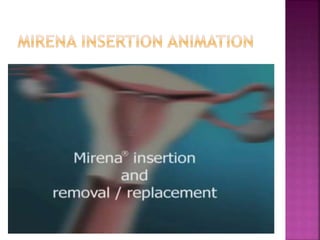
IUD/MULTILOAD/MIRENA
 PROCEDURE OF REMOVAL OF IUCD
 COMPLICATIONS & MANAGEMENT
 INDICATIONS FOR IUCD REMOVAL
 ADVANTAGES
 NONCONTRACEPTIVE BENEFITS OF HORMONAL
IUCDs
 DISADVANTAGES OF HORMONAL IUCDs
 Most commonly used contraceptive
worldwide
 IUDs have a small plastic frame which has to
be inserted into the uterine cavity
 Safe,effective & reversible method of
contraception
 They have failure rate of less than 1%
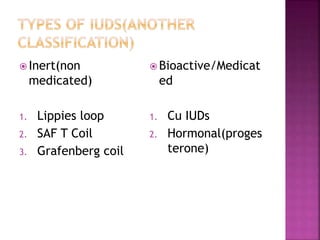
 Inert(non
medicated)
1. Lippies loop
2. SAF T Coil
3. Grafenberg coil
 Bioactive/Medicat
ed
1. Cu IUDs
2. Hormonal(proges
terone)
 BIOACTIVE
1. Cu7,Cu 250(3yrs)
2. Multiload
375(5yrs)
3. Cu T 380
A(PARAGARD)(10y
rs)
 HORMONAL
1. Progestasert(Iyr)
2. LNG IUD(7 yrs)
3. Skyla(3yrs)
4. Gynefix
COPPER IUD
 It is a T shaped polyethyelene device 32mm
long &32mm wide.It comes in a package with
single use inserter.A monofilament
polyethylene thread is attached to a loop at
the base of the stem.
 T shaped body has barium sulphate for
visualisation on X Ray
 LNG is dispersed in a silicon reservoir on the
stem
 It has 52 mg of LNG releasing 20mcg/day
after insertion.VERY LOW DOSE IS RELEASED
COMPARED TO OC PILLS
Newer
IUDs(Gynefix/Skyla)
GYNEFIX
 Biochemical & Histological reactions
Nonspecific inflammatory reaction
which affects the
1. Functioning & viability of gametes
2. Prevents fertilization
3. Reduces chance of implantation
4. Release PGs which r toxic to sperms
5. Macrophages cause phagocytosis of
sperms
 Endometrial INFLAMMATORY RESPONSE
decreases sperm transport & ability to meet
the ovum
 Cu devices…Ionised copper has antifertility
effect by impairing blastocyst implantation.
Cu ions release cytokines which r cytotoxic
Cu ions impede sperm transport & viability in
the cervical mucus
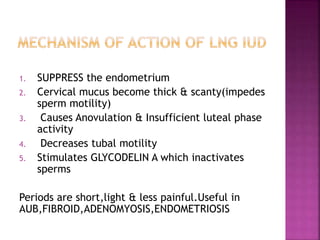
1. SUPPRESS the endometrium
2. Cervical mucus become thick & scanty(impedes
sperm motility)
3. Causes Anovulation & Insufficient luteal phase
activity
4. Decreases tubal motility
5. Stimulates GLYCODELIN A which inactivates
sperms
Periods are short,light & less painful.Useful in
AUB,FIBROID,ADENOMYOSIS,ENDOMETRIOSIS
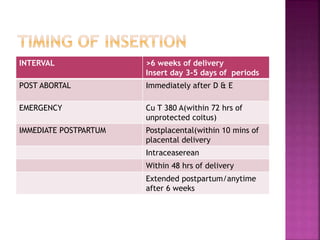
INTERVAL >6 weeks of delivery
Insert day 3-5 days of periods
POST ABORTAL Immediately after D & E
EMERGENCY Cu T 380 A(within 72 hrs of
unprotected coitus)
IMMEDIATE POSTPARTUM Postplacental(within 10 mins of
placental delivery
Intraceaserean
Within 48 hrs of delivery
Extended postpartum/anytime
after 6 weeks
 Pregnancy ruled out
 Cervix partially open(no paracervical block
needed)
 Pain mixed with menstrual cramps
Postinsertion
menorrhagia/dysmenorrhea may be
there for 3 months
She has to feel the threads
occassionally
During 1st period of insertion,check
the pads for expulsion
Follow up if periods are missed
Regular follow up as advised
 First FU after periods
 Later on every 6 months
 Later on yearly
 Pregnancy
 Undiagnosed vaginal bleeding
 Acute pelvic infection in last 3 mnths
 Distorted uterine cavity
 Severe dysmenorrhea
 Known/suspected uterine/cervical neoplasia
 Ppartum/Post abortal endometritis in last 3 mnths
 STIs
 Molar pregnancy
 Cu IUDs :Cu allergy/Wilson s disease
 LNG IUS:hepatic tumour/hepatocellular disease OR current
breast disease OR severe arterial disease
 PUSH METHOD
 WITHDRAWAL METHOD
 complete history/Per speculum & Pelvic Examination.
 OPD Procedure
 Empty bladder
 Patient in lithotomy position
 Load the Cu t 250 using no touch technique
 The genital area cleansed with savlon/betadine
 Bimanual exam for uterine position
 Measure the UCL by uterine sound
 Adjust the guard on the inserter tube to the UCL
 Insert plunger into the inserter
 Introduce the IUD into the uterine cavity.
 The horizontal arms should sit at the fundus
 Once the inserter with IUD touches the fundus
(guard/flangeat the external os),the inserter
tube along with the plunger are gently
withdrawn together causing release of horizontal
arms
 The threads are cut 1 to 2 cms from the external
os
 Applicator with device is taken out of sealed
packet
 Pushed through the os into the uterine cavity
upto fundus
 Applicator is withdrawn releasing the IUD
 The vertical stem is thicker
 May need cervical dilatation/mild local
analgesia
 Slider is adjusted to pull the mirena into the
inserter tubeUCL measured & flange adjusted
 UCL measured & flange adjusted
 Mirena inserted into the uterine cavity
 The slider is advanced backward to release
the IUD.
 Patient empties the bladder
 Lithotomy position
 Speculum introduced
 Cervix held with vulsellum
 Threads are visualised & caught with artery
forceps & IUD pulled out
 Shown to the patient
 IMMEDIATE COMPLICATIONS
 REMOTE COMPLICATIONS
CRAMP LIKE PAIN ANALGESICS
SYNCOPAL ATTACK PROPER SIZE IUD
PARTIAL/COMPLETE
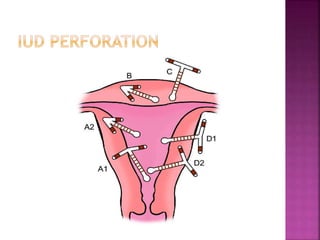
PERFORATION
FAULTY INSERTION TECHNIQUE
• PAIN PROPER SIZE DEVICE
• ABNORMAL UTERINE BLEEDING
(menorrhagia/more
duration/intermenstrual
spotting)
Counselling
Tranaxemic acid 500mg TID
NOT THERE WITH LNG IUS(60%
reduction of bleeding & 50% have
amenorrhea)
• PID Don’t insert if pt has any
infective vaginal discharge
Asepsis during insertion
• SPONTANEOUS EXPULSION 5%
More with postabortal or
postpartum insertions
Check during periods
Feeling of threads
• PERFORATION OF UTERUS
1:1000
Uncommon with withdrawal
technique
Examination
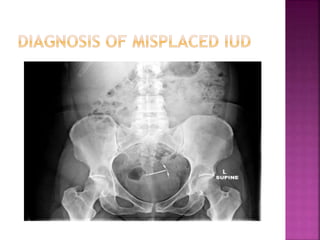
X Ray with sound
USG
HYSTEROSCOPY
USG TO DIAGNOSE MISPLACED IUD
NORMAL USG MISPLACED IUD
WITHIN CAVITY OUTSIDE CAVITY
Cu T hook removal Laparoscopy
Curette Laparotomy
Artery forceps
Hysteroscopy NOTE:Cu T causes intense
inflammatory reaction
surrounding structureswith
 LOWEST with paragard/LNG IUS
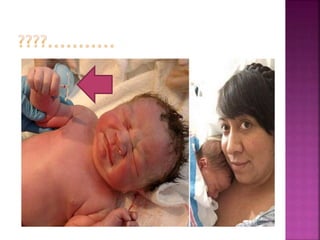
 Risk of ECTOPIC PREGNANCY is there
 If insitu it can lead to Abortion,Preterm
labour,Sepsis,Placenta
previa,Abruption,LBW & Malformations
WHAT TO DO?
1. Thread visible:Remove the device
2. Thread not visible:Counsel & do
termination/Continuation
 Desiring pregnancy
 Effective lifespan of IUD is over
 Missing threads
 Perforation
 Persistent vaginal discharge
 Pregnancy with IUD insitu
 Persistent excessive bleeding/dysmenorrhea
 One year after menopause
 Reduction in the risk of endometrial &
cervical cancer
 LNG IUS can be used as a fertility sparing
treatment of early stage endometrial Ca
 Safe & as effective as sterilisation procedure
 As an alternative treatment for
MENORRHAGIA,AUB,ADENOMYOSIS,SMALL
FIBROIDS & ENDOMETRIOSIS
 Safe & highly effective
 Long term protection
 Economical
 Simple insertion/removal technique
 No systemic side effects9HT,breast feeding &
epileptics)
 Immediate return to fertility after removal
 No repeated costs /repeated visits
 High continuation rates & user satisfaction
 Apart from contraception,it is also used post
adhesiolysis of Ashermanns syndrome(without
copper)
 Cu T 380 A,mirena,multiload 375
 Higher efficacy with lower pregnancy rates
 More longer duration of action
 Lower expulsion rates
 Risk of ectopic pregnancy is reduced
 Risk of PID,anaemia is reduced
 LNG IUD..Benefits
AUB,anaemia,endometriosis,dysmenorrhea,PID &
higher satisfaction
 Hormonal IUD has no effect on carbohydrate Or
lipid metabolism,cagulation Or liver functions.
 Expensive
 Not supplied by govt in India
 Amenorrhea(5%)…return to normal menses
occurs after removal
 Malpositioning may cause
pregnancy/expulsion
 Minor side effects of LNG..acne,depression
and mood change,breast tenderness,nausea
& headache,slight spotting daily during early
weeks
CONTRACEPTION  IUCD POWERPOINT

CONTRACEPTION IUCD POWERPOINT

  • 1.
  • 2.
     What isIUD?  TYPES  MECHANISM OF ACTION  TIMING OF INSERTION  CONTRAINDICATIONS  METHODS OF INSERTION  PROCEDURE OF INSERTING COPPER IUD/MULTILOAD/MIRENA  PROCEDURE OF REMOVAL OF IUCD  COMPLICATIONS & MANAGEMENT  INDICATIONS FOR IUCD REMOVAL  ADVANTAGES  NONCONTRACEPTIVE BENEFITS OF HORMONAL IUCDs  DISADVANTAGES OF HORMONAL IUCDs
  • 3.
     Most commonlyused contraceptive worldwide  IUDs have a small plastic frame which has to be inserted into the uterine cavity  Safe,effective & reversible method of contraception  They have failure rate of less than 1%
  • 5.
     Inert(non medicated) 1. Lippiesloop 2. SAF T Coil 3. Grafenberg coil  Bioactive/Medicat ed 1. Cu IUDs 2. Hormonal(proges terone)
  • 6.
     BIOACTIVE 1. Cu7,Cu250(3yrs) 2. Multiload 375(5yrs) 3. Cu T 380 A(PARAGARD)(10y rs)  HORMONAL 1. Progestasert(Iyr) 2. LNG IUD(7 yrs) 3. Skyla(3yrs) 4. Gynefix
  • 9.
  • 13.
     It isa T shaped polyethyelene device 32mm long &32mm wide.It comes in a package with single use inserter.A monofilament polyethylene thread is attached to a loop at the base of the stem.  T shaped body has barium sulphate for visualisation on X Ray  LNG is dispersed in a silicon reservoir on the stem  It has 52 mg of LNG releasing 20mcg/day after insertion.VERY LOW DOSE IS RELEASED COMPARED TO OC PILLS
  • 17.
  • 19.
     Biochemical &Histological reactions Nonspecific inflammatory reaction which affects the 1. Functioning & viability of gametes 2. Prevents fertilization 3. Reduces chance of implantation 4. Release PGs which r toxic to sperms 5. Macrophages cause phagocytosis of sperms
  • 20.
     Endometrial INFLAMMATORYRESPONSE decreases sperm transport & ability to meet the ovum  Cu devices…Ionised copper has antifertility effect by impairing blastocyst implantation. Cu ions release cytokines which r cytotoxic Cu ions impede sperm transport & viability in the cervical mucus
  • 21.
    1. SUPPRESS theendometrium 2. Cervical mucus become thick & scanty(impedes sperm motility) 3. Causes Anovulation & Insufficient luteal phase activity 4. Decreases tubal motility 5. Stimulates GLYCODELIN A which inactivates sperms Periods are short,light & less painful.Useful in AUB,FIBROID,ADENOMYOSIS,ENDOMETRIOSIS
  • 22.
    INTERVAL >6 weeksof delivery Insert day 3-5 days of periods POST ABORTAL Immediately after D & E EMERGENCY Cu T 380 A(within 72 hrs of unprotected coitus) IMMEDIATE POSTPARTUM Postplacental(within 10 mins of placental delivery Intraceaserean Within 48 hrs of delivery Extended postpartum/anytime after 6 weeks
  • 23.
     Pregnancy ruledout  Cervix partially open(no paracervical block needed)  Pain mixed with menstrual cramps
  • 24.
    Postinsertion menorrhagia/dysmenorrhea may be therefor 3 months She has to feel the threads occassionally During 1st period of insertion,check the pads for expulsion Follow up if periods are missed Regular follow up as advised
  • 25.
     First FUafter periods  Later on every 6 months  Later on yearly
  • 26.
     Pregnancy  Undiagnosedvaginal bleeding  Acute pelvic infection in last 3 mnths  Distorted uterine cavity  Severe dysmenorrhea  Known/suspected uterine/cervical neoplasia  Ppartum/Post abortal endometritis in last 3 mnths  STIs  Molar pregnancy  Cu IUDs :Cu allergy/Wilson s disease  LNG IUS:hepatic tumour/hepatocellular disease OR current breast disease OR severe arterial disease
  • 27.
     PUSH METHOD WITHDRAWAL METHOD
  • 30.
     complete history/Perspeculum & Pelvic Examination.  OPD Procedure  Empty bladder  Patient in lithotomy position  Load the Cu t 250 using no touch technique  The genital area cleansed with savlon/betadine  Bimanual exam for uterine position  Measure the UCL by uterine sound  Adjust the guard on the inserter tube to the UCL  Insert plunger into the inserter  Introduce the IUD into the uterine cavity.
  • 31.
     The horizontalarms should sit at the fundus  Once the inserter with IUD touches the fundus (guard/flangeat the external os),the inserter tube along with the plunger are gently withdrawn together causing release of horizontal arms  The threads are cut 1 to 2 cms from the external os
  • 33.
     Applicator withdevice is taken out of sealed packet  Pushed through the os into the uterine cavity upto fundus  Applicator is withdrawn releasing the IUD
  • 35.
     The verticalstem is thicker  May need cervical dilatation/mild local analgesia  Slider is adjusted to pull the mirena into the inserter tubeUCL measured & flange adjusted  UCL measured & flange adjusted  Mirena inserted into the uterine cavity  The slider is advanced backward to release the IUD.
  • 37.
     Patient emptiesthe bladder  Lithotomy position  Speculum introduced  Cervix held with vulsellum  Threads are visualised & caught with artery forceps & IUD pulled out  Shown to the patient
  • 38.
     IMMEDIATE COMPLICATIONS REMOTE COMPLICATIONS
  • 39.
    CRAMP LIKE PAINANALGESICS SYNCOPAL ATTACK PROPER SIZE IUD PARTIAL/COMPLETE PERFORATION FAULTY INSERTION TECHNIQUE
  • 40.
    • PAIN PROPERSIZE DEVICE • ABNORMAL UTERINE BLEEDING (menorrhagia/more duration/intermenstrual spotting) Counselling Tranaxemic acid 500mg TID NOT THERE WITH LNG IUS(60% reduction of bleeding & 50% have amenorrhea) • PID Don’t insert if pt has any infective vaginal discharge Asepsis during insertion • SPONTANEOUS EXPULSION 5% More with postabortal or postpartum insertions Check during periods Feeling of threads • PERFORATION OF UTERUS 1:1000 Uncommon with withdrawal technique Examination X Ray with sound USG HYSTEROSCOPY
  • 44.
    USG TO DIAGNOSEMISPLACED IUD NORMAL USG MISPLACED IUD
  • 45.
    WITHIN CAVITY OUTSIDECAVITY Cu T hook removal Laparoscopy Curette Laparotomy Artery forceps Hysteroscopy NOTE:Cu T causes intense inflammatory reaction surrounding structureswith
  • 47.
     LOWEST withparagard/LNG IUS  Risk of ECTOPIC PREGNANCY is there  If insitu it can lead to Abortion,Preterm labour,Sepsis,Placenta previa,Abruption,LBW & Malformations WHAT TO DO? 1. Thread visible:Remove the device 2. Thread not visible:Counsel & do termination/Continuation
  • 48.
     Desiring pregnancy Effective lifespan of IUD is over  Missing threads  Perforation  Persistent vaginal discharge  Pregnancy with IUD insitu  Persistent excessive bleeding/dysmenorrhea  One year after menopause
  • 49.
     Reduction inthe risk of endometrial & cervical cancer  LNG IUS can be used as a fertility sparing treatment of early stage endometrial Ca  Safe & as effective as sterilisation procedure  As an alternative treatment for MENORRHAGIA,AUB,ADENOMYOSIS,SMALL FIBROIDS & ENDOMETRIOSIS
  • 50.
     Safe &highly effective  Long term protection  Economical  Simple insertion/removal technique  No systemic side effects9HT,breast feeding & epileptics)  Immediate return to fertility after removal  No repeated costs /repeated visits  High continuation rates & user satisfaction  Apart from contraception,it is also used post adhesiolysis of Ashermanns syndrome(without copper)
  • 51.
     Cu T380 A,mirena,multiload 375  Higher efficacy with lower pregnancy rates  More longer duration of action  Lower expulsion rates  Risk of ectopic pregnancy is reduced  Risk of PID,anaemia is reduced  LNG IUD..Benefits AUB,anaemia,endometriosis,dysmenorrhea,PID & higher satisfaction  Hormonal IUD has no effect on carbohydrate Or lipid metabolism,cagulation Or liver functions.
  • 52.
     Expensive  Notsupplied by govt in India  Amenorrhea(5%)…return to normal menses occurs after removal  Malpositioning may cause pregnancy/expulsion  Minor side effects of LNG..acne,depression and mood change,breast tenderness,nausea & headache,slight spotting daily during early weeks