METHODS OF POPULATION
CONTROL
• Contraceptive or fertility Regulating methods are preventive methods
to help women avoid unwanted pregnancies.
• They include all temporary and permanent measures to prevent
pregnancy.
IDEAL CONTRACEPTIVE

Safe

Effective

Acceptable

Inexpensive

Reversible

Simple to administer

Independent of coitus

Long-lasting

Little or no medical supervision
• The present approach in family planning programmes is to
offer all methods from which an individual can choose
according to his needs and wishes and to promote family
planning as a way of life.
• Conventional contraceptives denote methods used that require
action at the time of coitus.
E.g. : Condoms , spermicides , etc .
Spacing methods
 Barrier methods
A) PHYSICAL METHODS
B) CHEMICAL METHODS
C) COMBINED METHODS
 Intra-uterine devices
 Hormonal methods
 Post-conceptional methods
 Miscellaneous
TERMINAL METHODS
Male sterilisation
Female sterilisation
BARRIER METHODS
Occlusive methods:
The aim of these methods is to prevent sperm from meeting
Ovum.
Eg: Male condom, female condom
Advantages :
Free from side effects associated with pills & IUD.
Protection from STD’s , pelvic inflammatory diseases & cancer
Cervix.
Disadvantages
High degree of motivation
Less effective than pill or loop
They should be used consistently & carefully.
INTRA UTERINE DEVICES
2 types of IUDs
1. Nonmedicated 2. Medicated
1.Cu IUDs 2. Hormone Releasing
• Both types ( Medicated & Nonmedicated ) IUDs made up of
polyethylene or other polymers.
• Non medicated/ Inert/ First generation IUDs :
• Loops, spirals, coils, rings, bows etc.
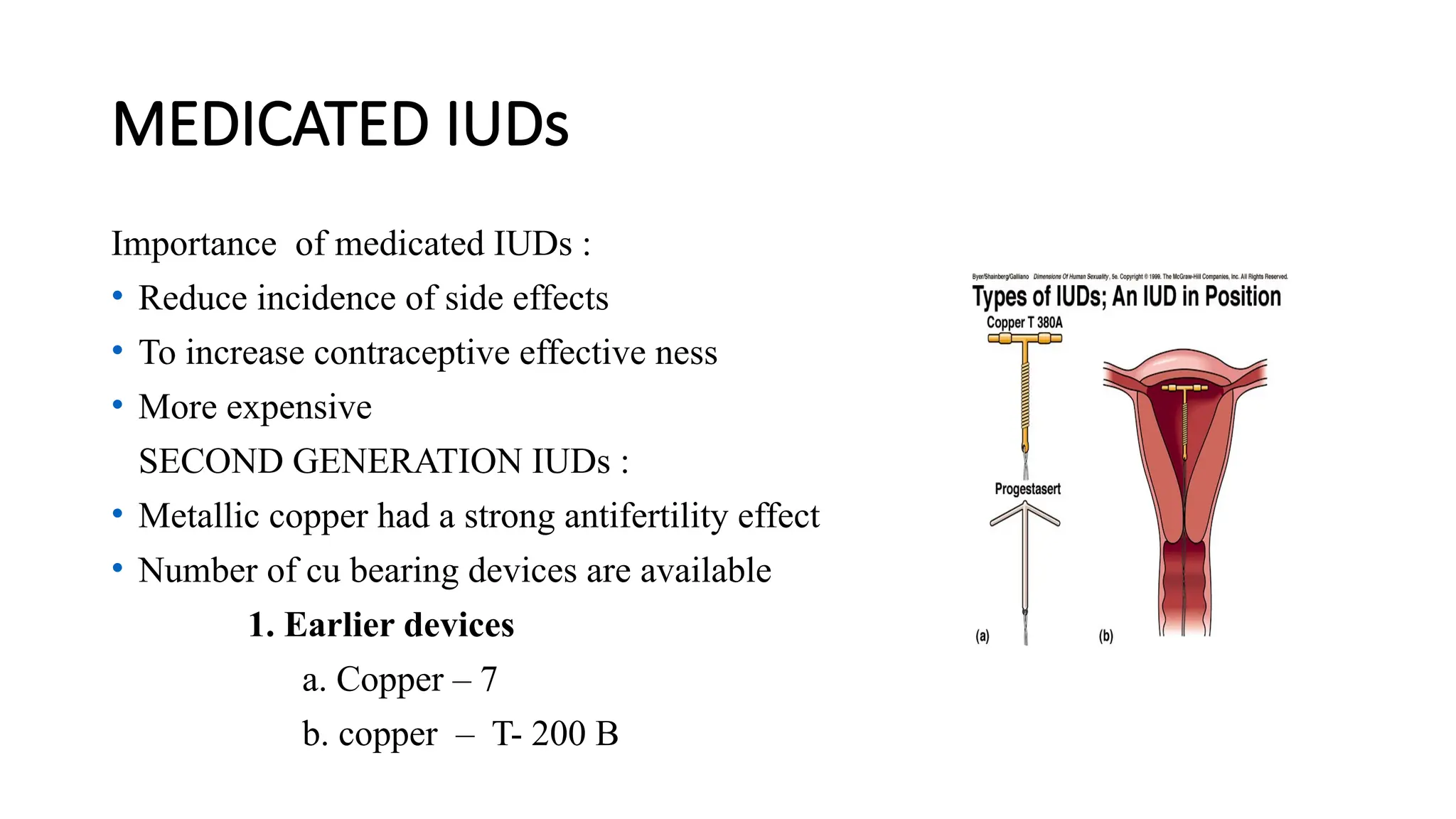
MEDICATED IUDs
Importance of medicated IUDs :
• Reduce incidence of side effects
• To increase contraceptive effective ness
• More expensive
SECOND GENERATION IUDs :
• Metallic copper had a strong antifertility effect
• Number of cu bearing devices are available
1. Earlier devices
a. Copper – 7
b. copper – T- 200 B
2. Newer devices
a. variants of the T devices
i. T cu – 220C
ii. T cu – 380 A or Ag
b. Nova T
c. Multi load devices
i. ML – Cu -250
ii. ML – Cu- 375
Numbers represents the surface area of
the copper on the device (in. sq mm).
THIRD GENERATION IUD
• Most widely used hormonal devices are
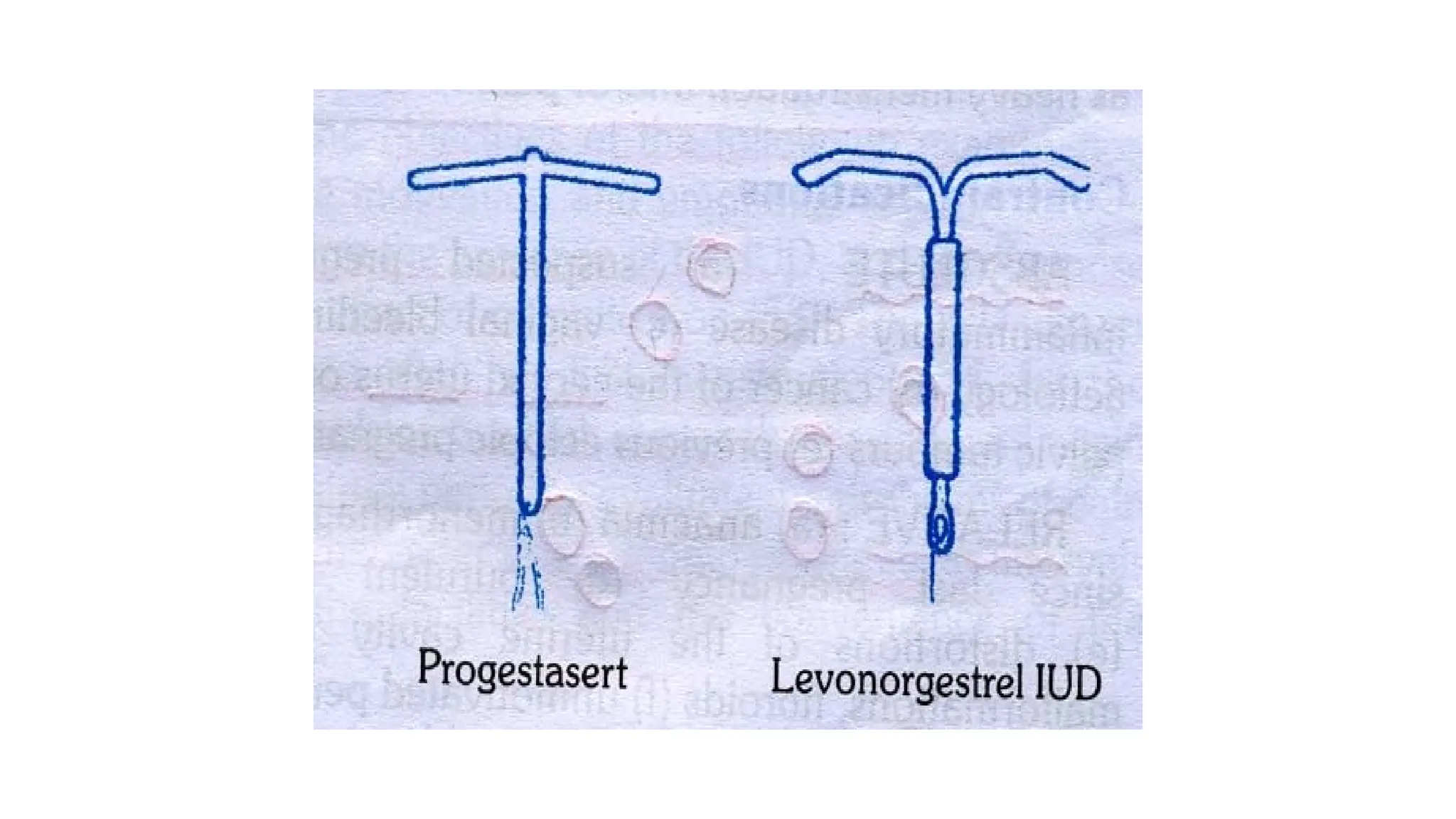
1.Progestasert
• T shape device filled with 38 mg of progesterone
• It has direct effect on uterine lining, cervical mucus and sperms
• 2. Levonorgestrel (LNG – 20)
• T shaped device
• It has 1. low pregnancy rate
2. less number of ectopic pregnancies
3. Lower menstrual blood loss
4. Fewer days of bleeding
MOA
• Foreign body reaction.
• Cellular and biochemical changes.
• Impair the viability of the gamete.
• Reduce the chances of fertilisation rather than implantation.
• Copper enhances the Cellular response in the endometrium.
• Affects the enzymes in the uterus.
• Alter biochemical composition ofcervical mucus.
• Hormonal devices increase viscosity of the cervical mucus.
Advantages
• 1. Simplicity
• 2. Insertion takes few minutes
• 3. Once inserted IUD stays in place as long as required
• 4. Reversible
• 5. In expensive
• 6. High continuation rates
• 7. Single act of motivation
• 8. Free of systemic side effects
HORMONAL CONTRACEPTIVES
• Hormonal contraceptives when properly used are the most effective
methods of contraception
• They provide the best means of ensuring spacing between one
childbirth and another
• GONADAL STEROIDES:
a. synthetic steroids: eg ethinyl oestradiol and mestranol.
b. synthetic progestogens: they are pregnanes , oestranes and
gonanes.
CLASSIFICATION
a) ORAL PILLS
1.Combined pills
2.Progestogen only pill
3.Post coital pill
4.Once a month pill
5.Male pill
b) DEPOT FORMULATIONS
1. Injectables
2. Subcutaneous implants
3. vaginal rings
ORAL PILLS
1. Combined pill:
It is one of the major spacing methods of contraception.It
contains 30-35 mcg of a synthetic oestrogen and 0.5 to 1
mcg of a progesterone.
The pill should be taken at a fixed time everyday.
• The pill is given orally for 21 days starting on the 5th
day of menstrual
cycle followed by a break of 7 days during which menstruation occurs.
• This is called withdrawal bleeding.
• The department of family welfare , in the Ministry of Health and
Family Welfare Govt. of India has made available low dose of oral
pills – MALA-N and MALA-D.
2. Progesterone only pill
• It is called as minipill or micropill .it contains only progesterone which
is given in small doses through out the cycle.
• These pills have an increased pregnancy rate so not being used , but
can be used for women with cardiovascular problem and for those
with the risk factors for neoplasia.
3. Post coital contraception:
It is used within 48 hrs of unprotected intercourse.
Two methods are available.
a) IUD: e.g. copper device
b) Hormonal: combine oc pill is used. It contains double dose of
the standard combined pill. 2 pills immediately followed by 2 pills
12 hours later.
For emergency contraception a women must take four instead of 2
in each dose.
4. Once a month long acting pill
• Quniestrol , a long acting estrogen is given in combination with a
short acting progesterone.
• Disadvantage: high pregnancy rate and irregular bleeding.
5. Male pill:
The approach is
• a) preventing spermatogenesis.
b) interfering with sperm storage.
c) preventing sperm transport.
d) affecting the seminal fluid constitution.
• An ideal male contraceptive will decrease the sperm count while
leaving testosterone at normal values.
Mode of action of oral pill:
• Combined only pill prevents the release of ova from the ovary by
blocking the pituitary secretion of gonadotropin.
• Progesterone only pills render the cervical mucus thick and
scanty and inhibit the sperm penetration.
Effectiveness :
• If taken according to the prescribed regimen oral contraceptives of
the combined type are 100% effective.
• It is also influenced by drugs – rifampicin, phenobarbital, ampicillin.
BENEFICIAL EFFECTS
Contraceptive benefits- prevention of unwanted pregnancy (failure rate-
0.1per 100 women year).
Non contraceptive benefits-
a. relief of:
menorrhagia (50% ),
dysmenorrhoea (40% ),
premenstrual tension syndrome,
mittleschmerz syndrome.
b. improvement of:
iron def. anemia,hirsutism,
acne, endometriosis, autoimmune disorders of
thyroid, rheumatoid arthritis.
c. Marked reduction in: pelvic inflammatory disease, benign breast
cancer, ectopic pregnancy, fibroid uterus, functional ovarian cysts,
carcinoma of ovary (40%) carcinoma of endometrium (50% )
protection against osteoporosis.
b) DEPOT FORMULATIONS
• Injectable contraceptives, sub dermal implants and vaginal
rings come in this category.
1. Injectable contraceptives:
There are two types:
PROGESTAGEN ONLY INJECTABLES:
• (a) DMPA: Depot medroxy - progesterone acetate.
• Dose is i.m injection of 150mg every 3months.
• It is safe effective and an acceptable contraceptive.
• Acceptable in the postpartum period as a means of spacing.
• Side effects: weight increase, irregular menstrual bleeding.
(b) NET-EN
• Norethisterone enantate is given as i.m injection dose of
200mg. every 60 days.
• Contraceptive action is by inhibiting ovulation and
progesterogenic effects on cervical mucus.
ADMINISTRATION:
• Both DMPA ,NET-EN should be given during first five days of
menstrual period.
B. COMBINED INJECTABLE :
• They contain a progestogen and an oestrogen.
• Given at monthly intervals.
• Act by suppressing ovulation ,cervical mucus is affected
mainly by progestogen and inhibits sperm penetration.
• CONTRAINDICATIONS: confirmed or suspected pregnancy;
past or present evidence of thromboembolic disorders;
cerebrovascular or coronary artery disease; focal migraine;
malignancy of breast and diabetes with vascular
complications.
2. SUBDERMAL IMPLANTS:
• Norplant : it consists of 6 silastic capsules containing 35mg of
levonorgesterel.
• The capsules are implanted beneath the skin of forearm or
upper arm.
• Effective contraception is provided for 5 years.
3. VAGINAL RINGS
Vaginal rings containing levonorgesterel are highly effective.
• The hormone is slowly absorbed through the vaginal mucosa
, bypassing the digestive tract and liver and allowing a
potentially lower dose.
• The ring is worn in the vagina for 3 weeks and removed for
the 4th
week.
THANK YOU

14193_contraception.pptx Contraception PPT

  • 1.
  • 2.
    • Contraceptive orfertility Regulating methods are preventive methods to help women avoid unwanted pregnancies. • They include all temporary and permanent measures to prevent pregnancy.
  • 3.
    IDEAL CONTRACEPTIVE  Safe  Effective  Acceptable  Inexpensive  Reversible  Simple toadminister  Independent of coitus  Long-lasting  Little or no medical supervision
  • 4.
    • The presentapproach in family planning programmes is to offer all methods from which an individual can choose according to his needs and wishes and to promote family planning as a way of life. • Conventional contraceptives denote methods used that require action at the time of coitus. E.g. : Condoms , spermicides , etc .
  • 5.
    Spacing methods  Barriermethods A) PHYSICAL METHODS B) CHEMICAL METHODS C) COMBINED METHODS  Intra-uterine devices  Hormonal methods  Post-conceptional methods  Miscellaneous
  • 6.
  • 7.
    BARRIER METHODS Occlusive methods: Theaim of these methods is to prevent sperm from meeting Ovum. Eg: Male condom, female condom Advantages : Free from side effects associated with pills & IUD. Protection from STD’s , pelvic inflammatory diseases & cancer Cervix.
  • 8.
    Disadvantages High degree ofmotivation Less effective than pill or loop They should be used consistently & carefully.
  • 9.
    INTRA UTERINE DEVICES 2types of IUDs 1. Nonmedicated 2. Medicated 1.Cu IUDs 2. Hormone Releasing • Both types ( Medicated & Nonmedicated ) IUDs made up of polyethylene or other polymers.
  • 10.
    • Non medicated/Inert/ First generation IUDs : • Loops, spirals, coils, rings, bows etc.
  • 12.
    MEDICATED IUDs Importance ofmedicated IUDs : • Reduce incidence of side effects • To increase contraceptive effective ness • More expensive SECOND GENERATION IUDs : • Metallic copper had a strong antifertility effect • Number of cu bearing devices are available 1. Earlier devices a. Copper – 7 b. copper – T- 200 B
  • 13.
    2. Newer devices a.variants of the T devices i. T cu – 220C ii. T cu – 380 A or Ag b. Nova T c. Multi load devices i. ML – Cu -250 ii. ML – Cu- 375 Numbers represents the surface area of the copper on the device (in. sq mm).
  • 14.
    THIRD GENERATION IUD •Most widely used hormonal devices are 1.Progestasert • T shape device filled with 38 mg of progesterone • It has direct effect on uterine lining, cervical mucus and sperms • 2. Levonorgestrel (LNG – 20) • T shaped device • It has 1. low pregnancy rate 2. less number of ectopic pregnancies 3. Lower menstrual blood loss 4. Fewer days of bleeding
  • 16.
    MOA • Foreign bodyreaction. • Cellular and biochemical changes. • Impair the viability of the gamete. • Reduce the chances of fertilisation rather than implantation. • Copper enhances the Cellular response in the endometrium. • Affects the enzymes in the uterus. • Alter biochemical composition ofcervical mucus. • Hormonal devices increase viscosity of the cervical mucus.
  • 17.
    Advantages • 1. Simplicity •2. Insertion takes few minutes • 3. Once inserted IUD stays in place as long as required • 4. Reversible • 5. In expensive • 6. High continuation rates • 7. Single act of motivation • 8. Free of systemic side effects
  • 18.
    HORMONAL CONTRACEPTIVES • Hormonalcontraceptives when properly used are the most effective methods of contraception • They provide the best means of ensuring spacing between one childbirth and another • GONADAL STEROIDES: a. synthetic steroids: eg ethinyl oestradiol and mestranol. b. synthetic progestogens: they are pregnanes , oestranes and gonanes.
  • 19.
    CLASSIFICATION a) ORAL PILLS 1.Combinedpills 2.Progestogen only pill 3.Post coital pill 4.Once a month pill 5.Male pill b) DEPOT FORMULATIONS 1. Injectables 2. Subcutaneous implants 3. vaginal rings
  • 20.
    ORAL PILLS 1. Combinedpill: It is one of the major spacing methods of contraception.It contains 30-35 mcg of a synthetic oestrogen and 0.5 to 1 mcg of a progesterone. The pill should be taken at a fixed time everyday.
  • 21.
    • The pillis given orally for 21 days starting on the 5th day of menstrual cycle followed by a break of 7 days during which menstruation occurs. • This is called withdrawal bleeding. • The department of family welfare , in the Ministry of Health and Family Welfare Govt. of India has made available low dose of oral pills – MALA-N and MALA-D.
  • 22.
    2. Progesterone onlypill • It is called as minipill or micropill .it contains only progesterone which is given in small doses through out the cycle. • These pills have an increased pregnancy rate so not being used , but can be used for women with cardiovascular problem and for those with the risk factors for neoplasia.
  • 23.
    3. Post coitalcontraception: It is used within 48 hrs of unprotected intercourse. Two methods are available. a) IUD: e.g. copper device b) Hormonal: combine oc pill is used. It contains double dose of the standard combined pill. 2 pills immediately followed by 2 pills 12 hours later. For emergency contraception a women must take four instead of 2 in each dose.
  • 24.
    4. Once amonth long acting pill • Quniestrol , a long acting estrogen is given in combination with a short acting progesterone. • Disadvantage: high pregnancy rate and irregular bleeding.
  • 25.
    5. Male pill: Theapproach is • a) preventing spermatogenesis. b) interfering with sperm storage. c) preventing sperm transport. d) affecting the seminal fluid constitution. • An ideal male contraceptive will decrease the sperm count while leaving testosterone at normal values.
  • 26.
    Mode of actionof oral pill: • Combined only pill prevents the release of ova from the ovary by blocking the pituitary secretion of gonadotropin. • Progesterone only pills render the cervical mucus thick and scanty and inhibit the sperm penetration.
  • 27.
    Effectiveness : • Iftaken according to the prescribed regimen oral contraceptives of the combined type are 100% effective. • It is also influenced by drugs – rifampicin, phenobarbital, ampicillin.
  • 28.
    BENEFICIAL EFFECTS Contraceptive benefits-prevention of unwanted pregnancy (failure rate- 0.1per 100 women year). Non contraceptive benefits- a. relief of: menorrhagia (50% ), dysmenorrhoea (40% ), premenstrual tension syndrome, mittleschmerz syndrome. b. improvement of: iron def. anemia,hirsutism, acne, endometriosis, autoimmune disorders of thyroid, rheumatoid arthritis.
  • 29.
    c. Marked reductionin: pelvic inflammatory disease, benign breast cancer, ectopic pregnancy, fibroid uterus, functional ovarian cysts, carcinoma of ovary (40%) carcinoma of endometrium (50% ) protection against osteoporosis.
  • 30.
    b) DEPOT FORMULATIONS •Injectable contraceptives, sub dermal implants and vaginal rings come in this category. 1. Injectable contraceptives: There are two types: PROGESTAGEN ONLY INJECTABLES: • (a) DMPA: Depot medroxy - progesterone acetate. • Dose is i.m injection of 150mg every 3months.
  • 31.
    • It issafe effective and an acceptable contraceptive. • Acceptable in the postpartum period as a means of spacing. • Side effects: weight increase, irregular menstrual bleeding.
  • 32.
    (b) NET-EN • Norethisteroneenantate is given as i.m injection dose of 200mg. every 60 days. • Contraceptive action is by inhibiting ovulation and progesterogenic effects on cervical mucus. ADMINISTRATION: • Both DMPA ,NET-EN should be given during first five days of menstrual period.
  • 33.
    B. COMBINED INJECTABLE: • They contain a progestogen and an oestrogen. • Given at monthly intervals. • Act by suppressing ovulation ,cervical mucus is affected mainly by progestogen and inhibits sperm penetration. • CONTRAINDICATIONS: confirmed or suspected pregnancy; past or present evidence of thromboembolic disorders; cerebrovascular or coronary artery disease; focal migraine; malignancy of breast and diabetes with vascular complications.
  • 34.
    2. SUBDERMAL IMPLANTS: •Norplant : it consists of 6 silastic capsules containing 35mg of levonorgesterel. • The capsules are implanted beneath the skin of forearm or upper arm. • Effective contraception is provided for 5 years.
  • 35.
    3. VAGINAL RINGS Vaginalrings containing levonorgesterel are highly effective. • The hormone is slowly absorbed through the vaginal mucosa , bypassing the digestive tract and liver and allowing a potentially lower dose. • The ring is worn in the vagina for 3 weeks and removed for the 4th week.
  • 36.