Antisperm Antibody
Detection Methods
by: Ahmad Ricardo
When an ASA assay should be
obtained ?
1) the semen analysis shows sperm agglutination or
clumping in the absence of clinical infection;
2) low sperm motility exists, with history of testis
injury or surgery;
3) there is confirmation that increased round cells
are leukocytes ;
4) sperm “shaking” is observed on sperm–cervical
mucus contact testing;
5) poor penetration of mucus is observed on a
postcoital test;
6) there is unexplained infertility.
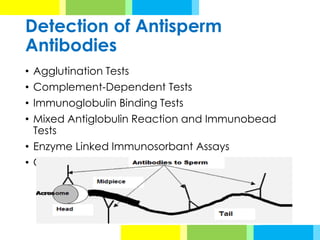
Detection of Antisperm
Antibodies
• Agglutination Tests
• Complement-Dependent Tests
• Immunoglobulin Binding Tests
• Mixed Antiglobulin Reaction and Immunobead
Tests
• Enzyme Linked Immunosorbant Assays
• Other Tests
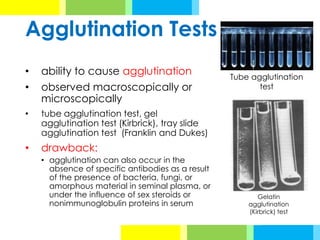
Agglutination Tests
• ability to cause agglutination
• observed macroscopically or
microscopically
• tube agglutination test, gel
agglutination test (Kirbrick), tray slide
agglutination test (Franklin and Dukes)
• drawback:
• agglutination can also occur in the
absence of specific antibodies as a result
of the presence of bacteria, fungi, or
amorphous material in seminal plasma, or
under the influence of sex steroids or
nonimmunoglobulin proteins in serum
Tube agglutination
test
Gelatin
agglutination
(Kirbrick) test
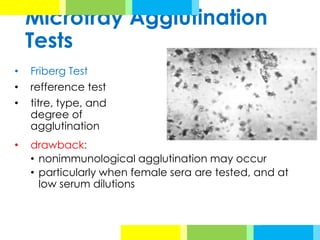
Microtray Agglutination
Tests
• Friberg Test
• refference test
• titre, type, and
degree of
agglutination
• drawback:
• nonimmunological agglutination may occur
• particularly when female sera are tested, and at
low serum dilutions
Complement-Dependent
Tests
(Isojima)
• Induction of a cytotoxic
effect which occurs in the
presence of complement
• Cytotoxicity results in the
loss of sperm motility
• used as a marker
➢ the sperm
immobilization test (SIT)
or
➢ membrane damage
✓ need specific dyes
✓ ATP release cytotoxicity
test (ARCT)→ objective
• disadvantage: can't detect
IgA class antibodies
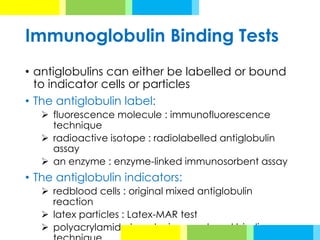
Immunoglobulin Binding Tests
• antiglobulins can either be labelled or bound
to indicator cells or particles
• The antiglobulin label:
➢ fluorescence molecule : immunofluorescence
technique
➢ radioactive isotope : radiolabelled antiglobulin
assay
➢ an enzyme : enzyme-linked immunosorbent assay
• The antiglobulin indicators:
➢ redblood cells : original mixed antiglobulin
reaction
➢ latex particles : Latex-MAR test
➢ polyacrylamide beads : immunobead binding
Mixed Antiglobulin Reaction
Test
• presence of immunoglobulins bound to spermatozoa
• (red blood cells--immunoglobulins) + (motile spermatozoa--
antiglobulin)
→ mixed agglutination
• the coated red blood cells have been replaced
→ coated latex particles
• MAR TEST
•direct : fresh semen
•indirect : blood serum, solubilized cervical mucus
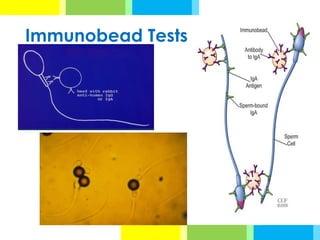
Immunobead Tests
• polyacrylamide beads are coated with polyclonal
antibodies against human IgG, IgA, or IgM
• requires washing the spermatozoa
• repeated centrifugation-resuspension
• remove the bulk of immunoglobulins present in seminal plasma
• ≥ 50% or more adherence of particles to the motile
spermatozoa : strong evidence for an immunological
cause of infertility
• time consuming, less adequate, lower specificity and
sensitivity than the SpermMAR test
Immunobead Tests
Enzyme Linked Immunosorbant
Assays
• Antibody-enzyme-
immunoglobulin
complexes
• add a specific enzyme
substrate →
colourchange
• advantage : specific
and quantitative
• disadvantage: the time
and cost , poor
sensitivity, and inability
to determine ASA
location and isotype.
Postcoital test (PCT)
• examining the cervical mucus several hours after
intercourse for the presence of sperm
• prior to ovulation in the periovulatory phase
• a drop of cervical mucus is examined under wet-
mount microscopy for the presence of sperm
• normal result :
• ≥10–20 sperm per HPF (× 400)
• the majority : progressive motility
• abnormal:
• sperm immobilized
• shaking motion in the cervical mucus (suspicious for the
presence of antisperm antibodies)
Other Tests
• panning procedure for ASA detection on spermatozoa
• polyacrylamide gel electrophoresis and
immunoblotting
• flowcytometry
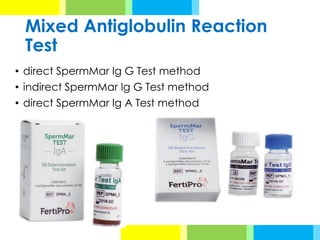
Mixed Antiglobulin Reaction
Test
• direct SpermMar Ig G Test method
• indirect SpermMar Ig G Test method
• direct SpermMar Ig A Test method
Direct SpermMar Ig G Test
method
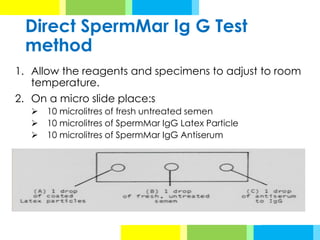
1. Allow the reagents and specimens to adjust to room
temperature.
2. On a micro slide place:s
➢ 10 microlitres of fresh untreated semen
➢ 10 microlitres of SpermMar IgG Latex Particle
➢ 10 microlitres of SpermMar IgG Antiserum
Direct SpermMar Ig G Test
method
con't
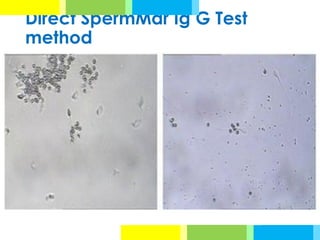
3. Mix the sample and the Latex reagent 5 times with
the edge of a cover glass
4. Mix the Antiserum with the Latex reagent and sample
mixture
5. The cover glass is put on the mixture and the mixture
is observed under a light microscope using a 400x or
a 600x magnification
6. Read the result after 2-3 minutes. Observe for latex
particles attached to motile sperm. Count 100
spermatozoa to determine the percentage reactive
sperm
7. If no attachement of beads to sperm is observed,
read again after 10 minutes
Direct SpermMar Ig G Test
method
Direct SpermMar Ig G Test
method
Direct SpermMar Ig G Test
method
Direct SpermMar Ig G Test
method
Indirect SpermMar Ig G Test
method
1. Allow all the reagents and specimens to adjust to
room temperature.
2. Inactivate the serum specimens by heating them at
560 C for 30 minutes if glas test-tubes are used, 45
minutes if plastic test-tubes are used
3. Adjust the pH (by adding 0,1N NaOH or HCl) of the
EBSS to 7,4-7,5
4. Wash the motile donor spermatozoa by letting them
swim up at the pH adjusted medium (pH=7,4-7,5).
Swim up has to be done in 5 ml glass or sterile plastic
test-tubes with round bottom at 370 C for 45 minutes.
Adjust the sperm concentration to 20x106 sp/ml with
EBSS medium (pH= 7,4-7,5)
Indirect SpermMar Ig G Test
method
con't
5. Serially dilute the inactivated serum specimen 1/16
with EBSS medium (pH= 7,4-7,5) in a titre plate
6. Mix 50 microlitres of the (1/16) diluted, inactivated
serum specimen (step 5) with 50 microlitres of the
washed motile donor sperm donor sperm (step 4) in
a free well on the titre plate. Incubate for 60 minutes
at 37C.
7. On a micro slide place:
➢10 microlitres of the sperm-serum mixture
➢10 microlitres of SpemMar IgG Latex Particle
➢10 microlitres of SpemMar IgG Antiserum
8. Mix the sample and the Latex reagent 5 times with
the edge of a cover glass.
Indirect SpermMar Ig G Test
method
con't
9. Mix the Antiserum with the Latex reagent and sample
mixture
10.The cover glass is put on the mixture and the mixture
is observed under a light microscope using a 400x or
600x magnification (phase contrast or dark field
illumination may also be used to fascilitate reading)
11.Read the results after 2-3 minutes. Observed for latex
particles attached to motile sperm. Count 100
spermatozoa to determine the percentage reactive
sperm. If no attachment of particle to sperm is
observed, read again after 10 minutes.
Result
• Test properly performed
• spem antibodies (+) → spermatozoa covered by latex particle
and immobilized.
• Direct SpermMar IgG Test
• Suspected : 10-39 %
• Highly probable : 40 %
• Result (+) → recommended to perform the SpermMar IgA test.
• Indirect Sperm IgG Test
• Accepted : ≥ 40% reaction between the coated latex particle and motile
spermatozoa.
Inirect SpermMar Ig G Test
method
Direct SpermMar Ig A Test
method
1. Allow all the reagents and specimens to adjust to
room temperature.
2. On a micro slide place:
➢10 microlitres of the sperm-serum mixture
➢10 microlitres of SpemMar IgG Latex Particle
3. Mix the sample and the Latex reagent 5 times with
the edge of a cover glass.
4. The cover glass is put on the mixture and the mixture
is observed under a light microscope using a 400x or
600x magnification. The use of phase contrast or dark
field illumination may also be used to fascilitate
reading the slide.
Direct SpermMar Ig A Test
method
5. Read the result after 2-3 minutes. Observe for latex
particles attached to motile sperm. Count 100
spermatozoa to determine the percentage reactive
sperm. Read again after 10 minutes.
6. The diagnosis
• Suspected : 10-39 % attached to latex particle
• Highly probable : 40 % attached to latex particle
7. Occurrence of Mixed Aglutination Reaction (+):
• ≥ 40 % in semen
• ≥ 10 % in cervical mucus
Research Data
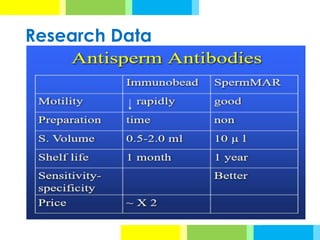
• direct MAR test result for IgG correlated better with the
indirect MAR result for IgG in seminal plasma and serum
than did the direct immunobead test result for IgG
• the results of indirect MAR IgG test on serum correlate
better than the immunobead test with the results of TAT
and ARCT on serum
• Using the cut-off value of 40%, motile spermatozoa
attached to coated latex particles as the lower limit of
significant activity, the indirect MAR test has a sensitivity
of 96% and specificity of 87% in comparison with the
TAT test as a reference
Research Data
Refference
• Kompendium der Andrologie. From URL: http://www.med.uni-
giessen.de/aka/andro/inhalt.html
• Mahmoud A, Comhaire F. Immunological Causes. Andrology for the Clinician. Springer-
Verlag Berlin Heidelberg 2006. 47-51
• Mahmoud A, Comhaire. F. Semen analysis What’s new. Presentation from URL:
http://slideplayer.com/slide/7283211/
• Ong F. Semen Analysis and Sperm Preparation. Presentation from URL:
http://slideplayer.com/slide/4687961/
• Pourmand G. Medical Therapy in Male Infertility. 9 th Royan Int. Congress. Presentation
from URL: http://www.slideshare.net/patriciakh/infertility2-1923189
• Sperm Antibody Testing. From URL: http://fertilitysolutions.com.au/sperm-antibody-testing/
• SpermMar™ /MAR-Test (mixed antiglobulin reaction) . IVF Express. Presentation from URL:
https://www.ivf.express/products/1392?hl=en
• Ulcova-Gallova Z. Reproductive Immunology. Presentation from URL:
http://slideplayer.com/slide/10413210/
• Walsh TJ, Turek PJ. Immunologic infertility. Infertility in the Male Fourth Edition. Cambridge
University Press. 2009 (16):277-89
•Thank You

Antisperm antibody

  • 1.
  • 2.
    When an ASAassay should be obtained ? 1) the semen analysis shows sperm agglutination or clumping in the absence of clinical infection; 2) low sperm motility exists, with history of testis injury or surgery; 3) there is confirmation that increased round cells are leukocytes ; 4) sperm “shaking” is observed on sperm–cervical mucus contact testing; 5) poor penetration of mucus is observed on a postcoital test; 6) there is unexplained infertility.
  • 3.
    Detection of Antisperm Antibodies •Agglutination Tests • Complement-Dependent Tests • Immunoglobulin Binding Tests • Mixed Antiglobulin Reaction and Immunobead Tests • Enzyme Linked Immunosorbant Assays • Other Tests
  • 4.
    Agglutination Tests • abilityto cause agglutination • observed macroscopically or microscopically • tube agglutination test, gel agglutination test (Kirbrick), tray slide agglutination test (Franklin and Dukes) • drawback: • agglutination can also occur in the absence of specific antibodies as a result of the presence of bacteria, fungi, or amorphous material in seminal plasma, or under the influence of sex steroids or nonimmunoglobulin proteins in serum Tube agglutination test Gelatin agglutination (Kirbrick) test
  • 5.
    Microtray Agglutination Tests • FribergTest • refference test • titre, type, and degree of agglutination • drawback: • nonimmunological agglutination may occur • particularly when female sera are tested, and at low serum dilutions
  • 6.
    Complement-Dependent Tests (Isojima) • Induction ofa cytotoxic effect which occurs in the presence of complement • Cytotoxicity results in the loss of sperm motility • used as a marker ➢ the sperm immobilization test (SIT) or ➢ membrane damage ✓ need specific dyes ✓ ATP release cytotoxicity test (ARCT)→ objective • disadvantage: can't detect IgA class antibodies
  • 7.
    Immunoglobulin Binding Tests •antiglobulins can either be labelled or bound to indicator cells or particles • The antiglobulin label: ➢ fluorescence molecule : immunofluorescence technique ➢ radioactive isotope : radiolabelled antiglobulin assay ➢ an enzyme : enzyme-linked immunosorbent assay • The antiglobulin indicators: ➢ redblood cells : original mixed antiglobulin reaction ➢ latex particles : Latex-MAR test ➢ polyacrylamide beads : immunobead binding
  • 8.
    Mixed Antiglobulin Reaction Test •presence of immunoglobulins bound to spermatozoa • (red blood cells--immunoglobulins) + (motile spermatozoa-- antiglobulin) → mixed agglutination • the coated red blood cells have been replaced → coated latex particles • MAR TEST •direct : fresh semen •indirect : blood serum, solubilized cervical mucus
  • 9.
    Immunobead Tests • polyacrylamidebeads are coated with polyclonal antibodies against human IgG, IgA, or IgM • requires washing the spermatozoa • repeated centrifugation-resuspension • remove the bulk of immunoglobulins present in seminal plasma • ≥ 50% or more adherence of particles to the motile spermatozoa : strong evidence for an immunological cause of infertility • time consuming, less adequate, lower specificity and sensitivity than the SpermMAR test
  • 10.
  • 11.
    Enzyme Linked Immunosorbant Assays •Antibody-enzyme- immunoglobulin complexes • add a specific enzyme substrate → colourchange • advantage : specific and quantitative • disadvantage: the time and cost , poor sensitivity, and inability to determine ASA location and isotype.
  • 12.
    Postcoital test (PCT) •examining the cervical mucus several hours after intercourse for the presence of sperm • prior to ovulation in the periovulatory phase • a drop of cervical mucus is examined under wet- mount microscopy for the presence of sperm • normal result : • ≥10–20 sperm per HPF (× 400) • the majority : progressive motility • abnormal: • sperm immobilized • shaking motion in the cervical mucus (suspicious for the presence of antisperm antibodies)
  • 13.
    Other Tests • panningprocedure for ASA detection on spermatozoa • polyacrylamide gel electrophoresis and immunoblotting • flowcytometry
  • 14.
    Mixed Antiglobulin Reaction Test •direct SpermMar Ig G Test method • indirect SpermMar Ig G Test method • direct SpermMar Ig A Test method
  • 15.
    Direct SpermMar IgG Test method 1. Allow the reagents and specimens to adjust to room temperature. 2. On a micro slide place:s ➢ 10 microlitres of fresh untreated semen ➢ 10 microlitres of SpermMar IgG Latex Particle ➢ 10 microlitres of SpermMar IgG Antiserum
  • 16.
    Direct SpermMar IgG Test method con't 3. Mix the sample and the Latex reagent 5 times with the edge of a cover glass 4. Mix the Antiserum with the Latex reagent and sample mixture 5. The cover glass is put on the mixture and the mixture is observed under a light microscope using a 400x or a 600x magnification 6. Read the result after 2-3 minutes. Observe for latex particles attached to motile sperm. Count 100 spermatozoa to determine the percentage reactive sperm 7. If no attachement of beads to sperm is observed, read again after 10 minutes
  • 17.
    Direct SpermMar IgG Test method
  • 18.
    Direct SpermMar IgG Test method
  • 19.
    Direct SpermMar IgG Test method
  • 20.
    Direct SpermMar IgG Test method
  • 21.
    Indirect SpermMar IgG Test method 1. Allow all the reagents and specimens to adjust to room temperature. 2. Inactivate the serum specimens by heating them at 560 C for 30 minutes if glas test-tubes are used, 45 minutes if plastic test-tubes are used 3. Adjust the pH (by adding 0,1N NaOH or HCl) of the EBSS to 7,4-7,5 4. Wash the motile donor spermatozoa by letting them swim up at the pH adjusted medium (pH=7,4-7,5). Swim up has to be done in 5 ml glass or sterile plastic test-tubes with round bottom at 370 C for 45 minutes. Adjust the sperm concentration to 20x106 sp/ml with EBSS medium (pH= 7,4-7,5)
  • 22.
    Indirect SpermMar IgG Test method con't 5. Serially dilute the inactivated serum specimen 1/16 with EBSS medium (pH= 7,4-7,5) in a titre plate 6. Mix 50 microlitres of the (1/16) diluted, inactivated serum specimen (step 5) with 50 microlitres of the washed motile donor sperm donor sperm (step 4) in a free well on the titre plate. Incubate for 60 minutes at 37C. 7. On a micro slide place: ➢10 microlitres of the sperm-serum mixture ➢10 microlitres of SpemMar IgG Latex Particle ➢10 microlitres of SpemMar IgG Antiserum 8. Mix the sample and the Latex reagent 5 times with the edge of a cover glass.
  • 23.
    Indirect SpermMar IgG Test method con't 9. Mix the Antiserum with the Latex reagent and sample mixture 10.The cover glass is put on the mixture and the mixture is observed under a light microscope using a 400x or 600x magnification (phase contrast or dark field illumination may also be used to fascilitate reading) 11.Read the results after 2-3 minutes. Observed for latex particles attached to motile sperm. Count 100 spermatozoa to determine the percentage reactive sperm. If no attachment of particle to sperm is observed, read again after 10 minutes.
  • 24.
    Result • Test properlyperformed • spem antibodies (+) → spermatozoa covered by latex particle and immobilized. • Direct SpermMar IgG Test • Suspected : 10-39 % • Highly probable : 40 % • Result (+) → recommended to perform the SpermMar IgA test. • Indirect Sperm IgG Test • Accepted : ≥ 40% reaction between the coated latex particle and motile spermatozoa.
  • 25.
    Inirect SpermMar IgG Test method
  • 26.
    Direct SpermMar IgA Test method 1. Allow all the reagents and specimens to adjust to room temperature. 2. On a micro slide place: ➢10 microlitres of the sperm-serum mixture ➢10 microlitres of SpemMar IgG Latex Particle 3. Mix the sample and the Latex reagent 5 times with the edge of a cover glass. 4. The cover glass is put on the mixture and the mixture is observed under a light microscope using a 400x or 600x magnification. The use of phase contrast or dark field illumination may also be used to fascilitate reading the slide.
  • 27.
    Direct SpermMar IgA Test method 5. Read the result after 2-3 minutes. Observe for latex particles attached to motile sperm. Count 100 spermatozoa to determine the percentage reactive sperm. Read again after 10 minutes. 6. The diagnosis • Suspected : 10-39 % attached to latex particle • Highly probable : 40 % attached to latex particle 7. Occurrence of Mixed Aglutination Reaction (+): • ≥ 40 % in semen • ≥ 10 % in cervical mucus
  • 28.
    Research Data • directMAR test result for IgG correlated better with the indirect MAR result for IgG in seminal plasma and serum than did the direct immunobead test result for IgG • the results of indirect MAR IgG test on serum correlate better than the immunobead test with the results of TAT and ARCT on serum • Using the cut-off value of 40%, motile spermatozoa attached to coated latex particles as the lower limit of significant activity, the indirect MAR test has a sensitivity of 96% and specificity of 87% in comparison with the TAT test as a reference
  • 29.
  • 31.
    Refference • Kompendium derAndrologie. From URL: http://www.med.uni- giessen.de/aka/andro/inhalt.html • Mahmoud A, Comhaire F. Immunological Causes. Andrology for the Clinician. Springer- Verlag Berlin Heidelberg 2006. 47-51 • Mahmoud A, Comhaire. F. Semen analysis What’s new. Presentation from URL: http://slideplayer.com/slide/7283211/ • Ong F. Semen Analysis and Sperm Preparation. Presentation from URL: http://slideplayer.com/slide/4687961/ • Pourmand G. Medical Therapy in Male Infertility. 9 th Royan Int. Congress. Presentation from URL: http://www.slideshare.net/patriciakh/infertility2-1923189 • Sperm Antibody Testing. From URL: http://fertilitysolutions.com.au/sperm-antibody-testing/ • SpermMar™ /MAR-Test (mixed antiglobulin reaction) . IVF Express. Presentation from URL: https://www.ivf.express/products/1392?hl=en • Ulcova-Gallova Z. Reproductive Immunology. Presentation from URL: http://slideplayer.com/slide/10413210/ • Walsh TJ, Turek PJ. Immunologic infertility. Infertility in the Male Fourth Edition. Cambridge University Press. 2009 (16):277-89
  • 32.