Emergency Obstetric care
To Avert  Death and Disability… … We Need to Ensure that Women have Access To… Emergency Obstetric Care (EmOC)
How  Can We Improve Access  to EmOC? By making sure  health facilities provide the services needed to  save women’s lives. Eight key functions “signal” a facility’s ability to provide EmOC
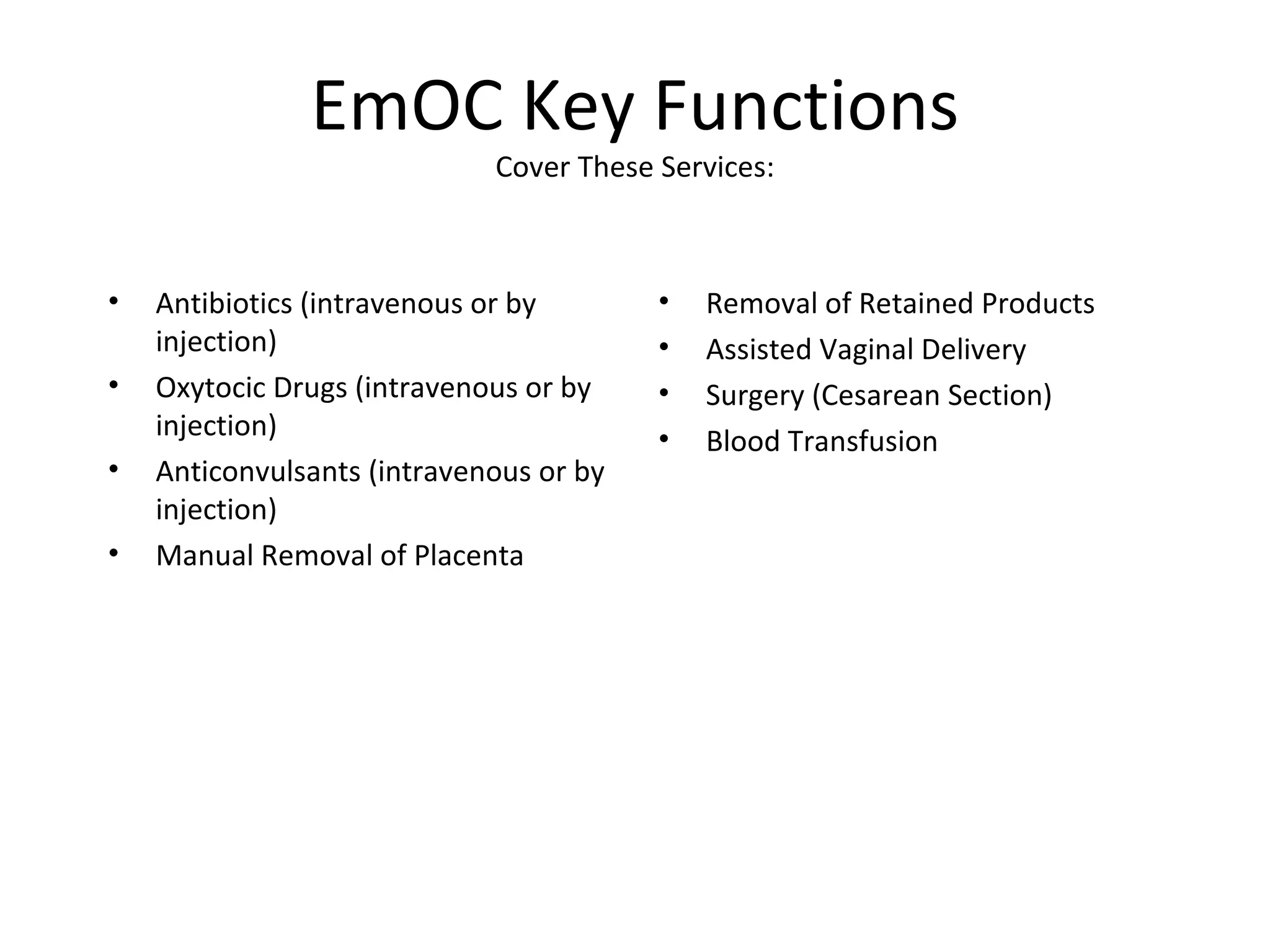
EmOC Key Functions Cover These Services: Antibiotics (intravenous or by injection) Oxytocic Drugs (intravenous or by injection)  Anticonvulsants (intravenous or by injection) Manual Removal of Placenta Removal of Retained Products Assisted Vaginal Delivery Surgery (Cesarean Section) Blood Transfusion
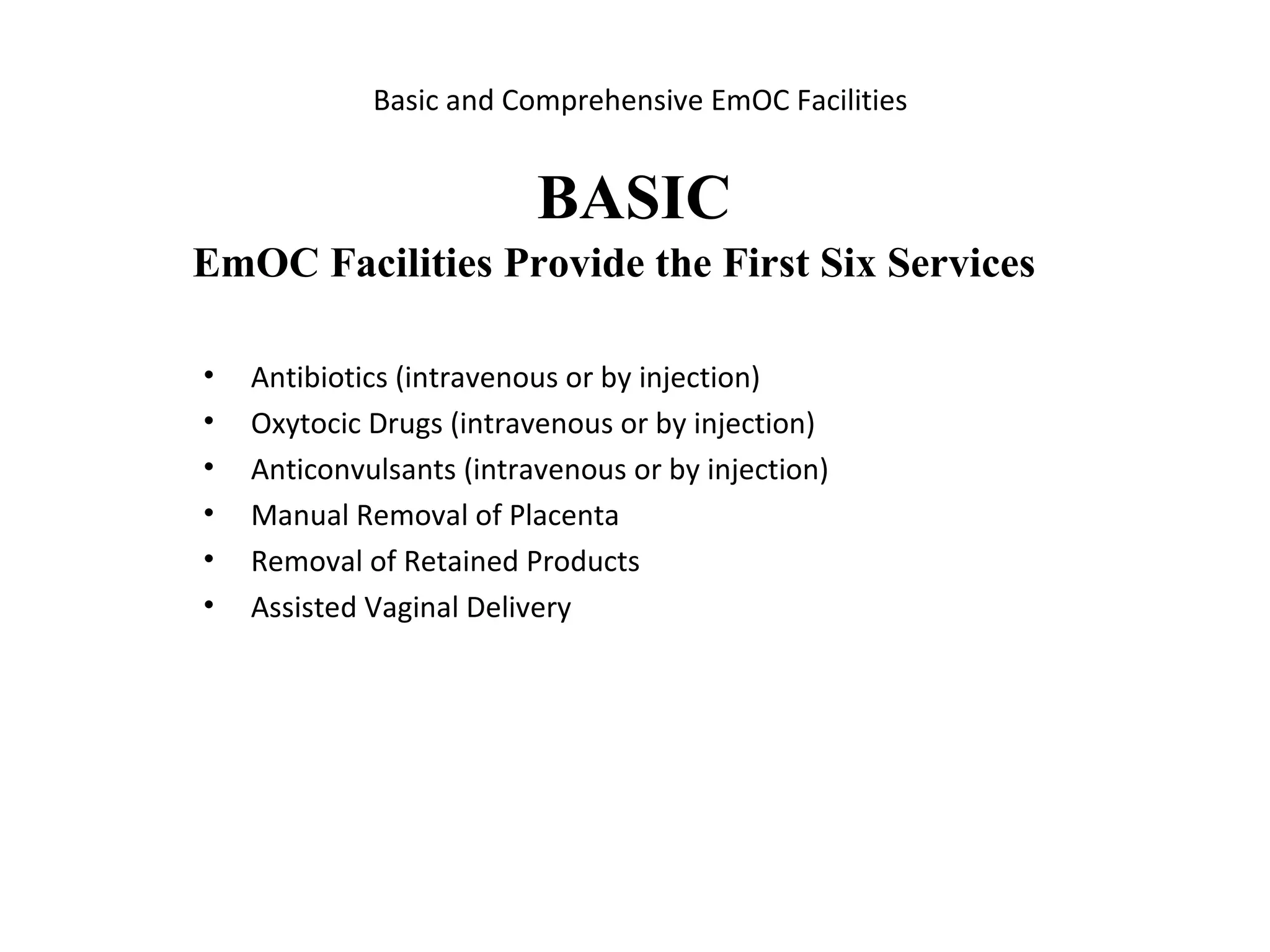
Basic and Comprehensive EmOC Facilities Antibiotics (intravenous or by injection) Oxytocic Drugs (intravenous or by injection) Anticonvulsants (intravenous or by injection) Manual Removal of Placenta Removal of Retained Products Assisted Vaginal Delivery BASIC EmOC Facilities Provide the First Six Services
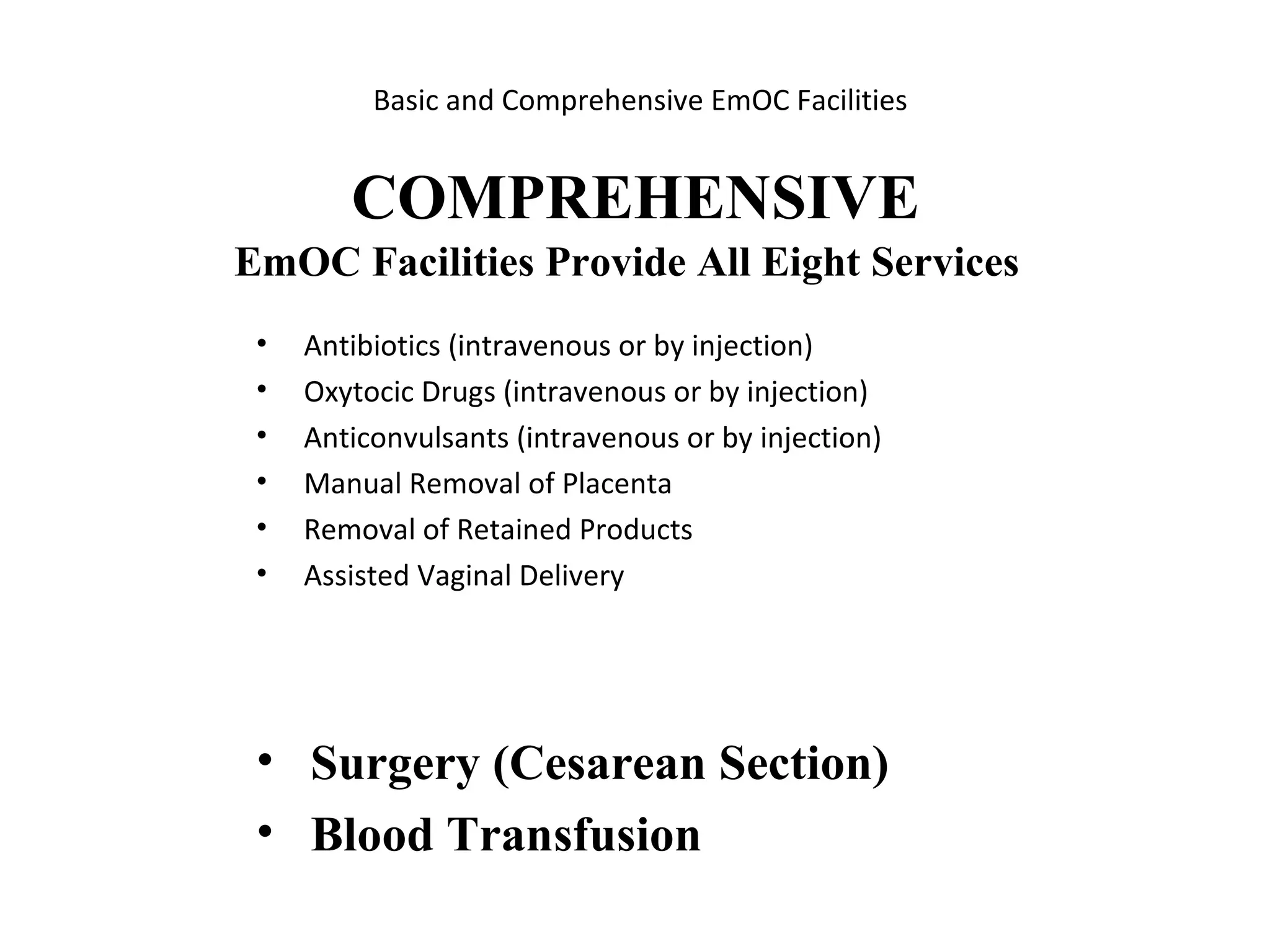
Basic and Comprehensive EmOC Facilities Antibiotics (intravenous or by injection) Oxytocic Drugs (intravenous or by injection) Anticonvulsants (intravenous or by injection) Manual Removal of Placenta Removal of Retained Products Assisted Vaginal Delivery COMPREHENSIVE EmOC Facilities Provide All Eight Services Surgery (Cesarean Section) Blood Transfusion
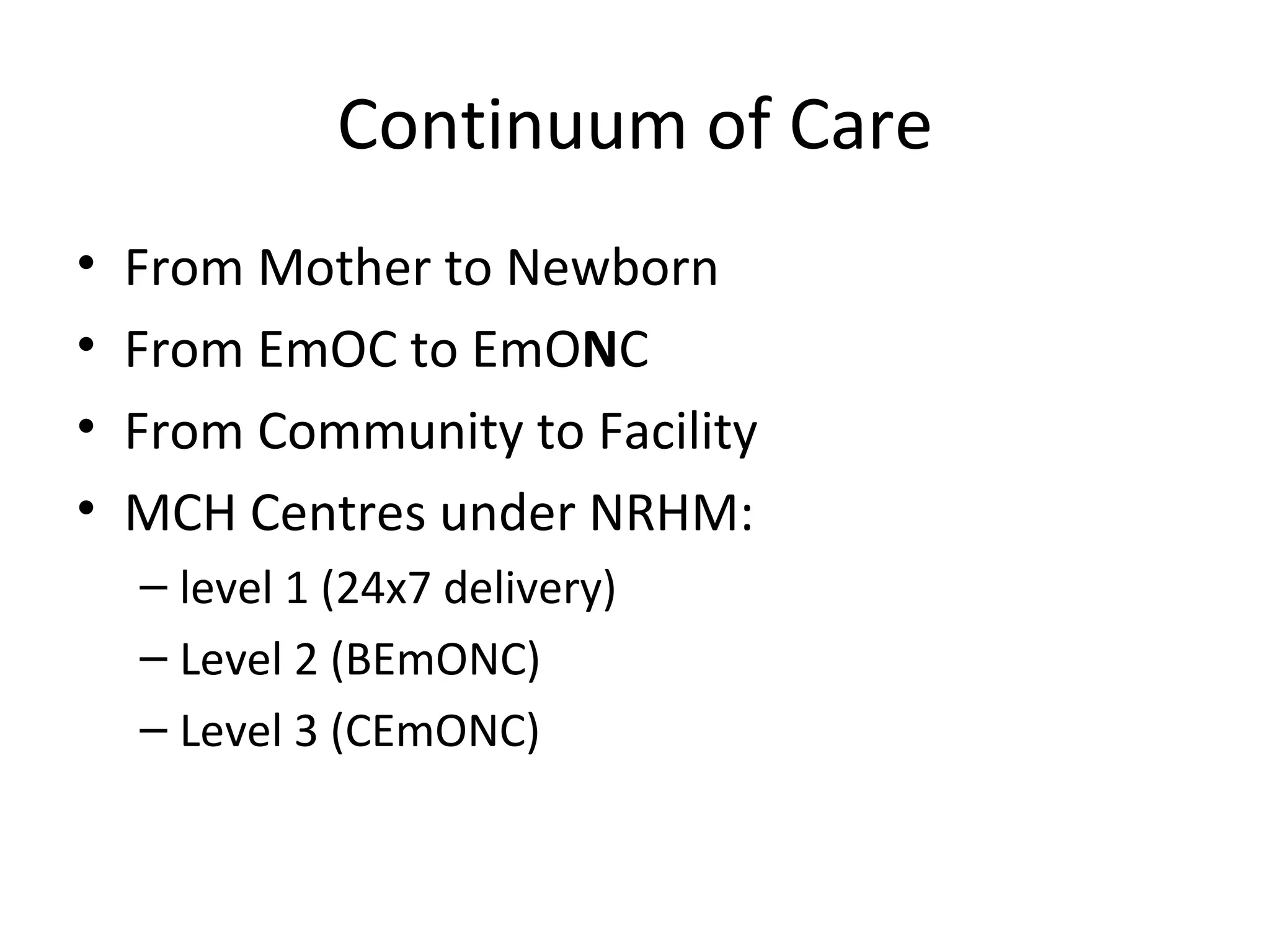
Continuum of Care From Mother to Newborn From EmOC to EmO N C From Community to Facility MCH Centres under NRHM: level 1 (24x7 delivery) Level 2 (BEmONC) Level 3 (CEmONC)
THE GOOD NEWS Not all these functions need hospitals and doctors Well-trained nurses and midwives can perform most functions at Basic EmOC Facilities An Important Point  for Resource Poor Areas
How Can We Tell  We Are Making a Difference? If we know we have provided enough EmOC… … and if we know that these services are being used by women suffering obstetric complications… WE CAN BE CONFIDENT  THAT WE ARE SAVING WOMEN’S LIVES
How Do We Know  Which Women  Will E xperience  Complications? WE DON’T
… But we do know that of any population of pregnant women at least 15% will experience an obstetric complication … This is as true of pregnant women in the US and Europe as of women in Africa, Asia and Latin America Nobody Knows Why This Happens. It is a Fact of Life.
Can We Really Tell if Services Are Functioning? In 1991,  United Nations Children’s Fund (UNICEF) and Columbia University developed 6 Process Indicators to do just that. These were issued by UNICEF/WHO/United Nation’s Population Fund (UNFPA) in 1997: Guidelines for Monitoring Availability  and Use of Obstetric Services … And Are Being Used?
In general, process indicators show you the changes  in the conditions that lead to an outcome (such as death or disability) Process Indicators
Access to… THE 6 PROCESS INDICATORS tell us about changes in: Utilization of… and Quality of… EmOC Services
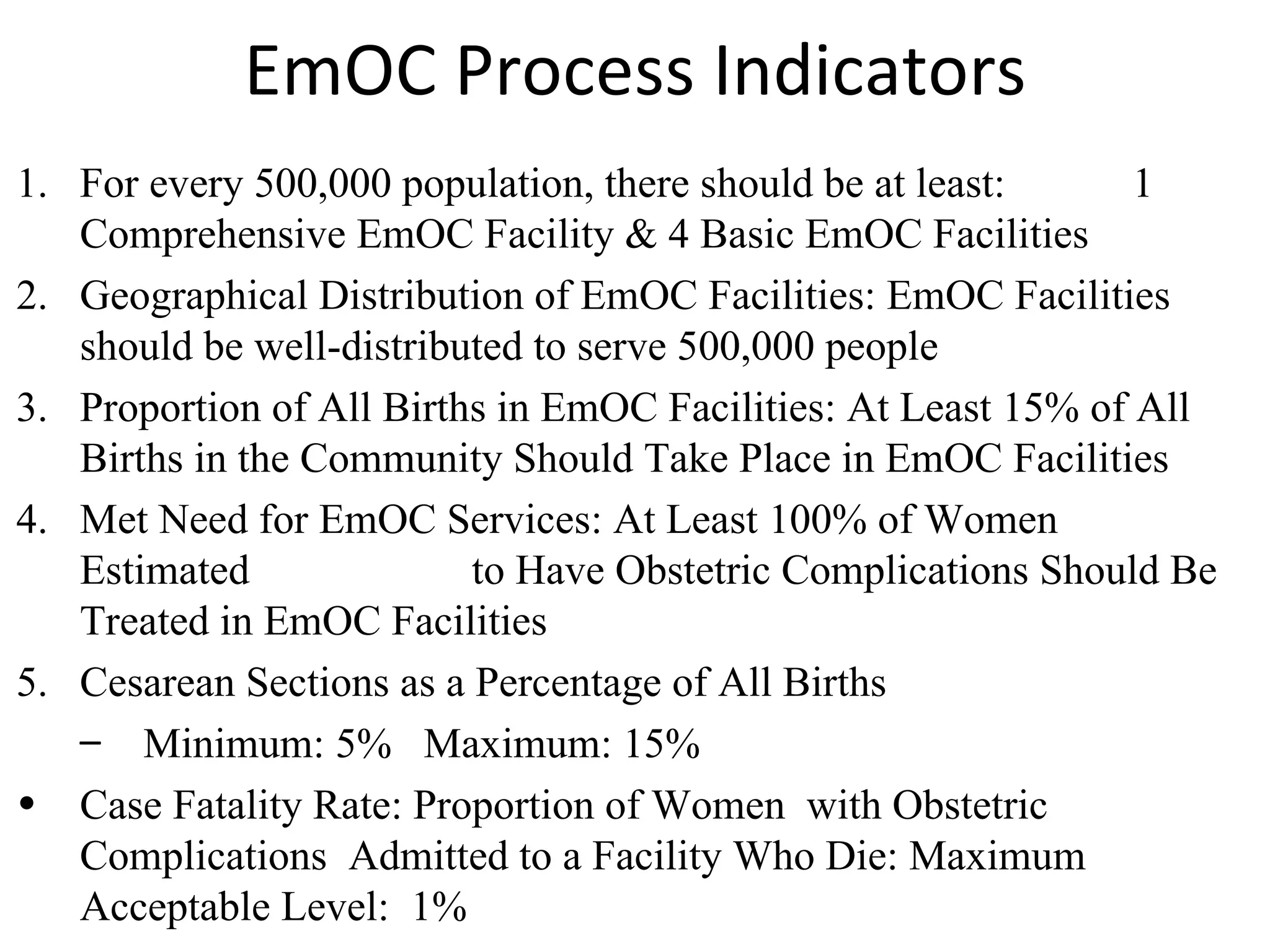
EmOC Process Indicators For every 500,000 population, there should be at least:  1 Comprehensive EmOC Facility & 4 Basic EmOC Facilities Geographical Distribution of EmOC Facilities: EmOC Facilities should be well-distributed to serve 500,000 people Proportion of All Births in EmOC Facilities: At Least 15% of All Births in the Community Should Take Place in EmOC Facilities  Met Need for EmOC Services: At Least 100% of Women Estimated  to Have Obstetric Complications Should Be Treated in EmOC Facilities Cesarean Sections as a Percentage of All Births  Minimum: 5%  Maximum: 15% Case Fatality Rate: Proportion of Women  with Obstetric Complications  Admitted to a Facility Who Die: Maximum Acceptable Level:  1%
INDICATOR #1 For every 500,000 population, there should be at least: 1 Comprehensive EmOC Facility 4 Basic EmOC Facilities
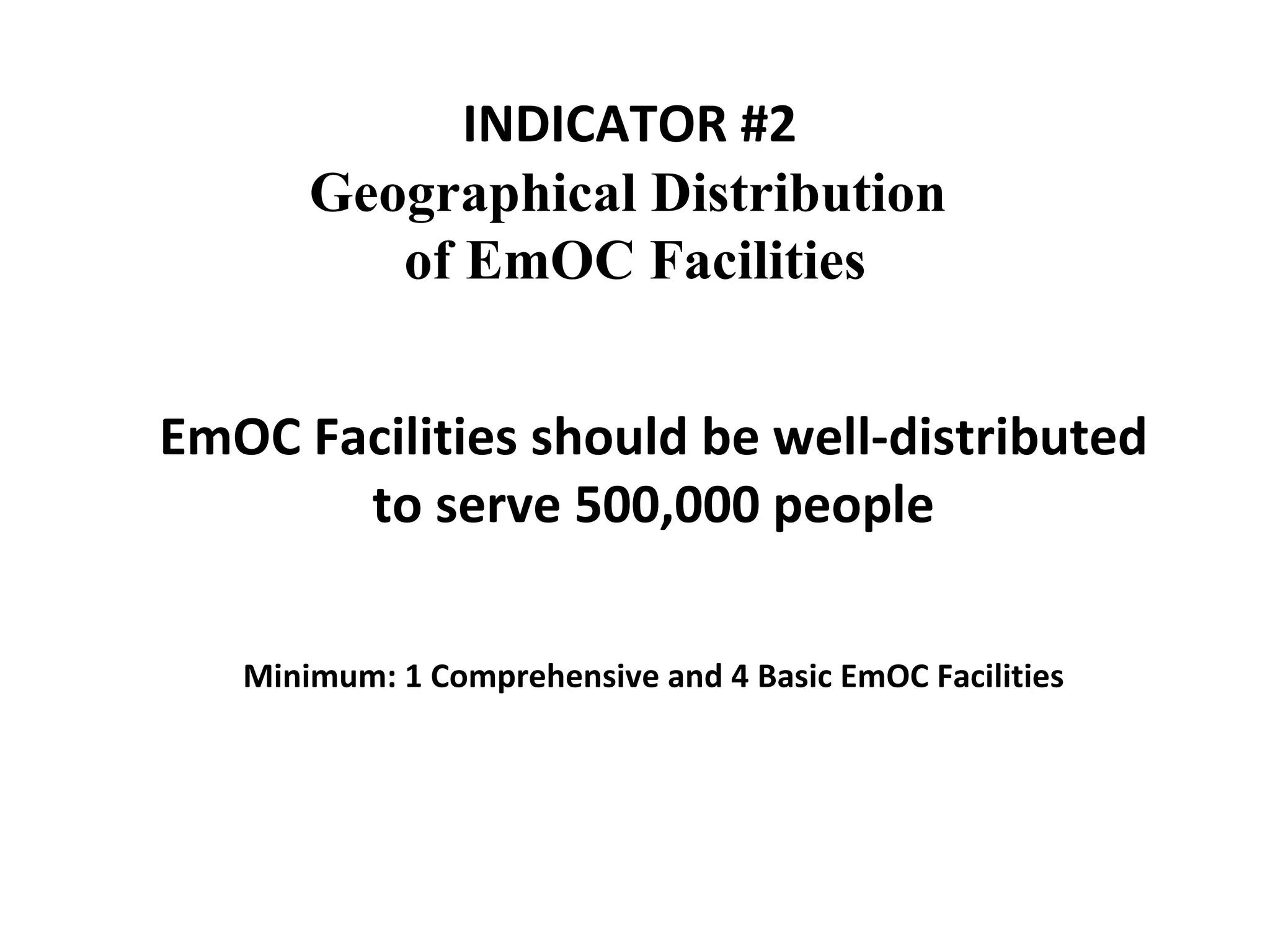
INDICATOR #2 Geographical Distribution  of EmOC Facilities EmOC Facilities should be well-distributed to serve 500,000 people Minimum: 1 Comprehensive and 4 Basic EmOC Facilities
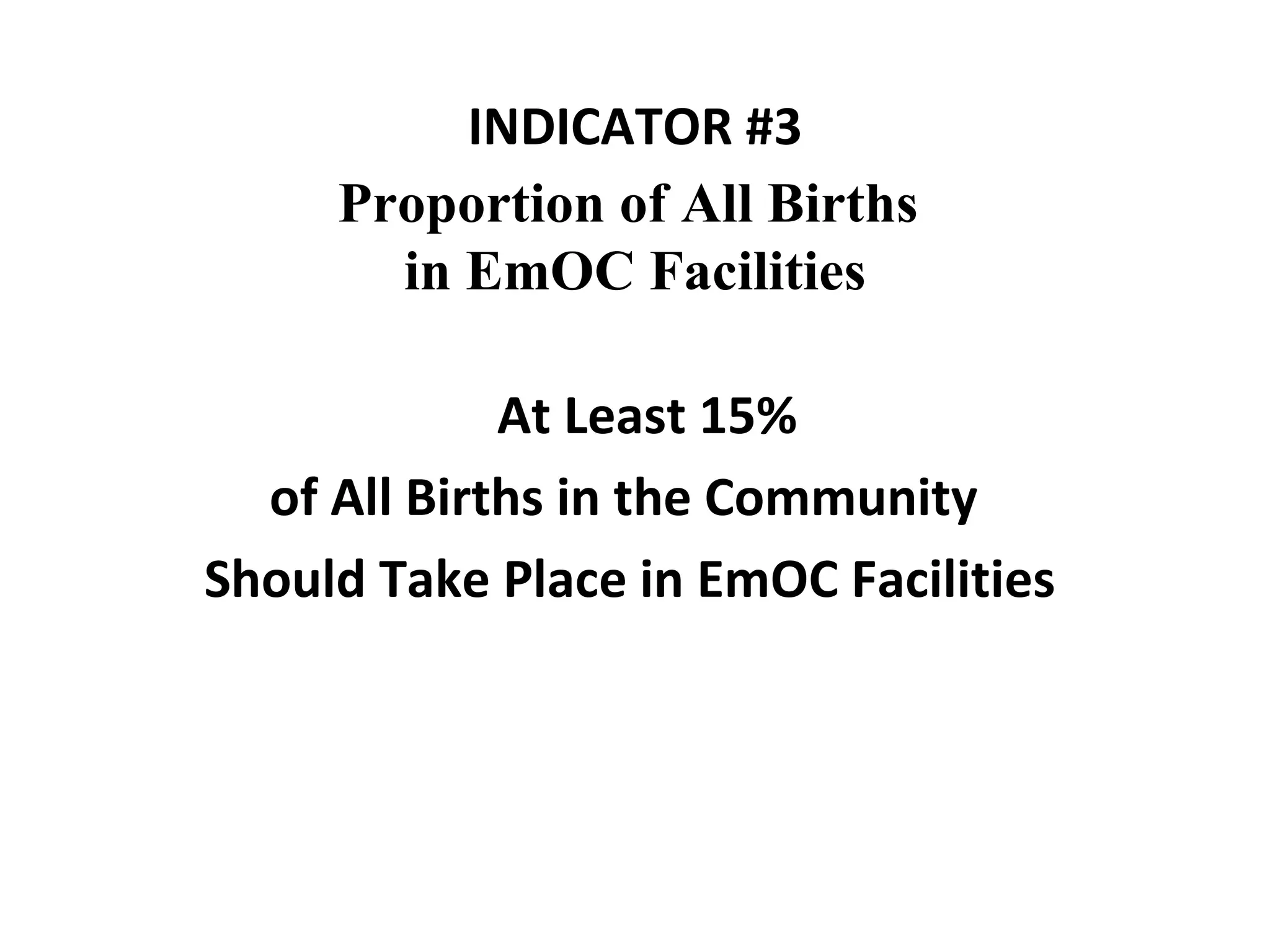
INDICATOR #3 Proportion of All Births  in EmOC Facilities At Least 15%  of All Births in the Community  Should Take Place in EmOC Facilities
INDICATOR #4 Met Need for EmOC Services At Least 100% of Women Estimated  to Have Obstetric Complications Should Be Treated in EmOC Facilities
INDICATOR #5 Cesarean Sections  as a Percentage of All Births Minimum:    5% Maximum: 15%
INDICATOR #6 Case Fatality Rate Proportion of Women  with Obstetric Complications  Admitted to a Facility  Who Die: Maximum Acceptable Level:  1%
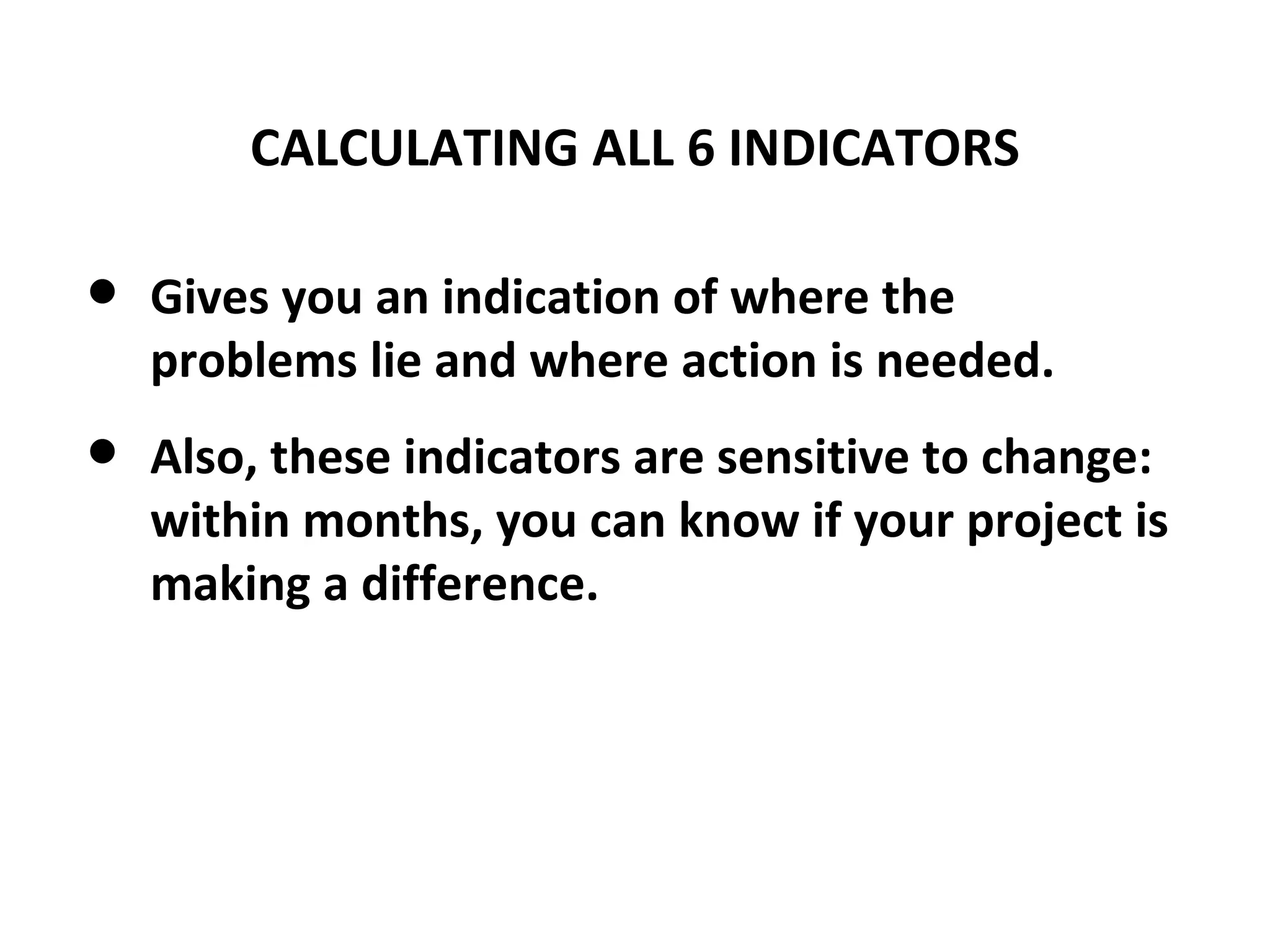
CALCULATING ALL 6 INDICATORS Gives you an indication of where the problems lie and where action is needed. Also, these indicators are sensitive to change: within months, you can know if your project is making a difference.
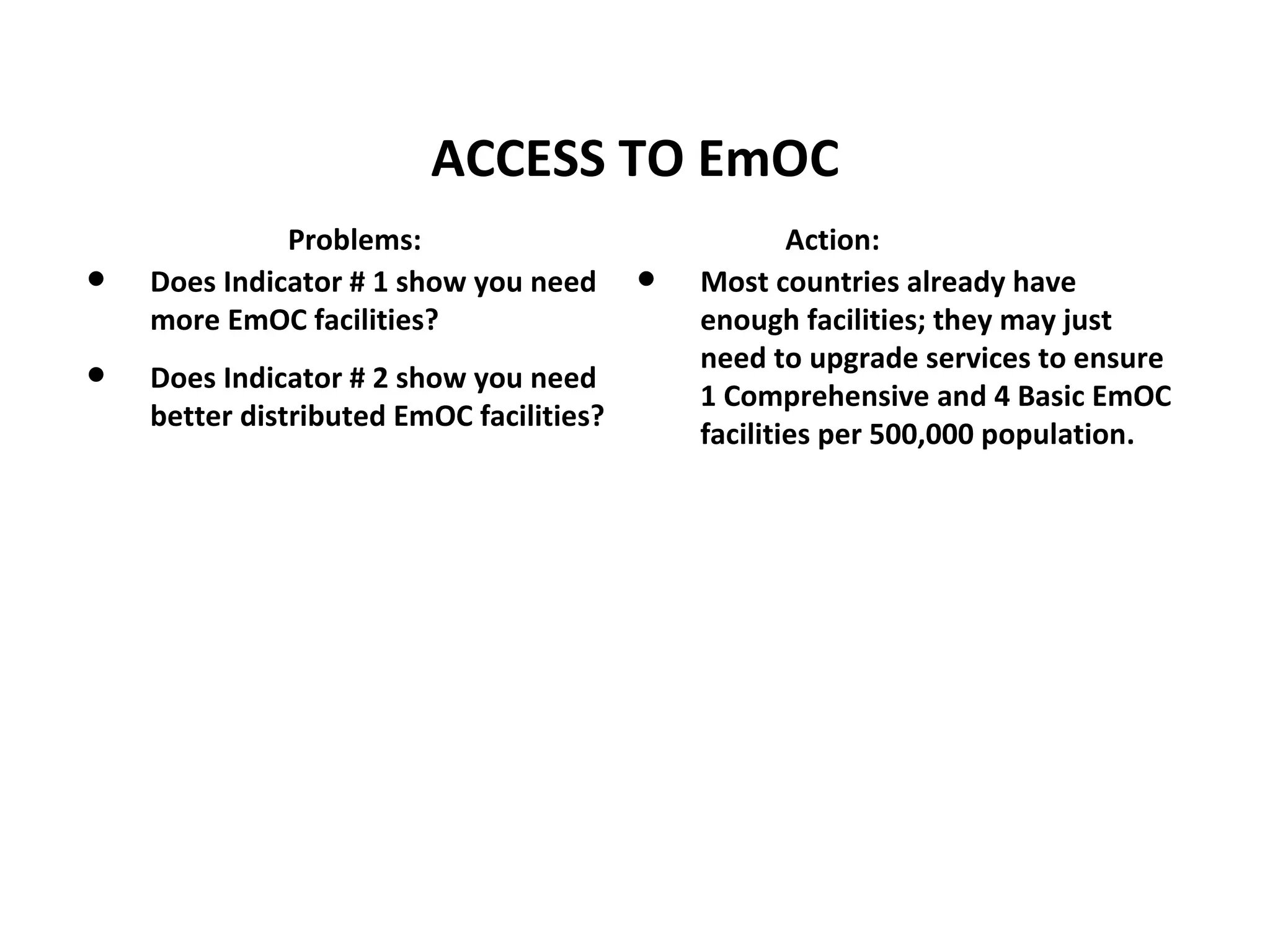
ACCESS TO EmOC Problems: Does Indicator # 1 show you need more EmOC facilities? Does Indicator # 2 show you need better distributed EmOC facilities?   Action: Most countries already have enough facilities; they may just need to upgrade services to ensure 1 Comprehensive and 4 Basic EmOC facilities per 500,000 population.
UTILIZATION OF EmOC Does Indicator # 3 show that births in your EmOC facilities are fewer than 15% of all births in the population? Does Indicator # 4 show that “Met Need” is less than 100% (i.e., that not all women who experience obstetric complications are using EmOC facilities)? Does Indicator # 5 show that less than 5% of all births in the population are by Cesarean section? Problems
UTILIZATION OF EmOC Do you have enough qualified staff? Do you need to train staff on management of emergency obstetric complications? Does hospital management need improvement? What is the supply situation like? What is the equipment situation like? If all the above is in place, conduct focus groups in the community to find out why women are not coming for care Action:  Collect More Information First
QUALITY OF EmOC Does Indicator # 6 show that more than 1% of women treated for obstetric complications are dying at your EmOC facilities? Problem:
QUALITY OF EmOC Find out if your EmOC facilities are really functioning  Check staff numbers, skills, management capacity, supplies and equipment Lobby your health ministry for more support — and get the community to lobby with you Action: Get More Information
Any Country  Can Avert  Maternal Death and Disability if it Makes Good EmOC  Available and Accessible on Time
References Loudon I. 1991. On maternal and infant mortality 1900 – 1960.  Soc Hist Med  4(1): 29 – 73. Maine D. 1991.  Safe Motherhood Programs: Options and Issues . Columbia University: New York. UNFPA and AMDD. 2002.  Reducing Maternal Deaths: Selecting Priorities, Tracking Progress, Distance Learning Courses on Population Issues . Turin: UN System Staff College. UNICEF/WHO/UNFPA. 1997.  Guidelines for Monitoring the Availability and Use of Obstetric Services . UNICEF: New York.

01 Emergency Obstetric care

  • 1.
  • 2.
    To Avert Death and Disability… … We Need to Ensure that Women have Access To… Emergency Obstetric Care (EmOC)
  • 3.
    How CanWe Improve Access to EmOC? By making sure health facilities provide the services needed to save women’s lives. Eight key functions “signal” a facility’s ability to provide EmOC
  • 4.
    EmOC Key FunctionsCover These Services: Antibiotics (intravenous or by injection) Oxytocic Drugs (intravenous or by injection) Anticonvulsants (intravenous or by injection) Manual Removal of Placenta Removal of Retained Products Assisted Vaginal Delivery Surgery (Cesarean Section) Blood Transfusion
  • 5.
    Basic and ComprehensiveEmOC Facilities Antibiotics (intravenous or by injection) Oxytocic Drugs (intravenous or by injection) Anticonvulsants (intravenous or by injection) Manual Removal of Placenta Removal of Retained Products Assisted Vaginal Delivery BASIC EmOC Facilities Provide the First Six Services
  • 6.
    Basic and ComprehensiveEmOC Facilities Antibiotics (intravenous or by injection) Oxytocic Drugs (intravenous or by injection) Anticonvulsants (intravenous or by injection) Manual Removal of Placenta Removal of Retained Products Assisted Vaginal Delivery COMPREHENSIVE EmOC Facilities Provide All Eight Services Surgery (Cesarean Section) Blood Transfusion
  • 7.
    Continuum of CareFrom Mother to Newborn From EmOC to EmO N C From Community to Facility MCH Centres under NRHM: level 1 (24x7 delivery) Level 2 (BEmONC) Level 3 (CEmONC)
  • 8.
    THE GOOD NEWSNot all these functions need hospitals and doctors Well-trained nurses and midwives can perform most functions at Basic EmOC Facilities An Important Point for Resource Poor Areas
  • 9.
    How Can WeTell We Are Making a Difference? If we know we have provided enough EmOC… … and if we know that these services are being used by women suffering obstetric complications… WE CAN BE CONFIDENT THAT WE ARE SAVING WOMEN’S LIVES
  • 10.
    How Do WeKnow Which Women Will E xperience Complications? WE DON’T
  • 11.
    … But wedo know that of any population of pregnant women at least 15% will experience an obstetric complication … This is as true of pregnant women in the US and Europe as of women in Africa, Asia and Latin America Nobody Knows Why This Happens. It is a Fact of Life.
  • 12.
    Can We ReallyTell if Services Are Functioning? In 1991, United Nations Children’s Fund (UNICEF) and Columbia University developed 6 Process Indicators to do just that. These were issued by UNICEF/WHO/United Nation’s Population Fund (UNFPA) in 1997: Guidelines for Monitoring Availability and Use of Obstetric Services … And Are Being Used?
  • 13.
    In general, processindicators show you the changes in the conditions that lead to an outcome (such as death or disability) Process Indicators
  • 14.
    Access to… THE6 PROCESS INDICATORS tell us about changes in: Utilization of… and Quality of… EmOC Services
  • 15.
    EmOC Process IndicatorsFor every 500,000 population, there should be at least: 1 Comprehensive EmOC Facility & 4 Basic EmOC Facilities Geographical Distribution of EmOC Facilities: EmOC Facilities should be well-distributed to serve 500,000 people Proportion of All Births in EmOC Facilities: At Least 15% of All Births in the Community Should Take Place in EmOC Facilities Met Need for EmOC Services: At Least 100% of Women Estimated to Have Obstetric Complications Should Be Treated in EmOC Facilities Cesarean Sections as a Percentage of All Births Minimum: 5% Maximum: 15% Case Fatality Rate: Proportion of Women with Obstetric Complications Admitted to a Facility Who Die: Maximum Acceptable Level: 1%
  • 16.
    INDICATOR #1 Forevery 500,000 population, there should be at least: 1 Comprehensive EmOC Facility 4 Basic EmOC Facilities
  • 17.
    INDICATOR #2 GeographicalDistribution of EmOC Facilities EmOC Facilities should be well-distributed to serve 500,000 people Minimum: 1 Comprehensive and 4 Basic EmOC Facilities
  • 18.
    INDICATOR #3 Proportionof All Births in EmOC Facilities At Least 15% of All Births in the Community Should Take Place in EmOC Facilities
  • 19.
    INDICATOR #4 MetNeed for EmOC Services At Least 100% of Women Estimated to Have Obstetric Complications Should Be Treated in EmOC Facilities
  • 20.
    INDICATOR #5 CesareanSections as a Percentage of All Births Minimum: 5% Maximum: 15%
  • 21.
    INDICATOR #6 CaseFatality Rate Proportion of Women with Obstetric Complications Admitted to a Facility Who Die: Maximum Acceptable Level: 1%
  • 22.
    CALCULATING ALL 6INDICATORS Gives you an indication of where the problems lie and where action is needed. Also, these indicators are sensitive to change: within months, you can know if your project is making a difference.
  • 23.
    ACCESS TO EmOCProblems: Does Indicator # 1 show you need more EmOC facilities? Does Indicator # 2 show you need better distributed EmOC facilities? Action: Most countries already have enough facilities; they may just need to upgrade services to ensure 1 Comprehensive and 4 Basic EmOC facilities per 500,000 population.
  • 24.
    UTILIZATION OF EmOCDoes Indicator # 3 show that births in your EmOC facilities are fewer than 15% of all births in the population? Does Indicator # 4 show that “Met Need” is less than 100% (i.e., that not all women who experience obstetric complications are using EmOC facilities)? Does Indicator # 5 show that less than 5% of all births in the population are by Cesarean section? Problems
  • 25.
    UTILIZATION OF EmOCDo you have enough qualified staff? Do you need to train staff on management of emergency obstetric complications? Does hospital management need improvement? What is the supply situation like? What is the equipment situation like? If all the above is in place, conduct focus groups in the community to find out why women are not coming for care Action: Collect More Information First
  • 26.
    QUALITY OF EmOCDoes Indicator # 6 show that more than 1% of women treated for obstetric complications are dying at your EmOC facilities? Problem:
  • 27.
    QUALITY OF EmOCFind out if your EmOC facilities are really functioning Check staff numbers, skills, management capacity, supplies and equipment Lobby your health ministry for more support — and get the community to lobby with you Action: Get More Information
  • 28.
    Any Country Can Avert Maternal Death and Disability if it Makes Good EmOC Available and Accessible on Time
  • 29.
    References Loudon I.1991. On maternal and infant mortality 1900 – 1960. Soc Hist Med 4(1): 29 – 73. Maine D. 1991. Safe Motherhood Programs: Options and Issues . Columbia University: New York. UNFPA and AMDD. 2002. Reducing Maternal Deaths: Selecting Priorities, Tracking Progress, Distance Learning Courses on Population Issues . Turin: UN System Staff College. UNICEF/WHO/UNFPA. 1997. Guidelines for Monitoring the Availability and Use of Obstetric Services . UNICEF: New York.