Content Knowledge
Support Thinking
What is content knowledge?
Content knowledge is all the information we have about the
world. It includes things like:
scientific and historical facts
literary frameworks
rules for games
famous people
geography
animals
technology
language
How do we
obtain content
knowledge?
environment
experience
media
social circles
books, newspapers
school
Source: http://www.superstringtheory.com/basics/basic4a.html
Read this sentence from an article on string theory:
“According to Einstein's theory, a
relativistic equation has to use
coordinates that have the proper
Lorentz transformation properties.”
Hmmm... No idea what it
means? Let's say you are
determined to understand
that sentence. You might:
  
1. read an encyclopedia entry
on Einstein’s theory of
relativity
  
2. look up an article on
relativistic equations 
3. figure out what a Lorentz
transformation is
Now you are holding
three significant new
pieces of information in
your working memory
and trying to connect
them.
It’s quite a bit to
mentally juggle, and
that is only one
sentence from a much
longer article.
That is the reading experience of a
student who lacks content knowledge.
Even with all the best strategies at
your disposal, you just can't wrap your
head around the ideas in the text.
You might think that
string theory is an
extreme example. Let's
try something simpler:
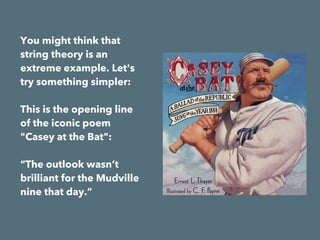
This is the opening line
of the iconic poem
"Casey at the Bat":
  
“The outlook wasn’t
brilliant for the Mudville
nine that day.”  
The poem is so simple that Disney
turned it into a movie! 
But what if you grew up in India only playing cricket? 
You can look up “Mudville” and “nine” in the dictionary,
but unless you know something about baseball, you will
not understand that the poet is referring to a local town’s
baseball team. 
Everything we read contains information that the
writer assumes his or her reader already knows. 
A sports columnist will not remind his or
her readers about the basic rules of
football. 
A novelist will use figurative language
that relies on a reader’s ability to infer
non-literal meaning. 
Even math and physics problems
involving trains, ramps, and pendulums
assume that students are familiar with
these objects and how they work.
This makes reading less tedious for
those of us who share the writer's
background knowledge. If you're
reading Motor Trend magazine, you
don't need to be reminded what a car is.
But it makes it difficult for readers who
don't have the knowledge that the
writer assumes they have. 
How significant is content knowledge to
reading comprehension?
 
Source: Recht, D. R., & Leslie, L. (1988). Effect of prior knowledge on good and poor readers'
memory of text. Journal of Educational Psychology, 80(1) 16–20.
In 1988, researchers took a group of junior high
school students and gave them a reading test.
The students had either high or low reading
ability (as determined by a standard reading test),
and either high or low knowledge of baseball.
The students were asked to read a passage
describing a baseball game and reenact or
describe what they'd read.
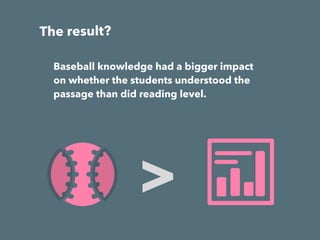
The result?
>
Baseball knowledge had a bigger impact
on whether the students understood the
passage than did reading level.
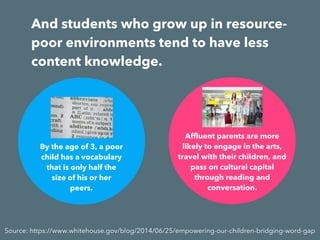
And students who grow up in resource-
poor environments tend to have less
content knowledge.
By the age of 3, a poor
child has a vocabulary
that is only half the
size of his or her
peers.
Source: https://www.whitehouse.gov/blog/2014/06/25/empowering-our-children-bridging-word-gap
Affluent parents are more
likely to engage in the arts,
travel with their children, and
pass on cultural capital
through reading and
conversation.
“Teaching reading strategies is a low-cost
way to give developing readers a boost, but
it should be a small part of a teacher’s job.
[...] Acquiring a broad vocabulary and a rich
base of background knowledge will yield
more substantial and longer-term benefits.”
— Cognitive scientist and reading expert Daniel T. Willingham, "The
Usefulness of Brief Instruction in Reading Comprehension Strategies"
http://www.aft.org/sites/default/files/periodicals/CogSci.pdf
So what can you do
to build students'
content knowledge?
Action #1:
Consider the background knowledge 
needed to comprehend the text...
What was
Prohibition?
Why is “Oxford”
such a big deal?
What's a
Prime Minister?
Why does
the EU matter? 
What is “the red
planet”? What do
metals have to do
with soil? 
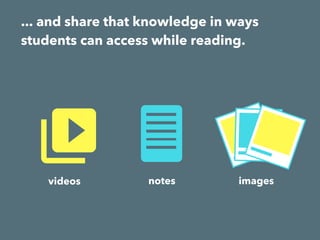
... and share that knowledge in ways
students can access while reading.
videos imagesnotes
Action #2:
Sequence instruction to build knowledge.
Students will learn more from reading a
sequenced text set than they will from
reading a series of disconnected texts.
Use questions to tie the texts together.
"How does this
compare to...?"
"What is the
connection
between...?"
"How does this
account differ
from...?"
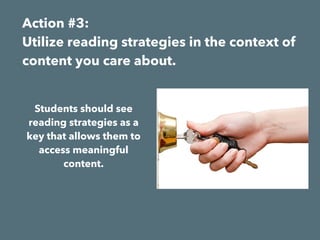
Action #3:
Utilize reading strategies in the context of
content you care about.
Students should see
reading strategies as a
key that allows them to
access meaningful
content.
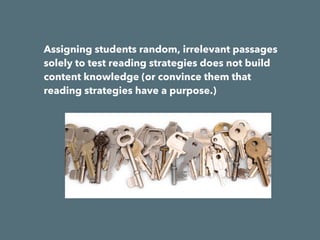
Assigning students random,
irrelevant passages solely to test
reading strategies does not build
content knowledge (or convince them
that reading strategies have a
purpose.)
To improve reading
comprehension, we need to
build content knowledge.
Focusing on reading strategies
will not overcome knowledge
deficits. 
#deepreading
#contentknowledge

How does content knowledge impact reading comprehension?

  • 1.
  • 2.
    What is contentknowledge? Content knowledge is all the information we have about the world. It includes things like: scientific and historical facts literary frameworks rules for games famous people geography animals technology language
  • 3.
  • 4.
    Source: http://www.superstringtheory.com/basics/basic4a.html Read this sentencefrom an article on string theory: “According to Einstein's theory, a relativistic equation has to use coordinates that have the proper Lorentz transformation properties.”
  • 5.
    Hmmm... No ideawhat it means? Let's say you are determined to understand that sentence. You might:    1. read an encyclopedia entry on Einstein’s theory of relativity    2. look up an article on relativistic equations  3. figure out what a Lorentz transformation is
  • 6.
    Now you areholding three significant new pieces of information in your working memory and trying to connect them. It’s quite a bit to mentally juggle, and that is only one sentence from a much longer article.
  • 7.
    That is thereading experience of a student who lacks content knowledge. Even with all the best strategies at your disposal, you just can't wrap your head around the ideas in the text.
  • 8.
    You might thinkthat string theory is an extreme example. Let's try something simpler: This is the opening line of the iconic poem "Casey at the Bat":    “The outlook wasn’t brilliant for the Mudville nine that day.”  
  • 9.
    The poem isso simple that Disney turned it into a movie! 
  • 10.
    But what ifyou grew up in India only playing cricket?  You can look up “Mudville” and “nine” in the dictionary, but unless you know something about baseball, you will not understand that the poet is referring to a local town’s baseball team. 
  • 11.
    Everything we readcontains information that the writer assumes his or her reader already knows.  A sports columnist will not remind his or her readers about the basic rules of football.  A novelist will use figurative language that relies on a reader’s ability to infer non-literal meaning.  Even math and physics problems involving trains, ramps, and pendulums assume that students are familiar with these objects and how they work.
  • 12.
    This makes readingless tedious for those of us who share the writer's background knowledge. If you're reading Motor Trend magazine, you don't need to be reminded what a car is. But it makes it difficult for readers who don't have the knowledge that the writer assumes they have. 
  • 13.
    How significant iscontent knowledge to reading comprehension?   Source: Recht, D. R., & Leslie, L. (1988). Effect of prior knowledge on good and poor readers' memory of text. Journal of Educational Psychology, 80(1) 16–20. In 1988, researchers took a group of junior high school students and gave them a reading test. The students had either high or low reading ability (as determined by a standard reading test), and either high or low knowledge of baseball. The students were asked to read a passage describing a baseball game and reenact or describe what they'd read.
  • 14.
    The result? > Baseball knowledgehad a bigger impact on whether the students understood the passage than did reading level.
  • 15.
    And students whogrow up in resource- poor environments tend to have less content knowledge. By the age of 3, a poor child has a vocabulary that is only half the size of his or her peers. Source: https://www.whitehouse.gov/blog/2014/06/25/empowering-our-children-bridging-word-gap Affluent parents are more likely to engage in the arts, travel with their children, and pass on cultural capital through reading and conversation.
  • 16.
    “Teaching reading strategiesis a low-cost way to give developing readers a boost, but it should be a small part of a teacher’s job. [...] Acquiring a broad vocabulary and a rich base of background knowledge will yield more substantial and longer-term benefits.” — Cognitive scientist and reading expert Daniel T. Willingham, "The Usefulness of Brief Instruction in Reading Comprehension Strategies" http://www.aft.org/sites/default/files/periodicals/CogSci.pdf
  • 17.
    So what canyou do to build students' content knowledge?
  • 18.
    Action #1: Consider the background knowledge  needed tocomprehend the text... What was Prohibition? Why is “Oxford” such a big deal? What's a Prime Minister? Why does the EU matter?  What is “the red planet”? What do metals have to do with soil? 
  • 19.
    ... and sharethat knowledge in ways students can access while reading. videos imagesnotes
  • 20.
  • 21.
    Students will learnmore from reading a sequenced text set than they will from reading a series of disconnected texts.
  • 22.
    Use questions totie the texts together. "How does this compare to...?" "What is the connection between...?" "How does this account differ from...?"
  • 23.
    Action #3: Utilize readingstrategies in the context of content you care about. Students should see reading strategies as a key that allows them to access meaningful content.
  • 24.
    Assigning students random, irrelevantpassages solely to test reading strategies does not build content knowledge (or convince them that reading strategies have a purpose.)
  • 25.
    To improve reading comprehension,we need to build content knowledge. Focusing on reading strategies will not overcome knowledge deficits. 
  • 26.