Education of marginalized and
socially disadvantages segments
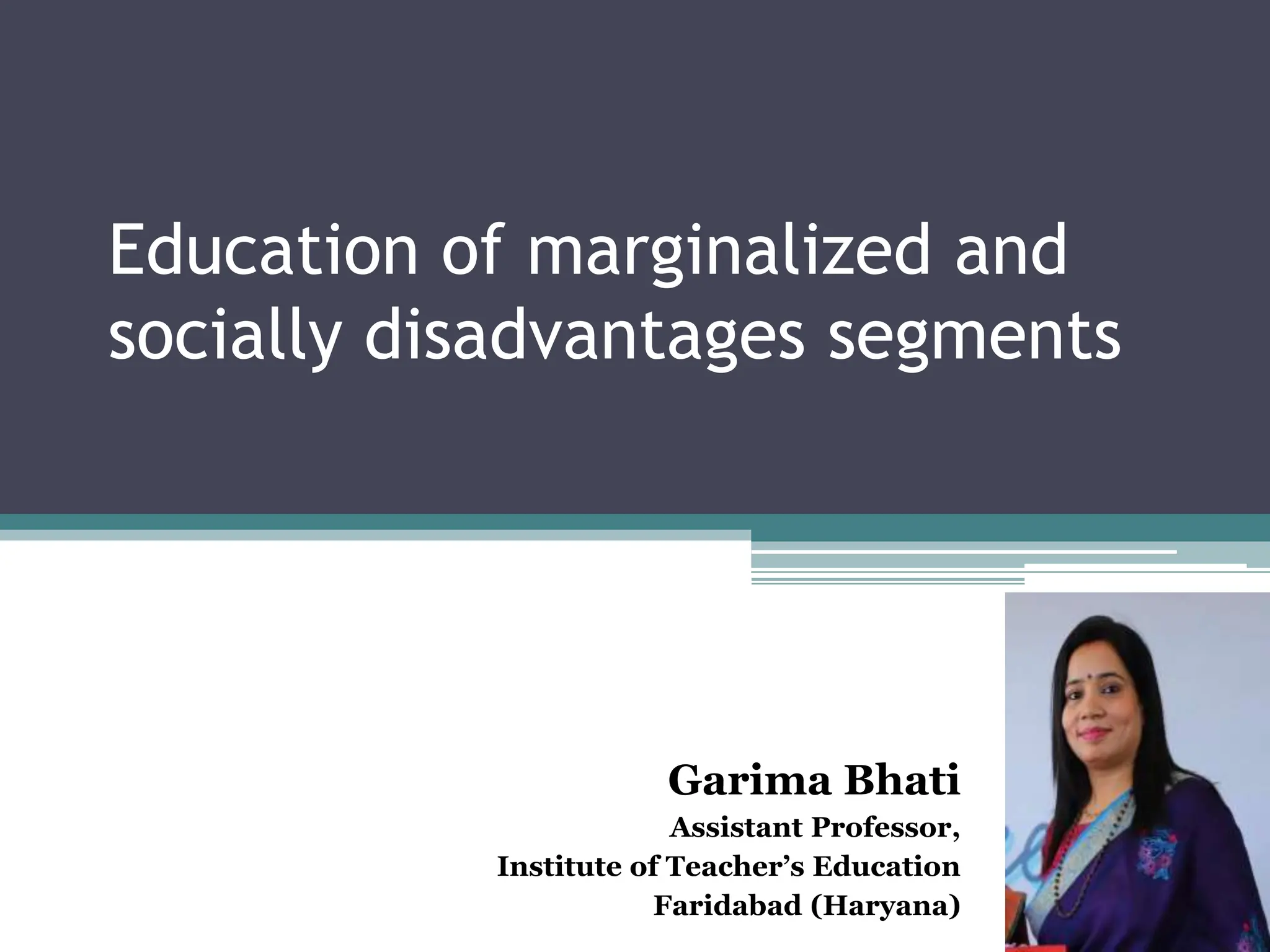
Garima Bhati
Assistant Professor,
Institute of Teacher’s Education
Faridabad (Haryana)
Meaning
(Deprived/ Marginalized Groups)
Marginalization/deprived is generally described
as the overt actions or tendencies of human
societies, where people who they perceive to be
undesirable or without useful function are
excluded, i.e., marginalized. The people who
are Deprived/ Marginalized are outside the
existing systems of protection and integration.
This limits their opportunities and means for
survival.
Nature of Deprived/ Marginalized
Groups
• Multidimensional:It is a multidimensional,
multi-causal, historical phenomenon. To
relegate or confine to a lower or outer limit or
edge, as of social standing. There are no general
laws to understand and comprehend the
complex nature of marginalization.
• Reasons:It can be due to class, in relation to
specific social, cultural, economic and political
conditions, as well as ideological systems, social
awareness, and human action.
Nature of Deprived/ Marginalized
Groups
• It varies in different settings: The religious,
ecological system, patriarchy, political economy of a
country, and the overall social system have an
impact on the marginalization of specific groups or
an individual.
• It varies from culture to culture: This can be
seen in relation to elderly people living in different
countries and cultures. The strong and supportive
traditional family system in some cultures often
provides better respect and care to elders than the
public aided system available in others.
Nature of Deprived/ Marginalized
Groups
• Level of awareness: Level of awareness among
the marginalized groups plays very important role.
Organized communities which are aware of their
rights, demand more justice than unorganized
communities.
• It occurs at different levels: Deprived/
Marginalized Groups occurs at different levels, i.e.,
individual, group, community, and global.
Discrimination across different social institutions,
such as family, schools and neighborhood, at work
places, or places of worship.
Nature of Deprived/ Marginalized
Groups
• Other factors: Many communities, a result of
colonization, experience marginalization such as
aboriginals, or women too face discrimination.
• Globalization: Globalization too has increased
the gap between rich and poor nations. The
influx of capitalism, information technology,
company outsourcing, job insecurity, and the
widening gap between the rich and the poor,
impacts the lives of individuals and groups in
many capacities.
Types of Deprived/ Marginalized
Groups
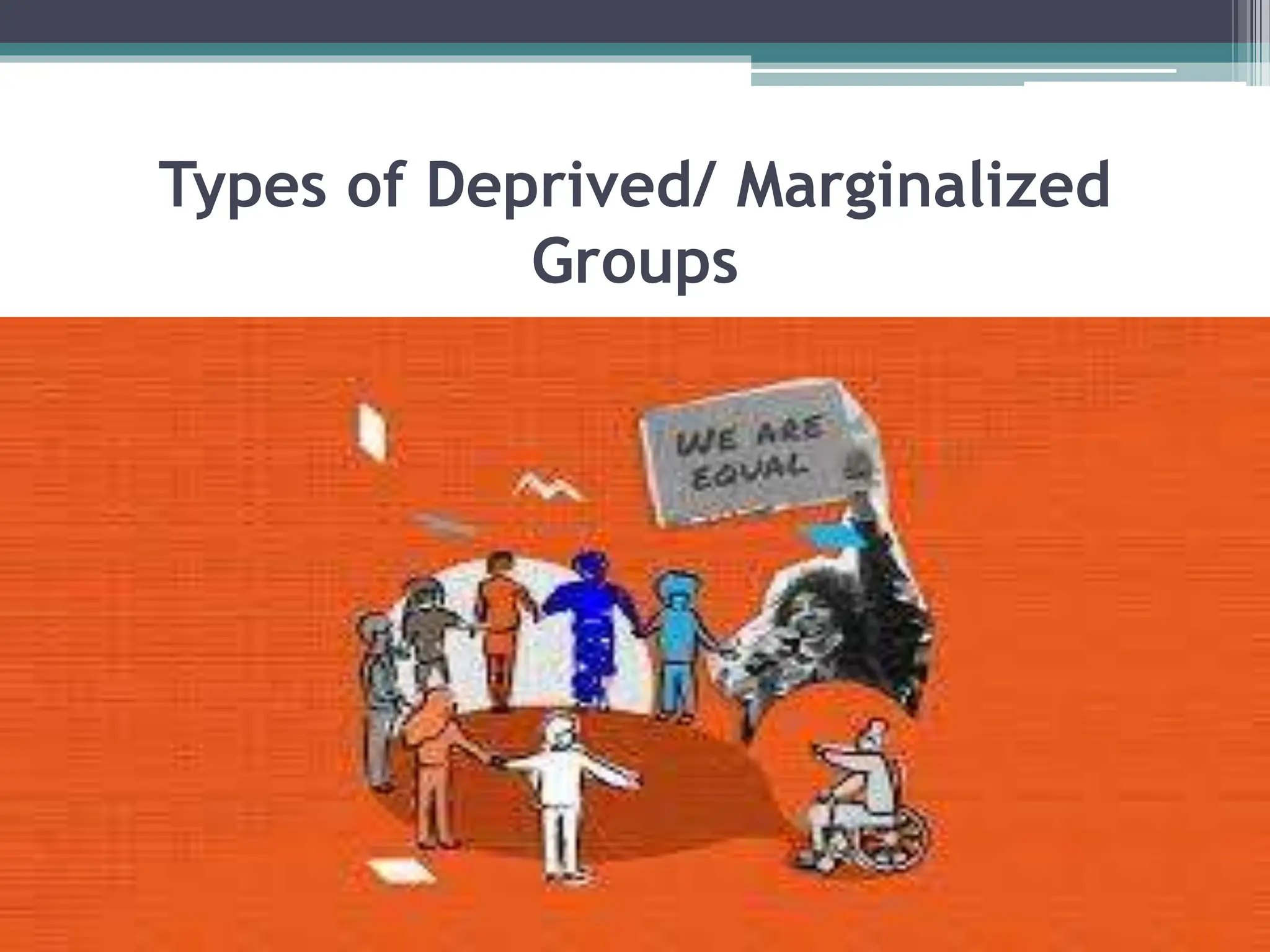
Types of Deprived/ Marginalized
Groups
• Socially Deprived/ Marginalized Groups:
Social marginalization is a process of social
rupture or destruction, in which groups as well
as individuals alike become detached from
various types of social functions and relations.
This generally prevents these people from
functioning in the so called normal activities
within a society. The individual is forced into a
new system of rules while facing social stigma
and stereotypes from the dominant group in
society.
Types of Deprived/ Marginalized
Groups
• Economically Deprived/ Marginalized
Groups: Economic marginalization” means
being unimportant to the economy. Some
individuals or groups can be marginalized from
the rest of the economy. The sources and
amount of their income varies. Poverty and
economic marginalization have both direct and
indirect impact on people’s health and
wellbeing.
Types of Deprived/ Marginalized
Groups
• Politically Deprived/ Marginalized
Groups: Political marginalization does not
allow the group to participate democratically in
decision making, and, hence, they lose their
right to every social, economic, and political
benefit. In every society, lack of political
empowerment affects large sections of people,
including women, ethnic minorities, migrants,
and disabled persons, elderly.
Reasons responsible for Deprived/
Marginalized Groups
Reasons responsible for Deprived/
Marginalized Groups
• Exclusion: Marginalization is a process that denies
opportunities and outcomes to ‘those ‘living on the
margins’, while enhancing the opportunities and
outcomes for those who are ‘at the
centre’. Deprived/ Marginalized combines
discrimination and social exclusion. It offends
human dignity, and it denies human rights. Caste
and class prejudice, in many societies across the
globe, exclude many groups and communities, and
hinder their active participation in economic and
social development.
Reasons responsible for Deprived/
Marginalized Groups
• Globalization: Globalization has increased
openness which has promoted development at
the cost of equity. It is viewed that globalization
has enhanced the gap between haves and have-
nots and thus boosted marginalization. While it
is true that some middle income developing
countries, as well as the most populous
countries, India and China, are gaining out of
globalization, yet the impact is not equally
universal.
Reasons responsible for Deprived/
Marginalized Groups
• Displacement: The development programmes
implemented by the government and increasing
construction of development projects
consistently displace a massive number of tribal,
poor, and weaker sections. This results in
marginalization of already marginalized people.
Reasons responsible for Deprived/
Marginalized Groups
• Disasters- Natural and Unnatural: Disasters are a global phenomena and
a serious challenge to development. Vulnerability is linked to broader social
issues such as poverty, social exclusion, conflict, education, health, gender
issues and marginalization. Classifications of disasters:
• Natural: earthquake, volcanic eruption, hurricane, tornado, ice storm,
flood, landslide, wildfire, insect infestation, and disease outbreaks.
• Manmade: Can be associated with technological advances, i.e., explosives,
unexploded ordinance, toxic spills, emissions of radioisotopes, and
transportation accidents. It also includes incidents involving hazardous
materials such as carcinogens, mutagens, or heavy metals. Dangers are
posed by structural failure of devices and machines or installations, and
plants, such as bridges, dams, mines, power plants, pipelines, high rise
buildings, vehicles, and trains.
• Social: These include incidents primarily involving social unrest, such as
hijacking, riots, demonstrations, crowd rushes, and stampedes, terrorist
incidents, as well as bombings, shootings, and hostage taking.
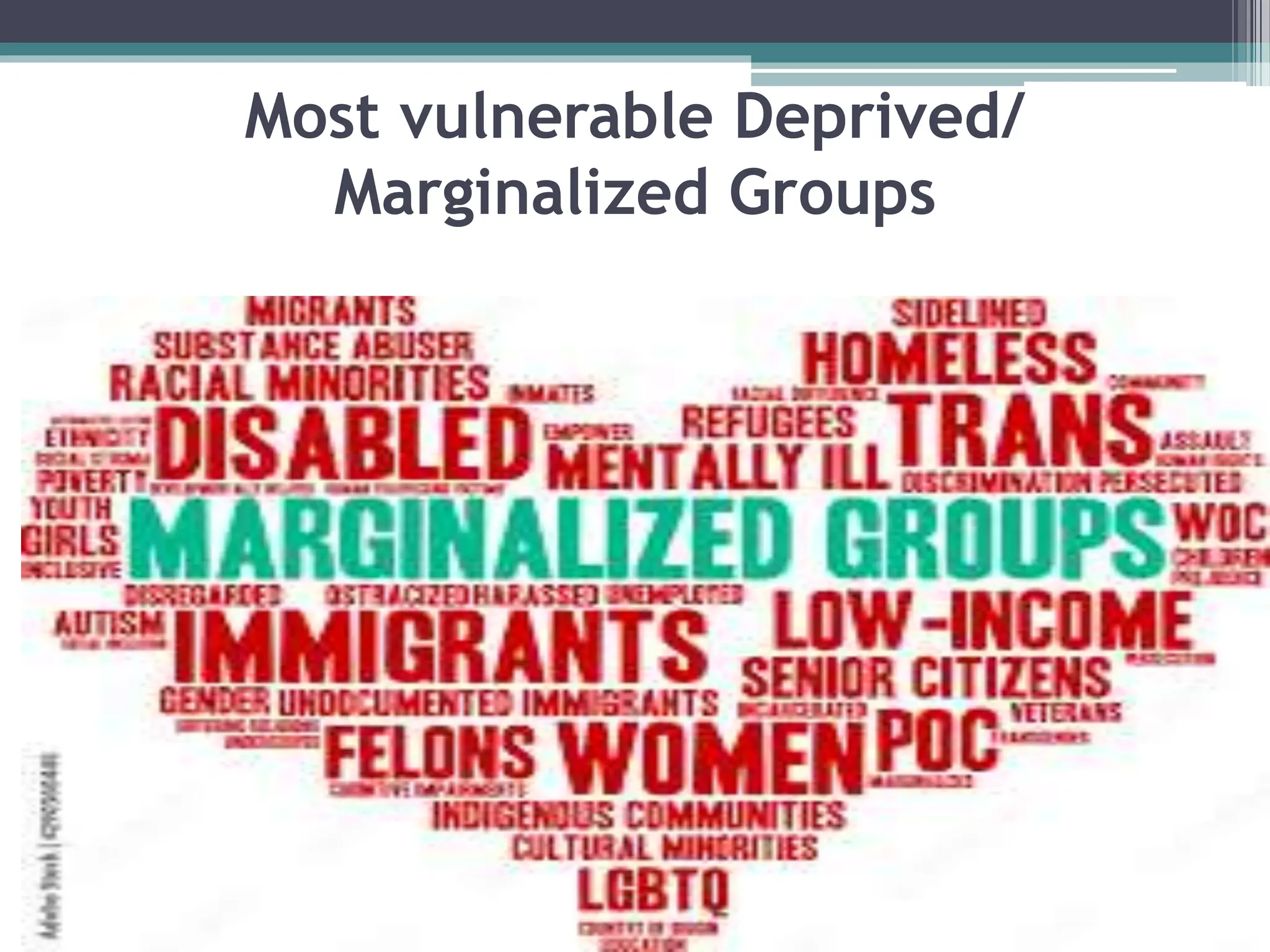
Most vulnerable Deprived/
Marginalized Groups
Most vulnerable Deprived/
Marginalized Groups
• Women: Under different economic conditions,
and under the influence of specific historical,
cultural, legal and religious factors,
marginalization of women can be seen from
their exclusion from certain jobs and
occupations. Women belonging to lower classes,
lower castes, illiterate, and the poorest region
have been marginalized more than their better
off counterparts.
Most vulnerable Deprived/
Marginalized Groups
• People with Disabilities: People with
disabilities have had to battle against centuries
of biased assumptions, harmful stereotypes, and
irrational fears. The stigmatization of disability
resulted in the social and economic
marginalization of generations with disabilities,
and thus has left people with disabilities in a
severe state of impoverishment for centuries.
Most vulnerable Deprived/
Marginalized Groups
• Elderly: Being past middle age and
approaching old age; rather old. S Ageing is an
inevitable and inexorable process in life. For
most nations, regardless of their geographic
location or developmental stage, the 80 year
olds, or over-age group is growing faster than
any younger segment of the older population.
Elderly women form the majority of
marginalized groups among them.
Most vulnerable Deprived/
Marginalized Groups
• Ethnic minority: – a group that has different national
or cultural traditions from the majority of the population
the term, ethnic minority, refers to marginalized people
of the same race or nationality who share a distinctive
culture. A minority is a sociological group that does not
constitute a politically dominant voting majority of the
total population of a given society. It may include any
group that is subnormal with respect to a dominant
group, in terms of social status, education, employment,
wealth, and political power. Every large society contains
ethnic minorities. They may be migrant, indigenous or
landless nomadic communities, or religious minorities
that have a different faith from the majority.
Most vulnerable Deprived/
Marginalized Groups
• Caste Groups: The caste system is a strict hierarchical
social system based on underlying notions of purity and
pollution. Brahmins are on the top of the hierarchy and
Shudras or Dalits orthe Scheduled Castes constitute the
bottom of the hierarchy. The marginalization of Dalits
influences all spheres of their life, violating basic human
rights such as civil, political, social, economic and
cultural rights. Literacy rates, purchasing power and
poor housing conditions among Dalits are very low.
Physical segregation of their settlements is common.
However, in recent years due to affirmative action and
legal protection, the intensity of caste-based
marginalization is reducing.
Most vulnerable Deprived/
Marginalized Groups
• Tribes: In India, the population of Scheduled
Tribes is around 84.3 million and is considered to be
socially and economically disadvantaged group.
They are mainly landless with little control over
resources such as land, forest and water. They
constitute agricultural, casual, plantation and
industrial labourers. This has resulted in poverty,
low levels of education and poor access to health
care services. In the Indian context the marginalized
are categorized as the scheduled castes, scheduled
tribes, denoted tribes, nomadic tribes, and other
backward classes.
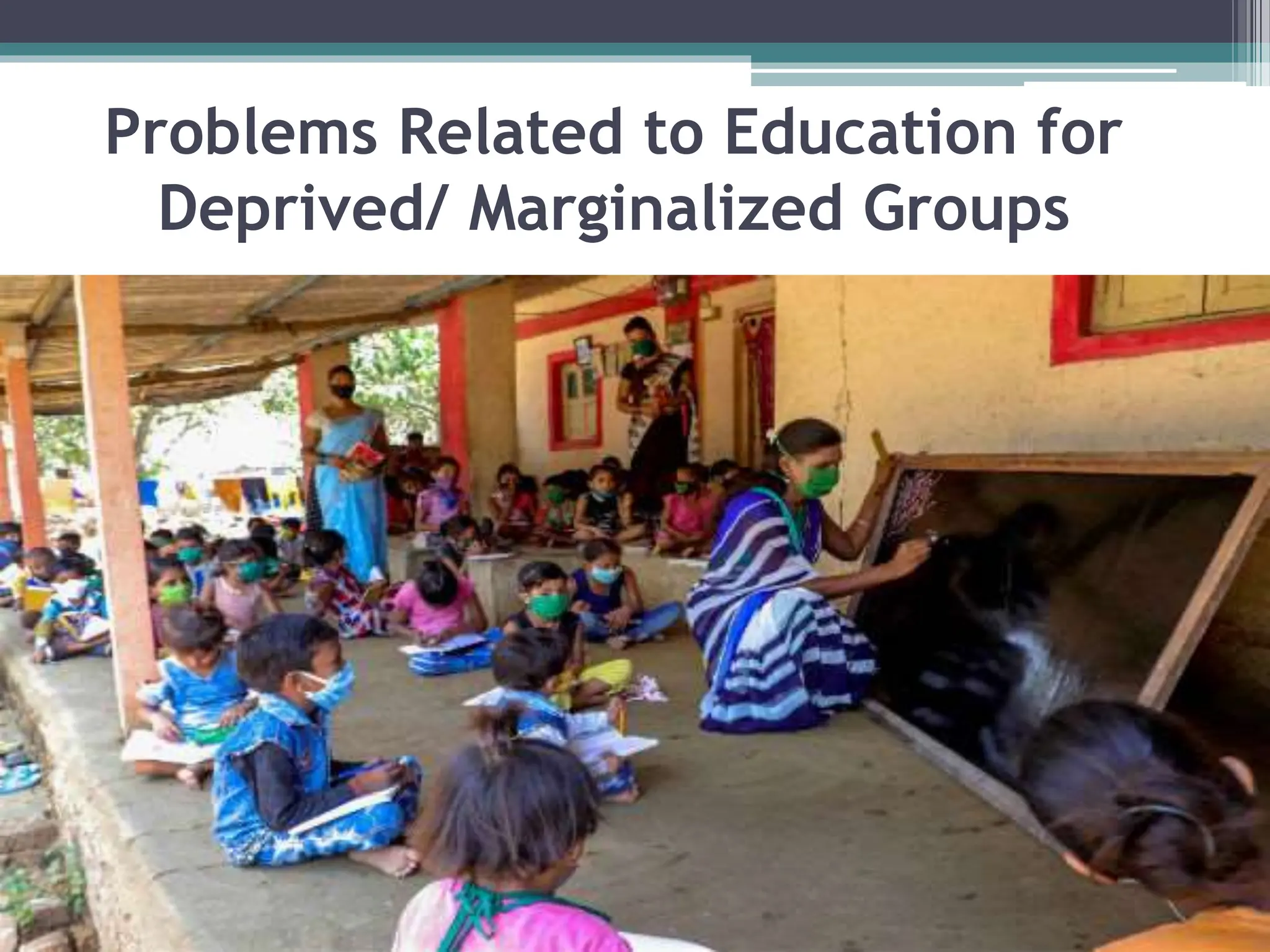
Problems Related to Education for
Deprived/ Marginalized Groups
Problems Related to Education for
Deprived/ Marginalized Groups
• Dissemination and public education: People, including
parents and school personnel, are largely unaware of the full
intent of the recent legislation passed by Indian Parliament. A
large number of school personnel are also not aware of
funding available to include students with disabilities in
regular schools. Thus, unless people, especially parents of
children with disabilities and school personnel, are made
knowledgeable about the various provisions enshrined in the
Act, the Central and State governments’ commitment to
providing integrated education will be in vain. Although some
attempts are being made to disseminate information about
the Persons with Disabilities Act to parents, to government
officials and non government organizations, they have been
extremely limited in coverage.
Problems Related to Education for
Deprived/ Marginalized Groups
• The challenge of providing adequate
levels of training to key stakeholders: The
majority of school personnel in India are not
trained to design and implement educational
programs for students with disabilities in regular
schools. Most teacher training programs in India
do not have a unit on Disability Studies. The
universities, which do cover some aspects of
special education in their teacher training
programs, fail to train teachers adequately to
work in integrated settings
Problems Related to Education for
Deprived/ Marginalized Groups
• Inadequate resources: The majority of schools in
India are poorly designed and few are equipped to
meet the unique needs of students with disabilities.
The lack of disability friendly transportation services
and accessible buildings are considered by some to
be far greater problems than social prejudice and
negative attitudes. Both the Central and State
governments will have to provide increased
resources to this aspect of education to ensure
successful implementation of integrated practices in
schools.
Education of the Marginalized
Deprived/ Marginalized Groups in the
Indian Context
The Education Commission 1964-66 in its report
stressed on the equalization of educational
opportunity. One of the most important
objectives of education is to equalize opportunity
enabling the marginalized, backward or the
underprivileged classes to use education for
improvement of their conditions. Policies on
education 1968, 1986 and 1992 all stressed upon
speedy action for the promotion education of the
deprived sections of the society.
Mainstreaming the Deprived/
Marginalized Groups
Mainstreaming is the process, to integrate
(a student with special needs) into regular
school classes. To incorporate into a prevailing
group. The prevailing current of thought,
influence, or activity. Representing the prevalent
attitudes, values, and practices of a society or
group.
Mainstreaming the Deprived/
Marginalized Groups
• Efforts have been made to reach education to all.
However, there is wastage and stagnation in
education. There are economic, social and
educational causes that hinder the education of
children coming from lower strata of society.
• Incentives to families to send their children
regularly to schools till they reach the age of 14.
• Pre-metric scholarships for all children
regardless of incomes.
Mainstreaming the Deprived/
Marginalized Groups
• Constant micro planning and verification to ensure
enrolment, retention and successful completion of
courses.
• Remedial measures to better their chances for
further education and employment.
• Recruitment of teachers from scheduled castes.
• Provision of hostel facilities.
• Location of school buildings, balwadis, and adult
education centres to facilitate participation
especially in rural areas, hill and desert districts or
remote and inaccessible areas.
Mainstreaming the Deprived/
Marginalized Groups
• Priority given to opening schools in tribal areas
with help of tribal welfare schemes.
• Developing curricula and instructional materials
in tribal languages with facility to switch to
regional language.
• Teacher training to tribal youth with assured
employment.
Mainstreaming the Deprived/
Marginalized Groups
• Residential schools including ashram schools,
anganwadis, non formal and adult education
centres to open on priority basis.
• Incentive schemes, scholarships for higher
education with emphasis on technical,
professional and Para-professional courses.
• Remedial programmes to help overcome psycho-
social impediments.
Conclusion
Protecting the rights of, marginalized and
vulnerable persons is probably the most
overlooked and disregarded area of human
rights law. Marginalized groups are generally
marginalized by society, making them easy to
ignore. Since they only ever represent a small
percentage of the population they lack the
critical mass that is often needed to successfully
assert human rights claims. Furthermore
marginalized themselves are often antagonistic
towards each other.
Education of marginalized and socially disadvantages segments.pptx

Education of marginalized and socially disadvantages segments.pptx

  • 1.
    Education of marginalizedand socially disadvantages segments Garima Bhati Assistant Professor, Institute of Teacher’s Education Faridabad (Haryana)
  • 3.
    Meaning (Deprived/ Marginalized Groups) Marginalization/deprivedis generally described as the overt actions or tendencies of human societies, where people who they perceive to be undesirable or without useful function are excluded, i.e., marginalized. The people who are Deprived/ Marginalized are outside the existing systems of protection and integration. This limits their opportunities and means for survival.
  • 5.
    Nature of Deprived/Marginalized Groups • Multidimensional:It is a multidimensional, multi-causal, historical phenomenon. To relegate or confine to a lower or outer limit or edge, as of social standing. There are no general laws to understand and comprehend the complex nature of marginalization. • Reasons:It can be due to class, in relation to specific social, cultural, economic and political conditions, as well as ideological systems, social awareness, and human action.
  • 6.
    Nature of Deprived/Marginalized Groups • It varies in different settings: The religious, ecological system, patriarchy, political economy of a country, and the overall social system have an impact on the marginalization of specific groups or an individual. • It varies from culture to culture: This can be seen in relation to elderly people living in different countries and cultures. The strong and supportive traditional family system in some cultures often provides better respect and care to elders than the public aided system available in others.
  • 7.
    Nature of Deprived/Marginalized Groups • Level of awareness: Level of awareness among the marginalized groups plays very important role. Organized communities which are aware of their rights, demand more justice than unorganized communities. • It occurs at different levels: Deprived/ Marginalized Groups occurs at different levels, i.e., individual, group, community, and global. Discrimination across different social institutions, such as family, schools and neighborhood, at work places, or places of worship.
  • 8.
    Nature of Deprived/Marginalized Groups • Other factors: Many communities, a result of colonization, experience marginalization such as aboriginals, or women too face discrimination. • Globalization: Globalization too has increased the gap between rich and poor nations. The influx of capitalism, information technology, company outsourcing, job insecurity, and the widening gap between the rich and the poor, impacts the lives of individuals and groups in many capacities.
  • 9.
    Types of Deprived/Marginalized Groups
  • 10.
    Types of Deprived/Marginalized Groups • Socially Deprived/ Marginalized Groups: Social marginalization is a process of social rupture or destruction, in which groups as well as individuals alike become detached from various types of social functions and relations. This generally prevents these people from functioning in the so called normal activities within a society. The individual is forced into a new system of rules while facing social stigma and stereotypes from the dominant group in society.
  • 11.
    Types of Deprived/Marginalized Groups • Economically Deprived/ Marginalized Groups: Economic marginalization” means being unimportant to the economy. Some individuals or groups can be marginalized from the rest of the economy. The sources and amount of their income varies. Poverty and economic marginalization have both direct and indirect impact on people’s health and wellbeing.
  • 12.
    Types of Deprived/Marginalized Groups • Politically Deprived/ Marginalized Groups: Political marginalization does not allow the group to participate democratically in decision making, and, hence, they lose their right to every social, economic, and political benefit. In every society, lack of political empowerment affects large sections of people, including women, ethnic minorities, migrants, and disabled persons, elderly.
  • 13.
    Reasons responsible forDeprived/ Marginalized Groups
  • 14.
    Reasons responsible forDeprived/ Marginalized Groups • Exclusion: Marginalization is a process that denies opportunities and outcomes to ‘those ‘living on the margins’, while enhancing the opportunities and outcomes for those who are ‘at the centre’. Deprived/ Marginalized combines discrimination and social exclusion. It offends human dignity, and it denies human rights. Caste and class prejudice, in many societies across the globe, exclude many groups and communities, and hinder their active participation in economic and social development.
  • 15.
    Reasons responsible forDeprived/ Marginalized Groups • Globalization: Globalization has increased openness which has promoted development at the cost of equity. It is viewed that globalization has enhanced the gap between haves and have- nots and thus boosted marginalization. While it is true that some middle income developing countries, as well as the most populous countries, India and China, are gaining out of globalization, yet the impact is not equally universal.
  • 16.
    Reasons responsible forDeprived/ Marginalized Groups • Displacement: The development programmes implemented by the government and increasing construction of development projects consistently displace a massive number of tribal, poor, and weaker sections. This results in marginalization of already marginalized people.
  • 17.
    Reasons responsible forDeprived/ Marginalized Groups • Disasters- Natural and Unnatural: Disasters are a global phenomena and a serious challenge to development. Vulnerability is linked to broader social issues such as poverty, social exclusion, conflict, education, health, gender issues and marginalization. Classifications of disasters: • Natural: earthquake, volcanic eruption, hurricane, tornado, ice storm, flood, landslide, wildfire, insect infestation, and disease outbreaks. • Manmade: Can be associated with technological advances, i.e., explosives, unexploded ordinance, toxic spills, emissions of radioisotopes, and transportation accidents. It also includes incidents involving hazardous materials such as carcinogens, mutagens, or heavy metals. Dangers are posed by structural failure of devices and machines or installations, and plants, such as bridges, dams, mines, power plants, pipelines, high rise buildings, vehicles, and trains. • Social: These include incidents primarily involving social unrest, such as hijacking, riots, demonstrations, crowd rushes, and stampedes, terrorist incidents, as well as bombings, shootings, and hostage taking.
  • 18.
  • 19.
    Most vulnerable Deprived/ MarginalizedGroups • Women: Under different economic conditions, and under the influence of specific historical, cultural, legal and religious factors, marginalization of women can be seen from their exclusion from certain jobs and occupations. Women belonging to lower classes, lower castes, illiterate, and the poorest region have been marginalized more than their better off counterparts.
  • 20.
    Most vulnerable Deprived/ MarginalizedGroups • People with Disabilities: People with disabilities have had to battle against centuries of biased assumptions, harmful stereotypes, and irrational fears. The stigmatization of disability resulted in the social and economic marginalization of generations with disabilities, and thus has left people with disabilities in a severe state of impoverishment for centuries.
  • 21.
    Most vulnerable Deprived/ MarginalizedGroups • Elderly: Being past middle age and approaching old age; rather old. S Ageing is an inevitable and inexorable process in life. For most nations, regardless of their geographic location or developmental stage, the 80 year olds, or over-age group is growing faster than any younger segment of the older population. Elderly women form the majority of marginalized groups among them.
  • 22.
    Most vulnerable Deprived/ MarginalizedGroups • Ethnic minority: – a group that has different national or cultural traditions from the majority of the population the term, ethnic minority, refers to marginalized people of the same race or nationality who share a distinctive culture. A minority is a sociological group that does not constitute a politically dominant voting majority of the total population of a given society. It may include any group that is subnormal with respect to a dominant group, in terms of social status, education, employment, wealth, and political power. Every large society contains ethnic minorities. They may be migrant, indigenous or landless nomadic communities, or religious minorities that have a different faith from the majority.
  • 23.
    Most vulnerable Deprived/ MarginalizedGroups • Caste Groups: The caste system is a strict hierarchical social system based on underlying notions of purity and pollution. Brahmins are on the top of the hierarchy and Shudras or Dalits orthe Scheduled Castes constitute the bottom of the hierarchy. The marginalization of Dalits influences all spheres of their life, violating basic human rights such as civil, political, social, economic and cultural rights. Literacy rates, purchasing power and poor housing conditions among Dalits are very low. Physical segregation of their settlements is common. However, in recent years due to affirmative action and legal protection, the intensity of caste-based marginalization is reducing.
  • 24.
    Most vulnerable Deprived/ MarginalizedGroups • Tribes: In India, the population of Scheduled Tribes is around 84.3 million and is considered to be socially and economically disadvantaged group. They are mainly landless with little control over resources such as land, forest and water. They constitute agricultural, casual, plantation and industrial labourers. This has resulted in poverty, low levels of education and poor access to health care services. In the Indian context the marginalized are categorized as the scheduled castes, scheduled tribes, denoted tribes, nomadic tribes, and other backward classes.
  • 25.
    Problems Related toEducation for Deprived/ Marginalized Groups
  • 26.
    Problems Related toEducation for Deprived/ Marginalized Groups • Dissemination and public education: People, including parents and school personnel, are largely unaware of the full intent of the recent legislation passed by Indian Parliament. A large number of school personnel are also not aware of funding available to include students with disabilities in regular schools. Thus, unless people, especially parents of children with disabilities and school personnel, are made knowledgeable about the various provisions enshrined in the Act, the Central and State governments’ commitment to providing integrated education will be in vain. Although some attempts are being made to disseminate information about the Persons with Disabilities Act to parents, to government officials and non government organizations, they have been extremely limited in coverage.
  • 27.
    Problems Related toEducation for Deprived/ Marginalized Groups • The challenge of providing adequate levels of training to key stakeholders: The majority of school personnel in India are not trained to design and implement educational programs for students with disabilities in regular schools. Most teacher training programs in India do not have a unit on Disability Studies. The universities, which do cover some aspects of special education in their teacher training programs, fail to train teachers adequately to work in integrated settings
  • 28.
    Problems Related toEducation for Deprived/ Marginalized Groups • Inadequate resources: The majority of schools in India are poorly designed and few are equipped to meet the unique needs of students with disabilities. The lack of disability friendly transportation services and accessible buildings are considered by some to be far greater problems than social prejudice and negative attitudes. Both the Central and State governments will have to provide increased resources to this aspect of education to ensure successful implementation of integrated practices in schools.
  • 29.
    Education of theMarginalized Deprived/ Marginalized Groups in the Indian Context The Education Commission 1964-66 in its report stressed on the equalization of educational opportunity. One of the most important objectives of education is to equalize opportunity enabling the marginalized, backward or the underprivileged classes to use education for improvement of their conditions. Policies on education 1968, 1986 and 1992 all stressed upon speedy action for the promotion education of the deprived sections of the society.
  • 30.
    Mainstreaming the Deprived/ MarginalizedGroups Mainstreaming is the process, to integrate (a student with special needs) into regular school classes. To incorporate into a prevailing group. The prevailing current of thought, influence, or activity. Representing the prevalent attitudes, values, and practices of a society or group.
  • 31.
    Mainstreaming the Deprived/ MarginalizedGroups • Efforts have been made to reach education to all. However, there is wastage and stagnation in education. There are economic, social and educational causes that hinder the education of children coming from lower strata of society. • Incentives to families to send their children regularly to schools till they reach the age of 14. • Pre-metric scholarships for all children regardless of incomes.
  • 32.
    Mainstreaming the Deprived/ MarginalizedGroups • Constant micro planning and verification to ensure enrolment, retention and successful completion of courses. • Remedial measures to better their chances for further education and employment. • Recruitment of teachers from scheduled castes. • Provision of hostel facilities. • Location of school buildings, balwadis, and adult education centres to facilitate participation especially in rural areas, hill and desert districts or remote and inaccessible areas.
  • 33.
    Mainstreaming the Deprived/ MarginalizedGroups • Priority given to opening schools in tribal areas with help of tribal welfare schemes. • Developing curricula and instructional materials in tribal languages with facility to switch to regional language. • Teacher training to tribal youth with assured employment.
  • 34.
    Mainstreaming the Deprived/ MarginalizedGroups • Residential schools including ashram schools, anganwadis, non formal and adult education centres to open on priority basis. • Incentive schemes, scholarships for higher education with emphasis on technical, professional and Para-professional courses. • Remedial programmes to help overcome psycho- social impediments.
  • 35.
    Conclusion Protecting the rightsof, marginalized and vulnerable persons is probably the most overlooked and disregarded area of human rights law. Marginalized groups are generally marginalized by society, making them easy to ignore. Since they only ever represent a small percentage of the population they lack the critical mass that is often needed to successfully assert human rights claims. Furthermore marginalized themselves are often antagonistic towards each other.