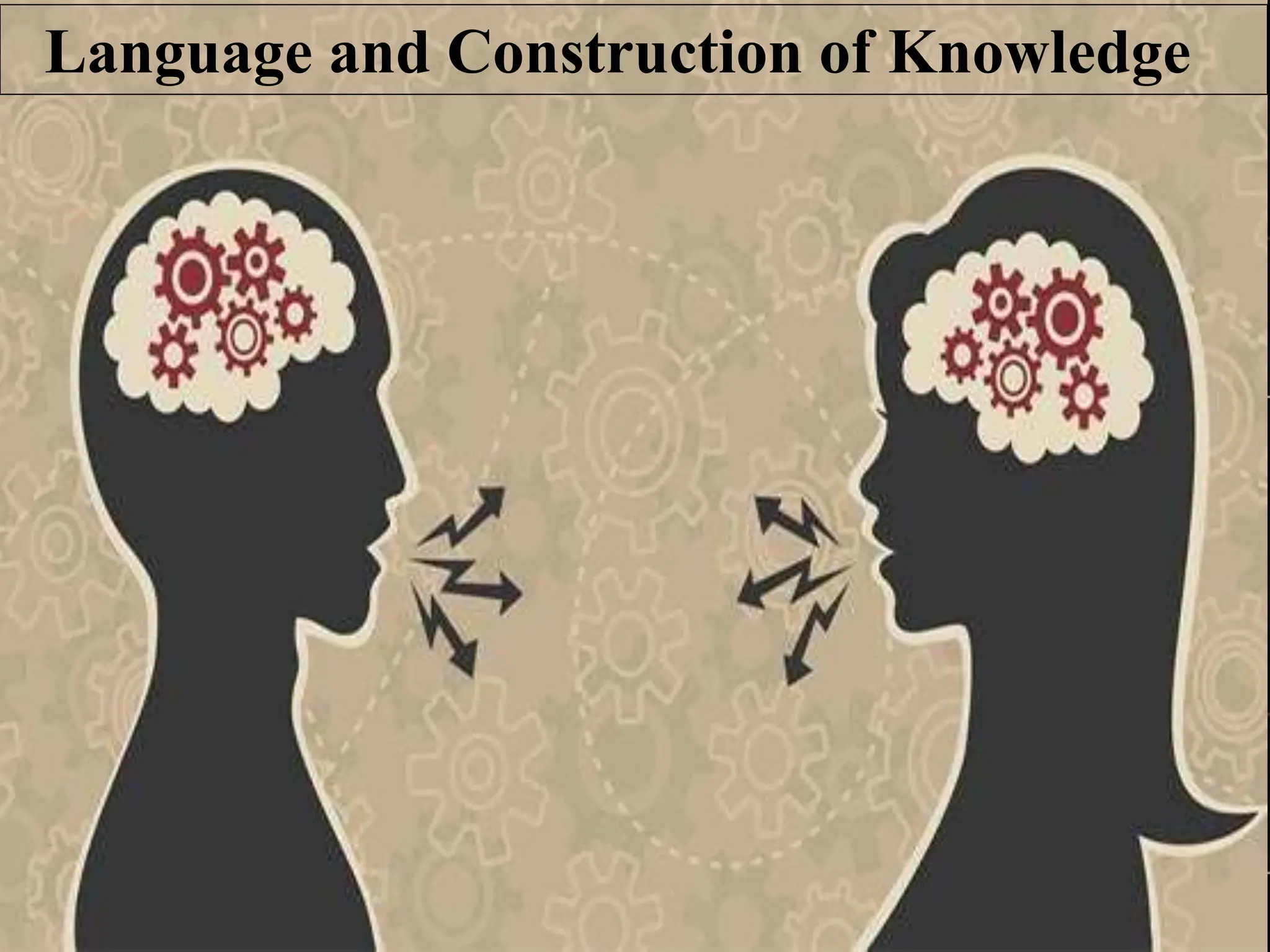
Language and Construction of Knowledge
What is Language?
• According to Merriam Webster dictionary , it is a
systematic means of communicating ideas or
feelings by the use of conventionalized signs,
sounds, gestures, or marks having understood
meanings.
• It serves as a tool for expressing thoughts, emotions,
and information, allowing individuals to interact and
share ideas.
What is Knowledge?
• Knowledge is a familiarity, awareness, or
understanding of someone or something, such
as facts, information, descriptions, or skills,
which is acquired through experience or
education by perceiving, discovering, or
learning.
Role of Language in Construction of
Knowledge
1. Foundation for Understanding
2. Critical thinking
3. Problem-Solving
4. Integration of Concepts
5. Expression of thoughts and ideas
6. Influence on thought processes
7. Transmission of culture and values
Views of Different Linguists and
Psychologists Regarding the Role of
Language in Knowledge Construction
1.Jean Piaget
• a crucial factor in shaping &
organizing thought.
• central role in the development of
cognitive structures and mental
processes.
• two functions of language in
cognitive development:
1. as a tool for social communication
2. as a system of symbols that help
children represent and organize their
experiences.
• According to Piaget, language learning begins in the
Pre-operational stage i.e. 2 to 7 years.
• He observed that there is a general correlation
between age & vocabulary size. For example, a 2-
year-old child might only have a vocabulary of few
hundred words , while a 6-year-old child might have
a vocabulary of several thousand words.
• As children’s brain develop , they become better able
to process and store language information.
2. Lev Vygotsky
• stress on social interaction
• fosters learning through collaboration
• role of verbal cues in scaffolding
• 3 forms of speech
1. Social Speech ( usually from the age of 2)
2. Private Speech ( usually from the age of 3)
3. Silent Inner Speech ( usually from the age of 7)
• For Piaget, thought preceded language. A child
learned to think first, and then from that
thought, speak.
• Vygotsky believed that thought and speech
were separate, intact processes that merged
around age three.
3. Jerome Bruner
• He viewed language as a powerful tool for
organizing, categorizing, and representing
information, enabling individuals to make sense
of the world around them.
• Bruner emphasized the crucial role of language
in supporting the transition from enactive and
iconic representation to symbolic representation,
enabling individuals to construct more complex
and abstract knowledge.
4. Noam Chomsky
• Language as a Universal Faculty
• Language Enables Abstract Thought
• Language as a Tool for Inquiry
• Language and Creativity
• Language and Power
• Language Influences Perception
4. Language in Educational Settings
• Language provides a framework for
organizing information.
• Language promotes active engagement and
participation.
• Language provides a tool for self-reflection
and metacognition.
• Language is a powerful tool for
communication and collaboration.
• Classroom diversity fosters multicultural
awareness.
Effective Classroom Communication
Strategies
• Set Clear Expectations
• Use Active Language
• Explain Concepts Clearly
• Encourage Questions
• Check for Understanding
• Provide Feedback
• Use Varied Communication Methods
• Use visuals, such as charts, graphs, and diagrams,
to help students understand complex concepts.
• Promote Collaborative Learning
Role of Digital Communication in
Construction of Knowledge
• Facilitating Collaborative Learning
• Enhancing Access to Information
• Promoting Personalized Learning
• Expanding Learning Opportunities
Conclusion
• Thus knowledge construction involves an
exchange of facts, ideas and experiences in an
input rich language friendly environment.
Check Your Progress
• According to Vygotsky:
1.cognition is independent of language.
2. cognitive development guides language
development
3.language facilitates cognitive
development
4.cognitive development is not related to
language.
language across curriculum.pptx

language across curriculum.pptx

  • 1.
  • 2.
    What is Language? •According to Merriam Webster dictionary , it is a systematic means of communicating ideas or feelings by the use of conventionalized signs, sounds, gestures, or marks having understood meanings. • It serves as a tool for expressing thoughts, emotions, and information, allowing individuals to interact and share ideas.
  • 3.
    What is Knowledge? •Knowledge is a familiarity, awareness, or understanding of someone or something, such as facts, information, descriptions, or skills, which is acquired through experience or education by perceiving, discovering, or learning.
  • 4.
    Role of Languagein Construction of Knowledge 1. Foundation for Understanding 2. Critical thinking 3. Problem-Solving 4. Integration of Concepts 5. Expression of thoughts and ideas 6. Influence on thought processes 7. Transmission of culture and values
  • 5.
    Views of DifferentLinguists and Psychologists Regarding the Role of Language in Knowledge Construction
  • 6.
    1.Jean Piaget • acrucial factor in shaping & organizing thought. • central role in the development of cognitive structures and mental processes. • two functions of language in cognitive development: 1. as a tool for social communication 2. as a system of symbols that help children represent and organize their experiences.
  • 7.
    • According toPiaget, language learning begins in the Pre-operational stage i.e. 2 to 7 years. • He observed that there is a general correlation between age & vocabulary size. For example, a 2- year-old child might only have a vocabulary of few hundred words , while a 6-year-old child might have a vocabulary of several thousand words. • As children’s brain develop , they become better able to process and store language information.
  • 8.
    2. Lev Vygotsky •stress on social interaction • fosters learning through collaboration • role of verbal cues in scaffolding • 3 forms of speech 1. Social Speech ( usually from the age of 2) 2. Private Speech ( usually from the age of 3) 3. Silent Inner Speech ( usually from the age of 7)
  • 9.
    • For Piaget,thought preceded language. A child learned to think first, and then from that thought, speak. • Vygotsky believed that thought and speech were separate, intact processes that merged around age three.
  • 10.
    3. Jerome Bruner •He viewed language as a powerful tool for organizing, categorizing, and representing information, enabling individuals to make sense of the world around them. • Bruner emphasized the crucial role of language in supporting the transition from enactive and iconic representation to symbolic representation, enabling individuals to construct more complex and abstract knowledge.
  • 11.
    4. Noam Chomsky •Language as a Universal Faculty • Language Enables Abstract Thought • Language as a Tool for Inquiry • Language and Creativity • Language and Power • Language Influences Perception
  • 12.
    4. Language inEducational Settings • Language provides a framework for organizing information. • Language promotes active engagement and participation. • Language provides a tool for self-reflection and metacognition. • Language is a powerful tool for communication and collaboration. • Classroom diversity fosters multicultural awareness.
  • 13.
    Effective Classroom Communication Strategies •Set Clear Expectations • Use Active Language • Explain Concepts Clearly • Encourage Questions • Check for Understanding • Provide Feedback • Use Varied Communication Methods • Use visuals, such as charts, graphs, and diagrams, to help students understand complex concepts. • Promote Collaborative Learning
  • 14.
    Role of DigitalCommunication in Construction of Knowledge • Facilitating Collaborative Learning • Enhancing Access to Information • Promoting Personalized Learning • Expanding Learning Opportunities
  • 15.
    Conclusion • Thus knowledgeconstruction involves an exchange of facts, ideas and experiences in an input rich language friendly environment.
  • 16.
    Check Your Progress •According to Vygotsky: 1.cognition is independent of language. 2. cognitive development guides language development 3.language facilitates cognitive development 4.cognitive development is not related to language.