Named Data Networking 
Lixia Zhang 
UCLA Computer Science Department 
August 12, 2014
NDN Team 
2 
Jeff 
Burke 
Van 
Jacobson 
(architect) 
Lixia 
Zhang 
Beichuan 
Zhang 
Lan 
Wang 
Tarek 
Abdelzaher 
Kim 
Claffy 
Alex 
Halderman 
Patrick 
Crowley 
Christos 
Papadopoulos
Marching Order 
“We would like to become smarter about 
NDN/CCN and other new approaches to 
networking: 
♢ What is it? 
♢ How does it work? 
♢ How will NDN change things? 
♢ What is the current status? 
♢ What are the research needs?” 
3
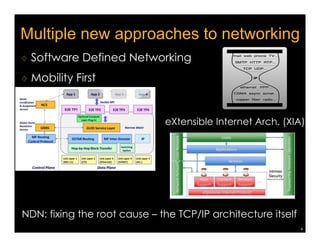
Multiple new approaches to networking 
♢ Software Defined Networking 
♢ Mobility First 
eXtensible Internet Arch. (XIA) 
NDN: fixing the root cause – the TCP/IP architecture itself 
4
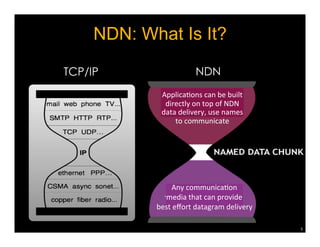
NDN: What Is It? 
5 
TCP/IP NDN 
ApplicaKons 
can 
be 
built 
directly 
on 
top 
of 
NDN 
data 
delivery, 
use 
names 
to 
communicate 
Any 
communicaKon 
media 
that 
can 
provide 
best 
effort 
datagram 
delivery
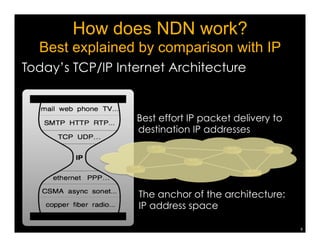
How does NDN work? 
Best explained by comparison with IP 
Today’s TCP/IP Internet Architecture 
6 
♢ Best effort IP packet delivery to 
destination IP addresses 
The anchor of the architecture: 
IP address space
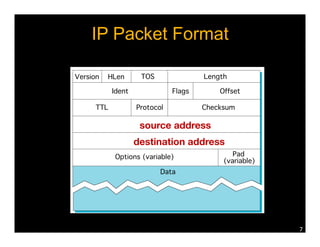
IP Packet Format 
7 
0 4 8 16 19 31 
Version HLen TOS Length 
Ident Flags Offset 
TTL Protocol Checksum 
Source 
Address 
DesKnaKon 
Address 
source SourceAddr 
address 
destination DestinationAddr 
address 
Options (variable) Pad 
(variable) 
Data
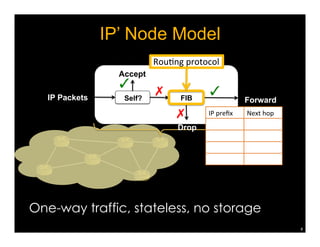
IP’ Node Model 
8 
Accept 
RouKng 
protocol 
IP Packets Self? FIB 
Forward 
✗ 
✗ 
✓ 
✓ 
IP 
prefix 
Next 
hop 
Drop 
One-way traffic, stateless, no storage
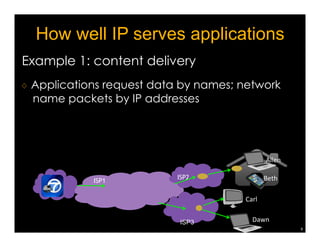
How well IP serves applications 
Example 1: content delivery 
♢ Applications request data by names; network 
name packets by IP addresses 
9 
ISP1 ISP2 
ISP3 
Allen 
Beth 
Carl 
Dawn
10 
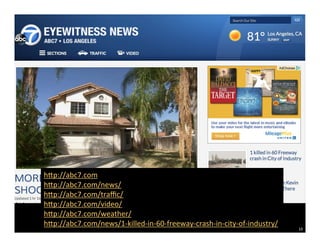
h[p://abc7.com 
h[p://abc7.com/news/ 
h[p://abc7.com/traffic/ 
h[p://abc7.com/video/ 
h[p://abc7.com/weather/ 
h[p://abc7.com/news/1-­‐killed-­‐in-­‐60-­‐freeway-­‐crash-­‐in-­‐city-­‐of-­‐industry/
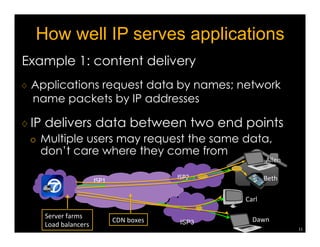
How well IP serves applications 
Example 1: content delivery 
♢ Applications request data by names; network 
name packets by IP addresses 
♢ IP delivers data between two end points 
¡ Multiple users may request the same data, 
don’t care where they come from 
11 
ISP1 ISP2 
ISP3 
Allen 
Beth 
Carl 
Server 
farms 
Dawn 
Load 
balancers 
CDN 
boxes
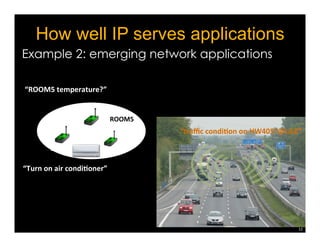
How well IP serves applications 
12 
Example 2: emerging network applications 
“ROOM5 
temperature?” 
ROOM5 
“traffic 
condi6on 
on 
HW405?@LAX” 
“Turn 
on 
air 
condi6oner”
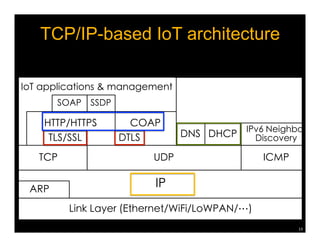
TCP/IP-based IoT architecture 
!%'
#!$$ '# 
!'
)%
'%'#* 
 

(#%
#(%) 


13 
IoT applications  management
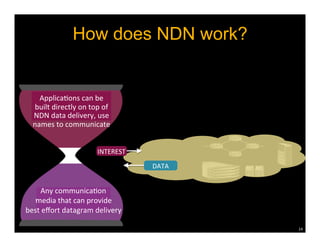
How does NDN work? 
ApplicaKons 
can 
be 
built 
directly 
on 
top 
of 
NDN 
data 
delivery, 
use 
names 
to 
communicate 
Any 
communicaKon 
media 
that 
can 
provide 
best 
effort 
datagram 
delivery 
14 
INTEREST 
DATA
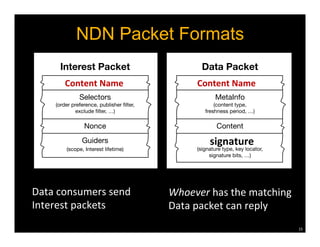
NDN Packet Formats 
Interest Packet Data Packet 
Name Name 
Selectors MetaInfo 
(order preference, publisher filter, 
exclude filter, …) 
Nonce 
Guiders 
(scope, Interest lifetime) 
(content type, 
freshness period, …) 
Content 
Signature 
signature 
(signature type, key locator, 
signature bits, …) 
15 
Content 
Name 
Content 
Name 
Data 
consumers 
send 
Interest 
packets 
Whoever 
has 
the 
matching 
Data 
packet 
can 
reply
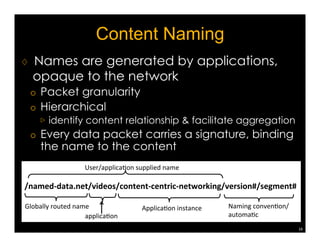
Content Naming 
♢ Names are generated by applications, 
opaque to the network 
¡ Packet granularity 
¡ Hierarchical 
▷ identify content relationship  facilitate aggregation 
¡ Every data packet carries a signature, binding 
the name to the content 
16 
User/applicaKon 
supplied 
name 
/named-­‐data.net/videos/content-­‐centric-­‐networking/version#/segment# 
Globally 
routed 
name 
applicaKon 
ApplicaKon 
instance 
Naming 
convenKon/ 
automaKc
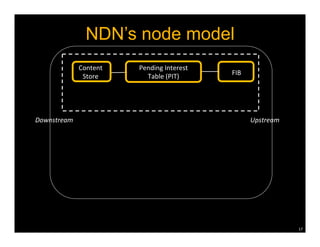
NDN’s node model 
17 
FIB 
Content 
Store 
Pending 
Interest 
Table 
(PIT) 
Downstream 
Upstream
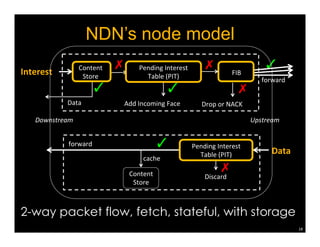
NDN’s node model 
2-way packet flow, fetch, stateful, with storage 
18 
Content 
Store 
Pending 
Interest 
Interest 
Table 
(PIT) 
FIB 
✗ 
✗ 
✓ 
forward 
✓ 
Data 
✓ 
Add 
Incoming 
Face 
✗ 
Drop 
or 
NACK 
Downstream 
Upstream 
Content 
Store 
Pending 
Interest 
Table 
(PIT) 
✗ 
Data 
forward 
✓ 
Discard 
cache
NDN’s stateful forwarding plane enables 
♢ Multicast delivery 
♢ Scalable content distribution 
♢ Multipath forwarding 
♢ Closed Feedback loop 
¡ Built in performance measurement at every 
router 
¡ Congestion control 
19
20 
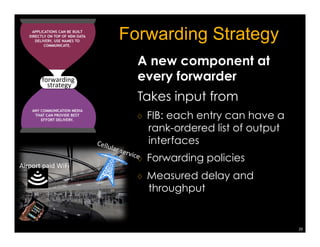
Forwarding Strategy 
A new component at 
every forwarder 
Takes input from 
♢ FIB: each entry can have a 
rank-ordered list of output 
interfaces 
♢ Forwarding policies 
♢ Measured delay and 
throughput 
forwarding 
strategy 
Airport 
paid 
WiFi 
Cellular 
service
21 
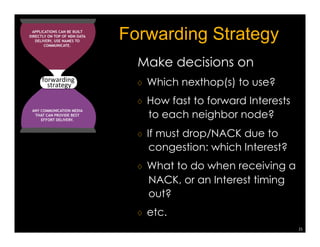
Forwarding Strategy 
Make decisions on 
♢ Which nexthop(s) to use? 
♢ How fast to forward Interests 
to each neighbor node? 
♢ If must drop/NACK due to 
congestion: which Interest? 
♢ What to do when receiving a 
NACK, or an Interest timing 
out? 
♢ etc. 
forwarding 
strategy
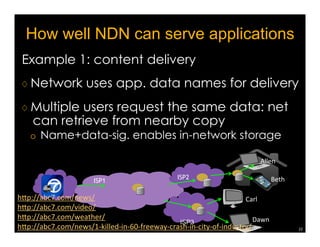
How well NDN can serve applications 
Example 1: content delivery 
♢ Network uses app. data names for delivery 
♢ Multiple users request the same data: net 
can retrieve from nearby copy 
¡ Name+data-sig. enables in-network storage 
22 
ISP1 ISP2 
ISP3 
Allen 
Beth 
Carl 
Dawn 
h[p://abc7.com/news/ 
h[p://abc7.com/video/ 
h[p://abc7.com/weather/ 
h[p://abc7.com/news/1-­‐killed-­‐in-­‐60-­‐freeway-­‐crash-­‐in-­‐city-­‐of-­‐industry/
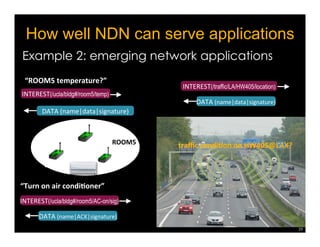
How well NDN can serve applications 
23 
Example 2: emerging network applications 
“ROOM5 
temperature?” 
DATA 
(name|data|signature) 
ROOM5 
traffic 
condi6on 
on 
HW405@LAX? 
INTEREST(/ucla/bldg#/room5/temp) 
“Turn 
on 
air 
condi6oner” 
ROOM5 
INTEREST(/ucla/bldg#/room5/AC-on/sig) 
DATA 
(name|ACK|signature) 
INTEREST(/traffic/LA/HW405/location) 
DATA 
(name|data|signature)
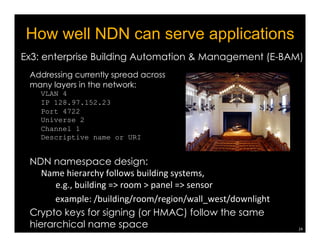
How well NDN can serve applications 
Ex3: enterprise Building Automation  Management (E-BAM) 
Addressing currently spread across 
many layers in the network: 
VLAN 4 
IP 128.97.152.23 
Port 4722 
Universe 2 
Channel 1 
Descriptive name or URI 
NDN namespace design: 
Name 
hierarchy 
follows 
building 
systems, 
e.g., 
building 
= 
room 
 
panel 
= 
sensor 
example: 
/building/room/region/wall_west/downlight 
Crypto keys for signing (or HMAC) follow the same 
hierarchical name space 
24
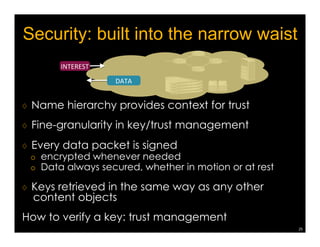
Security: built into the narrow waist 
♢ Name hierarchy provides context for trust 
♢ Fine-granularity in key/trust management 
♢ Every data packet is signed 
¡ encrypted whenever needed 
¡ Data always secured, whether in motion or at rest 
♢ Keys retrieved in the same way as any other 
content objects 
How to verify a key: trust management 
25 
INTEREST 
DATA
Outline 
♢ What is it? 
♢ How does it work? 
♢ How will NDN change things? 
♢ What is the current status? 
♢ What are the research needs? 
26
How will NDN change things? 
Address the fundamental challenges facing 
Internet today 
♢ Scalability 
♢ Enabling new applications 
♢ Empower edge users 
♢ Security 
27
Enabling scalable applications 
A case study by WashU: broadcast a 
laptop’s video feed to a global audience 
♢ May’13 CAFOE demo: broadcast to 1K 
clients around the world over an NDN net 
♢ Software required 
¡ NDN daemon running on gateways  clients 
¡ ndnvideo application on clients  server 
♢ Management required 
¡ The clients connect to NDN testbed 
¡ The clients know the video name 
28
For comparative study: built a comparable 
broadcast-capable video streaming system 
¡ Distribute video to 100 clients, using HTTP-based 
clients  proxies 
♢ Software required 
¡ VLC used as clients and server 
¡ Proxies run varnish, an HTTP video proxy/cache 
▷ Commercial-grade sw used by vimeo, BBC, and others 
▷ Version 3.0, Nov 2011, first support of video streaming 
♢ Management required 
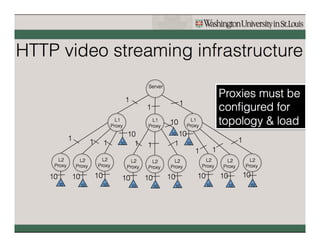
¡ Proxies must be configured to speak up stream 
¡ VLC clients know video name 
¡ VLC clients must know which proxy to connect to 
29
30
Video Streaming Case Study Summary 
♢ NDN was easier to setup 
¡ HTTP proxies and clients need topology-specific 
configuration 
¡ Using DNS/transparent proxies to avoid this 
would likely be just as complex 
♢ NDN required no tweaking 
¡ HTTP proxies needed to be tweaked to support 
changing loads 
Remember NDN is general-purpose 
31 
Form 
more 
details: 
h[p://named-­‐data.net/publicaKons/fia-­‐2013-­‐ndn-­‐perf-­‐11-­‐15-­‐2013/
How will NDN change things? 
♢ Enable a new generation of applications 
that are difficult to support with today’s 
TCP/IP 
¡ IP enabled a revolution because packet 
switching is fundamentally more general than 
circuit 
¡ NDN as a distribution network: fundamentally 
more general than IP’s point-to-point comm. 
Model 
32
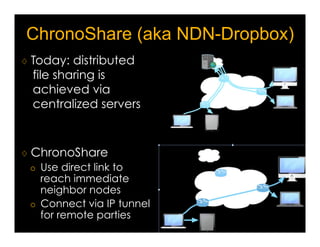
ChronoShare (aka NDN-Dropbox) 
♢ Today: distributed 
file sharing is 
achieved via 
centralized servers 
♢ ChronoShare 
¡ Use direct link to 
reach immediate 
neighbor nodes 
¡ Connect via IP tunnel 
for remote parties 
33
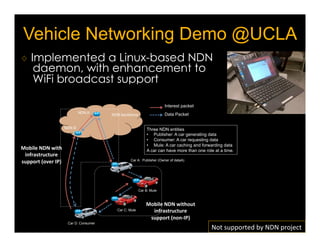
Vehicle Networking Demo @UCLA 
34 
♢ Implemented a Linux-based NDN 
daemon, with enhancement to 
WiFi broadcast support 
♢ Enhanced laptops with WiFi/WiMAX/Cellular 
interfaces 
Car A: Publisher (Owner of dataA) 
Car B: Mule 
Car C: Mule 
Car D: Consumer 
Interest packet 
Data Packet 
Three NDN entities 
• Publisher: A car generating data 
• Consumer: A car requesting data 
• Mule: A car caching and forwarding data 
A car can have more than one role at a time. 
NDN A NDN#backbone# 
NDN B 
Mobile'NDN'with' 
infrastructure' 
support'(over'IP)' 
Mobile'NDN'without' 
infrastructure' 
support'(non:IP)' 
Not 
supported 
by 
NDN 
project
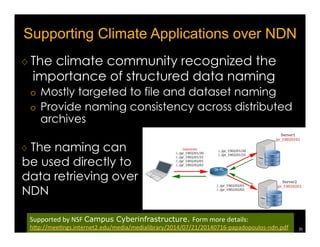
Supporting Climate Applications over NDN 
♢ The climate community recognized the 
importance of structured data naming 
¡ Mostly targeted to file and dataset naming 
¡ Provide naming consistency across distributed 
archives 
♢ The naming can 
be used directly to 
data retrieving over 
NDN 
35 
Supported 
by 
NSF 
Campus Cyberinfrastructure. Form 
more 
details: 
h[p://meeKngs.internet2.edu/media/medialibrary/2014/07/21/20140716-­‐papadopoulos-­‐ndn.pdf
Outline 
♢ What is it? 
♢ How does it work? 
♢ How will NDN change things? 
♢ What is the current status? 
♢ What are the research needs? 
36
The Current Status: NDN team (I) 
♢ Application-driven architecture 
development 
“Solving real problems forces architectural details to 
be filled in and, most importantly, verifies and shapes 
the architectural direction.” 
♢ What we have produced: 
¡ NDN protocol specification 
http://named-data.net/doc/ndn-tlv/ 
¡ NDN platform and libraries with multiple 
language supports (C++, Python, Javascript) 
https://github.com/named-data 
¡ A widely used NDN simulator 
http://ndnsim.net 
37
What NDN team has produced (II) 
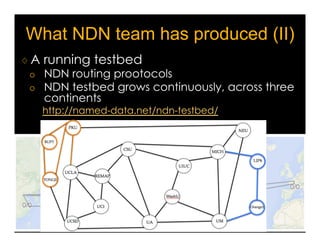
♢ A running testbed 
¡ NDN routing prootocols 
¡ NDN testbed grows continuously, across three 
continents 
http://named-data.net/ndn-testbed/ 
38
What NDN team has produced (III) 
♢ A growing set of applications 
¡ Fully distributed apps: NDN-chat, NDN-dropbox 
¡ Vehicular networking 
¡ Scalable streaming 
¡ Enterprise building automation  mgmt. (E-BAM) 
¡ IoT broadly defined 
¡ Open mHealth 
39
40
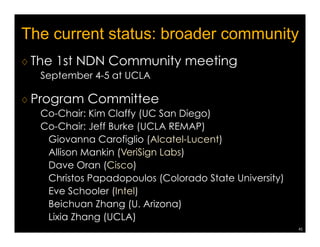
The current status: broader community 
♢ The 1st NDN Community meeting 
September 4-5 at UCLA 
♢ Program Committee 
Co-Chair: Kim Claffy (UC San Diego) 
Co-Chair: Jeff Burke (UCLA REMAP) 
Giovanna Carofiglio (Alcatel-Lucent) 
Allison Mankin (VeriSign Labs) 
Dave Oran (Cisco) 
Christos Papadopoulos (Colorado State University) 
Eve Schooler (Intel) 
Beichuan Zhang (U. Arizona) 
Lixia Zhang (UCLA) 
41
The current status: broader community 
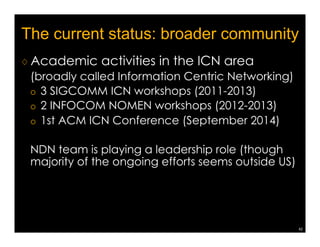
♢ Academic activities in the ICN area 
(broadly called Information Centric Networking) 
¡ 3 SIGCOMM ICN workshops (2011-2013) 
¡ 2 INFOCOM NOMEN workshops (2012-2013) 
¡ 1st ACM ICN Conference (September 2014) 
NDN team is playing a leadership role (though 
majority of the ongoing efforts seems outside US) 
42
What are the research needs? 
♢ Engaging broader US research community 
to invest into NDN 
♢ Applying NDN to solve real networking 
problems 
¡ The Internet is already information-centric 
▷ youtube, netflix, amazon, facebook 
▷ new generations of applications 
¡ Solving info distribution problems via IP point-to- 
point communication, as we do today, is 
complex  error-prone 
43
Analogy: consider TCP/IP in early 80’s 
♢ Promising new technology 
♢ Largely unknown outside its small community 
♢ Federal funding led TCP/IP to its success 
¡ BSD development, NSFnet 
¡ Various research projects over Internet 
♢ A number of problems exposed and resolved 
through larger scale experimentation 
¡ DNS development 
¡ Congestion control 
¡ Evolution of the routing system 
¡ and a set of others 
44

Named data networking. Basic Principle

  • 1.
    Named Data Networking Lixia Zhang UCLA Computer Science Department August 12, 2014
  • 2.
    NDN Team 2 Jeff Burke Van Jacobson (architect) Lixia Zhang Beichuan Zhang Lan Wang Tarek Abdelzaher Kim Claffy Alex Halderman Patrick Crowley Christos Papadopoulos
  • 3.
    Marching Order “Wewould like to become smarter about NDN/CCN and other new approaches to networking: ♢ What is it? ♢ How does it work? ♢ How will NDN change things? ♢ What is the current status? ♢ What are the research needs?” 3
  • 4.
    Multiple new approachesto networking ♢ Software Defined Networking ♢ Mobility First eXtensible Internet Arch. (XIA) NDN: fixing the root cause – the TCP/IP architecture itself 4
  • 5.
    NDN: What IsIt? 5 TCP/IP NDN ApplicaKons can be built directly on top of NDN data delivery, use names to communicate Any communicaKon media that can provide best effort datagram delivery
  • 6.
    How does NDNwork? Best explained by comparison with IP Today’s TCP/IP Internet Architecture 6 ♢ Best effort IP packet delivery to destination IP addresses The anchor of the architecture: IP address space
  • 7.
    IP Packet Format 7 0 4 8 16 19 31 Version HLen TOS Length Ident Flags Offset TTL Protocol Checksum Source Address DesKnaKon Address source SourceAddr address destination DestinationAddr address Options (variable) Pad (variable) Data
  • 8.
    IP’ Node Model 8 Accept RouKng protocol IP Packets Self? FIB Forward ✗ ✗ ✓ ✓ IP prefix Next hop Drop One-way traffic, stateless, no storage
  • 9.
    How well IPserves applications Example 1: content delivery ♢ Applications request data by names; network name packets by IP addresses 9 ISP1 ISP2 ISP3 Allen Beth Carl Dawn
  • 10.
    10 h[p://abc7.com h[p://abc7.com/news/ h[p://abc7.com/traffic/ h[p://abc7.com/video/ h[p://abc7.com/weather/ h[p://abc7.com/news/1-­‐killed-­‐in-­‐60-­‐freeway-­‐crash-­‐in-­‐city-­‐of-­‐industry/
  • 11.
    How well IPserves applications Example 1: content delivery ♢ Applications request data by names; network name packets by IP addresses ♢ IP delivers data between two end points ¡ Multiple users may request the same data, don’t care where they come from 11 ISP1 ISP2 ISP3 Allen Beth Carl Server farms Dawn Load balancers CDN boxes
  • 12.
    How well IPserves applications 12 Example 2: emerging network applications “ROOM5 temperature?” ROOM5 “traffic condi6on on HW405?@LAX” “Turn on air condi6oner”
  • 13.
  • 14.
  • 15.
  • 16.
    #(%) 13 IoT applications management
  • 17.
    How does NDNwork? ApplicaKons can be built directly on top of NDN data delivery, use names to communicate Any communicaKon media that can provide best effort datagram delivery 14 INTEREST DATA
  • 18.
    NDN Packet Formats Interest Packet Data Packet Name Name Selectors MetaInfo (order preference, publisher filter, exclude filter, …) Nonce Guiders (scope, Interest lifetime) (content type, freshness period, …) Content Signature signature (signature type, key locator, signature bits, …) 15 Content Name Content Name Data consumers send Interest packets Whoever has the matching Data packet can reply
  • 19.
    Content Naming ♢Names are generated by applications, opaque to the network ¡ Packet granularity ¡ Hierarchical ▷ identify content relationship facilitate aggregation ¡ Every data packet carries a signature, binding the name to the content 16 User/applicaKon supplied name /named-­‐data.net/videos/content-­‐centric-­‐networking/version#/segment# Globally routed name applicaKon ApplicaKon instance Naming convenKon/ automaKc
  • 20.
    NDN’s node model 17 FIB Content Store Pending Interest Table (PIT) Downstream Upstream
  • 21.
    NDN’s node model 2-way packet flow, fetch, stateful, with storage 18 Content Store Pending Interest Interest Table (PIT) FIB ✗ ✗ ✓ forward ✓ Data ✓ Add Incoming Face ✗ Drop or NACK Downstream Upstream Content Store Pending Interest Table (PIT) ✗ Data forward ✓ Discard cache
  • 22.
    NDN’s stateful forwardingplane enables ♢ Multicast delivery ♢ Scalable content distribution ♢ Multipath forwarding ♢ Closed Feedback loop ¡ Built in performance measurement at every router ¡ Congestion control 19
  • 23.
    20 Forwarding Strategy A new component at every forwarder Takes input from ♢ FIB: each entry can have a rank-ordered list of output interfaces ♢ Forwarding policies ♢ Measured delay and throughput forwarding strategy Airport paid WiFi Cellular service
  • 24.
    21 Forwarding Strategy Make decisions on ♢ Which nexthop(s) to use? ♢ How fast to forward Interests to each neighbor node? ♢ If must drop/NACK due to congestion: which Interest? ♢ What to do when receiving a NACK, or an Interest timing out? ♢ etc. forwarding strategy
  • 25.
    How well NDNcan serve applications Example 1: content delivery ♢ Network uses app. data names for delivery ♢ Multiple users request the same data: net can retrieve from nearby copy ¡ Name+data-sig. enables in-network storage 22 ISP1 ISP2 ISP3 Allen Beth Carl Dawn h[p://abc7.com/news/ h[p://abc7.com/video/ h[p://abc7.com/weather/ h[p://abc7.com/news/1-­‐killed-­‐in-­‐60-­‐freeway-­‐crash-­‐in-­‐city-­‐of-­‐industry/
  • 26.
    How well NDNcan serve applications 23 Example 2: emerging network applications “ROOM5 temperature?” DATA (name|data|signature) ROOM5 traffic condi6on on HW405@LAX? INTEREST(/ucla/bldg#/room5/temp) “Turn on air condi6oner” ROOM5 INTEREST(/ucla/bldg#/room5/AC-on/sig) DATA (name|ACK|signature) INTEREST(/traffic/LA/HW405/location) DATA (name|data|signature)
  • 27.
    How well NDNcan serve applications Ex3: enterprise Building Automation Management (E-BAM) Addressing currently spread across many layers in the network: VLAN 4 IP 128.97.152.23 Port 4722 Universe 2 Channel 1 Descriptive name or URI NDN namespace design: Name hierarchy follows building systems, e.g., building = room panel = sensor example: /building/room/region/wall_west/downlight Crypto keys for signing (or HMAC) follow the same hierarchical name space 24
  • 28.
    Security: built intothe narrow waist ♢ Name hierarchy provides context for trust ♢ Fine-granularity in key/trust management ♢ Every data packet is signed ¡ encrypted whenever needed ¡ Data always secured, whether in motion or at rest ♢ Keys retrieved in the same way as any other content objects How to verify a key: trust management 25 INTEREST DATA
  • 29.
    Outline ♢ Whatis it? ♢ How does it work? ♢ How will NDN change things? ♢ What is the current status? ♢ What are the research needs? 26
  • 30.
    How will NDNchange things? Address the fundamental challenges facing Internet today ♢ Scalability ♢ Enabling new applications ♢ Empower edge users ♢ Security 27
  • 31.
    Enabling scalable applications A case study by WashU: broadcast a laptop’s video feed to a global audience ♢ May’13 CAFOE demo: broadcast to 1K clients around the world over an NDN net ♢ Software required ¡ NDN daemon running on gateways clients ¡ ndnvideo application on clients server ♢ Management required ¡ The clients connect to NDN testbed ¡ The clients know the video name 28
  • 32.
    For comparative study:built a comparable broadcast-capable video streaming system ¡ Distribute video to 100 clients, using HTTP-based clients proxies ♢ Software required ¡ VLC used as clients and server ¡ Proxies run varnish, an HTTP video proxy/cache ▷ Commercial-grade sw used by vimeo, BBC, and others ▷ Version 3.0, Nov 2011, first support of video streaming ♢ Management required ¡ Proxies must be configured to speak up stream ¡ VLC clients know video name ¡ VLC clients must know which proxy to connect to 29
  • 33.
  • 34.
    Video Streaming CaseStudy Summary ♢ NDN was easier to setup ¡ HTTP proxies and clients need topology-specific configuration ¡ Using DNS/transparent proxies to avoid this would likely be just as complex ♢ NDN required no tweaking ¡ HTTP proxies needed to be tweaked to support changing loads Remember NDN is general-purpose 31 Form more details: h[p://named-­‐data.net/publicaKons/fia-­‐2013-­‐ndn-­‐perf-­‐11-­‐15-­‐2013/
  • 35.
    How will NDNchange things? ♢ Enable a new generation of applications that are difficult to support with today’s TCP/IP ¡ IP enabled a revolution because packet switching is fundamentally more general than circuit ¡ NDN as a distribution network: fundamentally more general than IP’s point-to-point comm. Model 32
  • 36.
    ChronoShare (aka NDN-Dropbox) ♢ Today: distributed file sharing is achieved via centralized servers ♢ ChronoShare ¡ Use direct link to reach immediate neighbor nodes ¡ Connect via IP tunnel for remote parties 33
  • 37.
    Vehicle Networking Demo@UCLA 34 ♢ Implemented a Linux-based NDN daemon, with enhancement to WiFi broadcast support ♢ Enhanced laptops with WiFi/WiMAX/Cellular interfaces Car A: Publisher (Owner of dataA) Car B: Mule Car C: Mule Car D: Consumer Interest packet Data Packet Three NDN entities • Publisher: A car generating data • Consumer: A car requesting data • Mule: A car caching and forwarding data A car can have more than one role at a time. NDN A NDN#backbone# NDN B Mobile'NDN'with' infrastructure' support'(over'IP)' Mobile'NDN'without' infrastructure' support'(non:IP)' Not supported by NDN project
  • 38.
    Supporting Climate Applicationsover NDN ♢ The climate community recognized the importance of structured data naming ¡ Mostly targeted to file and dataset naming ¡ Provide naming consistency across distributed archives ♢ The naming can be used directly to data retrieving over NDN 35 Supported by NSF Campus Cyberinfrastructure. Form more details: h[p://meeKngs.internet2.edu/media/medialibrary/2014/07/21/20140716-­‐papadopoulos-­‐ndn.pdf
  • 39.
    Outline ♢ Whatis it? ♢ How does it work? ♢ How will NDN change things? ♢ What is the current status? ♢ What are the research needs? 36
  • 40.
    The Current Status:NDN team (I) ♢ Application-driven architecture development “Solving real problems forces architectural details to be filled in and, most importantly, verifies and shapes the architectural direction.” ♢ What we have produced: ¡ NDN protocol specification http://named-data.net/doc/ndn-tlv/ ¡ NDN platform and libraries with multiple language supports (C++, Python, Javascript) https://github.com/named-data ¡ A widely used NDN simulator http://ndnsim.net 37
  • 41.
    What NDN teamhas produced (II) ♢ A running testbed ¡ NDN routing prootocols ¡ NDN testbed grows continuously, across three continents http://named-data.net/ndn-testbed/ 38
  • 42.
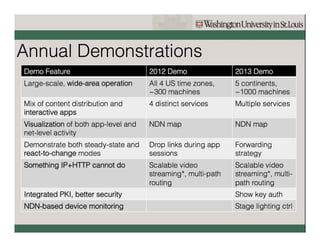
    What NDN teamhas produced (III) ♢ A growing set of applications ¡ Fully distributed apps: NDN-chat, NDN-dropbox ¡ Vehicular networking ¡ Scalable streaming ¡ Enterprise building automation mgmt. (E-BAM) ¡ IoT broadly defined ¡ Open mHealth 39
  • 43.
  • 44.
    The current status:broader community ♢ The 1st NDN Community meeting September 4-5 at UCLA ♢ Program Committee Co-Chair: Kim Claffy (UC San Diego) Co-Chair: Jeff Burke (UCLA REMAP) Giovanna Carofiglio (Alcatel-Lucent) Allison Mankin (VeriSign Labs) Dave Oran (Cisco) Christos Papadopoulos (Colorado State University) Eve Schooler (Intel) Beichuan Zhang (U. Arizona) Lixia Zhang (UCLA) 41
  • 45.
    The current status:broader community ♢ Academic activities in the ICN area (broadly called Information Centric Networking) ¡ 3 SIGCOMM ICN workshops (2011-2013) ¡ 2 INFOCOM NOMEN workshops (2012-2013) ¡ 1st ACM ICN Conference (September 2014) NDN team is playing a leadership role (though majority of the ongoing efforts seems outside US) 42
  • 46.
    What are theresearch needs? ♢ Engaging broader US research community to invest into NDN ♢ Applying NDN to solve real networking problems ¡ The Internet is already information-centric ▷ youtube, netflix, amazon, facebook ▷ new generations of applications ¡ Solving info distribution problems via IP point-to- point communication, as we do today, is complex error-prone 43
  • 47.
    Analogy: consider TCP/IPin early 80’s ♢ Promising new technology ♢ Largely unknown outside its small community ♢ Federal funding led TCP/IP to its success ¡ BSD development, NSFnet ¡ Various research projects over Internet ♢ A number of problems exposed and resolved through larger scale experimentation ¡ DNS development ¡ Congestion control ¡ Evolution of the routing system ¡ and a set of others 44