Principles of
Curriculum
Development
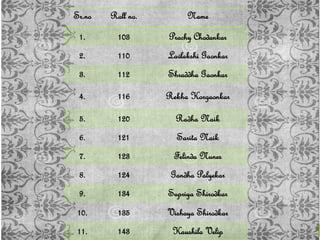
Sr.no Roll no. Name
1. 103 Prachy Chodankar
2. 110 Lavlakshi Gaonkar
3. 112 Shraddha Gaonkar
4. 116 Rekha Korgaonkar
5. 120 Radha Naik
6. 121 Sarita Naik
7. 123 Felinda Nunes
8. 124 Gandha Palyekar
9. 134 Supriya Shirodkar
10. 135 Vishaya Shirodkar
11. 143 Kaushila Velip
ACKNOWLEDGEMENT
“We can do everything through him who gives us strength.”
We thank God for the wisdom and perseverance that he has
bestowed upon us during this group assignment.
A group assignment like this is never the work of an
individual. The contribution of many people in different
ways have made this possible and made it a memorable one.
A heartfelt thank you to our guide Mrs. Rachael Noronha .
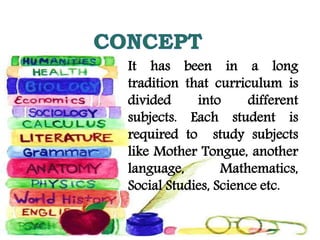
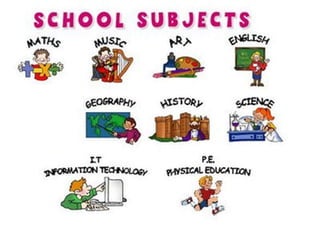
It has been in a long
tradition that curriculum is
divided into different
subjects. Each student is
required to study subjects
like Mother Tongue, another
language, Mathematics,
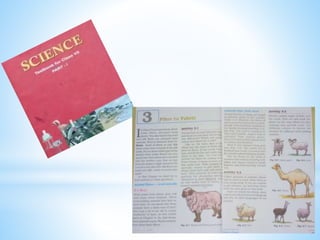
Social Studies, Science etc.
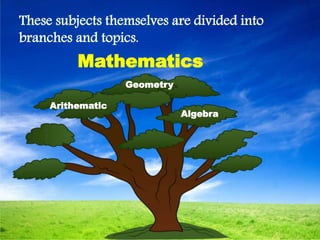
These subjects themselves are divided into
branches and topics.
Mathematics
Arithematic
Algebra
Geometry
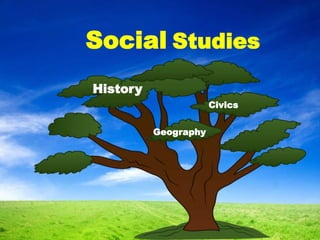
Social Studies
History
Civics
Geography
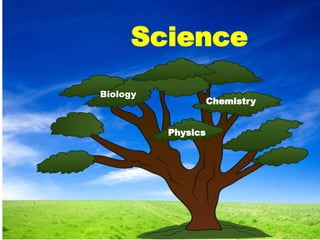
Science
Biology
Chemistry
Physics
• The content-centered curriculum is based
upon the idea that various subjects contain
essential knowledge, the mastery of which
will make child an educated one. Thus the
best method of making children educated is to
explore various subjects areas and learn what
is given in them.
• Subject matter will always be taught whether
the curriculum is content-centered or child
centered.
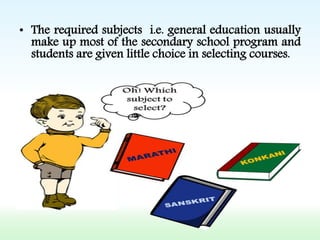
• The required subjects i.e. general education usually
make up most of the secondary school program and
students are given little choice in selecting courses.
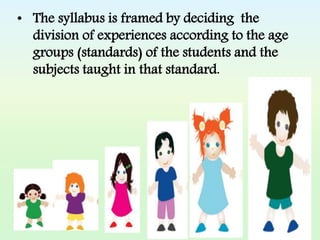
• The syllabus is framed by deciding the
division of experiences according to the age
groups (standards) of the students and the
subjects taught in that standard.
• This division and order in the syllabus is of
course done by the expert. Lecture method is
the mainly used teaching method.
• Textbook is the important aid.
• It is expected that the teacher
is an expert in the subject he
teaches.
• The progress or development
of the student is judged by the
amount of the information in
the subject he is able to tell or
write accurately.
DEFINITION
• Information to be learned in school, another
term for knowledge (a collection of facts,
concepts, generalization, principles, theories).
• Content comes in any form (audio, text and
video) and it informs, entertains, enlightens or
teaches people who consume it.
Criteria
For selection of content
criteri
a
1.
Suitability
Learning experiences
must be suitable to the
learners present state
of learning.
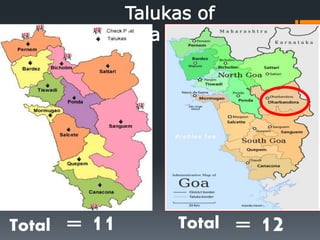
Talukas of
Goa
Total = 11 Total = 12
2.
Validity
criteri
a
3.
Interest
The content suit the
personality and
intellectual capabilities
of the students.
The content should be
placed in such a way
that it should retain the
interest of the students.
criteri
a
4. Utility
It is concerned with the
usefulness of the
content. It should lead
to the acquisition of
skills and knowledge
which is useful in daily
life.
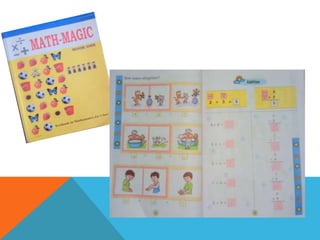
5.
Learnabilit
y
This criteria
emphasizes on the
optimal placement and
appropriate
organization and
sequencing of the
content.
CRITERI
A
6.
Continuit
y
Content should provide
continuity and learning
and prevent loss
through forgetting.
The students should be
provided with
experiences step by
step.
CRITERI
A
It means less teaching
effort and educational
resources. Less learners
effort but more results
and effective learning
outcome.
7.
Econom
y
criteri
a
The content matter
should contribute to basic
ideas, concepts, principles
and generalization to
achieve the over all aim
of the curriculum. It
should develop learning
abilities, skills, processes
and attitude.
8.Signific
ance
criteri
a
9. Relevance to life
The content should be
selected in such a way
that it should relate to
the learners real life
experiences in and out
of school.
ADVANTA
GES
1
Arrangemen
t in
Reasonable
order
What subjects are to
be taught in which
standard / to which
age- group of
students is very
clearly and
systematically
arranged.
2
Simplicity
The teacher,
students and
parents know
exactly what is
to be done and
at what time.
3
Development
of Abilities
The subject –
knowledge is arranged
in the order of the age-
group of the students,
their physical,
intellectual and
emotional
development.
4
Well-connected
As the subjects and
topics are well- divided
and their order is pre-
decided, it is possible to
do pre- planning of
learning and teaching.
This makes the
education process
well- knit or well-
connected.
5
Aids facility
As there is stress on the
content- knowledge and
as the division subjects
and topics are well
defined, the only
teaching – aid of the
textbook is enough for
learning and teaching.
6
Economics saving
Content-centered
curriculum is less
expensive than
any other kind of
curriculum.
7
Teacher’s convenience
The teacher is an
expert and a trained
person in a particular
subject. If one teacher
leaves the job or is
transferred he can be
easily substituted by
another teacher who
teaches the same
subject.
Disadvantages
1.Personal differences neglected
The personal differences of students in
liking, ability, aptitude, stage of
development are neglected.
2. Neglect of Psychological Principles
In subject – centred curriculum the learning
experiences are arranged in a reasonable method.
What will be easy for the students and what will be
known or familiar to students is generally decided
by guess work or manipulation.
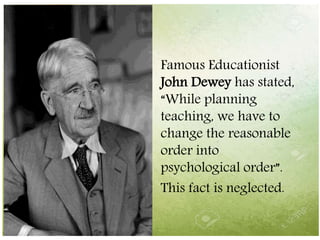
Famous Educationist
John Dewey has stated,
“While planning
teaching, we have to
change the reasonable
order into
psychological order”.
This fact is neglected.
3. Neglect of Social Problems
Due to subject- centred curriculum, there is a
possibility of current social problems in day-to-
day life being neglected.
4. Development of thinking power
neglected
In subject centred curriculum more stress is
given on assimilating the basic concepts and
generalisations. The method of studying the
subject is not paid any attention. This results in
only verbal knowledge.
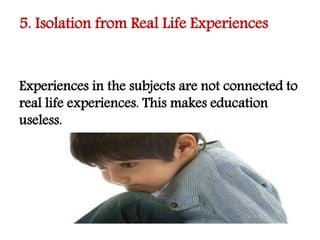
5. Isolation from Real Life Experiences
Experiences in the subjects are not connected to
real life experiences. This makes education
useless.
6. Centrally controlled
The subject-centred curriculum is controlled
from one centre only. At the State level we have
Board which decides the curriculum and that
curriculum is brought into practice all over the
state. No teacher’s and headmaster’s can change
this curriculum.
7. Teacher- centeredness
The subject-centred curriculum ultimately
becomes a teacher-centred one. Students
likings, stage of mind are neglected. Students
get bored to come to school if they do not get
joy, satisfaction, chances of self- expression and
self-respect through educational experiences
provided in the school.
8.Dominance by adults
The world of experiences of adults is given
priority over that of the children in subject-
centred curriculum.
Content-Centered Curriculum
V/S
Student Centered Curriculum
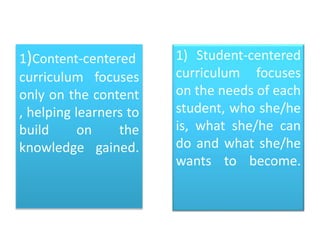
1)Content-centered
curriculum focuses
only on the content
, helping learners to
build on the
knowledge gained.
1) Student-centered
curriculum focuses
on the needs of each
student, who she/he
is, what she/he can
do and what she/he
wants to become.
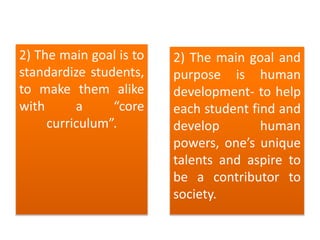
2) The main goal is to
standardize students,
to make them alike
with a “core
curriculum”.
2) The main goal and
purpose is human
development- to help
each student find and
develop human
powers, one’s unique
talents and aspire to
be a contributor to
society.
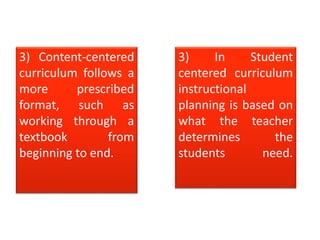
3) Content-centered
curriculum follows a
more prescribed
format, such as
working through a
textbook from
beginning to end.
3) In Student
centered curriculum
instructional
planning is based on
what the teacher
determines the
students need.
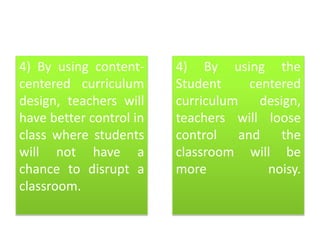
4) By using content-
centered curriculum
design, teachers will
have better control in
class where students
will not have a
chance to disrupt a
classroom.
4) By using the
Student centered
curriculum design,
teachers will loose
control and the
classroom will be
more noisy.
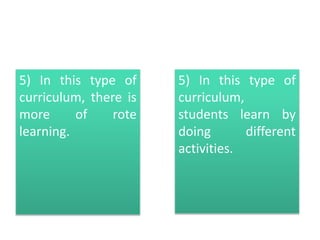
5) In this type of
curriculum, there is
more of rote
learning.
5) In this type of
curriculum,
students learn by
doing different
activities.
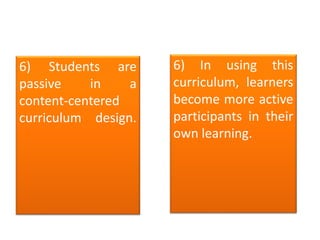
6) Students are
passive in a
content-centered
curriculum design.
6) In using this
curriculum, learners
become more active
participants in their
own learning.
Reference
Books :
• Curriculum Planning and Development , pg 90.
• Curriculum and Evaluation, pg. 38-41.
• School Curriculum, pg. 70-73.
• Curriculum Development, pg. 92-95.
Website:
www.slideshare.net/julietacabiles/curriculum-
contentcontentppt

content centred curriculum

  • 2.
  • 3.
    Sr.no Roll no.Name 1. 103 Prachy Chodankar 2. 110 Lavlakshi Gaonkar 3. 112 Shraddha Gaonkar 4. 116 Rekha Korgaonkar 5. 120 Radha Naik 6. 121 Sarita Naik 7. 123 Felinda Nunes 8. 124 Gandha Palyekar 9. 134 Supriya Shirodkar 10. 135 Vishaya Shirodkar 11. 143 Kaushila Velip
  • 4.
    ACKNOWLEDGEMENT “We can doeverything through him who gives us strength.” We thank God for the wisdom and perseverance that he has bestowed upon us during this group assignment. A group assignment like this is never the work of an individual. The contribution of many people in different ways have made this possible and made it a memorable one. A heartfelt thank you to our guide Mrs. Rachael Noronha .
  • 7.
    It has beenin a long tradition that curriculum is divided into different subjects. Each student is required to study subjects like Mother Tongue, another language, Mathematics, Social Studies, Science etc.
  • 8.
    These subjects themselvesare divided into branches and topics. Mathematics Arithematic Algebra Geometry
  • 9.
  • 10.
  • 11.
    • The content-centeredcurriculum is based upon the idea that various subjects contain essential knowledge, the mastery of which will make child an educated one. Thus the best method of making children educated is to explore various subjects areas and learn what is given in them. • Subject matter will always be taught whether the curriculum is content-centered or child centered.
  • 13.
    • The requiredsubjects i.e. general education usually make up most of the secondary school program and students are given little choice in selecting courses.
  • 14.
    • The syllabusis framed by deciding the division of experiences according to the age groups (standards) of the students and the subjects taught in that standard.
  • 15.
    • This divisionand order in the syllabus is of course done by the expert. Lecture method is the mainly used teaching method.
  • 16.
    • Textbook isthe important aid. • It is expected that the teacher is an expert in the subject he teaches. • The progress or development of the student is judged by the amount of the information in the subject he is able to tell or write accurately.
  • 17.
    DEFINITION • Information tobe learned in school, another term for knowledge (a collection of facts, concepts, generalization, principles, theories). • Content comes in any form (audio, text and video) and it informs, entertains, enlightens or teaches people who consume it.
  • 18.
  • 19.
    criteri a 1. Suitability Learning experiences must besuitable to the learners present state of learning.
  • 20.
  • 21.
  • 24.
    3. Interest The content suitthe personality and intellectual capabilities of the students. The content should be placed in such a way that it should retain the interest of the students. criteri a
  • 25.
    4. Utility It isconcerned with the usefulness of the content. It should lead to the acquisition of skills and knowledge which is useful in daily life.
  • 26.
    5. Learnabilit y This criteria emphasizes onthe optimal placement and appropriate organization and sequencing of the content. CRITERI A
  • 28.
    6. Continuit y Content should provide continuityand learning and prevent loss through forgetting. The students should be provided with experiences step by step. CRITERI A
  • 31.
    It means lessteaching effort and educational resources. Less learners effort but more results and effective learning outcome. 7. Econom y
  • 32.
    criteri a The content matter shouldcontribute to basic ideas, concepts, principles and generalization to achieve the over all aim of the curriculum. It should develop learning abilities, skills, processes and attitude. 8.Signific ance
  • 33.
    criteri a 9. Relevance tolife The content should be selected in such a way that it should relate to the learners real life experiences in and out of school.
  • 35.
  • 36.
    1 Arrangemen t in Reasonable order What subjectsare to be taught in which standard / to which age- group of students is very clearly and systematically arranged.
  • 37.
    2 Simplicity The teacher, students and parentsknow exactly what is to be done and at what time.
  • 38.
    3 Development of Abilities The subject– knowledge is arranged in the order of the age- group of the students, their physical, intellectual and emotional development.
  • 39.
    4 Well-connected As the subjectsand topics are well- divided and their order is pre- decided, it is possible to do pre- planning of learning and teaching. This makes the education process well- knit or well- connected.
  • 40.
    5 Aids facility As thereis stress on the content- knowledge and as the division subjects and topics are well defined, the only teaching – aid of the textbook is enough for learning and teaching.
  • 41.
    6 Economics saving Content-centered curriculum isless expensive than any other kind of curriculum.
  • 42.
    7 Teacher’s convenience The teacheris an expert and a trained person in a particular subject. If one teacher leaves the job or is transferred he can be easily substituted by another teacher who teaches the same subject.
  • 43.
  • 44.
    1.Personal differences neglected Thepersonal differences of students in liking, ability, aptitude, stage of development are neglected.
  • 45.
    2. Neglect ofPsychological Principles In subject – centred curriculum the learning experiences are arranged in a reasonable method. What will be easy for the students and what will be known or familiar to students is generally decided by guess work or manipulation.
  • 46.
    Famous Educationist John Deweyhas stated, “While planning teaching, we have to change the reasonable order into psychological order”. This fact is neglected.
  • 47.
    3. Neglect ofSocial Problems Due to subject- centred curriculum, there is a possibility of current social problems in day-to- day life being neglected.
  • 48.
    4. Development ofthinking power neglected In subject centred curriculum more stress is given on assimilating the basic concepts and generalisations. The method of studying the subject is not paid any attention. This results in only verbal knowledge.
  • 49.
    5. Isolation fromReal Life Experiences Experiences in the subjects are not connected to real life experiences. This makes education useless.
  • 50.
    6. Centrally controlled Thesubject-centred curriculum is controlled from one centre only. At the State level we have Board which decides the curriculum and that curriculum is brought into practice all over the state. No teacher’s and headmaster’s can change this curriculum.
  • 51.
    7. Teacher- centeredness Thesubject-centred curriculum ultimately becomes a teacher-centred one. Students likings, stage of mind are neglected. Students get bored to come to school if they do not get joy, satisfaction, chances of self- expression and self-respect through educational experiences provided in the school.
  • 52.
    8.Dominance by adults Theworld of experiences of adults is given priority over that of the children in subject- centred curriculum.
  • 53.
  • 54.
    1)Content-centered curriculum focuses only onthe content , helping learners to build on the knowledge gained. 1) Student-centered curriculum focuses on the needs of each student, who she/he is, what she/he can do and what she/he wants to become.
  • 55.
    2) The maingoal is to standardize students, to make them alike with a “core curriculum”. 2) The main goal and purpose is human development- to help each student find and develop human powers, one’s unique talents and aspire to be a contributor to society.
  • 56.
    3) Content-centered curriculum followsa more prescribed format, such as working through a textbook from beginning to end. 3) In Student centered curriculum instructional planning is based on what the teacher determines the students need.
  • 57.
    4) By usingcontent- centered curriculum design, teachers will have better control in class where students will not have a chance to disrupt a classroom. 4) By using the Student centered curriculum design, teachers will loose control and the classroom will be more noisy.
  • 58.
    5) In thistype of curriculum, there is more of rote learning. 5) In this type of curriculum, students learn by doing different activities.
  • 59.
    6) Students are passivein a content-centered curriculum design. 6) In using this curriculum, learners become more active participants in their own learning.
  • 60.
    Reference Books : • CurriculumPlanning and Development , pg 90. • Curriculum and Evaluation, pg. 38-41. • School Curriculum, pg. 70-73. • Curriculum Development, pg. 92-95. Website: www.slideshare.net/julietacabiles/curriculum- contentcontentppt