1
Curriculum Design and its
Types
Dr.A.Thangasamy
Assistant Professor
Department of Education
Gandhigram Rural Institute
Gandhigram, Dindigul.
What is Curriculum Design?
 Curriculum design is a term used to describe the
purposeful, deliberate, and systematic organization of
curriculum (instructional blocks) within a class or course.
In other words, it is a way for teachers to plan instruction.
When teachers design curriculum, they identify what will
be done, who will do it, and what schedule to follow.
 Curriculum design consists of inclusion and exclusion of
topics in the document to decide what subjects the students
will be learning in the course.
2
Purpose of Curriculum Design
 Teachers design each curriculum with a specific
educational purpose in mind.
 The ultimate goal is to improve student learning, but there
are other reasons to employ curriculum design as well. For
example, designing a curriculum for middle school
students with both elementary and high school curricula in
mind helps to make sure that learning goals are aligned and
complement each other from one stage to the next. If a
middle school curriculum is designed without taking prior
knowledge from elementary school or future learning in
high school into account it can create real problems for the
students.
3
Types of Curriculum Design
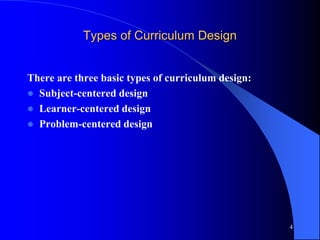
There are three basic types of curriculum design:
 Subject-centered design
 Learner-centered design
 Problem-centered design
4
Subject-centered Curriculum Design
 Subject-centered curriculum design revolves around a
particular subject matter or discipline. For example,
a subject-centered curriculum may focus on math or
biology. ... In particular, this form of curriculum design is
constructed without taking into account the specific
learning styles of the students.
 The curriculum is designed as per the subject being taught.
Each topic in the subject is taught as per the examples.
This design model doesn’t take into the picture the
capabilities of the students taking up the course and hence
may not be suitable for all.
5
Characteristics of Subject
centered curriculum
 Learning subject matter is an end in itself-
– Listening to lectures, studying the textbooks and studying for examination
are all practices that show the influence of the subject centered curriculum
approach. The subject teacher considers it of great importance to cover the
prescribed textbook. Since a specific amount of subject matter is to be
learnt in a set time. If subject matter has been learnt, the teacher and
students feel satisfaction.
There is a predetermined uniform standard of knowledge –
Those who follow the subject centered approach strongly advocate
minimum standards. They advocate set standard for a class to be achieved
by all students in order to qualify the examination. In other words a time
limit is placed on achievements and if the pupil fails, the course must be
repeated. The teacher attempts to bring the pupil up to the set standard.
Thus failures are required to repeat a grade or they are dropped out from
their institutions.
6
 Practice in skills is emphasized
– Drill in specific skills is one of the typical characteristics of the subject
curriculum. Drill session, remedial work, review work, coaching classes
are often devoted to such type of drill. This drill is given in equal amounts
to all pupils in the group.
 Emphasis is placed upon acquiring information for future use-
The subject matter selected for a course, is considered to be of value in
adult living rather than child’s immediate needs. Thus adult problems are
given more weight than problems of children in youth.
Progress is measured by how much of the subject a pupil has learnt-
As the subject matter is an important thing to be learnt, learning is
measured by how well the subject matter has been mastered.
Frequent tests are given to check the extent of achievement by the
students.
7
 Each subject is distinct entity (unit) with a logical organization of its own
– Emphasis is placed on the acquisition of skills, facts and information in
different logically organized subjects. The members of the staff, teaching
different subjects do not plan courses together and they do not discuss
common problems.
 Subject matter is selected by adults previous to the teaching, learning
situations
– As the subject matter is taught in logically organized discipline, therefore,
the content of the course is selected before it is taught. For this purpose
they receive help from subject matter, specialists, supervisors,
administrators and textbook writers.
8
Learner centred curriculum
 This design aims to customize the curriculum as
per the needs of the student. Its core philosophy is
that each student is unique and there is no standard
curriculum which can fit all of them.
Differentiated instruction plans can be prepared to
suit each student as per their requirement.
9
 learner-centered curriculum design takes
each individual's needs, interests, and goals
into consideration. In other words, it
acknowledges that students are not uniform
and adjust to those student needs. Learner-
centered curriculum design is meant to
empower learners and allow them to shape
their education through choices.
10
 Instructional plans in a learner-centered
curriculum are differentiated, giving students the
opportunity to choose assignments, learning
experiences or activities. This can motivate
students and help them stay engaged in the
material that they are learning.
 The drawback to this form of curriculum design is
that it is labor-intensive. Developing differentiated
instruction puts pressure on the teacher to create
instruction and/or find materials that are
conducive to each student's learning needs
11
Principles of Students Centred Curriculum
 The teacher role is that of a guide
 Interest is the motive of all work
 Scientific study of pupil development
 Co-operation between the school and home to
meet the needs of child-life
12
Characteristics of Learner Centred
Curriculum
 This type of curriculum gives importance to learner and
considers child as the centre of interest which is the most
natural approach.
 The interest of the child is the most important factor in the
process of teaching and learning. This factor is highly
emphasized in this type-of curriculum.
 In this curriculum the teacher’s role is not that of a task-
master but that of a guide. In this curriculum, the child is
treated as, plant, the teacher as gardener and the school as a
garden. Thus, and child grows and develops in a natural
atmosphere.
13
 Students centered curriculum gives several options
(special activities, exploratory courses and other
experiences) to the students. The options are based
on knowledge of learner characteristics.
 Students are actively involved in planning and
evaluation of the options in general and for
themselves in particular.
 Learner centered curriculum points out that “the
more experience in life a child has the more eager
he will to learn.”
14
Problem-centred Curriculum Design
 A curriculum design that also uses a student approach
but that instructs students to look at a problem or
situation and figure out a way to solve it. Teachers
expect students to use their real-life experiences to
determine an answer.
 This method aims at exposing the students to practical
situations and problems so that they can apply their
knowledge to solve them. This method helps the students
to remember what they learned and the knowledge sticks
with them for a long time. The disadvantage is that this
method doesn’t suit all the student.
15
 Like learner-centered curriculum design, problem-centered
curriculum design is also a form of student-centered
design. Problem-centered curricula focus on teaching
students how to look at a problem and come up with a
solution to the problem. Students are thus exposed to real-
life issues, which helps them develop skills that are
transferable to the real world.
 Problem-centered curriculum design increases the
relevance of the curriculum and allows students to be
creative and innovate as they are learning. The drawback
to this form of curriculum design is that it does not always
take learning styles into consideration.
16
Curriculum Design Tips
 Identify the needs of stakeholders (i.e., students)
– early on in the curriculum design process. This can be
done through needs analysis, which involves the
collection and analysis of data related to the learner.
This data might include what learners already know and
what they need to know to be proficient in a particular
area or skill. It may also include information about
learner perceptions, strengths, and weaknesses.
17
 Create a clear list of learning goals and outcomes.
– This will help you to focus on the intended purpose of
the curriculum and allow you to plan instruction that
can achieve the desired results. Learning goals are the
things teachers want students to achieve in the course.
Learning outcomes are the measurable knowledge,
skills, and attitudes that students should have achieved
in the course.
18
 Identify constraints
– that will impact your curriculum design. For
example, time is a common constraint that must
be considered. There are only so many hours,
days, weeks or months in the term. If there isn't
enough time to deliver all of the instruction that
has been planned, it will impact learning
outcomes.
19
 Identify the instructional methods
– that will be used throughout the course and
consider how they will work with student
learning styles. If the instructional methods are
not conducive to the curriculum, the
instructional design or the curriculum design
will need to be altered accordingly.
20
 Establish evaluation methods
– that will be used at the end and during the school year
to assess learners, instructors, and the curriculum.
Evaluation will help you determine if the curriculum
design is working or if it is failing. Examples of things
that should be evaluated include the strengths and
weaknesses of the curriculum and achievement rates
related to learning outcomes. The most effective
evaluation is ongoing and summative.
21
22
 Remember that curriculum design is not
a one-step process;
– continuous improvement is a necessity. The
design of the curriculum should be assessed
periodically and refined based on assessment
data. This may involve making alterations to
the design partway through the course to ensure
that learning outcomes or a certain level of
proficiency will be achieved at the end of the
course.
THANK YOU
23

Curriculam and types

  • 1.
    1 Curriculum Design andits Types Dr.A.Thangasamy Assistant Professor Department of Education Gandhigram Rural Institute Gandhigram, Dindigul.
  • 2.
    What is CurriculumDesign?  Curriculum design is a term used to describe the purposeful, deliberate, and systematic organization of curriculum (instructional blocks) within a class or course. In other words, it is a way for teachers to plan instruction. When teachers design curriculum, they identify what will be done, who will do it, and what schedule to follow.  Curriculum design consists of inclusion and exclusion of topics in the document to decide what subjects the students will be learning in the course. 2
  • 3.
    Purpose of CurriculumDesign  Teachers design each curriculum with a specific educational purpose in mind.  The ultimate goal is to improve student learning, but there are other reasons to employ curriculum design as well. For example, designing a curriculum for middle school students with both elementary and high school curricula in mind helps to make sure that learning goals are aligned and complement each other from one stage to the next. If a middle school curriculum is designed without taking prior knowledge from elementary school or future learning in high school into account it can create real problems for the students. 3
  • 4.
    Types of CurriculumDesign There are three basic types of curriculum design:  Subject-centered design  Learner-centered design  Problem-centered design 4
  • 5.
    Subject-centered Curriculum Design Subject-centered curriculum design revolves around a particular subject matter or discipline. For example, a subject-centered curriculum may focus on math or biology. ... In particular, this form of curriculum design is constructed without taking into account the specific learning styles of the students.  The curriculum is designed as per the subject being taught. Each topic in the subject is taught as per the examples. This design model doesn’t take into the picture the capabilities of the students taking up the course and hence may not be suitable for all. 5
  • 6.
    Characteristics of Subject centeredcurriculum  Learning subject matter is an end in itself- – Listening to lectures, studying the textbooks and studying for examination are all practices that show the influence of the subject centered curriculum approach. The subject teacher considers it of great importance to cover the prescribed textbook. Since a specific amount of subject matter is to be learnt in a set time. If subject matter has been learnt, the teacher and students feel satisfaction. There is a predetermined uniform standard of knowledge – Those who follow the subject centered approach strongly advocate minimum standards. They advocate set standard for a class to be achieved by all students in order to qualify the examination. In other words a time limit is placed on achievements and if the pupil fails, the course must be repeated. The teacher attempts to bring the pupil up to the set standard. Thus failures are required to repeat a grade or they are dropped out from their institutions. 6
  • 7.
     Practice inskills is emphasized – Drill in specific skills is one of the typical characteristics of the subject curriculum. Drill session, remedial work, review work, coaching classes are often devoted to such type of drill. This drill is given in equal amounts to all pupils in the group.  Emphasis is placed upon acquiring information for future use- The subject matter selected for a course, is considered to be of value in adult living rather than child’s immediate needs. Thus adult problems are given more weight than problems of children in youth. Progress is measured by how much of the subject a pupil has learnt- As the subject matter is an important thing to be learnt, learning is measured by how well the subject matter has been mastered. Frequent tests are given to check the extent of achievement by the students. 7
  • 8.
     Each subjectis distinct entity (unit) with a logical organization of its own – Emphasis is placed on the acquisition of skills, facts and information in different logically organized subjects. The members of the staff, teaching different subjects do not plan courses together and they do not discuss common problems.  Subject matter is selected by adults previous to the teaching, learning situations – As the subject matter is taught in logically organized discipline, therefore, the content of the course is selected before it is taught. For this purpose they receive help from subject matter, specialists, supervisors, administrators and textbook writers. 8
  • 9.
    Learner centred curriculum This design aims to customize the curriculum as per the needs of the student. Its core philosophy is that each student is unique and there is no standard curriculum which can fit all of them. Differentiated instruction plans can be prepared to suit each student as per their requirement. 9
  • 10.
     learner-centered curriculumdesign takes each individual's needs, interests, and goals into consideration. In other words, it acknowledges that students are not uniform and adjust to those student needs. Learner- centered curriculum design is meant to empower learners and allow them to shape their education through choices. 10
  • 11.
     Instructional plansin a learner-centered curriculum are differentiated, giving students the opportunity to choose assignments, learning experiences or activities. This can motivate students and help them stay engaged in the material that they are learning.  The drawback to this form of curriculum design is that it is labor-intensive. Developing differentiated instruction puts pressure on the teacher to create instruction and/or find materials that are conducive to each student's learning needs 11
  • 12.
    Principles of StudentsCentred Curriculum  The teacher role is that of a guide  Interest is the motive of all work  Scientific study of pupil development  Co-operation between the school and home to meet the needs of child-life 12
  • 13.
    Characteristics of LearnerCentred Curriculum  This type of curriculum gives importance to learner and considers child as the centre of interest which is the most natural approach.  The interest of the child is the most important factor in the process of teaching and learning. This factor is highly emphasized in this type-of curriculum.  In this curriculum the teacher’s role is not that of a task- master but that of a guide. In this curriculum, the child is treated as, plant, the teacher as gardener and the school as a garden. Thus, and child grows and develops in a natural atmosphere. 13
  • 14.
     Students centeredcurriculum gives several options (special activities, exploratory courses and other experiences) to the students. The options are based on knowledge of learner characteristics.  Students are actively involved in planning and evaluation of the options in general and for themselves in particular.  Learner centered curriculum points out that “the more experience in life a child has the more eager he will to learn.” 14
  • 15.
    Problem-centred Curriculum Design A curriculum design that also uses a student approach but that instructs students to look at a problem or situation and figure out a way to solve it. Teachers expect students to use their real-life experiences to determine an answer.  This method aims at exposing the students to practical situations and problems so that they can apply their knowledge to solve them. This method helps the students to remember what they learned and the knowledge sticks with them for a long time. The disadvantage is that this method doesn’t suit all the student. 15
  • 16.
     Like learner-centeredcurriculum design, problem-centered curriculum design is also a form of student-centered design. Problem-centered curricula focus on teaching students how to look at a problem and come up with a solution to the problem. Students are thus exposed to real- life issues, which helps them develop skills that are transferable to the real world.  Problem-centered curriculum design increases the relevance of the curriculum and allows students to be creative and innovate as they are learning. The drawback to this form of curriculum design is that it does not always take learning styles into consideration. 16
  • 17.
    Curriculum Design Tips Identify the needs of stakeholders (i.e., students) – early on in the curriculum design process. This can be done through needs analysis, which involves the collection and analysis of data related to the learner. This data might include what learners already know and what they need to know to be proficient in a particular area or skill. It may also include information about learner perceptions, strengths, and weaknesses. 17
  • 18.
     Create aclear list of learning goals and outcomes. – This will help you to focus on the intended purpose of the curriculum and allow you to plan instruction that can achieve the desired results. Learning goals are the things teachers want students to achieve in the course. Learning outcomes are the measurable knowledge, skills, and attitudes that students should have achieved in the course. 18
  • 19.
     Identify constraints –that will impact your curriculum design. For example, time is a common constraint that must be considered. There are only so many hours, days, weeks or months in the term. If there isn't enough time to deliver all of the instruction that has been planned, it will impact learning outcomes. 19
  • 20.
     Identify theinstructional methods – that will be used throughout the course and consider how they will work with student learning styles. If the instructional methods are not conducive to the curriculum, the instructional design or the curriculum design will need to be altered accordingly. 20
  • 21.
     Establish evaluationmethods – that will be used at the end and during the school year to assess learners, instructors, and the curriculum. Evaluation will help you determine if the curriculum design is working or if it is failing. Examples of things that should be evaluated include the strengths and weaknesses of the curriculum and achievement rates related to learning outcomes. The most effective evaluation is ongoing and summative. 21
  • 22.
    22  Remember thatcurriculum design is not a one-step process; – continuous improvement is a necessity. The design of the curriculum should be assessed periodically and refined based on assessment data. This may involve making alterations to the design partway through the course to ensure that learning outcomes or a certain level of proficiency will be achieved at the end of the course.
  • 23.