



CONSUMERISM AND WASTE PRODUCTS


                         SUBMITTED BY:

                         •NIKITA RANJAN
                           (10BIT0203)
CONSUMER??

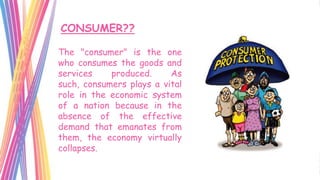
The "consumer" is the one
who consumes the goods and
services    produced.     As
such, consumers plays a vital
role in the economic system
of a nation because in the
absence of the effective
demand that emanates from
them, the economy virtually
collapses.
Consumerism??

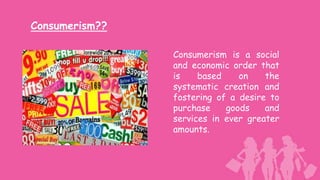
                Consumerism is a social
                and economic order that
                is    based    on    the
                systematic creation and
                fostering of a desire to
                purchase    goods    and
                services in ever greater
                amounts.
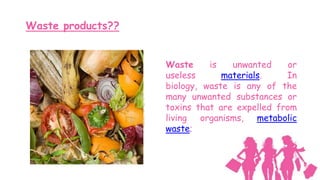
Waste products??


                   Waste     is   unwanted     or
                   useless      materials.    In
                   biology, waste is any of the
                   many unwanted substances or
                   toxins that are expelled from
                   living organisms, metabolic
                   waste;
What are the
  problems and
    causes of
consumerism and
 waste product?
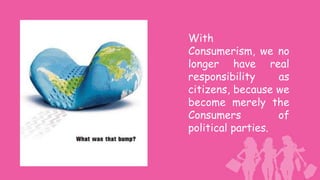
With
Consumerism, we no
longer have real
responsibility     as
citizens, because we
become merely the
Consumers          of
political parties.
Poverty around the world…..

The resources are not divided
properly among people; they are
neither saved nor consumed
properly. Due to economic
growth, migration is also taking
place every where in the world.
Many people move from on
country to another country and
from rural areas to urban areas,
in order to improve and have a
high standard of living.
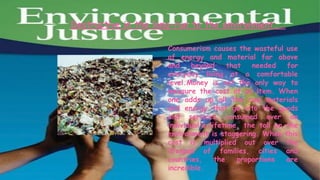
Destructive in the long-run to the environment……

                     Consumerism causes the wasteful use
                     of energy and material far above
                     and    beyond      that   needed   for
                     everyday living at a comfortable
                     level.Money is not the only way to
                     measure the cost of an item. When
                     one adds up all the raw materials
                     and energy that go into the goods
                     and services consumed over an
                     individual's lifetime, the toll on the
                     environment is staggering. When this
                     cost is multiplied out over the
                     lifespan of families, cities and
                     countries,     the    proportions  are
                     incredible.
VARIATIONS IN CONSUMERISM


• Consumerism has shown an exponential growth.
• It         may         be          due     to
  industrialization, urbanization, increase in
  population as well as increase in our demands
  due to change in lifestyle.
• Our population < 1 million (long before)
• Our population > 6 billion (now)
The above 2 reasons can be explained using Paul
   Ehrlich and John Hodlren model :

      I=P×A×T

I =Human Impact on the environment
P= Population
A= Affluence
T= Technology.

This describes how our growing
population, affluence, and technology contribute toward
our environmental
In Under developed countries No. of people are very high
but per capita use of resources and waste generated are
less

In More developed countries No. of people is low but per
capita use of resources and waste generated are very
high

And hence from the formula it can be seen that the final
impact by both of them is almost same

Thus, consumerism varies with the country
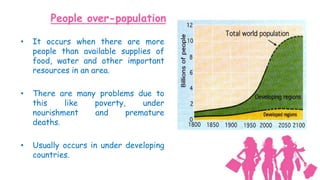
People over-population

•   It occurs when there are more
    people than available supplies of
    food, water and other important
    resources in an area.

•   There are many problems due to
    this    like  poverty,    under
    nourishment   and     premature
    deaths.

•   Usually occurs in under developing
    countries.
Consumption Over-Population

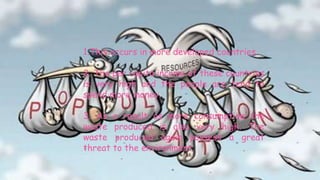
  1.This occurs in more developed countries.

  2. The per capita income of these countries
  is very high and the people are tend to
  spend more money.

  3. As a result os more consumption the
  waste produced is also very high. The
  waste produced again possess a great
  threat to the environment.
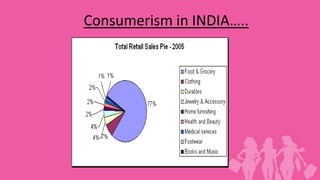
Consumerism in INDIA…..
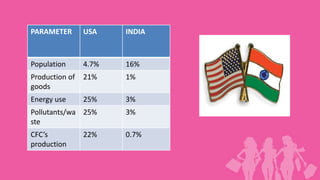
PARAMETER       USA    INDIA


Population      4.7%   16%
Production of   21%    1%
goods
Energy use      25%    3%
Pollutants/wa 25%      3%
ste
CFC’s           22%    0.7%
production
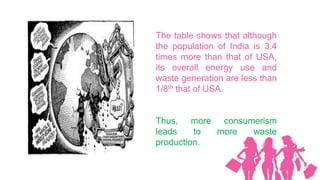
The table shows that although
the population of India is 3.4
times more than that of USA,
its overall energy use and
waste generation are less than
1/8th that of USA.


Thus, more consumerism
leads    to more waste
production.
Facts about the consumerism….


Consumption(USA)=50 x Consumption(India)

Damage to earth due to USA person= 20-100 times
damage due to Indian person

In Japan, with up-gradation in technology, the impact
on earth is much less than USA although it is at par with
USA in all other terms.
How to solve these problems?
• Population: We need to control population growth. This is
  the very basic and important step to be taken into
  consideration. Laws are to be passed for the prevention of
  population growth.

• Consumption: Once we control population growth, the
  consumption rate would fall down itself, beyond this, still
  we have to control more the consumption rate by passing
  some laws.

• Technology: We should stop at this stage some of the
  irrelevant and unimportant products, in order to stabilize
  the environment
THANK YOU…..
    

Consumerism and waste products.

  • 1.
    CONSUMERISM AND WASTEPRODUCTS SUBMITTED BY: •NIKITA RANJAN (10BIT0203)
  • 2.
    CONSUMER?? The "consumer" isthe one who consumes the goods and services produced. As such, consumers plays a vital role in the economic system of a nation because in the absence of the effective demand that emanates from them, the economy virtually collapses.
  • 3.
    Consumerism?? Consumerism is a social and economic order that is based on the systematic creation and fostering of a desire to purchase goods and services in ever greater amounts.
  • 4.
    Waste products?? Waste is unwanted or useless materials. In biology, waste is any of the many unwanted substances or toxins that are expelled from living organisms, metabolic waste;
  • 5.
    What are the problems and causes of consumerism and waste product?
  • 6.
    With Consumerism, we no longerhave real responsibility as citizens, because we become merely the Consumers of political parties.
  • 7.
    Poverty around theworld….. The resources are not divided properly among people; they are neither saved nor consumed properly. Due to economic growth, migration is also taking place every where in the world. Many people move from on country to another country and from rural areas to urban areas, in order to improve and have a high standard of living.
  • 8.
    Destructive in thelong-run to the environment…… Consumerism causes the wasteful use of energy and material far above and beyond that needed for everyday living at a comfortable level.Money is not the only way to measure the cost of an item. When one adds up all the raw materials and energy that go into the goods and services consumed over an individual's lifetime, the toll on the environment is staggering. When this cost is multiplied out over the lifespan of families, cities and countries, the proportions are incredible.
  • 9.
    VARIATIONS IN CONSUMERISM •Consumerism has shown an exponential growth. • It may be due to industrialization, urbanization, increase in population as well as increase in our demands due to change in lifestyle. • Our population < 1 million (long before) • Our population > 6 billion (now)
  • 10.
    The above 2reasons can be explained using Paul Ehrlich and John Hodlren model : I=P×A×T I =Human Impact on the environment P= Population A= Affluence T= Technology. This describes how our growing population, affluence, and technology contribute toward our environmental
  • 11.
    In Under developedcountries No. of people are very high but per capita use of resources and waste generated are less In More developed countries No. of people is low but per capita use of resources and waste generated are very high And hence from the formula it can be seen that the final impact by both of them is almost same Thus, consumerism varies with the country
  • 12.
    People over-population • It occurs when there are more people than available supplies of food, water and other important resources in an area. • There are many problems due to this like poverty, under nourishment and premature deaths. • Usually occurs in under developing countries.
  • 13.
    Consumption Over-Population 1.This occurs in more developed countries. 2. The per capita income of these countries is very high and the people are tend to spend more money. 3. As a result os more consumption the waste produced is also very high. The waste produced again possess a great threat to the environment.
  • 14.
  • 15.
    PARAMETER USA INDIA Population 4.7% 16% Production of 21% 1% goods Energy use 25% 3% Pollutants/wa 25% 3% ste CFC’s 22% 0.7% production
  • 16.
    The table showsthat although the population of India is 3.4 times more than that of USA, its overall energy use and waste generation are less than 1/8th that of USA. Thus, more consumerism leads to more waste production.
  • 17.
    Facts about theconsumerism…. Consumption(USA)=50 x Consumption(India) Damage to earth due to USA person= 20-100 times damage due to Indian person In Japan, with up-gradation in technology, the impact on earth is much less than USA although it is at par with USA in all other terms.
  • 18.
    How to solvethese problems?
  • 19.
    • Population: Weneed to control population growth. This is the very basic and important step to be taken into consideration. Laws are to be passed for the prevention of population growth. • Consumption: Once we control population growth, the consumption rate would fall down itself, beyond this, still we have to control more the consumption rate by passing some laws. • Technology: We should stop at this stage some of the irrelevant and unimportant products, in order to stabilize the environment
  • 21.

Editor's Notes

  • #2 The best things in life are nearest:  Breath in your nostrils, light in your eyes, flowers at your feet, duties at your hand, the path of right just before you.  Then do not grasp at the stars, but do life&apos;s plain, common work as it comes, certain that daily duties and daily bread are the sweetest things in life.
  • #3 A consumer is someone who consumes anything that is required by him. Mahatma Gandhi said a customer is the most important visitor in our premises. He is not dependent on us, we are on him. He is not an interruption to our work, he is the purpose of it.
  • #4 Consumerism: Consumerism refers to the consumption of resources by the people.
  • #5 Waste product is the product which is thrown after a short-period of time usage.
  • #7 We all consume.  And we always will.  The act of consumption is merely the act of using something, and we will always need to use things to fulfil fundamental human needs.Our role in representative democracy as it stands in this country today is merely to be marketed to, and if we are sufficiently wooed, to choose the best value for ourselves as individuals.  We have no responsibility even to vote, and many – even most of us – do not.
  • #8 Greedy consumers in rich countries are mesmerised by the allure of consumerism, purchasing unsustainably in a fruitless attempt to attain self-fulfilment, while ignoring the poverty crisis in the developing world.The age-old saying “money can’t buy you happiness” appears to hold an element of truth.  Western society’s greed for consumption has created a severe imbalance in world consumption levels only to be confronted with the realisation that they are still as unhappy as ever before.This migration of people causes of slums in the cities, different types of pollution and pressure on natural resources such as land, water, food and other resources.
  • #9 oday’s 20% of the world richest consume 86% of the world’s total resources. In my point of views the 86% of the resources won’t be consumed properly by only 20% of the population, so in result there would be waste products as they are consuming and then throwing them away after a short-period of time usage, and finally such kind of process lead to pollution and environmental problems.