SOLIDWASTE POLLUTION&
MANAGEMENT
Dr Fayaz A. Malla
Assistant Professor, Environmental Sciences
Higher Education Department, Govt. of J&K
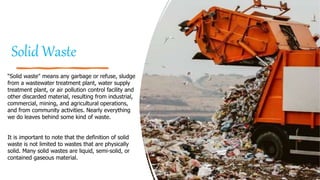
Solid Waste
“Solid waste" means any garbage or refuse, sludge
from a wastewater treatment plant, water supply
treatment plant, or air pollution control facility and
other discarded material, resulting from industrial,
commercial, mining, and agricultural operations,
and from community activities. Nearly everything
we do leaves behind some kind of waste.
It is important to note that the definition of solid
waste is not limited to wastes that are physically
solid. Many solid wastes are liquid, semi-solid, or
contained gaseous material.
Important Sources/Classification
Domestic Waste: Paper
plastic. leather
Industrial Waste: Paper and
pulp industries, oil
refineries, chemical
industries, metal smelters
Commercial Waste: Paper
fibres, plastic,packaging
material
Mining Waste
Radioactive Waste: Nuclear
explosions, nuclear testing,
use of radioactiven
substances in medical and
scientific research
Agriculture Waste:
Farms,livestock
yards,bagasse from
sugarcane
Hospital Waste:
Needles,syringe,blade,ban
dage,tissues
Electronic Waste (E-waste)
Effects of Solid Waste
Solid waste leads to increase in disease causing organisms such as
mosquitoes, flies etc to thrive freely and increase in population
It runs off with rainwater and mixes with the nearby water bodies
causing water pollution
Burning of solid waste leads to air pollution
Radioactive substance present in solid waste causes a number of
diseases in human being
Solid waste reduces asthetic value of land
Non biodegradable solid waste such as polythene,plastic release toxic
gases when burnt hence carry air pollution.
Treatment of Solid Waste in 3 steps
Collection of Solid Waste
Large number of dustbins should be provided in streets and
along roads which must be cleared at least once or twice a
day and to enable proper collection of solid wastes as per
their categories. Door to door collection of domestic
garbage is a popular practice.
Transportation of Solid Waste
From urban areas to dumping grounds, tractors, trucks are
used. Overloading of wastes should be avoided to prevent
spilling.
Disposal
Solid waste collation
Disposal of Solid Waste
Open Dumping: Refuse is disposed in open
dumps without being covered or protected.
This leads to growth of flies an soil and land
pollution.
Landfill:Waste is covered by a thick layer of
soil.It reduces risk of human disease but still
contaminates ground water makes the area
unfit for agriculture
Ocean Dumping: Industrial effluents
containing poisonous chemicals are dumped
in coastal and estuarine area. It adversely
effects the marine ecosystems
Incineration: Combustible waste is burnt at
higher temperature such that all combustible
substance is reduced to ash. Fly ash is used
in construction industry or buried as
landfills; it is also used for soil amendment
as in increases water retention and aeration
of soil. By this volume of waste is reduced by
75% to 95%. The heat-emitted during
incineration is used to generate electricity.
Composting:Biochemical degradation of
organic matter to yield a soil supp element
.Useful and eco friendly technique.
Drawback is it is necessity to separate the
organic material from other wastes.
Source Reduction: Best possible technique.
Overconsumption and wastage can be
checked by adopting 5 R’S
Incineration
Most of the solid waste is burned such that nothing is left except for ashes. A separate facility is built to do
this job. A unit or incinerator is built with heavy-duty insulated substances such that it minimizes the
production of external heat
The method of composting is
applicable for biodegradable waste
where quality manure is formed by
decomposing the solid waste. Using
this manure improves the quality of
soil as well. After composting, the
formed matter is rich in nitrogen
and carbon which helps in fertilizing
the plants and crops.
Composting
Sanitary landfilling
In this, the garbage is distributed n thin layers and
covered with clay such that there is no seepage of
water post landfilling. This method gives rise to
the production of methane that helps in
generating electricity. It is a form of composting
but on a larger scale.
Pyrolysis
This is decomposing
organic materials by heat
in the absence of oxygen.
This method has its own
limitation since creating
an atmosphere
completely void of
oxygen is difficult.
Solid waste Generation
Currently, as per government estimates, about 65 million tonnes of waste is generated
annually in India, and over 62 million tonnes of it are Municipal Solid Waste (MSW) that
includes organic waste, recyclables like paper, plastic, wood, glass, etc.
Only about 75-80% of the municipal waste gets collected and out of this only 22- 28% is
processed and treated.
The remaining MSW is deposited at dump yards.
By 2031, MSW generated is projected to increase to 165 million tonnes, and further up
to 436 million tonnes by 2025.
Though the quantity of waste generated is increasing, waste collection efficiency in
India is still catching up. It ranges from 70 to 90% in major metro cities and is below
50% in many smaller cities.
Rules for Waste Management
The major solid waste contributors in India are Municipal Solid
Waste, sewage, Industrial Waste, Bio-Medical Waste, e-Waste,
Nuclear Waste, and Agriculture Waste. There are multiple rules
notified by the Environment Ministry, to be complied with, while
disposing solid waste. These are-
• Solid Waste Management (SWM) Rules 2016
• Plastic Waste Management (PWM) Rules 2016
• E-Waste Management (EWM) Rules 2016
• Bio-Medical Waste Management Rules 2016
• Hazardous Waste Management Rules 2016
Problems in Waste Management
Inadequate service coverage
Operational inefficiencies of services
The remaining MSW is deposited at dump yards.
Limited utilization of recycling activities
Inadequate management of nonindustrial hazardous
waste
•Inadequate landfill disposal
R’s of Solid Waste
THANK
YOU

Solid waste pollution

  • 1.
    SOLIDWASTE POLLUTION& MANAGEMENT Dr FayazA. Malla Assistant Professor, Environmental Sciences Higher Education Department, Govt. of J&K
  • 2.
    Solid Waste “Solid waste"means any garbage or refuse, sludge from a wastewater treatment plant, water supply treatment plant, or air pollution control facility and other discarded material, resulting from industrial, commercial, mining, and agricultural operations, and from community activities. Nearly everything we do leaves behind some kind of waste. It is important to note that the definition of solid waste is not limited to wastes that are physically solid. Many solid wastes are liquid, semi-solid, or contained gaseous material.
  • 3.
    Important Sources/Classification Domestic Waste:Paper plastic. leather Industrial Waste: Paper and pulp industries, oil refineries, chemical industries, metal smelters Commercial Waste: Paper fibres, plastic,packaging material Mining Waste Radioactive Waste: Nuclear explosions, nuclear testing, use of radioactiven substances in medical and scientific research Agriculture Waste: Farms,livestock yards,bagasse from sugarcane Hospital Waste: Needles,syringe,blade,ban dage,tissues Electronic Waste (E-waste)
  • 4.
    Effects of SolidWaste Solid waste leads to increase in disease causing organisms such as mosquitoes, flies etc to thrive freely and increase in population It runs off with rainwater and mixes with the nearby water bodies causing water pollution Burning of solid waste leads to air pollution Radioactive substance present in solid waste causes a number of diseases in human being Solid waste reduces asthetic value of land Non biodegradable solid waste such as polythene,plastic release toxic gases when burnt hence carry air pollution.
  • 5.
    Treatment of SolidWaste in 3 steps Collection of Solid Waste Large number of dustbins should be provided in streets and along roads which must be cleared at least once or twice a day and to enable proper collection of solid wastes as per their categories. Door to door collection of domestic garbage is a popular practice. Transportation of Solid Waste From urban areas to dumping grounds, tractors, trucks are used. Overloading of wastes should be avoided to prevent spilling. Disposal
  • 6.
  • 7.
    Disposal of SolidWaste Open Dumping: Refuse is disposed in open dumps without being covered or protected. This leads to growth of flies an soil and land pollution. Landfill:Waste is covered by a thick layer of soil.It reduces risk of human disease but still contaminates ground water makes the area unfit for agriculture Ocean Dumping: Industrial effluents containing poisonous chemicals are dumped in coastal and estuarine area. It adversely effects the marine ecosystems Incineration: Combustible waste is burnt at higher temperature such that all combustible substance is reduced to ash. Fly ash is used in construction industry or buried as landfills; it is also used for soil amendment as in increases water retention and aeration of soil. By this volume of waste is reduced by 75% to 95%. The heat-emitted during incineration is used to generate electricity. Composting:Biochemical degradation of organic matter to yield a soil supp element .Useful and eco friendly technique. Drawback is it is necessity to separate the organic material from other wastes. Source Reduction: Best possible technique. Overconsumption and wastage can be checked by adopting 5 R’S
  • 8.
    Incineration Most of thesolid waste is burned such that nothing is left except for ashes. A separate facility is built to do this job. A unit or incinerator is built with heavy-duty insulated substances such that it minimizes the production of external heat
  • 9.
    The method ofcomposting is applicable for biodegradable waste where quality manure is formed by decomposing the solid waste. Using this manure improves the quality of soil as well. After composting, the formed matter is rich in nitrogen and carbon which helps in fertilizing the plants and crops. Composting
  • 10.
    Sanitary landfilling In this,the garbage is distributed n thin layers and covered with clay such that there is no seepage of water post landfilling. This method gives rise to the production of methane that helps in generating electricity. It is a form of composting but on a larger scale.
  • 11.
    Pyrolysis This is decomposing organicmaterials by heat in the absence of oxygen. This method has its own limitation since creating an atmosphere completely void of oxygen is difficult.
  • 12.
    Solid waste Generation Currently,as per government estimates, about 65 million tonnes of waste is generated annually in India, and over 62 million tonnes of it are Municipal Solid Waste (MSW) that includes organic waste, recyclables like paper, plastic, wood, glass, etc. Only about 75-80% of the municipal waste gets collected and out of this only 22- 28% is processed and treated. The remaining MSW is deposited at dump yards. By 2031, MSW generated is projected to increase to 165 million tonnes, and further up to 436 million tonnes by 2025. Though the quantity of waste generated is increasing, waste collection efficiency in India is still catching up. It ranges from 70 to 90% in major metro cities and is below 50% in many smaller cities.
  • 13.
    Rules for WasteManagement The major solid waste contributors in India are Municipal Solid Waste, sewage, Industrial Waste, Bio-Medical Waste, e-Waste, Nuclear Waste, and Agriculture Waste. There are multiple rules notified by the Environment Ministry, to be complied with, while disposing solid waste. These are- • Solid Waste Management (SWM) Rules 2016 • Plastic Waste Management (PWM) Rules 2016 • E-Waste Management (EWM) Rules 2016 • Bio-Medical Waste Management Rules 2016 • Hazardous Waste Management Rules 2016
  • 14.
    Problems in WasteManagement Inadequate service coverage Operational inefficiencies of services The remaining MSW is deposited at dump yards. Limited utilization of recycling activities Inadequate management of nonindustrial hazardous waste •Inadequate landfill disposal
  • 15.
  • 16.