Sustainable Solid Waste Management in ChintamaniBy Hindustan Waste  Management
Project OverviewHWM will focus on essential aspects of life in society, cleanliness, and has the environment at it's core. It requires flawless professionalism, an ability to listen, a service that is 100% reliable and a total respect of the commitments undertaken.        Our goal is to achieve  sustainable development and fully committed to balancing out the creation of economic, environmental and social value. By Professionalism Partnership, Team Spirit, Value Creation, Respect for the Environment, Ethics, Respecting our Shareholders. Our mission is to fully integrate environmental stewardship into our business by  minimising waste disposal and maximising waste recycling and recovery for our customers' waste.Our Commitment Peace of mind through the implementation of fully integrated waste management solutions.Our Promise Increasing recycling will diminish waste costs and help fulfill India's obligations to lower carbon emissions.
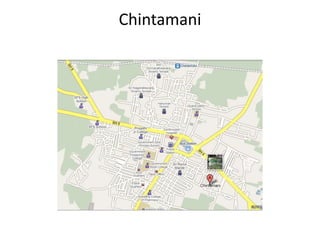
Chintamani
Chintamani Portfolio	Chintamani is located at Karnataka. It has an average elevation of 865 meters (2837 ft). It is a taluk headquarter and part of Chikkaballapura district. It became a part of Chikkaballapura district in 2007 when Kolar district was split. The name Chintamani is supposed to be given by a Maratha warrior who had camped in this place long ago. The economy is agriculture based. Chintamani is famous for Tomato and Mango and Banana. Srinivaspur, an adjoining town 18 kilometers away, is very famous for Mango production.Country  		 India State    		 Karnataka District(s) 	                  Chikkaballapura Population*	                  65,456 (2001[update])Density		 *5,236.48 /km2 (13,562 /sq mi) Time zone 	 	IST (UTC+5:30) Area*			 Elevation 12.5 km² (5 sq mi)			   			* 865 m (2,838 ft)
Project Detail      Waste management is the collection, transport, processing, recycling or disposal, and monitoring of waste materials. The term usually relates to materials produced by human activity, and is generally undertaken to reduce their effect on health, the environment or aesthetics. Waste management is also carried out to recover resources from it. Waste management can involve solid, liquid, gaseous or radioactive substances, with different methods and fields of expertise for each.      In HWM we Process Organic waste by Biological reprocessing such as Anaerobic digestion and Compositing and we recycle Inorganic waste by Effective recycling methods.
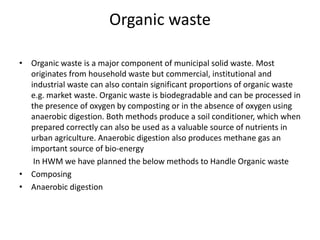
Organic wasteOrganic waste is a major component of municipal solid waste. Most originates from household waste but commercial, institutional and industrial waste can also contain significant proportions of organic waste e.g. market waste. Organic waste is biodegradable and can be processed in the presence of oxygen by composting or in the absence of oxygen using anaerobic digestion. Both methods produce a soil conditioner, which when prepared correctly can also be used as a valuable source of nutrients in urban agriculture. Anaerobic digestion also produces methane gas an important source of bio-energy       In HWM we have planned the below methods to Handle Organic waste Composing Anaerobic digestion
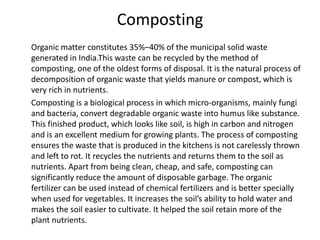
Composting      Organic matter constitutes 35%–40% of the municipal solid waste generated in India.This waste can be recycled by the method of composting, one of the oldest forms of disposal. It is the natural process of decomposition of organic waste that yields manure or compost, which is very rich in nutrients.       Composting is a biological process in which micro-organisms, mainly fungi and bacteria, convert degradable organic waste into humus like substance. This finished product, which looks like soil, is high in carbon and nitrogen and is an excellent medium for growing plants. The process of composting ensures the waste that is produced in the kitchens is not carelessly thrown and left to rot. It recycles the nutrients and returns them to the soil as nutrients. Apart from being clean, cheap, and safe, composting can significantly reduce the amount of disposable garbage. The organic fertilizer can be used instead of chemical fertilizers and is better specially when used for vegetables. It increases the soil’s ability to hold water and makes the soil easier to cultivate. It helped the soil retain more of the plant nutrients.
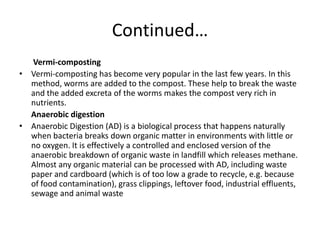
Continued…       Vermi-composting Vermi-composting has become very popular in the last few years. In this method, worms are added to the compost. These help to break the waste and the added excreta of the worms makes the compost very rich in nutrients.      Anaerobic digestionAnaerobic Digestion (AD) is a biological process that happens naturally when bacteria breaks down organic matter in environments with little or no oxygen. It is effectively a controlled and enclosed version of the anaerobic breakdown of organic waste in landfill which releases methane. Almost any organic material can be processed with AD, including waste paper and cardboard (which is of too low a grade to recycle, e.g. because of food contamination), grass clippings, leftover food, industrial effluents, sewage and animal waste
      Methods of Composting in HWMIn-Vessel Method      In the In-Vessel Method, the organic material is composted inside a drum, silo, agitated bed, covered or open channel, batch container or other structure. The process conditions are closely monitored and controlled and the material is aerated and mechanically turned or agitated.Aerated Static Pile Method      The Aerated Static Pile Method involves forming compostable materials into large piles, which are aerated by drawing air through the pile or forcing air out through the pile. The pile is not turned. .      Windrow MethodIn the Windrow Method, compostable material is formed into elongated piles, known as windrows, which are turned mechanically on a regular basis
Benefits of CompositingCompost allows the soil to retain more plant nutrients over a longer period.It supplies part of the 16 essential elements needed by the plants.It helps reduce the adverse effects of excessive alkalinity, acidity, or the excessive use of chemical fertilizer.It makes soil easier to cultivate.It helps keep the soil cool in summer and warm in winter.It aids in preventing soil erosion by keeping the soil covered.It helps in controlling the growth of weeds.
Recycling    Common recyclablesBatteriesClothingElectronics disassembly and reclamation Ferrous metalsNon-ferrous metalsGlassPaperPlasticTextiles
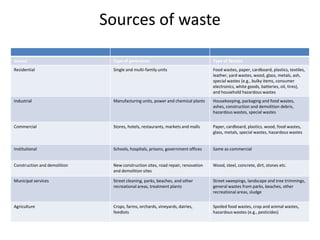
Sources of waste
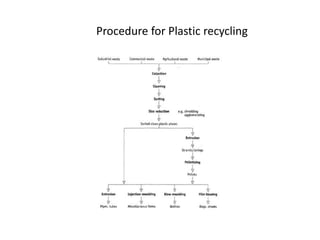
Procedure for Plastic recycling
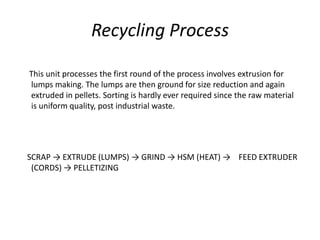
Recycling Process     This unit processes the first round of the process involves extrusion for lumps making. The lumps are then ground for size reduction and again extruded in pellets. Sorting is hardly ever required since the raw material is uniform quality, post industrial waste.    SCRAP -> EXTRUDE (LUMPS) -> GRIND -> HSM (HEAT) ->    FEED EXTRUDER (CORDS) -> PELLETIZING
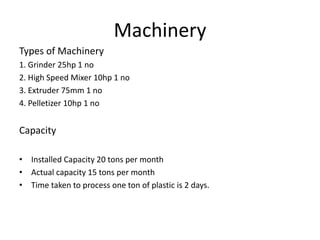
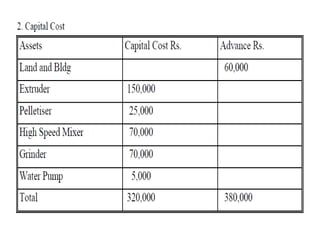
MachineryTypes of Machinery1. Grinder 25hp 1 no2. High Speed Mixer 10hp 1 no3. Extruder 75mm 1 no4. Pelletizer 10hp 1 noCapacityInstalled Capacity 20 tons per monthActual capacity 15 tons per monthTime taken to process one ton of plastic is 2 days.
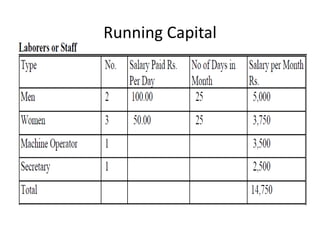
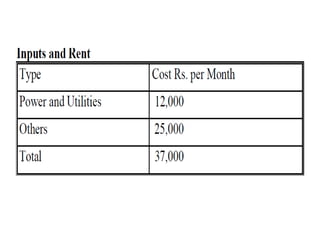
Running Capital
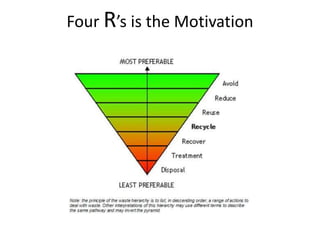
Four R’s is the Motivation
 “The world has enough for everyone’s need…but not for everyone’s greed.”                                                        -Mahatma GandhiThank you

Sustainable Solid Waste Management

  • 1.
    Sustainable Solid WasteManagement in ChintamaniBy Hindustan Waste Management
  • 2.
    Project OverviewHWM willfocus on essential aspects of life in society, cleanliness, and has the environment at it's core. It requires flawless professionalism, an ability to listen, a service that is 100% reliable and a total respect of the commitments undertaken. Our goal is to achieve sustainable development and fully committed to balancing out the creation of economic, environmental and social value. By Professionalism Partnership, Team Spirit, Value Creation, Respect for the Environment, Ethics, Respecting our Shareholders. Our mission is to fully integrate environmental stewardship into our business by minimising waste disposal and maximising waste recycling and recovery for our customers' waste.Our Commitment Peace of mind through the implementation of fully integrated waste management solutions.Our Promise Increasing recycling will diminish waste costs and help fulfill India's obligations to lower carbon emissions.
  • 3.
  • 4.
    Chintamani Portfolio Chintamani islocated at Karnataka. It has an average elevation of 865 meters (2837 ft). It is a taluk headquarter and part of Chikkaballapura district. It became a part of Chikkaballapura district in 2007 when Kolar district was split. The name Chintamani is supposed to be given by a Maratha warrior who had camped in this place long ago. The economy is agriculture based. Chintamani is famous for Tomato and Mango and Banana. Srinivaspur, an adjoining town 18 kilometers away, is very famous for Mango production.Country India State Karnataka District(s) Chikkaballapura Population* 65,456 (2001[update])Density *5,236.48 /km2 (13,562 /sq mi) Time zone IST (UTC+5:30) Area* Elevation 12.5 km² (5 sq mi) * 865 m (2,838 ft)
  • 5.
    Project Detail Waste management is the collection, transport, processing, recycling or disposal, and monitoring of waste materials. The term usually relates to materials produced by human activity, and is generally undertaken to reduce their effect on health, the environment or aesthetics. Waste management is also carried out to recover resources from it. Waste management can involve solid, liquid, gaseous or radioactive substances, with different methods and fields of expertise for each. In HWM we Process Organic waste by Biological reprocessing such as Anaerobic digestion and Compositing and we recycle Inorganic waste by Effective recycling methods.
  • 6.
    Organic wasteOrganic wasteis a major component of municipal solid waste. Most originates from household waste but commercial, institutional and industrial waste can also contain significant proportions of organic waste e.g. market waste. Organic waste is biodegradable and can be processed in the presence of oxygen by composting or in the absence of oxygen using anaerobic digestion. Both methods produce a soil conditioner, which when prepared correctly can also be used as a valuable source of nutrients in urban agriculture. Anaerobic digestion also produces methane gas an important source of bio-energy In HWM we have planned the below methods to Handle Organic waste Composing Anaerobic digestion
  • 7.
    Composting Organic matter constitutes 35%–40% of the municipal solid waste generated in India.This waste can be recycled by the method of composting, one of the oldest forms of disposal. It is the natural process of decomposition of organic waste that yields manure or compost, which is very rich in nutrients. Composting is a biological process in which micro-organisms, mainly fungi and bacteria, convert degradable organic waste into humus like substance. This finished product, which looks like soil, is high in carbon and nitrogen and is an excellent medium for growing plants. The process of composting ensures the waste that is produced in the kitchens is not carelessly thrown and left to rot. It recycles the nutrients and returns them to the soil as nutrients. Apart from being clean, cheap, and safe, composting can significantly reduce the amount of disposable garbage. The organic fertilizer can be used instead of chemical fertilizers and is better specially when used for vegetables. It increases the soil’s ability to hold water and makes the soil easier to cultivate. It helped the soil retain more of the plant nutrients.
  • 8.
    Continued… Vermi-composting Vermi-composting has become very popular in the last few years. In this method, worms are added to the compost. These help to break the waste and the added excreta of the worms makes the compost very rich in nutrients. Anaerobic digestionAnaerobic Digestion (AD) is a biological process that happens naturally when bacteria breaks down organic matter in environments with little or no oxygen. It is effectively a controlled and enclosed version of the anaerobic breakdown of organic waste in landfill which releases methane. Almost any organic material can be processed with AD, including waste paper and cardboard (which is of too low a grade to recycle, e.g. because of food contamination), grass clippings, leftover food, industrial effluents, sewage and animal waste
  • 9.
    Methods of Composting in HWMIn-Vessel Method In the In-Vessel Method, the organic material is composted inside a drum, silo, agitated bed, covered or open channel, batch container or other structure. The process conditions are closely monitored and controlled and the material is aerated and mechanically turned or agitated.Aerated Static Pile Method The Aerated Static Pile Method involves forming compostable materials into large piles, which are aerated by drawing air through the pile or forcing air out through the pile. The pile is not turned. . Windrow MethodIn the Windrow Method, compostable material is formed into elongated piles, known as windrows, which are turned mechanically on a regular basis
  • 10.
    Benefits of CompositingCompostallows the soil to retain more plant nutrients over a longer period.It supplies part of the 16 essential elements needed by the plants.It helps reduce the adverse effects of excessive alkalinity, acidity, or the excessive use of chemical fertilizer.It makes soil easier to cultivate.It helps keep the soil cool in summer and warm in winter.It aids in preventing soil erosion by keeping the soil covered.It helps in controlling the growth of weeds.
  • 11.
    Recycling Common recyclablesBatteriesClothingElectronics disassembly and reclamation Ferrous metalsNon-ferrous metalsGlassPaperPlasticTextiles
  • 12.
  • 13.
  • 14.
    Recycling Process This unit processes the first round of the process involves extrusion for lumps making. The lumps are then ground for size reduction and again extruded in pellets. Sorting is hardly ever required since the raw material is uniform quality, post industrial waste. SCRAP -> EXTRUDE (LUMPS) -> GRIND -> HSM (HEAT) -> FEED EXTRUDER (CORDS) -> PELLETIZING
  • 15.
    MachineryTypes of Machinery1.Grinder 25hp 1 no2. High Speed Mixer 10hp 1 no3. Extruder 75mm 1 no4. Pelletizer 10hp 1 noCapacityInstalled Capacity 20 tons per monthActual capacity 15 tons per monthTime taken to process one ton of plastic is 2 days.
  • 16.
  • 19.
    Four R’s isthe Motivation
  • 20.
    “The worldhas enough for everyone’s need…but not for everyone’s greed.” -Mahatma GandhiThank you