WASTELAND RECLAMATION
SUBMITTED BY :
Priyanka
Bhupesh
Rupinder
WHAT IS WASTELAND?
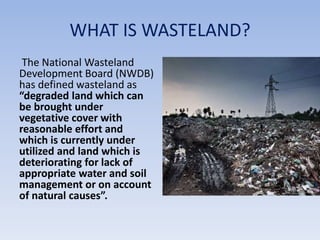
The National Wasteland
Development Board (NWDB)
has defined wasteland as
“degraded land which can
be brought under
vegetative cover with
reasonable effort and
which is currently under
utilized and land which is
deteriorating for lack of
appropriate water and soil
management or on account
of natural causes”.
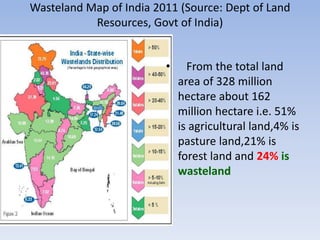
Wasteland Map of India 2011 (Source: Dept of Land
Resources, Govt of India)
• From the total land
area of 328 million
hectare about 162
million hectare i.e. 51%
is agricultural land,4% is
pasture land,21% is
forest land and 24% is
wasteland
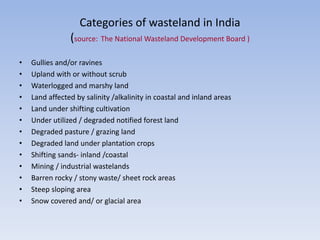
Categories of wasteland in India
(source: The National Wasteland Development Board )
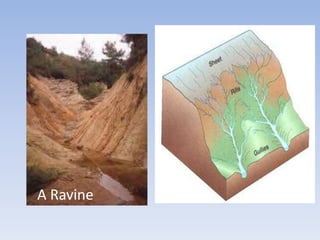
• Gullies and/or ravines
• Upland with or without scrub
• Waterlogged and marshy land
• Land affected by salinity /alkalinity in coastal and inland areas
• Land under shifting cultivation
• Under utilized / degraded notified forest land
• Degraded pasture / grazing land
• Degraded land under plantation crops
• Shifting sands- inland /coastal
• Mining / industrial wastelands
• Barren rocky / stony waste/ sheet rock areas
• Steep sloping area
• Snow covered and/ or glacial area
A Ravine
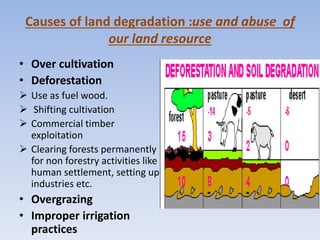
Causes of land degradation :use and abuse of
our land resource
• Over cultivation
• Deforestation
 Use as fuel wood.
 Shifting cultivation
 Commercial timber
exploitation
 Clearing forests permanently
for non forestry activities like
human settlement, setting up
industries etc.
• Overgrazing
• Improper irrigation
practices
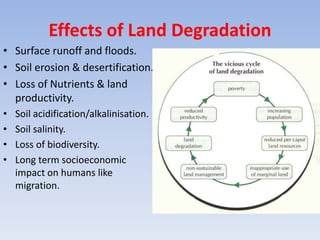
Effects of Land Degradation
• Surface runoff and floods.
• Soil erosion & desertification.
• Loss of Nutrients & land
productivity.
• Soil acidification/alkalinisation.
• Soil salinity.
• Loss of biodiversity.
• Long term socioeconomic
impact on humans like
migration.
Wasteland reclamation
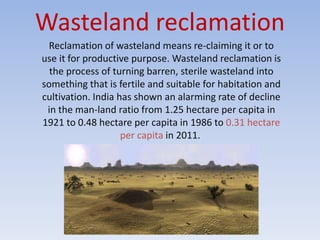
Reclamation of wasteland means re-claiming it or to
use it for productive purpose. Wasteland reclamation is
the process of turning barren, sterile wasteland into
something that is fertile and suitable for habitation and
cultivation. India has shown an alarming rate of decline
in the man-land ratio from 1.25 hectare per capita in
1921 to 0.48 hectare per capita in 1986 to 0.31 hectare
per capita in 2011.
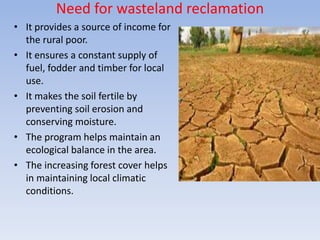
Need for wasteland reclamation
• It provides a source of income for
the rural poor.
• It ensures a constant supply of
fuel, fodder and timber for local
use.
• It makes the soil fertile by
preventing soil erosion and
conserving moisture.
• The program helps maintain an
ecological balance in the area.
• The increasing forest cover helps
in maintaining local climatic
conditions.
Wastelands can be classified into
three forms:
(1) Easily reclaimable,
(2) Reclaimable with some difficulty,
(3) Reclaimable with extreme difficulty.
Easily reclaimable
Easily reclaimable wastelands can be used for
agricultural purposes. Wastelands can be
reclaimed for agriculture by reducing the salt
content which can be done by leaching etc.
Gypsum, urea, potash and compost are added
before planting crops in such areas.
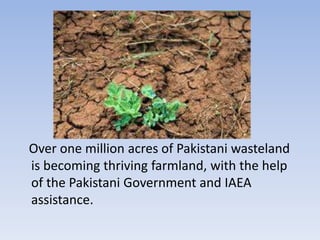
Over one million acres of Pakistani wasteland
is becoming thriving farmland, with the help
of the Pakistani Government and IAEA
assistance.
Reclaimed with some difficulty
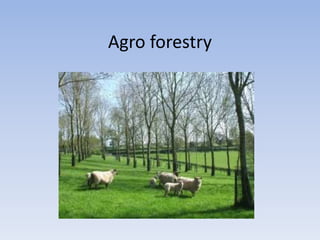
These wastelands can be utilized for agro
forestry. Agro forestry involves putting land to
multiple uses. Its main purpose is to have
trees and crops inter- and/or under planted to
form an integrated system of biological
production within a certain area. Thus, agro
forestry implies integration of trees with
agricultural crops or livestock management
simultaneously.
Agro forestry
Reclaimed with extreme difficulty
Wasteland that are reclaimed with extreme difficulty can
be used for forestry or to recreate natural ecosystem.
Attempts to grow trees in highly non alkaline saline soils
have been largely unsuccessful. Field experiments have
shown that species like Eucalyptus, Prosopis and Acacia
nilotica could not be grown in highly alkaline soil. Studies
have shown that if tree seedlings are planted with a
mixture of original soil, gypsum, and manure, better
growth can be achieved. It is however important to use
indigenous species of trees so that the program recreates
the local ecosystem with all its species.
Method of wasteland
reclamation
• There are various methods by which wastelands can
be reclaimed.
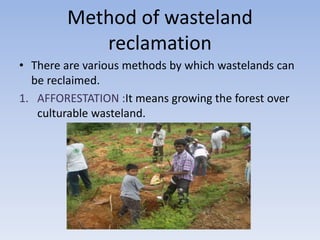
1. AFFORESTATION :It means growing the forest over
culturable wasteland.
2. REFORESTATION :Growing the forest again over the
lands where they were existing and was destroyed
due to fires, overgrazing, and excessive cutting.
Reforestation checks water logging, floods, soil
erosion and increase productivity of land.
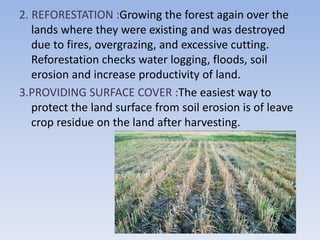
3.PROVIDING SURFACE COVER :The easiest way to
protect the land surface from soil erosion is of leave
crop residue on the land after harvesting.
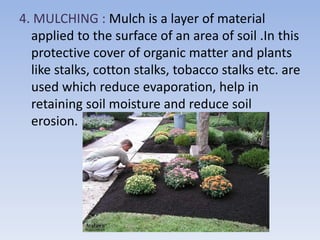
4. MULCHING : Mulch is a layer of material
applied to the surface of an area of soil .In this
protective cover of organic matter and plants
like stalks, cotton stalks, tobacco stalks etc. are
used which reduce evaporation, help in
retaining soil moisture and reduce soil
erosion.
5.CHANGING GROUND TOPOGRAPHY ON
DOWNHILL’S :Running water erodes the hill
soil and carries the soil along with it. This can
be minimized by following alternation in
ground topography:
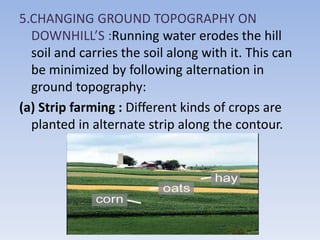
(a) Strip farming : Different kinds of crops are
planted in alternate strip along the contour.
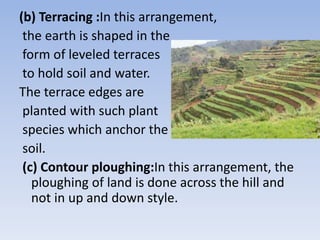
(b) Terracing :In this arrangement,
the earth is shaped in the
form of leveled terraces
to hold soil and water.
The terrace edges are
planted with such plant
species which anchor the
soil.
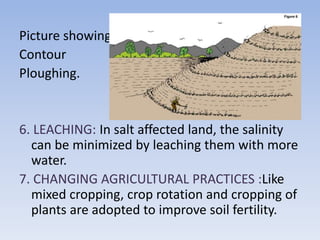
(c) Contour ploughing:In this arrangement, the
ploughing of land is done across the hill and
not in up and down style.
Picture showing
Contour
Ploughing.
6. LEACHING: In salt affected land, the salinity
can be minimized by leaching them with more
water.
7. CHANGING AGRICULTURAL PRACTICES :Like
mixed cropping, crop rotation and cropping of
plants are adopted to improve soil fertility.
8. ECOLOGICAL SUCCESSION :This refers to the
natural development or redevelopment of an
ecosystem which help in reclaiming the
minerally deficient soil of wasteland.
Role of the authorities in wasteland reclamation
• A massive campaign for
increasing the land under
productive use for fuel and
fodder species needs to be
launched.
• Voluntary efforts by farmers’
cooperatives, NGO`s and
organizations should be fully
recognized and assisted.
• Mining of land for house
building material such as
bricks can be reduced by
developing alternative building
materials.
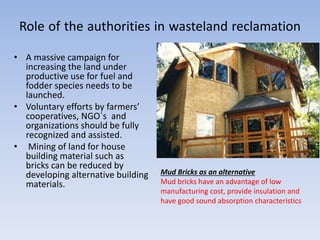
Mud Bricks as an alternative
Mud bricks have an advantage of low
manufacturing cost, provide insulation and
have good sound absorption characteristics
NWDB, has initiated a lot of
new schemes which include:
• Grants-in-aid to voluntary
agencies.
• Ariel seeding programe
• Decentralized People’s
nurseries.
• Silvi pasture farms.
• Seed development.
• Area oriented fuel wood
and fodder projects.
• Rural employment
schemes.
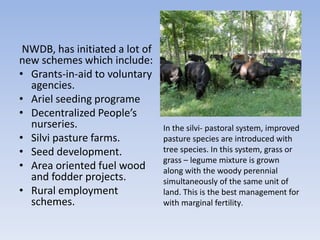
In the silvi- pastoral system, improved
pasture species are introduced with
tree species. In this system, grass or
grass – legume mixture is grown
along with the woody perennial
simultaneously of the same unit of
land. This is the best management for
with marginal fertility.
A case study of Jatropa plantation
Jatropha (Jatropha curcas) has a great ability to withstand hot weather with
water scarce low fertile soil, it has very promising scope for cultivation on
wastelands even in hot deserts. It also has an ability to withstand high salt
concentration in soil. The tribal belt of Kumbalgarh (Udaipur) and Banswara
are the leading Jatropha growing area because of the most suitable climate
for its commercial plantation in these areas. Rajasthan is the leading state in
Jatropha cultivation. Jatropha in the country is now being grown in about 4,
97, 881 hectares of area with the production potential around 25 million
tonne per year. About 90 per cent of the Jatropha cultivation is in Rajasthan.
Rajasthan government is promoting its production on waste lands. Recently
Rajasthan government has allotted 110 hectare of wastelands for jatropa
plantation. Jatropha plant starts yielding 3rd year after planting and yield
increases over the year. ‘Society for Rural Initiatives for Promotion of
Herbals’ is the major society for promoting Jatropha cultivation. Jatropha is a
promising crop for Rajasthan as it has various benefits like wasteland
reclamation and reforestation, soil preparation, income generation from
previously unusable areas, reducing increased demand for employment by
providing opportunities for livelihood and sustainable & renewable land
resources management. Various industries like bio-fuel industry, cosmetic
industries, pharmaceutical industries, food industries, lubricants industries,
etc could use Jatropha.
Constraints in Jatropha Cultivation
Perceived by Farmers of Rajasthan
i.] Lack of technical guidance and information
ii.] Inadequate training facilities for acquiring skills about its
cultivation technology
iii.] Lack of suitable plantation schedule
iv.] Long gestation period of Jatropha
v.] Adverse climatic and edaphic factors for the survival of plants
Vi.] Lack of knowledge about scientific cultivation of Jatropha
vii.] Lack of awareness of economic value of Jatropha seeds
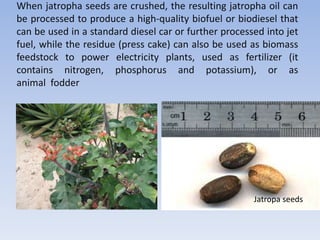
When jatropha seeds are crushed, the resulting jatropha oil can
be processed to produce a high-quality biofuel or biodiesel that
can be used in a standard diesel car or further processed into jet
fuel, while the residue (press cake) can also be used as biomass
feedstock to power electricity plants, used as fertilizer (it
contains nitrogen, phosphorus and potassium), or as
animal fodder
Jatropa seeds
wasteland reclamation

wasteland reclamation

  • 1.
    WASTELAND RECLAMATION SUBMITTED BY: Priyanka Bhupesh Rupinder
  • 2.
    WHAT IS WASTELAND? TheNational Wasteland Development Board (NWDB) has defined wasteland as “degraded land which can be brought under vegetative cover with reasonable effort and which is currently under utilized and land which is deteriorating for lack of appropriate water and soil management or on account of natural causes”.
  • 3.
    Wasteland Map ofIndia 2011 (Source: Dept of Land Resources, Govt of India) • From the total land area of 328 million hectare about 162 million hectare i.e. 51% is agricultural land,4% is pasture land,21% is forest land and 24% is wasteland
  • 4.
    Categories of wastelandin India (source: The National Wasteland Development Board ) • Gullies and/or ravines • Upland with or without scrub • Waterlogged and marshy land • Land affected by salinity /alkalinity in coastal and inland areas • Land under shifting cultivation • Under utilized / degraded notified forest land • Degraded pasture / grazing land • Degraded land under plantation crops • Shifting sands- inland /coastal • Mining / industrial wastelands • Barren rocky / stony waste/ sheet rock areas • Steep sloping area • Snow covered and/ or glacial area
  • 5.
  • 6.
    Causes of landdegradation :use and abuse of our land resource • Over cultivation • Deforestation  Use as fuel wood.  Shifting cultivation  Commercial timber exploitation  Clearing forests permanently for non forestry activities like human settlement, setting up industries etc. • Overgrazing • Improper irrigation practices
  • 7.
    Effects of LandDegradation • Surface runoff and floods. • Soil erosion & desertification. • Loss of Nutrients & land productivity. • Soil acidification/alkalinisation. • Soil salinity. • Loss of biodiversity. • Long term socioeconomic impact on humans like migration.
  • 8.
    Wasteland reclamation Reclamation ofwasteland means re-claiming it or to use it for productive purpose. Wasteland reclamation is the process of turning barren, sterile wasteland into something that is fertile and suitable for habitation and cultivation. India has shown an alarming rate of decline in the man-land ratio from 1.25 hectare per capita in 1921 to 0.48 hectare per capita in 1986 to 0.31 hectare per capita in 2011.
  • 9.
    Need for wastelandreclamation • It provides a source of income for the rural poor. • It ensures a constant supply of fuel, fodder and timber for local use. • It makes the soil fertile by preventing soil erosion and conserving moisture. • The program helps maintain an ecological balance in the area. • The increasing forest cover helps in maintaining local climatic conditions.
  • 10.
    Wastelands can beclassified into three forms: (1) Easily reclaimable, (2) Reclaimable with some difficulty, (3) Reclaimable with extreme difficulty.
  • 11.
    Easily reclaimable Easily reclaimablewastelands can be used for agricultural purposes. Wastelands can be reclaimed for agriculture by reducing the salt content which can be done by leaching etc. Gypsum, urea, potash and compost are added before planting crops in such areas.
  • 12.
    Over one millionacres of Pakistani wasteland is becoming thriving farmland, with the help of the Pakistani Government and IAEA assistance.
  • 13.
    Reclaimed with somedifficulty These wastelands can be utilized for agro forestry. Agro forestry involves putting land to multiple uses. Its main purpose is to have trees and crops inter- and/or under planted to form an integrated system of biological production within a certain area. Thus, agro forestry implies integration of trees with agricultural crops or livestock management simultaneously.
  • 14.
  • 15.
    Reclaimed with extremedifficulty Wasteland that are reclaimed with extreme difficulty can be used for forestry or to recreate natural ecosystem. Attempts to grow trees in highly non alkaline saline soils have been largely unsuccessful. Field experiments have shown that species like Eucalyptus, Prosopis and Acacia nilotica could not be grown in highly alkaline soil. Studies have shown that if tree seedlings are planted with a mixture of original soil, gypsum, and manure, better growth can be achieved. It is however important to use indigenous species of trees so that the program recreates the local ecosystem with all its species.
  • 16.
    Method of wasteland reclamation •There are various methods by which wastelands can be reclaimed. 1. AFFORESTATION :It means growing the forest over culturable wasteland.
  • 17.
    2. REFORESTATION :Growingthe forest again over the lands where they were existing and was destroyed due to fires, overgrazing, and excessive cutting. Reforestation checks water logging, floods, soil erosion and increase productivity of land. 3.PROVIDING SURFACE COVER :The easiest way to protect the land surface from soil erosion is of leave crop residue on the land after harvesting.
  • 18.
    4. MULCHING :Mulch is a layer of material applied to the surface of an area of soil .In this protective cover of organic matter and plants like stalks, cotton stalks, tobacco stalks etc. are used which reduce evaporation, help in retaining soil moisture and reduce soil erosion.
  • 19.
    5.CHANGING GROUND TOPOGRAPHYON DOWNHILL’S :Running water erodes the hill soil and carries the soil along with it. This can be minimized by following alternation in ground topography: (a) Strip farming : Different kinds of crops are planted in alternate strip along the contour.
  • 20.
    (b) Terracing :Inthis arrangement, the earth is shaped in the form of leveled terraces to hold soil and water. The terrace edges are planted with such plant species which anchor the soil. (c) Contour ploughing:In this arrangement, the ploughing of land is done across the hill and not in up and down style.
  • 21.
    Picture showing Contour Ploughing. 6. LEACHING:In salt affected land, the salinity can be minimized by leaching them with more water. 7. CHANGING AGRICULTURAL PRACTICES :Like mixed cropping, crop rotation and cropping of plants are adopted to improve soil fertility.
  • 22.
    8. ECOLOGICAL SUCCESSION:This refers to the natural development or redevelopment of an ecosystem which help in reclaiming the minerally deficient soil of wasteland.
  • 23.
    Role of theauthorities in wasteland reclamation • A massive campaign for increasing the land under productive use for fuel and fodder species needs to be launched. • Voluntary efforts by farmers’ cooperatives, NGO`s and organizations should be fully recognized and assisted. • Mining of land for house building material such as bricks can be reduced by developing alternative building materials. Mud Bricks as an alternative Mud bricks have an advantage of low manufacturing cost, provide insulation and have good sound absorption characteristics
  • 24.
    NWDB, has initiateda lot of new schemes which include: • Grants-in-aid to voluntary agencies. • Ariel seeding programe • Decentralized People’s nurseries. • Silvi pasture farms. • Seed development. • Area oriented fuel wood and fodder projects. • Rural employment schemes. In the silvi- pastoral system, improved pasture species are introduced with tree species. In this system, grass or grass – legume mixture is grown along with the woody perennial simultaneously of the same unit of land. This is the best management for with marginal fertility.
  • 25.
    A case studyof Jatropa plantation Jatropha (Jatropha curcas) has a great ability to withstand hot weather with water scarce low fertile soil, it has very promising scope for cultivation on wastelands even in hot deserts. It also has an ability to withstand high salt concentration in soil. The tribal belt of Kumbalgarh (Udaipur) and Banswara are the leading Jatropha growing area because of the most suitable climate for its commercial plantation in these areas. Rajasthan is the leading state in Jatropha cultivation. Jatropha in the country is now being grown in about 4, 97, 881 hectares of area with the production potential around 25 million tonne per year. About 90 per cent of the Jatropha cultivation is in Rajasthan. Rajasthan government is promoting its production on waste lands. Recently Rajasthan government has allotted 110 hectare of wastelands for jatropa plantation. Jatropha plant starts yielding 3rd year after planting and yield increases over the year. ‘Society for Rural Initiatives for Promotion of Herbals’ is the major society for promoting Jatropha cultivation. Jatropha is a promising crop for Rajasthan as it has various benefits like wasteland reclamation and reforestation, soil preparation, income generation from previously unusable areas, reducing increased demand for employment by providing opportunities for livelihood and sustainable & renewable land resources management. Various industries like bio-fuel industry, cosmetic industries, pharmaceutical industries, food industries, lubricants industries, etc could use Jatropha.
  • 26.
    Constraints in JatrophaCultivation Perceived by Farmers of Rajasthan i.] Lack of technical guidance and information ii.] Inadequate training facilities for acquiring skills about its cultivation technology iii.] Lack of suitable plantation schedule iv.] Long gestation period of Jatropha v.] Adverse climatic and edaphic factors for the survival of plants Vi.] Lack of knowledge about scientific cultivation of Jatropha vii.] Lack of awareness of economic value of Jatropha seeds
  • 27.
    When jatropha seedsare crushed, the resulting jatropha oil can be processed to produce a high-quality biofuel or biodiesel that can be used in a standard diesel car or further processed into jet fuel, while the residue (press cake) can also be used as biomass feedstock to power electricity plants, used as fertilizer (it contains nitrogen, phosphorus and potassium), or as animal fodder Jatropa seeds