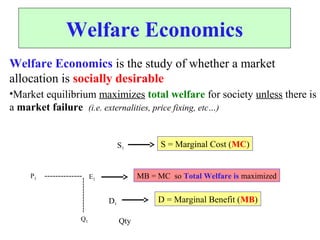
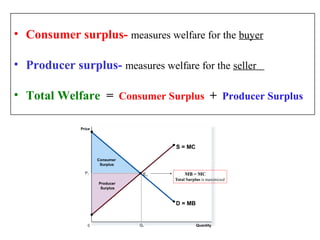
- Welfare economics studies whether market allocations are socially desirable. Market equilibrium maximizes total welfare unless there are market failures like externalities or price fixing.
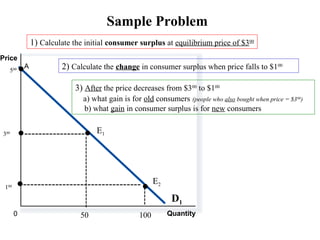
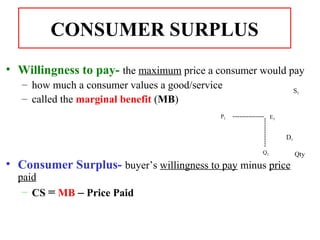
- Consumer surplus measures welfare for buyers and is the difference between what consumers are willing to pay and the actual price paid. It represents the benefit consumers receive from purchasing goods or services.
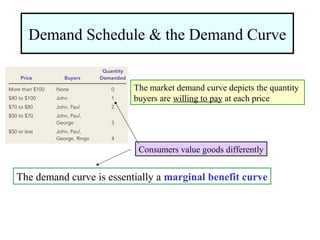
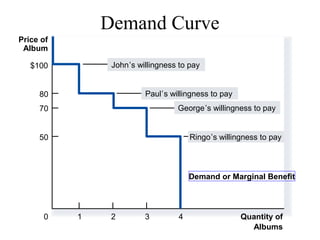
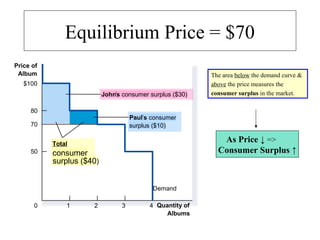
- The demand curve shows consumers' willingness to pay at different prices and is essentially a marginal benefit curve. The area under the demand curve and above the price measures total consumer surplus in the market. Lower prices increase consumer surplus.


![Equilibrium Price & Consumer Surplus
Consumer
Surplus
Quantity
Price
0
D1 = MB1
100
20
B
A
C
This triangle represents the
“welfare” of all consumers at a market price of $100
200
Total Consumer Surplus = $10
½ * 1 * 20 = $10 [½ b * h]](https://image.slidesharecdn.com/consumersurplus-150625092927-lva1-app6892/85/Consumer-surplus-8-320.jpg)