Visit To Building
Construction Site
By: Maliha Mehar
Hajira Shah
(1st semester)
Building Site
• The building we chose for site visit was a Plaza. We went their once and
observed everything, asked different questions from the workers and the
owner.
• Type of building: A triple story building with a Parking.
• Location: ………………..
• Architect: …………….
• Structural Engineer: …………….
• Date of visit: 16-December-2018.
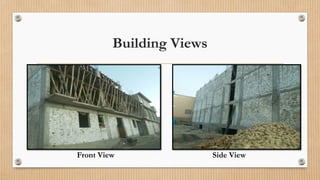
Building Views
Front View Side View
Building Materials
• We observed and asked questions about various building materials:
1- Bricks
2-Aggregates
3-Cement
4-Mortar
5-Cocrete Mix
6-Bars
1.Bricks
- Bricks are most widely used building materials.
-On the basis of strength, they’re classified into 1st, 2nd, 3rd
and 4th class.
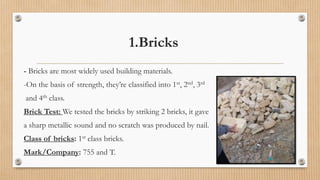
Brick Test: We tested the bricks by striking 2 bricks, it gave
a sharp metallic sound and no scratch was produced by nail.
Class of bricks: 1st class bricks.
Mark/Company: 755 and T.
2.Aggregates
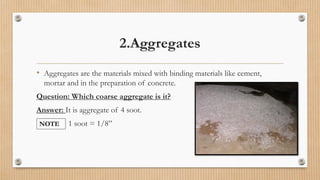
• Aggregates are the materials mixed with binding materials like cement,
mortar and in the preparation of concrete.
Question: Which coarse aggregate is it?
Answer: It is aggregate of 4 soot.
1 soot = 1/8”NOTE
3.Cement
-Cement is the binding material used to bind various construction materials
such as bricks, stones concrete blocks, etc.
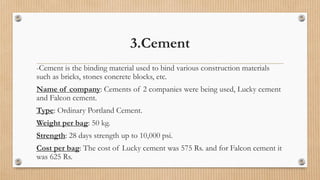
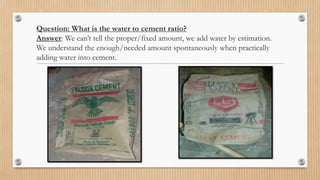
Name of company: Cements of 2 companies were being used, Lucky cement
and Falcon cement.
Type: Ordinary Portland Cement.
Weight per bag: 50 kg.
Strength: 28 days strength up to 10,000 psi.
Cost per bag: The cost of Lucky cement was 575 Rs. and for Falcon cement it
was 625 Rs.
Question: What is the water to cement ratio?
Answer: We can’t tell the proper/fixed amount, we add water by estimation.
We understand the enough/needed amount spontaneously when practically
adding water into cement.
4.Mortar
• It is the mixture of cement, fine aggregate (sand) and water in specific
proportions.
• Mortar being used at the construction site was “Cement mortar”.
Question: Ratio of cement to sand in mortar?
Answer: We take sand of volume 2 and half wheelbarrows (2.5 * 35 liters/80
kg) for every 1 packet (50kg) of cement.
5.Concrete Mix
• Concrete is the mixture of coarse aggregate, fine aggregate, sand and water.
• As we observed, plain concrete cement (PCC) and reinforced concrete cement
(RCC) was being used at the site.
• We asked about the ratio of concrete mix and they told us about the quantity of
components with approximate volume, we did not know about the specific volumes
of the drums being used.
• As well as we could not find out the exact water to cement ratio.
Question: What is the ratio of concrete mix?
Answer: We use 2 drums of coarse aggregates, 1.5 drum of fine aggregate and 0.45
packet of cement.
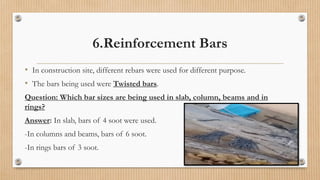
6.Reinforcement Bars
• In construction site, different rebars were used for different purpose.
• The bars being used were Twisted bars.
Question: Which bar sizes are being used in slab, column, beams and in
rings?
Answer: In slab, bars of 4 soot were used.
-In columns and beams, bars of 6 soot.
-In rings bars of 3 soot.
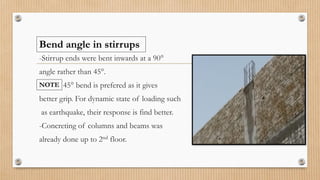
-Stirrup ends were bent inwards at a 90°
angle rather than 45°.
45° bend is prefered as it gives
better grip. For dynamic state of loading such
as earthquake, their response is find better.
-Concreting of columns and beams was
already done up to 2nd floor.
NOTE
Bend angle in stirrups
Building Details
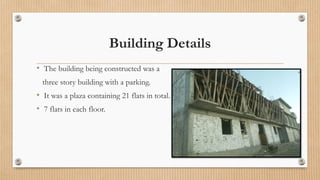
• The building being constructed was a
three story building with a parking.
• It was a plaza containing 21 flats in total.
• 7 flats in each floor.
Construction Progress
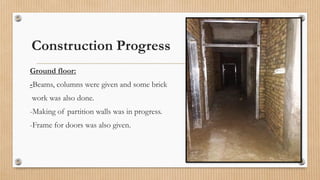
Ground floor:
-Beams, columns were given and some brick
work was also done.
-Making of partition walls was in progress.
-Frame for doors was also given.
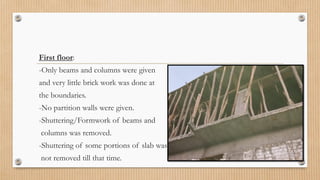
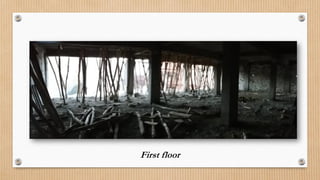
First floor:
-Only beams and columns were given
and very little brick work was done at
the boundaries.
-No partition walls were given.
-Shuttering/Formwork of beams and
columns was removed.
-Shuttering of some portions of slab was
not removed till that time.
First floor
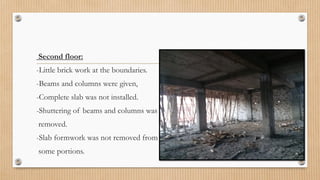
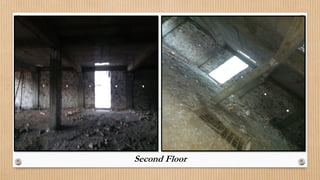
Second floor:
-Little brick work at the boundaries.
-Beams and columns were given,
-Complete slab was not installed.
-Shuttering of beams and columns was
removed.
-Slab formwork was not removed from
some portions.
Second Floor
Building Design
• The building was “Frame Structure”.
• We came to this conclusion by observing the structure, positions of columns
and beams.
• Also because the sizes of columns and beams were different.
• Columns were not given at each corner.
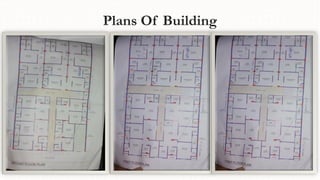
Plans Of Building
Flat 3 Details
• Almost all the flats had the same design.
• Flats were connected through corridors.
• We observed Flat 3.
• Its total area was 1300 ft.
• It consisted of 2 Bedrooms, a Drawing room, a Kitchen, a Lounge, 3
Bathrooms, a dressing, 2 voids/ducts and a lobby.
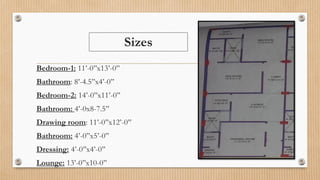
Sizes
Bedroom-1: 11’-0’’x13’-0’’
Bathroom: 8’-4.5’’x4’-0’’
Bedroom-2: 14’-0’’x11’-0’’
Bathroom: 4’-0x8-7.5’’
Drawing room: 11’-0’’x12’-0’’
Bathroom: 4’-0’’x5’-0’’
Dressing: 4’-0’’x4’-0’’
Lounge: 13’-0’’x10-0’’
Lobby: 5’-4.5’’x11’
Void-1: 4’-0’’x8’-7.5’’
Void-2: 4’-0’’x7’-0’’
-Room sizes were according to the standards, but bathrooms and kitchen sizes
were a bit smaller than the standard sizes.
-Sizes of rooms and other areas were according to the plan given, we
confirmed the sizes from the labors present.
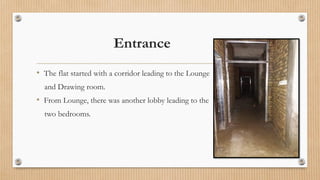
Entrance
• The flat started with a corridor leading to the Lounge
and Drawing room.
• From Lounge, there was another lobby leading to the
two bedrooms.
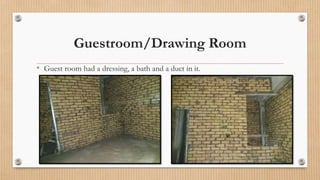
Guestroom/Drawing Room
• Guest room had a dressing, a bath and a duct in it.
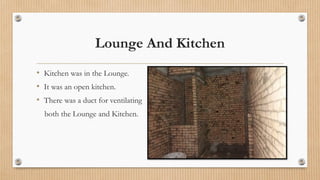
Lounge And Kitchen
• Kitchen was in the Lounge.
• It was an open kitchen.
• There was a duct for ventilating
both the Lounge and Kitchen.
Rooms
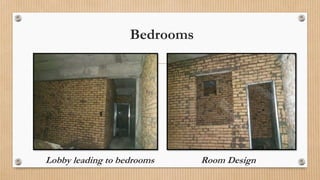
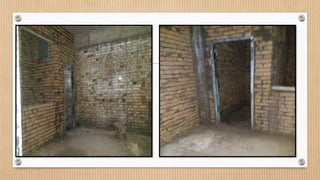
• There were 2 bedrooms in the flat.
• Both similar in design.
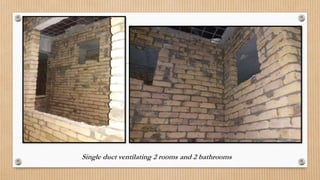
• Only a single duct was given for the ventilation of both the rooms and the
attached baths in them.
• Both rooms had attached bathrooms.
• Single window from duct was given for ventilation in both the rooms.
Bedrooms
Lobby leading to bedrooms Room Design
Single duct ventilating 2 rooms and 2 bathrooms
Kitchen and Bath floors
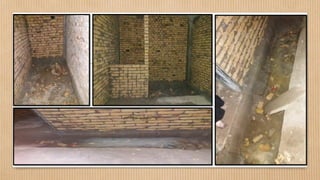
• Kitchen and bathroom floors were below than the floor level of rooms,
about 9 inches.
Question: Why the floors of bathrooms and kitchen is below than the
room level?
Answer: After plumbing installation, again concreting would be done.
Door and Window sizes
• Door size: Approximate height was 6.5ft and width varies with 2.5ft for
bathrooms and 3.5ft for other doors.
• Window sizes: Various sizes.
• Ventilators sizes for baths: Approximately 4.5’*5.5’
Stairs
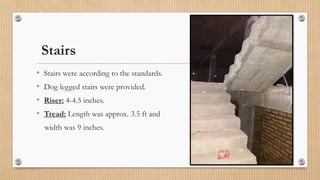
• Stairs were according to the standards.
• Dog legged stairs were provided.
• Riser: 4-4.5 inches.
• Tread: Length was approx. 3.5 ft and
width was 9 inches.
Parking
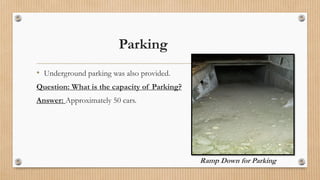
• Underground parking was also provided.
Question: What is the capacity of Parking?
Answer: Approximately 50 cars.
Ramp Down for Parking
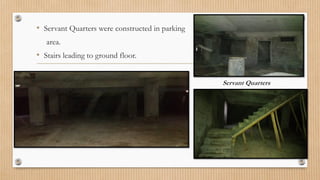
• Servant Quarters were constructed in parking
area.
• Stairs leading to ground floor.
Servant Quarters
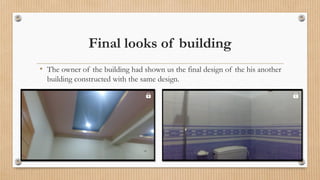
Final looks of building
• The owner of the building had shown us the final design of the his another
building constructed with the same design.
THANK YOU

Construction Site Visit

  • 1.
    Visit To Building ConstructionSite By: Maliha Mehar Hajira Shah (1st semester)
  • 2.
    Building Site • Thebuilding we chose for site visit was a Plaza. We went their once and observed everything, asked different questions from the workers and the owner. • Type of building: A triple story building with a Parking. • Location: ……………….. • Architect: ……………. • Structural Engineer: ……………. • Date of visit: 16-December-2018.
  • 3.
  • 4.
    Building Materials • Weobserved and asked questions about various building materials: 1- Bricks 2-Aggregates 3-Cement 4-Mortar 5-Cocrete Mix 6-Bars
  • 5.
    1.Bricks - Bricks aremost widely used building materials. -On the basis of strength, they’re classified into 1st, 2nd, 3rd and 4th class. Brick Test: We tested the bricks by striking 2 bricks, it gave a sharp metallic sound and no scratch was produced by nail. Class of bricks: 1st class bricks. Mark/Company: 755 and T.
  • 6.
    2.Aggregates • Aggregates arethe materials mixed with binding materials like cement, mortar and in the preparation of concrete. Question: Which coarse aggregate is it? Answer: It is aggregate of 4 soot. 1 soot = 1/8”NOTE
  • 7.
    3.Cement -Cement is thebinding material used to bind various construction materials such as bricks, stones concrete blocks, etc. Name of company: Cements of 2 companies were being used, Lucky cement and Falcon cement. Type: Ordinary Portland Cement. Weight per bag: 50 kg. Strength: 28 days strength up to 10,000 psi. Cost per bag: The cost of Lucky cement was 575 Rs. and for Falcon cement it was 625 Rs.
  • 8.
    Question: What isthe water to cement ratio? Answer: We can’t tell the proper/fixed amount, we add water by estimation. We understand the enough/needed amount spontaneously when practically adding water into cement.
  • 9.
    4.Mortar • It isthe mixture of cement, fine aggregate (sand) and water in specific proportions. • Mortar being used at the construction site was “Cement mortar”. Question: Ratio of cement to sand in mortar? Answer: We take sand of volume 2 and half wheelbarrows (2.5 * 35 liters/80 kg) for every 1 packet (50kg) of cement.
  • 10.
    5.Concrete Mix • Concreteis the mixture of coarse aggregate, fine aggregate, sand and water. • As we observed, plain concrete cement (PCC) and reinforced concrete cement (RCC) was being used at the site. • We asked about the ratio of concrete mix and they told us about the quantity of components with approximate volume, we did not know about the specific volumes of the drums being used. • As well as we could not find out the exact water to cement ratio. Question: What is the ratio of concrete mix? Answer: We use 2 drums of coarse aggregates, 1.5 drum of fine aggregate and 0.45 packet of cement.
  • 11.
    6.Reinforcement Bars • Inconstruction site, different rebars were used for different purpose. • The bars being used were Twisted bars. Question: Which bar sizes are being used in slab, column, beams and in rings? Answer: In slab, bars of 4 soot were used. -In columns and beams, bars of 6 soot. -In rings bars of 3 soot.
  • 12.
    -Stirrup ends werebent inwards at a 90° angle rather than 45°. 45° bend is prefered as it gives better grip. For dynamic state of loading such as earthquake, their response is find better. -Concreting of columns and beams was already done up to 2nd floor. NOTE Bend angle in stirrups
  • 13.
    Building Details • Thebuilding being constructed was a three story building with a parking. • It was a plaza containing 21 flats in total. • 7 flats in each floor.
  • 14.
    Construction Progress Ground floor: -Beams,columns were given and some brick work was also done. -Making of partition walls was in progress. -Frame for doors was also given.
  • 15.
    First floor: -Only beamsand columns were given and very little brick work was done at the boundaries. -No partition walls were given. -Shuttering/Formwork of beams and columns was removed. -Shuttering of some portions of slab was not removed till that time.
  • 16.
  • 17.
    Second floor: -Little brickwork at the boundaries. -Beams and columns were given, -Complete slab was not installed. -Shuttering of beams and columns was removed. -Slab formwork was not removed from some portions.
  • 18.
  • 19.
    Building Design • Thebuilding was “Frame Structure”. • We came to this conclusion by observing the structure, positions of columns and beams. • Also because the sizes of columns and beams were different. • Columns were not given at each corner.
  • 20.
  • 21.
    Flat 3 Details •Almost all the flats had the same design. • Flats were connected through corridors. • We observed Flat 3. • Its total area was 1300 ft. • It consisted of 2 Bedrooms, a Drawing room, a Kitchen, a Lounge, 3 Bathrooms, a dressing, 2 voids/ducts and a lobby.
  • 22.
    Sizes Bedroom-1: 11’-0’’x13’-0’’ Bathroom: 8’-4.5’’x4’-0’’ Bedroom-2:14’-0’’x11’-0’’ Bathroom: 4’-0x8-7.5’’ Drawing room: 11’-0’’x12’-0’’ Bathroom: 4’-0’’x5’-0’’ Dressing: 4’-0’’x4’-0’’ Lounge: 13’-0’’x10-0’’
  • 23.
    Lobby: 5’-4.5’’x11’ Void-1: 4’-0’’x8’-7.5’’ Void-2:4’-0’’x7’-0’’ -Room sizes were according to the standards, but bathrooms and kitchen sizes were a bit smaller than the standard sizes. -Sizes of rooms and other areas were according to the plan given, we confirmed the sizes from the labors present.
  • 24.
    Entrance • The flatstarted with a corridor leading to the Lounge and Drawing room. • From Lounge, there was another lobby leading to the two bedrooms.
  • 25.
    Guestroom/Drawing Room • Guestroom had a dressing, a bath and a duct in it.
  • 26.
    Lounge And Kitchen •Kitchen was in the Lounge. • It was an open kitchen. • There was a duct for ventilating both the Lounge and Kitchen.
  • 27.
    Rooms • There were2 bedrooms in the flat. • Both similar in design. • Only a single duct was given for the ventilation of both the rooms and the attached baths in them. • Both rooms had attached bathrooms. • Single window from duct was given for ventilation in both the rooms.
  • 28.
    Bedrooms Lobby leading tobedrooms Room Design
  • 30.
    Single duct ventilating2 rooms and 2 bathrooms
  • 31.
    Kitchen and Bathfloors • Kitchen and bathroom floors were below than the floor level of rooms, about 9 inches. Question: Why the floors of bathrooms and kitchen is below than the room level? Answer: After plumbing installation, again concreting would be done.
  • 33.
    Door and Windowsizes • Door size: Approximate height was 6.5ft and width varies with 2.5ft for bathrooms and 3.5ft for other doors. • Window sizes: Various sizes. • Ventilators sizes for baths: Approximately 4.5’*5.5’
  • 34.
    Stairs • Stairs wereaccording to the standards. • Dog legged stairs were provided. • Riser: 4-4.5 inches. • Tread: Length was approx. 3.5 ft and width was 9 inches.
  • 35.
    Parking • Underground parkingwas also provided. Question: What is the capacity of Parking? Answer: Approximately 50 cars. Ramp Down for Parking
  • 36.
    • Servant Quarterswere constructed in parking area. • Stairs leading to ground floor. Servant Quarters
  • 37.
    Final looks ofbuilding • The owner of the building had shown us the final design of the his another building constructed with the same design.
  • 38.