Roger Howell:
Project Summaries—Mining Hydrogeology
Silangan Copper-Gold
Deposit, Philippines
• Pre-feasibility-level
dewatering requirements for
block-cave development
• Feasibility-level dewatering
requirements for open-pit
mine
• Underground mine-inflow
and water balance
Hydrogeologic Setting:
• Recent volcanic rocks and lacustrine sediments overlying porphyry deposits
• High-K fractured basaltic basement sequence
• Difficult drilling through “mudstone” at base of volcano-sedimentary pile;
• High temperatures and high-volume gas exsolution in deep aquifer;
• Very-high precipitation rates and surface recharge
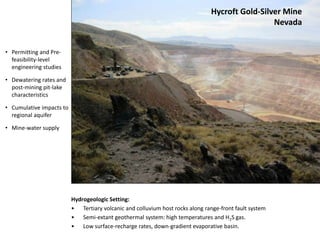
Hycroft Gold-Silver Mine
Nevada
Hydrogeologic Setting:
• Tertiary volcanic and colluvium host rocks along range-front fault system
• Semi-extant geothermal system: high temperatures and H2S gas.
• Low surface-recharge rates, down-gradient evaporative basin.
• Permitting and Pre-
feasibility-level
engineering studies
• Dewatering rates and
post-mining pit-lake
characteristics
• Cumulative impacts to
regional aquifer
• Mine-water supply
Salar de Diablillos
lithium deposit,
Argentina
• Aquifer
characterization,
• Pre-feasibility brine
resource evaluation,
• Production well design
and construction
• Blowout mitigation
Hydrogeologic Setting:
• Very-immature clastic sediments filling structurally complex basin
• Very-high hydraulic conductivity and specific yield,
• High gas content in basin brine resulting in “cold geysers” of
unusual duration
Morelos Gold
Deposit,
Guererro, Mexico
• Feasibility-level
dewatering projections
for multiple pits
• Drilling and well
construction
• Aquifer
characterization,
• Impacts to surface
waters
Hydrogeologic Setting:
• Skarn deposit at contact between granodiorite and a thick sequence of limestones and mudstones;
• Low hydraulic conductivity, except at discrete faults;
• High but very seasonal precipitation; elevated water levels resulting from low-K of country rock
Pre-Feasibility and
Feasibility Engineering
studies for greenfields
project.
Mine-water supply
Baseline Environmental
Evaluation
Aquifer characterization
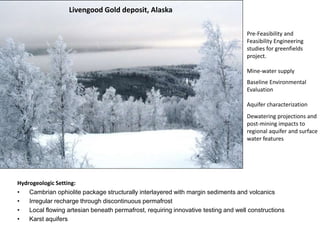
Livengood Gold deposit, Alaska
Dewatering projections and
post-mining impacts to
regional aquifer and surface
water features
Hydrogeologic Setting:
• Cambrian ophiolite package structurally interlayered with margin sediments and volcanics
• Irregular recharge through discontinuous permafrost
• Local flowing artesian beneath permafrost, requiring innovative testing and well constructions
• Karst aquifers
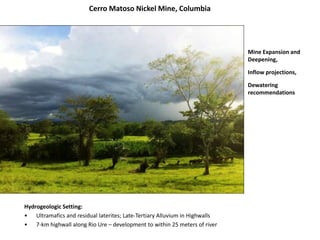
Cerro Matoso Nickel Mine, Columbia
Mine Expansion and
Deepening,
Inflow projections,
Dewatering
recommendations
Hydrogeologic Setting:
• Ultramafics and residual laterites; Late-Tertiary Alluvium in Highwalls
• 7-km highwall along Rio Ure – development to within 25 meters of river
Shea Creek uranium
deposit,
Cluff Lake district,
Saskatchewan
• Deep aquifer
characterization;
• Innovative well construction
using core rig for high-
volume pumping test
• Underground inflow
predictions,
• Freeze-wall feasibility;
Hydrogeologic Setting:
• Pre-Cambrian sandstones overlying crystalline basement at 900 meters
• Flowing sands in high-pressure, de-silicified contact zones.
Hydrogeologic Setting:
• Tertiary volcanic rocks, epithermal veining and alteration;
• Very low-flow, sparse meteoric recharge (occasional flash-floods not withstanding);
• Municipal return flow as a significant contribution to groundwater budget;
• Residual drawdown from 100-year old mining in main mining district.
Gemfield gold deposit,
Goldfield District,
Nevada
• Dewatering/ inflow
Predictions,
• Mine-water supply;
• Pit-lake characteristics
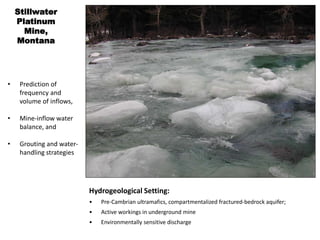
Stillwater
Platinum
Mine,
Montana
• Prediction of
frequency and
volume of inflows,
• Mine-inflow water
balance, and
• Grouting and water-
handling strategies
Hydrogeological Setting:
• Pre-Cambrian ultramafics, compartmentalized fractured-bedrock aquifer;
• Active workings in underground mine
• Environmentally sensitive discharge
• Dewatering Predictions,
Discharge Chemistry, and
Surface Water Impacts:
• Design and construction of
perimeter dewatering-well
system
Hydrogeologic Setting:
• Ordovician/Silurian carbonates overlying Precambrian shield granites;
• Micro-karst and bedding-plane karst; buried canyons filled with glacial
and inter-glacial sediments;
• Marine clay and till deposits pierced by carbonate bioherms;
• Environmentally-sensitive muskeg and surface-waters.
Victor Diamond Mine,
Ontario
• Groundwater-inflow
mitigation
• Inflow source study and
permit/litigation support
• “Probable Hydrologic
Consequences” for current
mine expansion
• Dewatering estimates for
expansion feasibility
Skyline Coal Mine, Utah
Hydrogeologic Setting:
• Shore-face sands overlain by lagoonal/deltaic coals and shales; wrench faults
• High-volume, long-lived ground water inflows locally at fault crossings;
• Overlying reservoir losing water coincident with drought;
• Plans to expand mining down-dip
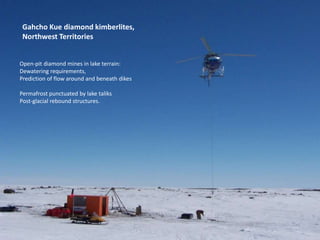
Gahcho Kue diamond kimberlites,
Northwest Territories
Open-pit diamond mines in lake terrain:
Dewatering requirements,
Prediction of flow around and beneath dikes
Permafrost punctuated by lake taliks
Post-glacial rebound structures.
Morococha District, Peru
Fracture-controlled inflows to
underground silver mine
Black Thunder Coal Mine, Wyoming
Optimization of drilling, testing, and well construction for overburden dewatering;
Passive drain options in shale
General Approach
1. Scoping-Level Model: at the earliest stages of a project, the exploration geology
and driller’s observations are compiled into a groundwater-flow concept to be
tested in the field.
2. Preliminary Characterization: drill-stem tests coordinate with exploration,
geotechnical, and baseline environmental studies to provide initial estimates of
hydraulic properties and recharge parameters.
3. Heuristic Modeling: we attempt to integrate numerical modeling as early as
possible in an iterative process to prioritize follow-up testing, and to confirm the
reasonableness of the conceptual model.
4. Confirmation of Model: long-term, higher-volume testing where necessary to
confirm flow boundaries and long-term projections of dewatering and
environmental impacts.
Technical Contributions
• Interpretation of geological, structural, and alteration studies with respect to hydraulic
properties of rocks and structures.
• Design and implementation of large-scale to small, single-well pumping tests.
• Underground testing: flow-shut-in tests, packer-testing, water balance.
• Innovative testing and well-construction in exploration coreholes and rotary boreholes
in deep, hot, gaseous, unstable, corrosive, and permafrost conditions.
• Analysis of dirty, incomplete, overprinted, and otherwise non-textbook data.
• Development of conceptual groundwater models, including zone parameters,
recharge, abstractions, boundary conditions, and environmental receptors.
600
800
1000
1200
1400
1600
1800
2000
120 170 220 270 320 370 420
WaterLevelaboveTransducer(ft)
Time (minutes)
246 Test 3 (1391-1726)
0
10
20
30
40
50
60
70
80
90
100
110
120
1 10 100 1000 10000
ResidualDraedown(ft)
(T/t')
246 Test 3 (1391-1726)
b= 335 ft
Q= 13.40 gpm
delta s= 19.5 ft
T= 181.45 gpd/ft
K= 0.022 m/day
0.10
1.00
0.000 0.001 0.002 0.003 0.004 0.005
(H-h)/(H-H0)
Recovery Time (days)
0.37
t0 0.0029 days
r 0.0389 m
L 102.1341 m
R 0.048 m
K 0.020 m/day
Deep Packer Test in HQ Corehole: Fractured
Bedrock
A – Theis Recovery analysis following 1-hour
airlift pumping at 74 m3/day
B – Hvorslev analysis of rising-head slug following
instantaneous “blowdown”.
Roger Howell, P.G., is a Principal
Hydrogeologist with over 30 years of
experience in mining hydrogeology,
exploration geology/ geochemistry,
and environmental engineering.
Mr. Howell's areas of expertise
include design and management of
mine dewatering and mine-water
disposal projects, geological synthesis
and development of conceptual
hydrogeologic models, and integration of hydrogeology with
exploration drilling and development programs. His many years
of experience as an economic geologist give him a unique
perspective on groundwater flow through mineralized systems.
His project experience includes work for numerous new
mine developments and operating mines in arctic and
temperate regions of North America, throughout South America,
and in Southeast Asia. For these projects, he has directed
hydrogeological characterization, mine-inflow analysis and
dewatering system design, surface-water/groundwater
interaction, and evaluation of environmental impacts of mine
dewatering.
Mr. Howell has represented clients at numerous meetings
with permitting agencies, water boards, and non-governmental
organizations.

RHowell_project summaries

  • 1.
  • 2.
    Silangan Copper-Gold Deposit, Philippines •Pre-feasibility-level dewatering requirements for block-cave development • Feasibility-level dewatering requirements for open-pit mine • Underground mine-inflow and water balance Hydrogeologic Setting: • Recent volcanic rocks and lacustrine sediments overlying porphyry deposits • High-K fractured basaltic basement sequence • Difficult drilling through “mudstone” at base of volcano-sedimentary pile; • High temperatures and high-volume gas exsolution in deep aquifer; • Very-high precipitation rates and surface recharge
  • 3.
    Hycroft Gold-Silver Mine Nevada HydrogeologicSetting: • Tertiary volcanic and colluvium host rocks along range-front fault system • Semi-extant geothermal system: high temperatures and H2S gas. • Low surface-recharge rates, down-gradient evaporative basin. • Permitting and Pre- feasibility-level engineering studies • Dewatering rates and post-mining pit-lake characteristics • Cumulative impacts to regional aquifer • Mine-water supply
  • 4.
    Salar de Diablillos lithiumdeposit, Argentina • Aquifer characterization, • Pre-feasibility brine resource evaluation, • Production well design and construction • Blowout mitigation Hydrogeologic Setting: • Very-immature clastic sediments filling structurally complex basin • Very-high hydraulic conductivity and specific yield, • High gas content in basin brine resulting in “cold geysers” of unusual duration
  • 5.
    Morelos Gold Deposit, Guererro, Mexico •Feasibility-level dewatering projections for multiple pits • Drilling and well construction • Aquifer characterization, • Impacts to surface waters Hydrogeologic Setting: • Skarn deposit at contact between granodiorite and a thick sequence of limestones and mudstones; • Low hydraulic conductivity, except at discrete faults; • High but very seasonal precipitation; elevated water levels resulting from low-K of country rock
  • 6.
    Pre-Feasibility and Feasibility Engineering studiesfor greenfields project. Mine-water supply Baseline Environmental Evaluation Aquifer characterization Livengood Gold deposit, Alaska Dewatering projections and post-mining impacts to regional aquifer and surface water features Hydrogeologic Setting: • Cambrian ophiolite package structurally interlayered with margin sediments and volcanics • Irregular recharge through discontinuous permafrost • Local flowing artesian beneath permafrost, requiring innovative testing and well constructions • Karst aquifers
  • 7.
    Cerro Matoso NickelMine, Columbia Mine Expansion and Deepening, Inflow projections, Dewatering recommendations Hydrogeologic Setting: • Ultramafics and residual laterites; Late-Tertiary Alluvium in Highwalls • 7-km highwall along Rio Ure – development to within 25 meters of river
  • 8.
    Shea Creek uranium deposit, CluffLake district, Saskatchewan • Deep aquifer characterization; • Innovative well construction using core rig for high- volume pumping test • Underground inflow predictions, • Freeze-wall feasibility; Hydrogeologic Setting: • Pre-Cambrian sandstones overlying crystalline basement at 900 meters • Flowing sands in high-pressure, de-silicified contact zones.
  • 9.
    Hydrogeologic Setting: • Tertiaryvolcanic rocks, epithermal veining and alteration; • Very low-flow, sparse meteoric recharge (occasional flash-floods not withstanding); • Municipal return flow as a significant contribution to groundwater budget; • Residual drawdown from 100-year old mining in main mining district. Gemfield gold deposit, Goldfield District, Nevada • Dewatering/ inflow Predictions, • Mine-water supply; • Pit-lake characteristics
  • 10.
    Stillwater Platinum Mine, Montana • Prediction of frequencyand volume of inflows, • Mine-inflow water balance, and • Grouting and water- handling strategies Hydrogeological Setting: • Pre-Cambrian ultramafics, compartmentalized fractured-bedrock aquifer; • Active workings in underground mine • Environmentally sensitive discharge
  • 11.
    • Dewatering Predictions, DischargeChemistry, and Surface Water Impacts: • Design and construction of perimeter dewatering-well system Hydrogeologic Setting: • Ordovician/Silurian carbonates overlying Precambrian shield granites; • Micro-karst and bedding-plane karst; buried canyons filled with glacial and inter-glacial sediments; • Marine clay and till deposits pierced by carbonate bioherms; • Environmentally-sensitive muskeg and surface-waters. Victor Diamond Mine, Ontario
  • 12.
    • Groundwater-inflow mitigation • Inflowsource study and permit/litigation support • “Probable Hydrologic Consequences” for current mine expansion • Dewatering estimates for expansion feasibility Skyline Coal Mine, Utah Hydrogeologic Setting: • Shore-face sands overlain by lagoonal/deltaic coals and shales; wrench faults • High-volume, long-lived ground water inflows locally at fault crossings; • Overlying reservoir losing water coincident with drought; • Plans to expand mining down-dip
  • 13.
    Gahcho Kue diamondkimberlites, Northwest Territories Open-pit diamond mines in lake terrain: Dewatering requirements, Prediction of flow around and beneath dikes Permafrost punctuated by lake taliks Post-glacial rebound structures.
  • 14.
    Morococha District, Peru Fracture-controlledinflows to underground silver mine
  • 15.
    Black Thunder CoalMine, Wyoming Optimization of drilling, testing, and well construction for overburden dewatering; Passive drain options in shale
  • 16.
    General Approach 1. Scoping-LevelModel: at the earliest stages of a project, the exploration geology and driller’s observations are compiled into a groundwater-flow concept to be tested in the field. 2. Preliminary Characterization: drill-stem tests coordinate with exploration, geotechnical, and baseline environmental studies to provide initial estimates of hydraulic properties and recharge parameters. 3. Heuristic Modeling: we attempt to integrate numerical modeling as early as possible in an iterative process to prioritize follow-up testing, and to confirm the reasonableness of the conceptual model. 4. Confirmation of Model: long-term, higher-volume testing where necessary to confirm flow boundaries and long-term projections of dewatering and environmental impacts. Technical Contributions • Interpretation of geological, structural, and alteration studies with respect to hydraulic properties of rocks and structures. • Design and implementation of large-scale to small, single-well pumping tests. • Underground testing: flow-shut-in tests, packer-testing, water balance. • Innovative testing and well-construction in exploration coreholes and rotary boreholes in deep, hot, gaseous, unstable, corrosive, and permafrost conditions. • Analysis of dirty, incomplete, overprinted, and otherwise non-textbook data. • Development of conceptual groundwater models, including zone parameters, recharge, abstractions, boundary conditions, and environmental receptors. 600 800 1000 1200 1400 1600 1800 2000 120 170 220 270 320 370 420 WaterLevelaboveTransducer(ft) Time (minutes) 246 Test 3 (1391-1726) 0 10 20 30 40 50 60 70 80 90 100 110 120 1 10 100 1000 10000 ResidualDraedown(ft) (T/t') 246 Test 3 (1391-1726) b= 335 ft Q= 13.40 gpm delta s= 19.5 ft T= 181.45 gpd/ft K= 0.022 m/day 0.10 1.00 0.000 0.001 0.002 0.003 0.004 0.005 (H-h)/(H-H0) Recovery Time (days) 0.37 t0 0.0029 days r 0.0389 m L 102.1341 m R 0.048 m K 0.020 m/day Deep Packer Test in HQ Corehole: Fractured Bedrock A – Theis Recovery analysis following 1-hour airlift pumping at 74 m3/day B – Hvorslev analysis of rising-head slug following instantaneous “blowdown”. Roger Howell, P.G., is a Principal Hydrogeologist with over 30 years of experience in mining hydrogeology, exploration geology/ geochemistry, and environmental engineering. Mr. Howell's areas of expertise include design and management of mine dewatering and mine-water disposal projects, geological synthesis and development of conceptual hydrogeologic models, and integration of hydrogeology with exploration drilling and development programs. His many years of experience as an economic geologist give him a unique perspective on groundwater flow through mineralized systems. His project experience includes work for numerous new mine developments and operating mines in arctic and temperate regions of North America, throughout South America, and in Southeast Asia. For these projects, he has directed hydrogeological characterization, mine-inflow analysis and dewatering system design, surface-water/groundwater interaction, and evaluation of environmental impacts of mine dewatering. Mr. Howell has represented clients at numerous meetings with permitting agencies, water boards, and non-governmental organizations.