Construction and Demolition
Waste Recycling;
A legislative comparison for use in
Queensland policy making.
Presentation for BEB801 Capstone Project
Tom Ahern – Bachelor of Civil Engineering
Queensland University of Technology
10th June 2016
Index
 Introduction to construction and demolition (C&D) waste;
 History of C&D waste management and recycling;
 C&D Recycling in South-East Queensland;
 C&D Recycling in Denmark;
 C&D Recycling in Hong Kong;
 Recommendations
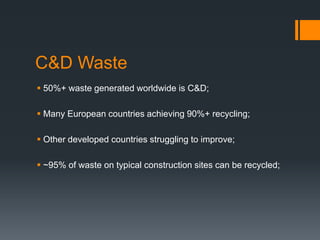
C&D Waste
 50%+ waste generated worldwide is C&D;
 Many European countries achieving 90%+ recycling;
 Other developed countries struggling to improve;
 ~95% of waste on typical construction sites can be recycled;
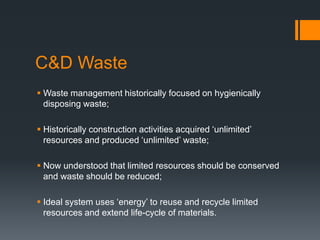
C&D Waste
 Waste management historically focused on hygienically
disposing waste;
 Historically construction activities acquired ‘unlimited’
resources and produced ‘unlimited’ waste;
 Now understood that limited resources should be conserved
and waste should be reduced;
 Ideal system uses ‘energy’ to reuse and recycle limited
resources and extend life-cycle of materials.
Current C&DW Recycling Climate
 Denmark/Netherlands/Germany world leaders in C&D
recycling practices;
 Lack of awareness in many developed countries such as EU
members and USA;
 Australia achieving promising results in NSW & Victoria;
 Queensland struggling with ~42% C&DW recycled.
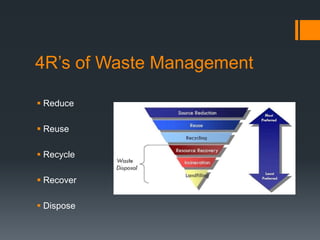
4R’s of Waste Management
 Reduce
 Reuse
 Recycle
 Recover
 Dispose
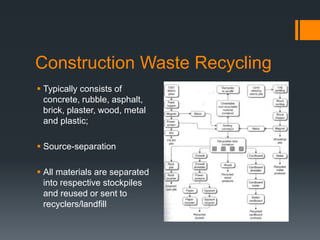
Construction Waste Recycling
 Typically consists of
concrete, rubble, asphalt,
brick, plaster, wood, metal
and plastic;
 Source-separation
 All materials are separated
into respective stockpiles
and reused or sent to
recyclers/landfill
Demolition Waste Recycling
 Includes aggregate, concrete, wood, metal, insulation and
glass;
 Usually contaminated with paints, adhesives, dirt etc.
 Selective demolition as an alternative to full demolition;
 Allows components to be disassembled and recycled before
core structure is destroyed.
South-East Queensland C&D
Recycling
 SEQ is largest growth area in the state;
 Only reports 42% recycling of C&D wastes where other
states are achieving 70%+;
 Many barriers including landfill fees, inferior recycled
materials and general lack of experience;
 Timber and concrete largest recycled products.
Waste Management Legislation -
SEQ
 Lack of policy surrounding the reduction and recycling of
construction waste;
 Waste Reduction Recycling Act;
 Waste Reduction and Recycling Strategy;
 Landfill levy introduced at $35/t then repealed;
Waste Management Legislation -
SEQ
 Only affects government subsidiaries and those under
government owned contracts;
 Sets target at 40% total weight of waste to be reused or
recycled;
 Requires source-separation techniques where practicable;
 Only accounts for a small section of C&D taking place.
Denmark C&D Recycling
 First developed after Copenhagen landfill exhaustion in 1985;
 1989 first municipal solid waste management plan enforced;
 1993 Estimated 50% of C&D waste recycled, 23%
incinerated & 27% disposed in landfill;
 By 2008 approximately 90% of C&D waste recycled, 2% via
incineration (energy recovery) & 8% disposed in landfill.
Denmark C&D Recycling
 Waste is managed at all levels of government;
 Environmental Protection Agency,
 Ministry of Environment and Energy,
 County policies &
 Municipality governance.
 Odense Waste Management Facilities;
 Municipal Solid Waste (MSW) collection throughout Odense,
 8 Recycling stations,
 Landfilling, sorting and composting facilities.
Waste Management Legislation –
Denmark
 Statutory Orders
 Source-separation,
 Hazardous waste separation,
 Recycling unpolluted C&DW
 Landfill Ban
 Ban for all materials suitable
for incineration.
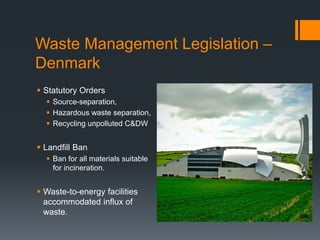
 Waste-to-energy facilities
accommodated influx of
waste.
Waste Management Legislation –
Denmark
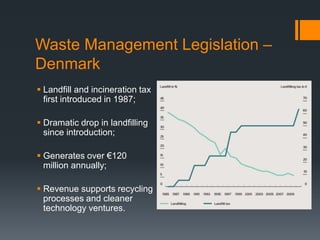
 Landfill and incineration tax
first introduced in 1987;
 Dramatic drop in landfilling
since introduction;
 Generates over €120
million annually;
 Revenue supports recycling
processes and cleaner
technology ventures.
Hong Kong C&D Recycling
 Sovereign territory in China – 7.3 million residents;
 Inert waste – rock, rubble, concrete, brick, sand soil – Sent to
public filling facilities for land reclamation;
 Non-inert waste – Organic material and contaminated inert
waste – Disposed in landfill.
 Approximately 20% non-inert, 80% inert
Hong Kong C&D Recycling
 Adopted the 4R’s approach to construction waste
management;
 Source-separation is not widely encouraged – Only used
when contractually required;
 Top-down demolition required due to lack of space;
 Tseung Kwan O Fill Bank Recycling facilities;
 Crushing plant and sorting facilities;
 Daily capacity of 1200 tonnes of crushed aggregate.
Waste Management Legislation –
Hong Kong
 Waste disposal ordinance (1980) to reduce illegal dumping;
 Waste Reduction Framework Plan (1998) to promote reuse
and recycling of materials;
 2006 Off-site construction waste sorting program;
 Led to the commissioning of the Tseung Kwan O Fill Bank.
 Introduced in conjunction with Waste Charging Scheme
Waste Management Legislation –
Hong Kong
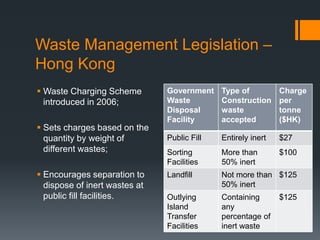
 Waste Charging Scheme
introduced in 2006;
 Sets charges based on the
quantity by weight of
different wastes;
 Encourages separation to
dispose of inert wastes at
public fill facilities.
Government
Waste
Disposal
Facility
Type of
Construction
waste
accepted
Charge
per
tonne
($HK)
Public Fill Entirely inert $27
Sorting
Facilities
More than
50% inert
$100
Landfill Not more than
50% inert
$125
Outlying
Island
Transfer
Facilities
Containing
any
percentage of
inert waste
$125
Recommendations for South-East
Queensland Legislation
 Use of recycled materials in new construction;
 Relax policy surrounding the use of recycled materials;
 Allow use in non-critical structural applications;
 Stringent testing procedures to ensure quality;
 Landfill levy;
 Greatly reduce the amount of waste being landfilled;
 Boost business for local recyclers;
 Provide revenue to offer rebates to contractors for applying
reduction and reuse techniques.
Recommendations for South-East
Queensland Legislation
 Recycling awareness campaigns;
 Increase awareness for recycling throughout the industry;
 Move away from a negative recycling mentality;
 Recycling bans;
 Landfill ban on items suitable for recycling;
 Removes these items from waste streams destined for landfill;
 Requires contractors to source-separate recyclable materials.
Conclusion
 Queensland waste legislation is years behind foreign
counterparts;
 Through careful planning the recommendations offered in
this presentation can be realised;
 Updating policy now can encourage a philosophy of reuse
within the construction industry in the future.

Construction and Demolition Waste Recycling

  • 1.
    Construction and Demolition WasteRecycling; A legislative comparison for use in Queensland policy making. Presentation for BEB801 Capstone Project Tom Ahern – Bachelor of Civil Engineering Queensland University of Technology 10th June 2016
  • 2.
    Index  Introduction toconstruction and demolition (C&D) waste;  History of C&D waste management and recycling;  C&D Recycling in South-East Queensland;  C&D Recycling in Denmark;  C&D Recycling in Hong Kong;  Recommendations
  • 3.
    C&D Waste  50%+waste generated worldwide is C&D;  Many European countries achieving 90%+ recycling;  Other developed countries struggling to improve;  ~95% of waste on typical construction sites can be recycled;
  • 4.
    C&D Waste  Wastemanagement historically focused on hygienically disposing waste;  Historically construction activities acquired ‘unlimited’ resources and produced ‘unlimited’ waste;  Now understood that limited resources should be conserved and waste should be reduced;  Ideal system uses ‘energy’ to reuse and recycle limited resources and extend life-cycle of materials.
  • 5.
    Current C&DW RecyclingClimate  Denmark/Netherlands/Germany world leaders in C&D recycling practices;  Lack of awareness in many developed countries such as EU members and USA;  Australia achieving promising results in NSW & Victoria;  Queensland struggling with ~42% C&DW recycled.
  • 6.
    4R’s of WasteManagement  Reduce  Reuse  Recycle  Recover  Dispose
  • 7.
    Construction Waste Recycling Typically consists of concrete, rubble, asphalt, brick, plaster, wood, metal and plastic;  Source-separation  All materials are separated into respective stockpiles and reused or sent to recyclers/landfill
  • 8.
    Demolition Waste Recycling Includes aggregate, concrete, wood, metal, insulation and glass;  Usually contaminated with paints, adhesives, dirt etc.  Selective demolition as an alternative to full demolition;  Allows components to be disassembled and recycled before core structure is destroyed.
  • 9.
    South-East Queensland C&D Recycling SEQ is largest growth area in the state;  Only reports 42% recycling of C&D wastes where other states are achieving 70%+;  Many barriers including landfill fees, inferior recycled materials and general lack of experience;  Timber and concrete largest recycled products.
  • 10.
    Waste Management Legislation- SEQ  Lack of policy surrounding the reduction and recycling of construction waste;  Waste Reduction Recycling Act;  Waste Reduction and Recycling Strategy;  Landfill levy introduced at $35/t then repealed;
  • 11.
    Waste Management Legislation- SEQ  Only affects government subsidiaries and those under government owned contracts;  Sets target at 40% total weight of waste to be reused or recycled;  Requires source-separation techniques where practicable;  Only accounts for a small section of C&D taking place.
  • 12.
    Denmark C&D Recycling First developed after Copenhagen landfill exhaustion in 1985;  1989 first municipal solid waste management plan enforced;  1993 Estimated 50% of C&D waste recycled, 23% incinerated & 27% disposed in landfill;  By 2008 approximately 90% of C&D waste recycled, 2% via incineration (energy recovery) & 8% disposed in landfill.
  • 13.
    Denmark C&D Recycling Waste is managed at all levels of government;  Environmental Protection Agency,  Ministry of Environment and Energy,  County policies &  Municipality governance.  Odense Waste Management Facilities;  Municipal Solid Waste (MSW) collection throughout Odense,  8 Recycling stations,  Landfilling, sorting and composting facilities.
  • 14.
    Waste Management Legislation– Denmark  Statutory Orders  Source-separation,  Hazardous waste separation,  Recycling unpolluted C&DW  Landfill Ban  Ban for all materials suitable for incineration.  Waste-to-energy facilities accommodated influx of waste.
  • 15.
    Waste Management Legislation– Denmark  Landfill and incineration tax first introduced in 1987;  Dramatic drop in landfilling since introduction;  Generates over €120 million annually;  Revenue supports recycling processes and cleaner technology ventures.
  • 16.
    Hong Kong C&DRecycling  Sovereign territory in China – 7.3 million residents;  Inert waste – rock, rubble, concrete, brick, sand soil – Sent to public filling facilities for land reclamation;  Non-inert waste – Organic material and contaminated inert waste – Disposed in landfill.  Approximately 20% non-inert, 80% inert
  • 17.
    Hong Kong C&DRecycling  Adopted the 4R’s approach to construction waste management;  Source-separation is not widely encouraged – Only used when contractually required;  Top-down demolition required due to lack of space;  Tseung Kwan O Fill Bank Recycling facilities;  Crushing plant and sorting facilities;  Daily capacity of 1200 tonnes of crushed aggregate.
  • 18.
    Waste Management Legislation– Hong Kong  Waste disposal ordinance (1980) to reduce illegal dumping;  Waste Reduction Framework Plan (1998) to promote reuse and recycling of materials;  2006 Off-site construction waste sorting program;  Led to the commissioning of the Tseung Kwan O Fill Bank.  Introduced in conjunction with Waste Charging Scheme
  • 19.
    Waste Management Legislation– Hong Kong  Waste Charging Scheme introduced in 2006;  Sets charges based on the quantity by weight of different wastes;  Encourages separation to dispose of inert wastes at public fill facilities. Government Waste Disposal Facility Type of Construction waste accepted Charge per tonne ($HK) Public Fill Entirely inert $27 Sorting Facilities More than 50% inert $100 Landfill Not more than 50% inert $125 Outlying Island Transfer Facilities Containing any percentage of inert waste $125
  • 20.
    Recommendations for South-East QueenslandLegislation  Use of recycled materials in new construction;  Relax policy surrounding the use of recycled materials;  Allow use in non-critical structural applications;  Stringent testing procedures to ensure quality;  Landfill levy;  Greatly reduce the amount of waste being landfilled;  Boost business for local recyclers;  Provide revenue to offer rebates to contractors for applying reduction and reuse techniques.
  • 21.
    Recommendations for South-East QueenslandLegislation  Recycling awareness campaigns;  Increase awareness for recycling throughout the industry;  Move away from a negative recycling mentality;  Recycling bans;  Landfill ban on items suitable for recycling;  Removes these items from waste streams destined for landfill;  Requires contractors to source-separate recyclable materials.
  • 22.
    Conclusion  Queensland wastelegislation is years behind foreign counterparts;  Through careful planning the recommendations offered in this presentation can be realised;  Updating policy now can encourage a philosophy of reuse within the construction industry in the future.