Objectives :
1.Identify thedifferent forms of supply-type items:
short answer, completion, restricted essay, and
extended (non-restricted) essay.
2.Differentiate between restricted and non-restricted
essay questions based on structure and purpose.
3.Analyze the advantages and disadvantages of using
constructed response-type items in assessment.
4.Apply guidelines for writing effective supply-type test
items for classroom use.
3.
Supply Type ofTest
Supply Type of Test
“Supply-type or subjective tests are assessments
where students are required to construct and supply
their own responses. Unlike multiple-choice tests,
there's no guessing—students must express their
understanding directly. These are widely used in
language, math, science, and even performance-based
subjects.”
Classification of a Supply Type of Test
1. Short answer/ Completion Type
2. Essay Type ( restricted/ not-restricted response)
4.
Example
Example
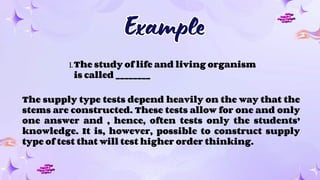
1.The study oflife and living organism
is called ________
The supply type tests depend heavily on the way that the
stems are constructed. These tests allow for one and only
one answer and , hence, often tests only the students’
knowledge. It is, however, possible to construct supply
type of test that will test higher order thinking.
5.
Example
Example
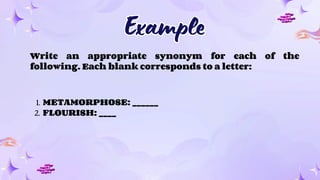
Write an appropriatesynonym for each of the
following. Each blank corresponds to a letter:
1. METAMORPHOSE: ______
2. FLOURISH: ____
6.
Completion or ShortAnswer Test
Completion or Short Answer Test
is an alternative form of assessment
because the examinee needs to supply or
create the appropriate words , symbols/
numbers to answer the questions or
complete the statement rather than
selecting the answer from the given
options.
7.
Guidelines in ConstructingCompletion
Type/ Short Answer Test
Guidelines in Constructing Completion
Type/ Short Answer Test
1. The item should require a single word answer or brief
definite statement. Do not use indefinite statement
that allows several answers
2.Be sure that the language used in the statement is
precise and accurate in relation to the subject matter
tested.
3.Be sure to omit only the key words, do not eliminate so
many words so that the meaning of the item statement
will not change.
4.Do not leave the blank at the beginning or within the
statement. It should be at the end of the statement.
8.
Guidelines in ConstructingCompletion
Type/ Short Answer Test
Guidelines in Constructing Completion
Type/ Short Answer Test
5. Use direct question rather than incomplete
statement. The statement should pose the
problem to the examinee.
6. Be sure to indicate the units in which to be
expressed when the statement requires
numerical answer.
7. Be sure that the answer that the student is
require to produce is factually correct.
8. Avoid grammatical clues.
9. Do not select textbook sentence.
9.
Example
Example
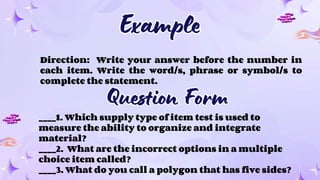
Direction: Write youranswer before the number in
each item. Write the word/s, phrase or symbol/s to
complete the statement.
____1. Which supply type of item test is used to
measure the ability to organize and integrate
material?
____2. What are the incorrect options in a multiple
choice item called?
____3. What do you call a polygon that has five sides?
Question Form
Question Form
10.
Example
Example
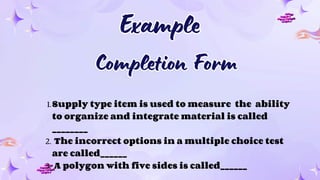
1.Supply type itemis used to measure the ability
to organize and integrate material is called
________
2. The incorrect options in a multiple choice test
are called______
3. A polygon with five sides is called______
Completion Form
Completion Form
11.
Advantages of aCompletion or Short Answer Test
Advantages of a Completion or Short Answer Test
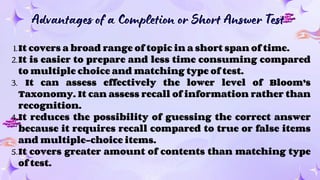
1.It covers a broad range of topic in a short span of time.
2.It is easier to prepare and less time consuming compared
to multiple choice and matching type of test.
3. It can assess effectively the lower level of Bloom’s
Taxonomy. It can assess recall of information rather than
recognition.
4.It reduces the possibility of guessing the correct answer
because it requires recall compared to true or false items
and multiple-choice items.
5.It covers greater amount of contents than matching type
of test.
12.
Disadvantages of aCompletion or Short Answer
Test
Disadvantages of a Completion or Short Answer
Test
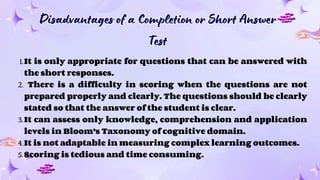
1.It is only appropriate for questions that can be answered with
the short responses.
2. There is a difficulty in scoring when the questions are not
prepared properly and clearly. The questions should be clearly
stated so that the answer of the student is clear.
3.It can assess only knowledge, comprehension and application
levels in Bloom’s Taxonomy of cognitive domain.
4.It is not adaptable in measuring complex learning outcomes.
5.Scoring is tedious and time consuming.
13.
Essay
Essay
Essays, classified asnon-objective tests,
allow for the assessment of higher order
thinking skills. Such tests require students
to organize their thoughts on a subject
matter in coherent sentences in order to
inform an audience. In essay tests, students
are requested to write one or more
paragraphs on a specified topic.
14.
The word “essay”has been derived
from the French word “essayer”
which means to ‘to try’ or ‘to
attempt’.
“ Essay test is a test that requires the
student to structure a rather long
written response up to several
paragraphs.
15.
Form of EssayTest
1.Restricted Response/ Controlled Response
The test limits the examinees response may be answered
by the examinees responses in terms of length, content,
style or organization.
Ex: Give and explain the three reasons why the
government should or should not allow teachers to work
abroad as domestic helpers.
16.
Form of EssayTest
2. Extended response/ non-rCCCestricted essay allows
students to select information that they think is
pertinent, to organize the answer in accordance with
their best judgement, and to integrate and evaluate
ideas as they think suitable.
Ex: Imagine that you and a friend found a magic wand.
Write a story about an adventure that you and your
friend had with the magic wand.
17.
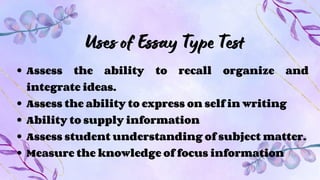
Uses of EssayType Test
Assess the ability to recall organize and
integrate ideas.
Assess the ability to express on self in writing
Ability to supply information
Assess student understanding of subject matter.
Measure the knowledge of focus information
18.
Essay
Essay
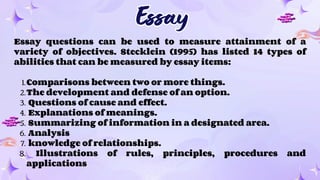
Essay questions canbe used to measure attainment of a
variety of objectives. Stecklein (1995) has listed 14 types of
abilities that can be measured by essay items:
1.Comparisons between two or more things.
2.The development and defense of an option.
3. Questions of cause and effect.
4. Explanations of meanings.
5. Summarizing of information in a designated area.
6. Analysis
7. knowledge of relationships.
8. Illustrations of rules, principles, procedures and
applications
19.
Essay
Essay
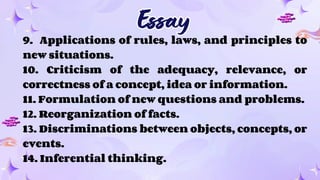
9. Applications ofrules, laws, and principles to
new situations.
10. Criticism of the adequacy, relevance, or
correctness of a concept, idea or information.
11. Formulation of new questions and problems.
12. Reorganization of facts.
13. Discriminations between objects, concepts, or
events.
14. Inferential thinking.
20.
Rules in gradingessay papers
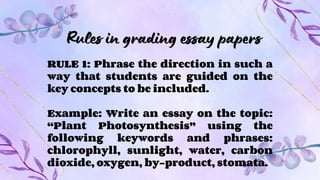
RULE 1: Phrase the direction in such a
way that students are guided on the
key concepts to be included.
Example: Write an essay on the topic:
“Plant Photosynthesis” using the
following keywords and phrases:
chlorophyll, sunlight, water, carbon
dioxide, oxygen, by-product, stomata.
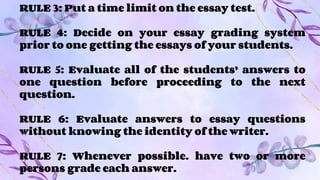
RULE 3: Puta time limit on the essay test.
RULE 4: Decide on your essay grading system
prior to one getting the essays of your students.
RULE 5: Evaluate all of the students’ answers to
one question before proceeding to the next
question.
RULE 6: Evaluate answers to essay questions
without knowing the identity of the writer.
RULE 7: Whenever possible. have two or more
persons grade each answer.
23.
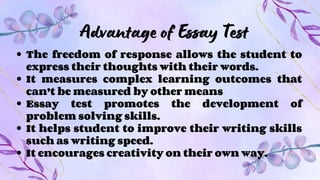
Advantage of EssayTest
The freedom of response allows the student to
express their thoughts with their words.
It measures complex learning outcomes that
can’t be measured by other means
Essay test promotes the development of
problem solving skills.
It helps student to improve their writing skills
such as writing speed.
It encourages creativity on their own way.
24.
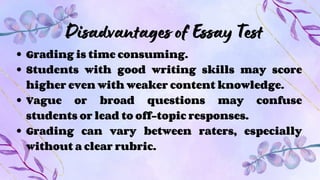
Disadvantages of EssayTest
Grading is time consuming.
Students with good writing skills may score
higher even with weaker content knowledge.
Vague or broad questions may confuse
students or lead to off-topic responses.
Grading can vary between raters, especially
without a clear rubric.