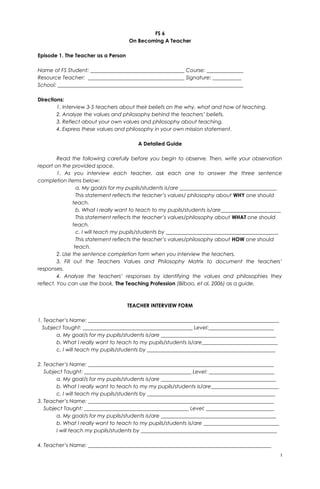
FS 6
On Becoming A Teacher
Episode 1. The Teacher as a Person
Name of FS Student: ____________________________________ Course: ______________
Resource Teacher: _____________________________________ Signature: ___________
School: _______________________________________________________________________
Directions:
1. Interview 3-5 teachers about their beliefs on the why, what and how of teaching.
2. Analyze the values and philosophy behind the teachers’ beliefs.
3. Reflect about your own values and philosophy about teaching.
4. Express these values and philosophy in your own mission statement.
A Detailed Guide
Read the following carefully before you begin to observe. Then, write your observation
report on the provided space.
1. As you interview each teacher, ask each one to answer the three sentence
completion items below:
a. My goal/s for my pupils/students is/are _____________________________________
This statement reflects the teacher’s values/ philosophy about WHY one should
teach.
b. What I really want to teach to my pupils/students is/are_______________________
This statement reflects the teacher’s values/philosophy about WHAT one should
teach.
c. I will teach my pupils/students by ___________________________________________
This statement reflects the teacher’s values/philosophy about HOW one should
teach.
2. Use the sentence completion form when you interview the teachers.
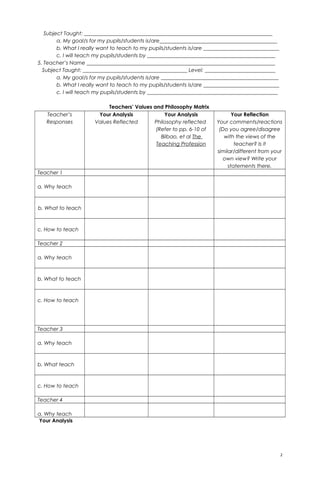
3. Fill out the Teachers Values and Philosophy Matrix to document the teachers’
responses.
4. Analyze the teachers’ responses by identifying the values and philosophies they
reflect. You can use the book, The Teaching Profession (Bilbao, et al, 2006) as a guide.
TEACHER INTERVIEW FORM
1. Teacher’s Name: _________________________________________________________________________
Subject Taught: __________________________________________ Level:_________________________
a. My goal/s for my pupils/students is/are ____________________________________________
b. What I really want to teach to my pupils/students is/are_____________________________
c. I will teach my pupils/students by _________________________________________________
2. Teacher’s Name: _______________________________________________________________________
Subject Taught: _________________________________________ Level: _________________________
a. My goal/s for my pupils/students is/are ____________________________________________
b. What I really want to teach to my my pupils/students is/are__________________________
c. I will teach my pupils/students by _________________________________________________
3. Teacher’s Name: _______________________________________________________________________
Subject Taught: ________________________________________ Level: __________________________
a. My goal/s for my pupils/students is/are ____________________________________________
b. What I really want to teach to my pupils/students is/are _____________________________
I will teach my pupils/students by ____________________________________________________
4. Teacher’s Name: ______________________________________________________________________
1
Subject Taught: ________________________________________________________________________
a. My goal/s for my pupils/students is/are_____________________________________________
b. What I really want to teach to my pupils/students is/are _____________________________
c. I will teach my pupils/students by _________________________________________________
5. Teacher’s Name ________________________________________________________________________
Subject Taught: ________________________________________ Level: ___________________________
a. My goal/s for my pupils/students is/are _____________________________________________
b. What I really want to teach to my pupils/students is/are _____________________________
c. I will teach my pupils/students by __________________________________________________
Teachers’ Values and Philosophy Matrix
Teacher’s
Responses
Your Analysis
Values Reflected
Your Analysis
Philosophy reflected
(Refer to pp. 6-10 of
Bilbao, et al The
Teaching Profession
Your Reflection
Your comments/reactions
(Do you agree/disagree
with the views of the
teacher? Is it
similar/different from your
own view? Write your
statements there.
Teacher 1
a. Why teach
b. What to teach
c. How to teach
Teacher 2
a. Why teach
b. What to teach
c. How to teach
Teacher 3
a. Why teach
b. What teach
c. How to teach
Teacher 4
a. Why teach
Your Analysis
2
What values and philosophies are reflected in the teachers’ responses? You can jot down your
thoughts here, and then write your final answers on the Teachers Values and Philosophy Matrix
on the preceding page.
Teacher 1
Teacher 2
Teacher 3
Teacher 4
Teacher 5
Your Reflections
1. Which views do you agree with? Disagree with? Expound.
3
2. This time, it’s your turn to answer the three sentence completion items.
a. My goal/s for my pupils/students is/are
b. What I really want to teach to my pupils/students is/are
c. I will teach my pupils/students by
What philosophy do you adhere to? Why?
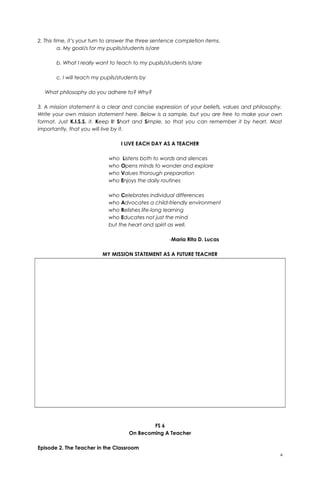
3. A mission statement is a clear and concise expression of your beliefs, values and philosophy.
Write your own mission statement here. Below is a sample, but you are free to make your own
format. Just K.I.S.S. it. Keep It Short and Simple, so that you can remember it by heart. Most
importantly, that you will live by it.
I LIVE EACH DAY AS A TEACHER
who Listens both to words and silences
who Opens minds to wonder and explore
who Values thorough preparation
who Enjoys the daily routines
who Celebrates individual differences
who Advocates a child-friendly environment
who Relishes life-long learning
who Educates not just the mind
but the heart and spirit as well.
-Maria Rita D. Lucas
MY MISSION STATEMENT AS A FUTURE TEACHER
FS 6
On Becoming A Teacher
Episode 2. The Teacher in the Classroom
4
Name of FS Student: ____________________________________ Course: _____________
Resource Teacher: _____________________________________ Signature: ___________
School: _____________________________________________________________________
Directions:
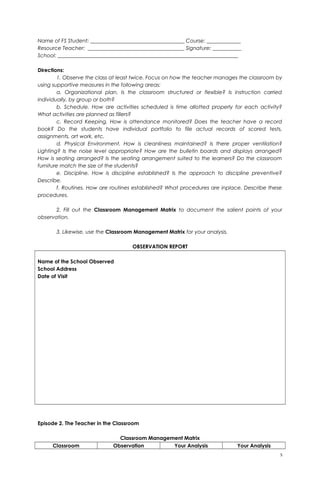
1. Observe the class at least twice. Focus on how the teacher manages the classroom by
using supportive measures in the following areas:
a. Organizational plan. Is the classroom structured or flexible? Is instruction carried
individually, by group or both?
b. Schedule. How are activities scheduled is time allotted properly for each activity?
What activities are planned as fillers?
c. Record Keeping. How is attendance monitored? Does the teacher have a record
book? Do the students have individual portfolio to file actual records of scored tests,
assignments, art work, etc.
d. Physical Environment. How is cleanliness maintained? Is there proper ventilation?
Lighting? Is the noise level appropriate? How are the bulletin boards and displays arranged?
How is seating arranged? Is the seating arrangement suited to the learners? Do the classroom
furniture match the size of the students?
e. Discipline. How is discipline established? Is the approach to discipline preventive?
Describe.
f. Routines. How are routines established? What procedures are inplace. Describe these
procedures.
2. Fill out the Classroom Management Matrix to document the salient points of your
observation.
3. Likewise, use the Classroom Management Matrix for your analysis.
OBSERVATION REPORT
Name of the School Observed
School Address
Date of Visit
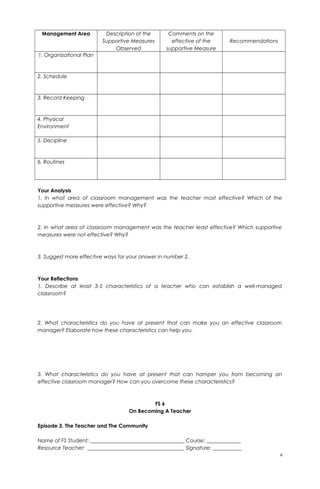
Episode 2. The Teacher in the Classroom
Classroom Management Matrix
Classroom Observation Your Analysis Your Analysis
5
Management Area Description of the
Supportive Measures
Observed
Comments on the
effective of the
supportive Measure
Recommendations
1. Organizational Plan
2. Schedule
3. Record Keeping
4. Physical
Environment
5. Discipline
6. Routines
Your Analysis
1. In what area of classroom management was the teacher most effective? Which of the
supportive measures were effective? Why?
2. In what area of classroom management was the teacher least effective? Which supportive
measures were not effective? Why?
3. Suggest more effective ways for your answer in number 2.
Your Reflections
1. Describe at least 3-5 characteristics of a teacher who can establish a well-managed
classroom?
2. What characteristics do you have at present that can make you an effective classroom
manager? Elaborate how these characteristics can help you.
3. What characteristics do you have at present that can hamper you from becoming an
effective classroom manager? How can you overcome these characteristics?
FS 6
On Becoming A Teacher
Episode 3. The Teacher and The Community
Name of FS Student: ____________________________________ Course: _____________
Resource Teacher: _____________________________________ Signature: ___________
6
Cooperating School: _________________________________________________________
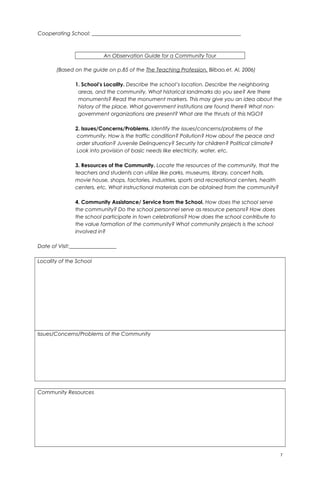
An Observation Guide for a Community Tour
(Based on the guide on p.85 of the The Teaching Profession. Bilbao,et. Al, 2006)
1. School’s Locality. Describe the school’s location. Describe the neighboring
areas, and the community. What historical landmarks do you see? Are there
monuments? Read the monument markers. This may give you an idea about the
history of the place. What government institutions are found there? What non-
government organizations are present? What are the thrusts of this NGO?
2. Issues/Concerns/Problems. Identify the issues/concerns/problems of the
community. How is the traffic condition? Pollution? How about the peace and
order situation? Juvenile Delinquency? Security for children? Political climate?
Look into provision of basic needs like electricity, water, etc.
3. Resources of the Community. Locate the resources of the community, that the
teachers and students can utilize like parks, museums, library, concert halls,
movie house, shops, factories, industries, sports and recreational centers, health
centers, etc. What instructional materials can be obtained from the community?
4. Community Assistance/ Service from the School. How does the school serve
the community? Do the school personnel serve as resource persons? How does
the school participate in town celebrations? How does the school contribute to
the value formation of the community? What community projects is the school
involved in?
Date of Visit:__________________
Locality of the School
Issues/Concerns/Problems of the Community
Community Resources
7
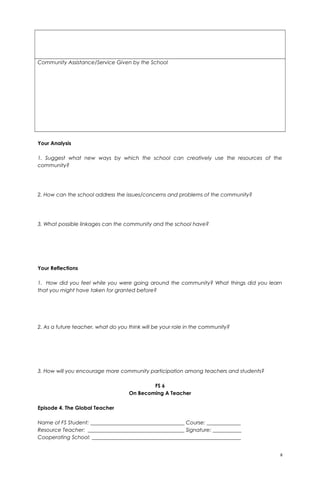
Community Assistance/Service Given by the School
Your Analysis
1. Suggest what new ways by which the school can creatively use the resources of the
community?
2. How can the school address the issues/concerns and problems of the community?
3. What possible linkages can the community and the school have?
Your Reflections
1. How did you feel while you were going around the community? What things did you learn
that you might have taken for granted before?
2. As a future teacher, what do you think will be your role in the community?
3. How will you encourage more community participation among teachers and students?
FS 6
On Becoming A Teacher
Episode 4. The Global Teacher
Name of FS Student: ____________________________________ Course: _____________
Resource Teacher: _____________________________________ Signature: ___________
Cooperating School: _________________________________________________________
8
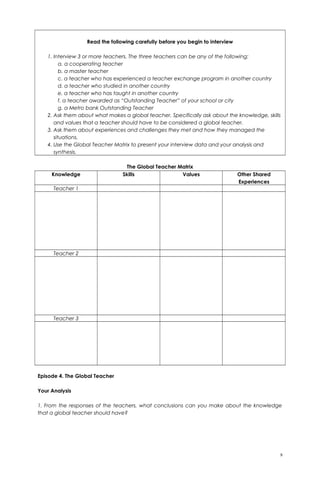
Read the following carefully before you begin to interview
1. Interview 3 or more teachers. The three teachers can be any of the following:
a. a cooperating teacher
b. a master teacher
c. a teacher who has experienced a teacher exchange program in another country
d. a teacher who studied in another country
e. a teacher who has taught in another country
f. a teacher awarded as “Outstanding Teacher” of your school or city
g. a Metro bank Outstanding Teacher
2. Ask them about what makes a global teacher. Specifically ask about the knowledge, skills
and values that a teacher should have to be considered a global teacher.
3. Ask them about experiences and challenges they met and how they managed the
situations.
4. Use the Global Teacher Matrix to present your interview data and your analysis and
synthesis.
The Global Teacher Matrix
Knowledge Skills Values Other Shared
Experiences
Teacher 1
Teacher 2
Teacher 3
Episode 4. The Global Teacher
Your Analysis
1. From the responses of the teachers, what conclusions can you make about the knowledge
that a global teacher should have?
9
2. From the responses of the teachers, what conclusions can you make about the skills that a
global teacher should have?
3. From the responses of the teachers, what conclusions can you make about the values that a
global teacher should have?
4. Collect articles or reading about Global education the global teacher. Enrich your answers in
1-3 with these readings. Place the additional learnings/insights you got from your readings.
Your Reflections
1. Write a song about your insights as to the knowledge, skills and values that make up a global
teacher. Make it to the tune of “It’s a Small World” or create your own tune too.
My Global Teacher Song
10
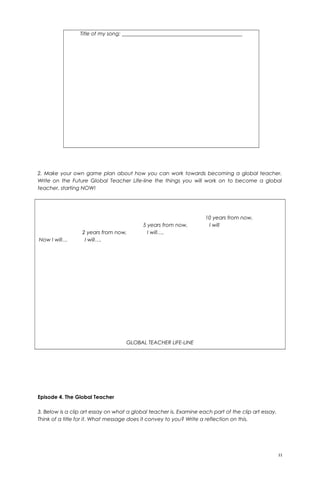
Title of my song: ______________________________________________
2. Make your own game plan about how you can work towards becoming a global teacher.
Write on the Future Global Teacher Life-line the things you will work on to become a global
teacher, starting NOW!
10 years from now,
5 years from now, I will
2 years from now, I will….
Now I will… I will….
GLOBAL TEACHER LIFE-LINE
Episode 4. The Global Teacher
3. Below is a clip art essay on what a global teacher is. Examine each part of the clip art essay.
Think of a title for it. What message does it convey to you? Write a reflection on this.
11
Title: _____________________________________________________________
Its message:
My Reflection:
FS 6
On Becoming A Teacher
Episode 5. The Teacher As A Professional
Name of FS Student: ____________________________________ Course: _____________
Resource Teacher: _____________________________________ Signature: __________
Cooperating School: _________________________________________________________
12
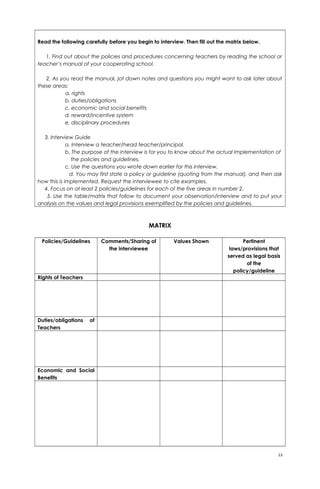
Read the following carefully before you begin to interview. Then fill out the matrix below.
1. Find out about the policies and procedures concerning teachers by reading the school or
teacher’s manual of your cooperating school.
2. As you read the manual, jot down notes and questions you might want to ask later about
these areas:
a. rights
b. duties/obligations
c. economic and social benefits
d. reward/incentive system
e. disciplinary procedures
3. Interview Guide
a. Interview a teacher/head teacher/principal.
b. The purpose of the interview is for you to know about the actual implementation of
the policies and guidelines.
c. Use the questions you wrote down earlier for this interview.
d. You may first state a policy or guideline (quoting from the manual), and then ask
how this is implemented. Request the interviewee to cite examples.
4. Focus on at least 2 policies/guidelines for each of the five areas in number 2.
5. Use the table/matrix that follow to document your observation/interview and to put your
analysis on the values and legal provisions exemplified by the policies and guidelines.
MATRIX
Policies/Guidelines Comments/Sharing of
the interviewee
Values Shown Pertinent
laws/provisions that
served as legal basis
of the
policy/guideline
Rights of Teachers
Duties/obligations of
Teachers
Economic and Social
Benefits
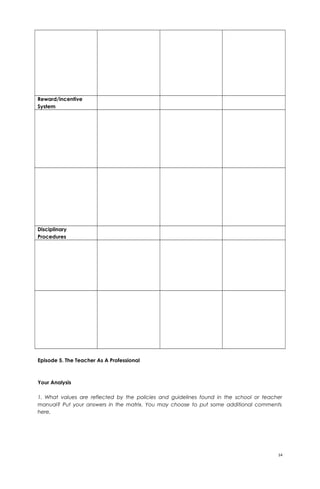
13
Reward/incentive
System
Disciplinary
Procedures
Episode 5. The Teacher As A Professional
Your Analysis
1. What values are reflected by the policies and guidelines found in the school or teacher
manual? Put your answers in the matrix. You may choose to put some additional comments
here.
14
2. Cite the legal provisions/laws that are exemplified by each of the policies/guidelines that you
included in your matrix. To help you, focus on the provisions of the following:
a. Magna Carta for Public School Teachers
b. Code of Ethics for Professional Teachers
c. Manual of Regulations for Private School
d. Certain Parts of the Labor Code
e. Philippine Teachers Professionalization Act of 1994
Write your additional comments here.
Your Reflections
1. How do you feel about the policies and guidelines concerning teachers? How will you
respond to them in the future?
2. What insights/realizations did you have about the “demands” of being a professional
teacher? How will you meet these challenging “demands” in the future?
3. What are your values and strengths that can help you become a true professional?
15

Field study 6: On Becoming A Teacher

  • 1.
    FS 6 On BecomingA Teacher Episode 1. The Teacher as a Person Name of FS Student: ____________________________________ Course: ______________ Resource Teacher: _____________________________________ Signature: ___________ School: _______________________________________________________________________ Directions: 1. Interview 3-5 teachers about their beliefs on the why, what and how of teaching. 2. Analyze the values and philosophy behind the teachers’ beliefs. 3. Reflect about your own values and philosophy about teaching. 4. Express these values and philosophy in your own mission statement. A Detailed Guide Read the following carefully before you begin to observe. Then, write your observation report on the provided space. 1. As you interview each teacher, ask each one to answer the three sentence completion items below: a. My goal/s for my pupils/students is/are _____________________________________ This statement reflects the teacher’s values/ philosophy about WHY one should teach. b. What I really want to teach to my pupils/students is/are_______________________ This statement reflects the teacher’s values/philosophy about WHAT one should teach. c. I will teach my pupils/students by ___________________________________________ This statement reflects the teacher’s values/philosophy about HOW one should teach. 2. Use the sentence completion form when you interview the teachers. 3. Fill out the Teachers Values and Philosophy Matrix to document the teachers’ responses. 4. Analyze the teachers’ responses by identifying the values and philosophies they reflect. You can use the book, The Teaching Profession (Bilbao, et al, 2006) as a guide. TEACHER INTERVIEW FORM 1. Teacher’s Name: _________________________________________________________________________ Subject Taught: __________________________________________ Level:_________________________ a. My goal/s for my pupils/students is/are ____________________________________________ b. What I really want to teach to my pupils/students is/are_____________________________ c. I will teach my pupils/students by _________________________________________________ 2. Teacher’s Name: _______________________________________________________________________ Subject Taught: _________________________________________ Level: _________________________ a. My goal/s for my pupils/students is/are ____________________________________________ b. What I really want to teach to my my pupils/students is/are__________________________ c. I will teach my pupils/students by _________________________________________________ 3. Teacher’s Name: _______________________________________________________________________ Subject Taught: ________________________________________ Level: __________________________ a. My goal/s for my pupils/students is/are ____________________________________________ b. What I really want to teach to my pupils/students is/are _____________________________ I will teach my pupils/students by ____________________________________________________ 4. Teacher’s Name: ______________________________________________________________________ 1
  • 2.
    Subject Taught: ________________________________________________________________________ a.My goal/s for my pupils/students is/are_____________________________________________ b. What I really want to teach to my pupils/students is/are _____________________________ c. I will teach my pupils/students by _________________________________________________ 5. Teacher’s Name ________________________________________________________________________ Subject Taught: ________________________________________ Level: ___________________________ a. My goal/s for my pupils/students is/are _____________________________________________ b. What I really want to teach to my pupils/students is/are _____________________________ c. I will teach my pupils/students by __________________________________________________ Teachers’ Values and Philosophy Matrix Teacher’s Responses Your Analysis Values Reflected Your Analysis Philosophy reflected (Refer to pp. 6-10 of Bilbao, et al The Teaching Profession Your Reflection Your comments/reactions (Do you agree/disagree with the views of the teacher? Is it similar/different from your own view? Write your statements there. Teacher 1 a. Why teach b. What to teach c. How to teach Teacher 2 a. Why teach b. What to teach c. How to teach Teacher 3 a. Why teach b. What teach c. How to teach Teacher 4 a. Why teach Your Analysis 2
  • 3.
    What values andphilosophies are reflected in the teachers’ responses? You can jot down your thoughts here, and then write your final answers on the Teachers Values and Philosophy Matrix on the preceding page. Teacher 1 Teacher 2 Teacher 3 Teacher 4 Teacher 5 Your Reflections 1. Which views do you agree with? Disagree with? Expound. 3
  • 4.
    2. This time,it’s your turn to answer the three sentence completion items. a. My goal/s for my pupils/students is/are b. What I really want to teach to my pupils/students is/are c. I will teach my pupils/students by What philosophy do you adhere to? Why? 3. A mission statement is a clear and concise expression of your beliefs, values and philosophy. Write your own mission statement here. Below is a sample, but you are free to make your own format. Just K.I.S.S. it. Keep It Short and Simple, so that you can remember it by heart. Most importantly, that you will live by it. I LIVE EACH DAY AS A TEACHER who Listens both to words and silences who Opens minds to wonder and explore who Values thorough preparation who Enjoys the daily routines who Celebrates individual differences who Advocates a child-friendly environment who Relishes life-long learning who Educates not just the mind but the heart and spirit as well. -Maria Rita D. Lucas MY MISSION STATEMENT AS A FUTURE TEACHER FS 6 On Becoming A Teacher Episode 2. The Teacher in the Classroom 4
  • 5.
    Name of FSStudent: ____________________________________ Course: _____________ Resource Teacher: _____________________________________ Signature: ___________ School: _____________________________________________________________________ Directions: 1. Observe the class at least twice. Focus on how the teacher manages the classroom by using supportive measures in the following areas: a. Organizational plan. Is the classroom structured or flexible? Is instruction carried individually, by group or both? b. Schedule. How are activities scheduled is time allotted properly for each activity? What activities are planned as fillers? c. Record Keeping. How is attendance monitored? Does the teacher have a record book? Do the students have individual portfolio to file actual records of scored tests, assignments, art work, etc. d. Physical Environment. How is cleanliness maintained? Is there proper ventilation? Lighting? Is the noise level appropriate? How are the bulletin boards and displays arranged? How is seating arranged? Is the seating arrangement suited to the learners? Do the classroom furniture match the size of the students? e. Discipline. How is discipline established? Is the approach to discipline preventive? Describe. f. Routines. How are routines established? What procedures are inplace. Describe these procedures. 2. Fill out the Classroom Management Matrix to document the salient points of your observation. 3. Likewise, use the Classroom Management Matrix for your analysis. OBSERVATION REPORT Name of the School Observed School Address Date of Visit Episode 2. The Teacher in the Classroom Classroom Management Matrix Classroom Observation Your Analysis Your Analysis 5
  • 6.
    Management Area Descriptionof the Supportive Measures Observed Comments on the effective of the supportive Measure Recommendations 1. Organizational Plan 2. Schedule 3. Record Keeping 4. Physical Environment 5. Discipline 6. Routines Your Analysis 1. In what area of classroom management was the teacher most effective? Which of the supportive measures were effective? Why? 2. In what area of classroom management was the teacher least effective? Which supportive measures were not effective? Why? 3. Suggest more effective ways for your answer in number 2. Your Reflections 1. Describe at least 3-5 characteristics of a teacher who can establish a well-managed classroom? 2. What characteristics do you have at present that can make you an effective classroom manager? Elaborate how these characteristics can help you. 3. What characteristics do you have at present that can hamper you from becoming an effective classroom manager? How can you overcome these characteristics? FS 6 On Becoming A Teacher Episode 3. The Teacher and The Community Name of FS Student: ____________________________________ Course: _____________ Resource Teacher: _____________________________________ Signature: ___________ 6
  • 7.
    Cooperating School: _________________________________________________________ AnObservation Guide for a Community Tour (Based on the guide on p.85 of the The Teaching Profession. Bilbao,et. Al, 2006) 1. School’s Locality. Describe the school’s location. Describe the neighboring areas, and the community. What historical landmarks do you see? Are there monuments? Read the monument markers. This may give you an idea about the history of the place. What government institutions are found there? What non- government organizations are present? What are the thrusts of this NGO? 2. Issues/Concerns/Problems. Identify the issues/concerns/problems of the community. How is the traffic condition? Pollution? How about the peace and order situation? Juvenile Delinquency? Security for children? Political climate? Look into provision of basic needs like electricity, water, etc. 3. Resources of the Community. Locate the resources of the community, that the teachers and students can utilize like parks, museums, library, concert halls, movie house, shops, factories, industries, sports and recreational centers, health centers, etc. What instructional materials can be obtained from the community? 4. Community Assistance/ Service from the School. How does the school serve the community? Do the school personnel serve as resource persons? How does the school participate in town celebrations? How does the school contribute to the value formation of the community? What community projects is the school involved in? Date of Visit:__________________ Locality of the School Issues/Concerns/Problems of the Community Community Resources 7
  • 8.
    Community Assistance/Service Givenby the School Your Analysis 1. Suggest what new ways by which the school can creatively use the resources of the community? 2. How can the school address the issues/concerns and problems of the community? 3. What possible linkages can the community and the school have? Your Reflections 1. How did you feel while you were going around the community? What things did you learn that you might have taken for granted before? 2. As a future teacher, what do you think will be your role in the community? 3. How will you encourage more community participation among teachers and students? FS 6 On Becoming A Teacher Episode 4. The Global Teacher Name of FS Student: ____________________________________ Course: _____________ Resource Teacher: _____________________________________ Signature: ___________ Cooperating School: _________________________________________________________ 8
  • 9.
    Read the followingcarefully before you begin to interview 1. Interview 3 or more teachers. The three teachers can be any of the following: a. a cooperating teacher b. a master teacher c. a teacher who has experienced a teacher exchange program in another country d. a teacher who studied in another country e. a teacher who has taught in another country f. a teacher awarded as “Outstanding Teacher” of your school or city g. a Metro bank Outstanding Teacher 2. Ask them about what makes a global teacher. Specifically ask about the knowledge, skills and values that a teacher should have to be considered a global teacher. 3. Ask them about experiences and challenges they met and how they managed the situations. 4. Use the Global Teacher Matrix to present your interview data and your analysis and synthesis. The Global Teacher Matrix Knowledge Skills Values Other Shared Experiences Teacher 1 Teacher 2 Teacher 3 Episode 4. The Global Teacher Your Analysis 1. From the responses of the teachers, what conclusions can you make about the knowledge that a global teacher should have? 9
  • 10.
    2. From theresponses of the teachers, what conclusions can you make about the skills that a global teacher should have? 3. From the responses of the teachers, what conclusions can you make about the values that a global teacher should have? 4. Collect articles or reading about Global education the global teacher. Enrich your answers in 1-3 with these readings. Place the additional learnings/insights you got from your readings. Your Reflections 1. Write a song about your insights as to the knowledge, skills and values that make up a global teacher. Make it to the tune of “It’s a Small World” or create your own tune too. My Global Teacher Song 10
  • 11.
    Title of mysong: ______________________________________________ 2. Make your own game plan about how you can work towards becoming a global teacher. Write on the Future Global Teacher Life-line the things you will work on to become a global teacher, starting NOW! 10 years from now, 5 years from now, I will 2 years from now, I will…. Now I will… I will…. GLOBAL TEACHER LIFE-LINE Episode 4. The Global Teacher 3. Below is a clip art essay on what a global teacher is. Examine each part of the clip art essay. Think of a title for it. What message does it convey to you? Write a reflection on this. 11
  • 12.
    Title: _____________________________________________________________ Its message: MyReflection: FS 6 On Becoming A Teacher Episode 5. The Teacher As A Professional Name of FS Student: ____________________________________ Course: _____________ Resource Teacher: _____________________________________ Signature: __________ Cooperating School: _________________________________________________________ 12
  • 13.
    Read the followingcarefully before you begin to interview. Then fill out the matrix below. 1. Find out about the policies and procedures concerning teachers by reading the school or teacher’s manual of your cooperating school. 2. As you read the manual, jot down notes and questions you might want to ask later about these areas: a. rights b. duties/obligations c. economic and social benefits d. reward/incentive system e. disciplinary procedures 3. Interview Guide a. Interview a teacher/head teacher/principal. b. The purpose of the interview is for you to know about the actual implementation of the policies and guidelines. c. Use the questions you wrote down earlier for this interview. d. You may first state a policy or guideline (quoting from the manual), and then ask how this is implemented. Request the interviewee to cite examples. 4. Focus on at least 2 policies/guidelines for each of the five areas in number 2. 5. Use the table/matrix that follow to document your observation/interview and to put your analysis on the values and legal provisions exemplified by the policies and guidelines. MATRIX Policies/Guidelines Comments/Sharing of the interviewee Values Shown Pertinent laws/provisions that served as legal basis of the policy/guideline Rights of Teachers Duties/obligations of Teachers Economic and Social Benefits 13
  • 14.
    Reward/incentive System Disciplinary Procedures Episode 5. TheTeacher As A Professional Your Analysis 1. What values are reflected by the policies and guidelines found in the school or teacher manual? Put your answers in the matrix. You may choose to put some additional comments here. 14
  • 15.
    2. Cite thelegal provisions/laws that are exemplified by each of the policies/guidelines that you included in your matrix. To help you, focus on the provisions of the following: a. Magna Carta for Public School Teachers b. Code of Ethics for Professional Teachers c. Manual of Regulations for Private School d. Certain Parts of the Labor Code e. Philippine Teachers Professionalization Act of 1994 Write your additional comments here. Your Reflections 1. How do you feel about the policies and guidelines concerning teachers? How will you respond to them in the future? 2. What insights/realizations did you have about the “demands” of being a professional teacher? How will you meet these challenging “demands” in the future? 3. What are your values and strengths that can help you become a true professional? 15