The Role of Constraint-Induced Movement
Therapy (CIMT)
Aditya Johan .R, M.Fis
Introduction
• Constraint-induced movement therapy (CIMT) is a movement
rehabilitation technique, which aims to counteract learned nonuse
acquired after stroke
• The CIMT comprises of task practice with the affected limb,
constraint of the unaffected limb, and transfer package to foster
compliance and increase the amount of task repetition
• This acquired behavior may set off a vicious cycle of impairments
comprising of decreased movement, decreased cortical representation
of the affected part of the body, and compensatory behavior that may
also decrease use of the affected part
Constraint-induced movement therapy
• The basic components of CIMT include repetitive task/shaping
practice with the affected limb, constraint of the unaffected limb, and
transfer package
• Task practice involves carrying out the usual everyday tasks or
activities such as brushing, cooking, washing plates, playing tennis,
kicking or throwing a ball, and picking up a cup and taking it to the
mouth to drink from it
• Constraining the unaffected limb involves use of slings, mitts, or any
possibly practicable orthotic device to prevent the use of the limb
• Sometimes, this can be achieved through conscious restriction of the
use of the unaffected limb by the patient
Protocols of constraint-induced movement therapy
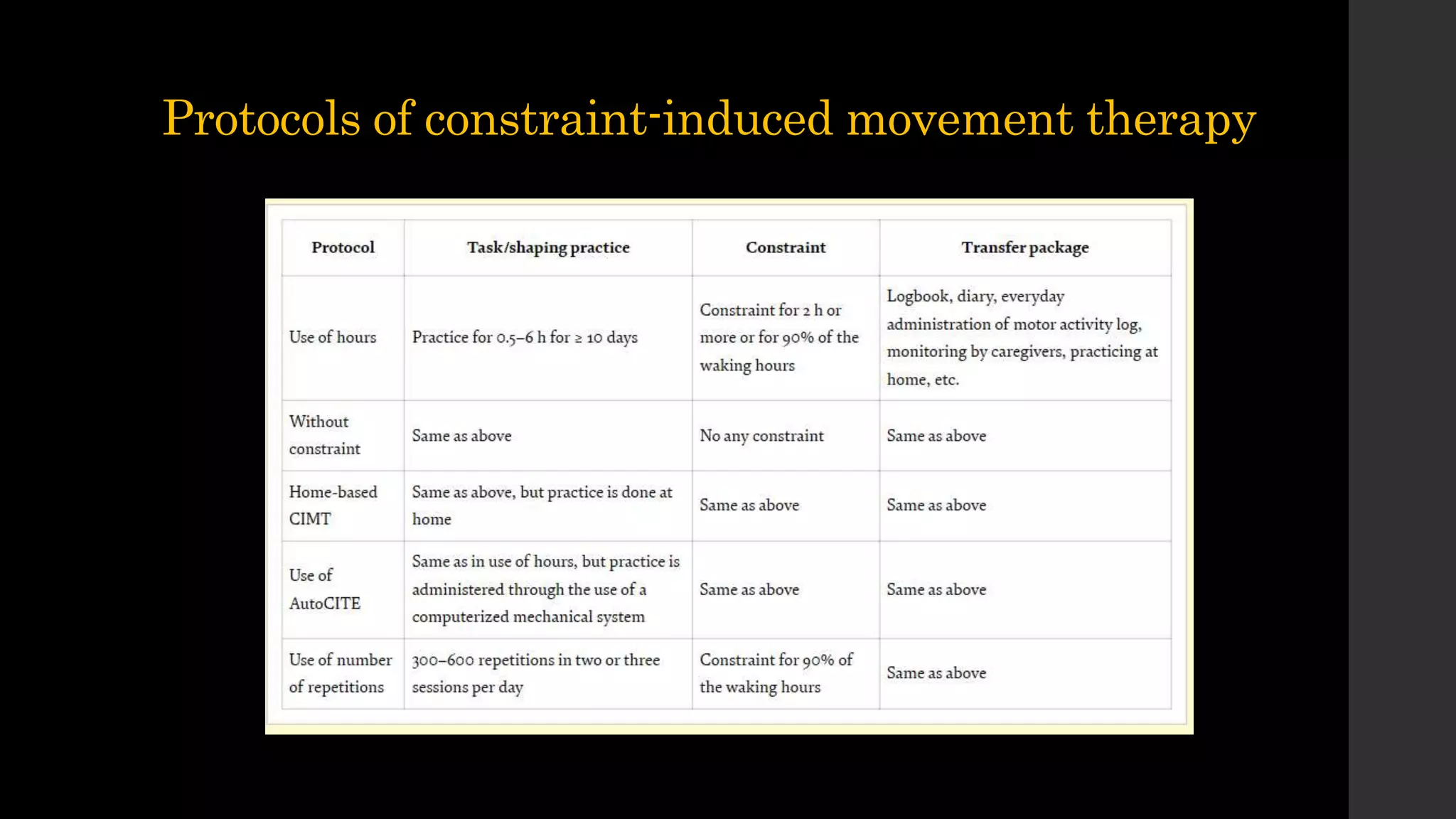
• Constraint-induced movement therapy has evolved over the years to
have many different protocols
• The protocols involve either modification of the task/shaping
practice, constraint or both components of CIMT
• These protocols include using hours as measure of intensity of
task/shaping practice
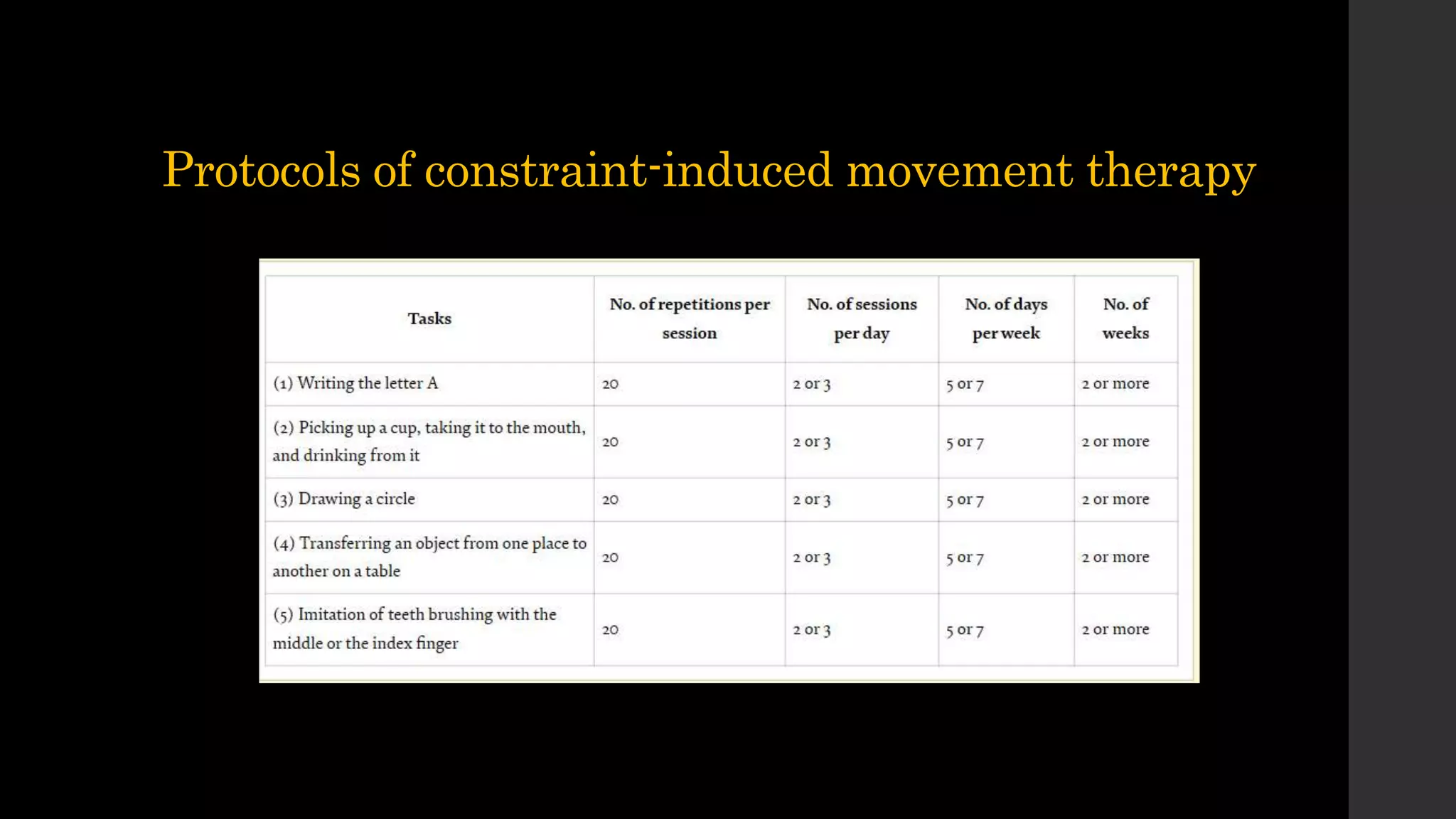
• Using number of repetitions as measure of intensity of task/shaping
practice
Protocols of constraint-induced movement therapy
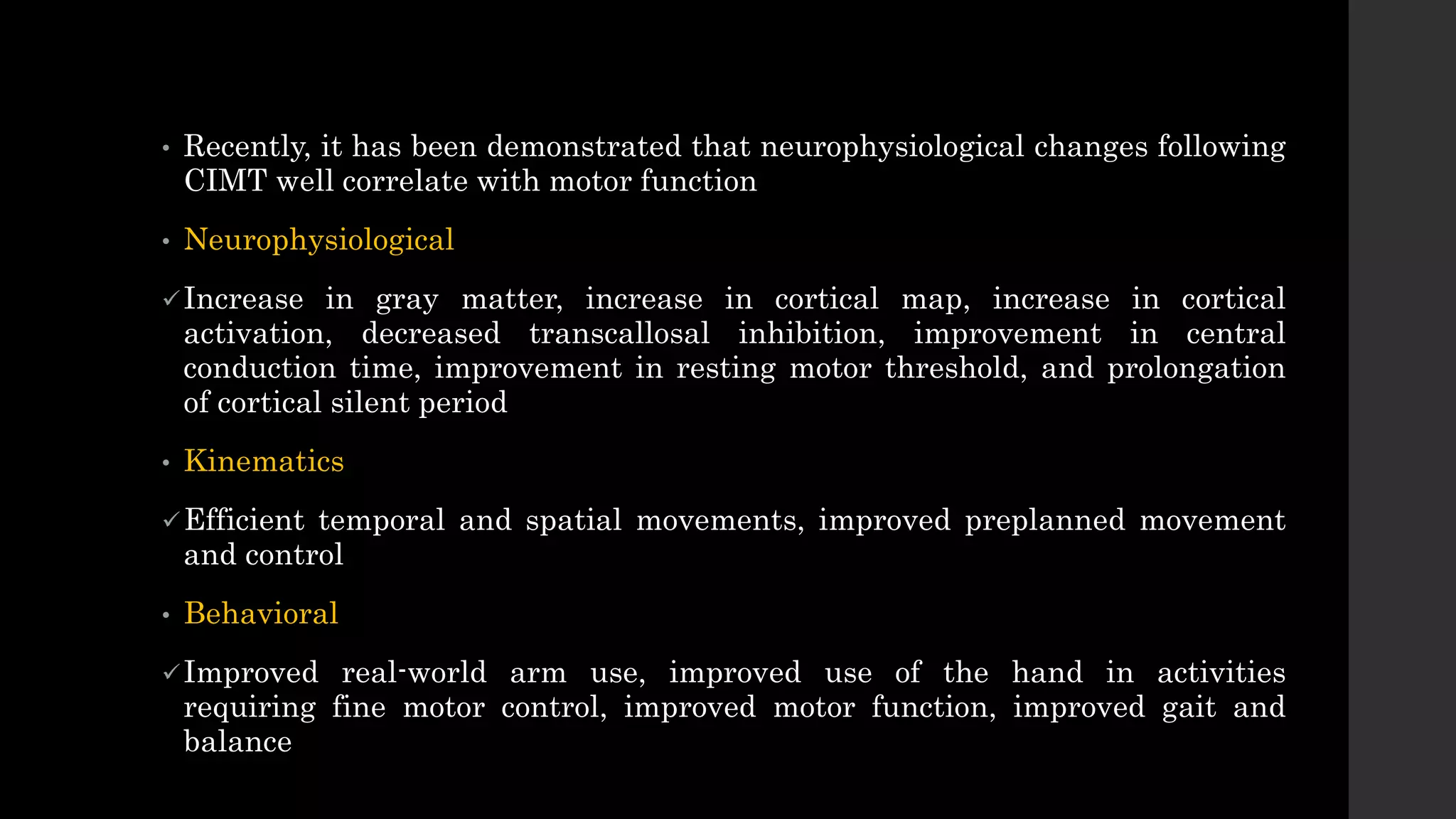
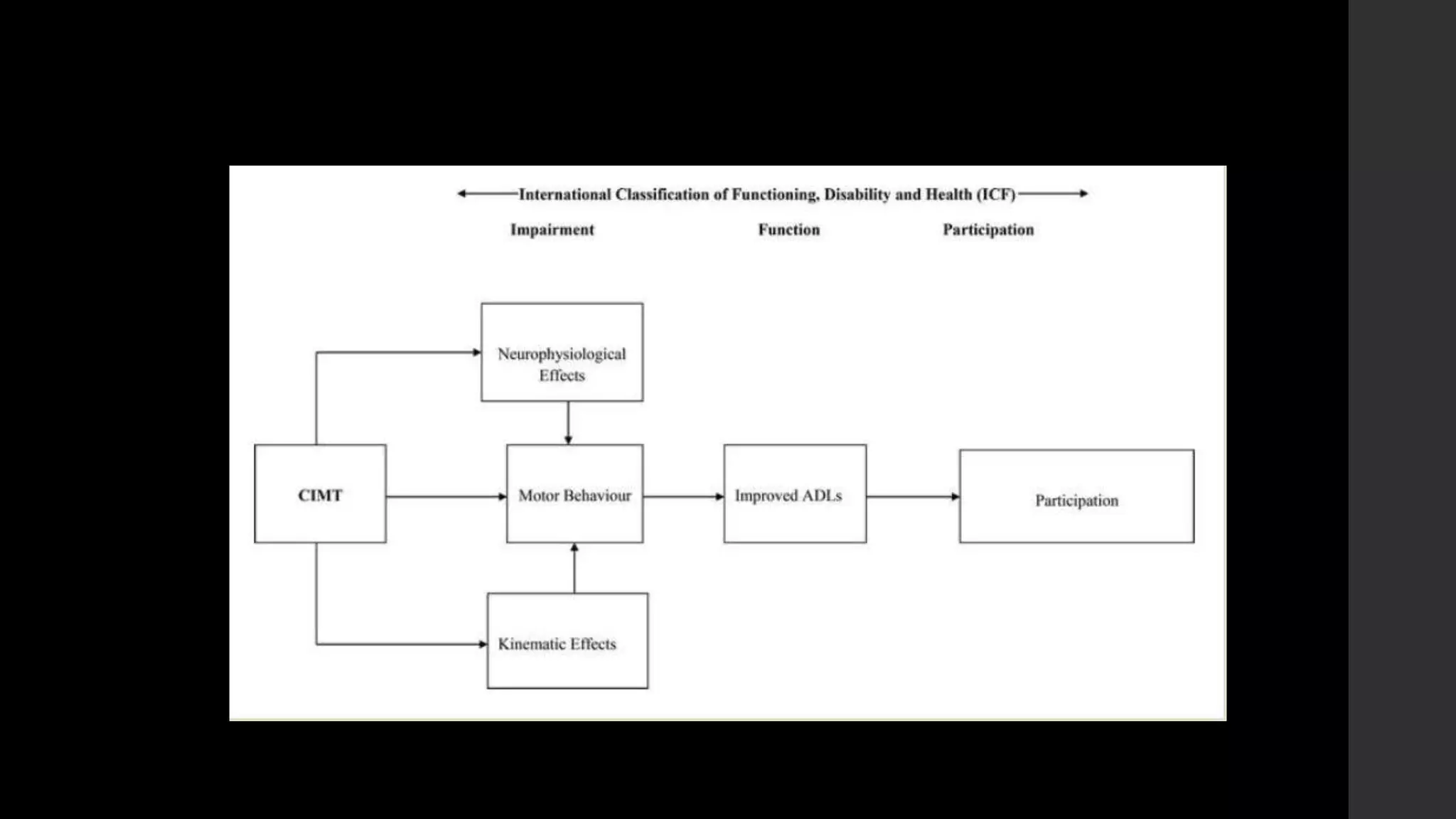
• Recently, it has been demonstrated that neurophysiological changes following
CIMT well correlate with motor function
• Neurophysiological
Increase in gray matter, increase in cortical map, increase in cortical
activation, decreased transcallosal inhibition, improvement in central
conduction time, improvement in resting motor threshold, and prolongation
of cortical silent period
• Kinematics
Efficient temporal and spatial movements, improved preplanned movement
and control
• Behavioral
Improved real-world arm use, improved use of the hand in activities
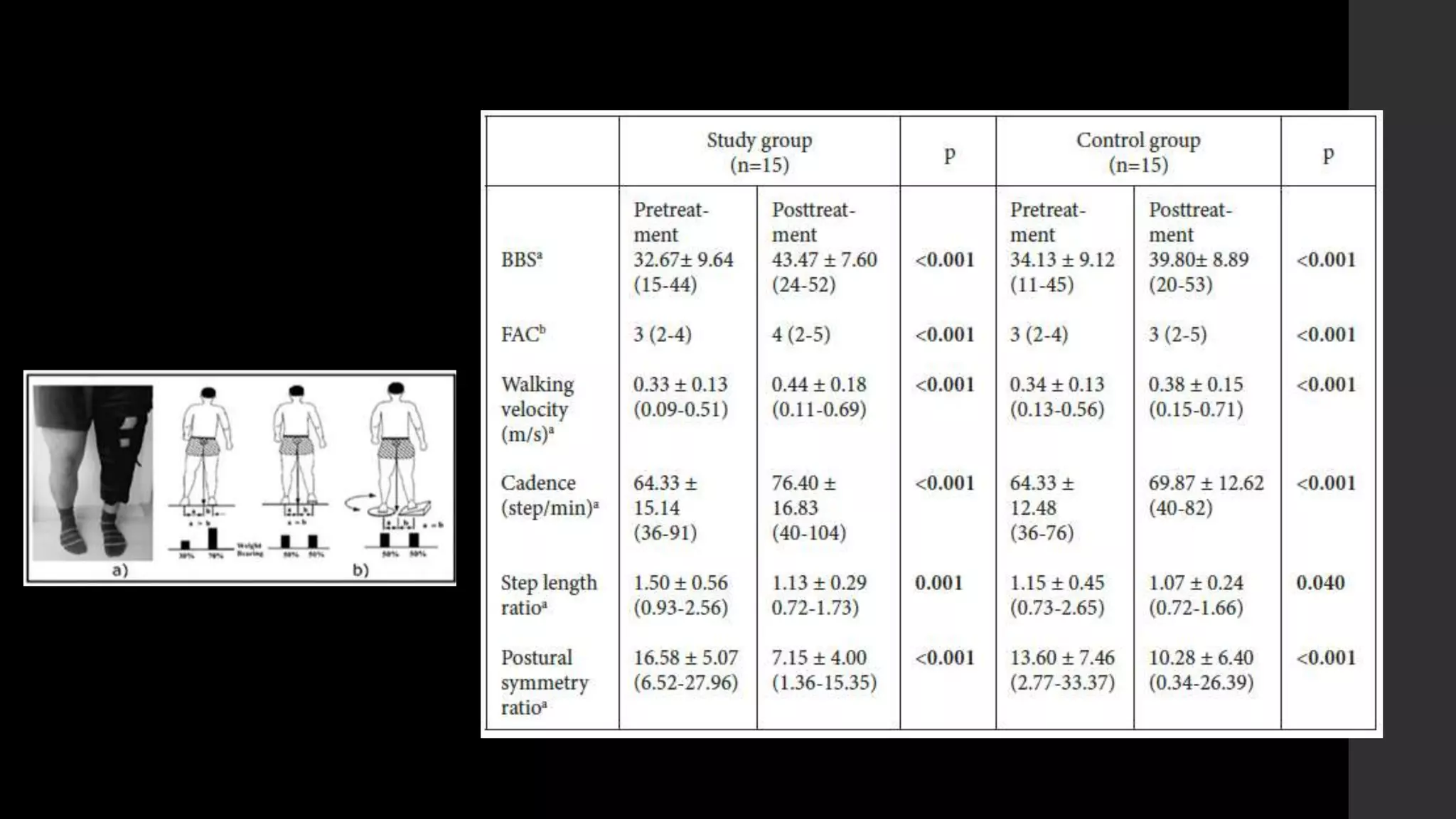
requiring fine motor control, improved motor function, improved gait and
balance
THANKS
• https://www.intechopen.com/books/different-areas-of-physiotherapy/movement-
rehabilitation-in-physiotherapy-after-stroke-the-role-of-constraint-induced-movement-
therap?fbclid=IwAR17rzIj2ldBgbcrJau44pBqCznCOXTYls8Ukii_y4faeah1GOo5zkiYsdY
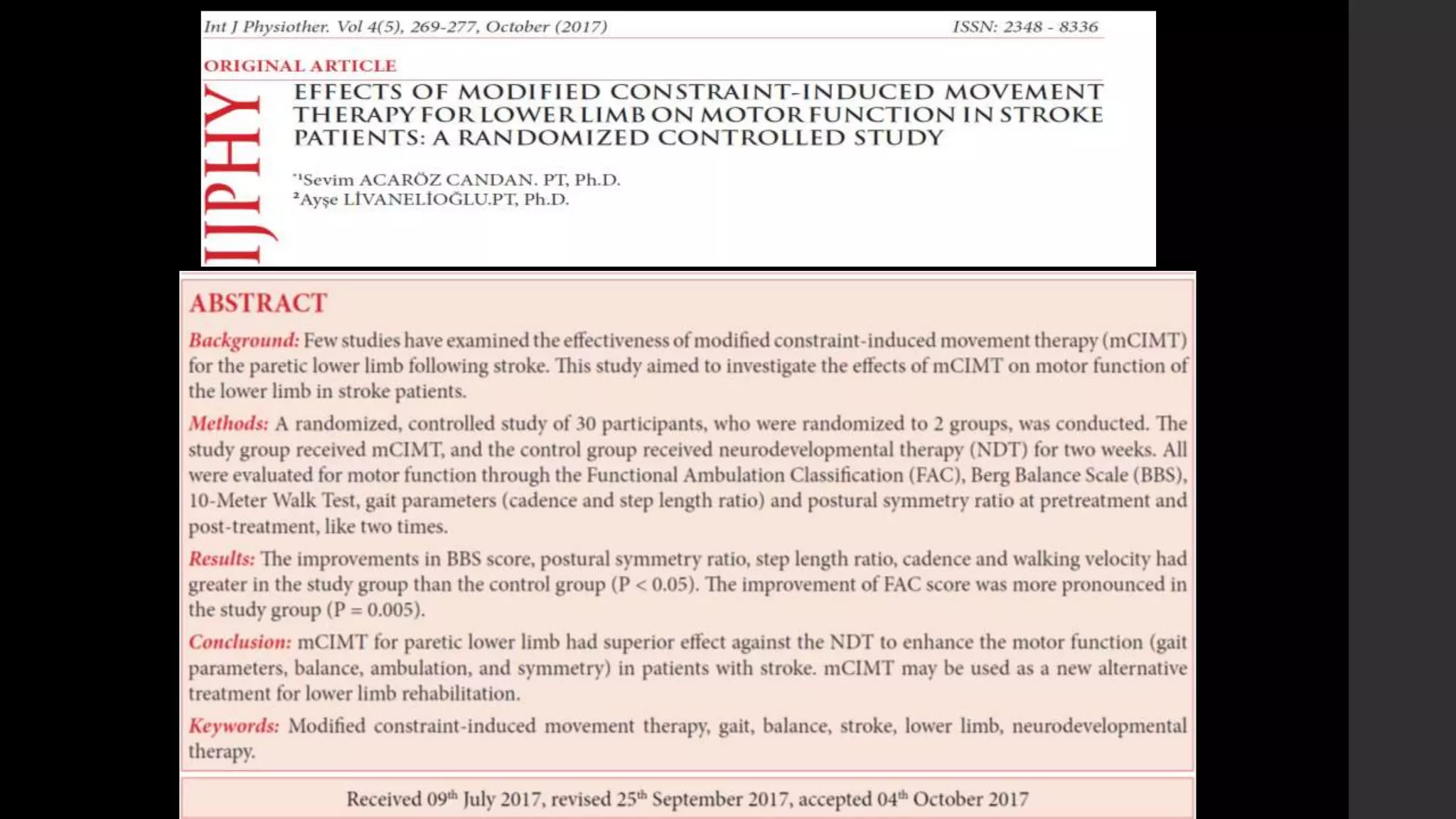
• 10.15621/ijphy/2017/v4i5/159421

The role of constraint induced movement therapy (cimt)

  • 1.
    The Role ofConstraint-Induced Movement Therapy (CIMT) Aditya Johan .R, M.Fis
  • 2.
    Introduction • Constraint-induced movementtherapy (CIMT) is a movement rehabilitation technique, which aims to counteract learned nonuse acquired after stroke • The CIMT comprises of task practice with the affected limb, constraint of the unaffected limb, and transfer package to foster compliance and increase the amount of task repetition • This acquired behavior may set off a vicious cycle of impairments comprising of decreased movement, decreased cortical representation of the affected part of the body, and compensatory behavior that may also decrease use of the affected part
  • 3.
    Constraint-induced movement therapy •The basic components of CIMT include repetitive task/shaping practice with the affected limb, constraint of the unaffected limb, and transfer package • Task practice involves carrying out the usual everyday tasks or activities such as brushing, cooking, washing plates, playing tennis, kicking or throwing a ball, and picking up a cup and taking it to the mouth to drink from it • Constraining the unaffected limb involves use of slings, mitts, or any possibly practicable orthotic device to prevent the use of the limb • Sometimes, this can be achieved through conscious restriction of the use of the unaffected limb by the patient
  • 4.
    Protocols of constraint-inducedmovement therapy • Constraint-induced movement therapy has evolved over the years to have many different protocols • The protocols involve either modification of the task/shaping practice, constraint or both components of CIMT • These protocols include using hours as measure of intensity of task/shaping practice • Using number of repetitions as measure of intensity of task/shaping practice
  • 5.
  • 6.
  • 7.
    • Recently, ithas been demonstrated that neurophysiological changes following CIMT well correlate with motor function • Neurophysiological Increase in gray matter, increase in cortical map, increase in cortical activation, decreased transcallosal inhibition, improvement in central conduction time, improvement in resting motor threshold, and prolongation of cortical silent period • Kinematics Efficient temporal and spatial movements, improved preplanned movement and control • Behavioral Improved real-world arm use, improved use of the hand in activities requiring fine motor control, improved motor function, improved gait and balance
  • 12.