Considerations for Seismic Retrofitting
Mike Tong and Mike Mahoney
FEMA, NEHRP
Structural Vulnerability –Warding off the 3 UGLIES Earthquake, Flood and Fire
2015 International Hazard Mitigation Practitioner’s Symposium
Building a Safer World to Thrive in the New Normal
Earthquake Hazard and Building Vulnerability
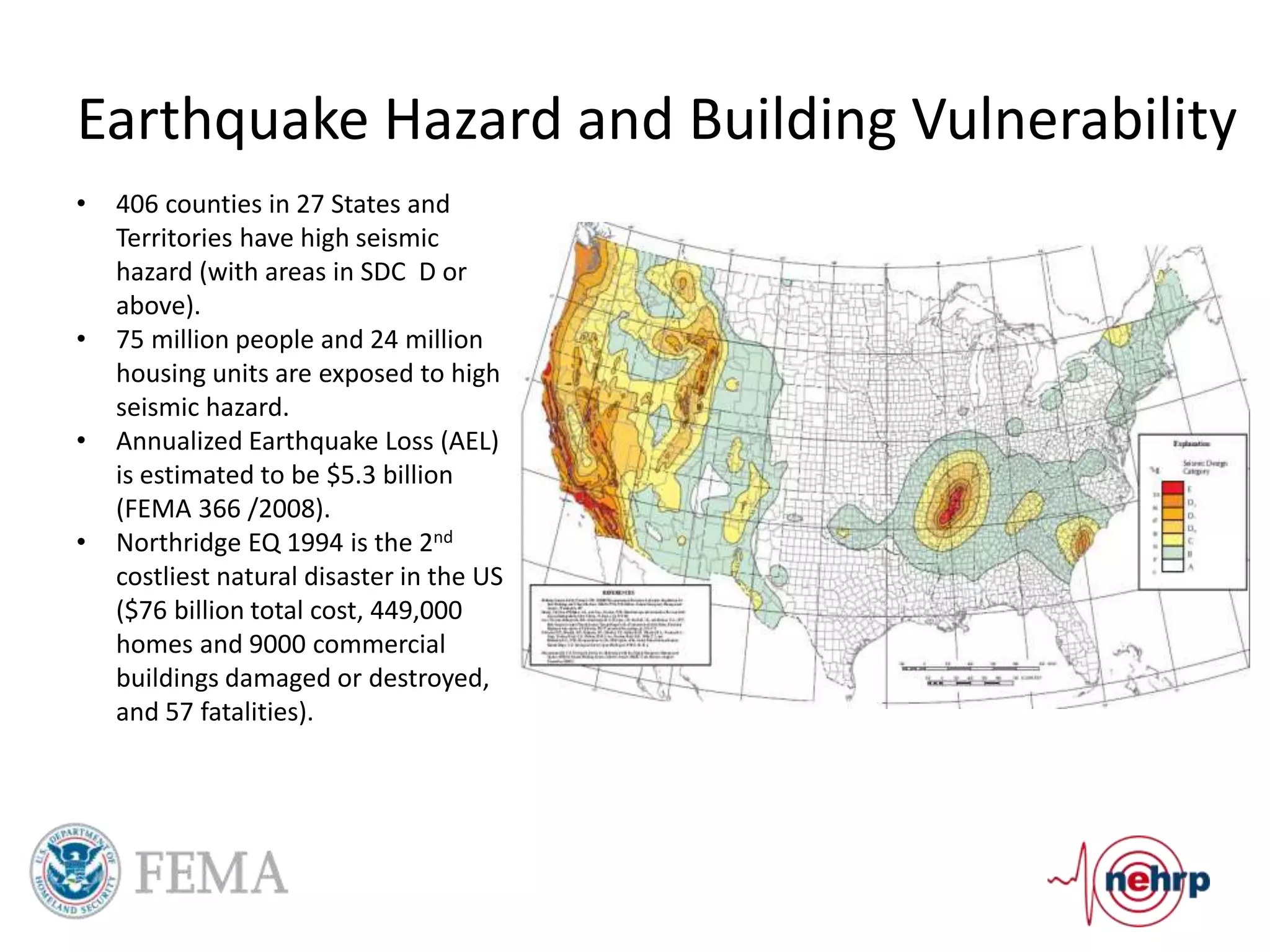
• 406 counties in 27 States and
Territories have high seismic
hazard (with areas in SDC D or
above).
• 75 million people and 24 million
housing units are exposed to high
seismic hazard.
• Annualized Earthquake Loss (AEL)
is estimated to be $5.3 billion
(FEMA 366 /2008).
• Northridge EQ 1994 is the 2nd
costliest natural disaster in the US
($76 billion total cost, 449,000
homes and 9000 commercial
buildings damaged or destroyed,
and 57 fatalities).
Considerations for Seismic Retrofitting
• Local Seismic Hazard
• Building Codes
• Building Stock Inventory
• Prioritization by Seismically Hazardous
Construction Types or Building
Weaknesses
0.0001
0.001
0.01
0.1
0.01 0.1 1 10
1-Second Spectral Acceleration (g)
AnnualFrequency
San Francisco
Los Angeles
Seattle
Salt Lake City
Sacramento
Memphis
Charleston
St. Louis
New York City
Chicago
Hazard Curves for WUS vs. E/CUS Cities
Western US
EQ Frequency
~ 1 in 10 yr.
Central US
EQ Frequency
~ 1 in 100 yr.
MCE
FEMA/USGS – ‘07 Seismic
Design Procedures Group
WUS & CUS
with similar
largest EQ
Risk and Timeframe Considerations for
Seismic Retrofitting Policies
• Seismic hazard levels vary largely from west to east coast; therefore,
seismic design requirements are also different in different communities.
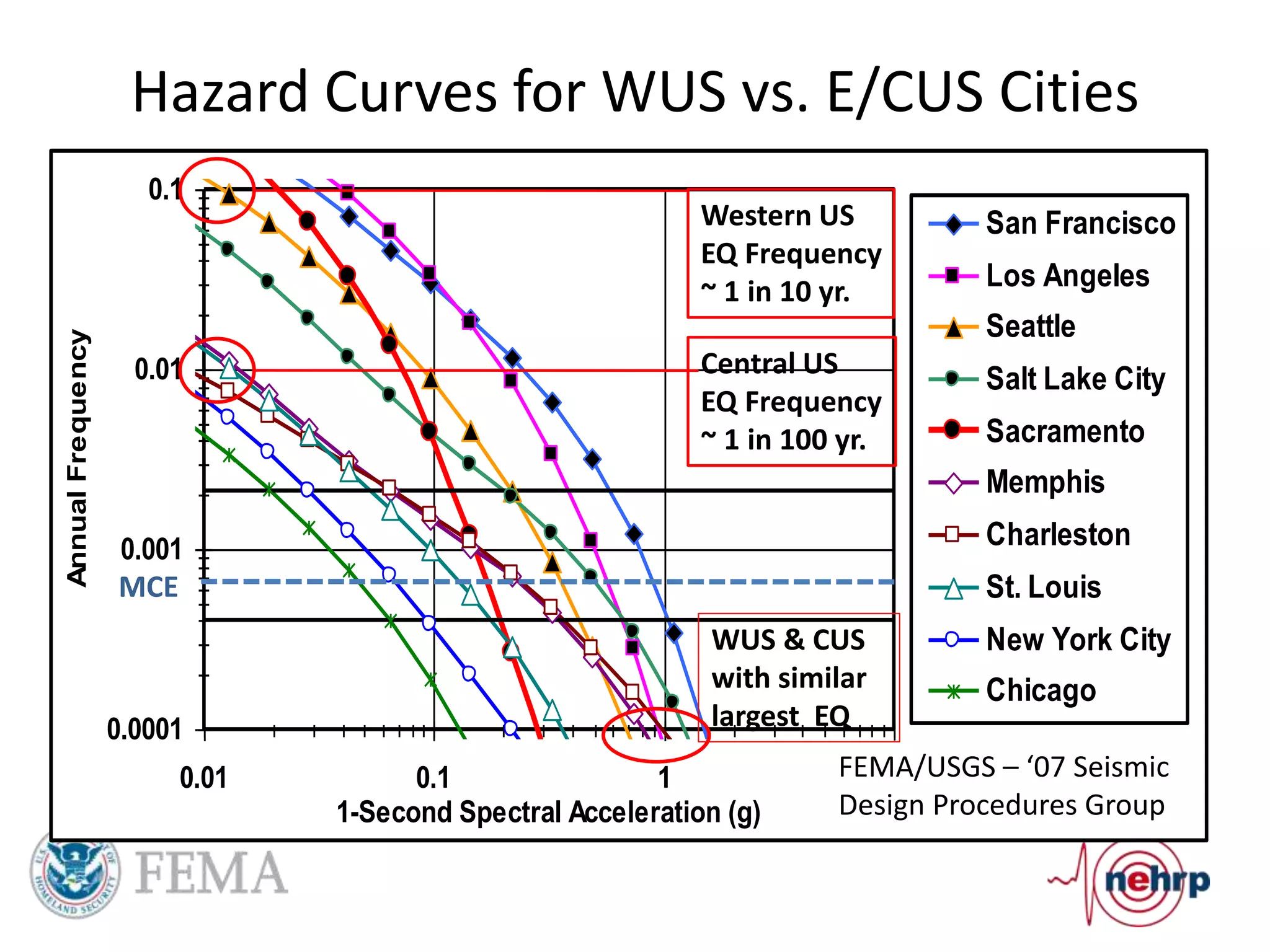
• Hazard curves show that a damaging western US earthquake can be
expected roughly once every 10 years, while a damaging eastern or
central US earthquake can be expected roughly once every 100 years or
more.
• The central and eastern US should have more time between damaging
earthquakes to allow States and locals to address risk from existing
buildings.
• This additional time could be taken into account in planning a State
and/or local existing buildings seismic retrofitting policy.
• For all high seismic hazard areas, impact of potentially very large
earthquake events should not be underestimated.
• This would require retrofitting to focus on essential and seismically
hazardous buildings.
Building Codes for Seismic Risk Mitigation
• New constructions in compliance to a current model building code (IBC or IRC)
are expected to perform much better in earthquakes than those existing pre-
1970 buildings.
• Code compliant construction provides adequate structural protection against
collapse, and is considered life safe.
– Code compliant means built to a building code equivalent to the NEHRP Provisions, or the
ASCE/SEI 31-03 benchmark codes.
– However, code does not always provide adequate protection against non-structural damage,
but that is a different presentation.
• Existing buildings built prior to the ASCE/SEI 31 benchmark codes may not
provide adequate life safety protection.
• ASCE/SEI 31-03 and the current ASCE/SEI 41-13 allow existing buildings to be
retrofitted to meet 75% of seismic resisting capacity for new buildings.
Building Code Adoption and Enforcement
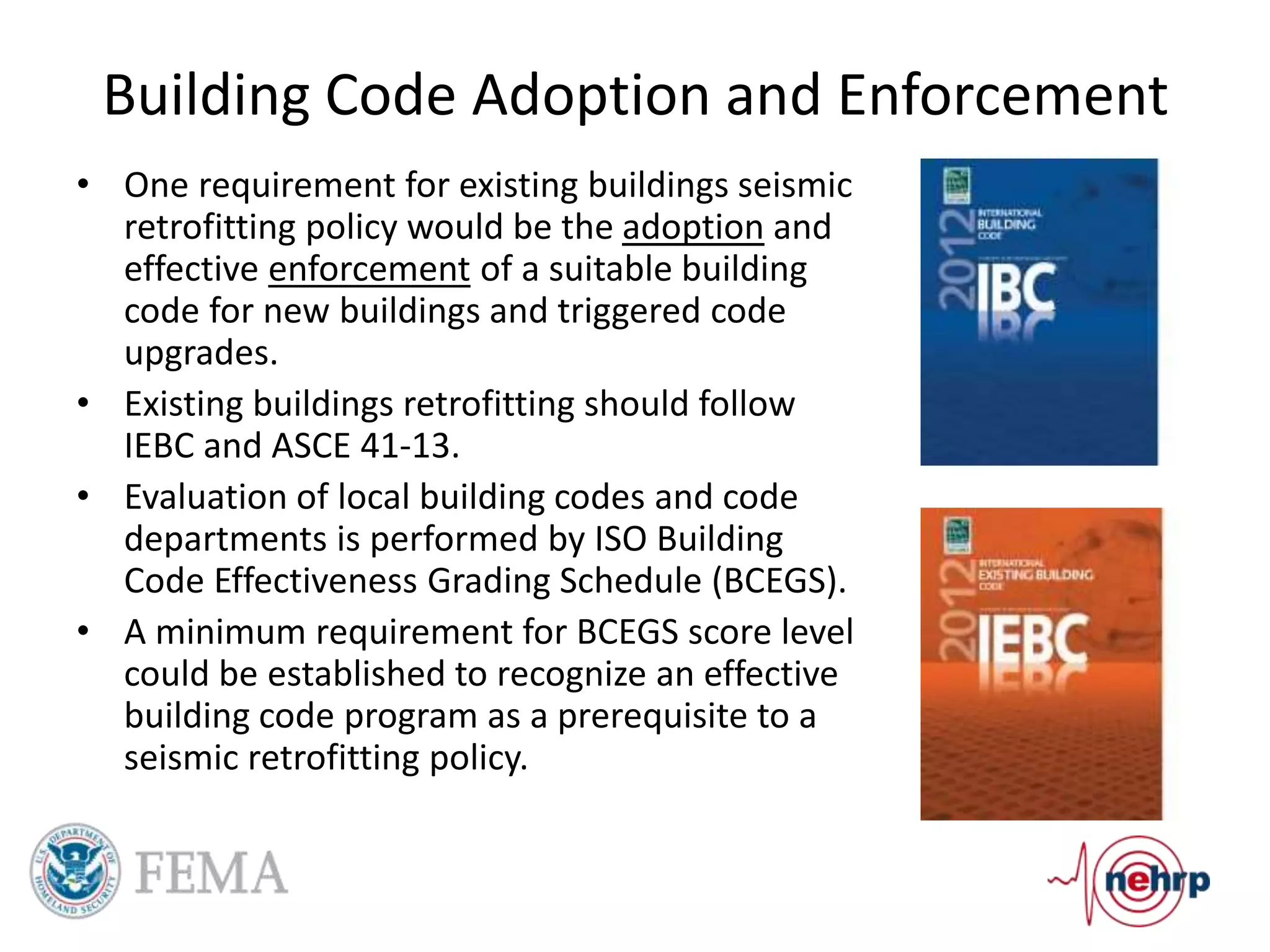
• One requirement for existing buildings seismic
retrofitting policy would be the adoption and
effective enforcement of a suitable building
code for new buildings and triggered code
upgrades.
• Existing buildings retrofitting should follow
IEBC and ASCE 41-13.
• Evaluation of local building codes and code
departments is performed by ISO Building
Code Effectiveness Grading Schedule (BCEGS).
• A minimum requirement for BCEGS score level
could be established to recognize an effective
building code program as a prerequisite to a
seismic retrofitting policy.
Evaluation and Inventory of Existing Buildings
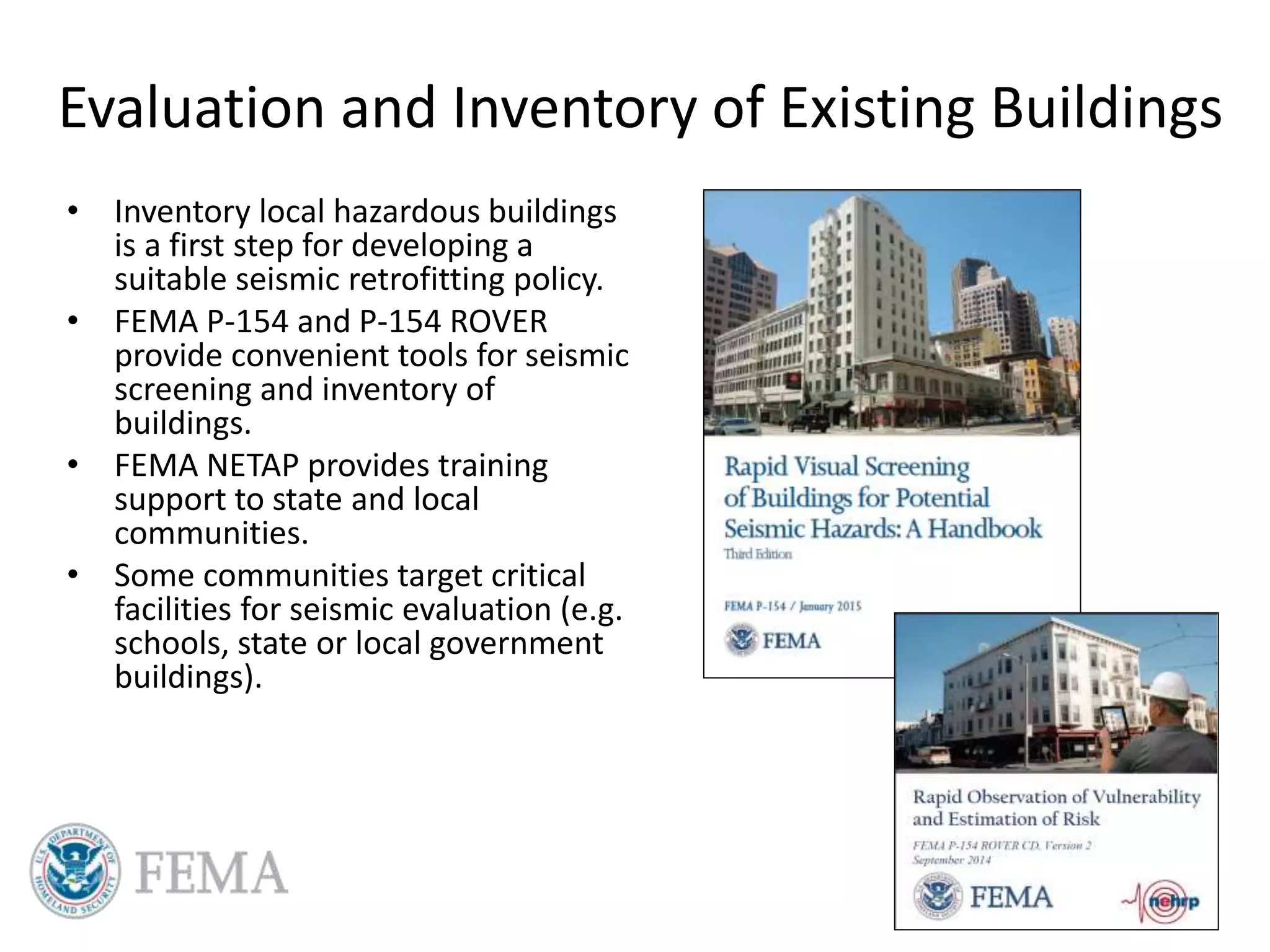
• Inventory local hazardous buildings
is a first step for developing a
suitable seismic retrofitting policy.
• FEMA P-154 and P-154 ROVER
provide convenient tools for seismic
screening and inventory of
buildings.
• FEMA NETAP provides training
support to state and local
communities.
• Some communities target critical
facilities for seismic evaluation (e.g.
schools, state or local government
buildings).
Prioritization for Seismic Retrofitting
• Critical buildings such as hospitals, schools, EOCs and hazmat
facilities should be given high priority in seismic retrofitting policy.
• The more hazardous the construction, the greater the risk and the
greater the need for a seismic retrofitting program.
• Starting with most hazardous, the types of construction and
weaknesses to be considered and prioritized for retrofitting include:
– Unreinforced masonry (URM)
– Non-ductile reinforced concrete (pre-San Fernando)
– Tilt-up buildings (rigid wall & flexible diaphragm)
– Steel frame (pre-Northridge)
– Soft story multi-unit wood frame
– Wood frame residential (cripple walls and/or masonry chimney)
– Nonstructural retrofitting
Unreinforced Masonry
• Unreinforced masonry (or URM), is the most
seismically hazardous building type. This type of
construction is considered collapse hazard in
earthquake.
• Commonly seen failure mechanism for URM is out
of plane failure of the masonry walls, resulting in
loss of the floor support structure, collapsing the
floors.
• URM construction is no longer permitted in high
seismic risk areas in the US.
• FEMA P-774 is a guide on establishing a URM
seismic retrofitting program.
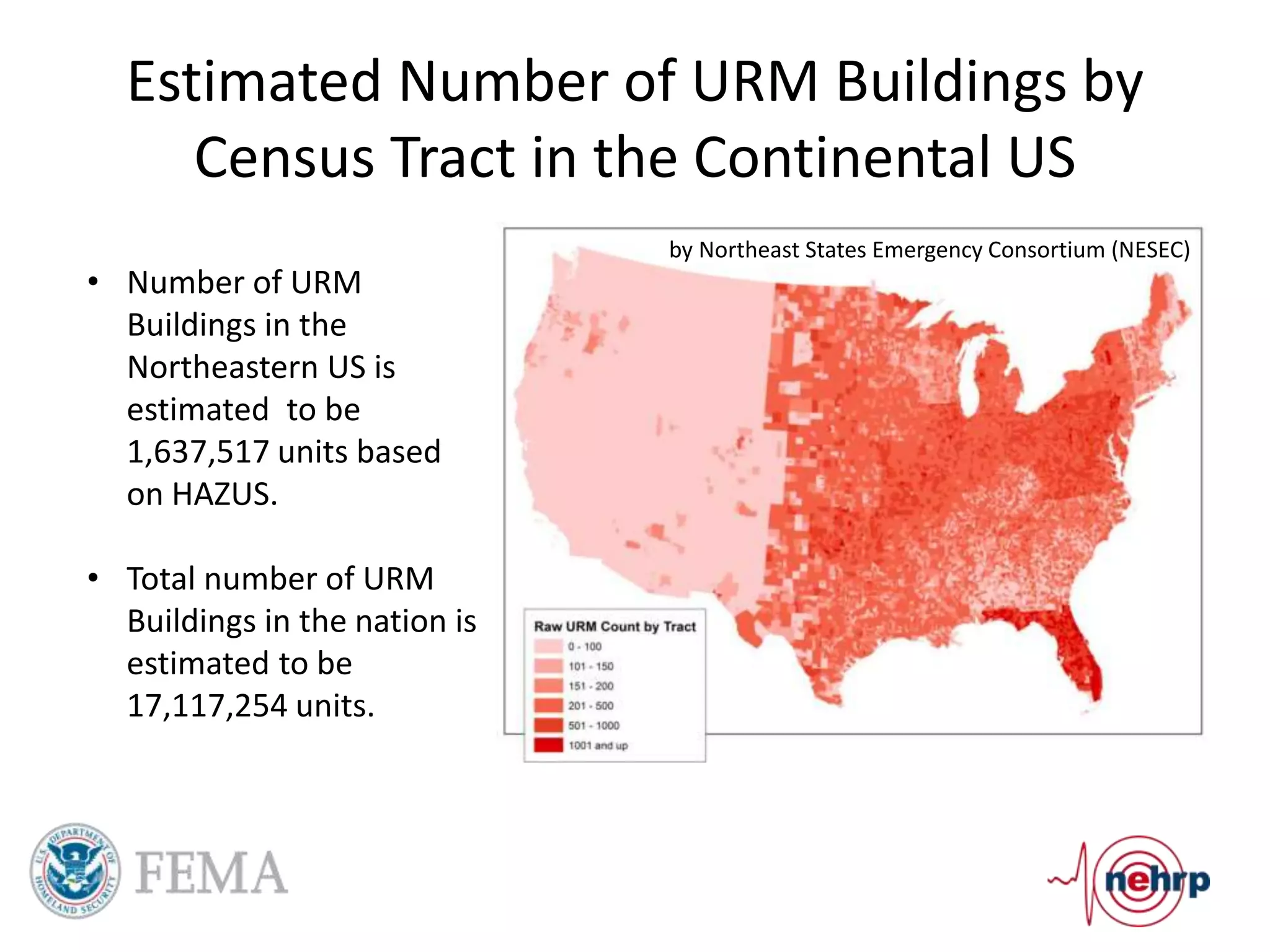
Estimated Number of URM Buildings by
Census Tract in the Continental US
by Northeast States Emergency Consortium (NESEC)
• Number of URM
Buildings in the
Northeastern US is
estimated to be
1,637,517 units based
on HAZUS.
• Total number of URM
Buildings in the nation is
estimated to be
17,117,254 units.
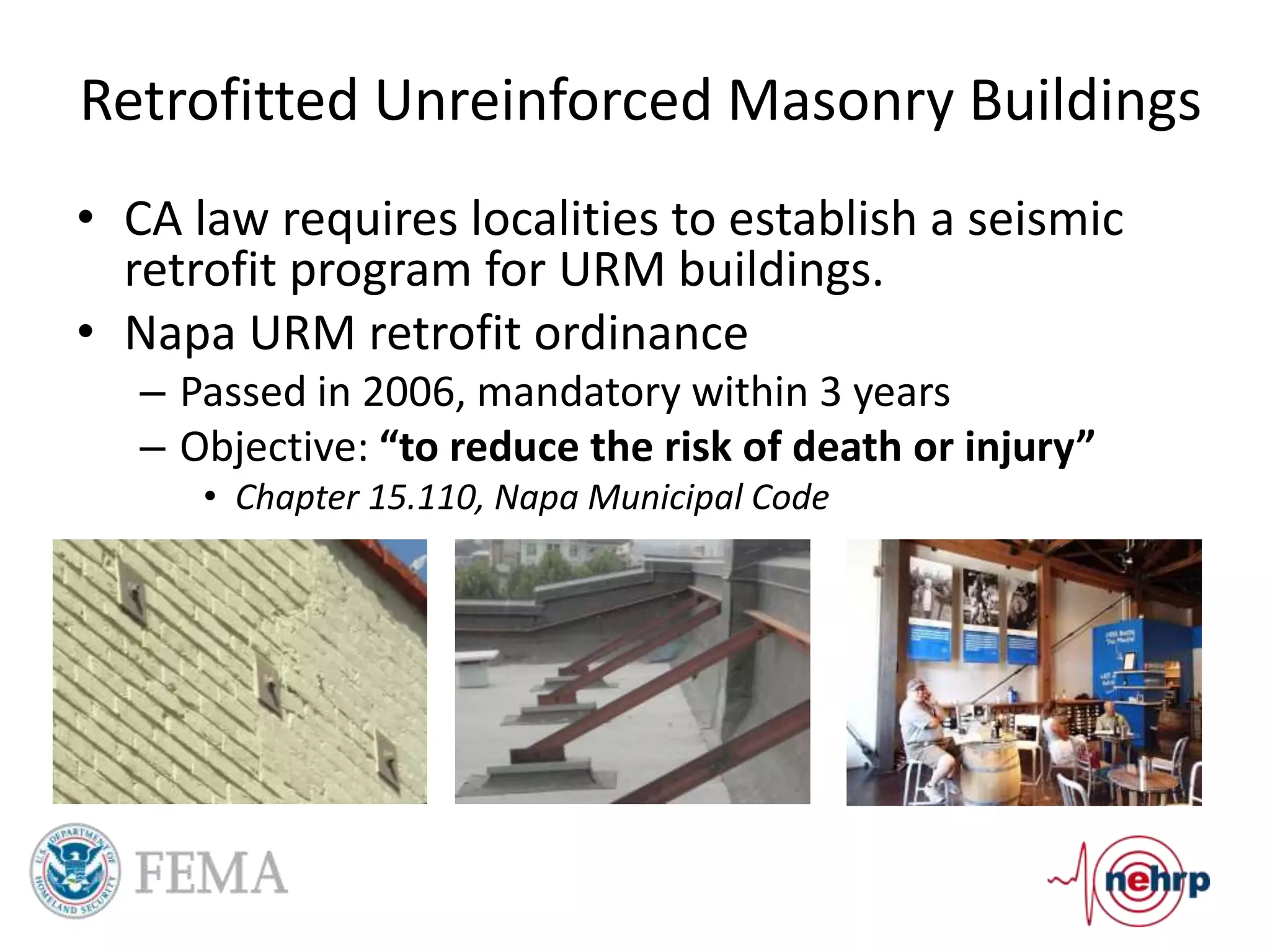
Retrofitted Unreinforced Masonry Buildings
• CA law requires localities to establish a seismic
retrofit program for URM buildings.
• Napa URM retrofit ordinance
– Passed in 2006, mandatory within 3 years
– Objective: “to reduce the risk of death or injury”
• Chapter 15.110, Napa Municipal Code
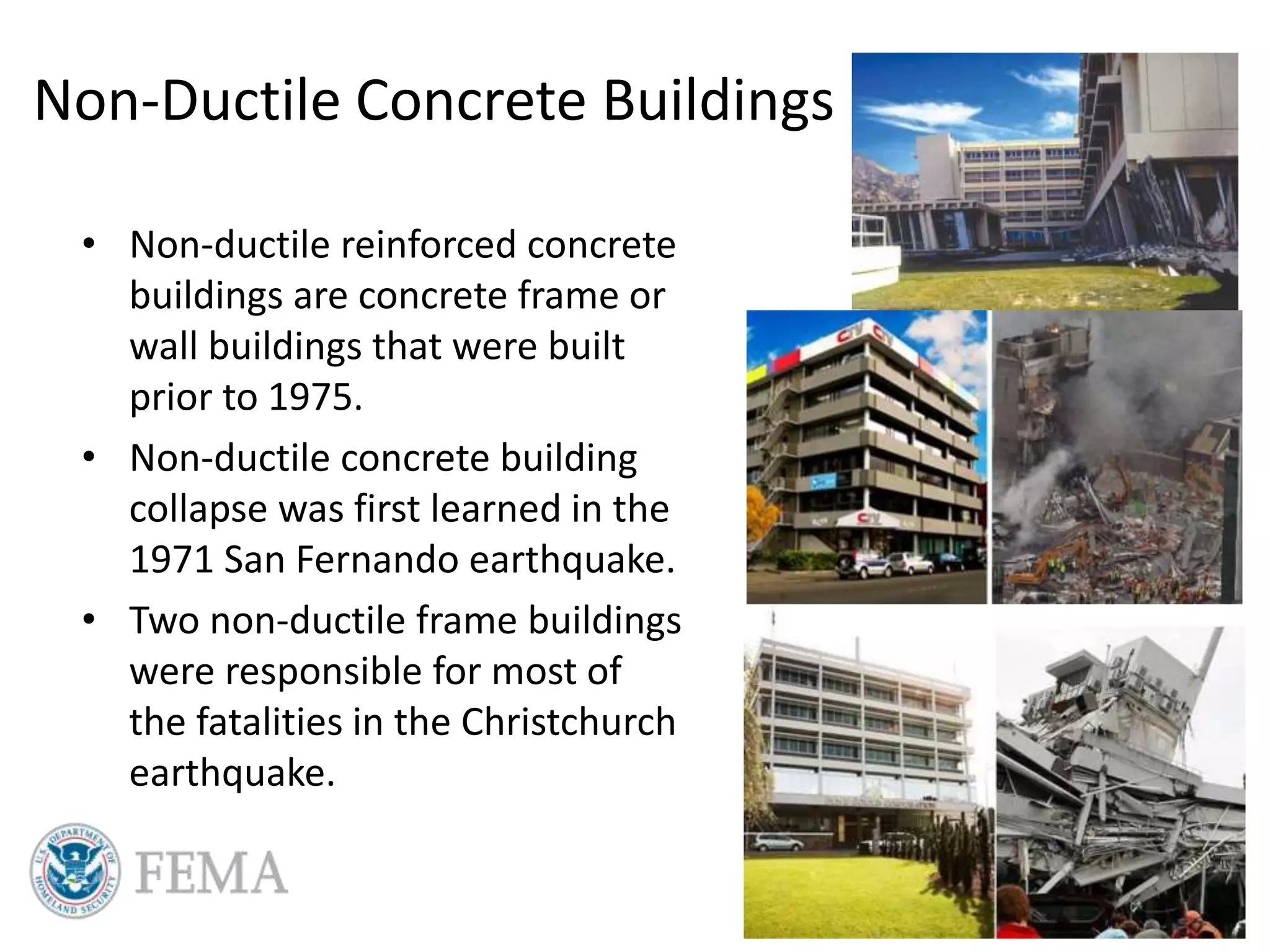
Non-Ductile Concrete Buildings
• Non-ductile reinforced concrete
buildings are concrete frame or
wall buildings that were built
prior to 1975.
• Non-ductile concrete building
collapse was first learned in the
1971 San Fernando earthquake.
• Two non-ductile frame buildings
were responsible for most of
the fatalities in the Christchurch
earthquake.
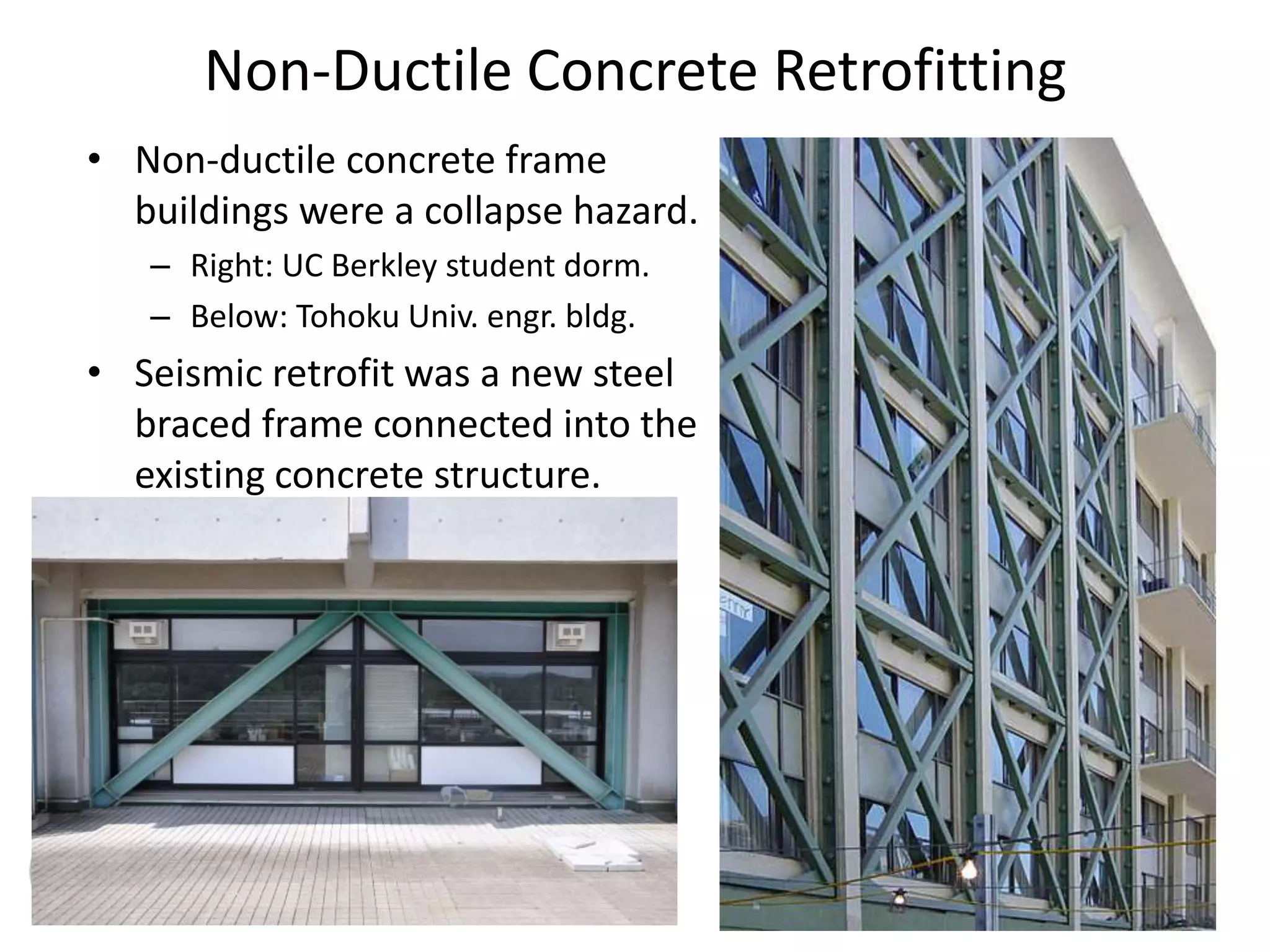
Non-Ductile Concrete Retrofitting
• Non-ductile concrete frame
buildings were a collapse hazard.
– Right: UC Berkley student dorm.
– Below: Tohoku Univ. engr. bldg.
• Seismic retrofit was a new steel
braced frame connected into the
existing concrete structure.
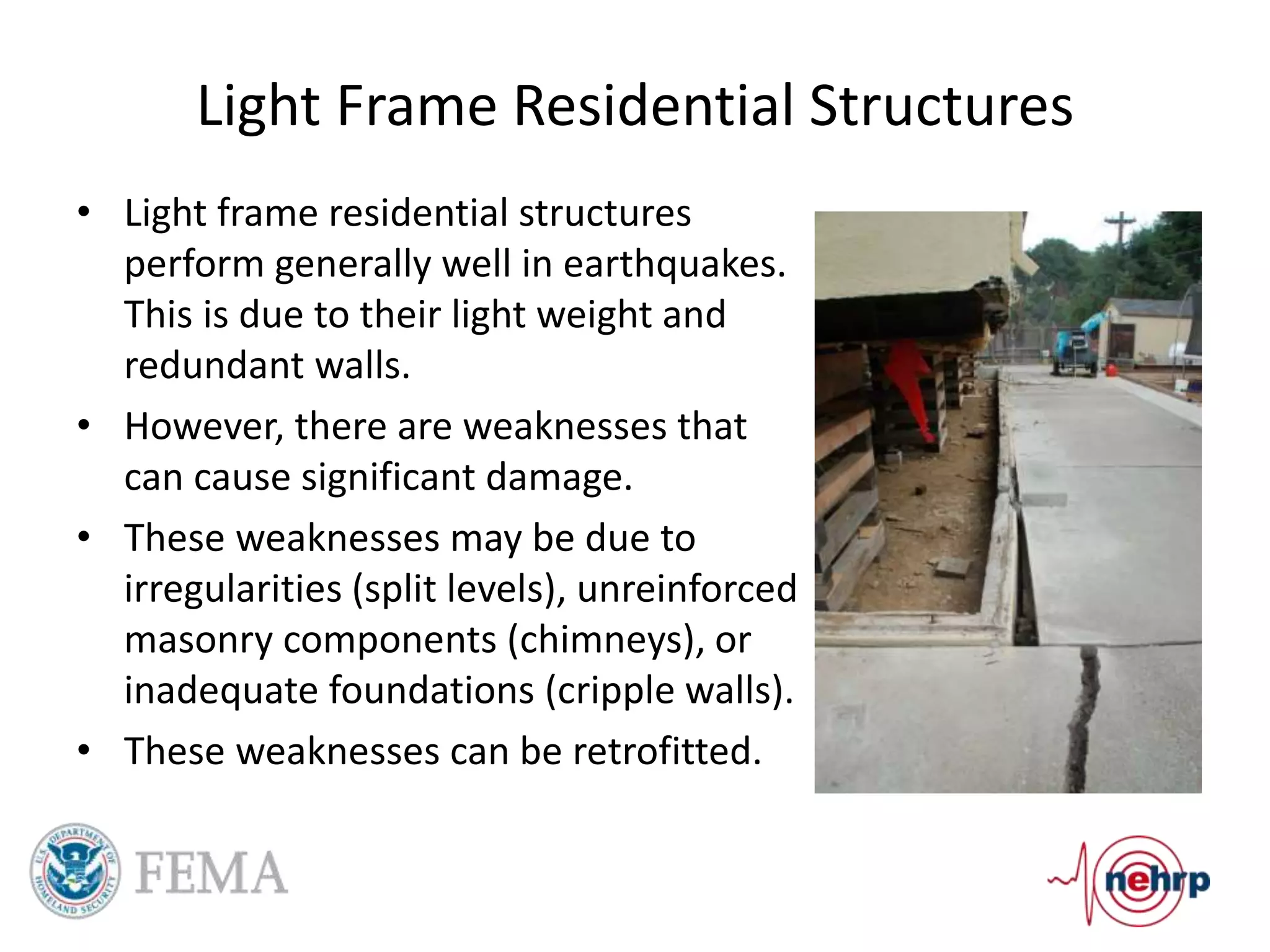
Light Frame Residential Structures
• Light frame residential structures
perform generally well in earthquakes.
This is due to their light weight and
redundant walls.
• However, there are weaknesses that
can cause significant damage.
• These weaknesses may be due to
irregularities (split levels), unreinforced
masonry components (chimneys), or
inadequate foundations (cripple walls).
• These weaknesses can be retrofitted.
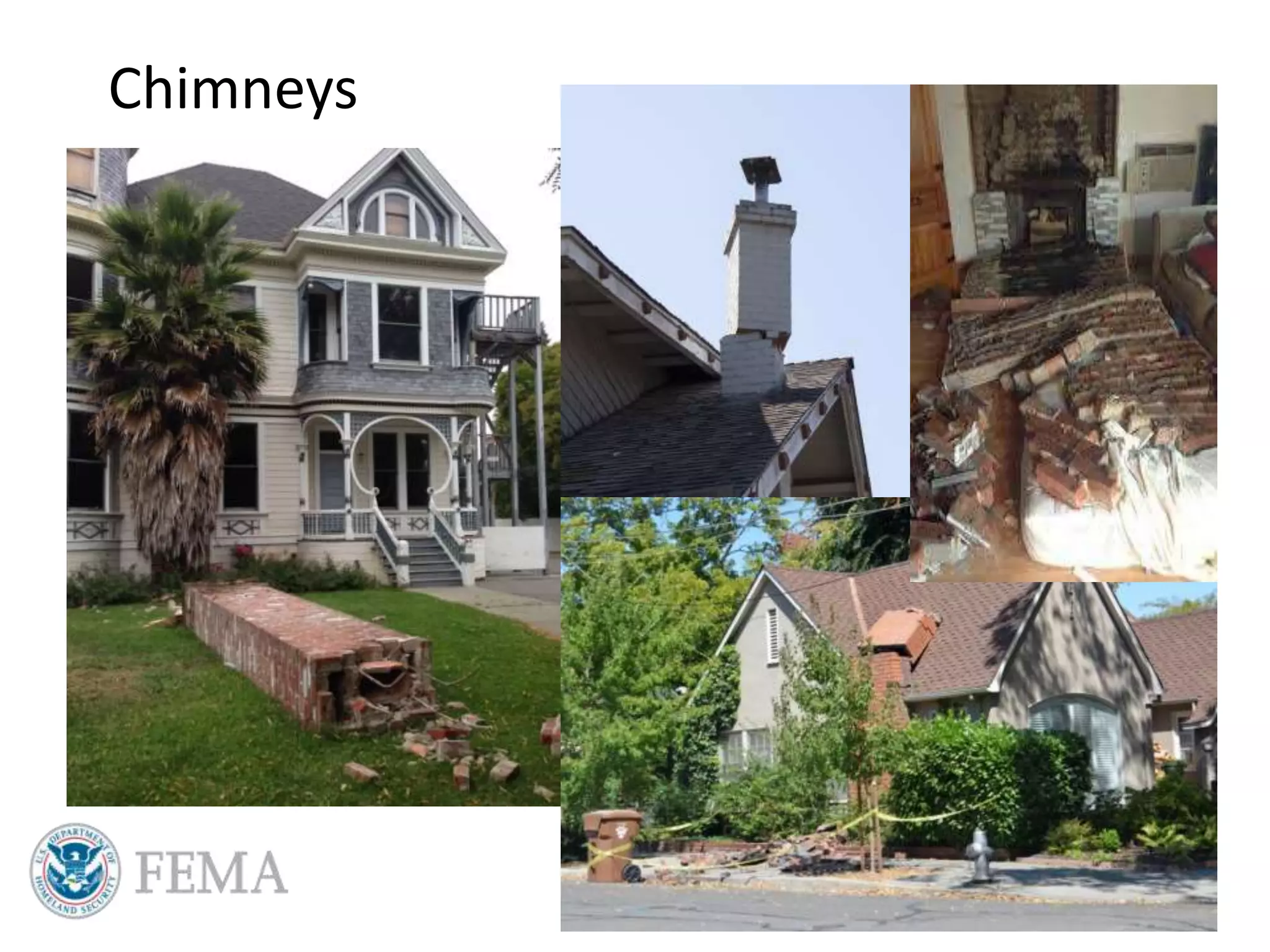
Chimneys
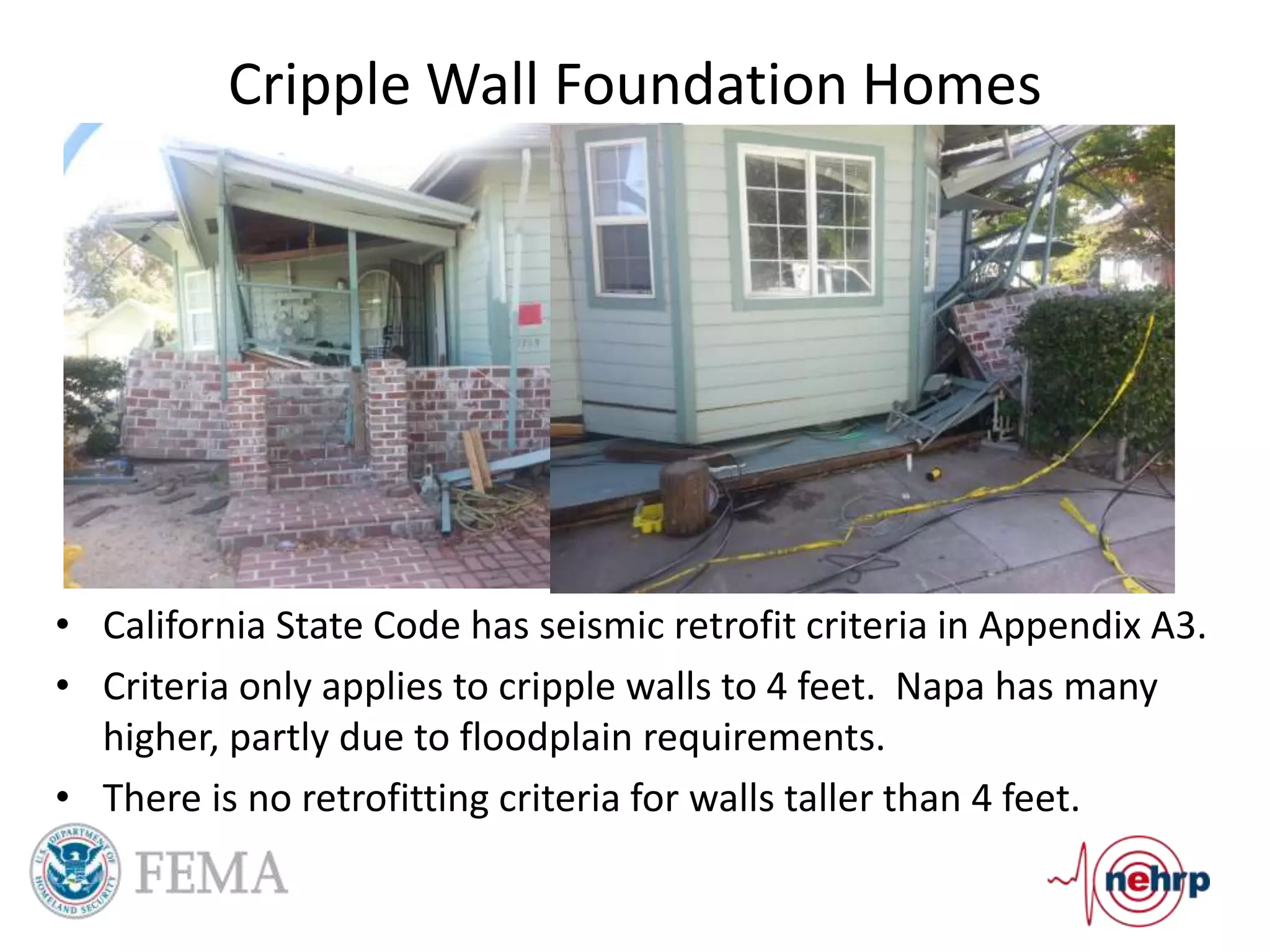
Cripple Wall Foundation Homes
• California State Code has seismic retrofit criteria in Appendix A3.
• Criteria only applies to cripple walls to 4 feet. Napa has many
higher, partly due to floodplain requirements.
• There is no retrofitting criteria for walls taller than 4 feet.
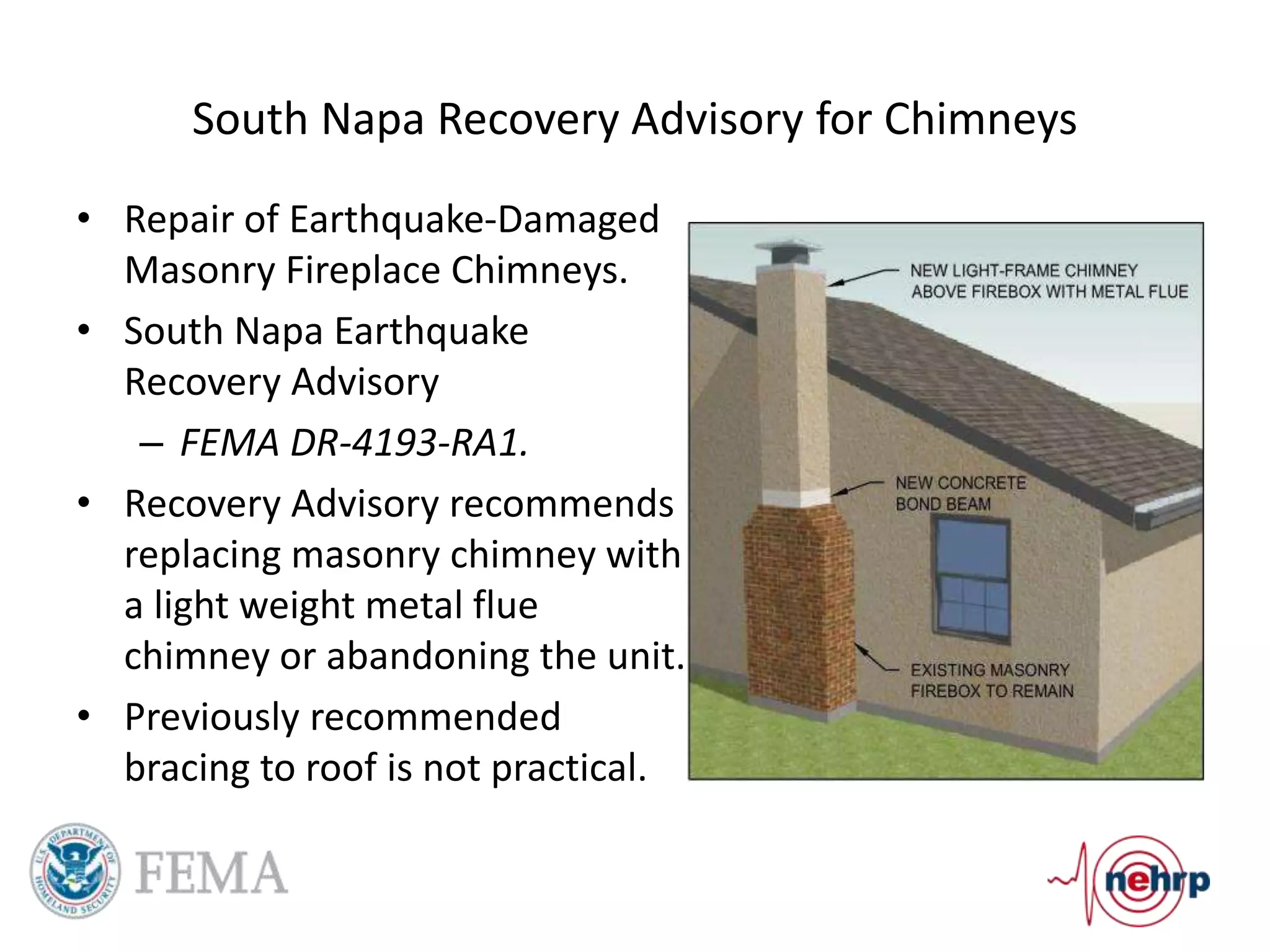
South Napa Recovery Advisory for Chimneys
• Repair of Earthquake-Damaged
Masonry Fireplace Chimneys.
• South Napa Earthquake
Recovery Advisory
– FEMA DR-4193-RA1.
• Recovery Advisory recommends
replacing masonry chimney with
a light weight metal flue
chimney or abandoning the unit.
• Previously recommended
bracing to roof is not practical.
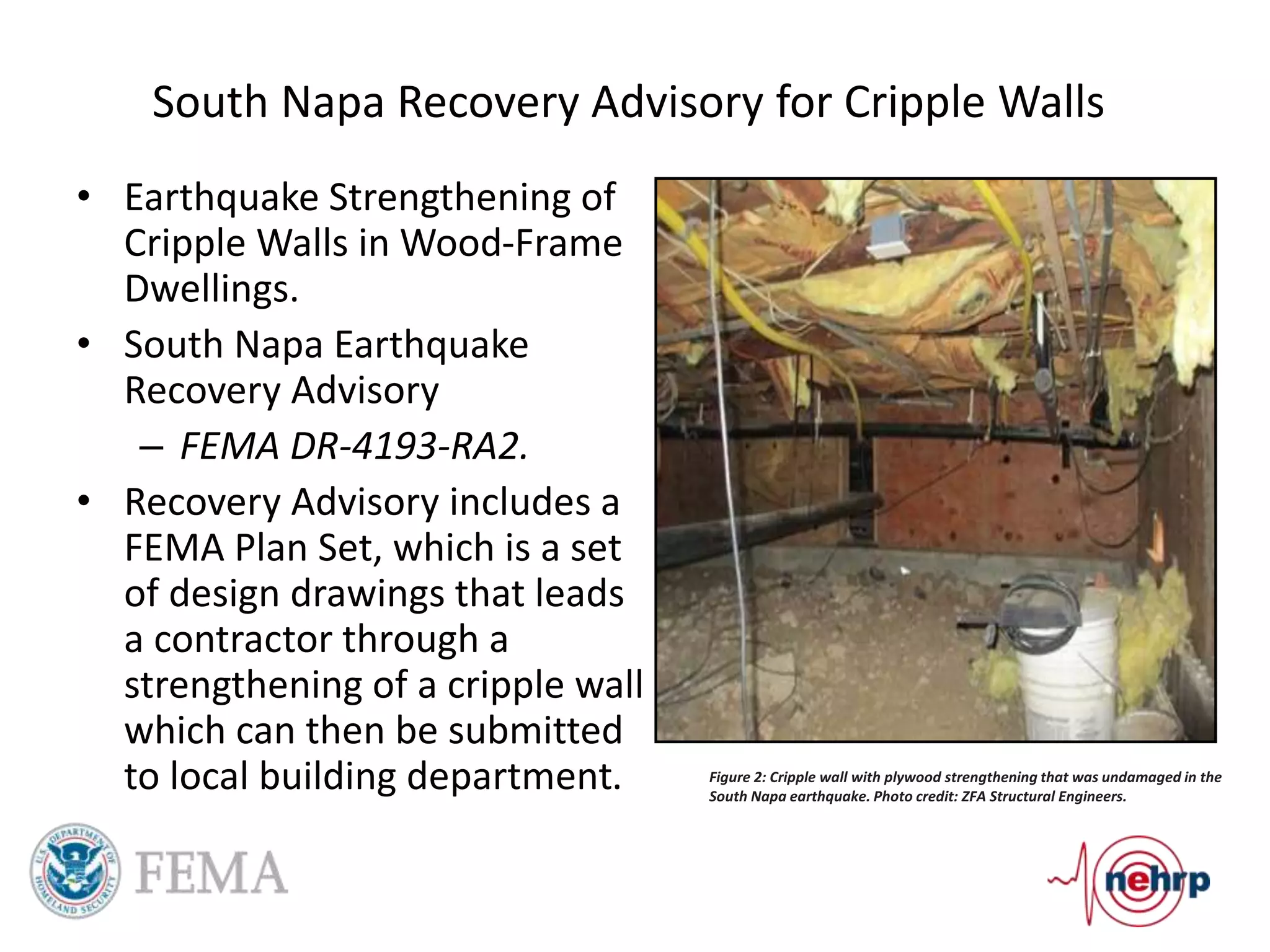
South Napa Recovery Advisory for Cripple Walls
Figure 2: Cripple wall with plywood strengthening that was undamaged in the
South Napa earthquake. Photo credit: ZFA Structural Engineers.
• Earthquake Strengthening of
Cripple Walls in Wood-Frame
Dwellings.
• South Napa Earthquake
Recovery Advisory
– FEMA DR-4193-RA2.
• Recovery Advisory includes a
FEMA Plan Set, which is a set
of design drawings that leads
a contractor through a
strengthening of a cripple wall
which can then be submitted
to local building department.
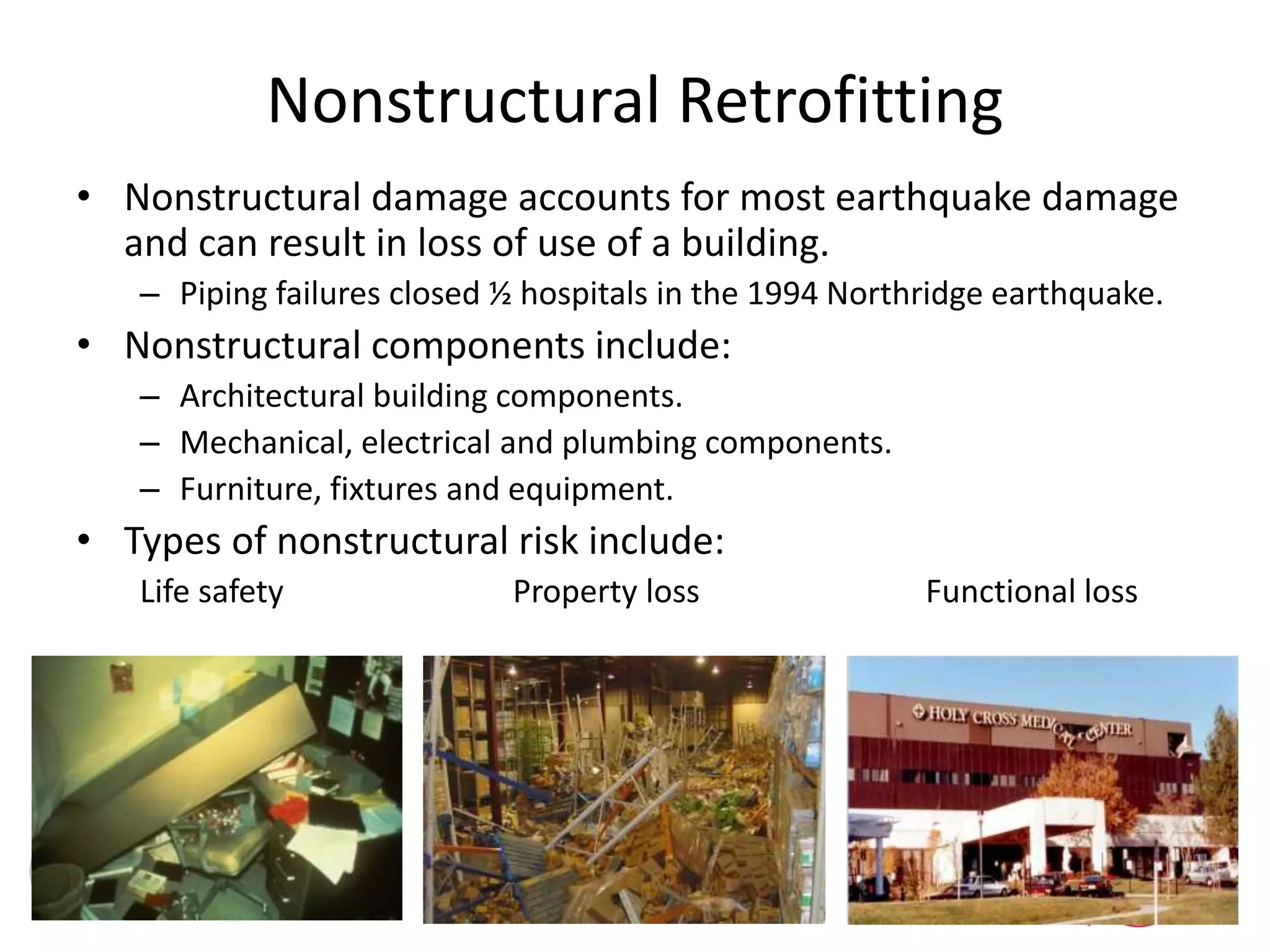
Nonstructural Retrofitting
• Nonstructural damage accounts for most earthquake damage
and can result in loss of use of a building.
– Piping failures closed ½ hospitals in the 1994 Northridge earthquake.
• Nonstructural components include:
– Architectural building components.
– Mechanical, electrical and plumbing components.
– Furniture, fixtures and equipment.
• Types of nonstructural risk include:
Life safety Property loss Functional loss
Nonstructural Mitigation Guide
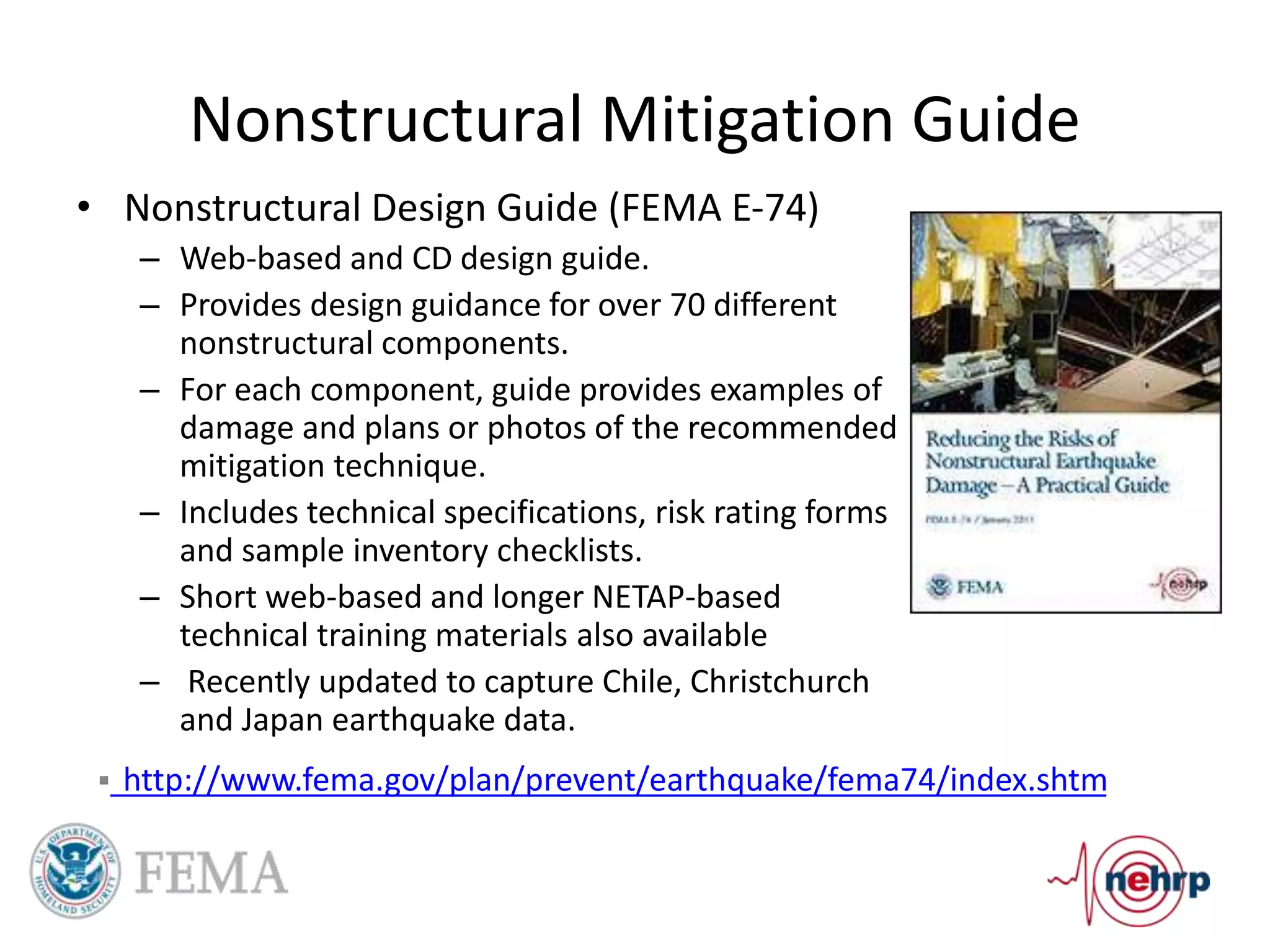
• Nonstructural Design Guide (FEMA E-74)
– Web-based and CD design guide.
– Provides design guidance for over 70 different
nonstructural components.
– For each component, guide provides examples of
damage and plans or photos of the recommended
mitigation technique.
– Includes technical specifications, risk rating forms
and sample inventory checklists.
– Short web-based and longer NETAP-based
technical training materials also available
– Recently updated to capture Chile, Christchurch
and Japan earthquake data.
 http://www.fema.gov/plan/prevent/earthquake/fema74/index.shtm
Conclusions
• Existing buildings are a risk that need to be addressed by mitigation policy
makers and professionals.
• Seismic retrofitting policies need to be based on the local seismic hazard and
risk.
• Adopting and enforcing national building codes for new buildings and code
triggered upgrades should be required as pre-requisite of seismic retrofitting
policies.
• Seismic retrofitting policies should encourage screening and inventory
seismically hazardous buildings.
• Prioritization of seismic retrofitting should target critical facilities , hazardous
buildings in the community and non-structural components.
Questions?

Considerations for Seismic Retrofitting

  • 1.
    Considerations for SeismicRetrofitting Mike Tong and Mike Mahoney FEMA, NEHRP Structural Vulnerability –Warding off the 3 UGLIES Earthquake, Flood and Fire 2015 International Hazard Mitigation Practitioner’s Symposium Building a Safer World to Thrive in the New Normal
  • 2.
    Earthquake Hazard andBuilding Vulnerability • 406 counties in 27 States and Territories have high seismic hazard (with areas in SDC D or above). • 75 million people and 24 million housing units are exposed to high seismic hazard. • Annualized Earthquake Loss (AEL) is estimated to be $5.3 billion (FEMA 366 /2008). • Northridge EQ 1994 is the 2nd costliest natural disaster in the US ($76 billion total cost, 449,000 homes and 9000 commercial buildings damaged or destroyed, and 57 fatalities).
  • 3.
    Considerations for SeismicRetrofitting • Local Seismic Hazard • Building Codes • Building Stock Inventory • Prioritization by Seismically Hazardous Construction Types or Building Weaknesses
  • 4.
    0.0001 0.001 0.01 0.1 0.01 0.1 110 1-Second Spectral Acceleration (g) AnnualFrequency San Francisco Los Angeles Seattle Salt Lake City Sacramento Memphis Charleston St. Louis New York City Chicago Hazard Curves for WUS vs. E/CUS Cities Western US EQ Frequency ~ 1 in 10 yr. Central US EQ Frequency ~ 1 in 100 yr. MCE FEMA/USGS – ‘07 Seismic Design Procedures Group WUS & CUS with similar largest EQ
  • 5.
    Risk and TimeframeConsiderations for Seismic Retrofitting Policies • Seismic hazard levels vary largely from west to east coast; therefore, seismic design requirements are also different in different communities. • Hazard curves show that a damaging western US earthquake can be expected roughly once every 10 years, while a damaging eastern or central US earthquake can be expected roughly once every 100 years or more. • The central and eastern US should have more time between damaging earthquakes to allow States and locals to address risk from existing buildings. • This additional time could be taken into account in planning a State and/or local existing buildings seismic retrofitting policy. • For all high seismic hazard areas, impact of potentially very large earthquake events should not be underestimated. • This would require retrofitting to focus on essential and seismically hazardous buildings.
  • 6.
    Building Codes forSeismic Risk Mitigation • New constructions in compliance to a current model building code (IBC or IRC) are expected to perform much better in earthquakes than those existing pre- 1970 buildings. • Code compliant construction provides adequate structural protection against collapse, and is considered life safe. – Code compliant means built to a building code equivalent to the NEHRP Provisions, or the ASCE/SEI 31-03 benchmark codes. – However, code does not always provide adequate protection against non-structural damage, but that is a different presentation. • Existing buildings built prior to the ASCE/SEI 31 benchmark codes may not provide adequate life safety protection. • ASCE/SEI 31-03 and the current ASCE/SEI 41-13 allow existing buildings to be retrofitted to meet 75% of seismic resisting capacity for new buildings.
  • 7.
    Building Code Adoptionand Enforcement • One requirement for existing buildings seismic retrofitting policy would be the adoption and effective enforcement of a suitable building code for new buildings and triggered code upgrades. • Existing buildings retrofitting should follow IEBC and ASCE 41-13. • Evaluation of local building codes and code departments is performed by ISO Building Code Effectiveness Grading Schedule (BCEGS). • A minimum requirement for BCEGS score level could be established to recognize an effective building code program as a prerequisite to a seismic retrofitting policy.
  • 8.
    Evaluation and Inventoryof Existing Buildings • Inventory local hazardous buildings is a first step for developing a suitable seismic retrofitting policy. • FEMA P-154 and P-154 ROVER provide convenient tools for seismic screening and inventory of buildings. • FEMA NETAP provides training support to state and local communities. • Some communities target critical facilities for seismic evaluation (e.g. schools, state or local government buildings).
  • 9.
    Prioritization for SeismicRetrofitting • Critical buildings such as hospitals, schools, EOCs and hazmat facilities should be given high priority in seismic retrofitting policy. • The more hazardous the construction, the greater the risk and the greater the need for a seismic retrofitting program. • Starting with most hazardous, the types of construction and weaknesses to be considered and prioritized for retrofitting include: – Unreinforced masonry (URM) – Non-ductile reinforced concrete (pre-San Fernando) – Tilt-up buildings (rigid wall & flexible diaphragm) – Steel frame (pre-Northridge) – Soft story multi-unit wood frame – Wood frame residential (cripple walls and/or masonry chimney) – Nonstructural retrofitting
  • 10.
    Unreinforced Masonry • Unreinforcedmasonry (or URM), is the most seismically hazardous building type. This type of construction is considered collapse hazard in earthquake. • Commonly seen failure mechanism for URM is out of plane failure of the masonry walls, resulting in loss of the floor support structure, collapsing the floors. • URM construction is no longer permitted in high seismic risk areas in the US. • FEMA P-774 is a guide on establishing a URM seismic retrofitting program.
  • 11.
    Estimated Number ofURM Buildings by Census Tract in the Continental US by Northeast States Emergency Consortium (NESEC) • Number of URM Buildings in the Northeastern US is estimated to be 1,637,517 units based on HAZUS. • Total number of URM Buildings in the nation is estimated to be 17,117,254 units.
  • 12.
    Retrofitted Unreinforced MasonryBuildings • CA law requires localities to establish a seismic retrofit program for URM buildings. • Napa URM retrofit ordinance – Passed in 2006, mandatory within 3 years – Objective: “to reduce the risk of death or injury” • Chapter 15.110, Napa Municipal Code
  • 13.
    Non-Ductile Concrete Buildings •Non-ductile reinforced concrete buildings are concrete frame or wall buildings that were built prior to 1975. • Non-ductile concrete building collapse was first learned in the 1971 San Fernando earthquake. • Two non-ductile frame buildings were responsible for most of the fatalities in the Christchurch earthquake.
  • 14.
    Non-Ductile Concrete Retrofitting •Non-ductile concrete frame buildings were a collapse hazard. – Right: UC Berkley student dorm. – Below: Tohoku Univ. engr. bldg. • Seismic retrofit was a new steel braced frame connected into the existing concrete structure.
  • 15.
    Light Frame ResidentialStructures • Light frame residential structures perform generally well in earthquakes. This is due to their light weight and redundant walls. • However, there are weaknesses that can cause significant damage. • These weaknesses may be due to irregularities (split levels), unreinforced masonry components (chimneys), or inadequate foundations (cripple walls). • These weaknesses can be retrofitted.
  • 16.
  • 17.
    Cripple Wall FoundationHomes • California State Code has seismic retrofit criteria in Appendix A3. • Criteria only applies to cripple walls to 4 feet. Napa has many higher, partly due to floodplain requirements. • There is no retrofitting criteria for walls taller than 4 feet.
  • 18.
    South Napa RecoveryAdvisory for Chimneys • Repair of Earthquake-Damaged Masonry Fireplace Chimneys. • South Napa Earthquake Recovery Advisory – FEMA DR-4193-RA1. • Recovery Advisory recommends replacing masonry chimney with a light weight metal flue chimney or abandoning the unit. • Previously recommended bracing to roof is not practical.
  • 19.
    South Napa RecoveryAdvisory for Cripple Walls Figure 2: Cripple wall with plywood strengthening that was undamaged in the South Napa earthquake. Photo credit: ZFA Structural Engineers. • Earthquake Strengthening of Cripple Walls in Wood-Frame Dwellings. • South Napa Earthquake Recovery Advisory – FEMA DR-4193-RA2. • Recovery Advisory includes a FEMA Plan Set, which is a set of design drawings that leads a contractor through a strengthening of a cripple wall which can then be submitted to local building department.
  • 20.
    Nonstructural Retrofitting • Nonstructuraldamage accounts for most earthquake damage and can result in loss of use of a building. – Piping failures closed ½ hospitals in the 1994 Northridge earthquake. • Nonstructural components include: – Architectural building components. – Mechanical, electrical and plumbing components. – Furniture, fixtures and equipment. • Types of nonstructural risk include: Life safety Property loss Functional loss
  • 21.
    Nonstructural Mitigation Guide •Nonstructural Design Guide (FEMA E-74) – Web-based and CD design guide. – Provides design guidance for over 70 different nonstructural components. – For each component, guide provides examples of damage and plans or photos of the recommended mitigation technique. – Includes technical specifications, risk rating forms and sample inventory checklists. – Short web-based and longer NETAP-based technical training materials also available – Recently updated to capture Chile, Christchurch and Japan earthquake data.  http://www.fema.gov/plan/prevent/earthquake/fema74/index.shtm
  • 22.
    Conclusions • Existing buildingsare a risk that need to be addressed by mitigation policy makers and professionals. • Seismic retrofitting policies need to be based on the local seismic hazard and risk. • Adopting and enforcing national building codes for new buildings and code triggered upgrades should be required as pre-requisite of seismic retrofitting policies. • Seismic retrofitting policies should encourage screening and inventory seismically hazardous buildings. • Prioritization of seismic retrofitting should target critical facilities , hazardous buildings in the community and non-structural components.
  • 23.

Editor's Notes

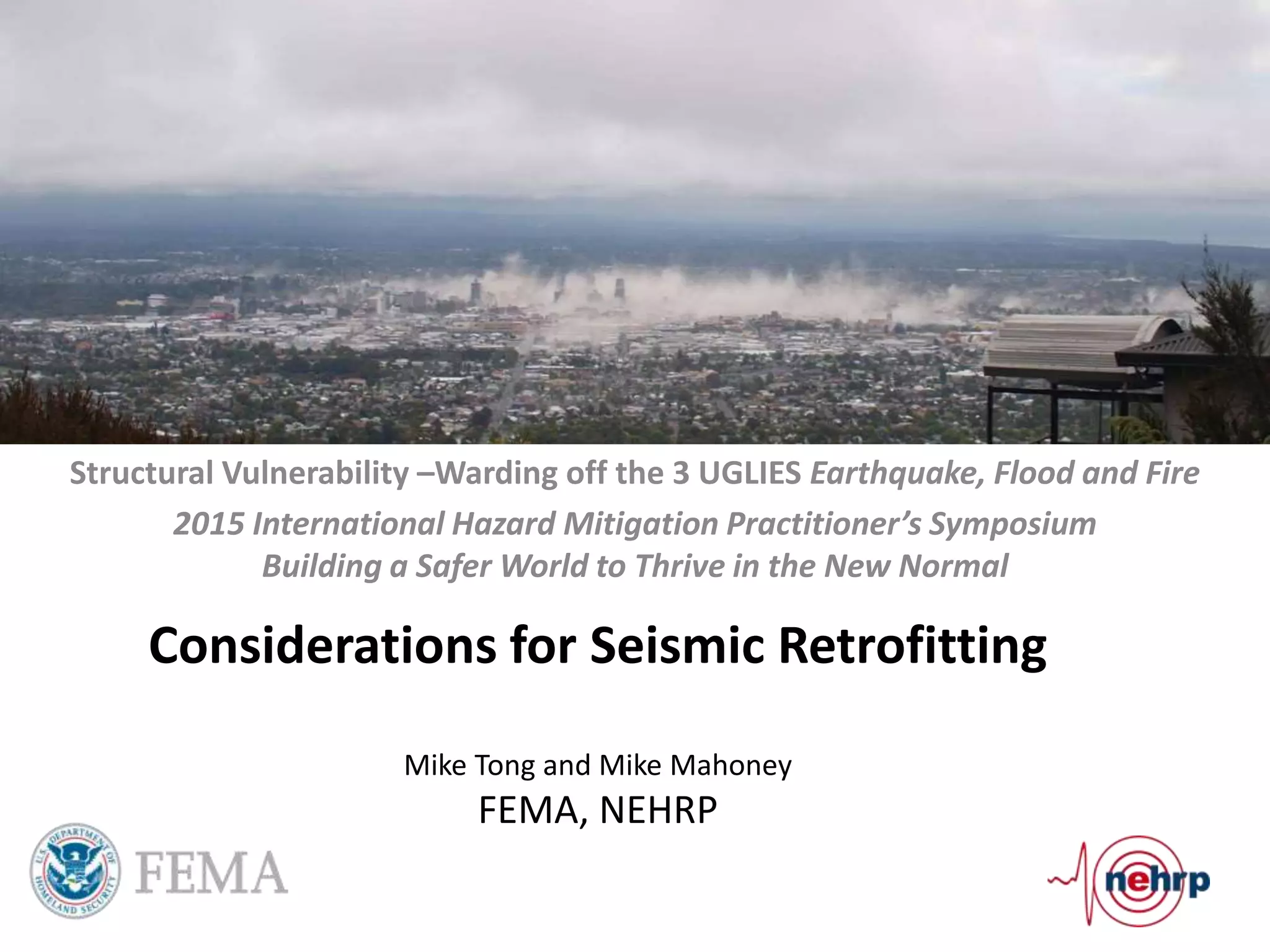
  • #2 This picture was taken just a minute or so after the magnitude 6.3 earthquake hit Christchurch NZ on Feb 22, 2011. It shows the massive destructive power. The EQ is not a very large event, it is actually an aftershock of a magnitude 7.1 EQ occurred at Canterbury in September 2010, but this aftershock EQ produced more damage than the main shock because its epicenter is only 6 miles from the center of Christchurch, and the depth of the rupture is only 3.1 miles. The earthquake killed 185 people and of the 4000 buildings in the downtown area, 1000 buildings were damaged so badly that eventually had to be demolished. Total cost of the damage was about $40 billion. Could such EQ event occur near your community? If so, are the buildings in your community able to stand the ground shaking? What can we do to reduce the risk before an EQ strikes?
  • #3 This is a map of US seismic hazard used by the current International Residential Code. It depicts the hazard by levels of Seismic Design Category in individual counties, with SDC D and above (orange and red colors) as high hazard and SDC C (yellow color) as moderate hazard, SDC B &A (green and white) as low. We have 406 counties out of the total 3116 that are in SDC D or above. 75 million people live in these areas 24 million housing units are located in these areas HAZUS estimated the average annual earthquake loss at $5.3 billion In view of the natural disasters occurred in the past, the magnitude 6.7 Northridge EQ of 1994 stands the second costly disaster. Its epicenter is 20 miles from downtown LA and the depth is 11 miles. It cost $76 billion, 449,000 houses and 9000 commercial buildings damaged along with 57 fatalities. First is 2005 Katrina Hurricane disaster ($145 billion and 1833 fatalities). [1988 drought and heat wave (with wild fire) also cost$76 billion and 5000~10000 lives.]
  • #4 In the following of this presentation, I’d like to discuss some considerations for seismic retrofitting. Local seismic hazard Building codes Building stock inventory Prioritization by most hazardous building types or building weaknesses
  • #5  This slid shows the earthquake hazard curves for 10 cities across the US. The horizontal axis measures the intensity of a ground shaking event, the vertical axis measures the frequency of the earthquake event. Obviously the higher the intensity, the lower the frequency to occur. Note that for low intensity, but damage causing events, western US cities will see on average 1 in 10 years, whereas, central and eastern US cities will see on average one in 100 or more years. If you compare the largest possible intensity events, central and western US cities face almost the same intensity level and occurrence frequency. Even though such an event occurs 1 in 10,000 years, but it is very uncertain of which year, month, day, and time to occur.
  • #6 So how do we take into consideration of the local seismic hazard in seismic retrofitting? For central and eastern US, we may give longer time period for general seismic retrofitting policies. For the extremely large ground shaking, we may need to focus on essential and most hazardous buildings as higher priorities.
  • #7 The seismic performances of existing buildings vary by many factors and are related to the building codes applied at the time of construction. New constructions today following IBC and ASCE7 are expected to deliver much better seismic performance than existing buildings constructed pre-1970. For existing buildings built under a benchmark code of ASCE31, they should provide life-safety protection. If built before the benchmark codes, they may not provide adequate life-safety protection. These buildings may need serious consideration for retrofitting. The current ASCE41-13 standard – seismic rehabilitation for existing buildings allows existing buildings to be retrofitted to 75% of the design force level for new buildings. So for those retrofitted ones, they may generally be still weaker than the new buildings.
  • #9 How many people have ever involved in seismic screening and inventory of buildings? Knowing how many buildings out there are seismically hazardous is a very important first step towards developing seismic retrofitting policies. FEMA has recently updated its guidance document FEMA P-154 rapid visual screening of buildings for potential seismic hazard. This guidance provides a screening procedure for communities with large building stocks to quickly identify those most hazardous ones. A free mobile software call –ROVER has also been developed for inventory of these buildings for both pre- and post- earthquake use. One successful example is the Utah School Building Evaluation project organized and carried out by Utah Seismic Safety Council a few years ago. They surveyed a sample of 128 school buildings in the salt lake area and found that 60 % of the school buildings were potentially at high risk. The project raised a statewide awareness of the issue and eventually persuaded state legislature to fund a statewide seismic screening and inventory of all the school buildings.
  • #10 After considering local hazard, adoption of building codes, and inventory the hazardous buildings, now perhaps it is the time to face the reality. Resource for seismic retrofitting is scarce (limited). So prioritization is another necessary consideration for most seismic retrofitting. Essential buildings such as schools, hospitals, EOCs and more hazardous buildings such as fuel and hazmat storage facilities should be the highest priority due to their potentially significant impact. For general buildings to meet the life safety performance, more hazardous type of constructions are recommended to be considered as higher priority. Listed here are six commonly seen construction types, some are seismically hazardous others with certain weaknesses that deserve retrofitting. And of cause, non-structural systems and components are always on the check list as well. Due to the limited time, I will overview URM, non-ductile and residential buildings plus non-structural.
  • #11 URM buildings is the most seismically hazardous building type. There are two major failure modes for this type of building, in plane shear failure resulting URM walls loss of load carrying capacity; or out-of-plane falling of the URM walls resulting loss of the floor support. The Christchurch earthquake caused severe damage to the URM buildings in the city. URM buildings are banned in high seismic hazard areas in the US FEMA P-774 URM buildings and Earthquakes provides a guidance on URM retrofitting program.
  • #12 How many existing URM buildings do we have? This slide shows the distribution of the URMs in the nation. NESEC conducted an HAZUS bases estimate for the new England area just to compare with their LiDAR image based inventory. Their estimate shows 1.6 million units and it is found that the estimate may be underestimating by 15%. Nationwide, the estimate stands over 17 million.
  • #13 Typical retrofitting of URM buildings consists of anchoring the walls to additional lateral load resisting systems; bracing the URM parapets; and tying up the walls to increase its integrity and lateral load resisting capacity. The 1968 CA law requires localities to establish a seismic retrofit program for URMs City of Napa has many URMs. The ordinance passed in 2006 mandated retrofitting within 3 years.
  • #14 Next seismically hazardous building type is non-ductile concrete buildings. The picture on the top right is the Oliver View hospital, a concrete frame building. The 1971 San Fernando, California, earthquake (magnitude 6.7) severely damaged then recently built Olive View Hospital. The middle right two pictures show the CTV building, a six story concrete frame building before and after collapsed in the Christchurch EQ Bottom right pictures show the Pyne Gould Guinness building before and after collapsed in Christchurch EQ According a PEER survey, LA area has over 1500 old non-ductile concrete buildings. Not all non-ductile concrete buildings are seismically hazardous, one big challenge is to determine which non-ductile concrete buildings are hazardous, FEMA is working with the structural engineering community to develop a comprehensive evaluation methodology.
  • #15 Retrofitting non-ductile concrete frame buildings typically involve adding another lateral load resisting system such as shown here the added steel braced frames.
  • #16  Residential buildings are the majority of our building stocks. Generally, these light frame structures perform very well in earthquakes. However, there are some weaknesses that may cause severe damage Two of the commonly seen weaknesses are brick chimney and cripple walls.
  • #17 Here are a few examples of brick chimney collapses in the Aug 24, 2014 Napa earthquake (magnitude 6 and depth 11 miles). An collapsed fireplace wall crushed on 13-year-old Nicholas Dillon at his Napa home during a sleepover. The 13-year-old said he is fortunate to be alive after a pile of bricks falling from the fireplace. Chimney collapses were also reported in the Aug 23, 2011 Mineral VA earthquake including some of my Neighbors in Falls Church, VA, which is over 100 miles away from the epicenter of the M5.8 earthquake.
  • #18 Cripple walls is another commonly seen weakness of residential light frame structures. California state code has criteria for cripple wall seismic retrofit, the criteria applies to typical cripple walls up to 4 feet. However, in Napa, many homes have cripple walls higher than 4 feet due to floodplain requirements. There is no retrofitting criteria for walls taller than 4 ft as the taller walls may have problem of overturning moments.
  • #19 FEMA RD 4193 Recovery Advisory RA1 recommends replacing masonry chimney with light weight metal flue. Bracing brick chimney is not recommended any more as it is not practical.
  • #20 FEMA DR 4193 recovery advisory RA2 provides retrofitting details for cripple walls. The advisory also includes a plan set, which is a set of design drawings that leads contractors through the process of strengthening a cripple wall. The picture shows a strengthened cripple wall with sheathing. The walls survived the Napa earthquake.
  • #21 Last but not least, we should not forget non-structural retrofitting. Non-structural damage accounts for most earthquake damage. There are many non-structural systems and components in a building: Architectural components such as parapets, canopies, ceiling Mechanical, electrical, and plumbing components such as HVAC, fire sprinkler, Furniture, fixture and equipment such as bookshelf, pictures Pictures at the bottom show some of the potential impact non-structural damage and failures
  • #22 FEMA has recently updated a nonstructural seismic mitigation guidance document FEMA E-74 It provides retrofit suggestions for over 70 different non-structural components. We also provide training through our training program NETAP (national earthquake technical assistance program). Interested communities may apply through their state EQ program manager or contact FEMA NEHRP directly. The document can be downloaded from the FEMA website. As listed here.
  • #23 22