Community Planning and Capacity
Building Recovery Support Function
National Coordinator, FEMA
Crafting and designing programs
for a safer (and more prosperous)
future
• Key question - Are communities able to
adapt effectively/appropriately after a
disaster? If not, why not?
 A focus on supporting local governments and
officials
◦ What is needed to be successful?
◦ How can we help them, how, when?
◦ What are we doing/should we be doing together?
 Physical (environment, people, infrastructure)
 Capability/capacity - social, organizational,
political
-Which comes first?
Leadership &
strategy
Health &
wellbeing
Infrastructure
& environment
Economy &
society
From Rockefeller City Resilience Framework
 Leadership
 Planning
 Community engagement
 Recovery management
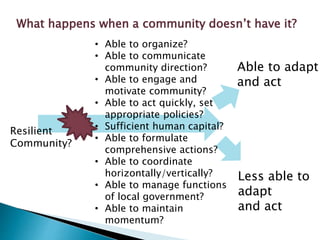
What happens when a community doesn’t have it?
Resilient
Community?
• Able to organize?
• Able to communicate
community direction?
• Able to engage and
motivate community?
• Able to act quickly, set
appropriate policies?
• Sufficient human capital?
• Able to formulate
comprehensive actions?
• Able to coordinate
horizontally/vertically?
• Able to manage functions
of local government?
• Able to maintain
momentum?
Able to adapt
and act
Less able to
adapt
and act
 Identify key decision points and points of
“failure” or success in community process
 What strategies are appropriate to influence
those?
 Who can help with those strategies?
 What can we develop now, to apply before
and after an event?
◦ Alliances and coordination
◦ Guidance, tools, examples, training
◦ Resources and capabilities
•NHMA
•NADO
•ASFPM
•USACE
•EDA
•NOAA
•APA
•ICMA
•NACO
•AIA
•ARC
•EPA
•HUD
•USDA
•DOT
•DOI
•CNCS
Leader-
ship
Plannin
g
Community
Engagemnt
Manage-
ment
 The CPCB RSF enables communities to
effectively lead, plan, and manage recovery,
and to engage the whole community in the
recovery planning process.
 CPCB RSF coordinates federal and non-
federal organizations support to local and
tribal governments to build their ability to
apply the Operational Coordination, Planning,
and Public Information Core Capabilities.
 Changes in leadership
 Lack of direction
 Missed opportunities
 Premature/improper investments
 No policy/wrong policy
 Disconnect from stakeholders and from
external agencies and organizations
 Decisive – appropriate planning and actions at
decision points
 Strong, consistent, supported leadership and
vision
 Understanding of and appropriate application of
law, regulation and policy
 Coordinated, planned investment choices and
processes
 Proactive and resources recovery management
 Community support, cohesion, involvement,
psychology as a result of involvement and
ownership

Community Planning & Capacity Building

  • 1.
    Community Planning andCapacity Building Recovery Support Function National Coordinator, FEMA Crafting and designing programs for a safer (and more prosperous) future
  • 2.
    • Key question- Are communities able to adapt effectively/appropriately after a disaster? If not, why not?  A focus on supporting local governments and officials ◦ What is needed to be successful? ◦ How can we help them, how, when? ◦ What are we doing/should we be doing together?
  • 3.
     Physical (environment,people, infrastructure)  Capability/capacity - social, organizational, political -Which comes first?
  • 4.
    Leadership & strategy Health & wellbeing Infrastructure &environment Economy & society From Rockefeller City Resilience Framework
  • 5.
     Leadership  Planning Community engagement  Recovery management
  • 6.
    What happens whena community doesn’t have it? Resilient Community? • Able to organize? • Able to communicate community direction? • Able to engage and motivate community? • Able to act quickly, set appropriate policies? • Sufficient human capital? • Able to formulate comprehensive actions? • Able to coordinate horizontally/vertically? • Able to manage functions of local government? • Able to maintain momentum? Able to adapt and act Less able to adapt and act
  • 7.
     Identify keydecision points and points of “failure” or success in community process  What strategies are appropriate to influence those?  Who can help with those strategies?  What can we develop now, to apply before and after an event? ◦ Alliances and coordination ◦ Guidance, tools, examples, training ◦ Resources and capabilities
  • 8.
  • 9.
     The CPCBRSF enables communities to effectively lead, plan, and manage recovery, and to engage the whole community in the recovery planning process.  CPCB RSF coordinates federal and non- federal organizations support to local and tribal governments to build their ability to apply the Operational Coordination, Planning, and Public Information Core Capabilities.
  • 10.
     Changes inleadership  Lack of direction  Missed opportunities  Premature/improper investments  No policy/wrong policy  Disconnect from stakeholders and from external agencies and organizations
  • 11.
     Decisive –appropriate planning and actions at decision points  Strong, consistent, supported leadership and vision  Understanding of and appropriate application of law, regulation and policy  Coordinated, planned investment choices and processes  Proactive and resources recovery management  Community support, cohesion, involvement, psychology as a result of involvement and ownership