Severe Thunderstorm
Impacts and Mitigation—Hail
Mitigation
Tanya M. Brown, Ph.D.
Lead Research Engineer & Director of Hail Research
NHMA Symposium
July 23, 2015
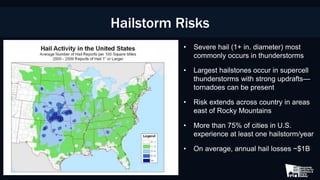
Hailstorm Risks
• Severe hail (1+ in. diameter) most
commonly occurs in thunderstorms
• Largest hailstones occur in supercell
thunderstorms with strong updrafts—
tornadoes can be present
• Risk extends across country in areas
east of Rocky Mountains
• More than 75% of cities in U.S.
experience at least one hailstorm/year
• On average, annual hail losses ~$1B
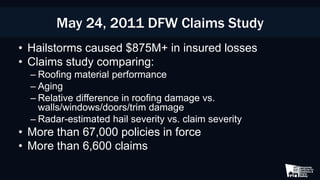
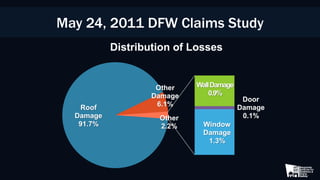
May 24, 2011 DFW Claims Study
• Hailstorms caused $875M+ in insured losses
• Claims study comparing:
– Roofing material performance
– Aging
– Relative difference in roofing damage vs.
walls/windows/doors/trim damage
– Radar-estimated hail severity vs. claim severity
• More than 67,000 policies in force
• More than 6,600 claims
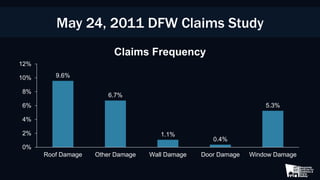
May 24, 2011 DFW Claims Study
9.6%
6.7%
1.1%
0.4%
5.3%
0%
2%
4%
6%
8%
10%
12%
Roof Damage Other Damage Wall Damage Door Damage Window Damage
Claims Frequency
May 24, 2011 DFW Claims Study
Roof
Damage
91.7%
Other
Damage
6.1%
WallDamage
0.9%
Door
Damage
0.1%
Window
Damage
1.3%
Other
2.2%
Distribution of Losses
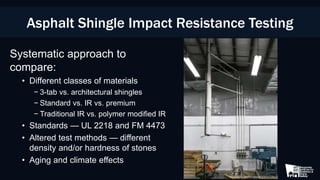
Asphalt Shingle Impact Resistance Testing
Systematic approach to
compare:
• Different classes of materials
− 3-tab vs. architectural shingles
− Standard vs. IR vs. premium
− Traditional IR vs. polymer modified IR
• Standards — UL 2218 and FM 4473
• Altered test methods — different
density and/or hardness of stones
• Aging and climate effects
UL 2218 Asphalt Shingle Impact
Test Method & Observations
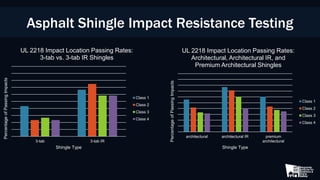
3-tab 3-tab IR
PercentageofPassingImpacts
Shingle Type
UL 2218 Impact Location Passing Rates:
3-tab vs. 3-tab IR Shingles
Class 1
Class 2
Class 3
Class 4
Asphalt Shingle Impact Resistance Testing
architectural architectural IR premium
architectural
PercentageofPassingImpacts
Shingle Type
UL 2218 Impact Location Passing Rates:
Architectural, Architectural IR, and
Premium Architectural Shingles
Class 1
Class 2
Class 3
Class 4
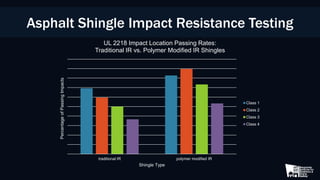
traditional IR polymer modified IR
PercentageofPassingImpacts
Shingle Type
UL 2218 Impact Location Passing Rates:
Traditional IR vs. Polymer Modified IR Shingles
Class 1
Class 2
Class 3
Class 4
Asphalt Shingle Impact Resistance Testing
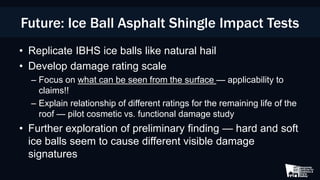
• Replicate IBHS ice balls like natural hail
• Develop damage rating scale
– Focus on what can be seen from the surface — applicability to
claims!!
– Explain relationship of different ratings for the remaining life of the
roof — pilot cosmetic vs. functional damage study
• Further exploration of preliminary finding — hard and soft
ice balls seem to cause different visible damage
signatures
Future: Ice Ball Asphalt Shingle Impact Tests
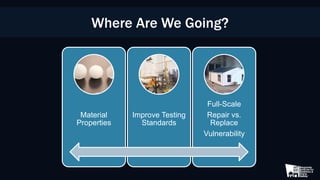
Where Are We Going?
Material
Properties
Improve Testing
Standards
Full-Scale
Repair vs.
Replace
Vulnerability
Where Are We Going?
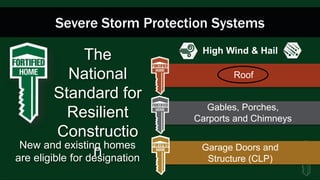
Severe Storm Protection Systems
Gables, Porches,
Carports and Chimneys
Garage Doors and
Structure (CLP)
Roof
High Wind & Hail
The
National
Standard for
Resilient
Constructio
nNew and existing homes
are eligible for designation
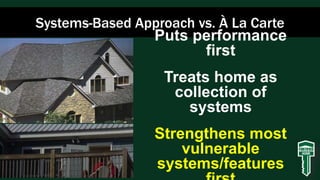
Systems-Based Approach vs. À La Carte
Puts performance
first
Treats home as
collection of
systems
Strengthens most
vulnerable
systems/features
FORTIFIED Roof – High Wind and Hail Bronze
• Minimum 7/16 in. OSB or plywood roof deck
• Roof deck attachment = 2 options
–8d smooth or 10d smooth nails
•Spaced at 4 in. o.c.
–8d ring shank nails
•Spaced 6 in. o.c.
• Drip edge required with 3 in. laps and fastened at
12 in. o.c.
FORTIFIED Roof – High Wind and Hail Bronze
• Roof deck must be sealed with a qualified system
– Taped seams
– 2-layers of #30 felt
– Fully adhered membrane
– Reinforced synthetic underlayment installed for high wind and
prolonged exposure
– Closed-cell foam polyurethane adhesive applied to the underside
of deck (retrofit)
• Roof covering must be high-wind rated, Class F or higher,
and impact-rated, either Class 3 or 4 depending on roof
covering type
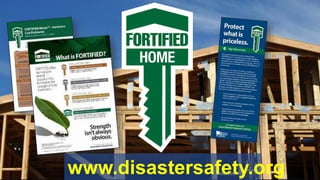
www.disastersafety.org

Severe Thunderstorm Impacts

  • 1.
    Severe Thunderstorm Impacts andMitigation—Hail Mitigation Tanya M. Brown, Ph.D. Lead Research Engineer & Director of Hail Research NHMA Symposium July 23, 2015
  • 2.
    Hailstorm Risks • Severehail (1+ in. diameter) most commonly occurs in thunderstorms • Largest hailstones occur in supercell thunderstorms with strong updrafts— tornadoes can be present • Risk extends across country in areas east of Rocky Mountains • More than 75% of cities in U.S. experience at least one hailstorm/year • On average, annual hail losses ~$1B
  • 3.
    May 24, 2011DFW Claims Study • Hailstorms caused $875M+ in insured losses • Claims study comparing: – Roofing material performance – Aging – Relative difference in roofing damage vs. walls/windows/doors/trim damage – Radar-estimated hail severity vs. claim severity • More than 67,000 policies in force • More than 6,600 claims
  • 4.
    May 24, 2011DFW Claims Study 9.6% 6.7% 1.1% 0.4% 5.3% 0% 2% 4% 6% 8% 10% 12% Roof Damage Other Damage Wall Damage Door Damage Window Damage Claims Frequency
  • 5.
    May 24, 2011DFW Claims Study Roof Damage 91.7% Other Damage 6.1% WallDamage 0.9% Door Damage 0.1% Window Damage 1.3% Other 2.2% Distribution of Losses
  • 6.
    Asphalt Shingle ImpactResistance Testing Systematic approach to compare: • Different classes of materials − 3-tab vs. architectural shingles − Standard vs. IR vs. premium − Traditional IR vs. polymer modified IR • Standards — UL 2218 and FM 4473 • Altered test methods — different density and/or hardness of stones • Aging and climate effects
  • 7.
    UL 2218 AsphaltShingle Impact Test Method & Observations
  • 8.
    3-tab 3-tab IR PercentageofPassingImpacts ShingleType UL 2218 Impact Location Passing Rates: 3-tab vs. 3-tab IR Shingles Class 1 Class 2 Class 3 Class 4 Asphalt Shingle Impact Resistance Testing architectural architectural IR premium architectural PercentageofPassingImpacts Shingle Type UL 2218 Impact Location Passing Rates: Architectural, Architectural IR, and Premium Architectural Shingles Class 1 Class 2 Class 3 Class 4
  • 9.
    traditional IR polymermodified IR PercentageofPassingImpacts Shingle Type UL 2218 Impact Location Passing Rates: Traditional IR vs. Polymer Modified IR Shingles Class 1 Class 2 Class 3 Class 4 Asphalt Shingle Impact Resistance Testing
  • 10.
    • Replicate IBHSice balls like natural hail • Develop damage rating scale – Focus on what can be seen from the surface — applicability to claims!! – Explain relationship of different ratings for the remaining life of the roof — pilot cosmetic vs. functional damage study • Further exploration of preliminary finding — hard and soft ice balls seem to cause different visible damage signatures Future: Ice Ball Asphalt Shingle Impact Tests
  • 11.
    Future: Ice BallAsphalt Shingle Impact Tests
  • 12.
    Where Are WeGoing? Material Properties Improve Testing Standards Full-Scale Repair vs. Replace Vulnerability
  • 13.
  • 14.
    Severe Storm ProtectionSystems Gables, Porches, Carports and Chimneys Garage Doors and Structure (CLP) Roof High Wind & Hail The National Standard for Resilient Constructio nNew and existing homes are eligible for designation
  • 15.
    Systems-Based Approach vs.À La Carte Puts performance first Treats home as collection of systems Strengthens most vulnerable systems/features
  • 16.
    FORTIFIED Roof –High Wind and Hail Bronze • Minimum 7/16 in. OSB or plywood roof deck • Roof deck attachment = 2 options –8d smooth or 10d smooth nails •Spaced at 4 in. o.c. –8d ring shank nails •Spaced 6 in. o.c. • Drip edge required with 3 in. laps and fastened at 12 in. o.c.
  • 17.
    FORTIFIED Roof –High Wind and Hail Bronze • Roof deck must be sealed with a qualified system – Taped seams – 2-layers of #30 felt – Fully adhered membrane – Reinforced synthetic underlayment installed for high wind and prolonged exposure – Closed-cell foam polyurethane adhesive applied to the underside of deck (retrofit) • Roof covering must be high-wind rated, Class F or higher, and impact-rated, either Class 3 or 4 depending on roof covering type
  • 18.

Editor's Notes

  • #9 IR 3-tab products performed better than the basic 3-tab products (about 55 to 225 percent better) for all steel ball impact classes. The basic products had relatively consistent passing rates for the Class 2 and larger steel ball impacts, while the IR products showed consistent passing rates for Class 3 and larger steel ball impacts. Class 1 UL 2218 impacts resulted in passing ratings for about 65 percent of the impact locations on the IR 3-tab shingles versus about 45 percent for the basic 3-tab shingles. Class 2 UL 2218 impacts resulted in passing ratings for about 75 percent of the impact locations on the IR 3-tab shingles versus about 25 percent for the basic 3-tab shingles. Class 3 UL 2218 impacts resulted in passing ratings for about 60 percent of the impact locations on the IR 3-tab shingles versus about 25 percent for the basic 3-tab shingles. Class 4 UL 2218 impacts resulted in passing ratings for about 60 percent of the impact locations on the IR 3-tab shingles versus about 25 percent for the basic 3-tab shingles.
  • #10 Polymer modified IR shingles performed better than traditional IR shingles (about 20 to 50 percent improvement) for all four steel ball impact classes. This was most noticeable at the larger steel ball sizes (1.50-2.00 in.) where the polymer modified shingles performed at least 40 percent better than the traditional IR shingles. Class 1 UL 2218 impacts resulted in passing ratings for about 85 percent of the impact locations on the polymer modified IR products compared to about 70 percent for the traditional IR shingles. Class 2 UL 2218 impacts resulted in passing ratings for about 90 percent of the impact locations on the polymer modified IR products compared to about 60 percent for the traditional IR shingles. Class 3 UL 2218 impacts resulted in passing ratings for about 75 percent of the impact locations on the polymer modified IR products compared to about 50 percent for the traditional IR shingles. Class 4 UL 2218 impacts resulted in passing ratings for about 55 percent of the impact locations on the polymer modified IR products compared to about 35 percent for the traditional IR shingles.
  • #15 Be sure to mention that FORTIFIED Home standards for High Wind and Hail are for both new and existing construction.
  • #16 Consider for a moment the components that comprise the roof system: Roof framing (type and spacing), roof decking material, roof decking thickness, roof decking attachment (fastener type, size and spacing), roof deck sealing method, roofing underlayment, drip edge installation, finally roof covering. Energy efficiency failures can lead to higher ownership cost, resilience failures can lead costly and disruptive failures, and in extreme circumstances violent and sudden catastrophic losses. Text from slide: Without adequate resilience, risk of loss can be significant even in low intensity events. Systems-based approach used in FORTIFIED seeks to mitigate all of the components that make up vulnerable assemblies. À la carte approaches encourage the selection of individual components to achieve a score/credit. Score, first; Performance second.
  • #17 Roof covering spec is critical- Shingles are rated for wind speed, metal roofs must be rated and attached for the wind design pressure. Both must be installed per manufacturer’s requirements for the appropriate wind speed/ design pressure Tile must be installed to meet the “required aerodynamic uplift moment”.
  • #18 Roof covering spec is critical- Roof deck must be sealed with a qualified system - Entire roof deck covered with full layer of self-adhering poly modified bitumen membrane - Application of self-adhering polymer modified bitumen flashing tape at horizontal and vertical joints in the roof deck - Application of reinforced synthetic roof underlayment with an ICC approval
  • #19 IBHS IS A STONG SUPPORTER OF MODERN, WELL-ENFORCED BUILDNG CODES, BUT AWAY FROM THE COASTS, EVEN THE NEWEST CODES DO NOT REALLY PROTECT HOMES AND COMMERCIAL STRUCTURES AGAINST HIGH WINDS. So, IBHS created a set of science-based, voluntary building standards known collectively as FORTIFIED. A FORTIFIED DESIGNATION IS AN INDIVIDUAL INDICATOR OF A PROPERTY’S RESILIENCE TO A PARTICULAR HAZARD. Fortified is increasingly be used by our industry, as well as builders at all price points. Holistic, system-based approach Third-party inspections & validation of required elements (design / construction)