Building local
resilience to climate
change in Salt Lake
City
July 2015
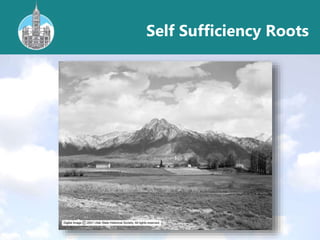
Self Sufficiency Roots
1. Ensure we can continue to keep its service
commitments and protect people, property and
infrastructure
2. Make decisions today that account for tomorrow’s
vulnerabilities
3. Plan early to keep costs down
4. Continue our legacy of effective long-range planning
5. Capitalize on co-benefits
What is government’s
responsibility?
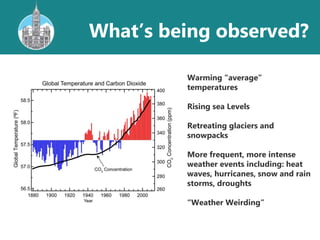
Warming “average”
temperatures
Rising sea Levels
Retreating glaciers and
snowpacks
More frequent, more intense
weather events including: heat
waves, hurricanes, snow and rain
storms, droughts
“Weather Weirding”
What’s being observed?
Photo: Salt Lake Tribune, Aug 2010
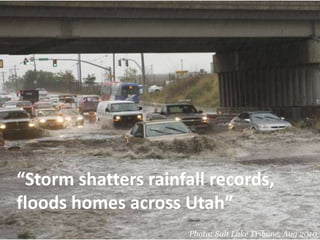
“Storm shatters rainfall records,
floods homes across Utah”
Photo: Salt Lake Tribune, Aug 2010
Photo: KSL.com, Dec 2011
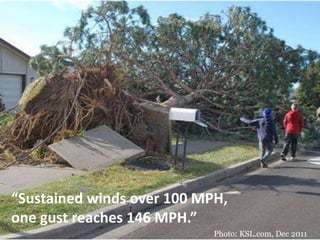
“Sustained winds over 100 MPH,
one gust reaches 146 MPH.”
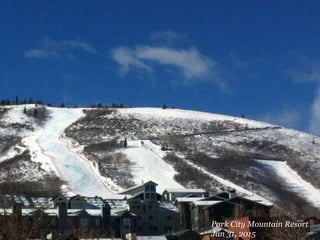
Park City Mountain Resort
Jan 31, 2015
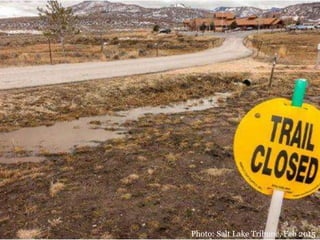
Photo: Salt Lake Tribune, Feb 2015
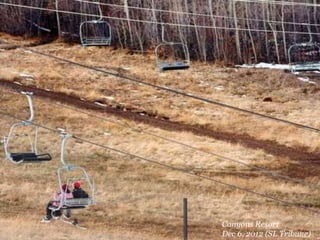
Canyons Resort
Dec 6, 2012 (SL Tribune)
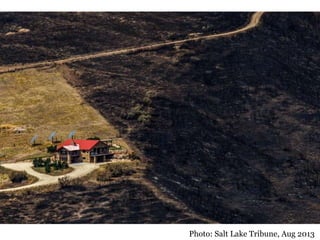
Photo: Salt Lake Tribune, Aug 2013
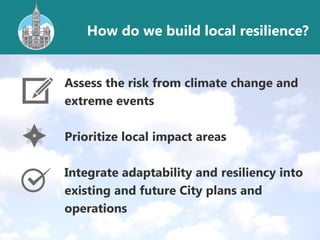
Assess the risk from climate change and
extreme events
Prioritize local impact areas
Integrate adaptability and resiliency into
existing and future City plans and
operations
How do we build local resilience?
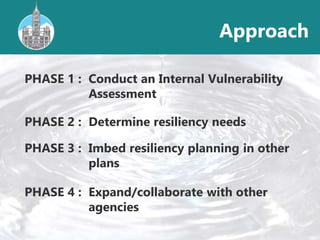
PHASE 1 : Conduct an Internal Vulnerability
Assessment
PHASE 2 : Determine resiliency needs
PHASE 3 : Imbed resiliency planning in other
plans
PHASE 4 : Expand/collaborate with other
agencies
Approach
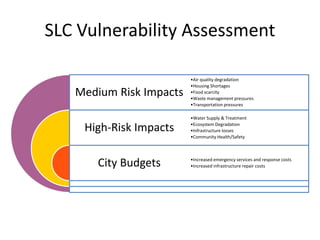
SLC Vulnerability Assessment
Medium Risk Impacts
High-Risk Impacts
City Budgets
•Air quality degradation
•Housing Shortages
•Food scarcity
•Waste management pressures
•Transportation pressures
•Water Supply & Treatment
•Ecosystem Degradation
•Infrastructure losses
•Community Health/Safety
•Increased emergency services and response costs
•Increased infrastructure repair costs
Convene regional practitioners
Inventory current efforts
Create a local repository of information
Develop mitigation and adaptation strategies
Establish a robust Regional Climate Network
Utah Climate Network
Catalyze research, action and engagement
to ensure a coordinated response to
climate change and its impacts on the
people, economies and general prosperity
of Utah.
•No advocacy
•No politics
•Just collaboration
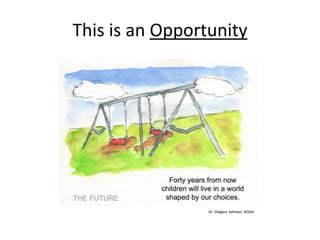
This is an Opportunity
Dr. Gregory Johnson, NOAA

Climate adaptation- County planning

  • 1.
    Building local resilience toclimate change in Salt Lake City July 2015
  • 2.
  • 3.
    1. Ensure wecan continue to keep its service commitments and protect people, property and infrastructure 2. Make decisions today that account for tomorrow’s vulnerabilities 3. Plan early to keep costs down 4. Continue our legacy of effective long-range planning 5. Capitalize on co-benefits What is government’s responsibility?
  • 4.
    Warming “average” temperatures Rising seaLevels Retreating glaciers and snowpacks More frequent, more intense weather events including: heat waves, hurricanes, snow and rain storms, droughts “Weather Weirding” What’s being observed?
  • 6.
    Photo: Salt LakeTribune, Aug 2010 “Storm shatters rainfall records, floods homes across Utah”
  • 7.
    Photo: Salt LakeTribune, Aug 2010
  • 8.
    Photo: KSL.com, Dec2011 “Sustained winds over 100 MPH, one gust reaches 146 MPH.”
  • 9.
    Park City MountainResort Jan 31, 2015
  • 10.
    Photo: Salt LakeTribune, Feb 2015
  • 11.
    Canyons Resort Dec 6,2012 (SL Tribune)
  • 12.
    Photo: Salt LakeTribune, Aug 2013
  • 14.
    Assess the riskfrom climate change and extreme events Prioritize local impact areas Integrate adaptability and resiliency into existing and future City plans and operations How do we build local resilience?
  • 15.
    PHASE 1 :Conduct an Internal Vulnerability Assessment PHASE 2 : Determine resiliency needs PHASE 3 : Imbed resiliency planning in other plans PHASE 4 : Expand/collaborate with other agencies Approach
  • 16.
    SLC Vulnerability Assessment MediumRisk Impacts High-Risk Impacts City Budgets •Air quality degradation •Housing Shortages •Food scarcity •Waste management pressures •Transportation pressures •Water Supply & Treatment •Ecosystem Degradation •Infrastructure losses •Community Health/Safety •Increased emergency services and response costs •Increased infrastructure repair costs
  • 19.
    Convene regional practitioners Inventorycurrent efforts Create a local repository of information Develop mitigation and adaptation strategies Establish a robust Regional Climate Network Utah Climate Network
  • 20.
    Utah Climate Network Catalyzeresearch, action and engagement to ensure a coordinated response to climate change and its impacts on the people, economies and general prosperity of Utah. •No advocacy •No politics •Just collaboration
  • 21.
    This is anOpportunity Dr. Gregory Johnson, NOAA

Editor's Notes

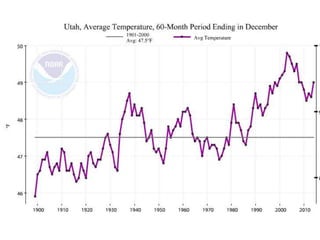
  • #6 Temperatures on every continent are rising decade-by-decade and Utah’s temperature trend reflects this too. Utah-specific temperatures: year-to-year fluctuations. One year to see through noise and into trends is by looking at a “running mean” Graphic represents a 60-month (5-year) running average of temps in Utah – take this year and preceding four years to create a data point. Warmer “Average” Temperatures: The appearance of extreme heat events? The absence of cold winter freezes? Changes in precipitation patterns? Decrease in amount and duration of snowpack? More frequent, more intense weather events possibly including: heat waves, severe wind, few but heavy snow and rain storms, droughts?
  • #7  “Storm shatters rainfall records, floods homes across Utah” (August 2010) 0.39 inches of rainfall in five minutes. Not just temperatures changing but climate systems http://www.sltrib.com/sltrib/home/50138662-75/storm-rain-basement-inch.html.csp
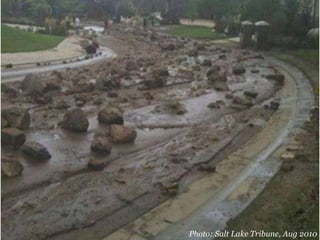
  • #8 http://www.sltrib.com/sltrib/home/50138662-75/storm-rain-basement-inch.html.csp Draper neighborhood Cities are the ones who get to clean up this mess
  • #9  70,000 trees toppled or damaged, one public golf course (Davis Park) lost 500 mature trees by itself. http://www.ksl.com/index.php?sid=23177386&nid=148&title=1-year-after-davis-county-wind-storm-area-recovers
  • #10 Another thing that’s vulnerable in Utah: snowpack. Water implications, but also wintersports. economy Photo: January 2015. This past winter is warmest on record for City. – ski runs (the image is from Park City) supported by snow-making equipment on ski runs. Utah Climate Center report of 50-year trends: Smaller percentage of precipitation falling as snow (rain instead) Decreased snow depth Decreased snow coverage Source: Observational and synoptic analyses of the winter precipitation regime change over Utah (revised July 2011) http://cliserv.jql.usu.edu/paper/JCLI-Utah-Snow.pdf
  • #11 Another cross-country image from Park City (around 7000’ elevation in February!)
  • #12 Climate modeling going forward: PCMR commissioned 2009 report as part of “Save Our Snow” efforts – models show mixed results on total annual precipitation, but consensus around negative impact on snowpack  reduced skier days. Forecasted impact loss range: $160 MM - $392 MM annually by 2050. thousands of jobs Park City Ski Area Study: http://www.parkcitygreen.org/Community/Community-Footprint/SOS-ClimateStudy.aspx
  • #13  Then, of course….wildfire: Rockport Fire, Park City August 2013
  • #14  How have local governments responded? Preparation vs prevention
  • #16 Prepare a Vulnerability Assessment Exposure: What/who could be impacted? Sensitivity: To what extent are we exposed? Adaptive Capacity: What resources are available to respond?
  • #17 2012 internal vulnerability assessment: 81 Impact Areas Identified; 23 High-Risk
  • #18 What are we, and everyone else trying to accomplish on climate change?
  • #20 Strategies – cost, social and environmental considerations.
  • #21 Strategies – cost, social and environmental considerations.
  • #22 CLOSING THOUGHT: podcast advice (from LT organizer working on global challenges) “Don’t save something because you feel guilty about it, do it because you love it.”