The tissue level of organization
Connective, Muscle, and Nervous Tissues
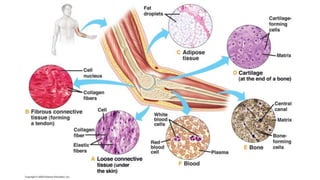
Examples of connective tissue
• Solid
– Cartilage
– Bone
– Tendons
– Ligaments
– Fibrous tissues
• Fluid
– Lymph
– Blood
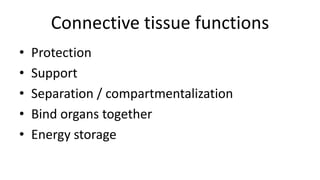
Connective tissue functions
• Protection
• Support
• Separation / compartmentalization
• Bind organs together
• Energy storage
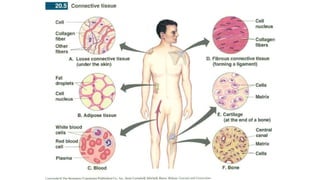
Loose connective tissue
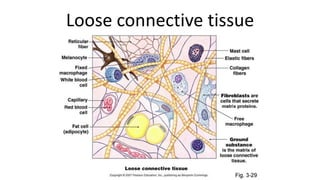
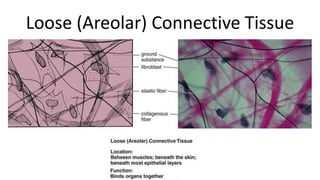
Loose (Areolar) Connective Tissue
Loose connective tissue
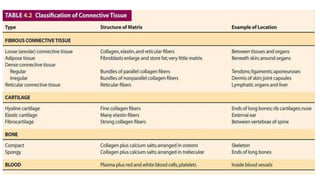
• Loosely woven fibers produced by fibroblasts
• Three types of fibers
– Collagenous (collagen): tough, parallel bundles
– Elastic (elastin): smaller, still strong, can stretch
– Reticular: v. thin branching strong support
Adipose tissue
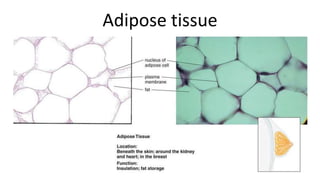
Adipose tissue
• Fat
• Found within loose connective
– Sub cutaneous = adipose + areolar
• Insulation and protection
– Around kidneys, heart surface, joints, behind eye
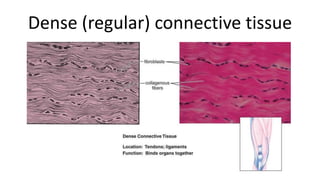
Dense (regular) connective tissue
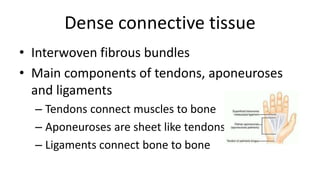
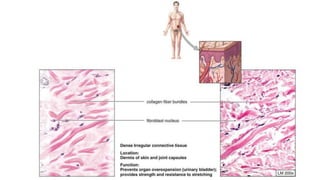
Dense connective tissue
• Interwoven fibrous bundles
• Main components of tendons, aponeuroses
and ligaments
– Tendons connect muscles to bone
– Aponeuroses are sheet like tendons
– Ligaments connect bone to bone
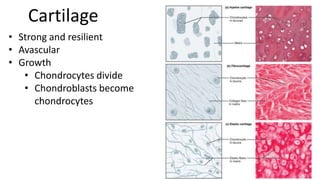
Cartilage
• Strong and resilient
• Avascular
• Growth
• Chondrocytes divide
• Chondroblasts become
chondrocytes
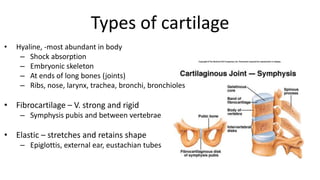
Types of cartilage
• Hyaline, -most abundant in body
– Shock absorption
– Embryonic skeleton
– At ends of long bones (joints)
– Ribs, nose, larynx, trachea, bronchi, bronchioles
• Fibrocartilage – V. strong and rigid
– Symphysis pubis and between vertebrae
• Elastic – stretches and retains shape
– Epiglottis, external ear, eustachian tubes
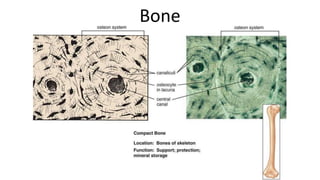
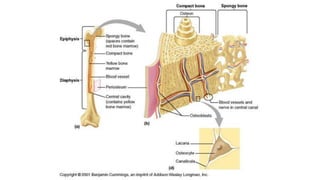
Bone
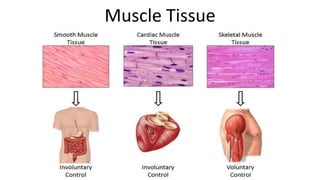
Muscle Tissue
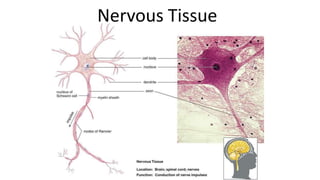
Nervous Tissue

Connective, muscle and nervous tissues

  • 1.
    The tissue levelof organization Connective, Muscle, and Nervous Tissues
  • 3.
    Examples of connectivetissue • Solid – Cartilage – Bone – Tendons – Ligaments – Fibrous tissues • Fluid – Lymph – Blood
  • 4.
    Connective tissue functions •Protection • Support • Separation / compartmentalization • Bind organs together • Energy storage
  • 7.
  • 8.
  • 9.
    Loose connective tissue •Loosely woven fibers produced by fibroblasts • Three types of fibers – Collagenous (collagen): tough, parallel bundles – Elastic (elastin): smaller, still strong, can stretch – Reticular: v. thin branching strong support
  • 10.
  • 11.
    Adipose tissue • Fat •Found within loose connective – Sub cutaneous = adipose + areolar • Insulation and protection – Around kidneys, heart surface, joints, behind eye
  • 12.
  • 13.
    Dense connective tissue •Interwoven fibrous bundles • Main components of tendons, aponeuroses and ligaments – Tendons connect muscles to bone – Aponeuroses are sheet like tendons – Ligaments connect bone to bone
  • 15.
    Cartilage • Strong andresilient • Avascular • Growth • Chondrocytes divide • Chondroblasts become chondrocytes
  • 16.
    Types of cartilage •Hyaline, -most abundant in body – Shock absorption – Embryonic skeleton – At ends of long bones (joints) – Ribs, nose, larynx, trachea, bronchi, bronchioles • Fibrocartilage – V. strong and rigid – Symphysis pubis and between vertebrae • Elastic – stretches and retains shape – Epiglottis, external ear, eustachian tubes
  • 17.
  • 19.
  • 20.