ANIMAL
TISSUES
TOPIC: Connective tissues, Blood & Structure of a Long Bone
PREPARED BY : MR SOMTSEWU
PRESENTER: MR Kofi
CHRIS HANI WEST DISTRICT
LESSON OUTLINE
Terminology
Brief overview on tissues
Connective tissues
Structure of the long bone &
Blood
CAPS DOCUMENT : ANIMAL TISSUES-
CONTENT TO BE TAUGHT
Important Terms
• Glottis: is the opening of the trachea
• Epiglottis: is a leaf shaped cartilage that opens and closes the glottis.
• Chondrin: is the ground substance of cartilage.
• Lacunae: are fluid filled spaces found embedded in the chondrin.
• Chondrocytes: are the cartilage cells found within the lacunae.
• Tendons: attach muscle to bones
• Ligaments: connect bone to bone
• Tissue: is a group of cells that have the same structure that work together
to carry out the same function.
DO YOU REMEMBER WHAT IS A
TISSUE?
 A tissue is as a group of cells that
have the same structure that work
together to carry out the same
function.
 Or a tissue may be defined as a
group of similar cells performing a
similar function.
 These tissues are found in both
plants and animals cells
 In this lesson we shall look at
connective tissues.
Connective tissues
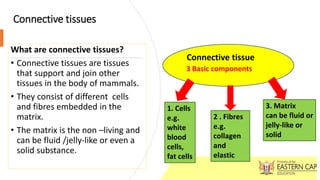
What are connective tissues?
• Connective tissues are tissues
that support and join other
tissues in the body of mammals.
• They consist of different cells
and fibres embedded in the
matrix.
• The matrix is the non –living and
can be fluid /jelly-like or even a
solid substance.
Connective tissue
3 Basic components
1. Cells
e.g.
white
blood
cells,
fat cells
2 . Fibres
e.g.
collagen
and
elastic
3. Matrix
can be fluid or
jelly-like or
solid
Types of Connective Tissue
There are Six types of connective
tissues
These are:
Areolar
White fibrous connective tissue
Yellow elastic connective tissue
Cartilage
Bone and
Blood
AREOLAR TISSUE:
Location, structure and function
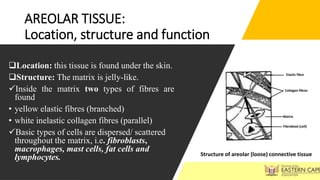
Location: this tissue is found under the skin.
Structure: The matrix is jelly-like.
Inside the matrix two types of fibres are
found
• yellow elastic fibres (branched)
• white inelastic collagen fibres (parallel)
Basic types of cells are dispersed/ scattered
throughout the matrix, i.e. fibroblasts,
macrophages, mast cells, fat cells and
lymphocytes.
Elastic fibre
Collagen fibres
Matrix
Fibroblast (cell)
Structure of areolar (loose) connective tissue
AREOLAR TISSUE:
Location, structure and function continued
Functions of areolar tissue:
• Serves as an insulating material-
prevent heat loss.
• Protects the organs by serving as a
packing tissue, e.g. around the kidneys.
• Connects the skin to underlying layers.
• It serves as a packing tissue that fills
the spaces between organs, blood
vessels, nerves and muscles.
• NB: [when large amount of fat are
stored in this tissue, it is known as
adipose/fat tissue]
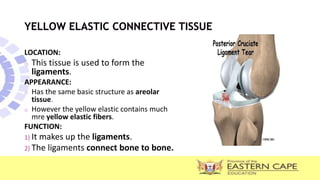
LOCATION:
o This tissue is used to form the
ligaments.
APPEARANCE:
o Has the same basic structure as areolar
tissue.
o However the yellow elastic contains much
mre yellow elastic fibers.
FUNCTION:
1) It makes up the ligaments.
2) The ligaments connect bone to bone.
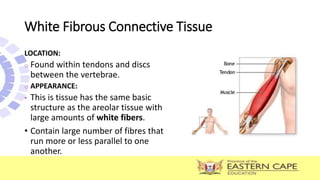
White Fibrous Connective Tissue
LOCATION:
o Found within tendons and discs
between the vertebrae.
o APPEARANCE:
• This is tissue has the same basic
structure as the areolar tissue with
large amounts of white fibers.
• Contain large number of fibres that
run more or less parallel to one
another.
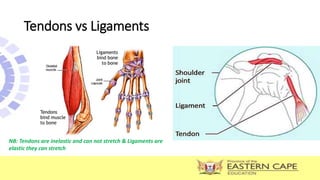
Tendons vs Ligaments
NB: Tendons are inelastic and can not stretch & Ligaments are
elastic they can stretch
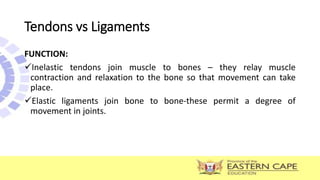
FUNCTION:
Inelastic tendons join muscle to bones – they relay muscle
contraction and relaxation to the bone so that movement can take
place.
Elastic ligaments join bone to bone-these permit a degree of
movement in joints.
Tendons vs Ligaments
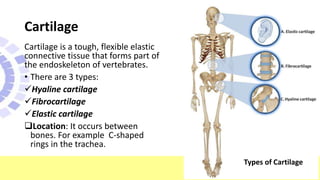
Cartilage
Cartilage is a tough, flexible elastic
connective tissue that forms part of
the endoskeleton of vertebrates.
• There are 3 types:
Hyaline cartilage
Fibrocartilage
Elastic cartilage
Location: It occurs between
bones. For example C-shaped
rings in the trachea.
Types of Cartilage
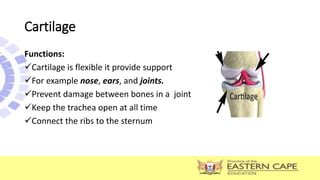
Cartilage
Functions:
Cartilage is flexible it provide support
For example nose, ears, and joints.
Prevent damage between bones in a joint
Keep the trachea open at all time
Connect the ribs to the sternum
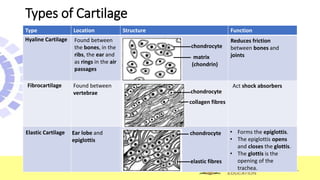
Types of Cartilage
Type Location Structure Function
chondrocyte
matrix
(chondrin)
collagen fibres
chondrocyte
chondrocyte
elastic fibres
Hyaline Cartilage Found between
the bones, in the
ribs, the ear and
as rings in the air
passages
Fibrocartilage
Elastic Cartilage
Found between
vertebrae
Ear lobe and
epiglottis
Reduces friction
between bones and
joints
Act shock absorbers
• Forms the epiglottis.
• The epiglottis opens
and closes the glottis.
• The glottis is the
opening of the
trachea.
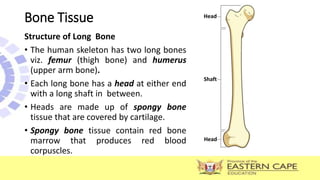
Bone Tissue
Structure of Long Bone
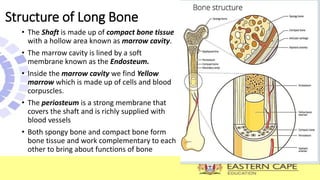
• The human skeleton has two long bones
viz. femur (thigh bone) and humerus
(upper arm bone).
• Each long bone has a head at either end
with a long shaft in between.
• Heads are made up of spongy bone
tissue that are covered by cartilage.
• Spongy bone tissue contain red bone
marrow that produces red blood
corpuscles.
Head
Shaft
Head
Structure of Long Bone
• The Shaft is made up of compact bone tissue
with a hollow area known as marrow cavity.
• The marrow cavity is lined by a soft
membrane known as the Endosteum.
• Inside the marrow cavity we find Yellow
marrow which is made up of cells and blood
corpuscles.
• The periosteum is a strong membrane that
covers the shaft and is richly supplied with
blood vessels
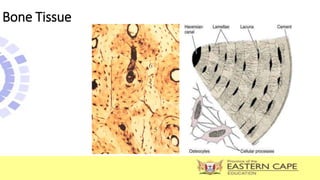
• Both spongy bone and compact bone form
bone tissue and work complementary to each
other to bring about functions of bone
Bone Tissue
Bone gives strength and support
It protects internal organs such as the brain, spinal cord, heart and
lungs.
It serves as a place of attachment for muscles to make movement
possible.
Serves as a storage for minerals ,e.g. calcium stored in bone tissue.
Functions of Bone Tissue
BLOOD TISSUE
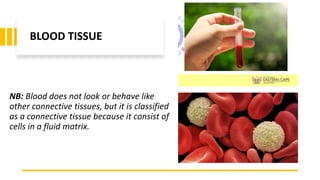
NB: Blood does not look or behave like
other connective tissues, but it is classified
as a connective tissue because it consist of
cells in a fluid matrix.
Blood Tissue
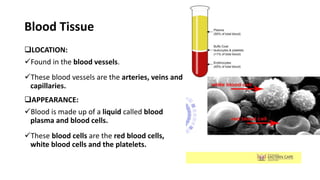
LOCATION:
Found in the blood vessels.
These blood vessels are the arteries, veins and
capillaries.
APPEARANCE:
Blood is made up of a liquid called blood
plasma and blood cells.
These blood cells are the red blood cells,
white blood cells and the platelets.
BLOOD
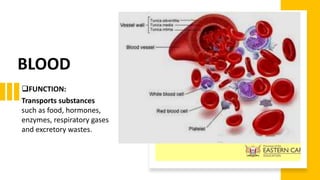
FUNCTION:
Transports substances
such as food, hormones,
enzymes, respiratory gases
and excretory wastes.
FUNCTION:
Transports substances such as food, hormones, enzymes, respiratory
gases and excretory wastes.
BLOOD
ACTIVITY
1. Which of the following tissues can be considered as connective tissue?
(i) blood
(ii) cartilage
(iii) skin
(iv) ligaments
(v) squamous epithelium
A (i), (iii), (v)
B (ii), (iii), (iv)
C (i), (ii), (iv)
D (iii), (iv), (v)
ANSWER: C
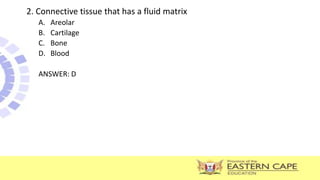
2. Connective tissue that has a fluid matrix
A. Areolar
B. Cartilage
C. Bone
D. Blood
ANSWER: D
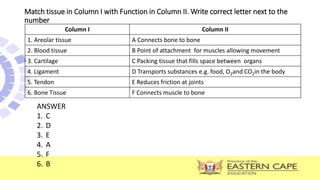
Match tissue in Column I with Function in Column II. Write correct letter next to the
number
Column I Column II
1. Areolar tissue A Connects bone to bone
2. Blood tissue B Point of attachment for muscles allowing movement
3. Cartilage C Packing tissue that fills space between organs
4. Ligament D Transports substances e.g. food, O2and CO2in the body
5. Tendon E Reduces friction at joints
6. Bone Tissue F Connects muscle to bone
ANSWER
1. C
2. D
3. E
4. A
5. F
6. B
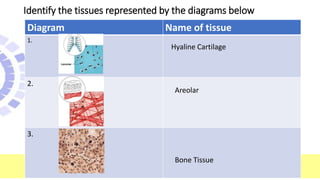
Identify the tissues represented by the diagrams below
Diagram Name of tissue
1.
2.
3.
Hyaline Cartilage
Areolar
Bone Tissue

00 Life Sciences Grade 10 PPT Connective Tissues.pptx

  • 1.
    ANIMAL TISSUES TOPIC: Connective tissues,Blood & Structure of a Long Bone PREPARED BY : MR SOMTSEWU PRESENTER: MR Kofi CHRIS HANI WEST DISTRICT
  • 2.
    LESSON OUTLINE Terminology Brief overviewon tissues Connective tissues Structure of the long bone & Blood
  • 3.
    CAPS DOCUMENT :ANIMAL TISSUES- CONTENT TO BE TAUGHT
  • 4.
    Important Terms • Glottis:is the opening of the trachea • Epiglottis: is a leaf shaped cartilage that opens and closes the glottis. • Chondrin: is the ground substance of cartilage. • Lacunae: are fluid filled spaces found embedded in the chondrin. • Chondrocytes: are the cartilage cells found within the lacunae. • Tendons: attach muscle to bones • Ligaments: connect bone to bone • Tissue: is a group of cells that have the same structure that work together to carry out the same function.
  • 5.
    DO YOU REMEMBERWHAT IS A TISSUE?  A tissue is as a group of cells that have the same structure that work together to carry out the same function.  Or a tissue may be defined as a group of similar cells performing a similar function.  These tissues are found in both plants and animals cells  In this lesson we shall look at connective tissues.
  • 6.
    Connective tissues What areconnective tissues? • Connective tissues are tissues that support and join other tissues in the body of mammals. • They consist of different cells and fibres embedded in the matrix. • The matrix is the non –living and can be fluid /jelly-like or even a solid substance. Connective tissue 3 Basic components 1. Cells e.g. white blood cells, fat cells 2 . Fibres e.g. collagen and elastic 3. Matrix can be fluid or jelly-like or solid
  • 7.
    Types of ConnectiveTissue There are Six types of connective tissues These are: Areolar White fibrous connective tissue Yellow elastic connective tissue Cartilage Bone and Blood
  • 8.
    AREOLAR TISSUE: Location, structureand function Location: this tissue is found under the skin. Structure: The matrix is jelly-like. Inside the matrix two types of fibres are found • yellow elastic fibres (branched) • white inelastic collagen fibres (parallel) Basic types of cells are dispersed/ scattered throughout the matrix, i.e. fibroblasts, macrophages, mast cells, fat cells and lymphocytes. Elastic fibre Collagen fibres Matrix Fibroblast (cell) Structure of areolar (loose) connective tissue
  • 9.
    AREOLAR TISSUE: Location, structureand function continued Functions of areolar tissue: • Serves as an insulating material- prevent heat loss. • Protects the organs by serving as a packing tissue, e.g. around the kidneys. • Connects the skin to underlying layers. • It serves as a packing tissue that fills the spaces between organs, blood vessels, nerves and muscles. • NB: [when large amount of fat are stored in this tissue, it is known as adipose/fat tissue]
  • 10.
    LOCATION: o This tissueis used to form the ligaments. APPEARANCE: o Has the same basic structure as areolar tissue. o However the yellow elastic contains much mre yellow elastic fibers. FUNCTION: 1) It makes up the ligaments. 2) The ligaments connect bone to bone.
  • 11.
    White Fibrous ConnectiveTissue LOCATION: o Found within tendons and discs between the vertebrae. o APPEARANCE: • This is tissue has the same basic structure as the areolar tissue with large amounts of white fibers. • Contain large number of fibres that run more or less parallel to one another.
  • 12.
    Tendons vs Ligaments NB:Tendons are inelastic and can not stretch & Ligaments are elastic they can stretch
  • 13.
    FUNCTION: Inelastic tendons joinmuscle to bones – they relay muscle contraction and relaxation to the bone so that movement can take place. Elastic ligaments join bone to bone-these permit a degree of movement in joints. Tendons vs Ligaments
  • 14.
    Cartilage Cartilage is atough, flexible elastic connective tissue that forms part of the endoskeleton of vertebrates. • There are 3 types: Hyaline cartilage Fibrocartilage Elastic cartilage Location: It occurs between bones. For example C-shaped rings in the trachea. Types of Cartilage
  • 15.
    Cartilage Functions: Cartilage is flexibleit provide support For example nose, ears, and joints. Prevent damage between bones in a joint Keep the trachea open at all time Connect the ribs to the sternum
  • 16.
    Types of Cartilage TypeLocation Structure Function chondrocyte matrix (chondrin) collagen fibres chondrocyte chondrocyte elastic fibres Hyaline Cartilage Found between the bones, in the ribs, the ear and as rings in the air passages Fibrocartilage Elastic Cartilage Found between vertebrae Ear lobe and epiglottis Reduces friction between bones and joints Act shock absorbers • Forms the epiglottis. • The epiglottis opens and closes the glottis. • The glottis is the opening of the trachea.
  • 17.
    Bone Tissue Structure ofLong Bone • The human skeleton has two long bones viz. femur (thigh bone) and humerus (upper arm bone). • Each long bone has a head at either end with a long shaft in between. • Heads are made up of spongy bone tissue that are covered by cartilage. • Spongy bone tissue contain red bone marrow that produces red blood corpuscles. Head Shaft Head
  • 18.
    Structure of LongBone • The Shaft is made up of compact bone tissue with a hollow area known as marrow cavity. • The marrow cavity is lined by a soft membrane known as the Endosteum. • Inside the marrow cavity we find Yellow marrow which is made up of cells and blood corpuscles. • The periosteum is a strong membrane that covers the shaft and is richly supplied with blood vessels • Both spongy bone and compact bone form bone tissue and work complementary to each other to bring about functions of bone
  • 19.
  • 20.
    Bone gives strengthand support It protects internal organs such as the brain, spinal cord, heart and lungs. It serves as a place of attachment for muscles to make movement possible. Serves as a storage for minerals ,e.g. calcium stored in bone tissue. Functions of Bone Tissue
  • 21.
    BLOOD TISSUE NB: Blooddoes not look or behave like other connective tissues, but it is classified as a connective tissue because it consist of cells in a fluid matrix.
  • 22.
    Blood Tissue LOCATION: Found inthe blood vessels. These blood vessels are the arteries, veins and capillaries. APPEARANCE: Blood is made up of a liquid called blood plasma and blood cells. These blood cells are the red blood cells, white blood cells and the platelets.
  • 23.
    BLOOD FUNCTION: Transports substances such asfood, hormones, enzymes, respiratory gases and excretory wastes.
  • 24.
    FUNCTION: Transports substances suchas food, hormones, enzymes, respiratory gases and excretory wastes. BLOOD
  • 25.
    ACTIVITY 1. Which ofthe following tissues can be considered as connective tissue? (i) blood (ii) cartilage (iii) skin (iv) ligaments (v) squamous epithelium A (i), (iii), (v) B (ii), (iii), (iv) C (i), (ii), (iv) D (iii), (iv), (v) ANSWER: C
  • 26.
    2. Connective tissuethat has a fluid matrix A. Areolar B. Cartilage C. Bone D. Blood ANSWER: D
  • 27.
    Match tissue inColumn I with Function in Column II. Write correct letter next to the number Column I Column II 1. Areolar tissue A Connects bone to bone 2. Blood tissue B Point of attachment for muscles allowing movement 3. Cartilage C Packing tissue that fills space between organs 4. Ligament D Transports substances e.g. food, O2and CO2in the body 5. Tendon E Reduces friction at joints 6. Bone Tissue F Connects muscle to bone ANSWER 1. C 2. D 3. E 4. A 5. F 6. B
  • 28.
    Identify the tissuesrepresented by the diagrams below Diagram Name of tissue 1. 2. 3. Hyaline Cartilage Areolar Bone Tissue