CONNECTED COMPOUNDS
 Studied implemented and evaluated
various parallel algorithms for
connected components labeling in
graphs.
 Two Architectures
 CPU– (OpenMp) and (CUDA)
 Different types of graphs.
 Propose simple auto tuned approach for
choosing best technique for a graph.
 Motivation
 Definitions
 Basic Algorithm
 Optimizations
 Datasets and Experiments
 Auto tuning
 Future Scope
 Identify vertices that form a
connected set in a graph.
 Used in:
 Pattern Recognition
 Physics
 Biology
 Social Network Analysis
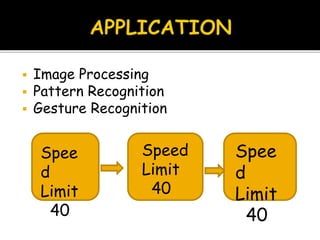
 Image Processing
 Pattern Recognition
 Gesture Recognition
Spee
d
Limit
40
Speed
Limit
40
Spee
d
Limit
40
 Disjoint Set Union
Make Set
Union
Link
Find Set
 Depth First Search
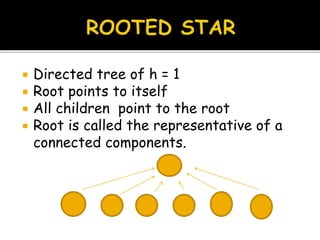
 Directed tree of h = 1
 Root points to itself
 All children point to the root
 Root is called the representative of a
connected components.
 ( I,J ) is an edge in the graph.
 If i and j are currently in
differently trees.
 Merge the two trees in to one.
 Make representation of one,
point to the representative of
the other.
 Merging two trees T1 and T2.
 Whose representative should be
changed?
 Toss a coin and choose a winner
 Tree with lower index wins always
 Alternate between iterations
(Even, Odd)
 Tree with greater height wins
 Move a node higher in the tree.
Single level
Multi level
Final Aim
 EXAMPLE:
 Singletons
 Hooking
 Point jumping
 Single instance edge storage
( u,v ) is same as (u,v)
Reduced Memory Footprint
Smaller traversal overhead
 Unconditional Hooking
Calling at appropriate iteration
helps in decreasing the number of
iterations.
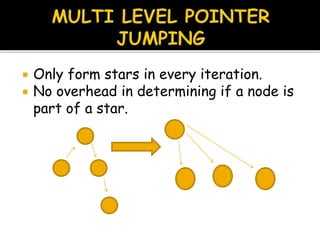
 Only form stars in every iteration.
 No overhead in determining if a node is
part of a star.
 Random graphs
1Mto 7M nodes, average degree 5
 RMAT Graphs
Synthetic Social Networking
1M to 7M nodes
 Real world Data
 Web graphs
Google web
Berkeley Stanford domains
Thank you!!!

connected compounds

  • 1.
  • 2.
     Studied implementedand evaluated various parallel algorithms for connected components labeling in graphs.  Two Architectures  CPU– (OpenMp) and (CUDA)  Different types of graphs.  Propose simple auto tuned approach for choosing best technique for a graph.
  • 3.
     Motivation  Definitions Basic Algorithm  Optimizations  Datasets and Experiments  Auto tuning  Future Scope
  • 4.
     Identify verticesthat form a connected set in a graph.  Used in:  Pattern Recognition  Physics  Biology  Social Network Analysis
  • 5.
     Image Processing Pattern Recognition  Gesture Recognition Spee d Limit 40 Speed Limit 40 Spee d Limit 40
  • 6.
     Disjoint SetUnion Make Set Union Link Find Set  Depth First Search
  • 7.
     Directed treeof h = 1  Root points to itself  All children point to the root  Root is called the representative of a connected components.
  • 8.
     ( I,J) is an edge in the graph.  If i and j are currently in differently trees.  Merge the two trees in to one.  Make representation of one, point to the representative of the other.
  • 9.
     Merging twotrees T1 and T2.  Whose representative should be changed?  Toss a coin and choose a winner  Tree with lower index wins always  Alternate between iterations (Even, Odd)  Tree with greater height wins
  • 10.
     Move anode higher in the tree. Single level Multi level Final Aim  EXAMPLE:  Singletons  Hooking  Point jumping
  • 11.
     Single instanceedge storage ( u,v ) is same as (u,v) Reduced Memory Footprint Smaller traversal overhead  Unconditional Hooking Calling at appropriate iteration helps in decreasing the number of iterations.
  • 12.
     Only formstars in every iteration.  No overhead in determining if a node is part of a star.
  • 13.
     Random graphs 1Mto7M nodes, average degree 5  RMAT Graphs Synthetic Social Networking 1M to 7M nodes  Real world Data  Web graphs Google web Berkeley Stanford domains
  • 14.