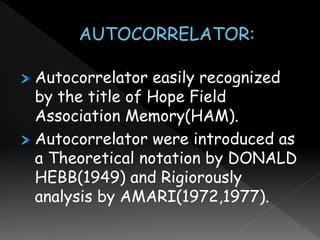
Autocorrelator easily recognized
by the title of Hope Field
Association Memory(HAM).
Autocorrelator were introduced as
a Theoretical notation by DONALD
HEBB(1949) and Rigiorously
analysis by AMARI(1972,1977).
A first order auto correlated stores M
bipolar pattern A1,A2,A3,…..Am by
summing together M outer product as,
T= ∑ [Ai][Aj]
Here,
T=[tij] is a (p*p) connection matrix and
Ai È {-1,1}.
The Autocorrelator is recalls Equation is
Vector matrix Multipulication.
Consider the following pattern’s
A1=(-1,1,-1,1)
A2=(1,1,1,-1)
A3=(-1,-1,-1,1)
The Connection Matrix:-
3 1 3 -3
T = ∑ [Ai][Aj]= 1 3 1 -1
3 1 3 -3
-3 -1 -3 3
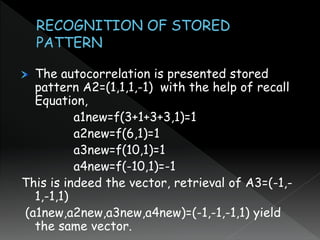
The autocorrelation is presented stored
pattern A2=(1,1,1,-1) with the help of recall
Equation,
a1new=f(3+1+3+3,1)=1
a2new=f(6,1)=1
a3new=f(10,1)=1
a4new=f(-10,1)=-1
This is indeed the vector, retrieval of A3=(-1,-
1,-1,1)
(a1new,a2new,a3new,a4new)=(-1,-1,-1,1) yield
the same vector.
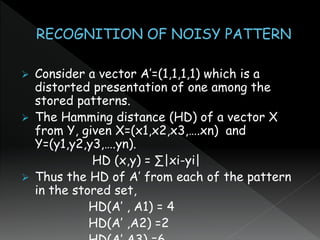
 Consider a vector A’=(1,1,1,1) which is a
distorted presentation of one among the
stored patterns.
 The Hamming distance (HD) of a vector X
from Y, given X=(x1,x2,x3,….xn) and
Y=(y1,y2,y3,….yn).
HD (x,y) = ∑|xi-yi|
 Thus the HD of A’ from each of the pattern
in the stored set,
HD(A’ , A1) = 4
HD(A’ ,A2) =2
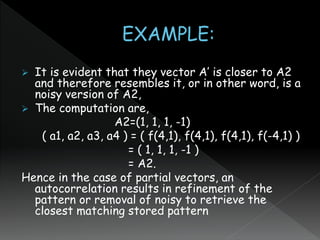
 It is evident that they vector A’ is closer to A2
and therefore resembles it, or in other word, is a
noisy version of A2,
 The computation are,
A2=(1, 1, 1, -1)
( a1, a2, a3, a4 ) = ( f(4,1), f(4,1), f(4,1), f(-4,1) )
= ( 1, 1, 1, -1 )
= A2.
Hence in the case of partial vectors, an
autocorrelation results in refinement of the
pattern or removal of noisy to retrieve the
closest matching stored pattern
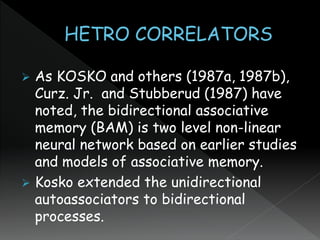
 As KOSKO and others (1987a, 1987b),
Curz. Jr. and Stubberud (1987) have
noted, the bidirectional associative
memory (BAM) is two level non-linear
neural network based on earlier studies
and models of associative memory.
 Kosko extended the unidirectional
autoassociators to bidirectional
processes.
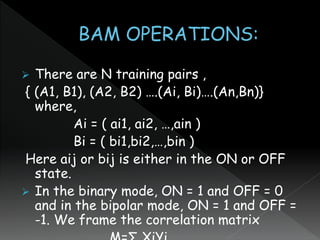
 There are N training pairs ,
{ (A1, B1), (A2, B2) ….(Ai, Bi)….(An,Bn)}
where,
Ai = ( ai1, ai2, …,ain )
Bi = ( bi1,bi2,…,bin )
Here aij or bij is either in the ON or OFF
state.
 In the binary mode, ON = 1 and OFF = 0
and in the bipolar mode, ON = 1 and OFF =
-1. We frame the correlation matrix
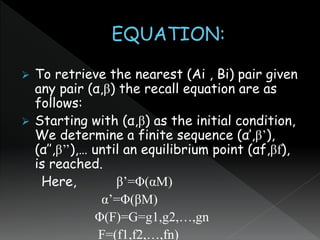
 To retrieve the nearest (Ai , Bi) pair given
any pair (α,β) the recall equation are as
follows:
 Starting with (α,β) as the initial condition,
We determine a finite sequence (α’,β’),
(α’’,β’’),… until an equilibrium point (αf,βf),
is reached.
Here, β’=Φ(αM)
α’=Φ(βM)
Φ(F)=G=g1,g2,…,gn
F=(f1,f2,…,fn)
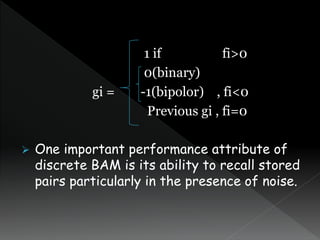
1 if fi>0
0(binary)
gi = -1(bipolor) , fi<0
Previous gi , fi=0
 One important performance attribute of
discrete BAM is its ability to recall stored
pairs particularly in the presence of noise.
 Given a set of pattern pairs (Xi,Yi), for i =
1, 2, …, n and their correlation matrix M, a
pair (X’,Y’) can be added or an existing
pair (Xj,Yj) can be erased or deleted from
the memory model.
 In case of addition, the new correlation
matrix M is,
M = X1Y1+X2Y2+…+XnYn+XY
 In the case of deletion, we subtract the
matrix corresponding to (Xj, Yj) from the
matrix M,
(New) M=M-(Xj,Yj)
 The addition and deletion of information
contributes to the functioning of the
system as a typical human memory
exhibiting learning and forgetfulness.
 The stability of a BAM can be proved by
identifying a Lyapunov or energy function
E with each state (A,B).
 In the autoassociative case, Hopfield
identified an appropriate E (actually,
Hopfield defined half this quantity) as,
E(A) = -AMA
 Kosko proposed an energy function,
E(A,B) = -AMB
 Kosko proved that each cycle of decoding
lowers the energy E if the energy function
for any point ( α,β ) is given by,
E = -αMβ ,
 However, if the energy E evaluated using
the coordinates of the pair (Ai, Bi),
(i.e),
E = -AiMBi
 Eventhought one starts with α = Ai. In this
aspect, Kosko’s encoding method does not
ensure that the stored pairs are at a local
mimima.
Thank you!!!

AUTO & HETRO CORRELATOR

  • 2.
    Autocorrelator easily recognized bythe title of Hope Field Association Memory(HAM). Autocorrelator were introduced as a Theoretical notation by DONALD HEBB(1949) and Rigiorously analysis by AMARI(1972,1977).
  • 3.
    A first orderauto correlated stores M bipolar pattern A1,A2,A3,…..Am by summing together M outer product as, T= ∑ [Ai][Aj] Here, T=[tij] is a (p*p) connection matrix and Ai È {-1,1}. The Autocorrelator is recalls Equation is Vector matrix Multipulication.
  • 4.
    Consider the followingpattern’s A1=(-1,1,-1,1) A2=(1,1,1,-1) A3=(-1,-1,-1,1) The Connection Matrix:- 3 1 3 -3 T = ∑ [Ai][Aj]= 1 3 1 -1 3 1 3 -3 -3 -1 -3 3
  • 5.
    The autocorrelation ispresented stored pattern A2=(1,1,1,-1) with the help of recall Equation, a1new=f(3+1+3+3,1)=1 a2new=f(6,1)=1 a3new=f(10,1)=1 a4new=f(-10,1)=-1 This is indeed the vector, retrieval of A3=(-1,- 1,-1,1) (a1new,a2new,a3new,a4new)=(-1,-1,-1,1) yield the same vector.
  • 6.
     Consider avector A’=(1,1,1,1) which is a distorted presentation of one among the stored patterns.  The Hamming distance (HD) of a vector X from Y, given X=(x1,x2,x3,….xn) and Y=(y1,y2,y3,….yn). HD (x,y) = ∑|xi-yi|  Thus the HD of A’ from each of the pattern in the stored set, HD(A’ , A1) = 4 HD(A’ ,A2) =2
  • 7.
     It isevident that they vector A’ is closer to A2 and therefore resembles it, or in other word, is a noisy version of A2,  The computation are, A2=(1, 1, 1, -1) ( a1, a2, a3, a4 ) = ( f(4,1), f(4,1), f(4,1), f(-4,1) ) = ( 1, 1, 1, -1 ) = A2. Hence in the case of partial vectors, an autocorrelation results in refinement of the pattern or removal of noisy to retrieve the closest matching stored pattern
  • 8.
     As KOSKOand others (1987a, 1987b), Curz. Jr. and Stubberud (1987) have noted, the bidirectional associative memory (BAM) is two level non-linear neural network based on earlier studies and models of associative memory.  Kosko extended the unidirectional autoassociators to bidirectional processes.
  • 9.
     There areN training pairs , { (A1, B1), (A2, B2) ….(Ai, Bi)….(An,Bn)} where, Ai = ( ai1, ai2, …,ain ) Bi = ( bi1,bi2,…,bin ) Here aij or bij is either in the ON or OFF state.  In the binary mode, ON = 1 and OFF = 0 and in the bipolar mode, ON = 1 and OFF = -1. We frame the correlation matrix
  • 10.
     To retrievethe nearest (Ai , Bi) pair given any pair (α,β) the recall equation are as follows:  Starting with (α,β) as the initial condition, We determine a finite sequence (α’,β’), (α’’,β’’),… until an equilibrium point (αf,βf), is reached. Here, β’=Φ(αM) α’=Φ(βM) Φ(F)=G=g1,g2,…,gn F=(f1,f2,…,fn)
  • 11.
    1 if fi>0 0(binary) gi= -1(bipolor) , fi<0 Previous gi , fi=0  One important performance attribute of discrete BAM is its ability to recall stored pairs particularly in the presence of noise.
  • 12.
     Given aset of pattern pairs (Xi,Yi), for i = 1, 2, …, n and their correlation matrix M, a pair (X’,Y’) can be added or an existing pair (Xj,Yj) can be erased or deleted from the memory model.  In case of addition, the new correlation matrix M is, M = X1Y1+X2Y2+…+XnYn+XY
  • 13.
     In thecase of deletion, we subtract the matrix corresponding to (Xj, Yj) from the matrix M, (New) M=M-(Xj,Yj)  The addition and deletion of information contributes to the functioning of the system as a typical human memory exhibiting learning and forgetfulness.
  • 14.
     The stabilityof a BAM can be proved by identifying a Lyapunov or energy function E with each state (A,B).  In the autoassociative case, Hopfield identified an appropriate E (actually, Hopfield defined half this quantity) as, E(A) = -AMA  Kosko proposed an energy function, E(A,B) = -AMB
  • 15.
     Kosko provedthat each cycle of decoding lowers the energy E if the energy function for any point ( α,β ) is given by, E = -αMβ ,  However, if the energy E evaluated using the coordinates of the pair (Ai, Bi), (i.e), E = -AiMBi  Eventhought one starts with α = Ai. In this aspect, Kosko’s encoding method does not ensure that the stored pairs are at a local mimima.
  • 16.