Introduction to Algorithms
Why do you need algorithms?
Good algorithmic training is VERY important for the programmer, but
you don’t need to memorize all the algorithms
Understanding algorithms gives you:
1) Ability to solve incomprehensible problems
2) Habit to analyze the effectiveness of each of your solutions
3) Ability to skillfully use the existing tools
One more reason: jobs
Outline
• Definition of algorithm
• Formal properties of algorithms
• Some classification of algorithms
• Complexity of algorithms
• ALGORITHMS
Disclaimer
Some of the terms and words Google-translated.
Sorry.
Source code is availigle on GitHub
Definition of algorithm
Simple:
Algorithm is a set of rules for solving a problem in a finite
number of steps
Less simple:
Algorithm is a finite set of unambiguous instructions that, given some
set of initial conditions, can be performed in a prescribed sequence to
achieve a certain goal and that has a recognizable set of end
conditions.
Formal properties of algorithms
1) Finiteness
2) Discreteness
3) Clarity
4) Accuracy
5) Mass character
6) Definitiveness
Finiteness
Finiteness (or effectiviness)
means that algorithm has a finite number of steps
to received result.
Discreteness
Discreteness
means that algorithm has to be broken down into
a sequence of steps performed
Clarity
Clarity
means that algorithm must contain only the
commands that are part of a set of commands
that can perform a particular executor
Accuracy
Accuracy
means that any step of an algorithm should be
definite and unambiguous
Mass character
Mass character
means that once algorithm is made up it must
solve similar problems with different input data
Definitiveness
Definitiveness
means that the same set of input data will
produce the same result, i.e. the result is uniquely
determined by the initial data.
Test yourself
I want to cut an orange.
What’s the plan?
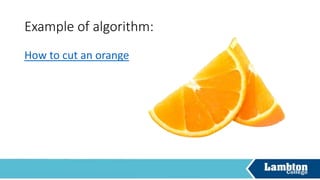
Example of algorithm:
How to cut an orange
Classification
Couple of categories of algorithms (there are a plenty of them)
•Deterministic / Randomized
•Exact / Approximation
•Sequential / Parallel
•etc.
Complexity of algorithms
1) Confusing explanation
2) Clear explanation (must read)
The idea is Big-O notation
Big-O notation is a relative representation of the
complexity of an algorithm.
Algorithms: Strings/arrays
Algorithm #1: Remove Element
Given an array and a value, remove all instances of
that value in place and return the new length.
(Note: The order of elements can be changed. It doesn't matter
what you leave beyond the new length.)
Algorithms: Strings/arrays
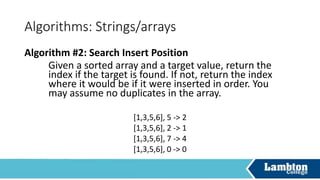
Algorithm #2: Search Insert Position
Given a sorted array and a target value, return the
index if the target is found. If not, return the index
where it would be if it were inserted in order. You
may assume no duplicates in the array.
[1,3,5,6], 5 -> 2
[1,3,5,6], 2 -> 1
[1,3,5,6], 7 -> 4
[1,3,5,6], 0 -> 0
Algorithms: Strings/arrays
Algorithm #3: Anagrams
Given an array of strings, return all groups of strings that are
anagrams.
An anagram is a type of word play, the result of rearranging the
letters of a word or phrase to produce a new word or phrase,
using all the original letters exactly once; for example Torchwood
can be rearranged into Doctor Who.
If two strings are anagram to each other, their sorted sequence is
the same. Therefore, this problem can be seen as a problem of
finding duplicate elements.
Algorithms: Matrix
Algorithm: Rotate Image
You are given an n x n 2D matrix representing an image.
Rotate the image by 90 degrees (clockwise).
Algorithms: Linked List
Linked list is a linear collection of data elements, called nodes pointing
to the next node by means of pointer
Algorithm: Reverse Linked List
Reverse a singly linked list.
Algorithms: Binary Tree
Binary tree is a tree data structure in which each node has at most two
children, which are referred to as the left child and the right child
Algorithm: Binary Tree Maximum Path Sum
Given a binary tree, find the maximum path sum. The path may
start and end at any node in the tree.
Algorithms: Sorting
Сhances that you will need to write a sorting algorithm are close to
zero.
http://www.sorting-algorithms.com/
https://www.youtube.com/watch?v=kPRA0W1kECg
Today:
• Learn some theory (definition properties, complexity)
• Overview several algorithms
Extra resources
1) http://www.programcreek.com/2012/11/top-10-algorithms-for-
coding-interview/

CubeIT Tech - Algorithms

  • 1.
  • 2.
    Why do youneed algorithms? Good algorithmic training is VERY important for the programmer, but you don’t need to memorize all the algorithms Understanding algorithms gives you: 1) Ability to solve incomprehensible problems 2) Habit to analyze the effectiveness of each of your solutions 3) Ability to skillfully use the existing tools One more reason: jobs
  • 3.
    Outline • Definition ofalgorithm • Formal properties of algorithms • Some classification of algorithms • Complexity of algorithms • ALGORITHMS
  • 4.
    Disclaimer Some of theterms and words Google-translated. Sorry. Source code is availigle on GitHub
  • 5.
    Definition of algorithm Simple: Algorithmis a set of rules for solving a problem in a finite number of steps Less simple: Algorithm is a finite set of unambiguous instructions that, given some set of initial conditions, can be performed in a prescribed sequence to achieve a certain goal and that has a recognizable set of end conditions.
  • 6.
    Formal properties ofalgorithms 1) Finiteness 2) Discreteness 3) Clarity 4) Accuracy 5) Mass character 6) Definitiveness
  • 7.
    Finiteness Finiteness (or effectiviness) meansthat algorithm has a finite number of steps to received result.
  • 8.
    Discreteness Discreteness means that algorithmhas to be broken down into a sequence of steps performed
  • 9.
    Clarity Clarity means that algorithmmust contain only the commands that are part of a set of commands that can perform a particular executor
  • 10.
    Accuracy Accuracy means that anystep of an algorithm should be definite and unambiguous
  • 11.
    Mass character Mass character meansthat once algorithm is made up it must solve similar problems with different input data
  • 12.
    Definitiveness Definitiveness means that thesame set of input data will produce the same result, i.e. the result is uniquely determined by the initial data.
  • 13.
    Test yourself I wantto cut an orange. What’s the plan?
  • 14.
    Example of algorithm: Howto cut an orange
  • 15.
    Classification Couple of categoriesof algorithms (there are a plenty of them) •Deterministic / Randomized •Exact / Approximation •Sequential / Parallel •etc.
  • 16.
    Complexity of algorithms 1)Confusing explanation 2) Clear explanation (must read) The idea is Big-O notation Big-O notation is a relative representation of the complexity of an algorithm.
  • 18.
    Algorithms: Strings/arrays Algorithm #1:Remove Element Given an array and a value, remove all instances of that value in place and return the new length. (Note: The order of elements can be changed. It doesn't matter what you leave beyond the new length.)
  • 19.
    Algorithms: Strings/arrays Algorithm #2:Search Insert Position Given a sorted array and a target value, return the index if the target is found. If not, return the index where it would be if it were inserted in order. You may assume no duplicates in the array. [1,3,5,6], 5 -> 2 [1,3,5,6], 2 -> 1 [1,3,5,6], 7 -> 4 [1,3,5,6], 0 -> 0
  • 20.
    Algorithms: Strings/arrays Algorithm #3:Anagrams Given an array of strings, return all groups of strings that are anagrams. An anagram is a type of word play, the result of rearranging the letters of a word or phrase to produce a new word or phrase, using all the original letters exactly once; for example Torchwood can be rearranged into Doctor Who. If two strings are anagram to each other, their sorted sequence is the same. Therefore, this problem can be seen as a problem of finding duplicate elements.
  • 21.
    Algorithms: Matrix Algorithm: RotateImage You are given an n x n 2D matrix representing an image. Rotate the image by 90 degrees (clockwise).
  • 22.
    Algorithms: Linked List Linkedlist is a linear collection of data elements, called nodes pointing to the next node by means of pointer Algorithm: Reverse Linked List Reverse a singly linked list.
  • 23.
    Algorithms: Binary Tree Binarytree is a tree data structure in which each node has at most two children, which are referred to as the left child and the right child Algorithm: Binary Tree Maximum Path Sum Given a binary tree, find the maximum path sum. The path may start and end at any node in the tree.
  • 24.
    Algorithms: Sorting Сhances thatyou will need to write a sorting algorithm are close to zero. http://www.sorting-algorithms.com/ https://www.youtube.com/watch?v=kPRA0W1kECg
  • 25.
    Today: • Learn sometheory (definition properties, complexity) • Overview several algorithms
  • 26.

Editor's Notes

  • #3 First, is the ability to solve the problem of incomprehensible. The vague wording of vital problems to see the possible strict interpretation. Comprehensively analyze the various options and choose the most suitable. Obviously, it is not enough just to know the algorithms. You must be able to "see them", to recognize the possibilities of their application. Secondly, algorithmic training should get you the habit of analyzing the effectiveness of each of your solutions. Third, algorithmic training should help skillfully use the existing tools. Databases are continuous data structures and algorithms. And conceptually quite simple and clear - search trees, hash table For example, knowing that the database index - it's just a search tree, it is easy to understand which requests can be met quickly and which ones are doomed to full-scan.
  • #6 http://dictionary.reference.com/browse/algorithm https://books.google.ca/books?id=uI1ytRzul8MC&pg=PA5&lpg=PA5&dq=finite+set+of+unambiguous+instructions+that,+given+some+set+of+initial+conditions,+can+be+performed+in+a+prescribed+sequence+to+achieve+a+certain+goal+and+that+has+a+recognizable+set+of+end+conditions&source=bl&ots=QLftG8AKmM&sig=EMu5Y74g3c9qrZowCNpYEr9VOJ4&hl=ru&sa=X&ved=0ahUKEwi7gMvQwvzKAhXBnIMKHZutDpoQ6AEIHDAA#v=onepage&q=finite%20set%20of%20unambiguous%20instructions%20that%2C%20given%20some%20set%20of%20initial%20conditions%2C%20can%20be%20performed%20in%20a%20prescribed%20sequence%20to%20achieve%20a%20certain%20goal%20and%20that%20has%20a%20recognizable%20set%20of%20end%20conditions&f=false
  • #7 http://learnpascal.ru/vvedenie-v-paskal/algoritm.html
  • #8 1) SIMPLE: the algorithm must eventually terminate. Something endless is not an algorithm
  • #9 Example: Do that – then that – then that. Not like do that or that – then that – but before you should do that
  • #10 Example: if you need to perform a mathematical algorithm you will probably use calculator or something like that, you can only do mathematical operations with that (like division, multiplication, addition, substraction, power etc). Calculator cannot do barrel roll to do that math algorithm
  • #12 I’ll try to give examples of that properties later
  • #15 1) Finiteness – we need 5 steps to get result 2) Discreteness – each step is discrete 3) Clarity – we have comands like lay orange and cut 4) Accuracy - cut the orange in half vertically (NOT HORISONTALLY) but also that tutorial is specially designed for oranges. 5) Mass character – using that tutorial we can cut not only that but anyof the oranges in the world 6) Definiteness – if we follow these steps we will always have 6 pieces of orange in the end
  • #16 I won’t spend a lot of time on classification. Here I’d like to stress that in general algorithms never contain random processes. Here randomized means that in such of algorithms are used another algorithm for generating a sequence of numbers whose properties approximate the properties of sequences of random numbers.  2 – clear 3 – example of making a soup. We can put water to boil and peel and cut potatoes during that.
  • #17 Обозначение логарифма: log 𝑏 𝑁 = x Эта запись равнозначна следующей:  bx = N .
  • #19 I want to show you some algorithms, explain them code programming Strings/arrays are easy to understand, but the interview problems often require advanced algorithm to solve, such as dynamic programming, recursion, etc.
  • #25 But it’s still important to know when one sorting algorithm is better than another