Connecting Ideas
using Conjunctions
in an Argumentative
Text
What’s a
Conjunction?
A conjunction is a part of
speech that links words, phrases
and clauses. Think of them as
bridges that connect ideas.
Conjunctions fall into one of
four categories based on how
they’re used.
What Are Some
Examples of
Conjunctions in
Sentences?
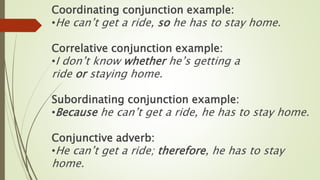
Coordinating conjunction example:
•He can’t get a ride, so he has to stay home.
Correlative conjunction example:
•I don’t know whether he’s getting a
ride or staying home.
Subordinating conjunction example:
•Because he can’t get a ride, he has to stay home.
Conjunctive adverb:
•He can’t get a ride; therefore, he has to stay
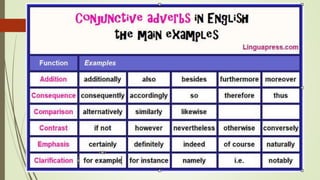
home.
A conjunction is the glue that holds words,
phrases and clauses (both dependent and
independent) together. There are three
different kinds of conjunctions --
coordinating, subordinating, and correlative
-- each serving its own, distinct purpose,
but all working to bring words together.
Coordinating Conjunctions
-are single words (example: and, but,
but, or, so).They link equivalent
grammatical elements, such as
nouns with nouns, and clauses with
clauses. The ideas being connected
carry the same weight in a sentence.
Coordinating conjunctions
link ideas by showing how
they relate.
For example, a word like
"and" indicates two ideas go
together.
Example:
Peter and Paul are best friends.
(the word “and” is a conjunction.
It is joining two entities, which
are Peter, Paul).
Example:
• I stayed up all night writing, so
I was tired the next day
• She’s editing and proofreading
my essay.
What to watch for when using
coordinating conjunctions:
When a coordinating conjunction joins two
independent clauses (complete thoughts or sentences),
use a comma between the clauses.
• I can’t remember the rules, so I need a refresher.
When you’re joining an independent clause and a
dependent clause (incomplete thought), you don’t
need a comma.
• I prefer to write on my laptop but edit on paper.
Example:
I am going to the market and to the
grocery store.
(the word “and” in this sentence is
joining two ideas, which are going to
the market and to
the grocery store).
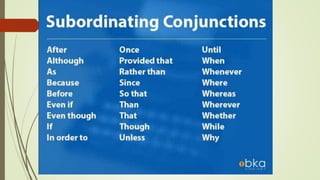
Subordinating Conjunctions
-are one or more words that unite ideas
in a complex sentence (example: as
soon as, in case, unless, while).
They link dependent clauses
(incomplete thoughts) to independent
clauses (complete thoughts).
A subordinating conjunction indicates
that one idea depends on another.
For instance, in this
sentence the word "unless" depends on
the action that follows it:
Example:
We will be late unless we leave now.
Example:
• Unless we give him a ride, he
won’t be able to come.
• Here’s some cash in case your
credit card doesn’t work.
Example:
My mother asked me if I am
going to wash my clothes or
wash the dishes.
(It is stating that the girl has two
choices, to wash her clothes or
wash the dishes)
The subordinating conjunction is
placed in front of the dependent
clause. As Cambridge Dictionary
explains, subordinating conjunctions
modify the independent clause and
provide a cause, reason, result or
purpose.
What to watch for when using
subordinating conjunctions:
Use a comma if the subordinating conjunction
and dependent clause are at the beginning of a
sentence. Otherwise, the comma isn’t required.
• As soon as she’s finished her phone call, we’ll
leave for the restaurant.
• We’ll leave for the restaurant as soon as she’s
finished her phone call.
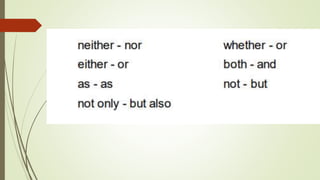
Correlative Conjunctions
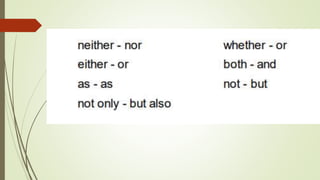
-work in pairs (example: either/or,
both/and, not only/but also, as/as)
Similar to coordinating conjunctions,
they link grammatical elements of
similar importance.
Correlative conjunctions join
elements within a sentence,
indicating the two are of
equal importance. The words
"neither" and "nor" work this way in
this sentence:
Example:
I like neither carrots nor celery.
Example:
• I not only passed the exam,
but also got 100%.
• The box is as tall as it is
wide.
What to watch for when using
correlative conjunctions:
Correlative conjunctions need
parallel construction. Check the
words after each conjunction and
make sure they’re similarly
structured.
What to watch for when using
correlative conjunctions:
• Correct: We should either book the tickets in
advance or arrive an hour early. (In this example, the
phrase “book the tickets” is parallel to “arrive an hour
early”)
• Incorrect: We should either book the tickets in
advance or be arriving an hour early. (In this example,
the phrase “book the tickets” is not parallel to “be
arriving”)
Conjunctive Adverbs
-are one or more words used to join
two independent clauses (example:
after all, besides, nevertheless).
These words are technically adverbs,
but perform the same linking
function as conjunctions.
What to watch for when using
conjunctive adverbs:
When a conjunctive adverb unites
two independent clauses in one
sentence, it’s preceded by a
semicolon and followed by a
comma.
What to watch for when using
conjunctive adverbs:
• The dessert is so tempting;
however, I’m trying to eat less sugar.
• We’re happy to pay for your
expenses; after all, you’re doing us a
favor.
Conjunctions serve as a
cue within a sentence,
signaling the reader that
another
idea is coming.
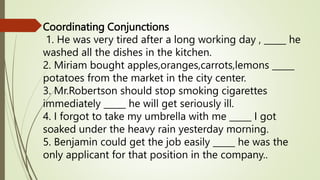
Coordinating Conjunctions
1. He was very tired after a long working day , _____ he
washed all the dishes in the kitchen.
2. Miriam bought apples,oranges,carrots,lemons _____
potatoes from the market in the city center.
3. Mr.Robertson should stop smoking cigarettes
immediately _____ he will get seriously ill.
4. I forgot to take my umbrella with me _____ I got
soaked under the heavy rain yesterday morning.
5. Benjamin could get the job easily _____ he was the
only applicant for that position in the company..
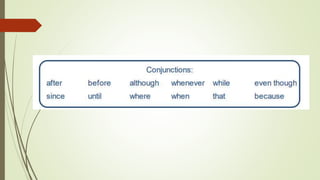
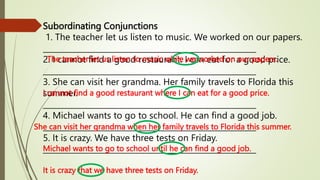
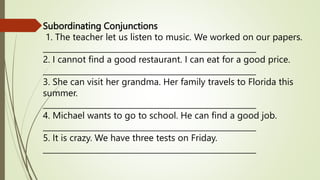
Subordinating Conjunctions
1. The teacher let us listen to music. We worked on our papers.
_______________________________________________________
2. I cannot find a good restaurant. I can eat for a good price.
_______________________________________________________
3. She can visit her grandma. Her family travels to Florida this
summer.
_______________________________________________________
4. Michael wants to go to school. He can find a good job.
_______________________________________________________
5. It is crazy. We have three tests on Friday.
_______________________________________________________
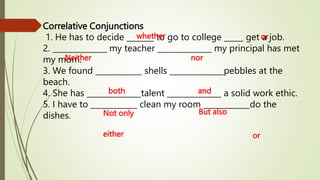
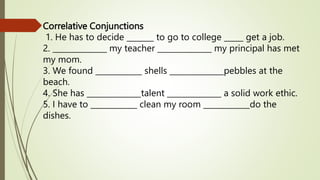
Correlative Conjunctions
1. He has to decide _______ to go to college _____ get a job.
2. ______________ my teacher ______________ my principal has met
my mom.
3. We found ____________ shells ______________pebbles at the
beach.
4. She has ______________talent ______________ a solid work ethic.
5. I have to ____________ clean my room ____________do the
dishes.
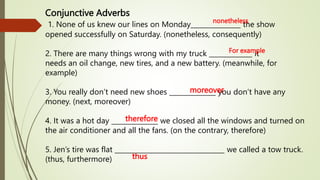
Conjunctive Adverbs
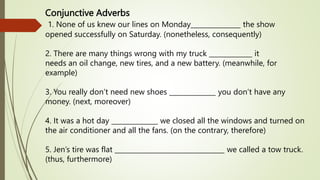
1. None of us knew our lines on Monday_______________ the show
opened successfully on Saturday. (nonetheless, consequently)
2. There are many things wrong with my truck _____________ it
needs an oil change, new tires, and a new battery. (meanwhile, for
example)
3. You really don’t need new shoes ______________ you don’t have any
money. (next, moreover)
4. It was a hot day ______________ we closed all the windows and turned on
the air conditioner and all the fans. (on the contrary, therefore)
5. Jen’s tire was flat _________________________________ we called a tow truck.
(thus, furthermore)
Answer
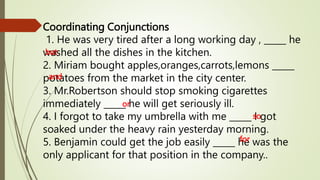
Coordinating Conjunctions
1. He was very tired after a long working day , _____ he
washed all the dishes in the kitchen.
2. Miriam bought apples,oranges,carrots,lemons _____
potatoes from the market in the city center.
3. Mr.Robertson should stop smoking cigarettes
immediately _____ he will get seriously ill.
4. I forgot to take my umbrella with me _____ I got
soaked under the heavy rain yesterday morning.
5. Benjamin could get the job easily _____ he was the
only applicant for that position in the company..
but
and
or
so
for
Subordinating Conjunctions
1. The teacher let us listen to music. We worked on our papers.
_______________________________________________________
2. I cannot find a good restaurant. I can eat for a good price.
_______________________________________________________
3. She can visit her grandma. Her family travels to Florida this
summer.
_______________________________________________________
4. Michael wants to go to school. He can find a good job.
_______________________________________________________
5. It is crazy. We have three tests on Friday.
_______________________________________________________
The teacher let us listen to music while we worked on our papers.
I cannot find a good restaurant where I can eat for a good price.
She can visit her grandma when her family travels to Florida this summer.
Michael wants to go to school until he can find a good job.
It is crazy that we have three tests on Friday.
Correlative Conjunctions
1. He has to decide _______ to go to college _____ get a job.
2. ______________ my teacher ______________ my principal has met
my mom.
3. We found ____________ shells ______________pebbles at the
beach.
4. She has ______________talent ______________ a solid work ethic.
5. I have to ____________ clean my room ____________do the
dishes.
whether or
Neither nor
both and
But also
Not only
either or
Conjunctive Adverbs
1. None of us knew our lines on Monday_______________ the show
opened successfully on Saturday. (nonetheless, consequently)
2. There are many things wrong with my truck _____________ it
needs an oil change, new tires, and a new battery. (meanwhile, for
example)
3. You really don’t need new shoes ______________ you don’t have any
money. (next, moreover)
4. It was a hot day ______________ we closed all the windows and turned on
the air conditioner and all the fans. (on the contrary, therefore)
5. Jen’s tire was flat _________________________________ we called a tow truck.
(thus, furthermore)
nonetheless
For example
moreover
therefore
thus
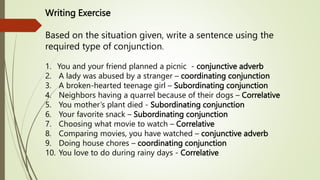
Writing Exercise
Based on the situation given, write a sentence using the
required type of conjunction.
1. You and your friend planned a picnic - conjunctive adverb
2. A lady was abused by a stranger – coordinating conjunction
3. A broken-hearted teenage girl – Subordinating conjunction
4. Neighbors having a quarrel because of their dogs – Correlative
5. You mother’s plant died - Subordinating conjunction
6. Your favorite snack – Subordinating conjunction
7. Choosing what movie to watch – Correlative
8. Comparing movies, you have watched – conjunctive adverb
9. Doing house chores – coordinating conjunction
10. You love to do during rainy days - Correlative
Conjunction part of speech..............

  • 1.
  • 3.
  • 4.
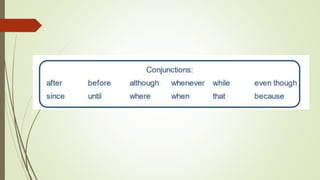
    A conjunction isa part of speech that links words, phrases and clauses. Think of them as bridges that connect ideas. Conjunctions fall into one of four categories based on how they’re used.
  • 5.
    What Are Some Examplesof Conjunctions in Sentences?
  • 6.
    Coordinating conjunction example: •Hecan’t get a ride, so he has to stay home. Correlative conjunction example: •I don’t know whether he’s getting a ride or staying home. Subordinating conjunction example: •Because he can’t get a ride, he has to stay home. Conjunctive adverb: •He can’t get a ride; therefore, he has to stay home.
  • 7.
    A conjunction isthe glue that holds words, phrases and clauses (both dependent and independent) together. There are three different kinds of conjunctions -- coordinating, subordinating, and correlative -- each serving its own, distinct purpose, but all working to bring words together.
  • 8.
    Coordinating Conjunctions -are singlewords (example: and, but, but, or, so).They link equivalent grammatical elements, such as nouns with nouns, and clauses with clauses. The ideas being connected carry the same weight in a sentence.
  • 9.
    Coordinating conjunctions link ideasby showing how they relate. For example, a word like "and" indicates two ideas go together.
  • 10.
    Example: Peter and Paulare best friends. (the word “and” is a conjunction. It is joining two entities, which are Peter, Paul).
  • 11.
    Example: • I stayedup all night writing, so I was tired the next day • She’s editing and proofreading my essay.
  • 12.
    What to watchfor when using coordinating conjunctions: When a coordinating conjunction joins two independent clauses (complete thoughts or sentences), use a comma between the clauses. • I can’t remember the rules, so I need a refresher. When you’re joining an independent clause and a dependent clause (incomplete thought), you don’t need a comma. • I prefer to write on my laptop but edit on paper.
  • 13.
    Example: I am goingto the market and to the grocery store. (the word “and” in this sentence is joining two ideas, which are going to the market and to the grocery store).
  • 14.
    Subordinating Conjunctions -are oneor more words that unite ideas in a complex sentence (example: as soon as, in case, unless, while). They link dependent clauses (incomplete thoughts) to independent clauses (complete thoughts).
  • 15.
    A subordinating conjunctionindicates that one idea depends on another. For instance, in this sentence the word "unless" depends on the action that follows it: Example: We will be late unless we leave now.
  • 16.
    Example: • Unless wegive him a ride, he won’t be able to come. • Here’s some cash in case your credit card doesn’t work.
  • 17.
    Example: My mother askedme if I am going to wash my clothes or wash the dishes. (It is stating that the girl has two choices, to wash her clothes or wash the dishes)
  • 18.
    The subordinating conjunctionis placed in front of the dependent clause. As Cambridge Dictionary explains, subordinating conjunctions modify the independent clause and provide a cause, reason, result or purpose.
  • 19.
    What to watchfor when using subordinating conjunctions: Use a comma if the subordinating conjunction and dependent clause are at the beginning of a sentence. Otherwise, the comma isn’t required. • As soon as she’s finished her phone call, we’ll leave for the restaurant. • We’ll leave for the restaurant as soon as she’s finished her phone call.
  • 21.
    Correlative Conjunctions -work inpairs (example: either/or, both/and, not only/but also, as/as) Similar to coordinating conjunctions, they link grammatical elements of similar importance.
  • 22.
    Correlative conjunctions join elementswithin a sentence, indicating the two are of equal importance. The words "neither" and "nor" work this way in this sentence: Example: I like neither carrots nor celery.
  • 23.
    Example: • I notonly passed the exam, but also got 100%. • The box is as tall as it is wide.
  • 24.
    What to watchfor when using correlative conjunctions: Correlative conjunctions need parallel construction. Check the words after each conjunction and make sure they’re similarly structured.

  • 25.
    What to watchfor when using correlative conjunctions: • Correct: We should either book the tickets in advance or arrive an hour early. (In this example, the phrase “book the tickets” is parallel to “arrive an hour early”) • Incorrect: We should either book the tickets in advance or be arriving an hour early. (In this example, the phrase “book the tickets” is not parallel to “be arriving”)
  • 26.
    Conjunctive Adverbs -are oneor more words used to join two independent clauses (example: after all, besides, nevertheless). These words are technically adverbs, but perform the same linking function as conjunctions.
  • 27.
    What to watchfor when using conjunctive adverbs: When a conjunctive adverb unites two independent clauses in one sentence, it’s preceded by a semicolon and followed by a comma.
  • 28.
    What to watchfor when using conjunctive adverbs: • The dessert is so tempting; however, I’m trying to eat less sugar. • We’re happy to pay for your expenses; after all, you’re doing us a favor.
  • 30.
    Conjunctions serve asa cue within a sentence, signaling the reader that another idea is coming.
  • 32.
    Coordinating Conjunctions 1. Hewas very tired after a long working day , _____ he washed all the dishes in the kitchen. 2. Miriam bought apples,oranges,carrots,lemons _____ potatoes from the market in the city center. 3. Mr.Robertson should stop smoking cigarettes immediately _____ he will get seriously ill. 4. I forgot to take my umbrella with me _____ I got soaked under the heavy rain yesterday morning. 5. Benjamin could get the job easily _____ he was the only applicant for that position in the company..
  • 33.
    Subordinating Conjunctions 1. Theteacher let us listen to music. We worked on our papers. _______________________________________________________ 2. I cannot find a good restaurant. I can eat for a good price. _______________________________________________________ 3. She can visit her grandma. Her family travels to Florida this summer. _______________________________________________________ 4. Michael wants to go to school. He can find a good job. _______________________________________________________ 5. It is crazy. We have three tests on Friday. _______________________________________________________
  • 35.
    Correlative Conjunctions 1. Hehas to decide _______ to go to college _____ get a job. 2. ______________ my teacher ______________ my principal has met my mom. 3. We found ____________ shells ______________pebbles at the beach. 4. She has ______________talent ______________ a solid work ethic. 5. I have to ____________ clean my room ____________do the dishes.
  • 37.
    Conjunctive Adverbs 1. Noneof us knew our lines on Monday_______________ the show opened successfully on Saturday. (nonetheless, consequently) 2. There are many things wrong with my truck _____________ it needs an oil change, new tires, and a new battery. (meanwhile, for example) 3. You really don’t need new shoes ______________ you don’t have any money. (next, moreover) 4. It was a hot day ______________ we closed all the windows and turned on the air conditioner and all the fans. (on the contrary, therefore) 5. Jen’s tire was flat _________________________________ we called a tow truck. (thus, furthermore)
  • 38.
  • 39.
    Coordinating Conjunctions 1. Hewas very tired after a long working day , _____ he washed all the dishes in the kitchen. 2. Miriam bought apples,oranges,carrots,lemons _____ potatoes from the market in the city center. 3. Mr.Robertson should stop smoking cigarettes immediately _____ he will get seriously ill. 4. I forgot to take my umbrella with me _____ I got soaked under the heavy rain yesterday morning. 5. Benjamin could get the job easily _____ he was the only applicant for that position in the company.. but and or so for
  • 41.
    Subordinating Conjunctions 1. Theteacher let us listen to music. We worked on our papers. _______________________________________________________ 2. I cannot find a good restaurant. I can eat for a good price. _______________________________________________________ 3. She can visit her grandma. Her family travels to Florida this summer. _______________________________________________________ 4. Michael wants to go to school. He can find a good job. _______________________________________________________ 5. It is crazy. We have three tests on Friday. _______________________________________________________ The teacher let us listen to music while we worked on our papers. I cannot find a good restaurant where I can eat for a good price. She can visit her grandma when her family travels to Florida this summer. Michael wants to go to school until he can find a good job. It is crazy that we have three tests on Friday.
  • 43.
    Correlative Conjunctions 1. Hehas to decide _______ to go to college _____ get a job. 2. ______________ my teacher ______________ my principal has met my mom. 3. We found ____________ shells ______________pebbles at the beach. 4. She has ______________talent ______________ a solid work ethic. 5. I have to ____________ clean my room ____________do the dishes. whether or Neither nor both and But also Not only either or
  • 44.
    Conjunctive Adverbs 1. Noneof us knew our lines on Monday_______________ the show opened successfully on Saturday. (nonetheless, consequently) 2. There are many things wrong with my truck _____________ it needs an oil change, new tires, and a new battery. (meanwhile, for example) 3. You really don’t need new shoes ______________ you don’t have any money. (next, moreover) 4. It was a hot day ______________ we closed all the windows and turned on the air conditioner and all the fans. (on the contrary, therefore) 5. Jen’s tire was flat _________________________________ we called a tow truck. (thus, furthermore) nonetheless For example moreover therefore thus
  • 45.
    Writing Exercise Based onthe situation given, write a sentence using the required type of conjunction. 1. You and your friend planned a picnic - conjunctive adverb 2. A lady was abused by a stranger – coordinating conjunction 3. A broken-hearted teenage girl – Subordinating conjunction 4. Neighbors having a quarrel because of their dogs – Correlative 5. You mother’s plant died - Subordinating conjunction 6. Your favorite snack – Subordinating conjunction 7. Choosing what movie to watch – Correlative 8. Comparing movies, you have watched – conjunctive adverb 9. Doing house chores – coordinating conjunction 10. You love to do during rainy days - Correlative